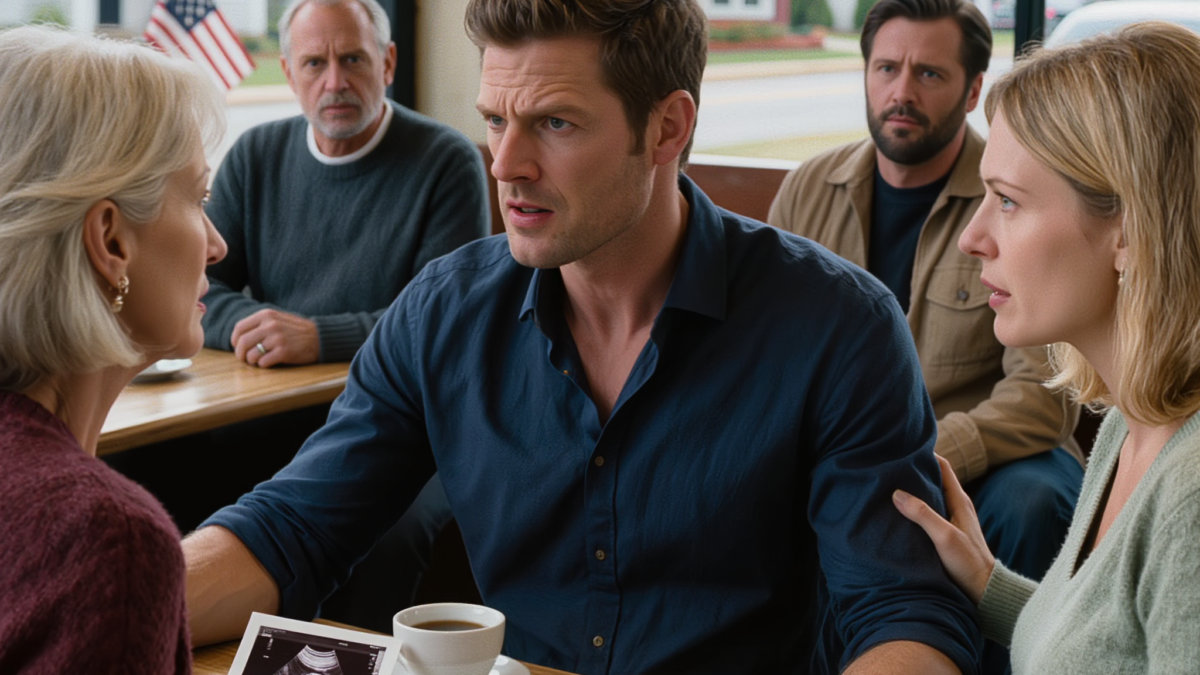
“You and Clara can have more,” my mother said. Three years after my parents boycotted our wedding, they saw our ultrasound photo and invited us to coffee. Now they wanted my older brother to help raise our unborn son. Clara pushed back her chair. I stayed seated. They had no idea what his ex-wife had told me.
I’m Henry. I’m twenty-nine years old, and three years after my own family tried to destroy my life, they came back to demand custody of my unborn child.
Before I explain how I finally exposed their years of lies in a way they never saw coming, you need to understand what happened to us.
The meeting took place on a Tuesday, a day that still plays over and over in my head.
For three years, there had been nothing but silence. A blessed, peaceful, hard-won silence. My wife, Clara, and I had built a life in that quiet space. A good life.
But then the text came from my mother, Eleanor.
“Henry, we need to talk. It’s about Leo. It’s important.”
Just seeing his name was enough to make the hairs on my arms stand up.
Leo. My older brother. The golden child. The center of my parents’ universe.
Clara’s hand found mine under the table at the sterile little coffee shop they’d chosen.
Neutral ground, they’d called it.
It felt more like an interrogation room.
My father, Richard, gave me a tight, thin-lipped smile that didn’t reach his eyes. My mother was already dabbing at the corners of her eyes with a napkin, a performance she’d perfected over decades.
And Leo?
Leo sat slumped in his chair, the picture of a tragic hero, staring into his cold coffee as though it held the secrets to all his suffering.
“Thank you for coming, son,” my father began, his voice laced with that familiar, patronizing tone. “It means a lot to all of us.”
I just nodded, my throat too tight to speak.
Clara answered for me.
“We’re here. What is this about?”
My mother took a shaky breath.
“Henry, you know your brother. You know the struggles he’s been through. The divorce was so hard on him. And now… now the doctors have confirmed it. He can’t have children. The treatments all failed.”
I looked at Leo.
He didn’t flinch. He just continued his silent, dramatic vigil over his cup.
I felt a flicker of something, but it wasn’t pity.
It was caution.
With my family, every piece of information was a weapon. Every conversation was a strategic move.
“I’m sorry to hear that,” I said, the words feeling like ash in my mouth.
This was the opening my mother had been waiting for.
She leaned forward, her eyes gleaming with a desperate, unnerving light.
“You and Clara… we saw your announcement on the internet. A baby boy.”
She smiled, a brittle, cracking thing.
“We are so happy for you. Truly. A grandson.”
Then she dropped the bomb.
“Leo has so much love to give, Henry. So much. He’s always wanted to be a father. It’s the one thing that would make him whole again. And you, you’re so young. You and Clara can have more.”
I stared at her, my mind refusing to connect the dots.
It couldn’t be.
My father cleared his throat, spelling it out.
“What your mother is saying is that this is a perfect solution. A way for this family to heal. You can let Leo share the baby. He and a surrogate could help raise him. He would have the father he deserves, and you would have all the support in the world.”
The air left my lungs.
The background noise of the coffee shop faded into a dull roar.
Share my child?
My son?
With the man who had systematically dismantled the most important day of my life?
Clara’s grip on my hand was like iron.
“Are you out of your minds?” she whispered, her voice trembling with rage.
But it was my mother’s final sentence that shattered whatever was left of my composure.
She looked at me, her face a mask of earnest, twisted logic.
“Think about it, Henry,” she pleaded. “It’s a gift. You get to help your brother heal your family. And besides, you have everything now. A wife, a career, a new baby on the way. But Leo? Leo has nothing.”
To understand the insanity of that request, you have to understand my childhood.
It wasn’t a childhood of overt cruelty.
It was worse.
It was a slow, steady erosion of my sense of self-worth, all in service of propping up my brother, Leo.
Leo was born with a spotlight on him. He was the firstborn, the heir apparent. He had my father’s eyes and my mother’s charm.
I was the afterthought, the quiet, observant one who always seemed to be in the way.
Our entire family life was structured around Leo’s needs, his triumphs, and, most of all, his failures.
When Leo was seventeen, he took our father’s brand-new sedan without permission and wrapped it around a telephone pole.
He walked away with a few scratches and a DUI charge.
I remember my father storming around the house, his face purple with rage. But by the time he got to the police station to pick Leo up, his anger had been replaced by a suffocating wave of concern.
“My boy! My poor boy! Are you okay?” my mother sobbed, clutching Leo as if he had just returned from war.
The conversation that followed was about getting a good lawyer to have the charges dropped. It was about how this one mistake shouldn’t derail his college applications.
They bought him a new, even nicer car for his eighteenth birthday a few months later.
A reward, they said, for getting through such a stressful time.
A year later, I was sixteen.
I won a prestigious regional award for an architectural design I’d submitted to a competition. It came with a small scholarship for my college fund.
I remember running home, the plaque heavy in my hands, my heart pounding with a desperate need for their approval.
My father glanced at it over his newspaper.
“Oh, that’s nice, son. Good work.”
My mother hugged me briefly.
“That’s wonderful, dear. Now, can you set the table? Leo’s bringing his new girlfriend over for dinner, and I want everything to be perfect.”
There was no party.
There was no reward.
My achievement was a footnote in the grand, dramatic novel of Leo’s life.
He got a standing ovation for breathing. I had to move mountains just to get a nod of acknowledgment.
This pattern continued into adulthood.
Leo’s promotion at a mid-level marketing firm was celebrated with a lavish dinner at the city’s most expensive restaurant.
My first solo project as a licensed architect, a beautiful community center I had poured my soul into for over a year, earned me a text message from Dad.
“Congrats.”
That was it.
It taught me a terrible lesson.
My value was conditional.
My purpose, in their eyes, was to be the stable, low-maintenance son who never caused trouble. The reliable backdrop against which their brilliant, tempestuous star could shine.
I existed to make their lives easier, to be the one who didn’t need anything so they could pour all their energy, money, and emotional support into Leo.
I craved their approval with an ache that felt like a physical part of me.
For years, I believed that if I just worked harder, achieved more, and asked for less, one day they would turn around and finally see me.
See me.
Not just Leo’s little brother.
Meeting Clara was like stepping out of a dark room into the sun.
She saw me.
She celebrated my successes. She listened to my frustrations. And she was the first person to ever say the words I so desperately needed to hear.
“Henry, that’s not fair. What they’re doing is wrong.”
She helped me build a spine, piece by piece.
She was my rock when I finally landed a fantastic job at a top architectural firm, and she was the one who held my hand when I decided to propose.
For the first time, I was building a life that was truly mine.
A life where I was the main character, not a supporting actor.
And that, I would soon learn, was a direct threat to the entire ecosystem of my family.
Because in their world, there was only room for one star.
The year I proposed to Clara was the same year Leo’s perfect life began to publicly unravel.
He had married Amelia, a sweet, intelligent woman, a few years earlier in a wedding that cost more than a down payment on a house.
My parents had been insufferably proud.
They finally had the daughter-in-law they could show off and, more importantly, the woman they expected to provide their future grandchildren.
The pressure on Leo and Amelia to start a family was immediate and immense.
At every holiday, every family dinner, the question would hang in the air.
“So, when are you two going to give us a grandbaby?”
My mother would pat Amelia’s stomach with a hopeful smile.
My father would talk about carrying on the family name and hint at a sizable inheritance tied to the next generation.
What I didn’t know at the time was that Leo had been lying.
He told Amelia before they got married that he was open to having kids someday, but someday never seemed to arrive.
He was always too busy with work.
They needed to save more money.
They should travel more first.
The excuses piled up, and Amelia grew increasingly unhappy.
Meanwhile, my life was moving in the opposite direction.
I proposed to Clara on a trip to the coast, on a cliff overlooking the ocean at sunset.
It was quiet, it was personal, and it was perfect.
When we told my family, the reaction was lukewarm.
“Oh, that’s lovely, dear,” my mother said over the phone. “Just make sure you plan for a long engagement. These things are expensive.”
It was a stark contrast to the frenzy that had surrounded Leo’s engagement.
But we didn’t care.
We were happy.
We set a date for the following autumn, a year away. We wanted a small, intimate wedding at a beautiful old vineyard.
It was going to be our day.
About six months before our wedding, the call came.
It was my mother, her voice thick with manufactured drama.
“It’s over, Henry. Leo and Amelia. They’re getting a divorce.”
I was stunned.
From the outside, they were the perfect couple.
But my mother wasn’t sad.
She was furious.
“She’s leaving him after everything we’ve done for her! She just couldn’t wait. She was so impatient about this whole baby business. Your brother is devastated. Absolutely shattered.”
Over the next few weeks, Leo moved back into my parents’ house.
He was treated like a wounded prince.
My mother cooked all his favorite meals. My father took him on a boys’ trip to Vegas to clear his head.
The narrative was set in stone.
Amelia was the selfish, impatient villain.
Leo was the tragic victim.
No one ever asked what had really happened.
No one ever questioned Leo’s side of the story.
A month later, Clara and I were at my parents’ house for our weekly obligatory Sunday dinner.
The tension was thick enough to cut with a knife.
Leo was there, looking sullen and playing the part of the heartbroken husband to perfection.
After a mostly silent meal, my mother turned to me, her expression grim.
“Henry,” she said, her voice low and serious. “Your father and I have been talking. And we think… we think you and Clara need to do the right thing.”
I looked at Clara, confused.
“The right thing about what?”
My father placed his fork down with a deliberate clink.
“About the wedding. It’s not a good time. Your brother is going through a divorce. It would be incredibly insensitive to throw a big celebration in his face right now. We want you to postpone it.”
The room went silent.
The ticking of the grandfather clock in the hallway sounded like a hammer striking an anvil.
Postpone our wedding?
Our day, the one we had been planning for nearly a year, the one bright spot on my personal horizon, had to be put on hold because Leo’s life had hit a speed bump.
Clara spoke first, her voice dangerously calm.
“Richard, with all due respect, our wedding has nothing to do with Leo’s divorce.”
My mother shot her a venomous look.
“It has everything to do with it. This is a family. We’re supposed to support each other. Leo is in pain. How do you think it will look? You two parading your happiness around while his life is falling apart? He can barely get out of bed in the morning.”
I looked over at Leo.
He was staring down at his plate, a faint smirk playing on his lips.
He wasn’t even trying to hide his satisfaction.
He was reveling in it.
This was what he wanted.
For the world, once again, to stop and revolve around him.
A cold fury, an emotion I had suppressed for my entire life, began to burn in my chest.
All those years of being sidelined, of my achievements being minimized, of my feelings being dismissed, came rushing back.
“No,” I said.
The word was quiet, but it cut through the tension like a razor.
My parents stared at me as if I’d just grown a second head.
“What did you say?” my father asked, his voice low and threatening.
“I said no,” I repeated, louder this time.
I felt Clara’s hand squeeze my thigh under the table.
A silent surge of support.
“We are not postponing our wedding. It’s in six months. Leo’s divorce will be well underway by then. It’s a completely separate event.”
My mother gasped, placing a hand over her heart.
“I can’t believe how selfish you’re being! After everything we’ve done for you!”
“What have you done?” I shot back, the words tumbling out before I could stop them. “You paid for Leo’s college. You paid for his first car. You paid the lawyer for his DUI. You paid for half his wedding. You’ve paid for his entire life!”
I took a breath.
“Clara and I are paying for our own wedding with our own money, money we earned from our own jobs. We are asking for nothing but for you to show up and be happy for us for one single day.”
The truth, spoken so plainly, was like a physical blow.
My mother started to cry, real tears this time.
My father’s face hardened into a mask of cold fury.
“You have no idea what your brother is going through,” he spat. “He’s lost everything.”
“And that’s my fault?” I asked, my voice rising. “Am I supposed to put my life on hold indefinitely because his didn’t work out? I won’t do it.”
This was it.
The moment I had dreaded and, in a strange way, longed for my entire life.
The moment I finally stood up for myself.
My father stood, his chair scraping loudly against the hardwood floor.
He pointed a trembling finger at me.
“You will listen to me, boy,” he seethed. “You will show your brother some respect. You will postpone this wedding, or we will not be there. Your mother, myself, your brother. None of us.”
It was checkmate.
The ultimate move to force me into submission.
He thought he had me.
He thought I would crumble just like I always had.
But he didn’t see Clara beside me.
He didn’t see the years of quiet resentment that had finally solidified into a core of steel inside me.
I stood up to face him.
“Then I guess you won’t be there,” I said, my voice shaking but clear. “Clara, we’re leaving.”
As we walked out, I heard my mother’s wail behind us.
“You’re choosing her over your family!”
I stopped at the door and looked back at them.
My father, red-faced with rage. My mother, crumpled in her chair.
And Leo, who was now looking directly at me with an expression of pure, triumphant malice.
In that moment, I knew this wasn’t just about the wedding.
This was a declaration of war.
And I had no idea just how dirty my own family was willing to play.
The fallout from that dinner was swift and brutal.
I had expected the silent treatment. I had expected angry voicemails.
What I hadn’t expected was the calculated, vicious campaign that Leo, with my parents’ blessing, launched against me.
It started subtly.
A call from my aunt Carol, my mother’s sister.
“Henry, dear,” she said, her voice dripping with false concern. “I just had a long chat with your mother. She’s absolutely beside herself. She told me… well, she told me that you were part of the reason Leo and Amelia broke up.”
I felt my blood run cold.
“What? That’s insane. I had nothing to do with it.”
“Well,” she continued, lowering her voice conspiratorially, “Eleanor said that you were always jealous of Leo’s marriage and that you used to tell Amelia she could do better. That you filled her head with ideas about leaving him.”
It was a complete fabrication, a lie spun from thin air, designed to paint me as the villain, the saboteur.
I defended myself, of course, but the seed of doubt had been planted.
Then the lies escalated.
Leo started telling people that I had given him bad financial advice, causing him to lose a significant amount of money.
He told our cousin Mark, who worked in the same industry, that I had stolen a design concept from him.
A blatant impossibility, as Leo was in marketing and couldn’t draw a straight line.
But people believed him.
Because why would a brother lie about something like that?
Why would loving parents support such a lie?
Leo had spent a lifetime being coddled and believed, and I had spent a lifetime in his shadow.
The roles were already cast.
He was the charming, wronged victim, and I was the jealous, bitter younger brother.
The phone calls started coming in one by one.
People who had RSVP’d yes to our wedding were now calling with flimsy excuses.
My uncle Robert, my father’s younger brother and the closest thing I had to a confidant in the family, called me one evening.
“Hank,” he started, using my childhood nickname. “Listen, I don’t think Betty and I are going to be able to make it to the wedding.”
The disappointment hit me like a physical blow.
“Why not, Uncle Rob? Is everything okay?”
He hesitated.
“Your father called. He told me… he told me some things about the situation with Leo. He said you were being incredibly cruel to your brother during his time of need. He said you basically spat in your mother’s face. He made it sound pretty bad, Hank.”
“And you believed him?” I asked, my voice barely a whisper. “After all these years, you just believed him?”
“It’s not that simple,” he stammered. “He’s my older brother. And Richard, well, you know how he can be. He put me in a very difficult position. It’s just better if we stay out of it.”
He had chosen a side.
They all had.
They chose the path of least resistance, which meant siding with my parents and the golden child.
The wedding invitations we had sent out with such joy now felt like artifacts from another life.
With each cancellation, another piece of my heart chipped away.
The worst part was the loneliness.
It was an isolating, suffocating feeling to know that your own family, the people who were supposed to love you unconditionally, were actively working to destroy your happiness.
They were poisoning the well, turning people I had known my entire life against me with whispers and lies.
Clara was my anchor in the storm.
She held me when I broke down in frustration and fury. She fielded calls from her own confused family members, calmly explaining that there was a family disagreement but that the wedding was absolutely still on.
Her parents, God bless them, were horrified.
They offered to call my father themselves, but I asked them not to.
It was my battle to fight.
One night, sitting amid a pile of RSVPs with “No” checked in angry, definitive strokes, I finally broke.
“Maybe they’re right,” I said to Clara, the words tasting like poison. “Maybe we should just postpone. I can’t take this.”
She came over and knelt in front of me, taking my face in her hands.
Her eyes were fierce.
“No,” she said, her voice unwavering. “That is exactly what they want. They want to win. They want to prove that they still control you.”
She held my gaze.
“We are going to walk down that aisle in two months, Henry. We are going to have a beautiful day surrounded by the people who truly love us, and we are going to be happy. Do you hear me? Their poison stops here.”
Our wedding day arrived on a crisp, perfect autumn afternoon.
The sky was a brilliant, cloudless blue. The leaves on the grapevines had turned to fiery shades of gold and crimson.
It was everything we had dreamed of visually.
But as I stood at the end of the aisle waiting for Clara, I couldn’t help but see the ghosts.
The rows of white chairs were half empty.
The side that was meant for my family was a desolate landscape of vacant seats.
No mother to pin on my boutonniere.
No father to give me a last-minute piece of advice.
No brother standing by my side.
My uncle, my aunts, my cousins. All gone.
Erased by Leo’s lies.
A wave of profound, bottomless grief washed over me.
This was supposed to be one of the happiest days of my life, and my own family had turned it into a public shaming.
They had succeeded in making their point.
Their absence was a scream that echoed across the entire vineyard.
I felt a hand on my shoulder.
It was Clara’s father, George.
He looked at the empty chairs, then back at me, his eyes filled with a compassion that made my throat tighten.
“I know this is hard, son,” he said, his voice gruff but kind. “But look at who is here.”
I forced myself to scan the crowd.
Clara’s family was there in full force, their faces beaming with love and support.
My few friends from college, who had flown in from across the country.
My boss from the firm.
And Jessica, my childhood friend, the only person from my old life who had called my mother and told her she was being a fool.
They were few, but they were mighty.
They had chosen us.
And then the music started.
Everyone stood, and I saw Clara.
She was walking down the aisle on her father’s arm, and she was so beautiful it literally took my breath away.
She wasn’t looking at the empty chairs.
She wasn’t looking at the ghosts.
She was looking right at me, a radiant, defiant smile on her face.
In that moment, the grief and anger receded, replaced by an overwhelming wave of love for this incredible woman.
She was my family.
She was my home.
As she reached me, she squeezed my hand and whispered, “You and me. That’s all that matters.”
The ceremony was a blur of happy tears.
We said our vows, the words feeling more meaningful, more powerful in the face of all the opposition we had overcome.
When the officiant pronounced us husband and wife, the cheers from our small group of guests felt as loud and joyous as a stadium full of people.
At the reception, George stood up to give a toast.
He raised his glass and looked directly at me.
“I’m not a man of many words,” he began. “But I want to say this. I’ve watched Henry face a situation that would have broken many men. He has stood tall with integrity, with strength, and with love for my daughter.”
He paused.
“He has been failed by people who should have cherished him. So I want to make a promise here today, in front of all of you.”
His eyes met mine.
“Henry, from this day forward, you are my son. Our family is your family. Always.”
I finally broke.
The tears I had been holding back for months streamed down my face.
They weren’t tears of sadness anymore.
They were tears of gratitude.
We danced.
We ate.
We laughed.
It wasn’t the wedding we had originally planned, but it was perfect.
It was a celebration of love, loyalty, and the profound truth that family is not just about blood.
It’s about who shows up.
That night, as Clara and I were leaving, I made a decision.
I took out my phone and blocked my parents’ and my brother’s numbers.
I unfriended every last family member who had turned their back on us.
I severed the ties.
It was a painful, brutal separation, but I knew it was the only way to stop the damage from spreading.
I was choosing my future.
I was choosing my wife.
I was choosing myself.
Life after the wedding was quiet.
The first few months were strange.
I kept expecting the phone to ring with an angry number I didn’t recognize, or for a letter filled with accusations to show up in the mail.
But there was nothing.
Just silence.
Clara and I settled into our new life.
We poured our energy into our work, into building our home.
We found a new rhythm, a new sense of normalcy that didn’t involve weekly calls filled with passive aggression or holidays ruined by family drama.
We had our chosen family.
Clara’s parents and our close friends.
It was peaceful, but a part of me was still haunted.
I still didn’t understand why.
I knew Leo was selfish and my parents enabled him, but the sheer viciousness of their campaign still baffled me.
There had to be more to the story of his divorce.
About a year after the wedding, I was in a coffee shop near a new construction site I was managing.
I was grabbing a latte when I heard a familiar voice say my name.
“Henry?”
I turned around, and my heart skipped a beat.
It was Amelia.
Leo’s ex-wife.
She looked different. Healthier.
The perpetual anxiety that had clouded her eyes when she was with Leo was gone.
She looked free.
“Amelia,” I said, surprised. “Wow, it’s good to see you. How have you been?”
“I’ve been good,” she said, a small, genuine smile on her face. “Really good. I moved out of the city, started my own little bakery. I’m happy.”
We made small talk for a few minutes, the elephant in the room, our shared history with my family, looming between us.
Finally, she took a deep breath.
“Listen, Henry,” she said, her expression turning serious. “I owe you an apology. I heard what they did about your wedding. I had no idea until months after, and by then, well, I didn’t want to get involved. It was cowardly of me, and I’m sorry.”
“It wasn’t your fault,” I said immediately. “You had your own escape to make.”
Her eyes filled with a sad understanding.
“That’s the thing,” she said, lowering her voice. “It’s all connected. The reason they went after you so hard. It was to cover up the real reason I left Leo.”
I leaned in, my heart starting to pound.
“What was the real reason?”
She took another breath, as though bracing herself.
“Your mother’s narrative was that I was impatient, that I was desperate for a baby and Leo wanted to wait. That’s a lie. A carefully constructed lie.”
She looked down for a moment before continuing.
“The truth is, I was the one who was hesitant. Leo became obsessed, not with having a child, but with the idea of having an heir. It was all he and your father talked about, especially after your grandfather’s funeral and the will was read. Something about a big inheritance.”
She paused, looking me straight in the eye.
“We had agreed to wait, to use protection. But then I found out he was lying. I found my birth control pills in the trash. He’d been swapping them out for sugar pills.”
Her voice grew quieter.
“He was trying to make me pregnant without my consent.”
The air was sucked out of my lungs.
It was so much worse than I could ever have imagined.
“When I confronted him,” she continued, her voice trembling slightly, “he didn’t even deny it. He told me it was his right as a husband, that I owed him a son. He became controlling, frightening. I realized I didn’t know the man I’d married. So I left. I packed a bag while he was at work, and I just ran.”
It all clicked into place.
The insane fury.
The desperation.
The need to make me the villain.
“They had to destroy you,” Amelia said, as if reading my mind. “Because if they couldn’t blame you for the divorce, then people might start asking questions. They might start looking at Leo. They had to create a smokescreen to hide what he’d done.”
She watched me carefully.
“Your wedding was just convenient collateral damage.”
I stood there on the tiled floor of that coffee shop, the world tilting on its axis.
It wasn’t just about jealousy or selfishness.
It was about protecting a dark, rotten secret.
My family hadn’t just betrayed me.
They had used me as a shield to cover up a profound violation of Amelia’s trust and autonomy.
The quiet peace I had built for myself was shattered, replaced by a cold, hard, and liberating truth.
After that conversation with Amelia, something inside me shifted.
The lingering grief I held for the family I’d lost finally evaporated, replaced by a clean, sharp certainty.
I had made the right choice.
Cutting them off wasn’t just an act of self-preservation.
It was a moral necessity.
The next three years were the best of my life.
With the weight of my family’s expectations and toxicity gone, I thrived.
I received a major promotion at work, becoming a senior project lead.
My salary increased significantly, and Clara and I were able to buy our first house, a beautiful mid-century home that we lovingly renovated ourselves.
We filled it with light, laughter, and friends.
We built a sanctuary.
We traveled.
We adopted a rescue dog.
We lived, for the first time.
I felt like I could breathe without waiting for the other shoe to drop.
The silence from their side of the world was no longer empty.
It was full of peace.
And then, one sunny spring morning, Clara came out of the bathroom, her hands trembling, holding a small white stick with two pink lines.
The joy that erupted in me was pure and untainted.
We were going to be parents.
We were going to have a family, a real one, built on love and respect, not obligation and control.
We were going to break the cycle.
We would create a home where our child would feel seen, heard, and cherished for exactly who they were.
A few weeks later, after our first ultrasound, we saw the tiny, fluttering heartbeat.
It was real.
It was a boy.
We decided to share our news on social media with a simple, happy photo of us holding the sonogram picture.
The post blew up.
Hundreds of likes and comments flooded in.
Congratulations from friends, from Clara’s family, from old colleagues.
It was a pure, unadulterated moment of shared happiness.
We were blissfully unaware that this public declaration of our joy was like a flare shot into the dark, signaling our location to the very people we had escaped.
We didn’t know that they were watching.
We didn’t know that in their world, our happiness wasn’t something to be celebrated.
It was a resource to be exploited.
And we had just announced that we were in possession of the one thing they now wanted more than anything in the world.
A child.
A grandson.
An heir.
The key to that inheritance.
The first message arrived less than forty-eight hours after our announcement.
It was a friend request on social media from my mother.
I ignored it.
Then came an email.
The subject line read: “Thinking of You.”
Against my better judgment, I opened it.
It was a long, rambling message filled with sentimentality and regret.
She wrote about how much she missed me, how she prayed for me every night.
She said seeing the picture of her future grandson had broken her heart open and made her realize how foolish their pride had been.
“Family is everything, Henry,” she wrote. “And life is too short for this anger. Can we please, please talk?”
Clara read it over my shoulder, her arms crossed.
“Don’t fall for it,” she said quietly. “It’s a trap.”
“I know,” I said.
But a tiny, treacherous part of me felt a flicker of something.
Not hope, exactly.
More like a painful, lingering longing.
The ghost of the little boy who just wanted his mom.
Then a text came through from an unknown number.
It was Leo.
“Hey, little brother. Heard the news. Congrats. Seriously, look, I know I messed up. I was in a dark place after the divorce, and I handled things terribly. I said and did things I regret every single day. I’d love a chance to apologize in person. For what it’s worth, I’ve done a lot of work on myself. I’m in therapy. I just want my family back.”
It was the perfect apology.
It hit all the right notes.
Accountability.
Personal growth.
A desire for reconciliation.
It was so perfect, in fact, that it felt completely fake.
It sounded like something a lawyer would write.
“It’s a coordinated effort,” Clara said, her voice firm. “They’re trying to soften you up.”
She was right.
I knew she was right.
But the thought of my son growing up without knowing any of his grandparents or his uncle on my side still caused a pang in my chest.
Was I being stubborn?
Was I holding on to anger that was only hurting me?
I discussed it with Clara for days.
We went back and forth.
Finally, we landed on a compromise.
“Okay,” she said. “One meeting in a public place. We go in, we listen, and we set firm boundaries. No talk of the past unless it’s a direct apology. No promises for the future. We see if they have genuinely changed.”
Then she took my hands.
“But Henry, the second, the very second it feels wrong, we walk. No questions asked. Deal?”
“Deal,” I said, feeling a sense of dread mixed with that foolish, flickering hope.
I replied to my mother’s email.
“We can meet for coffee next Tuesday. The Daily Grind on Main Street. 10:00 a.m.”
The reply was almost instantaneous.
“Wonderful! We’ll all be there.”
The word “all” sent a chill down my spine.
This wasn’t going to be a simple reconciliation.
It was an ambush, and we were walking right into it.
The coffee shop was just as I remembered it from the day I’d run into Amelia.
Bright, noisy, and impersonal.
This time, however, the meeting wasn’t an accident.
We arrived to find them already there, occupying a booth in the corner like a tribunal waiting for the accused.
My mother.
My father.
And Leo.
The initial pleasantries were painfully awkward.
They asked about Clara’s pregnancy with a cloying sweetness that made my skin crawl.
They commented on my promotion, which they had clearly heard about through the family grapevine.
It was all a performance, a carefully rehearsed play designed to lull us into a false sense of security.
And then, just as I described at the beginning of this story, my mother launched into her speech about Leo’s infertility, his suffering, his deep-seated need to be a father.
And then came the request.
The insane, unbelievable proposal that we should simply hand over our child or, at the very least, give my brother a significant role in raising him.
The moment the words left my father’s mouth, calling it a perfect solution for the family, Clara stood up.
“I’m not going to listen to this. Henry, we’re leaving.”
But I was frozen.
The audacity of it had shocked me into silence.
They hadn’t changed.
They had gotten worse.
They didn’t see me as a son, or Clara as a daughter-in-law, or our baby as a human being.
We were just a collection of spare parts to be used to fix Leo.
And in my shock, my anger finally found its voice.
“Are you listening to yourselves?” I said, my voice dangerously low. “You think that after you sabotaged our wedding, after you lied to our entire family, after three years of silence, you can just stroll back into our lives and demand our child?”
I looked from my father to my mother, then to Leo.
“My son is not a prescription to cure Leo’s problems.”
Leo, who had been silent until now, suddenly looked up, his eyes flashing with familiar venomous anger.
“You have no idea what it’s like,” he spat. “To have your one dream taken away from you. You, who have everything so easy.”
“Easy?”
I laughed, a harsh, bitter sound.
“Nothing in my life has been easy, Leo. I worked for everything I have while you had it all handed to you on a silver platter, and you still managed to ruin it all.”
I felt years of frustration rising to the surface.
“You know what? Maybe there’s a reason you shouldn’t be raising a child right now. You are a selfish, manipulative, and cruel human being. You’ve spent your life treating other people as if their choices don’t matter.”
The words were out before I could stop them.
They were brutal.
They were low.
But in that moment, I believed every word.
My mother burst into tears.
My father slammed his hand on the table, making the coffee cups jump.
“That’s enough! You will not speak to your brother that way!”
“I’ll speak to him however I want,” I said, standing up and pulling Clara with me. “We’re done here. Don’t contact us again.”
We walked out of the coffee shop, my heart hammering against my ribs.
I knew I had crossed a line.
I had said things I could never take back.
But I didn’t care.
The war was no longer cold.
It had become an open confrontation.
And two days later, the entire family would know about it.
Two days later, the war went public.
My mother wrote a long, rambling post on Facebook.
She didn’t name me, but everyone knew who she was talking about.
She wrote about her two beloved sons, one who had suffered unimaginable loss and another who, blinded by his own good fortune, had become cruel and heartless.
“To hear one son tell another that he deserves his suffering, that he deserves to be barren, is a pain no mother should have to bear. We only wanted to heal our family, to offer our love and support to the new baby coming into our lives. And we were met with a venom that has left us shattered. We ask for your prayers for our suffering son and for the son who has lost his way.”
It was a masterpiece of manipulation.
Within hours, it had hundreds of likes and sympathetic comments from family members and old neighbors.
“We’re so sorry you’re going through this, Eleanor.”
“Sending love to Leo.”
“Some children are just so ungrateful.”
My phone started buzzing with notifications.
I was being tagged.
People were messaging me, telling me I should be ashamed of myself.
They had taken my private pain and my anger and twisted them into a public spectacle where I was the villain.
They had cornered me.
They had left me with no choice.
I looked at Clara, my hands shaking.
“They want a public battle,” I said. “Fine. Let’s give them one.”
That evening, I did something I never thought I would do.
I called Amelia.
My heart was pounding as I explained the situation, the meeting, the unbelievable request for custody, my outburst, and now the public shaming on social media.
I told her I understood if she wanted to stay out of it, that she owed me nothing.
But I had to ask.
“They’re using Leo’s infertility as a weapon,” I said, my voice tight. “They’re painting him as a tragic victim, but we know the truth. We know what he did.”
There was a long silence on the other end of the line.
For a moment, I thought she was going to say no.
“He tried to ruin my life, Henry,” she finally said, her voice cold and clear. “And now he’s trying to ruin yours and take your child.”
She paused.
“No. It ends now. You have my permission. Tell them everything. If you need me to, I’ll back you up.”
A wave of relief so powerful it almost made me buckle washed over me.
“Thank you, Amelia,” I whispered. “Thank you.”
“Make sure they hear the truth,” she said.
Then she hung up.
I sat down at my computer, Clara beside me, her hand resting on my back.
I pulled up my mother’s post, reading through the sugary, self-pitying comments one more time.
Then I began to write.
I didn’t write with anger.
I wrote with a cold, clear, and devastating precision.
I started from the beginning.
“This is for my friends, my family, and for anyone who has read my mother’s recent post and is wondering about the son who has lost his way. I have been silent for three years, and I had intended to remain silent forever. My family has now made that impossible.”
I laid it all out.
The years of being treated as a second-class citizen.
The demand to postpone my wedding.
The calculated smear campaign that followed.
I described standing at the altar, looking out at a sea of empty chairs, a public humiliation orchestrated by the very people who should have been cheering me on.
“I cut them out of my life, not out of spite, but for my own survival and for the protection of my wife. We built a beautiful, peaceful life in their absence. A peace they recently decided to shatter.”
Then I detailed the coffee shop meeting.
I wrote about their unbelievable demand that we should give them a stake in our child’s life, essentially making Leo a co-parent to make up for his own disappointments.
I even quoted my mother’s line.
“You have everything, but Leo has nothing.”
And then I delivered the final, crushing blow.
“My family is framing this entire conflict around my brother Leo’s tragic infertility. They are painting him as a victim who was wronged by a cruel ex-wife and now by a heartless brother. It is time for the truth.”
I paused, staring at the screen.
Clara’s hand remained steady against my back.
Then I continued.
“The reason for Leo’s divorce was not a disagreement about when to have children. The reason Amelia left my brother is that she discovered he was secretly replacing her birth control pills with sugar pills. He tried to make her pregnant against her will and without her consent.”
I took a breath.
“This is not the behavior of someone who respects another person’s right to make decisions about their own body or their own future. It is the behavior of someone who believes he is entitled to control other people.”
I didn’t need to provide the screenshots Amelia had sent me of her conversations with a lawyer about the matter.
My words were enough.
I described my chance meeting with Amelia.
I explained that she had left him to save herself from an increasingly controlling and frightening man.
“My family has known this truth,” I concluded. “And instead of holding Leo accountable, they chose to hide it. They chose to attack me and my wife to create a diversion. They are not victims. They are enablers.”
I looked over at Clara.
She nodded for me to continue.
“My wife and I will not be bullied. We will not be manipulated. And our son will never, ever be used as a tool to fix the damage they have allowed to continue.”
I finished with one final statement.
“This is the last time I will ever speak of this. We ask only to be left in peace.”
My finger hovered over the Post button.
It felt like the point of no return.
This would detonate a bomb in the middle of my entire extended family.
Clara leaned over and kissed my cheek.
“Do it,” she whispered.
I clicked.
And then we watched as the world caught fire.
This was the moment everything changed.
The moment I finally took back control of my own story.
The first five minutes after I posted were silent.
Then my phone began to vibrate, and it didn’t stop for the next forty-eight hours.
The initial reactions to the post itself were a mixture of shock and disbelief.
But my story had a ring of truth that my mother’s vague, emotional post lacked.
It was specific.
It had details.
And it answered the question that must have been nagging at the back of everyone’s minds.
Why would a son completely cut off his family?
My post gave them the answer.
And it was more horrifying than they could have imagined.
The first domino to fall was Aunt Carol.
She didn’t comment on the post.
She called me directly, her voice flustered.
“Henry, I just read your… your post. Is that true about the pills?”
“Every word of it,” I said, my voice flat.
There was a long pause.
“Oh my God,” she whispered. “Your mother… she told us Amelia was unstable. We just… we believed her.”
She started to cry.
“Henry, I am so, so sorry for not coming to your wedding. For believing them. I am so ashamed.”
One by one, the calls came in.
My cousin Mark, who had been one of Leo’s most vocal supporters, sent me a long, rambling text message apologizing profusely.
He said Leo had fed him a completely different story.
But the most significant call came from my uncle Robert.
“Hank,” he said, his voice thick with emotion. “I am a coward. A complete coward.”
I said nothing.
“I let your father bully me. I chose my brother over my nephew, and it was the wrong choice. I read your post, and I felt sick to my stomach. What can I do to make this right?”
“There’s nothing to do, Uncle Rob,” I said, feeling a weariness deep in my bones. “The damage is done.”
“No,” he said, his voice firm. “I’m calling Richard right now, and then I’m going to comment on your mother’s post and set the record straight. I should have stood with you then. I’m standing with you now.”
The public tide turned with a vengeance.
People started questioning my mother’s post.
Uncle Robert’s comment, confirming that he’d been lied to, opened the floodgates.
The narrative of the poor, grieving family collapsed, replaced by a much darker story of lies, enabling, and mistreatment.
The next day at work, I was a nervous wreck.
I was sure someone would have seen the drama.
My boss, Mr. Davidson, called me into his office and closed the door.
I braced myself for a lecture about airing family drama online.
“Henry,” he said, sitting down across from me. “I’m not on social media, but my wife is. She showed me the exchange.”
My stomach tightened.
“I just want you to know that this is a safe place for you. Your personal life is your own. But if you need time off, if you need anything at all, you just have to ask.”
I stared at him.
“You’ve been a stellar employee through what I can now see has been an unimaginable amount of stress. That promotion you got last year? It wasn’t just for your talent. It was for your character.”
I was so taken aback that I couldn’t speak.
The validation coming from a place of pure professional respect meant more than any of the family apologies.
It was confirmation that I was more than just the sum of my family’s dysfunction.
I was my own man.
And for the first time, everyone could see it.
After two days of relentless public criticism, my parents and Leo went dark.
They deleted their posts.
Then they deleted their entire social media profiles.
The silence that followed was heavy with their defeat.
A week later, a letter arrived.
It was addressed to me in my mother’s familiar handwriting.
I opened it with a strange sense of detachment.
The letter was what I had always thought I wanted.
An apology.
They were sorry.
Sorry for the pain they had caused.
Sorry for not believing me.
Sorry for their actions.
It was all there in black and white.
But the words were hollow, lifeless.
They felt like they had been written by a lawyer, a last-ditch effort at damage control.
The final paragraph revealed their true motive.
“We understand that we have broken your trust. We hope that in time you can find it in your heart to forgive us. As a first step toward healing, we would be so grateful if you would consider taking down your post. It is causing irreparable harm to our family’s reputation.”
There it was.
It was never about my pain.
It was about their reputation.
It was never about reconciliation.
It was about public image.
They weren’t sorry for what they did.
They were sorry they got caught.
I showed the letter to Clara.
She read it and snorted.
“Of course. Unbelievable.”
That evening, my phone rang.
It was my father.
I almost didn’t answer, but some morbid curiosity made me press the green button.
“Henry,” he said, his voice strained. “Did you get our letter?”
“I did,” I replied, my tone neutral.
“And… and what? You want a thank-you?”
He sighed, a long, weary sound.
“Son, we are trying to make amends. We are apologizing. All we ask is that you take down the post. It’s the decent thing to do.”
I felt a strange calm settle over me.
The little boy in me who had desperately craved this man’s approval was gone.
In his place was a man who was about to become a father himself.
A man who understood the true meaning of the word.
“Whether I take the post down or not is my decision. And it has nothing to do with you or your apology.”
I paused.
“Your letter isn’t for me. It’s for you. So you can tell yourselves you tried. But you’re too late. You had years to do the right thing. You chose not to. Now you have to live with the consequences.”
“But the family name,” he started.
“That’s no longer your concern,” I said, cutting him off.
It was the cleanest, most honest sentence I had ever spoken to him.
I was setting a boundary, not out of anger, but as a matter of fact.
Their world and my world were no longer connected.
I hung up the phone before he could reply.
I felt no anger.
No sadness.
For the first time, when it came to my family, I felt absolutely nothing at all.
I was free.
Six months later, on a rainy Tuesday morning, our son was born.
We named him Miles.
He was small, perfect, and he filled our renovated house with a kind of joy I had never known was possible.
The weeks that followed were a blur of sleepless nights, endless diaper changes, and a love so fierce and overwhelming it felt like my heart had been cracked wide open.
Holding my son in my arms, I would look at his tiny, trusting face and make a silent vow.
I would never make him feel invisible.
I would never make him compete for my love.
He would be seen.
He would be cherished.
And he would always, always know his worth.
I would be the father my own father never was.
Our home became a hub of happy activity.
Clara’s parents were over almost every day, cooing over their new grandson.
George, my father-in-law, would hold Miles for hours, telling him stories about his beloved Chicago Cubs.
Clara’s mother, Mary, would cook us mountains of food, making sure we were eating while we were lost in our newborn haze.
Our friends came in shifts, bringing gifts and offering to hold the baby so we could nap.
Jessica came over and just did our laundry without even being asked.
My boss, Mr. Davidson, sent an incredibly generous gift basket with a note that said, “Enjoy every moment. They grow up too fast.”
This was my family.
This noisy, loving, supportive, incredible group of people.
They were the ones who had shown up.
They were the ones who mattered.
The silence from the other side of the firewall I had erected was complete.
I hadn’t heard a word from my parents or Leo since that final phone call, and I hadn’t given them a second thought.
I did eventually take the post down.
About a month after Miles was born, I logged on one last time, reread my words, and clicked Delete.
It didn’t feel like I was surrendering or giving in.
It felt like I was cleaning up.
The post had served its purpose.
It had been my weapon, my shield, and my declaration of independence.
But I didn’t need it anymore.
The war was over, and I had won.
My prize wasn’t their defeat.
It was my peace.
It was the quiet joy of rocking my son to sleep in the early hours of the morning, the world outside silent and still.
One afternoon, Clara and I were sitting on the couch, watching Miles sleep in his bassinet.
“Do you ever think about them?” she asked softly.
I considered it for a moment.
“Honestly? No, not really. It feels like a movie I watched a long time ago about someone else’s life.”
She smiled and leaned her head on my shoulder.
“Good. That’s how it should be.”
I thought I had all the answers.
I thought I finally understood the full scope of their dysfunction.
But there was one last piece of the puzzle.
One final, dark secret that I had yet to uncover.
And it was about to arrive in the mail.
The letter came in a thick, cream-colored envelope.
The return address was from a law firm I didn’t recognize, located in the small town where my grandparents had lived and died.
It was addressed to me.
With a sense of unease, I opened it.
It was from the executor of my great-aunt’s estate, a woman I had only vaguely known who had passed away a few months earlier.
It seemed she had left me a small token in her will.
But that wasn’t the important part of the letter.
The lawyer, a Mr. Abernathy, wrote that while executing my great-aunt’s will, he had come across some other family legal documents he thought I should be aware of, given my recent and public estrangement from my parents.
It was a copy of my paternal grandfather’s last will and testament.
I sat down at the kitchen table, my coffee growing cold, and started to read.
It was mostly standard legal language.
But then I got to a section about a significant family trust fund.
It was an enormous sum of money, far more than I ever imagined my hardworking grandparents had accumulated.
And then I saw the clause.
The single paragraph that explained everything.
The trust my grandfather had written was to remain untouched until the birth of his first great-grandchild.
And it was to be distributed in its entirety to the family of his firstborn son, my father, Richard, if and only if that great-grandchild was the legitimate biological child of Richard’s own firstborn son, Leo.
If Leo failed to produce a male heir, or if the first great-grandchild was born to the second son, me, the trust would be dissolved, and the entire fortune would be donated to a list of specified charities.
I read the paragraph three times, the words blurring in front of my eyes.
It was never just about favoritism.
It wasn’t just about my father seeing himself in Leo.
It wasn’t just about pride or carrying on the family name.
It was about money.
It was about a massive inheritance.
All of it.
The decades of coddling Leo, the immense pressure on him and Amelia to have a son, their fury at the divorce.
It all came crashing into focus.
Leo’s desperate act of tampering with his wife’s contraception wasn’t just born of a desire for a child.
It was born of a desperate need to secure his financial future.
And their behavior toward me?
Their demand for my son?
It suddenly took on a new, even more disturbing meaning.
Were they trying to find a way to legally claim him?
Was there some loophole they were trying to exploit with a lawyer?
Some way to argue for custody so they could get their hands on that money?
The document specified a biological connection to Leo, and I couldn’t see how taking custody of my son would satisfy it.
But I couldn’t stop wondering whether they had imagined some other arrangement, some way to challenge the terms, or whether desperation had simply convinced them they could find a solution later.
The thought made me physically ill.
My entire life, I had been an obstacle.
My success, my happiness, my marriage, and now my child.
They were all threats to their financial windfall.
They hadn’t destroyed my wedding just to punish me for my defiance.
They had tried to isolate me, to discredit me, to ensure that if I ever found out about this, no one would believe me.
At least, that was how their behavior looked to me now.
It was the final, ugly truth.
Their love wasn’t just conditional.
It was transactional.
And I had been on the losing end of the deal since the day I was born.
I folded the letter and put it back in the envelope.
I didn’t feel anger anymore.
The rage had burned out, leaving behind a strange and profound sense of pity.
How empty their lives must be to value money over their own son.
How pathetic.
I walked into the living room, where Clara was playing with Miles on the floor.
He let out a delighted squeal and reached for me with his chubby little hands.
I picked him up, held him close, and breathed in the sweet, milky scent of him.
He was my inheritance.
This life.
This love.
This peace.
This was my fortune, and it was worth more than all the money in the world.
That’s how I lost a family and found myself.
It’s been two years since I received that letter.
Miles is a boisterous, happy toddler now, filling our home with a joyful chaos I wouldn’t trade for anything.
We have another baby on the way.
A little girl.
Our life is full.
It’s real.
I never confronted my parents with the information about the trust fund.
What would be the point?
There was nothing left to say.
The truth didn’t need to be a weapon anymore.
For me, it was simply a shield, a final, impenetrable defense against any lingering guilt or doubt.
It confirmed that walking away was the safest, healthiest, and only choice I could ever have made.
Sometimes I wonder what they’re doing.
I assume they’re living their lives, perhaps still portraying themselves as the victims in a story where they were always the villains.
But the difference is, I no longer care.
Their story has no power over me anymore because I’m busy writing my own.
It’s a story about a man who learned that sometimes the most courageous act is not to fight, but to let go.
It’s about realizing that you can’t force people to see your worth.
You can only choose to surround yourself with those who already do.
Family, I’ve learned, is a verb.
It’s about showing up.
It’s about protecting each other.
It’s about celebrating triumphs and weathering storms together.
It’s not about blood or a name or an inheritance.
It’s about choice.
Every single day, I choose my wife.
I choose my children.
I choose the loving circle of people who have proven time and again that they choose me back.
Looking at my son as he sleeps, his small chest rising and falling in the soft glow of the nightlight, I understand that breaking a toxic cycle is the greatest inheritance I can ever give him.
He will grow up knowing that love is not a transaction.
It’s a gift.
The greatest gift of all.
I know it’s a long story, and I know that not everyone will understand the choice I made.
Walking away from the people who raised you is not something anyone should have to consider lightly.
But there are moments when protecting your own peace, your marriage, and your children means accepting that some relationships cannot continue as they were.
I’ve often thought about how many other people have faced that kind of choice.
How many have had to leave a painful situation behind, even when doing so meant losing people they once loved.
For me, the hardest part wasn’t walking away.
It was finally accepting that the family I’d spent my whole life trying to win over might never become the family I needed.
And once I understood that, I was able to stop waiting.
I could look at Clara, at Miles, and at the little girl we would soon welcome into our home, and know that the love I’d searched for all those years was already there.
It had been there in the people who came to our wedding.
In George’s hand on my shoulder.
In Mary’s meals.
In Jessica quietly doing our laundry.
In Clara’s steady voice whenever I doubted myself.
And now, in the small, trusting hands of a little boy who reached for me without hesitation.
That was enough.
More than enough.








