My Family Left Me Alone in Labor. Three Years Later, They Needed a Place to Live
The phone was already on the coffee table when my parents walked into my house.
Face down.
Fully charged.
Three years of messages were still on it.
My mother didn’t know that.
Neither did my father.
And my sister, Brin, certainly didn’t.
They thought they were coming over for Sunday dinner to explain why they needed somewhere to live.
I already knew.
What they didn’t know was that before I gave them an answer, I intended to take them back to the one night they had spent three years pretending hadn’t happened the way it did.
My name is Susanna Voss.
I’m thirty-one years old, a labor and delivery nurse, and the mother of a three-year-old girl named Ren.
For most of my life, my family described me with the same handful of words.
Independent.
Capable.
Strong.
The one who didn’t need much.
I used to think those were compliments.
It took me until my daughter was born to understand that they were excuses.
I grew up in suburban Illinois with my younger sister, Brin.
There were two daughters in our house, but there was only ever room for one of us to need something.
Brin was gifted.
Piano lessons.
Ballet.
Recitals.
Later, dance.
My mother could tell you every teacher Brin ever loved, every costume she wore, every performance that made her nervous.
I was the easy one.
At least that was what everyone said.
“Susanna doesn’t need much.”
If Brin had a fever, my mother slept beside her bed.
When I was sick, I was expected to manage.
If Brin was upset, the house rearranged itself around her.
If I was upset, I was reminded that I was sensible.
By the time I was old enough to understand the pattern, I had already adapted to it.
I packed my own lunches.
Solved my own problems.
Got good grades without making anyone remind me.
Learned to say “I’m fine” before anybody asked.
A child will become whatever version of herself causes the least trouble.
Mine became useful.
I left home for nursing school at eighteen.
Eventually, I chose labor and delivery.
For years I told myself I simply loved the work.
I did love it.
But there was another reason.
I wanted to be the person who stayed.
When a woman was frightened, I stayed.
When a husband froze, I explained what was happening.
When a mother cried, I held her hand.
When a patient told me she felt alone, I never answered by telling her she was strong enough to handle it.
Then, three years ago, I found out what my own family would do when I was the one who needed somebody.
I was about thirty-six weeks pregnant.
Several weeks early.
My marriage had already fallen apart, and my husband was gone.
So I was living alone and preparing to have my first baby with the kind of obsessive organization people mistake for confidence.
The hospital bag was ready.
The car seat was installed.
Emergency numbers were written down even though I knew half of them by memory.
And I had told my mother repeatedly that the baby might come early.
She always said the same thing.
“We’ll be there.”
The problem was that Brin had a spring showcase coming up.
She wasn’t even performing.
By then she was running a dance studio, and the showcase was one of her big annual events.
She organized it.
Supervised it.
Adjusted costumes.
Handled nervous parents.
My mother had been talking about it for weeks.
Two days before I went into labor, I sent a message to our family group chat.
The doctor says the baby could come anytime now. Please keep your phones on this week.
My mother replied that she knew.
Then she reminded me that Brin’s showcase was Thursday.
She ended the message with a joking suggestion that I should “try to hold off.”
I remember staring at it.
I knew she was joking.
At least, I told myself she was.
My water broke Thursday night at about 7:40.
I was in the bathroom.
One second I was trying to convince myself the pressure I felt was normal.
The next I was on the tile floor, staring at the clock.
The contractions came faster than I expected.
Too fast.
I had spent enough years working labor and delivery to know when a situation was changing.
I called my mother.
No answer.
I called again.
Nothing.
Then I texted the family group.
I think it’s happening. Water broke. Can someone come?
I watched the typing indicator appear.
Disappear.
Then appear again.
For a few seconds, I actually felt relieved.
Someone was responding.
My mother’s reply arrived at 7:51.
She told me I would be fine.
She told me to stop being needy.
She reminded me the showcase was that night.
Then she said something that stayed with me longer than anything else.
You’re a nurse. You know what to do.
Two minutes later, my father added his own message.
Don’t make tonight about you, Susanna. Your sister worked hard for this.
I sat on the bathroom floor and read those words again.
And again.
I was in labor.
My water had broken.
I was alone.
And somehow I was still the one in danger of being selfish.
I didn’t argue.
That was the old training.
The easy daughter doesn’t argue.
She solves the problem.
But before I called the hospital, I did one thing I had never done before.
I took screenshots.
Every message.
Every timestamp.
Not because I was planning revenge.
Not because I knew I would use them three years later.
I did it because I knew my family.
By breakfast, they would remember the night differently.
They always did.
So I made sure there would be one version they couldn’t edit.
Then I pulled on a coat over my nightgown.
Put a towel over the driver’s seat.
And drove myself to the hospital where I worked.
Patrice was on duty when I arrived.
We had worked together for years.
She took one look at me and stopped whatever she was doing.
I was in active labor.
Alone.
Still carrying the towel I had used in the car.
Patrice didn’t ask me why nobody was with me.
She just came toward me.
“I’ve got you, Sue.”
Three words.
That was all.
I nearly broke right there.
Not because Patrice had done something extraordinary.
Because she had done the ordinary thing my own family had refused to do.
She showed up.
Ren was born at 4:11 the next morning.
I held her against my chest and looked at the empty chair beside my hospital bed.
No mother.
No father.
No sister.
Just me and this tiny person who had arrived before either of us was ready.
I made her a promise before she could even open her eyes long enough to see me clearly.
She would never have to earn love by needing less.
My parents came later.
Much later.
They brought a stuffed elephant.
My mother hugged me.
My father acted concerned.
Then, almost immediately, the story began changing.
My mother told people at the hospital that they had rushed over as soon as they heard.
Patrice heard her say it.
I saw Patrice look at me across the nurses’ station.
Neither of us corrected my mother.
We didn’t need to.
The truth was still sitting inside my phone.
I said nothing.
For three years.
I went back to work.
Raised Ren.
Picked up extra shifts.
Built a routine.
Eventually I bought a small house with a yard.
Ren had daycare, pediatrician appointments, birthday cakes, pajamas washed before she ran out, and someone who was always there when she cried in the middle of the night.
I stopped expecting my parents to become different people.
That made family gatherings easier.
At Thanksgiving, my mother would say things like, “Susanna has always been so independent.”
Everyone would nod.
And I would smile.
But I started noticing things.
My father stopped bragging about his consulting work.
My mother kept the same car much longer than usual.
Then Brin moved back into my parents’ house.
She told everyone it was temporary.
A way to save money.
Later I learned her dance studio had closed.
Nobody had bothered to tell me.
That was another privilege of being the daughter who “didn’t need much.”
You stopped being included in the conversations where people actually admitted things were falling apart.
Then my mother called.
She usually texted.
So when her name appeared on my screen, I knew something had changed.
She called me “sweetheart.”
That was warning number two.
She asked about Ren.
Asked about my house.
Then she suggested we all get together Sunday.
“At your place,” she said. “You have that nice big living room.”
Then came the phrase I had heard my whole life.
“There’s something your father and I want to talk to you about.”
I agreed.
That night, after Ren went to sleep, I opened the folder on my phone containing the screenshots from the night she was born.
I hadn’t looked at them in a long time.
My mother’s message.
My father’s message.
The timestamps.
Then I found one I barely remembered.
A private message from Brin.
It had been sent almost two hours after my water broke.
Mom told me. Don’t be dramatic. You’ll have the baby and be fine. Tonight matters to me.
I read it until the words stopped feeling like words.
Then I started checking everything.
Not because I wanted to punish them.
Because some part of me still wondered whether I had exaggerated the night in my own head.
That is what years of being called dramatic will do.
You begin cross-examining your own memory.
So I asked Patrice to lunch.
I asked what she remembered.
She didn’t hesitate.
I had arrived alone.
In active labor.
Clearly distressed.
She had charted it.
Then she reminded me of something I had completely forgotten.
Hospitals keep records.
Admission records.
Triage notes.
Visitor logs.
I requested mine.
Two business days later, I was sitting in my car with the envelope open across my lap.
Admission time: 8:46 p.m.
Active labor.
Unaccompanied.
Mode of arrival: self, personal vehicle.
Then the triage note.
Patient arrived alone.
And the visitor log.
The first family visitor was recorded Saturday morning.
Almost forty hours after I had been admitted.
My mother had told people they rushed over.
The hospital had quietly preserved the truth for three years.
I printed everything.
Then I called my cousin Ranata.
By the end of that conversation, I understood why my mother suddenly wanted a family dinner.
My parents were in serious financial trouble.
Years earlier, they had taken on debt to keep Brin’s studio alive.
Then there had been more debt.
Business obligations.
A second mortgage.
The studio failed anyway.
Now foreclosure was moving forward.
They needed somewhere to go.
And my mother already had a plan.
My house.
The stable daughter’s house.
The daughter with the yard.
The daughter without a husband.
The daughter who always handled things.
According to Ranata, my mother had already told relatives that family takes care of family.
She was speaking as though my answer had already been decided.
That was the part that finally made everything clear.
They had spent my entire life teaching me not to need anything.
Now they intended to use the independence they created as an argument for why I should rescue them.
I called my aunt Marcia next.
She was my father’s sister.
One of the few people in the family who sometimes seemed to notice more than she said.
I told her everyone was coming Sunday.
I asked her to come too.
She went quiet.
Then she asked, “Is this about the night Ren was born?”
I had never told her what happened.
My mother had.
Only she had told Marcia a different version.
According to my mother, I had panicked, rushed to the hospital, and made a big deal out of something that turned out fine.
Marcia admitted she had laughed along at the time.
Then she apologized.
“I should have called you,” she said.
I asked her to come Sunday.
She agreed.
The night before dinner, I almost canceled everything.
That is the part people don’t understand about boundaries.
Even when someone has hurt you repeatedly, saying no can still feel cruel.
I sat on the edge of my bed with the folder in my lap and thought about my parents losing their home.
I thought about how old they looked lately.
I thought about my father’s hands shaking slightly when he held a coffee cup.
For a few minutes, I convinced myself I should simply let them move in.
Family was family.
Maybe I should be the bigger person.
Maybe keeping three years of screenshots was proof that I really was cold.
Then I walked down the hall and looked at Ren asleep in her bed.
And I imagined her growing up watching me apologize every time somebody crossed a line.
I imagined her learning that the person who can tolerate the most mistreatment becomes responsible for everyone else.
That was when I understood.
The confrontation wasn’t revenge.
It was a fence.
And I wasn’t building it because I hated the people outside.
I was building it because I loved the little girl inside.
They arrived Sunday afternoon.
My mother, my father, and Brin came together.
My mother looked around my house as soon as she entered.
“So much room,” she said.
I noticed that.
Of course I did.
Marcia and her husband, Dale, arrived shortly afterward.
My mother’s expression changed when she saw them.
She hadn’t expected witnesses.
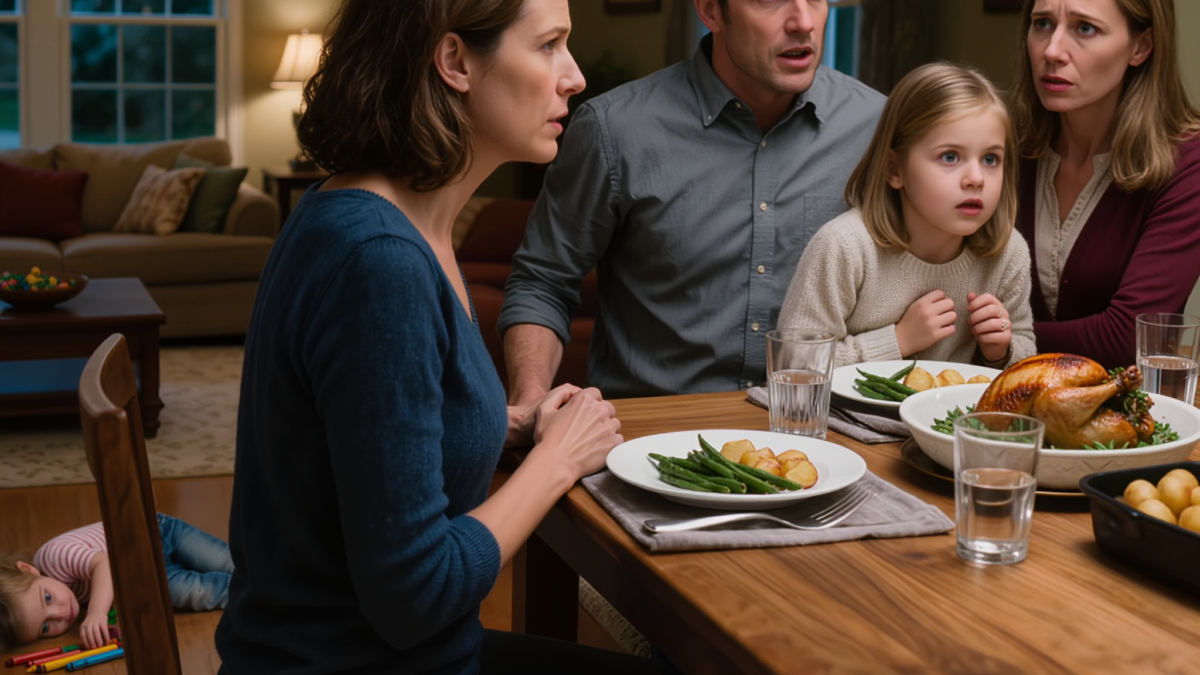
Dinner was painfully normal.
Roast.
Small talk.
My father told a story about a neighbor.
Brin complimented the food.
My mother kept steering the conversation toward family.
How important it was.
How blood took care of blood.
How, at the end of the day, family was all anyone really had.
I let her talk.
Eventually she put down her fork.
“Susanna, your father and I—and Brin—we’ve hit a difficult patch.”
She explained the house.
Not everything.
Just enough.
They needed to be out soon.
Then she looked around my home.
“You have all this space.”
There it was.
She said it would only be temporary.
They would help with Ren.
They would be useful.
Then she reached across the table and put her hand over mine.
“You’ve always been our rock, sweetheart.”
My body reacted before my mind did.
For one second, I wanted to say yes.
That old reflex.
Make everyone comfortable.
Fix the problem.
Be the easy daughter.
Then my mother smiled through tears and added:
“You never needed much. You always came through.”
I looked at her hand on mine.
Then at my father.
Then at Brin.
Before I answered, I reached for my phone.
My mother’s expression changed immediately.
“What is this?”
“I want to read something first.”
My father sighed.
“Susanna, we’re not here to dig up old history.”
“You’re here to ask to live in my house,” I said. “So I get to decide what history is relevant.”
The room went quiet.
I opened the family chat.
I started with the message I had sent two days before Ren was born.
The one warning them the baby might come at any time.
Then my mother’s reply reminding me about the showcase.
Then I moved to the night itself.
7:40.
My water broke.
7:46.
I asked someone to come.
7:51.
My mother told me I would be fine and to stop being needy.
7:53.
My father told me not to make the night about me.
Brin stared at the table.
Then I read her private message.
Her head snapped up.
For several seconds, nobody spoke.
My mother recovered first.
She said they hadn’t known it was serious.
She said first babies often took a long time.
She said they thought they had time.
“We came,” she insisted. “We came that weekend.”
“You brought a stuffed elephant.”
Her face tightened.
I set my phone down.
Then I opened the folder.
“This is my hospital admission record.”
I turned it toward them.
8:46 p.m.
Active labor.
Unaccompanied.
Self, personal vehicle.
“That means I drove myself to the hospital while I was in labor.”
Nobody moved.
I turned another page.
“And this is the visitor log.”
My father’s face changed.
I read the first family visitor entry.
Saturday morning.
Nearly forty hours after I arrived.
My mother immediately accused me of trying to humiliate them.
I shook my head.
“I’m not changing anything. I’m reading it.”
My father said they had helped me plenty over the years.
I looked at him.
“Name one time.”
He went quiet.
“I’ve paid my own way since I was eighteen. Name one transfer. One bill. One emergency you handled for me.”
He couldn’t.
That was when his temper finally broke.
He came halfway out of his chair and reached across toward my phone.
“Give me that.”
I pulled it back before he could grab it.
A water glass tipped.
Marcia’s voice cut through the room.
“Sit down, Gerald.”
My father froze.
“Sit down.”
He slowly lowered himself back into his chair.
Marcia stared at him.
“You just tried to take the phone out of your daughter’s hand because she read your own words to you.”
Nobody defended him.
Not even Brin.
Then my mother said the thing that changed everything.
She wiped her eyes and looked directly at me.
“Susanna, you have always been the strong one. That’s why we didn’t worry.”
I didn’t speak.
She continued.
“Brin needed us. She always did. You didn’t. You could handle things.”
I felt something inside me go still.
All these years, I had wondered whether she understood what she had done.
Now I had my answer.
She understood.
She just believed it was justified.
“You’re right,” I said.
My mother looked surprised.
“I did handle it.”
I stood.
“I handled driving myself to the hospital.”
I looked at my father.
“I handled giving birth without any of you.”
Then Brin.
“I handled raising Ren.”
Then back to my mother.
“I handled everything.”
She nodded as if I had finally proven her point.
I shook my head.
“But do you know why I always handled everything?”
She said nothing.
“Because being fine was the only way I knew how to stay lovable in this family.”
The room was silent.
“I learned when I was a kid that Brin’s needs were emergencies and mine were inconveniences. So I stopped needing things. I became someone who could survive being left alone.”
My mother opened her mouth.
I kept going.
“You called that strength because ‘strong’ sounds better than ‘abandoned.’”
Marcia went completely still.
Brin was crying.
My father stared at his hands.
I had imagined saying those words for years.
When they finally came out, they didn’t feel dramatic.
They felt accurate.
“I was never the daughter who didn’t need anyone,” I said. “I was the daughter who learned nobody was coming.”
My mother had no answer.
For once, there was no version of the story she could build fast enough to cover what had just been said.
So I gave them my decision.
“You came here to ask whether you can live in my house.”
My mother straightened.
“I already knew about the foreclosure before you got here.”
Her eyes widened.
“I know about the mortgage. I know about Brin’s studio. I know you’re running out of time.”
Brin looked down.
“So here is my answer.”
I looked at all three of them.
“No.”
My mother inhaled sharply.
“No, you cannot live here.”
She started speaking.
I raised my hand.
“I’m not putting you on the street.”
That stopped her.
“I’ll pay the deposit, first month, and last month on a reasonable two-bedroom apartment. I’ll also cover three months of rent while you get settled.”
My father looked at me.
“And after that?”
“After that, you handle your own lives.”
My mother stared at me as if I had slapped her.
“You would put your own parents in an apartment when you have this house?”
“Yes.”
“After we raised you?”
“I’m offering you more help than I received when I needed you most.”
Her face twisted.
“This is all because of one bad night?”
“No.”
I looked at her.
“It was thirty-one years.”
I touched the phone lying beside the folder.
“That night just happened to have timestamps.”
Then my mother made one final attempt to turn the room.
She stood.
She said she had sacrificed her entire life for her daughters.
Then she pointed toward the empty high chair in the corner and told me I had always been cold.
Calculating.
She said Brin would have taken them in without producing a folder of accusations.
The room changed.
Even she seemed to realize what she had just done.
She had finally said the quiet part out loud.
The daughter who had been rescued again and again was “good-hearted.”
The daughter who had survived without help was “cold” because she finally said no.
Dale, who had barely spoken all afternoon, set down his coffee cup.
“Diane.”
My mother turned toward him.
He looked directly at her.
“The girl drove herself to the hospital in labor.”
He paused.
“There’s nothing else to say.”
My mother sat down.
Not because she agreed.
Because she knew she had lost the room.
Marcia walked around the table and put a hand on my shoulder.
Then she admitted something in front of everyone.
Diane had told her about the night Ren was born years earlier.
She had told it like a funny story about how I overreacted.
Marcia had laughed.
“I’ve regretted that laugh for three years,” she said.
Then she looked at my parents.
“Susanna’s offer is generous. Take it.”
They left less than an hour later.
My mother cried at the door.
My father wouldn’t look at me.
Brin was the last one out.
She stopped on the threshold.
“I’m sorry, Sue.”
I said nothing.
She wiped her face.
“For that night. For the message. For letting all of this become normal.”
She looked embarrassed.
“I heard what I wrote when you read it out loud, and I hated the person who wrote it.”
That mattered.
It did not erase anything.
But it mattered.
“You don’t get to fix three years in a doorway,” I told her.
“I know.”
That was probably why I believed her.
My parents took the apartment.
I paid exactly what I promised.
Deposit.
First month.
Last month.
Three additional months of rent.
I sent the money through a lawyer so everything was documented.
Then I stopped.
The first month, my mother sent a thank-you message followed by a hint that rent was more expensive than expected.
I didn’t respond.
The second month, she accused me of treating my own mother cruelly.
I didn’t respond.
After the final payment, the messages stopped.
That was when I learned something else about boundaries.
Saying the sentence is not the hardest part.
The hardest part is continuing to mean it afterward.
Every old instinct told me to call.
To soften things.
To ask whether they were okay.
I didn’t.
They survived.
My father eventually found part-time work.
My mother started doing office work.
Their apartment remained their apartment.
My house remained mine.
Brin and I took a different path.
Slow.
Careful.
She found a job.
She stopped expecting me to pretend the past had disappeared.
Eventually she asked if she could spend time with Ren.
Really spend time with her.
I agreed to meet at a park.
Ren scraped her palm near the slide.
Before I could reach her, Brin was already on her knees in the wood chips.
“I’ve got you,” she told Ren. “Let me see.”
I froze.
Those were Patrice’s words.
The words a coworker had given me when my own family would not.
Brin had no idea.
She was simply reacting.
Showing up before anyone asked.
That was the first moment I believed she might actually be changing.
My parents and I still do not speak.
I hear about them occasionally through Marcia.
They are surviving.
I’m glad.
But being glad they are okay does not mean I have to reopen my home.
Or my life.
For a long time, I thought the confrontation would be the hardest part.
It wasn’t.
The hardest part was grieving the mother I had spent thirty-one years imagining might someday appear.
The mother who would finally understand.
The mother who would look back at that hospital room and say, “I should have been there.”
Maybe someday my parents will do that work.
Maybe they won’t.
I no longer organize my life around the possibility.
Not long ago, Ren got a fever.
Nothing serious.
But she was miserable and frightened.
I called out of work.
That night I slept on the floor beside her bed with one hand resting against her back.
Around two in the morning, she woke.
“Mom?”
“I’m here.”
Her hand reached toward me in the dark.
I took it.
She fell asleep again almost immediately.
I stayed there listening to her breathe.
And I thought about the little girl I used to be.
The one who learned to ask for less.
The one who believed being easy was the price of being loved.
The one everyone praised for being fine.
Ren will never have to become that girl.
If she needs me, I want her to know exactly what happens next.
I come.
I’m already on my way.