Dad Credited My Brother With Saving Our Family Diner—But the Books Told Another Story
I noticed it almost immediately.
Dad had been talking about a commemorative plaque for weeks, but he hadn’t told me what would be written on it. I assumed it would have the diner’s name, the year it opened, maybe something about forty years of serving Toledo.
I didn’t think much more about it because within five minutes of arriving, someone needed something from me.
The caterer couldn’t find the outlet they’d been promised.
The slideshow wouldn’t connect to the projector.
Dad wasn’t sure whether he’d already paid the remaining balance on the hall.
I handled all three problems before most of the guests arrived.
That was normal.
My name is Rachel Monroe. I was forty-eight, and I worked full-time as a procurement manager for a hospital system. My job was contracts, supply costs, vendor negotiations, and catching expensive problems before they became emergencies.
Monroe Family Diner wasn’t my job.
Officially, anyway.
My father, Walt, had opened the diner forty years earlier.
My older brother, Dean, had spent most of his adult life moving in and out of different roles there. He was good with customers. People remembered him. He could walk through a Saturday breakfast rush, call half the room by name, and make everybody feel like the Monroe family personally appreciated their business.
Dad loved that about him.
Dean arrived about twenty minutes before the anniversary program started.
He wore a sport coat and looked completely comfortable walking into a room full of people waiting to congratulate our family.
“Big night,” he said when he passed me.
“It is.”
He glanced at the stack of place cards in my hand.
“You’ve been here long?”
“Since four.”
Dean smiled.
“You always come early.”
Then he headed toward the bar.
I watched him go and told myself not to be irritated.
It was a celebration.
I wanted Dad to enjoy it.
The diner had survived forty years. My mother had helped him build it from six booths and a used grill before she died nine years earlier. There were former employees at the party who had worked there when Dean and I were children.
It mattered.
That was partly why what happened later hurt as much as it did.
Two years before the anniversary, the diner had started having trouble paying bills.
At first, Dad made it sound ordinary.
Food costs were up.
Business was inconsistent.
Catering had slowed.
Then a produce vendor called about an overdue invoice.
The linen company threatened to move the diner to payment on delivery.
One Thursday night, Dad called me and asked whether I knew anything about short-term business financing because payroll was getting tight.
I went to the diner the next morning.
Mae Carter, the bookkeeper, was already there.
Mae had worked for Dad for eighteen years. She wasn’t family, which was probably one reason she could look at the business more clearly than the rest of us.
The books weren’t impossible to understand.
They were simply messy.
Bills were being paid late. Some deposits didn’t line up neatly with the catering calendar. Credit card balances were carrying over. Dad had been shifting money from one obligation to another to keep everything moving.
For the next several weekends, Mae and I worked through it.
I built a payment schedule.
I contacted vendors and negotiated extensions.
I helped Dad find a CPA who specialized in small businesses.
We changed purchasing schedules and started tracking cash flow more carefully.
Even after all of that, the diner still had a short-term gap.
So I lent the business $28,000 from my savings.
The CPA insisted we document it properly.
There was a promissory note, repayment terms, and a paper trail.
Dad seemed embarrassed when we signed it.
“This is temporary,” he told me.
“I know.”
“I don’t want you thinking this place is your responsibility.”
“I don’t.”
He hugged me.
For a long time, I remembered that hug whenever I was tired of helping.
The diner stayed open.
Vendors kept delivering.
Employees kept getting paid.
And gradually, the story Dad told people changed.
It became the story of Dean stepping up.
Dean represented the diner at community events.
Dean talked to customers.
Dean appeared in a local newspaper article about second-generation family businesses.
He started talking about “carrying Dad’s legacy forward.”
Meanwhile, I continued taking calls from vendors after work.
Mae and I reviewed invoices.
I checked numbers.
I told myself I didn’t need recognition.
I had my own career.
I didn’t want to run a diner.
I wasn’t trying to take anything from Dean.
Then Dad unveiled the plaque.
By the time the program began, the hall was full.
Former employees sat with longtime customers. Vendors were there. People from the Chamber of Commerce were there. Family friends and neighbors filled the tables.
Dad stood at the front of the room beside Dean.
He told everyone about opening the diner forty years earlier.
He talked about my mother working the register while pregnant.
He told stories about broken equipment, burned biscuits, and customers who had been coming in since before Dean and I were old enough to see over the counter.
People laughed.
Dad was good at this.
Then he put his hand on Dean’s shoulder.
“Every man hopes that when the time comes, his son will step up and carry something forward,” he said.
He pulled the cloth from the plaque.
WALT & DEAN MONROE
FORTY YEARS OF FAMILY LEADERSHIP
The room applauded.
I did too.
For a second, I told myself it didn’t matter.
My name didn’t belong beside Dad’s just because I’d helped during a difficult period.
I wasn’t an owner.
I wasn’t asking to be one.
But then Dad kept talking.
“Dean has been the one holding this place together through some hard years,” he said. “He’s the son who stepped up when this family needed him most.”
More applause.
Then Dad looked toward me.
“And Rachel helped too, of course.”
Several people turned.
Dad smiled.
“Rachel was always better with spreadsheets than people.”
The room laughed.
It wasn’t a cruel laugh.
That almost made it worse.
It sounded harmless.
Affectionate.
Like one of those little family jokes nobody questions because the person telling it is smiling.
So I smiled too.
That was what I had always done.
For the next half hour, people congratulated Dean.
One of our bread suppliers shook his hand.
“Good thing your dad had you when things got rough.”
Dean smiled and said, “We all did what we had to do.”
He didn’t correct him.
A former waitress hugged Dean and told him his mother would have been proud.
Someone from the Chamber of Commerce praised him for keeping a local institution alive.
Dean thanked them.
I went to get water.
Mae found me near the back wall.
“You okay?”
“I’m fine.”
She looked at me for a moment.
“Rachel.”
“I’m forty-eight years old, Mae. I’ll survive a plaque.”
She didn’t argue.
But she didn’t look convinced either.
A little later, Dad stood again.
“I’ve got one more announcement.”
Dean looked toward him.
Dad said he planned to step back from some of the day-to-day responsibilities at the diner.
Not retire completely.
Just shift more responsibility to the next generation.
Then he announced that Dean would be taking a larger role in the financial side of the business.
“He’s earned it,” Dad said.
I stopped smiling.
Dean handling customers was one thing.
Dean handling staffing was one thing.
Financial control was different.
I knew too much about how fragile the business had been.
Before I could say anything, people began applauding again.
About an hour later, Dad found me near the coatroom.
“Come outside for a minute.”
The October air was cold.
Dad waited until the door shut behind us.
“Don’t make that face.”
“What face?”
“The one you’ve been making.”
“I’m not making a face.”
He looked toward the parking lot.
“We’ve got a temporary cash issue.”
I stared at him.
“How temporary?”
“A couple months.”
“How much?”
“I don’t know exactly.”
“Then what are you asking me?”
Dad hesitated.
“If things stay tight, would you be willing to help again?”
“Help how?”
“Another short-term loan.”
For a few seconds, I said nothing.
Through the glass doors behind him, I could see part of the plaque.
Walt & Dean Monroe.
Forty Years of Family Leadership.
“If Dean saved the business,” I asked, “why do you need me to save it again?”
Dad’s face changed.
“Don’t do this tonight.”
“Do what?”
“Make this about recognition.”
“You just gave Dean more control over the finances.”
“Because he’s there every day.”
“And you’re asking me for the money.”
“Rachel.”
“No. Explain it.”
His jaw tightened.
“You’ve always had a problem keeping score.”
That sentence used to work on me.
Any time I mentioned something I’d done for the family, Dad could make me feel ashamed for noticing it.
I would immediately start explaining that I wasn’t keeping score.
That I loved them.
That I didn’t mind helping.
This time I didn’t.
“I’m not lending the diner more money,” I said.
Dad stared at me.
Then he opened the door.
“We’ll talk about this when you’re not emotional.”
He went inside.
I stayed outside for another minute.
By the time I returned, he was smiling again.
By dessert, the tension between us was invisible.
Someone asked Dad how Monroe Family Diner had managed to survive the difficult years.
Dad thanked the community.
He thanked the staff.
Then he turned toward Dean.
“My son refused to let this place go under.”
Dean lowered his head modestly.
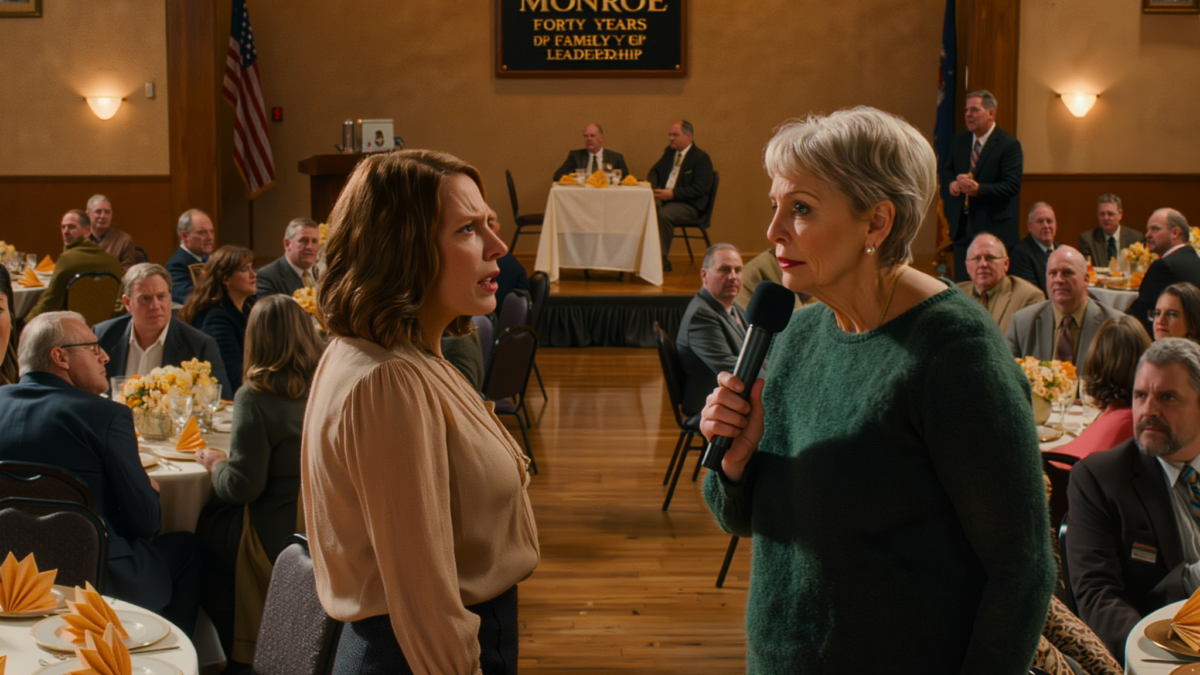
That was when Mae stood up.
She was sitting near the aisle in a dark green sweater.
Mae wasn’t somebody who enjoyed attention.
In eighteen years, I’d never seen her make a scene.
Dad noticed her.
“Mae, you want to say something?”
“I do.”
Someone handed her the microphone.
Mae stayed beside her table.
She looked directly at Dad.
“I’ve kept those books for eighteen years,” she said. “Rachel is the reason those doors stayed open.”
The room went silent.
Dad gave a short laugh.
“Well, Rachel certainly helped with the numbers.”
Mae didn’t smile.
“No.”
One word.
Dad’s expression changed.
Mae continued.
“Rachel negotiated with vendors when we couldn’t pay them on schedule. She worked with the CPA. She built the payment plan we’re still using. And when the business couldn’t cover the gap, she put her own money in.”
People started looking at me.
I had imagined plenty of times what it might feel like if someone finally said the truth out loud.
It didn’t feel good.
I wanted the floor to open.
Dad stepped closer.
“Mae, private finances aren’t appropriate conversation for an anniversary dinner.”
Mae looked at him.
“You’ve been discussing the finances all night.”
A few people shifted in their chairs.
Dean stood.
“Okay. This is getting a little ridiculous.”
Mae looked at him, then back at Dad.
“I told you months ago this was going to happen if you kept pretending the cash problem was just bad timing.”
I looked at my father.
He looked away.
“What does that mean?” I asked.
Dean answered quickly.
“It means nothing.”
Mae turned toward me.
Her expression changed.
“Rachel, I’m sorry. I thought Walt had told you.”
Dad’s voice sharpened.
“Enough.”
I looked at Mae.
“Told me what?”
Nobody answered for a second.
Then Mae said, “The diner wasn’t short only because sales were down.”
The room seemed to shrink.
Dean took a step toward her.
“Mae.”
She ignored him.
“Some of the catering deposits weren’t staying in the business account.”
I looked at Dean.
He immediately said, “I didn’t steal anything.”
Mae hadn’t accused him of stealing.
“What happened to the money?” I asked.
Dean spread his hands.
“I borrowed some of it.”
“Customer deposits?”
“It was temporary.”
“For what?”
Dean glanced at Dad.
That told me more than I wanted to know.
Mae spoke carefully.
“There were also charges on the business card that weren’t business expenses.”
Dean shook his head.
“I paid some of that back.”
Some.
I thought about the night Dad had called me asking about emergency financing.
The weekends Mae and I had spent reorganizing bills.
The $28,000 I had moved out of my savings.
All the conversations about rising costs and bad timing.
Then I looked at Dad.
“Did you know before you asked me for the twenty-eight thousand?”
He didn’t answer.
“Did you know?”
“Rachel, it’s more complicated than that.”
“Did you know Dean was using business money?”
Dad glanced around the room.
“Dean was going to put it back.”
That was enough.
He had known.
Maybe he hadn’t known every charge.
Maybe he hadn’t understood the full amount immediately.
But he had known enough.
And when the diner needed money, he had come to me.
I was the one he trusted to solve the problem.
Dean was the one he wanted everyone to credit for solving it.
The room was no longer looking at Mae.
They were looking at Dad.
Dad noticed.
“Everyone needs to understand that running a restaurant isn’t simple,” he said. “Money moves around. When you’re a family, everybody pitches in.”
I almost laughed.
Everybody pitches in.
Except some people were expected to contribute money and work.
Other people received plaques.
Dean looked at me.
“Don’t act like you’ve never needed help.”
“I didn’t say I hadn’t.”
“You’ve always thought you’re smarter than everybody because of your hospital job.”
“I didn’t say that either.”
Dad stepped in.
“This is exactly what I mean. Everything becomes a ledger with you.”
I looked toward Mae.
“No. Mae keeps the ledger.”
A few people laughed before they could stop themselves.
Dad’s face reddened.
I hadn’t meant to be funny.
Then one of the vendors spoke from a nearby table.
“Rachel was the one who called us last winter.”
Another man nodded.
“Same with us.”
A former employee said quietly, “I saw her there after closing plenty of nights.”
People began putting together things they’d already seen.
That mattered more than any speech I could have made.
I had been there.
They just hadn’t understood why.
Dad tried again.
“Dean made mistakes. Everybody makes mistakes.”
Mae answered before I could.
“Then let him fix his.”
I looked at her.
Let him fix his.
It was such an ordinary sentence.
But I’d spent most of my life doing the opposite.
When someone in the family created a problem, I figured out how to make it smaller.
If Dad needed paperwork handled, I handled it.
If the diner was short, I looked at the numbers.
If a vendor was angry, I made the call.
I had become useful enough that nobody needed to ask whether it was fair.
My mind was already trying to do it again.
How much money was missing?
Which bills were due next?
Was payroll safe?
What vendors needed to be contacted?
I stopped myself.
I turned to Dad.
“I’m not lending the diner any more money.”
His expression hardened.
“We’ve already been through this.”
“I’m also done handling vendor calls.”
“Rachel.”
“I’m not reviewing invoices after work. I’m not fixing the books. I’m not negotiating payment plans for free.”
Dean shook his head.
“You’re really going to walk away because your feelings got hurt?”
I looked at him.
“You wanted more responsibility.”
“So?”
“Take it.”
Dad said, “This is still your family.”
“I’m not leaving the family. I’m leaving a job nobody admits I’m doing.”
Then I picked up my coat.
Mae followed me toward the lobby.
Before I left, she stopped me.
“Your loan is documented correctly,” she said. “The CPA made sure of it.”
I nodded.
“Good.”
“I’m sorry you found out this way.”
“You thought Dad told me.”
She looked down.
“I hoped he had.”
“So did I.”
The anniversary party didn’t solve anything.
The diner still had bills the next morning.
Dean’s spending didn’t disappear because people knew about it.
Dad didn’t suddenly become a different man.
But the business could no longer operate the same way.
Mae told Dad she would resign unless formal controls were put in place.
The CPA backed her.
Dean’s access to the business accounts was restricted.
Large expenses required approval from more than one person.
Catering deposits had to be reconciled properly.
Business-card charges were reviewed.
Dad hated the changes.
But he agreed to them because there wasn’t much choice.
For the first time, the diner had rules that did not depend on Dad deciding which child should be protected.
My $28,000 remained a loan.
I didn’t demand ownership.
I didn’t try to take over the diner.
I didn’t threaten to shut anything down.
I simply expected the business to honor the promissory note it had already signed.
And I stopped putting new money in.
That turned out to be harder for my family than anything I said at the anniversary.
For years, they had been able to rely on the idea that if things became bad enough, Rachel would figure something out.
Now they had to figure it out themselves.
Dean lost the freedom he’d had around the accounts.
Mae stayed because the controls were put in writing.
Dad cut back parts of the catering business.
The diner became smaller.
It also became more stable.
A few months later, it was still open.
That mattered to me.
I had never wanted the place to fail.
I just no longer believed keeping it alive was automatically my responsibility.
Dad and I didn’t speak much for a while.
When we eventually did, there was no perfect apology.
He never sat me down and admitted that he’d spent years minimizing what I did while exaggerating what Dean did.
He never explained the plaque.
He never gave me some speech about finally understanding me.
Our relationship became quieter and more limited.
And eventually, I realized I could live with that.
The payments on the $28,000 continued.
Little by little, the money came back.
But the biggest change had nothing to do with the balance.
I got my evenings back.
I stopped checking my phone every time the diner called.
I stopped assuming every problem needed my answer.
I stopped measuring whether I was a good daughter by how much inconvenience I was willing to absorb.
The diner survived without me carrying all of that.
Dean had to deal with the responsibility Dad had publicly given him.
Dad had to live with the business decisions he’d made.
Mae kept the books.
The CPA kept the financial controls in place.
And I went back to being what I had actually been all along.
Rachel.
A daughter.
A sister.
A woman with her own career and her own life.
Not the emergency fund.
Not the unpaid financial manager.
Not the person who had to save everybody before she was allowed to belong.
For years, I thought helping my family meant stepping in whenever they needed me.
Now I understand there is a difference between helping someone and protecting them from every consequence of their own choices.
It took me forty-eight years, a $28,000 loan, and one plaque with my name missing from it to learn that difference.
I wish I’d learned it sooner.
But I learned it.