While my husband was deployed, my family walked into our Ohio home and started dividing his things. My sister spun his truck keys around her finger, Dad had both hands on his tool chest, and Mom said, “If he doesn’t come back, this belongs with his real family.” I told them to put everything back. My sister laughed, “Or what?” Then a man in the open doorway answered for me—and the keys hit the floor.
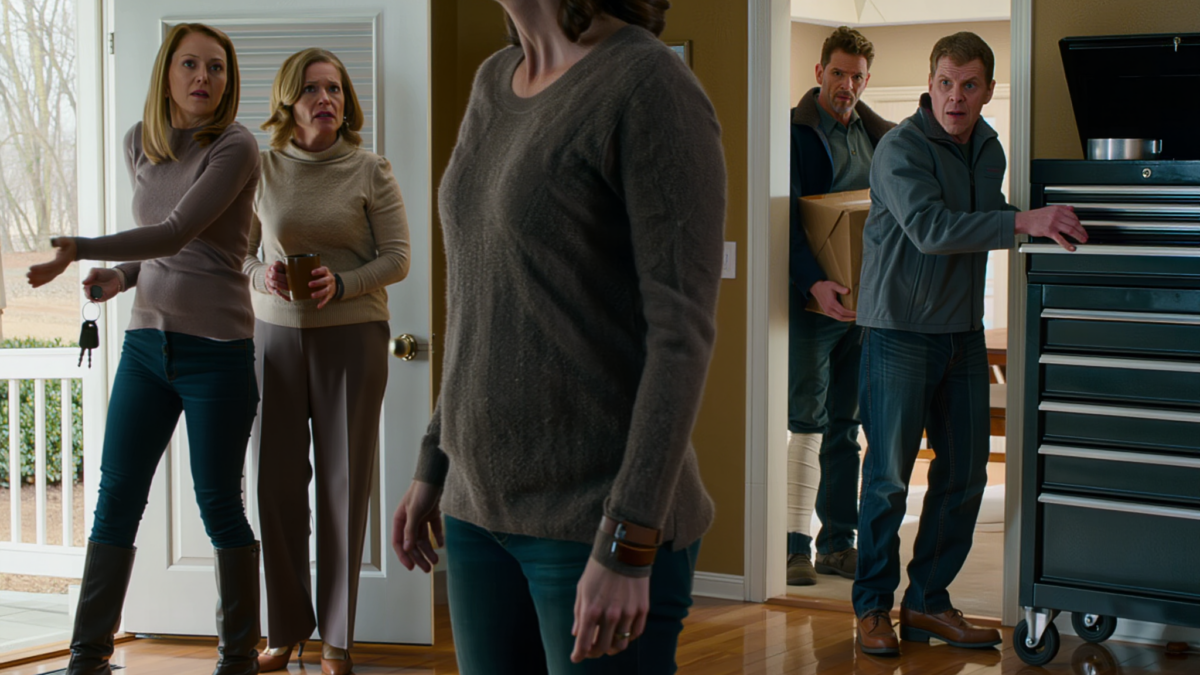
“If he doesn’t come back, this belongs with his real family, not the temporary wife he left behind.”
My mother said it while standing in my living room, six months into my husband’s deployment.
My sister was already spinning his truck keys around her finger. My father had both hands on the tool chest Wes had spent a decade building.
They weren’t visiting.
They were dividing his things as if he were already gone.
I didn’t raise my voice. I only said, “Put it back.”
My sister laughed in my face.
“Or what?”
A man stepped through the open front door behind her.
“Or you can explain it to me.”
She turned.
The keys hit the floor.
They had already told people Wes was as good as gone. They thought I would stay quiet the way I always had.
They were wrong.
My name is Mia. I’m 31 years old, and the day my family walked into my house to divide up a living man’s life was the day I stopped being quiet.
To understand how my own family ended up in my living room sorting my husband’s belongings into piles, you have to understand who I had always been to them.
Because that was the part they were counting on.
I own a small flower shop called Marie Golden Vine. It sits on a corner two streets off the main road in our town, close enough to Dayton that people drive out on weekends and far enough away that they slow down when they get here.
I’ve had it for four years.
Before that, I arranged flowers for a larger shop and hated nearly every part of the job except the flowers. Now the shop is mine. The mistakes are mine, and the good mornings are mine too.
People think a florist spends all day cutting stems and tying ribbons.
What I actually do all day is read people.
A man who buys lilies and can’t look me in the eye is usually apologizing for something. A woman who orders the cheapest arrangement and asks me to make it look expensive is usually trying to survive a wedding she can’t afford.
I learned to notice the gap between what people say they want and what they actually need.
It turns out that skill follows you home.
There’s something else you should know about me because it matters later.
I can tell a fake flower with my eyes closed.
Silk has no smell. It doesn’t give when you press it. It stays perfect in a way real things never do.
My grandmother taught me that when I was little. She would turn a stem between her fingers and say, “You can always tell, honey. The real ones bruise.”
I didn’t understand what she meant for a long time.
Every night Wes was gone, I left the porch light on.
It’s an old habit among military families, leaving a light burning so the house looks as though it’s still waiting. I told myself it was silly.
I did it anyway.
That little light became the last thing I saw before bed and the first thing I checked in the morning.
And eventually, that light showed me more than I ever wanted to see.
Wes and I met in 2017.
I was delivering centerpieces to a wedding, and he was the person who carried them inside for me when the venue staff didn’t show up. He had grease under one fingernail and apologized for it before he even told me his name.
We married in the fall of 2019.
This past October marked six years.
You also need to understand something about my husband because my mother built her entire story around it.
Wes doesn’t have family.
Not really.
His mother left when he was young, and he was raised by his grandfather, a quiet man named Roy who fixed engines in a garage that smelled like oil and coffee.
Roy died when Wes was 21.
After that, it was just Wes.
When he married me, he married into the only family he had left.
Mine.
At our wedding, he said something I have replayed in my mind a hundred times since.
“Your people are my people now. That’s the whole deal, right?”
I said yes.
I believed it completely.
I didn’t know then that my people would one day decide he wasn’t quite one of them.
Wes is a diesel mechanic. During the week, he keeps a fleet running at a shop across town. On weekends, he keeps almost everything else running too.
The tool chest my father had his hands on that afternoon had originally belonged to Roy.
It was a battered steel chest Wes inherited and then spent ten years filling, one hard-earned tool at a time, until what was inside it was worth more than the truck.
Mechanics will understand what I mean.
That chest wasn’t furniture.
It was Roy’s hands and Wes’s patience stacked inside steel drawers.
It was a man’s entire trade.
Wes is also a sergeant in the Ohio Army National Guard. Most of the year, that means one weekend a month and two weeks in the summer. It fades into the background of an ordinary life.
But in the summer of 2025, his unit was mobilized.
In early August, he shipped out overseas.
Eight months, maybe nine, they told us.
He’d be home before the lilacs bloomed.
Then there was my family.
Three people matter most.
My mother, Carol.
My father, Dennis.
And my sister, Brooke, who is two years older than me and has spent her entire life being two years older in every way that allowed her to go first.
My mother is not a cartoon villain.
That matters.
Carol believes in family the way some people believe in religion, as something that comes before you, stands above you, and is always owed something.
She believes blood is a contract.
She believes in being practical.
If you handed my mother a knife and told her cutting someone was necessary for the good of the family, she would do it and call it love.
My father goes along.
Dennis has a bad heart, a good handshake, and a lifelong talent for being somewhere else when decisions are made. Afterward, he’ll tell you he never wanted any of it.
The terrible part is that he’ll mean it.
And Brooke is the one who acts.
My whole childhood, the rule in our house was simple, although nobody ever said it aloud.
Brooke needs it more.
My bike when she wanted a newer color.
My babysitting money more than once.
The better bedroom.
The benefit of every doubt.
Whenever I objected, my mother gave me the same answer in that warm, reasonable voice I knew so well.
“Mia will understand.”
“Mia always understands.”
I did understand.
That was the problem.
I understood so thoroughly and for so long that I accidentally taught my family something.
I could be counted on to swallow it.
The cost of taking from me was zero.
There’s one afternoon from my childhood that I keep returning to because it contains the whole family in a single hour.
I was 12.
I had saved for most of a year to buy a real camera. Birthday money, dog walking, skipping the book fair. I kept the bills folded inside a sock in my drawer and counted them the way you count something you love.
Brooke was 14 and wanted a phone.
One Sunday, my mother sat us both down and explained, warmly and reasonably, that it only made sense to put my camera money toward Brooke’s phone.
Brooke was older.
Brooke needed it more.
We were a family, and families shared.
I remember looking at my father.
He looked at the television.
I remember saying it wasn’t fair.
I remember my mother’s expression becoming soft and disappointed.
Then she said the sentence I would hear my whole life.
“Mia will understand. Mia always understands.”
I gave her the sock.
I never got the camera.
Brooke got the phone.
The lesson I learned that day wasn’t about sharing.
It was that the fastest way to make discomfort disappear was to hand over the thing they wanted and let them call me generous for it.
I got very good at making discomfort disappear.
There’s one thing about Wes you should keep in mind.
My husband is quiet, but he isn’t empty.
He writes things down.
He keeps lists in a little notebook. Parts he needs. Jobs he has promised. The mileage on every vehicle he has ever loved.
He remembers anniversaries by writing them inside the cover of whatever book he is reading.
When we were dating and he couldn’t say something aloud, he would leave it on a Post-it note beside the coffee maker.
I used to tease him that he communicated best on paper.
I didn’t think enough about that after he deployed.
I told myself a deployed man simply wasn’t much for letters.
I should have known better.
I did know better.
I just wasn’t ready to ask where the letters were.
When my husband left the country, there was suddenly a house full of his belongings and a woman my family had trained since childhood not to make a fuss.
They did the math the way they always had.
The morning everything happened was a Sunday in the first week of February.
I called Wes on video before opening the shop.
The connection was rough. His face froze and jumped across the screen, but he was there.
He was laughing about something one of his guys had done.
He looked tired and alive and completely himself.
“Almost there,” he said. “Home before the lilacs.”
Then he added, “Don’t let your family run you ragged while I’m gone.”
“They wouldn’t dare,” I told him.
He reminded me to leave the light on.
I told him I always did.
Then the screen went dark.
I put my phone in my coat pocket, where I could still feel its warmth, and drove to the shop to check on a delivery.
I was gone maybe three hours.
When I turned onto our street that afternoon, there were three cars I didn’t recognize parked along the curb and halfway up my driveway.
I wish I could say I understood immediately.
I didn’t.
My first thought was that something had happened.
An accident. Bad news. The kind of gathering where somebody holds your hand while a chaplain searches for the right words.
My stomach dropped.
I parked crooked and ran.
Then I reached the door and heard my sister laughing.
The living room looked like a garage sale that had been raided.
Wes’s belongings were everywhere.
His winter coat.
His watch box.
The flannel shirt he wore when he was cold.
The good jacket he wore when he wasn’t.
Things had been pulled from closets and drawers and sorted into two rough piles on the rug.
My father was crouched beside the tool chest, running his thumb along the edge of a drawer as if he were appraising it.
My mother stood in the middle of the room directing traffic with a mug of my coffee in her hand.
“Relax,” Brooke said when she saw my face.
She was turning Wes’s truck keys over and over in her hand.
“We’re just being practical.”
Practical.
That word again.
In my family, practical was the word people used right before they took something.
I set my own keys down gently on the side table because I didn’t trust my hands.
“What is this?”
It didn’t sound like a question.
My mother turned toward me.
She hadn’t really seen my face yet, so she delivered the line she had clearly prepared in the same calm, reasonable voice I had heard my entire life.
“If he doesn’t come back, this belongs with his real family, not the temporary wife he left behind.”
Temporary.
Six years, and I was temporary.
I’ve thought many times about what I felt in that moment.
The honest answer is that I didn’t feel the big emotions yet.
Those came later.
At first, I felt something small and precise, like a key turning inside a lock.
All my life, I had been the one who understood.
Suddenly, I understood something new.
They had waited for him to leave.
His absence was not a tragedy to them.
It was an opening.
“Put it back,” I said.
That was all.
Two words.
Brooke laughed.
“Or what?”
I didn’t have an answer.
That was the part that would have ended things on any other day.
She was right in the way people who have always won are right.
There was no “or what.”
I had never once in my life made her put anything back.
Then a voice came from behind her, through the front door I had left open when I ran inside.
“Or you can explain it to me.”
I knew the voice before I placed the man.
Brooke turned.
The color left her face.
The keys slipped from her fingers and hit the hardwood with a sound much too loud for such a small object.
The man in my doorway was Cole Merik.
To understand why those keys fell, you have to understand who Cole was.
Cole was Wes’s best friend.
They had come up through the Guard together, attended their first weekend drills together, and stood at each other’s weddings.
Cole was supposed to be overseas on the same rotation as my husband.
He wasn’t.
Six weeks before the unit mobilized, he injured his knee badly enough to need surgery. The Army kept him stateside.
Instead of deploying, he had been given the thankless job of being one of the people families could call back home, someone who knew the difference between “we haven’t heard from him” and “something is wrong.”
Cole had talked to Wes the day before.
He knew, in a way nobody in that room could argue with, that Wes Pard was alive and well and moving toward the final stretch of his deployment.
And my family had just been caught dividing that living man’s belongings.
“Hey, Mia,” Cole said, as if he had knocked on a normal door on a normal afternoon.
He wore a brace on his knee and carried a brown paper package under one arm.
“Wes asked me to drop this by. He said mail to the house has been slow.”
His eyes moved slowly over the piles on the rug.
“Looks like I picked a bad time. Or a good one.”
Nobody moved.
For one long beat, the whole room seemed trapped inside the sentence my mother had just said.
Then my mother recovered.
That was the thing about my family.
They didn’t fold when caught.
A cartoon villain confesses.
Real people adjust.
Mom set down my coffee and smoothed the front of her sweater. In seconds, she became a woman who had only ever been trying to help.
“We were tidying,” she said. “That’s all. It’s a lot for one person, Mia, keeping up a whole house like this. We didn’t want you overwhelmed.”
My father stood up and put his hands in his pockets.
He said nothing.
That single gesture contained most of my father’s personality.
Brooke bent down and picked up the truck keys.
This is the part I keep coming back to.
She did not return them to the hook beside the door.
She put them in her purse.
Right in front of me.
She looked directly at me while she did it, daring me to become the person who made a scene.
Because I never was.
“We’ll talk when you’ve calmed down,” my mother said as she gathered her coat.
They took a few small things with them.
“A couple of boxes,” Mom said, “so they won’t be in your way.”
Cole stepped aside to let them pass.
Brooke didn’t look at him.
Then they were gone.
It was just Cole and me, standing in the wreckage of my husband’s belongings spread across the rug.
The porch light was still burning in the gray afternoon because I had forgotten to turn it off that morning.
Cole put the package beside my keys.
“You okay?”
“No.”
The answer surprised me because I didn’t usually tell the truth that quickly.
He nodded as though it were the right answer.
“For what it’s worth, I talked to Wes yesterday. He’s fine. He was asking about you.”
Then he paused.
“Why did she have his truck keys, Mia?”
I didn’t answer.
I was looking at the tool chest.
My father had opened the top drawer while examining it and left it open.
Something was wrong.
It took me a moment to understand what.
The drawer was too light in the wrong place.
Where Wes kept the expensive equipment, there was a clean rectangle in the dust.
Something had been sitting there.
Now it wasn’t.
I knew that chest.
I had dusted around those tools.
I had listened to my husband talk about each one the way another man might show someone photographs of his children.
Something was missing.
And judging by the dust around the empty space, it had been missing for a while.
Cole left after making sure I wasn’t about to fall apart.
His knee needed ice, and he told me to call if my family came back.
I said I would.
I didn’t tell him about the drawer because I didn’t have words for it yet.
Only a feeling.
And I had learned not to say a feeling aloud until I could point to the thing that caused it.
After he left, I opened the package.
My hands weren’t steady.
I remember thinking that was ridiculous.
It was a padded envelope, not a bomb.
Inside was something wrapped in a shop rag.
A small wooden bird.
It was rough and crooked, clearly whittled by someone with more patience than talent.
Beside it was a folded note in my husband’s handwriting.
“Found a knife and too much downtime. First one’s ugly. I’ll get better. Keep it by the light. W.”
I stood in my ransacked living room holding a crooked wooden bird my husband had carved on the other side of the world.
I thought about the piles on my rug.
I thought about the word temporary.
Something inside me became very cold and very clear at the same time.
My family was in a group text calling him gone.
He was carving wooden birds and mailing them home because he had realized the regular mail wasn’t reaching me.
Only one of those versions could be true.
I was going to find out which one.
I didn’t call anyone.
I got a notebook.
I sat on the floor beside the open tool chest and went through it drawer by drawer, making a list of what my husband owned.
Not because I’m unusually organized, although I am.
I needed to understand the exact shape of what had been taken before I let myself feel anything about it.
Feelings are loud.
Lists are quiet.
Somewhere underneath the numbness, I already knew I would need to stay quiet for a while.
The scan tool was gone.
If you don’t know cars, that phrase might mean nothing.
In our house, it meant a lot.
A diagnostic scanner is essential equipment for a modern mechanic. It is how you communicate with a car’s systems and find out what is wrong instead of guessing.
Wes’s scanner was a professional unit.
He had saved for it.
It cost $3,200 new, and he had bought it eighteen months earlier.
I remembered because he had apologized for the price for nearly a week.
I also knew it had been in the garage in the fall.
Not because I vaguely remembered seeing it.
Because I had proof.
I run the flower shop’s social media myself.
In October, I had posted a short video of Wes under the hood of my delivery van, keeping the old thing alive for one more winter.
The scanner was visible in the shot, sitting on the fender with its screen catching the light.
So I scrolled.
I found another clip from three weeks before Wes deployed.
The scanner was sitting on the bench.
Then I found a cheerful little video I had recorded in December about winterizing a car.
Same garage.
Same work area.
No scanner.
Only the empty spot where it normally sat.
It had disappeared before Christmas.
It had disappeared while my husband was overseas and I was living alone in the house.
Nobody else was supposed to have a key.
That changed the shape of what had happened.
Until then, I had been telling myself my family had made one stupid, hurtful, impulsive decision that afternoon.
Entitlement.
Fear.
Whatever explanation made it easier to understand.
But you cannot impulsively do something in December that you get caught doing in February.
This had a timeline.
I opened the marketplace app on my phone.
I had bought enough secondhand shop equipment to know how people listed things they wanted to move quickly.
I typed in the scanner’s model number.
It took less than a minute.
There it was.
A professional diagnostic scanner.
Listed for $1,850.
Cash only.
No lowballers.
The photograph showed the scanner resting on a workbench against a pegboard I recognized.
I had stood in that garage at Thanksgiving.
It belonged to Trevor.
My sister’s husband.
The listing described the scanner as “barely used.”
That phrase did something to me.
Barely used.
Of course it was barely used.
Nobody in that house knew how to turn it on.
They hadn’t simply taken a random tool.
They had taken something my husband depended on for his work and put a price on it.
I took screenshots of the listing.
I saved the date.
I created a folder on my phone and gave it a boring name because I already understood that I was building something, and things you build quietly should never look interesting from the outside.
For a moment, I considered messaging the seller while pretending to be a buyer.
I started typing.
Then I stopped.
I could already imagine how it would sound if someone read it later.
Desperate.
Entrapping.
The move of someone trying to force a confession.
I didn’t need Trevor to confess.
I had the listing.
The price.
The garage.
The dates.
A receipt you can hold is worth more than a confession someone can later take back.
So I did the boring thing.
I wrote down the model number.
I found the serial number in Wes’s old purchase email.
I recorded the exact figures.
$3,200 new.
$1,850 used.
Then I waited.
Waiting is a skill nobody thanks you for.
It was most of what I did that winter.
A little later, Cole texted to check on me.
Near the end of the conversation, almost as an afterthought, he asked whether I had received the package.
Then he added something else.
Wes had started sending things to Cole’s address because the mail at our house seemed strange.
He said Wes wrote home every week.
Every week.
I read the message three times.
I had spent months telling myself that my husband simply wasn’t much of a letter writer.
The calls were enough for him, I had decided.
There had been a card here, a note there.
I had made peace with the thin trickle of mail the way you make peace with the small things about somebody you love that disappoint you.
But Wes wrote every week.
He had been writing home every week.
And the letters weren’t reaching me.
I typed, “What letters?”
Then I deleted it.
Cole didn’t have the answer.
And I wasn’t ready to say the question aloud yet.
Instead, I sat in my quiet house with the porch light still burning and thought about the difference between mail that was slow and mail that had been stopped.
My phone buzzed again.
This time it was my aunt Diane.
She was my father’s younger sister, the one relative I had always liked but never fully trusted because she enjoyed family gossip too much to be completely safe.
“Honey,” she wrote. “You need to see this. I don’t think you know.”
Before I tell you what Diane sent, I need to be fair about where my head was at that moment.
I did not yet think my family was evil.
I thought they were greedy.
I thought they were thoughtless.
I thought my mother had said something unforgivable in my living room.
I thought I was heading toward an ugly, exhausting fight over a truck and some tools.
The kind of fight my family always won because I always let them.
That was the story I thought I was in.
Then Diane sent me a screenshot.
It was from a family group text.
My mother was in it.
My father.
Brooke.
Trevor.
Two cousins.
I was not.
Diane had scrolled back far enough to capture a sentence that ended the story I thought I was in and started another one.
“Let’s handle the truck before it’s too late.”
Brooke had written it.
Then came another line.
“Mia won’t make a fuss.”
I read those words slowly.
There it was.
My family’s entire theory of me, typed out in my sister’s own message.
The thing they had trained into me since childhood was now supporting their plan.
They were counting on me being exactly who I had always been.
But one phrase bothered me even more.
Before it’s too late.
Too late for what?
Too late implied a deadline.
Too late implied something was coming.
Something they wanted to happen after the truck was already gone.
I kept scrolling.
Diane had sent the entire thread.
The picture got worse the way a dark room gets worse as your eyes adjust.
They weren’t only discussing the truck.
They were discussing a story.
Weeks earlier, my mother had written, “I told the Hendersons we haven’t heard from him. Best if everyone’s on the same page.”
One of my cousins asked, “Is that true?”
My mother answered, “It’s true enough. The letters stopped.”
The letters stopped.
I sat very still.
My husband wrote home every week.
My mother had told people his letters had stopped.
Both statements could be true at the same time.
But only if something had happened to the letters between the moment Wes mailed them and the moment they were supposed to reach me.
I still didn’t have proof.
That distinction mattered.
What I had was a shape.
What I needed was a receipt.
Over the next few days, I listened.
That is another skill florists develop.
People talk while you wrap their flowers.
If you stay quiet long enough, they forget to be careful.
In fragments at the shop, at the market, and over the phone with people calling to check on me, I began hearing the story my family had apparently been telling for weeks.
A woman named Peg came into the shop that Thursday for a table arrangement.
She was a regular, the kind of customer who narrated her entire week while I worked.
When she saw me, she became unusually quiet.
Then she reached across the counter and squeezed my wrist.
“You’re being so brave,” she said. “I told Carol that girl is being so brave.”
I kept working on the stems.
“What did Mom tell you?”
Peg explained, in the gentle tone people use when repeating a tragedy that isn’t theirs, that nobody had heard from Wes in more than a month.
His letters had stopped.
The family was trying to prepare me.
I simply wasn’t ready to hear it.
“You just keep hoping, honey,” she said, patting my hand. “That’s not denial. That’s love.”
I finished her arrangement.
I rang her up.
I smiled.
And the whole time, one phrase repeated in my head.
Over a month.
His letters had supposedly stopped over a month earlier.
That was right around the time my mother had begun collecting my mail so the house wouldn’t look empty.
I wasn’t ready to put those facts together aloud.
Instead, I wrote them in my notebook, one under the other.
Wes was not officially missing.
Nobody had said the official words because those words would have come through the Army, and they were never going to come because Wes was fine.
My family had built a version of events that lived inside the gap.
His unit had gone quiet.
His letters had stopped.
They were preparing for the worst.
Then a woman I barely knew appeared on my porch carrying a warm casserole dish and told me she was praying for me.
I stood beneath my husband’s porch light holding a stranger’s grief for a man I had video-called that very morning.
“Thank you,” I said.
What else could I say?
That was when the ground truly moved beneath me.
Not when Brooke took the keys.
Not even when I found the scanner.
It happened while I stood on my porch being offered a widow’s sympathy for a man who was alive and asking about me from eight time zones away.
My family had not merely taken his belongings.
They had taken the fact of his life and replaced it with something more useful to them.
That was when I made my decision.
I would not accuse.
I would collect.
Every instinct in me wanted to drive to my mother’s house and throw the truth in her face.
He’s alive.
I talked to him.
How dare you?
But I knew exactly what would happen if I did.
My family had already prepared the room to catch me.
They had been telling people I wasn’t handling things well.
That I was struggling.
That I refused to accept reality.
If I showed up shouting that Wes was alive and waving my phone around, they would not be the ones exposed.
I would be.
Poor Mia.
In denial.
Unable to accept the truth.
Needing family to step in.
They had spent weeks turning my correctness into a symptom.
So I couldn’t win with a claim.
I needed a thing.
Something so plain that nobody could reinterpret it as hysteria.
I made a file.
Screenshots.
Dates.
The scanner listing.
The group text Diane had sent.
Then two more screenshots she forwarded after I quietly asked her to keep sending anything relevant.
I photographed the empty space in the tool chest.
I saved the October video.
I wrote down who had said what and when.
At the top of the first page of my notebook, I wrote two words.
Don’t accuse.
Then one more.
Collect.
Three days later, while wrapping a bouquet for a woman from my mother’s church, I heard a word I didn’t understand.
“We all chipped in for the fund,” she said, patting my hand. “Whatever you need, sweetheart.”
The fund.
I smiled.
I thanked her.
I finished the ribbon.
Then I waited until she left.
Afterward, I sat behind the counter and searched my husband’s name along with mine.
I found it.
There is a specific kind of cold that starts in your hands.
Mine began there and worked its way up my arms as the page loaded.
It was a public fundraiser on one of the large donation sites.
At the top was a photograph of Wes from our second anniversary.
I recognized it immediately.
I had been cropped out.
Below it was the title:
Support the Pard family through this difficult time.
Then came the description.
It sounded like Brooke.
Careful.
Measured.
Almost lawyerly.
It never said Wes had died.
It never said he had been killed.
It said we had not heard from him in weeks.
It said the family was bracing for what might come.
It said every dollar would help them get through.
Whoever wrote it understood exactly where the line was and stood carefully on one side of it.
Close enough to grief to make people open their wallets.
Far enough from a specific claim to avoid saying outright that Wes was dead.
The fundraiser had collected $12,300.
I stared at the number.
More than two hundred people.
Neighbors.
Coworkers.
Church members.
Strangers moved by the story of a soldier who might not come home.
People reaching into their own budgets to help his grieving family.
Twelve thousand three hundred dollars of other people’s kindness built around a death that had not happened.
I scrolled down to the section showing who organized the fundraiser.
The organizer’s name was public.
Brooke Callaway.
My sister.
Her husband, Trevor, had lost his job in November.
His garage was also where my husband’s $3,200 scanner was sitting with a price tag on it.
Then I found a comment somebody had tried to bury.
It was from a military spouse in another town whose husband was on the same rotation as Wes.
She would have known the network of wives and families, the way information moved among people counting the same days.
“Wait,” she had written. “I thought the guys were all fine. Did something happen to Wes specifically?”
It was an honest question.
The kind that could unravel the whole story.
Nobody answered.
The comment had been hidden.
I could see it only because the woman had also posted about it on her own page, where Diane found it.
Nobody in my family had replied.
They had simply made the question disappear.
That told me something the missing letters had only suggested.
They weren’t confused.
Confused people answer questions.
People who already know the truth make dangerous questions disappear.
Later that night, Diane sent one more screenshot without my asking.
I think by then she was beginning to feel frightened by what she had uncovered.
It was a text from Brooke to Trevor, visible in the background of a photograph Diane had enlarged.
“Once it clears we’re good till spring.”
Spring.
The exact season my husband was due home.
They were not waiting for grief to arrive.
They were racing his homecoming.
They wanted to cash out the story before the living man walked back into it and made it worthless.
I put my phone facedown on the counter.
Then I pressed both palms against the cool wood and allowed myself, for the first time, to understand the whole thing.
They had not come to my house simply to take a truck.
The truck was almost incidental.
The truck was cleanup.
What my family had built quietly over months, inside a group text I wasn’t part of, was a story in which my husband was gone.
Then they had sold tickets to it.
The grief was the product.
The prayers were the marketing.
My mother’s line about his “real family” suddenly made a horrible kind of sense.
If Wes was gone and I was temporary, then everything associated with him could flow naturally toward the people who had declared themselves permanent.
The truck.
The tools.
The sympathy.
The money.
That was when my grandmother’s lesson came back to me.
You can always tell a fake.
The real ones bruise.
My family’s grief was silk.
Perfect.
Photogenic.
Odorless.
It never gave when you pressed it.
It remained flawless in exactly the way real grief never does.
I almost did something reckless right then.
I nearly typed a public comment beneath the fundraiser.
This man is alive.
I spoke to him this morning.
I’m his wife.
My thumb was already moving when I stopped.
I could see exactly how my mother would handle it.
She would turn to the women at church with that sad, patient expression.
You see what I mean?
She can’t accept it.
She thinks he’s still calling her.
The poor thing.
A comment was a claim.
A claim could be reframed as a symptom.
I would be handing them the final brick they needed to wall me off from my own life.
So I locked my phone.
I closed the shop.
Then I drove home to the porch light I had left on and started thinking seriously about how a quiet woman ends a lie that large without ever raising her voice.
I didn’t have long.
My family could feel me changing.
I had gone quiet in a different way.
I wasn’t returning calls as quickly.
My silence no longer meant “Mia understands.”
My mother noticed.
She had spent 31 years reading me as easily as I read a nervous groom.
She called me on a Tuesday afternoon, which she almost never did.
“You seem so tense lately,” she said warmly. “Are you sleeping? You know you don’t have to carry all this alone.”
I told her I was fine.
I said the shop was busy.
“I just worry about you,” she replied. “We all do.”
I didn’t recognize the significance of that sentence until I began hearing it from other people.
We all worry about Mia.
A supplier I had worked with for years carefully asked whether I was doing okay “with everything.”
A woman from church stopped me in the parking lot.
“Your mom mentioned you’ve been struggling, that you won’t accept it. It’s all right to lean on family, you know.”
Same words.
Same softness.
Too many mouths for coincidence.
Someone was handing out a script.
The clearest example was a woman named Sharon, whom I had gone to high school with and hadn’t spoken to in ten years.
She came into the shop without buying flowers.
She sat on the little stool beside the counter and told me she had heard I was isolating myself.
My mother was supposedly beside herself with worry.
Sometimes, Sharon said, the strongest thing you can do is let your family carry you for a while.
She used the word carry twice.
I realized I was talking to someone who had been sent.
Not just with a message.
With vocabulary.
She would deliver it to my face and report back on how I responded.
So I gave her something to report.
I let my eyes fill.
I said quietly that I was just so tired.
Then I let her leave believing she had found me exactly as fragile as advertised.
It cost me nothing to appear the way they needed me to appear for one more week.
And it bought me the thing I needed most.
Time they didn’t know I was using.
They were turning me into the unstable one.
The one in denial.
The one who couldn’t be trusted with her own husband’s affairs.
Once that story took hold, everything else would follow.
Of course the family should handle the truck.
Of course the family should manage things.
Poor Mia isn’t herself.
Then, in that same phone conversation, my mother mentioned something so casually I nearly missed it.
She said she had been “grabbing your mail when we’re by so it doesn’t pile up and make the house look empty.”
I had enough on my plate.
There it was.
Not a confession.
My mother does not confess.
A helpful little favor presented as kindness.
For months, my mother had been collecting my mail to help me.
And somewhere in those helpful stacks, week after week, were my husband’s letters.
That was how the letters stopped.
They stopped in my mother’s hands.
I didn’t confront her.
I thanked her.
I had become very good at thanking people while every part of my body was saying something else.
Two days later, my father called.
That unsettled me even more because my father rarely initiated anything.
He talked around the subject.
The weather.
His heart.
My mother’s cooking.
Then he said, “That truck of Wes’s shouldn’t just sit, you know.”
He explained that the engine could suffer if the truck sat too long.
Why didn’t I let him look after it?
Keep it running for Wes.
Then he paused before adding, “For when he’s back.”
For when he’s back.
My father, at least, still allowed himself to say the words.
But the request was identical to Brooke’s actions in my living room.
The keys.
They wanted the keys again.
This time wrapped in concern.
Presented as a favor to the same man they had been telling the town might never return.
“I’ve got the space for it,” Dad continued when I didn’t answer quickly enough. “Right there in the side yard. I’ll start it every week. Keep the battery up. It’s just sitting there in your driveway reminding you, honey. Can’t be good for you.”
There it was.
He had found the soft spot and pressed it.
The idea that seeing my husband’s truck in my own driveway was harming me.
A wound my family needed to remove.
I told him the battery was fine.
He said battery tenders failed.
I said I would think about it.
Then I heard the small, satisfied breath on the other end of the line.
For 31 years, “I’ll think about it” had been the sound I made immediately before giving in.
After we hung up, I sat with the spare truck keys in my hand.
The keys they did not have yet.
And I understood.
They did not want to care for the truck.
They wanted to move it somewhere I could no longer see it.
Before spring.
Before Wes came home.
Before the story collapsed.
The truck wasn’t a kindness.
It was evidence with wheels.
And they wanted it moved.
That was the shape of their next move.
Not another raid.
Something slower.
Kinder.
More reasonable.
The truck looked after until it became theirs.
The mail collected until it disappeared.
Me helped until I had no standing left.
They were removing my husband from his own house one considerate favor at a time and daring me to seem ungrateful.
I called Cole.
I told him Wes had apparently been writing every week.
I told him I had never received those letters.
I told him my mother had been “helping” with my mail.
I could almost hear Cole doing the math.
“He keeps a little log,” Cole said. “He’s like that. He’d know the exact dates he mailed them.”
Then he went quiet.
“Mia, if he’s been writing every week and you never got a single one, and your mom’s the one grabbing the mail…”
He didn’t finish the sentence.
He didn’t have to.
“I know.”
“You want me to talk to them?”
Cole was ready to walk into my mother’s house and end it.
He had credibility.
Certainty.
Loyalty.
For a moment, I wanted to let him.
“No,” I said. “If you do it, it’s an argument. His word against theirs. They’ll say you’re confused or lying for me or that soldiers stick together.”
I could already hear my mother reframing it.
“I need it to be a thing they can’t argue with. Not a person. A thing.”
Cole was quiet.
“Okay,” he said. “Then tell me what you need, and I’ll get you the door. You walk through it.”
That was all Cole ever did.
And it was all I ever allowed him to do.
He got me a door.
I walked through it myself.
My mother invited me to dinner that Sunday to “clear the air.”
She said we needed to put everything behind us as a family.
I knew what the dinner was before I arrived.
It was the offer.
They had felt me pulling away.
Now they were going to reel me back using the only method they trusted.
Family.
The table was set nicely.
My father’s heart pills sat in their weekly organizer beside his plate where I couldn’t miss them.
My mother cooked the roast I had loved as a child.
Brooke wasn’t there.
That told me everything.
This was the delicate part.
My mother handled delicate work.
Brooke was too blunt.
We ate.
We talked about nothing.
Then, over coffee, my mother folded her hands and made the offer.
I have to give her credit.
It was good.
Better than good.
For about 90 seconds, I wanted to take it.
“I know things got out of hand,” she said. “That day at your house, your father and I have talked about it. And we think the fairest thing is we give the money to you. All of it. You keep it. You decide what to do with it, and we put all this behind us. No lawyers, no ugliness, nobody at church has to know a thing. We keep it in the family where it belongs.”
She reached across the table and placed her hand over mine.
“You’ve always been the one who understood, Mia. Don’t do something now you can’t take back. Think of your father’s heart.”
In that moment, I understood exactly why people accept offers like that.
I felt the pull of it.
Look at what she was giving me.
Peace.
The end of the fight.
Twelve thousand dollars.
My entire family still sitting together at a table with a roast.
The version of my life where I was still the good daughter.
The one who understood.
The one everybody loved because she never made anyone put anything back.
Wes could return in four weeks to a family instead of a war.
I could keep the light on.
Keep the peace.
Take the money.
Never even tell him what had happened.
I could make it disappear.
For 90 seconds, I let myself want that.
I won’t pretend otherwise.
It wasn’t only the money, and my mother knew it.
She had cooked the meal I loved as a child.
My father sat across from me with his heart pills beside his plate, looking older than I had allowed myself to notice.
I found myself doing the ugly arithmetic every adult child eventually does.
How many more dinners like this are there?
There was a version of the next four weeks where I said yes.
Wes came home.
My family showed up at the airport.
We celebrated holidays.
If Wes and I ever had children, they had grandparents.
My mother was offering me the entire ordinary life I thought I had lost.
All it would cost was silence.
I had purchased peace with my silence hundreds of times before.
I knew exactly how to do it.
My hands already remembered the shape of that sock full of camera money.
Then I turned the offer over in my mind and looked at what saying yes actually meant.
The story stayed true.
Everyone at church continued believing my husband was as good as gone and that I was too broken to accept it.
More than two hundred people had given $12,300 because they believed that story.
Taking the money meant I would accept payment to keep quiet about what had happened.
I would take my husband’s absence, which they had sold, and buy it back from them.
Then call it peace.
It would teach my family the oldest lesson in our house one final time.
Taking from Mia costs nothing.
Because in the end, Mia understands.
“This is what family does,” my mother said gently when I didn’t answer. “We protect each other.”
I looked at her hand on mine.
I thought about the word temporary.
Then I thought about my husband’s letters.
Somewhere in this very house, there had to be a stack of them.
I thought about the empty rectangle in the tool chest.
“Can I think about it?” I asked.
Not because I needed time.
Because I had just realized there was something inside this house I needed to find.
My mother squeezed my hand.
She looked delighted.
Certain she had won.
She had played the only card that had ever worked on me.
“Of course,” she said. “Take all the time you need.”
I helped clear the table.
While my mother ran water in the kitchen and asked how much sugar I wanted in my coffee, I walked down the hall toward the bathroom.
Then I opened the spare room instead.
I wasn’t guessing anymore.
My mother had told me she collected my mail.
She had said it proudly, as though it were an act of kindness.
That meant there was a place in this house where my mail went.
I had maybe 90 seconds to find it.
The spare room was where my childhood things had gone to be forgotten.
A bed nobody used.
Boxes of my mother’s practical hoarding.
The smell of a room that gets dusted but never lived in.
I could hear the water running in the kitchen.
My mother was humming.
I knew I had until the coffee was poured.
My heart was beating hard enough that I could feel it in my throat.
I forced myself to slow down.
A guilty search is loud.
A calm one can look accidental.
Then I saw it.
On the closet shelf.
A shoe box.
The kind my mother saves because good boxes are practical.
I lifted the lid.
I recognized the handwriting on the top envelope before I could read a word.
I had seen that handwriting on grocery lists and anniversary cards for six years.
It was addressed to me.
At our house.
The envelope had been opened neatly along the top seam with a letter opener.
Read.
Folded back into the envelope.
Stacked with the others.
There were a lot of others.
I stood in my parents’ spare room holding my husband’s letter while water ran in the kitchen and my mother hummed.
Then I understood the last thing I needed to understand.
My family did not think Wes was gone.
That was the kinder story I had been telling myself about them.
That they were grieving badly.
That perhaps they had somehow convinced themselves of something terrible.
But you do not open a living man’s letters, read his ordinary news, learn that he is fine, refold those letters, hide them in a box, and continue telling people he is as good as gone.
Not by accident.
Not because of grief.
They knew.
They had known the whole time.
My husband had been writing home every week.
Telling us he was alive.
Telling us he loved us.
Telling us he would be home before the lilacs.
My family had been reading those letters one by one and hiding them.
Keeping the story intact.
Keeping the fundraiser alive.
Keeping the money useful until spring.
I opened the top letter.
It was mine.
It had always been mine.
It was only two paragraphs.
Wes wrote about the food.
A card game.
Then, at the end:
“Tell everyone I’ll be home before the lilacs. Keep the porch light on for me.”
Home before the lilacs.
My mother had read those words.
She had read them and folded the letter back up.
Then she had gone to church and allowed people to pray over my supposed grief.
I didn’t take the box.
I took one letter.
The one addressed to me.
It had arrived three weeks earlier.
I put it inside my coat.
Then I photographed the rest exactly as they were.
I replaced the lid.
And I went back to the kitchen.
I drank my coffee with two sugars.
I told my mother I would think about her offer.
“That’s all I ask,” she said as she walked me to the door.
She kissed my cheek.
“You’ll see. This is best for everyone.”
I drove home beneath a sky that was just beginning to think about spring.
And I planned.
Because now I knew exactly where this would end.
Not in my mother’s kitchen.
Not in a group text.
Not underneath a fundraiser where they could dismiss me as hysterical.
It would end in the place where they had done their real work.
In front of the people they had lied to.
There was a dinner that Saturday.
The church was hosting it at my family’s encouragement.
A community support dinner for the Pards.
A room full of kind, generous people who had given roughly $12,000 because they believed they were supporting a grieving family.
My mother had told me about it with tears in her eyes.
There would be a moment, she said, when the family thanked everyone.
That night, I texted Cole.
“Can we get online Saturday at 7 our time? I need him to say hello to some people.”
Cole answered within the hour.
“He can. He wants to. Just tell me when.”
No magic.
No rescue.
A friend with a phone and a schedule.
Opening a door.
I would walk through it myself.
I spent the days before Saturday getting quiet in a way that almost felt like prayer.
I considered a lawyer.
I considered the police.
Opening someone else’s mail is serious.
So was what had happened with the fundraiser.
But I kept returning to the same thought.
A legal case could take months.
It would happen somewhere most of the people I cared about would never see.
And my mother would know exactly how to turn herself into the injured party.
I didn’t want the truth hidden inside another room.
I wanted it to land where the lie had been sold.
In front of the people who had believed it.
And I needed it to be so plain nobody could bend it back into a story about my mental state.
So I arranged it the way I arranged flowers.
You don’t throw everything onto the table at once.
You place one thing.
Then another.
Then the stem everyone notices last.
The scanner listing first.
Small.
Specific.
Undeniable.
Then the fundraiser.
Then the letter.
A man’s own handwriting is difficult to argue with.
And only after that, the living man himself.
I called Wes the night before.
I told him everything.
The fundraiser.
The letters.
The shoe box.
The word temporary.
There was a long silence on the line.
Then he asked one question.
“What do you want me to say?”
“Whatever’s true.”
I paused.
“Don’t perform it. Just be alive where they can all see you.”
“Okay.”
Then he said, “Mia, you didn’t have to do all this alone.”
“I know.”
And I wasn’t alone.
Both things were true.
I barely slept.
I laid the folder out on the kitchen table three times to make sure every page was in order.
I left the porch light on.
Around two in the morning, I stopped rehearsing.
I finally understood I wouldn’t need to say much.
The paper would do the talking.
That was the entire point.
Saturday night, the church basement was warm and full.
Folding tables were covered with paper cloths.
Casseroles lined another table.
Someone had made a banner.
At the front, beside a framed photograph of my husband, sat an arrangement of flowers.
Silk flowers.
Perfect.
Dustless.
Odorless.
Chosen because real flowers die.
These people wanted a grief that would not wilt.
I looked at those fake flowers beside my husband’s face.
And I felt calm.
The kind of calm that arrives when you stop hoping something isn’t true and start dealing with the fact that it is.
My mother moved between the tables, radiant, accepting hands and murmured sympathy.
My father sat near the front with his heart pills in his shirt pocket.
Brooke worked the room like a hostess.
Pastor Ellis was preparing to say a few words.
He was a decent man who had no idea he was standing in the middle of any of this.
I came in quietly with Cole beside me.
Pastor Ellis saw me.
His face softened the way people’s faces did when they saw the grieving wife they had been told about.
“Mia,” he said warmly, taking my hand in both of his. “We’re all here for you tonight.”
“Thank you.”
Then I said, “Actually, I’d like to say a few words myself, Pastor, if that’s all right. To everyone who’s been so kind.”
Of course it was all right.
He was moved.
He walked me to the little microphone at the front of the room.
The room quieted.
About two hundred faces turned toward me, full of sympathy I was about to have to break.
I placed a thin folder on the podium.
I did not raise my voice.
“I want to thank all of you for being here. You gave your money and your prayers to my family because you were told my husband might not be coming home.”
Then I looked at my mother.
“I need to ask my mother a question in front of all of you so everyone hears the same answer.”
The room became very quiet.
“Mom, can you tell everyone what happened to Wes?”
My mother’s face passed through several expressions before settling on the one that had worked best.
Grief.
“We’re preparing for the worst, dear,” she said gently, for the room. “You know that.”
“I do.”
Then I asked, “And the fund? Where does the money go?”
A different silence followed.
Brooke, standing near the wall, went still.
Trevor suddenly found the floor interesting.
“Before anyone answers,” I said, “I brought a few things. I’m not going to shout. I’m just going to show you, and then you can decide for yourselves.”
I opened the folder.
I didn’t give a speech.
I have watched people lose arguments by talking too much, filling the silence until they somehow talk themselves back into the wrong.
So I let the paper speak.
I held up the marketplace listing first.
“This is my husband’s diagnostic scanner. It cost $3,200.”
Then I showed them the price.
“It has been listed for sale out of my sister’s garage for $1,850 since before Christmas. At the same time, according to the fundraiser, we hadn’t heard from him and were bracing for the worst.”
I put the page down.
“You can’t sell a missing man’s tools in December and grieve him in February. Not both.”
Then I held up the screenshot of the fundraiser.
The amount was large enough for people at the front tables to read.
$12,300.
“Given by you.”
I told them it went to one linked account.
Then I said my sister’s name once.
Without heat.
“Brooke Callaway.”
Finally, I took out the letter.
My husband’s letter.
My name on the front.
The envelope opened neatly across the top.
“This came to my house three weeks ago. It’s from Wes to me. Someone in my family took it out of my mail, opened it, read it, and hid it in a shoe box with the others he’s been sending every week.”
I looked across the room.
“Because if you had known he was writing home, you would have known he wasn’t missing at all.”
I unfolded the letter.
My hands were steady.
That surprised me.
Then I read one line into the microphone.
“Tell everyone I’ll be home before the lilacs. Keep the porch light on for me.”
I let the words sit there.
In that warm basement.
Beside the silk flowers.
Beside his photograph.
Then I said, “But you don’t have to take my word for any of it.”
I took out my phone.
And I made the call.
It connected on the third ring.
I turned the screen toward the room and held it up.
There he was.
A little pixelated.
A little delayed.
Tired.
Alive.
Completely himself.
“Hey, everyone,” Wes said through the speaker. “It’s Wes. I’m alive. Four weeks and I’m home.”
I have never heard a room make the sound that room made.
It wasn’t exactly a gasp.
It was the sound of certainty falling out from under two hundred people at once.
A collective breath.
Chairs shifting.
Someone covering her mouth.
A woman near the front began to cry.
I understood the emotion on her face.
Relief and shame tangled together.
Relief that Wes was alive.
Shame at having grieved because someone told her to.
Beside my husband’s living face on the screen, the silk flowers remained exactly as perfect as they had been an hour earlier.
Not one petal changed.
That is the thing about fakes.
Everything real in that room had just moved.
The fake flowers didn’t tremble.
My grandmother was right.
You can always tell.
The night before, Wes had asked what he should say.
I told him to say whatever was true.
So he looked into the little camera at a room he could barely see and gave them the simplest truth he had.
“I heard some of you were told I was gone. I’m not.”
He paused.
“And I heard my wife got called temporary.”
His voice never rose.
But something in it became flat and hard.
“We’ve been married six years. She kept the light on every night I’ve been gone. She’s the only family I ever got to choose.”
Then he looked toward the screen as though he could somehow see where my mother and sister were standing.
“Mom. Brooke. Put my things back.”
Put it back.
The same words I had spoken in my living room a month earlier.
The same words that had made Brooke laugh.
They didn’t sound like a plea now.
They sounded like what they had always been meant to be.
I lowered the phone.
Then I said the final thing I had come to tell the people whose kindness had been used.
“The fund is closed as of tonight. I’ve contacted the site. Every person who gave will get their money back. It may take a few weeks, but you’ll get it back. All of it. Because none of you gave it for what it was actually spent on.”
My mother tried.
I’ll give her that.
She tried to reach for the story that had worked for her entire life and pull it over the room one more time.
She stood.
She did not deny the letters.
Or the fundraiser.
Or the scanner listing.
She wasn’t foolish.
Denying something two hundred people had just seen would not help her.
Instead, she reframed it.
“You don’t have children yet, Mia, so you can’t know.”
Her voice stayed warm and steady.
And I realized this might have been the truest thing my mother had ever said to me because she actually believed it.
“When you have a family, you plan for the worst. You protect people from things they’re too soft to face. Do you know what a deployment is? Half of them don’t come back the same. Some don’t come back at all. Somebody has to be practical while everyone else falls apart. I was being practical. I was holding this family together.”
She looked around the room.
For a second, it almost worked.
Because there is a version of my mother people want to believe in.
The strong woman.
The one who makes the hard choices.
The one willing to do what nobody else can.
“Everything I have ever done,” she said, “I did for this family.”
That sentence finished her.
Although she didn’t know it.
Because it was true.
She had done all of it for “the family.”
She had simply decided, long ago, back in a house with a sock full of camera money, who counted as family and who was temporary.
She had been sorting people into those two piles her entire life.
Eventually, she did it to a living man’s coat on my living room floor.
“You read his letters,” I said quietly. “You knew he was alive. And you read the church a story about his grave. That’s not protecting anyone, Mom. That’s just the pile you put him in.”
I looked at Pastor Ellis.
His face had gone gray.
Then I looked back at my mother.
For the first time in my life, she had nothing to say.
No redirection.
No reasonable explanation.
No “Mia will understand.”
She opened her mouth.
Then closed it.
I watched a woman who had defined reality for me for 31 years lose the ability to define it for an entire room.
That was the release.
Not that I had talked louder than she did.
That she couldn’t talk at all.
She had run out of story in front of everyone she had told it to.
Brooke left first.
I heard her chair scrape back.
Then her heels moved quickly up the basement stairs.
She didn’t look at me.
Or Trevor.
Or anyone.
Trevor followed about a minute later.
My father remained seated with his hands folded, staring at the table.
I understood that he would stay there until somebody told him what to do.
It was the only thing my father had ever really known how to do.
Cole stood beside me.
He didn’t say anything grand.
He simply held out his hand.
I reached into my coat pocket and took out the truck keys.
I had retrieved them from Brooke’s purse that afternoon when she left it sitting on my mother’s counter.
You can decide whether that was theft or a return.
I placed the keys in Cole’s palm.
“Hold these for Wes.”
“His real family will.”
My mother heard me.
She had to.
And then she said the only thing she managed to say to me the rest of the night.
“Mia, please.”
I looked at her.
I wasn’t angry anymore.
That is a strange feeling to have in the middle of the biggest confrontation of your life.
I was simply done.
“You said his things should go to his real family.”
I paused.
“They are.”
Then I walked out of the church basement, climbed the stairs into the cold, and drove home to the light I had left on.
The days after were not dramatic.
Nothing collapsed overnight.
Real consequences are often slow and anticlimactic.
They arrive in emails.
Text messages.
Refunds.
And in the way people stop meeting someone’s eyes.
My phone filled up that night.
Some messages were apologies.
Neighbors who had donated.
Mortified.
Kind.
“I’m so sorry, Mia. We didn’t know.”
Some messages were angry.
Not many were angry at me.
Several came from my mother’s number.
I didn’t open them.
The fundraiser came down the next morning.
The site suspended it after I filed a report, and refunds began clearing over the following weeks.
One by one.
Then two at a time.
Back to the more than two hundred people who had given money because they believed the story.
I knew the refunds were going through because several donors came into the shop and told me their money had been returned.
Some thanked me.
That felt strange.
Being thanked for undoing something I hadn’t done.
Brooke’s consequences were the loudest, but even those came gradually.
Word moved through a town like ours not through headlines but through quiet subtraction.
She lost two cleaning clients she had gotten through the church.
Then she stopped attending church entirely.
Trevor removed the scanner listing within a day.
I bought the scanner back myself.
I paid his asking price.
$1,850 cash.
I used a stranger’s account so I wouldn’t have to speak to him.
I wanted the scanner home more than I wanted to make a point.
About a week later, Diane came to the flower shop on a slow afternoon.
She stood in the doorway as though she wasn’t sure she was allowed inside.
She had sent me the first screenshot.
I think she had spent the week wondering whether she had helped me or merely helped herself to a front-row seat.
“I keep thinking I should have said something sooner,” she said. “I saw the group text in December. I told myself it wasn’t my business.”
I told her the truth.
She could have kept quiet.
She didn’t.
That mattered.
I also told her I wasn’t going to pretend that made her a hero.
It didn’t.
But it made her the one relative I still wanted to know.
She cried a little.
I gave her a bunch of carnations on the house.
It wasn’t exactly forgiveness.
It was simply the honest amount of family I still had, and I decided to keep it.
My father called and left a voicemail.
I listened to it once while standing in my kitchen.
His voice sounded thick.
“I should have stopped it,” he said. “I didn’t. I’m sorry, Mia.”
That was all.
I didn’t call him back.
Not then.
I’m still deciding.
And I have made peace with not knowing yet.
Not everything gets a clean ending.
Some doors you leave slightly open and check later.
My mother never apologized.
I want to be clear about that because it is the truest thing about her.
She sent messages during the following weeks.
None contained the word sorry.
They contained the word family many times.
She said I had humiliated her.
That I had torn everyone apart.
That a real daughter would have handled the matter privately.
In her version of events, she was the one who had been wronged.
And I think she will believe that for the rest of her life.
I finally understood that I had spent years waiting for an apology from someone who could not give one.
Because apologizing would require her to believe she had done something wrong.
And she never had.
So I did something I had never done before.
I stopped waiting.
I blocked my mother’s number.
Then Brooke’s.
Then Trevor’s.
Not in anger.
In the plainest possible way.
Like returning a key that was never yours to hold.
It was the quietest thing I had ever done.
And one of the hardest.
There was no scene.
No dramatic final argument.
That was how I knew it was real.
Diane was the only relative on that side whose number I kept.
She had handed me the first thread when she could have stayed comfortable.
That counted for something.
Wes came home at the very end of April.
Before the lilacs.
Exactly as he had written.
I would rather tell you about that than spend more time on my family.
They have had enough of this story.
I got the call that his flight had landed.
I drove out and stood among a crowd of other people waiting for their people.
Then I saw him come through with his bag over one shoulder, scanning the crowd until he found me.
He looked older.
And exactly the same.
He held onto me for a long time.
Longer than the drive there had prepared me for.
Neither of us said anything.
There wasn’t anything large enough to fit the moment.
That night, we pulled into our driveway.
The porch light was on.
I had left it burning that morning, the way I had every morning for eight months.
Wes looked at it for a second before getting out of the truck.
“You kept the light on.”
“I always did.”
I gave him back his keys.
His real keys.
They had been hanging safely at Cole’s place.
Wes turned them over in his hand the way Brooke once had in our living room.
Same object.
Completely different meaning.
I don’t think I will ever be able to explain how much difference can live inside something so small.
Over the next few days, I told him everything in pieces.
You cannot say a thing like that all at once.
I showed him the shoe box.
I had kept it.
The entire stack of letters.
His own words, held hostage and eventually returned.
He sat on our couch and read them one by one, in order.
The letters he had written into what he thought was silence.
And I watched my husband discover that every week he had reached toward home, somebody had intercepted his hand.
He didn’t say much.
He isn’t a man who says much.
He put the crooked little wooden bird on the windowsill beside the front door, next to the switch for the porch light where he had told me to keep it.
It is still there.
It is the ugliest thing in the house.
And I would run into a fire for it.
Later, half asleep, Wes asked me quietly, “So who’s my real family?”
Not because he didn’t know.
Because he wanted to hear me know the answer.
I did.
It’s early May now.
The lilacs are out.
I’m telling this from the shop on a slow morning with a bucket of real carnations beside me.
The ones that bruise.
The ones that give when you press them.
The ones that will be brown around the edges by Friday and are therefore worth something.
Wes is in the garage keeping my delivery van alive for one more season.
His scanner is back on the fender where it belongs.
Through the window, I can see the truck in the driveway.
The keys hang on the hook beside our door.
When I pass them now, I don’t feel anything sharp.
The mornings are ordinary.
I have learned that ordinary is the whole prize.
Cole comes over on Saturdays.
His knee is better.
He and Wes disappear into the garage for hours and emerge greasy and satisfied.
I bring them coffee and pretend to complain.
Peg still comes into the shop for her table arrangements.
She doesn’t tilt her head sympathetically anymore.
We don’t talk about that winter.
That is its own kind of grace.
Several church members who received their refunded donations began buying flowers from me instead.
Pastor Ellis sends the Sunday altar order my way now.
I think that is his quiet language for saying he is sorry he stood in the middle of everything and didn’t see it.
I let him.
People find their way toward apology in whatever language they have.
My mother still lives 40 minutes away in the same house with the same closet shelf where the shoe box sat.
I don’t drive past it.
That is the boundary.
It isn’t loud.
And I don’t explain it to people who ask.
I used to think a boundary was a fight you had to win.
It turns out a boundary is simply a door you are finally willing to keep closed.
Even when the person knocking is family.
Even when they knock the way family knocks.
Reasonable.
Wounded.
After everything I’ve done for you.
I used to think family meant the people you were born to.
I thought blood was a contract because that was what I had been taught.
I spent 31 years paying a debt I never actually owed.
I don’t believe that anymore.
I think family is whoever keeps the light on for you when you aren’t there to ask them to.
I think a house belongs to the people who defend it, not the people who feel entitled to it.
And I think the word temporary is the funniest thing my mother ever said.
Six years into my marriage, with the lilacs blooming and my husband’s boots by the door, I’m the permanent one.
She is the person who turned out to be passing through.
The porch light is off right now.
Not because anyone gave up on anyone.
Because it is morning.
He is home.
And the sun is doing the job the light used to do.
Life became quieter after that winter.
It did not become emptier.
Those are not the same thing.
It took me 31 years and a shoe box full of hidden letters to learn the difference.
Keep the light on for the people who would keep it on for you.
Everyone else can find their own way.








