Twenty minutes before my wedding, my parents demanded half my savings for my sister and threatened to tell 120 guests I had stolen from them. Mom said, “She’s had to watch you take the life that should have been hers.” I set down my bouquet and said, “Do it.” Thirty seconds later, the microphone clipped to her dress went live outside.
My name is Jade Rowley. I was thirty-four years old when I stood in a bridal suite with a bouquet in my hands and told my parents to go ahead and accuse me of stealing from them.
To understand why I could say that without taking it back, you have to go back years before the wedding, to when being the responsible one in my family still sounded like a compliment.
I sell buildings for a living, mostly commercial property. Strip centers, medical suites, the kind of ordinary square footage that keeps a town running. My job taught me early that there is a difference between the person paying for a property and the person whose name appears on the paperwork.
My family taught me the same lesson in a much harder way.
My grandmother Nora lived with my parents during the last years of her life. Her room was in the back of the house, and whenever I visited, it smelled faintly of cold cream and old paperbacks.
She died in 2018.
Before that, she had a habit of handing me small things. A casserole dish she wanted returned. A twenty-dollar bill folded into quarters. Once, a spare key to my parents’ front door so I could let myself in and check on her without waiting for someone to answer.
“Anyone can live in a house, sweetheart,” she told me. “Keeping one up, that’s the job nobody thanks you for.”
I kept that key on my ring for years.
At the time, I didn’t think it meant anything. It was simply the key I used when my mother called because something had broken.
Grandma Nora was the one person in that house who seemed to understand what was happening to me before I did.
Whenever I gave something up and everyone else moved on as though nothing had happened, she noticed. She never made a speech about it. She would catch my eye for a second, and somehow that look was enough to tell me she had seen the cost.
Near the end of her life, she took my hand and said, “Don’t let them make you the whole family, Jade. A person can’t be a whole family. It’ll crush you.”
I was in my twenties. I thought she was rambling.
She wasn’t.
There were two daughters in my family. Paige was three years younger than me.
If you looked at our childhoods side by side, you might have thought we grew up in different houses.
I was the one who could handle things.
Paige was the one who couldn’t.
That distinction was made so early that neither of us ever had much chance to challenge it.
When I earned an A, it was expected. When Paige passed something she had struggled with, it was celebrated.
When I needed something, I was told to wait.
When Paige needed something, the family reorganized itself around her.
“You can handle it, Jade,” my mother used to say.
For years, I heard that as praise.
When I was twelve, I spent most of a year saving for a bicycle. It was blue, with hand brakes, and I would look at it in the window of a shop we passed on the way to church.
I mowed lawns and put the money in a coffee can on my dresser.
Then, just before I had enough, Paige needed braces. There was a portion insurance wouldn’t cover.
My mother sat me down and explained that family helped family. She reminded me how much a nice smile would mean to my sister and how good I was about things like this.
I gave her the coffee can.
Paige got the braces.
I never got the bicycle.
More important, nobody ever mentioned the bicycle again.
That was another rule in our family. Once you gave something up, bringing it up later made you selfish. The sacrifice was supposed to disappear the moment it was made.
That pattern followed us into adulthood.
My father worked in warehouse operations for most of his life. He was a floor manager and later a supervisor. He was steady, quiet, and out of the house early every morning.
My mother worked in sales. Cosmetics counters, a furniture showroom, later a boutique she talked about as though it were a corporation.
What she managed best, though, was the family story.
She decided how we looked from the outside. She decided which version of an argument got repeated at holidays until everyone accepted it as fact.
If you wanted to know what had happened in our family, you didn’t ask what had actually happened.
You asked my mother.
I moved out at eighteen, put myself through school, and found my way into real estate almost by accident.
I started as a receptionist at a brokerage. That became a license, and the license became a career.
By my early thirties, I had built a decent life. I wasn’t rich, but I had savings. I lived below my means.
At the time, I told myself that was because I was responsible.
Looking back, part of the reason was that I always needed enough money available to rescue someone.
When Paige totaled her car at twenty-four, it was understood that I would help with the replacement.
Nobody directly asked.
My mother called and talked about how Paige couldn’t get to work, what a terrible position she was in, and how fortunate it was that I was doing well.
I paid for half the car.
When a family reunion needed a deposit nobody else could cover, I paid it.
When my parents’ water heater failed in the middle of January, I called the plumber and read my card number over the phone while my father stood in the basement.
Every time the money left my account, it seemed to stop belonging to the story.
My mother had a particular way of thanking me.
“I don’t know what this family would do without you.”
It sounded affectionate.
After hearing it enough times, I realized it wasn’t gratitude.
It was a job description.
Then came 2019.
My father lost his job that spring. The plant contracted, and older workers were among the easiest positions to cut. He was sixty.
He picked up some work afterward, but he never found another comparable supervisor position.
My mother didn’t tell me how bad things had become.
She told relatives that Dad was “consulting,” which was her way of making unemployment sound temporary and respectable.
I found out because something broke, just as I always did.
It was a Tuesday when she called and asked me to come over.
When I arrived, my father was in the garage. My mother handed me a stack of mail she said she had been meaning to sort.
Near the top was a letter from Cascade Home Loans.
I read the first line.
Then the second.
The second line contained the word foreclosure.
They were three months behind, plus fees.
I remember standing in their kitchen with that letter in my hands while my mother watched my face.
She didn’t ask me for money.
She almost never asked directly.
Direct questions created transactions, and transactions could be refused.
Instead, she let the silence stretch.
Then she said, “We don’t tell people about this. Family keeps family business inside.”
That year, I had enough money to stop the immediate problem.
I set up an automatic payment from my own account to Cascade Home Loans.
$1,850 every month.
I told myself it was temporary.
Just until Dad found something.
Just until they got back on their feet.
Nobody forced me to do it.
I chose it.
That distinction mattered to me for a long time.
I made the decision in a few minutes at their kitchen table because I was the daughter who could handle things. Somewhere inside me, I also believed that if I kept the house standing long enough, my family would eventually look at me and understand who had been holding it up.
The autopay ran for six years.
Seventy-two payments.
More than $130,000.
The money left my account on the same day every month.
I saved every confirmation email.
At first, I told myself that was simply professional habit. In real estate, you keep records. You don’t rely on memory when paperwork exists.
My father picked up part-time work here and there. A hardware store. A period driving for a parts supplier.
The mortgage stayed mine.
Eventually, what had begun as an emergency stopped feeling temporary at all.
It became normal.
I brought the wine to Thanksgiving. I moved furniture when my parents changed a room. I dealt with repairs. I paid the mortgage.
Twice during those six years, they needed more.
Once, Paige needed money for a certification course she started but never finished.
Another time, my father had a medical bill.
I paid those too.
Once you have convinced yourself that you are already carrying the big expense, every new request starts looking small by comparison.
That was how I kept going.
The strangest part was sitting at Sunday dinners inside the house my payments were protecting and listening to my mother talk about how hard things had become for her and my father.
She would talk about money being tight and how afraid she was that they might lose everything.
She almost never looked at me while she said it.
Three years into the mortgage payments, I almost stopped.
Owen and I were becoming serious, and for the first time I was imagining a future that belonged to me.
I drafted a message to my mother explaining that I needed to scale back.
I wondered whether Dad’s part-time work or Paige’s income could cover more of the payment.
I never sent it.
I pictured my mother’s reaction before it happened.
The wounded voice. The reminder of everything they had done for me. The suggestion that I was choosing a man over my family. The implication that the strong daughter had suddenly become selfish.
Deleting the message felt easier.
So I let the payment run.
Paige moved back into my parents’ house in 2021.
A relationship ended. Then one job. Then another.
My parents took her in without expecting her to contribute.
She didn’t pay rent.
She didn’t pay utilities.
She and I both had keys to the same front door.
She used hers to come home.
I used mine to fix things.
I don’t believe Paige woke up one morning and decided she was entitled to my money.
She had been raised inside the same family system I had.
The difference was that she had been assigned the role of the person who needed help, while I had been assigned the role of the person who provided it.
If I had something good, our family’s arithmetic treated it as evidence that Paige must be lacking something.
And if Paige was lacking, someone had to correct the imbalance.
That someone was usually me.
There was a dinner during the winter after I got engaged when I finally understood how deeply Paige believed that story.
I mentioned that Owen and I had put down a deposit on our wedding venue.
My mother said, “Must be nice.”
Paige pushed food around her plate.
“It’s easy to be generous when you’ve got it,” she said. “Some of us are still trying to catch up.”
Catch up to what?
I remember wondering exactly where she believed the finish line was.
I didn’t know then that somebody had already promised her something that my money had been protecting for years.
Our family group chat told the same story in miniature.
If Paige posted about a bad week, people responded with hearts, prayers, and offers to help.
When she got a part-time front desk job, my mother announced it like a promotion.
When I mentioned that I had closed the biggest deal of my career, my mother replied, “That’s nice, honey. So proud.”
Her next message asked whether I could look at a leak in the guest bathroom.
My accomplishment got one line.
The leak got a paragraph.
For a long time, I told myself I was being sensitive.
But my work had trained me to look at numbers, patterns, and flows.
And the family ledger never balanced.
Resources, attention, sympathy, and the benefit of the doubt flowed toward Paige.
Money, time, and responsibility flowed away from me.
I met Owen Marsh in 2022.
He is a civil engineer.
Maybe it makes sense that I ended up loving another person who spends his working life thinking about what holds structures up.
We were together for three years before we became engaged in September 2025.
Owen did something my family rarely did.
He asked how I was.
Not how work was.
Not whether I could help with something.
How I was.
And then he waited for the answer.
Early in our relationship, he told me he had grown up in a family where nobody kept score.
I found that hard to believe.
I asked what happened when one person did more than their share.
He looked genuinely confused.
“You thank them,” he said. “And then you try to do more the next time.”
For a while, that sounded unrealistic to me.
Eventually, I understood that Owen wasn’t describing some idealized family.
He was showing me that what I had accepted as normal was not universal.
He never told me to cut my parents off.
He never demanded that I stop helping.
He simply gave me a different baseline.
Once you know what it feels like to be valued instead of merely useful, certain things become difficult to ignore.
Owen knew about the mortgage.
I told him because it wasn’t possible to seriously plan a life together while hiding an expense that large.
He never mocked me for paying it.
He did eventually ask a question I couldn’t answer.
“You’ve paid for their house longer than we’ve known each other,” he said one night. “When does temporary end?”
I talked about Dad’s health.
I said I didn’t want to create a family crisis.
I said $1,850 didn’t seem like that much when I spread it across the years.
Owen didn’t push.
But his question stayed with me.
When does temporary end?
Around the same period, another part of my family’s story started bothering me.
At a holiday gathering, I was standing in the hallway holding a plate when I heard my mother talking to a cousin in another room.
She didn’t know I was there.
“After everything we did for her, she cleaned out our account and never looked back,” she said. “But we don’t hold grudges.”
She was talking about me.
Years earlier, my parents had put me on a joint savings account at Maritan. It was supposed to help me build credit.
Once I started working, I used the account too. My paychecks and my own deposits went into it.
Eventually, I moved my money to an account in my name alone.
Every dollar I withdrew was money I had deposited.
In my mother’s version, however, I had “cleaned out the family savings.”
Standing in that hallway, I realized something I should have understood much earlier.
I wasn’t only paying for my family’s problems.
My mother also controlled the story about who I was.
No amount of money I gave them had changed the role she had assigned me.
I was still the daughter who supposedly took.
I went home without confronting her.
That was still who I was then.
The person who could hear herself being called a thief and decide it was easier not to make a scene.
Planning a wedding made the cracks harder to ignore.
Owen and I were paying for it ourselves.
About $30,000.
My parents contributed nothing, which was fine with me.
What bothered me was that contributing nothing did not stop my mother from treating our budget as if it belonged to the family.
“A married couple shouldn’t be sitting on that kind of savings while family struggles,” she said one afternoon.
She also worried aloud that people would wonder why my parents weren’t paying for the wedding.
As though their decision not to contribute were somehow something I had done to embarrass them.
Eventually, I stopped giving her many details.
Every piece of information seemed to come back to me altered.
One night, Owen said, “She’s not upset about the wedding. She’s upset she can’t get her hands on it.”
I thought he was being too harsh.
Later, I understood he had simply seen the pattern sooner than I had.
The first clear crack appeared at a dress fitting.
I stood on the little platform in front of a three-way mirror while Paige sat behind me with her phone.
She was talking about how things would settle down after the wedding.
Then she said, “So once the money’s sorted out, Mom said…”
She stopped.
I watched her in the mirror.
“What money?”
“Nothing,” she said quickly. “I meant the wedding stuff.”
We both moved on.
But I didn’t forget it.
A few weeks later, in February, my aunt Colette sent me a screenshot.
No explanation at first.
Then another message appeared.
I figured you already knew about this.
The screenshot showed a text conversation between my mother and Paige.
My mother had written:
“Don’t worry about any of it. The house will be yours.”
I stared at those words.
The house.
The same house I had saved from foreclosure.
The same house I had paid $1,850 toward every month for six years.
The same house where Paige lived without paying rent.
My name had never been on the deed.
My money had simply been keeping the property available for my parents to promise to someone else.
I called Colette.
“How long has she been saying this?”
“Weeks,” she said. “She’s been telling people at church the house is going to Paige. She says Paige needs the security and you’ve got your own life. Jade, I thought you knew.”
I didn’t.
Then Colette hesitated.
“There’s more.”
She told me my mother had been discussing how to get me to agree to give Paige money around the wedding.
My mother believed I would be easier to pressure in a wedding dress.
Too happy to fight.
Too many witnesses to risk embarrassment.
Colette told me my mother had even said it would be easier than a courtroom.
Then she told me something else.
Growing up, she said, she had been assigned the role I now recognized in myself.
My mother had been the sibling who received the benefit of everything.
Colette had been expected to understand.
“I watched them do it to you,” she said. “Just aimed the other way. You became the giver instead of the one who’s owed.”
Then she apologized.
Not for participating, but for seeing it for years and staying quiet.
It was the first apology I could remember receiving from anyone in my family about the way I had been treated.
That night, I opened every record I had.
Six years of Cascade Home Loans confirmations.
More than $130,000 in mortgage payments.
Then I pulled the old Maritan statements.
I traced every deposit into that account back to its source.
My payroll.
My transfers.
My paychecks from the brokerage.
The savings my mother had spent years telling people I stole were mine.
The statements were clear.
For the first time, I stopped trying to decide whether my feelings were justified and looked at the situation the way I would have looked at a client’s file.
The paperwork told a very different story from my mother’s.
My parents didn’t owe Paige a house because I had somehow taken too much from the family.
I was the reason the house was still there to give away.
I printed the statements even though I already had everything on my phone.
Then Colette sent me a second screenshot.
This one changed the way I saw my father.
For most of my life, I had considered him the passive parent.
My mother was the one who spoke, pressured, complained, and managed everyone.
Dad sat quietly.
Whenever she did something unfair, he would give me a look that seemed to say, What can I do? You know how she is.
I had spent decades interpreting silence as helplessness.
The second screenshot contained a message from him to my mother.
“Do the house paperwork after the wedding. Get the rest from Jade at the reception. She won’t make a scene in front of everyone. Then it’s done and we don’t have to talk about it again.”
I read it three times.
He wasn’t being dragged along.
He wasn’t helpless.
He had worked out the sequence.
My mother wasn’t the planner while he reluctantly stood nearby.
He had written the plan down.
They were counting on me being too polite to embarrass them.
Owen wanted me to confront them immediately.
“Just call them,” he said. “Tell them you know.”
I refused.
Not because I wanted revenge.
Because I knew exactly what would happen in private.
My mother would say the screenshots had been taken out of context.
She would say I was being dramatic.
She would explain that they only wanted what was fair.
By the end of the conversation, I would somehow become the daughter attacking her parents weeks before her wedding.
They had spent years controlling private conversations.
I wasn’t interested in giving them another one.
Still, I didn’t immediately make a plan to expose them.
I did something much less dramatic.
I gave them another chance.
The week before the wedding, I asked my parents to meet me for coffee.
I did not mention the screenshots.
We sat near a window with two coffees between us.
“I need to ask you something,” I said. “And I want you to think before you answer.”
They waited.
“If I told you I wasn’t going to give Paige any of my savings, that it’s mine and I’ve decided it’s staying mine, would you still walk me down the aisle on Saturday?”
It was the easiest question in the world to answer.
All they had to say was yes.
My mother set down her cup.
“Walking you down that aisle is a privilege you earn by doing right by your family.”
My father barely looked up.
“It’s not a threat, Jade. It’s just how it has to be.”
Neither of them raised their voice.
That was what made it so clear.
They weren’t angry people saying something they might regret.
They believed my wedding was leverage they were entitled to use.
I left the coffee shop knowing I had given them a genuine opportunity to choose me.
They chose the money.
By then, I had already begun preparing for what stopping would look like.
In March, two months before the wedding, I logged into my account and canceled the Cascade autopay.
I didn’t announce it.
I didn’t call my mother.
I also moved my savings into an account that had only my name on it.
For the first time in six years, my parents’ mortgage was their responsibility again.
They knew I had been making the payments.
That had never been a secret.
What they couldn’t imagine was that I might stop.
When the April payment failed to appear, they apparently assumed there had been a problem.
They never called to ask me why.
I learned later that they spent that month scrambling quietly.
But they were still convinced everything would be fixed around the wedding.
They expected me to behave exactly as I always had.
I also prepared something else.
Because I work in property, I knew what their actual options were if I stopped paying.
I put together a simple sheet.
What the house was worth.
What refinancing would require.
What downsizing could look like.
What selling might net them.
I wasn’t willing to continue carrying their mortgage, but I didn’t want to leave them without information.
When Owen saw the sheet, he said, “You’re being kinder than they’d ever be to you.”
“I’m not doing it for them,” I said. “I’m doing it so I can live with me.”
I wasn’t as certain as I sound now.
Several times that week, I almost gave in.
I imagined offering a smaller amount.
Not half my savings.
Just enough to avoid a scene and preserve the wedding.
Thirty-four years of habit kept whispering the same thing.
Pay it.
You can handle it.
You always have.
What stopped me wasn’t anger.
It was the realization that if I paid this time, there would always be another time.
At forty, fifty, sixty, I would still be receiving the call that wasn’t really a call.
Temporary would never end because I was the person making sure it didn’t.
Underneath all the money and paperwork was something harder for me to admit.
I didn’t actually want my parents’ house.
I never had.
What I wanted was one sentence from my mother.
You carried us, and we saw it.
That was all.
I had imagined hearing some version of it for years.
Maybe during a holiday.
Maybe quietly in the kitchen.
I knew what you did for us, Jade. I know it cost you. Thank you.
The week before my wedding, I finally understood that I could wait my entire life for those words.
My mother wasn’t withholding them because she wanted to punish me.
In her version of the family, there was nothing to thank me for.
The strong daughter simply did what the strong daughter was supposed to do.
I had been waiting for her to acknowledge a reality she had spent decades refusing to see.
So I stopped waiting.
On the morning of the wedding, I woke before my alarm in a hotel room with my dress hanging from the closet door.
For about an hour, I let myself forget the family situation.
I drank coffee.
My friends did my hair.
People laughed too loudly.
I was simply a woman getting married.
I had organized all of the records on my phone.
The Cascade confirmations.
The Maritan statements.
My mother’s messages.
My father’s message.
Not because I planned to make a speech.
I wanted the truth available in case they forced me to use it.
The wedding was at Windmir Estate, an old converted property with a garden ceremony space and a bridal suite off to one side.
The guests would sit outside facing an arbor.
The bridal suite had its own entrance near the garden.
A coordinator named Sloan Merrick was running the ceremony. An audio technician named Colin handled the speakers.
Months earlier, my mother had asked to give a short family welcome before the processional.
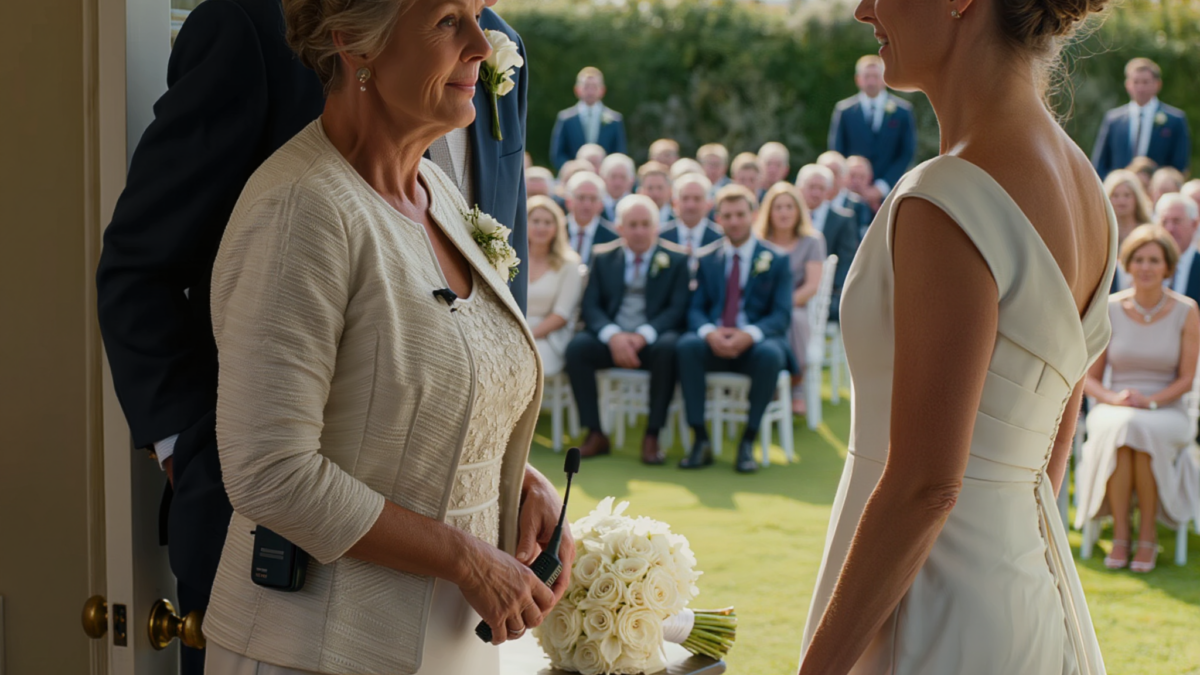
That afternoon, at the 4:15 sound check, Sloan clipped a wireless lavalier microphone onto her.
The small body pack sat at her waist beneath the jacket of her dress.
“It’s channel 2,” Sloan told her. “It runs straight to the garden speakers. Leave the pack on and I’ll keep it muted until your welcome.”
My mother left it on.
Then she forgot about it.
There was no hidden camera.
No secret recorder.
No plan involving the microphone.
I didn’t arrange what happened next.
At 4:40, the guests were taking their seats in the garden.
I was dressed and holding my bouquet, waiting for Sloan to knock.
Instead, the bridal-suite door opened.
My parents walked in.
My father closed the door behind them.
My mother spoke first.
“Give your sister half of everything you’ve saved. She’s had to watch you take the life that should have been hers.”
My father was more direct.
“Pay her right now or we walk out there and tell every guest you stole from this family.”
I looked at them.
They had discussed this exact moment in writing.
They had selected my wedding day because they believed I wouldn’t risk making a scene.
Then I noticed the small black body pack at my mother’s waist.
The microphone from the sound check.
I didn’t know whether Colin had turned the channel on.
I didn’t remind her she was still wearing it.
Instead, I gave them one more chance.
“You’d really do that on my wedding day?”
“You’ve left us no choice,” my mother said.
My hands had started to shake.
I set my bouquet down on a table.
Then I looked at them.
“Do it.”
They smiled.
That smile stayed with me.
They thought I had finally surrendered.
My mother kept talking.
Thirty seconds later, Colin brought channel 2 back up for one final speaker test before the ceremony.
My mother’s next words went directly into the garden.
“Good girl,” she said. “Transfer it to your sister now, and after today, nobody ever has to hear about what you did with our savings again.”
Outside, 120 guests heard her.
I saw the moment she realized it.
Her own voice came back through the open doorway from the garden speakers.
The people outside stopped moving the way people do when they realize they are hearing something they were never supposed to hear.
My aunt Colette rose from her seat in the third row.
My mother’s hand went to the body pack at her waist.
“Colin,” she said. “Is channel 2 on?”
It was.
The microphone exposed the pressure.
It did not explain the truth behind it.
Nobody outside knew about the mortgage yet.
Nobody knew about the statements.
Nobody knew my father had written out the plan.
That part was still mine to tell.
I picked up my bouquet and walked out of the bridal suite.
My mother remained near the doorway.
My father stared at the ground.
Instead of walking down the aisle toward the groom, I walked in the opposite direction toward the arbor.
The officiant was standing there with a handheld microphone.
I held out my hand.
He gave it to me.
The garden was so quiet that I did not need to raise my voice.
“For six years, the name on my parents’ mortgage payments was mine,” I said. “$1,850 a month. More than $130,000 so they wouldn’t lose that house.”
I looked at relatives, family friends, and some of my father’s former coworkers.
People who had heard versions of my mother’s story for years.
“They told you I stole from this family. Every payment is on my phone.”
There was no dramatic gasp.
The reaction was quieter.
People looked at each other.
A cousin leaned toward her husband.
One of my father’s old coworkers removed his glasses and rubbed his eyes.
Sloan stood at the side of the garden with her clipboard pressed against her chest.
Paige went pale.
Then my father stepped forward.
“Now, everybody,” he said, raising his hands. “This is a family matter. This isn’t the place.”
I looked at him.
“It’s exactly the place, Dad. You picked it.”
Then I opened his message.
I read it into the microphone.
“Do the house paperwork after the wedding. Get the rest from Jade at the reception. She won’t make a scene in front of everyone.”
I lowered the phone.
“You wrote that,” I said. “You planned it in order. You even wrote down the part where you were counting on me being too polite to embarrass you.”
The garden became very still.
Then Paige spoke.
She was crying, confused, looking at our parents.
“You said she’d just pay it.”
That sentence hurt more than I expected.
Until then, some part of me had still treated Paige as a passenger in the family system.
Someone who benefited from it without fully understanding what it cost me.
Her words told me she had known enough.
I stepped away from the microphone.
“I know, Paige,” I said quietly. “That was the plan.”
I could have kept going.
I had my mother’s messages too.
I had years of payment records.
I could have read every line.
I didn’t.
I had decided before the wedding that stopping their control did not require destroying them.
So I set the microphone down.
When I turned, Owen was standing at the arbor waiting for me.
He had watched everything.
He hadn’t rushed toward me.
He hadn’t grabbed the microphone or tried to defend me.
Later, he told me that standing still was one of the hardest things he had ever done.
Every instinct in him wanted to step in.
But he understood that if he took over the confrontation, he would be deciding for me just as my family always had.
So he waited.
He let the moment remain mine.
“I’m still getting married today,” I said.
Then I looked toward the third row.
“Colette, will you walk with me?”
My mother made a small sound as though she might object.
She didn’t.
Colette came up the aisle and took my arm.
I wish I could say that walking toward Owen felt like triumph.
It didn’t.
It felt like putting down something I had been carrying for so long that I had forgotten what my arms felt like without it.
My parents stood to the side.
They weren’t walking me anywhere.
For once, they were simply guests at their daughter’s wedding.
Owen and I married beneath the arbor about twenty minutes late.
My hands shook through the vows.
I cried.
Not all of the tears were happy.
Some were grief for the wedding day I had wanted.
Some were grief for the parents I had spent thirty-four years hoping they might someday become.
Owen held my hands and never asked me to pretend it was only happiness.
The reception wasn’t what we had planned.
It couldn’t be.
Half the guest list had just watched my family break apart in the garden.
Most people stayed anyway.
The afternoon became quieter than a normal wedding and, in some strange way, more honest.
At one point, one of my father’s old coworkers approached me.
He shook Owen’s hand, then took both of mine.
“Your grandmother would have been proud of you,” he said. “She saw it too. She used to tell people.”
I hadn’t known that.
Grandma Nora had been telling people that she saw what I carried.
The sentence I had spent my life waiting to hear reached me through someone else, years after she was gone.
It still counted.
My parents left early.
They didn’t say goodbye.
I watched them cross the garden toward their car.
My mother’s chin was lifted.
My father’s eyes stayed down.
I didn’t feel victorious watching them leave.
They were still my parents.
Part of me was grieving the version of them I had kept alive in my imagination for most of my life.
The story did not end at the wedding.
Within seventy-two hours, my mother began calling relatives.
She had a new version.
I had ambushed them.
I had humiliated my parents at my wedding.
I had aired private family business.
I had embarrassed my father.
I was ungrateful and vindictive.
Under other circumstances, that version might have worked.
This time, 120 people had heard her voice through the speakers.
They had heard her tell me to transfer money to my sister.
They had heard her bring up the savings she claimed I had stolen.
The story was no longer hers alone.
When my mother called Colette and tried to recruit her, Colette ended the conversation.
“Sharon, I was there. I heard it. So did everyone. Let’s not do this.”
One of my father’s former coworkers had already repeated the amount I had stated at the wedding.
$130,000.
Facts traveled faster than my mother’s explanations.
Four days after the wedding, my father’s sister called me.
She told me I had disgraced the family.
Whatever my parents had done, she said, I should not have exposed them publicly.
A good daughter would have protected her parents’ dignity.
I let her finish.
Then I asked one question.
“Did you hear the recording?”
There was a pause.
She had.
“Then you know what I protected them from for six years,” I said. “And you know how they thanked me for it. I’m not going to apologize for stopping.”
She never called again.
My parents still went ahead with the house plan.
They put the house in Paige’s name and made the arrangement official.
They gave her the security they had been promising her.
What they could not give her was six years of my payments.
The mortgage still existed.
$1,850 was still due every month.
A house doesn’t stop being a bill simply because somebody calls it a gift.
Once I stopped paying, the property became exactly what it had always been.
An obligation owed by the people living inside it.
Paige texted me late one night in June.
There was no apology.
Just one question.
“How did you do this every month for six years?”
I looked at the message for a long time.
I considered responding angrily.
I didn’t want to.
I considered comforting her.
I wasn’t ready to do that either.
So I gave her the simplest answer I had.
“I didn’t think I had a choice. You do.”
Through Colette, I heard what happened afterward.
The house that had been promised to Paige as security became an expense she couldn’t comfortably carry.
Selling it would have forced everyone to admit that what they had treated as a gift had always depended on my paycheck.
Paige took a second job.
At thirty-one, she had to learn what $1,850 really meant.
It came due whether she felt ready or not.
I didn’t enjoy knowing she was struggling.
I knew exactly how heavy that payment was.
But I also began to see that protecting Paige from every difficult consequence had never truly helped her.
It had allowed her to remain a passenger in her own life.
She and I are not close now.
Maybe we never will be.
But the silence between us is different.
The old silence required me to swallow things.
The new silence is simply distance.
I did not put my parents on the street.
I gave them the options sheet I had prepared.
Refinance.
Sell.
Downsize.
I offered to explain any of those choices the way I would explain them to a client.
The one time I spoke to my father after the wedding, I told him exactly where my boundary was.
“I’ll help you understand the options. I won’t pay them for you.”
He didn’t thank me.
I wasn’t expecting him to.
The consequences weren’t punishments I had invented.
They were simply the financial weight of the house landing on the people who lived there.
At the end of May, about three weeks after the wedding, I went back to my parents’ house one last time.
I let myself in with Grandma Nora’s key.
Nobody came out to meet me.
I didn’t need them to.
I walked into the kitchen and placed the key on the counter.
For years, I had believed Grandma’s words meant that keeping the house standing was my responsibility.
Standing there, I finally understood something else.
I was allowed to decide that it wasn’t my house to hold up.
I didn’t leave a note.
There was nothing left to explain.
I put the key down and walked outside.
Out of habit, I reached back to lock the door.
Then I realized I couldn’t.
I had just returned the key.
I stood on the porch and laughed once at the strangeness of it.
For the first time in my adult life, I could no longer walk into that house whenever I wanted.
It didn’t feel like being locked out.
It felt like being free.
The house remained standing.
My parents remained alive.
The world did not collapse because I stopped paying.
What ended was my role in a family story where my primary value was what I could provide.
Owen and I have our own place now.
It’s not big.
It’s ours.
Both our names are on the paperwork.
Both our paychecks contribute to the mortgage.
There is a new key on my ring where Grandma Nora’s old one used to be.
Colette visits on Sundays sometimes.
My parents and I have little contact.
Occasionally there is a text that neither side quite knows how to answer.
There was no apology.
No tearful reconciliation.
No moment when my mother finally admitted she understood everything I had done.
I stopped waiting for one.
One day, while Owen and I were unpacking boxes in our new place, he looked at me and asked, “You okay?”
For once, it was simply a question.
Not a request.
Not a problem I had to solve.
Not a bill waiting for me.
“Yeah,” I said.
And I was.
People who know what happened sometimes ask whether I wish the wedding confrontation had been quieter.
I didn’t choose the microphone.
That part was an accident.
But I don’t regret that the truth became loud.
For most of my life, my family’s version of me existed in rooms where I wasn’t present to answer it.
I had been taught that correcting the story meant making a scene, and making a scene was the worst thing I could do.
The hot microphone changed that.
I didn’t destroy my family that afternoon.
My family was already what it was.
I simply stopped being the wall that kept everyone from seeing it.
For thirty-four years, they told me I could handle anything.
They meant it as both a compliment and an assignment.
For most of my life, I accepted both.
They just never imagined that the one thing I would finally decide to handle was leaving.
Turns out I could.
It was the easiest bill I ever paid.








