Twelve hours after our wedding, my wife calmly told me we’d live separate lives—and that I’d still fund hers. I said nothing. By 8:12 the next morning, her $150,000 transfer was frozen, her penthouse access was gone, and a legal envelope arrived with her new married name on it.
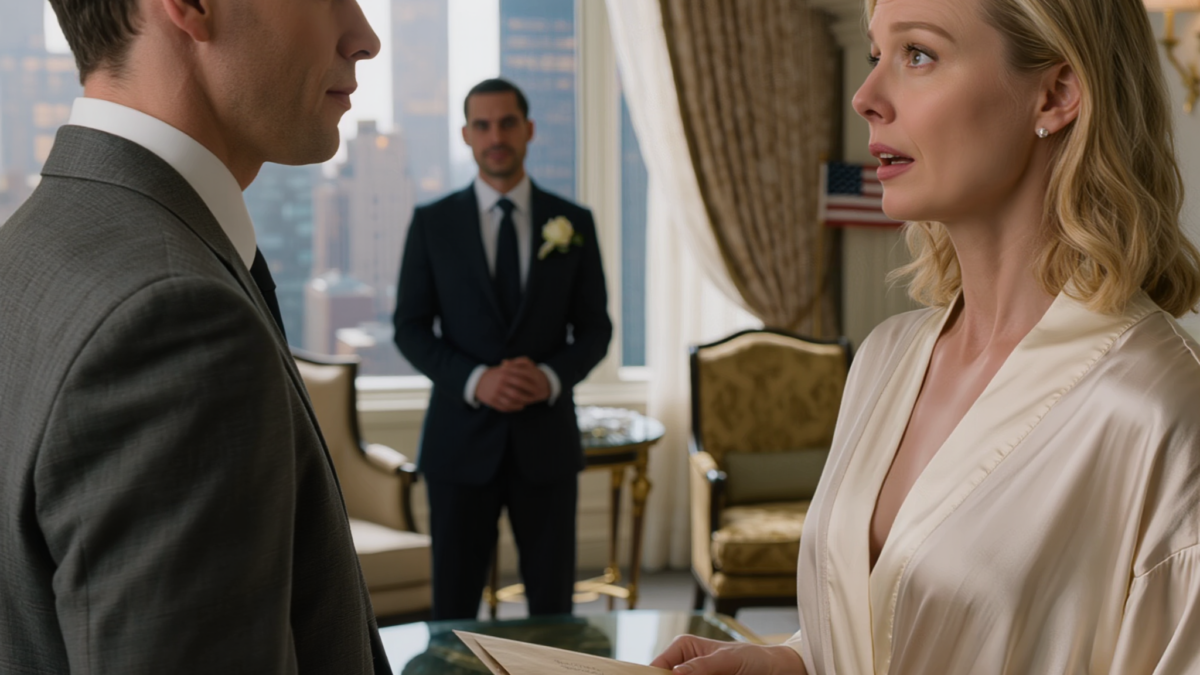
I am Ryan, 32 years old. Exactly 12 hours after I stood at a flower-draped altar and promised my entire life to the woman I genuinely believed was my soulmate, my brand-new wife looked me dead in the eye, took a sip of her champagne, and told me our marriage was nothing but a calculated financial arrangement.
While I was standing in our luxury honeymoon suite, still wearing my tailored tuxedo pants, my heart full of hope and excitement for our future, my wife Chloe unzipped her custom silk wedding gown.
She did not look at me with love. She did not reach out for an embrace.
Instead, she poured herself a drink, turned to me with an expression of absolute ice, and said, “Now that we are married, we live separate lives. I get your money to maintain my status. You get my physical presence when social appearances require it, and you never, ever ask where I go.”
She laughed right in my face.
It was a cold, hollow sound.
She was completely, utterly confident that she had successfully trapped a naive, desperately in-love middle-management guy into funding her lavish lifestyle for the rest of his natural life.
Her parents, Eleanor and Kenneth, had been in on it the entire time.
They had mocked my supposed salary. They had pushed the wedding forward, and they had plotted to drain every cent I had to save themselves from a mountain of toxic debt.
They thought they had secured their golden goose.
But there was one massive, earth-shattering thing they did not know.
I was not the struggling corporate employee driving a beat-up Honda Accord that they thought I was.
I was the silent sole owner of the massive private-equity firm they were secretly drowning in debt to.
And right now, as I tell this story, her mother is begging in the marble lobby of my corporate headquarters while her entire family faces serious financial charges and total financial ruin.
The wedding reception at The Plaza had been nothing short of spectacular.
We had 200 guests, towering arrangements of white roses that cost more than some people’s annual salary, and a live string quartet.
I remember standing by the ice sculpture, looking over at my new mother-in-law, Eleanor. She was dabbing her eyes with a lace handkerchief during the toasts.
She played the part of the emotional mother perfectly.
My father-in-law, Kenneth, was clapping my shoulder, puffing his chest out in his tuxedo as he paraded me around his country-club friends.
I thought I had finally found it.
The family I had always wanted. The loyalty I had craved ever since I started building my businesses from scratch in my early twenties—a journey that had left me wealthy but incredibly isolated.
When the heavy mahogany doors to the penthouse suite finally closed behind us at 2:00 in the morning, I let out a massive sigh of relief.
The cameras were gone. The superficial chatter was over.
It was just us.
I took off my jacket, loosened my bow tie, and walked over to my beautiful bride.
I expected a romantic evening. I expected her to kick off her heels and fall into my arms, relieved that the stress of planning was finally behind us.
Instead, Chloe walked right past me.
She went straight to the minibar.
Her posture was entirely different. The warm, affectionate, slightly vulnerable woman I had dated for two years had completely vanished.
She had been replaced by someone rigid, calculated, and entirely unfamiliar.
“Now that we’re married, we need to establish some ground rules,” she said.
Her back was to me as she popped open a bottle of champagne provided by the hotel.
I chuckled, leaning against the doorframe. I honestly thought she was making a joke about who got to control the television remote or who had to make the coffee in the morning.
“Sure, whatever you want, honey. The remote is yours.”
She turned around.
Her eyes were devoid of any warmth.
“I’m serious, Ryan. We live separate lives. Marriage is about stability, family expectations, and most importantly, appearances. I want my freedom. There will be no questions about where I go on weekends. No checking my phone. No expectations of physical affection unless we’re attending a public event for my parents’ social circle. You provide the lifestyle I’m accustomed to, and I provide the image of a happy wife.”
I just stood there.
The silence in the room was so heavy it felt like it was crushing my lungs.
I waited for the punchline.
I waited for her to crack a smile, tell me she was messing with me, and throw her arms around my neck.
But she just took a slow sip of champagne, her expression completely flat and serious.
“You should have told me this before the wedding,” I said.
My voice was barely a whisper. I could feel my heart pounding against my ribs.
She offered a cynical, condescending little smile.
It was the exact same smile her mother, Eleanor, used when looking at service workers.
“If I had told you before the wedding, you wouldn’t have married me, and my parents need the optics of this marriage right now. It’s just business, Ryan. Don’t make it weird. Just deposit the $150,000 into the joint account tomorrow morning like we agreed, and we’ll get along just fine.”
The cruelty in her voice was not accidental.
It was calculated. Practiced.
She had rehearsed this speech in her head.
She had stood at the altar, looked me in the eyes, held my hands, and promised to love and cherish me, knowing full well she was going to deliver this speech the second the door locked behind us.
I did not scream.
I did not throw anything.
I did not cry.
Years of sitting in high-stakes boardroom negotiations and dealing with hard-nosed corporate negotiators had taught me one critical lesson.
When someone shows you their hand, you do not react emotionally.
You strategize.
You observe.
You gather your assets, and you prepare your next move.
I simply nodded.
I kept my face entirely neutral.
“Understood.”
That one word unsettled her.
I saw a flicker of confusion in her eyes.
She expected a fight. She expected me to beg or maybe get angry and yell so she could play the victim and storm out, giving her the perfect excuse to avoid me while still demanding the money.
I denied her that satisfaction.
I quietly went to the bathroom, changed out of my suit into a simple T-shirt and sweatpants, took a spare blanket from the closet, and lay down on the living-room couch.
I stared at the ornate ceiling for hours, listening to the muffled sounds of New York City traffic below.
I had been a husband for exactly six hours, and my marriage already felt like a case file.
I did not sleep a single minute.
My mind was running a thousand miles an hour, cataloging every lie, every red flag, and every single dollar.
At 5:40 the next morning, before the sun had fully crested over the Manhattan skyline, I got up.
I did not feel heartbroken anymore.
The grief had burned away into a cold, searing focus.
I picked up my phone and made my first call.
It was to Nathan Brooks, my executive assistant, who was already at his desk.
“Nathan, it’s Ryan. Execute Protocol Zero. Lock it all down. Revoke all secondary access to the penthouse real-estate systems. Cancel the Maldives itinerary completely. Don’t leave a single reservation active, and flag the upcoming wire transfer to the joint account. Stop it in its tracks. Nothing goes through.”
“Consider it done, Mr. Mitchell,” Nathan replied, not asking a single question.
I made a second call to my wealth manager to freeze all secondary credit lines.
I made a third call to Marcus, my lead attorney, telling him to meet me at my real home by 10:00.
By 7:00 a.m., the financial shutdown was fully prepared.
I was sitting in the armchair drinking black coffee I had ordered from room service when Chloe walked into the living room at 8:12 a.m.
She was wearing a silk robe and holding her phone, and her face was completely drained of color.
She looked like she had just received devastating news.
I thought the worst was over.
I was incredibly wrong.
Chloe stood frozen in the center of the room, staring at her phone screen. Her thumb was frantically tapping the glass, refreshing an app over and over again.
She finally looked up at me with wide, panicked eyes.
I did not say a word.
I just took another slow sip of coffee, letting the silence stretch out while I watched the reality of her situation begin to settle in.
To understand how we got to this exact moment of panic on her face, you have to understand the massive lie I had been living for the past two years.
As I mentioned, I am a wealthy man.
I own a private-equity firm that handles multimillion-dollar real-estate portfolios, corporate buyouts, and distressed-debt management.
But I never wanted a woman to love me for my net worth.
I had seen too many colleagues go through painful public divorce settlements, losing huge portions of their assets to partners who had seen them as little more than walking bank accounts.
I wanted someone who loved the man, not the money.
So when I met Chloe at a charity gala for a children’s hospital, I introduced myself as a mid-level project manager at a logistics firm.
I parked my vintage Porsche 911 in a secure private garage across town and bought a five-year-old used Honda Accord with cloth seats for my daily commute.
I rented a modest two-bedroom apartment under a corporate LLC to serve as my fake home.
I kept my primary residence—a sprawling glass-walled penthouse in Manhattan—completely hidden from her.
I wore generic suits off the rack.
I complained about my fictional boss to make myself sound like a normal everyday guy struggling to climb the corporate ladder.
Chloe seemed absolutely perfect.
She was beautiful, vibrant, and she told me she loved how hard I worked.
She packed me lunches. She rubbed my shoulders when I pretended to be stressed about my fake spreadsheets.
But looking back now, with the clarity of hindsight, the red flags had been waving right in front of me.
I just chose not to see them because I was desperate for a family.
The most glaring warnings always came from her parents.
Her father, Kenneth, fancied himself a high-society aristocrat.
He was always bragging about his alleged stock investments and his golf handicap, though I had quietly noticed he drove a leased mid-range car and his country-club membership was constantly on the verge of suspension for unpaid dues.
Her mother, Eleanor, was significantly worse.
She was the unyielding gatekeeper of their social image, constantly judging everyone by their ZIP code and the designer labels on their clothes.
I vividly remember a Thanksgiving dinner at their house a year into our relationship.
I had brought a nice but reasonably priced bottle of Cabernet.
Kenneth looked at the label, smirked, and set it on the kitchen counter like it did not belong there, pushing it behind a bottle of imported olive oil.
“So, Ryan,” Kenneth said loudly across the dining table, making sure the entire extended family could hear him over the turkey, “still grinding away in middle management at that logistics place? You know, a salary like that barely covers a decent college fund for future kids, let alone a proper mortgage in a respectable neighborhood like ours.”
I looked at Chloe, expecting her to defend me.
She just looked down at her plate, pushing her mashed potatoes around.
Eleanor immediately chimed in, offering a fake sympathetic smile.
“Well, Kenneth, not everyone has your natural business acumen. Ryan is doing his best with what little he has. We just have to hope he gets a promotion soon so our Chloe doesn’t have to lower her standard of living permanently.”
I swallowed my pride that night.
I forced a smile and took the humiliation.
I told myself they were just protective parents, anxious about their daughter’s future.
I told myself Chloe was the golden child caught in the middle of their insufferable snobbery and that once we were married, I could take her away from their toxic influence.
I wanted to believe she loved me for me.
Everything shifted into high gear three months before the wedding.
We had originally planned to marry in late November, which gave us plenty of time.
Then Eleanor suddenly called an emergency family meeting on a Tuesday night.
She paced the living room, claiming a once-in-a-lifetime venue cancellation had opened a date at The Plaza and that we absolutely had to move the wedding up to early September.
“It’s a sign from the universe, Ryan,” Eleanor insisted, gripping my arm with surprising, almost desperate strength. “We have to lock this in right now. You two need to secure this date tomorrow. It will be the social event of the season.”
I was hesitant.
Rushing a wedding forward by two months was incredibly stressful and financially draining.
But Chloe broke down in tears, begging me to give her this dream wedding, saying it was all she had ever wanted since she was a little girl.
I caved.
I paid the exorbitant rush fees, pretending I had to dip heavily into my life savings and 401(k) to make it happen.
Then came the demand for the joint account.
Two weeks before the wedding, Chloe approached me in my fake apartment with a sweet, innocent smile.
She said her parents were deeply traditional and wanted to see that we were combining our lives financially before giving us their final blessing.
She asked me to deposit $150,000 into a newly opened joint account the exact morning after our wedding.
“It’s just for our security, babe,” she whispered, kissing my cheek. “For a down payment on a starter house. I want to prove to my dad that we’re in this together as a team.”
Because I loved her, and because $150,000 was literal pocket change in my actual world, I agreed.
I scheduled the wire transfer for 9:00 a.m. on the morning after our wedding night.
I viewed it as a wedding gift—a solid foundation for our fake middle-class life until I felt we had built enough trust for me to reveal my true wealth.
Then came the wedding night.
The mask finally slipped.
The arrogant separate-lives speech.
The horrific realization that I was nothing but a mark.
A financial stepping stone for a family obsessed with appearances.
Back in the hotel room, the clock on the nightstand hit 8:14 a.m.
Chloe finally found her voice.
“What did you do?” she demanded, her voice trembling, her knuckles white as she gripped the phone.
I carefully set my coffee mug down on the glass table.
“I woke up early, folded my blanket on the couch, and did exactly what you asked for, Chloe. Separate lives.”
She turned the phone screen toward me.
It was the smart-home application for the penthouse.
I had finally shown her the property a month earlier, claiming I had inherited a trust fund from my late grandfather and used it to buy the place outright so we could move in after the honeymoon.
She had been absolutely thrilled.
She had spent the last four weeks excitedly ordering custom, nonrefundable Italian furniture for it.
Now the app was displaying a bright red error message.
Access revoked. Owner override.
“You locked me out of our home,” she hissed, her face shifting from panic to entitled rage.
“My home,” I corrected her, keeping my voice calm as I leaned back in my chair.
“I bought that penthouse through a private investment company long before I ever met you. You have never contributed a single dollar to the mortgage, property taxes, or the exorbitant HOA fees. It was going to be our marital home. But since you announced last night that our marriage is nothing more than a theatrical performance for your parents’ country-club friends, the invitation is permanently rescinded.”
“You’re being childish,” she yelled, pacing the room, the silk robe billowing around her.
“I told you I wanted separate lives socially, not financially. You’re my husband. You have obligations to provide for me.”
I almost laughed.
I actually felt a genuine smile tugging at the corner of my mouth.
“Of course. You want separate rules for your behavior but shared benefits from my bank account. You want a financial sponsor, Chloe, not a life partner.”
Before she could respond, her phone started ringing wildly on the table.
The caller ID flashed brightly on the screen.
Eleanor.
Chloe practically lunged across the room to answer it, hitting the speakerphone button in her panic.
“Chloe, what on earth is going on?” Eleanor’s frantic voice blasted through the hotel room. “The travel agency just called me. Why did they say the Maldives itinerary has been completely canceled? What happened to the first-class flights?”
Chloe looked at me, her mouth hanging open in shock.
“That was my second phone call this morning,” I said loudly, making sure Eleanor could hear every syllable. “The entire trip was booked on my personal credit card. Since Chloe informed me there is no ‘us’ anymore, I canceled my ticket, and then I canceled hers.”
“This is insane!” Chloe shouted, dropping the phone onto the unmade bed.
Eleanor’s voice came through the speaker again, her fake high-society accent completely gone.
“Ryan Mitchell, you pick up this phone right now and explain yourself. You are humiliating my daughter. You are ruining everything.”
But I was not looking at the phone.
I was looking at the silent notification that had just appeared on my secure tablet beside my coffee.
What I read made my stomach tighten.
The situation was much bigger than a canceled honeymoon.
It was a high-priority security alert from my primary corporate banking institution.
Critical alert: attempted override on scheduled wire transfer.
Secondary authorization code used.
Initiator: Trevor Sullivan.
Status: blocked by Protocol Zero.
Trevor Sullivan.
My accountant.
My supposed best friend from college.
The guy who knew exactly how much money I really had.
The guy who had helped me set up the LLCs and manage the illusion of my middle-class life so my identity would not leak.
He had administrative access to my lower-tier accounts to pay my fake apartment rent and handle my daily expenses.
And he had just tried to force the $150,000 transfer through to Chloe’s joint account, aggressively attempting to bypass my cancellation order.
The betrayal landed like a heavy blow.
They had not simply manipulated me.
They had reached into my inner circle.
They had bought off my own accountant.
I picked up Chloe’s phone from the bed.
“Eleanor,” I said, my voice cutting cleanly through her frantic rambling, “if you ever speak to me like this again, I will make sure every questionable financial decision tied to this family gets reviewed by the people whose job it is to review them. Do not call this number again.”
I ended the call and blocked her contact.
Chloe was hyperventilating now, grasping the edge of the dresser for support.
“You can’t do this. The transfer—the money is supposed to be there at nine. You promised. You swore in front of my father.”
“I promised a lot of things to a woman who didn’t actually exist,” I replied.
I picked up my own phone and dialed Trevor’s direct line.
He answered on the second ring, sounding breathless and nervous.
“Hey, Ryan. Look, man, the bank system is acting super weird this morning. I was just trying to push through that—”
“You’re fired, Trevor,” I said, my tone flat and final.
“You are stripped of all fiduciary access as of thirty seconds ago. My legal team is drafting a major action against you for breach of contract, unauthorized access to secure financial systems, and attempted unauthorized financial activity. You have until noon to clear out your desk before corporate security escorts you out of the building.”
“Ryan, wait. Please let me explain.”
Trevor’s voice cracked.
“Chloe’s family—her mother, Eleanor—they came to me. They offered me a cut. They said it was just an advance on her inheritance from you, that you wouldn’t even notice it was gone. I’m drowning in debt, man. I needed the money. They promised me twenty grand if I just made sure the wire cleared this morning.”
I hung up.
I did not care about his excuses.
I did not care about his debt.
He had sold me out for a fraction of what I paid him in annual bonuses.
I looked back at Chloe.
She was backed against the wall, clutching her silk robe tightly around herself.
Her arrogant, entitled facade had shattered.
She was realizing in real time that the strings she thought she was pulling were closing in around her.
“You canceled the transfer,” she whispered, her voice shaking.
Then genuine fear appeared in her eyes.
“Ryan, you don’t understand. I need that money. We need that money today.”
“There is no ‘we,’ Chloe,” I reminded her. “Remember? Separate lives. You get my presence at parties, and I keep my money. That was your deal.”
“What about the investment?” she blurted out.
I stopped.
I narrowed my eyes.
“What investment?”
Her eyes darted wildly around the room.
She clamped a hand over her mouth.
She realized she had just said too much.
“Nothing. Just—just forget it. Please, Ryan. Please authorize the transfer. I’ll be a good wife. I’ll be whatever you want me to be. I’ll cancel the separate-lives thing. I was just stressed from the wedding.”
The desperation was revealing.
This was not simply about designer handbags or paying for a fancy car.
This was about survival.
There was a massive hole somewhere in their finances, and I was the designated solution they had planned to shove into it.
Before I could press her further, there was a sharp, authoritative knock at the suite door.
Chloe jumped.
I walked over and opened the heavy wooden door.
Standing there was James Holloway, the general manager of The Plaza, looking extremely uncomfortable in his morning suit.
He was holding a thick legal-sized manila envelope.
“Mr. Mitchell, I apologize for the intrusion on your first morning,” James said, keeping his eyes respectfully lowered. “This was delivered by a private legal courier downstairs ten minutes ago. They were incredibly insistent. They said it was a matter of urgent legal importance and had to be handed directly to the occupants of this specific suite.”
I took the envelope.
It felt heavy.
“Thank you, James. I appreciate your discretion.”
I closed the door, locked the deadbolt, and looked at the front of the envelope.
It was addressed to Chloe Mitchell.
The ink was barely dry on our marriage certificate.
The ink was barely dry on her new last name, and she was already being served with legal paperwork.
I tossed it onto the glass coffee table.
“Open it.”
Chloe shook her head furiously, terrified even to look at it.
“No. It’s private mail. You can’t force me.”
“Open it, Chloe, or I walk out that door right now and you never see a single dime from me. Not even for a taxi ride back to your parents’ house.”
With violently shaking hands, she reached out, tore open the envelope, and pulled out a thick stack of legal papers.
As her eyes scanned the first page, she let out a choked sob.
Her knees buckled, and the documents slipped onto the floor.
I stepped forward and picked them up.
It was a formal, heavily documented payment-demand notice—a precursor to a major civil lawsuit and asset seizure.
The creditor was listed as a commercial real-estate holding company.
The debtor was listed as Chloe Walsh.
The amount due, payable immediately to avoid asset seizure and serious legal consequences for financial misconduct, was exactly $96,000.
And the final deadline for payment was Monday.
Today.
I looked at the document, tracing the numbers, then looked down at her.
“$96,000. What is this, Chloe?”
She slid down the wall and sat on the carpet, burying her face in her hands, her shoulders heaving.
For the first time since I met her at that charity gala, the arrogant, entitled woman I knew seemed completely broken.
“I owe people money,” she sobbed.
“How much?”
She swallowed hard, refusing to look at me.
“More than you think.”
The scattered pieces of the puzzle began slamming into place in my mind.
The sudden, frantic rush to move the wedding up from November to early September.
The exact timing of the joint-account transfer.
The covert involvement of my own accountant to ensure the money moved regardless of my wishes.
It was a carefully orchestrated financial scheme disguised as romance.
And I was the bank account they were trying to open to save themselves.
I walked over to the closet and grabbed my overnight bag, which I had already packed in silence while she was sleeping.
I slung it over my shoulder and walked toward the door.
“Where are you going?” she cried, scrambling to her feet and nearly tripping over her robe.
“Ryan, please. You can’t leave me here. They’re going to ruin me. My parents put the family house up as collateral for my loans. If I don’t pay this by noon today, we lose everything. We’ll be on the street.”
I paused at the door, my hand resting on the cool brass handle.
I looked back at the woman I had promised my life to just a few hours earlier.
The woman who had looked at me with disgust and told me we lived separate lives.
“You should have thought about that before you told me how your version of marriage works.”
I walked out and let the heavy door close behind me.
I thought I knew the depth of their deception.
I thought I had seen the worst of it.
But as I got into a cab on Fifth Avenue and headed to my real penthouse, I realized the $96,000 demand letter was just the tip of a very dark financial iceberg.
The cab ride back to my penthouse was a blur of early-morning city lights, yellow taxis, and a cold anger that settled deep in my chest.
I did not go back to the modest fake apartment I had used as my cover for the last two years.
I told the driver to head straight to my real home, a sprawling multimillion-dollar residence in the sky inside one of the most exclusive buildings in Manhattan.
As I walked through the lobby, the security guards nodded respectfully.
They did not see the middle-management guy Chloe thought she had married.
They saw the man who owned the building’s management company.
By the time the private elevator doors opened directly into my living room, my lead attorney, Marcus Warren, was already sitting at my twelve-foot dining table.
His laptop was open, and he was surrounded by towering stacks of financial readouts, corporate filings, and background-check reports.
Marcus is relentless in a three-piece tailored suit.
He has been my right-hand man since my first major corporate acquisition, and he simply does not lose.
“Rough honeymoon, boss?” Marcus asked without looking up from his glowing screen, his fingers flying across the keyboard.
“The absolute worst.”
I walked over to the bar cart and poured myself three fingers of scotch.
It was barely 10:00 a.m., but I did not care.
The burn in my throat matched what I was feeling.
“Talk to me, Marcus. What exactly did Nathan uncover when we froze the accounts this morning? How deep is this hole?”
Marcus finally turned his laptop around so I could see the screen.
It was a complex web of LLCs, shell companies, and red ink.
“Your wife and her family aren’t just bad with money, Ryan. They’re a walking financial disaster. We did a deep dive into the public records and the hidden LLCs associated with Kenneth and Eleanor Walsh. That $96,000 demand letter you sent me a photo of? That’s just the appetizer.”
I leaned over the table, bracing my hands against the polished wood and staring at the cascading numbers on the screen.
“Show me everything.”
“Over the last three years, Chloe engaged in a phantom restaurant venture with a guy named Dylan Harrison,” Marcus explained, using a silver pen to point at a labyrinth of corporate filings. “Harrison isn’t just a businessman. He fronts money for failing businesses at extremely high interest rates, masking the arrangements as investments. Chloe promised him $100,000 in capital that she never actually had. When she couldn’t pay, Kenneth and Eleanor secretly co-signed private high-interest loans to cover her tracks, using their own home as collateral.”
“And that wasn’t enough?”
“Not even close.”
Marcus tapped another page.
“Then they took out massive lines of credit on multiple premium cards to maintain their country-club lifestyle—to keep up the appearance of wealth while the debt compounded daily.”
“What’s the total?”
Marcus looked me dead in the eye.
“$310,000. And that’s just the principal. All of it is due immediately because they missed three consecutive restructuring deadlines. Their creditors were closing in this week. That’s exactly why Eleanor was so frantic to move the wedding up to September. They desperately needed your $150,000 transfer this morning just to hold off Dylan Harrison. And they planned to pull the rest from your accounts slowly over the next year by disguising it as household expenses.”
I took a slow sip of scotch.
The sheer audacity of it was staggering.
They had not just manipulated my feelings.
They had weaponized my affection and my desire for a family to save themselves from a financial mess of their own making.
“And Trevor?” I asked. “How did he factor into this?”
“Trevor was promised a $20,000 payment directly from Eleanor’s hidden slush fund to ensure the transfer went through this morning, regardless of any cancellation authorization you issued.”
Disgust edged Marcus’s voice.
“He sold you out for pennies. We’ve already had corporate security secure his company laptop and phone and lock him out of the building. But, Ryan, there’s something else. Something much worse.”
Marcus reached into his leather briefcase, pulled out a physical document inside a plastic sleeve, and laid it flat on the table under the overhead light.
It was a high-quality photocopy of a legal form bearing the raised seal of a notary public.
The title across the top in bold black letters read:
Marital Asset Authorization.
“What is this?”
My stomach dropped as I picked it up.
“I intercepted this from Trevor’s outbound encrypted emails before we shut his server access down,” Marcus said grimly. “It’s a legally binding document authorizing Chloe Walsh to leverage your real-estate assets—specifically this penthouse and your hidden Vanguard investment portfolios—as collateral for external commercial loans. Look at the bottom of the second page.”
I flipped to the last page.
There, sitting perfectly on the signature line in blue ink, was my name.
Ryan Mitchell.
My stomach turned.
I had never seen this document in my life.
I had never signed it.
I had never even discussed my Vanguard portfolios with her.
“They forged my signature,” I whispered, tracing the ink with my finger.
“Trevor provided them with the legal template and high-resolution samples of your signature from old tax returns,” Marcus confirmed. “I’ve already sent digital scans to Scott Bradley, one of the best forensic handwriting experts on the East Coast. He called me ten minutes before you walked in. The inconsistencies are glaring. The pressure points are wrong. It’s an amateur forgery, but it could have been enough to fool a desperate lender for a few days.”
I walked over to the floor-to-ceiling windows and looked down at the sprawling city below.
My wife had not simply married me for money.
She and her family had been actively attempting to reach my assets through a forged financial document.
“They thought I was a middle-management idiot,” I said quietly.
The anger inside me was becoming focused.
“They thought I was just some average guy pulling in eighty grand a year who would be too intimidated by their fake high-society status to fight back. They thought I would roll over and pay to keep the peace.”
I turned around.
“They picked the wrong guy.”
“Boss,” Marcus said, closing his laptop with a sharp snap, “what’s the play? Do we call the authorities, hand over the forgery evidence to the district attorney, and let the legal process handle it?”
I looked down at the city.
That would have been easy.
Too easy.
They had humiliated me.
They had looked down on me.
Eleanor had treated me like a man who should feel lucky simply to be allowed into her family, and Chloe had treated me like a bank account with a wedding ring.
I did not simply want an immediate confrontation.
I wanted them to understand exactly how badly they had misjudged the situation.
“No,” I said. “Not yet. We let them think they still have a chance. Where does Dylan Harrison’s debt paper currently reside? Who holds the actual paper for the $310,000?”
Marcus tapped a few keys on his phone, checking a database.
“It’s held by a subsidiary debt-collection agency called Apex Financial, which is owned by Vanguard Holdings. Why?”
Vanguard Holdings was a massive corporate entity that, on paper, looked like a faceless conglomerate.
But if you dug through the shell companies, blind trusts, and boards of directors, all roads eventually led back to one man.
Me.
“Call Alexander Vaughn,” I instructed Marcus.
Alexander was a billionaire partner of mine and the public-facing chairman of Vanguard Holdings.
“Tell him I need a personal favor. Tell him we’re acquiring the entirety of the Walsh family debt and pulling it from the subsidiary, effective immediately. I want to own every single cent they owe. I want their entire financial future sitting in my hands.”
Marcus’s eyes widened as he realized exactly what I was doing.
Then he smiled.
A knowing, professional smile.
“Consider it done, Ryan.”
I looked back out at the city.
The situation was no longer happening to me.
I was controlling it.
And the Walsh family had absolutely no idea that the man they were trying to manipulate was about to become the person with the final say over their financial future.
For the next 48 hours, I completely disappeared as far as my new wife and her family were concerned.
I did not return a single phone call.
I did not reply to a single frantic text message.
I did not log into any social-media accounts.
I let the silence do the heavy lifting.
If you want to deal with people who thrive on arguments, sometimes the strongest response is simply to remove their access to your energy and let their own anxiety fill the space.
My secure cell phone, sitting on the marble kitchen island of my penthouse, became a constant stream of escalating panic.
Chloe went through every emotional stage in record time.
First came anger and demanding texts about how I was overreacting, claiming a real husband was supposed to protect his wife’s investments and honor his financial commitments.
When I did not reply, it turned into voicemails of her sobbing, swearing she loved me with all her heart and that her mother had pressured her into the separate-lives speech.
Finally, it was Eleanor.
She left a voicemail on Wednesday morning that I actually saved to my hard drive, simply because it perfectly captured the audacity of the situation.
Her voice was shrill, the fake high-society accent completely gone.
“Ryan Mitchell, you listen to me right now. If you do not authorize that bank transfer immediately, I will personally call your boss at the logistics firm. I will tell Human Resources that you are mistreating my daughter, and I will make sure you never get another promotion or salary increase in your miserable life. You will be blacklisted. You owe us this inheritance advance. Call Chloe right now.”
I sat in my leather armchair, drinking a cup of black coffee and watching morning traffic move through the city below while Marcus meticulously constructed the legal trap we were about to place in front of them.
By Wednesday afternoon, everything was set.
Marcus had officially processed the paperwork through Vanguard Holdings.
We had purchased the entirety of the Walsh family’s toxic debt from Apex Financial, using our position as the parent company.
The paper for the $310,000—plus accumulated interest and late penalties—was now sitting inside a thick leather folder on my coffee table.
I owned it.
Literally and legally.
That evening, I finally picked up my phone and sent Chloe one brief text message.
“We need to talk. Bring your parents. The Oak Room tomorrow morning at exactly 10:00 a.m. Do not be late.”
The Oak Room was an incredibly exclusive private dining club in Midtown Manhattan.
Its membership fee cost more than a luxury car, and its waiting list stretched for years.
It was exactly the kind of place Kenneth and Eleanor liked to pretend they belonged in but could never actually afford to enter.
I knew the moment they saw the location, they would assume I was trying to impress them.
They would think I was ready to grovel, apologize for my behavior on our wedding night, and hand over my checkbook to keep the peace.
When Marcus and I walked into the private dining suite at exactly 10:00 the next morning, the scene at the table was almost comical in its predictability.
Kenneth sat at the head of the long polished mahogany table, wearing a dark suit that looked as if it had been tailored a decade ago.
He was trying to appear imposing, puffing his chest out as though the room belonged to him.
Eleanor was seated tightly beside him, sipping sparkling water with a slice of lemon, her chin tilted upward in the arrogant pose she had perfected at country-club luncheons.
Chloe sat across from them.
She looked terrible.
The confident, icy, entitled woman from our wedding night was gone.
She had deep circles under her eyes. Her blonde hair was pulled back in a messy bun, and she was nervously shredding a white cloth napkin in her lap.
Then there was the fourth person at the table.
Dylan Harrison.
I had never met Dylan in person before that morning, but Marcus’s background check had painted a vivid picture.
Dylan made his money providing fast cash to desperate people who could not get approved by traditional banks, disguising the arrangements as private-equity investments.
He wore a flashy pinstriped suit that was slightly too tight across the shoulders, an oversized gold-colored watch, and enough cheap cologne to announce his arrival before he spoke.
He was leaning back in his velvet chair, picking his teeth with a wooden toothpick, looking completely out of place in the elegant dining room.
I walked in slowly, buttoning my suit jacket, Marcus directly behind me carrying his heavy leather briefcase.
“Well, it’s about time,” Kenneth said loudly, leaning forward and putting both hands flat on the table, trying to take control of the room immediately. “I hope you’ve spent the last few days thinking long and hard about your responsibilities as a man, Ryan, because frankly, your behavior on your wedding night—walking out on your bride—was nothing short of disgraceful.”
I did not answer him immediately.
I calmly pulled out a chair opposite them and sat down.
Marcus stood silently behind me, his hands clasped casually in front of him, observing the room with the detached calm of a seasoned negotiator who already knew far more than the other side.
“I’ve thought about a lot of things over the last 48 hours, Kenneth,” I said evenly. “For instance, I’ve been thinking about the $96,000 demand letter that was delivered to my honeymoon suite by the hotel manager.”
Chloe flinched visibly.
She looked down at the polished wood table, unable to meet my eyes.
Eleanor let out a dramatic, condescending sigh and waved her hand dismissively.
“Oh, Ryan, please don’t be so dramatic. It’s simply a minor cash-flow issue. Chloe was trying to build a restaurant business. She was trying to secure a future for your potential children. You should be proud of her entrepreneurial spirit. But since you’re so tightly wound and insecure about your little salary, we brought Dylan here today to help smooth things over and restructure the payments.”
Dylan leaned forward, resting his forearms on the table.
“Look, buddy. Your wife got into a little financial bind with a commercial project. It happens. Business is risky. But she owes me money, and her parents put their house on the line to guarantee it. Now, I’m a reasonable guy. I hear you’ve got a decent chunk of change saved up. Maybe a college fund you never used or some 401(k) savings. You sign over $150,000 today as a good-faith payment, and I’ll restructure the rest of the debt so her parents don’t end up losing their house. It’s a win-win for everyone involved.”
I looked at Dylan, taking in his suit and arrogant posture.
Then I shifted my gaze to Chloe.
“Is this true, Chloe? You want me to drain what you think is my entire life savings to pay off a private lender for a restaurant that never even existed outside of an LLC filing?”
“Do not call him that in public,” Kenneth snapped, his face turning red. “He is a private-equity investor. And yes, Ryan, that is exactly what you are going to do today. When you marry into this family, you take on the family burdens. You share the load. That is how a real marriage works.”
“I see.”
I nodded slowly.
“That’s fascinating, because I distinctly remember Chloe looking me dead in the eye on our wedding night and telling me we live separate lives. I believe her exact words were that she gets my money to maintain her status and I get her physical presence when social appearances require it. I don’t recall ‘sharing the load’ being part of her speech.”
Chloe’s head snapped up.
“Ryan, stop. Please. My parents don’t know I said that to you.”
“Oh, I think they know exactly what you said, Chloe.”
I leaned back in my chair and crossed my arms.
“Because Eleanor orchestrated the entire thing down to the exact timing, didn’t you, Eleanor? You pushed the wedding up from November to September because Dylan gave you a hard deadline for the balloon payment on the loans. You needed my money before foreclosure paperwork was filed against your precious suburban home.”
Eleanor’s eyes narrowed.
The elegant act vanished.
“You listen to me very carefully, you ungrateful little pencil pusher. We accepted you into our home. We let you marry our beautiful daughter when you were clearly reaching above your station. The least you can do is sign the papers and show some gratitude. Otherwise, we’ll annul this marriage so fast your head will spin, and we’ll bury you in an emotional-distress lawsuit.”
“Speaking of signing legal papers,” Marcus finally said.
His voice cut through the tension.
He reached into his briefcase and pulled out a stack of documents.
“Mr. Harrison, I believe you have a contract you want my client to sign this morning.”
Dylan grinned and slid a thick, heavily stapled legal packet across the polished wood table.
“Yeah, I do. This is a standard assumption-of-liability form. It transfers the $310,000 debt fully into your name, Ryan. Your wife and in-laws get released as guarantors completely, and you become solely responsible for the principal and interest. You sign this, wire the first payment today by noon, and we’re all good.”
I looked down at the document.
It was legally binding, completely one-sided, and designed to destroy the financial life they believed I had while allowing them to walk away and continue their fake country-club lifestyle.
“And if I don’t sign it?” I asked, looking directly into Kenneth’s eyes.
Kenneth slammed his hand onto the table, rattling the crystal water glasses.
“If you don’t sign it, you are proving that you are exactly the pathetic, weak little man I always knew you were. You will lose Chloe today. You will lose this family forever. And I will personally make sure everyone in our social circle knows you abandoned your wife in her greatest time of need.”
I let the heavy silence hang in the air.
I looked at the three of them.
They were unbelievably confident in their manipulation.
They genuinely thought my love for Chloe—or my fear of public embarrassment and losing a family—would force me to put pen to paper.
They thought they had outsmarted the system and secured their golden ticket.
I slowly reached into the inside pocket of my suit jacket and pulled out my favorite silver fountain pen.
I deliberately uncapped it.
The metal made a soft click.
Chloe released a shuddering breath of relief.
She actually smiled.
The tension left her shoulders.
Eleanor sat back in her chair, smug satisfaction washing across her face.
Kenneth crossed his arms like a man who believed the negotiation was over.
“You’re doing the right thing, Ryan,” Chloe whispered, her eyes shining with carefully manufactured gratitude. “I promise I’ll make this up to you. We can go back to how things were.”
“I know you will, Chloe,” I said quietly.
But I did not press the pen to their contract.
Instead, I set it gently on the table beside the paperwork.
I looked at my watch.
It was exactly 10:15 a.m.
“Right on time,” Marcus murmured, glancing toward the window.
I looked at Kenneth.
All warmth left my face.
“I’m not going to sign your contract, Kenneth, because I don’t need to assume liability for your debt.”
I paused.
“I already own it.”
The smug satisfaction on Eleanor’s face disappeared instantly.
Kenneth uncrossed his arms and leaned forward, a deeply confused scowl forming on his forehead.
“What are you talking about?” he demanded, looking from me to Marcus and back again. “What do you mean you own it? You don’t have that kind of money, Ryan. Stop playing games and sign the paper before Dylan loses his patience.”
“He isn’t playing games, Kenneth,” Marcus said smoothly. “And I strongly suggest you lower your voice in this establishment.”
At that exact second, the heavy mahogany doors to the private dining room opened.
The maître d’ stepped aside, looking nervous and deferential, and gestured for the new arrival to enter.
A hush fell over the table.
Walking through the door was Alexander Vaughn.
Alexander was a billionaire.
He was the chairman of Vanguard Holdings, a man whose face regularly appeared in Forbes and The Wall Street Journal.
He wore a bespoke midnight-blue suit and carried the kind of unquestioned authority Kenneth Walsh had spent his entire life trying to imitate.
Outside the window, three stories below, I could see Alexander’s matte-black Rolls-Royce idling quietly at the curb with a chauffeur nearby.
Kenneth’s jaw dropped.
He recognized Alexander immediately.
Everyone in the New York financial and social scene knew who he was.
Alexander ignored Kenneth, Eleanor, and Chloe and walked directly over to me, extending his hand.
“Ryan,” he said with unmistakable respect. “Apologies for interrupting your meeting. I brought the finalized corporate portfolios you requested. The acquisition of Apex Financial’s distressed-asset ledger was completed and notarized at 9:00 this morning. Your signature is already on file.”
I stood and shook his hand.
“Thank you, Alexander. I appreciate you bringing them personally. You didn’t have to make the trip.”
“Of course, boss.”
Alexander handed a thick leather-bound folio directly to Marcus, gave me a polite nod, and walked back out.
The silence in the Oak Room was absolute.
Kenneth stared at me, his eyes wide with horror and bewilderment.
“Boss?” he whispered. “Did Alexander Vaughn, chairman of Vanguard Holdings, just call you boss?”
I slowly sat back down.
I did not adjust my suit.
I did not raise my voice to match their earlier shouting.
I simply looked at them.
“Allow me to formally reintroduce myself to the family.”
The room was completely still.
“My name is Ryan Mitchell. I am the founder, majority shareholder, and CEO of Vanguard Holdings. The logistics firm I told you I worked for? Vanguard owns it. It is a tiny subsidiary we acquired three years ago. The modest apartment I lived in while dating your daughter? A corporate holding we use for out-of-town contractors. My actual home is a $12 million penthouse that you, Chloe, were trying to decorate using my money.”
Chloe let out a small gasp and clapped both hands over her mouth.
Her eyes darted back and forth as she tried to process the magnitude of what I was saying.
Eleanor started shaking her head.
“No. No, that’s impossible. You drive a used Honda Accord with cloth seats. You complained to Kenneth about your salary. You’re lying. This is some elaborate joke to get out of paying the debt.”
“The Honda was a prop, Eleanor.”
I held her gaze.
“It was a test. A test to see whether your daughter could genuinely love a man for who he was rather than what he could buy for her. A test to see whether this family had any values beyond ZIP codes and country-club memberships.”
I paused.
“And you all failed spectacularly.”
I turned my attention to Dylan Harrison.
He was suddenly looking incredibly nervous, perspiration gathering beneath his collar as he realized he was completely out of his depth.
“Dylan, Apex Financial—the agency used to back these high-risk loans—is a subsidiary of Vanguard Holdings. We specialize in acquiring distressed, high-risk debt from smaller collection agencies. As of 9:00 this morning, Vanguard Holdings purchased the entirety of the Walsh family ledger from Apex. We bought their loans, their credit-card debt, and the liens on their house. We bought it all for pennies on the dollar, which means they don’t owe you a single dime anymore.”
Dylan blinked.
“Wait. You bought their debt? You’re the parent company?”
“Yes.”
I kept my voice level.
“And you received your money from the corporate acquisition, which means your presence here is no longer required. You can leave now. If I discover you are conducting business in this city without the proper licensing, I will make sure the appropriate people review it.”
Dylan did not say another word.
He grabbed his briefcase and hurried out of the private dining room.
Now it was just family.
I looked back at Kenneth and Eleanor.
They looked physically ill.
The arrogant high-society facade they had worn for years was disappearing, exposing the terrified, financially desperate people beneath it.
“You own our debt?” Kenneth whispered, his face pale, his hands trembling on the table. “Ryan, you’re our sole creditor.”
“Yes, Kenneth.”
There was no warmth in my expression.
“I hold the mortgage on your house. I hold the loans for the fake restaurant venture. I hold every credit line you maxed out paying for country-club dues, designer clothes, and lavish vacations you couldn’t afford.”
I leaned back.
“You owe me $310,000, payable immediately under the terms of the original agreement you signed.”
“Ryan, please,” Chloe cried.
Tears streamed down her face, ruining her expensive makeup.
She reached across the table, trying to take my hand.
I moved it away.
“We didn’t know,” she said. “I swear I loved you. If I had known who you really were, I never would have said those things on our wedding night. I would have been the perfect wife.”
I looked at her.
“That is exactly the problem, Chloe. You would have been the perfect wife to the CEO of Vanguard Holdings, but you treated Ryan, the logistics manager, like he didn’t matter. You only respect power and money. You don’t know the first thing about love, loyalty, or equal partnership.”
Eleanor was breathing rapidly now.
“We’re family, Ryan. You can’t do this to us. We can work this out. You have millions of dollars. This is nothing to you. It’s pocket change. Just forgive the debt. Consider it a wedding gift.”
“A wedding gift?” Marcus said.
He opened his briefcase and pulled out the clear plastic sleeve containing the forged document.
He placed it in the center of the table.
“Like this little wedding gift you prepared for my client behind his back?”
Kenneth looked down at the document.
The remaining color left his face.
“The Marital Asset Authorization,” I said. “A document authorizing Chloe to leverage my penthouse and my private Vanguard investment portfolios to pay off your lender. A document my former accountant, Trevor Sullivan, helped create.”
I tapped the signature line.
“The document where you forged my signature.”
“We didn’t,” Eleanor stammered. “That wasn’t us. Trevor must have done that on his own. We didn’t know.”
“Save it for the legal process, Eleanor,” Marcus said. “We have Trevor’s internal emails. We have his sworn statement admitting you offered him $20,000 from your hidden fund. And we have a forensic handwriting report confirming the signature is not authentic. These are serious financial matters with serious consequences.”
Chloe buried her face in her arms and sobbed.
Kenneth looked faint, clutching the edge of the table and breathing heavily, unable to form a coherent sentence.
“You thought you were incredibly smart,” I said, keeping my voice controlled. “You thought you could look down on me, humiliate me at Thanksgiving dinners, rush a wedding to get access to my money, and use my name to rescue yourselves from financial ruin. You thought I was someone you could push around.”
I looked at each of them.
“You badly misjudged me.”
Marcus reached into his briefcase one final time.
He pulled out a thick stack of pristine white papers secured with a blue legal cover.
He placed them gently on the table in front of Chloe.
“What is that?” she asked, barely looking at them.
“Divorce papers.”
I stood and buttoned my suit jacket.
“The marriage lasted less than a week. It will be legally annulled on the grounds of fraud. You will sign the necessary papers, waiving any claims to spousal support, alimony, or my assets. If you contest this or attempt to claim money from me, I will provide the financial documents to the appropriate legal authorities and let the process proceed.”
I looked down at them one last time.
The devastation in their eyes was the payoff I had been waiting for since our wedding night.
It was not about the money.
It never had been.
It was about respect.
It was about establishing a boundary so clear that they would never think about crossing it again.
“Have a nice breakfast,” I said quietly.
I turned toward the door.
“The bill is on you.”
Marcus walked out beside me, leaving them at the table with the consequences of their own decisions.
The fallout from that morning in the Oak Room was swift.
When a toxic family finally loses control, the consequences can keep unfolding for weeks.
But I had built a strong wall around my life, my assets, and my peace of mind.
They could no longer reach me.
Marcus did not wait around for them to process what had happened.
The moment we stepped outside into the crisp Manhattan morning air, he made a phone call and initiated the formal foreclosure process on Kenneth and Eleanor’s home.
Because Vanguard Holdings was now the sole holder of their debt, I had control over the collection timeline.
I did not give them a thirty-day extension.
I did not negotiate a friendly payment plan.
I demanded the $310,000 in full, exactly as the original contract they had signed dictated.
Naturally, they did not have the money.
They never had.
Two days later, the real panic set in.
I was sitting in my spacious corner office at Vanguard Holdings, reviewing an upcoming corporate acquisition, when the lobby security desk called my private line.
“Mr. Mitchell,” the head of security said, sounding annoyed and confused, “there’s a woman down here named Eleanor Walsh. She’s causing a scene in the main lobby. She’s demanding to see you, claiming it’s an urgent family emergency. She says she won’t leave until you come down and speak to her face-to-face.”
I calmly pulled up the high-definition security-camera feed on my secondary monitor.
There she was.
Eleanor Walsh.
The woman who used to turn her nose up at the wine I brought to Thanksgiving.
The woman who scoffed at my fake salary.
She was standing in the marble lobby of my building wearing oversized sunglasses indoors and clutching her designer handbag like a life preserver while arguing with a security guard.
She looked desperate.
“Do not let her past the turnstiles,” I instructed the guard. “Tell her Ryan Mitchell has no family by that name. If she refuses to leave the premises within sixty seconds, follow the building’s standard trespassing procedure.”
I watched the guard relay the message.
Eleanor’s face crumpled.
She stopped arguing.
She began crying in the middle of the corporate lobby while executives in tailored suits walked past without engaging.
She finally realized she had no leverage.
Her country-club status and carefully constructed social image meant nothing in the real world of contracts, debt, and legal consequences.
After about thirty seconds, she turned around and walked through the revolving doors.
Her shoulders were slumped.
I never saw her again in person.
The divorce was finalized quickly.
Chloe signed the papers three days after the restaurant meeting.
She did not hire a lawyer.
She could not afford one.
She knew that if she tried to claim my assets through a prolonged legal battle, Marcus would provide the forged-document evidence to the appropriate authorities.
She signed the waiver, legally relinquishing any claims to my estate, my businesses, and my real estate.
But signing the divorce papers did not magically save her parents from financial ruin.
I kept my word about not pursuing the harshest possible legal penalties for the forgery, mostly because a prolonged case would require my time and energy, and I wanted them entirely out of my life.
But I did not stop the financial consequences.
Within three months, their large suburban house was seized as part of the debt process.
The house Kenneth had always bragged about.
The house they had used as collateral for Chloe’s fake restaurant venture.
It was auctioned to satisfy a portion of the debt.
I heard through mutual acquaintances that they desperately tried to move in with some of their wealthy country-club friends.
But the moment their social circle discovered they were broke and facing public foreclosure, those friendships evaporated almost overnight.
Eleanor and Kenneth were forced to pack their remaining belongings into a rented truck and move into a small two-bedroom apartment on the outskirts of the city.
Kenneth had to swallow his pride and take a job as a floor manager at a retail hardware store just to cover groceries and basic expenses.
It was a severe reality check for a man who had spent years mocking my fake logistics career.
His Tuesday-afternoon golf games and expensive cigars were over.
Now he clocked in and out wearing a name tag.
As for Chloe, her life completely derailed from the fairy tale she had planned.
The debt did not magically disappear because she signed divorce papers.
While the sale of her parents’ house covered part of the loans, the remaining balances still followed her.
Without my money funding her lifestyle, she was forced to get a real job for the first time in her life.
The last I heard, she was working as a front-desk receptionist at a dental clinic and spending her weekends dealing with collection calls tied to her maxed-out credit cards.
Dylan Harrison’s specific debt had been acquired by my company, but Chloe’s reckless personal spending over the years had left her dealing with other creditors as well.
There was no custody battle over children.
Thankfully, we had not been married long enough for that to become an issue.
The only thing they truly lost custody of was the illusion of their own superiority.
I did not celebrate their downfall.
There were no champagne corks popping in my office.
No victory toast.
I did not feel joyful.
Honestly, it felt more like attending the funeral of a toxic relationship.
Sad.
Quiet.
Necessary.
I had ended a destructive relationship before it could damage the rest of my life.
I had protected my assets.
I had protected my peace of mind.
More importantly, I had protected my self-respect.
They had looked at me and seen a weak victim.
What they discovered instead was that I was the person with the ability to make the final decisions about my own life.
A full year passed.
The dust completely settled.
The Walsh family became nothing more than a distant, unpleasant memory—a cautionary tale I kept in the back of my mind whenever I met someone new.
I threw myself into my work at Vanguard Holdings, aggressively expanding our commercial real-estate portfolios across the country and securing a major promotion for Marcus, making him a senior partner at the firm.
I was thriving.
I was wealthy.
I was healthy.
Most importantly, I was completely free from the burden of a fake relationship.
Then, on a crisp Tuesday afternoon in October, just as the leaves were beginning to turn brown, I received a text message from an unknown number on my private cell.
Ryan, it’s Logan, Chloe’s younger brother. I know you probably hate my entire family right now, and I don’t blame you at all, but I have something you need to see. Can I buy you a cup of coffee?
Logan was the only member of the Walsh family who had never actively insulted me.
He was younger, quieter, and usually stayed far away from his mother’s plotting.
He had skipped the wedding reception entirely, claiming he had a stomach bug, and I had not spoken a word to him since the day I walked out of the hotel suite.
Curiosity and a strange sense of closure got the better of me.
I agreed to meet him at a small, quiet café near Central Park.
When I walked in, Logan was already sitting in a corner booth, looking incredibly nervous.
He had a manila folder sitting on the table in front of him.
“Ryan,” he said, standing quickly to shake my hand. “Thanks for coming. I know this is weird, reaching out after a whole year.”
“It’s fine, Logan.”
I sat across from him.
“What is this about? If Chloe or your mother sent you to ask for money or a loan, you can save your breath. The answer is no.”
“No. No, absolutely not,” Logan said quickly, shaking his head. “I don’t speak to them much anymore. My mom is unbearable now that they’re broke. She sits in that apartment all day complaining about how unfair the world is. This isn’t about them getting money.”
He looked down at the folder.
“It’s about giving you the truth. The whole truth.”
He slowly pushed the manila folder across the table toward me.
“I was cleaning out my old laptop yesterday,” Logan explained, his voice low and slightly ashamed. “I found some screenshots that had automatically synced from a family group chat from two years ago—the exact week after you and Chloe first met at that children’s hospital charity gala. I wasn’t going to show you, but I felt like you deserved to know you weren’t imagining things. You were targeted from day one.”
I opened the folder.
Inside were several printed screenshots of text messages between Eleanor, Kenneth, and Chloe.
The first message was from Eleanor.
Timestamp: two days after the gala.
Chloe, I saw the guy you were talking to at the gala. Ryan Mitchell. Kenneth ran a quiet background check on his name through a friend at a private-investigation firm.
Chloe’s reply:
The logistics guy? He’s cute, but he drives a terrible Honda Accord. I’m not interested in struggling, Mom.
Eleanor’s next message made my stomach drop.
He is lying, Chloe. He doesn’t drive a Honda. Kenneth’s friend saw him leave the gala parking garage in a vintage Porsche 911 registered to a corporate LLC linked to Vanguard Holdings. The man is loaded. He is a multimillionaire playing some kind of undercover game. He is testing you.
Chloe’s reply came five minutes later.
Are you serious? A Porsche? Are you sure?
Eleanor replied:
Dead serious. Play dumb. Act like you love his work ethic. Eat his cheap dinners. Pretend you don’t care about money at all. Once you have a ring on your finger and the ink is dry on the marriage certificate, we secure the bag. He’ll be so desperate to keep his “normal wife” happy that he’ll pay off Dylan Harrison’s debt without batting an eye. Play the long game, honey. He is our way out.
Chloe’s reply was simple.
Understood. Securing the bag.
I stared at the papers.
I read those words over and over.
Securing the bag.
Play dumb.
Play the long game.
It had never been real.
Not a single second of it.
The sweet lunches she packed for me.
The long walks in the park where she pretended to care deeply about my fake corporate stress.
The vows she read at the altar with tears in her eyes.
From the very first days of our relationship, I had been nothing more than a financial rescue plan they had meticulously engineered after noticing a luxury car leaving a parking garage.
“I’m sorry, Ryan,” Logan said quietly, watching my face. “I should have warned you. I really should have. But I was terrified of my mom, and by the time the wedding happened, everything was moving so fast. I just wanted you to have closure. I wanted you to know the truth.”
I closed the folder.
I did not feel angry anymore.
That anger had burned itself out a long time ago.
What I felt instead was an overwhelming sense of relief.
Any lingering doubt I had—any small voice in my head that wondered whether maybe I had been too harsh—went quiet.
“Thank you, Logan,” I said sincerely, tapping the folder. “You have no idea how much I needed to see this. You’re a good kid. Don’t let their toxicity drag you down with them.”
I paid for his coffee, took the folder, and walked out into the crisp autumn air.
That evening, I stood on the balcony of my penthouse watching the sunset paint the New York City skyline in brilliant shades of orange and gold.
I held a glass of scotch in one hand and a slightly crumpled piece of paper in the other.
It was the original copy of my wedding vows.
I had found it tucked inside a desk drawer a few weeks earlier while cleaning.
I read the words I had written.
I had promised honesty.
I had promised true partnership.
I had promised unwavering loyalty and unconditional respect.
I had not failed those vows.
I had meant every word when I said them.
I had simply offered them to a woman who interpreted partnership as unrestricted access to a bank account and loyalty as a willingness to accept financial manipulation.
I did not tear the vows up.
I folded them neatly and placed them in my pocket.
They were a reminder of the man I was.
A man capable of deep, genuine love.
The fact that Chloe could not appreciate that was her loss, not mine.
I took a slow sip of scotch, feeling the cool evening breeze against my face.
I had survived the ultimate betrayal.
I had successfully separated our lives, our accounts, our names, and our futures.
Chloe had wanted a husband whose money was unconditionally shared while his expectations remained entirely separate.
Instead, she taught me the most valuable lesson of my life before our marriage even reached the breakfast table.
When someone looks you in the eye and tells you exactly how little your partnership means to them, believe them.
Do not argue.
Do not try to prove your worth.
Pay attention to what they have shown you, protect your boundaries, and make sure the life you build afterward reflects the respect you expect from the people allowed to share it.








