Three days after my grandfather’s funeral, my brother flew to Bali expecting to spend his $210,000 estate while my parents told me, “Desmond needs this inheritance more than you do.” I didn’t fight them. As the estate executor, I took Winston’s will and my court papers back to the bank. By Wednesday afternoon, an Indonesian number lit up my phone—and Desmond wasn’t bragging anymore.
I was standing at the worn porcelain sink in my grandfather Winston’s lake house when the message came through.
The water running over my hands was almost too hot, but I barely noticed it. I was washing Winston’s favorite coffee mug, a heavy blue ceramic one with a chipped rim and a faded lighthouse painted on the side. He had used that mug almost every morning for thirty years while sitting at the kitchen table and watching the fog roll across Crescent Cove.
Three days earlier, I had stood in freezing October rain while his casket was lowered into the ground.
Since then, I had handled funeral arrangements, catering, relatives, paperwork, and the uncomfortable presence of my immediate family. I was exhausted in a way sleep could not fix. Every room in the lake house felt too quiet without Winston’s voice in it.
Then my phone buzzed against the granite counter.
I dried my hands and picked it up.
The message was from my older brother, Desmond.
“Transfer went through. We’re in Bali. Don’t wait up.”
I stared at the screen for a long time.
A normal reaction might have been panic. I could have called the bank immediately. I could have demanded to know what Desmond had done. I could have called my parents and started another argument about the money.
Instead, I placed the phone face down beside the sink and went back to drying Winston’s mug.
Desmond believed he had finally gotten what he wanted.
What he did not know was that I had already taken steps to protect the estate.
That moment had been building for years.
My parents, Harrison and Brenda, had always treated Desmond differently from me. He was the son whose mistakes needed explanations, whose ambitions deserved funding, and whose wants somehow became family priorities.
When he married Bianca, that pattern became impossible to ignore. My parents took out a second mortgage on their modest suburban house to help pay for a $70,000 country club wedding because they did not want Bianca’s wealthier friends judging the event.
I had learned not to compete for their approval.
I built my own life. I worked as a paralegal at a law firm. Clara, my wife, had her own corporate job. We paid our bills and stayed mostly out of the family drama.
The one relationship that never felt like a competition was my relationship with Winston.
His lake house was not glamorous. The porch railings peeled. The roof needed patching before winter. The garage smelled like old tools, oil, and decades of mechanical work.
To Winston, the garage was almost sacred.
He had been a master mechanic, and he cared for his tools with the same quiet discipline he brought to everything else. A vintage 1967 Porsche 911 sat there under his protection, but what mattered to him was never just the value of the car or the property.
Clara and I spent countless weekends helping him maintain the place.
We patched the roof, painted the porch, fixed things that broke, and sat with him on the cushioned window seat overlooking the water. On Sundays, we drank black coffee and ate apple cake like the kind my grandmother used to make before she passed away.
Those weekends became some of the most important memories of my adult life.
Desmond saw the house differently.
He and Bianca usually showed up for about two weeks in July. They treated the property like a free vacation resort. They used the boat for social media photos, complained about mosquitoes and the internet connection, and worked their way through Winston’s expensive bourbon.
One summer, Bianca became furious because the Wi-Fi was not fast enough for her to upload a video, even though Winston, already in his eighties, had just stood over the stove making dinner for everyone.
My parents defended them.
“Desmond is a very busy entrepreneur, Nolan,” my mother would say whenever I objected. “We should be grateful he makes time to visit at all.”
According to her, my job was simple.
Desmond had pressure.
Desmond had an image to maintain.
About two years before Winston died, everything changed.
He began forgetting small things.
At first, it was a wrench placed in the wrong drawer or a garden hose left running. Then he would walk into the kitchen and forget why he was there. Eventually, he began forgetting people’s names.
The diagnosis was a rapidly progressing form of dementia.
Watching it happen was brutal because Winston understood what was happening before the disease fully took hold. During those earlier months, when he still had long periods of clarity, he began putting his affairs in order.
One rainy Tuesday in November, he called me to the lake house.
He was sitting at the kitchen table with the blue lighthouse mug in front of him. Beneath his hands was a thick manila folder.
He looked tired.
For a while, neither of us said anything. Rain tapped against the windows while he studied me from across the scratched wooden table.
Then he pushed the folder toward me.
“Nolan,” he said, “I need the person who actually understands this stuff to be in charge of it.”
I opened the folder.
Inside was an updated will prepared by a local attorney, the deed to the lake house, the title to the 1967 Porsche, and statements from the savings account Winston had built over decades.
The account was meant to help maintain the property, cover taxes, and protect what he had built.
Winston had chosen me to be in charge of the estate.
He had also been watching the family more closely than anyone realized.
“I know exactly what happens when families fight over money,” he told me. “I see how your parents look at Desmond with blinders on.”
Then his expression hardened.
“And I see exactly how Desmond looks at my garage and this property. He doesn’t see a home, Nolan. He sees a payday.”
I knew what the documents would do to our family.
“Grandpa, this is going to cause a war.”
“Let it.”
For a moment, I heard the mechanic I had grown up with again, the man who could turn stubbornness into something almost immovable.
“You are the only one in this bloodline who respects what this place actually means,” he said. “Your brother would pave over your grandmother’s garden to put in a patio for his rich friends. And he would sell my cars to the first bidder to pay his credit cards.”
Then he asked me for one thing.
“Promise me you will protect this house and everything in it.”
I promised.
I took the folder home, locked it inside a fireproof safe, and told no one except Clara.
Over the next eighteen months, Winston’s condition deteriorated.
And something strange happened.
Desmond and Bianca suddenly became remarkably attentive.
They began coming to the lake house on weekends. Bianca brought expensive herbal teas. She sat beside Winston and played the role of the devoted granddaughter-in-law.
Desmond started asking financial questions.
How much were the property taxes?
Was the house becoming too expensive to maintain?
How much were nearby lakefront properties selling for?
What could a vintage Porsche bring at auction?
My parents interpreted every question as proof that Desmond had matured.
One afternoon, my mother cornered me in the hallway.
“Isn’t it wonderful how Desmond is finally stepping up?” she said. “He’s going to make a wonderful head of the family when Winston is gone. You should learn from his example.”
I said nothing.
Helen, the hospice nurse helping care for Winston during his final months, was less impressed.
One evening, she pulled me aside and told me she had caught Bianca going through Winston’s private desk drawers in the study when she thought everyone else was asleep.
At the time, I assumed greed was the whole story.
I thought Desmond and Bianca were positioning themselves for a larger inheritance.
I did not realize how far things had already gone.
Winston passed away on a quiet Tuesday in late October.
The lake outside his window was almost perfectly still. Orange and yellow leaves moved through the birch trees around the house.
At the graveside, Clara held my hand as the casket was lowered into the damp ground.
I had lost the closest thing I had ever had to a father who truly understood me.
The reception afterward made the loss even harder.
Desmond wore an expensive tailored suit and moved through the lake house shaking hands, talking to neighbors, and receiving condolences as though he were already assuming some formal position at the head of the family.
My parents stayed close to him.
They made sure his glass was full.
They protected him from anything uncomfortable.
I was asked about the catering bill and the trash.
Then they all stayed at the lake house for five days.
Within hours, grief gave way to money.
Desmond followed me through the house asking when I would begin the probate process. He suggested finding ways around the normal waiting periods so the family could get access to the money sooner.
Then he brought up selling the property.
“We should really list this place before winter,” he told me one morning.
I was washing dishes while he leaned against the kitchen counter drinking espresso.
He said a luxury real estate agent named Sylvia believed developers would pay top dollar for the lakefront lot.
“We could split the cash fifty-fifty, pay the estate taxes, and everyone walks away happy and rich,” he said. “It is exactly what Grandpa would have wanted.”
I stopped washing the pan in my hands.
“The house isn’t being listed.”
Desmond looked at me.
“The terms of Grandpa’s will are clear. The property stays in the family. I’m responsible for following his instructions.”
His expression changed immediately.
He reminded me that I had a stable salary. Clara had a good job. We were doing fine.
He, however, had a business to expand.
He needed liquidity.
In his version of events, Winston would have wanted the estate money used to help his entrepreneurial ambitions.
My mother had been listening from the dining room.
She came into the kitchen and took his side without hesitation.
“Your brother needs this inheritance more than you do, Nolan,” she told me. “Don’t be selfish with Winston’s money. We are a family and we share.”
I left the kitchen and walked down to the dock.
The argument was no longer about what Winston had written.
It was about what my family believed Desmond deserved.
The night before they left, Bianca tried a different approach.
She found me alone in the kitchen and told me I looked exhausted. Managing the accounts, bills, attorneys, and paperwork was too much for one person, she said.
She and Desmond could help.
They could manage the savings accounts and investments while I dealt with the legal paperwork.
I declined.
She smiled and told me to think about it.
That night, I could not sleep.
At around 2:00 a.m., I went into the living room and opened the shared family laptop. I intended to check an email from work.
Desmond had left his browser open.
On the screen was a debt-consolidation dashboard.
I began reading.
There was more than $38,000 in high-interest debt spread across four maxed-out platinum credit cards.
Their upscale city condo was four months behind on its mortgage and facing pre-foreclosure.
And the landscaping company Desmond still presented to everyone as a successful business had filed for bankruptcy three months earlier.
Suddenly, the last several days made sense.
The pressure to sell the house.
Bianca’s offer to manage the estate accounts.
Desmond’s obsession with property values.
They were not planning an expansion.
They were drowning.
Two days after they returned to the city, my office phone rang.
The caller was Marcus, a senior loan officer at a regional bank branch two towns away.
Winston had once held a small loan there years earlier, so his financial profile still existed in their system.
Marcus offered condolences and then told me there was a serious problem.
Someone had presented paperwork claiming Winston had agreed, shortly before his death, to use the 1967 Porsche 911 as collateral for a $55,000 personal loan.
The money had already been disbursed to an outside joint account.
I gripped my pen.
“Marcus, my grandfather couldn’t even hold a pen in his final weeks. He had severe dementia.”
Marcus told me the bank’s internal audit team had already noticed something was wrong.
The signature on the collateral agreement did not match Winston’s signature on file.
The notarization raised more questions. It came from a shipping store in a county about two hours away.
I wrote down everything Marcus told me.
Until then, I had been dealing with family entitlement.
Now there was a document tied to Winston’s car and a signature the bank itself had questioned.
I asked Marcus to preserve the relevant records and footage connected with the transaction.
Then I went home.
Clara was in the kitchen preparing dinner when I arrived.
I told her everything.
The debt.
The mortgage.
The failed business.
Bianca going through Winston’s desk.
And now the loan against the Porsche.
Clara listened.
Then she asked what we were going to do.
The following morning, I went to the bank that held Winston’s actual estate savings account.
I brought the death certificate, the original will, my court documents, and the paperwork showing my authority over the estate.
The account held $210,000.
I had the money transferred into a more secure estate trust account under my name and Clara’s.
Then I instructed the bank to put exactly $12,000 back into the old account.
I wanted the estate protected.
I also knew Desmond had been watching the account.
From the bank, I returned to the law firm and went straight to my supervising attorney, Mr. Henderson.
He had thirty years of litigation experience.
I gave him everything I had.
The timeline.
The loan document Marcus had sent.
The details of the signature issue.
Mr. Henderson read it all carefully.
Then he told me the situation was far more serious than an inheritance dispute.
Over the next forty-eight hours, we began documenting everything.
Detective Miller at the county prosecutor’s office received a preliminary fraud report.
Records connected to the notary were examined.
That was when another connection surfaced.
The notary stamp carried the name Silus Vance.
Late one night, while searching through old social media photographs and tagged posts, I found a college graduation photo from about ten years earlier.
Standing next to Silus was Bianca.
According to the records we gathered, Bianca had also made a fourteen-minute phone call to Silus at 9:47 p.m. the night before the loan paperwork was submitted.
The situation looked very different now.
There was bank footage showing Desmond submitting the paperwork.
There was the disputed signature.
There was the notary connection.
And there was the phone record linking Bianca to the notary before the transaction.
I organized the material in a thick black binder.
Then I went back to the lake house.
I sat on the porch beside Clara with Winston’s blue mug in my hands and waited.
Desmond and Bianca had already left the country.
They had booked expensive first-class tickets and flown toward Bali, apparently expecting the estate money to finance the trip.
I knew roughly when they would land.
I knew when they would reach the resort.
And I knew the account they expected to use no longer held $210,000.
Three days later, on a quiet Wednesday afternoon, my phone lit up on my desk.
The number was international.
Indonesia.
I let it ring three times.
On the fourth, I answered.
“Nolan, what the hell did you do?”
Desmond sounded nothing like the brother who had messaged me from the airport.
The confidence was gone.
I could hear the sounds of a resort lobby behind him.
“I did my job,” I said. “I secured the estate assets.”
He exploded.
The transfer had failed.
His banking app showed insufficient funds.
He accused me of stealing his inheritance.
He insisted Winston had wanted the money divided equally.
I waited until he stopped.
Then I told him about the Porsche.
I told him I had the $55,000 loan paperwork.
I told him the bank had questioned the signature.
I reminded him that Winston had been in the final stage of dementia and could not have handled a complex collateral agreement.
Desmond went silent.
Then another voice appeared on the call.
My mother.
He had brought our parents into a three-way call.
Brenda demanded that I transfer the money back. She said Bianca was crying in the hotel lobby and that the resort was threatening to involve local authorities over the unpaid booking.
Then she threatened me with a lawsuit over the way I was handling the estate.
My father joined in.
He accused me of jealousy.
Desmond, he said, was an entrepreneur willing to take risks. I had chosen a safe paralegal salary.
According to him, I was using my position to ruin my brother’s vacation.
Then he threatened to cut Clara and me out of the family completely.
For years, threats like that had mattered to me.
That afternoon, they stopped working.
I asked Desmond if he was still listening.
Then I told him what I knew.
The $38,000 in credit card debt.
The four months of missed mortgage payments.
The bankruptcy filing for his landscaping business.
His voice cracked.
“You went through my laptop.”
I reminded him that he had left a shared family computer open in Winston’s house.
Then I returned to the only issue that mattered.
The debt itself was not the crime.
The loan paperwork was.
The Porsche had been appraised at $152,000 when Winston updated his insurance policy the previous year. Yet someone had used it to obtain $55,000 quickly, based on a signature the bank had flagged as not matching Winston’s records.
My mother tried to explain it away.
“It was just a misunderstanding,” she said. “Desmond was going to pay the loan back. It’s family property anyway. He just needed an advance.”
I told her estate property was not the same thing as something Desmond could use whenever he wanted.
Then Bianca took the phone.
Her tone changed immediately.
She wanted everyone to calm down and talk like rational adults when they returned.
She said grief had made everything confusing.
Then she said, “You know how much Desmond and I loved Harold. We were just trying to protect the assets from depreciation.”
I cut her off.
The loan was for $55,000.
The Porsche was worth far more than that.
This was not about protecting the car.
It was about getting cash quickly.
Desmond shouted from the background that they would repay the money.
I asked him how.
The business had failed.
The mortgage was behind.
The credit cards were maxed out.
And the estate money was no longer available to them.
Then I gave him a choice.
They could return to the United States and meet with me, Clara, and Mr. Henderson. They could sign an agreement giving up any attempt to contest the estate. The estate would pay the fraudulent loan so the Porsche title could be cleared, and I would decline to pursue the forged-signature complaint further. Desmond would receive exactly what Winston had designated for him: $15,000 and the contents of the old workshop.
Or I could proceed with the complaint and allow the entire dispute to move through the courts.
For the first time on the call, Desmond sounded frightened.
My mother asked whether I would really allow things to go that far over money and a car.
But that was the part she still did not understand.
This was not about punishing Desmond.
It was about the promise I had made to Winston.
My family had spent years assuming that because I was the reliable one, I would always be the one who gave way.
They were wrong.
Four days later, Desmond and Bianca flew home.
I never learned exactly how they paid for the emergency travel. By then, I did not care.
Clara drove our SUV to the airport with me.
Desmond sat behind me on the return trip, staring out the window.
His clothes were wrinkled from the long flight, and the confidence he normally carried into every room was gone.
Bianca sat beside him with her arms crossed.
No one spoke.
We drove directly to Mr. Henderson’s office.
My parents were already waiting in the lobby.
The moment Desmond stepped off the elevator, my mother rushed to him as if he had survived some terrible ordeal instead of returning from a failed luxury trip.
My father turned on me.
“This is an absolute outrage, Nolan.”
He accused me of bullying Desmond and threatened to hire another lawyer to keep the estate tied up in court for years.
I told him he was free to hire anyone he wanted.
Then we went into the conference room.
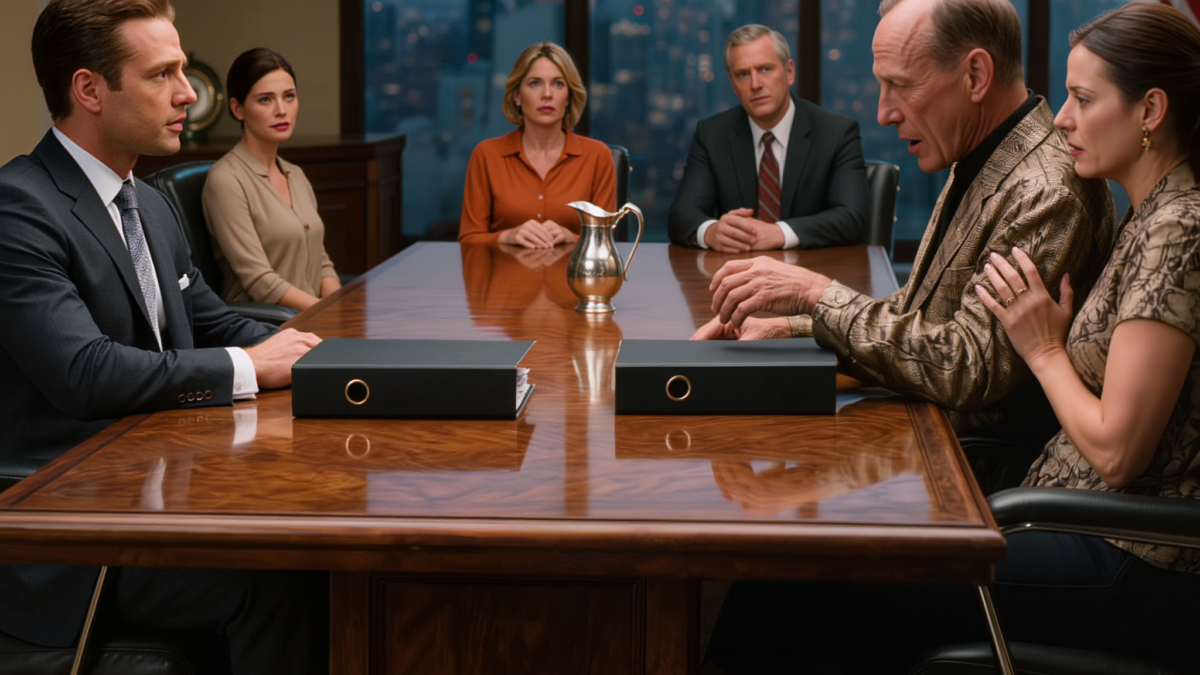
It was a large room with a polished mahogany table, heavy leather chairs, a pitcher of ice water, and two black folders in the center.
Mr. Henderson stood near the window until everyone was seated.
Clara sat beside me.
Desmond and Bianca sat across from us.
My parents took positions beside them.
I pushed the first folder toward Desmond.
It contained the accounting for Winston’s estate, including the transfer of the savings into the secure trust and the distribution Desmond would receive if he accepted the settlement.
He opened it.
The figure in front of him was $15,000.
Not the hundreds of thousands he had expected.
Then I indicated the second folder.
It contained the evidence connected to the Porsche loan.
The application.
The bank records.
The disputed signature.
Security images showing Desmond at the teller window.
The notary information.
And the complaint Mr. Henderson had helped prepare.
My mother immediately called it intimidation.
A signature on a page did not prove Desmond had intended anything malicious, she argued.
Mr. Henderson responded.
The notary records had created a problem for that defense.
Bianca looked up.
I told her the name.
Silus Vance.
Then I explained the connection.
Silus had been her college roommate.
We had the old graduation photograph.
We also had a record of a fourteen-minute phone call from Bianca’s number to his at 9:47 p.m. the night before the loan documents were submitted.
Desmond turned toward his wife.
“You called him?”
His voice had changed.
Bianca had apparently told him Silus was simply someone she had found who would not ask too many questions.
Now Desmond was learning that she had known him personally.
“I didn’t think they would dig this deep,” Bianca snapped.
Then she turned on me, accusing me of becoming obsessed with destroying them.
I reminded her that I worked at a law firm.
More importantly, she and Desmond had left a trail.
My father looked from the documents to his eldest son.
His confidence had disappeared.
“Desmond, is this true? Did you forge your grandfather’s signature?”
Desmond stared down at the table.
Then he turned on Bianca.
“She made me do it.”
The room went quiet.
He said he had wanted to wait for probate.
According to him, Bianca panicked because their condo was heading toward foreclosure.
He said she found Silus.
She printed the forms.
She helped him practice Winston’s signature.
Bianca stared at him.
Years of partnership collapsed in seconds.
“You spineless coward,” she said.
Then she reminded him that he had spent the money too.
He bought the first-class tickets.
He bought the Rolex he used to impress his country club friends.
She accused him of crying about losing his image after the landscaping business failed.
Mr. Henderson stopped the argument.
Whatever blame they wanted to assign to each other, both of them were connected to the transaction.
He directed them to the settlement agreement.
If they signed, Desmond would receive the $15,000 Winston had left him along with the workshop contents, and they would give up their challenge to the estate.
If they refused, the complaint would move forward.
My mother began crying.
Bianca insisted the arrangement was unfair.
“We deserve half of that house. We are family. Winston would have wanted us to have a fresh start.”
Mr. Henderson pushed a pen across the table.
“Sign the paper.”
Desmond picked it up first.
His hand shook as he signed.
Then he pushed the document toward Bianca.
She sat there for several minutes, staring at me as if she expected me to change my mind.
I did not.
Eventually, she signed too.
Mr. Henderson checked the documents and closed the folders.
The estate was secure.
As Clara and I prepared to leave, my father grabbed my arm.
“You destroyed this family, Nolan,” he said.
He believed I could have simply paid Desmond’s debts.
Instead, in his view, I had destroyed my brother’s life because I was too stubborn to help him.
Then he told me my parents no longer considered themselves to have any sons.
I removed his hand from my arm.
“I didn’t destroy anything, Dad. I just stopped cleaning up the mess.”
Then Clara and I left.
That night, after we got home and closed the door behind us, the adrenaline disappeared.
I did not feel victorious.
I thought about Winston.
I pictured him sitting in his window seat on a Sunday afternoon, eating apple cake and holding that blue lighthouse mug.
He had understood something long before I did.
A family can look intact from the outside while the people inside it are slowly pulling it apart.
Four months later, the estate officially closed.
The taxes were paid.
The paperwork was completed.
The lake house deed was transferred to Clara and me exactly as Winston had directed.
Desmond received his $15,000.
He also received the contents of Winston’s workshop, including a set of vintage Snap-on tools that Winston had maintained carefully for forty years.
Three days later, I saw those tools listed for sale.
Desmond had sold the collection to a local pawn shop for a fraction of its real value because he needed quick cash for legal expenses.
I was not angry.
The tools were legally his.
He had the right to do whatever he wanted with them.
But seeing the listing proved Winston’s judgment one last time.
Without the estate money to rescue them, Desmond and Bianca’s financial situation collapsed.
The bank foreclosed on their condo.
They moved out, loading their belongings into a U-Haul.
Two months later, Bianca filed for divorce.
She had not forgiven Desmond for turning on her in Mr. Henderson’s conference room.
My parents remained loyal to Desmond.
They spent what remained of their savings helping him deal with debts and civil claims connected to his failed business. Eventually, they left their suburban house and moved into a smaller apartment.
About six months later, they called my office once.
They left a voicemail asking for a short-term loan to help Desmond with his mounting legal expenses.
I listened to it once.
Then I deleted it and blocked the number.
The Porsche was handled exactly according to Winston’s written instructions.
It did not go to me.
I arranged for it to be sold through a high-end classic car auction house.
A private collector bought it for $165,000.
Every dollar went to a charitable fund for the local historical preservation society, where Winston had volunteered for fifteen years.
He had cared deeply about preserving an old covered wooden bridge on Route 9.
The society used the money to restore it and placed a small bronze plaque bearing his name there.
I visit sometimes.
It feels right.
A year after Winston died, I was back at the lake house on another crisp Sunday morning in late October.
The air smelled like pine needles and wood smoke from nearby cabins.
The same cushioned window seat still overlooked the water.
Clara was in the kitchen making apple cake from my grandmother’s handwritten recipe, which I had found on a yellowed index card tucked inside a drawer.
I sat by the window with Winston’s chipped blue lighthouse mug warming my hands.
Outside, the old dock sagged toward the water. Birch trees lined the shore. Morning light spread across the cove in a flat silver sheet.
For the first time in a long time, I was not thinking about Desmond.
I was not thinking about the argument in the law office.
I was not thinking about my parents.
I was thinking about what Winston had actually asked me to protect.
It had never been just $210,000.
It was the house.
The garage.
The memories.
The rituals.
The idea that something built carefully over a lifetime did not have to be sacrificed simply because someone else wanted it badly enough.
For years, I had confused being dependable with giving in.
I thought being the reasonable son meant absorbing whatever happened so the rest of the family could remain comfortable.
Winston had taught me something different.
There is a difference between leaving the front door open for someone you love and leaving the vault unlocked for someone who has already shown you what they intend to take.
Grace does not require surrendering every boundary.
Sometimes protecting something worth keeping means accepting that the people who resent the boundary may walk away.
I had promised Winston I would protect what he built.
The deed was secure.
The house was still standing.
Clara was in the kitchen making apple cake.
And I was sitting in the place Winston had loved most, drinking black coffee from his old blue mug and looking across the same quiet water he had watched for decades.
He used to say the best thing about the lake house was not the property value or the cars in the garage.
It was that you could come there and be still.
You did not have to impress anyone.
You did not have to pretend you were richer or more successful than you were.
You could simply exist exactly as you were.
Looking out across Crescent Cove that morning, I finally understood what he meant.








