They called me a “worthless dropout” and kicked me out at 22. Five years later, I walked into my sister’s medical school graduation, and her dean asked, “How do you know her?” I only said, “You have no idea.” Minutes later, my father’s proud speech stopped cold when the dean revealed who I really was.
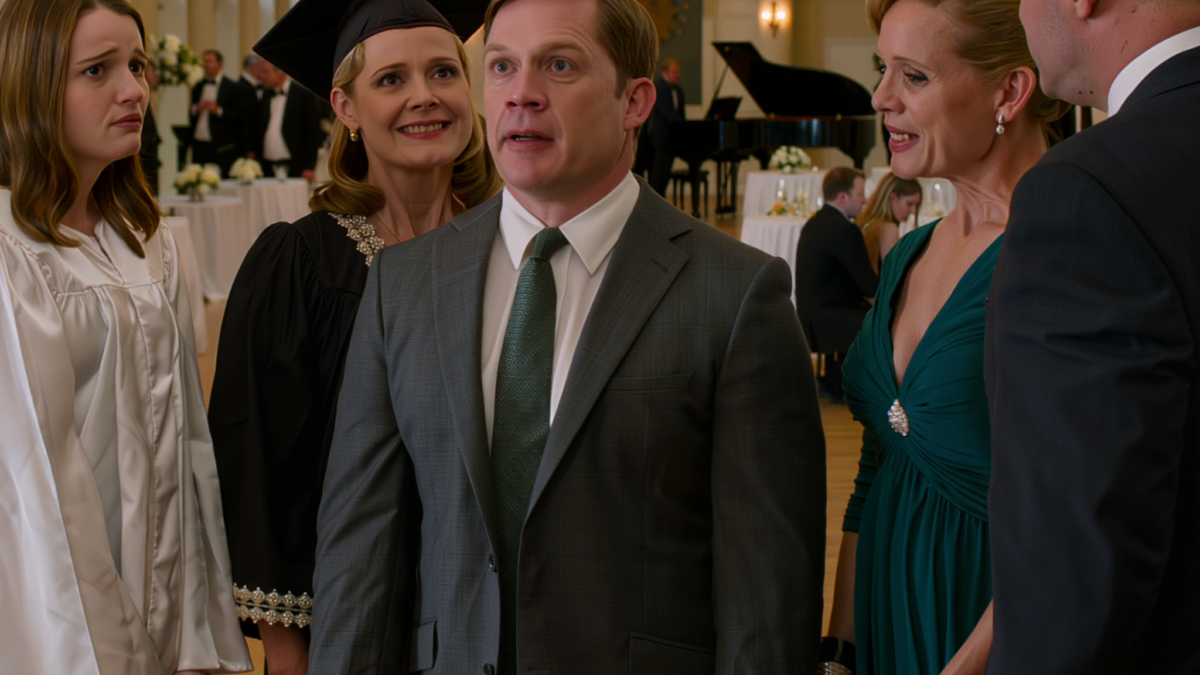
I’m Leo Vance. I’m 27 now, but this story really begins five years ago, when my own family labeled me a worthless college dropout and threw me onto the street with nothing but the clothes on my back and a beat-up laptop.
Picture this: the grand ballroom of the Northgate Country Club, the kind of place where the air itself smells expensive. It carried a mixture of professionally arranged lilies, old money, and a faint hint of smug satisfaction. Massive chandeliers poured crystal light over at least fifty tables, each draped in immaculate white linen. Men in tailored tuxedos and women in shimmering evening gowns moved through the room with the easy grace of people who had never known a day of hardship.
This was my sister Isabelle’s medical school graduation party, a monument to her success meticulously crafted by my parents.
And I, the family ghost, their greatest failure, was standing right in the middle of it all.
Five years is a strange measurement of time. It is long enough to build a new life from scratch, but short enough for the sting of old wounds to remain fresh. I wore a custom-made charcoal-gray suit, a quiet statement from a world they could not even imagine I was part of.
I had changed, and not just because of the suit.
The desperate, hollowed-out 22-year-old they had thrown away was gone. In his place stood a man they walked right past, their eyes sliding over me as if I were part of the catering staff.
The irony was so thick I could taste it.
I saw them holding court near the grand piano, standing at the center of their own universe. My father, Richard Vance, was telling a story, his voice booming with a manufactured joviality that made my teeth ache. My mother, Eleanor, stood beside him, wearing a tight, perfectly practiced smile as the diamonds around her neck caught the light.
And there was Isabelle, the golden child, radiant in a white designer dress and accepting congratulations like a queen receiving her subjects.
They were a perfect portrait of success and affluence.
They were also a complete and utter lie.
I was nursing a glass of sparkling water and observing from the edge of the room when a woman with sharp, intelligent eyes and an undeniable air of authority approached me.
“I don’t believe we’ve been introduced,” she said, her voice warm but firm as she extended a hand. “I’m Evelyn Reed, dean of the medical school.”
I shook her hand. Her grip was firm and businesslike.
“Leo. It’s a pleasure to meet you, Dean Reed.”
“Leo,” she repeated, her brow furrowing slightly as she tried to place me. “Are you a colleague of Isabelle’s?”
I took a slow sip of water, my eyes drifting toward my sister, who was posing for a photograph with our beaming parents.
“You could say I know her,” I replied, the words carrying an irony only I understood.
The dean followed my gaze.
“Ah, the Vances. Powerful family. Richard has been an incredibly generous donor to the university’s new research wing.”
She turned back to me, her expression politely curious.
“So, how exactly do you know her?”
I let the question hang in the air for a moment. Then I met her eyes and gave her a small, unreadable smile.
“You have no idea.”
They had no idea who I was, what I had become, or why I was really there. They saw a stranger in a nice suit.
They were about to see the ghost they thought they had buried five years earlier.
My father was walking toward the small stage, tapping a champagne flute with a spoon to get everyone’s attention. The show was about to begin.
But to understand the explosion that was coming, you need to understand the long, slow burn that led to it. You need to go back five years, to the night my world ended so that a new one could begin.
Five years earlier, the Vance family home was less of a home and more of a museum dedicated to my sister’s achievements. Her trophies lined the mantelpiece. Her academic awards were framed in the hallway. Dinner conversations orbited her like planets around the sun.
My father presided over the dinner table like a judge, and I was perpetually on trial for the crime of not being Isabelle.
“Isabelle, your debate coach called me today,” my father would announce while slicing into a piece of steak. “He said your rebuttal in the finals was the sharpest he’s seen in a decade. A born litigator, that’s what he called you. Of course, you’ll make an even better doctor.”
“Oh, Richard, don’t embarrass her,” my mother would say, though her eyes shone with pride. “She’s just naturally gifted at everything she does.”
Isabelle would give a small, practiced shrug.
“It was nothing, really.”
Then the full weight of their attention would pivot toward me, and the temperature in the room would seem to drop twenty degrees.
“Leo,” my father would sigh, putting down his fork. “Your academic adviser called me too. He said you’re in danger of failing corporate finance.”
“It’s not that I can’t do it,” I tried to explain, my voice small. “I just don’t find it engaging. My mind wanders.”
“Wanders where, son?” he asked, his voice dripping with condescension. “To your little doodles?”
Doodles.
That was what they called my passion, my art, and my future. To them, my sketchbooks were evidence of a defective mind, a distraction from the real world of business and finance my father had already chosen for me.
The pattern had been established long before college.
In high school, I submitted a piece to a statewide art competition. It was a complex digital painting I had spent more than one hundred hours creating. Against all odds, I won first place. The award came with a small scholarship and a letter of commendation from the governor.
I was ecstatic.
I ran home clutching the plaque, my heart pounding with a desperate need for my parents’ approval. I found them in the kitchen celebrating because Isabelle had received a 98 on a chemistry midterm.
A midterm.
“Mom, Dad, look,” I said, bursting into the room and holding up the plaque. “I won. First place in the state.”
My mother took it from me, glanced at it, and placed it on the counter with a thin smile.
“Oh, that’s lovely, dear. Very creative.”
Then she immediately turned back to my sister.
“A 98. Izzy, your father and I are taking you to the Clove for dinner to celebrate.”
The plaque remained on the counter, forgotten.
My victory, my passion, and my moment had become an afterthought, an interruption to the main event, which was, as always, Isabelle.
The message could not have been clearer.
My achievements were a cute hobby.
Hers were the family legacy.
That night at the dinner table, with the threat of failing finance hanging in the air, I decided to try one final time. I had been working on a branding package for a fictional charity, something into which I had poured my soul.
“I know the finance classes are a struggle,” I began, my hands clammy beneath the table, “but I wanted to show you what I’ve been working on.”
I slid my laptop onto the table and opened the file, revealing a complete collection of logos, color palettes, and mock-ups.
“It’s a concept for a nonprofit that helps homeless youth. I was thinking about how branding can build trust, and—”
Isabelle snorted into her water glass.
“You’re building a fake brand for fake homeless people while you’re about to become a real failure in a real class.”
Her cruelty took the air out of me.
I looked toward my parents, hoping for a defense, a rebuke, or any sign of support.
I found none.
My father stared at the screen for a long moment, his expression unreadable. For a split second, I allowed myself a flicker of hope.
Maybe this time he would see it.
Maybe this time he would understand.
He closed the laptop gently, but with a horrifying sense of finality.
“Leo,” he said, his voice dangerously quiet, “your sister is learning how to save human lives. You are wasting your time, my money, and this family’s patience on make-believe. There is no future in this. The world doesn’t pay for doodles. It pays for results.”
He stood up from the table.
“Your mother and I are paying for a business degree. You will pass your classes. You will graduate. And you will join my firm. That is the only result I will accept. This discussion is over.”
He walked out of the room.
My mother followed him without giving me a backward glance.
I remained alone at the enormous mahogany table, surrounded by the ghosts of a thousand similar conversations.
In that moment, I knew I could not do it anymore.
Hope was a luxury I could no longer afford. Their love was not unconditional. It was a performance bonus for a job I did not want, and I was about to be fired.
The final confrontation was not a spontaneous explosion. It was a slow, deliberate demolition.
One week after that disastrous dinner, I officially withdrew from my finance class. I knew the decision would trigger an alert to my father, who monitored my academic progress like a hawk.
I spent the week in a state of quiet terror, secretly packing a duffel bag and gathering the few things that mattered to me: my laptop, hard drives filled with design work, sketch pads, and a faded photograph of my grandmother.
The call came on a Sunday evening.
“My office. Now.”
That was all my father said before hanging up.
The study felt like a courtroom. My father sat behind his massive desk. My mother stood beside the fireplace, her arms crossed and her expression like stone. My academic withdrawal notice lay on the desk between us.
“Explain this,” my father said.
It was not a question.
It was a command.
“I can’t do it, Dad,” I said, my voice steadier than I expected. “I’m not a businessman. I’m a designer. I’ve enrolled in two online design certification courses. I’m going to build a portfolio and get a job in a field I’m actually good at.”
“You are good at what I tell you you’re good at!” he roared, slamming his fist onto the desk and making the lamp jump. “You are a Vance. We are not flighty, starving artists. We are leaders. Financiers. Do you have any idea how much shame you are bringing on this family?”
“What shame?” I shot back, my own voice rising. “The shame of being different? The shame of not being a carbon copy of you? Or is it just the shame of having a son who isn’t Isabelle?”
That struck a nerve.
My mother flinched.
“Do not bring your sister into this,” she hissed. “Your sister has worked for everything she has. She has never disappointed us. You do nothing but disappoint.”
“I disappoint you because I’m not her.”
I was on my feet now, my fists clenched.
“I could cure cancer, and you’d be disappointed that it wasn’t a high-yield investment. You’ve never once, not once, supported a single thing I genuinely cared about.”
“Support?”
My father laughed, a harsh, ugly sound.
“We gave you a life of privilege, a roof over your head, food on the table, and a top-tier education that you are now throwing in the garbage. That is support. What you’re asking for isn’t support. It is an endorsement of a fantasy, and we will not endorse failure.”
He stood and walked around the desk until he was directly in front of me, looking down at me with utter contempt.
“So here are your choices, Leo. You will reenroll in your classes tomorrow morning, and you will beg your professor for a second chance. Or you will walk out that door and never come back. If you choose this ridiculous design path, you are no longer our son. We will cut you off completely. No money, no contact, nothing. You will be on your own.”
I looked at him, at his furious and unyielding face.
Then I looked at my mother, who watched me with cold, lifeless eyes.
There was no negotiation. No room for compromise.
This was an ultimatum.
Be them, or be nothing.
A strange calm settled over me. The fear was gone, burned away by years of accumulated pain and resentment. The choice was so stark and absolute that it was actually simple.
“I guess I’m on my own, then,” I said quietly.
I turned without another word and walked out of the study. My duffel bag was already waiting by the front door.
As I reached for the handle, my mother’s voice, sharp as broken glass, cut through the silence behind me.
“You’re nothing but a worthless, ugly college dropout,” she said, her voice dripping with venom. “Don’t you dare show your face in this family again. Don’t you dare.”
I did not look back.
I opened the heavy oak door, stepped into the cold night air, and heard the deadbolt slide into place behind me.
The sound was deafeningly final.
It was the sound of my old life ending.
I was 22 years old, homeless, and beaten down. But for the first time in as long as I could remember, I was free.
Freedom, it turned out, was cold and terrifying.
On my first night, I drove to a deserted parking lot overlooking the city and tried to sleep in the cramped back seat of my Honda Civic. Every creak of the car and every distant siren sent a jolt of panic through me.
My parents’ words echoed through the suffocating silence.
Worthless.
Disgrace.
Dropout.
The next few weeks became a descent into a kind of hell I had not known existed.
I couch-surfed for a while, but you can impose on friends only so long before their pity begins to sour into resentment. I wore out my welcome one home at a time until there were no more doors to knock on.
My car became my home.
I learned the rhythm of homelessness. I knew which public parks had restrooms that opened early. I learned how to make a 99-cent cup of gas-station coffee last three hours so I could use the Wi-Fi. I learned to ignore the gnawing hunger in my stomach and the deeper, more painful hunger for a kind word or a safe place to sleep.
Depression became a constant companion, a heavy, wet blanket that smothered every spark of hope. I would sit in my car during torrential downpours, watching the world pass by and feeling completely invisible.
In those moments, I came dangerously close to believing my parents were right.
Maybe this was all I deserved.
A failure living inside a metal box, going nowhere.
I found a job washing dishes at a 24-hour diner. It was brutal, thankless work. My hands were perpetually chapped and smelled of grease and bleach. I stood over a steaming sink for eight hours at a time, scraping dried egg yolk from plates while my mind dissolved into a numb buzz of exhaustion.
But it was a paycheck.
It was gas money.
It was instant noodles and the occasional slice of pizza.
It was survival.
My only escape was a small independent coffee shop called The Grind. It had comfortable, worn-out armchairs, a tolerant owner, and, most importantly, reliable Wi-Fi.
It became my lifeline.
After my shift at the diner, I would go to a truck stop, pay for a cheap shower, put on my one clean shirt, and head to The Grind. There, in my corner chair, I would open my laptop and work.
I was not just doodling anymore.
I was studying.
I devoured online tutorials about typography, UI and UX design, and branding strategy. I dissected the work of great designers, and I created. I poured all my loneliness, anger, and shame into my designs.
It was the only time I felt as though I had a voice.
It was the only time I felt as though I had a purpose.
I had noticed her before, a woman with dark, intelligent eyes who was almost always there, typing furiously on her own laptop. We were both members of the unofficial Grind office club. We exchanged polite nods, but that was all.
Her name, I had learned from the baristas, was Chloe.
One evening, she broke our unspoken code of silence.
I was working on a particularly complex logo, becoming increasingly frustrated, and I must have let out an audible sigh.
“Code not compiling?” she asked without looking up from her screen.
“Something like that,” I muttered. “Just design stuff.”
“Let me see,” she said, surprising me.
She stood, walked over, and peered at my screen.
I felt a rush of embarrassment, expecting the same dismissal I had received my entire life. She remained silent for a long moment, studying the intricate lines and negative space of the logo.
“That’s clever,” she finally said. “The way the E and V merge to create a mountain peak. It’s for a company called Everest Consulting. Nice.”
I stared at her.
“You got all that just from looking at it?”
She gave me a small, wry smile.
“I’m a programmer. I spend my life looking for patterns and logic. Your work has both. It’s not just pretty. It’s smart.”
She pointed toward the screen.
“You’ve got a real gift.”
No one had ever said that to me before.
Not like that.
Not with such simple, unvarnished sincerity.
A dam broke inside me. Over the next hour, fueled by cheap coffee, I told her everything. I told her about my family, the fight, being disowned, sleeping in my car, and washing dishes at the diner.
I laid out the entire pathetic story of my life.
When I finished, I braced myself for pity and awkward condolences.
Chloe simply took a slow sip of her latte.
“Okay,” she said. “So your rich, narcissistic parents kicked you out because you wouldn’t become their clone. Sounds to me like you escaped a cult.”
The bluntness shocked a laugh out of me.
“They called your passion worthless,” she continued, her eyes flashing with indignation. “Leo, I build websites for a living. I know what good design is worth. It’s worth everything. It is the difference between a company that looks professional and one that looks like a joke. What you do has real, tangible value.”
She leaned forward, her expression serious.
“I’ve got a client right now, a small organic bakery. Sweet people, great product, terrible website. Their budget is basically nothing, but it’s a real paying job. I’m building the site, but they need a logo and a brand identity. Do you want in?”
It was more than a job offer.
It was a rope thrown into the dark pit where I had been living.
It was a voice saying, I see you. What you do matters.
“Yes,” I said, my voice thick with an emotion I could not name. “Yes, absolutely.”
In that dingy coffee shop, a partnership was formed.
A business was born.
And a life was saved.
The bakery project was our first test. We poured everything we had into it. We held client meetings at a wobbly table in the back of The Grind and sketched ideas on napkins. I worked on the logo during my breaks at the diner, my hands still smelling faintly of bleach. Chloe coded the website late into the night.
We presented the finished product to the bakery’s owners, a kind older couple, while my heart pounded with fear of rejection.
They loved it.
They actually cried.
The $500 they paid us felt like a million. It was the first money I had ever earned simply for being myself.
That small victory was the spark that lit the fuse.
We started hungry. We scoured freelance platforms and sent fifty proposals for every one response. We accepted any job, no matter how small: a flyer for a lost dog, a menu for a new taqueria, a banner advertisement for a local car wash.
We built a portfolio one tiny project at a time.
We also experienced our share of failures.
I remember one of our first major pitches. It was for a small chain of fitness studios. We worked for two weeks straight, sleeping perhaps four hours a night while creating a complete branding presentation.
We walked into their corporate office as two young, hungry freelancers carrying a laptop and a dream.
We gave the pitch of our lives.
They listened politely and chose a larger, more established agency.
As we left the building, I felt the familiar sting of failure.
“Maybe my parents were right,” I muttered to Chloe as we walked down the street. “Maybe we’re just not cut out for this.”
Chloe stopped in the middle of the sidewalk and turned to face me.
“Don’t you dare,” she said, her voice fierce. “Don’t you dare let them get inside your head. We lost one pitch. One. Did you see their faces when you presented those concepts? They were impressed. We were just too small. We’re going to lose more. That’s how this works. You get knocked down, you get back up, and you aim for a bigger client. Now let’s get some pizza and figure out how to land the next one.”
Her belief in me was relentless.
It became the scaffolding that held me up while I rebuilt my own sense of self-worth.
After six months of that grueling routine, I finally saved enough money to quit the dishwashing job. It was one of the best days of my life.
I walked out of the diner, threw my grease-stained apron into a dumpster, and never looked back.
One week later, I moved into a tiny studio apartment. The shower had two settings, scalding hot and ice cold, and the man next door played the tuba at three in the morning.
But it was mine.
It was a home.
Chloe and I decided to make our partnership official. We pooled our meager savings, registered an LLC, and gave the business a name: Innovate Leo.
It was Chloe’s idea.
“Because you’re the innovator,” she said. “And because it’s going to make your family furious someday when they see it.”
We moved from the coffee shop into a shared co-working space, where we split a single desk, and we began aiming higher. We targeted technology startups, companies that valued fresh ideas over stuffy corporate pedigrees.
Our portfolio, once filled with tiny local businesses, gradually began to include sleek, modern brands.
Our major break came about a year and a half later.
We landed a meeting with Mark Jennings, the notoriously demanding CEO of a rising company in the financial technology world called Vidian Dynamics. Every design agency in the city was competing for its rebranding contract.
We were the undeniable underdogs.
We entered a boardroom overlooking the entire city.
I was terrified.
But as I began speaking about the design philosophy and the story we wanted to tell through the company’s brand, the fear melted away.
I was in my element.
When I finished, Jennings remained silent, staring at our presentation. He turned toward his board members and then back to us.
“Everyone else who pitched us offered a prettier version of what we already are,” he said, a slow smile spreading across his face. “You two just showed me what we could become.”
We walked out of that building with a contract containing so many zeros that I initially thought it was a mistake.
That night, Chloe and I sat on the floor of our tiny co-working space, surrounded by empty pizza boxes, and I finally understood something.
My father had been wrong.
The world did pay for doodles.
And it paid very, very well.
That contract was not merely the foundation of our company. It became the foundation of the rest of my life.
Five years can be a lifetime.
The man who received that email on a Tuesday afternoon was a stranger to the boy who had been kicked out of his home.
That boy had been frightened, broken, and desperate.
This man was the CEO of his own company.
Innovate Leo had a team of twelve brilliant employees, a waiting list of clients, and a reputation as one of the most creative agencies in the country. I owned a downtown condominium with a view that still took my breath away.
The dull ache of my family’s betrayal had faded, replaced by the vibrant, demanding pulse of a life I loved.
I had built a fortress around myself, not out of anger, but out of success and new relationships. My team was not merely a group of employees. They were my family.
Chloe was my partner in every sense of the word.
She was the sister I should have had.
The Vances were a chapter in a book I had closed long ago and placed on a high shelf to gather dust.
Then the email arrived.
It came from Helen Gable, a name that stirred memories of my mother’s charity luncheons and the cloying scent of Chanel No. 5. Helen was a professional gossip columnist disguised as a housewife.
The subject line was almost comically cheerful: “A Celebration for Isabelle.”
My immediate, visceral reaction was to slam my laptop shut. The email felt like a home invasion, a violation of the safe world I had built so carefully.
My finger hovered over the delete button while my heart hammered against my ribs.
It was a full-blown fight-or-flight response.
“Leo, you look like you’re about to throw your computer out the window,” Chloe said from her desk.
Her ability to read my moods was almost telepathic.
I swallowed hard and forced down the panic.
“It’s from them,” I said, my voice strained. “Well, from one of their cronies.”
I turned the monitor so she could see it. She read the ostentatious digital invitation, her lips tightening into a hard line.
A photograph of Isabelle, looking impossibly perfect in her cap and gown, smiled out from the screen.
“Richard and Eleanor Vance request the pleasure of your company.”
“The nerve,” Chloe said in a low growl. “After five years of absolute, deafening silence, they send this? What do they want? For you to appear and applaud?”
“I don’t know, and I don’t care,” I replied, my voice harder than I intended. “I’m deleting it.”
“Wait,” she said, placing a hand on my arm. “Don’t. Not yet. Think for a second.”
“There’s nothing to think about,” I shot back. “Going there would be like a sheep willingly walking back into the slaughterhouse. I have nothing to say to them.”
“I know,” she said patiently. “This wouldn’t be for them. It would be for you.”
I stared at her, unable to understand.
“For me? Why would I want to put myself through that?”
“Because,” she said, her gaze steady and serious, “you’re not the same person who left that house, Leo. That boy was a victim. He was powerless. The man sitting in this chair is one of the most successful designers in the city. You don’t have to hide. You have the right to walk into that room with your head held high and let them see exactly who they threw away. You don’t have to say a word. Your presence alone could be the final chapter. It could be closure.”
I hated that she was making sense.
The thought of facing them filled me with cold dread, but the image she painted of walking into that room, not as their failure but as my own success, was undeniably compelling.
It was an opportunity to rewrite the ending of my own story, an ending they would not control.
“I don’t know, Chloe,” I said as the conflict churned inside me. “It feels dangerous.”
“The most dangerous things are sometimes the most necessary,” she replied.
I leaned back in my chair, the invitation glowing on the screen.
I still could not shake the feeling that something was wrong.
This was not a gesture of reconciliation, however twisted. It was a move, a calculated strategic move. My family never did anything without an agenda, and I intended to discover exactly what it was.
The sensation of being a chess piece moved into position would not leave me.
For two days, I agonized over the invitation. Chloe’s reasoning was sound. Facing them might be empowering, but my instincts, sharpened by years of navigating their emotional minefields, were screaming that this was a trap.
“They have never done anything that wasn’t for their own benefit,” I explained to Chloe while we ordered coffee. “Every gift came with strings. Every compliment was a setup for a later criticism. Why would this be any different?”
That was when the memory surfaced.
It was faint, almost like a childhood dream.
I had been about 18, sitting inside a stuffy lawyer’s office after my grandmother’s funeral. She was my mother’s mother, a kind, vibrant woman who always smelled of cinnamon and paint thinner. She was an amateur artist and the only person who had ever bought me a professional set of sketching pencils.
I remembered the lawyer, a dry man named Mr. Abernathy, discussing her will. He mentioned something about a significant inheritance for both Isabelle and me, managed through a trust.
My parents quickly silenced him, saying they would handle the complexities.
I had been too consumed by grief to care about money, so I let the matter go.
Until now.
The moment I returned to the office, I called Sam Chun.
“Sam, I need you to do some digging for me,” I said before explaining the entire bizarre situation: five years without contact, the sudden formal invitation, and my hazy memory of a trust fund.
“A trust fund with your parents acting as trustees?” Sam asked.
His voice immediately lost its casual tone and became razor sharp.
“And a sudden invitation right at the five-year mark? Leo, that is a colossal red flag. In legal terms, five years can be a significant number for many things, including statutes of limitation and abandonment clauses in wills and trusts.”
“An abandonment clause?” I repeated as a cold knot formed in my stomach.
“It is a stipulation an estate planner might include to prevent a beneficiary who completely cut ties from inheriting,” Sam explained. “For example, if a child abandoned an elderly parent, such a clause might stop that person from appearing later to collect an inheritance. But a clause like that can also be manipulated. Tell me everything you remember about your grandmother.”
I told him about her love of art, her encouragement, and how she had been the one person who saw my passion as a gift.
“Okay,” Sam said after a long pause. “A woman like that probably would not want to disinherit a grandchild for pursuing his passion. That means that if such a clause exists, your parents may be interpreting it for their own benefit. Let me make some calls. Wills are public records, but trusts can be private. It may take some work to obtain the documents.”
It took him forty-eight hours.
He called me on Friday afternoon, and I put him on speakerphone.
“I’ve got it,” Sam said, his voice grim. “I had to pull several strings, but I have a copy of your grandmother’s trust agreement. She was a very clever, very careful woman, Leo. She created two identical trust funds, one for you and one for Isabelle. The funds are substantial. We are talking about life-changing money. They were to remain in trust until your thirtieth birthdays.”
“Okay,” I said, my breath catching in my throat.
“And yes,” Sam continued, “there is a familial abandonment clause. It is worded very specifically. It states that if a beneficiary is shown to have willfully abandoned all attempts at familial relations for a continuous period of five years, that beneficiary’s trust is forfeited and absorbed into the sibling’s trust. Executing the clause requires the trustees, your parents, to demonstrate that they made a good-faith effort to reestablish contact and that their effort was willfully rejected.”
The pieces of the puzzle slammed into place with sickening force.
“The invitation,” I whispered.
“The invitation,” Sam confirmed. “It is their documented good-faith effort. It is Exhibit A. They may be counting on you being so angry and hurt that you ignore it or send an angry response. Either way, they could claim they had proof of rejection. If you attend, I would bet my license that they will have a document waiting for you to sign, something disguised as a gesture of peace that legally signs away your rights to the inheritance.”
The audacity of it, the cold and calculated cruelty, took my breath away.
They had not merely thrown me out.
They had not merely erased me from their lives.
They had placed a timer on my back.
For five years, they had been waiting patiently for it to run out so that they could collect their prize.
“So they don’t want to see me,” I said as the realization settled over me in its full horror. “They just want my money. My grandmother’s money.”
“They are not inviting you to a party, Leo,” Sam said, his voice hard as steel. “They are serving you a subpoena to your own financial dismemberment.”
I ended the call.
The room was silent.
I looked at Chloe, my eyes burning. All the pain, hurt, and unanswered questions of the previous five years had been replaced by a single clarifying emotion.
Cold, diamond-hard rage.
“I’m going to that party,” I said.
My voice was quiet, but it held the promise of an earthquake.
“And I’m going to burn their entire world to the ground.”
The rage did not burn hot and wild.
It cooled into something far more dangerous.
A plan.
The next few days became a blur of focused preparation. The party was no longer a personal trial. It was a battlefield, and I intended to walk onto it as the most prepared person there.
My first move was to meet Sam Chun at his downtown office.
The conference room was stark and modern, a place where emotions were stripped away and only facts remained.
“They believe they are in control,” Sam said as he paced in front of a floor-to-ceiling window. “They have the social standing, the history, and the narrative. We need to shatter that narrative with undeniable, irrefutable proof.”
He laid out our strategy.
Step one was the legal paperwork.
He drafted a brutal collection of documents: a formal demand for an immediate accounting of the trust’s assets, a legally binding agreement requiring my parents to relinquish any claims to my portion of the inheritance, and a cease-and-desist letter so airtight that it could suffocate them.
It forbade them from mentioning my name, my company’s name, or any fabricated story about my life to anyone ever again.
“But this is only paper,” Sam warned, tapping the stack. “It has no power until you give it power. You need leverage, something that will make refusing to sign more painful than signing.”
That was where step two came in.
“They expect the broken kid,” I reasoned. “They will be arrogant. My sister will be careless. My parents will be condescending. They’ll talk.”
Sam smiled.
It was not a friendly smile.
He opened his briefcase and removed a sleek metallic pen.
“Then let’s make sure we hear every word. This is a high-fidelity digital voice recorder. The audio quality is forensic grade. One click on the top starts it, and another stops it. It can pick up a whisper from across a room. Get Isabelle talking about the papers. Get your father lying about your supposed success overseas. Get your mother saying something dismissive. Get anything.”
The pen felt heavy in my hand, almost like a weapon.
Step three was the armor.
I knew I could not enter that party looking like their victim. I visited a tailor my father had always disliked for being too modern and had a suit made.
Charcoal-gray wool.
Sharp lines.
A perfect fit.
It was a suit that did not scream for attention.
It commanded it.
It was the physical manifestation of the man I had become.
The night before the party, I stood inside my condominium, practicing in front of a mirror. I tried to project an air of calm confidence that I did not entirely feel.
What would I say?
How would I react when I saw them?
A wave of anxiety washed over me. The old fears and feelings of worthlessness were still there, lurking beneath the surface.
My phone buzzed.
It was Chloe.
“Final pre-battle check-in,” she said. “How is the soldier?”
“Nervous,” I admitted, my voice barely a whisper. “What if I can’t do it, Chloe? What if I see them and freeze?”
“You won’t,” she said, her voice a rock of certainty. “Listen to me, Leo. Tomorrow, when you enter that room, I want you to remember something. Remember sleeping in your car on that freezing November night. Remember the smell of dishwater at the diner. Remember losing that first major pitch and feeling like a failure. Then remember landing the Vidian Dynamics contract. Remember hiring Maya and seeing her face when you told her that her work was brilliant. You did all of that. They didn’t. They have no power over you anymore. You are not their son walking into a family party. You are the CEO of Innovate Leo walking into a business negotiation, and you are going to win.”
Her words were like a shot of adrenaline to my heart.
She was right.
This was not about family anymore.
This was business.
And it was time to close the deal.
The moment I stepped through the grand doors of the Northgate Country Club, I felt the shift. It was like crossing an invisible barrier into a foreign country where I had once lived.
The air was thick with the same cloying perfume, the same entitled laughter, and the same polite, meaningless chatter.
But this time, I was not part of it.
I was an observer.
A ghost at their feast.
I took a glass of water from a passing tray and found a strategic position beside a large marble pillar. It gave me a clear view of the room’s main traffic areas.
I was a chameleon, blending in perfectly.
My suit was just as expensive as theirs.
My posture was just as confident.
And because of that, I was utterly invisible to the people who should have recognized me most.
My father stood at the center of a circle of portly, gray-haired men, all laughing uproariously at one of his jokes. My mother, a vision in emerald green, accepted compliments about the party’s décor. Isabelle was surrounded by a coterie of friends who were fawning over her.
I watched them for twenty minutes.
They moved past my pillar, sometimes only a few feet away, without looking in my direction once.
They were searching for familiar faces.
Important people.
I was neither.
Then I noticed a face I recognized.
Helen Gable, the woman who had sent the email, was moving toward me, her eyes alight with the thrill of discovering fresh gossip.
“You must be one of Isabelle’s friends from the hospital,” she gushed, offering her cheek for a kiss I did not give. “I’m Helen Gable, a dear friend of the family.”
“Leo,” I said simply, offering no last name.
“Leo. What a strong name. It’s such a tragedy that Richard and Eleanor’s own son couldn’t be here,” she said, lowering her voice into a conspiratorial whisper. “He’s in Europe, you know. An incredible success in the import-export business, but so busy. He hasn’t been home in years. Eleanor is heartbroken, though she would never show it.”
The ease with which she recited the lie was stunning.
It was their official story, distributed throughout their entire social circle.
I simply nodded, a grim smile forming on my lips.
“What a shame,” I said.
Just as she was about to ask more questions, a warm voice rescued me.
“Leo, by God, is that really you?”
I turned and saw Professor Alistister Finch, my former art history professor, weaving through the crowd. His face was etched with genuine delight and surprise.
“Professor Finch,” I said, smiling sincerely for the first time that night. “It’s good to see you.”
“Good to see you, my boy. It’s wonderful to see you,” he exclaimed, shaking my hand vigorously.
He looked me up and down.
“The last I heard from your father, you were shipping goods across the Atlantic. This is a pleasant surprise. You look fantastic. Life must be treating you well.”
“I’ve been lucky,” I said, delivering the understatement of the century.
“Nonsense,” he scoffed. “Luck has nothing to do with it. Talent is what you have. I always said so. A true artist’s eye. It was a crime to keep you chained to a balance sheet.”
While we caught up, I spotted my opportunity.
Isabelle, looking annoyed, had separated from her friends and was heading toward a secluded alcove to answer a call.
I excused myself from Professor Finch, promising we would speak again later.
Then I followed her at a distance, my hand moving toward my jacket pocket.
I rounded a corner decorated with a large floral arrangement. It placed me just beyond her line of sight but only ten feet away.
I clicked the top of the pen.
Her voice came through in a sharp, angry hiss.
“I don’t care if it’s awkward, Mother. He isn’t even here. How am I supposed to get him to sign the papers if he doesn’t show up? What do you mean, be charming? I’m not going to grovel. I just need his signature on the waiver. The lawyer said that without it, we can’t touch the inheritance. Yes, I’ll tell him it’s about the college fund. Some nonsense about updating the estate. Just make sure Dad brings the document. I want this finished tonight. I’ve waited five years for this money.”
Every word was another nail in her coffin.
Waiver.
Inheritance.
College fund.
Five years.
She had just narrated their entire conspiracy.
I clicked the pen again and stopped the recording.
Then I straightened my tie, adrenaline singing through my veins.
I had the leverage.
I had the evidence.
I stepped out from behind the flowers and walked back into the heart of the party like a predator who had just marked its prey.
The time for hiding was over.
The gentle chime of a spoon against a champagne flute silenced the room.
My father, Richard Vance, stood on the low stage, basking in the spotlight. His face glowed with pride and perhaps a little too much expensive scotch.
“Friends, esteemed colleagues, family,” he began, his voice a smooth, practiced baritone that had charmed boardrooms and investors for decades. “Thank you. Thank you all for coming tonight to celebrate a truly momentous occasion. My daughter, Isabelle Vance, M.D.”
He paused, allowing the title to hang in the air as applause rippled through the ballroom.
My mother, standing beside the stage, dabbed at a perfectly dry eye with a silk handkerchief.
It was masterful theater.
“Brilliance, dedication, and a relentless pursuit of excellence,” my father continued, his voice swelling with emotion. “These are the values that we, as a family, hold most dear. Isabelle embodies every one of them. She has made us prouder than words can express.”
I began moving, not with urgency but with a slow, deliberate purpose that drew the attention of those I passed.
I saw Professor Finch speaking with Dean Reed near the side of the stage.
My destination was clear.
I was positioning my key witnesses.
“Of course,” my father continued, “Isabelle is not our only child and not our only source of pride. Many of you have been asking about my son, Leo.”
He adopted an expression of fond, fatherly regret.
“He sends his deepest apologies that he could not be with us tonight. As you know, his work has him based in Europe. He has built a tremendously successful import-export business from the ground up. It’s a demanding field, but he is thriving. We are so, so proud of both our children and the incredible paths they have chosen.”
The lie was so polished and complete that it was almost impressive.
He was not merely erasing me.
He was replacing me with a more acceptable version, a son who had succeeded on his terms.
I reached Professor Finch’s side just as a sneering voice cut through the air.
“Well, I’ll be damned.”
I did not have to turn around to know it belonged to Ben Carter, a sycophant I remembered from college.
He had positioned himself among Isabelle’s friends and was speaking loudly enough for everyone within twenty feet to hear.
“Leo Vance. I thought the Vances had fumigated and gotten rid of their pest problem years ago.”
Several of his friends snickered.
Dean Reed’s polite smile tightened.
Professor Finch’s face clouded with anger.
“What are you doing here, Vance?” Ben continued, emboldened by the attention. “Did your little doodle business go bust? Are you here to ask Daddy for a loan?”
This was their narrative about me.
The pathetic failure.
The charity case.
Ben was merely their unwitting mouthpiece.
I met his gaze across the small space between us.
I did not give him the satisfaction of a reaction.
I simply held his stare, my expression unreadable.
Before the silence could become awkward, Professor Finch stepped forward, his posture radiating academic authority.
“Ben, your memory must be failing you,” he said, his voice calm but edged with steel. “I remember Leo as one of the most intellectually curious and creatively gifted students I ever had the pleasure of teaching. His decision to leave the business program was not a failure. It was an act of profound intellectual courage. He chose to pursue his actual talent rather than follow the path of least resistance.”
Ben’s smug expression dissolved into confusion.
He had been publicly corrected by a respected academic.
“I just meant…” he stammered, glancing toward his friends for support they did not offer.
“I know exactly what you meant,” I said quietly, my voice carrying the weight of finality.
Then I turned my back on him in complete dismissal and focused my attention on the stage.
My father raised his glass.
“So, a toast to my daughter, the doctor, and to the Vance family. A legacy of success.”
“To success,” the crowd echoed.
As the applause faded, I caught my father’s eye.
He was staring directly at me.
The jovial mask fell from his face. In a single second, his expression cycled through confusion, disbelief, recognition, and finally a surge of pure, undiluted fury.
The look in his eyes said everything.
How dare you show your face here?
How dare you ruin our perfect night?
He had no idea.
The night was only beginning.
And I was not there to ruin it.
I was there to end it.
As my father stepped off the stage, his face a thundercloud of controlled rage, Dean Evelyn Reed intercepted him. Her smile was bright and completely genuine.
She was the only person in our immediate vicinity who had not sensed the tectonic plates shifting beneath the ballroom floor.
“Richard, what a moving speech,” she said as she shook his hand. “You and Eleanor must be floating on air tonight.”
Then she turned her warm gaze toward me.
“And what a wonderful surprise that your son could make it after all. You must be thrilled to have him home.”
My father’s jaw tightened so severely that I could see the muscle jump.
“Leo’s presence is unexpected,” he managed to say, his eyes boring into me with a look that could curdle milk.
“Well, I, for one, am absolutely delighted,” Dean Reed said, her tone shifting seamlessly from social grace to professional purpose. “In fact, it is an incredible stroke of luck.”
She addressed me directly, her voice crisp and focused.
“Mr. Vance, I’ve been hoping to arrange a meeting with you for weeks. My team has been hitting a brick wall with your assistant. The university’s board recently approved a comprehensive, multi-year rebranding initiative for the entire medical school and its five affiliated hospitals. It is a massive undertaking, a seven-figure project.”
She paused, allowing the weight of that number to settle.
My father’s angry expression began transforming into one of confusion.
My mother and Isabelle, drawn by the strange energy around us, moved closer.
“After an exhaustive six-month search,” Dean Reed continued, her eyes alight with professional admiration, “and after reviewing proposals from every leading agency in the state, the board reached a unanimous decision. The firm we chose, the firm we believe is the only one with the vision to execute this project properly, is Innovate Leo.”
The silence that followed was not merely an absence of noise.
It became a physical presence.
A vacuum that seemed to pull all the air out of the room.
I could almost hear the individual heartbeats of the people surrounding us.
My father stared at Dean Reed.
Then at me.
Then back at her.
His mind was visibly short-circuiting as he attempted to process the impossible words he had just heard.
“Innovate Leo?” he stammered, the name foreign and strange on his tongue. “What are you talking about?”
“His company,” Dean Reed explained, a trace of confusion entering her voice, as though she could not understand why this was not common knowledge. “Leo Vance is the founder and chief creative officer of Innovate Leo. Honestly, Richard, you should be boasting. They are one of the most sought-after design and branding agencies on the entire West Coast. We were genuinely concerned that he might not have time for a project of our scale.”
This was it.
The moment of detonation.
The perfect, beautiful, catastrophic reversal.
The validation was not coming from me. It came from the dean of my sister’s medical school, a woman whose opinion and money carried more weight in my father’s world than anything I could have said myself.
My mother’s perfectly lipsticked mouth fell open.
A tiny, almost silent gasp escaped her.
Her face turned as white as the tablecloths.
Isabelle looked as if she had been physically struck, her eyes wide with dawning horror.
“That’s a lie,” Eleanor whispered, her voice thin and desperate. “He’s a college dropout. He washes dishes.”
Dean Reed’s eyebrows rose.
She looked from my mother’s frantic expression to my calm one.
“He’s a visionary,” she corrected, her voice now carrying a distinct chill.
I finally spoke.
My voice was quiet, but it seemed to boom through the suffocating silence.
“It’s true. All of it.”
I let my gaze travel from my father’s stunned face to my mother’s horrified expression and then to my sister’s crumbling composure.
“Funny, isn’t it? The worthless dropout who washes dishes is the person you are all now desperately hoping to hire.”
My father finally found his voice and made a pathetic attempt to salvage the situation.
“Now, son, let’s not be dramatic,” he said, forcing a laugh. “We are incredibly proud of you. We always have been. We simply didn’t know all the details of your success.”
“Details,” I repeated.
This time, I laughed, a short and humorless sound.
“You call five years of lies a detail? You call telling everyone that I work in import-export a detail? What about the most important detail of all? The real reason you invited me here tonight?”
I turned my full attention toward Isabelle.
She flinched as if I had raised a hand.
“You had papers for me to sign, didn’t you, Izzy? A waiver? Something about updating the family’s college fund? Or should we be honest and call it what it is: a coordinated five-year attempt to defraud me and take the inheritance our grandmother left me?”
“That is a vile, disgusting accusation!” my mother shrieked as her carefully constructed composure finally shattered.
“Is it?” I asked calmly.
I reached into my jacket pocket and removed the pen.
I held it between my thumb and forefinger.
“Because this pen is a digital recorder, and it contains a crystal-clear recording of you, Isabelle, speaking with Mother less than two hours ago and outlining the entire plan.”
I did not have to play it.
The sight of the pen, combined with the absolute certainty in my voice, was enough.
The color drained from Isabelle’s face.
My father stared at the pen as though it were a snake poised to strike.
The small crowd surrounding us gasped. Whispers were no longer whispers. They became a rising tide of scandal.
The Vances.
The perfect family.
Thieves.
Liars.
Frauds.
Their reputation, the currency they valued above everything else, above decency, above honesty, and even above their own son, was going up in flames.
And I was holding the match.
This was the moment everything changed.
The moment I finally reclaimed control of my life.
The implosion was swift and complete.
The party died.
The music faded.
The laughter stopped.
The only sound was the rising murmur of shocked whispers.
Guests who had been fawning over my parents only minutes earlier now stared at them, their faces displaying a mixture of pity and contempt.
My family had become a spectacle, a real-life soap opera unfolding in the middle of the ballroom.
My father, a man who had commanded boardrooms throughout his life, had been rendered utterly powerless. He opened his mouth, then closed it again without producing a word.
He was a king whose castle had crumbled around him, leaving him exposed and powerless among the rubble.
My mother reacted first.
Her instinct for self-preservation, honed over a lifetime of social climbing, took control. She seized my father’s arm.
“Richard, we are leaving. Now,” she hissed, her voice low and venomous.
She attempted to pull him away, but he remained frozen.
Isabelle, however, completely fell apart.
Her perfect evening, her coronation, had transformed into a public trial in which she was the lead defendant. Sobs shook her body, harsh and gasping.
“You ruined it!” she screamed at me as tears carved dark mascara tracks down her pale cheeks. “You ruined everything! This was my night. It was supposed to be about me!”
The breathtaking narcissism of her outburst was astonishing.
Even after being caught trying to take my inheritance, her primary concern was that her party had been spoiled.
“You ruined your own night, Isabelle,” I replied, my voice calm and even.
The anger had passed, leaving behind a cold, clear emptiness.
“You ruined it five years ago when you stood by and watched them throw me out. You ruined it every day afterward when you allowed them to lie about me. And you finished the job tonight when you tried to take what our grandmother left me. This is not on me. This is the bill for your own actions finally coming due.”
Dean Reed, looking mortified to have been drawn into the middle of this family war but also undeniably resolute, stepped forward.
She addressed my parents in a voice made of pure ice.
“Richard, Eleanor, I agree with your wife. It is time for you to leave.”
The command was unmistakable.
Then she turned toward me, and her expression softened slightly.
“Leo, my office will contact yours on Monday morning to schedule a preliminary project meeting.”
It was a public execution of my parents’ social standing.
In front of everyone, she had dismissed them and legitimized me.
That was what finally broke my father’s paralysis. The prospect of losing the university’s prestige and the social capital of being a major donor horrified him more than anything else.
He allowed my mother to drag him toward the exit, his movements stiff and jerky, like a puppet whose strings had been cut.
Isabelle stumbled after them, her sobs echoing through the now-silent room.
As they retreated through the crowd, the guests parted for them as though they were contagious.
My mother turned her head and gave me one final look.
It was not a look of sadness or regret.
It was a look of pure, unadulterated hatred.
The kind of look someone gives an enemy who has burned an entire city to the ground.
It was the last genuine emotion I would ever see from her.
Professor Finch approached and placed a heavy hand on my shoulder. His eyes were misty.
“Leo,” he said, his voice thick with emotion, “that was the bravest thing I have ever witnessed. I am so sorry that you had to do it. But my God, I am proud of the man you have become.”
I could only nod as a lump formed in my throat.
I looked around at the debris of a life I had never wanted and a family I no longer had.
I did not feel triumphant.
I did not feel happy.
I simply felt quiet.
For the first time in five years, the roaring inside my head, the constant need to prove, fight, and survive, had stopped.
There was only silence.
And in that silence, there was peace.
The conference room at Sam Chun’s law firm was aggressively neutral. Beige walls, a polished mahogany table, and a single sterile floral arrangement filled the space.
It was a room designed to remove emotion and leave only the cold, hard facts of legal agreements.
I arrived first and sat at the head of the table. Chloe sat to my right, a silent and unwavering pillar of support.
She was not merely my business partner.
She was my family.
And she had insisted on witnessing the final act.
My parents and Isabelle arrived precisely on time, followed by their lawyer, a man who looked as though he had not slept in a week.
They were a pathetic sight without their country-club glamour.
My father’s expensive suit seemed to hang from him, his usual robust confidence replaced by a sullen, resentful slump. My mother wore dark sunglasses indoors in a failed attempt to conceal the bitterness in her eyes.
Isabelle looked like a ghost, pale and silent, staring at a fixed point on the table.
Sam entered with brisk efficiency. He offered no condolences or pleasantries.
He was a surgeon preparing to make a clean incision.
“Good morning,” he said, placing a thick stack of documents in the center of the table. “We are here today to finalize the resolution regarding the trust fund established by the late Martha Duer for her grandson, Leo Vance. We will also execute a permanent severance agreement.”
He slid the documents toward their lawyer.
“The terms are nonnegotiable. Your clients,” he said, nodding slightly in their direction, “will immediately surrender any trustee authority they hold over Mr. Vance’s inheritance. They will sign a binding relinquishment of any claims, now or in the future, and they will execute this cease-and-desist agreement.”
Their lawyer, a man named Donald, began reading. His face grew paler with each paragraph. He leaned toward my father and whispered frantically, but my father merely stared ahead with a blank expression.
A broken man.
“This is extremely aggressive, Sam,” Donald finally said, his voice trembling slightly.
“Is it?” Sam replied, his voice dangerously soft. “Because from where I am sitting, it is incredibly generous. My client possesses a digital recording that constitutes clear evidence of a conspiracy to commit felony fraud. He also has a list of more than fifty influential witnesses who can attest to your clients’ slander and libel. What this document offers is my client’s silence. It is a gift. The alternative is a lawsuit that will not only bankrupt your clients but could also lead to criminal charges. I suggest that you advise them to accept the gift.”
The threat was delivered so calmly that it became utterly devastating.
Donald swallowed hard and turned toward my father.
“Richard, he is right. You have to sign.”
My mother released a small, choked sob from behind her sunglasses. She reached across the table, her hand trembling.
“Leo, please,” she whispered. “Don’t do this to us. Think of the family. Think of our name.”
I looked at her, at this woman who was my mother.
For a fleeting moment, I felt a pang of something, a ghost of the love a son was supposed to feel for his mother.
But it disappeared as quickly as it came.
“Our name,” I replied, my voice level and cold. “You were willing to sacrifice your son to protect it. You were willing to commit a crime to enrich it. You do not get to use that word with me anymore.”
I looked at all three of them.
“The family is a business that went bankrupt a long time ago. I’m only here to sign the dissolution papers.”
That was the end of it.
With a hand trembling from barely suppressed rage, my father picked up the pen and signed his name.
My mother followed, her signature a spidery, angry scrawl.
Isabelle signed last without even looking up.
They stood to leave.
My father paused as he passed my chair.
“Leo,” he croaked, his voice thick with a confusing mixture of anger and something that might have been regret. “I hope you’re happy.”
“I am,” I said simply.
And the most surprising part was that it was absolutely true.
I watched them leave the room, three strangers I had once known.
The heavy door clicked shut, and a five-year war finally came to an end.
Chloe reached over and squeezed my hand.
I squeezed hers in return.
The past was finally where it belonged.
Behind me.
Six months later, the view from my office window was different.
Innovate Leo had exploded.
The university rebranding became a landmark success, earning us a collection of industry awards and making us the agency everyone wanted to hire. We moved into a new headquarters, a sun-drenched loft in the city’s restored warehouse district.
We had to hire five new employees simply to keep up with the demand.
I was standing beside the desk of Maya, our newest junior designer. She was a prodigy, a 22-year-old whose portfolio had blown me away.
At that moment, however, she looked terrified. She chewed the end of a stylus while staring at her screen.
“I don’t know, Leo,” she said quietly. “The client wanted something safe, but I had this bolder idea. I think it’s better, but maybe it’s too much. Maybe I should just follow the brief.”
I looked at her design.
It was audacious, vibrant, and utterly brilliant.
It was exactly the kind of smart, courageous work my family would have dismissed as a doodle.
“Maya,” I said, leaning against her desk, “let me tell you a secret. Clients don’t always know what they want. They know the problem they have. Our job is to show them a solution they never could have imagined.”
I tapped the screen.
“This is that solution. It’s risky. It’s bold. And it is the right decision. I will back you one hundred percent. Trust your instincts.”
The relief and gratitude that washed over her face meant more to me than any contract.
In her, I saw a reflection of my younger self, someone filled with talent but crippled by self-doubt.
The fact that I could now be the person who gave her the confidence I had never received made me feel as though I were healing part of my own past.
I returned to my office and found Chloe waiting there, holding up her phone with a triumphant grin.
The screen displayed a gossip column from a local society magazine.
The headline read, “Vance Family Downsizes: Northgate Mansion Sold in Quiet Off-Market Deal.”
“Looks like the mighty have fallen,” Chloe said, not without a trace of satisfaction. “I heard from a friend at the club that they were essentially forced out. Nobody wanted to do business with Richard after the incident. They lost half their clients in a month.”
I read the short article.
It mentioned that they had moved into a smaller condominium across town.
It was a concrete consequence, a tangible result of their actions.
I expected to feel a surge of vindictive pleasure.
Instead, I felt nothing.
Their downfall did not bring me joy.
My success did.
Their story was no longer intertwined with mine.
My phone buzzed with a calendar notification.
Lunch with Professor Finch.
I met him at a small Italian restaurant near the university. He looked proud, happy, and at peace. He told me about his upcoming retirement and his plans to travel.
“You know,” he said, swirling the wine in his glass, “what you did that night required more than courage. It required a profound sense of self-worth to stand up to people who spent your entire life telling you that you had none. That is a rare thing, Leo.”
“I had good people on my side,” I said, thinking of Chloe.
“Yes,” he agreed. “But in the end, you were the person who had to walk into that room alone. You built this life, this success, and this sense of self. It is truly your masterpiece.”
As I walked back to the office after lunch, the sun warm against my face, I realized he was right.
My life was my best design.
It was not merely about logos or websites. It was about creating a life filled with purpose, integrity, and joy from the ashes of a painful past.
And it was a beautiful life.
A few weeks after the news about the house, a letter arrived.
It was inside a thick, cream-colored envelope, with my name written in my mother’s flawless, looping cursive. It had been forwarded from my old condominium, a ghost from a former address.
I stared at it for a long time, turning it over in my hands.
Part of me, the part that still craved a final and clean ending, wanted to burn it without reading it.
Another part, the part that was no longer afraid, needed to know what her final words would be.
That night, alone in my apartment with a glass of scotch, I opened it.
The letter was four pages long.
It was not, as I had suspected, an apology.
An apology requires accountability, and my mother was allergic to accountability.
The letter was a masterpiece of self-pity and blame-shifting.
She wrote about the immense pressure she had experienced from my father and their social circle. She portrayed herself as a victim of his ambition.
“Your father only sees the world in terms of wins and losses, Leo. For him, your art was a loss he could not tolerate.”
Then she wrote about Isabelle.
“It was simply so much easier with your sister. Her path was straight and understandable. Yours was confusing. We did not know how to support you because we did not understand what we were supposed to support.”
Then came the section she had intended as her checkmate, her final absolution.
It concerned my aunt Caroline.
“You must also understand that we were being influenced by others. Your aunt, Richard’s own sister, was a constant voice in our ears. I remember that after you won the art prize in high school, Caroline called me. I can still hear her voice. ‘Eleanor, you must be firm with him. He will become a bohemian living in some filthy apartment and embarrassing us all.’ She told Richard that you were weak and needed a strong hand. She was the first person to use the word dropout. She planted those seeds of fear in us. Leo, we were only trying to protect you from the future she described.”
Aunt Caroline.
The woman who had always offered sympathetic smiles and secretly slipped twenty-dollar bills into my hand.
She had been the saboteur, the hidden manipulator whispering poison into my parents’ ears to protect the family’s pristine social armor, which she also wore.
It was the final pathetic piece of a very pathetic puzzle.
The letter ended with the closest thing to a plea my mother could manage.
“The sale of the house has been a terrible blow. Your father is not himself. I am writing to ask whether you can find it in your heart to understand the position we were in. Perhaps, when everything has settled, we can find a way to move forward.”
Move forward.
The audacity of it.
As though everything had been a simple misunderstanding that could be smoothed over with brunch.
I read the letter again, and a profound sense of clarity washed over me.
For years, I had craved an apology and an admission of guilt.
I finally understood that I would never receive either because they were incapable of offering them.
Their entire world rested on a foundation of excuses.
And I no longer needed them to admit they had been wrong in order to know that I had been right.
I folded the letter, returned it to its envelope, and placed it inside a wooden box on my bookshelf.
I was not keeping it as a wound to revisit.
I was keeping it as a receipt.
Proof of a debt that had been paid in full.
Proof that I had purchased my freedom, and the price had been my entire past.
The box closed with a quiet, satisfying click.
Today, I am standing inside my office.
It is late, and the city has transformed into a glittering tapestry of light against the dark velvet of the night sky. It is a view I never grow tired of, a constant reminder of the world I built instead of the one I was given.
For so many years, my horizon was limited by the opinions of two people.
Their definition of success, worth, and love was the only one I knew. I spent much of my life trying to contort myself to fit inside the tiny, suffocating box they had built for me, and then hating myself when I could not.
Being thrown out of that house felt like the end of the world.
In reality, it was the beginning.
It was a forced emancipation.
It taught me that sometimes the most loving thing a family can do is let you go, even when they do it with cruelty instead of grace. Their rejection became the catalyst that forced me to define myself on my own terms.
The world is far larger than the people who try to make you feel small.
Your value is not something that can be granted or revoked by your parents, teachers, or peers.
It is inherent.
It is the spark in your mind, the passion in your heart, and the unique, unrepeatable combination of talents that only you possess.
The labels people try to attach to you, dropout, failure, disgrace, are only words.
They are echoes from a past in which you do not have to remain.
I still think about that night at the party.
I think about the expression on my father’s face when Dean Reed said the words “Innovate Leo.”
It was not simply shock.
It was a fundamental breakdown of his entire worldview.
In that moment, his reality shattered. He learned that the son he had dismissed as worthless had become more successful, on his own terms, than my father could ever have imagined.
I did not need to shout.
My success was the roar that silenced all their noise.
A message from Chloe appears on my screen and pulls me away from my thoughts.
It is a photograph of our entire team at our company retreat the previous weekend. All of us are laughing, our arms wrapped around one another.
The caption reads, “Best family ever.”
I smile.
She is right.
Family is not merely about the blood you share.
It is about the people who show up.
The people who believe in you when you cannot believe in yourself.
The people who celebrate your victories and help you stand again after your failures.
Looking out at the endless horizon, I feel a profound sense of gratitude.
Not for the hardship, but for the strength it forged inside me.
My past does not define me.
But it did create me.
And I am finally, deeply, and unapologetically happy with the man I have become.








