“The real pride of this family graduated today. The other one was an accident we kept,” Dad joked into the mic at my sister’s graduation party, and 30 guests laughed. I’d spent three years quietly paying the $62,000 loan that kept Mom alive. I set down my glass, crossed the room, and took the microphone. “There’s a truth my father has spent three years making sure this room would never hear.”
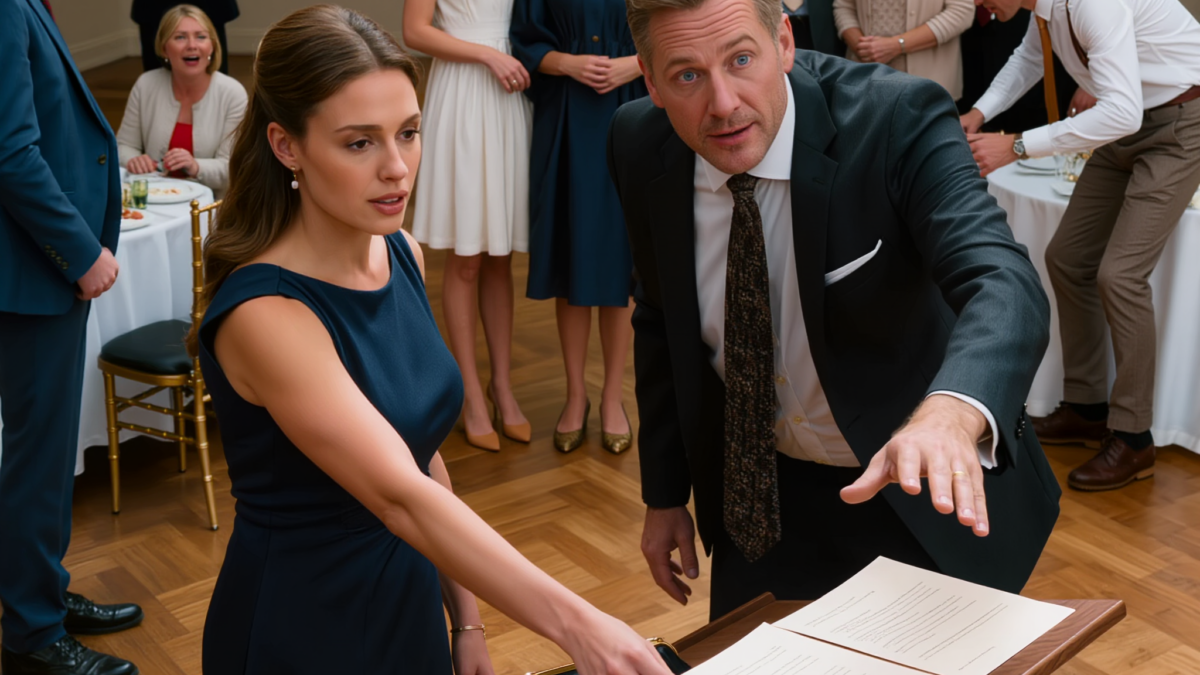
My sister’s graduation party had been going for three hours when my father decided to be funny.
He tapped the microphone. Thirty guests turned toward him. A caterer froze in the middle of pouring a drink.
“Let’s toast the real pride of this family,” he said, tipping his glass toward my sister.
Then he looked at me, still smiling.
“The accident we kept.”
The tables laughed on cue. Somebody whistled. My mother set down her glass and didn’t pick it back up.
I stayed calm. I always do.
I stood, smoothed my navy dress, and walked toward the little stage while the whole room watched me climb the steps. My father was still smiling when I reached him. He thought I was coming up to play along.
He handed me the microphone.
He actually handed it to me.
That was how safe he felt.
“Before we raise another glass to my sister,” I said, “there’s a truth my father has spent three years making sure this room would never hear.”
My name is Thea. I’m 34 years old, and the man standing beside me with that glass had no idea the quietest person in the room was the only reason my mother was still alive to hear him.
Six weeks earlier, my sister Camille called me halfway through a 12-hour shift at the cancer center.
Camille almost never called. She texted when she wanted something. A phone call meant an event.
“You’re coming to my party,” she said.
It wasn’t a question.
I stepped into the med room and lowered my voice.
“What party?”
“My graduation. I finished my MBA. Thea, try to keep up.”
I already knew.
Our mother had mentioned it twice, carefully, the way she mentioned anything that might make me feel left out.
“Dad rented Rosewood Hall,” Camille continued. “It’s a real event, so wear something that isn’t scrubs.”
“I’ll be there.”
“Mom wants you there,” she corrected. “There’s a difference.”
Then she hung up.
I stood in the little room with the drug refrigerator humming behind me and felt the old thing settle back into my chest.
There’s a difference.
In our family, there had always been a difference.
And I had spent 34 years on the wrong side of it.
There’s a particular way you learn that you’re the child a family keeps instead of the child it chooses. Nobody announces it. You notice it the way you notice weather.
The good chair is never yours.
Your name comes second.
When family photos get framed, you’re the one slightly out of focus at the edge.
I stopped needing them to say it out loud a long time ago.
What I never managed to stop doing was showing up.
I went back to my patients.
A woman in Bay 4 was three hours into her infusion and gripping the armrest. I sat beside her and talked her through the cold that runs up your arm when the line opens.
I was good at that part.
Steady hands. Low voice. No panic.
It was the only inheritance my family had ever given me on purpose.
They taught me not to make a scene.
They had no idea what I had been quietly carrying for three years, or what it would cost them the day I finally set it down.
That night, I drove home and did what I always did.
I opened my banking app.
The automatic payment had cleared that morning.
$740.
Gone on the fourth of the month, just like every month before it.
The loan had a harmless-sounding name, a medical financing account, but the balance could still make my stomach drop.
It had started at $62,000.
It was lower now, but not much lower.
Most of what I paid each month disappeared into interest before it ever touched the amount I had borrowed.
I had been carrying the loan alone since the spring my mother was supposed to die.
I closed the app before I could sit too long with the number.
That was a rule I had made for myself.
I could look.
I couldn’t sit in it.
Sitting in it was how you got bitter, and bitter was a luxury I couldn’t afford while I was still paying.
The party was six weeks away.
I told myself I would go, smile, clap for Camille, and come home.
Just get through it.
That was what I told myself every year.
The next morning, Mom called.
Her voice had been different since chemo. Thinner around the edges, like a photograph left too long in the sun.
Three years of treatment will do that to a person.
She survived.
Not all of her came back.
“You talked to your sister,” she said.
“I did.”
“You’re coming?”
“I’m coming.”
“Good.”
There was a pause.
“Thea, your father’s been… He’s excited. He’s telling everyone Camille’s the first in the family with a master’s.”
“She is.”
“He forgets things,” Mom said.
Then she stopped.
Because we both knew he didn’t forget.
Forgetting is accidental.
What my father did was deliberate, and it had been deliberate my whole life.
I could have told her the truth right then.
I could have said, Mom, remind him who signed the papers when the hospital needed a guarantor and he refused.
I didn’t.
I never did.
I told myself she was fragile. She had been through enough. Dragging the past into the light would only hurt the one person who hadn’t hurt me.
That was the lie I lived inside.
It kept me warm right up until the night I walked to a microphone and burned it down.
“I’ll wear something nice,” I told her.
“For you?”
“For me,” she said softly.
Three weeks before the party, I went looking for a dress.
Instead, I found the box.
It was in the back of my closet, taped shut, with two words in my handwriting across the top.
Spring 2023.
I had sealed it the week Mom came home from surgery because I couldn’t look at what was inside and keep functioning.
I had meant to throw it away.
Instead, I had moved it through three apartments.
I cut the tape.
On top was a manila envelope, soft around the corners from being handled during the worst month of my life.
Inside were the papers that ran through the second half of this story.
The papers my father would later insist, in front of 30 people, did not exist.
I didn’t open the envelope that night.
I only held it.
And I remembered the phone call that had started all of it.
It had come at 6:40 on a Tuesday morning in April.
A doctor I had worked beside for years called me instead of my father because my father had stopped answering calls from the hospital.
“Thea,” he said, “it’s about your mom. We need someone to make a decision, and we need it today.”
I put the envelope back into the box.
My hands were steady.
They’re always steady.
But I sat on my bedroom floor for a long time.
For the first time in three years, I let myself wonder what would happen if I stopped protecting people who had never once protected me.
I didn’t have an answer.
I had three weeks.
The following Sunday, Mom asked me to come to the house for dinner.
A practice run, she called it, before the party.
Dad called it a family meeting.
In our family, those were the same event with different lighting.
I brought a pie.
I always brought something because arriving empty-handed at that house could become a charge they held against you for years.
Camille was already seated at the good end of the table with her laptop open, showing Dad a slideshow of her graduation pictures.
He leaned toward the screen like a man reading scripture.
“Look at that,” he said. “Summa cum laude. You know what that means, Diane?”
“It means she worked hard,” Mom said.
“It means Walsh means something now.”
He said it to the room.
He said everything to the room.
My father had spent his life performing for an audience that was usually just us.
I set the pie on the counter.
Nobody looked up.
“Hi, Thea.”
Aunt Sylvie was standing in the kitchen doorway with a dish towel over one shoulder.
She was Mom’s younger sister and the only person in that house who ever said my name like it was a normal thing to be glad I had arrived.
She had been in the hospital waiting room three years earlier when most of the family wasn’t.
Sylvie knew more than she said.
She always had.
“Hi, Sylvie.”
I hugged her.
For a second, the cold feeling in my chest eased.
“You look tired,” she murmured. “Working doubles again?”
“Somebody has to.”
She held my eyes a little too long.
“Somebody always does.”
Dinner belonged to Camille.
Every course of it.
Her program. Her professors. Her job offer from a firm downtown. The apartment she was touring with the balcony.
Dad narrated her future like a sportscaster.
Mom nodded and reached twice for a glass of water she wasn’t drinking.
I watched her hands.
Three years after treatment, they still shook slightly in the evenings.
Nobody else at that table seemed to notice.
I noticed because I had spent a career learning to read the things my family refused to see.
“Thea, you’re quiet.”
Uncle Roy had arrived with a bottle of wine whose price he liked to mention.
He was Dad’s older brother and the family’s Greek chorus.
Whatever Dad believed, Roy usually said louder.
“Long week,” I said.
“Still up at the hospital wiping noses?”
He chuckled at his own joke.
“You know Camille’s starting at eighty-five grand. What does a nurse pull these days?”
“Roy,” Mom said.
“I’m asking. It’s a fair question.”
“Enough.”
Something in her voice made him stop.
She didn’t do that often.
It cost her something every time.
I looked across the table at my mother and felt the envelope in my closet as if it were sitting in my pocket.
She had no idea I still had it.
She thought that spring lived only in her body now, in the scar and the trembling hands.
She didn’t know I had kept the paper trail from the month her husband decided she wasn’t worth the cost.
“I think it’s wonderful,” I said.
And I meant the half of it that was about my mother being alive to sit there.
“Congratulations, Camille.”
My sister looked up as if she were surprised I could form the word.
“Thanks. You’ll come early to help set up, right? Mom said you’re good with that stuff.”
Good with that stuff.
Setup.
Cleanup.
The labor of celebrating people who would never celebrate me.
I had been good with that stuff my whole life.
“Sure.”
Later, I stood beside Mom at the sink drying dishes while everyone else watched the game.
The kitchen was warm. Water ran steadily from the faucet. For a moment, it felt like the safest room in the world.
“Mom,” I said, “do you ever think about that spring?”
Her hands went still.
The gold cross she had worn throughout chemo caught the light at her throat.
She almost never took it off anymore.
She said it reminded her that she had gotten to keep her neck to hang it on.
She didn’t look at me.
“Every day.”
“Do you ever wonder how the surgery got paid for?”
The plate in her hands trembled.
She set it down carefully.
“Your father handled it.”
The words were flat.
Rehearsed.
A sentence someone had given her and asked her to keep.
“He took care of everything.”
“That’s what he says.”
I looked at her profile and understood.
She knew.
Not everything.
But enough.
She had been handed a story to protect, just as I had.
And she was holding it because the alternative was a war she didn’t have the strength to fight.
“Right,” I said. “Of course he did.”
I dried the plate.
I let it go.
I told myself I was letting it go for her.
The truth was uglier.
I let it go because saying it aloud would have made it real.
And if it was real, I would have to do something.
Doing something meant becoming the daughter who finally made a scene.
That was the one thing they had raised me never to be.
I drove home with the radio off.
At a red light, I opened my phone and looked at the family group chat.
I was technically in it and functionally invisible.
Forty-one unread messages.
Camille’s photographs.
Dad’s replies.
That’s my girl.
Proud isn’t the word.
The Walsh name finally earned.
I scrolled upward out of habit.
The way you press on a bruise.
And then I saw it.
Not a new message.
A three-year-old screenshot I had forgotten I saved, buried in my camera roll under hundreds of pictures of other people’s celebrations.
It was a message from Dad to Mom’s oncologist’s billing office.
During the chaos of that week, he had accidentally forwarded it to the family chat and deleted it minutes later.
But I had seen it.
I had saved it.
And until that red light, I had never allowed myself to read it again.
We’ve discussed it as a family. We’re going to let things run their natural course. Please stop calling about the surgical estimate.
Run their natural course.
My mother’s natural course that spring was death within the season.
That was what the estimate was about.
That was what he had told them to stop calling about.
The light turned green.
Somebody behind me honked.
I didn’t move for a second.
Because my father didn’t know what I had.
None of them did.
They could sit in that warm house dividing up my sister’s glory because they had no idea I still had the screenshot.
I still had the envelope.
And for three years, I had been the only person alive who could prove that the “real pride” of the family had received her expensive education in a home that still had a mother in it only because the “accident” had refused to let her go.
I placed the phone facedown on the passenger seat.
My hands were perfectly steady.
For the first time, that frightened me more than shaking would have.
I didn’t sleep that night.
Around two in the morning, I made a decision I was proud of.
For about nine days, I decided to do nothing.
It felt like wisdom.
Mom was alive.
Mom was fragile.
Blowing up her marriage and her family at Camille’s graduation party would heal nothing.
I would go.
I would clap.
I would come home.
I would continue paying $740 on the fourth of every month until the balance reached zero.
No one would ever know.
That was the mature choice.
That was the nurse’s choice.
You stabilize the patient.
You don’t perform surgery at the dinner table.
I held on to that for nine days.
Then Dad called me himself.
He almost never did.
“Thea.”
His voice was all business.
“Your mother wants you at the family table, but we’re tight on seats up front. I’m putting you with Sylvie’s crowd near the back. You understand? It photographs better with the immediate family together.”
I stood in my kitchen and let the words settle.
The immediate family.
Mom.
Dad.
Camille.
And apparently not me.
I belonged near the back, with the aunt, where the camera didn’t have to work as hard.
“I’m your daughter,” I said quietly.
I mostly wanted to hear how the sentence sounded out loud.
“You’re being sensitive. It’s one night. Don’t make it a thing.”
Don’t make it a thing.
I had heard that sentence more times than I had heard I love you.
I had stopped expecting the second one years ago.
Something was different now.
I could feel the screenshot in my phone like a coal.
“Fine. The back is fine.”
“Good girl.”
He hung up.
I stood there for a while.
Then I walked to my closet, took down the box labeled Spring 2023, and did the thing I had sealed it three years earlier to avoid.
I opened the envelope.
Inside was the hospital’s financial responsibility form.
My name was on the guarantor line, written in my handwriting and dated that April.
There was the loan agreement.
$62,000.
My signature.
My income.
My risk.
There was the insurer’s letter denying the surgery as “not medically necessary at this time.”
And there was a single index card in my own handwriting.
I didn’t remember writing it until I saw it.
She doesn’t need to know it was me. She just needs to live.
I read those words and finally understood what I had actually been doing for three years.
I had not only protected my mother.
I had protected all of them.
I had kept peace in a family that had never once kept it for me.
I had been calling my silence love because the truth was too heavy to pick up alone.
I put the card in my wallet.
I’m not entirely sure why.
Maybe part of me already knew where this was going, even while the rest of me was still promising everyone I would sit quietly in the back.
Two days later, Camille sent the family group chat a photograph of the seating chart.
She had made a seating chart for a graduation party.
Near the bottom, beside the kitchen doors, was a small rectangle with two names.
Sylvia.
Thea.
Dad responded within a minute.
“Perfect. Looks great, sweetheart.”
Mom said nothing in the group chat.
Later that night, she sent me a private message.
I’m so sorry.
I stared at it for a long time.
Then I typed what I had been saying all my life.
Don’t worry about it. It’s fine.
I deleted it before sending.
Instead, I wrote:
“Sorry for what, Mom?”
The three dots appeared.
Disappeared.
Appeared again.
For almost a minute, my mother sat somewhere in that dark house trying to decide how much truth she was allowed to say.
Finally:
For all of it.
I’ll fix it one day. I promise you I will.
She wouldn’t.
Not because she didn’t mean it.
She did.
She meant it with everything cancer had left her.
But Mom didn’t have the envelope.
She didn’t have the screenshot.
She had been given a story to keep, and keeping it was the only power she had left.
I couldn’t ask a woman who had just fought her way back from dying to also fight her way out of the only role her marriage still allowed her.
If I wanted anything fixed, I would have to do it myself.
I just didn’t fully know that yet.
Two days after the seating chart arrived, Mom had a follow-up scan.
She asked me to take her.
She always asked me.
Dad always had something more important.
Neither of them ever named the pattern.
I picked her up at 9:00.
She was waiting on the porch in her good coat even though the weather was warm.
Chemo had taken away her ability to regulate temperature and never really returned it.
The gold cross sat at her throat.
She climbed into my car slowly.
I reached across and fastened her seat belt without being asked.
I had done the same thing for countless patients.
“Your father’s golfing,” she said.
“I didn’t ask.”
“I know.”
She looked out the window.
“I just didn’t want you to think he forgot.”
He hadn’t forgotten.
That was the thing Mom could never say and I could never stop knowing.
He didn’t forget her scans.
He scheduled around them.
At the imaging center, the staff knew me.
I had worked inside the system for a decade, and the technician waved us straight back.
Mom held my hand while the machine ran.
I watched her face for a reaction I had seen in hundreds of patients.
The little collapse people allow themselves when they think nobody is reading them.
She did it.
Then she put it away and smiled at me.
“You’re good at this.”
I didn’t answer.
“You were always good at this,” she continued. “Even when you were little. You’d sit with me when I had migraines. Camille would cry. You’d bring me a wet cloth.”
“I remember.”
“Your father used to say you were born forty years old.”
She laughed softly.
“He didn’t mean it kindly, but it was true.”
I thought about the version of that story Dad told at parties.
Thea was the serious one.
The humorless one.
The old soul who never quite fit.
The same set of facts can become a compliment or an insult depending on who is holding the microphone.
After the scan, we sat in the car.
Mom opened her purse and pulled out a folded piece of mail.
She handled it like it might bite.
“Another bill,” she said. “From the specialist.”
Dad had told her insurance would sort it out.
The bills kept arriving anyway.
Three years earlier, the cancer had been in her ovaries and moving.
The surgeon who could remove it worked at a center two hours away.
Out of network.
The estimate exceeded $60,000.
Insurance refused to cover the procedure and called it “not medically necessary at this time.”
Those were the words.
My mother had been dying on a technicality.
And the technicality had a phone number my father stopped answering.
I unfolded the new bill.
$410.
A lab fee.
The kind of thing that slips through every crack in the system.
“I’ll handle it,” I said before I could stop myself.
“No.”
She closed her hand over mine.
“No, sweetheart. I didn’t show you so you’d pay it. I just wanted one person to know they keep coming. That’s all. Just one person.”
I looked at my mother.
Three years after surviving something that should have killed her, she was still carrying bills into my car so her husband wouldn’t see them and get that look.
And I understood that she and I had been doing the same thing.
Carrying things quietly.
Protecting the man who had decided neither of us was worth the cost.
“Okay,” I said. “One person knows.”
I paid the $410 from my phone that night.
I never told her.
The following afternoon, Camille called.
Her second real phone call in a month.
That meant she wanted something.
“So, the party’s shaping up,” she said. “Dad went a little crazy on the hall. It’s gorgeous. But the flowers came in over budget, and he’s stressed about it. I told him you’d want to help.”
I stood in my kitchen.
“You told him I’d want to help pay for your graduation party?”
“Don’t make it weird. You don’t have kids. You don’t have a mortgage. It’s like six hundred bucks. Everyone chips in for family stuff.”
Everyone chips in for family stuff.
I nearly laughed.
I thought about $62,000.
I thought about $740 leaving my account every month.
I thought about the $410 I had paid the night before.
I thought about all the family stuff I had quietly been paying for while my sister toured apartments with balconies.
“Sure,” I said. “Send me the florist’s information.”
“You’re the best. See? This is why Mom says you’re the reliable one.”
There was a pause.
“Dad’s doing a whole speech, by the way. It’s going to be so sweet. You should hear how he talks about me when you’re not around.”
I bet I should, I thought.
I sent the florist $600.
Money for flowers I would stand behind at a table by the kitchen at a party where I would become the joke.
Somewhere in that transaction, something inside me that had held for 34 years made a very small sound.
Like a hairline crack in a plate you keep using anyway.
I told myself I hadn’t heard it.
At work the next day, the hospital did what hospitals always do when your personal life becomes too loud.
It handed me someone else’s.
His name was Mr. Alderman.
Eighty-one.
End-stage.
He was in the corner bay with the good window and had been my patient for three weeks.
Mr. Alderman had two daughters.
The younger one, Paige, came every day.
She learned his medication schedule.
She brought lotion for his hands and the specific pudding he would still eat.
She slept in a vinyl chair.
She asked the difficult questions in a low voice in the hallway where he couldn’t hear.
How long?
What will it look like?
Will he hurt?
The older daughter, Denise, came twice.
Both times she arrived late, stayed about 20 minutes, took a picture holding his hand, and left before the difficult part.
And both times, Mr. Alderman lit up.
“That’s my Denise,” he told me after the second visit, beaming while Paige quietly changed his water pitcher behind him. “Successful girl. Big career. Busy, busy. She flew in special.”
Denise had driven 40 minutes.
Paige looked at me over his bed.
She smiled.
A tired, private smile.
The smile of someone who has chosen not to correct the record because correcting it would only hurt the person she loves.
I knew that smile from the inside.
I had been wearing it my whole life.
Later, Denise had gone and Paige had stepped out to call her children.
I was checking Mr. Alderman’s line when he caught my wrist.
He was drifting, but his grip was stronger than I expected.
“You tell the quiet one,” he said.
His eyes were half closed.
“You tell her I knew. I always knew which one really stayed.”
His grip loosened.
“I just never said it out loud. A man runs out of out louds. You tell her.”
Then he fell asleep.
I stood there with his chart in my hands.
A man runs out of out louds.
He didn’t know he was talking to a version of Paige.
He didn’t know he was talking to the accident.
He was only an old man near the end, finally sorry that he had spent a lifetime making the wrong daughter feel like the miracle and the right one feel like the staff.
I found Paige near the elevators.
I wasn’t supposed to editorialize with families.
I did it anyway.
“He knows,” I told her. “What you do. He knows it’s you. Even when he says it’s her, some part of him knows.”
Her eyes filled.
“Does that matter, though?”
She wiped at her face quickly.
“If he never says it? If he dies still telling everyone it was her?”
She glanced away.
“Sorry. You’ve got other patients.”
I didn’t have an answer.
But her question followed me to the parking garage and sat beside me all the way home.
Does it matter if they never say it out loud?
If you spend your life being the one who stayed, and the story still gets told with your name blurry at the edge, does the truth matter if nobody hears it?
For three years, my answer had been silence.
Let them have the story.
Keep the peace.
But Mr. Alderman was running out of chances to say things aloud.
And he had used one of his last clear moments asking a stranger to correct something he had failed to correct himself.
That evening, the charge nurse, Ranata, found me in the break room staring at a coffee I had made 20 minutes earlier and never touched.
“You’ve been somewhere else all shift.”
Ranata had worked in oncology longer than I had.
She noticed everything.
“That your family thing? The party?”
“It’s fine.”
“You say that like a patient rating their pain a two while their monitor is screaming.”
She sat across from me.
“You don’t have to tell me. But I’ve watched you hold it together for other people’s families for ten years, Thea. You’re the calmest person on this floor.”
She paused.
“I’ve always wondered who’s calm for you.”
I didn’t cry.
But my throat closed enough that I had to look at the wall before I could answer.
Because the honest answer was nobody.
It had always been nobody.
I had built an entire personality around not needing anyone.
“There’s a thing I could say to my family,” I said eventually. “At the party. A true thing. I’ve spent three years not saying it because I thought that made me kind.”
Ranata nodded.
“And now?”
“Now I have a patient asking me to say the thing he never said. And I can’t stop thinking I’m going to end up exactly like him. Ninety years old, still keeping the peace, still watching them thank the wrong person.”
She was quiet for a moment.
Then she said something I carried into that party like a second envelope.
“Keeping the peace isn’t the same as being kind, honey. Sometimes it’s just the version of quiet that’s easiest for everyone but you.”
I went home.
I looked at the box marked Spring 2023.
I didn’t open it that night.
But for the first time, I stopped promising myself that I never would.
There is a version of this story where Camille is simply oblivious.
For a long time, I wanted to believe that version.
Then we had coffee.
A week before the party, she asked me to meet at a place near her new office to discuss logistics.
When I arrived, she was already sitting with her laptop open and a spreadsheet of vendors and seating arrangements on the screen.
She slid a coffee toward me.
She had guessed my order.
She had guessed wrong.
“So,” she said, “I need you to manage the caterer and the setup. You’re good at the invisible stuff. It genuinely calms me down knowing you’ve got it.”
The invisible stuff.
She meant it as a compliment.
In our family, those things always came dressed as compliments.
“Sure.”
“I don’t know how you do it, honestly.”
She continued scrolling.
“You’re so content. Your shifts, your apartment, no drama. I’d lose my mind. But it suits you. You were always the one who didn’t need much.”
I looked across the table at my sister.
And for the first time, I understood something I had avoided seeing.
Camille wasn’t cruel because she had never thought about me.
She had thought about me.
She had simply settled on a story that let her keep everything.
Thea doesn’t need much.
Thea likes being in the background.
Thea chose a quiet little life.
If that story was true, then nobody had taken anything from me.
The apartment with the balcony, the summa cum laude, the chair at the front of the room, all of it could be explained as the natural result of one daughter wanting the spotlight and the other preferring the shade.
It was a comfortable story.
It cost the person telling it nothing.
“Can I ask you something?”
Camille kept looking at her laptop.
“Sure.”
“Do you know how Mom’s surgery got paid for?”
Her scrolling slowed.
Only for a second.
But I saw it.
Something crossed her face.
Not confusion.
The opposite.
The specific stillness of someone deciding not to know something.
“Dad handled it,” she said. “Insurance, or he took care of it. Why?”
“Mom said something to you once, didn’t she? About me helping?”
Camille closed the laptop halfway.
“She was on a lot of medication back then, Thea. She said all kinds of things.”
Then she met my eyes.
There it was.
The family talent, passed down clean.
Looking straight at the truth and filing it under things we don’t discuss.
“Whatever you did or didn’t do, it’s not really… this is Mom and Dad’s marriage. It’s their money. It’s not our business. And it’s definitely not a party conversation.”
She opened her laptop again.
“So, the caterer. Can you be there by four?”
Three years earlier, Mom had handed Camille a loose thread.
Foggy from medication, she had apparently let something slip.
Camille could have pulled the thread.
Instead, she had cut it and thrown it away because pulling might unravel the coat she was wearing.
That wasn’t obliviousness.
Obliviousness is innocent.
What Camille had was a choice she had made over and over because it kept her in the comfortable chair.
“I can be there by four.”
“You’re the best.”
She smiled, relieved.
The conversation had closed safely.
“Seriously, what would this family do without you?”
I almost laughed.
It was the truest thing anyone in my family had said to me in years.
She had no idea she had said it.
I drove home thinking about Dad and Camille.
One had built the story.
The other maintained it.
Both of them needed me exactly where I was.
Quiet.
Useful.
Grateful for the shade.
I had spent 34 years being the load-bearing wall their happy family hung itself on.
Nobody thanks a wall.
They only get nervous when it makes a sound.
That week, I made a small one.
I told the florist to bill me directly instead of Camille and paid the $600 myself.
I let myself notice what I was doing.
Once again, I was quietly financing my own humiliation.
It was the last time I ever would.
That night, Mom texted me after Dad had gone to sleep.
Your dad knows you paid the florist directly.
He’s angry.
Says you’re making a point.
I stared at the message.
I had paid for flowers at my sister’s graduation party and somehow become the problem.
I typed back:
“I’m not making a point, Mom. I’m just tired of pretending.”
The three dots came and went.
Finally:
Please. Please just get through Saturday for me. Then we’ll talk. I promise. We’ll talk.
She had been promising to talk for three years.
I looked toward my closet.
Spring 2023.
The box was still there.
Saturday and the talk had become the same event, whether she knew it or not.
“Okay, Mom,” I wrote. “I’ll get through Saturday.”
It wasn’t a lie.
I simply didn’t tell her how.
A week before the party, Dad asked me to come to the house alone.
That almost never happened.
He was in his study, the room he called an office even though he had been retired for years.
The walls were filled with trophies from a life he had narrated more impressively than he had lived.
He didn’t offer me a chair.
“I’ll get to it,” he said. “The party’s cost more than I planned. Your mother’s medical situation is ongoing. You know how it is.”
He said it like weather.
Like her survival was an inconvenient line item.
“I’m a little short this quarter. I was thinking you could help your old man out.”
He paused.
“Ten thousand. Call it a loan.”
I stared at him.
“You want to borrow money from me?”
“I said I want you to contribute. There’s a difference.”
There’s a difference.
Second time in a month.
It ran in the family.
“Camille’s just starting out. She can’t. And you don’t spend on anything. You’ve got no life to speak of. No offense. It just sits there. Might as well do some good.”
No life to speak of.
It just sits there.
He had no idea what it sat there for.
He didn’t know a piece of the life I could have built had been converted into the monthly payment that kept his wife alive.
He didn’t know the debt had my signature on every important line and his on none of them.
“I’ll think about it.”
“Don’t think too long. I need it before the party.”
He turned back to his desk.
“And Thea, this stays between us. Your mother worries about money. No need to upset her.”
No need to upset her.
Dad had built his life on the principle that the women around him should be protected from the truth of what he was.
And he had trained us so thoroughly that we protected him right back.
I drove home and made one clear decision.
He wasn’t getting $10,000.
The other decision, the one about the secret, was harder.
I circled it.
Picked it up.
Put it down.
The same way I had handled that envelope for three years.
Because making that decision meant becoming the person my family had spent a lifetime teaching me not to be.
The morning the surgeon’s office finally called me because they had given up on Dad, a doctor I had worked beside for years said it plainly.
“If she doesn’t have the procedure in the next ten days, we’re out of options. There’s a family decision to make.”
“There’s no decision,” I told her. “Book it.”
“Someone has to sign for the cost.”
Then she said the part I already knew.
“Your father declined.”
I stood in a supply hallway at my own hospital in my scrubs and signed my mother’s life onto my own name because the man who was supposed to do it had gone golfing.
Two days after Dad asked me for $10,000, Sylvie called.
Her voice sounded strange.
“I need to tell you something,” she said. “I should have told you three years ago. I’ve been sick about it since.”
“Sylvie…”
“Just listen.”
She took a breath.
“That spring, in the waiting room, your father was on the phone with the insurance company. He thought I was in the restroom. I heard him.”
Silence.
Then:
“He said, ‘Let it run its natural course. We’re not going to bankrupt ourselves over this.’ About your mother, Thea. His wife.”
She stopped again.
“Then the surgery happened anyway. Everybody acted like a miracle paid for it. I knew it wasn’t a miracle. And I never said anything because your mother begged me to keep the peace.”
I sat down on the kitchen floor.
“I know.”
There was silence on the other end.
“I have the message,” I said. “He put it in writing.”
Sylvie inhaled.
Then she said the sentence that ended the last of my hesitation.
“Then you’re the only one who can end it.”
I closed my eyes.
“Your mother won’t. I don’t have the standing. God knows he never will. It has to be the one it happened to.”
She paused.
“I’m tired, Thea. I’m fifty-nine years old, and I’m tired of watching you fold their napkins. Whatever you decide to do, I’ll stand up for you in front of all of them.”
For the first time in three years, I wasn’t carrying the secret alone.
That changed something.
A secret you carry by yourself feels like a burden.
A truth two people are willing to say aloud feels like a door.
I thanked her.
Then I sat on my kitchen floor staring at that door.
I was terrified to walk through it.
So I did what I had always done with doors.
I left it closed for the moment.
Three days before the party, Mom asked me to come sit with her while Dad was out.
Not for a scan.
Not for an appointment.
Just to sit.
That almost never happened.
She made tea neither of us drank.
We sat in the front room where the framed family pictures lived.
The ones where I always seemed slightly out of focus.
For a while, Mom only held my hand.
“I know he says things,” she said eventually. “Your father. I know how he is. I’ve known for forty years.”
“Mom…”
“Let me say it.”
Her voice was thin, but she pushed the words forward.
“This party is for Camille, and I need it to be a nice night.”
Her fingers tightened around mine.
“I don’t have as many nice nights left as I used to, Thea. The scans are okay for now, but I know what ‘for now’ means.”
I knew too.
I had explained those words to hundreds of families.
For now is one of medicine’s kinder lies.
“So whatever happens,” Mom said, “whatever he says up there, please. For me, don’t.”
She looked at me.
“Just let it be a nice night. Let them have their night. Let me have you at the end of it in one piece. Not in a war I can’t fight.”
There was fear in her eyes that I never saw in Sylvie’s.
“I can’t lose the peace, sweetheart. It’s the only thing I have left that doesn’t hurt.”
That was how you disarmed the accident.
Not with cruelty.
With a sick woman’s hand around your wrist, asking you to swallow the truth one more time because she was too tired for it to cost anything.
“Okay,” I said.
I meant it.
God help me, I meant it.
Sitting in that room full of photographs where I was always blurry at the edge, I decided I would keep the peace one final time.
Dad could have his microphone.
He could give his speech.
I would clap.
I would go home.
I would keep paying the loan.
I would remain forever the accident who understood.
There was one final piece of that spring I rarely let myself remember.
After the surgery, Mom woke groggy and grateful.
She reached for Dad’s hand.
“You saved me,” she whispered. “I don’t know how you did it, but you saved me.”
Dad held her hand.
And he let her believe it.
Then he looked across the recovery room at me.
He knew.
I knew.
And he watched me choose not to correct her.
I stood in the corner in my scrubs.
I had signed the financial papers eleven hours earlier.
And I let my mother thank the man who had told the hospital to stop calling.
That was the real moment.
Not the microphone.
That was when I became the accident who kept the peace.
I had been paying for that decision on the fourth of every month ever since.
The interest wasn’t the worst part.
The worst part was watching her thank him and remaining silent because I loved her and had been taught that my love was supposed to be quiet.
The night before the party, I laid out my navy dress.
I placed my clutch beside it.
Then I put the envelope back into the box, taped it shut, and returned it to the closet.
I promised myself it would stay there.
I lasted until morning.
At 6:00 a.m., I got up, cut the tape, and took the envelope back out.
I didn’t exactly decide to.
My hands seemed to decide before the rest of me did.
They had been making decisions quietly for three years while I kept calling it peace.
I put the envelope in my purse.
Just in case.
I didn’t ask myself what that meant.
I told Sylvie I would sit in the back and smile.
I told Mom everything was fine.
I told myself until the morning of the party that I would keep the peace one more time.
I believed it.
I arrived at Rosewood Hall two hours early wearing the navy dress that wasn’t scrubs.
I carried folding chairs in from the car like the good daughter I had been trained to be.
The hall was nicer than anything our family had rented before.
String lights.
A raised stage.
A microphone on a stand.
Dad had already found it.
He was tapping it and saying, “Check, check,” into an empty room like a man who had spent his life waiting for a stage.
“Thea,” he said without turning. “Good. The linens need doing, and keep an eye on the caterer. They overcharge if you let them.”
Not hello.
Not thank you for coming early.
The linens need doing.
So I did the linens.
I set thirty places for a celebration where I wasn’t allowed to be celebrated.
I folded thirty napkins.
At the final table, near the kitchen doors, I set down my clutch.
The envelope remained zipped inside where I could see it.
By accident, I told myself.
But I had never done anything in my life by accident.
That was Dad’s word for me.
Not mine.
Guests started arriving at six.
I knew most of them.
I belonged to none of them.
Dad’s old work friends came, men who called him a good provider without ever checking whether that was true.
Camille’s classmates arrived, bright and loud and twenty-six.
Cousins I mostly saw at funerals appeared.
Roy was one of the first people at the bar, already telling everyone about Camille’s job offer as though he had negotiated it himself.
I stood near the kitchen doors beside Sylvie with a glass of wine I never drank.
“You okay?” she asked.
“I’m always okay.”
“That’s not what I asked.”
I looked at her.
She had Mom’s eyes without Mom’s fear.
“I’m at the kitchen table at my own sister’s party, Sylvie. It’s fine.”
“It’s not fine. It’s never been fine.”
Her jaw tightened.
“I’ve been watching them do this to you since you were six. Every year, I tell myself I’ll say something. Every year, your mother asks me to keep the peace.”
She exhaled.
“I’m getting too old to keep the peace, Thea. I don’t know how much longer I can watch you carry this family while they treat you like the help.”
I almost told her then.
The envelope was only a few feet away in my clutch.
Then Camille swept past in her white dress.
“Thea, can you check if the cake made it? You’re closest to the kitchen.”
The moment closed.
I checked the cake.
Of course I did.
Congratulations, Camille was written across the top in gold script.
It was beautiful.
I stood alone in the catering kitchen looking at my sister’s name in frosting and felt the specific loneliness of a person who has spent her life making everyone else’s celebrations run smoothly.
The caterer glanced at me.
“Your sister?”
“Yeah.”
“Big day for the family.”
“Big day.”
She hesitated.
“Your dad told me to seat the vendors and you at the same table. I told him that didn’t seem right. He said you’d understand.”
She looked embarrassed for me.
A stranger holding a cake knife was embarrassed on my behalf.
“For what it’s worth,” she said, “I don’t think you understand it. I think you just let it go.”
I didn’t answer.
But I remembered her face later.
She was the first person in that building to say the true thing aloud.
And she wasn’t even family.
Dinner was served.
I ate beside Sylvie, two vendors, and a cousin’s bored teenager.
From our table near the kitchen, I could see the head table.
Dad was holding court.
Camille was glowing.
Mom looked small between them, wearing a cardigan despite the June warmth.
Halfway through the entrée, her color changed.
Nobody else noticed.
Dad was in the middle of a story.
Camille was laughing at her phone.
Mom had gone the particular gray I had seen on hundreds of patients.
I was standing before I consciously decided to move.
I crossed the room and crouched beside her chair.
Two fingers went to her wrist.
“I’m fine,” she murmured.
“Your pulse says otherwise. When did you eat last?”
“This morning. I didn’t want to feel sick in the pictures.”
I brought her a roll and a glass of juice.
I stayed crouched beside her while she ate half the bread.
Dad talked over us the entire time.
Never paused.
Never asked why his wife had turned the color of ash.
Camille glanced down once.
“Is Mom okay?”
She was already looking back toward her phone.
“She’s okay,” I said. “I’ve got her.”
I’ve got her.
Three words I had built a life around.
Said quietly beside a table I wasn’t allowed to sit at.
When Mom’s color improved, she squeezed my hand beneath the tablecloth.
Hard.
For a moment, she didn’t let go.
It was the only thank-you I received from that table all night.
I took it.
I had learned to survive on very little.
The speeches began before dinner was completely cleared.
A classmate of Camille’s spoke first.
She called Camille the hardest worker in their cohort and made everyone laugh with a story about an all-nighter.
Then Camille took the microphone.
The room became quiet for her in a way it never became quiet for me.
She thanked her professors.
Her new firm.
Then she thanked “the two people who made all of this possible.”
“My mom and my dad,” she said, lifting her glass. “You believed in me before I believed in myself.”
People applauded.
Mom pressed a napkin near her eye.
“And I guess I should thank my sister too,” Camille added, looking toward the kitchen doors.
She laughed.
“Thea, who’s always around somewhere keeping the napkins folded.”
The room chuckled.
Fondly.
That was the difficult part to explain.
Nobody thought they were being cruel.
To them, Thea was a warm little family joke.
The woman who was always somewhere in the background making sure things worked.
I raised my water glass an inch.
“Congratulations,” I said to nobody who was listening.
Sylvie’s jaw tightened.
Under the table, she found my hand.
Then Dad announced the slideshow.
Of course he had made a slideshow.
The lights dimmed.
A screen came down behind the stage.
Camille appeared.
Camille as a baby.
Camille in a cap and gown at different ages.
Camille at the beach.
Camille blowing out birthday candles.
Photograph after photograph of the daughter they had planned.
I counted three pictures that included me.
In one, I was reaching for a plate at the edge of a birthday photograph.
In another, I was a blurred shape in the background at Christmas.
In the third, I was about nine years old, standing slightly apart from everyone else at some family reunion.
A woman at a nearby table leaned toward someone and whispered loudly enough for me to hear.
“Is that the other daughter? The one he mentioned?”
“That’s Thea,” Dad said from the stage without turning around. “She’s the practical one. Camille got the shine.”
Then he moved to the next slide.
Camille again.
I sat in the dark watching three decades of a family I had apparently attended rather than belonged to.
For once, my hands were not steady.
I pressed them flat against my thighs until they were.
That was the closest I came all night to leaving.
Not going to the microphone.
Going to the parking lot.
Getting into my car.
Letting them keep the slideshow, the speeches, the story, and the lie.
My keys were in my purse beside the envelope.
For about ten seconds in the dark, I chose the keys.
Then the lights came back on.
I stepped into the hallway for air.
That was when I heard Dad speaking around the corner.
Roy was with him.
“No, she’s fine. She’s no trouble,” Dad said.
I stopped.
“Thea’s the easy one. You know why? She knows what she is. Never fought it. Some kids you plan, and some you make peace with.”
I heard ice shift inside a glass.
Then Dad said:
“Best thing that girl ever did was stay quiet and useful. If she’d had half her sister’s ambition, she’d have been unbearable.”
Roy laughed.
“To the quiet ones.”
“To the quiet ones,” Dad agreed.
I stood against the hallway wall.
Best thing that girl ever did was stay quiet and useful.
Thirty-four years.
There it was.
The entire philosophy of me, spoken plainly by the man who had built it.
Six feet away stood the daughter holding proof of exactly how quiet and useful she had been.
I wish I could say I felt rage.
I didn’t.
Not yet.
What I felt was colder.
Clearer.
For the first time, the peace I had been keeping showed me its price.
All those quiet years.
And this was the return.
Not love.
Not respect.
Just my father’s satisfaction that his accident had learned her place.
I took a breath.
Steady hands.
Steady voice.
The nurse’s inheritance.
Then I walked back into the hall.
Even then, I thought I could finish the evening without saying anything.
I almost did.
Then Doyle stood.
He was one of Dad’s golf friends, warm with wine and feeling sentimental.
He tapped his glass.
“I want to say something about this family.”
My stomach dropped.
“Three years ago, we almost lost Diane. We all remember it.”
He looked toward Dad.
“Dennis, the way you fought for her, got her the best doctors, moved heaven and earth. That’s a husband. That’s a man.”
Then he raised his glass.
“To Dennis, for saving the love of his life.”
The room stood.
Thirty people.
Thirty glasses.
Thirty witnesses applauding my father for saving my mother.
And Mom, sitting at the head table, put one hand over her mouth.
There were tears in her eyes.
She looked at Dad.
And she mouthed:
Thank you.
I stood at the kitchen-side table and watched my mother thank him for her life for the second time.
Only now there were witnesses.
Something in me finally broke past the hairline crack.
I could carry my own humiliation.
I had years of practice.
I could carry the seating chart.
The napkin joke.
The slideshow.
The things Dad had said in the hallway.
But I could not watch an entire room applaud him for the one thing I had done.
That was the line.
Mom’s gratitude pointed at the wrong person wasn’t mine to keep quiet.
She was thanking a liar because the liar had made sure she never knew.
Dad was glowing after Doyle’s toast.
He waved everyone back into their seats.
Then I saw the idea arrive on his face.
The room was warm.
People were happy.
He had their attention.
He wanted one more moment.
He reached for the microphone.
I reached for my purse.
I didn’t stand immediately.
Under the table, I unzipped the clutch and placed two fingers against the corner of the manila envelope that had waited three years for a room exactly this full.
Sylvie saw me.
She didn’t tell me to stop.
“I’ve got your back,” she whispered. “Whatever you do, go.”
Dad tapped a fork against his glass.
Everyone turned.
“I want to say a few words about my daughter.”
My daughter.
Singular.
Everybody knew which daughter he meant.
Nobody looked toward the kitchen.
Dad talked about sacrifice.
His sacrifice.
The long hours he had worked so his children could have more than he had.
He talked about how Camille had made everything worthwhile.
He said Walsh the way some men say amen.
Roy lifted his glass.
“Hear, hear.”
Everyone followed.
I lifted mine too.
I want that understood.
Even then, I toasted my sister.
Thirty-four years of training doesn’t disappear in one evening.
“I’m not a sentimental man,” Dad continued.
It was the most honest thing he said all night.
“But I look at Camille, summa cum laude, the first Walsh with a master’s degree, and I think that’s the real thing. That’s what we hoped for when we started this family.”
He paused.
He was enjoying himself.
Then he finally looked toward me.
“Some kids you plan,” he said into the microphone, smiling. “And some kids just happen. Right, Thea?”
There was uncertain laughter.
Dad kept going.
“The real pride of this family graduated today.”
He raised his glass toward Camille.
Then toward me.
“The other one was an accident we kept.”
People laughed.
That was the worst part.
It wasn’t vicious laughter.
It was comfortable.
The laughter of people who assumed this was an old family joke and that I was part of it.
Someone near the bar whistled.
Roy slapped the table.
A woman I didn’t know laughed as if Dad had said something charming.
Camille laughed.
Mom didn’t.
She placed her glass on the table.
She looked down at her lap.
One shaking hand covered her mouth.
I sat there with a strange calm moving through me.
The calm I feel when a patient is crashing and everyone else is panicking.
Thirty-four years seemed to narrow into one sentence.
Every folded napkin.
Every monthly payment.
Every expression of affection I had stopped waiting to hear.
The accident we kept.
I looked down at my hands.
Perfectly steady.
I understood that I had two choices.
I could laugh.
Drive home.
Pay the loan again on the fourth.
Let the family keep telling the story.
Or I could pick up my purse.
I picked up my purse.
I stood.
Smoothed my navy dress.
And walked from the kitchen table into the light.
Thirty faces turned toward me.
Dad was still holding the microphone.
Still smiling.
He thought I was coming up to be a good sport.
Maybe take a bow.
Maybe add another joke.
He handed me the microphone.
“Before we raise another glass to my sister,” I said, “there’s a truth my father has spent three years making sure this room would never hear.”
The laughter faded.
People held their smiles a second too long because they weren’t sure whether the joke was continuing.
“Doyle.”
I looked toward the man who had toasted Dad.
“That was a beautiful toast. About Dad saving Mom. I want to talk about that because you all just stood up for it.”
“Thea.”
Dad’s smile remained.
His eyes changed.
“Give me the mic, sweetheart. You’ve had a long day.”
“Three years ago, my mother had ovarian cancer,” I said, speaking to the room instead of him. “The surgery that saved her was out of network. Insurance wouldn’t cover it. The estimate was more than sixty thousand dollars.”
“This isn’t the time,” Dad said.
“My father told the hospital to stop calling about it.”
The room quieted.
“He told them to let it run its natural course. Those were his words.”
Mom had both hands flat on the tablecloth now.
“That’s a lie.”
Dad’s voice came through the speakers too loudly.
He laughed, but it sounded wrong.
“Folks, my apologies. She gets like this. Always been dramatic. Jealous of her sister since they were kids.”
That was Dad’s one move.
It had always worked.
Raise his voice.
Name me as the problem.
Loud father.
Dramatic daughter.
Everybody relax.
He had used it my entire life.
He used it again.
Only this time, thirty people were watching.
I didn’t raise my voice.
He became louder.
I became quieter.
And a room can hear the difference between someone defending the truth and someone trying to bury it.
“I have it here.”
I placed my purse on the podium.
Unzipped it.
Took out the manila envelope.
I didn’t wave it.
I didn’t make a performance of it.
I opened it and laid three pages beneath the podium light the way I would lay out a chart.
“The insurance denial,” I said, touching the first sheet.
Then the next.
“The loan agreement. Sixty-two thousand dollars.”
Then the last page.
“And the hospital’s financial responsibility form.”
I rested my finger beside the guarantor line.
“There’s a signature here. It isn’t his. It’s mine.”
Dad moved toward me.
“I signed for my mother’s surgery while he was on the golf course, and I’ve been paying for it on the fourth of every month for three years.”
“She forged that.”
Dad reached toward the papers.
I moved them calmly out of his reach.
“Camille,” he snapped. “Tell them. Tell them your sister’s insane.”
“You can read them yourself,” I told the room.
I turned the documents toward the tables.
“The denial is on hospital letterhead. The loan is from a lender you can look up. The guarantor form has a notary stamp from the day of the surgery three years ago.”
One of Dad’s golf friends leaned closer.
His name was Whitfield.
He was an accountant.
He read the first page.
Then the second.
Then he sat back.
He stopped looking at my father.
That was all it took.
One reader.
That is how belief changes in a room.
One person does the math with his face, and everyone else reads him.
“Dennis,” Whitfield said slowly. “These look real.”
Dad turned toward him.
“Of course they look real. She’s a professional. She works in a hospital. She knows how to make anything look real.”
He was sweating now.
Turning from table to table.
Still trying to sell to a room that had stopped buying.
“You’re going to take her word after everything I’ve built? She’s always resented this family.”
Camille stood.
Her white dress caught the light.
Her graduation night was collapsing around her.
“You’re ruining my party,” she said. “Whatever this is, you couldn’t let me have one night?”
“Sit down, Camille.”
Sylvie’s voice came sharply from the kitchen-side table.
My aunt stood.
“This is a family matter,” Roy started.
“It is,” I said. “So let’s have the family settle it.”
Then I looked at Mom.
I hadn’t planned to.
She sat small in her cardigan, the gold cross at her throat.
I said the only thing that night I had not rehearsed in my head.
“Mom, you can keep the peace if you need to. I’ll understand. I’ve kept it your whole recovery. But this room just thanked him for saving your life, and I can’t be the only person here who knows that isn’t what happened.”
The hall held its breath.
Mom looked at the pages.
Then at Dad.
His face had gone from red to a strange gray.
Then she looked at me.
Two days earlier, this woman had begged me to let Camille have one nice night.
For three years, she had carried the story she had been given because she didn’t believe she could survive the cost of putting it down.
Mom placed both hands on the table.
She pushed herself to her feet.
“She’s not lying.”
Three words.
The entire room turned.
“Diane,” Dad said. “Sit down. You’re not well. You don’t…”
“I’m not well,” she agreed.
Her voice was thin.
But everyone heard it.
“I know exactly how not well I am, Dennis. I count in months now, and I am not spending one more of them letting this room believe you saved me.”
Her hand went to the cross at her throat.
“You told them to let me go. I heard about the phone calls afterward. And our daughter, the one you just called an accident into a microphone at her sister’s party, signed her name to a loan she is still paying so I could be here tonight to hear you do it.”
“You’re twisting it.”
Dad’s voice had lost the stage.
“There were financial realities. You don’t understand what a procedure like that costs. I was being responsible. I was protecting this family’s future.”
“You were protecting your money,” Mom said, “from me.”
She reached into her cardigan pocket.
Her hand shook badly enough that it took several tries to find what she wanted on her phone.
Nobody moved to help.
Nobody dared.
“He forwarded it to me by mistake,” she said. “Three years ago. He deleted it a minute later, but I’d already seen it.”
She didn’t look at the screen.
She looked directly at Dad.
“I’ve read it every day since. I could recite it.”
Then she did.
“We’ve discussed it as a family. We’re going to let things run their natural course. Please stop calling about the surgical estimate.”
Her voice remained steady.
“There was no ‘we,’ Dennis. There was you, a phone, and a decision to let me go. And there was Thea, who you never asked, signing the papers you wouldn’t.”
Doyle lowered himself into his chair.
The man who had toasted Dad for saving the love of his life set down his glass.
He didn’t touch it again.
“I heard him too.”
Sylvie was still standing.
Her voice carried through the room.
“In the waiting room. He said, ‘Let it run its course. We’re not going to bankrupt ourselves over this.’ I’ve carried that for three years because my sister asked me to keep the peace.”
She looked around the hall.
“I’m done keeping it.”
Then she pointed toward me.
“You want to know who saved Diane? She’s standing at that microphone in a dress you didn’t save her a seat for.”
The caterer had appeared in the kitchen doorway, drawn by the silence.
She met my eyes.
Gave me a small nod.
Earlier, she had told me I didn’t understand.
I only let things go.
I wasn’t letting this go anymore.
The room began to move.
Not dramatically.
Nobody threw anything.
Nobody screamed.
It moved the way a room moves when thirty people simultaneously realize they have been made part of someone else’s lie.
A woman named Gail, who had known my parents for decades, pushed her chair away from the head table.
She stood.
“Dennis,” she said quietly. “Is it true?”
He didn’t answer.
In a room like that, not answering becomes an answer.
Gail heard it.
She picked up her purse.
Two other people did the same.
Dad tried his old move one final time.
He got louder.
“After everything I’ve done for this family…”
He reached toward the microphone in my hand.
I stepped back.
His own glass tipped over.
Red wine spread across the white tablecloth.
Across Camille’s gold lettering.
Dad stood in front of thirty people with wine on his sleeve and no story left that anyone wanted to buy.
“You ungrateful… You were nothing. You were a mistake we took in. You were an accident…”
“We kept,” I finished.
I said it calmly into the microphone.
“You’ve called me that my whole life. You called me that tonight for a laugh, and thirty people laughed with you.”
I looked around the room.
Most of them couldn’t hold my gaze.
“So let’s use it. Let’s make it true.”
I placed the microphone on the podium beside the three documents carrying my name.
“I am the accident you kept.”
Then I looked at Dad.
“And I’m the accident who kept this family.”
Nobody moved.
“I kept your wife alive. I kept your secret for three years so she could have her peace. I kept folding the napkins. I kept sitting at the back. I kept clapping for the daughter you planned.”
Camille was crying now.
Not the way she had imagined crying at her graduation party.
Mom had started walking toward me from the head table, one careful step at a time.
“I’m done keeping things,” I said. “That’s the whole announcement.”
Then I looked at my sister.
“Congratulations, Camille. It’s a beautiful hall.”
Camille came around the table.
For one second, I thought she might finally say the real thing.
Her makeup had started to run.
A splash of Dad’s wine marked the hem of her white dress.
“Why would you do this?” she whispered when she reached me. “Tonight? Why tonight?”
“You asked me a question once. At coffee. How Mom’s surgery got paid for.”
She went still.
“You already knew the answer, Camille. You just decided not to.”
She flinched.
Truth lands differently when other people are watching.
“I didn’t… I was young. I didn’t understand what you were…”
“You were twenty-four.”
She looked down.
“I was the same person then that I am now. The reliable one. The one who’s always around.”
I wasn’t angry anymore.
I was somewhere past anger.
“You didn’t fail to understand. You decided it was Mom and Dad’s business because if it was mine, you would have had to move over.”
Camille looked at me.
“And you liked where you were sitting.”
For a moment, I thought she would argue.
Then she looked around.
At the wine across the tablecloth.
At our father breathing hard with nothing left to say.
At our mother reaching my side and taking my arm.
Something changed in Camille’s expression.
Not guilt exactly.
The first draft of it.
“I didn’t know it was that much,” she said quietly.
“Sixty-two thousand?”
She pressed one hand to her mouth.
“I thought it was like co-pays. God, you’ve been paying that this whole time while I…”
“While you toured apartments with a balcony.”
She had nothing for that.
There wasn’t anything to say.
And somewhere between the podium and that moment, I realized I no longer needed her to find the right words.
That’s what nobody tells you about the moment you stop keeping the peace.
It doesn’t feel like winning.
Dad wasn’t destroyed.
Men like my father aren’t destroyed in one evening.
They become smaller as the people around them begin doing the math.
Doyle would never toast him the same way again.
Roy had gone quiet.
The room wasn’t cheering for me.
It was simply quiet, ashamed, and awake three years too late.
What I felt wasn’t victory.
It felt like setting down something so heavy I had carried it for so long I had stopped thinking of it as weight.
Mom reached me.
She was crying.
She put both cold, shaking hands around my face.
The same hands I had fastened seat belts around and steadied at appointments.
Then she said the thing she should have said in the recovery room three years earlier.
“It was you.”
Her voice broke.
“I said thank you to him. And it was you the whole time.”
She pressed her forehead toward mine.
“Oh, my girl. It was you.”
There it was.
The out loud.
The thing Mr. Alderman was running out of time to give Paige.
My mother, before she ran out of hers, turned toward the wrong story she had been given and finally put it down in front of witnesses.
She named the right daughter.
I had waited 34 years to be named.
I wish I could say it fixed everything.
It didn’t.
But it was enough to build something else on.
I never screamed at Dad.
Not that night.
Not afterward.
The withdrawal was quieter.
And I think it cost him more.
Three days after the party, I called him.
He answered like a man waiting for an apology.
“I’m not giving you the ten thousand,” I said.
Silence.
“And I’m done being the account you draw from when it’s convenient. The medical loan is mine. I’ll finish paying it. But you don’t get to sit me by the kitchen and call me the reliable one in the same breath.”
“Thea, family is family.”
“Yes.”
I had never agreed with him more.
“That’s why I’m still going to answer when Mom calls.”
I paused.
“Not when you do.”
He said nothing.
“I don’t need a thank-you. I stopped needing that years ago. I just needed this to be the last time anyone in this family calls me an accident.”
Then I said goodbye.
I hung up.
My hands were steady.
For the first time in my life, that steadiness felt like something I owned instead of something they had trained into me.
The truth didn’t punish Dad as much as it freed Mom.
She didn’t file for divorce.
At sixty-one, with the scans she has, she told me she didn’t want to spend whatever time remained dealing with one.
I didn’t argue.
She gets to decide how to use what is hers.
But she moved into the guest room.
She comes to my apartment on Sundays now.
She sits at my kitchen table in the center of the frame.
Not blurry at the edge.
We don’t keep peace that costs either of us anything.
She still wore the gold cross for a while.
Then one Sunday, she reached up and unclasped it.
She placed it in my palm.
“This kept me company when I thought I was dying alone,” she said.
She closed my fingers around it.
“I wasn’t. You just never let me see the bill.”
I looked at her.
“You keep it now,” she said. “You’re the one who kept me.”
I wear it to work.
My patients think it’s pretty.
Sometimes a tired daughter sleeping in a vinyl chair notices it.
The kind of daughter who does everything and gets thanked for nothing.
And I think about Paige.
I think about Mr. Alderman running out of things he could still say aloud.
So whenever I can, I say the true thing to the quiet person before she has to wonder whether it matters.
Because it does.
I was the child my family kept instead of the child they chose.
For 34 years, I thought those were two different things, and I believed I had landed on the wrong side of the difference.
I was wrong.
Being kept isn’t the same as being lucky.
Being chosen isn’t the same as being loved.
I wasn’t the accident.
I was the one who stayed.
And the day I finally said it into a microphone in a room that had laughed at me wasn’t the day I lost my family.
It was the day I finally stopped paying to belong.








