“Still taking public transport, Arthur?” my mother taunted at Thanksgiving. “Your brother has three cars. It is just pathetic.” My father laughed at the aviation business I’d spent ten years building, and my brother demanded proof I wasn’t broke. I didn’t argue. I checked my watch as a message from my fleet commander appeared: “10 minutes out, sir.” Then I asked the whole family to get their coats.
I am Arthur, 32 years old. Ten years ago, my own family decided I was the worthless son because I chose a different path from the one they had mapped out for my life.
While I was pouring every ounce of my energy, savings, and determination into building a future from nothing, my parents told me my life was an embarrassment. They laughed at me in front of our extended family during our annual Thanksgiving dinner, treating me like a failure while proudly showing off my older brother Julian and his collection of luxury cars.
“Still taking public transport, Arthur?” my mother taunted, her voice carrying across the living room. “Your brother has three cars. It is just pathetic.”
What they didn’t understand was that I wasn’t riding the city bus because I couldn’t afford anything else. I rode it by choice. It kept me grounded and allowed me to move through the world without attracting attention.
Meanwhile, I had quietly built Trans Global Aviation into a company valued at $2.8 billion.
And before that Thanksgiving evening was over, my family would be standing in their backyard, watching three of my executive helicopters descend onto a property they had no idea I owned.
But to understand how we reached that moment, I need to start with the bus ride.
The ride to my parents’ house that Thursday afternoon in late November was unusually quiet. I sat in my usual place near the back, beside the window, watching suburban neighborhoods pass while other passengers slept against the glass or scrolled through their phones.
There was nothing glamorous about arriving at a family gathering by public transportation, especially one where appearances mattered as much as they did in my family. But that was precisely why I preferred it.
Growing up, I had always been practical. My older brother Julian treated luxury cars like fashion accessories. I preferred walking, taking the bus, or occasionally using a rideshare when the weather was especially unpleasant.
To my mother, Evelyn, my lack of a personal vehicle was evidence that I had failed as an adult. To my father, Richard, it was a joke he could repeat whenever a family conversation needed another target.
The bus reached their neighborhood at exactly 2:00 p.m.
Their house stood two blocks from the nearest stop. I walked the remaining distance through the cold November air, mentally preparing myself for another afternoon of questions about my career, income, and supposedly disappointing life.
When I reached the driveway, the contrast was almost comical.
Julian’s white Porsche occupied the center. His bright red Lamborghini was parked on one side, and a black Range Rover he had supposedly purchased the previous month stood on the other.
Three expensive vehicles for one man who lived alone in a downtown loft.
I approached the front entrance, my leather boots crunching across a few dry leaves. Before I could reach the brass doorknob, the door opened.
My mother stood there wearing an apron over a designer dress.
“Oh, look, everyone. He actually made it,” she announced loudly enough for the relatives inside to hear.
Then she looked at me.
“Did the city bus run on time today, Arthur? I know how unreliable public transportation can be, especially on a major holiday. You must be freezing standing at those stops.”
“The bus was perfectly fine, Mom,” I replied, stepping inside and removing my wool coat.
She immediately began the speech I had heard countless times.
“You really should let your father help you with a down payment on a reliable used car. Something practical. Maybe a Honda or an old Toyota. Honey, you’re 32 years old. Riding the bus like a struggling college student doesn’t look good for the family.”
I gave her a polite smile and complimented the smell of the turkey roasting in the kitchen.
There was no point explaining that I coordinated transportation on a scale she could barely imagine.
The living room smelled of turkey, expensive cologne, and bourbon.
Julian was sitting on the large leather sofa, wearing designer clothes and swirling a glass of bourbon. Although he was only two years older than me, he carried himself like the family’s most important authority.
He looked up when I entered.
“Well, if it isn’t Arthur,” he announced. “Did you have to take two or three different buses to get here? I know those holiday routes can be confusing.”
“Just one,” I answered. “It was a direct route.”
Dad emerged from his oak-paneled study, clapping his hands.
“The transit rider returns to the nest.”
He turned toward Julian.
“Have you shown Arthur the new Porsche yet? That’s what real success looks like.”
I placed my overnight bag beside the staircase.
“It’s a very striking car, Julian.”
Dad laughed.
“Striking? That’s a $150,000 machine. Meanwhile, you’re spending what, $2.50 on a bus ride? Really putting that expensive college degree we helped pay for to work, aren’t you?”
My phone vibrated inside my pocket.
It was the familiar pattern of a priority message from my corporate operations center.
I ignored it for the moment.
The Thanksgiving interrogation had begun, and I knew from experience that we were nowhere near the worst of it.
To understand why I had stopped defending myself against these people, you have to understand what happened ten years earlier.
I was 22, fresh out of university, when my grandmother died.
Her funeral took place on a bleak, rainy day. She had always cared about both her grandsons, and she left Julian and me equal inheritances of approximately $100,000 each.
It wasn’t enough to make either of us wealthy, but it was enough to create an opportunity.
Julian used a large portion of his inheritance as a down payment on his first luxury sports car. He spent the remainder on expensive vacations to Ibiza and Miami, then began accumulating high-interest credit card debt to maintain the lifestyle he displayed on social media.
I took another path.
I moved into a tiny, unheated studio apartment, lived on ramen noodles and tap water, and used my inheritance to lease one used commercial helicopter.
Since childhood, I had spent countless hours studying aviation. I was fascinated by aircraft mechanics, flight patterns, and the way transportation systems worked.
I believed there was an enormous opportunity in emergency medical transport, executive aviation, and rapid disaster-relief coordination.
The existing systems were often slow and inefficient. I thought there was a better way to organize them.
So I founded Trans Global Aviation.
Those first years nearly broke me.
I regularly worked 20-hour days and sometimes slept on a broken canvas cot in a drafty hangar near a regional airfield. Every available dollar went back into keeping the company operating.
Eventually, we secured our first major regional hospital contract.
For the first time, I believed the business might survive.
Then Mr. Sterling, an early investor I had trusted almost like a second father, attempted a hostile takeover.
He hired an aggressive corporate attorney and exploited a loophole buried in our original operating agreement. He filed a multimillion-dollar lawsuit intended to exhaust my resources and take control of the company.
I was fighting to protect the business while making sure our pilots were paid, our mechanics had what they needed, and our medical transport contracts were fulfilled.
It was the darkest period of my professional life.
I went to my parents for help.
Not financial help. I wasn’t asking for a loan, a bailout, or access to their retirement savings.
I wanted encouragement. I wanted someone to tell me that the years I had spent building something mattered.
I sat at their granite kitchen table, exhausted, and explained the lawsuit.
Dad shook his head.
“Arthur, this is exactly what happens when you play pretend in the real world. You aren’t a CEO. You’re a kid who rented a helicopter and got in over his head.”
He told me to drop the lawsuit, declare bankruptcy, and find a stable job.
“Maybe Julian can pull some strings and get you an entry-level logistics position at his firm.”
Mom agreed.
“We told you to use that inheritance for a house or a nice car. Instead, you threw it away. You need to stop this fantasy before you end up homeless.”
I remember sitting there and realizing that neither parent believed I was capable of building anything worthwhile.
They viewed my business as an excuse to avoid a conventional corporate career.
After that conversation, I stopped sharing my professional life with them.
I fired my original attorney and hired a new legal firm on contingency. We fought Sterling in federal court and won.
I emerged from that lawsuit with full ownership of Trans Global Aviation.
Over the following eight years, the company expanded into fourteen countries. We acquired regional airlines, built maintenance infrastructure, and developed an international executive transport operation.
We secured government and defense contracts, expanded our medical aviation services, and acquired commercial real estate.
Our valuation eventually reached $2.8 billion.
I remained the sole owner.
My family knew almost none of this.
As far as they were concerned, I was still Arthur, the disappointing younger son who couldn’t afford a car.
Back at Thanksgiving, more relatives were arriving.
Aunt Clara entered the living room, her familiar voice immediately dominating the conversation.
Clara had recently gone through a bitter divorce. She had always enjoyed making comments that sounded affectionate until you realized what she was actually saying.
“Arthur, my sweet boy,” she exclaimed, pulling me into a tight hug that smelled of floral perfume and gin.
Then she stepped back and examined me.
“Julian was just telling me you’re still doing the public transit thing. You’re very brave walking around downtown at night. I read about a terrible mugging at a bus stop last week.”
“I’m quite safe, Aunt Clara,” I said. “I know how to take care of myself.”
She continued as though I hadn’t spoken.
“A grown man standing alone at bus stops in freezing weather. What if you have a medical emergency? A car is safety, Arthur. It’s independence. It’s the bare minimum of adulthood.”
Dad nodded from his leather armchair.
“That’s exactly what I keep telling him. But he’s stubborn.”
Then he turned toward me.
“Remember when you said you were building an aviation business? How’s that little hobby going? Still pretending to be CEO of the skies?”
“The business is going very well, actually.”
Dad leaned forward.
“Well enough to finally afford a reliable vehicle? Because I’m serious about that Honda flyer I mailed to your apartment. I even printed the Carfax report.”
He pulled a crumpled piece of paper from his pocket and tossed it onto the coffee table.
“Nothing fancy. But it’s better than waiting outside in the sleet.”
My phone vibrated again.
This time I checked it.
Liam, my executive vice president of global operations, needed authorization for a major fuel-hedging purchase.
I reviewed the information, approved the transaction, and put the phone away.
Aunt Clara noticed.
“Always staring at that screen. Was that important business? Something for your little aviation thing?”
“Ground logistics,” I replied. “High-level routing.”
Julian laughed and adjusted his Rolex.
“What kind of imaginary logistics require all that phone attention on Thanksgiving? You’re always so vague about what you actually do. It’s sketchy.”
“I coordinate transportation services.”
Clara’s eyes brightened.
“Oh, are you an Uber driver? Or one of those delivery boys? Honey, there’s nothing wrong with that. Gig work is perfectly respectable when you’re trying to find your footing.”
The living room filled with laughter.
My cousin Sarah laughed into her wineglass. My parents smiled.
They were perfectly comfortable imagining me struggling as a driver. That explanation supported everything they already believed about Julian’s superiority and my supposed failures.
Looking around the room, I understood something that had taken years to accept.
They weren’t interested in discovering whether their assumptions were wrong.
They preferred the version of me they had created.
Eventually, everyone moved into the dining room.
The mahogany table was covered with Thanksgiving food: roasted turkey, elaborate side dishes, crystal glasses, and imported wine.
Julian positioned himself at the head of the table and dominated the conversation.
He described his luxury condo and the biometric security system in its parking garage. He explained how the garage was climate-controlled to protect the paint on his cars.
Then he began complaining about the $1,800 monthly payment on his Porsche.
“You know, Arthur,” he said, lifting his wineglass, “that single car payment probably costs more than your entire monthly rent. You still live in that depressing little studio, don’t you?”
“I don’t have a car payment, Julian.”
“Exactly my point.”
He slapped the table lightly.
“Because you can’t afford one. It’s fine to admit it. Not everyone is cut out for success in the corporate world.”
Dad poured another glass of whiskey.
“I just don’t understand what went wrong with you. We raised both boys in the same house. Same private schools, same college fund, same opportunities. Julian became a senior vice president last year. And you?”
He gestured at me as if my presence answered the question.
Mom sighed.
“He was always different. Remember how he used to stand outside the regional airport fence watching cargo planes? We thought it was a phase. We didn’t realize that obsession would ruin his career prospects.”
“I liked aviation mechanics,” I replied. “I still do.”
Uncle Robert pointed a piece of asparagus toward me.
“I liked playing varsity football in high school. That doesn’t mean I should have tried to join the NFL. You have to live in reality.”
Sarah joined in.
“If Arthur’s aviation business were real, wouldn’t he at least have a cheap company car? Do you even have business cards, Arthur? A website? Derek searched for your company once and couldn’t find anything.”
I glanced toward Derek, my younger, technology-obsessed cousin, who was sitting near the end of the table.
“We intentionally maintain a low profile in our sector,” I explained.
Julian nearly choked laughing.
“Low profile? That’s corporate language for a company that doesn’t exist.”
He leaned back.
“You’ve wasted ten years chasing a fantasy while real success passes you by at the bus stop.”
At that moment, my phone rang.
It wasn’t another message. It was Liam calling through the priority system, overriding my do-not-disturb settings.
That meant something significant needed my attention.
“Excuse me for a moment,” I said, standing.
Julian called after me.
“Seriously? You’re taking calls during Thanksgiving dinner? Is your Uber passenger getting impatient?”
I ignored him and stepped into the hallway.
“Go ahead, Liam.”
“Arthur, sorry to interrupt the holiday. The executive board needs your immediate authorization.”
His voice was clear and professional.
“The Singapore Ministry of Transport just approved the defense contract. Ninety-five million dollars over three years, with exclusive government access to fifteen of our fully equipped medical helicopters.”
I listened.
“They need the countersignatures within sixty minutes because of the time zone difference and their legislative session.”
“Understood. Tell legal to finalize the DocuSign paperwork. I authorize the terms. Ninety-five million is acceptable for the initial phase. Proceed with fleet integration.”
“Done,” Liam replied.
I heard typing in the background.
“Captain Vance is holding on the second line. He needs final clearance for your holiday extraction.”
“Put him through.”
A click sounded before my chief fleet commander’s voice came onto the line.
“Sir, we’re forty minutes from the GPS coordinates you provided. Weather is clear, and we’re maintaining standard VIP formation. Would you prefer that we circle the perimeter or approach the primary landing zone directly?”
“Direct approach, Captain. Use the clear backyard at the residential address I sent you.”
“Understood, sir.”
“I’ll see you on the ground.”
I ended the call and returned to the dining room.
Everyone stared at me.
“Work call,” I explained, sitting down.
“Work?” Dad repeated. “Your imaginary aviation business? What could possibly be so important that you interrupt Thanksgiving dinner?”
“Just some final logistics. Closing a government contract.”
Julian slammed his hand onto the table.
The silverware rattled.
“This is ridiculous, Arthur. You’re pretending to be some high-powered CEO. We’re your family. You can stop the act. You don’t have government contracts.”
“I’m not acting.”
“Then prove it.”
He stood up.
“Show us one piece of evidence that you’re not just a broke guy riding the city bus.”
Before I could answer, Derek spoke.
“Uh, guys, wait a second.”
He had been searching on his phone.
“I just Googled Trans Global Aviation again.”
Dad smirked.
“Let me guess. Nothing.”
“No, actually.”
Derek stared at his screen.
“There is a company with that exact name. And it’s huge.”
He began reading.
The company operated international medical transport services, executive aviation fleets, and government contracts.
Then he stopped.
“Wait. Bloomberg says the latest valuation is $2.8 billion.”
For a moment, nobody spoke.
Julian broke the silence with laughter.
“Arthur, you’re unbelievable. You picked the name of an actual multibillion-dollar company for your fake business?”
Derek kept scrolling.
“It says they’re privately held. The founder’s name isn’t publicly listed. They operate pretty quietly.”
Aunt Clara laughed.
“Maybe Arthur works in their mail room. Or cleans the offices at night. That would explain his aviation logistics.”
I looked at my mother, then my father, then Julian.
“I don’t work in the mail room. I founded Trans Global Aviation ten years ago with Grandma’s inheritance. I own one hundred percent of it.”
The room erupted.
Dad laughed so hard he wiped tears from his eyes.
Mom leaned away from me, visibly alarmed.
At that moment, I understood that none of them would accept an explanation. Even the public information Derek had found wasn’t enough.
My mother reached toward my hand, then withdrew hers.
“Arthur, sweetheart, please stop. Maybe you need to speak with a professional. We can help pay for it.”
“I’m perfectly sane, Mom.”
Dad slammed his fist onto the table.
“Then show us actual proof. Bank statements. Property deeds. A stock portfolio. Anything.”
I pulled back my cuff and looked at my platinum Rolex Daytona.
I usually kept it concealed precisely because I didn’t want conversations about status and possessions.
“You’ll have undeniable proof in fifteen minutes.”
Julian stood over the table.
“What happens in fifteen minutes? Is your imaginary billionaire chauffeur coming in a golden helicopter?”
Before I responded, another encrypted message arrived.
It was Captain Vance.
“10 minutes out, sir. Visual confirmed on the primary landing zone. Note, we may have a severe HOA noise violation on our hands with this approach. Awaiting final authorization.”
I typed back.
“I am the HOA. Execute the landing.”
Then I stood and pushed my chair away from the table.
“If everyone would grab their winter coats, I suggest we move to the back patio.”
Sarah stared at me.
“Why would we do that?”
“To watch three of my executive helicopters land in our backyard.”
Dad’s face reddened.
“You’ve lost your mind. You’re standing in my house, eating my food, telling everyone helicopters are about to land in my backyard. This has gone far enough.”
“Nine minutes now, to be exact,” I replied, checking my watch again.
Then I added something he barely seemed to notice.
“And it isn’t actually your backyard, Dad. We can discuss the legal details later.”
I walked down the hallway, collected my wool coat, and opened the double glass doors leading onto the stone patio.
Cold November air hit my face.
The backyard was nearly an acre of carefully maintained grass, bordered by mature oak trees.
That large, open area had been one of the reasons I purchased the property through a shell corporation three years earlier.
Behind me, I could hear angry voices.
My relatives were following.
Julian stepped outside, pulling his expensive cashmere coat tighter around himself.
“I can’t believe we’re doing this. Standing outside in freezing weather to entertain Arthur’s fantasy.”
Derek held his smartphone up, recording.
“I’m getting the whole thing on high-definition video. When nothing happens, I’m posting it everywhere.”
“That’s cruel, Derek,” my mother said weakly.
But she made no effort to stop him recording.
She approached me cautiously.
“Arthur, please come inside. We can forget this happened. We’ll help you get treatment.”
“Just look at the sky, Mom,” I replied, pointing east.
We waited.
For five long minutes, nothing happened.
The sun was beginning to set, casting long shadows across the lawn.
Dad paced back and forth, complaining about the neighbors and the embarrassment I was causing.
Uncle Robert finally lost patience.
“This is absurd. I’m going back inside to finish my turkey.”
Then Derek lowered his phone slightly.
“Wait. Do you hear that?”
Julian turned.
“Hear what?”
A low, rhythmic thumping moved through the cold air.
At first, it was more of a vibration than a sound.
Then it grew louder.
Thrum. Thrum. Thrum.
Dad looked toward the trees.
“That’s just a commercial cargo plane passing overhead.”
But his voice no longer sounded certain.
The noise intensified.
The tops of the oak trees began moving violently. Leaves lifted from the lawn, and patio furniture shifted in the powerful downdraft.
My mother stepped back.
“Arthur…”
Then the aircraft appeared.
Three enormous black S76 executive helicopters emerged above the tree line against the fading purple autumn sky.
They flew in precise formation, their polished exterior panels catching the last light of the sun.
Each helicopter was worth more than $13 million.
Aunt Clara cried out and covered her ears.
Julian stumbled backward over a patio chair and fell onto the concrete.
He remained sitting there, staring.
“No. No, no, no. That’s impossible.”
The three helicopters descended toward the lawn.
Their rotors sent Thanksgiving decorations flying from the porch railings. Everyone struggled against the wind.
The first helicopter landed exactly where I had instructed. The second and third followed, forming a triangle across the grass.
Nearly $40 million in aircraft had just arrived in the backyard of the man my family had called a failure.
The rotors began slowing.
Then the side door of the lead helicopter opened.
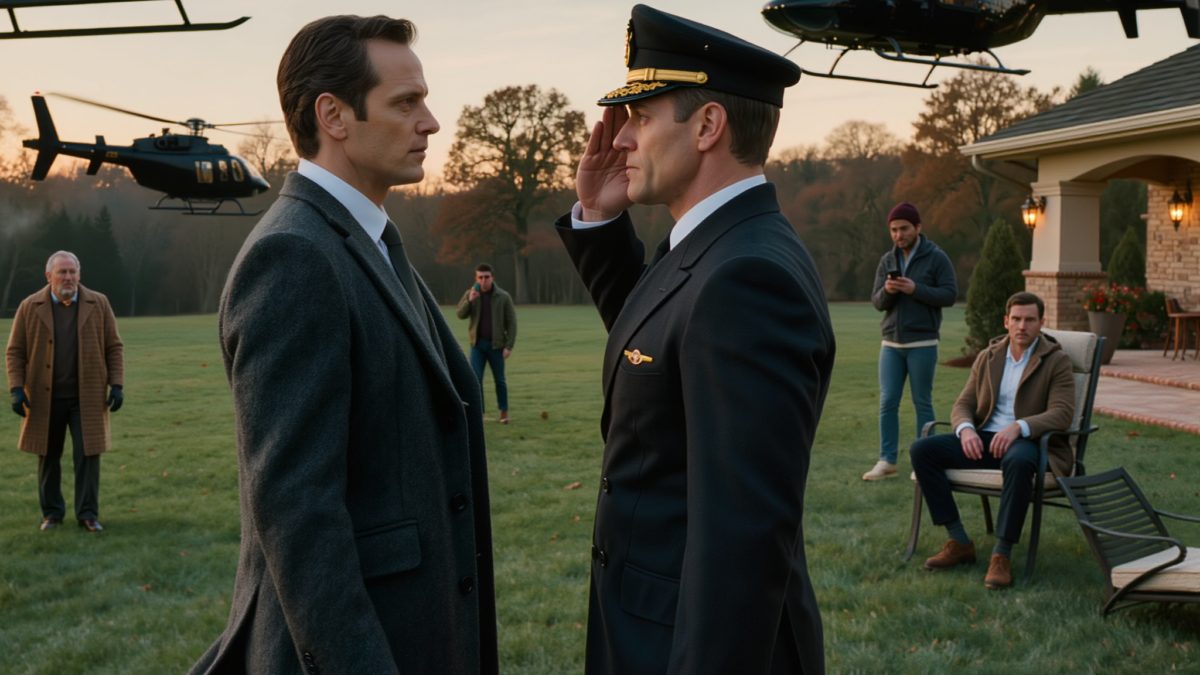
Captain Vance stepped onto the grass.
He wore a sharp black aviator uniform with the gold Trans Global Aviation insignia displayed on his chest.
He had flown combat missions before joining our organization, and his military discipline was evident in every movement.
Five other crew members followed him, including co-pilots, flight engineers, and logistics specialists.
They were trained professionals from an international aviation operation.
Captain Vance crossed the lawn, passing my father without stopping. My mother stood clutching her chest. Julian was still sitting in the dirt beside the overturned chair.
Vance stopped three feet in front of me.
He stood at attention and saluted.
“Reporting for duty, Mr. CEO.”
His voice carried across the patio.
“The primary executive fleet has arrived at the designated coordinates. All aeronautical systems are operational. The immediate perimeter is secure. We’re ready for your VIP extraction whenever you give the order, sir.”
I acknowledged his salute.
“Thank you, Captain. Excellent approach. Any problems with air traffic clearance over the suburban area?”
“None, sir. The mayor’s office expedited the flight path after recognizing your registered tail numbers. Weather conditions were excellent.”
He gave a small professional smile.
“Though I have to admit, this is the first time I’ve coordinated a formation landing at a private residence for a Thanksgiving dinner pickup.”
“There’s a first time for everything, Captain.”
Dad finally found his voice.
“Arthur, what is this? Who are these people? Did you rent these helicopters for some kind of joke? Do you understand the legal trouble you could be facing?”
I turned toward him.
“I’m not renting anything, Richard. I own them.”
Then I explained the scale of the operation.
“These three helicopters represent a small part of our executive fleet. Trans Global Aviation operates 327 aircraft worldwide. That includes 244 commercial helicopters and 83 private Gulfstream jets used for executive transport, international diplomats, and heads of state.”
Aunt Clara gasped.
“You’re lying. You can’t own a company like that. You take the bus. We see you at the bus stop.”
“I take the bus because it reduces my personal carbon footprint,” I replied. “More importantly, it keeps me grounded. I don’t want to become someone who measures another person’s worth by the car parked in their driveway.”
I looked toward Julian.
“Someone exactly like my brother.”
Julian struggled to his feet.
His designer suit was dirty from the grass and mud.
“This is illegal,” he snapped. “You can’t land helicopters in a residential neighborhood. I’m calling the police. You’ll be arrested for reckless endangerment.”
Aunt Clara pulled out her phone.
“You don’t need to call, Julian. I already called 911 when those things appeared above the trees. The police are coming.”
Moments later, sirens sounded.
Two police cruisers arrived in the driveway, their red and blue lights reflecting off the brick exterior of the house.
Two uniformed officers hurried down the side pathway toward the backyard.
The lead officer, a veteran named Higgins, stepped onto the patio and surveyed the aircraft.
“What the hell is going on here? Who’s responsible for these helicopters? This appears to violate local zoning ordinances and FAA regulations.”
My mother hurried toward him.
“Officer, thank goodness you’re here. My son Arthur has completely lost his mind. He ordered these aircraft here to intimidate his family. Please arrest him.”
Higgins approached me.
Then the patio lights illuminated my face.
He stopped.
“Mr. Arthur? Arthur from Trans Global Corporate?”
“Good evening, Officer Higgins,” I said, extending my hand. “How’s your daughter doing this semester? Did the scholarship we established through the local police union come through for her university tuition?”
He shook my hand warmly.
“She’s doing extremely well, sir. Straight A’s in her premed classes. My wife and I can’t thank your foundation enough.”
He glanced toward the helicopters.
“I had no idea this was your family’s residence. Dispatch reported a rogue aircraft emergency and a potential hostile threat.”
“It’s a coordinated holiday pickup,” I explained.
I opened the relevant documents on my encrypted phone.
“We have signed permits from the regional FAA office and documented clearance from the mayor’s office. The temporary landing arrangement has been authorized.”
Higgins reviewed the situation and stepped back.
“Of course, sir. With the mayor’s clearance and FAA documentation, there’s no issue here. My apologies for the interruption.”
He motioned toward his partner.
“False alarm. Everything is legal. Have a good Thanksgiving.”
The officers returned to their vehicles and departed.
My relatives watched them leave.
The people who had been certain the police would remove me now had to confront an entirely different explanation.
My mother sat heavily in a wrought-iron patio chair.
Her face had lost its color.
“Arthur,” she whispered. “Why didn’t you tell us? We’re your family. Why did you let us worry about your future? Why did you let us pay for your dinners?”
“You weren’t worried about me, Mom.”
I kept my voice steady.
“You were worried about what your friends at the country club would think. You thought my supposed poverty made you look bad.”
I reminded her of the conversation at the kitchen table years earlier.
“Every time I tried to discuss my business, you dismissed me. You told me to quit and find a real job. So I stopped trying to convince you.”
Julian clenched his fists.
“This isn’t fair. You did this on purpose. You came here acting poor so you could humiliate us.”
“I didn’t create your assumptions, Julian. You did. You demanded proof, and I gave it to you.”
The cold wind continued moving across the patio.
Dad, however, wasn’t ready to admit defeat.
He marched toward me, pointing an angry finger.
“I don’t care how much money you have. I don’t care if you own three hundred helicopters or three thousand. You don’t get to come into my house, disrespect your mother, embarrass your brother, and ruin Thanksgiving.”
He gestured toward the lawn.
“This is my private property. I want these machines removed immediately. Otherwise, I’ll take you and your company to court for trespassing and property damage.”
I looked at the man who had ridiculed my ambitions for ten years.
“Actually, Richard, it’s my real estate.”
He blinked.
“What are you talking about? I bought this house thirty years ago. I hold the deed.”
“And you nearly lost it three years ago.”
The patio grew quiet.
I explained what had happened.
Three years earlier, my parents had made a series of reckless stock market investments while trying to maintain their expensive lifestyle.
They had exhausted multiple credit lines and fallen into serious financial trouble.
The bank initiated foreclosure proceedings.
They were approximately three weeks from losing the house.
My mother covered her face.
She had worked hard to keep their financial situation secret from the extended family.
“Your bankruptcy attorney contacted my corporate legal team about restructuring the debt,” I explained.
“The attorney didn’t realize who my firm represented.”
When I learned what was happening, I authorized Trans Global Properties, my commercial real estate subsidiary, to intervene.
We purchased the estate directly from the bank in cash, cleared the outstanding tax liens, and stopped the foreclosure.
Dad stared at me.
“That’s impossible. The bank said our mortgage had been restructured. We’ve been making monthly payments to a new management company.”
“Those aren’t mortgage payments, Richard. You’ve been paying subsidized rent to my corporation.”
I pointed toward the house.
“I’m your legal landlord. I own the roof over your head, the driveway where Julian parks his cars, and the grass these helicopters are sitting on.”
I had purchased the property three years earlier and allowed my parents to remain there at significantly below-market rent.
I had protected them from losing their home, and they had never known.
“I did all of that without making a public announcement,” I continued. “Not once in those three years did any of you ask whether I was doing okay.”
Uncle Robert, who had spent dinner criticizing me, stood quietly.
Sarah and Derek had moved toward a corner of the patio, watching with wide eyes.
Julian still refused to let the matter end.
“So what?” he snapped. “You bought a house through a shell company. Congratulations. You’re a landlord. That doesn’t make you better than me. I worked for my salary. I earned my promotion. I built my career.”
I turned toward him.
“Since we’re discussing family finances tonight, Julian, let’s talk about your debt.”
His expression changed.
“Shut up. You don’t know anything about my personal finances.”
“I know quite a bit.”
During routine due diligence for a possible acquisition in Julian’s business sector, my firm had encountered information concerning his financial obligations.
I told him what we had found.
The white Porsche was leased under expensive terms that placed considerable pressure on his salary.
The Lamborghini and Range Rover were heavily financed, and he was three months behind on payments for both.
His carefully maintained luxury lifestyle depended on debt.
He was dangerously close to bankruptcy.
Julian’s face turned pale.
He looked toward our parents, but neither offered a defense.
“Tonight you mocked me for riding the bus,” I said. “But the platinum watch on my wrist is worth more than your combined net worth.”
I looked directly at him.
“I take the bus because I don’t need to prove anything. You keep buying luxury cars because appearances are everything to you.”
Then I turned toward Aunt Clara.
She backed against the brick wall, holding her purse against her chest.
“And Clara, I haven’t forgotten your part in this.”
Her expression tightened.
After her divorce, Clara had struggled to maintain the expensive country club lifestyle she preferred.
But there was another matter I knew about.
“Four years ago, you convinced my parents that my aviation business was a legal threat to their personal assets.”
She stared at me.
“You told them that if I was sued, my company’s creditors might come after their money. You used that fear to persuade them to remove me from their will.”
I paused.
“You convinced them to leave everything to Julian, hoping he would eventually share some of it with you.”
Dad turned toward Clara.
“Arthur, how do you know about the revised will? We told the lawyer never to discuss it.”
“I have excellent corporate attorneys,” I replied. “I knew when the documents were signed.”
I looked back at my parents.
“The worst part wasn’t the money. I was already a billionaire. What mattered was how little loyalty you showed me.”
For years, they had treated Julian as the only son capable of success.
Now the entire family was confronted with a different reality.
“You demanded proof,” I said. “You wanted income, assets, and evidence that I had built something real. Look at the helicopters. Look at this house. Look at what I’ve actually done.”
I stood in the middle of the patio.
“I’m the CEO and sole owner of a multibillion-dollar aviation company. And none of that changes what happened here tonight.”
The family had no more arguments.
For the first time that evening, nobody laughed.
My mother sank to her knees on the cold stone patio.
Her expensive dress absorbed the dampness as she reached toward my coat.
“Arthur, please,” she sobbed. “I’m sorry. I’m so deeply sorry. We didn’t know. We couldn’t see past our pride.”
She looked up at me.
“You’re my son. My brilliant son. Please forgive us. We can fix this. We can be a family again.”
She promised to change the will and make whatever arrangements I wanted.
Dad stood beside her, his shoulders slumped.
“She’s right,” he said through tears. “I was wrong about you. I let my ego blind me. Please stay. Send the helicopters away. Come back inside and have Thanksgiving dinner with us. We can start over.”
I looked at both of them.
Ten years earlier, I would have given almost anything to hear those words.
When I was 22, struggling in a freezing hangar and fighting to keep my company, I had wanted my parents to say they believed in me.
I had wanted them to be proud of me before there was proof that I could make money.
But I wasn’t that young man anymore.
“You don’t actually want to fix our family, Mom,” I said quietly. “You want to fix your relationship with someone you now know has money and influence.”
She shook her head.
“That isn’t true. I love you. I’ve always loved you.”
“If you loved me, you would have respected the man riding the bus just as much as the billionaire standing here.”
I took a step back, and her hands fell away from my coat.
“You didn’t treat me differently because of who I was. You treated me differently because you thought I had failed.”
I turned toward Julian.
He was staring at the ground.
There was nothing more I wanted to say to him.
His financial problems were the consequences of decisions he had made long before this Thanksgiving.
I walked past my relatives and returned through the glass doors into the dining room.
The house was quiet.
The Thanksgiving feast remained on the mahogany table, exactly as we had left it.
The turkey, stuffing, sweet potatoes, and imported wine were still there, slowly growing cold.
Captain Vance followed me inside and waited beside the doorway.
“Captain Vance,” I said, pointing toward the table. “Pack up the turkey, the sweet potatoes, the stuffing, and the wine. All of it.”
He raised an eyebrow but didn’t question the instruction.
“Yes, sir. Initiating food recovery and transport protocols.”
Within two minutes, Vance and one of our flight engineers had packed the Thanksgiving meal into insulated transport containers.
My relatives watched through the patio doors as the food was removed.
For me, the gesture was more than taking a meal.
I had spent years giving my family time, attention, and emotional energy, hoping for an affection that never came without conditions.
That evening, I finally chose to direct my generosity elsewhere.
I returned to the patio.
“My flight crew has been working difficult routes for ten straight hours today,” I told the family. “They gave up their holiday to make sure our operations ran safely. They deserve a Thanksgiving dinner.”
I didn’t wait for an answer.
I crossed the lawn and climbed into the leather-lined cabin of the lead helicopter.
Captain Vance secured the door behind me.
The noise of the wind faded as I fastened my seat belt and put on my headset.
“Sir,” Vance said through the communications system. “All cargo is secured. We’re ready for departure. What’s our destination?”
I looked through the reinforced window.
My family stood outside the house that I legally owned.
They appeared small beneath the patio lights.
“Take us to the corporate jet waiting at the regional airfield,” I instructed. “We’re going to our private resort in Hawaii tonight. Full holiday pay and premium benefits for the crew. Thanksgiving dinner on the beach.”
The helicopters lifted from the lawn.
I didn’t look back again.
The flight to Hawaii became one of the most peaceful experiences I had known in years.
At 35,000 feet, inside the comfortable cabin of our flagship Gulfstream jet, my crew shared the Thanksgiving meal we had brought from the house.
They laughed, told stories about their families, and toasted the company’s continued success.
When we landed in Maui, the warm ocean air felt entirely different from the freezing patio I had left behind.
I spent three days sitting on the beach, listening to the waves and trying to enjoy the silence.
My phone, however, rarely stopped vibrating.
During those seventy-two hours, I received exactly 147 text messages, 32 voicemails, and dozens of emails.
Mom begged me for another chance. She promised to begin intensive therapy and insisted she would do whatever was necessary to repair our relationship.
Dad sent long apologies about his pride and poor judgment. He also asked for financial advice concerning his retirement accounts.
Sarah and Derek apologized. Derek confirmed that he had permanently deleted the video he had recorded on the patio, frightened that my corporate legal team might take action against him.
Julian’s messages were different.
He didn’t apologize for his behavior.
Instead, he asked whether I could arrange a corporate loan.
The lenders were looking for his Lamborghini, his credit cards were maxed out, and he had nowhere else to turn.
I didn’t respond to any of them.
For the first time, I felt no obligation to explain myself.
Six months passed.
By then, the consequences of my family’s choices had become unavoidable.
Julian’s expensive cars were repossessed by the lenders.
His credit suffered badly, and many of the wealthy friends who had admired his carefully constructed lifestyle disappeared when he could no longer maintain it.
He left his luxury downtown loft and moved into a much cheaper apartment in a less desirable neighborhood.
For the first time, he had to confront the difference between appearing wealthy and being financially secure.
Aunt Clara experienced her own consequences.
After the family learned about her involvement in the changes to my parents’ will, the extended relatives turned against her.
She was excluded from future gatherings, and the people who had once tolerated her gossip no longer welcomed her influence.
She ended up largely alone.
As for my parents, they eventually traveled to the city and attempted to visit my corporate headquarters.
They entered the large glass lobby of Trans Global Aviation, surrounded by employees and visitors moving through the building.
The scale of the company seemed to overwhelm them.
At the front desk, security informed them that the CEO was unavailable without a scheduled appointment.
I watched the scene from my corner office on the 42nd floor using the building’s security cameras.
For the first time in my life, I saw my parents looking uncertain and lost in a place where my professional identity was understood without explanation.
I instructed my executive assistant to deliver an envelope.
Inside was a legal document transferring the deed to their suburban home directly into their names.
The property was free and clear of any outstanding mortgages or financial liens.
I had decided to give them their house back.
Attached to the deed was a typed letter.
It read:
“I have fully paid your debts and secured your home. You will never have to worry about foreclosure or losing your house again.
“But my financial help does not buy you access to my life, my peace, or my time.
“I genuinely wish you health and happiness in the years ahead, but I am permanently stepping away from this family dynamic.
“Do not contact my corporate offices or personal phone numbers again.”
I watched my mother read the letter.
She covered her mouth and began crying in the middle of the lobby.
Dad put his arm around her shoulders.
For several moments, they remained there, holding the documents that confirmed they once again owned their home.
Then they turned toward the revolving glass doors and walked out.
They had their house back.
But they no longer had a relationship with the son who had quietly protected it for years.
I stepped away from the security monitors and walked toward the floor-to-ceiling windows of my office.
The city stretched below, filled with buildings, streets, vehicles, and people moving through their daily lives.
I was 32 years old.
I had accumulated wealth that would once have seemed impossible. I led an international company employing thousands of people. Our aircraft operated across the world, carrying out medical, executive, and government transportation assignments.
Yet standing at that window, I understood that the greatest benefit of my success wasn’t the money.
It wasn’t the property, the aircraft, or the corporate influence.
It was the freedom to decide which people and environments deserved a place in my life.
For years, I had thought I needed to prove my worth to people who had already decided what kind of person I was.
I no longer felt that need.
I didn’t have to destroy my family to move forward. I had to stop organizing my life around their approval.
Their opinions had once controlled my confidence, my choices, and the way I measured success.
Now they no longer determined any of those things.
I still occasionally ride the city bus.
Not because I’m hiding my identity or trying to make a point to anyone else.
I ride it because sitting beside an ordinary window, watching familiar streets pass, reminds me of the young man who once had almost nothing except an idea and the determination to pursue it.
That young man didn’t know whether his business would survive.
He didn’t know about the helicopters, the international contracts, the corporate headquarters, or the wealth that would eventually follow.
He only knew that the future he wanted was worth working for, even when the people closest to him couldn’t understand it.
And when I think about the life I’ve built, that’s still the part of my story that matters most.
I no longer need my family’s validation to know that the choices I made were my own.








