“One daughter saves lives. The other mops floors,” Mom told 19 relatives, raising her glass to my surgeon sister as they laughed at me. Then she handed me a pink toy mop and demanded I apologize for being jealous. I stood to answer—but my hospital phone buzzed for the third time, and I said, “This is Fletcher.”
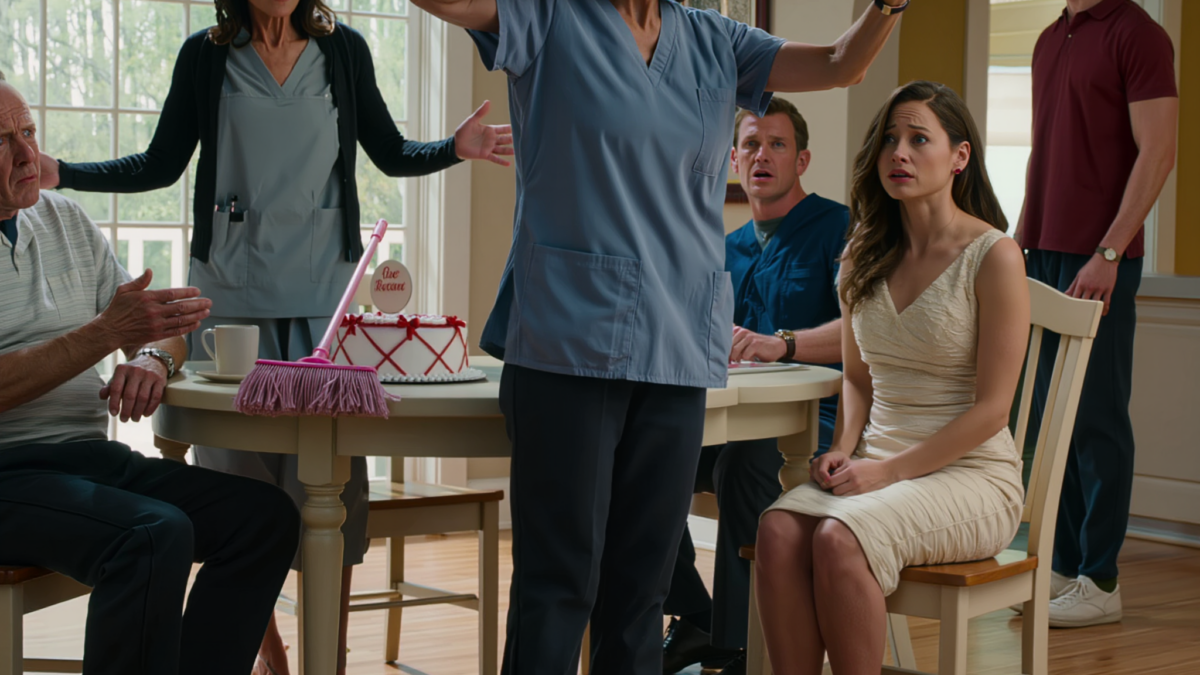
The cake said, “Our hero.”
My mother pointed the knife at me and smiled.
“This one? This one mops floors.”
Nineteen relatives laughed on cue.
For years, I had been her cautionary tale, proof that she had raised one winner and one waste. Diane was her trophy, the surgeon in the newspaper, the daughter she could show off. Me, she seated near the trash bags and told to refill the ice.
For eleven years, I had let her carve me up in public without fighting back.
That night, I set down the plate she had shoved at me and looked at the poster-sized newspaper photograph of my sister.
“Lovely photo of Diane,” I said. “Shame it’s only half true.”
The table chuckled, waiting for the joke.
Diane didn’t.
She had gone white around the lips.
My sister was the only person in that room who could finish the thought behind my sentence, and she had just realized I might be able to finish it too.
My name is Otie. I was 41 years old, and according to my mother, I cleaned up after other people for a living.
She wasn’t entirely wrong.
She was only wrong about which building, which floor, and whose life was in my hands when I did it.
The party was at my mother Loretta’s house in Bell Haven, the one Diane helped pay the mortgage on. Loretta had strung the porch with the little white lights she saved for church socials. By the front door, where nobody could enter without seeing it, she had mounted Diane’s newspaper photograph on an easel.
Local surgeon saves man’s life.
Diane’s face appeared below the headline, her gloved hands still raised, her eyes bright above a lowered mask.
She looked like a woman who had just been told the universe belonged to her.
I arrived at six after driving forty minutes straight from work. I still smelled faintly of the soap we scrubbed with at the hospital, that sharp antiseptic scent that never quite washed out.
My mother opened the door and looked me over from top to bottom.
“You could have dressed up.”
“I did.”
“Diane’s fiancé’s family is here. Try not to embarrass her.”
She said it lightly.
That was always my mother’s trick. She could hand you the cruelest sentence in the world with such a soft smile that you felt rude for flinching.
Inside, the house was crowded with aunts, uncles, second cousins, and relatives who appeared mainly for weddings, funerals, and moments of family glory.
My uncle Boyd stood by the fireplace telling the story of the newspaper article as if he had scrubbed into the operation himself. Years earlier, he had co-signed Diane’s medical school loans, and he had been dining out on that fact ever since.
Someone had put on the kind of soft jazz you hear in a dentist’s waiting room.
Diane sat in the center of everything in a cream dress while people touched her arm and called her “Doctor,” “hero,” and “miracle.”
Her fiancé, Preston, stood behind her chair with one hand on her shoulder like he was guarding a monument.
Preston came from money. Long before he married the woman, he had fallen in love with the idea of marrying a surgeon. You could hear it in the way he redirected every conversation toward Diane’s career or the newspaper article.
Nobody stood when I came in.
When a family decides who you are early enough, you eventually stop expecting the room to turn when you enter. You come in through the side. You find a quiet corner. You make yourself useful so your presence has a reason.
My family had taught me a long time ago that I needed one.
My mother handed me an apron.
An actual apron, folded neatly and still creased from the drawer.
“The ice keeps running low,” she said. “You know where everything is.”
I took it.
That is one of the parts I remember most clearly because I want to be fair about my own role in what happened.
I took the apron.
I tied it around my waist.
I carried the ice.
At 41 years old, some stubborn part of me still wanted to know whether being useful might finally be enough for her.
It never had been.
But hope survives things that should have killed it years earlier.
So I refilled the ice. I refilled the wine. I wiped a wet ring from the good table before my mother could notice and somehow blame me for both the water and the age of the furniture.
I moved through my own family like staff.
The strangest part was that not one of the nineteen people in the room found it strange.
To them, this was simply the natural order.
Diane sat while I served.
Around seven, Aunt Colleen caught my wrist as I passed with a pitcher of water.
Colleen was my mother’s youngest sister, and she had been through a difficult spring. She had undergone surgery she rarely discussed. Everyone assumed it had been something routine.
She looked up at me with an expression I couldn’t place.
Not pity.
Something more searching.
“Do I know you from somewhere?”
“Besides this?” I asked. “I’m Otie. Loretta’s oldest.”
“I know who you are.”
She kept hold of my wrist.
Her thumb rested near the callus at the base of my hand. Something shifted behind her eyes, then disappeared.
“Never mind,” she said. “You just remind me of someone.”
I refilled her water and moved on before the strange pressure in my chest became something I had to deal with.
What none of them knew was that three weeks earlier, shortly after two in the morning, a phone had rung in a hospital call room.
The voice on the other end had belonged to my sister.
And Diane had been terrified.
At eight, my mother called for quiet by tapping the cake knife against her glass.
The cake had come from the good bakery, white frosting with gold lettering.
Our hero.
Loretta had positioned it beneath the framed article so both would appear in every photograph.
My mother had always understood staging.
“I want to say something about my girls,” she began.
I was standing by the sideboard with the ice bucket in my hands.
“Everybody knows Diane,” Loretta said.
The room laughed warmly because everybody did.
“My Diane. When she was six years old, she told me she was going to save lives. Six years old. And she did it. She did exactly what she said.”
Her voice caught with real emotion.
That was what made my mother complicated.
The love was genuine.
“There was a man on that table who was not going to see morning,” she continued. “And my daughter brought him back.”
People applauded.
Preston squeezed Diane’s shoulder. Diane dipped her head, modest and radiant.
Then my mother turned toward me.
“And there’s my other one.”
The room turned with her.
Nineteen faces swung toward the woman in the apron.
My mother lifted her glass and smiled.
“One daughter saves lives,” she said. “The other one mops floors.”
The room laughed.
Boyd laughed hardest, slapping his knee.
My cousins laughed.
Preston’s parents laughed politely, the way people laugh when they don’t understand a family joke but assume it is affectionate.
Diane laughed too.
That was the part that stayed with me.
My little sister, the doctor, the hero, laughed into her wine while our mother turned me into the evening’s entertainment.
I set down the ice bucket.
Then I untied the apron.
Nobody noticed. They were still enjoying the joke, wiping their eyes and refilling their glasses.
My mother stood there with her glass raised, waiting for me to do what I had always done.
Smile a little.
Make it easy.
Disappear back into being useful.
I looked at Diane’s photograph on the easel.
“Lovely photo of Diane,” I said. “Shame it’s only half true.”
The laughter thinned.
Boyd chuckled.
“Half true?”
Diane did not laugh.
She set down her glass.
Her face had gone pale.
Three weeks earlier, there had been a two-in-the-morning phone call. My sister knew that much.
Now, in the space of one breath, she seemed to realize that I might know it too.
My mother did not wake up one morning and decide I mattered less than my sister.
It happened slowly.
We had been poor in the specific way families are poor when the money runs out but the pride does not.
My father left when I was nine and Diane was four.
After that, my mother had one plan for our future.
The plan was Diane.
Diane was the pretty one, the sweet one, the child who cried in a way that made adults want to repair the world around her. My mother looked at her and saw possibility.
She wasn’t wrong about Diane.
She was wrong about me.
I was the practical one.
When the sink backed up, I fixed it.
When Diane needed to get to ballet, I walked the two miles with her.
When the electric bill arrived marked overdue, I was 14 and found a job.
The job was a weekend cleaning shift at County General.
That was where the family story began.
I did mop floors.
I cleaned rooms. I stripped beds. By 16, after a supervisor decided I was dependable, I was working with the overnight environmental crew that turned over operating rooms between cases.
At two in the morning, while Bell Haven slept, I cleaned operating room floors.
I was good at it.
I was fast, thorough, and observant.
The scrub nurses eventually let me linger in the doorway during turnovers because I asked questions and listened to the answers.
My mother told people her daughter cleaned at the hospital.
She said it the way someone might describe a burden she had learned to carry.
“Otie’s over at County cleaning.”
Then she let the sentence do the rest.
Meanwhile, Diane attended a private academy two towns away on scholarship. My mother stretched every dollar, borrowed when she had to, and found ways to cover whatever the scholarship did not.
Every dollar I brought home in a cleaning uniform went into the same household.
Some of it helped support the life being built around my sister.
I do not blame Diane for that.
She was a child.
She did not build the machine.
She grew up inside it.
From the time she was six, she was told she was special, that her specialness was fragile, and that the people around her, especially me, existed partly to protect it.
That does something to a person.
It can make an arrangement feel natural enough that years later, you can laugh when your sister is humiliated at a party without fully understanding what you are participating in.
When I was 18, I was accepted into a state university premed program with enough scholarship money and enough savings from cleaning to make it possible if I lived carefully.
I told my mother at the kitchen table.
For one foolish, hopeful second, I expected her to be proud.
Instead, she asked, “And who’s going to help with Diane’s tuition if you go off playing college?”
That was all.
No congratulations.
No questions about the school.
No interest in the scholarship.
Just an accounting of what my leaving might cost the daughter she had chosen to invest in.
So I left.
I packed a duffel bag and walked out.
I did not slam the door.
By then, I had learned that slamming a door only gave my mother a story to tell the aunts about how ungrateful I was.
I closed it softly.
I closed a lot of things softly in my life.
The years after that moved fast.
State university.
Premed.
Three jobs.
Another cleaning job because it was familiar and the hospital near campus trusted my references from County.
I scrubbed floors to pay for an education that would one day let me stand over those same floors in a very different role.
Then came medical school and loans I was still paying years later.
Residency.
Trauma surgery.
A fellowship.
Fourteen-hour days became eighteen-hour days. There were stretches when I barely remembered what my own kitchen looked like.
Somewhere in the middle of all that, I met Sam Fletcher.
Sam fixed the heating system in the residence building. He asked me to dinner four times before I finally said yes because finding even one free evening was difficult.
We married at a courthouse with two witnesses from the surgical floor.
I took his last name.
Fletcher.
For years, I told myself I chose it because I liked the sound.
The truth was simpler.
It wasn’t my mother’s name.
A small part of me wanted a wall between the woman I had become and the family that had already decided who I was.
My mother did not attend the wedding.
She wasn’t invited.
Neither was Diane.
By then, we were the kind of estranged family where birthdays passed in silence and important news traveled through one cousin months after it happened.
I heard when Diane got into medical school.
I sat in my car in a hospital parking garage and cried for reasons I could not cleanly explain.
Then I went back inside and operated on a patient.
My hands did not shake.
That was the thing my family never understood about me.
My hands do not shake.
Growing up with my mother had trained me to become very still under pressure.
When you spend your childhood learning to stay calm while someone who is supposed to love you reduces you to whatever role makes her world easier, you develop a nervous system that can become unusually steady.
In an operating room at two in the morning, when everybody else is frightened and someone needs to make a decision, steadiness is worth a great deal.
Four months before the party, I came back to the region.
The hospital system that operated County General and three other facilities had lost its chief of surgery to a larger city.
They came looking.
I was ready to stop moving.
Sam wanted to live closer to his aging parents. Bell Haven was forty minutes down the highway. My mother was getting older too, and despite everything, I was still her daughter.
So I accepted the position.
Chief of surgery.
I signed the contract as Otie Fletcher.
My family did not know.
For twenty-three years, I had done very little to help them find me.
Walls, it turns out, work in both directions.
I did not know Diane was there either.
That was the part that still hurt in a way I never expected.
My younger sister had matched into the surgical residency program within the same hospital system the previous summer.
For months, our schedules and campuses did not overlap enough for either of us to realize it.
And even when they did, there were masks.
At work, I was often behind a surgical mask, cap, and protective equipment. To Diane, the chief named Dr. Fletcher existed mostly as a name on schedules, a signature on paperwork, and a voice on the overnight consult line.
She never thought to wonder whether Fletcher might be the sister she had spent her entire life believing cleaned hospital floors.
Six weeks before the party, I was in my office signing resident rotation schedules.
Halfway down a page of second-year names, I saw it.
Vain, D.
I stopped.
Vain was my mother’s family name. It had once been mine.
I pulled up the file.
Diane Vain.
Second-year surgical resident.
My little sister was in my department.
She had no idea.
I sat at my desk with a pen in my hand for a long time.
For twenty-three years, I had been building distance between myself and my family.
Now the universe had quietly placed my sister directly under my professional authority.
I could have called her into my office.
I rehearsed it.
Diane, it’s me.
It’s Otie.
I’m your chief.
Three separate times, I opened the message system and got as far as her name.
I never sent anything.
I was afraid.
That admission embarrassed me more than almost anything else in the story.
I was a 41-year-old trauma surgeon. I could remain calm when a case went bad and everybody in the room turned toward me.
But I was afraid of my 36-year-old sister because she was still connected to the family that had made me disappear.
The last time they had known me closely, they had known me in a cleaning smock.
I was afraid that if I walked into Diane’s life and said, “I’m your sister, and I’m your boss,” she would look at me through my mother’s eyes and find me wanting.
So I chose distance again.
I watched her from behind a mask.
I made sure she had opportunities to learn.
I answered when she called the overnight line.
I never told her my first name.
Once, about three weeks before the emergency call, we passed in a hospital hallway.
Both of us were capped and masked.
She was heading into a case. I was coming out of one.
Like residents do when the chief passes, she stepped aside.
“Dr. Fletcher.”
I acknowledged her and kept moving.
Our shoulders passed within a foot of each other.
We had shared a bedroom for thirteen years.
Neither of us knew.
Around the corner, I stopped and put my back against the wall.
I could have turned around.
I could have said her name.
I didn’t.
My mother had made me invisible, but somewhere along the way, I had learned to participate in my own disappearance.
The shadow felt safer.
Then, three weeks later, just after two in the morning, the consult phone rang.
I was in the chief’s call room with my shoes off and my eyes closed.
I wasn’t asleep, just resting.
The phone that rang was not my personal phone. It was the one the surgical service used when a case was going badly and the resident needed help immediately.
I answered on the first ring.
“Fletcher.”
The voice on the other end was young and strained.
“This is Vain, second year. I’ve got a 40-year-old male from a highway pileup. Splenic laceration. We thought we had it controlled, and now his pressure is dropping. There’s more bleeding than I can manage.”
She stopped.
I heard her take a breath.
“I need help. I’m losing him.”
Vain.
Diane.
My sister.
Whatever happened inside my chest when I recognized her voice had to wait.
There was no time for it.
“Talk to me,” I said.
She told me what she had done.
Most of it was right.
She was just moving a little too slowly because she was frightened and alone.
She had never held responsibility for a life that seemed to be slipping away in front of her.
I had.
So I became the calm she did not have yet.
“I’m coming down. Keep pressure. Don’t chase the bleeding. Pack all four quadrants and do not let anyone move him. Two minutes.”
I remember not putting my shoes on properly.
I ran down two flights with them half tied while pulling on my cap.
When I pushed through the operating room doors, I smelled the same antiseptic sharpness that had followed me through my entire adult life.
At 14, I had entered those kinds of rooms with a mop.
At 41, I entered with a surgeon’s hands.
Same smell.
Same floor.
I scrubbed in beside a resident whose eyes were huge above her mask.
Diane did not recognize me.
Why would she?
She had spent decades believing her sister cleaned hospital floors.
The person standing beside her was Dr. Fletcher.
The chief.
We worked.
I found the source she had not been able to reach, a vessel behind the spleen in a place a second-year resident might not think to check quickly enough.
I controlled it.
Then I guided her through the repair.
For part of it, my hands were over hers.
When she regained control of the case, I stepped back and let her finish.
A good chief knows when teaching matters more than ego.
The patient stabilized.
Diane closed.
Afterward, the adrenaline caught up with her.
“That was excellent work under pressure,” I told her. “You’re going to be a real surgeon.”
“Thank you, Dr. Fletcher.”
She never saw my face.
I went back upstairs, sat on the edge of the call-room bed, and put my head in my hands.
I had just helped save a man’s life beside my little sister.
She had no idea who I was.
And I had not told her.
The hospital’s public relations office called the case a save.
The local newspaper heard that a young resident had helped save a crash victim during a dramatic overnight surgery and built the story around Diane.
I let them.
Residents receive credit for cases they participate in. Building confidence is part of teaching. I did not need my name in the Bell Haven Courier.
I thought I was letting my sister have a good moment.
I did not know my mother would take that moment and use it against me in front of nineteen people.
Back at the party, after I called the newspaper photograph “half true,” my mother’s smile began to tighten.
“Half true?” she repeated with a laugh, trying to pull the room back under control.
Boyd lifted an empty glass.
“Refill on the Chardonnay over here.”
A few relatives laughed.
My mother saw the opening.
“You heard your uncle,” she said. “Make yourself useful.”
And here is the humiliating truth.
I almost did.
At 41 years old, chief of surgery at a trauma center, my body still responded to that tone of voice.
My hand started toward the bottle.
Then I looked at Diane.
My sister was no longer laughing.
She was staring at me with a small vertical line between her eyebrows.
I had seen that expression on residents hundreds of times, the look that appeared when separate pieces of information began connecting in a way they did not want to accept.
Whatever Diane was calculating, it was draining the color from her face.
I lowered my hand.
“Actually, Mom,” I said, “I think I’ll sit for this part.”
I pulled out a chair.
Then I sat down at the table my mother had expected me to serve.
Nineteen relatives went quiet.
They did not understand why.
But the person who always served had taken a seat among them, and some instinctive part of the room understood that the pattern had changed.
The evening continued.
My mother recovered, because my mother always recovered.
She decided my behavior was jealousy.
“She gets like this,” Loretta told the table warmly, patting Preston’s mother on the hand. “Otie’s always had a jealous streak. It’s not her fault. When you don’t accomplish much yourself, it’s hard to watch your sister shine.”
She looked at me with almost maternal tenderness.
That was one of her sharpest weapons.
“We don’t hold it against her.”
A few relatives made sympathetic noises.
Preston’s father nodded as though he had just been given useful context.
I did not respond.
But Diane made a small sound.
“Mom.”
“What, sweetheart?”
Diane opened her mouth.
For a moment, I watched my sister stand at the edge of something.
Then she lost her nerve.
“Nothing,” she said. “Never mind.”
She picked up her wine.
Her hand was not steady.
Mine, resting on the table, was.
For the first time that evening, my mother seemed to notice my hands.
A woman who spends her life mopping floors can have rough hands.
But there was something about the stillness of mine that made Loretta look twice.
She let the room warm back up.
Dinner plates disappeared.
Coffee came out.
Then my mother reached beneath her chair and lifted a gift bag.
“Now,” she announced. “I got a little something for Otie too. I don’t want her to feel left out.”
The table chuckled.
She reached into the bag and slowly pulled out a mop.
A child’s toy mop.
Pink plastic.
The kind you might buy for a five-year-old who wanted to imitate a parent cleaning the house.
My mother had tied a bow around the handle.
The room erupted.
Boyd laughed so hard he had to put down his coffee.
My cousins laughed.
Preston’s mother covered her mouth.
My mother extended the little pink mop across the table toward me.
“For the professional,” she said. “Don’t say I never got you anything nice.”
I looked at it.
I wish I could say it didn’t hurt.
It did.
I was 41 years old and chief of surgery, and that ridiculous toy landed harder than it should have.
Not because it was a mop.
Because nineteen people were laughing.
Because Diane’s photograph stood on the easel.
Because my sister was no longer laughing, but she still wasn’t stopping our mother.
Because everyone in that room had accepted the same story about me for so long that my mother could reduce my entire life to a toy and expect applause.
My hospital phone buzzed inside my bag.
Not my personal phone.
The other one.
I felt the distinctive double pulse against my hip.
Somewhere forty minutes down the highway, something was happening, and somebody in the chain of command was reaching for me.
I let it buzz.
Then I took the toy mop from my mother.
Refusing it would have given her the tantrum she expected.
Instead, I set it gently on the table beside the cake.
“Thank you,” I said. “It’s very thoughtful.”
My plan was still to leave.
That is important.
I was going to say thank you, drive home, and let them keep their version of me.
After twenty-three years, I had learned that the easiest way to survive my mother was to stop playing.
Then Aunt Colleen spoke.
“Loretta.”
She was staring at my hands.
“Where did you say Otie works?”
“County,” my mother said casually. “She cleans. Same as always.”
“Which department?”
My mother frowned.
“I don’t know, Colleen. The floors. It’s cleaning.”
Colleen kept looking at me.
“In the spring, when I had my surgery, you remember?”
The room quieted.
“I don’t tell people much about it because it scared me more than I admitted. There was a problem they didn’t expect.”
She placed one hand against her abdomen.
“I was going under, and there was a woman leaning over me. A surgeon. I never saw her face. Just her eyes.”
Colleen looked at my hands again.
“She held my hand before they put me out. She said, ‘I’ve got you, Colleen. Go to sleep.’ And I did. And I woke up.”
The room became quiet in a different way.
My mother laughed lightly.
“Colleen, honestly, what does that have to do with anything?”
“I don’t know.”
Colleen looked at me.
“You just have very steady hands, Otie.”
I could have ended it there.
I could have told her.
But I didn’t want to win by being recognized.
My entire life, I had been taught that love had to be earned through usefulness or achievement.
Some stubborn part of me refused to stand in my mother’s dining room and present my résumé as proof that she should finally treat me like a daughter.
“A lot of people have steady hands, Aunt Colleen,” I said. “I’m glad you’re okay.”
Something in her expression dimmed.
My mother sensed weakness.
“You know what?” Loretta said, standing with her glass. “I think tonight is actually a good night for this.”
She smiled first at Diane and then at me.
“Otie, I want you to do something for your sister in front of everybody.”
I waited.
“I want you to apologize to Diane.”
The room stilled.
“Apologize?”
“For the jealousy. For years of it. For that little comment about the photo being half true. We all heard it, honey. It was ugly. Diane worked her whole life for this, and you can’t stand to let her have one night.”
The painful part was that my mother believed every word.
She had repeated the story for so long that it had become reality to her.
“She saved a man’s life,” Loretta continued. “Otie, what have you ever done? The least you can do is stand up and tell your sister you’re sorry for being jealous of a hero.”
Nineteen faces turned toward me.
The old instinct pulled at me.
Stand.
Apologize.
Keep the peace.
Give her the ending she wants.
Close the door softly.
My hospital phone buzzed again.
More insistently this time.
Somewhere, a resident was frightened and someone needed the chain of command.
I stood.
My mother’s face relaxed into triumph.
She thought I was standing to apologize.
Diane looked up at me.
Her eyes were wet.
Her chin trembled.
Then she gave the smallest shake of her head.
No.
Or I’m sorry.
Maybe both.
For the first time that night, I understood clearly that my sister was not the villain of the story.
Our mother was.
Diane had been handed a crown as a child and had spent her whole life terrified of the day someone might decide it did not belong to her.
“We’re waiting,” my mother said.
I opened my mouth.
My phone buzzed for the third time.
This time, I reached into my bag.
A patient’s life did not wait for my mother’s theater.
I looked at the screen.
Then I answered.
“This is Fletcher.”
There are moments when a room hears a voice it has never heard from a person it thinks it knows.
I stepped three paces toward the hallway and pressed a finger to my other ear to block the party noise.
“Slow down,” I said. “Who’s the surgeon of record?”
I listened.
“Okay. Put them on.”
Another pause.
“No. Put them on now.”
My mother started to interrupt.
“Otie, we are in the middle of—”
I raised one hand.
Not angrily.
Just finally.
The sentence stopped.
In forty-one years, I had never told my mother to wait with a gesture and then continued speaking as though her approval was irrelevant.
“This is the chief,” I said into the phone. “Talk to me.”
The room behind me stopped breathing.
I listened to the report.
“Okay. You’re not going to lose him. Stop chasing it. Pack all four quadrants and get control above the injury.”
I pressed my free hand against my own abdomen while speaking, instinctively demonstrating a movement to someone who could not see me.
“Good. Is it slowing? Then it’s slowing. Breathe. I’m staying right here until the attending scrubs in. You’re doing this correctly.”
Behind me, someone whispered, “The chief?”
I did not turn around.
I stayed on the phone.
For several minutes, I talked a frightened young resident through the worst part of a case while standing in my mother’s dining room.
The apron I had untied earlier was nearby.
The toy mop with its bow sat beside the cake that said Our hero.
Eventually, the attending took over.
“Good handoff,” I said. “You did well. Call me back if it turns.”
Then I ended the call.
I turned around.
Nineteen people were looking at me as if a stranger had entered the house wearing my face.
Boyd’s mouth hung slightly open.
Preston had straightened behind Diane’s chair.
Preston’s father stared at me with the recalculating expression of a man who took pride in recognizing important people and had just discovered that he had misread the room completely.
My mother was still smiling.
Her mind had not accepted what had happened yet.
“Well,” Loretta said with a bright, brittle laugh. “Aren’t we fancy on the phone, playing doctor now, Otie? Is that a new job? Answering phones at the hospital?”
She looked around, trying to gather the room again.
“She was always a good little actress. When she was nine, she used to—”
“Mom.”
Diane’s voice cut across hers.
My sister had stood up.
Her cream dress was wrinkled from sitting. Her face was wet. She gripped the edge of the table as though the floor had shifted beneath her.
“Mom, stop talking.”
Loretta stared at her.
“Please,” Diane said. “For once in your life, stop talking.”
The room turned toward my sister.
“Diane, sweetheart, sit down. You’ve had a lot of wine.”
“I know that voice.”
Diane was looking at me.
Not our mother.
At me.
“I’ve been hearing that voice for four months on the overnight line.”
Her breath caught.
“‘This is Fletcher. Slow down. You’re not going to lose him.’ I’ve called that voice from the worst nights of my life.”
She covered her mouth for a moment.
“I never once thought…”
“Diane,” I said quietly. “You don’t have to do this here.”
“Yes, I do.”
She gave a broken laugh.
“Yes, I do, because they were about to make you apologize to me.”
Her voice cracked.
“The man in that photograph. The man everybody’s been toasting me for. The man I saved.”
The room waited.
“I didn’t save him.”
Nobody moved.
“I didn’t save him,” Diane repeated, louder.
“Three weeks ago, at two in the morning, a man came in from the highway and started dying on my table. I couldn’t stop it. I was a second-year resident, I was in over my head, and I called the one number you call when you’re drowning.”
She looked at me.
“A voice answered on the first ring and said, ‘This is Fletcher.’”
Tears ran down her face.
“The chief came downstairs in under two minutes. I found out later she hadn’t even tied her shoes properly because she ran. She found the source I couldn’t find. It was behind the spleen, exactly where I didn’t know to look.”
My mother’s hand tightened around her glass.
“She controlled it,” Diane continued. “Then she put her hands over mine and taught me how to repair it. And after that, she stepped back and let me finish so I would learn.”
Diane’s voice broke again.
“She told me, ‘You’re going to be a real surgeon.’ Then she went back upstairs, and I never saw her face.”
She turned toward the newspaper photograph.
“I have felt like a liar for twenty-one days.”
Then she pointed at me.
“There is your hero.”
Silence swallowed the room.
“I just held the clamp she handed me.”
My mother’s knuckles had gone white.
For my entire life, I had watched Loretta control rooms.
She softened conversations, redirected attention, and used affection like a steering wheel.
Now, for the first time, she was losing control of one.
She reached for volume.
“That’s a lie.”
Nobody responded.
“Diane, you’re confused. You’ve had wine. She has cleaned floors her whole life. She dropped out. She left this family. She has never done anything but disappoint me, and now she is going to walk in here and steal your night with some story about a phone call?”
“Loretta.”
Aunt Colleen was standing too.
“The woman who operated on me in April was named Fletcher.”
My mother shook her head.
“No.”
“I asked afterward because I wanted to send her a card. They told me Dr. Fletcher. The chief.”
Colleen’s eyes filled.
She looked at me.
“It was you.”
My mother snapped, “Fletcher is a common name.”
“Mom,” Diane said.
Loretta looked at her.
“It’s her married name. Sam Fletcher. She married him eleven years ago.”
My mother said nothing.
“You didn’t go to the wedding,” Diane continued. “So you never learned her name.”
She wiped her face with the flat of her hand.
“You never recognized your own daughter because you told all of us our whole lives that Otie was the one who mopped floors.”
That was the center of it.
My mother had repeated one version of me so often that it had become stronger than reality.
She had not failed to recognize a stranger.
She had failed to recognize her daughter because, for twenty-three years, she had stopped looking.
“She does mop floors,” Loretta said weakly. “She told me. She said she cleans at the hospital.”
“I did clean at the hospital,” I said.
The room turned toward me.
“When I was 14, you needed the electric bill paid and Diane needed ballet. I got a job on the cleaning crew at County.”
My mother stared.
“I mopped operating rooms overnight between cases from 14 to 18. That part is true.”
I looked at the pink toy mop on the table.
“I did mop floors.”
Nobody laughed.
“Then I went to college using the money I saved. I went to medical school on loans I’m still paying. I completed residency and a trauma surgery fellowship.”
My voice stayed level.
“Four months ago, I became chief of surgery for the hospital system that owns the same building where I used to push a mop at two in the morning.”
Loretta’s face seemed to lose structure.
“I clean up messes for a living,” I said. “You were right about that. You were just wrong about the size of them.”
The little pink mop sat between us.
It was no longer funny.
Preston slowly sat down.
Boyd cleared his throat.
“Hang on. So the article…”
“The article gave a resident appropriate credit for a save she participated in,” I said. “That’s how teaching hospitals work. I didn’t correct it because building Diane up is part of my job. And because I didn’t need the Bell Haven Courier.”
I let the words settle.
“I did not come here tonight to take anything away from my sister. I came because Mom asked me to. I was going to carry the ice, drive home, and let all of you keep your hero.”
I looked at Loretta.
“That was the plan until you handed me a toy mop and demanded I apologize for being jealous of a life you know nothing about.”
After that, old memories began surfacing around the table.
Cousin Ranata covered her mouth.
“The birthday money.”
She looked at me.
“You told me to say it was from a friend. All those years?”
I knew which money she meant.
“You paid for Diane’s sweet sixteen dress out of a cleaning paycheck,” Ranata said. “And you let Loretta tell people you forgot her birthday.”
“Diane got the dress,” I said. “That was what mattered.”
“It mattered,” Ranata replied. “It mattered, Otie.”
Preston’s father cleared his throat.
He was a hospital foundation donor, the kind of man who bought a table at a gala and expected the podium to remember his name.
“The founders’ gala,” he said slowly. “This spring. They gave an award to the incoming chief of surgery for trauma outcomes.”
I looked at him.
“I shook her hand.”
Recognition spread across his face.
“I shook your hand. I told my wife the new chief was the most impressive person in the room.”
He stopped.
Then he looked toward the ice bucket.
“And tonight I watched you carry ice for two hours.”
“You thought I was the help,” I said.
His expression tightened.
“It’s all right. So did everyone.”
One of the younger relatives had already pulled out a phone.
“Oh my God,” she said. “She’s on the hospital website.”
Several people leaned toward the screen.
“There’s a photo. Chief of surgery. There’s an article about regional trauma outcomes.”
She looked up at me.
“How did none of us know this? It’s been right here the whole time.”
That sentence reached my mother in a way nothing else had.
It had been right there.
I had not changed my name to disappear under a false identity.
I had returned to the region.
I had accepted one of the biggest medical leadership jobs in the area under my own married name.
My face had appeared on a hospital website, in a gala program, and in local business coverage.
Nobody knew because nobody had looked.
My mother had told the family for so many years that there was nothing about Otie worth looking for that eventually nobody had bothered.
Loretta stood beneath the cake while the people around her quietly recalculated twenty-three years.
For one second, I thought she might finally say my name differently.
I thought she might say the thing I had been waiting forty-one years to hear.
She did not.
“You’ve ruined Diane’s party.”
After everything, I almost laughed.
My mother did not cry.
She became angry.
That was what Loretta had always done with grief.
“You think you’re better than me now?”
Her voice was low and shaking.
“You come into my house with your steady hands and your chief-of-whatever job, and you humiliate me in front of my whole family.”
“I answered a phone.”
“You planned this.”
She pointed at me.
“You’ve been sitting on this. Waiting. You let me hand you that mop. You let me stand up and ask you to apologize. You could have said something the second you walked in, and instead you let me make a fool of myself.”
Her eyes were bright.
“That was cruel, Otie. That is a cruel thing to do to your mother.”
The hardest part was that there was a piece of truth in it.
I had let her continue.
“I didn’t plan this,” I said. “But you’re right about one thing. I let you keep going.”
She stopped.
“I’ve been letting you keep going my whole life, Mom. I let you tell people I cleaned floors. I let you skip my wedding. I let you build Diane into a monument on top of me.”
Nobody spoke.
“I never stood up because I learned when I was very young that the easiest way to survive you was to disappear. And I got so good at disappearing that I disappeared from this family for twenty-three years.”
My voice stayed level.
“So no, I didn’t plan tonight. But I’m not going to apologize for it either.”
“After everything I sacrificed—”
“You sacrificed for Diane,” I said. “Not for me.”
My mother froze.
“I was the one you sacrificed.”
That landed.
For half a second, something beneath her anger cracked open.
“You want to know about sacrifice?”
Her voice sounded different.
“I had an older brother. Did you know that?”
I waited.
“My father put everything into Wallace. Everything. The good schools. The car. The down payment on his first house.”
She laughed bitterly.
“And me? I was the girl. I was there to help. I fetched. I cleaned. I stayed useful.”
The room was silent.
“I watched my father look through me for forty years. And when he died, he left everything to Wallace.”
She swallowed.
“I got the sewing machine.”
Her chin shook.
“So I swore one of my children was going to be somebody the world couldn’t look through. I swore one of you would be undeniable.”
Suddenly, I understood her more clearly than I wanted to.
“So you picked Diane,” I said.
Loretta looked at me.
“And you made me the girl.”
“I made you strong.”
“You made me invisible.”
Her face tightened.
“You did to me exactly what your father did to you.”
She shook her head.
“You knew what it felt like,” I continued. “That’s the part I can’t get past. You knew better than anyone what it feels like to be the child who fetches things, stays useful, and gets looked through.”
My mother had no answer.
“You didn’t fail to see me,” I said. “You chose not to.”
Loretta sat down hard in the chair at the head of the table.
For the first time in my life, my mother had nothing to say.
I looked around at the aunts, cousins, Preston’s parents, and Boyd.
“For the record, so nobody has to whisper about it in the car on the way home, yes. I’m a surgeon.”
I paused.
“I’m the chief of surgery.”
The room remained still.
“Three weeks ago, a man came off the highway in critical condition, and I’m one of the reasons he survived. I let my sister have the headline because teaching her is my actual job.”
I looked at Diane.
“And because I love her. Even though she laughed tonight. Even though she spent her life on the pedestal our mother built.”
My voice did not rise.
“And I still mop floors.”
Someone shifted in a chair.
“I check the operating room floor before every case. I care whether the field is clean because clean spaces matter in surgery. I don’t ask people working under me to respect work I would consider beneath myself.”
I looked at Loretta.
“So when my mother says one daughter saves lives and the other one mops floors, she is describing the same daughter.”
Nobody moved.
“She just never bothered to find out.”
What happened after that was not dramatic in the way people imagine family confrontations.
It happened through small gestures.
Boyd put down his coffee and stopped looking at his sister.
“You told me she dropped out,” he said to Loretta.
His voice was thick.
“I bragged about the wrong niece for four months.”
Then he looked at me.
“I owe you an apology I don’t know how to make.”
“You don’t owe me anything, Boyd.”
I was too tired to collect debts.
Preston’s parents leaned toward each other and whispered.
Preston looked at Diane, who was still standing with tears on her face.
For the first time that night, she no longer looked like a newspaper photograph.
She looked human.
And Diane watched Preston look at her.
She was not stupid.
Whatever she saw in his expression, she filed it away.
My mother remained beneath the cake and seemed to become smaller with every passing minute.
I had imagined some version of this moment for twenty-three years.
I had imagined what it would feel like when they finally knew.
There was no triumph.
It tasted like dust.
Because what I had actually wanted was never for my family to know I was important.
I had wanted my mother to look at me before she was forced to.
I had wanted her to see me when there was nothing to prove.
No headline.
No title.
No emergency call.
That was the one thing I could never earn.
Then my hospital phone rang again.
The room flinched at the sound now.
I looked at the screen.
It was a call back about the earlier case.
I answered.
“Fletcher.”
I listened.
The situation had changed.
The patient needed to return to the operating room, and the attending wanted the chief.
“I’m forty minutes out,” I said. “Start without me. I’ll scrub in when I get there. Don’t wait on me.”
I was already reaching for my bag.
“Yes. Now go.”
I ended the call.
“I have to leave.”
Nobody tried to stop me.
“Somebody needs me.”
That was the strange part.
After everything, I did not get a perfect closing speech.
I did not stand there and watch my mother suffer.
I got called back to work.
Because that was my life.
While my family had spent an evening deciding what I was worth, a hospital forty minutes away had called because someone needed a surgeon.
I picked up my bag.
I left the pink toy mop on the table.
I left the cake.
I left the framed photograph.
I left nineteen people rearranging everything they thought they knew.
I was almost at the door when Diane caught me.
“Otie.”
She had taken off her shoes and was carrying them in one hand. Her mascara had run. She looked twelve years old and forty years old at the same time.
“Take me with you.”
“You don’t have to.”
“I’m a surgical resident.”
Something almost like a laugh broke through her tears.
“There’s a man going back to the OR. My chief is my sister. I’ve spent twenty-one days feeling like a fraud, and I would very much like to go be useful for real.”
She swallowed.
“Please. I don’t want to stay here.”
Behind us, my mother’s voice came thinly from the dining room.
“Diane. You’re not going with her. Diane, come back and sit down.”
My sister did not turn around.
“Good night, Mom.”
Then she followed me outside.
For once in my life, I did not close the door softly.
I left it standing open behind us.
Warm light spilled across the porch while the two of us walked toward my car.
Diane got into the passenger seat.
We pulled out of Bell Haven and onto the dark highway.
For the first few miles, neither of us spoke.
There is something strange about sitting beside a sister you lost without either of you dying.
She was a stranger with a face I had known since the day she was born.
Diane broke the silence first.
“I laughed.”
She stared through the windshield.
“When Mom said it. ‘The other one mops floors.’ I laughed.”
I kept driving.
“I want to tell you I didn’t,” she said. “But you were there. You saw me. And I need you to know I’ve hated myself for it since the second it came out.”
“I know.”
She looked at me.
“That’s not enough.”
“No.”
She pressed her hands between her knees.
“Can I say the whole thing? I’ve been building it for three weeks, and if I don’t say it now, I’ll lose my nerve again like I did at the table.”
“Say it.”
She took a breath.
“I’ve known something was wrong since that night in the OR. The way Fletcher moved. The way she found the problem. The way she said, ‘You’re going to be a real surgeon.’”
Her voice softened.
“Nobody talks to a resident like that unless they want the resident to succeed more than they want credit.”
The highway lines moved beneath the headlights.
“I kept wondering who does that. Who runs down two flights in the middle of the night, helps you save a patient, lets you finish, and disappears?”
She paused.
“Some part of me knew the shape of it.”
I glanced at her.
“It felt like being taken care of by someone who had been taking care of me my whole life.”
She looked down at her hands.
“I didn’t let myself finish the thought because if I did, I would have had to look at everything else too.”
I kept my eyes on the road.
“When I was little, they told me you were the smart one who went bad,” Diane said. “The jealous one who left and broke Mom’s heart.”
She swallowed.
“I believed it because I was six and I needed my crown to be real.”
Then she gave a tired laugh.
“But I got older, and the story stopped making sense.”
She reminded me of the hundred dollars I had sent through cousin Ranata for her sixteenth birthday after my mother told everyone I had forgotten.
Then she told me something I had never known.
“When I got into medical school, there was a card.”
I looked over.
“No name. Just: ‘I’m proud of you. Keep your hand steady.’”
I remembered writing it.
“I kept it,” Diane said. “It’s in my badge holder.”
I had to breathe carefully.
“I’ve been carrying your handwriting against my chest for six years,” she said. “And I thought it came from a stranger.”
I did not know what to say.
“I didn’t have a good childhood either, Otie.”
She gave a humorless laugh.
“I know how ridiculous that sounds when you were the one getting stepped on. But being the monument was its own kind of prison.”
Her voice shook.
“I’ve been terrified my whole life that everyone would eventually find out I wasn’t the genius. I was just the one Mom chose.”
She wiped her face.
“I have never once felt like a real doctor. Every case, I’m waiting to be exposed.”
The confession sat between us.
“And now the thing I was most afraid of is partly true. My big heroic story was built on somebody else.”
She looked at me.
“Except that somebody else is my sister. The sister I was taught to look down on. The sister who has apparently been taking care of me from a distance for years.”
“You’re a good resident.”
She shook her head.
“That’s not a legend,” I said. “You closed that patient yourself. Your hands were fine once somebody stopped you from drowning.”
Her face tightened.
“That part is real.”
I looked back at the road.
“You’re going to be a real surgeon.”
This time, she cried quietly.
I let her.
I did not tell her everything was okay.
It wasn’t.
Not yet.
But it could become okay.
That was different.
And better.
After a while, she asked, “Can I know you?”
I looked at her.
“Not the chief. You.”
She shook her head at herself.
“I don’t know anything. I don’t know your husband. I don’t know if you have kids. I found out your middle name from the hospital website tonight.”
She laughed through the last of her tears.
“I’m thirty-six years old and I had to read my sister’s middle name on a website.”
I told her.
She repeated it softly.
Then she said, “Mom really did want us to be somebody.”
“She wanted one of us to be somebody.”
Diane turned sharply in her seat.
“Then she was wrong.”
I looked at her.
“There are two of us.”
Her voice became fierce.
“One of us is a chief of surgery who helped pay for the other one’s birthday out of a cleaning paycheck. If Mom couldn’t make room for both of us, that was her failure.”
She wiped her face.
“It was never yours.”
I held the steering wheel a little tighter.
“I’m going to spend a long time trying to make this right,” she said. “I don’t know how yet. But I’m not going back to that table.”
Then she looked at me.
“I picked you tonight.”
My throat tightened.
“I’m picking you.”
For most of my life, I had thought the wound inside me came from wanting to matter.
It didn’t.
I wanted to be chosen by someone who knew the truth.
Someone who saw all of it and stayed.
“Okay,” I said.
My voice was not completely steady.
For once, I let it be unsteady.
“Then let’s go help this patient.”
Diane wiped her face one last time.
“Start with the aorta,” I said. “Tell me what you do.”
She sat straighter and began answering.
By the time we reached the hospital exit, she was no longer crying.
She was preparing for a case.
The patient was the same man from the newspaper story.
He had recovered enough to leave the hospital after the first operation, but later developed another complication and had returned needing surgery again.
Diane read the chart over my shoulder.
“It’s him.”
“I know.”
She looked at me.
“The same patient.”
I was already preparing to scrub.
“So let’s not lose him.”
Operating rooms are not glamorous.
They are cold, bright spaces built around checklists and small disciplines.
Before I touch a patient, I still notice the floor.
I have done that since I was fourteen.
Back then, I held a mop.
Now, I held surgical instruments.
The instinct was the same.
A clean field.
A controlled space.
Nothing overlooked.
I checked the room.
I checked the counts.
Then I checked my resident.
Diane’s eyes above her mask were frightened.
But this time she was not drowning.
This time she knew she was not alone.
“You’re going to find it,” I told her.
I used her professional title in front of the room.
“Dr. Vain.”
She looked at me.
“You know where to look now. Three weeks ago, you watched somebody find it.”
She nodded.
“So find it.”
Her breathing slowed.
“I’m right here.”
She went still in the way surgeons have to go still.
Then she found the problem.
On her own.
Her hands controlled it while I stood at her shoulder.
“Got it,” she whispered.
“Yes,” I said. “You do.”
She completed the repair.
It took longer than it would have taken me.
That didn’t matter.
It was good work.
When the patient stabilized, the anesthesiologist said, “Nice work.”
This time, the compliment belonged to Diane.
She looked at me over her mask.
Her eyes were shining.
That became the version of the story I chose to keep.
Not the toy mop.
Not the laughter.
Not the cake.
A resident doing the work herself while her sister stood beside her instead of hiding in the background.
We finished together.
Afterward, we stood at the scrub sink washing the long night from our hands.
Diane looked down at the water running over her fingers and began to laugh from sheer exhaustion.
“I used to think we were nothing alike.”
I glanced at her.
“Mom told me that constantly. ‘You’re my Diane. You’re not like her.’”
She held up her hands.
“And now I’m standing here looking at these, and they’re exactly like yours.”
“They’re Mom’s hands, actually.”
Diane looked at me.
“The good thing she gave both of us,” I said. “And never noticed she gave twice.”
We walked out into the gray light before dawn.
Diane bought two terrible coffees from the machine in the surgical lounge.
We sat in plastic chairs, and as promised, I told her everything.
Sam.
The loans.
The courthouse wedding.
The witnesses from the surgical floor.
The fourteen-hour days.
The night I sat in a parking garage and cried after hearing she had gotten into medical school because I was proud of her and devastated at the same time.
She listened like someone trying to recover decades in one sitting.
She asked questions.
At one point, she wrote Sam’s name on her hand so she would not forget it.
Somewhere around the second cup of coffee, she reached across and took my hand.
My rough, steady hand inside hers.
“She’s going to call you,” Diane said.
“Mom?”
“Eventually. When the aunts start asking why her surgeon daughter doesn’t come around.”
I smiled without humor.
“She’ll make it sound like she’s doing you a favor.”
“I know.”
“What are you going to do?”
I thought about twenty-three years of doors I had closed softly.
The toy mop.
My mother’s face.
The fact that even after learning the truth, her first instinct had been anger instead of curiosity.
“I’m going to answer.”
Diane watched me.
“Because she is still my mother, and that doesn’t switch off just because I want it to.”
I looked down at our hands.
“But I’m not carrying the ice anymore.”
Diane smiled faintly.
“And I’m never apologizing for existing again.”
The smile disappeared.
“She can have a daughter, or she can have a shadow. She does not get to keep casting me as both.”
A few weeks passed.
My mother called almost exactly the way Diane predicted.
“I’ve decided we can put all of this behind us,” Loretta said, as though the toy mop had somehow been my offense.
I answered because I meant what I had told my sister.
Some bonds do not switch off cleanly.
But I did not carry the ice.
“I’d love to see you, Mom,” I told her. “Come to the hospital. Ask for the chief.”
She has not come.
Even knowing the truth, she still struggles to say the word.
Some people would rather protect the story they understand than rebuild a relationship that requires them to admit they were wrong.
I stopped waiting for her to choose differently.
The waiting had been heavier than I realized.
Boyd drove two hours to apologize to me in person.
He did it badly.
It still counted.
Colleen finally sent the card she had meant to send months earlier.
I keep it on my desk.
The patient from the highway eventually walked out of the hospital on his own feet.
He does not know either of our names.
That is exactly how it should be.
Diane calls every Sunday.
She is no longer standing on the pedestal our mother built for her.
She seems lighter without it.
She still keeps the old card in her badge holder.
Keep your hands steady.
Now she knows whose handwriting it is.
Not long ago, Diane handled a difficult case without me in the room.
Later, she called just to tell me she had done it.
I listened because I understood why saying it aloud mattered.
My mother once announced to a room full of relatives that one daughter saved lives and the other mopped floors.
In the strangest way, she had been right.
I had done both.
I had spent part of my life cleaning operating room floors.
Then I built a career standing on them.
The work had never been the shameful part.
The shame belonged to anyone who decided a person’s worth by which job they happened to see them doing.
Before every case, I still notice the floor.
Then I look at my hands.
They are steady.








