On our wedding night, my wife said, “Now that we’re married, we live separate lives.” She still expected me to deposit $150,000 into our joint account the next morning. I slept on the couch, woke up before sunrise, canceled the transfer and locked down everything I was paying for. At 8:12 a.m., she walked out holding her phone—and suddenly looked very pale.
My name is Ryan Mitchell, and I was 32 when I learned that my marriage had been built on a lie.
Less than twelve hours after I stood beneath a flower-draped altar and promised my life to the woman I believed was my soulmate, my new wife looked me straight in the eye, took a sip of champagne, and explained that our marriage was nothing more than a financial arrangement.
We were standing in our honeymoon suite after a wedding that had taken months of planning, hundreds of guests, white roses everywhere, and a live string quartet.
I was still wearing my tuxedo pants. Khloe had just stepped out of her custom silk wedding gown.
I expected her to turn toward me with relief, affection, maybe even laughter now that the pressure of the ceremony and reception was finally over.
Instead, she walked to the minibar and poured herself a drink.
“Now that we are married, we live separate lives,” she said.
I stared at her, waiting for some sign that she was joking.
There wasn’t one.
“I get your money to maintain my status. You get my physical presence when social appearances require it, and you never ask where I go.”
Then she laughed.
It was a short, hollow sound, completely different from the warm laugh I had heard during the two years we had been together.
She seemed completely certain that the hard part was over. The wedding certificate had been signed. The guests had gone home. In her mind, there was no longer any reason to pretend.
Her parents, Eleanor and Kenneth Walsh, had spent years looking down on the man they thought I was. They believed I was a middle-management employee at a logistics company, driving a used Honda Accord and trying to work my way toward a better salary.
They had mocked that supposed salary at family dinners. They had worried loudly about whether I could support Khloe’s lifestyle. They had pushed our wedding forward by two months.
What they did not know was that the life they had been judging was largely a cover.
I was wealthy. I owned a private equity business involved in real estate portfolios, corporate acquisitions, and distressed debt. The logistics company I claimed to work for was connected to a much larger corporate structure that I controlled.
I had hidden that part of my life because I wanted to know whether a woman could care about me without knowing what I was worth.
That decision would eventually expose far more than I expected.
But that night, standing in the suite with Khloe holding a champagne glass, none of the later discoveries had happened yet.
All I knew was that the woman I had married a few hours earlier had just told me she did not want a marriage in any meaningful sense of the word.
The reception itself had been spectacular.
Two hundred guests had filled the ballroom. Tall arrangements of white roses stood on nearly every table. A live string quartet played through dinner, and an ice sculpture glittered beneath the lights.
During the toasts, Eleanor dabbed her eyes with a lace handkerchief.
She played the emotional mother perfectly.
Kenneth spent much of the evening clapping me on the shoulder and introducing me to people from his country club.
I remember thinking that maybe I had finally found the kind of family I had always wanted.
I had built my businesses from the ground up through most of my twenties. The work had given me money and freedom, but it had also made my life surprisingly isolated.
I wanted loyalty.
I wanted people around me who cared about more than deals, numbers, and balance sheets.
I believed Khloe and her family might be that.
By 2:00 a.m., when the heavy doors of the suite closed behind us, I felt relieved.
No cameras.
No guests.
No polite conversations.
Just my wife and me.
I took off my jacket and loosened my bow tie.
Khloe walked past me.
She went straight to the minibar.
Her posture had changed. The affectionate, slightly vulnerable woman I had dated for two years seemed to disappear the moment the door closed.
“Now that we are married, we need to establish some ground rules,” she said.
I actually laughed.
I thought she was about to joke about who controlled the television or who had to make coffee in the morning.
“Sure,” I said. “Whatever you want. The remote is yours.”
She turned around.
Her expression stopped me.
“I’m serious, Ryan. We live separate lives.”
Then she began laying out the terms.
Marriage, she said, was about stability, family expectations, and appearances.
She wanted freedom.
There would be no questions about where she went on weekends. I was not supposed to check her phone. She did not want expectations of physical affection unless we were attending a public event for her parents’ social circle.
“You provide the lifestyle I am accustomed to,” she said, “and I provide the image of a happy wife.”
For several seconds, I could not think of anything to say.
I waited for her to smile.
She didn’t.
I waited for her to tell me she had gone too far with a joke.
She simply took another drink.
“You should have told me this before the wedding,” I finally said.
My voice sounded quieter than I expected.
Khloe gave me a small, condescending smile.
“If I had told you before the wedding, you would not have married me. My parents need the optics of this marriage right now.”
She took another sip.
“It’s just business, Ryan. Don’t make it weird. Just deposit the $150,000 into the joint account tomorrow morning like we agreed, and we’ll get along just fine.”
That was the moment everything began rearranging itself in my head.
Two weeks before the wedding, Khloe had asked me to open a joint account with her.
She said her parents were traditional and wanted proof that we were combining our lives financially before giving us their full blessing.
She asked me to transfer $150,000 into the account the morning after our wedding.
According to her, the money would help with a future house and show her father that we were serious about starting our life together.
Because I loved her, I agreed.
The transfer was scheduled for 9:00 the next morning.
Now, only hours before that money was supposed to move, she had admitted that she never intended for our lives to be truly shared.
Her freedom would be hers.
My money would be ours.
The cruelty of the timing was what stayed with me.
She had stood across from me at the altar, held my hands, and promised partnership while already knowing that she planned to deliver this speech once we were alone.
I did not give her the argument she seemed to expect.
Years of negotiating difficult business deals had taught me that reacting before you understand a situation usually makes things worse.
I nodded once.
“Understood.”
For the first time that night, Khloe looked uncertain.
She had expected anger.
Maybe she had expected me to beg, argue, or demand an explanation.
Instead, I went into the bathroom, changed into a T-shirt and sweatpants, pulled a spare blanket from the closet, and lay down on the couch.
I stared at the ceiling for most of the night.
New York traffic moved far below the windows.
I had been a husband for only a few hours, and I was already replaying every strange conversation, every uncomfortable family dinner, and every financial request from the previous year.
At 5:40 a.m., I got up.
I picked up my phone and called Nathan Brooks, my executive assistant.
“Nathan, it’s Ryan. Execute protocol zero. Lock it all down.”
He did not ask why.
I told him to revoke all secondary access to the penthouse property systems.
I canceled the Maldives itinerary.
Then I told him to flag the $150,000 wire transfer and stop it before anything left my account.
“Consider it done, Mr. Mitchell,” he said.
My second call was to my wealth manager. I had secondary credit lines frozen.
My third call was to Marcus Warren, my lead attorney.
I told him to meet me at my actual home later that morning.
By 8:12, I was sitting in an armchair with a cup of black coffee from room service.
Khloe walked into the living room wearing a silk robe.
Her phone was in her hand.
The color had drained from her face.
She stood in the center of the room repeatedly refreshing an app.
Finally, she looked at me.
“What did you do?”
I set my coffee down.
“I woke up early, folded my blanket, and did exactly what you asked for.”
She stared at me.
“Separate lives.”
She turned the screen toward me.
It was the smart-home app for the penthouse.
A red message appeared across it.
Access revoked.
Owner override.
A month before the wedding, I had finally shown Khloe the penthouse. I had not told her the whole truth about how I owned it. Instead, I said I had inherited money from my late grandfather and used it to buy the property so we would have somewhere to live after the honeymoon.
She had been thrilled.
For weeks, she had been ordering custom, nonrefundable Italian furniture for the place.
Now she could no longer access the property.
“You locked me out of our home,” she said.
“My home.”
Her expression hardened.
I explained that I had purchased the penthouse through a private investment company long before I met her. She had never contributed to the mortgage, property taxes, or building fees.
It had been intended to become our marital home.
But that assumption had depended on us actually having a marriage.
Khloe began pacing.
“You’re being childish. I told you I wanted separate lives socially, not financially. You are my husband. You have obligations to provide for me.”
I nearly laughed.
So that was the arrangement.
Separate rules for her behavior.
Shared benefits from my bank account.
“You wanted a financial sponsor, Khloe,” I said. “Not a life partner.”
Before she could answer, her phone rang.
Eleanor’s name appeared on the screen.
Khloe grabbed it and hit speaker.
“Khloe, what on earth is going on?” Eleanor demanded. “The travel agency just called. Why did they say the Maldives itinerary has been canceled? What happened to the first-class flights?”
Khloe looked at me.
“That was my second call this morning,” I said loudly enough for Eleanor to hear. “The entire trip was booked on my personal credit card. Since Khloe informed me there is no ‘us’ anymore, I canceled my ticket, and then I canceled hers.”
“This is insane,” Khloe shouted.
Eleanor’s polished social voice disappeared.
“Ryan Mitchell, you pick up this phone right now and explain yourself. You are humiliating my daughter. You are ruining everything.”
But I had stopped listening.
A notification had appeared on the secure tablet beside my coffee.
It was an urgent alert from my bank.
I opened it.
Someone had attempted to override my cancellation of the scheduled wire transfer.
A secondary authorization code had been used.
The bank had blocked the transaction because of the restrictions I had placed that morning.
Then I saw the name attached to the attempt.
Trevor Sullivan.
My accountant.
My college friend.
One of the few people who knew how much money I actually had.
Trevor had helped me maintain the financial structure behind the ordinary life I showed Khloe. He had access to lower-tier accounts used for my apartment, daily expenses, and other routine payments.
He had just tried to force the $150,000 transfer through after I had personally canceled it.
That changed everything.
Until then, I had believed I was dealing with a selfish wife and possibly an opportunistic family.
Now someone inside my own circle was involved.
I picked up Khloe’s phone.
“Eleanor.”
She stopped talking.
“Do not call this number again.”
I ended the call and blocked her.
Khloe gripped the edge of the dresser.
“The transfer,” she said. “The money is supposed to be there at nine. You promised.”
“I promised a lot of things to a woman who apparently didn’t exist.”
Then I called Trevor.
He answered quickly.
“Hey, Ryan. Look, man, the bank system is acting weird this morning. I was just trying to push through that transfer.”
“You’re fired, Trevor.”
Silence.
I told him his financial access had been revoked and that my legal team would review what he had done.
“Ryan, wait. Please let me explain.”
I waited.
“Khloe’s family came to me,” he said. “Her mother, Eleanor. They offered me a cut. They said it was just an advance on her inheritance from you. They said you wouldn’t even notice.”
He was breathing quickly.
“I’m drowning in debt, man. I needed the money. They promised me twenty grand if I made sure the wire cleared this morning.”
I ended the call.
Trevor had sold access to my financial system for $20,000.
When I turned back toward Khloe, she was pressed against the wall, clutching her robe around herself.
“You canceled the transfer,” she whispered.
“Yes.”
“Ryan, you don’t understand. I need that money. We need that money today.”
“There is no ‘we,’ Khloe. Remember?”
Her own words hung between us.
“Separate lives.”
Then she made a mistake.
“What about the investment?”
I stopped.
“What investment?”
Khloe froze.
Her eyes moved around the room.
“Nothing.”
“What investment?”
“Just forget it. Please, Ryan. Authorize the transfer. I’ll be a good wife. I’ll cancel the separate-lives thing. I was stressed from the wedding.”
Her sudden change in tone told me more than the words did.
This was not just about expensive clothes or vacations.
There was a financial problem somewhere, and the $150,000 was supposed to solve it.
Before I could get more out of her, someone knocked sharply at the suite door.
Khloe jumped.
I opened it.
James Holloway, the hotel’s general manager, stood outside in his morning suit holding a thick legal-size manila envelope.
“Mr. Mitchell, I apologize for the intrusion,” he said. “This was delivered by a private legal courier downstairs. They insisted it had to be handed directly to the occupants of this suite.”
I took the envelope.
“Thank you, James.”
After closing the door, I looked at the name on the front.
Khloe Mitchell.
The ink on our marriage certificate was barely dry, and someone was already sending legal documents to her new last name.
I placed the envelope on the coffee table.
“Open it.”
Khloe shook her head.
“It’s private mail.”
“Open it, Khloe.”
Her hands were shaking as she tore the envelope open.
She pulled out a stack of legal papers.
After reading the first page, her knees seemed to lose strength.
The papers slipped from her hands.
I picked them up.
It was a formal payment demand tied to a commercial real estate holding company.
The debtor was listed as Khloe Walsh.
The amount immediately due was $96,000.
The deadline was that Monday.
I looked at her.
“Ninety-six thousand dollars. What is this?”
Khloe sat against the wall and covered her face.
“I owe people money.”
“How much?”
“More than you think.”
Suddenly the timing made sense.
The wedding had originally been planned for late November.
Three months earlier, Eleanor had called an emergency family meeting.
She had paced the living room claiming a rare cancellation had opened a date at the Plaza and that we absolutely had to move the wedding to early September.
“It’s a sign from the universe,” she had insisted, gripping my arm.
Khloe had cried and begged me to give her the wedding she had always dreamed about.
I paid the rush costs.
Then, two weeks before the wedding, came the request for the joint account.
Now I understood why September had mattered so much.
This was not simply a family eager to hold a wedding earlier.
They were racing a financial deadline.
I grabbed the overnight bag I had packed while Khloe slept and headed for the door.
“Where are you going?” she cried.
I kept walking.
“Ryan, please. You can’t leave me here. My parents put their house up as collateral for my loans. If I don’t pay this, we lose everything.”
I paused with my hand on the door.
A few hours earlier, I had promised my life to her.
Then she had told me that our marriage would exist only when it benefited her.
“You should have thought about that before you explained your version of marriage.”
I left.
The ride back to my actual penthouse passed in a blur of morning traffic.
For two years, Khloe had believed the modest apartment I rented through a corporate LLC was my home.
It wasn’t.
My real residence was a multimillion-dollar penthouse in Manhattan.
When I walked through the lobby, the security team greeted me by name.
By the time the private elevator opened into my living room, Marcus Warren was already waiting at the dining table.
His laptop was open.
Financial reports, public records, corporate filings, and background information covered the surface around him.
“Rough honeymoon?” he asked.
“The worst.”
I poured myself a drink and sat across from him.
“Tell me what you found.”
Marcus turned the laptop toward me.
The screen showed a web of LLCs, loans, missed payments, and overlapping obligations connected to Khloe and her parents.
“They’re not dealing with one bad loan,” he said. “This is much bigger.”
The $96,000 notice was only one piece.
Over the previous three years, Khloe had become involved in a restaurant venture with a man named Dylan Harrison.
According to the records Marcus found, Khloe had promised $100,000 in capital she did not actually have.
When she could not produce it, Kenneth and Eleanor had co-signed private high-interest loans and used their house as collateral.
Then they took on additional debt to maintain their lifestyle.
Country club expenses.
Credit cards.
Vacations.
Everything that allowed them to appear wealthy while their actual finances deteriorated.
“What’s the total?”
Marcus looked at me.
“Three hundred ten thousand dollars, before additional interest and penalties.”
That number explained the rush.
Their creditors were closing in.
The $150,000 transfer scheduled for that morning would not have solved their entire problem, but it would have bought them time.
“And Trevor?”
“Eleanor promised him a twenty-thousand-dollar payment if he made sure your transfer cleared.”
I sat back.
Then Marcus’s expression changed.
“There’s something else.”
He reached into his briefcase and removed a document inside a protective sleeve.
The title read: Marital Asset Authorization.
I picked it up.
“What is this?”
Marcus said it had been recovered from Trevor’s outbound communications before his company access was shut down.
The document purported to authorize Khloe to use my real estate and investment assets as collateral for outside commercial loans.
I turned to the signature page.
My name was there.
Ryan Mitchell.
Written in blue ink.
I had never signed it.
I had never seen the document.
I had never authorized Khloe to leverage those assets.
“They forged my signature.”
“Trevor appears to have provided the template and signature samples from older records,” Marcus said.
He had already sent scans to a forensic handwriting specialist.
According to the preliminary review, the signature showed obvious inconsistencies.
For the first time since the wedding, I understood the full scale of the problem.
Khloe had not simply married me expecting financial support.
Someone had prepared paperwork designed to give her access to assets I had never agreed to risk.
Marcus closed his laptop.
“What do you want to do?”
My first instinct was anger.
Then I thought about the way Kenneth had spent two years speaking to me as if my supposed salary made me less worthy of his daughter.
I thought about Eleanor treating service workers with contempt.
I thought about Khloe explaining that she wanted personal freedom while expecting unrestricted financial support.
But acting out of anger would only create more chaos.
I wanted control of the situation.
“Where is the Walsh debt held?”
Marcus checked.
A subsidiary called Apex Financial held much of it.
Apex belonged to Vanguard Holdings.
Vanguard was the larger corporate entity connected to my business interests.
I called Alexander Vaughn, Vanguard’s public-facing chairman and a longtime business partner.
I asked for one thing.
Acquire the Walsh debt from the subsidiary and consolidate it under our direct control.
Marcus understood immediately.
If Vanguard acquired the debt, the Walsh family would no longer be negotiating with Dylan Harrison.
They would be negotiating with us.
For the next forty-eight hours, I did not respond to Khloe or her parents.
My phone filled with messages.
At first, Khloe was angry.
She accused me of overreacting.
Then the messages changed.
She left tearful voicemails saying she loved me and that Eleanor had pressured her into the wedding-night speech.
Eleanor eventually called too.
Her message was very different.
She threatened to contact the logistics company where she believed I worked and complain to my supposed boss and human resources department.
According to her, she could make sure I never received another promotion.
The irony would have been funny under different circumstances.
By Wednesday afternoon, Marcus had completed the acquisition paperwork.
Vanguard now controlled the Walsh family’s $310,000 debt.
That evening, I sent Khloe one message.
“We need to talk. Bring your parents. The Oak Room tomorrow morning at 10:00. Do not be late.”
The Oak Room was an exclusive private dining club in Midtown.
It was exactly the kind of place Kenneth and Eleanor admired.
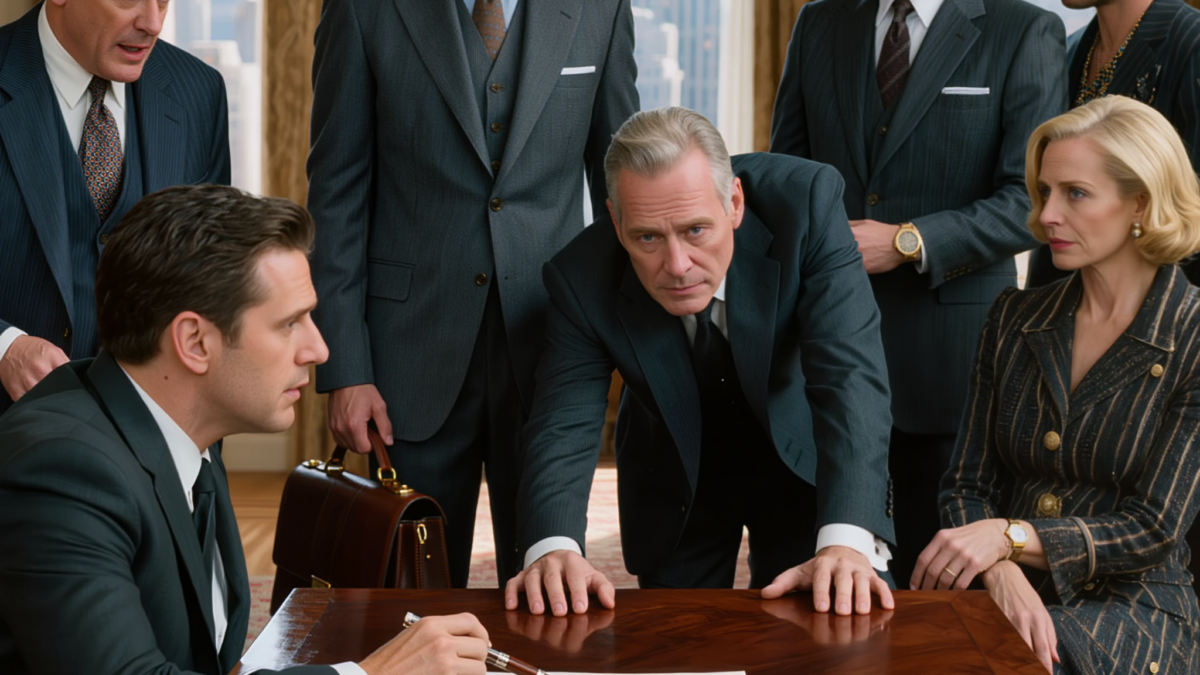
When Marcus and I arrived the next morning, all three of them were already seated.
Kenneth sat at the head of the table wearing a dark suit.
Eleanor sat beside him with a glass of sparkling water and lemon.
Khloe sat across from them.
She looked exhausted.
Her blonde hair was pulled back, and she was tearing at the edge of a cloth napkin in her lap.
There was also a fourth person.
Dylan Harrison.
Marcus’s background report had described him accurately.
He wore a flashy pinstriped suit, a large gold-colored watch, and enough cologne to announce his presence before he spoke.
Kenneth leaned forward the second I entered.
“Well, it’s about time.”
I pulled out a chair and sat.
Marcus remained standing behind me with his briefcase.
Kenneth folded his hands on the table.
“I hope you’ve spent the last few days thinking about your responsibilities as a man, Ryan. Walking out on your wife on your wedding night was disgraceful.”
“I’ve thought about a lot of things.”
I looked at Khloe.
“For example, I’ve thought about the $96,000 payment demand that was delivered to our honeymoon suite.”
Khloe looked down.
Eleanor sighed as if I were being unreasonable.
“Oh, Ryan. Please don’t be dramatic. It’s a temporary cash-flow issue. Khloe was trying to build a restaurant business.”
Then she gestured toward Dylan.
“We brought him here so everyone could behave like adults and restructure the payments.”
Dylan leaned forward.
“Look, your wife got into a financial bind. It happens. Business is risky. Her parents guaranteed the debt with their house.”
He tapped the table.
“I hear you’ve got some savings. You put up $150,000 today as a good-faith payment, and I’ll restructure the rest so her parents don’t lose the house.”
I looked at Khloe.
“Is that what you want?”
She did not answer.
Kenneth did.
“When you marry into this family, you take on the family burdens. That’s how a real marriage works.”
I nodded slowly.
“That’s interesting.”
Kenneth frowned.
“Because on our wedding night, Khloe looked me in the eye and told me we live separate lives.”
Khloe’s head came up.
“Ryan, please.”
I continued.
“She said she gets my money to maintain her status, and I get her presence when social appearances require it.”
Khloe looked at her parents.
“My parents didn’t know I said that.”
I looked at Eleanor.
“I think they knew exactly what you planned to say.”
Eleanor’s expression hardened.
I laid out the timeline.
The wedding had been moved from November to September just as their financial deadline approached.
The joint account had been opened two weeks before the wedding.
The $150,000 transfer was scheduled for the morning after the ceremony.
Trevor had been offered $20,000 to make sure the transaction cleared.
Eleanor stopped pretending to be gracious.
“You listen to me, you ungrateful little pencil pusher. We accepted you into our home. We let you marry our daughter.”
She leaned forward.
“You are going to sign what needs to be signed.”
Marcus finally spoke.
“Speaking of signatures, Mr. Harrison, I believe you have a contract for my client.”
Dylan slid a thick legal packet across the table.
“This is an assumption-of-liability form,” he said. “It moves the $310,000 debt into your name. Your wife and her parents are released as guarantors. You make the first payment today, and we’re done.”
I looked through it.
The arrangement was simple.
Their debt became mine.
They walked away.
“If I don’t sign?”
Kenneth hit the table with his palm.
“Then you prove you’re exactly the weak man I always thought you were. You lose Khloe. You lose this family. Everyone we know will hear how you abandoned your wife when she needed you.”
For a moment, nobody moved.
Then I reached into my jacket and removed my silver fountain pen.
Khloe exhaled.
Eleanor leaned back.
Kenneth looked satisfied.
Khloe even managed a small smile.
“You’re doing the right thing, Ryan.”
I uncapped the pen.
Then I placed it beside the contract.
“I’m not signing this.”
Kenneth stared at me.
“I don’t need to assume your debt.”
I looked around the table.
“I already own it.”
Eleanor’s expression froze.
Kenneth leaned forward.
“What are you talking about?”
Marcus answered calmly.
“He’s not playing games.”
At that moment, the dining-room doors opened.
Alexander Vaughn walked in.
Kenneth recognized him immediately.
Alexander was the public chairman of Vanguard Holdings and a familiar figure in the financial world.
He walked directly to me and extended his hand.
“Ryan. Sorry to interrupt. The acquisition of Apex Financial’s distressed asset ledger was completed this morning. I brought the finalized portfolio documents you requested.”
I shook his hand.
“Thank you for bringing them yourself.”
“Of course, boss.”
The room went quiet.
Alexander handed the portfolio to Marcus, nodded to me, and left.
Kenneth stared at me.
“Did Alexander Vaughn just call you boss?”
I sat back down.
“I think we should start over.”
I looked at all three members of the Walsh family.
“My name is Ryan Mitchell. I’m the founder, majority shareholder, and CEO of Vanguard Holdings.”
Eleanor shook her head.
“No.”
“The logistics company you thought I worked for is part of the corporate structure. The apartment where Khloe visited me was a company property. My actual home is the penthouse Khloe has been decorating.”
Khloe covered her mouth.
Eleanor kept shaking her head.
“That’s impossible. You drive a used Honda Accord.”
“The Honda was intentional.”
I had wanted to know whether Khloe could love the man without being influenced by what the man owned.
I had gone too far in hiding my wealth, but the result was now impossible to ignore.
Eleanor and Kenneth had believed money determined a person’s worth.
Khloe had built our relationship around information she thought I did not know she possessed.
Then I turned toward Dylan.
“Apex Financial is under Vanguard.”
His posture changed.
“As of this morning, Vanguard acquired the Walsh debt. Their loans, the related obligations, and the liens connected to the house are no longer your problem.”
Dylan blinked.
“You bought the debt?”
“Yes.”
Marcus confirmed that Dylan’s position had been settled through the acquisition.
He no longer had any reason to remain at the meeting.
Dylan picked up his briefcase and left.
Now it was just Khloe and her parents.
Kenneth looked pale.
“You own our debt?”
“Yes.”
I explained it plainly.
Vanguard now held the $310,000 obligation.
The payment terms they had agreed to did not disappear simply because the creditor had changed.
Khloe reached across the table.
“Ryan, please. We didn’t know.”
I moved my hand away.
“I loved you,” she said. “If I had known who you really were, I never would have said those things.”
“That’s exactly the problem.”
She stopped.
“You would have treated the CEO of Vanguard differently from the logistics manager you thought you married.”
I looked at her.
“The man was the same.”
Eleanor tried another approach.
“We’re family. This amount means nothing to you. Forgive the debt. Consider it a wedding gift.”
Marcus opened his briefcase.
He removed the forged marital-asset document and placed it on the table.
“Like this wedding gift?”
The color drained from Kenneth’s face.
I pushed the paper toward them.
“This document supposedly gives Khloe authority to use my penthouse and investment assets as collateral.”
Eleanor immediately denied knowing anything about it.
Marcus told them Trevor had already admitted that he had been offered $20,000 and that digital communications connected the scheme to the family.
He also explained that a handwriting specialist had reviewed the signature.
The room changed.
The arrogance disappeared.
For the first time, they were not arguing about whether I owed them money.
They were asking what I intended to do.
Marcus reached into his briefcase one last time.
He placed another stack of papers in front of Khloe.
She looked at them.
“What is that?”
“Divorce papers.”
Her face crumpled.
The marriage had lasted less than a week.
My legal team planned to seek an annulment based on fraud and to separate our finances as completely as possible.
I told Khloe I wanted no claim on her assets and no financial relationship between us beyond what the law required to resolve the marriage.
I also made it clear that if the forged paperwork became part of a contested legal fight, my attorneys would submit the evidence to the appropriate authorities.
Khloe stared at the documents.
I stood.
A few days earlier, I had thought I was marrying into a family.
Now I understood that they had viewed the ceremony as access to my finances.
I buttoned my jacket.
“Have a nice breakfast.”
Then Marcus and I left the Oak Room.
The fallout began immediately.
Because Vanguard now held the Walsh family debt, the company controlled the collection process.
Kenneth and Eleanor could not produce the $310,000 they owed.
Two days later, the panic became public.
I was in my office at Vanguard reviewing an upcoming acquisition when security called.
“Mr. Mitchell, there’s a woman named Eleanor Walsh in the lobby. She’s demanding to see you.”
I opened the building’s security feed.
There she was.
The same woman who had once looked down on the wine I brought to Thanksgiving was standing in the marble lobby of my office building wearing oversized sunglasses and clutching a designer handbag.
She was arguing with a security guard.
“Do not let her past the turnstiles,” I said.
The guard relayed the message.
Eleanor stopped shouting.
Her face crumpled.
She stood there crying while employees crossed the lobby around her.
Eventually, she turned and walked out.
I never saw her in person again.
Khloe signed the divorce papers three days after the restaurant meeting.
She did not pursue a prolonged fight over my businesses, real estate, or other assets.
The forged authorization document remained with my legal team.
I ultimately chose not to spend months of my life pursuing a criminal case against her parents.
I wanted distance more than I wanted another battle.
But I did not forgive their debt.
Within three months, the Walsh family house that had been pledged as collateral was seized and sold to cover part of what they owed.
Their country-club lifestyle disappeared quickly.
The people Eleanor and Kenneth had spent years trying to impress did not rush to help once the illusion of wealth was gone.
I heard that they moved into a small two-bedroom apartment outside the city.
Kenneth took a job as a floor manager at a hardware store to cover basic expenses.
The man who once mocked my supposed logistics career now clocked in wearing a name tag.
Khloe’s life changed too.
The divorce did not erase her other debts.
Without access to my accounts, she had to support herself.
The last I heard, she was working at the front desk of a dental office while dealing with creditors tied to years of spending.
I did not celebrate any of it.
By then, there was very little satisfaction left in watching them struggle.
Mostly, I felt tired.
I had protected my assets and ended a marriage that had been built on deception, but I had also lost two years of my life to a relationship I had believed was genuine.
A year passed.
The Walsh family became a distant memory.
I focused on Vanguard, expanded our real estate business, and promoted Marcus to a senior position.
My life became quiet again.
Then, one October afternoon, I received a message from an unfamiliar number.
Ryan, it’s Logan, Khloe’s younger brother. I know you probably want nothing to do with my family, and I don’t blame you, but I have something you need to see. Can I buy you a coffee?
Logan was the one Walsh who had never openly insulted me.
He was younger and quieter than the rest of them.
He had usually stayed away from Eleanor’s schemes and Kenneth’s posturing.
He had even missed the wedding reception, claiming he was sick.
Curiosity won.
I agreed to meet him at a small café near Central Park.
When I arrived, Logan was already sitting in a corner booth.
A manila folder rested on the table.
He stood when he saw me.
“Thanks for coming.”
I sat across from him.
“If Khloe or your mother sent you to ask me for money, the answer is no.”
“No. Absolutely not.”
He shook his head.
“I barely speak to them now. This isn’t about money.”
He pushed the folder toward me.
“It’s about the truth.”
I looked at him.
“What truth?”
“I was cleaning out an old laptop yesterday. I found screenshots from a family group chat. They synced automatically years ago.”
He looked embarrassed.
“They’re from the week after you and Khloe met at the children’s hospital gala.”
I opened the folder.
Inside were printed screenshots of messages between Eleanor, Kenneth, and Khloe.
The first message was from Eleanor.
Khloe, I saw the guy you were talking to at the gala. Ryan Mitchell. Kenneth had a friend run a quiet background check.
Khloe responded.
The logistics guy? He’s cute, but he drives a terrible Honda Accord. I’m not interested in struggling, Mom.
Then came Eleanor’s reply.
He’s lying, Khloe.
I kept reading.
According to Eleanor, Kenneth’s contact had seen me leave the gala parking garage in my vintage Porsche 911.
The car was registered through a corporate LLC connected to Vanguard Holdings.
They had known.
Not everything, but enough.
Enough to understand that the Honda, the modest apartment, and the logistics job did not tell the full story.
Enough to suspect I was wealthy.
Eleanor’s next message was even clearer.
He is testing you. Play dumb. Act like you love his work ethic. Eat his cheap dinners. Pretend you don’t care about money.
Then came the line that stayed with me.
Once you have a ring on your finger and the ink is dry on the marriage certificate, we secure the bag.
A second message followed.
Play the long game, honey. He is our way out.
Khloe replied that she understood.
I read the screenshots again.
For a year after the divorce, some part of me had wondered whether the relationship had begun honestly and become corrupted later.
Maybe Eleanor had pressured Khloe after we were already serious.
Maybe the financial desperation had changed her.
Maybe the wedding had simply brought out the worst in people.
The messages erased that possibility.
They had suspected the truth about my money within days of meeting me.
Khloe’s lunches.
The evenings when she listened to me complain about my fictional work problems.
The cheap dinners she claimed to enjoy.
The walks where she told me she admired how hard I worked.
All of it had happened after she knew I was probably hiding wealth.
The relationship had been a test, but not only mine.
I thought I was testing whether Khloe could love me without money.
Her family had realized what I was doing and decided to perform the answer I wanted to see.
“I’m sorry,” Logan said.
I closed the folder.
“I should have told you,” he continued. “I was scared of my mother. By the time the wedding happened, everything was moving so fast. I just wanted you to know you weren’t imagining it.”
I looked at the folder.
For months after the divorce, I had occasionally wondered whether I had reacted too quickly.
Whether I should have listened longer.
Whether some part of the marriage could have been saved.
Those messages answered the question.
“Thank you, Logan.”
He nodded.
I paid for our coffee and left with the folder.
That evening, I stood on the balcony of my penthouse watching the sunset over the city.
In one hand, I held a glass of scotch.
In the other was a piece of paper I had found weeks earlier in a desk drawer.
My wedding vows.
I read them again.
I had promised honesty.
Partnership.
Loyalty.
Respect.
I had meant every word.
For a long time, I thought that made me foolish.
It didn’t.
The mistake was not believing in those things.
The mistake was offering them to someone who saw partnership as access and commitment as leverage.
I folded the vows carefully instead of tearing them up.
They were still mine.
Khloe had wanted a husband whose money was shared while his expectations remained separate.
Instead, our marriage taught me something before we even reached breakfast the next morning.
When someone tells you clearly what your partnership means to them, listen.
I had spent two years trying to find out whether Khloe could love a man without knowing his net worth.
In the end, the answer had been sitting in her family’s group chat almost from the day we met.
And for the first time since that wedding night, I no longer needed another explanation.








