My younger brother fired me from the company I spent 12 years building. “It’s not personal, Mason. It’s just business,” Elijah said, sliding a termination folder across his desk. Then he demanded the master decryption cipher and a five-year noncompete. I handed over my laptop, walked past the engineers I’d trained, and called the attorney who drafted a licensing agreement our parents signed ten years earlier. One clause had never been removed.
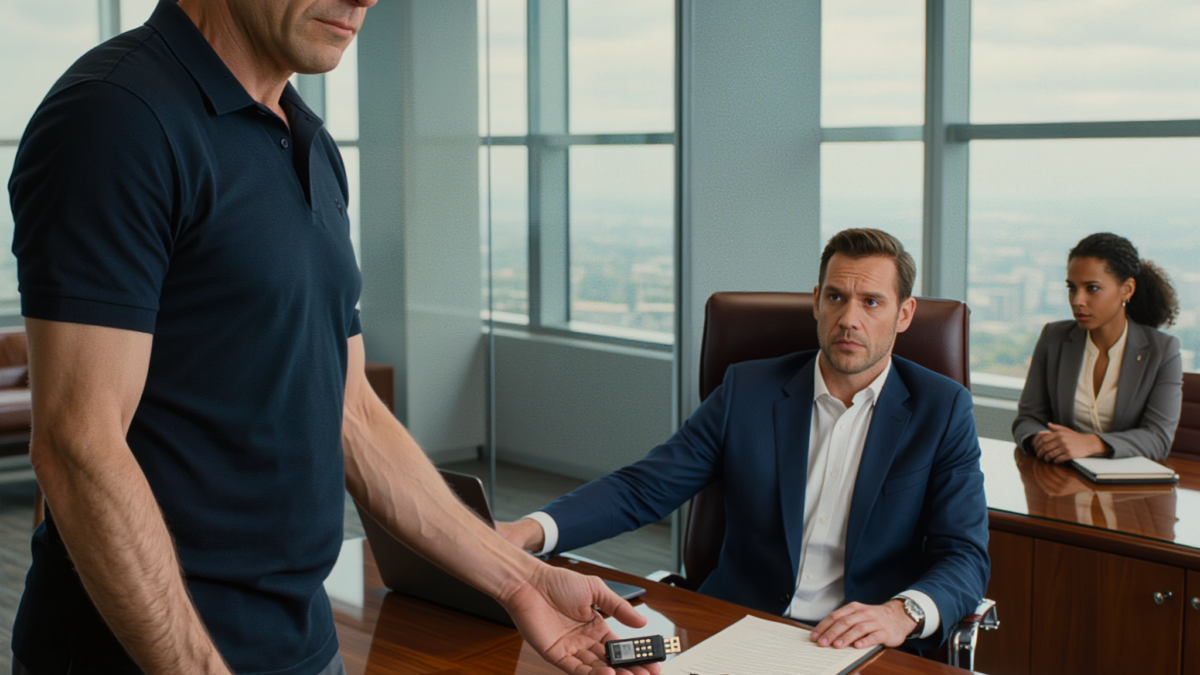
I knew my time at the company was coming to an end the moment my younger brother, Elijah, refused to make eye contact with me.
You develop a sixth sense for systemic failures when you spend twelve years building a defense encryption framework from scratch. You learn to recognize the smallest warning signs, the slight delay in a server response before an entire system goes down, or the tiny fracture that eventually brings something much larger apart.
Sitting in Elijah’s sterile, glass-walled office on the top floor of Techflow Dynamics, I felt that same warning.
He sat across from me as though I were an expense on a quarterly report that needed to be eliminated. He smelled of expensive cologne and carried himself with the confidence of someone who had spent too much time impressing venture capitalists.
His Porsche 911 was parked outside in a reserved space. He opened my personnel file with a casual flick of his wrist, treating the record of my life’s work like a document he’d already decided wasn’t worth reading.
“Let’s talk about optimization, Mason,” he said.
No greeting. No question about my weekend. No acknowledgment of the twelve years I had spent helping transform our parents’ struggling business from a garage operation into a defense contractor.
Just optimization.
My stomach tightened.
I was thirty-five years old. I had written the software that made our defense contracts valuable. I had designed the encryption architecture our customers depended on to secure sensitive communications.
And now my thirty-year-old brother, a man who had never written a line of production code as far as I knew, was explaining why the company no longer needed me.
“Look, Mason,” he continued, finally meeting my eyes. “You’ve done solid work. Really. Mom and Dad appreciate the legacy systems you’ve maintained.”
Legacy systems.
That was how he described the technology supporting the company’s most important contracts.
He leaned forward, resting his elbows on the mahogany desk.
“But the company is pivoting. We need agile people. Fresh perspectives for the next-generation rollout. Frankly, your salary band is restrictive for the kind of hiring we need to do.”
He paused, studying my expression.
“If you’re not comfortable with our new direction, the door is right there.”
For several seconds, I couldn’t answer.
I looked at his carefully manicured hands resting on the folder containing my termination papers. Then I looked down at my own hands, worn from years of working on equipment, assembling systems, and spending countless nights at a keyboard.
“You’re firing me?” I asked. “Just like that?”
Elijah barely hesitated.
“It’s not personal, Mason. It’s just business. Please leave your badge with Joseph at the front desk.”
He spoke as though he were canceling a service contract.
My brother had just dismissed me from the company I had helped build, and he seemed genuinely surprised that I might take it personally.
At the time, I couldn’t fully process what had happened. I could only think about how much I had given up to keep that business alive.
Twelve years earlier, there had been no top-floor office, no executive boardroom, and no investors discussing nine-figure acquisitions.
There had been our parents’ detached garage, two space heaters that repeatedly tripped the circuit breaker, and a collection of aging computers.
Our parents, Robert and Susan Caldwell, operated a small IT consulting company that was drowning in debt.
I had recently left my master’s program because they could no longer afford to help me continue. They needed someone who understood software development, and I needed to believe that sacrificing my education would help save our family.
So I moved home and went to work.
I wasn’t simply an employee collecting a paycheck. I was trying to prevent my parents from losing everything.
There were nights when I slept on a rolled-up yoga mat beneath a makeshift plywood desk. Sometimes the garage became so cold that I could barely feel my fingers before the computers warmed the space.
Meanwhile, Elijah was attending a private university.
My parents somehow always found money for his tuition, fraternity dues, and spring break trips. They used their savings and borrowed more when that wasn’t enough.
They called it Elijah’s college fund.
I knew much of that money had effectively come from the contracts I was working late into the night to complete.
But he was my little brother. I wanted him to succeed.
I believed we were working toward the same future.
I still remember the stale coffee from the vending machine and the smell of overheating equipment in that garage. I spent seventy-two exhausting hours developing the base kernel that would eventually become our flagship defense encryption architecture.
When the compiler finally returned zero errors and the encryption handshake worked correctly, I cried.
I had been so exhausted that I could barely keep my eyes open, but the software worked.
For the first time, I believed we might actually save the business.
My parents congratulated me and took me out for an inexpensive dinner.
I treasured that evening.
Years later, when Elijah graduated, they hosted an enormous backyard celebration. They bought him a luxury watch and spent the evening praising his leadership potential and business instincts.
I stood near the edge of the party holding a warm beer.
Nobody mentioned the software that had kept the company operating while Elijah was away.
At first, I told myself it didn’t matter.
I wasn’t interested in expensive watches or public recognition. I wanted to build reliable systems and keep doing the work I loved.
I didn’t demand a promotion or insist on a substantial equity stake. I trusted my parents to treat me fairly when the company became successful.
I thought that was what family meant.
But over time, the way they talked about our contributions changed.
I became “the technical guy.”
Elijah became “the future of the business.”
I worked behind the scenes while my brother collected praise for opportunities created by the technology I had developed.
There was another part of our company’s history that Elijah knew almost nothing about.
Ten years before he became an executive, the business encountered a serious legal obstacle.
We were moving beyond small consulting contracts and attempting to secure government defense work. The compliance requirements were complicated, and our parents had little experience handling intellectual property arrangements on that scale.
They hired inexpensive consultants who created more confusion than clarity.
I was worried about protecting the encryption architecture.
A larger competitor could potentially take advantage of our disorganization, and the company could lose the one technology that distinguished it from everyone else.
One rainy Tuesday evening, I met my childhood friend Arthur at a neighborhood bar.
Arthur had recently passed the bar exam and was working long hours at an intellectual property firm. We sat in a cracked vinyl booth while I explained the situation and drew network diagrams on damp cocktail napkins.
My parents had been reluctant to spend money on the necessary filings.
Arthur listened until I finished, then set down his drink.
“Mason, you’re an idiot,” he said.
I stared at him.
“Your parents love you, sure. But business makes people crazy. You wrote that code on your own time, using your own equipment, before the company incorporated the new defense division. You need to protect yourself.”
I argued that we didn’t need to bring aggressive legal arrangements into a family business.
Arthur disagreed.
“File the provisional patent application under your own name. You’re the inventor. Let the company use the technology under a temporary licensing agreement, but don’t simply give away ownership.”
He drafted the documents that weekend.
We submitted the initial filing to the United States Patent and Trademark Office and arranged a license allowing the company to use the technology without paying an ongoing fee.
My parents signed the agreement.
They were relieved the paperwork had been handled because it allowed them to move forward with their defense contract plans.
I don’t think either of them paid much attention to its details.
Arthur had included a particular provision in the licensing agreement.
If the company terminated my employment involuntarily and without cause, its rights to use the underlying technology would end under the agreement. The documents also established a twenty-four-hour period before the ownership provisions would take effect.
Arthur called it a dead man’s switch.
At the time, I thought he was being unnecessarily cautious.
The possibility that my own parents might one day authorize my dismissal from the business I was saving seemed ridiculous.
I laughed when he explained the provision.
After everything was signed and notarized, I placed the documents in a metal lockbox in my closet.
Then I went back to work.
The company expanded. Contracts became larger. Revenue increased. We hired engineers and moved into proper office space.
The documents stayed in that lockbox.
Nobody completed a permanent assignment of the underlying intellectual property to the company.
For years, nobody appeared concerned about it.
After all, everyone assumed I would always be there.
Two years before my firing, Elijah returned from his MBA program.
Our parents brought him directly into senior management, appointing him chief strategy officer. Within a year, he was acting CEO.
Robert and Susan were ready to retire.
They believed Elijah had the business instincts and connections needed to sell Techflow Dynamics to a major defense conglomerate for a nine-figure amount.
Elijah embraced his new authority immediately.
Unfortunately, his management style involved making life difficult for the people who understood how our systems worked.
He introduced aggressive performance metrics and filled meetings with phrases about synergy, disruption, and organizational efficiency.
He walked through the engineering department in expensive custom-tailored suits, commenting on cluttered desks and what he called our lack of professionalism.
He particularly disliked being challenged by me.
I knew the architecture. I knew the technical limitations. I knew which promises could be fulfilled and which were likely to create serious compliance problems.
Elijah considered those objections insubordination.
He denied my promotion request and froze salaries for the junior engineers.
I fought those decisions because I knew how difficult it would be to replace the people who maintained our systems.
Whenever I raised security concerns, he looked at his phone.
“We need to think outside the box, Mason,” he would say. “Don’t be a blocker. You engineers always find reasons to say no.”
He started describing Aegis, our most valuable architecture, as a cost center.
He hired outside consultants to examine the code and search for a cheaper commercial replacement.
They couldn’t find one that met the same requirements.
The technology remained central to our defense business, but Elijah rarely acknowledged that.
He was focused on securing a major Aegis contract with the Department of Defense, increasing the company’s valuation, and selling the operation to the highest bidder.
To him, I was becoming an obstacle.
I knew too much about how the system operated. I questioned decisions he wanted implemented immediately. And I wasn’t interested in pretending a proposal was technically sound simply because it looked impressive in an investor presentation.
The conflict reached a breaking point one week before my dismissal.
We were having dinner at an expensive downtown steakhouse to celebrate our parents’ upcoming wedding anniversary.
Elijah arrived in his Porsche and tossed his keys to the valet.
For the first forty-five minutes, he talked almost exclusively about the upcoming Pentagon demonstration.
He discussed valuation multiples, potential investors, and the money the family would receive once the company sold.
“We’re about to secure generational wealth,” he announced, raising his wineglass. “The Aegis contract is practically in the bag. Once they sign, our valuation triples.”
Mom looked delighted.
“We’re so proud of you, honey. You’ve really taken this company to the next level.”
I sat at the far end of the table, cutting my steak.
During the previous three nights, I had slept under my desk to make sure the server load balancing would hold up during the demonstration.
Nobody asked about the work.
Then Dad turned toward me.
“Mason, Elijah mentioned you’re pushing back on the new cloud integration timeline. You need to be a team player. We can’t have internal friction right before the finish line.”
I set down my knife.
“Dad, the cloud integration violates three separate DoD security protocols. If we push that update before the demo, we fail the compliance audit. I’m not creating friction. I’m trying to keep us out of federal prison.”
Elijah sighed loudly.
“Always the drama queen, Mason. I already spoke with a consultant. There are workarounds. You just don’t want to adapt.”
“Workarounds for federal security clearances?” I asked. “Are you out of your mind?”
“Enough!” Mom snapped.
She looked directly at me.
“Don’t ruin a nice dinner with your technical complaints, Mason. Elijah is the CEO. You need to respect his authority.”
Dad nodded.
Elijah watched me from behind his wineglass with a faint smile.
I looked around that table and realized how far apart we had become.
My parents no longer seemed interested in hearing why I disagreed with my brother. They had already chosen whose judgment mattered.
As the dinner continued, they discussed inheritance arrangements, future trusts, and the wealth they expected Elijah’s deal to create.
My name barely entered the conversation.
I was still useful to the company, but I no longer seemed to have a place in the family’s plans.
A week later, I was back in Elijah’s glass office, looking at the termination folder.
Chloe, a young HR representative, sat in the corner. She looked nervous and avoided meeting my eyes.
Elijah leaned back in his leather chair.
“We’ve prepared a severance package,” he said. “Standard industry rates. Two weeks of pay for every year of service.”
I calculated the amount.
After twelve years of work, the offer felt insulting, especially considering how often I’d accepted salary freezes to protect the people on my team.
“There’s one condition,” Elijah continued.
He pushed another document across the desk.
“We need all administrative passwords, root access keys, and the master decryption cipher before you leave this room. You’ll also sign this noncompete and nondisclosure agreement.”
I examined the document.
The noncompete was broad enough to prevent me from working in the technology industry for five years.
Elijah wanted my access credentials, my knowledge, and my ability to support myself after I left.
“And if I refuse?” I asked.
He smiled.
“Then you forfeit the severance. We’ll tie you up in litigation until you’re bankrupt. Come on, Mason. Don’t make this ugly. You know you can’t afford a legal battle against the company.”
He knew my financial situation.
For years, I had accepted less money than I might have earned elsewhere because I wanted the company and my team to succeed.
I didn’t have a large reserve of savings to spend fighting an expensive lawsuit.
My brother was counting on that.
I picked up the company laptop I’d brought into the meeting and placed it on his desk.
Then I removed a small USB drive containing encrypted backup keys from my pocket and set it beside the computer.
“It’s all there,” I told him.
Elijah looked satisfied.
“Good. Chloe will escort you to your desk to collect your personal items. You have fifteen minutes.”
I stood slowly.
My knees cracked as I straightened.
“You have absolutely no idea what you’re doing, Elijah,” I said. “You’re tearing out the load-bearing walls and calling it a renovation.”
He narrowed his eyes.
“I have an MBA. I think I know exactly what I’m doing. Leave.”
I collected a few framed photographs, an old coffee mug, and the mechanical keyboard I had assembled myself.
Chloe stood nearby while I packed.
“I’m sorry, Mason,” she whispered. “I didn’t know until ten minutes ago.”
“It’s not your fault, Chloe.”
She looked as though she wanted to say more, but neither of us had much time.
I took the elevator to the parking garage and got into my ten-year-old sedan.
For a while, I sat with both hands gripping the steering wheel.
My chest felt tight.
I had been preparing myself for disagreements with Elijah, but I hadn’t expected my own brother to dispose of me so easily.
I took out my phone and called Dad.
It rang four times before he answered.
“Robert here.”
“Dad, it’s me.”
My voice cracked.
“Elijah just fired me. He handed me termination papers.”
There was a pause.
I could hear a television playing in the background.
“I know, Mason,” Dad said eventually.
I sat upright.
“What?”
“We discussed it this morning. Your mother and I signed off on it.”
I stared through the windshield at the concrete wall ahead of me.
“You signed off on it? After twelve years? After I saved this company from bankruptcy?”
“You’re being emotional, Mason,” he replied. “Elijah is right. Your salary is too high, and your methods are outdated. Investors want a streamlined operation. You’ve been a roadblock to progress for the last six months.”
I tightened my grip on the phone.
“We need to look at the big picture,” he added.
“The big picture? I built the system you’re about to sell. I gave up my twenties for this family. You used the money I earned to fund Elijah’s education.”
“Don’t raise your voice at me,” Dad snapped.
“We paid you a fair wage. You’re not a victim here. Elijah is securing our future. We’re talking about generational wealth.”
He paused, then continued.
“When the company sells, we’ll make sure you get a nice bonus. But right now, you need to step aside.”
A nice bonus.
That was his answer to twelve years of work.
A discretionary payment from the proceeds of a deal made possible by the software I had created.
“I have to go, Mason,” Dad said. “We’re having lunch with the venture capital guys. Drop your keys at the front desk.”
He ended the call.
I stayed in the driver’s seat, holding the silent phone.
My parents hadn’t been misled into believing I was taking a vacation or leaving for another opportunity.
They knew exactly what Elijah was doing.
They had approved it.
The realization hurt more than the dismissal itself.
Before driving away, I remembered something I’d left behind.
My personal hard drive was still in the server room. It contained family photographs and old tax records, nothing proprietary, but I didn’t want to abandon it.
I returned to the lobby.
Joseph, the head of security, was standing near the turnstiles.
He was a large man and a former police officer. We’d spent years discussing baseball almost every morning.
Now he crossed his arms as I approached.
“Joseph, I need to grab my personal drive from the server room.”
He shook his head.
“Sorry, Mason. Mr. CEO’s orders. Your badge is deactivated. You’re not allowed back into the secure area. I have to escort you off the premises.”
I looked at him.
“Joseph, it’s me. You know I’m not going to steal anything.”
He lowered his eyes.
“I have a job to do, man.”
He walked beside me toward the side exit, taking me past the engineering department.
The room had been designed as an open-plan workspace to encourage collaboration.
That afternoon, it felt like a public dismissal.
Wyatt, a talented young programmer I’d mentored for three years, looked up as we approached.
I’d spent countless nights teaching him how to debug complex kernels.
He saw Joseph escorting me and immediately dropped his eyes to his laptop, pretending to type.
Dylan and Luke were standing near the coffee machine.
Only a month earlier, I’d fought Elijah to prevent their layoffs.
They turned toward a blank whiteboard and avoided looking at me.
Nobody stood up.
Nobody asked what had happened.
I knew they were frightened. They had watched Elijah punish people who questioned his decisions.
Still, walking past those familiar desks without a single word of acknowledgment was painful.
Joseph opened the heavy glass door.
“Take care of yourself, Mason,” he said quietly.
I stepped outside.
The door closed and locked behind me.
I had spent twelve years building the systems inside that building. Now I couldn’t even retrieve my own family photographs.
I drove three blocks to Murphy’s Diner instead of returning to my apartment.
The place had cracked red vinyl booths, waitresses who called customers honey, and unusually strong coffee.
I found a booth in the back corner and ordered a black coffee.
My hands were shaking badly enough that I wrapped both of them around the mug.
Two weeks of pay for every year of service.
A nice bonus.
Don’t raise your voice at me.
I kept hearing those phrases.
For twelve years, I’d assumed my loyalty would be returned with loyalty.
I’d accepted difficult conditions and passed up opportunities because I believed our success belonged to the family.
Now it was clear that my parents and Elijah expected obedience, not partnership.
When I became inconvenient, they removed me.
I sat there watching a waitress refill bottles of ketchup on the counter.
Eventually, I opened my personal ThinkPad.
It was old and heavy, but it had never let me down.
I avoided the diner’s public Wi-Fi and connected through my phone’s cellular hotspot.
Then I opened my email.
Arthur was no longer the newly qualified attorney I’d met in a neighborhood bar ten years earlier. He had become a partner at his firm and handled complex intellectual property disputes.
I typed his address into the recipient field.
The subject line was simple.
Project Lazarus.
I attached high-resolution scans of the old USPTO filing and the original licensing agreement, the documents I’d kept in my metal lockbox.
Then I wrote:
“Arthur, I was terminated involuntarily and without cause at 10:00 a.m. today by the CEO with board approval. Does the clause in Section 4, Paragraph B still hold water? Has statutory law changed since we filed? I’m ready to execute the reversion.”
I read the message once more and clicked Send.
Rain began streaking down the diner’s windows.
I leaned back against the cracked vinyl booth and waited.
Elijah had insisted that what happened wasn’t personal.
If he wanted to treat the company as a business transaction, then it was time to examine the agreements governing that business.
My phone rang eighteen minutes later.
Arthur didn’t bother with a greeting.
“Mason! Tell me you’re joking. Tell me Elijah didn’t actually fire you.”
“He fired me,” I said. “With our parents’ blessing.”
Arthur let out a long whistle.
“The arrogance of that family is breathtaking.”
I heard pages turning on his end.
“I’m looking at the original agreement right now,” he continued. “I’d forgotten how carefully we drafted this.”
“Is the dead man’s switch valid?” I asked.
My heart was beating hard enough that I could feel it in my chest.
“Valid? Mason, the language is ironclad. Techflow has been operating under a license tied to your continued employment. The moment they processed your termination without cause, the twenty-four-hour countdown began.”
I sat forward.
“So what happens now?”
Arthur paused to check something.
“I’ve reviewed the USPTO records. There’s no new assignment of rights. Nobody ever completed the permanent transfer.”
He continued.
“Under the original arrangement, the intellectual property reverts to you tomorrow morning at ten.”
I stared at the tabletop.
For years, I’d treated those papers as an unnecessary precaution.
Now they were the only reason my brother couldn’t simply take control of the software and erase me from the company that depended on it.
“And the Aegis contract?” I asked. “Elijah is presenting the system on Thursday.”
Arthur’s tone changed.
“If they demonstrate software they no longer have permission to use, they could face serious infringement claims. If they misrepresent ownership during a federal procurement process, the consequences could become far more serious.”
He took a breath.
“We need to document everything carefully.”
“Draft the notification,” I said.
“I’m already working on it. I’ll prepare it for 10:01 tomorrow morning. Don’t contact them, and don’t answer their calls until we’ve established the record.”
I hung up.
The coffee on the table had gone cold.
For the first time since Elijah handed me the termination folder, I had a concrete way to defend what I’d created.
I left the diner and walked into the rain.
The next twenty-four hours were miserable.
I returned to my apartment and spent most of the night staring at the digital clock on my microwave.
I barely slept.
Every time I considered calling Dad or confronting Elijah, I remembered Arthur’s instructions.
There was nothing useful I could say to them. The termination had already happened, and the board had approved it.
The documents would determine what happened next.
At ten o’clock the following morning, the contractual twenty-four-hour period expired.
One minute later, my phone buzzed.
Arthur had forwarded an automated notification from the United States Patent and Trademark Office.
The notice showed an updated status for the intellectual property and identified me as the original inventor to whom the rights had reverted.
I opened it twice.
For twelve years, the encryption architecture had supported Techflow Dynamics’ most important work. My family had treated it as though it belonged entirely to the business.
Now, according to the documents Arthur had reviewed and the agreement my parents had signed, that assumption was no longer valid.
I sat down on my couch and stared at the notification.
Part of me wanted to celebrate.
Another part kept remembering how Dad had sounded when he told me my salary was too high.
The business was still my family’s company, even if they had chosen to push me out.
I understood that enforcing my rights could affect people who had never participated in that decision.
Wyatt, Dylan, Luke, Chloe, and the other employees still depended on their jobs.
I didn’t want them to lose everything because Elijah had decided he could run the company without its technical foundation.
But I also knew what would happen if I simply handed the software back without addressing the underlying problem.
Elijah would continue making the same decisions.
My parents would continue defending him.
And sooner or later, someone else would pay the price.
At 1:30 that afternoon, my phone rang.
Wyatt’s name appeared on the screen.
I let it ring three times before answering.
“Hello, Wyatt.”
“Mason?”
His voice was barely above a whisper.
“Man, everything is melting down over here. Elijah is screaming at everyone.”
“What happened?” I asked.
“The code. Something’s wrong with the code.”
I sat forward.
Wyatt explained that the engineering team was attempting to push the final build to the secure demonstration server for the following day’s Pentagon presentation.
Every attempt failed.
The compiler kept returning a fatal checksum error involving the core encryption library.
The system identified the build as unauthorized.
“Did you plant a logic bomb before you left?” Wyatt asked.
“No,” I answered.
And that was the truth.
Twelve years earlier, I’d designed the original kernel to periodically verify the digital signature associated with the software license.
It was an anti-piracy measure intended to prevent unauthorized use of the architecture.
According to Wyatt’s description, the verification system had checked the licensing status, recognized that Techflow no longer held the necessary authorization, and stopped the build.
The software was functioning as designed.
I hadn’t accessed the company’s systems after leaving.
I hadn’t remotely disabled anything.
The licensing conditions had changed, and the system was responding to those conditions.
“I haven’t touched anything, Wyatt,” I told him. “I’m just an unemployed guy sitting on my couch.”
Wyatt didn’t laugh.
“Elijah is losing his mind. The Pentagon representatives are coming tomorrow, and he wants the system running.”
He lowered his voice further.
“He’s ordered me to bypass the security check. He wants the copyright headers removed, your name deleted from the source code, and the compiler forced to ignore the license verification.”
I straightened.
“Wyatt, listen carefully. Don’t alter those headers or bypass the licensing check.”
“But he’s insisting.”
“Then tell him you can’t resolve the error. Don’t make changes that could put you personally at risk.”
Wyatt was silent for a moment.
“Mason, he’s going to fire me.”
I remembered seeing him stare at his laptop while Joseph escorted me out.
He had a legitimate reason to be frightened.
“I know you’re worried,” I said. “But following that instruction could put you in a much worse position. Leave the code as it is.”
“Oh my God,” he whispered. “Are you serious?”
“Completely serious.”
I explained that altering copyright information and deliberately bypassing authorization could raise significant legal issues, especially in connection with a federal defense contract.
I told him Elijah’s instructions didn’t protect him from responsibility for his own actions.
Wyatt took a shaky breath.
“Okay.”
“Keep your hands off the code until this gets sorted out.”
I ended the call and immediately contacted Arthur.
I told him Wyatt had reported that Elijah wanted the engineering team to remove my attribution and defeat the license verification.
Arthur responded shortly afterward.
He said the allegation raised concerns about possible destruction or alteration of evidence and deliberate interference with intellectual property rights.
“We need to preserve anything that establishes those instructions,” he told me.
Until that afternoon, I had been dealing with a dispute about ownership.
Now I was concerned about what Elijah might do to conceal the company’s lack of authorization.
I knew my brother was proud.
He hated being contradicted, especially by people he considered beneath him in the organizational hierarchy.
What I didn’t know was how far he would go to avoid admitting that his plan had failed.
That evening, heavy rain swept across the city.
I was sitting at my kitchen island, looking over the messages from Arthur, when the doorbell rang at eight o’clock.
I wasn’t expecting anyone.
I walked to the front door and looked through the peephole.
Chloe was standing on my porch.
She wore a thin trench coat that was soaked from the rain, and she was clutching a thick brown envelope against her chest.
She kept glancing toward the street.
I opened the door.
“Chloe? What are you doing here?”
She looked frightened.
“Can I come in?”
“Of course. You’re soaked.”
She stepped inside, leaving drops of water on the hardwood floor.
“I can’t stay long, Mason,” she said. “If Elijah finds out I came here, he’ll ruin me.”
I closed the door.
“What happened?”
“He threatened to fire anyone who even spoke your name today. But I couldn’t sleep. I couldn’t just sit there and watch him do this to you.”
Her hands tightened around the envelope.
“Not after everything you’ve done for us.”
I led her into the kitchen and gave her a towel.
“Take a breath. Tell me what’s going on.”
She wiped the rain from her face and placed the envelope on the granite counter.
“Last year, when my mother was sick, you fought for my salary increase. You made sure I kept my medical benefits.”
I remembered that disagreement.
Elijah had wanted to reduce employee expenses, and Chloe’s benefits had been part of the proposed cuts.
I’d objected.
“Elijah wanted to take those benefits away to save money,” she continued. “I never forgot what you did.”
She looked down at the envelope.
“Today, after Wyatt told Elijah about the license error, he completely lost control.”
She explained that Elijah had called an emergency meeting involving the board, including Dad and Carter, one of the senior directors.
Afterward, he summoned Chloe into his office.
“He gave me a written order,” she said.
“What kind of order?”
“He told me to go into the secure physical archives in the basement.”
My stomach tightened.
“What was he looking for?”
“Your original employment contract from ten years ago. The one with the licensing agreement.”
I stared at her.
“He told me to run it through the industrial shredder. He said it was an outdated document that had been misfiled.”
For a moment, I couldn’t answer.
Chloe continued.
“Then he sent an email to IT ordering them to remove your name from the source code repository and replace it with his own.”
The same instructions Wyatt had described were now being connected to a second employee.
“Did you shred the contract?” I asked.
She shook her head.
“No. I made a high-quality copy of the original. Then I shredded the copy.”
She pushed the envelope closer.
“I also printed the email Elijah sent to IT. It contains his digital signature.”
I looked at the envelope.
“Everything is in there?”
“Yes.”
I opened it carefully.
Inside were copies of the original agreement and the written instructions Chloe had described.
I spread the pages across the counter.
The contract was familiar.
I recognized the provisions Arthur and I had discussed years earlier, including the condition governing termination without cause.
Then I read Elijah’s email.
The wording was direct.
He had instructed employees to remove attribution associated with my work and alter the repository records.
I read it again to make sure I understood exactly what it said.
The document appeared to support what Wyatt had told me on the phone.
“Chloe, do you understand how serious this is?” I asked.
She nodded.
“I know.”
“This could become evidence in a major legal dispute. There may be consequences far beyond a disagreement over my employment.”
Her expression steadied.
“I want you to stop him, Mason. He’s destroying the company. He’s destroying everything you built.”
I looked at her for a long moment.
During the previous two days, almost everyone I’d worked with had been afraid to speak to me.
Chloe had risked her job to bring me information she believed I needed.
“Thank you,” I said.
She glanced at the door.
“I really have to go.”
Before I could say much more, she headed back into the rain.
I stood alone in my kitchen with the documents spread across the counter.
I’d spent years protecting the company from outside threats.
Now I was examining evidence that its own CEO had instructed employees to interfere with records connected to the business’s most valuable technology.
I contacted Arthur and told him what Chloe had brought.
We needed to preserve the materials and make sure the appropriate people could examine them.
The following morning was Thursday.
It was the day of the Techflow Dynamics Future of Defense Showcase.
Elijah had spent months preparing for the event.
The presentation was supposed to demonstrate the Aegis system, impress representatives from the Department of Defense, and move the company closer to a contract that could dramatically increase its valuation.
My brother expected to leave the convention center looking like the executive who had secured our family’s future.
I opened my closet.
Normally, I wore a polo shirt and comfortable slacks to work.
That morning, I took out a tailored charcoal-gray suit I’d worn only twice.
I put on a dark silk tie and looked at myself in the mirror.
For years, I’d considered formal clothes unnecessary for the work I did.
But this wasn’t a normal engineering meeting.
I was going to attend a presentation about technology I’d created, and I wanted to be taken seriously when the question of ownership arose.
I met Arthur outside the downtown convention center at noon.
He wore a navy suit and carried his battered leather briefcase.
“Are you ready?” he asked.
I glanced toward the glass entrance.
“I’ve been preparing for this longer than I realized.”
We walked inside.
The main ballroom was filled with expensive displays and corporate branding.
Large high-definition screens lined the walls. Waiters moved between the guests carrying trays of champagne and hors d’oeuvres.
Hundreds of people had gathered.
There were venture capitalists, defense contractors, government representatives, military liaisons, and members of the industry press.
My parents had spared little expense.
They wanted Elijah’s presentation to establish him as a visionary executive capable of guiding Techflow into its next phase.
Arthur and I entered quietly.
We stood toward the back of the ballroom, near the heavy curtains.
The audience’s attention was on the stage.
Elijah was walking back and forth with a wireless microphone in his hand.
His suit was immaculate, and he spoke with the confidence I’d heard so many times in board meetings.
He was presenting a product he didn’t fully understand to an audience that might invest substantial money in it.
Mom and Dad sat in the front row.
Mom wore an expensive designer dress and watched Elijah with obvious pride.
Dad sat beside her, looking pleased.
I remembered our anniversary dinner at the steakhouse and the way they had dismissed my concerns about the upcoming demonstration.
Now they were watching Elijah present the same technology as though he’d been responsible for its development.
“Ladies and gentlemen,” Elijah announced, his voice carrying through the ballroom, “we’re not just updating software today. We’re redefining the landscape of global security.”
A graphic appeared on the screen behind him.
“The Aegis next-generation system is fully proprietary. It is entirely owned, developed, and controlled right here within our walls.”
Arthur leaned toward me.
“There,” he whispered. “He’s publicly claiming complete ownership.”
I kept watching the stage.
Elijah clicked his remote.
A detailed graphic of my encryption architecture filled the screen.
“We looked at the legacy code,” he explained, “the slow, outdated methods of the past, and we optimized them. We stripped away the dead weight. We built a flawless, agile machine.”
A few members of the audience applauded.
Elijah paused to enjoy the response.
“And the best part,” he continued, “is that we own the intellectual property from the ground up. That guarantees absolute supply chain security for our partners in the Department of Defense.”
I felt my jaw tighten.
He was using the same phrase he’d used when he fired me.
Dead weight.
The man who had dismissed the architect of the system was now taking credit for improving it.
Arthur watched Elijah carefully.
The presentation continued.
“Now,” Elijah announced, gesturing toward the front row, “I’d like to invite General Vance from the Pentagon to the stage.”
The room quieted.
General Vance, a tall, severe-looking man wearing a uniform with three stars on his shoulders, stood and walked toward the stage.
Elijah explained that Vance would initiate the first live secure handshake of the Aegis system.
A sleek black laptop waited on the podium, connected to the ballroom’s enormous screens.
The demonstration was designed to confirm the system’s security capabilities in front of the assembled officials and investors.
Vance climbed the steps and approached the laptop.
Arthur reached into his pocket and removed his phone.
He had prepared a digital dossier containing the documents we’d assembled.
It included the USPTO materials connected to the ownership claim, the relevant licensing records, server information concerning unauthorized use, and copies of the email Chloe had provided.
The files also contained the evidence supporting our account of Elijah’s instructions to employees.
General Vance reached toward the laptop’s activation key.
Arthur pressed Send.
Before Vance touched the keyboard, his phone buzzed.
He stopped and removed it from his pocket.
Elijah waited beside him.
“Is everything all right, General? We’re ready to initiate.”
Vance didn’t answer.
He read the message on his screen.
The silence stretched.
People in the audience began shifting in their seats.
Mom leaned toward Dad, apparently trying to understand why the demonstration had stopped.
Arthur hadn’t sent the dossier to Vance alone.
He had included the Pentagon acquisition committee, venture capital investors seated in the VIP section, and Techflow’s own legal department.
Across the ballroom, phones began vibrating and chiming.
People glanced at their screens.
Several investors started reading immediately.
Elijah looked toward the audience, then back at Vance.
His confident expression faltered.
The general lowered his phone.
Instead of answering Elijah, he reached forward and pressed Enter on the presentation laptop.
Elijah released a small breath, apparently relieved that the demonstration was proceeding.
He turned toward the massive screens.
He was expecting a green confirmation indicating a successful secure connection.
That wasn’t what appeared.
The display turned red.
A large error window filled the screen, towering above the stage.
FATAL ERROR.
CHECKSUM INVALID.
UNAUTHORIZED USE OF PROPRIETARY KERNEL.
LICENSE EXPIRED.
THIS SOFTWARE IS THE EXCLUSIVE PROPERTY OF MASON CALDWELL.
SYSTEM LOCKDOWN INITIATED.
A collective gasp spread through the audience.
People leaned forward to read the message.
Investors in the second row began speaking urgently to one another.
Elijah stared at the display.
He pressed buttons on his presentation remote, trying to move to another screen.
Nothing happened.
The system remained locked.
“General Vance, I apologize,” Elijah stammered. “This is clearly a technical malfunction. A glitch in the legacy hardware. My team will have it cleared up in seconds.”
He looked toward the side of the stage.
Wyatt and the other engineers were nowhere to be seen.
Vance stepped away from the laptop and picked up the wireless microphone.
When he spoke, his voice was calm.
“Mr. Caldwell, I’m looking at a legal notification from a registered intellectual property attorney.”
He glanced at his phone.
“It includes certified documentation from the United States Patent and Trademark Office. According to these records, the underlying encryption architecture you’re attempting to sell to the United States military does not belong to your company.”
Elijah stepped forward.
“That’s not correct, General. It must be a clerical error. We own the rights. We paid for that code.”
Vance continued.
“The documents state that the rights reverted to the original inventor following an involuntary termination without cause.”
He looked directly at Elijah.
“I’m also looking at an email bearing your digital signature that appears to direct employees to destroy employment records and alter copyright information to bypass security checks.”
The room filled with murmurs.
Mom put a hand over her mouth.
Dad stood, his face turning red.
Vance’s expression hardened.
“Are you attempting to misrepresent the ownership of this technology to the Department of Defense?”
“No, General. Please, you have to listen to me.”
Elijah looked from Vance to the audience.
“My brother is a disgruntled former employee. He’s trying to sabotage this deal out of spite. He stole the code.”
I stepped out from the back of the ballroom.
“He didn’t steal anything, Elijah,” I said, correcting the accusation he had directed at me.
My voice carried through the microphone’s fading echo.
Arthur walked beside me with his briefcase.
People moved aside as we approached the stage.
I kept my eyes on Elijah.
Dad saw me passing his chair.
“Mason, what the hell are you doing?” he demanded in a low voice.
I continued toward the stage.
Elijah looked down at me.
His face was tense, and sweat had begun gathering around his forehead.
“This isn’t sabotage, Elijah,” I said. “It’s optimization.”
His eyes narrowed.
“You wanted to remove the dead weight. You fired the architect, but you never checked who held the rights to the foundation.”
“You can’t do this to me!” he shouted.
Then he turned toward the guards standing near the stage.
“Security, get him out of here! He’s trespassing!”
Two security officers stepped forward.
General Vance raised his hand.
They stopped.
Vance looked at me.
“You’re Mason Caldwell?”
“Yes, General.”
“Are you claiming ownership of the encryption framework?”
“Yes. I’m the registered owner under the documents my attorney provided. Techflow’s former license is no longer valid.”
Vance nodded and looked toward Elijah.
“Mr. Caldwell, the Department of Defense needs to know that its contractors have clear rights to the technology they’re providing.”
He gestured toward the screen.
“We cannot proceed with a demonstration when the underlying software is locked and its ownership is disputed.”
He placed the microphone on the podium.
“This demonstration is officially canceled.”
A nervous murmur spread across the ballroom.
Vance continued.
“Techflow Dynamics is suspended from current and future federal bidding processes pending an investigation by the inspector general.”
He paused.
“If our existing communications have been compromised, the appropriate authorities will be involved.”
He stepped away from the podium.
His aides followed as he walked down the stairs and toward the exit.
For a moment, nobody moved.
Then the room erupted into activity.
Investors stood and began making phone calls.
Some were already instructing their colleagues to review or withdraw funding commitments.
Reporters hurried toward the exits.
The presentation that was supposed to establish Elijah’s reputation had exposed a dispute over the company’s most valuable technology.
He remained on the stage beneath the enormous red error message.
Mom pushed through the departing guests.
“Elijah, what’s happening?” she asked. “Fix this.”
He dropped to his knees and covered his face with his hands.
He had no explanation that would make the screen disappear or change what the documents said.
I stood near the stage for a moment.
Only two days earlier, he’d looked at me across his desk and told me the company didn’t need my code.
Now the same company had been unable to complete its most important demonstration without it.
Arthur touched my arm.
“We need to get back to headquarters.”
I looked at Elijah one final time.
Then I left the ballroom.
By three o’clock that afternoon, the convention center was almost empty.
Cleaning crews were gathering discarded brochures and clearing tables while the consequences of the failed presentation unfolded elsewhere.
The next meeting took place in the Techflow Dynamics executive boardroom.
I walked through the double doors without knocking.
Arthur followed me and set his briefcase on the mahogany table.
Dad sat at the head of the table.
He looked exhausted, as though he’d aged several years since that morning.
Mom sat beside him, pressing a tissue against her eyes.
Carter, the senior board member who had supported Elijah’s decisions, stared at the opposite wall.
Elijah paced near the floor-to-ceiling windows.
His tie was loosened, and his carefully styled hair had fallen out of place.
When he saw me, he stopped.
“You ruined us,” he said, his voice hoarse. “You threw your own family under the bus because you’re jealous.”
I pulled out a chair and sat down.
Elijah waited for an answer.
I looked at the people around the table.
These were the same people who had decided my judgment was outdated and my salary was too expensive.
Now they were waiting to hear whether I would help them.
Dad spoke first.
“Mason, please.”
His voice trembled.
“The company’s in a death spiral. The bank called an hour ago. They saw the news.”
He rubbed his forehead.
“They’re threatening to call in our credit lines. If the Pentagon stops doing business with us, we could lose our revenue. We could lose the house. We could lose everything.”
I watched him.
“You lost something important yesterday morning, Dad.”
He looked up.
“When you signed my termination papers, you chose a potential payout over your own son.”
Mom leaned forward and reached toward me.
“We didn’t know!” she cried. “Elijah told us you were sabotaging the rollout. He told us the code belonged to the company.”
She looked toward my brother.
“We trusted him.”
Arthur opened his briefcase.
“Susan, you and Robert signed the licensing agreement ten years ago,” he said. “You’re founders and board members. You had a responsibility to understand what you were approving.”
Mom looked down at the table.
Elijah made a frustrated noise.
He walked toward us and threw his car keys onto the polished wood.
The Porsche key fob slid across the table and struck my coffee cup.
“Take it,” he shouted. “Take the damn car. Take my salary. Just turn the license back on and fix the code before the authorities start going through everything.”
I looked at the keys.
For twelve years, I’d driven an old sedan while working late nights on the company’s software.
Elijah drove a Porsche and had been praised for the financial success our technology made possible.
I reached across the table and pushed the keys over the edge.
They fell to the floor with a metallic clatter.
“I don’t want your leased car, Elijah.”
He stared at me.
“And you don’t have a salary to offer me anymore.”
Carter leaned forward.
“What does that mean?”
Arthur removed a stack of documents from his briefcase.
“It means Mason controls the technology this company depends on,” he said.
He placed the papers on the table.
“If Techflow wants to avoid bankruptcy, the board needs to consider our proposed licensing terms.”
Elijah returned to his chair.
Dad watched Arthur carefully.
The difference between that board meeting and my termination meeting was unmistakable.
Two days earlier, Elijah had pushed documents toward me and expected me to sign whatever he demanded.
Now Arthur was placing documents before the board, and every person at the table was waiting to learn what those documents required.
Arthur slid the proposed agreement toward Dad.
“These are the terms for emergency relicensing of the Aegis encryption framework,” he explained.
Carter picked up the document.
He read the first page.
His eyes widened.
“Twenty million dollars? You want a $20 million upfront licensing fee?”
He looked at me.
“That’s insane. We don’t have that kind of liquid cash.”
“Then you’ll need to consider your available assets and financing options,” I replied. “The company has been using my work under extremely favorable terms for twelve years.”
Carter looked back at the document.
Arthur continued.
“Mason would also receive a fifteen percent gross royalty on future defense contracts using his architecture.”
Dad closed his eyes.
“And a permanent seat on the board,” Arthur added, “with veto authority over major technological changes.”
Dad rubbed his temples.
“Mason, we can’t operate like this. You’re putting a chokehold on the business.”
I leaned forward.
“I’m protecting the system I built, Dad. I’m making sure another executive can’t disregard its technical requirements just because those requirements interfere with a sales presentation.”
He looked away.
“For years, you told me to trust the family. I did. That trust is gone.”
Elijah crossed his arms.
“Fine. Take the money. Take the board seat. Let’s sign the paper and call Vance to get the suspension lifted.”
He looked at Arthur.
“Can we stop wasting time?”
“We’re not finished, Elijah,” I said.
His expression hardened.
I looked directly at him.
“There’s one more condition.”
“What?”
I turned toward Carter and Dad.
“Elijah is out.”
The room became quiet.
“He steps down as CEO immediately,” I continued. “He surrenders his equity shares back to the company treasury and signs an agreement preventing him from returning to the defense technology sector.”
Elijah stood so abruptly that his chair fell backward.
“You can’t do that!”
He struck the table with his hands.
“I’m family! I built the valuation of this company!”
I stood.
“You didn’t build the technology, Elijah. You inherited the opportunity to manage it.”
He glared at me.
“You alienated the engineers. You ignored compliance concerns. You threatened my livelihood when you fired me. And then you ordered employees to alter records after the software stopped working.”
I gestured toward the documents on the table.
“Your decisions put the company and its employees at risk. You can’t continue leading it.”
Mom looked at Elijah.
Her expression had changed.
For the first time, she seemed to be considering that the son she’d defended so fiercely might bear responsibility for the disaster.
Dad sat motionless.
I addressed the board.
“If Elijah stays, I leave. I won’t authorize another license while he controls the company.”
Arthur watched Carter.
“I’ll pursue the legal remedies available to protect the intellectual property,” I added. “And we’ll provide the relevant evidence to investigators.”
Carter looked down at the agreement.
He understood the choice.
The company could attempt to continue without the technology it depended on, or it could accept the proposed terms and remove the executive who had created the crisis.
He picked up a heavy silver pen.
“He’s out,” Carter said.
He signed the document.
Dad looked at the pen.
His eyes filled with tears.
For years, he’d expected Elijah to take over the company and build the family’s future.
Now he was being asked to remove that same son to preserve what remained.
His hand shook as he reached for the pen.
Then he signed.
Elijah stared at the signatures.
For several seconds, he seemed unable to comprehend what had happened.
He made a strained sound, somewhere between a sob and a shout.
Then he turned and hurried out of the boardroom, slamming the double doors behind him.
Arthur began gathering the signed documents.
“It’s done,” he said quietly.
I looked at Mom and Dad.
I had imagined that finally being heard might feel satisfying.
Instead, I was exhausted.
The people sitting across from me were still my parents, but our relationship no longer felt familiar.
They had made a decision that changed it.
Money might eventually restore the business, but I couldn’t see how it would restore what we’d lost as a family.
I stood.
“I’ll be on the engineering floor,” I told them. “We have a lot of work to do.”
I left the boardroom and walked toward the elevator.
I pressed the button for the third floor.
The ride down seemed unusually slow.
When the doors opened, I stepped into the hallway leading to the engineering department.
Joseph stood beside the security turnstiles.
He saw me and immediately straightened.
“Mason?”
His hand moved toward his radio.
“I thought you were banned from the building. I don’t want any trouble, man.”
I looked at him.
“There’s no trouble, Joseph. My badge has been reactivated.”
He frowned.
“It has?”
“You might want to check the updated organizational chart.”
I took out my old key card and swiped it.
The indicator turned green.
The turnstile unlocked.
Joseph looked at the light, then at me.
A slow smile spread across his face.
“Welcome back, Mr. Caldwell.”
I walked through the glass doors.
The engineering department was unusually quiet.
News of the failed presentation had reached everyone. Employees stood in small groups near the coffee machine, speaking in worried voices.
They were afraid the company was collapsing.
They were afraid their jobs were disappearing.
When I entered, the conversations stopped.
Wyatt was sitting at his desk with his head in his hands.
He looked up.
For a moment, he seemed unsure whether he was actually seeing me.
Then he stood so quickly that his chair rolled backward and struck a filing cabinet.
“Mason?”
Dylan and Luke turned away from the whiteboard.
Chloe appeared in the doorway of the HR office.
Nobody cheered or started applauding.
That wasn’t the kind of team we were.
But the tension in the room began to ease.
I walked toward the center of the engineering floor.
“Listen up,” I said, raising my voice above the hum of the servers.
Everyone turned toward me.
“I know there are a lot of rumors going around. Here’s what I can tell you. The Aegis contract isn’t dead.”
Wyatt’s shoulders relaxed slightly.
“General Vance is giving us another chance to demonstrate the system properly, with the licensing issues addressed.”
I looked around the room.
“We have work to do, but the company still has an opportunity.”
Wyatt raised his hand hesitantly.
“Mason, is Elijah coming back?”
I knew what he was really asking.
Was the man who had spent two years threatening employees and dismissing their concerns going to return and punish everyone for the failed demonstration?
“Elijah is no longer with the company,” I answered.
A few people exchanged looks.
Dylan quietly pumped his fist.
I continued.
“Effective immediately, I’m taking over the technical direction of Techflow Dynamics.”
Chloe covered her mouth with one hand.
“We’re going to stop forcing impossible integration deadlines just to satisfy investors. We’re going to follow the security requirements and build the system correctly.”
I looked toward Wyatt.
“And there won’t be arbitrary budget cuts targeting the people doing the actual work.”
He nodded.
“Tomorrow morning, Chloe will begin processing salary restorations and bonuses for the employees who stayed through this.”
Chloe smiled from the doorway, wiping a tear from her cheek.
I walked toward my old desk in the corner.
The cardboard box I’d packed the previous day was still sitting on the floor.
I picked it up and set it beside the workstation.
My framed photographs went back where they’d always been.
I took out the old coffee mug.
Then I unpacked my mechanical keyboard and connected it to the terminal.
The familiar sound of the keys settling into place was strangely comforting.
I turned toward the team.
“All right. Let’s get back to work. We have a Pentagon demo to save.”
Wyatt sat down and cracked his knuckles.
“Yes, boss.”
I looked at him.
For years, I’d been responsible for the most important technical decisions without having the authority to protect them.
Now the title reflected the work.
And for the first time, I believed I could use that authority to change how the department operated.
Six months later, Techflow Dynamics looked very different.
I was standing in my new office on the top floor, looking out over the city.
I hadn’t moved into Elijah’s former office.
Instead, I’d had the walls removed and the space expanded to include a collaborative testing laboratory for senior engineers.
The sterile glass partitions were gone.
Whiteboards covered in complex algorithms filled the room.
Engineers could discuss difficult problems openly without worrying that asking a question would be interpreted as disloyalty.
The Aegis system had launched successfully.
General Vance had been impressed by the verified security architecture, and the Pentagon ultimately doubled the scope of our contract.
The company had survived the failed presentation.
More importantly, it had begun functioning differently.
We were making decisions based on technical requirements rather than executive slogans.
The people building and maintaining the systems were finally being heard.
The financial recovery mattered, but so did the atmosphere inside the engineering department.
Employees no longer seemed afraid to raise concerns during meetings.
We had a great deal of work ahead of us, yet the work felt more manageable because people could discuss problems honestly.
My relationship with my parents was another matter.
Robert and Susan remained on the board, but they rarely visited the office.
We spoke occasionally.
Our conversations were polite, usually brief, and often concerned ordinary business matters.
Neither of them could undo what had happened.
They had approved my dismissal.
They had sided with Elijah when I warned them about the technical risks.
And they had accepted my return only after those decisions threatened their financial security.
I understood that families could make serious mistakes.
I also understood that forgiveness and trust were not the same thing.
I could speak to my parents without pretending their choices had been harmless.
I could continue working with them in a professional capacity without returning to the arrangement in which I sacrificed my own interests to keep everyone else comfortable.
No amount of money could purchase the certainty I’d once had that they would stand beside me when it mattered.
As for Elijah, his professional life changed completely.
He surrendered his equity and was barred under the agreement from returning to the defense technology field he’d claimed to understand so well.
Without the company’s money supporting his expensive lifestyle, his Porsche was eventually repossessed.
The last news I heard about him came through people who still knew us both.
He was working in a mid-level sales position at a regional paper supply company and struggling to pay rent on a small apartment.
I didn’t contact him.
Our last meaningful conversation had taken place in the boardroom, after he offered me his car in exchange for restoring the software license.
I had no desire to revisit that argument.
He had spent years treating other people’s contributions as resources he was entitled to control.
Now he had to earn a living without the position our parents had given him.
One afternoon, I stood beside the windows of my new office and looked out at the skyline.
I thought about the freezing garage where everything began.
The space heaters that overloaded the circuit breaker.
The plywood desk.
The stale coffee.
The seventy-two-hour stretch when I finally made the original encryption system work.
I remembered how proud I’d been when I showed my parents the results.
Back then, I thought the future would be simple.
We would build the company together, share in its success, and eventually look back on those difficult years as something we’d overcome as a family.
That wasn’t how things turned out.
For a long time, I’d confused loyalty with accepting whatever my family asked of me.
I gave up opportunities, tolerated unfair treatment, and convinced myself that everything would be recognized eventually.
When Elijah handed me the termination folder, I almost believed that twelve years of work had simply been taken away.
I could have accepted the severance, collected my belongings, and tried to start over somewhere else.
The company might have continued presenting my technology as its own.
My parents might have retired believing Elijah had created the success they enjoyed.
But Arthur had insisted years earlier that I protect the work I’d done.
When the moment came, those documents gave me a way to defend it.
The company survived because the technology remained valuable, and because the engineers who understood it were willing to rebuild the trust Elijah had damaged.
I didn’t get the family relationship I’d once hoped for.
I couldn’t recover the years I’d spent waiting for my parents to recognize my contribution.
But I could make sure that the work itself was respected, and that the people who carried it forward were treated fairly.
I looked toward the collaborative lab, where the engineering team was reviewing another set of technical problems.
The whiteboards were crowded with calculations.
Someone had left a coffee mug beside a workstation.
I could hear the familiar rhythm of keyboards through the open doorway.
Twelve years earlier, those sounds had filled my parents’ garage.
Now they filled the top floor of the company I’d helped build.
Elijah had called my dismissal an optimization.
In the end, the company had needed a different kind of change.
And for the first time, I had the authority to make it.








