My wife praised her brother for hitting me. At our 10th wedding anniversary dinner, she told 50 guests, “He taught my husband some respect.” Minutes earlier, I had signed the papers handing my software company to her father. Now her family was raising their glasses while I stood there in my old navy suit. Then my twin brother walked through the ballroom doors—and I reached for my phone.
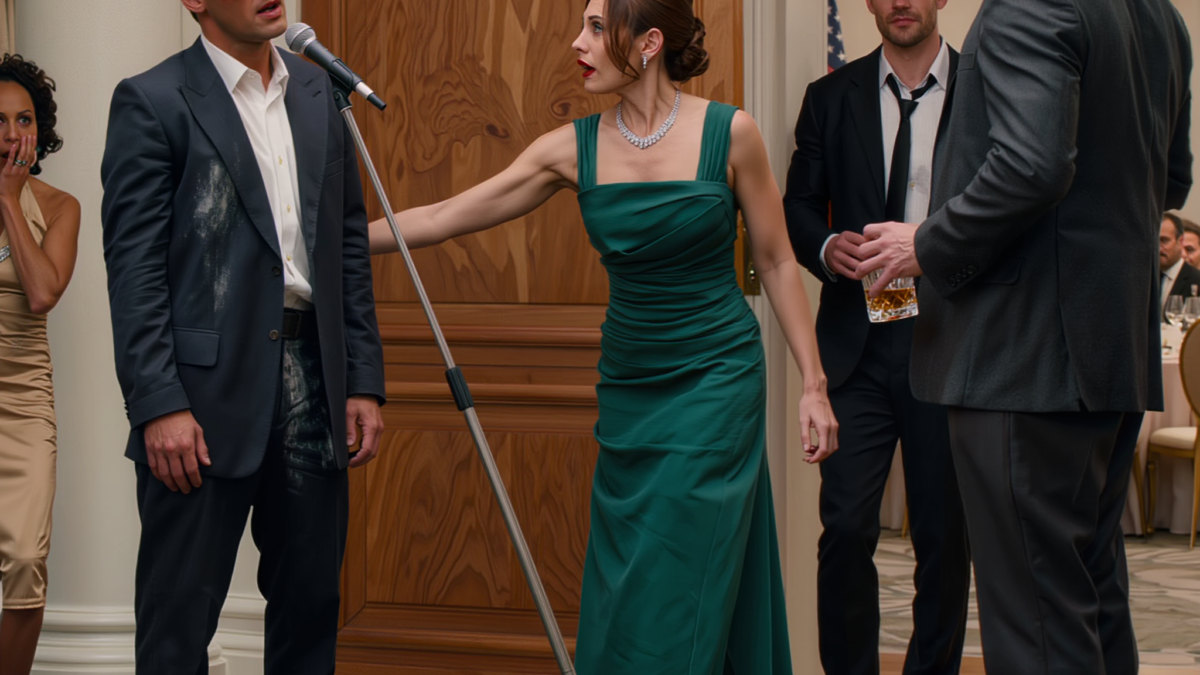
My name is Julian, and I am thirty-two years old. On the night of my tenth wedding anniversary, I stood in the middle of a private ballroom with a cut above my eyebrow and my left eye swollen shut.
While I tried to make sense of what was happening, my wife turned toward the fifty people gathered around us. Our friends were there. So were our relatives and business partners, people we would ordinarily expect to celebrate a milestone in our marriage.
“It was my brother,” she said. “He taught him some respect.”
Her family laughed. They raised their crystal champagne glasses as though the evening had given them something worth celebrating.
They did not know that I had already transferred the assets they were trying to take from me. My twin brother was about to walk through the ballroom doors, and the evening would eventually lead to lawsuits, public disgrace, and financial consequences none of them had anticipated.
But standing beside my wife, I was still the man they believed they had brought under control.
The chandeliers cast a golden light across the ballroom. Corporate partners, real estate developers, and people with fortunes I could barely have imagined growing up stood among the tables. Expensive perfume mingled with the smell of roasted filet mignon, and the live band had been providing a polished background to their conversations.
Now those conversations had stopped.
My white dress shirt was marked at the collar. The injury above my eye was difficult to hide, and I could feel everyone looking at it. Forks paused halfway to mouths. A room full of people accustomed to knowing what to say seemed unable to find a single useful word.
Valerie stood beside me in a custom emerald green gown that had cost more than my first car. I had paid for it with money earned through the company I built. Her hand was wrapped around my upper arm, her nails pressing through the fabric of my jacket.
She was not holding me for support. She was keeping me in place.
For ten years, she had encouraged her family to see me as clumsy, incapable, and fortunate that they had allowed me into their lives. No achievement of mine ever quite belonged to me. If I succeeded, her father had made it possible. If I made a mistake, it confirmed everything they believed.
Tonight, she wanted that version of me displayed in front of everyone.
A few feet away, her brother Preston swirled whiskey in a heavy crystal glass. His smile was relaxed and satisfied. He had never worked a difficult day in his life, but he carried himself with the confidence of a man who believed his father’s money made him untouchable.
When Valerie announced what he had done, I did not raise my voice or plead with her. I looked at the woman I had promised to love ten years earlier and waited for some sign that she understood what she was saying.
There was none.
Then the heavy oak doors at the back of the ballroom opened with a sound that brought every head around.
The man in the doorway looked exactly like me, except his face was uninjured and his suit was clean. His jaw was set, and his attention went straight to where I stood.
It was Dominic, my twin brother.
He had served two tours overseas and moved with the deliberate composure I had known all my life. Preston’s smile disappeared. Valerie’s grip loosened.
To explain why my brother had come, I have to go back three days, to the life I had been accepting as normal.
I was sitting at our kitchen island, staring at the seating chart for the anniversary party. My chest felt tight. That pressure had become so familiar whenever Valerie’s family was involved that I rarely stopped to question it.
For ten years, I had tried to be the patient husband, the grateful son-in-law, the man who never made a difficult gathering more difficult. I had built a software company from the ground up, working eighty-hour weeks and missing sleep to give us the life Valerie wanted.
Every dollar of my salary went into our joint accounts. I paid for the house, the cars, and the routines that made our marriage look comfortable from the outside. Some part of me still believed that, eventually, success would earn me a little respect from her parents, Winston and Beatatrice.
Winston had made his fortune in commercial real estate during the boom years. He treated relationships the way he treated business negotiations, evaluating what each person could offer and how much control he could retain.
To him, I was not a son-in-law. I was an investment he had made in a young man whose background did not meet his standards.
Beatatrice expressed the same judgment more carefully. She rarely needed to raise her voice. She could make a question about dinner sound like an assessment of my upbringing, and she had a way of asking for the salt that made me feel I had somehow mishandled the entire meal.
Valerie had brought those expectations into our home.
If I left a water glass on the counter for more than five minutes, she said I was disrespecting her and everything she did for us. If I suggested visiting my parents for Thanksgiving instead of going to her family’s ski lodge, she would develop a debilitating migraine. Our plans would be canceled, and I would call my mother to apologize again.
Over the years, my world became smaller.
Valerie questioned the motives of my friends and dismissed the things I enjoyed. I stopped going to the gym because she accused me of trying to impress other women. I stopped playing golf with my college friends because she said I was neglecting my responsibilities and embarrassing her by associating with people who had accomplished so little.
I gave things up because each individual argument seemed easier to avoid than to have.
I told myself I was choosing peace. Eventually, I began to understand that avoiding the next argument did not make the house peaceful. It only meant I was carrying the argument inside me.
Two nights before the anniversary, Valerie invited her family over to finalize the party arrangements. Her parents arrived on time, accompanied by Preston and her cousin Cassandra.
Cassandra enjoyed an uncomfortable conversation as long as someone else was the subject of it. She could ask a question in a sweet voice and leave everyone waiting to see how badly it would land.
I had spent four hours preparing a prime rib roast, trying to get it exactly the way Winston preferred. My back ached from standing in the kitchen. By the time we sat down, I was tired enough that even keeping a pleasant expression took effort.
I went around the table pouring the expensive red wine Beatatrice had brought.
Cassandra leaned forward, resting her chin on her hands.
“So, Julian,” she said. “I hear your little tech startup is finally making some actual money. Are you finally going to contribute to a college fund for your future kids, or is Uncle Winston still backing up your credit cards?”
My grip tightened around the bottle.
The company had been profitable for three consecutive years. I paid the mortgage on the house we were sitting in. I paid for the cars outside and the food on their plates.
But when Valerie and I first married, Winston had given us a relatively small loan toward our down payment. That loan remained the centerpiece of his account of our lives. Nothing I had done since seemed to reduce its importance.
“The company is doing very well, Cassandra,” I said. “We’re actually expanding into a new office space next month.”
Beatatrice rolled her eyes.
“Expanding? How quaint. Just make sure you don’t overextend yourself again, Julian. You don’t have the natural pedigree for high-stakes business. You should really leave the heavy lifting to men like Winston.”
Heat rose into my face. I reached across to refill Valerie’s glass, and my hand trembled just enough for one drop of cabernet to land on the white tablecloth.
Valerie brought her palm down on the table. The silverware rattled against the plates.
“Julen, look what you just did.”
“I’m sorry.” I reached for a napkin. “I’ll get it out right now. It’s just a tiny drop.”
Winston leaned back in his chair and folded his arms.
“You’re always so incredibly clumsy, son. It’s exhausting watching you try to fit into this world. You just lack refinement. It’s in your blood, I suppose.”
I stopped dabbing at the tablecloth.
I looked at Valerie, waiting for her to tell him he had gone too far. I did not need a speech or an argument. I wanted my wife to acknowledge that I was sitting there, in my own home, listening to her father insult me.
Instead, she looked annoyed with me.
“Go clean it up properly in the kitchen, Julian, and go upstairs and change your shirt. You’re embarrassing me in front of my family.”
Preston picked up his wine glass.
“Yeah, go clean up, Cinderella. Leave the adult conversations to the adults.”
I walked into the kitchen and put both hands on the edge of the marble counter. They were shaking badly enough that I needed something solid beneath them.
I was thirty-two years old. I ran a successful company. Yet a drop of wine had been enough to turn me into someone who could be ordered away from his own dinner table.
I did not return to the dining room. I went upstairs and slept in the guest room.
Valerie did not come looking for me. She did not text or ask whether I was all right. Ignoring me was one of the ways she let me know that, in her view, I had failed.
The following day, I still tried to find a way back to her.
I had recently received a major buyout offer for a piece of software I had developed. The deal could put us in a different financial position, and I had not told Valerie the details. I wanted to surprise her on our anniversary.
Even after everything that had happened at dinner, I was still imagining that the right achievement might finally settle the question of whether I deserved to be there.
I bought a custom-tailored Italian suit for the party. It cost $2,000, more than I ordinarily spent on clothing for myself.
It was charcoal gray, with clean lines and a fit that made me stand differently in the tailor’s mirror. For the first time in years, I liked what I saw without immediately wondering what Valerie would criticize.
I took the suit home and hung it carefully in the guest room closet.
That afternoon, I returned from running errands and found Preston on my couch. His muddy shoes were on the coffee table, and he was watching football on my television.
He did not acknowledge me.
I went upstairs to get a fresh shirt and opened the closet. The new suit was still on its hanger, but someone had cut through the fabric. The sleeves were barely attached, and the back panel had been opened from top to bottom.
I stood there for a moment, unable to make the expensive garment in front of me match the one I had brought home.
Then I took it downstairs.
“What is this?” I asked, putting the ruined suit on the coffee table in front of Preston.
He took a sip of his beer without looking away from the game.
“Looks like you have a severe moth problem, bro. Better get an exterminator.”
Valerie entered carrying a teacup. She glanced at the suit and then at me.
“Valerie, your brother deliberately destroyed my suit.”
She sighed.
“Oh, stop being so dramatic, Julian. It was probably an accident. Or maybe you ripped it yourself on a loose nail in the closet and you’re looking for someone to blame so you can start a fight before our party.”
“An accident? Look at it. It’s been cut to pieces. Valerie, this was intentional.”
She set her cup down and stepped closer.
“You know what? You’re acting completely unreasonable. You’re so obsessed with money and material things. It’s just a piece of clothing. You’ll wear your old navy suit tomorrow night. Now apologize to Preston for yelling at him in our home.”
I looked from her to the suit.
She was not simply refusing to believe me. The damage was right in front of her, and Preston had barely bothered to pretend he was innocent. She was telling me that even something this obvious would not make her stand beside me.
Until then, I had thought of our marriage as a relationship I kept failing to repair. Standing in the living room, I began to see how much of myself I had been giving up to keep trying.
The next morning was our tenth anniversary.
I woke in a quiet house and lay there feeling empty. I had spent so long questioning my reactions that I no longer trusted my own judgment. I needed to tell someone what had happened and hear a voice that did not belong to Valerie’s family.
I took my phone onto the back patio and called Greg.
We had shared a dorm room in college and stayed up together studying for engineering finals. He had been the best man at my wedding. Of all my old friends, he was the one Valerie had not managed to push completely out of my life.
“Hey, man,” he said when he answered. He sounded half asleep.
“Greg, I need your help.” I paced along the stone patio. “It’s Valerie. It’s her whole family. They destroyed my clothes yesterday. They treat me like garbage. I think I need to get out.”
I stopped walking and tried to make myself say the rest.
“I need a place to stay for a few days while I find a divorce lawyer. I can’t do this anymore. I’m drowning here.”
He was quiet for a long moment.
“Whoa, Julian. Slow down. Are you sure you’re not just stressed about the party tonight? Valerie loves you. Her family is just intense. You’re probably overreacting to a prank.”
“I’m not overreacting. Preston cut up my suit. Valerie defended him. She told me to apologize to him. I feel like I’m going crazy.”
“Look, just take a deep breath. Go to the anniversary party. Keep the peace for now. We can grab a beer next week and talk about it when you’ve calmed down. Don’t do anything rash that you’ll regret.”
I ended the call feeling more alone than I had expected to feel after speaking to him.
Still, I had finally said the words aloud. I wanted to leave. Hearing myself say it made the decision harder to dismiss.
Ten minutes later, I went into the kitchen to make coffee. My phone vibrated against the counter.
The message was from Valerie, upstairs in the master bedroom.
“So, you think you need a place to stay to figure out a divorce lawyer? You think you can’t do this anymore? You are pathetic. Make my coffee and bring it up immediately.”
I stared at the screen.
Those were the words I had used on the patio. I had spoken them to Greg and no one else.
The realization took a moment to settle. My oldest friend had passed my private request for help directly to the person I was trying to leave.
Months later, I learned why. Valerie had been paying thousands of dollars toward his credit card debt in exchange for information about my complaints and plans. At that moment, all I knew was that a conversation I believed was private had reached her almost immediately.
I made the coffee.
My hands were steadier than they had been the night before. I was still frightened, but the uncertainty had begun to give way to something clearer. I could no longer pretend the problem was simply that I needed to explain myself better.
I carried the mug upstairs.
The bedroom doors were partly open. As I approached, I heard Valerie speaking to someone on her phone’s speaker.
“Yes, Victor, he’ll be at the dinner tonight.”
Victor was Winston’s corporate lawyer. He handled the arrangements that allowed Winston to get what he wanted while keeping the paperwork in order.
“Make sure he has a few stiff drinks first,” Victor said. His gravelly voice carried through the open doorway. “The transfer documents are fully drafted and legally binding. We’re folding his software, intellectual property, and all core patents directly into Winston’s main holding company.”
I stopped outside the room.
“Once he signs those papers under the guise of the new family trust fund we discussed, he loses all controlling shares of his own life’s work. If he refuses to sign tonight, Winston is prepared to call in the original mortgage loan immediately, with the maximum penalty interest applied. It will bankrupt him within thirty days.”
“He won’t refuse,” Valerie said, laughing softly. “He’s terrified of public conflict. We just need to apply the right amount of pressure in front of the guests. Preston knows what to do if Julian gets stubborn and tries to embarrass us.”
I stood with the mug in my hand, listening to my anniversary being described as a business arrangement.
The party was not simply another evening I had to get through. They intended to use it to take control of the company.
The years of work, the software, the patents, and the future I had built around them were being discussed as assets that belonged in Winston’s hands. My willingness did not appear to matter.
I pushed the door open.
Valerie turned sharply and reached for her phone.
“I have to go, Victor,” she said, ending the call.
For a moment, she looked caught. Then her expression settled into the familiar irritation she used whenever I had inconvenienced her.
“Don’t you know how to knock? Have you lost all your manners?”
I set the coffee on the bedside table.
“I heard everything, Valerie. The transfer documents. Victor. Your father’s holding company. The plan to bankrupt me.”
She folded her arms over her robe.
“Good. Then it saves me the trouble of explaining finance to you. My father invested in you when you were nothing. You owe this family everything you have.”
She did not lower her voice.
“Tonight, you’re going to put on a suit. You’re going to smile. You’re going to sign those papers, and we’re going to celebrate your contribution to the family.”
“I’m not signing anything,” I said. “And I’m not going to that dinner. We’re done, Valerie. I’m filing for divorce.”
“Oh, you’re going.”
Preston’s voice came from behind me.
He was standing in the doorway. He had let himself into the house with his spare key and come upstairs without either of us hearing him.
He stepped into the room and closed the door.
“You think you can walk away from us with our money?” he asked. “You’re a nobody, Julian. We made you. We own you.”
“Get out of my house, Preston.”
“Make me.”
He moved closer. I could smell alcohol on his breath.
I looked toward Valerie.
“Call your dog off, Valerie.”
She leaned against the dresser and picked up her coffee.
“Teach my husband some respect, Preston. Show him what happens when he talks back.”
Preston struck me before I could move away. I stumbled, disoriented, and he shoved me backward. The side of my head caught the corner of the nightstand as I fell.
For a moment, all I could hear was the ringing in my left ear.
I lay on the floor trying to catch my breath. There was a cut above my eyebrow, and my vision on that side was blurred. When I looked up, Preston was standing over me with his hands still clenched.
He did not look concerned about what he had done.
Valerie came over more slowly. She looked down at me, holding the cup I had carried upstairs for her.
“Clean yourself up. We have a dinner in two hours.”
I tried to sit up.
“And if you run, or if you tell anyone what happened, I’ll make sure the police hear my version. I’ll tell them you attacked me and Preston had to defend his sister. Who do you think they’ll believe? The respected local family or the stressed-out tech guy?”
She let the question sit between us.
“Put on your suit, Julian. It’s time to celebrate.”
I got off the floor and locked myself in the bathroom.
At the sink, I held on to the marble until I felt steady enough to look in the mirror. My eye was swelling, and the cut above it was still open. I ran cold water over my hands and tried to think past the pain.
Valerie had made it clear how she intended to describe what had happened. Winston had already threatened to use the loan and the courts against me. Everything I considered seemed to lead back to another form of control.
I took out my phone.
This time, I did not call Greg. I called Dominic.
He answered on the second ring.
“Dom,” I said, and my voice broke. “I need you.”
He heard the difference immediately.
“Julian, what happened? Where are you?”
“I’m at the house. Valerie and Preston. Preston hurt me. They’re trying to force me to sign over the company at the anniversary dinner. Victor will be there with the papers.”
There was a silence on the line, but it was different from Greg’s. Dominic was not waiting for me to become less inconvenient. He was listening.
“Listen to me carefully, Jewels,” he said. “Let them see what happened. Let the bruising show. Put on your suit. You’re going to that dinner.”
“Dom, are you serious? They want to parade me in front of everyone. They have Victor waiting with contracts.”
“Let them think they’ve won,” he said. “I’m four hours away. I’m getting in my truck now. I’ll be there before the main course.”
Then he asked a question that brought my attention back to something I had almost lost sight of in the confusion.
“Do you still have the encrypted flash drive with the IP transfer documents from last month?”
A month earlier, Winston’s growing interest in my company and Valerie’s questions about my patents had worried me enough to take precautions.
I had transferred the core patents, source code, and intellectual property into a trust controlled by Dominic. Those assets were no longer held in the company Valerie and Victor were trying to take.
The transfer had been quiet, and it had been completed before the anniversary plans reached this point.
“Yes,” I said, opening the bathroom drawer. “I have it here.”
“Bring it. Keep it in your pocket. And turn on the voice memo app on your phone. Record what they say to you.”
When the call ended, I was still standing in the same bathroom. My face still hurt, and Valerie and Preston were still somewhere on the other side of the door.
But someone knew what was happening. Someone believed me, and he was on his way.
I pressed a towel against my forehead and took off the stained shirt.
A soft knock came at the door.
“Mr. Julian?”
It was Sylvia, our housekeeper.
She had worked for us for five years. Valerie frequently criticized her over small things, while I tried to make sure she received generous bonuses and enough paid time off to see her grandchildren.
I opened the door a little.
Sylvia stood outside with fresh towels. When she saw my face, her hand went to her mouth.
“Oh, my sweet Lord.”
“Please keep your voice down,” I said, glancing toward the bedroom.
She looked past me at the shirt on the floor. Without making a fuss, she stepped into the bathroom, took a black bag from the supply cabinet, and placed the shirt inside.
“Mrs. Valerie told me to clean the room,” she whispered. “I didn’t see anything. I wasn’t here. But I’ll take this straight to my car. Not the house trash. My car, in case you need proof later.”
She stopped and looked at me.
She had seen enough over the years to understand that the shirt might matter. She had also understood that disposing of it as Valerie expected could leave me with less than I already had.
“Thank you, Sylvia,” I said. “Thank you so much.”
I put on the old navy suit.
It was slightly faded, and it did not fit the way the charcoal suit had fit in the tailor’s mirror. I made no attempt to conceal the swelling around my eye.
Downstairs, Valerie and Preston were waiting by the front door.
Valerie’s emerald gown caught the light as she turned. Diamonds rested at her throat. She looked ready for the photographs and the congratulations, as though nothing upstairs had interrupted her anniversary preparations.
“You couldn’t put some concealer on that?” she asked. “You look terrible.”
“It’s the best I could do.”
Preston laughed and clapped a hand against my shoulder hard enough to make me flinch.
“Builds character, Julian. Come on. The rented Bentley’s outside. Don’t get anything on the leather.”
I sat beside Valerie in the back seat.
She and Preston drank champagne and took photographs of themselves. They laughed at things I could not make myself follow. Their confidence was almost harder to bear than their anger had been.
I reached into my jacket pocket and switched on the recording app.
Preston turned from the front passenger seat.
“Victor has a private boardroom set up off the ballroom. Before dinner, you go in, sign the papers giving us the company, and then we go out and play the happy family.”
He looked directly at me.
“Cause a scene or hesitate, and I’ll finish what I started upstairs. Do you understand?”
“I understand.”
The phone remained in my pocket.
“And remember,” Valerie said, touching up her lipstick in a silver compact, “if anyone asks about your face, you fell down the cellar stairs carrying a box of wine. Stick to the story, Julian.”
“I’ll stick to the story.”
At the hotel, a uniformed valet opened the car door. The event photographer took pictures as Valerie stepped out, smiling and turning toward the light.
Then I followed her.
The photographer lowered his camera.
Valerie took my arm again, tightening her grip on the fabric of my jacket.
“Smile,” she whispered. “One wrong move tonight and you’ll regret it.”
We walked through mirrored corridors toward the ballroom. I could hear the guests, the glasses, and the low music of the jazz band before we reached the doors.
My brother was still on the road. The recording was running in my pocket.
Valerie paused at the entrance and looked at me.
“Showtime.”
The doors opened.
The room had been arranged to make an impression. Chandeliers hung from a vaulted ceiling above the banquet tables. Men in tailored evening clothes stood with developers, corporate lawyers, and city officials. Women in expensive gowns held glasses of vintage champagne.
A jazz quartet played in the corner.
For a few seconds, the room looked like the anniversary celebration it was supposed to be.
Then people began to see my face.
The conversations closest to us stopped first. The quiet traveled outward as guests followed one another’s attention. The saxophone player lowered his instrument, and the band faltered.
No one seemed sure where to look.
I kept my shoulders lowered as Valerie guided me through the room. Her smile remained in place, even when she turned to wave at a local judge near the front.
“Keep walking,” she whispered. “Victor’s waiting in the boardroom to the left. We’re getting this done now, and then you can sit somewhere out of the way.”
Preston went ahead of us, moving people aside with his size and his confidence.
Guests looked between him and me. Some stepped back. Others stared at their glasses or turned toward the person beside them.
Nobody offered to help. Nobody approached with a napkin or asked whether I needed medical attention.
In that room, Winston’s family had enough influence that even visible distress became something people hesitated to acknowledge. They had been invited to a celebration, and interfering would require them to question the hosts.
We passed the dining tables and reached the frosted glass doors of the private boardroom.
Preston pushed them open.
Victor was seated at the head of a long mahogany table. His reading glasses rested low on his nose, and several stacks of documents were arranged in front of him. He wore a pinstripe suit and looked entirely prepared.
Winston stood by the floor-to-ceiling window, holding a glass of twenty-year-old scotch.
“Right on time,” he said.
His gaze moved over my face. He showed no surprise.
“Have a seat, Julian. Let’s make this quick and painless. We have fifty important guests waiting to celebrate our success.”
I sat opposite Victor.
My head throbbed, and my ribs hurt when I shifted in the chair. But I could follow the conversation clearly. As I leaned forward, I checked that the phone was still recording.
Victor slid a bound agreement across the table. A silver Montlank pen rested on top.
“This is the master equity and asset transfer agreement, Julian,” he said. “It permanently transfers all intellectual property, proprietary source code, future developments, and pending patents from your software company into the newly formed family legacy trust.”
He continued in the same even tone.
“The trust is controlled by Winston’s primary real estate holding company. In exchange for your signature, the original mortgage loan will be canceled, and you’ll receive a nominal salary as a consulting director, without voting rights, for the next three years.”
I looked down at the pages.
Everything I had spent years building had been reduced to a set of provisions they expected me to accept while Preston stood at the door. The company was not just an entry on a balance sheet to me. It held years of missed sleep, work, uncertainty, and problems I had stayed with until I could solve them.
“What happens if I refuse to sign tonight?” I asked.
I kept my voice low. I wanted their answer recorded as clearly as their offer.
Winston took a drink before replying.
“If you refuse, I’ll instruct Victor to begin proceedings to collect the entire outstanding loan balance tomorrow morning at nine. We’ll apply the maximum penalty interest. I’ll file a corporate lawsuit that keeps your software tied up in federal court for the next decade.”
He set his glass down.
“I’ll call every venture capitalist and investment firm in the state and make sure you never secure another dollar. You’ll lose the house. You’ll lose the cars. Your credit will be destroyed. You’ll have nothing left but the clothes you’re wearing.”
Valerie moved behind my chair and placed her hands on my shoulders.
From across the room, the gesture might have looked affectionate. I could feel the pressure of her fingers.
“Just sign, Julian,” she whispered. “Stop being stubborn and do the right thing for our family. You owe my father everything. Don’t ruin our night.”
Preston leaned against the closed doors with his arms folded.
“Don’t make me repeat the lesson from upstairs, bro. I’d hate for us to have another problem before the salad course.”
I looked at the pen.
They had spent so long dismissing me that they no longer seemed to consider the possibility that I might understand the position I was in. They expected fear to settle the matter, because fear had settled so many smaller matters before it.
My hand shook when I picked up the pen.
I signed my full name, Julian Thomas, on the first page. Then I turned to the next and signed again.
There were five pages requiring signatures, followed by provisions I had to initial. I worked through the restrictions, waivers, and releases. The agreement covered the controlling shares, the patents, and my right to challenge the transfer.
Victor watched until I reached the final page.
Then he took the documents back and checked each signature. He placed the agreement in his leather briefcase and closed the locks.
“A wise decision, Julian,” he said. “You’ve secured your place in the family empire.”
Winston clapped his hands together.
“Excellent. Now let’s go out there and show our guests a united front.”
He turned toward Valerie.
“Keep his head at an angle so the light doesn’t catch that eye. We don’t need questions during the toast.”
We returned to the ballroom after about twenty minutes.
The first shock had given way to whispers. People watched us leave the boardroom and tried to read something in our expressions.
Winston went directly to the small stage where the band had been playing. He took the microphone and tapped a spoon against his champagne glass until the conversations stopped.
“Family, friends, and esteemed colleagues,” he began. “Thank you for joining us to celebrate a monumental milestone. Ten years of marriage between my beautiful daughter Valerie and her husband Julian.”
The applause was polite.
I stood near the side of the stage with Valerie’s hand on my arm. Preston remained close behind my shoulder.
“Marriage isn’t just about romance,” Winston continued. “It’s about growth. It’s about corporate alignment. It’s about understanding your place in a legacy and making sacrifices for the greater good of the family name.”
He looked out across the tables.
“Tonight, Julian made a significant sacrifice. He has decided to bring his tech company entirely under our family’s corporate umbrella.”
This time, the applause was louder.
Several developers near the front nodded at Winston. To them, it appeared that he had completed another acquisition and chosen a family occasion to announce it.
Valerie stepped up to the microphone.
Her gown shimmered under the stage lights. She looked composed, pleased, and entirely certain of the story she was about to tell.
“Thank you all for being here,” she said. “I know some of you are looking at my husband’s face and feeling a little shocked. I know it looks dramatic.”
The room grew still.
She laughed lightly.
“Julian had a little accident at home today. He can be so clumsy. He forgot his place. He forgot how to speak to my family with the respect we deserve.”
She paused.
“So my brother Preston had to step in and handle things. He taught my husband some respect.”
There it was.
In the car, she had ordered me to say I fell down the stairs. Now, in front of fifty people, she was describing Preston’s actions as something the family had been entitled to do.
Preston laughed and raised his glass.
Several of Winston’s business partners smiled along with him. A few lifted their own glasses. I watched people whose opinions had mattered so much to my wife treat my humiliation as part of the evening’s entertainment.
Near the back, Penelope had a hand over her mouth.
She was the young wife of one of Winston’s associates. She was not smiling. Her expression told me that she recognized something the others were choosing not to name.
The laughter faded.
Then the oak doors opened again.
Dominic stood in the entrance in a black tailored suit, his tie slightly loosened. Behind him were my father, Harrison, and my mother, Clara.
They had driven four hours alongside him, their old sedan carrying them down the interstate to a celebration from which they had been kept at a distance.
For years, Valerie had found reasons we could not spend holidays with them. I had made the apologetic phone calls. I had allowed one canceled visit to become another, until the distance between us felt larger than the drive.
Now they were standing in the doorway.
Preston lowered his smile before he lowered his glass.
Valerie stepped backward and bumped the microphone stand. Feedback sounded through the speakers.
Dominic began walking toward me.
He did not stop to greet anyone. Guests moved out of the aisle, pushing back chairs and drawing closer to the tables as he approached.
Preston handed his glass to a waiter and stepped down from the stage.
He was accustomed to getting his way by being physically imposing. Until that moment, he had been surrounded by people who either deferred to him or avoided making him angry.
“Are you lost?” he asked Dominic. “This is a private event. Turn around and leave before I throw you out.”
Dominic continued forward.
Preston planted himself in his path. When they came together, Dominic caught the front of his jacket and brought him to the floor in one quick movement.
The nearby buffet rattled. Trays shifted, and guests drew back.
Before Preston could get up, Dominic had him restrained.
“Don’t move,” Dominic said.
He did not shout. Preston looked up at him, no longer carrying the easy confidence he had shown in the car.
Valerie rushed to the edge of the stage.
“Get off my brother! Winston, do something. Call security. Call the police!”
“The police have already been called, Valerie,” I said.
I stepped toward the center of the stage and took the microphone from its stand.
For the first time that night, I was not looking down or waiting for someone to tell me where to stand.
Winston came toward me.
“You ungrateful fool. You’re ruined. Do you hear me? Victor has your signature on a binding contract. We own your company. We own your life.”
“Actually, Winston,” I said, “you don’t own what you think you do.”
I took out my phone and connected it to the ballroom’s sound system. Then I opened the voice memo app and pressed play.
Victor’s voice came through the speakers.
“The transfer documents are fully drafted and legally binding. We’re folding his software, intellectual property, and all core patents directly into Winston’s main holding company. Once he signs those papers under the guise of the new family trust fund we discussed, he loses all controlling shares of his own life’s work.”
Nobody moved toward the microphone.
“If he refuses to sign tonight, Winston is prepared to call in the original mortgage loan immediately, with the maximum penalty interest applied. It will bankrupt him within thirty days.”
The recording continued.
Valerie’s voice described how she would give the police a different account if I refused to cooperate. Preston’s threats followed. There was no need for me to explain why I had signed while injured, with him blocking the boardroom door.
The guests could hear the pressure for themselves.
People who had smiled during the toast stood without speaking. The version of the evening Winston had presented no longer matched the words coming from his own family.
Victor began moving toward the exit.
“That recording is illegal,” he called. “It’s a wiretapping violation. It’s inadmissible.”
“This is a one-party consent state, Victor,” I said. “You’ve practiced here for thirty years. You should remember that.”
I reached into my pocket again.
The encrypted metal flash drive was small enough to disappear in my hand. I held it up where Winston and Valerie could see it.
“Thirty days ago, I realized I needed to protect the work I’d spent years building,” I said. “I hired an independent legal team out of state. The core patents, proprietary source code, and intellectual property were transferred into an asset-protection trust.”
I looked toward Dominic.
“My brother controls that trust. He is its sole beneficiary.”
Winston stopped moving.
“The company I signed over in the boardroom is a shell,” I continued. “It has no assets, no bank accounts, and no intellectual property. You and Victor spent $10,000 in legal fees taking over a company that holds none of what you wanted.”
Valerie stared at me.
“You can’t do that. We’re married, Julian. The company is marital property. I’m entitled to half.”
“The software was developed and patented before our wedding,” I said. “My lawyers handled the trust structure.”
For years, every conversation about my work had ended with her reminding me what I owed her family. Now she was asking about what remained for her to claim.
“Thank God we never had children,” I said. “A custody fight would have made this even harder. At least we won’t pass this on to another generation.”
I returned the microphone to its stand.
An older man rose from a table near the back.
Mr. Alistair ran the largest private equity firm in the state. More importantly for Winston, his firm supplied the capital behind much of the real estate business.
Winston needed that backing to get through the coming quarter.
Alistair looked across the room at him.
“Winston, this is coercion,” he said. “You’re running your family and your business as though you can treat people this way without consequences. My firm is withdrawing its backing from your development projects. We will not be associated with this.”
He did not raise his voice.
“Expect a call from my senior legal team Monday morning. We’re ending the relationship.”
Winston reached for the edge of a table.
The announcement stripped away the financial support he had been counting on. The man who had threatened to make sure I could never raise money again was now listening to his own principal backer withdraw.
The sound of police sirens reached us from outside.
A few moments later, red and blue lights reflected through the hotel windows.
Dominic had contacted the police captain when he was about ten minutes from the hotel. He had provided a copy of my emergency call and described what had happened at the house and what was expected to happen at the dinner.
Four uniformed officers entered the ballroom.
Guests moved aside as they approached the stage.
“Over here,” Dominic said.
He was still holding Preston on the floor.
“This man assaulted my brother at home earlier today, and he attempted to assault me here. I’m making a citizen’s arrest.”
The officers looked at Preston, then at me. They took in the swelling around my eye and the marks on my shirt before turning their attention back to the man on the floor.
Preston began struggling.
“Get him off me. He attacked me. My father is Winston Thomas. Do you know who we are?”
The lead officer did not answer the question.
“You’ll lose your badges if you touch me,” Preston added.
The officer took out his handcuffs.
Dominic released Preston and stepped back with his hands raised. The officers brought Preston to his feet and secured his arms behind him against a nearby dining table. Silverware shifted as he continued protesting.
“Preston Thomas, you’re under arrest for felony assault, battery, and domestic coercion,” the sergeant said.
Valerie came down from the stage.
Her composure was gone. Tears had begun to disturb the makeup she had checked so carefully in the car.
“No. You can’t do this to my brother.” She turned to me. “Julian, tell them it was a misunderstanding. Tell them you fell down the stairs. Please do something.”
She took hold of my arm again.
Earlier, that grip had been used to keep me in place. Now she was trying to make me stay within reach long enough to rescue the account she had given everyone.
I looked at her hand, then at her.
“Take your hands off me, Valerie.”
She let go.
“I’m filing for divorce tomorrow morning at eight. My legal team will handle the arrangements. Don’t call me. Don’t come to my office. If you come within a hundred feet of me, I’ll have Dominic enforce a restraining order.”
I reached for her left hand and removed the diamond anniversary band I had bought only days earlier.
It had been another attempt to express hope through a purchase. I had imagined giving it to her as proof that, despite everything, I still wanted us to be happy.
I let it fall to the floor.
The ring struck the wood and rolled beneath a catering table.
Near the exit, two officers stopped Victor. The recording had connected him to the arrangement they were investigating, and the consequences would reach beyond the signed documents in his briefcase.
He faced a federal indictment over his role in the extortion scheme, along with the loss of his legal career and professional standing.
As Preston was escorted through the ballroom, Winston sank into a velvet chair.
Beatatrice stood beside him, holding the pearls at her throat. Neither of them seemed able to respond to the guests watching their son leave in handcuffs.
The evening they had arranged to demonstrate their control had exposed what they had done to obtain it.
But the financial reason behind their urgency did not become clear that night.
Three weeks into the divorce and corporate litigation, my forensic accountant found an irregularity while examining the history of the joint accounts they had tried to use against me.
That discovery led to a much larger problem.
Preston’s spending had not been supported entirely by Winston’s generosity. The luxury cars, the overseas trips, and the money in offshore accounts had been funded in part through money taken from the investment funds entrusted to Winston’s development firm.
Preston had been creating false vendor invoices and forging corporate documents. Millions of dollars had been diverted into private accounts in the Cayman Islands.
Winston had discovered the shortfall a month before our anniversary.
Rather than report what his son had done, he had tried to find enough clean assets to replace the missing money before Alistair’s firm conducted its annual federal audit.
That was why they had become so interested in my software company.
They were not planning to nurture the business or help me expand. They wanted to liquidate its assets and patents to cover the deficit Preston had created.
The company I had built was supposed to become the solution to a problem they had concealed from everyone else.
My lawyer turned the financial file over to the FBI.
Winston was indicted on federal charges involving fraud, money laundering, and conspiracy. The government seized the estate, the luxury vehicles, and the corporate holdings connected to the case.
Beatatrice moved out of the mansion and into a small two-bedroom apartment on the edge of town.
Valerie lost access to the inheritance, credit cards, and family standing she had assumed would always be there. She took a retail job at a local department store to help pay the retainer for her criminal defense attorney.
The money they had tried to take from me had been intended to hide what Preston had already taken from someone else.
It has now been six months since the anniversary dinner.
I am sitting on the porch of a modest timber cabin in the Blue Ridge Mountains, hundreds of miles from the city and the house where I spent so much time trying not to make anyone angry.
There is coffee in a chipped ceramic mug beside me.
For the first time in years, I can sit without feeling that familiar pressure in my chest. I can take a full breath without immediately wondering what I have forgotten to do.
The injury above my eyebrow has healed, leaving a thin, pale scar. When I see it in the mirror, I remember the night clearly, but it no longer feels as though I am still standing in that room.
The other effects took longer to understand.
After the divorce was finalized and the company assets were secured, I struggled in ways I had not expected. A specialist diagnosed me with complex PTSD after years of manipulation, isolation, and fear.
Some nights, I woke in a panic and reached for my phone, certain I had missed a message from Valerie. I would be halfway through checking the screen before I remembered that I did not have to answer to her anymore.
I attended trauma therapy three days a week.
Much of that work involved examining a belief I had carried for so long that it felt like a fact: that my background made me less deserving of respect, and that being accepted by Valerie’s family required me to accept their treatment.
Dominic stayed at the cabin with me for the first two months.
He did not insist that I talk when I was not ready. He made sure there was food in the house, that I got out of bed, and that the days had some shape to them.
He reminded me that I was safe without demanding that I feel safe immediately.
Together, we launched a new independent software company under the protection of the trust. Without Winston’s interference, we secured funding from reputable investors and hired a team of developers.
The business is doing better than I had imagined possible while I was spending so much energy trying to defend my right to run it.
But one of the most important things that happened after the dinner had nothing to do with financing.
Two months ago, I opened my laptop and found an email from an unfamiliar address.
The subject line read, “Thank you from the ballroom.”
It was from Penelope.
She told me she had spent eight years in an abusive marriage to one of Winston’s business partners. Much of what she described was painfully familiar: the loss of friendships, the steady erosion of confidence, the fear of public humiliation, and the belief that leaving would cost her everything.
She was also afraid of losing her children.
She wrote that seeing me stand at the microphone had changed the way she understood her husband’s power. Watching the room hear what had happened to me made it harder for her to believe that the people controlling her life were beyond question.
The next morning, while her husband was at the office dealing with the news about Winston, she packed two suitcases.
She took her children and drove to a women’s shelter.
Now we meet for coffee once a week.
We are not dating, and neither of us is looking for a romance to explain what happened or repair what came before. We are learning how to live without arranging every thought around someone else’s anger.
Sometimes it helps to sit across from a person who understands that leaving is only part of the process.
I still have the charcoal Italian suit.
It is folded in a wooden box at the top of my closet. I did not throw it away, and I never asked a tailor to repair it.
For a while, I could not look at it without remembering how foolish I had felt carrying it downstairs, still expecting Valerie to acknowledge something obvious.
Now it reminds me of a boundary.
When I have a difficult day, when some old part of my mind starts repeating that I am weak or difficult to love, I take the box down. The damaged fabric reminds me how much I once accepted because I thought acceptance was the price of being loved.
I do not need to put that suit back together to understand what it meant to me.
It was the last time I tried to make myself smaller so someone else would feel entitled to take up more room.
I used to think family was something established by a name, a marriage certificate, or enough years spent trying to belong. I know now that those things cannot substitute for how people treat one another.
Family is not a bargain in which one person gives up their voice in exchange for conditional approval.
It is the housekeeper who keeps what she has been told to throw away because she understands it may help you. It is the people who get into a car and drive four hours because you finally admitted that you needed them.
It is someone standing beside you without asking you to pretend that nothing happened.
I do not owe anyone my presence, my work, or my peace simply because they have taught me to feel guilty for protecting them. I can leave a relationship that makes me afraid in my own home without spending the rest of my life defending the decision.
My voice matters. My boundaries matter.
And I am not as alone as they once made me feel.








