My wife emptied our accounts, handed me divorce papers, and gave me ten minutes to leave the house I had built. I walked out without fighting her. One month later, still wearing concrete-covered work boots, I placed a heavy black metal card on a bank counter—and the manager’s face suddenly changed.
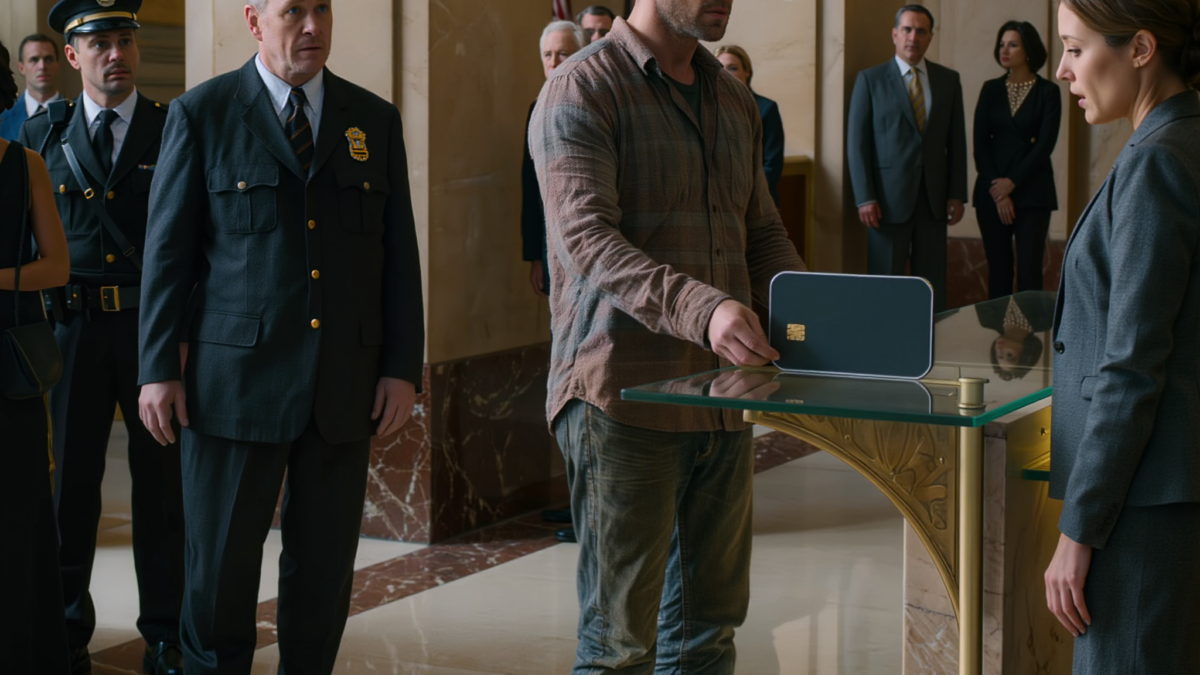
“Get your filthy boots off my Italian marble floor and get out of this building before I call security and have you escorted out. We do not serve day laborers here, and we most certainly do not hand out charity to people who wander in off the street.”
Those were the exact venomous words the security guard spat directly into my face, his heavy hand resting on his thick leather utility belt.
I stood dead center in the immaculate, soaring lobby of First National Hawthorne Bank. My heavy denim work jeans were caked in thick, dried gray concrete mud. My knuckles were scraped raw and sore, and my faded flannel work shirt was soaked through with the bitter sweat of a fourteen-hour shift.
All around me, the elite of the city—men in $5,000 tailored charcoal suits and women carrying pristine designer handbags—stopped their hushed, important conversations just to stare at me.
They looked at me with a level of undisguised disgust that burned right through my skin.
I was a dark, dirty stain on their pristine, cathedral-like world of infinite wealth and untouchable privilege.
My name is Asa. I am thirty-five years old.
Exactly one month earlier, my incredibly wealthy wife of ten years had kicked me out of the luxury home I had built for her with my own two hands, leaving me with absolutely nothing.
She legally drained every dollar from our joint accounts, canceled my health insurance with a single phone call, and publicly replaced me with a younger, slicker corporate consultant.
She thought she had broken me completely.
She truly believed she had tossed a useless, broken piece of trash out to the curb to disappear in the freezing rain.
But there was one massive, world-shattering thing she and her deeply arrogant family did not know.
They did not know about the heavy, unmarked, solid black metal card currently burning a hole in my calloused palm.
They did not know about the profound legacy my late mother had spent her entire life protecting.
And right then, the very same people who thought they owned the entire world were about to find out exactly who actually held the deed to it.
The bank lobby was deafeningly silent except for the faint classical music piped in through hidden speakers.
The security guard, a massive, thick-necked guy whose gold name tag read Garrison, took an aggressive step closer to me.
He reached toward my shoulder.
I did not flinch.
I did not take a single step back.
I looked him directly in the eye, a cold fire burning in my chest, and placed the heavy black metal card onto the thick glass counter directly in front of the teller.
It hit the glass with a solid, heavy thud that made the woman jump.
The teller was a young woman named Farley. She had perfectly manicured acrylic nails, heavily styled hair, and a sneer permanently etched onto her powdered face.
She looked down at the card.
There were absolutely no account numbers on it.
There was no expiration date.
There was no magnetic strip, no customer service phone number on the back, and no bank logo.
It was simply a solid, heavy piece of matte black metal with a single gold data chip embedded in the center and a beautifully engraved silver signature at the bottom.
“Run it,” I said.
My voice was low, perfectly steady, and sharp enough to cut through the silence.
Farley let out an exaggerated sigh and rolled her heavily mascaraed eyes for the benefit of the wealthy patrons watching the spectacle.
She picked up the black card using only her thumb and index finger, holding it as if it were contaminated, then pushed it into the chip reader, clearly intending to prove to everyone that the card was fake.
Ten seconds passed.
The silence in the lobby stretched into something deeply uncomfortable.
Nothing happened.
The machine did not beep.
Garrison moved closer.
“Listen here, buddy. You are done,” he growled.
But suddenly, Farley’s computer monitor went completely black.
The screen then flashed a brilliant, pulsing red.
A deep, rhythmic chime started echoing, not from her little desktop computer but from the massive stone walls of the bank itself.
It was a top-tier internal override alarm, the kind of signal used when something major happened inside the bank’s central system.
Farley pushed her chair back from the desk.
“What did you do?”
Her face went pale.
Someone nearby called for a supervisor.
Before Garrison could move me even five feet toward the heavy revolving glass doors, a distinct, incredibly smooth sound cut through the rising panic in the room.
At the far end of the vast lobby, the private executive elevator chimed a soft, melodic note.
The heavy doors slid open in perfect silence.
Three men stepped out.
Two of them were private security contractors wearing dark suits and discreet earpieces.
The man walking in the center was Augustus Hawthorne.
Augustus Hawthorne was the chief executive officer of Hawthorne Banking Group.
He was an absolute legend in the financial district, a man who personally controlled tens of billions of dollars in global assets, real estate portfolios, and international investments.
He was a man who never, under ordinary circumstances, came down to the public lobby to mingle with regular clients.
The entire room froze.
Garrison stepped away from me immediately, his face draining of color as he snapped to attention and tried to look professional.
Farley looked as if she were about to pass out, her hands shaking over her keyboard.
The wealthy clients who had been whispering insults about me suddenly became silent.
Augustus scanned the massive room with piercing blue eyes.
His gaze swept over the marble pillars, the anxious staff, and finally landed squarely on me.
He stopped for a fraction of a second.
Then he stepped out from between his security detail and walked slowly across the Italian marble floor.
His polished Oxfords clicked sharply, the only sound echoing through the silence.
He did not look at Garrison.
He completely ignored Farley.
He stopped exactly three feet in front of me.
He looked closely at my mud-caked boots.
He looked at the dried cement staining my torn jeans.
He looked at the exhaustion and grief carved deeply into my face.
“Sir,” Garrison stammered, gesturing toward me. “I was just removing this trespasser. He was causing a disturbance and trying to use a fake piece of metal.”
“Step away from him immediately,” Augustus said.
His voice was quiet, but it carried the unmistakable authority of a man whose decisions could alter entire careers.
Garrison backed away and pressed himself against a marble pillar.
Then the chief executive officer of the most powerful financial institution in the state did something that made every person in that lobby stare in disbelief.
He did not reach out to shake my hand.
He did not offer a polite corporate nod.
He placed his hands flat at his sides, bent at the waist, and gave me a deep, formal bow.
He held it for three long seconds.
When he finally straightened, I saw that his piercing blue eyes were shining with emotion.
“Welcome home, Mr. Hawthorne,” Augustus said, his voice carrying effortlessly across the silent room. “We have been holding your seat at the head of the table for a very long time.”
I closed my eyes, feeling a massive tremor run through my exhausted body.
I was shaking from the crushing weight of the moment.
As I stood there listening to the breathless whispers of the same wealthy people who had treated me like garbage only minutes earlier, my mind snapped backward.
Back through the pain.
Back through the grueling labor.
Back to the morning my entire life had been ripped apart by the woman I loved.
Exactly one month earlier, I had been standing in my own home, staring blankly at a thick stack of legal documents resting ominously on my custom kitchen island.
It was exactly 7:00 on a cloudy Tuesday morning.
Pale morning light poured through the massive bay windows I had personally designed, framed, and installed two summers earlier.
I held a chipped ceramic coffee mug, desperately trying to wake up and mentally prepare for another fourteen-hour shift at the Riverview construction site.
The bold black letters at the top of the legal papers seemed to blur in front of my tired eyes.
Petition for dissolution of marriage.
My wife, Fallon, stood on the opposite side of the massive granite island.
She wore a flawless silk blouse and a sharply tailored designer skirt, looking immaculate and completely untouched by the reality of what she was doing.
Her arms were crossed tightly over her chest.
She watched me with an expression of chilling boredom.
She had not even handed the divorce papers to me herself.
Her father’s corporate attorney had placed them on the countertop like a serving tray.
“Sign the documents, Asa,” Fallon said.
Her tone was completely flat, devoid of emotion.
She sounded as if she were canceling an unwanted magazine subscription, not ending a ten-year marriage.
“Do not make this harder or more drawn out than it needs to be. We both knew this day was coming eventually.”
I slowly set my coffee mug down on the counter.
My hands were shaking badly enough that a few drops of dark coffee spilled over the rim and splashed onto the pristine white stone.
I saw Fallon recoil at the minor mess.
That was her genuine reaction to our entire life ending.
She was more bothered by the possibility of a coffee stain on the stone I had imported from Italy and installed with my own hands.
“Did we know this was coming?” I asked.
My voice cracked slightly under the weight of the moment.
“Ten years, Fallon. Ten years of my life. I gave up my architectural apprenticeship to manage your father’s failing development properties because he convinced me it was best for the family business. I drained my personal 401(k) to cover the legal settlement when your brother got sued for property damage. I personally renovated every inch of this house. I built the back deck. I laid every plank of hardwood flooring. And you serve me divorce papers before I even finish my morning coffee.”
Her father, Benson, stepped out from the hallway.
He was a massive, imposing, deeply arrogant man who had made his fortune building residential apartment complexes as cheaply as possible and then selling them at luxury prices.
He was smoking an expensive cigar in my kitchen, casually dropping gray ash onto the clean floor.
“You were a decently reliable laborer, Asa,” Benson sneered. “And you were adequately compensated for your work. You got to live comfortably in a mansion you could never afford. You drove a nice company lease truck.”
He took another slow pull from his cigar.
“But let us be perfectly honest. You were always just a temporary placeholder. Fallon needed someone safe and remarkably dull while she found her footing in the competitive real estate business. Now she is ready for the big leagues, and you constantly smell like drywall dust and cheap sweat. You are an anchor dragging down her brand.”
I looked from Benson back to my wife.
I expected her to defend our decade together.
I expected her to show a shred of regret.
Instead, she nodded firmly in agreement with her father.
“I need to fly, Asa,” Fallon said smoothly, looking at her manicured nails. “And you are holding me back. My lawyer ensured the prenup protects my family’s assets. You are entitled to nothing. There is no alimony, no real estate division, and no settlement payout.”
She paused.
“However, out of the goodness of my heart, I am allowing you to keep your personal tool belt and that old truck.”
“Allowing me?”
A bitter laugh escaped my throat.
“That truck is registered in my name. I bought those tools five years before I even met you at that charity gala.”
Before she could answer, a man casually walked into my kitchen from the master bedroom.
It was Dalton.
He was the slick, thirty-year-old, overly groomed financial consultant Fallon’s corporate firm had hired six months earlier to handle its aggressive expansion portfolio.
He was wearing my monogrammed bathrobe.
He confidently poured himself a steaming cup of coffee from my coffee pot and smirked at me over the rim.
“Your time is up, buddy,” Dalton said. “The security team is waiting outside to change the exterior locks. You have exactly ten minutes to pack your work clothes and get off the property.”
I gripped the cold edge of the granite counter.
The reality of the betrayal hit me with crushing force.
All the late-night strategy meetings.
The sudden weekend business trips to coastal resorts.
The constant criticism of my blue-collar manners and my lack of corporate ambition.
It all made perfect, sickening sense.
I was not simply being discarded because the marriage had faded.
I was being deliberately replaced in my own home.
I did not give Benson the reaction he wanted.
He clearly expected me to lose control and create a legal problem he could use against me.
Instead, I turned my back on all three of them.
I walked down the hall into the bedroom, pulled a single canvas duffel bag from the closet, and packed my jeans, thick flannel shirts, and steel-toed work boots.
I took the framed, slightly faded photograph of my late mother, Delaney.
That was all I needed from that house.
I walked out through the heavy oak front door and into the freezing morning rain.
My ten-year-old Ford truck sputtered and coughed before the old engine finally turned over.
I drove away down the long driveway without looking in the rearview mirror once.
An hour later, parked in the rain-slicked lot of a local Walmart, I pulled out my phone and checked my banking app.
Available balance: $0.
Fallon had legally and systematically drained our joint checking and savings accounts the day before she served the papers.
Every dollar I had faithfully saved for our hypothetical children’s college fund.
Every bonus I had earned managing her father’s miserable, corner-cutting construction sites.
Gone.
My credit cards had also been deactivated.
One of them was declined when I tried to buy a cheap bottle of water.
I had half a tank of gas and exactly twenty dollars in my worn leather wallet.
I was thirty-five years old, entirely alone, and effectively homeless.
I spent the first miserable night sleeping in the cramped cab of my truck.
The bitter cold seeped through the thin glass windows and settled deep into my aching bones.
I wrapped myself tightly in an old, dust-covered moving blanket I found in the truck bed and shivered for hours.
It was not only the dropping temperature that hurt.
It was the shock of losing my home, identity, and future in the span of a single morning.
The smell of damp upholstery and the distant hum of highway traffic became my new reality.
The next morning, exhausted and starving, I walked into a cheap roadside diner.
I bought a small black coffee and a stale day-old plain donut.
I kept the printed receipt.
It was exactly $3.12.
I carefully folded the small piece of paper and put it in my wallet as a permanent reminder of the lowest point of my life.
For the next three brutal weeks, I swallowed every ounce of my remaining pride.
I stood outside the local Home Depot at five in the morning with other day laborers, waiting for contractors to drive by and point at the men they needed.
I hauled heavy concrete blocks until my shoulders screamed.
I dug trenches in cold rain until my hands were sore inside my gloves.
I worked for poor cash wages, earning barely enough to buy cheap sandwiches and put a few gallons of gas in the truck so I could run the heater at night.
I refused to call my older brother, Beckett.
Beckett was a hardworking plumber with three young kids, a tired wife, and a mortgage he was already struggling to pay.
I could not burden his family with what felt like my catastrophic failure.
But real family has a way of finding out.
On the twenty-first day of that nightmare, a familiar rusty plumbing van pulled into the Home Depot parking lot.
Beckett stepped out into the rain.
He looked at my muddy clothes, my hollow cheeks, and the exhaustion radiating from my body.
He did not ask a single question.
He walked straight over, grabbed my heavy duffel bag from the bed of my truck, tossed it into his van, and pointed at the passenger seat.
“You do not sleep in a frozen parking lot while I have a solid roof over my head,” Beckett said, his voice thick with emotion. “Get in the van, Asa.”
He took me straight home.
His wife, Hadley, immediately set a massive bowl of homemade stew in front of me at their small kitchen table.
They did not have much money.
The house was small and cramped.
But they gave me the warm couch in their living room without a second thought.
As I slowly ate the first warm, home-cooked meal I had tasted in a month, I felt something hard and unbreakable forming in my chest.
I was done thinking of myself as a victim.
I just needed one opportunity to rebuild.
That opportunity arrived on a rainy Tuesday afternoon.
I was lying flat on my back on the cold tile beneath a wealthy client’s kitchen sink, helping Beckett replace a shattered PVC drain pipe, when my cheap cell phone buzzed in my pocket.
It was an unknown local number.
Fully expecting another aggressive debt collector calling about bills somehow attached to my credit history, I nearly ignored it.
But something told me to answer.
“Asa?” a raspy but dignified elderly voice asked.
“Speaking,” I said, wiping pipe grease from my forehead with my flannel sleeve.
“My name is Harrison Fletcher. I was your late mother’s personal legal counsel. I need you and your brother Beckett to come to my private office immediately. It concerns a highly sensitive inheritance matter.”
I froze and nearly dropped the pipe wrench.
“You have the wrong number, sir. My mother was a hardworking house cleaner, Mr. Fletcher. She died of illness three years ago. She barely had enough money saved to cover her modest funeral expenses. There is no inheritance.”
“I assure you, I have the correct number,” Fletcher replied firmly.
He sounded completely unbothered by my disbelief.
“Your mother left very specific, legally binding instructions. I was required by a strict nondisclosure agreement to contact you only when exactly three full years had passed since her death and only when you had faced a significant, life-altering personal hardship. I read the public divorce filings in the county registry.”
He paused.
“Asa, both legal conditions are now met. Be at my office in exactly one hour.”
Beckett and I drove to the downtown district in stunned silence.
Fletcher’s office was not located inside one of the gleaming glass corporate skyscrapers where Fallon’s attorneys worked.
It was an old historic suite above a quiet bakery.
Fletcher himself looked as though he belonged to a different century.
He wore a tailored tweed suit and sat behind a massive oak desk covered with paper files and leather-bound legal books.
He asked us to sit in the worn leather chairs.
Then he reached into a locked desk drawer and carefully placed a polished mahogany box between us.
“Gentlemen,” Fletcher began, folding his wrinkled hands, “you knew your mother simply as Delaney, the hardworking woman who cleaned houses to keep food on your table and clothes on your backs. But she kept an enormous secret because she believed it was the only way to protect both of you from corruption.”
Beckett and I stared at him.
“Your father, who died in that car accident when you were both toddlers, was not simply a mechanic. His legal name was Silas Hawthorne.”
Beckett let out a nervous laugh.
“Hawthorne? Like the banking conglomerate that owns half the commercial real estate in this city?”
“Exactly like that,” Fletcher said without smiling.
He continued.
“Silas was the rightful heir to the Hawthorne empire. He fell deeply in love with your mother when she was working as a maid at the family’s summer estate. The Hawthorne patriarch gave him an ultimatum: keep the family fortune and marry someone acceptable to the family, or choose Delaney and walk away.”
Fletcher leaned back in his chair.
“Silas chose your mother. He left the fortune, changed the way he lived, and started over. After he died, the Hawthorne family tried to gain custody of both of you. They wanted the bloodline, but not your mother.”
My stomach tightened.
“Delaney fought them with everything she had. Eventually, she negotiated an extraordinary agreement.”
Fletcher reached toward the polished mahogany box.
“She refused direct financial support because she did not want you growing up inside the same world that had nearly destroyed your father. In exchange, the Hawthorne family placed your father’s rightful inheritance into an untouchable blind trust.”
He opened the brass latch.
“The trust was invested in technology, banking, and real estate for decades. Your mother made sure neither of you could access it until very specific conditions were met.”
The lid opened.
Resting on dark red velvet inside was a single heavy black metal card.
Fletcher picked it up carefully and slid it toward me.
“Take this key directly to First National Hawthorne Bank. Ask for Augustus Hawthorne.”
His eyes settled on mine.
“Your long waiting period is over.”
And that was exactly how I found myself standing in that immaculate bank lobby, watching the most powerful banking executive in the city bow to me while I stood there wearing mud-caked boots.
The transition from the dusty construction site to the serene penthouse office of Hawthorne Banking Group felt like stepping into another world.
Augustus personally led Beckett and me into an office significantly larger than the entire house I had built for Fallon.
Floor-to-ceiling windows offered a panoramic view of the city skyline.
Augustus walked to a hidden wall safe, opened it with practiced ease, and pulled out a thick leather financial binder.
He placed it gently on the glass coffee table.
“Your mother was the most stubborn and brilliant woman I ever had the honor of meeting,” Augustus said softly as he poured two glasses of sparkling water.
“I tried to send her cashier’s checks over the years to make life easier. She tore every single one of them into pieces and mailed the pieces back to me.”
A faint smile touched his face.
“She told me iron had to be forged in fire before it became steel.”
He looked at me.
“Looking at you now, Asa, I think she believed the struggle would make you strong enough to handle what came next.”
He opened the binder and flipped to the final summary page.
Then he pointed to the bottom line.
I stared at the numbers.
My brain, trained to calculate the cost of lumber, concrete, wages, and materials, simply stopped working.
I read the line three times.
$142 million in highly liquid assets.
And beneath that:
15% controlling equity stake in Hawthorne Banking Group.
Beckett let out a strangled breath and grabbed his chest.
He looked pale enough to faint onto the Persian rug.
I put a steadying hand on his shoulder, though my own heart was pounding against my ribs.
We were not merely comfortable.
We held generational wealth.
“Half of every penny belongs legally to Beckett,” I said, my voice strangely calm despite the adrenaline surging through me. “Set up his private accounts immediately.”
“Done,” Augustus said.
Then he looked at me.
“And for you?”
I slowly walked over to the massive glass window.
In the far distance, cutting through the haze, I could see huge yellow cranes towering over the Riverview luxury condo project.
It was Benson’s crown jewel.
It was the project Fallon was banking her entire professional reputation on.
It was also the exact project where I had broken my back laying the initial foundation before they threw me out.
“I need exactly $50,000 in a cashier’s check right now,” I said, turning away from the window. “And I need you to quietly establish a shell corporation. Name it Delaney Holdings.”
Augustus raised an eyebrow.
“I want complete anonymity. Nobody, especially Benson, knows my name is attached to it.”
Beckett stared at me, still trying to process the numbers.
“Asa, we have $140 million sitting here. Why do you only want fifty grand?”
“Because thirty thousand of it is paying off your mortgage today,” I said. “The rest is for gas, food, and basic supplies.”
I looked directly at him.
“Tomorrow morning, I am putting my dirty work boots back on. I am going back to the Riverview project.”
Augustus studied me.
“You want to use the family capital to buy them out?”
“No.”
A cold certainty settled over me.
“I am going to let them expose themselves through their own greed. Then I am going to take control of what they were willing to destroy.”
The next morning, before the sun fully rose, I drove my old sputtering Ford back to the Riverview construction site.
I bypassed the shiny, air-conditioned management trailers where Fallon and Dalton spent their days drinking expensive espresso and pretending to understand construction.
I walked straight through the mud to the foreman’s trailer.
Bram, an older, heavily scarred guy who had always treated me fairly when I managed the site, looked up from his blueprints in shock.
“Asa, man, I heard about the divorce. I’m sorry. But what are you doing here? If Benson or Dalton sees you on the property, they’ll have security remove you.”
“Benson never leaves his pristine office,” I replied. “I need work, Bram. I do not want a management position. I want a shovel. Give me minimum wage and put me on the concrete crew.”
Bram hesitated.
He understood the risk to his own job.
But he saw the desperation I was intentionally projecting.
Finally, he sighed, reached into a bin, and handed me a scratched yellow hard hat.
I spent the next week operating a deafening concrete mixer in brutal afternoon heat.
My back ached constantly.
My hands developed new calluses over the old ones.
But my eyes stayed open.
From ground level, I saw everything the corporate executives in the trailers missed.
I watched delivery trucks arrive.
I saw invoice codes printed on the sides of pallets.
I began noticing something deeply wrong.
Benson and Dalton were cutting dangerous corners.
They were ordering lower-grade rebar instead of the higher-rated structural steel required for a high-rise foundation.
They were pocketing the price difference to support their lavish lifestyles.
It was not simply a bookkeeping issue.
It was a catastrophic safety problem.
A luxury tower built on inadequate structural steel could eventually become unsafe for every family living inside it.
I began discreetly taking high-resolution photographs of shipping manifests with an inexpensive second phone.
After the crews went home, I searched discarded invoices in the management dumpsters.
Every night, sitting inside the dark cab of my truck, I sent the files securely to Augustus.
Delaney Holdings was quietly building an inescapable legal and financial case.
The heat that Thursday afternoon was suffocating.
The air was thick with humidity and concrete dust.
I was shoveling wet sand into the spinning mixer near the main access road, covered from head to toe in gray cement powder.
Every muscle in my arms burned.
But my mind was perfectly clear.
The trap was nearly complete.
Then the loud roar of an exotic engine cut through the industrial noise.
A brand-new lime-green Lamborghini rolled past the orange safety barrier and stopped near the management trailer.
The butterfly doors lifted.
Dalton stepped out wearing a sharply tailored light linen summer suit and loafers that probably cost more than several workers earned in a week.
Fallon stepped out of the passenger side in oversized designer sunglasses, carrying a tiny dog in her purse.
She looked disgusted by the dirt and noise and held one hand near her nose.
They were conducting a publicized walkthrough.
They headed toward the air-conditioned management trailer.
Then Fallon stopped.
She had seen me working near the road.
A cruel smile slowly spread across her face.
She tapped Dalton on the arm and pointed at me.
They changed direction and walked directly toward the concrete mixer.
I kept my head down.
I kept shoveling sand.
I refused to give them the satisfaction of seeing embarrassment on my face.
“Well, well, well,” Fallon said loudly enough for the nearby crew to hear. “Look how far the mighty project manager has fallen.”
She looked down at my mud-covered boots.
“Right back in the dirt, exactly where you belong.”
Dalton chuckled and adjusted his diamond-encrusted watch.
“I always told you he would end up digging ditches for minimum wage. Hey, Asa, do you want me to talk to Bram for you? Maybe get you a ten-cent raise. You look like you need a hot meal and a shower.”
Several exhausted workers stopped what they were doing.
The tension in the dusty air became heavy.
I slowly leaned on the wooden handle of my shovel.
I looked at the flashy Lamborghini.
Then I looked at the lower-grade steel bars rising from the drying concrete foundation behind them.
“Honest physical work is honest work, Fallon,” I said calmly.
My voice was steady.
“But you should be careful walking around here in those expensive shoes. The foundation of this place looks unstable.”
Fallon laughed.
“You are pathetic. You’re just jealous because Dalton knows how to run a profitable business instead of playing in the dirt. Enjoy the mud, Asa.”
She opened her designer purse, pulled out a crisp five-dollar bill, and dropped it into the wet gray mud beside my steel-toed boots.
“Buy yourself a coffee. You look tired.”
They turned and walked away toward the trailer, laughing at their own joke.
I did not bend down to pick up the money.
I simply stood there, leaning on my shovel, watching them walk back toward a car bought with money they had pulled from the company.
They had no idea that the dirty man they had just publicly humiliated now controlled resources capable of deciding the future of their entire business.
But my quiet investigation had not gone completely unnoticed.
Later that afternoon, as the sun began to set and long shadows stretched across the site, I crouched behind several wooden shipping crates and photographed another modified manifest showing the latest shipment of lower-grade steel.
Then I heard a work boot scrape against the gravel behind me.
I turned.
Cashion, a mid-level management supervisor I had once trusted, stood there with his smartphone raised.
The recording light was on.
Beside him stood Ellery, a young laborer known for doing Dalton’s unpleasant side work for extra cash.
“I knew something was off about you being here,” Cashion said, a triumphant smile spreading across his face. “Bram told everyone you were desperate and broke, but you’ve been snooping around manifests.”
He raised his phone slightly.
“Dalton pays very well for information about people watching the company.”
Ellery stepped closer, a heavy pipe wrench hanging from his work belt.
“Hand over the phone, Asa,” he said. “Do not make this difficult.”
This was the moment everything could have collapsed.
If they took the phone and destroyed the evidence, Dalton would know exactly what I had been doing before the legal trap was complete.
I did not panic.
I slowly put the second phone securely into my front pocket.
Then I looked directly at Cashion.
“Cashion,” I said, my voice low and controlled. “You have a mortgage on a four-bedroom house in the suburbs.”
His expression changed.
“You have two kids enrolled in private school. Your wife believes you are an honest, hardworking man.”
Cashion frowned.
“What are you talking about?”
“I am stating facts. I know you have been signing off on false municipal safety inspections for Dalton. I know you have been receiving a ten-percent cash kickback. And I know that when this building fails its state audit next month because of the steel, Dalton is going to blame you.”
The color drained from Cashion’s face.
“You’re bluffing. You’re a broke ditch digger.”
“Then call my bluff.”
I held his gaze.
“Send that video to Dalton. See what happens. Or turn around, walk away, and pretend you saw nothing. When the investigation reaches this company in a few days, I will make sure your cooperation is documented.”
Ellery looked confused.
“Cashion, what do we do?”
“Be quiet,” Cashion snapped.
His voice trembled.
He stared at me for several seconds.
Then he slowly lowered his phone and stopped the recording.
He grabbed Ellery by the shoulder and guided him backward.
“We didn’t see anything today,” he muttered.
Then they walked away toward the employee parking area.
I pulled my second phone out again, hit send, and watched the final piece of evidence transmit securely to Hawthorne Banking Group’s servers.
The trap was set.
The legal documents were ready.
I thought securing the evidence had been the hardest part.
I was wrong.
The real explosion was about to happen in a luxury ballroom full of the city’s elite.
The pressure on Benson’s real estate empire began with surgical precision.
It was invisible to the men operating the cranes and driving sports cars along the boulevard.
But inside the quiet, air-conditioned boardrooms of downtown financial institutions, everything changed.
Armed with the photographic evidence I had gathered while covered in mud at Riverview, Augustus went to work.
Using the capital behind Delaney Holdings, he began purchasing every significant piece of debt attached to Benson’s development firm.
Benson had leveraged nearly everything he owned to build Riverview.
He had taken out huge commercial loans from three regional banks and several private lenders to cover the rapidly rising costs created by his own mismanagement and the money being siphoned out of the company.
He believed he was untouchable.
He believed the system existed to protect men who wore expensive suits and smoked imported cigars.
One by one, in the span of forty-eight hours, Delaney Holdings acquired those high-risk promissory notes.
By Friday morning, my anonymous company legally controlled 95% of Benson’s outstanding corporate and personal debt.
I controlled the mortgage on his sprawling suburban estate.
I controlled the heavily leveraged loans attached to his corporate headquarters.
I even controlled the hidden high-interest debt he had used to finance Fallon’s extravagant lifestyle.
Then we called the loans.
All at once.
I was not physically sitting in the room when the final blow landed.
Augustus kept a secure phone line open so I could listen from my brother’s living room.
Benson was summoned to a mandatory emergency meeting at Hawthorne Banking Group headquarters.
He walked in confidently, expecting to negotiate a routine extension over a friendly discussion.
Instead, a team of corporate attorneys informed him that several major loans were officially in default.
The primary creditor, Delaney Holdings, demanded immediate repayment of $25 million by the end of the business day.
If he could not produce the money, the creditor would begin foreclosure proceedings against the Riverview project, seize pledged assets, and freeze access to certain corporate accounts before the banks closed for the weekend.
Benson did not have $25 million.
Because of Dalton’s reckless investments and the consulting fees being pulled from the company, Benson barely had $2 million in liquid capital.
Listening through the phone speaker, I heard the arrogant man begin to fall apart.
His breathing became shallow.
He begged the attorneys.
First he asked for a month.
Then a week.
Then a weekend.
He offered higher interest rates.
He offered equity.
He offered almost anything if they would give him breathing room.
Then, exactly on cue, Augustus presented the solution.
In a calm voice, he explained that the anonymous chairman of Delaney Holdings was willing to acquire the entire Riverview project and assume the crippling debt.
But in exchange, Benson had to sign over full ownership of his development company and immediately surrender his seat on the executive board.
It was a textbook hostile takeover disguised as a financial rescue.
Benson signed the documents with a shaking hand.
Through the phone, I could hear the scratch of his expensive fountain pen across the heavy paper.
He believed he was saving himself from bankruptcy and public disgrace.
He believed he was shifting a colossal failure onto a faceless corporate entity.
He had no idea he was signing his entire empire over to the same blue-collar son-in-law he had thrown out into the freezing rain one month earlier.
The following morning, an urgent company-wide memo went out to every employee, contractor, and vendor associated with the firm.
The real estate company was officially under new management.
All daily operations at Riverview were suspended pending a complete structural and safety review by independent engineering auditors.
I showed up to the construction site that morning exactly as usual, wearing dirty work jeans, scuffed steel-toed boots, and carrying my cheap plastic lunchbox.
But the chain-link gates were secured with heavy chains.
A large white sign was bolted to the fence.
Property under exclusive ownership of Delaney Holdings. Unauthorized personnel will be removed from the property.
Dalton was standing outside the locked gate.
His face was bright red.
His expensive linen suit was wrinkled as he argued with a new private security guard standing calmly on the other side.
“Do you have any idea who I am?” Dalton demanded. “I am the senior project director of this development. I run this entire operation. Open the gate.”
The guard did not move.
“Your corporate access badge has been permanently deactivated, sir. You have no legal authority here. Please leave the property.”
I walked up slowly, taking a crisp bite from a green apple.
“Hey, Dalton,” I said. “Did you get locked out of your own castle?”
He turned toward me.
“This is a clerical mistake. Some opportunistic capital firm bought our debt while Benson was asleep at the wheel. I’m calling him right now. We’ll have this fixed by noon, and then I’ll make sure you never get hired on another project in this state.”
“Benson isn’t answering his phone,” I said casually, tossing the apple core into a heavy-duty trash can.
Dalton’s expression tightened.
“I heard an interesting rumor down in the mud this morning. People are saying he’s currently sitting in a conference room with defense attorneys. Something about fraudulent safety paperwork, lower-grade steel, and millions in missing company funds.”
Dalton went white.
He took a small step backward.
“How do you know anything about the steel?”
“Word travels quickly when you bother talking to the honest men doing the work instead of treating them like garbage.”
My secure phone buzzed in my pocket.
A short coded message from Augustus appeared on the screen.
The takeover is legally complete and filed with the city. The reopening gala is set for Friday evening at the Ritz-Carlton. VIP invitations have been distributed.
I looked at Dalton’s sweating face.
Then I smiled.
“Are you going to the reopening gala Friday night? I heard the mysterious new owner of Delaney Holdings is finally making a public appearance.”
Dalton straightened his linen tie, desperately trying to recover his corporate composure.
“Of course I’m going. I need to meet this new owner face-to-face. Once I explain my profitable vision for the property, he’ll practically beg me to stay on the executive board. I’m indispensable to this operation.”
He leaned toward me.
“I know where all the bodies are buried.”
“I’m sure you know a great deal,” I said, turning toward my old Ford. “And I’m certain the new owner is very interested in hearing it.”
The days leading up to the Friday gala were the busiest and most surreal days of my life.
I was no longer mixing concrete in the blistering sun.
I was secretly working out of Augustus’s private penthouse office, orchestrating the systematic cleanup of the company from the shadows.
My first executive act as the anonymous owner of Delaney Holdings was to fire the corrupt upper-management team Dalton had installed during the previous year.
They were highly paid executives who had ignored critical safety protocols while draining the payroll.
Their severance packages were reviewed and, where negligence was documented, revoked according to the contracts.
Then I rehired Bram.
The honest foreman who had given me a job when I was starving became senior site director with a life-changing salary increase.
I doubled hourly wages for the ground crews.
For the first time in years, the people doing the hardest physical work were being treated with dignity.
I ordered the complete removal of all inadequate steel from the foundation.
The correction cost nearly $3 million from my own accounts.
I did not care.
I was never going to put my mother’s name on a building that could put families at risk.
Through it all, I remained hidden.
To the workers on the ground, Delaney Holdings was a mysterious company that finally valued their labor.
To Benson, Fallon, and Dalton, it was a faceless corporate force that now controlled their professional future and most of the financial leverage surrounding them.
With the business secured, I finally went shopping.
I did not initially look for a new truck.
I went looking for the right suit for Friday night.
I visited an appointment-only Italian tailor in the heart of the financial district.
I spent four hours being measured and fitted.
I purchased a custom midnight-blue tuxedo made from imported wool.
It fit perfectly, hiding the tired slump that years of long shifts had put into my shoulders while emphasizing the solid frame built through fifteen years of physical labor.
Beckett came with me.
He looked deeply uncomfortable in the luxurious environment, but he supported every step of the plan.
I bought him a classic black suit.
For the first time in our lives, we looked into tall gilded mirrors and saw something neither of us had ever been allowed to imagine.
Not plumbers.
Not ditch diggers.
Not men scrambling from paycheck to paycheck.
Hawthornes.
On the morning of the gala, I drove my sputtering old Ford to an automated car wash.
I cleaned the mud out of the interior and washed the exterior until the faded paint showed through.
Then I drove it to a luxury car dealership in the wealthy suburbs.
I did not trade the truck in.
I parked the rusted, dented Ford directly beside the gleaming new inventory and walked inside.
“I want that one,” I said, pointing toward a flawless midnight-black Porsche Panamera displayed on the showroom floor.
The young salesman looked at my old jeans, faded flannel shirt, and scuffed boots.
His smile became faintly condescending.
“Are we looking at financing options today, sir? We do have several programs if you have a co-signer.”
“Cash.”
I reached into my pocket and placed the solid black Hawthorne card on his glass desk.
“Run it.”
An hour later, I drove the Porsche off the lot while the salesman apologized repeatedly.
But I kept the old truck.
I paid a towing company to transport it.
I parked the Porsche inside the heated garage of a four-bedroom colonial house I had anonymously purchased in a safe neighborhood for Beckett, Hadley, and their children.
Then I parked the rusted Ford right beside it.
That truck was my anchor.
It reminded me of the freezing night I had slept in a dark parking lot.
It reminded me how quickly comfort could disappear.
It reminded me why I could never become the kind of man who looked at struggling people the way Benson had looked at me.
That evening, I stood in my brother’s guest room and dressed for the gala.
I looked into the mirror.
The man staring back at me was no longer the exhausted, discarded laborer who had sat alone at a truck stop.
He was clean-shaven.
His posture was straight.
His eyes were sharp.
I slid the heavy black metal card into the inner silk pocket of my tuxedo.
It rested directly over my heart.
It was finally time to introduce myself.
The highly anticipated reopening gala was held in the grand ballroom of the Ritz-Carlton downtown.
The event was designed to impress investors and reassure the city’s business community.
Crystal chandeliers hung from the vaulted ceiling, casting warm golden light over the room.
Champagne flowed into crystal flutes.
A live orchestra played soft jazz in the corner.
The air smelled of roasted duck, caviar, and expensive perfume.
Much of the city’s financial, political, and social elite had arrived.
Everyone was talking about Delaney Holdings, the mysterious firm that had swallowed Benson’s real estate empire almost overnight.
I arrived in a black limousine with Augustus and Beckett.
We bypassed the crowded main entrance and entered through a private back corridor.
Inside the VIP holding room behind the stage, several high-definition security monitors showed the guests entering the ballroom.
I watched Benson arrive.
He looked smaller than I remembered.
His expensive tuxedo seemed too large for his suddenly deflated frame.
He was sweating under the lobby lights, moving from banker to banker and politician to politician, desperately trying to shake hands with people who now found excuses to turn away.
Then Fallon and Dalton entered.
Fallon wore a striking red designer evening gown.
She gripped Dalton’s arm too tightly while her eyes searched the room for allies.
Dalton looked manic.
He wore heavy cologne and rehearsed some version of his corporate pitch to anyone unfortunate enough to stand beside him.
The three of them walked toward the VIP check-in desk.
“Name for the VIP list?” the attendant asked politely, holding a digital tablet.
“Benson, plus two executive guests,” Benson said, trying to summon his old booming authority.
The attendant scrolled through the list.
Her professional expression turned cool.
“I’m sorry, Mr. Benson. Your name is not on the VIP list this evening.”
Benson stared at her.
“You and your guests are assigned to the general admission section near the rear of the ballroom.”
“What are you talking about?” Benson snapped. “I built this project. I secured the zoning permits. This is my gala. I belong at the head table with the investors.”
“Not under the current ownership structure, sir.”
Two private security staff quietly stepped forward.
“Please move toward the general section.”
Watching from the monitor, I zoomed in on Fallon’s face.
She looked humiliated.
She was used to front-row seats, velvet ropes, private tables, and special treatment.
Now, in front of the very people whose approval she had spent years chasing, she was being directed to the back of the room.
Augustus turned toward me and checked his gold pocket watch.
“Are you ready to end this, Mr. Hawthorne?”
I adjusted my silver cufflinks.
The black card pressed reassuringly against my chest.
“I have been ready for a month, Augustus.”
I looked toward the stage curtain.
“Let’s finish it.”
Augustus stepped through the velvet curtains and onto the brightly lit main stage.
The buzzing ballroom fell silent.
Every eye turned toward the legendary banker.
“Ladies and gentlemen,” Augustus began, his deep voice filling the room, “thank you for coming tonight to celebrate a new era.”
He paused.
“As many of you know, the Riverview luxury project experienced serious problems under its previous management.”
A few uncomfortable murmurs moved through the crowd.
At the back of the room, Benson looked as though he had been slapped by the words.
“But under the new ownership structure, those structural concerns are being corrected. The hardworking men and women on the ground are being paid fairly, and this development is moving forward under a standard of integrity rather than greed.”
Polite applause spread through the ballroom.
“Many of you have asked the financial press one question.”
Augustus raised a hand, and the applause faded.
“Who is behind Delaney Holdings?”
The room became still.
“It is my honor to introduce the chairman tonight. A man who understands the value of difficult work because he has spent years building foundations with his own hands.”
Augustus turned toward the dark side of the stage.
“Ladies and gentlemen, please welcome my nephew and the new owner of this project, Mr. Asa Hawthorne.”
The spotlight moved away from Augustus.
The velvet curtains opened.
I stepped into the light wearing my midnight-blue tuxedo.
For five long seconds, there was complete silence.
I walked slowly to the podium.
I placed both hands against the polished wood and looked across the sea of shocked faces.
Confusion rippled through the room.
People whispered behind champagne glasses.
Isn’t that the construction guy?
Isn’t that Fallon’s broke ex-husband?
Then I looked toward the dark rear section of the ballroom.
Benson’s crystal wineglass slipped from his hand.
It shattered on the marble floor, splashing red wine across Fallon’s designer shoes.
She did not even react.
Her mouth was slightly open.
Her eyes were wide with disbelief.
Dalton slowly shook his head as though refusing to accept what he was seeing.
I leaned toward the microphone.
“Good evening.”
My voice was perfectly steady.
“Some of you know me simply as Asa, the project manager who fixed problems on your construction sites.”
I let the silence stretch.
“Some of you may recognize me as the man who was mixing concrete at Riverview last week.”
More whispers.
“But my late mother knew me as the son of Silas Hawthorne.”
I looked out at the room.
“And she taught me a simple lesson. A building is only as strong as its foundation.”
I pointed toward Benson.
The spotlight shifted toward the back of the room.
Benson stood frozen beneath it.
“Recently, I inspected a foundation that was failing from the inside,” I said. “Not only because of inadequate materials, but because the company behind it had been built on arrogance, dishonesty, and the backs of workers who were treated as disposable.”
Fallon covered her mouth.
Her hands were trembling.
The pieces were finally coming together in her mind.
The inheritance.
The black card.
The Hawthorne name.
The secret I had not even known until she threw me out and triggered the conditions that allowed Fletcher to contact me.
“Delaney Holdings is named after my mother,” I said. “A woman who cleaned floors so her sons could grow up understanding what honest work is worth.”
I tightened my hands around the podium.
“Under my leadership, we will not cut safety corners. We will not cheat workers out of fair pay. And we will not reward executives who treat the people doing the real work as if they do not matter.”
I stepped back from the microphone.
The applause began slowly.
Augustus started.
Then Beckett.
Then more people joined.
Within seconds, the entire ballroom was filled with sound.
I walked down the stage stairs and stepped into the crowd.
Bankers, investors, and socialites who would not have looked at me twice on the street suddenly approached me with business cards and invitations.
“Mr. Hawthorne, excellent speech.”
“Mr. Hawthorne, we should have lunch next week.”
I ignored all of them.
I walked directly toward the back of the room.
Toward Benson, Fallon, and Dalton.
Benson stared at the wine-stained floor.
He could not bring himself to meet my eyes.
Dalton tried to straighten his shoulders.
“Look, man,” he said, his voice cracking. “About what I said at the construction site last week—I was under a lot of corporate stress. You know how this business is.”
“You are permanently removed from the company, Dalton,” I said.
His mouth fell open.
“Security will escort you out of the building. And my forensic accountants have spent the last three days reviewing the missing steel funds and several accounts connected to your consulting business.”
His confidence vanished.
“You should probably speak with an attorney.”
Dalton slumped.
Two security guards appeared nearby and calmly escorted him from the ballroom while he protested.
Then I turned toward Fallon.
She looked up at me.
Tears streaked the makeup on her face.
For the first time all evening, she did not look like the polished, confident woman who had served me divorce papers.
She looked terrified.
“Asa,” she whispered. “Oh my God. Why didn’t you tell me?”
I took a step backward before she could touch my sleeve.
“I didn’t know, Fallon. Not until after you threw me out of the house and left me with nothing.”
Her voice broke.
“My father pressured me. Dalton manipulated me when I was vulnerable. I was confused.”
“You were not confused.”
The words came out quietly.
“You were calculated. You thought I was a broke loser, and you thought Dalton was the better investment.”
Her face crumpled.
“You traded a ten-year marriage for the image of a man with a sports car and a linen suit.”
She stepped closer.
“I still love you, Asa. I really do. We could fix this. We could start over. Think about what we could build together now. We could travel. We could build the house we always talked about.”
I looked at her.
Really looked at her.
For the first time in ten years, I did not see the woman I thought I loved.
I saw someone whose feelings changed according to the balance of a bank account.
I reached into the inside pocket of my tuxedo.
I pulled out my worn leather wallet.
From it, I removed a small, folded, faded piece of paper.
The diner receipt.
The $3.12 receipt for black coffee and a stale donut.
“Do you know what this is?” I asked.
Fallon shook her head.
“This was one of the only meals I could afford after you emptied the accounts.”
Her face went still.
“The night you stayed in the house I built, I slept in the cab of my truck. This receipt reminds me exactly how quickly you decided my life no longer mattered once I stopped being useful to you.”
“Asa, please.”
I folded the receipt again and put it back in my wallet.
“I do not need a business partner to help me spend money, Fallon. And I do not need a wife who remembers how to love me only after she sees a tuxedo and a bank balance.”
I turned away.
“Asa!” she called.
I stopped.
“You owe me. I gave you the best years of my life.”
I did not turn around.
“And I gave you everything I had,” I said. “For you, it was never enough.”
I looked toward Beckett waiting across the room.
“Now I have everything you thought mattered. And none of it belongs to you.”
Then I walked away.
I left Fallon standing alone at the back of the ballroom, surrounded by the consequences of the choices she had made.
The collapse of Benson’s public image happened quickly.
Within forty-eight hours of the gala, Augustus’s forensic accounting team delivered extensive financial records and construction evidence to the appropriate authorities.
The documents showed years of corporate embezzlement, tax violations, falsified municipal records, and the substitution of inadequate structural materials.
Six months after my divorce was finalized, federal investigators arrived at Benson’s suburban estate with a court-authorized warrant.
They secured his computers, financial records, and offshore account information.
Local news crews filmed as he was escorted from the property.
The next morning, the newspaper headline covered nearly half the business section.
Prominent real estate developer indicted on fraud and public-safety charges.
The article explained how Benson’s company had cut structural costs while falsifying inspection records.
Facing overwhelming evidence and almost no corporate allies, Benson accepted a plea agreement.
He was sentenced to five years in federal prison.
He lost his company, his reputation, and his freedom.
Dalton did no better.
The slick consultant tried to cooperate with prosecutors in exchange for a more favorable outcome.
But the paper trail I had photographed at Riverview showed that Dalton had personally coordinated much of the lower-grade steel purchasing.
Delaney Holdings also filed a major civil lawsuit seeking repayment of missing corporate funds.
The judgment left him bankrupt before the criminal case was even finished.
He eventually received a three-year sentence for corporate embezzlement and fraud.
The lime-green Lamborghini was repossessed from Fallon’s driveway while neighbors watched from their windows.
Then there was Fallon.
Without her father’s powerful social network, and with the family name tied to a major public scandal, her elite public-relations and real estate business collapsed.
Clients left.
Her country club membership ended after she could no longer maintain the dues.
Through mutual acquaintances, I heard she eventually sold designer bags, expensive shoes, and jewelry to cover legal costs and ordinary bills.
She took a retail job at a department store, selling perfume behind a glass counter.
She moved into a small apartment and drove a used Honda sedan that struggled in cold weather.
A small part of me felt a brief twinge of pity when I heard.
I had enough money to solve every financial problem she had with a single check.
It would not have made a noticeable difference to my portfolio.
I could have bought her a house in cash without thinking twice.
But then I remembered the freezing truck stop.
I remembered the expression on her face when I spilled coffee on the counter the morning she handed me the divorce papers.
I remembered opening my banking app and discovering that years of savings had vanished without warning.
She had wanted a life built around luxury and status.
She wanted to look down on people who worked with their hands.
She gambled everything she had on that worldview.
And she lost.
I was not punishing her by refusing to rescue her.
I was simply no longer responsible for protecting her from the consequences of her own choices.
In sharp contrast, Riverview flourished under the Delaney Holdings banner.
I spent an additional $3 million replacing every section of inadequate steel with the highest-rated materials available.
I made sure the building was structurally sound.
I kept every honest laborer employed.
I added comprehensive health benefits, retirement plans, and meaningful performance bonuses.
We were not simply constructing luxury condos for wealthy buyers.
We were building something that respected the people pouring the concrete.
Exactly one year later, I sat on the wide wooden deck of my new home.
It was not a flashy mansion inside an exclusive gated suburb like the house I had once built for Fallon.
It was a sturdy, beautifully crafted log cabin on fifty acres of private land beside a clear lake about an hour outside the city.
It was the kind of peaceful place my mother had always dreamed about but never lived long enough to enjoy.
Beckett was there with me.
He and Hadley stood near the edge of the lake with their three kids, laughing as they tried to teach the youngest how to cast a fishing line.
Beckett no longer spent every day repairing broken toilets for customers who barely noticed him.
He managed the entire maintenance division of Delaney Holdings.
He was good at it.
His crew respected him.
Most importantly, he was free from the constant panic of wondering whether the next mortgage payment would clear.
I took a slow sip of iced tea and breathed in the clean scent of pine trees.
Then I looked toward the garage beside the cabin.
Inside, parked next to the polished black Porsche Panamera, sat my rusted, dented ten-year-old Ford work truck.
I made sure the mechanics kept the engine perfectly tuned.
But I refused to repair the dents.
I refused to cover the rust.
I kept it exactly the way it was.
Every time I looked at that truck, I remembered who I was.
I was a man shaped by dirt, long shifts, and hard labor.
I was a man who survived betrayal and discovered that losing everything I thought I owned had forced me to understand what truly belonged to me.
I had unimaginable money now.
I had corporate power that placed me at tables with some of the most influential people in the country.
I carried the Hawthorne name, a name that made bankers and executives pay attention before I even entered a room.
But sitting on that wooden deck, watching my brother and his family laugh beside the lake, feeling the cool evening breeze move through the pine trees, I finally understood something Fallon and Benson had never understood.
I had enough.
I did not need to chase the next deal to feel important.
I did not need to step on people beneath me to feel taller.
My mother’s sacrifice had not been wasted.
She had left me resources, but she had also given me something far more important before I ever knew those resources existed.
She had taught me what work was worth.
She had taught me what loyalty looked like.
She had taught me the difference between having money and having character.
And when the money finally came, I used it to remove the corruption from the company, protect the people whose labor had been ignored, and build something strong enough to carry her name.
I left the people from my old life with the consequences of the choices they had made.
And I never spent a single dollar of my mother’s legacy trying to buy their love back….








