My wife demanded a divorce in front of her brother while I was preparing to tell her we’d been approved to adopt a little girl. For six years, I’d spent $82,000 of my savings supporting her family, including her nephew’s $14,000 school tuition and her brother’s Porsche. I agreed to leave, placed the adoption papers on the kitchen counter, and told them the payments were stopping.
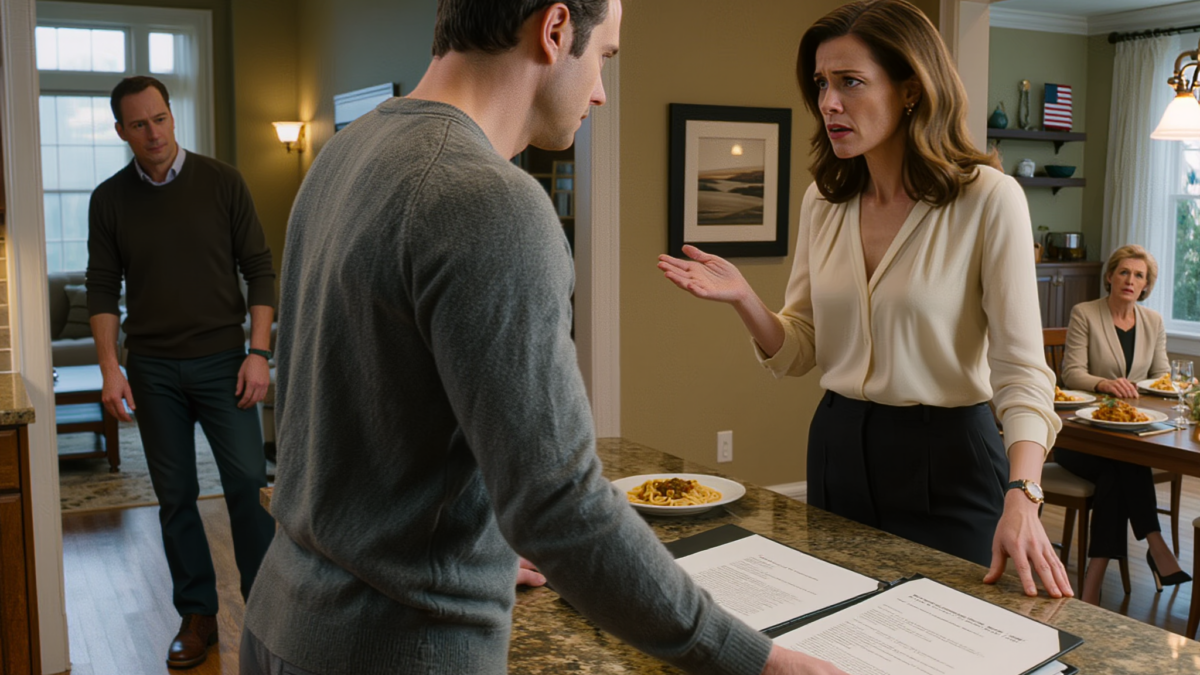
My name is Ethan Parker. I’m 32 years old, and for six exhausting years, I spent $82,000 of my personal savings supporting my wife’s family. I thought I was protecting my marriage. I thought that if I kept helping the people Sarah loved, we could eventually build the family we’d always wanted.
Instead, I found myself standing in our kitchen, surrounded by the smell of a dinner I’d spent two hours preparing, while my wife told me she wanted a divorce.
Her brother Dylan stood nearby with a smirk on his face. His twelve-year-old son, Caleb, was at the table, and my mother-in-law, Brenda, watched without saying a word in my defense.
What made that evening unbearable wasn’t simply the divorce. It was the heavy folder I had been keeping close for a week, waiting for the right moment to show Sarah.
Inside were the finalized adoption papers for a little girl.
I’d wanted to surprise my wife. I’d wanted to tell her that after everything we’d been through, we were finally going to become parents.
But before I could share the news, Sarah looked directly at me.
“I think maybe we should consider divorce,” she said.
Her voice was flat.
“You’re just not providing for this family the way you should. You’re holding us back.”
Dylan looked pleased with himself. Brenda offered no objection.
I stood there trying to understand how the people I’d spent years supporting could look at me as though I were the problem.
What they didn’t know was that I’d kept records of almost every dollar I’d spent on them. They also knew nothing about the family inheritance and trust arrangement that would eventually become central to the dispute.
At that moment, though, I wasn’t thinking about courtrooms or financial recovery. I was thinking about the little girl whose adoption papers were sitting in my kitchen drawer.
And I was realizing that the family I’d tried so hard to build might already be gone.
The evening had started with a pot roast.
I’d prepared it slowly, surrounding the meat with root vegetables and making a rich red wine reduction. The smell filled our Lincoln Park apartment in Chicago. I’d also made macaroni and cheese from scratch, grating three kinds of cheese because Caleb had mentioned three weeks earlier that he wanted some.
He hadn’t asked me to make it that night. I’d simply remembered.
That was how I approached family. If someone needed something, I tried to help. If they mentioned something that would make them happy, I remembered it.
Unfortunately, Sarah’s family had learned to treat that habit as an obligation.
Brenda arrived at 4:00 p.m., supposedly to keep me company while I cooked. Instead, she sat at the kitchen island and criticized nearly everything I did.
She noticed a water spot on the stainless steel faucet. She complained that I’d sliced the carrots too thick. She lifted the lid from the pot roast, inspected it, and put it down again without offering a compliment.
By the time dinner was nearly ready, my hands smelled of rosemary and rendered fat. I’d been fighting a headache behind my left eye since noon.
Still, I was excited.
Sarah and I had struggled to become parents. The strain had been difficult on both of us, and I’d finally taken the initiative to visit an adoption agency.
I remembered sitting in a cold office on a freezing Tuesday afternoon, wearing my winter coat while I signed the documents. My hands had been shaking, partly from nerves and partly from the significance of what I was doing.
Three weeks earlier, I’d learned that we had been approved for a little girl. I’d held on to the news, waiting for a moment when Sarah and I could celebrate privately.
I’d bought sparkling apple cider and put it in the refrigerator. I’d even written down what I wanted to say.
Then Dylan arrived at 5:30 p.m.
He walked through our front door without knocking, as he always did. He dropped his expensive leather coat, which I’d bought him the previous Christmas, onto an armchair I’d repeatedly asked him not to use as a coat rack.
He settled onto the couch and turned up the volume on his phone.
Caleb went straight to the refrigerator and started searching through the groceries I’d purchased.
I continued cooking.
Sarah came home at 6:15 p.m., dressed in the pressed blouse and expensive shoes she wore to her corporate job. She carried the designer bag she’d insisted she needed to maintain her professional image.
Dylan intercepted her in the entryway.
“Sarah, I really need to talk to you,” he said.
I could hear him from the kitchen.
“Ethan ordered another one of those subscription boxes today. The third one this month. I saw the package downstairs. You work so hard for your salary, and he just… I don’t know. I worry about you. You’re carrying the weight of this whole family.”
I put down the serving spoon.
The package he’d seen contained custom nursery decorations, high-end baby monitors, and a book about early childhood development. I’d bought those items with my own money, using savings I’d accumulated before our marriage.
Before moving to Chicago, I’d worked as a logistics coordinator. I’d given up that position to support Sarah’s career, but the money I’d saved from those years remained mine.
Dylan never mentioned that part.
Sarah entered the kitchen with a familiar crease between her eyebrows.
“What did you buy now, Ethan?”
“Things I needed,” I replied. “They were personal items.”
“Three huge boxes of personal items?”
From the living room, Dylan added another accusation.
“He’s probably buying more useless junk to guilt you into paying his way again.”
I looked toward him.
For six years, I’d helped cover his expenses. Hearing him accuse me of depending on Sarah was almost impossible to process.
Brenda arranged her napkin across her lap.
“Ethan, sweetheart, nobody is accusing you of anything. But you have to think about the whole family. We all share in Sarah’s success. That means you need to be mindful of the budget. We have a lot of expenses.”
Mindful.
I’d spent years being mindful.
I’d been mindful when Dylan couldn’t afford Caleb’s private academy tuition. The school cost $14,000 a year, and I’d begun making the payments after Dylan fell behind.
I’d been mindful when Brenda needed her roof repaired and Sarah said her account was short.
I’d been mindful when Dylan missed insurance payments and risked losing his coverage.
And I’d been mindful every time a grocery trip for our household somehow became an opportunity to feed additional relatives.
The requests had never started with large amounts.
When Sarah and I first married, Dylan occasionally needed help with a utility bill. Brenda had an unexpected expense. Someone needed money until the next paycheck.
I wanted to be a dependable husband. I believed helping Sarah’s family would show her how seriously I took our marriage.
Eventually, those occasional favors became recurring payments.
Dylan was 35 and had never held a steady job for longer than eight months. He was always waiting for a better opportunity, usually connected to some promising technology venture that never produced the income he expected.
Sarah and Brenda believed he was misunderstood.
I was expected to finance that belief.
The school tuition had been particularly difficult to refuse.
After Dylan failed to make the payments following Caleb’s first semester, Sarah came to me in tears.
“It’s for Caleb’s future, Ethan,” she pleaded. “You can’t let a child suffer because of his father’s temporary setbacks.”
I couldn’t bring myself to say no.
So I paid the academy directly from my savings.
Then came the Porsche.
Dylan insisted that driving an ordinary sedan to interviews made him look unsuccessful. He claimed he needed a luxury vehicle to convince potential employers that he belonged in an executive position.
After enough arguments, I found myself at a dealership co-signing the lease.
I also began making the monthly payments.
Meanwhile, Sarah continued spending on her professional image, and I quietly reduced my own expenses to keep everything running.
I skipped lunches. I wore old shoes. I watched my savings decline.
And somehow, I was still the person being told to think about the family budget.
That evening, Sarah set down her purse.
“Maybe we should talk about your spending separately from the family budget.”
“That’s fine,” I said.
She paused.
“In fact, I think maybe we should just talk about whether this arrangement is working at all.”
I watched her expression.
“I think maybe we should consider divorce.”
The apartment went quiet.
I could hear the pot roast bubbling in the oven.
Dylan looked up from his phone with an expression that made it clear he welcomed the suggestion.
Caleb reached for a dinner roll, apparently unaware of the significance of what his aunt had just said.
Brenda adjusted the tablecloth.
Nobody defended me.
I’d loved Sarah since I was 26. I’d moved away from my hometown, my parents, and my friends to build a life with her.
I’d believed we were working toward something together.
Now she was discussing ending our marriage in front of the very people whose expenses I’d spent years covering.
“Okay,” I said.
Dylan looked up sharply.
Sarah blinked.
“Okay,” I repeated. “If that’s what you really want.”
I opened the kitchen drawer and removed the thick folder.
I placed it on the granite counter in front of her.
“I finalized the adoption today,” I told her. “I found out three weeks ago that we were approved for a little girl. I wanted to tell you tonight we were going to be parents.”
Nobody spoke.
Sarah looked from the folder to my face.
Then Dylan laughed.
“You’re making that up. You don’t have the money for an adoption.”
I didn’t answer him.
I looked at Sarah.
“I’ll pack my bags. I’ll be out of here in twenty minutes.”
Then I told her that after that month, I would stop paying Caleb’s tuition.
I also told Dylan that responsibility for the Porsche payments would be his starting the following day.
I was finished financing his lifestyle.
I walked into the bedroom and packed a large suitcase.
I took my clothes, laptop, important files, and a locked metal box from the back of the closet.
That box contained years of records: bank transfers, receipts, screenshots of Dylan asking for money, and documents connected to Brenda’s expenses.
I hadn’t collected them because I was planning revenge. I’d kept them because, somewhere in the back of my mind, I understood that I might eventually need to prove what I’d contributed.
When I returned to the hallway, Sarah was standing near the door.
“You’re really leaving?” she asked. “Over one argument?”
“Over six years of arguments.”
I walked around her.
I reminded her that the school would need to send future tuition notices to Dylan.
Then I closed the door behind me.
I took the elevator to the parking garage, loaded my suitcase into the car, and drove north toward Wisconsin.
The highway was dark. My headlights illuminated the lane markings, and the heater ran constantly, but I couldn’t get warm.
For nearly four hours, I thought about the money.
$82,000.
That was approximately how much of my personal savings had disappeared during our marriage.
I’d spent it trying to keep Sarah’s family financially stable.
And when Sarah decided she no longer wanted me, her family still expected the payments to continue.
I reached my parents’ house in Wisconsin around 2:00 a.m.
The porch light was on.
Before I could turn off the engine, the front door opened.
My mother, Martha, came outside wearing a thick winter robe. She saw my face and the suitcase beside me.
She didn’t ask what had happened.
She simply hugged me.
Inside, she made decaf coffee and sat with me in the kitchen until I stopped shaking.
The next morning, I woke to the smell of bacon and eggs.
My father, Arthur, was sitting at the kitchen table.
He was a retired structural engineer who had spent his career thinking about foundations, calculations, and the consequences of overlooked weaknesses.
I sat across from him and told my parents everything.
I explained the divorce demand, the adoption papers, the tuition payments, the Porsche, and the $82,000.
My father listened without interrupting.
When I finished, he put down his coffee.
“There’s a family law attorney here in town,” he said. “I’ve heard exceptional things about him from a former colleague. His name is Ryan Mitchell.”
I hesitated.
“Dad, I don’t know. I don’t want a long, drawn-out war. I just want to be free of them.”
My father leaned forward.
He warned me that people who had depended on my money for years were unlikely to accept losing it without a fight.
He believed I needed someone who understood the law.
At 9:00 a.m., I called Ryan’s office.
By 1:00 p.m., I was sitting across from him.
Ryan was in his early fifties. His office was modest, with green plants and bookshelves rather than expensive decorations.
I placed my locked metal box on his desk and gave him the combination.
For two hours, he examined the documents.
He reviewed the transfers from my premarital account, Caleb’s tuition records, the Porsche lease, and the messages Dylan had sent requesting money.
When he finished, he stacked the papers neatly.
“You spent approximately $82,000 of your premarital savings over six years on your wife’s family’s expenses,” he said.
He noted the three years of private school tuition, the luxury vehicle payments, and Brenda’s debts.
The records were unusually detailed.
“I wasn’t doing it to build a case,” I told him. “I was just trying to survive. I thought I was keeping my marriage together.”
“I know,” Ryan replied. “But it builds a case anyway.”
He pulled out the Porsche lease.
Ryan noticed that Dylan had repeatedly referred to the payments as loans in written messages. Dylan had promised to repay me once he found employment.
Ryan explained that those messages might support a claim that the money wasn’t simply a gift.
While we were talking, my phone buzzed.
It was Dylan.
Caleb’s school had sent another notice. The automatic tuition payment had failed, and Dylan demanded that I fix it before Monday.
He told me to stop acting like a child and pay the bill.
I stared at the message.
Then I showed it to Ryan.
“What is our first move?”
“Absolute silence,” Ryan said. “We wait for them to make a mistake.”
Three days after I arrived in Wisconsin, Sarah’s attorney sent a proposed divorce settlement.
His name was Brandon Collins.
I printed the document at my parents’ kitchen table.
The demands were extensive.
Sarah wanted me to surrender my interest in the equity of our Chicago apartment. Her attorney argued that she needed the property value to maintain her established standard of living.
He also sought a substantial portion of my retirement savings.
Buried deeper in the proposal was language that appeared designed to keep me responsible for ongoing expenses connected to Sarah’s family.
That included Caleb’s tuition and the Porsche.
I couldn’t believe what I was reading.
They wanted me to leave the marriage while continuing to finance the people who had helped destroy it.
Then Sarah texted.
She told me to sign the agreement because it was fair, especially since I’d supposedly abandoned the family.
She also asked whether I could handle Caleb’s tuition payment one more time because the online portal was confusing.
That message changed how I understood her role in everything.
I’d spent years telling myself that Dylan manipulated Sarah and that she simply didn’t recognize what was happening.
But she was now asking me to continue paying her brother’s expenses after demanding a divorce.
I logged into my banking accounts.
I froze the joint credit cards, removed Sarah’s authorized access from my primary accounts, and transferred my remaining personal money to a secure Wisconsin account.
Then I called Ryan.
“We are absolutely not signing this,” I told him.
He agreed.
He began preparing our own petition and a counterclaim seeking recovery of the premarital funds I’d used to support Sarah’s family.
That afternoon, an old Chicago friend named Tyler Morgan called.
Tyler and I had played golf together. He was usually the person who tried to keep everyone on friendly terms.
He said he’d heard about the divorce and wanted to hear my side.
He also mentioned that he would be traveling through Wisconsin for a sales meeting and suggested coffee.
I agreed.
We met at a quiet diner near the highway.
Tyler arrived wearing a suit, ordered black coffee, and leaned across the booth.
He told me Sarah was furious and had been telling people I’d hidden money.
Then he asked whether I’d taken funds from our joint accounts before leaving.
He assured me that I could tell him the truth.
Something about his questions bothered me.
They were too specific, and he seemed unusually interested in getting me to admit financial misconduct.
I noticed his phone resting face down beside the sugar dispenser, positioned with the microphone opening toward me.
I suspected he was recording the conversation.
Rather than confront him, I told him I’d left the joint accounts untouched.
Then I deliberately invented a story to see how he would respond.
I claimed Dylan had threatened to damage the Chicago apartment and blame me unless I resumed the Porsche payments.
I said I had threatening messages and intended to take them to the police.
Tyler became visibly uncomfortable.
He asked whether Dylan had really threatened to frame me.
I continued the invented account, telling him I was concerned Sarah might be implicated if Dylan carried out such a scheme.
Tyler quickly reached for his phone.
He ended the meeting, left ten dollars on the table, and hurried away.
I’d started my own voice recording when I became suspicious.
After he left, I sent the recording to Ryan with an email explaining that I believed someone was trying to manufacture evidence against me.
I didn’t know how much of the plan Tyler had agreed to or who had directed him. But I knew I couldn’t treat the meeting as an ordinary conversation between friends.
Over the next three weeks, I focused on rebuilding my life.
I started a remote logistics consulting business from a small desk in my childhood bedroom.
I contacted people I’d worked with before, began taking clients, and wrote contracts for work that belonged entirely to me.
For the first time in years, I wasn’t measuring every paycheck against Dylan’s next emergency.
Meanwhile, the payments I’d stopped making were beginning to affect Sarah’s family.
Ryan notified the luxury vehicle financing company about the change in my financial backing for the Porsche lease.
Two days later, Dylan left a furious voicemail.
He said a tow truck had arrived to repossess the vehicle.
He demanded that I call the financing company and fix the problem.
He accused me of ruining their lives.
I saved the voicemail with my other records and didn’t respond.
Then I received a call from Justin Harper.
Justin was Sarah’s cousin, an accountant who sometimes helped Brenda with her taxes.
He disliked family conflict, so I was surprised to hear from him.
He told me Dylan was facing debts much larger than the Porsche payments or credit card balances.
According to Justin, Dylan had been gambling through online casinos and sports betting.
He also said Dylan had convinced Sarah to pursue the divorce because he expected her to receive money from a rapid








