My parents left the house I grew up in to my younger brother in their will, even though I’d spent seven years sending them $1,200 a month. I discovered it while scanning their paperwork; my name appeared only in a sentence saying they loved us both equally. Weeks later, Mom texted, “The mortgage is due. Can you send what you usually do?” I didn’t open my banking app. I wrote six words instead.
The screen of my phone cast a pale blue light across my dimly lit office.
It was a Tuesday afternoon, and I was sitting through a conference call while my boss discussed work in my earbud. Outside the window, the city skyline stretched into the distance. Everything about the day was ordinary until a message from my mother appeared.
“The mortgage is due. Can you send what you usually do?”
A month earlier, I would have answered without thinking. I would have opened my banking app, found the familiar account, and transferred the money.
I’d been doing some version of that for years.
My name is Benjamin Rivers. I’m 38 years old, and for most of my adult life, I was the person my family called whenever something needed to be fixed, paid for, or figured out.
My parents had come to depend on that arrangement. So had my younger brother, Lucas.
Until recently, I had considered it part of being a good son.
But sitting in my office that afternoon, staring at my mother’s message, I couldn’t stop thinking about a document I’d discovered several weeks earlier.
I remembered the words my father had used when I confronted him. I remembered my mother’s explanation. Most of all, I remembered the years I’d spent keeping their finances from falling apart.
I placed my thumb on the keyboard.
Instead of opening my banking app, I typed six words.
“Ask Lucas. It’s his house now.”
I pressed send.
For the first time in my adult life, I had deliberately refused to play the role my family had assigned me.
To understand why, I have to go back one month.
It started on a sunny Saturday when I drove 40 minutes to my parents’ house with my laptop and a portable scanner.
My mother, Eleanor, had called a few days earlier. She and my father were overwhelmed by years of paperwork and wanted everything organized digitally.
“Benjamin, honey, your father and I are drowning in paperwork. We need to get everything digitized like you said. But these machines are just so confusing.”
I agreed to help.
I’d grown up in that house. Walking through the front door still brought back familiar memories: the smell of lemon polish, my father’s old leather chair, and the roses my mother kept on the dining table.
It was the place I’d always associated with security and belonging.
My father, Henry, greeted me with a clap on the shoulder.
“You’re a lifesaver, Ben. We’d be lost without you.”
“It’s no problem, Dad,” I replied. “Better to get this sorted out.”
He brought me to the dining table, where three cardboard boxes were overflowing with documents.
There were old bank statements, tax returns, car titles, and report cards from my childhood. Some of the papers dated back decades.
Lucas was nowhere to be seen.
“He’s at a buddy’s place,” Dad explained. “Working on some music stuff.”
It was the kind of answer I’d heard my entire life.
Lucas was 34, still living at home, and frequently occupied with projects that never seemed to become permanent employment.
Nobody expected him to spend a Saturday helping our parents organize their records.
That responsibility belonged to me.
For several hours, I worked through the boxes, scanning documents and creating neatly labeled digital folders.
The process was repetitive but peaceful.
Then I reached the final box.
It had come from the back of my father’s closet and smelled faintly of mothballs. Beneath several old utility bills, I discovered a thick, professionally bound folder.
It looked different from everything else.
The cover carried a formal label:
“Estate Plan, Final Copy.”
I wasn’t particularly alarmed.
My parents were getting older, and preparing an estate plan seemed sensible. I assumed they had finally organized their affairs.
I also assumed the estate would eventually be divided between Lucas and me.
A straightforward 50/50 split seemed reasonable.
I opened the folder.
The legal language was dense, but I found the section concerning distribution of assets.
Article 4: Disposition of Residuary Estate.
One paragraph immediately caught my attention.
“I give, devise and bequeath all the rest, residue and remainder of my estate to my son Lucas M. Rivers.”
I read it twice.
Then a third time.
I started turning pages, convinced I’d misunderstood something.
The house was designated for Lucas.
The investment portfolio I’d helped Dad establish after his contracting business failed was designated for Lucas.
Even the life insurance policies whose premiums I’d occasionally helped cover appeared among the assets intended for him.
I searched for my name.
Eventually, I found it near the end, under General Provisions.
“We love both of our children, Benjamin H. Rivers and Lucas M. Rivers, equally, and we trust them to care for one another after we are gone.”
That was the only recognition I could find.
Everything of financial value had been left to my brother. My name appeared in a sentence about love and trust.
I sat there for a moment, trying to understand how my parents could have made that decision without telling me.
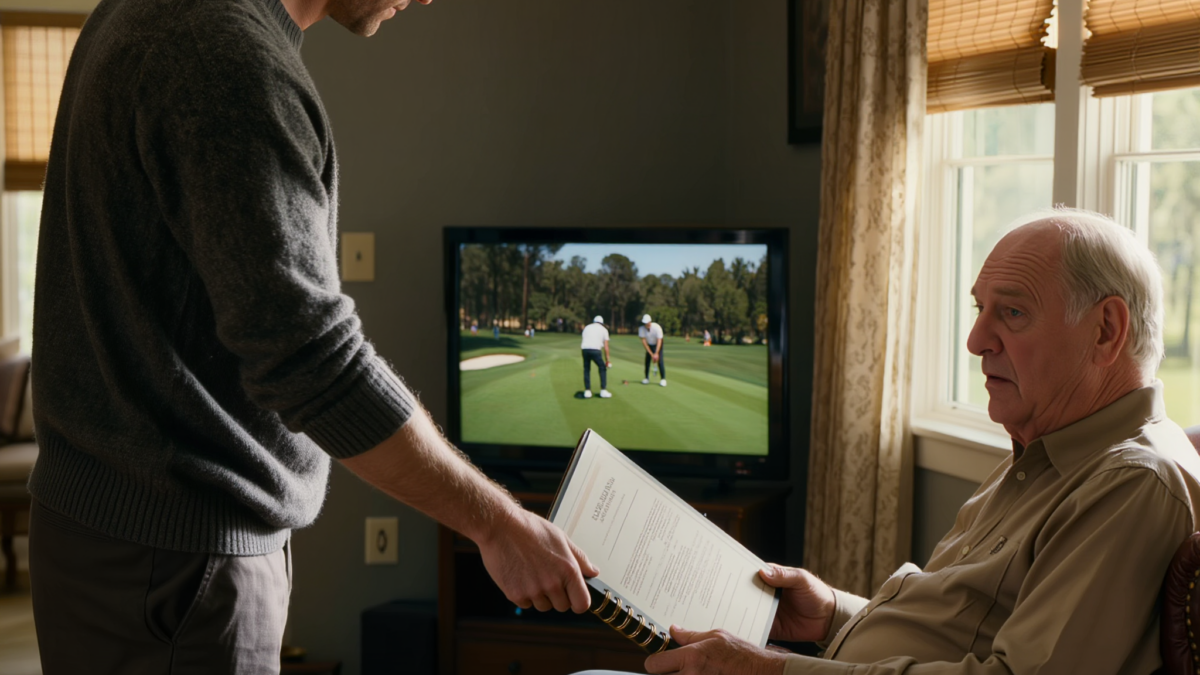
Then I closed the folder and walked into the living room.
Dad was sitting in his recliner, watching a golf tournament.
I held the folder toward him.
“Is this how it is, Dad? Everything? Everything goes to Lucas?”
He looked from the television to the folder, then toward me.
He didn’t seem surprised.
He sighed and muted the television.
“We figured you’d understand, Ben,” he said.
Then he explained.
“You’re doing well for yourself. You’re a project manager. You have a good salary. You’ve always done well.”
He spoke as though those facts settled the question.
I waited for him to acknowledge what I’d contributed to the family.
He didn’t.
Instead, he looked toward a spot on the wall behind me.
His decision had already been made, and he apparently expected me to accept it.
I walked outside and sat on the wooden swing on the back porch.
I’d installed that swing myself two summers earlier after the old one rotted.
Lucas had been at a jam session that Saturday.
As the chains creaked, I began thinking about all the other things I’d done for my parents.
Five years earlier, when I was 33, I’d been offered an opportunity to lead a new team in Boston.
It came with a vice president title and a substantial salary increase.
My director had been enthusiastic about my future.
I was excited too, until I told my mother.
“Oh, Boston,” she’d said anxiously. “That’s so far away, honey. What would your father and I do without you around to help with things?”
I ended up telling my boss I couldn’t accept the promotion for family reasons.
At the time, I thought I was doing the right thing.
Now I wondered what I’d sacrificed.
And Boston wasn’t the only example.
When I was 28, Dad’s small contracting business collapsed.
My parents were two months behind on their mortgage, and the bank had started foreclosure proceedings.
Dad called me in a panic.
The following day, I went to my bank and arranged a personal loan for $11,000.
I gave my parents the cashier’s check.
Mom cried and called me their guardian angel.
They promised to repay me when their finances improved.
Ten years later, they hadn’t returned any of it.
There had also been two other occasions when unpaid property taxes put the house at risk.
Each time, I took money I’d been saving for a down payment on my own home and used it to help them.
Then there were the smaller payments.
Car insurance every six months.
Weekly grocery orders.
A $2,000 dental bill for Dad that his insurance wouldn’t cover.
And countless requests from Lucas to borrow a hundred dollars until the following week.
I rarely saw that money again.
For years, I’d treated each expense as an individual act of kindness.
Sitting on the porch, I began seeing the pattern.
My parents had grown accustomed to receiving financial support from me, but when they planned the future of their assets, they had chosen Lucas.
The screen door opened.
Mom came outside and sat beside me.
For a while, neither of us spoke.
Then she said, “It’s not that we don’t love you, honey.”
I kept looking at the porch floor.
“Funny way of showing it.”
“Please, Benjamin, try to understand,” she said, placing a hand on my arm. “Lucas, he’s just had a much rougher time of it. Things haven’t come as easily to him as they have to you. You’re steady. You’re smart. You’ve always been our rock.”
I finally turned toward her.
“So, the rock gets nothing? The rock just gets to hold everyone else up until it crumbles into dust?”
“Don’t be so dramatic,” she answered.
She insisted the decision wasn’t about what I received. It was about what Lucas needed.
“We knew you would be okay. You always land on your feet. We had to make sure he would be taken care of after we’re gone. He’s more fragile.”
That word bothered me.
Fragile.
Lucas was a grown man who had never established a stable career.
Yet his difficulties were presented as reasons to protect him, while my reliability was being used as a reason to give me nothing.
“And what about me?” I asked. “What about what I need? Did you ever stop to think that maybe I’m steady because I have to be? That I can’t afford to be fragile because I’ve been too busy being your financial planner, your handyman, and your emergency contact?”
Mom pulled her hand away.
Then she lowered her voice.
“Look, there’s something else.”
She explained that she and Dad had co-signed a business loan for Lucas’s recording studio idea.
They’d believed it might finally give him a career.
I remembered that studio.
There had been some secondhand recording equipment, but by then it was mostly sitting unused in the basement.
“How much was the loan, Mom?”
She waved the question away.
“Oh, it wasn’t a huge amount, but it was significant for us. We just… we have to make sure that’s covered. The will helps with that. It secures his future and ours.”
I stared at her.
Now I was beginning to understand that the estate decision involved more than her concerns about Lucas’s future.
My parents had financially committed themselves to his business idea.
The will was connected to that decision.
“You didn’t choose him because he’s fragile,” I said. “You chose him because you bet on him and lost. You gave him his inheritance years ago, and now you’re making me pay for it. This will isn’t a gift. It’s an insurance policy on your bad investment.”
She looked guilty.
For a moment, she appeared ready to argue, but nothing came out.
I stood.
“I have to go.”
I left her sitting on the swing.
The drive back to my apartment took about 40 minutes.
During that drive, I made a decision.
I couldn’t control my parents’ estate plan, and I wasn’t going to force them to change it.
But I could control what happened to my own money.
When I got home, I walked straight into my office and opened my banking account.
For seven years, a scheduled payment of $1,200 had left my checking account on the first day of every month.
It was one of the most familiar transactions in my financial life.
I found it, clicked Edit, and selected Cancel Series.
A confirmation window appeared.
“Are you sure you want to cancel the scheduled transfer?”
I clicked Confirm.
That was it.
The automatic payments stopped.
Next, I opened my phone calendar.
For years, I’d kept reminders for my parents’ errands and responsibilities.
Order Dad’s medication every third Tuesday.
Call the plumber about the leaking faucet.
Check in on Mom every Sunday.
I deleted the recurring reminders.
Then I opened Instacart.
I’d created an account for my parents during the pandemic, and ordering their groceries had become part of my weekly routine.
I knew the coffee they preferred, the low-sodium soups Dad needed, and the ice cream Mom liked.
My credit card was still listed as the primary payment method.
I removed it.
The changes were small in appearance, but they represented something I’d never done before.
I was ending the assumption that their expenses and responsibilities automatically belonged to me.
I leaned back in my chair.
I wasn’t happy about what had happened.
But I did feel relieved.
I also knew my parents wouldn’t see it that way once they noticed.
The first week passed without any reaction.
During the second week, Mom sent a message about a higher-than-usual water bill.
She said the online portal was confusing and asked me to check the account.
Ordinarily, I would have handled it.
This time, I deleted the message thread without responding.
A few days later, Dad texted.
“Hey, Ben, the cable seems to be out. Did you pay the bill?”
I’d been managing their cable and internet payments for years.
I didn’t answer.
Then came the third week.
On the fifth of the month, Mom finally asked directly about the mortgage.
“The mortgage is due. Can you send what you usually do?”
That was the message I received while sitting in my office.
I read it and sent the answer I’d been thinking about for days.
“Ask Lucas. It’s his house now.”
The response was immediate.
Lucas called first.
I let the call go to voicemail.
Then he sent a text.
“Danny, what the hell? Mom is freaking out. She said you sent some crazy text. Don’t be a drama queen. Just help them out like you always do. This isn’t funny.”
Even then, he treated my decision as a temporary tantrum.
I answered him.
“This isn’t a joke, Lucas. This is the new reality. You’re the one who deserves it. You’re the sole heir. So, step up and be the man of the house. Handle it.”
He sent back angry emojis and insults.
Then he wrote, “It’s not about money. It’s about family.”
I didn’t reply.
About an hour later, an email arrived from Dad.
The subject was “Urgent Mortgage Payment.”
There wasn’t even a personal message in the body.
Instead, I found a payment request from the bank’s portal for $3,200, including a late fee.
They were still expecting me to pay.
I clicked Decline.
When the system asked for a reason, I typed one word.
“No.”
After that, the messages became more emotional.
Mom warned that they could lose the house.
She reminded me it was my childhood home and asked whether I wanted to see them without a place to live.
Dad accused me of cruelty.
Lucas said I was tearing the family apart because I was jealous.
I silenced my phone.
They had made their estate-planning decision without asking for my approval. I had made my financial decision without asking for theirs.
But they weren’t prepared to accept it.
When their direct messages failed, they began discussing the conflict publicly.
Mom posted a photograph of a sunset on Facebook.
Her caption talked about parents who gave their children everything, only to discover that some children never learned gratitude.
Friends and distant relatives rushed to comfort her.
People called her a wonderful mother and criticized selfish adult children.
Dad followed with a shared article about grown children abandoning elderly parents.
He added his own comment about discovering who would stand by you when times became difficult.
My uncle Robert responded sympathetically.
Watching these posts was painful.
People who had known me for years were reacting to a version of events that omitted my financial contributions entirely.
Then Lucas posted something worse.
He shared a family Christmas photograph from the previous year.
It had been taken on the front porch, with everyone wearing festive sweaters.
But he’d cropped me out.
There was an awkward empty space beside Mom where I had been standing.
Under the photo, Lucas wrote about people who only valued family when they expected an inheritance.
He presented himself as the loyal son protecting his parents.
My cousin Sarah praised him.
Others joined in.
I sat scrolling through the comments, staring at the space where I’d been removed from our family picture.
That house had required years of my financial help.
I had contributed to keeping it from foreclosure.
I’d paid bills, managed errands, and given up career opportunities because my parents needed me nearby.
Yet Lucas had reduced my place in the family to an empty space in a photograph.
I felt more isolated than I had at any point since discovering the will.
Then relatives began calling.
Aunt Carol, my mother’s older sister, contacted me first.
She opened with expressions of concern.
She said Mom was barely eating or sleeping and mentioned Dad’s heart condition.
Then she repeated the explanation I’d already heard.
Lucas needed security. I had a successful career. Therefore, I should understand why the estate was arranged differently.
“Family is supposed to support each other,” she reminded me.
“I supported them for 15 years,” I replied. “I supported them to the tune of tens of thousands of dollars. I supported them by putting my own life on hold. This isn’t about support, Aunt Carol. This is about being used.”
Then I asked whether Mom had mentioned the business loan she’d co-signed for Lucas.
Carol hesitated.
She said she didn’t want to discuss the details and insisted that family mattered more than money.
The call ended without changing anything.
That night, I met my friend Michael for a beer.
Michael knew the whole situation.
I showed him the Facebook posts and the altered Christmas photograph.
He was furious.
He couldn’t believe Lucas had removed me from a family photograph while publicly accusing me of abandoning our parents.
Michael believed they were trying to control the story by presenting themselves as victims.
I admitted that seeing relatives believe those posts still hurt.
Michael told me that family meant more than shared blood.
He reminded me that people who supported me mattered more than those trying to pressure me.
When I asked what else I could do, he told me to hold my ground.
I’d already made my decision.
I didn’t need to keep arguing with people who refused to acknowledge why I’d made it.
His words helped.
The following day, another call came.
This time it was David, an old family friend who had known Dad for 30 years.
David was direct from the beginning.
He said he’d spoken with Dad, who sounded defeated.
Then he demanded to know what I was doing to my parents.
I told him he didn’t understand the situation.
He responded by talking about duty, loyalty, and the risks my parents had taken for Lucas.
“They took a massive risk for Lucas a few years ago, and it didn’t pan out,” he said.
Something in that statement caught my attention.
“A massive risk?” I repeated. “What are you referring to exactly?”
David seemed irritated by the question.
He assumed I already knew.
“That business loan they co-signed for him, putting up $35,000 for a kid’s dream. That takes guts.”
I stopped moving.
“$35,000?”
“Yeah, $35 grand,” David answered.
He said Dad had worried for months that Lucas wouldn’t be able to make the payments.
Apparently, those concerns had been justified.
I leaned against the wall.
Mom had described the loan as not being a huge amount.
She’d refused to give me a number.
Now David had supplied one.
Thirty-five thousand dollars.
That revelation changed how I understood the conversation on the porch.
My parents hadn’t merely helped Lucas with a small amount of secondhand studio equipment.
They’d committed themselves to a substantial business loan.
And when I asked why the will favored him, Mom had connected their decision directly to that financial obligation.
I couldn’t independently prove every motive behind their estate plan.
But I could no longer accept that the arrangement was simply about Lucas being more fragile.
For years, my money had supported the family while my parents continued making financial decisions around my brother.
Now they wanted me to keep paying into a household whose future assets had been reserved for him.
“Ben, you still there?” David asked.
“Yeah, David,” I said. “I’m here, and you just gave me the one thing I was missing, the truth.”
I ended the call.
I had intended to keep my distance and let the situation settle.
My family had other plans.
The next day, they came to my workplace.
I was in a quarterly review meeting with my team and two senior directors.
We were discussing projected revenues when my desk phone rang.
I ignored it initially.
It rang again.
The caller ID showed the front desk.
I apologized to the room and answered.
“Benjamin?”
It was Jessica, the lobby receptionist.
She sounded uncomfortable.
“I’m so sorry to interrupt your meeting, but your family is here in the lobby. They’re being quite insistent on seeing you.”
I felt my stomach tighten.
My parents and Lucas had already tried phone calls, emails, and public criticism.
Now they’d come to my office.
“Tell them I will be down in five minutes, Jessica,” I said. “And thank you.”
I turned back to the meeting.
“Gentlemen, I apologize. A pressing family matter has come up that requires my immediate attention. We’ll have to reschedule.”
They understood.
As I walked toward the elevators, I considered finding a private conference room and bringing my family there.
I didn’t want colleagues witnessing an argument about my personal life.
I’d worked hard to earn their respect.
But as I approached the lobby, I remembered the Facebook posts and the Christmas photograph.
My family had already decided to make the dispute public.
I wasn’t going to pretend their accusations were justified merely to spare everyone an uncomfortable conversation.
The elevator opened onto the bright, spacious lobby.
There were marble floors, polished metal surfaces, and people moving through the building.
In the middle stood my parents and Lucas.
Dad’s face was flushed. His sport coat looked rumpled.
Mom was pale and tearful, holding her purse close.
Lucas stood behind them, visibly irritated.
Jessica looked relieved when she saw me.
I gave her a brief nod and approached my family.
I stopped about 10 feet away.
“This is wildly inappropriate,” I said. “You need to leave now.”
“We’re not leaving until we talk to you,” Mom answered. “You won’t answer our calls, Benjamin. What else were we supposed to do?”
Her raised voice attracted attention from people walking through the lobby.
Dad stepped forward.
“You’d really let us lose the house?”
I held my ground.
“The question isn’t what I would let happen,” I replied. “The question is, did you really think I would keep paying for a house you secretly gave to someone else?”
Several people slowed down to listen.
Mom returned to the explanation she’d offered on the porch.
“We thought you’d understand. You’ve always been the strong one, the responsible one.”
“And you used that strength as an excuse to erase me,” I said. “You used my responsibility as a blank check to fund his endless stream of failures.”
I looked toward Lucas.
He scowled.
“This has nothing to do with me,” he snapped. “This is about you being a selfish, greedy—”
“It has everything to do with you,” I interrupted.
By then, the lobby had become unusually quiet.
I noticed a group of executives emerging from one of the elevators.
Among them was our CEO, Mr. Thompson.
They stopped when they saw what was happening.
My family hadn’t noticed them.
Dad continued speaking.
“We raised you. We fed you. We gave you everything.”
He pointed toward me.
“You owe us. You have a duty to this family.”
For years, those words had been enough to make me reconsider almost any decision.
This time, they weren’t.
“Owe you?” I repeated. “Let’s talk about debts, Dad.”
I reminded him of the monthly mortgage support, the money I’d taken from my savings to prevent foreclosure, and the Boston promotion I’d abandoned so I could remain nearby.
“I paid and paid and paid,” I told him. “And what was my reward? My thank you? You wiped my name from your legacy and pretended I never existed.”
Mom began crying.
“We didn’t mean to hurt you.”
“You didn’t mean to?” I asked. “Then why did you lie to me? Why did you wait for me to disappear before realizing I was the only thing holding your entire world together?”
I looked briefly toward Mr. Thompson.
Then I faced Dad again.
“You want to talk about what I owe you? Let’s talk about the $35,000 you owe me.”
His face lost its color.
Mom gasped.
Lucas looked from one parent to the other.
“I… I don’t know what you’re talking about,” Dad stammered.
“Oh, I think you do,” I answered. “Let’s talk about the secret business loan you co-signed for Lucas. The one you never told me the real amount of. The catastrophic debt that made you write that will.”
I continued, explaining what I now believed.
“It wasn’t a choice between your sons, was it? It wasn’t about who deserved it more. It was a desperate financial maneuver. You were just paying off a bad debt. And you decided that my inheritance, my security, my entire 15-year contribution to this family was the price you were willing to pay.”
Nobody interrupted.
For the first time since discovering the estate plan, I had expressed the full extent of my anger without letting my parents redirect the conversation toward my supposed selfishness.
They stood there unable to answer.
The other people in the lobby had heard enough to understand that the situation was more complicated than parents asking their son for help.
I could see shock and concern on several faces.
But the reaction that mattered most was my family’s.
Dad had arrived expecting to demand obedience.
Now he seemed unable to continue.
Mom’s tears no longer stopped the conversation.
Lucas, who had been so confident in his social media posts, had nothing useful to say.
There was nothing left for me to explain.
Eventually, all three turned toward the doors.
They walked out of the lobby without looking back at me or at one another.
After they left, people gradually resumed moving through the building.
I remained where I was.
The confrontation had taken more out of me than I’d expected.
I felt exhausted.
Then someone spoke behind me.
“Benjamin.”
I turned.
It was Mr. Thompson.
He approached quietly.
I assumed he was about to lecture me about bringing personal problems into the workplace.
Instead, he placed a hand on my shoulder.
“I’m not going to pretend I understood all of that,” he said. “But what I do understand is character, and what I just saw took an incredible amount of it.”
Then he told me to go home.
He offered me the rest of the day off and the following day if I needed it.
“Your job will be here when you get back.”
I struggled to answer.
My own family had spent weeks criticizing my character, yet my boss had responded to an uncomfortable public situation with respect.
“Thank you, sir,” I managed. “That… that means a lot.”
He nodded and walked away.
On the drive home, my phone began receiving calls and messages again.
I didn’t block the numbers.
I turned on Do Not Disturb.
The messages continued for another day or two.
Some were angry. Others pleaded with me to reconsider.
Eventually, they stopped.
A few weeks later, I found myself driving through my old neighborhood.
It was a quiet Sunday afternoon.
The streets looked familiar, and I slowed as I approached the house where I’d grown up.
Then I saw a red-and-white sign planted in the front lawn.
“For Sale.”
I stopped long enough to take it in.
The wooden porch swing I’d assembled was still there, motionless.
Mom’s rose bushes looked neglected.
The house I’d spent years helping to preserve was now being offered to someone else.
My phone buzzed in the cup holder.
A missed call from Dad.
Then another from Mom.
I watched the screen.
For years, those names appearing on my phone had meant there was something I needed to do.
Now I felt strangely detached.
I didn’t feel victorious about seeing the house for sale.
Nor did I feel responsible for solving the situation.
I’d stopped paying because I no longer accepted the arrangement.
What my parents did afterward was their decision.
I put the car in drive and continued down the street.
I didn’t look back.
The following six months changed my life in ways I hadn’t expected.
Without the constant financial demands, I began having more room for my own plans.
I wasn’t organizing every week around my parents’ bills, appointments, and emergencies.
Then Mr. Thompson called me into his office.
It was about a week after the lobby confrontation.
He didn’t ask about my family.
Instead, he pointed to a map on the wall.
“Boston,” he said.
I recognized the city immediately.
“The VP position we discussed five years ago. The team is expanding again. The job is yours if you want it. This time for real.”
Five years earlier, I’d turned down that opportunity because Mom convinced me she and Dad couldn’t manage without me.
This time, I didn’t call her.
I didn’t ask whether anyone needed me to stay.
“I’ll take it,” I said.
Moving to Boston felt like a fresh beginning.
I sold my old apartment and most of the furniture, keeping only what I needed.
Michael flew out to help me settle into the new place.
We spent a weekend painting the walls of my high-rise apartment, which overlooked the Boston skyline.
At one point, we sat on the living room floor among the boxes, drinking beer.
“To new beginnings,” Michael said, lifting his bottle. “And to leaving the vampires behind.”
I laughed.
It had been a long time since laughing felt that easy.
“I couldn’t have done it without you, man.”
He looked at me seriously.
“Yes, you could have. You just needed to finally believe you were worth fighting for. I’m just glad I was here to see it.”
Life in Boston suited me.
I threw myself into my new role, and my work went well.
I made friends, started dating again, and explored the city.
For the first time in years, I was making decisions based on what I wanted instead of anticipating what my parents would need.
I occasionally heard news about them through a couple of cousins.
The house had sold at a loss.
My parents had moved into a small, run-down rental apartment in a town about an hour away.
Then I learned something unexpected about Lucas.
He’d gotten a job at a distribution warehouse.
A real, full-time job.
For the first time in his 34 years, he was supporting himself without the same level of assistance from our parents and me.
I didn’t feel the satisfaction I might once have imagined.
I simply accepted the news.
Without the arrangement we’d all maintained for so long, Lucas had finally been required to make changes.
One crisp autumn evening, I was watching the sunset from my apartment window when my phone rang.
The number was unfamiliar.
I answered.
“Benjamin.”
The voice sounded familiar, but I couldn’t place it immediately.
“Aunt Susan?”
She was my mother’s youngest sister.
Unlike Carol, Susan had generally stayed away from family disputes.
“Yes, it’s me,” she said. “I’m sorry to call out of the blue. I got your new number from Michael. I hope that’s okay.”
“It’s fine, Aunt Susan. It’s good to hear your voice. Is everything all right?”
She assured me she was fine.
Then her tone changed.
“I’m calling to apologize. I should have called months ago when all that ugliness was happening on Facebook. I stayed silent, and I’m ashamed of that. What Eleanor and Henry did to you was unforgivable. I want you to know that.”
Her apology affected me more deeply than I’d expected.
During the months when my parents and Lucas had been criticizing me publicly, very few relatives had tried to understand my side.
Susan was acknowledging that silence.
“Thank you,” I told her. “That means more than you know.”
She hesitated.
“There’s something else. Something you deserve to know. It might not change anything, but it might help you understand that this wasn’t about you. Not really.”
I sat down on my sofa.
“What is it?”
She began telling me about something that had happened before Lucas and I were born.
Our grandmother had passed away and left a modest inheritance to her daughters.
Susan remembered receiving about $10,000, which had been a considerable sum at the time.
Around that period, Dad’s first business had been struggling.
Mom had approached Susan and another sister, Margaret, asking to borrow their inheritance money.
She promised to repay it within a year.
Susan believed her.
“I was young and foolish, so I gave it to her,” she said.
Margaret refused.
Years later, Margaret went through a difficult divorce and found herself in serious financial trouble.
She approached Mom and Dad for assistance.
She wasn’t demanding repayment of the inheritance money.
She only wanted a small loan to get back on her feet.
According to Susan, Mom and Dad refused.
They told Margaret she was irresponsible and should have planned her finances better.
Then they cut her off.
I listened in silence.
Susan continued.
“They have a pattern, Benjamin. A sick, twisted pattern of using one person’s resources to fund their ambitions and then abandoning that person when they’re no longer useful.”
She believed the way my parents treated me wasn’t an isolated incident.
They had accepted Susan’s money when they needed it and later rejected another family member who needed help.
They had relied on my financial support for years while making decisions that favored Lucas.
“You weren’t the first person they sacrificed,” Susan said. “But I am so damn proud of you for being the last.”
When the call ended, I remained on the sofa for a long time.
The city lights were beginning to appear outside.
Her story hadn’t changed what my parents had done.
But it changed something about how I understood it.
I’d spent months wondering whether I could have been a better son.
Whether I should have worked harder, given more, or somehow made my parents understand how much I’d already sacrificed.
Susan’s account made me reconsider those questions.
Their behavior hadn’t begun with me.
It was part of a pattern that existed before I was born.
I hadn’t created that pattern, and I couldn’t have ended it by making one more mortgage payment.
I think about that sometimes when I look out over Boston.
My phone is quiet now.
My days belong to me.
My future is no longer organized around another family’s unpaid bills or last-minute emergencies.
I don’t hate my parents or Lucas.
When I think about them, I mostly feel distant from the lives we once shared.
There was a time when I believed being family meant remaining available no matter how badly someone treated you.
I believed love required endless patience and that refusing a request made me selfish.
I’ve changed my mind.
Family means something different to me now.
It’s Michael, who listened when everyone else was criticizing me and later flew across the country to help me paint my apartment.
It’s Mr. Thompson, who watched one of the most uncomfortable moments of my professional life and responded with compassion rather than judgment.
It’s Aunt Susan, who finally found the courage to acknowledge what had happened and apologize for her silence.
Those relationships taught me that respect and support matter more than a shared last name.
I lost the close relationship I thought I had with my mother, father, and brother.
That loss was real.
But I also gained something I hadn’t realized was missing.
The freedom to make decisions about my own life without constantly seeking their approval.
For most of my adult life, I’d been the person who caught everyone else when they fell.
I had treated their problems as my responsibility, and eventually they had come to expect it.
They forgot that I could choose differently.
The day I sent those six words to my mother, I wasn’t trying to destroy my family.
I was finally accepting that I had a right to protect my own future.
“No” wasn’t the end of my life as a son.
It was the beginning of my life as someone who understood his own worth.
I moved.
And I am never, ever going back.








