My parents left me at a bus station at 8.
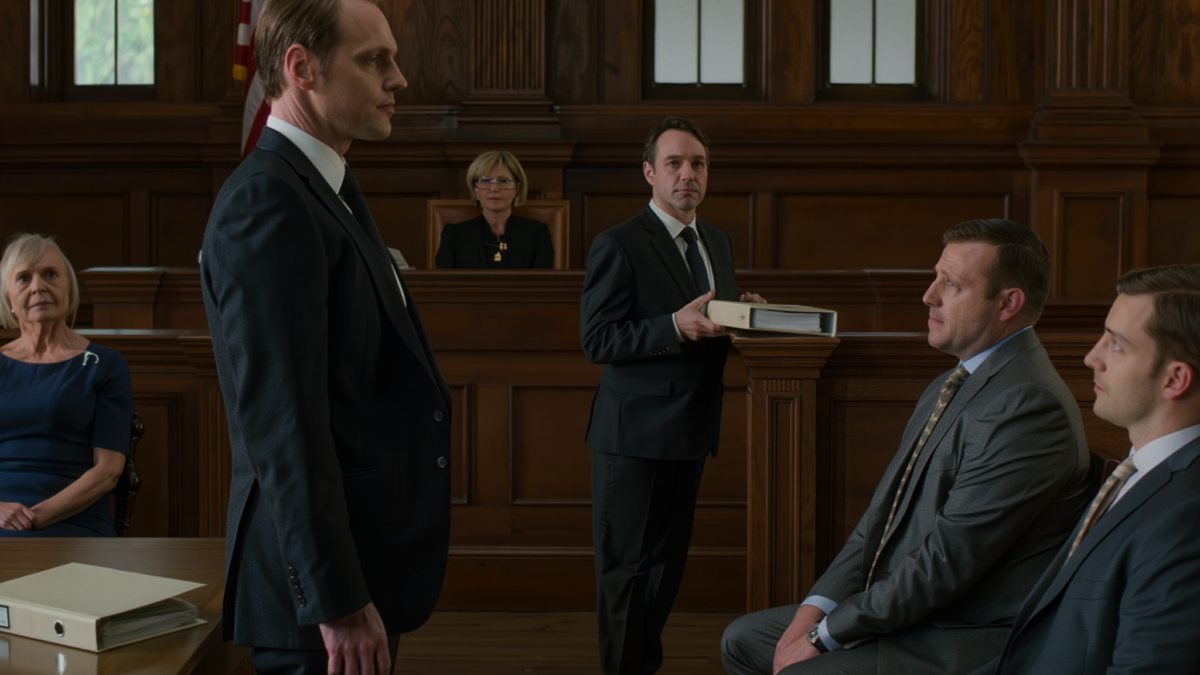
The courtroom was so quiet that I could hear the clerk’s pen scratching across her notepad.
Three rows behind me, my biological mother sat in a navy-blue dress she had probably bought specifically for the hearing. It was respectable and understated—the kind of dress meant to make her look like a grieving parent instead of the woman who had abandoned her eight-year-old son at a bus station.
Her name was Evelyn, though I had not called her Mom in twenty-two years.
Beside her sat my biological father, Arthur. His posture was rigid, and his eyes kept darting around the room as if he were already searching for an exit.
Behind them was Wyatt, my younger brother—the golden boy they had chosen to keep. At twenty-eight, he wore a tailored suit, expensive leather loafers, and a gold watch that caught the courtroom lights whenever he moved. He leaned back on the wooden bench with his arms crossed, an arrogant smirk fixed across his face.
They thought they had already won.
They still imagined me as the terrified boy they had left sitting alone beneath the flickering lights of a Greyhound terminal. They assumed I had grown into a frightened, unstable man who would crumble the moment they dragged me into court.
The heavy oak doors opened.
“All rise for the Honorable Judge Patricia Win.”
Everyone stood. I smoothed the front of my jacket and faced the bench.
When we sat again, I caught Evelyn’s eye for the first time in more than two decades. She did not smile.
Neither did I.
But I was not afraid of her. I had not been afraid of her in a very long time.
Judge Win flipped through the thick stack of filings on her desk, adjusted her silver-rimmed glasses, and surveyed the courtroom. Her gaze settled on my side of the aisle.
“Mr. Marsh,” she said, “I do not see your counsel present. Are we waiting for someone?”
Evelyn’s smirk widened.
Wyatt released a quiet breath that sounded like a laugh.
They believed I did not have the money or courage to face their team of attorneys. They thought I had come alone because no one was willing to stand beside me.
I rose, buttoned my jacket, and looked directly at the judge.
“No, Your Honor,” I said. “I will be representing myself.”
The silence became heavier.
Evelyn’s smirk vanished. Wyatt sat upright, his arms falling to his sides. Arthur swallowed hard.
They had no idea who I had become.
To understand how we ended up in that courtroom, you have to go back to February 1994, when I was eight years old.
Arthur drove us to the Greyhound station on the east side of Dayton, Ohio. The sky was the color of dirty dishwater, a bleak gray that seemed to press down on the entire city. Wind rushed across the concrete drop-off lane and cut through the cheap nylon shell of my winter coat.
The heater in Arthur’s rusted station wagon had stopped working, so I was already shivering when Evelyn opened the passenger door and pulled me out by the wrist.
She did not look me in the eye.
She led me through the sliding glass doors and into the terminal. The air smelled of stale cigarette smoke, floor wax, and wet wool. Travelers hurried past us, dragging heavy suitcases over scuffed linoleum.
Evelyn pointed to a wooden bench beside a row of dented metal lockers.
“Sit there,” she said.
I climbed onto the bench, my legs dangling above the floor.
“Where are we going?” I asked.
“Your father needs to buy the tickets,” she said, looking past me toward the counters. “I need to help him. He always gets confused about which window to use.”
“How long?”
“Ten minutes. Maybe fifteen.”
She opened her oversized purse, pulled out a crushed generic-brand granola bar, and pressed it into my hands.
“Eat this if you get hungry. Don’t talk to strangers. Do you understand me, Matthew?”
“Yes, Mom.”
“Do not move from this bench.”
“I won’t.”
She turned around, walked through the sliding doors, climbed back into the station wagon with Arthur, and drove away.
They never came back.
I stayed on that bench for four hours.
I remember the grain of the wood beneath my fingers. I remember the announcements echoing through the terminal—Indianapolis, St. Louis, Denver. They were names of places I had never seen and could barely imagine.
I ate the granola bar within the first twenty minutes. My stomach was tied in knots, and eating gave my hands something to do.
After that, I watched the doors.
Families came and went. A man carrying a battered guitar case fell asleep two benches away, his head resting against a cinder-block wall. An elderly woman in a heavy wool coat stopped three times to ask where my parents were.
“They’re buying tickets,” I told her each time, pointing toward the counters.
It was the same lie I kept telling myself.
By the fourth hour, the overhead lights had flickered on. The terminal was emptying, and the sky beyond the glass had turned from gray to black. My feet were numb. My throat burned.
I stopped telling myself they were buying tickets.
I stopped watching the doors.
The truth settled slowly into my chest: the people who were supposed to protect me from the darkness had deliberately left me in it.
A woman named Deborah finally approached me. She worked at the information window and wore reading glasses pushed into her frizzy hair. A dark coffee stain marked the bottom of her employee lanyard.
She lowered herself onto the bench beside me.
“What’s your name, sweetheart?”
“Matthew.”
“Who did you come here with?”
“My parents.”
“Where are they?”
“Buying tickets.”
“How long have they been gone?”
“Ten minutes.”
She looked at me carefully. Her eyes softened in the particular way adults’ eyes do when they are trying not to show a child that something is terribly wrong.
“I’m going to make a phone call,” she said. “Would you like another granola bar while we wait?”
“Yes, please.”
I did not really want the food.
I wanted her to stay near me.
Two police officers arrived about ten minutes later. Their radios crackled on their shoulders as they crossed the terminal. Behind them was Mrs. Higgins, a tired-looking woman from child services carrying a thick clipboard.
They placed me in the back of a police cruiser.
I stared through the window at the dark streets of Dayton. Streetlights stretched into blurred lines across the glass as we drove.
They brought me to a county building filled with harsh fluorescent light, hard plastic chairs, and the smell of industrial bleach and old paperwork. A television was mounted too high in the corner of the waiting room, playing a cartoon with the sound turned off.
I sat in a blue chair and watched the heavy door leading to the hallway.
I believed Arthur and Evelyn would burst through it at any moment. They would be frantic and apologetic. They would explain that there had been a misunderstanding—that the car had broken down or that they had been in an accident.
I was eight years old.
That was the only story I knew how to tell myself to survive the night.
I did not understand that the state had already opened a file on me. I did not know what custody meant, but my custody now belonged to the state of Ohio.
I spent two days in that building. Different adults asked me the same questions in different rooms.
No one came for me.
Every time a telephone rang, my heart slammed against my ribs.
It was never them.
Eventually, I stopped answering questions. I curled inward and built a wall around the part of me that could still hope. I decided that if I did not care about anything, nothing would ever hurt me that badly again.
On Thursday afternoon, while Mrs. Higgins searched for an emergency foster home with an available bed, the waiting-room door opened.
A man walked in wearing a faded brown corduroy jacket with patches sewn over the elbows.
His name was Elijah Marsh. He was fifty-three years old and volunteered every other Thursday to drive elderly people from a community center to their medical appointments. He had taken a wrong turn while looking for the elevator.
Elijah paused in the doorway. He glanced at the empty reception desk, then at me.
I was huddled in a corner chair with my knees pulled against my chest, staring at the linoleum floor.
Instead of leaving, he crossed the room and sat beside me.
He did not hover or look at me with suffocating pity. He simply allowed the silence to remain between us.
After a minute, he spoke.
“Do you know how to play chess?”
I shook my head.
“That’s fine,” he said. “I can teach you.”
He reached into the deep pocket of his jacket and pulled out a folding magnetic travel chess set. The plastic pieces were tiny and chipped. He opened the board on the empty chair between us and arranged them carefully.
We played for forty minutes.
Elijah was patient in a way I had never experienced. His patience was not a performance, and he was not waiting for gratitude. When I forgot how the knight moved, he explained it again without making me feel stupid.
When I finally trapped one of his bishops, the corner of his mouth lifted.
“Good instinct,” he said.
Mrs. Higgins eventually rushed into the room carrying a stack of files. She was ready to take me to my temporary placement.
Elijah stood and extended his hand. He shook mine as though I were an adult.
“Keep your eyes on the center of the board, Matthew.”
I assumed I would never see him again.
People always left. That was the first rule of the world as I understood it.
Six days later, Elijah arrived at my foster placement with the chess set and a library card he had opened in my name.
He had gone through the proper channels, submitted to background checks, and requested permission to visit me.
For the first time in my life, someone had made a promise and kept it.
Elijah visited every week for the next eight months. He followed me through two emergency placements and a move across county lines.
For a while, I stopped speaking altogether because I could not find any words that felt safe enough to say aloud. Elijah never pushed me. He sat beside me and moved the chess pieces across the board.
When I was nine and a half, he joined me on the porch of the group home.
“Matthew,” he said, looking directly at me, “I would like to apply to become your foster parent. I want you to live with me, but only if that’s what you want. Trust has to be earned. If I haven’t earned yours yet, I understand.”
I said yes before he finished the sentence.
I moved into his house on a cool Saturday in October. It was a modest cream-colored colonial on a quiet, tree-lined street in Centerville.
The moment I stepped through the door, I smelled cedarwood, old paperbacks, and baking bread. Every surface held something interesting: a half-finished crossword, a pile of history books, or a coffee mug with a chipped rim.
Elijah showed me a bedroom with a blue quilt and a lighthouse-shaped lamp.
“It’s yours,” he said. “Change anything you want.”
I never changed a thing.
Elijah did not merely give me a place to live. He raised me and taught me how to build a life.
He lived simply. He drove a twelve-year-old Subaru with a dented bumper, bought clothes from sale racks, and repaired his own plumbing. I assumed he lived on a modest income because he never displayed wealth.
But he always made certain I had what I needed.
When I graduated from high school, I expected to take out enormous student loans. Instead, Elijah sat with me at the kitchen table and handed me a folder.
He had quietly created a college fund.
He paid for my undergraduate degree without presenting it as a sacrifice. Later, he paid for law school without behaving as though he had done anything extraordinary.
I became a family-law attorney, representing children trapped in the crossfire of vicious custody disputes. After securing a major promotion at a high-end firm in Columbus, I eventually left and opened my own practice.
Elijah was there for all of it.
He sat in the third row at my law-school graduation and applauded in his quiet, sincere way.
When I was thirty-one, his health began to fail. He faded without complaint, exactly as he had lived.
He died peacefully in his own bed on a Tuesday morning in March.
The funeral was small. There were no elaborate speeches or displays—only neighbors, people from the community center, and me.
I stood beside his grave as cold wind swept across the cemetery. The loss felt immense, but I was no longer the abandoned child from the bus station.
I was a man formed by the love of a good father.
I packed Elijah’s house slowly. I kept the blue quilt and the chipped magnetic chess set. I cried as much as I needed to cry.
Then, because Elijah would have expected it, I returned to work.
A week after I packed away the last of his books, an attorney named Richard called me.
He explained that Elijah had named me the sole executor and beneficiary of his will.
I scheduled a meeting at Richard’s downtown office. I expected to sign paperwork for Elijah’s savings account and perhaps receive the deed to the cream-colored house.
Richard’s office was paneled in oak and smelled faintly of expensive leather. He slid a thick bound folder across his polished desk.
“Elijah was a very private man,” he said. “He gave me strict instructions not to discuss the details of his portfolio with you until after his death.”
“Portfolio?”
I opened the folder.
I had known about Elijah’s pension and savings account, but nothing more.
“Elijah inherited a significant amount from his father in the 1970s,” Richard explained. “He never touched the principal. He invested in index funds, held commercial real estate for decades, and co-owned a small manufacturing company that was acquired by a conglomerate when you were in middle school.”
I looked down at the columns of numbers.
At the bottom of the ledger was a total of $3.8 million.
My breath caught.
Elijah had driven an aging Subaru and patched the knees of his own corduroy trousers. He had possessed substantial, multigenerational wealth and had chosen to live simply.
“He left all of it to you,” Richard said. “There are no contingencies. The inheritance is entirely yours.”
I leaned back in the leather chair.
The money itself was not what brought tears to my eyes. What overwhelmed me was the depth of Elijah’s trust.
He had known exactly what he owned and exactly what he was building. He had looked at a silent, frightened boy in a child-services waiting room and decided that I was worthy of his entire legacy.
“He wanted you to have the freedom to practice law on your own terms,” Richard said, passing me a tissue.
I signed the necessary documents and transferred the funds.
When I left the office, I felt the weight of a beautiful responsibility. I was determined to honor Elijah’s name and ensure that the Marsh legacy meant something.
I did not know the probate filing had already attracted the attention of my biological family.
Six weeks later, I was sitting at my kitchen table, drinking black coffee and reviewing a client’s brief, when someone knocked sharply on the front door.
A process server handed me a thick manila envelope, asked for my signature, and walked away.
I returned to the kitchen and tore open the envelope. On the first page of the legal petition were the names of the plaintiffs: Arthur and Evelyn.
My stomach dropped.
The coffee turned acidic in my throat. My chest tightened, and my vision narrowed.
For three seconds, I was eight years old again, freezing on a wooden bench.
Then I forced myself to breathe.
I gripped the edge of the kitchen table until my knuckles turned white and allowed my legal training to take control.
My biological parents were suing me for the full amount of Elijah’s estate.
Their arguments were aggressive and creative. They claimed that, as my biological next of kin, they had a superior right to anything I inherited. Because Elijah had never married, they argued that his estate should effectively revert to them as my original legal guardians.
They also claimed they had never properly consented to my adoption and that the state had mishandled the termination of their parental rights.
I looked at the return address on the envelope.
Beavercreek, Ohio.
They lived twenty minutes away.
For twenty-two years, Arthur and Evelyn had lived within a twenty-minute drive of the place where they abandoned me. They had never searched for me, telephoned me, or tried to discover whether I was alive.
They only returned when $3.8 million appeared in a public probate filing.
I set the papers on the table.
I was no longer shaking. The grief of the abandoned child disappeared, replaced by an absolute, calculating anger.
They wanted a fight.
Before responding, I needed to understand what had motivated them to risk public exposure after two decades of silence.
That evening, I drove to the Beavercreek address listed in the court papers.
Their home stood in a deteriorating suburban neighborhood where lawns had grown high and siding peeled from the houses. I parked two blocks away beneath an old oak tree and watched.
After nearly an hour, a new black Porsche 911 turned onto the street. Its engine broke the silence of the neighborhood.
The car pulled diagonally into my parents’ cracked driveway, one tire rolling onto the grass.
Wyatt stepped out.
I recognized him from several blurry photographs I had found online. He wore a tailored suit that probably cost more than my first car, polished leather loafers, and a gold watch.
He looked frantic.
The front door opened. Arthur emerged first, older and more stooped than I remembered. Evelyn followed him, pulling a cheap cardigan around her shoulders.
“I told you not to bring that car here,” Arthur hissed.
“It’s a rental,” Wyatt snapped, slamming the door. “I needed it for a client meeting.”
He paced across the driveway, running a hand through his carefully styled hair.
“Marcus called again today,” he said. “The interest is compounding. If you don’t get your hands on that money soon, they’re going to break my legs, and then they’re going to take the house.”
Evelyn hurried forward and grabbed his arm.
“We filed the papers, Wyatt. We hired the lawyer you told us to hire. It’s his money, but he’s our blood. The court will make him settle. You just have to keep Marcus away a little longer.”
Wyatt pulled free.
“He’d better settle. Three-point-eight million dollars. Who the hell leaves that kind of money to a stray?”
I rolled up my window.
The truth was obvious. Wyatt had created a false life of luxury and financed it with debt owed to dangerous people. Arthur and Evelyn were trying to rescue the son they had chosen by taking the inheritance left to the son they had discarded.
They saw Elijah’s legacy as a winning lottery ticket.
They assumed I was a weak, traumatized victim who would settle privately to avoid facing them in court.
I drove away feeling no anger.
I felt surgical.
The following morning, I went to the offices of Carter and Hayes. Carter was one of my closest colleagues in the legal profession. We had attended law school together. While I specialized in family law, he had built a formidable reputation in high-net-worth divorce and estate litigation.
I sat across from his mahogany desk and tossed the lawsuit onto his blotter.
He adjusted his tie and began reading.
Within thirty seconds, he scoffed. Within a minute, he laughed aloud.
“This is garbage,” he said, throwing the papers onto the desk. “Structurally and legally, they have nothing. Your adoption terminated their parental rights. They have no standing to challenge a will in which they are not named. Whoever wrote this is incompetent, or they’re relying on you being too frightened to go to court.”
“They’re expecting me to settle to avoid public embarrassment,” I said.
Carter leaned forward.
“Let me take it. I’ll file a motion to dismiss before lunch. I’ll ask the judge to sanction their attorney for filing a frivolous action, and I’ll make them pay my hourly rate for the privilege of losing.”
Carter charged eight hundred dollars an hour. He was offering to destroy their claim as a favor to me.
“No,” I said.
He raised an eyebrow.
“I appreciate the offer, but I’m not giving this case to anyone else.”
“A lawyer who represents himself has a fool for a client,” Carter said. “You’re too close to this.”
“It isn’t emotional.”
He studied my face.
“They have relied on me not knowing things my entire life,” I continued. “They counted on me being weak. If I send someone else to fight them, they’ll think I’m still hiding. I want them to look across the aisle and see exactly who they threw away.”
After a long silence, Carter nodded.
“All right. But I’m helping with preparation. You are not handling every document alone.”
“Deal.”
I returned to my office and locked the door.
I drafted my response and denied every allegation. Then I filed counterclaims for legal fees, harassment, and intentional infliction of emotional distress.
The language was precise, brutal, and completely devoid of emotion.
But winning the lawsuit was not enough. I wanted to understand what had actually happened in 1994.
I called Sarah, a private investigator and former forensic accountant. Before starting her own firm, she had traced hidden money during corporate acquisitions. She was methodical, unemotional, and exceptionally dangerous with a computer.
“What do you need?” she asked.
“I’m sending you three names: Arthur, Evelyn, and Wyatt. I want financial records, debts, and associates. Find out exactly who Wyatt owes.”
“That’s easy enough. What else?”
I looked at the magnetic chess set on the corner of my desk and picked up the black knight.
“I need you to go backward. Montgomery County, 1994. Pull every public or private record connected to Arthur and Evelyn from six months before they abandoned me until two years afterward. Tax records, bank statements, police logs—everything.”
Sarah was silent.
“You think they hid something?”
“They left an eight-year-old at a bus station. People don’t always do that simply because they’re poor. Sometimes they do it because they have a plan. I want to know what the plan was.”
“Give me a week.”
She disconnected.
For the next eleven days, I handled my normal caseload and maintained complete silence with my biological family. Their attorney sent three emails offering to resolve the case privately in exchange for forty percent of the estate.
I deleted all three.
On the eleventh day, Sarah entered my office wearing a rain-soaked trench coat. She did not greet me or offer sympathy.
She removed a thick yellowed folder from her leather bag and dropped it onto my desk.
“You were right,” she said. “They didn’t just abandon you. They monetized you.”
I stopped typing.
The office suddenly felt cold.
The first document was a copy of a police report filed with the Montgomery County Sheriff’s Department on February 14, 1994—the same evening Arthur and Evelyn left me at the Greyhound station.
According to the report, they claimed their eight-year-old son had run away from home at approximately six o’clock that evening. They said they had searched the neighborhood before contacting the police.
“They reported me missing,” I said.
“Keep reading.”
The report contained an additional section describing me as severely troubled, violent, uncooperative, and prone to running away and hiding.
My jaw tightened.
I had been a quiet child. My greatest disciplinary offense in third grade had been reading a comic book beneath my desk during math class.
“They gave the police a reason not to search too hard,” I said. “They wanted everyone to believe I had disappeared voluntarily.”
“They were building a narrative,” Sarah replied. “That was only the first step.”
I turned to the next document.
It was a life-insurance policy issued by a firm in Chicago. Arthur and Evelyn had purchased it eighteen months before leaving me at the station.
I was the insured party.
They were the beneficiaries.
“People sometimes buy small burial policies for children,” Sarah said. “But look at the riders.”
A highlighted clause provided for payment after a prolonged disappearance that met the legal threshold for a presumption of death.
I turned to the last page.
It was a copy of a cleared bank check dated exactly two years and one month after the night at the bus station.
The check was payable to Arthur and Evelyn.
The amount was $62,000.
I stared at the number.
They had not abandoned me because they were overwhelmed or unable to afford food. It had not been an impulsive act committed under unbearable pressure.
They had planned it.
They purchased the policy, waited through the required period, took me to the station, and filed a false report portraying me as a violent runaway. Later, they had me declared legally dead and collected the insurance money.
They sold my safety and sanity for sixty-two thousand dollars, partly to pay their debts and protect Wyatt’s comfortable life.
I closed the folder and rested my hands on it.
I did not feel broken.
I felt clarity.
Arthur and Evelyn were not merely bad parents. They had committed insurance fraud, grand larceny, and filed false police reports.
Now, twenty-two years later, the same people had entered a courtroom to demand millions from the man who had saved my life.
“Make three copies of everything,” I told Sarah. “Place them in sealed binders.”
We returned to court two weeks later.
I sat alone at the defendant’s table. Across the aisle, Arthur, Evelyn, and Wyatt sat behind their attorney, a man named Vance.
Vance’s suit looked expensive from a distance, though the fabric was shiny at the elbows. He carried himself with the aggressive confidence of an attorney accustomed to bullying people through messy divorce settlements.
Judge Win folded her hands on the bench.
“Counselor,” she said, looking at Vance, “I have reviewed your filings, and I am struggling to identify any legal standing for your clients to contest this will. Please enlighten the court.”
Vance rose and buttoned his jacket.
“Your Honor, we are here to correct a profound injustice. My clients, Arthur and Evelyn, are the biological parents of the defendant. They share a bond of blood—an unbreakable biological imperative.”
He argued that Elijah had circumvented standard custody procedures and that my biological parents remained my rightful next of kin. According to Vance, Elijah’s estate should be placed in a trust controlled by my “original biological family.”
I listened without reacting.
It was legal fiction wrapped in emotional language.
Vance spoke about family values and the tragic separation of parents from their child. He portrayed Arthur and Evelyn as victims of a flawed government system.
Behind him, Wyatt adjusted his gold watch and smirked at me as though he were already deciding what to buy with my inheritance.
“Is that the entirety of your argument?” Judge Win asked.
“We believe the biological relationship supersedes an adoption decree finalized without my clients’ explicit presence,” Vance said.
The judge turned toward me.
“Mr. Marsh, your response.”
I stood slowly and aligned the files on my table.
Evelyn and Arthur watched me with hungry, expectant eyes. They still believed I was the silent child who did not know how to defend himself.
“Your Honor,” I said, “opposing counsel’s argument is not merely flawed. It is fundamentally absurd.”
I directed the court to my official adoption decree from Montgomery County, dated October 12, 1996.
“Under Ohio law, finalization of an adoption permanently terminates the legal rights and privileges of biological parents. The plaintiffs are legal strangers to me. They have no standing to request visitation, no standing to seek custody, and absolutely no standing to contest the valid will of my adoptive father.”
Vance shifted his weight.
“Their claim that they were excluded from the termination proceeding is also contradicted by the public record,” I continued. “They were absent because they abandoned me at a Greyhound station in 1994 and did not return. Their parental rights were terminated because of gross neglect and abandonment.”
I looked directly at Arthur and Evelyn.
“They cannot appear twenty-two years later and claim a right to a $3.8 million inheritance merely because we share DNA.”
I spoke for nine minutes.
I never raised my voice. Using statutes and legal precedent, I dismantled every part of Vance’s argument.
When I finished, Wyatt’s smirk was gone. His leg bounced beneath the table. Evelyn gripped the edge of the bench so tightly that her knuckles turned white.
“Mr. Marsh has presented a compelling, fact-based response,” Judge Win said. “Your clients’ claims appear to be entirely without merit.”
“Your Honor, if I may,” Vance stammered, dabbing his forehead with a handkerchief. “We are only seeking an equitable distribution.”
“I’m not finished, Your Honor,” I said.
The courtroom fell silent.
I lifted the three sealed binders Sarah had prepared and handed them to the bailiff. He carried one to the judge and placed another in front of Vance.
“The plaintiffs filed this frivolous lawsuit in an attempt to take money from my father’s estate,” I said. “But that is the least serious of their conduct.”
I explained that the binders contained an investigative report documenting the events surrounding February 14, 1994.
Vance opened his copy.
The color drained from his face.
“On the night my biological parents abandoned me, they drove to the Montgomery County Sheriff’s Department and filed a false report. They claimed I was a troubled runaway and falsified a history of violent behavior so the authorities would not search aggressively.”
Arthur gasped.
Evelyn covered her mouth.
I looked at Wyatt.
“Eighteen months before leaving me, Arthur and Evelyn purchased a life-insurance policy on me. It contained a specific rider providing payment after a prolonged disappearance. Exactly two years and one month after leaving me at the station, they filed a claim declaring me legally dead.”
Judge Win turned through the binder until she reached the highlighted check. Her neutral expression hardened into disgust.
“They collected sixty-two thousand dollars,” I said. “They did not lose a child. They liquidated an asset.”
The words echoed through the room.
“They committed insurance fraud, grand larceny, and filed false reports with state agencies. They used the proceeds to support themselves and the younger son they chose to keep. Now they have entered this courtroom to steal from the man who actually saved my life.”
The silence afterward felt like the sound of a trap closing.
Vance stared at the documents, then at Arthur and Evelyn.
He immediately understood that his clients had used him to facilitate a shakedown and exposed him to professional liability.
“Your Honor,” he said, his voice cracking, “I had no knowledge of these documents. None. My clients never disclosed any of this to me.”
“Sit down, Mr. Vance,” Judge Win ordered.
He collapsed into his chair and wiped his face.
Wyatt jumped to his feet.
“This is fake!” he shouted, pointing at me. “He forged all of it. He’s trying to keep the money!”
“Bailiff, secure that man,” the judge said.
The bailiff placed a hand on Wyatt’s shoulder and forced him back into his chair.
Wyatt stared at Arthur.
“Tell them it’s a lie. Dad, tell them.”
Arthur could not speak. He stared at the floor, breathing heavily.
Evelyn buried her face in her hands.
Judge Win closed the binder.
“In my thirty years on the bench, I have rarely encountered conduct displaying such profound depravity,” she said. “The plaintiffs’ claims are dismissed with prejudice. I am also ordering the plaintiffs to pay all legal fees and court costs incurred by the defendant.”
She lifted her gavel but paused before striking the block.
“Mr. Marsh, the court will retain this evidence. I am forwarding the full file to the Montgomery County District Attorney’s Office and the state insurance-fraud investigation unit, with a recommendation for immediate criminal review.”
The gavel came down.
“We are adjourned.”
The courtroom erupted into movement.
Vance shoved documents into his briefcase and hurried toward the doors, desperate to separate himself from his former clients. Court officers approached Arthur and Evelyn to detain them for questioning.
I calmly packed my legal pads and laptop into my briefcase.
When I turned toward the center aisle, Evelyn stepped into my path. She had pulled away from the officers for a moment.
Mascara streaked her cheeks, and her hands trembled.
For a fraction of a second, I remembered the woman who had once read bedtime stories to me before the money disappeared and darkness entered our home.
She reached toward my jacket.
“Matthew,” she whispered. “Please. We were desperate. We didn’t know what else to do.”
I said nothing.
“You’re my son. You have to help us. Please don’t let them take us away.”
She was searching for the frightened child who had once wanted nothing more than for his mother to return.
She hoped blood would save her from the consequences of her own choices.
I looked down at her.
I felt no anger or hatred—only a vast emptiness.
“You are mistaken,” I said. “Your son is sitting right behind you.”
I stepped around her and walked away.
Outside the courthouse, the Ohio sky was a brilliant blue. The wind was warm. I drew a deep breath, and for the first time in twenty-two years, it felt as though the air reached the bottom of my lungs.
The weight I had carried since childhood was gone.
Six months later, the criminal cases reached their conclusion.
The district attorney did not offer Arthur and Evelyn a favorable plea agreement. They were indicted on multiple felony counts, including insurance fraud, conspiracy, and filing false police reports.
Because their crimes involved the deliberate exploitation of a child, the sentencing judge showed little leniency. Both received significant prison terms.
The state seized their Beavercreek house to repay the insurance company, along with decades of accumulated interest.
Wyatt’s life collapsed soon afterward.
Without his parents’ home to borrow against and without the inheritance he had expected, his creditors closed in. Carter later told me that the black Porsche was repossessed in the middle of the night and Wyatt was evicted from his luxury apartment.
For about three weeks, my phone rang constantly from unknown numbers.
Wyatt left increasingly frantic messages. He begged for a loan and then for a position at my firm. He cursed me, cried, and pleaded.
I never answered.
Eventually, I changed my number.
You cannot rescue a man determined to drown, especially when he expects you to become his raft.
I did not leave Elijah’s inheritance sitting untouched in an investment account. He had given me the tools to build a life and the resources to create something larger than myself.
The following spring, I established the Elijah Marsh Foundation.
I placed a substantial portion of the inheritance into an irrevocable trust. The foundation had one mission: to provide elite, pro bono legal representation to children trapped in the foster-care system.
I hired Carter to help structure the finances, finally giving him the opportunity to bill me at his ridiculous hourly rate.
We developed a network of family-law attorneys who entered custody battles, neglect hearings, and placement disputes to ensure that children were never left undefended in rooms filled with exhausted adults.
We also established a college-fund program for young people aging out of foster care, giving them the same kind of beginning Elijah had given me.
On the day our downtown office officially opened, I handled the foundation’s first case myself.
I walked into a county building with harsh fluorescent lights and the familiar smell of floor wax. Inside an interview room, a ten-year-old boy sat clutching a worn backpack and staring at the scuffed linoleum.
He did not speak.
I sat across from him without asking how he felt or demanding that he trust me.
I opened my briefcase and removed Elijah’s chipped magnetic chess set. I unfolded the board and placed it between us.
“Do you know how to play chess?” I asked.
The boy slowly shook his head.
“That’s fine,” I said. “I can teach you.”
My law practice continued to grow, and I eventually became a senior partner. But the foundation became my life’s real work.
Elijah’s chess set still sits on the corner of my oak desk, permanently arranged in the middle of a game. It reminds me how fragile a person’s future can be and how completely one decision can alter the direction of a life.
Arthur and Evelyn looked at an eight-year-old child and saw a financial burden worth sixty-two thousand dollars.
Elijah took a wrong turn while searching for an elevator. He saw a frightened boy alone in a plastic chair and chose to stop.
He chose patience.
He chose love.
Blood is biology. It does not automatically make a family.
Family is made of the people who sit beside you in the darkness when there is nothing for them to gain.
Arthur and Evelyn thought they had destroyed my future at that bus station.
All they really did was clear the board so that a real father could sit beside me and teach me how to win the game.








