My parents gave me until Friday to sign over my house to my brother, or they’d sue me. I’d bought the ruined 1920s bungalow for $140,000 and spent five years rebuilding it, but Dad called it a “family asset” because Leo was getting married. I told him my name was on the deed, the mortgage, and every permit. Then I put him on speakerphone and asked him to repeat his threat.
The phone rang on a gray Tuesday afternoon while I was sanding a piece of reclaimed oak in my workshop.
I was 34 years old, and that workshop was the one place where I could usually forget about my family’s expectations. The smell of fresh sawdust filled the room, and the steady rhythm of my work made everything else seem distant.
Then my father’s name appeared on my phone.
My stomach tightened.
Dad never called simply to ask how I was doing. His calls usually meant he wanted something, and the conversation rarely ended with me feeling particularly good about myself.
“Henry,” he began without a greeting. “Your mother and I have been talking. We’ve been more than patient. It’s time you did the right thing. We’re giving you one last chance to sign the house over to Leo.”
I put down my sanding block.
For a moment, I just stared at the phone.
“What are you talking about, Dad? We’ve been over this a dozen times. This is my house. I am not giving my house to anyone.”
He sounded irritated, as though I were refusing to perform some minor family obligation.
“Don’t be so dramatic. It’s not just a house. It’s a family asset. Your brother needs it. Leo is getting married. He’s trying to start a family. He needs stability. You’re single, rattling around in that big place all by yourself. It’s selfish, is what it is. Pure selfishness.”
I looked around my workshop, at the tools I’d purchased and the projects I’d completed, and thought about everything it had taken to make that property livable.
“I found this house when it was a ruin,” I told him. “I bought it with my own money from a job you called a hobby. I rebuilt it with my own hands. My name is on the deed, the mortgage, every single permit. End of discussion.”
There was a heavy silence.
Then Dad delivered his ultimatum.
“It doesn’t have to be the end of the discussion. We’ve spoken to a lawyer, a very good one. If you don’t sign the transfer papers by Friday, we’re taking you to court. We will sue you for it.”
My own parents were threatening to sue me for a home they had never purchased, financed, or renovated.
I almost laughed at how absurd it sounded, but the laughter never quite came.
Then I remembered something important.
I had already consulted an attorney named Julia Morse about my family’s escalating demands. There were matters my parents knew nothing about, and their latest threat made those matters considerably more serious.
“You know what, Dad? Hold on a second. There’s someone here who would be very interested to hear this.”
I put him on speakerphone.
“Dad, you’re on speakerphone with my legal counsel, Julia Morse. Could you please do me the favor of repeating what you just said?”
He hesitated briefly.
Then, apparently determined to sound authoritative, he repeated his position.
“I said that if he does not willingly transfer the property to his brother, we have retained counsel and will sue him for full possession of the asset.”
Julia looked at me.
A slow, incredulous smile crossed her face.
And then she laughed.
Not a polite little chuckle, but genuine laughter at the remarkable legal argument my father apparently believed he was making.
“On what grounds exactly, Mr. Miller?” she asked. “Do you possibly plan to sue your own son for a property he legally purchased and owns? I’m dying to hear the legal theory behind this one.”
My mother, Gloria, must have been listening nearby because she suddenly joined the conversation.
“He knows what he owes us. We raised him. We gave him a roof over his head.”
Julia stopped laughing.
“Raising a child is a legal and moral duty, Mrs. Miller. Not a predatory loan you get to call in whenever you feel like it.”
She ended the conversation by explaining that her office would contact them.
Then she turned toward me.
“Well. That was illuminating.”
For the first time in my life, I felt as though my parents’ words didn’t automatically define my obligations.
But to understand why they believed they could claim my home, you have to understand how I built it and how my family had treated me long before the lawsuit.
Five years of rebuilding a house
The property was an old 1920s Craftsman bungalow on a street lined with enormous oak trees.
When I first discovered it, the place looked almost abandoned.
The roof sagged. The front porch was deteriorating. Several windows were broken or covered with plywood. Years of neglect had hidden much of the original craftsmanship beneath damaged materials and layers of old paint.
The asking price was $140,000.
Most people saw a demolition project.
I saw something worth saving.
I’ve always loved working with wood. My profession is custom furniture making, and I knew enough about craftsmanship to recognize the quality of the house’s original construction.
There were hardwood floors beneath the worn linoleum, built-in cabinets under layers of paint, and beautiful details that could be restored with enough patience.
After my offer was accepted, I brought my family to see the property.
My father kicked a loose porch step, and part of it crumbled.
“This is a money pit, Henry. A complete teardown. What in God’s name are you thinking?”
My mother looked around in disappointment.
“Oh, honey, you’re going to be all alone in this shack. You should be saving for a proper condominium, something secure. Not this project.”
Leo laughed.
“Seriously, bro. Good luck with that. Text me when you find a family of raccoons living in the attic. I’ll bring a camera.”
Nobody offered to help.
Nobody seemed interested in what I saw.
But I’d already made my decision.
For the next five years, the bungalow became the center of my life.
I spent my weekdays making furniture and my evenings working on the house. Most weekends were devoted to repairs, demolition, or restoration.
I learned plumbing, electrical work, masonry, and countless practical skills that my furniture business hadn’t required.
One summer, I spent weeks dealing with old insulation and asbestos in the heating system while wearing protective equipment. Other evenings disappeared into the painstaking work of stripping paint from the original fireplace mantel.
I studied carpentry books and online tutorials to learn techniques I hadn’t encountered professionally.
My hands were nearly always covered in small cuts, splinters, or calluses.
There were moments when I wondered whether I’d made a terrible mistake.
One January night, a corroded pipe burst in the attic. Water poured through the ceiling of my unfinished kitchen.
I stood there in the freezing darkness, soaked and exhausted, watching months of work become damaged.
For a moment, I heard my family’s voices in my head.
Money pit.
Shack.
We told you so.
I sat on the wet floor and nearly cried.
But eventually, I got up and continued.
There were better moments, too.
I uncovered beautiful oak flooring beneath old carpet. I restored the original windows. I rebuilt the front porch and finally sat on its steps one evening, watching the sunset over the street.
That quiet moment meant more to me than any praise I’d ever received from my family.
I had taken something neglected and made it beautiful again.
The house eventually became worth approximately half a million dollars.
And that was when my family stopped calling it a mistake.
They began treating it as something Leo deserved.
The family rule nobody admitted existed
My younger brother Leo had always been the golden child.
He was charming, outgoing, and comfortable attracting attention. My parents seemed endlessly impressed by his possibilities, even when those possibilities never became achievements.
I was quieter.
I worked hard, kept my problems to myself, and rarely asked for help.
Instead of appreciating that, my parents treated my independence as a reason to invest more in Leo.
When I was 15, I became interested in astronomy.
I saved $150 from my part-time grocery store job because I wanted a telescope that cost $300.
Dad glanced at the catalog and said it seemed expensive for a toy. My parents gave me $50 for my birthday and told me to continue saving.
Two months later, Leo decided he wanted to become a DJ.
Dad purchased more than $1,000 worth of equipment for him.
Leo used it for about six weeks before losing interest.
When I pointed out the difference, Mom explained that Leo was creative and needed his passions supported.
It was always different when Leo wanted something.
College followed the same pattern.
I earned a partial academic scholarship to a state university. I worked approximately 20 hours a week, first bussing tables and later doing freelance carpentry.
I graduated with honors and manageable student debt.
My parents occasionally praised my independence to their friends.
Leo, meanwhile, wanted to attend an expensive private university out of state.
My parents took out a second mortgage to pay for it.
They hosted a going-away party and spoke proudly about the opportunity they were providing their son.
Leo dropped out after three semesters because he found the professors boring.
My parents didn’t lecture him about responsibility.
They simply continued supporting him.
Their explanation was always the same.
Leo needed more help because he wasn’t as strong as I was.
Over time, I started to understand what that really meant.
Every time I solved a problem independently, it became another reason they believed they could ask more of me while giving less.
Then Leo announced that he intended to marry his girlfriend, Grace.
My parents decided he needed a proper home.
And their attention settled on mine.
There was only one member of my family who had ever truly understood me.
My grandmother, Martha.
The person who believed in me
Grandma Martha was my father’s mother.
She loved old books, the smell of cinnamon, and the warmth of her wood stove.
She also understood the satisfaction of making something with your hands.
When I turned 13, she gave me my first proper set of Japanese woodworking chisels.
I still use them.
She spent hours with me in the garage, teaching me how to read the grain of wood, make careful joints, and respect the tools I worked with.
“You have good hands, Henry,” she used to say. “Smart hands. Don’t ever let anyone make you feel small because you speak more with your work than with your words. A well-made chair will outlast a thousand empty promises.”
While my parents attended Leo’s football games, Grandma made time for me.
She didn’t need me to be louder, more social, or more impressive.
She simply saw me.
When she passed away five years ago, I felt as though I’d lost my only real ally.
Her funeral was one of the loneliest days of my life.
A week later, my parents gathered Leo and me in their living room.
Dad had a document in his hand.
“We’ve met with your grandmother’s lawyer and reviewed her will,” he explained. “She… well, she made some last-minute changes before she passed.”
Mom reached over and patted my hand.
She told me Grandma had become increasingly worried about Leo’s future and lack of direction.
Then Dad delivered the news.
“She decided to leave her entire estate to him, to give him the fresh start he needs.”
I could hardly believe it.
Grandma had repeatedly told me she planned to divide her estate equally between us. She’d explained that money from the sale of her farmland had been placed into trusts intended to provide both grandchildren with a financial foundation.
“Everything?” I asked. “She left me nothing at all?”
Mom insisted that wasn’t quite true.
Grandma had supposedly left me her old collection of tools from the garage.
I received a cardboard box containing worn handsaws and screwdrivers.
Leo offered an awkward apology and said he’d help me if I ever needed anything.
I took the box and went home.
I didn’t request a copy of the will.
I didn’t question the story my parents told me.
Instead, I spent years believing that the person who had always defended me had ultimately chosen Leo, too.
It was one of the reasons I threw myself so completely into rebuilding my house.
I wanted to create something nobody could give me and nobody could take away.
At least, that was what I believed.
Thanksgiving exposed the first crack
The first real sign that my parents had lied came during Thanksgiving dinner.
I hadn’t wanted to attend, but Mom insisted.
Leo and Grace were seated near the center of the table while Leo entertained everyone with stories about a recent European vacation.
He’d been unemployed for four months.
Grace worked as a teacher’s assistant.
Yet Leo was describing luxury hotels in Paris, including one he claimed cost $2,000 per night.
Dad was delighted.
“That’s my boy. Knows how to enjoy the finer things in life.”
I tried to concentrate on my dinner.
Then Leo laughed.
“Yeah, well, it’s easy to live it up when you’re flush. Thank God for Grandma’s inheritance. Eh, that money was just burning a hole in my pocket. Had to be spent. Use it or lose it.”
The conversation stopped.
I looked toward Dad.
For one brief moment, I saw unmistakable panic in his eyes.
He quickly looked down at his wine.
Mom stood and began offering everyone more mashed potatoes.
Then I noticed Grace.
She was staring at her plate, gripping her fork, her face flushed with embarrassment.
She gave Leo a tiny shake of her head, apparently urging him to stop talking.
Something about the entire exchange felt wrong.
I had spent five years believing Grandma had deliberately excluded me from her estate. Yet Leo spoke about the money as though it had simply been provided for him to enjoy.
And my parents seemed frightened that he’d mentioned it.
By the time I returned home, the house no longer felt entirely peaceful.
I couldn’t stop wondering what had really happened to Grandma’s estate.
Two days later, I received a message from an unknown number.
There was no explanation.
Just an audio recording.
I went into my workshop, closed the door, put on headphones, and pressed play.
It was an argument between Leo and Grace.
Grace was furious that he’d discussed the inheritance at Thanksgiving.
“Was it, Leo? Was it all yours? Or was half of that $200,000 supposed to be your brother’s inheritance?”
My heart began pounding.
Leo dismissed her concerns.
He argued that our parents had handled the inheritance and understood he needed the money more.
He mocked my workshop and my house.
Then Grace began listing his spending.
The European trip.
A luxury sports car he’d purchased and crashed.
A failed cryptocurrency venture into which he’d put $60,000.
“The money is gone, Leo. It’s all gone. And now your parents are trying to steal his house to cover for your monumental failures.”
Leo insisted that his parents were doing what was best for the family.
Grace rejected that explanation.
“No, they are doing what’s best for you. They always have, and I am sick of it. I am sick of the lies. I’m sick of watching them treat your brother like dirt after they stole from him. It’s wrong.”
The recording ended.
I sat motionless in my workshop.
My first reaction wasn’t satisfaction at discovering a possible explanation.
It was grief.
For years, I’d believed Grandma had abandoned me. Now there was a possibility that she’d done exactly what she had always promised, and my parents had concealed it.
I believed Grace had sent the recording, although the message itself contained no name.
The next morning, I decided to investigate.
The paper trail
I withdrew a significant amount from my business savings and hired a private investigator named Marco.
He was a quiet, methodical former police officer whose calm manner helped me explain everything without becoming overwhelmed.
I told him about Grandma’s death, the explanation my parents had given us, and the recording.
I provided every detail I could remember about her lawyer and the town where she’d lived.
“I want the truth,” I told Marco. “I want to find the real will. I want to know exactly what they did, down to the last dollar.”
He nodded.
“They always leave a paper trail. Give me a week.”
He called me back after five days.
A thick file folder sat on his desk.
Marco explained that Grandma had established an irrevocable trust in 2010.
The named beneficiaries were Henry Miller and Leo Miller.
Equal shares.
The trust records he obtained valued the estate at $42,000 upon her death, with the accounting he described listing $20,000 for each of us.
Then he showed me the document itself.
There was my name beside Leo’s.
Grandma had not chosen to exclude me.
The relief was almost painful.
But Marco continued.
According to the records he’d located, my parents had submitted an older version of Grandma’s will naming my father as sole heir rather than the later instructions reflecting the equal division.
The trust assets had subsequently been liquidated and deposited into a joint account connected to Richard, Gloria, and Leo.
I had neither known about nor had access to that account.
Marco’s findings suggested my parents had diverted the inheritance intended for me.
Then he showed me another set of papers.
Tax records.
For five consecutive years after I turned 24, my parents had claimed me as a dependent despite my independent finances, full-time employment, and responsibility for my own living expenses.
He also identified education-related deductions connected to tuition I’d paid through my scholarship and earnings.
The discovery made the house dispute look very different.
My parents weren’t simply asking me to make a sacrifice for Leo.
The records indicated they’d already treated my finances as something they could use without consulting me.
That was when I hired Julia Morse.
I brought her Marco’s file.
She read everything carefully, turning page after page while her expression grew increasingly serious.
When she finished, she closed the folder.
“They didn’t just steal from you, Henry,” she said. “They committed multiple serious felonies. This isn’t a family squabble that can be mediated over coffee. This is a criminal case masquerading as a civil dispute.”
Julia began preparing a legal response.
And that was the situation my father had unknowingly walked into when he threatened to sue me for my house.
He believed he was intimidating an obedient son.
I had already begun documenting a much larger problem.
My parents wanted a family dispute. Julia wanted the records.
After the phone call, Julia sent my parents a formal legal letter.
It addressed their attempt to claim my house and announced a countersuit seeking repayment of the inheritance identified as my share, plus compound interest.
The demand referred to $21,000 in inheritance funds, with the claimed total after interest exceeding $300,000.
The letter also described the inheritance records and the tax issues Marco had uncovered.
Julia stated that we were prepared to refer those matters to the appropriate authorities.
My parents stopped contacting me directly.
Instead, relatives began calling.
The family group chat, normally filled with birthday greetings and vacation pictures, became an endless stream of criticism.
My aunt Carol was among the first.
“Henry, I just heard the most awful, shocking news. How could you do this to your own parents? Suing your mother and father after everything they’ve done for you. It’s shameful.”
Uncle Joe joined in, reminding me that family was supposed to stick together.
My cousin Lucas said I was tearing everyone apart over money.
For most of my life, that kind of pressure would have worked.
I would have questioned myself, tried to calm everyone down, and accepted another unfair compromise.
This time, I opened the group chat and wrote one response.
I explained that my parents had taken an inheritance Grandma intended for me and that records also showed irregularities involving their tax filings.
I explained that supporting evidence had been submitted in connection with the legal dispute.
Then I told the family members criticizing me that they could examine the available records before deciding whom to blame.
I ended by stating it would be my only comment.
The messages stopped.
For the first time, I didn’t feel obligated to keep defending myself.
But Julia believed my parents were far from finished.
The dinner invitation
Julia explained that continuing the legal battle through court could be lengthy, expensive, and emotionally exhausting.
She proposed another approach.
I would invite my parents, Leo, and Grace to dinner at my house.
I would make it sound as though I regretted the conflict and wanted to find a compromise without attorneys.
The suggestion made me uncomfortable.
I didn’t want the people trying to take my house sitting inside it, enjoying the furniture I’d built and behaving as though they could dictate its future.
Julia believed that was precisely why the invitation would work.
My parents had spent their entire lives assuming I would eventually give in.
They were likely to interpret an invitation as weakness.
Julia also wanted one more person present.
David Abernathy.
David had been Dad’s business partner for 20 years. He was a respected, retired businessman and an old family friend.
My father admired him enormously.
Julia believed David’s presence mattered because Richard cared deeply about his reputation.
A respected witness could make it much harder for my parents to dismiss what they heard.
I eventually agreed.
When I called Mom, she initially sounded suspicious.
But as I explained that I hated the conflict and wanted everyone to sit down together, her tone changed.
She became increasingly confident that I was finally reconsidering my position.
She was particularly pleased when I mentioned David.
“Fine, Henry. We will be there, and I think it’s a wonderful idea that you invited David. It’s about time you had a respectable, neutral party there to make you see sense.”
The night before dinner, Aunt Carol called.
She was delighted that I was supposedly returning to my senses.
Then she explained, once again, that Leo needed more support because he wasn’t as strong and independent as I was.
She suggested my house was too much for one person anyway.
When I mentioned the inheritance, Carol called the word “stole” unnecessarily aggressive.
She described what my parents had done as reallocating a family resource to where it was needed most.
Then she dismissed the renovations I’d spent years completing.
Something in me finally settled.
I realized there was no argument I could make that would persuade people who had already decided my work and my rights mattered less than Leo’s needs.
“The dinner tomorrow is not a negotiation, Carol,” I told her. “It is a final presentation of facts.”
I ended the call.
The walnut table
Everyone arrived at seven o’clock.
Dad walked into my restored bungalow, examining the moldings and custom furniture with an assessing expression.
Mom gave me a stiff hug.
Leo entered looking irritated.
Grace appeared nervous. As she passed me, she gave a small nod that made me believe she still wanted the truth to come out.
David Abernathy arrived last.
He shook my hand and looked around the house.
“Henry, it’s a pleasure to see you. My goodness, this house, it’s magnificent. Your father told me you were handy. But this is true craftsmanship, a work of art.”
Dad smiled proudly.
“He gets it from me.”
I didn’t respond.
We sat around the large dining table I’d built from a beautiful slab of black walnut.
Mom had brought a tuna noodle casserole. I served the dinner I’d prepared, and everyone made awkward conversation for several minutes.
Then Dad put down his fork.
“Henry, I’m glad we’re all here to resolve this like a family. Your mother and I, in the interest of peace, are willing to be the bigger people here. We are willing to drop this silly, hurtful lawsuit.”
I took a sip of water.
He continued.
In exchange for dropping the case, he wanted a fair market appraisal of my house.
He proposed subtracting the $140,000 purchase price and giving the remaining equity to Leo as a down payment for a home with Grace.
I could apparently keep what Dad still referred to as my little project.
He presented the arrangement as a generous compromise.
Leo stared at his dinner, smirking slightly.
Mom nodded approvingly.
I looked around the table.
They had received the legal letter. They knew we were challenging the inheritance and tax records.
Yet they still believed they could demand the value of my work.
I put down my glass.
“No.”
Dad stared.
“What did you just say?”
“I said no.”
Then I laid out the terms Julia and I had prepared.
Their attorney would dismiss the lawsuit with prejudice within 24 hours.
They would arrange repayment of the inheritance money and the claimed interest.
They would correct the tax returns in which they had improperly claimed me as a dependent and address the resulting amounts owed.
If they refused, Julia would proceed with the evidence we’d collected.
Dad’s expression changed instantly.
He slammed his hand onto the table, making the dishes jump.
“How dare you? How dare you threaten me in my own… in front of our guest?”
“This is my home, Dad,” I replied. “The one I paid for, the one I built. And Mr. Abernathy isn’t just a guest. He’s a witness to this transaction.”
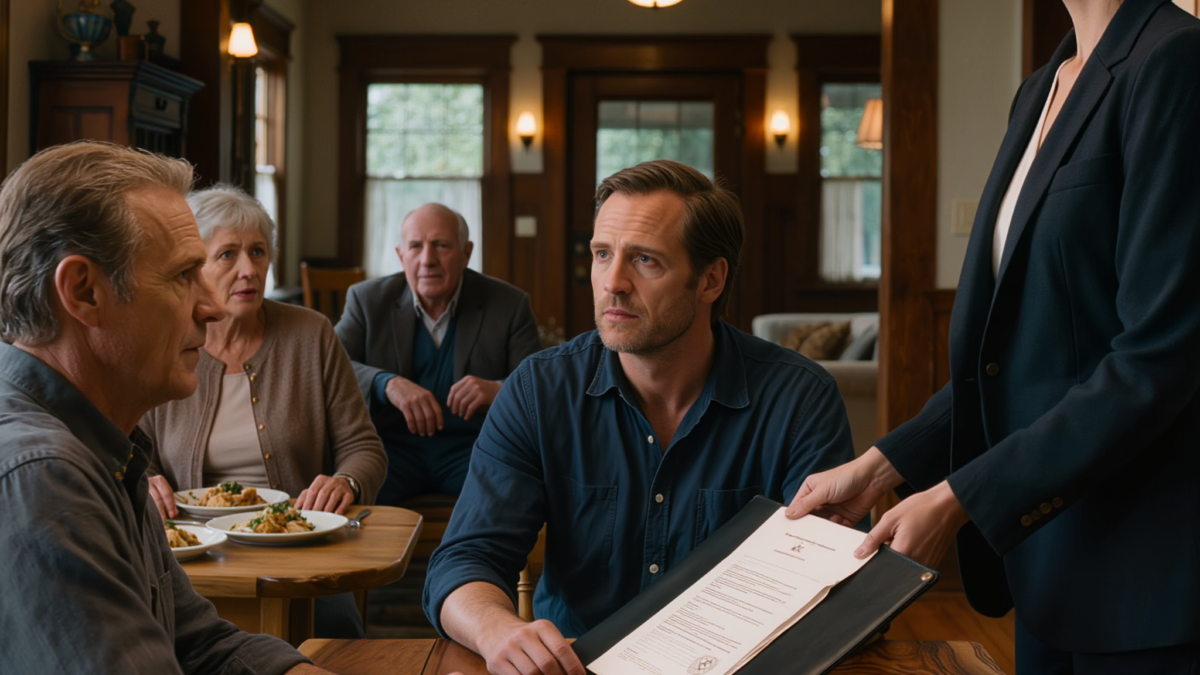
Julia stepped into the dining room from the kitchen, where she’d been waiting.
She carried a black leather portfolio.
“Richard, Gloria. I’m glad you’re all here. It saves us the trouble and expense of a formal deposition.”
My parents stared at her.
Leo looked toward the front door.
Julia opened her portfolio.
“Let’s start with Exhibit A.”
She placed a certified copy of Grandma’s actual will and trust documents on the walnut table.
The documents named Leo and me as equal beneficiaries of an estate valued at $42,000.
Then she produced the bank statements showing the funds transferred into an account connected to my parents and Leo.
Mom struggled to explain.
“We were… we were just managing it for them. It was a family fund for everyone’s needs.”
Julia pointed to the financial information.
The funds had supported spending connected to Leo’s expensive lifestyle, including his European vacation, failed business investment, and sports car.
Then she brought out the tax returns.
She explained the significance of claiming a financially independent adult as a dependent for five consecutive years.
My parents had repeatedly signed federal filings containing information Julia believed was false.
David sat quietly, listening.
Julia turned toward him.
She reminded him of his longstanding relationship with Dad and the trust they’d built as business partners.
She explained that the records raised serious questions about conduct Richard had hidden behind his respectable public reputation.
Dad looked toward his old friend.
David wasn’t shouting or arguing.
His expression had become one of profound disappointment.
That appeared to affect my father more than anything else said that evening.
For years, he’d defined himself as an honorable family man whose word deserved respect.
Now someone whose respect mattered enormously to him had seen the documents.
Mom began crying.
“We don’t have it,” she admitted. “The money, it’s gone. Leo’s business venture. It failed. It’s all gone.”
Julia told them they would need to work with their attorney to develop a repayment plan.
She gave them 24 hours to have counsel contact her office.
Then she closed the portfolio.
“Henry, I believe this dinner party is over.”
I left the dining room and went into my workshop.
The familiar smell of wood greeted me.
I closed the door and took a deep breath.
For the first time, my home felt entirely like mine again.
The consequences
Less than an hour later, Grace sent me a text.
She apologized for remaining silent for so long.
Then she told me she’d ended her engagement to Leo.
“I can’t marry into a family that operates on lies and theft,” she’d told him.
I felt relieved for her, although I knew the decision couldn’t have been easy.
The following morning, Julia called at 10:14.
Their attorney had sent a signed compliance agreement.
My parents had accepted the proposed terms.
Their lawsuit against me was being withdrawn with prejudice, and arrangements for the first repayment installment were underway.
Over the following weeks, the financial consequences became visible.
A red for-sale sign appeared outside my childhood home.
My parents needed to sell their primary asset to address the inheritance repayment, tax liabilities, and related financial obligations.
The house where I’d grown up, where my achievements had so often been dismissed, was now being sold because of decisions they had made.
News spread through their social circle.
David shared his disappointment with several people, and the story circulated further.
Dad’s reputation suffered badly.
Leo’s life also changed.
Without his parents’ financial support and with Grace gone, he moved into the small apartment my parents rented on the other side of town.
I didn’t celebrate any of it.
I had imagined justice might feel exhilarating.
Instead, it mostly felt quiet.
A burden I’d carried for years had finally begun to lift.
About a month after my parents sold their house, they appeared at my front door.
It was a Sunday afternoon.
I had been sketching a design for a new furniture project when I noticed them through the window.
Dad looked smaller than I remembered. His shoulders were slumped. Mom’s eyes were red, and her face looked tired.
I opened the door but didn’t invite them inside.
“Henry,” Mom began. “Can we please just talk?”
“I think we’ve done enough talking.”
Dad looked at me.
For an instant, I hoped he might apologize.
Instead, his expression hardened.
“Are you happy now? You’ve ruined us. You’ve destroyed your own family. I just hope it was worth it to you.”
That was when I understood something I’d resisted for years.
They weren’t there to acknowledge what they’d done.
They still believed I was responsible for the consequences of their choices.
I no longer felt any need to convince them otherwise.
“I didn’t ruin this family,” I told him. “You did. You made your choices over and over again for decades. These are simply the consequences. The money is being repaid. The legal matters are settled. We have nothing left to talk about.”
Mom started crying again.
“But we’re your parents. We’re your family.”
“Being a parent is a verb,” I replied. “It’s something you do day in and day out. It’s not a title you get to hold over someone’s head forever, regardless of your actions. And it’s a job you failed at. Goodbye.”
I closed the door.
I heard them remain on the porch briefly before their footsteps faded down the walkway.
I didn’t feel triumphant.
I felt relieved.
The relationship I’d spent my whole life trying to repair was finally something I could stop pursuing.
Building another kind of family
The next year was quieter than any period I could remember.
The court-ordered repayment installments began easing some of the financial strain I’d carried through years of renovation.
I paid off expensive loans and invested in better equipment for my workshop, including a new table saw.
My furniture business began attracting more commissions.
People had heard about the restoration of my house, and some wanted me to create custom pieces for their own homes.
The work challenged me in ways I loved.
But the greatest change wasn’t financial.
It was having room in my life for relationships that didn’t revolve around proving my worth.
Some relatives never contacted me again.
Aunt Carol and Uncle Joe remained distant.
Others surprised me.
An uncle who’d fallen out with Dad years earlier called to say he recognized the behavior I’d described. He told me that Dad had treated him similarly during a business dispute.
A cousin whom Mom had always dismissed for choosing pottery invited me to visit her studio.
We spent an afternoon talking about working with our hands.
For the first time, I began to appreciate how many people in my extended family had also felt judged or excluded.
Grace became a close friend.
Marco and Julia remained important people in my life.
By the following Thanksgiving, my restored bungalow was full of guests again.
My uncle and his wife were there.
My cousin and her family came.
Grace joined us, along with Marco, Julia, and their spouses.
We gathered around the same black walnut dining table where my parents had tried to pressure me into surrendering my home’s equity.
But this time there were no demands, no accusations, and no elaborate calculations about who owed what to whom.
There was conversation, laughter, and the simple pleasure of being together.
The house no longer felt like something I needed to defend.
It finally felt like the home I’d spent five years creating.
Then, when I believed that chapter of my life had reached its conclusion, I received one final piece of Grandma’s story.
The box she left behind
An elderly attorney named Caleb Morrison contacted me.
He lived in a quiet town about three hours away and introduced himself as Grandma Martha’s longtime friend and personal attorney.
He explained that he’d followed the public records of the dispute between my parents and me.
He had something Grandma had left in his care, entirely separate from her official estate documents.
She’d instructed him to give it to me after enough time had passed or if a serious family crisis occurred.
“I think a lawsuit between a son and his parents qualifies as fundamental,” he said with a gentle chuckle.
I drove to his office the next day.
The building smelled of old paper and was filled with law books.
Caleb handed me a heavy wooden box made from cherrywood.
“She called this your ‘just in case’ box,” he told me.
Then he gave me a small, ornate brass key.
I carried the box to my car.
Sitting in the driver’s seat with the engine off, I turned the key.
The lock clicked.
Inside were two things.
The first was an old blue bank passbook.
The last entry showed a balance of $50,000.
The second was a thick leather-bound journal.
Grandma’s diary.
I opened it carefully.
Her familiar handwriting filled the pages.
I turned to an entry dated a few months before she passed away.
She’d written that the trust was complete and that both grandsons would receive equal shares.
But she was worried about my father.
She understood Richard’s tendency to excuse Leo’s failures while treating my independence as an endless resource.
She feared he might eventually interfere with the inheritance intended for me.
Then I read the passage that changed everything.
“This separate account, this journal. This is my insurance policy for my dear Henry. It is my final act of love. It is not a fortune, but it is a secret between him and me.”
She wanted me to have a way to build a life without being dependent on my parents if they betrayed my trust.
But the money wasn’t the part that made me cry.
It was what she wrote next.
“I want him to know across the years that his grandmother saw him. I always saw him. His hands are smart. His heart is true. He will build a beautiful life. And he deserves every plank, every nail, every dollar he earns to build it.”
I sat in my car with tears running down my face.
For five years, I’d carried the belief that Grandma had chosen to abandon me.
I’d mistaken my parents’ version of her wishes for the truth.
Now I had her own words.
She had known me.
She had believed in me.
And she’d been worried enough about what might happen after her death to leave a separate message of protection and love.
The $50,000 was an extraordinary gift.
I used it to pay off the last of my business debts and build a beautiful greenhouse in my backyard.
Sunlight poured through its windows, and I filled it with plants.
It became a place where I could sit quietly, surrounded by something growing, and remember the woman who had encouraged me to build things with my own hands.
Two years later
It’s been two years since that dinner at my walnut table.
I’m 36 now.
I occasionally hear updates about my parents and Leo through relatives.
Richard and Gloria still live in a rented apartment, leading a much smaller and quieter life than before.
Dad no longer has the reputation he once valued so deeply.
Leo works in sales, supporting himself without the financial assistance he’d always expected.
We don’t speak.
I don’t spend much time thinking about them anymore.
For a long time, I believed that getting justice meant watching the people who had hurt me face consequences.
And there were consequences.
My parents lost their house. Their reputation suffered. Leo lost the future he’d assumed other people would provide for him.
But those things aren’t what matter most when I look back.
What matters is the life I have now.
I still spend my mornings in the workshop, breathing in the smell of fresh-cut wood.
I still run my hands across finished furniture, checking the smoothness of the surfaces and the precision of the joints.
I grow tomatoes in the greenhouse built with Grandma’s final gift.
I share meals with people who enjoy my company without asking what I can provide for them.
Sometimes I look around my restored bungalow and remember what it looked like when I bought it.
The broken windows.
The collapsing porch.
The sagging roof.
Everyone told me it wasn’t worth saving.
But they were wrong.
The house wasn’t worthless.
It simply needed someone willing to recognize what it could become.
For years, I thought I needed my parents to recognize that same potential in me.
I don’t anymore.
Grandma already had.
And eventually, I learned to see it for myself.
The best revenge isn’t about living well despite them. It’s about living honestly. It’s about building a life so full of truth, purpose, and integrity that their world of lies and manipulation can’t even touch it.
It’s about having nothing left to hide, and finally nothing left to fear.
My name is Henry Miller.
I’m 36 years old.
And I am finally completely free.








