My Parents Canceled My 25th Birthday For My Brother’s Tantrum — I Left And Watched Them Go Broke.
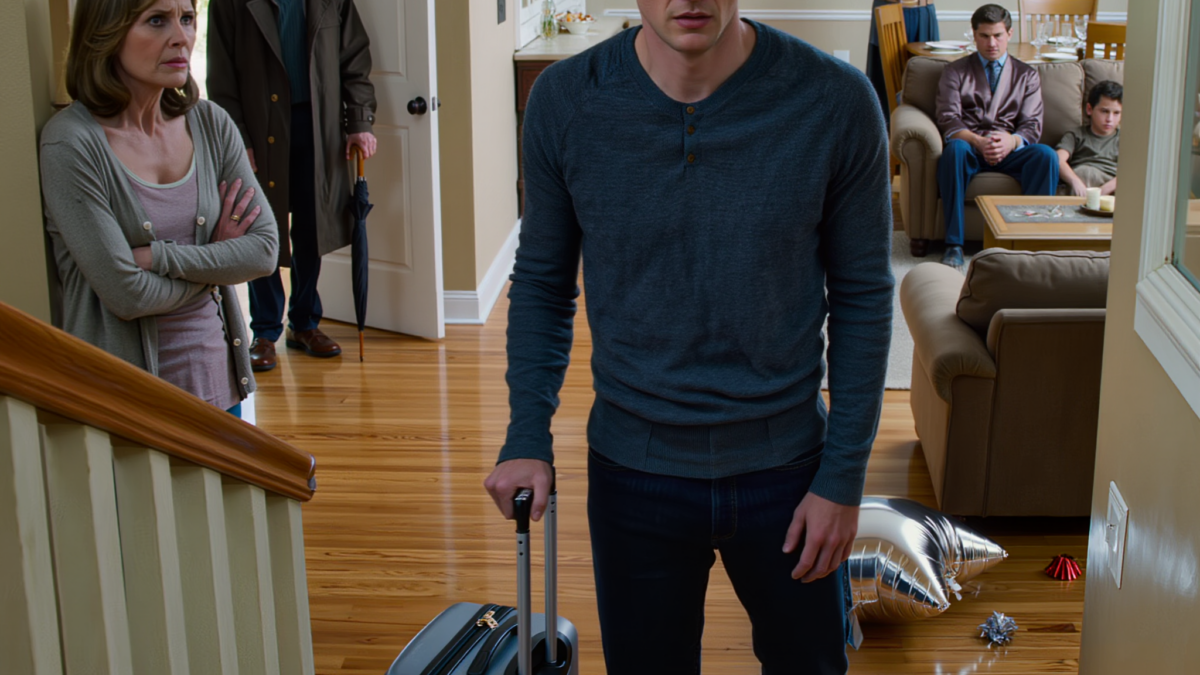
My name is Evan, and on my twenty-fifth birthday, my mother looked me straight in the eye and canceled the celebration I had planned with my own money, all to appease my older brother’s manufactured crisis. I stood in the middle of our living room, holding silver and gold balloons bought with the tips I had carefully saved. My mother stepped past the birthday cake on the kitchen island. She wrapped her arms around my twenty-eight-year-old brother, glared at me, and said, “Dylan is suffering today, Evan. You are not allowed to shine while he is in pain.”
They ordered my decorations taken down to comfort a grown man who was sobbing on the couch because an ex-girlfriend he hadn’t spoken to in three years had posted an engagement photo. What my family didn’t know, as they humiliated me, was that I had already found the hidden text messages on the shop’s iPad. They didn’t know I’d checked my bank accounts. And they certainly didn’t know that the wealthy uncle who quietly funded their carefully staged lifestyle was on his way to our driveway. Today, they live in a run-down two-bedroom apartment, leaving desperate voicemails asking me to share my salary.
To understand how everything unraveled, I have to go back to the freezing morning when I finally reached my breaking point. The sky outside my window was that heavy familiar shade of Seattle gray, like dirty dishwater that had been left sitting in a sink for days. It was 6:00 in the morning. I woke up and just stared at the water stains on the ceiling for a good 20 minutes. I didn’t reach for my phone right away because I already knew what was waiting for me on the screen.
Absolute silence, nothing. Not a single notification, no text from my mother, no awkward half-hearted email from my father, Arthur. That day wasn’t just another rainy Tuesday in the Pacific Northwest. It was my twenty-fifth birthday, a milestone I had secretly, foolishly hoped would become the turning point of my life. I had convinced myself that turning 25 would magically force them to look at me and see a human being, a son, instead of just the unpaid, invisible help that kept their lives running smoothly.
I rolled out of bed, my joints popping in the cold room. The heating in my room had been broken for 2 years. My bedroom was a suffocating shade of beige. I was never allowed to paint it, hang posters, or make any modifications because my mother always claimed it would ruin the real estate value of the house. Everything in that house was strictly about appearances.
We lived in a suburban neighborhood we couldn’t really afford, surrounded by neighbors my mother constantly tried to impress. Everything was a meticulously crafted stage set for the undisputed star of the show, my older brother, Dylan. I walked downstairs into the freezing kitchen, my bare feet slapping against the cold hardwood floor. In our family, Evan is the one who makes the coffee. Nobody ever formally asked me to do it.
It was an unspoken rule that had been established when I was 12 years old. If the coffee wasn’t brewing by 6:30, my mother would sigh so loudly you could feel the floorboards vibrate with her passive aggression. And my dad would pace around the kitchen looking utterly helpless until someone placed a warm mug in his hand. I took out the cheap bulk-buy coffee beans my parents drank and ground them. The noise of the grinder was deafening in the silent empty house.
I set out three mugs on the counter. I didn’t bother setting one out for Dylan because he almost never woke up before noon. Dylan was twenty-eight. On paper, on his perfectly curated LinkedIn profile, he was the creative director of our family’s boutique photography studio and print shop.
In reality, that grandiose title meant he showed up around 1:00 in the afternoon, drank an artisanal espresso that I had to make for him, took a few aesthetic selfies holding the expensive vintage Leica cameras we sold, posted them on the business Instagram account with some pseudo-intellectual caption, and left by three to go hang out with his equally idle friends. I, on the other hand, was the ghost that kept the machine running. I worked the opening shift at 7 in the morning. I did the heavy lifting for the inventory shift, unloading boxes of photographic paper and heavy chemicals.
I worked the closing shift until 8 at night. I handled the furious customers who demanded refunds. I fixed the jammed industrial photo printers and I scrubbed the floors. My salary for this grueling sixty-hour workweek, absolutely zero. Not a single paycheck.
“It’s a family business, Evan,”my father always said, patting my shoulder with a heavy, dismissive hand whenever I asked about getting paid. “We all pitch in. We’re building an empire. Your inheritance is the legacy we’re creating right here in this shop. You have to look at the big picture.”
Inheritance. What an absolute joke. I poured my black coffee and looked at the calendar pinned to the refrigerator door. I had circled today’s date in a bright red marker a month ago.
Underneath the red circle, in neat, hopeful letters, I had written: “Evan’s birthday dinner, 7:00 p.m. Uncle Richard coming.”I had organized my own birthday dinner. I used the small crumpled dollar bills and spare change I got from kind customers, the ones who took pity on the exhausted kid behind the counter to buy a modest spread of food. I bought my own birthday cake from a local bakery down the street. It was a small red velvet cake, my favorite.
My mother had told me a week prior that she was simply too overwhelmed with the shop’s quarterly taxes to bake one this year, just like she was too overwhelmed for my 24th birthday and my 21st and my 18th. I stood by the window, sipping the bitter, scalding coffee, watching the relentless rain streak against the glass. I took a deep breath, feeling the familiar weight of loneliness pressing down on my chest, and whispered to the empty room, “Happy birthday, Evan. Maybe this year will be different.”I genuinely thought the worst part of the day was going to be the morning silence.
I thought the worst thing I would have to endure was their indifference. I was so incredibly wrong. The worst of it hadn’t even begun. At exactly 7:15, the heavy footsteps of my father echoed on the stairs. Arthur shuffled into the kitchen. He was a man who looked perpetually exhausted, a man who had long ago surrendered his spine and his agency to his domineering wife.
He scratched his protruding stomach, barely glanced in my direction, and went straight for the coffee pot like a moth to a flame.
“Morning, Evan,”he grunted, taking a loud, slurping sip from his mug. “Is the rain supposed to stop anytime soon? The roof at the shop is leaking directly over the darkroom again. We are going to lose thousands in chemical stock if water gets into those vats.”I stood there holding my mug with both hands, trying to keep them steady. I just waited. A tiny, stubborn sliver of hope remained. Just say it, Dad.
Two words. Happy birthday. That’s all it takes. “Remind me to call the plumber,”he continued, completely oblivious to my silence. He stared out at the gray sky. “Oh, and your mother needs you to pick up Dylan’s dry cleaning before you open the shop. He needs his custom navy suit tonight. He has an important networking event after dinner.”He remembered there was a dinner tonight. He just completely forgot what the dinner was actually for. He thought the gathering I had planned and paid for was just a convenient stop on Dylan’s social calendar.
“Sure, Dad,”I said flatly. “I’ll get the dry cleaning.”He didn’t notice the tone. He never noticed me unless a physical task needed doing. I left the house without eating breakfast. I drove the sputtering, rust-bucket family van through the miserable morning traffic to the upscale dry cleaner across town. As I drove, I watched people my age walking on the sidewalks holding briefcases, heading to real jobs where they earned a real salary.
I felt a crushing wave of grief for the life I wasn’t living. I felt like a prisoner in a cell with the door wide open, unable to make myself walk out. When I got back to the house an hour later, the quiet, somber atmosphere of the morning was entirely gone. The golden child had awakened from his slumber. Dylan was standing in the center of the kitchen, leaning casually against the marble counter, intensely focused on his smartphone.
He was wearing a silk robe that probably cost more than my entire wardrobe combined. His hair was perfectly styled, as if he had a stylist on call. Outside in the driveway, parked sideways across the concrete so no other cars could fit, sat his ultimate pride and joy: a sleek silver Porsche. He told our extended family and the neighbors that he bought it outright from his lucrative crypto investments. I knew for an absolute fact it was leased, but pointing out reality in our house was tantamount to treason.
Next to Dylan stood his shadow, his best friend, Cameron Hughes. Cameron was the kind of insufferable guy who wore expensive aviator sunglasses indoors and called my parents by their first names. He was a well-connected hanger-on, but my parents absolutely adored him because his family had money and he constantly inflated Dylan’s fragile ego.
“Look who it is,”Cameron sneered as I walked through the back door with the plastic-wrapped suit over my shoulder. “The loyal workhorse. Heading to the shop soon? Ev, make sure you wipe down the front display cases. They looked a little dusty when Dylan and I stopped by yesterday.”
“I’m off today,”I said quietly, hanging the suit on the pantry door handle without looking at Cameron. “I requested the day off a month ago. It’s my birthday.”Dylan didn’t even lift his eyes from his phone screen. His thumbs moved rapidly as he texted. “Oh, cool. Hey, did Mom make eggs yet? I’m starving. I need protein before my gym session.”My mother walked into the kitchen at that exact moment. She practically glided toward Dylan, her stern face instantly melting into a sweet, adoring smile.
“I’ll make you an egg-white omelet right now, sweetie. You have a big day today.”She then turned her head and noticed me standing by the door. Her smile vanished, replaced by a tight, annoyed line.
“Evan, why is the suit hanging on the pantry door? Take it up to your brother’s room immediately. And don’t forget to haul the trash bins to the curb before you leave for the shop.”
“I took the day off, Mom,”I repeated, my hands clenching into fists inside my jacket pockets. “I told you and Dad. Uncle Richard is flying in from Portland this afternoon for my birthday dinner.”Her face tightened further. The air in the room grew instantly cold.
“Right, the dinner. Well, you still have plenty of time to take out the trash. Don’t be lazy, Evan. You know how stressed your father is about the shop’s finances. We can’t afford another HOA fine for leaving the bins beside the house.”I bit my tongue so hard I tasted the sharp metallic tang of copper in my mouth. I didn’t argue. Arguing with her was like trying to punch water. I walked out the back door, grabbed the heavy, foul-smelling trash bags, and dragged them down the long driveway in the freezing rain.
As I stood out there on the curb, getting absolutely soaked to the bone, I looked back at that ridiculous silver Porsche. I looked at the massive two-story house that was drowning in debt just to maintain an illusion. In that moment, I realized that my deepest fear—the thought that had kept me awake at night—was coming true. I was going to die here. I was going to spend the next 40 years of my life making coffee, taking out trash, and running a failing business into the ground while Dylan bought expensive cars, played the wealthy artist, and stole all the credit.
I was the human shock absorber for this family’s dysfunction. I walked back inside, dripping wet, ignoring my mother’s complaints about tracking water onto the floor, and went straight upstairs to my room. I spent the next few hours meticulously preparing for the evening. I blew up the gold and silver balloons until my lungs burned. I hung a cheap but cheerful ‘Happy 25th’ banner across the living room archway. I set the dining table with our best plates.
I placed the white bakery box containing my red velvet cake squarely on the kitchen island. I was determined to force them to acknowledge my existence just for one single evening. I needed to feel like I mattered. But just after three that afternoon, the front door slammed open with enough force to shake the frame. The sound of the door slamming was so loud the glass in the living room windows literally rattled in their frames.
I froze where I stood by the dining table. A half-inflated silver balloon remained clutched in my hands. Dylan stormed into the house like a hurricane. He looked completely beside himself. His face was blotchy red. His chest heaved with exaggerated breaths. He hurled his $500 leather jacket onto the hardwood floor.
“It’s over!”he screamed, his voice cracking. “My life is literally over. It’s completely ruined!”My mother appeared from her home office instantly. It was as if she possessed a supernatural radar tuned specifically to Dylan’s distress frequencies. She dropped whatever important paperwork she was holding and ran to him.
“Dylan, honey, what is it? What happened?”She rushed over, grabbing his broad shoulders, her eyes wide with sheer panic. Dylan threw his smartphone against the wall. It didn’t shatter, but it hit with a sickening thud and left a visible dent in the drywall.
“Jessica. She posted it. A photo with that corporate lawyer she works with. There’s a ring, Mom. A huge diamond ring. She got engaged.”I stood completely still in the living room. Jessica was a girl Dylan had briefly dated for about 4 months, over 3 years ago. She had dumped him because she realized he refused to get a real job and relied entirely on his parents. They had not spoken a single word since the day she walked out. But in Dylan’s self-centered mind, every woman who had ever paid him a moment of attention belonged to his territory forever.
“Oh, my poor sweetheart,”my mother gasped, pulling him into a tight, rocking embrace. “That vindictive girl. She did this on purpose. She posted it today because she knows you’re sensitive about your career right now. She wants to see you fail.”My dad came running from the garage, wiping grease off his hands with a rag.
“What’s going on in here? Is somebody hurt?”
“Jessica got engaged to a lawyer,”my mother announced in a grave, solemn voice. You would have thought she was reporting a terrible accident. “Dylan is absolutely devastated.”Dylan let out a dramatic, theatrical wail, burying his face in his hands and sinking onto the expensive living room sofa.
“I can’t believe she would do this to me today, of all days,”Dylan said. “She knows I’ve been stressed about expanding the business.”I couldn’t take it anymore. The sheer unadulterated absurdity of the situation snapped a vital wire inside my brain. I stepped forward out of the shadows and into their line of sight.
“Dylan, you haven’t seen Jessica in three years,”I said, my voice cutting through his crying. “You don’t even follow her on social media. You had to search for her profile to find that picture.”The room went dead silent. The crying stopped instantly. Three pairs of eyes snapped toward me. My dad looked nervous, shifting his weight. My mother looked furiously indignant. Dylan looked like a cornered animal.
“You have no empathy,”Dylan hissed, pointing a shaking finger at my chest. “You’ve always been jealous of me. You’re glad I’m hurting right now, aren’t you?”
“No,”I said, keeping my voice calm and level. “I’m saying it’s Tuesday afternoon, and tonight is my birthday dinner. Uncle Richard will be here in a few hours. Can we please calm down?”Dylan looked around the room for the very first time since he stormed in. He seemed to register his surroundings. He saw the silver balloons. He saw the banner hanging over the archway. He saw the neatly folded napkins and polished silverware on the dining table. His face contorted rapidly from fake performative sadness into genuine rage.
“You’re having a party?”he shouted, his voice rising. “While I’m grieving?”
I stared at him without blinking.
“It’s my twenty-fifth birthday, Dylan. I’ve planned it for a month.”
“I can’t handle this!”Dylan roared. He leaped off the couch, grabbed one of the silver balloons I had just painstakingly tied, and popped it violently with his bare hands. The loud bang echoed through the room, making my dad physically flinch.
“How can you be so selfish, Evan? I’m standing here heartbroken, and you want to throw a party? You want people laughing and celebrating your mediocre life while I’m suffering?”
“Dylan, son, take a breath,”my father said weakly, making no move to stop him from popping another balloon.
“No!”Dylan turned to my mother. “If he has this party tonight, I’m leaving. I’ll get in my car and disappear, Mom. I swear I won’t come back. I can’t be in a house full of happy people right now. He can’t shine when I’m having a bad day. It’s unfair to me.”He threw himself back onto the sofa, burying his head in the decorative pillows, putting on an absolute masterclass of a meltdown. My mother didn’t hesitate. There was no hesitation, no sign that she even considered her youngest son. She turned her back on her sobbing golden child, marched right up to me, and lowered her voice to a venomous, commanding whisper.
“Evan, take the decorations down. Immediately.”
I thought I was beyond shock, but the floor seemed to fall away beneath my feet. A cold sweat broke out along my neck.
“What did you just say?”
“You heard me,”she snapped, her eyes hard as flint. “Look at your brother. Look what you’re doing to him. He’s in a crisis. We cannot host a dinner party tonight. It would be cruel and insensitive.”
“It’s my twenty-fifth birthday,”I said, struggling to contain my anger. “Uncle Richard is flying in. I bought the food. I ordered the cake with my own money. You can’t do this.”
“We’ll call Richard and tell him not to come,”my mother said, already pulling her phone from her pocket. “We’ll say you’re sick. Food poisoning. Something contagious.”
“You’re going to lie to him?”I asked, my voice rising. “You’re going to cancel my birthday and lie to our family because Dylan’s throwing a tantrum over an ex-girlfriend he doesn’t even talk to?”
“This is about his mental health, Evan!”she shouted, stepping closer. “Dylan feels things deeply. He’s an artist. He’s sensitive. You—you’re stronger. You’re used to being in the background. You can handle disappointment better than he can. You always could.”That was the exact moment it happened. That was the phrase that finally permanently severed the burden they had put on my shoulders for twenty-five years. You’re used to being in the background. I looked at my dad, pleading with my eyes for him to intervene just once.
He wouldn’t even meet my gaze. He stared at his steel-toed work boots and muttered, “Be the bigger person, Evan. We’ll celebrate next week. Just the four of us. Let’s just keep the peace.”I realized then that keeping the peace simply meant I had to go to war with myself. And I was officially done doing that.
“No,”I said. The word hung heavily in the air. It was a simple word, but in that house it was an act of rebellion. My mother stopped typing on her phone. She looked up, her brow furrowed in deep confusion, as if a piece of furniture had just spoken to her.
“Excuse me?”my mother demanded.
“No,”I repeated. I didn’t raise my voice. I looked at her with utter disgust. “I’m not taking the decorations down. I’m not canceling my birthday, and I’m not participating in this delusion anymore.”
“Don’t you dare use that tone in my house,”she warned, taking a step toward me as if proximity would change my mind.
“It’s not a tone, Mom,”I replied. “It’s a boundary. Something this family knows nothing about.”I turned my back on her and walked purposefully toward the stairs.
“If you walk up those stairs, you’ll prove how selfish you are!”she shouted after me, her voice echoing through the foyer. “Your inheritance depends on family unity, Evan. Stop acting like a victim!”I didn’t answer. I walked up to my beige room, went inside, and locked the door behind me. My heart was pounding a frantic, chaotic rhythm against my ribs. But my mind was terrifyingly, beautifully clear. The dense fog of familial obligation had burned away in an instant.
I dropped to my knees, reached far under my bed, and pulled out the large black suitcase I had bought at a thrift store 3 years prior. I opened it on the floor. I moved with methodical efficiency. I packed my jeans, my sturdy boots, my favorite heavy sweaters. I packed my vintage Canon A-1 camera, and all the rolls of unexposed film I had hoarded in my closet. I walked over to my desk, opened the bottom drawer, and pulled out my birth certificate, my Social Security card, and my passport.
I had taken them from the family safe months ago. Deep down, my subconscious had been preparing for this day of reckoning. As I was zipping up my laptop bag, I noticed the shop’s iPad sitting on my desk. I used it daily to manage the inventory software. I picked it up to log out of my accounts and wipe my data. But as the screen illuminated, a text message banner dropped down from the top.
It was an iMessage linked directly to Dylan’s Apple ID. He must have left his account synced when he used the iPad to watch movies the week before. The preview text read:
“Listen carefully. I don’t want another excuse. If you don’t have the four grand by Friday, I’m coming to the shop and taking the camera gear. Don’t test me. —Mick.”
My blood ran instantly cold. I tapped the notification. The iPad didn’t have a passcode. The messaging app opened, revealing a long, terrifying thread with an unsaved number. I scrolled up. My eyes widened in horror as I read through weeks of frantic, desperate messages from Dylan. He wasn’t paying off the Porsche. He was deep in serious debt to an illegal sports-betting operation. He had lost thousands of dollars on college football games over the past month.
The texts were aggressive and threatening. The bookie threatened to show up at the family business and damage the displays if Dylan failed to pay. The messages also confirmed that his leased car was already being targeted for repossession. The timeline clicked into place perfectly in my mind. Dylan didn’t care about Jessica getting engaged. Jessica’s photo was just the convenient, socially acceptable excuse he needed to have a public meltdown. He was spiraling because his bookie had just given him a Friday deadline and he was completely, utterly broke.
He needed a massive distraction and he needed a compelling reason to manipulate my parents into giving him a large sum of cash. And my birthday was the perfect collateral damage for his scheme. A sickening wave of nausea washed over me. My parents were willing to sacrifice my entire life, my happiness, and my dignity for a man who was gambling away the family business and bringing criminals to our doorstep. Suddenly, I remembered the college fund my grandmother had established before she passed away five years earlier.
She had pulled me close to her hospital bed and told me she left a custodial account with $20,000 in it just for me. The strict stipulation was that I couldn’t touch it until my twenty-fifth birthday. That day was today. My mother was the custodian of the account. Over the years, whenever I cautiously asked about it, she would get immediately defensive, snap at me, and claim it was safely earning interest in a high-yield account.
My hands shaking, I grabbed my phone, opened my secure banking app, and navigated to the linked external accounts. I clicked on the custodial account number. The screen loaded with agonizing slowness. Current balance: $0.12. Last withdrawal: $19,990. Transaction date: exactly three years earlier. I collapsed onto the edge of my bed, struggling to catch my breath. The air had been sucked out of the room. 3 years ago was the time Dylan decided he desperately needed to go on a spiritual journey through Europe for 6 months to find his artistic voice.
My mother had told everyone, including me, that they took out a second mortgage to fund his lavish trip. They lied. They hadn’t taken out a second mortgage. They took my future. They took the money my grandmother left me to escape this town, to go to college, to start a life. And they handed it directly to Dylan so he could drink expensive wine in Italy and post pictures on the internet. The betrayal was so absolute, so profoundly evil that it didn’t even manifest as tears.
It manifested as a cold, hard, unbreakable knot of pure resolve in the center of my chest. My phone buzzed in my hand. A text from my mother:
“Stop pouting in your room. Come downstairs and help me order pizza. Dylan is calming down, but he needs family support. And take those ridiculous balloons down before Uncle Richard gets here.”I didn’t reply. I stood up. I walked over to the mirror and looked at myself. I looked tired. I looked like a ghost haunting my own life.
“Happy birthday, Evan,”I whispered to my reflection. “You’re finally leaving.”I zipped up the suitcase. But I wasn’t just going to sneak out the back door in the rain. No. If they wanted to play sick, twisted games, I was going to make sure the truth could finally be heard. I was going to wait for the exact right moment. I was going to wait for Uncle Richard. Uncle Richard was a self-made real estate developer who lived in Portland.
He was a stern, pragmatic man with very little tolerance for nonsense. He was also the only person in the family my parents actually feared. Primarily because he was the one who quietly bailed them out with massive checks whenever the shop’s finances dipped into the red. They presented an immaculate image of a successful, loving, united family to him. They hid the dysfunction, the debt, and the abuse perfectly. I pulled a wooden chair up to the window, sat down, and stared down at the rainy suburban street.
I waited for the storm to hit. Two agonizing hours passed. Downstairs, the house had returned to a sickeningly normal rhythm. Through the thin floorboards, I could hear the muffled, cheerful sounds of the television. They had ordered the pizza. I could hear Dylan laughing loudly at a joke on a sitcom. It was the miraculous instantaneous recovery of the grieving ex-boyfriend. His so-called devastation completely vanished the exact moment he regained total control of the household and successfully ruined my special day.
They didn’t call me down to eat. They didn’t come upstairs to check on me to see if I was okay or to apologize. They were completely blissfully content to let me rot in my beige room as long as I wasn’t making noise or demanding the attention that belonged to Dylan. I closed my eyes and imagined my small red velvet birthday cake sitting on the dark kitchen counter, untouched, uncelebrated, still locked inside its white cardboard box.
I remembered my 18th birthday. I had wanted to go to a nice steakhouse. Instead, we stayed home and ate cheap hot dogs because Dylan absolutely needed a brand new top-of-the-line MacBook for his photography editing, and the family budget was suddenly too tight for a dinner out. I remembered my 21st birthday. I had wanted to go to a bar and have my first legal drink with my father. Instead, I spent the night running to the pharmacy at midnight because Dylan claimed he had a severe migraine that required a specific expensive brand of medication.
Every single milestone of my life had been paved over to make a smooth road for Dylan. I checked my watch. 5:30 in the evening. Uncle Richard’s flight had landed at 3. With the brutal Seattle traffic in the rain, he should be pulling into our neighborhood right about now. I stood up and put on my heavy winter coat. I gripped the thick plastic handle of my suitcase. My knuckles turned stark white from the pressure.
The silence in the hallway outside my bedroom door was thick, oppressive, like the charged air right before a massive tornado touches down and rips the roof off a house. Then I saw it through the rain-streaked glass. A pristine black Lincoln Town car turned onto our street. Its bright LED headlights cut through the gray gloom. It slowed down and pulled right up to the curb, parking directly behind Dylan’s leased silver Porsche. The driver’s door opened and Uncle Richard stepped out.
He was wearing a sharp trench coat, holding a large black umbrella and a beautifully wrapped rectangular gift box. It was time. I walked to my bedroom door, unlocked it silently, and cracked it open just enough to listen. I heard the heavy authoritative thud of the brass front door knocker echoing downstairs. Instantly, chaos erupted below me. The television was abruptly muted. The laughter stopped dead. I heard the panicked scuffling of feet on the hardwood.
“Arthur, get those pizza boxes out of sight,”my mother hissed frantically. “Dylan, sit up straight. Fix your hair. Look presentable. I’ll get the door. Remember, everyone smiles.”I pushed my bedroom door open and slipped out into the dimly lit hallway. I dragged my heavy suitcase to the top of the landing. I stood there in the shadows, looking down at the front entryway, completely invisible to the people below. My mother opened the heavy wooden door. She immediately plastered on her fake, glowing, perfectly practiced hostess smile.
“Richard! Oh my goodness, you made it through the traffic!”she sang, every syllable impossibly sweet.
“Hello, Sarah,”Uncle Richard said, his deep voice carrying easily up to where I stood. He stepped inside onto the welcome mat, shaking the rain off his umbrella.
“Happy to be here. The drive wasn’t too bad. Where’s the birthday boy? I brought the vintage camera lens he mentioned last Thanksgiving. Twenty-five is a big enough deal to splurge a little.”My mother blocked his path into the living room. She put her hand gently on his arm, her face rapidly falling into a theatrical mask of deep, agonizing maternal concern. It was a carefully practiced performance.
“Richard, I’m so, so sorry,”she whispered, lifting wide, sorrowful eyes to his. “We tried your cell phone while you were in the air, but the calls wouldn’t go through. There’s been an emergency here at the house.”Uncle Richard frowned. His posture stiffened as he looked around the seemingly pristine entryway.
“An emergency? What kind? Where’s Arthur? Where’s Evan?”
“Arthur’s in the back, cleaning things up. But Evan—Evan is terribly sick, Richard,”she said without a moment’s hesitation. The lie came as naturally as breathing. “It hit him suddenly that afternoon. We think it’s a bad stomach bug, or food poisoning from something he ate at the shop. He’s been very ill and has a high fever. The doctor said it might be contagious.”I stood at the top of the stairs gripping the wooden banister so hard my hand ached. The absolute ease with which she fabricated a detailed lie about my health to cover up her own cruelty made my stomach physically turn. She looked like an ordinary mother in a cardigan, which somehow made the lie worse.
“Sick?”Uncle Richard’s tone shifted from anticipation to genuine concern. “Well, let me go up and see him. I don’t care about catching a little bug. I just want to poke my head in and wish him a happy birthday.”He took a decisive step forward toward the staircase. My mother panicked. She stepped sideways, physically throwing her body in front of the bottom step, blocking his path completely.
“No, absolutely not, Richard. I insist,”she said, her voice rising with desperation. “He’s asleep. He’s exhausted, and the doctor said he needs uninterrupted rest. It would be cruel to wake him just to say hello. It’s best if you find a nice hotel downtown tonight. We’re devastated we can’t host you, but we have to protect you from catching this.”She was trying to push him back out the door into the rain. She was trying to sweep my entire existence, my birthday, and my pain under the rug, just like she had done every single day of my life. But not today. I took a deep breath, filling my lungs with air, stepped out of the shadows, and looked down at them from the top of the stairs.
“I’m not sleeping, Uncle Richard,”I said. My voice cut through the thick tension in the foyer. Uncle Richard snapped his head up, his eyes widening. My mother whipped around, her face instantly draining of all color, her eyes wide with absolute horror. I stood at the top of the stairs, fully dressed in my winter coat, clutching the handle of my massive suitcase. I didn’t look sick. I didn’t look feverish. I looked furious.
“Evan?”Uncle Richard said, thoroughly confused. “Your mother just told me you were terribly ill in bed.”I didn’t answer him right away. I lifted my suitcase slightly and began to walk down the stairs. The heavy rubber wheels thumped against each wooden step. Thump, thump, thump. Every single step was a nail being hammered into the coffin of my mother’s perfect pristine lie.
“Evan, what on earth are you doing?”my mother hissed, her face flushing with rage and panic. She shot me a look of pure venom, silently threatening me to stop, to play along, to protect the family secret.
“Get back to bed right now. You’re delirious from the fever. Richard, don’t listen to him. He doesn’t know what he’s saying.”I reached the bottom of the stairs. I stopped a few feet away. I ignored my mother completely as if she were a ghost and looked directly into Uncle Richard’s sharp, intelligent eyes.
“I don’t have a fever, Uncle Richard,”I said, my voice steady despite my pounding heart. “I’m not sick. My mother is lying to you. They canceled my birthday party.”Uncle Richard’s brow furrowed deeper. A storm seemed to gather behind his eyes. He looked from me to my packed suitcase to my mother’s terrified pale face.
“Canceled? Why on earth would they do that?”I raised my arm and pointed a rigid finger straight into the living room, directly at Dylan, who was sitting frozen on the couch like a deer caught in headlights. A half-eaten slice of pepperoni pizza remained in his hand.
“Because Dylan’s ex-girlfriend from three years ago got engaged today,”I said clearly, each word carrying through the silent house. “He threw a tantrum and told Mom he couldn’t handle me having a party while he was having a bad day. So she ordered me to take down the decorations. Then she lied to your face so you wouldn’t see how they treat me.”My mother let out a shrill, desperate gasp.
“Richard, don’t listen to him!”my mother cried. “He’s making things up. He’s upset, and he’s always been jealous of Dylan.”I thought the worst was over. But as I watched the realization dawn on my uncle’s face, I understood that the real confrontation hadn’t even started. Uncle Richard stood absolutely frozen in the foyer. the heavy Seattle rain dripping from his black umbrella and forming a small dark puddle on the pristine hardwood floor that my mother spent hours polishing just for his arrival.
He looked at my mother, whose face was completely devoid of color, resembling a ghost caught in the headlights of an oncoming truck. Then he looked at me, standing a few feet away in my winter coat, still clutching the thick handle of my thrift-store suitcase. He did not yell. He did not raise his deep, booming voice. He simply bypassed my mother as if she were a piece of cheap, irrelevant furniture and walked straight into the center of our living room.
I followed him across the room, the heavy rubber wheels of my suitcase rattling over the seams in the hardwood flooring. Each small sound seemed as decisive as a gavel striking a bench. My mother trailed frantically behind us, her hands fluttering in the air, desperately trying to string together a coherent sentence to stop the inevitable, catastrophic collision she had caused. Uncle Richard stopped dead in his tracks in the center of the living room.
He looked down at the deflated, wrinkled silver balloon lying pathetically on the expensive Persian rug. He looked at the cheap, happy 25th banner hanging crookedly over the archway. He looked at the dining table, meticulously set for a birthday celebration with our best china. Finally, his piercing eyes landed on Dylan. My older brother was sitting on the expensive leather sofa. The absolute picture of perfect, robust health, holding a greasy slice of pepperoni pizza midbite.
There was no severe stomach flu. There was no highly contagious virus. There was only a spoiled, entitled 28-year-old man who had just successfully ruined his younger brother’s life for sheer sport, and a mother who was willing to burn her youngest son at the stake to keep the older one warm.
“Arthur,”Uncle Richard said. His voice dropped, carrying a cold authority that made the hairs on the back of my neck stand up. “Get in here. Now.”My father practically scrambled out of the kitchen. He was wiping his hands frantically on a greasy rag, looking exactly like a deer caught in the headlights. He took one look at Uncle Richard’s face and visibly shrank, his shoulders slumping under the weight of decades of cowardice.
“Richard,”my father stammered, eyes darting around the room, “we can explain. It’s a misunderstanding. Evan is being dramatic today. You know how kids his age get when they’re emotional.”
“Kids his age?”Uncle Richard repeated, narrowing his eyes. “He turned twenty-five today, Arthur. He works sixty hours a week running your business while you hide in the back. And from where I’m standing, the only one throwing a tantrum is the twenty-eight-year-old sitting on the couch eating pizza.”Dylan abruptly dropped his pizza back into the greasy cardboard box. He tried to puff out his chest, attempting to look intimidating and put together, but in his silk robe, he just looked ridiculous and pathetic.
“Uncle Richard, you don’t understand the pressure I’m under,”Dylan protested. “My ex-girlfriend got engaged to a wealthy corporate lawyer just to spite me. I’m having a difficult day, and Evan was insensitive enough to plan a loud party right in the middle of it.”Uncle Richard stared at him for a long, agonizing moment. The silence in the room was so thick, so heavy, you could have cut it with a butter knife.
“A difficult day,”Uncle Richard repeated flatly. “Then perhaps you can explain how that relates to the very specific financial instructions I gave your mother last week. Sarah, look at me.”My mother physically flinched. She clutched her hands together tightly in front of her chest, her knuckles stark white against her skin.
“Richard, please,”my mother said. “Let’s go into the kitchen and talk privately, like adults. We don’t need to do this in front of the boys. It’s a private family matter.”
“We’re doing this right here, right now, in front of both of them,”Uncle Richard said, leaving no room for debate. “Last Wednesday, I wired $5,000 to the business account. I told you in writing that it was for two things. First, a proper twenty-fifth birthday dinner for Evan at a nice restaurant. Second, a bonus for his work, because I know how many hours he puts in on the retail floor while Arthur supposedly manages the inventory. So, Sarah, I’ll ask you once: where is the birthday dinner?”
He looked at me. “And Evan, did you get your bonus?”I looked at my uncle, a bitter hollow smile crossing my face.
“I’ve never received a salary in my life, Uncle Richard. Not a single dime. I’ve never seen a paycheck. I bought these balloons and the cake with the spare change I saved from customer tips at the counter.”Uncle Richard’s face turned a shade of deep, dangerous red. The veins in his neck bulged. He turned back to my parents. The pristine, perfect suburban mask they had meticulously maintained for decades was violently cracking, and the ugly rotten truth was spilling out onto the floor for everyone to see.
“Arthur, where did that $5,000 go?”Uncle Richard demanded, stepping closer to my father. My dad backed up, his hip bumping hard into the edge of the dining table.
“The business, Richard,”my father said hurriedly. “The shop has been struggling. Property taxes went up, and inventory costs shot through the roof this quarter. We had to pay the chemical vendors to keep the darkroom operating. It was a business decision to keep the lights on. We planned to celebrate Evan next week when cash flow improved.”
“Stop lying,”I said, my voice echoing off the walls. I had never spoken to my father that way, but I was finished living by their rules. “You didn’t pay the vendors. You haven’t paid them in months.”I reached into my heavy coat pocket and pulled out my smartphone. Before coming downstairs, I had taken clear, high-resolution photographs of the text messages I found on the shop’s iPad. I walked confidently over to Uncle Richard and held the bright screen up for him to read.
“Dylan left his messages synced to the shop’s iPad on my desk,”I explained, watching the color leave my brother’s face. “He’s not stressed about Jessica getting engaged. He owes thousands to an illegal sports-betting operation. He lost a fortune on college football over the last three weeks. A bookie named Mick gave him until Friday to produce four grand, or he’s coming to the shop to take the vintage camera equipment. And that silver Porsche in the driveway? It’s leased. Dylan hasn’t paid in ninety days, and the leasing company is trying to repossess it.”Dylan jumped off the couch as if he had been electrocuted. His face twisted in pure, unadulterated rage.
“You little rat!”Dylan shouted. “You invaded my privacy. That’s a crime. I’ll sue you for hacking into my messages!”Uncle Richard didn’t even look at Dylan. He completely ignored the screaming manchild and just kept reading the threatening text messages on my phone screen. When he finished reading the threats, he slowly handed the phone back to me. He looked directly at my mother, his eyes filled with a cold fury.
“You took the $5,000 I sent specifically for Evan, and you gave it to Dylan to pay an illegal gambling debt,”Uncle Richard said. It wasn’t a question. He had already understood the answer. My mother broke into theatrical sobs. It was her final, most desperate weapon. She fell to her knees on the rug.
“He was in terrible trouble, Richard,”my mother sobbed. “Mick threatened him. What was I supposed to do as his mother? Let dangerous people come to our home? Dylan is an artist. He doesn’t understand finances the way other people do. We had to protect him. Evan is strong. He’s resilient. He doesn’t need money or attention the way Dylan does.”I felt a cold, hard knot of resolve completely solidify in my chest. I looked down at my mother, the woman who had birthed me, the woman who was currently weeping on the floor defending a son whose behavior had put everyone at risk, and I felt absolutely nothing but pity and profound disgust.
“If we’re talking about money,”I said, cutting through her sobs, “let’s talk about the college fund.”The crying stopped instantly. The silence that followed was deafening. My father gripped the edge of the dining table so hard the wood audibly creaked under the pressure. My mother looked up at me, her eyes wide with terror, looking like she was going to be physically sick.
“What college fund?”Uncle Richard asked, sensing the change in the room.
“When Grandma died, she left a custodial account for me,”I explained, looking straight at my parents. “$20,000. Her instructions were that I couldn’t touch it until today, my twenty-fifth birthday. I checked the balance on my banking app an hour ago, Uncle Richard. There’s twelve cents in it. Almost all the money was withdrawn three years ago.”Uncle Richard looked like he had been struck by a bolt of lightning. He took a staggering step back, shaking his head in absolute disbelief. He looked at my father.
“Arthur, tell me Evan is mistaken,”Uncle Richard said. “Tell me you didn’t take the inheritance your own mother left her youngest grandson.”My dad couldn’t even speak. His mouth opened and closed like a fish out of water. He just stared at the floor totally and completely defeated by his own cowardice.
“They gave it to Dylan,”I continued, exposing the secret they had kept hidden behind their perfect family image. “They gave him my twenty thousand dollars so he could spend six months traveling through Europe to find himself. They traded my education, my freedom, and the future Grandma wanted for me for his vacation.”Uncle Richard slowly reached inside his trench coat. He pulled out a thick leather checkbook. He looked at my parents, his eyes filled with a disgust so profound it was almost a physical entity in the room.
“For ten years,”Uncle Richard said, his voice remarkably calm, “I’ve been pouring money into your failing business. I paid your commercial property taxes. I paid off your high-interest loans. I thought I was helping a hardworking family through difficult times. But that’s not what I was doing. I was financing an illusion. I was paying for Dylan’s lifestyle and allowing both of you to keep enabling him.”He gripped the leather checkbook with both hands, ripped it entirely in half right down the middle, and let the torn pieces flutter to the hardwood floor like dead leaves.
“The bank is closed,”Uncle Richard announced. “I’m calling my accountant first thing tomorrow. My attorney will review every guarantee I’ve made on your commercial lease. I will not extend another dollar of credit, and I’ll close the credit lines I control according to their terms. From now on, you’re responsible for your own business. Let’s see how it survives when you have to face the consequences of your decisions.”
“Richard, no!”my mother screamed, moving forward on her knees. “You can’t do this. We’ll lose the house. We’ll lose the shop. We’ll have nothing left. We’ll be out on the street!”
“Then you’ll have to figure out what to do next,”Uncle Richard replied, stepping away from her grasping hands. He turned to me. The anger vanished from his face, replaced by a quiet, solid strength.
“Evan, is that suitcase everything you need?”
“Everything,”I said, gripping its handle.
“Then let’s go. My guest room in Portland has your name on it. We’re leaving this place behind.”I turned to follow him out the front door. My mother lunged forward and grabbed my ankle. Her manicured nails dug painfully into the denim of my jeans.
“Evan, please,”she pleaded. “I’m begging you. You can’t leave us. We’re family! Who will open the shop tomorrow? Who will deal with the angry customers? If you go, we’re ruined!”I looked down at her. I felt the final heavy iron chain around my neck snap into a million pieces.
“Then you’ll have to manage without me,”I said softly. I pulled my leg free with a sharp jerk, grabbed my suitcase, and walked out the front door into the freezing, pouring rain. I didn’t look back, not even once. I walked straight to the passenger side of Uncle Richard’s car, got in, slammed the heavy door shut, and locked it. As we drove away, leaving that miserable house and that miserable family behind us in the dark, my phone buzzed in my pocket.
I pulled it out and looked at the glowing screen. “Sarah has removed Evan from the family group chat.”I laughed out loud. It was a genuine booming laugh that startled Uncle Richard. I turned the phone off entirely, leaned my head against the cool glass of the window, and watched the Seattle skyline disappear into the rain in the rear view mirror. I was finally free. The long drive down Interstate 5 from Seattle to Portland felt like crossing the border into an entirely different dimension.
For the first 2 hours of the trip, I sat in the plush passenger seat, completely silent, mesmerized by the rhythmic, violent slapping of the windshield wipers against the heavy rain. My mind was racing a thousand miles an hour. The massive spike of adrenaline that had fueled my confrontation was rapidly crashing, leaving behind a profound, terrifying emptiness in my chest. Uncle Richard didn’t push me to talk. He was a smart man. He just drove steadily through the darkness, giving me the space I desperately needed.
When we finally crossed the massive bridge into the city limits of Portland, the city lights cutting through the fog, he glanced over at me.
“You know they’re going to make you the villain in this story, right?”he said quietly, keeping his eyes on the road. “They’ll tell everyone they’re the victims.”
“I know,”I replied, staring at the passing streetlights. “The crazy thing is, I actually feel guilty, Uncle Richard. It makes no sense. They took my future. They treated me terribly for twenty-five years. And yet sitting here, I feel like I abandoned them. Like it’s somehow my fault the shop might fail tomorrow.”
“That’s years of conditioning talking,”he said firmly. “Your mother taught you to feel guilty whenever you stopped serving the family. Guilt and obligation became buttons she could press. It takes time and distance to undo that kind of emotional manipulation. But today you took the hardest step. You walked out the front door.”We arrived at his beautiful sprawling home tucked away in the quiet Portland hills. He showed me to a massive guest room with large windows overlooking a dense green forest.
He told me I could stay as long as I needed, rent-free, until I figured out my next move. That night, for the first time in my entire adult life, I slept for 10 hours straight. I didn’t wake up in a cold sweat, panicking about brewing the coffee or hauling the heavy trash bins to the curb. The first month in Portland was an intensive, exhausting detox from the relentless chaos of my past.
I bought a brand new phone and got a new number. I didn’t reach out to anyone from Seattle. I needed a complete absolute break from my former life. With Uncle Richard’s encouragement, I gathered my personal portfolio of vintage film photography, the only thing I had ever done purely for myself, and walked into a high-end vintage camera shop in downtown Portland. It was owned by a man named Harold Peterson. Harold was a grumpy, meticulous, no-nonsense older man who didn’t care about my family background, my lack of a fancy college degree or my connections.
He just cared that I knew exactly how to properly calibrate a 50-year-old light meter and develop complex film without ruining the delicate contrast. He tested me for an hour, nodded once, and hired me on the spot. For the first time in my life, I was earning a real actual salary. Every two weeks, a direct deposit hit my newly opened bank account. It wasn’t a massive fortune, but it was mine. It was clean money.
I didn’t have to beg for a $10 bill to buy a cheap sandwich. I was respected by my peers. When I fixed a complex shutter mechanism on a rare Leica camera, Harold didn’t tell me it was my family duty. He genuinely thanked me, shook my hand, and gave me a cash bonus. Within 4 months, seeing my relentless work ethic, he gave me a massive promotion, making me the floor manager of the entire shop.
One rainy afternoon, a wealthy, prominent real estate developer named Scott Bradley came into the shop looking for authentic vintage prints to decorate the massive lobby of his new commercial building downtown. I spent two hours talking with him about architectural photography, lighting, and composition. He loved my personal portfolio so much that he bought five of my original black-and-white prints for $1,000 each. That single transaction, that moment of pure professional validation, felt infinitely better than the entire two decades I spent slaving away from my parents.
I was finally building a life with my own two hands. But the past is a heavy, dark shadow and it rarely stays hidden forever. 6 months after I walked out of that house in Seattle, I received an unexpected direct message on my professional photography Instagram account. It was from Travis Rhodes, the incredibly quiet accountant who occasionally handled the messy books for my parents’ shop. I had always liked Travis. He was a decent guy who kept his head down and avoided the family drama. The message read:
“Evan, I hope you’re doing well down in Oregon. I felt you deserved to know what’s happening here. The shop is collapsing. The books are a mess. Richard withdrew his financial support, just as he promised, and has stopped guaranteeing new obligations. The chemical suppliers are suing for thousands in unpaid invoices. Your dad looks like he’s aged twenty years in six months. Dylan’s Porsche was repossessed three months ago, and he’s been spiraling ever since. Your mom is telling neighbors and former customers that you stole thousands from the register before you left, and that’s why they’re broke. Please stay safe down there.”
I read the message while sitting alone in the quiet breakroom of Harold’s shop. I felt a cold chill run down my spine, but the crushing guilt that would have normally paralyzed me was surprisingly absent. They were finally truly facing the consequences of their choices. I replied to Travis, thanking him sincerely for the update, and immediately blocked his account just to be safe. I didn’t want any digital ties or tracking to that sinking ship.
I genuinely thought that was the end of it. I thought the physical distance of a three-hour drive on the highway was enough to protect me from the fallout. But I severely underestimated the desperate, vindictive, dangerous nature of my older brother. 2 weeks later, the real twist hit me like a runaway freight train. It was a quiet Tuesday afternoon. I was in the back room logging a new shipment of inventory when my phone buzzed with an incoming text from an unknown number.
“Hey Ev, it’s Jason Whitmore. We need to talk. Urgently.”Jason was a guy I had grown up with. We used to ride bikes together in middle school. We weren’t incredibly close anymore, but he was one of the very few people in Seattle who knew I had a deep passion for vintage cameras and a dream of working in Portland.
I cautiously replied, “Hey, Jason. What’s going on? It’s been a long time.”The response came back a minute later and it made my stomach drop.
“I’m so sorry, man. I messed up badly. Dylan found me at a dive bar last night. He looked terrible, Ev. Really agitated. He asked whether I knew where you went. I said I didn’t, but then he put five hundred dollars on the table. He said he only wanted to send you an apology letter and make things right. I’m behind on rent and was afraid of getting evicted. I remembered you once told me you dreamed of working at Harold Peterson’s camera shop in Portland. I told him the shop’s name and the street. I’m sorry. He grabbed the note and left immediately. Please be careful. He’s coming for you.”
My heart hammered against my ribs like a trapped bird trying to escape a cage. Jason Whitmore, a man I thought I could trust—a childhood friend— had sold my safety, my peace, and my exact location to a desperate, unhinged gambling addict for $500. I immediately locked the heavy metal door of the back room. I walked out to the main retail floor and looked out the large glass windows at the busy Portland street.
The sun was setting rapidly, casting long, dark, sinister shadows across the wet pavement. Every passing car, every person wearing a hoodie walking by the glass looked like a potential immediate threat. Dylan knew exactly where I worked. He knew I was the sole reason his endless free supply of money had violently dried up. He knew I was the reason he lost his precious sports car, his status, and his comfortable life. And based on Travis’s message, Dylan was a cornered animal with nothing left to lose.
I walked over to Harold and told him I felt sick and needed to leave a little early that day. I didn’t explain why. I didn’t want to bring my toxic family drama into his peaceful shop. I just wanted to get to the safety and security of Uncle Richard’s house. I walked out the front door of the shop, the cool evening air hitting my flushed face. I pulled my jacket tight around my chest, constantly checking over my shoulder as I walked briskly toward the large concrete parking garage where I kept my modest used car.
I thought I had escaped the madness. I thought I had built an impenetrable fortress. But the danger wasn’t just in my past anymore. My brother had followed me across state lines. The parking garage was poorly lit. Cheap fluorescent bulbs flickered overhead, casting eerie, dancing shadows against the cold, damp concrete walls. It was raining again, a persistent freezing Portland drizzle that blew in through the open sides of the structure. The sound of water dripping echoed loudly in the empty, cavernous space.
I walked quickly toward my car on the third level, my heart beating a frantic rhythm against my breastbone. I clenched my car keys in one hand, focusing on reaching my car as quickly as possible. I hit the unlock button on my key fob. The headlights flashed briefly in the gloom. As I reached out my hand to grab the door handle, a dark figure stepped out from behind a massive concrete pillar directly in front of the hood of my car.
“Surprise, little brother.”I jumped back violently, my heart launching straight into my throat. It was Dylan, but it wasn’t the Dylan I remembered from Seattle. The perfectly styled, expensive haircut was greasy and matted to his forehead with sweat and rain. He was wearing a cheap, wrinkled, stained hoodie instead of his $500 designer jackets. His face was gaunt, the cheekbones protruding sharply. His eyes were deeply sunken, dark circles underneath them, and they were completely manic, darting wildly around the empty garage. Parked a few spots down was a beaten up, rusted, ancient sedan that looked like a cheap daily rental. The golden child had fallen incredibly hard, and he had fallen farther than I could have imagined.
“Dylan,”I said, fighting to keep my voice steady. “How long have you been waiting here?”
“Long enough to learn your schedule,”he sneered, taking a slow step toward me. He smelled awful. He smelled like stale beer, days old sweat, and sheer unfiltered desperation.
“You think you’re so smart, don’t you, Evan?”he said. “Running away and hiding with Uncle Richard in his mansion. Playing the innocent victim while you destroy our family.”
“I didn’t destroy anything,”I said, stepping back so the hood of my car stayed between us. “You gambled away the shop’s money and let Mom and Dad take my college fund to pay for your lifestyle. I didn’t break the business. I stopped paying for your mistakes.”Dylan’s face twisted into an ugly, terrifying snarl.
“You owe me,”he said. “Do you have any idea what the last six months have been like? They took my car, Evan. A tow truck showed up in front of all the neighbors. Mick has people looking for me. I can barely sleep. Everything that happened is because of you.”
“That sounds like a problem you created,”I said, my voice growing firmer as fear gave way to disgust. “Turn around and leave right now, or I’m calling the police.”
“You’re not calling anyone!”Dylan shouted, his voice echoing through the garage. “You’re going to take out your phone and call Uncle Richard. You’ll say you lied about the gambling, that it was a misunderstanding. Then you’ll ask him to wire ten thousand dollars to my account tonight so I can pay Mick and get another car. Do it now.”The sheer, breathtaking audacity of his demand actually made me laugh out loud. It was a short, sharp, humorless sound.
“Have you lost your mind?”I asked. “You drove three hours across state lines to corner me in a parking garage and demand that I beg for money for you. You still don’t understand. I’m not giving you a cent.”The firm rejection snapped whatever fragile fraying thread of sanity Dylan had left in his brain. He let out a primal guttural scream of absolute rage and lunged entirely over the hood of my car. He was incredibly fast, fueled by adrenaline and sheer panic. Before I could turn and run toward the stairwell, his hands gripped the thick collar of my jacket. He yanked me forward with brutal force, slamming my back violently against the rough concrete pillar. The air exploded out of my lungs in a painful rush.
“Give me your phone!”he shouted, his face inches from mine, his eyes wild with anger. He reached aggressively into my pocket, violently clawing at my clothes to get to my device.
“Get off me!”I yelled, struggling to push him away. I threw a hard, sharp elbow directly into his ribs, making him grunt in pain. But his desperation made him incredibly strong. He grabbed a thick handful of my hair and yanked my head back ruthlessly, slamming my skull against the concrete pillar. Bright white flashes of light burst behind my eyes, and a wave of dizziness washed over me.
“I’ll ruin you,”Dylan shouted, pinning me against the wall, his hand closing around my throat. “I’m your older brother. You listen to me!”Suddenly, the loud, aggressive screech of tires echoed through the quiet garage. A heavy-duty lifted pickup truck rounded the corner entirely too fast and slammed on its brakes, stopping diagonally right behind Dylan’s rented sedan, blocking it incompletely. The heavy driver’s door flew open. It was Jeremy Dawson, one of the senior technicians from the camera shop. Jeremy was a massive guy, a heavily tattooed former Marine who usually kept strictly to himself and inadvertently intimidated everyone in the breakroom. I didn’t even know he parked his truck in this garage.
“Hey! Get your hands off him right now!”Jeremy roared, his voice filling the enclosed garage. Dylan whipped his head around, loosening his grip on my throat just enough for me to take a desperate, ragged gasp of air. Seeing a man twice his size, built like a brick wall, charging furiously toward him, Dylan’s inherent cowardly nature instantly took over. He let go of me entirely and stumbled backward, putting his hands up defensively in front of his face.
“This is private family business, man!”Dylan protested. “Back off! It’s a misunderstanding between brothers.”Jeremy didn’t slow down for a second. He grabbed Dylan by the thick front of his dirty hoodie, spun him around effortlessly, and slammed him face first against the cold metal hood of my car, pinning both of his arms securely behind his back with effortless, terrifying strength.
“I don’t care who you are,”Jeremy said, keeping Dylan from reaching me again. “Evan, are you okay? Call 911. Tell them you’ve been attacked.”I slid down the rough concrete pillar to the ground, coughing violently, rubbing my bruised, aching throat. I pulled my phone from my pocket with shaking hands and dialed the numbers. Within 5 minutes, the piercing wail of police sirens echoed through the rainy Portland night. Two squad cars pulled aggressively into the garage, their bright red and blue lights flashing violently against the gray concrete walls.
Four officers stepped out, hands resting cautiously on their belts. Jeremy handed a struggling Dylan directly over to the cops. The exact moment the officers took firm hold of him, Dylan immediately tried to deploy the classic manipulative family tactic, he played the innocent victim.
“Officers, you have to listen to me!”Dylan cried, suddenly playing the victim. “He attacked me first. My brother is unstable. He stole thousands from our family business. I only came here to talk some sense into him, and then his friend attacked me for no reason.”The lead officer looked over at me. I was leaning heavily against my car, gasping for breath, a highly visible, angry red mark forming in the exact shape of a hand on my neck and a small trickle of blood running down from where my head had struck the concrete pillar.
“Is that what happened, sir?”the officer asked me, opening his notepad.
“No,”I said, my voice hoarse but firm. “I work at the camera shop across the street. He waited for me here and tried to take my phone so he could force a money transfer. Officer, you don’t have to take my word for it. Look up.”I pointed a shaking finger at the high ceiling directly above my assigned parking space. Mounted securely to the concrete beam with a small blinking red light indicating it was actively recording was a high-definition security camera.
Dylan looked up. All the remaining color drained from his face. The fake manipulative tears stopped instantly. He knew with absolute certainty that it was over. Within minutes, garage security staff helped the officers review the footage. It showed everything with devastating crystal clarity. The lurking, the ambush, the violent lunge, the choking. The lead officer walked briskly back over to Dylan, pulled his arms roughly behind his back, and clamped heavy cold steel handcuffs onto his wrists. The sharp clicking sound echoed loudly in the quiet garage.
“Dylan Crawford, you’re under arrest on suspicion of assault and attempted robbery,”the officer said firmly as another officer escorted him toward the squad car.
“You can’t do this to me!”Dylan shouted, struggling beside the police car. “I’m an artist! I have a reputation! Evan, tell them to stop! Mom will blame you for this. Tell them to let me go. I’m your brother!”I stood there in the cold garage, watching the golden child, the tyrant who had ruthlessly ruled every aspect of my life for two and a half decades, being shoved into the back of a police cruiser like a common, desperate street criminal.
I didn’t feel sorry for him. I didn’t feel a single ounce of guilt. I just felt an overwhelming, profound sense of pure relief. The storm that had raged for twenty-five years was finally over. The legal aftermath of the parking-garage incident unfolded quickly. I hired a lawyer and petitioned for a protective order against Dylan the very next morning. The court granted emergency protections after reviewing the damning security footage, the police report, and the photographs of the bruised handprints around my neck.
Dylan spent three miserable days sitting in a cold cell in the county jail before my desperate parents could scrape together enough money from a predatory, high-interest payday loan company to post his bail. The very morning he was finally released, my new cell phone rang. It was an unknown, unlisted number from Seattle. I knew exactly who it was on the other end of the line. And for the first time in my entire life, I wasn’t terrified to answer it.
I pressed accept and put the phone on speaker, letting it sit on the granite kitchen counter while I casually made myself a cup of coffee.
“You heartless monster!”my mother shouted through the speaker, her voice ragged with anger. “You had your own brother arrested. You humiliated this entire family. Do you know how much his bail bond cost? We’re in financial trouble because of your selfishness!”I poured my coffee into a mug, watching the hot steam rise into the air. I took a slow, deliberate sip, savoring the quiet of my apartment.
“He attacked me in a parking garage, Mom. He put his hands around my throat until I couldn’t breathe. The police arrested him because of what he did.”
“He was upset,”she insisted, defending him as fiercely as ever. “He’s under pressure. If you had done your duty as a loyal son and helped us talk to Richard, none of this would have happened. This is your fault. If you don’t contact the district attorney, ask for the charges to be dropped, and come home, you’re no longer part of this family. I’ll call our lawyer and write you out of the will. You’ll never see a dime of this estate.”I leaned comfortably against the counter and laughed. It wasn’t a bitter, angry laugh. It was a genuine, hearty laugh of pure, unadulterated amusement.
“The inheritance?”I asked, shaking my head at how detached she was from reality. “Mom, your chemical vendors are suing you. The commercial landlord is trying to evict you. You spent my college fund on Dylan’s vacation. There’s nothing for you to leave me but debt, damaged credit, and years of hurt. You can’t threaten me with a will when the estate is falling apart.”
“Evan, wait.”Her voice cracked, the anger giving way to panic as she realized her threats no longer worked.
“You didn’t lose a son today, Mom,”I said before she could speak again. “You lost the person who worked for free and took the blame for everything. I hope you find a way to help Dylan, because I’m not taking responsibility for his choices anymore.”I hung up the phone. I didn’t just block the number. I contacted my cell phone provider that afternoon and changed my phone number entirely, ensuring they could never reach me again.
I cleanly severed the final fraying thread connecting me to that toxic wasteland of a family. A full year went by, and I turned twenty-six. I didn’t actively seek out information about my parents, but the gossip of their downfall eventually trickled down to me through Uncle Richard, who still kept tabs on the commercial real estate market in Seattle. The family business officially closed its doors four months after Dylan’s arrest. The bank aggressively foreclosed on the commercial building.
Shortly after that devastating blow, the bank came for their precious suburban house, the beautiful house with the pristine beige walls and the meticulously maintained landscaping they cared about more than me. They were forced to sell it at a massive loss just to avoid total bankruptcy and pay off the aggressive lawsuits from their angry suppliers. They moved out of that fancy upscale neighborhood and into a cramped, depressing two-bedroom apartment in a run-down struggling part of the city. My father, Arthur, the man who always talked grandly about building a lasting family legacy, was forced to take a low-paying job as a greeter at a local Walmart just to pay the basic electricity and grocery bills.
My mother, the arrogant woman who cared so deeply about her social status and neighborhood image, was reduced to joining a shady multi-level marketing company. She spent her days desperately spamming her few remaining Facebook friends with pathetic messages, begging them to buy her overpriced essential oils and useless weight-loss teas. Dylan, once the golden child and star of the show, had a pending criminal case hanging over him and no wealthy uncle to fund his grand illusions. He couldn’t get a job at any creative agency in the state.
He was living on a cheap futon in the living room of their cramped apartment, working part-time as a barista at a local chain coffee shop. It was exactly the kind of customer-service work he used to mock me for doing. I saw a photo of them once. A distant cousin posted a picture from a deeply depressing Thanksgiving dinner. They were sitting around a small, wobbly plastic card table in a poorly lit small apartment.
The holiday spread was meager. They looked incredibly old. They looked exhausted. Dylan was staring blankly at the floor, looking completely hollowed out, the arrogant spark in his eyes entirely gone. They looked miserable, but at least they had each other. And me, on my twenty-sixth birthday, I didn’t have to wake up at 6:00 in the morning in a freezing house to grind cheap coffee beans for people who absolutely hated me. I slept in.
I woke up in my own spacious apartment, which I had proudly painted a vibrant deep blue because I didn’t care about resale value. I cared about living. That evening, I sat at a large, beautifully decorated table in an upscale restaurant in downtown Portland. Across from me sat Uncle Richard, smiling proudly as he poured a glass of expensive red wine. Next to him was Harold, my boss, who had just officially promoted me to the general manager of the entire camera shop, complete with a salary I could only have dreamed of a year ago.
Jeremy, the man who saved my life in the garage, was there, too, laughing heartily at a joke. The smiling waiter brought out a massive, decadent chocolate cake with blazing candles.
“Happy twenty-sixth birthday, Evan,”Uncle Richard said, raising his glass. “To freedom, and to building your own legacy.”
I looked at the flickering candles. I didn’t close my eyes and wish for anything. I didn’t need to. I had everything I could have wanted right in front of me. I had a thriving career. I had unshakable peace. And I had a chosen family who valued me for exactly who I was, not for what they could extract from me.
Some late nights when the Oregon rain hits my bedroom window pane just right, I still think about that cold house in Seattle. I think about the lonely little boy in the beige room who just wanted his parents to look at him and say happy birthday. But I don’t feel anger anymore. I just feel an incredible overwhelming sense of relief that I got out alive. I didn’t break that family.
I had finally stopped being the glue holding their broken, sharp pieces together.








