My parents bought my brother a house, then handed me the mortgage papers: “You’ve saved enough. It’s time you help family.” I said no. They sued me for $350,000, claiming I owed them for raising me. Then, in court, the judge turned to my brother and asked one question that put everything they had built on me at risk.
Chapter 1: A shocking civil summons
I’m Leo Miller. I’m 34 years old, and my own parents sued me for $350,000 because I refused to pay my older brother’s mortgage.
It all started on a Tuesday, the kind of completely unremarkable gray Tuesday that should have disappeared from memory before the week was over. I had just gotten home from work. Part of my mind was still trying to debug a stubborn piece of code while I sorted through the mail on my kitchen counter.
Bills. Junk mail. A coupon for a pizza place I never ordered from.
Then I saw it.
A thick 9-by-12 manila envelope. It felt heavy. Official. My name and address were typed across the front. There was no return address, only a postmark from the city courthouse.
My heart gave a small thump.
Jury duty, I thought. Maybe a traffic ticket I had forgotten about.
I slid my thumb beneath the flap, my stomach tightening for reasons I couldn’t yet explain. Inside was a stack of papers held together by a thick metal clip. The top page carried a court seal and two bold words that seemed to shout at me from across the room.
Civil summons.
A cold sense of dread washed over me.
I had never been in trouble. I paid my taxes. I drove the speed limit. I was the kind of person who returned his shopping cart to the corral in the parking lot. Who could possibly be suing me?
I scanned the dense legal text, my eyes jumping from one unfamiliar phrase to another.
Plaintiff.
Defendant.
My name appeared beside “defendant.”
Then I looked for the names of the plaintiffs.
My blood ran cold.
It wasn’t a stranger. It wasn’t a corporation or a disgruntled client.
The names listed were George Miller and Helen Miller.
My father and my mother.
I read the document three times before I could believe it. My hands began to shake, making the pages tremble above the granite countertop.
It wasn’t a mistake.
There it was in black and white.
Amount of claim: $350,000.
Reason for lawsuit: reimbursement for financial and emotional support provided during upbringing.
I sank onto a kitchen stool. The papers rattled against the counter.
It felt like a punch to the stomach, as though the air had been pulled out of the room.
Three hundred and fifty thousand dollars for raising me.
It was absurd.
It was insane.
It was them.
It was so perfectly them.
As I sat beneath the low hum of the refrigerator, staring at a legal declaration of war from my own parents, my mind didn’t immediately turn to lawyers or possible defenses. Instead, it flashed forward to another moment: me standing in a packed courtroom while a judge looked down over her glasses, preparing to ask the question that would expose everything.
To understand how I ended up there, facing the people who had brought me into the world, we have to go back six months—to the day my brother, the golden child, lost everything.
Chapter 2: Growing up in Ethan’s shadow
To understand my family, you first have to understand the dynamic between me and my older brother, Ethan.
It wasn’t a rivalry. A rivalry implies that both people are actually competing.
In our family, the winner had been declared before the game even started.
Ethan was the golden child. The firstborn. The one who could do no wrong.
I was the other one.
The responsible one.
The quiet one.
Ethan was the sun. I was the planet that quietly orbited him, useful for my gravitational pull but never allowed to become the center of the family’s universe.
He was charming and popular, with a way of making everything look effortless. He landed the lead in the school play. He played quarterback for a season. Every one of his achievements was framed and mounted on the living room wall.
My straight-A report cards were glanced at, given a nod of approval, and placed in a drawer.
“That’s nice, Leo,” my mother would say before turning back to a story about Ethan’s latest social triumph.
I learned early that if I wanted something, I had to get it myself.
I’ll never forget the summer when I was twelve. I wanted a new bike more than anything—not just any bike, but a particular ten-speed I had seen in a catalog.
I spent the entire summer doing chores for neighbors. I mowed lawns, pulled weeds, and walked dogs. I saved every dollar in a shoebox beneath my bed.
The day I finally had enough, I walked to the bike shop with the cash in my pocket and bought it myself.
I was so proud I could barely stand it.
I rode home beaming and parked it in the garage beside Ethan’s perfectly good but slightly older bike.
The following weekend, Ethan decided he wanted a new bike, too.
He didn’t save.
He didn’t work.
He simply mentioned it to my father during dinner.
That Saturday, Dad came home with a brand-new, top-of-the-line mountain bike strapped to the roof of his car. It cost twice as much as mine.
When I asked Mom why, she ruffled my hair and smiled.
“Oh, honey, you’re so good at saving. Ethan just isn’t. We have to help him out a little.”
That was the logic I grew up with.
My independence wasn’t treated as a strength. It became a reason to overlook me. Because I was responsible, I supposedly didn’t need help. That allowed my parents to pour nearly all their attention, time, and money into Ethan.
I put myself through college with scholarships, student loans, and part-time jobs. My parents paid Ethan’s state university tuition.
When my car broke down, I taught myself how to repair it by watching videos online. When Ethan got a flat tire, he called Dad, who would drop everything and drive over to change it for him.
I eventually built a successful career as a software engineer. I was careful with money. I contributed as much as I could to my 401(k), built a healthy savings account, and paid off my student loans years ahead of schedule.
I didn’t have debts.
I had a plan.
My parents didn’t view my financial stability as something to celebrate. They viewed it as a family resource sitting there, waiting to be tapped.
That was how things remained for years—a quiet, simmering imbalance.
I loved my brother. I truly did. But I existed in his shadow, and I accepted that as the price of peace.
I didn’t know that the price was about to rise dramatically, because the center of our family’s universe was about to implode.
Chapter 3: Ethan’s life falls apart
Ethan’s seemingly perfect life began to unravel on a rainy Wednesday in April.
Until then, he appeared to have everything: a beautiful wife named Sarah, two young sons named Liam and Noah, a management position at a respectable company, and a suburban house with a two-car garage.
He was living the life my parents had always imagined for him.
The first crack appeared when Sarah found the text messages.
It wasn’t a single mistake. Ethan had been carrying on an affair with a woman from his office for months.
Sarah was devastated, but she wasn’t weak. The discovery didn’t just break her heart. It broke the spell Ethan had cast over everyone around him.
Within a week, she filed for divorce.
The fallout was brutal and swift.
Ethan had never faced a serious consequence in his life, and he was completely unprepared. He thought he could charm his way out of the situation, but Sarah was finished.
The divorce became messy. In their state, infidelity could affect how assets were divided, and Sarah’s attorney was sharp. Ethan lost a significant portion of their shared assets. The house had to be sold, and he found himself living in a cramped two-bedroom apartment while trying to navigate a shared custody arrangement he barely understood.
Then the stress of the divorce followed him into work.
His performance collapsed. He became unfocused and irritable. He missed important deadlines.
Two months after the divorce was finalized, he was laid off.
The golden boy had fallen, and he had fallen hard.
I was the first person he called.
“I’ve lost everything, Leo,” he sobbed over the phone. “Everything.”
Despite our history, my heart went out to him.
He was still my brother. I could hear his pain, and I couldn’t stop thinking about Liam and Noah, my nephews, who had been pulled into the middle of a mess they hadn’t created.
So I did what I had always done.
I stepped in.
I went to Ethan’s apartment that night. The place was a disaster. Pizza boxes were stacked on the counter. Toys covered the floor. Ethan sat on the couch in a wrinkled shirt, staring into the distance.
He looked broken.
“I don’t know what to do,” he whispered. “Sarah’s lawyer was expensive. The rent here is insane. I have no job and no prospects. My unemployment isn’t enough to cover child support and rent.”
I sat beside him.
“We’ll figure it out,” I said. “You’re not alone.”
I wish I could say our parents rushed in to help him, but their version of help was different.
They were excellent at providing emotional support. They called him several times a day to tell him how unfair the divorce was, how unreasonable Sarah had been, and how badly his company had treated him.
They were masters at validating his sense of victimhood.
But when it came to the practical financial problems, they were suddenly paralyzed.
They had their retirement to consider, they said. They were living on a fixed income.
And so the burden, as it always did, quietly settled onto my shoulders.
Chapter 4: Leo steps in
I didn’t wait to be asked.
I knew Ethan wouldn’t ask directly, and my parents certainly wouldn’t—not at first. That wasn’t their style.
Their style was to create a problem so large that I would feel obligated to solve it.
This time, I decided to get ahead of them.
A small, hopeful part of me believed that if I helped without making a fuss, my family might finally see me. Maybe they would finally appreciate what I did.
I was painfully naive.
The first problem was Ethan’s remaining legal bill. His divorce attorney still had an unpaid balance on the retainer, and threatening letters had begun to arrive.
Without telling Ethan, I called the law firm and paid the remaining $5,500.
I put it on my credit card and paid the card off at the end of the month. It was a significant amount, but I told myself it was a one-time cost to close a painful chapter.
Then there was the apartment.
It was in a decent school district, which mattered for Liam and Noah, but the rent was high. Ethan was already a month behind, and I knew that an eviction would make everything worse.
I wrote his landlord a check covering six months of rent in advance.
Seven thousand two hundred dollars.
I told Ethan it was a loan, but we both knew I would probably never ask him to repay it. I simply wanted him to have enough breathing room to find another job and provide a stable place for his sons.
My weekends changed as well.
Before Ethan’s divorce, weekends had been my time to decompress, go hiking, or work on personal projects. Now they belonged to my nephews.
Every Friday, I picked Liam and Noah up from school. We went to the park, built elaborate Lego castles, and watched superhero movies. I made sure they finished their homework and ate a few home-cooked meals before I returned them to Ethan on Sunday evening.
That gave Ethan a solid stretch of time to apply for jobs, attend interviews, or simply pull himself together.
I was running on fumes, balancing a demanding career with what had effectively become a part-time parenting role.
But I didn’t complain.
I did it because it was the right thing to do.
And somewhere inside me, that hopeful voice kept whispering, This is it. This is when they’ll finally see everything I do for this family.
I couldn’t have been more wrong.
My help was so seamless and quiet that it became invisible.
From my parents’ perspective, the crisis had simply disappeared. Ethan had a place to live. His legal bill was gone. His children were being cared for.
They never asked how any of it had happened.
They only saw that the situation was stable, which allowed them to return to one of their favorite subjects: what they believed was wrong with my life.
A few weeks later, I was having dinner at their house when Mom began.
“Leo, honey,” she said while passing me the potatoes, “you’re so good with the boys. It really makes me think. When are you going to settle down? You’re not getting any younger.”
A familiar knot tightened in my stomach.
“Mom, I’m happy with my life right now. I’m focusing on my career.”
Dad spoke from the head of the table.
“A career doesn’t keep you warm at night, son. Look at your brother. Even with all his troubles, he has his boys. He has a family. What do you have? A nice apartment and a good salary. It’s not the same.”
I stared at them.
I had spent thousands of dollars and countless hours keeping their favored son’s family afloat, and they were lecturing me about not having a family of my own.
The irony was almost suffocating.
They didn’t see my support as a sacrifice. They saw it as something they were entitled to—the natural duty of the responsible, unmarried son.
My contributions were expected.
My personal life was a problem they believed needed to be fixed.
That dinner became a turning point. The hope I had been clinging to finally burned out, replaced by a cold, hard resentment.
I continued helping Ethan, but I did it for Liam and Noah, not for my parents.
Emotionally, I began to withdraw. I kept conversations with Mom and Dad short and superficial.
The peace lasted about a month.
Then, one evening, my phone rang.
Chapter 5: The mortgage ambush
It was my mother.
Her voice was syrupy and bright, a tone that always made me uneasy.
“Leo, honey,” she chirped. “We have such good news. Wonderful news for the whole family. Can you come by for dinner tonight? We want to tell you all about it.”
I should have recognized the trap immediately.
That manufactured excitement was the voice she used whenever she was trying to sell me an idea she knew I wouldn’t like.
Still, I agreed.
The drive to my parents’ house was filled with unease. I told myself I was being paranoid. Maybe they had won the lottery. Maybe there really was good news.
The knot in my stomach told me otherwise.
When I pulled into the driveway, Ethan’s car was already there.
Of course it was.
This was a family announcement, and in our family, that usually meant it was about him.
The scene in the living room looked almost staged.
Dad sat in his usual armchair, wearing a serious, important expression. Mom perched on the edge of the sofa, practically vibrating with excitement. Ethan sat beside her, looking relieved and strangely smug.
“Leo, you’re here,” Mom exclaimed. “Come sit down.”
She patted the cushion beside Ethan.
The atmosphere felt less like a family gathering and more like a corporate presentation that was about to begin.
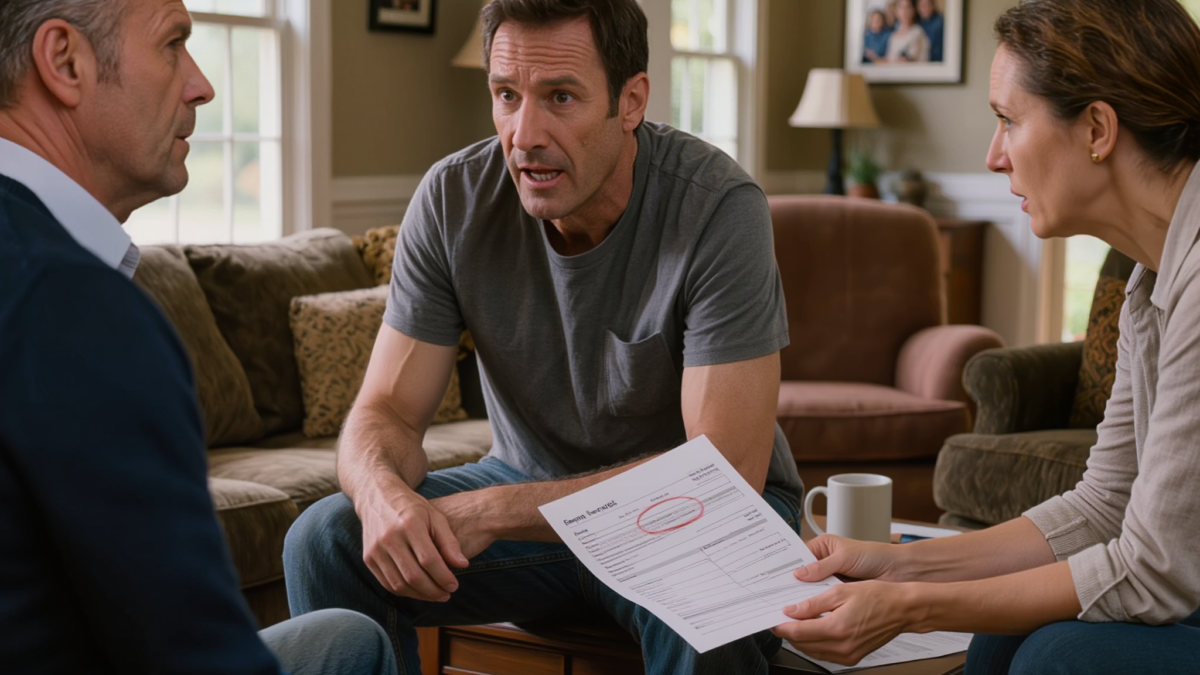
In the center of the coffee table sat a thick manila folder.
I lowered myself onto the sofa.
“So, what’s the good news?” I asked.
Dad cleared his throat and leaned forward with his hands clasped.
“Son, we’ve been very worried about Ethan and the boys. That apartment is no place to raise a family. They need stability. A backyard. A place to call home.”
I nodded slowly.
“Okay.”
Mom could barely contain herself. She leaned forward and tapped the folder.
“Your father and I decided to do something about it. We found the most perfect little house for them. Three bedrooms, a big yard for the boys, and a great school district. It’s perfect.”
Ethan finally joined in, grinning.
“It’s incredible, Leo. You should see it. It even has a finished basement.”
I was confused.
“That’s great, but how? I thought you were on a fixed income. Ethan is still looking for work.”
Dad picked up the folder and opened it on the coffee table.
Inside was a stack of official-looking documents. I caught phrases like “mortgage agreement” and “promissory note.”
“We took care of the down payment,” Dad said proudly, as though he had solved a major world crisis. “We used a good portion of our retirement savings. We see it as an investment in our grandchildren’s future.”
I looked at the papers, then at their expectant faces.
Something still didn’t make sense.
A down payment was one thing. A mortgage was a thirty-year commitment. Ethan couldn’t afford the monthly payments. My parents couldn’t afford them either.
“I don’t understand,” I said quietly. “Who’s going to pay the mortgage?”
Mom smiled.
It was a brilliant, terrifying smile.
She placed her hand on my arm, and her touch felt like ice.
“Well, that’s the other part of the good news, honey,” she said, lowering her voice as if we were sharing a pleasant secret. “We all know how well you’re doing. You’ve been so responsible. You’ve saved so much money. We figured it was time you helped the family in a bigger way.”
She removed a single document from the stack and pushed it toward me.
It was a bank transfer authorization form.
The monthly payment had been circled in red ink.
My name was already typed into the payer section.
My heart didn’t merely sink. It plummeted.
This wasn’t good news.
This wasn’t a family meeting.
It was an ambush.
I stared at the numbers until they began to swim in front of my eyes.
The payment was nearly $2,000 a month.
For thirty years.
They weren’t asking me to help Ethan for a few months. They intended to bind me to a three-decade financial obligation for a house I didn’t own.
A house purchased for a brother whose own choices had helped put him in this position.
The silence in the room was deafening.
All three of them watched me with the serene, unshakable confidence that I would agree.
To them, the equation was simple.
I had money.
Ethan needed money.
Therefore, my money belonged to Ethan.
I finally found my voice, though it came out as a strained whisper.
“You’re joking, right? This has to be a joke.”
Dad’s expression hardened. The pleasant patriarch vanished, replaced by the stern disciplinarian I remembered from childhood.
“There’s nothing funny about this, Leo. This is about family. This is about responsibility.”
“Responsibility?” I shot back. “I’ve been responsible. I’ve been paying for Ethan’s mistakes for the last six months. His lawyer, his rent, his children. What do you call that?”
Chapter 6: Leo stands his ground
Mom waved her hand as though brushing away an insect.
“That was temporary, dear. This is about the future. It’s about providing a stable home for your nephews.”
She was using Liam and Noah against me.
It was the ultimate form of emotional pressure because she knew how much I loved them.
“So your plan,” I said, struggling to keep my voice steady, “was to buy a house you couldn’t afford, use your retirement savings for the down payment, and then hand me the bill without even asking me?”
“We’re asking you now,” Ethan said.
He sounded genuinely confused that I wasn’t delighted by the arrangement.
“This is a good thing, Leo. It solves everything.”
“It solves everything for you.”
I stood so quickly that the room seemed to tilt.
“What about me? What about my future? What about my plans to buy a home someday? What about saving for my own children’s education if I ever have kids? Did any of you think about that for even one second?”
Mom’s eyes immediately filled with tears.
It was a move she had perfected over three decades.
“How can you be so selfish?” she whimpered. “We raised you. We fed you. We clothed you. We gave you everything. Isn’t it time you gave something back?”
The audacity of the statement took my breath away.
I had worked for everything I had—my education, my career, my savings.
They hadn’t given everything to me.
They had given everything to Ethan.
Dad rose from his chair, puffing out his chest.
“Your mother is right. Frankly, what do you need all that money for anyway? You don’t have a wife. You don’t have children. You have a great salary and no one to spend it on. Your brother has a family to support.”
That was the line.
That was the moment when years of resentment—years of being ignored, undervalued, and treated as less important—compressed into one point of cold clarity.
They didn’t see me as a person.
They saw me as a wallet.
An emergency fund.
A resource to be used for the benefit of their favored son.
“No,” I said.
My voice was suddenly calm.
“This isn’t help. This is manipulation. This is theft, and I will not be part of it.”
I looked at Ethan. He stared back with an expression of pure betrayal, as if I were the unreasonable one.
Then I looked at my parents.
Their faces showed a mixture of shock and anger.
They had genuinely believed their plan would work. It had never occurred to them that I might refuse.
“The answer is no,” I repeated as I turned toward the door. “Figure it out yourselves.”
I walked out and slammed the door hard enough to rattle the windows.
When I reached my car, my hands shook so badly that I could barely fit the key into the ignition.
As I drove away, I didn’t feel relieved.
I felt the ominous dread of a man who had just declared war against his own family.
Chapter 7: The family pressure campaign
I expected my phone to start ringing the moment I left the driveway, but it didn’t.
The silence was almost worse.
It felt like the eerie calm before a storm.
When I got home, I paced my apartment for nearly an hour, replaying the conversation. Every sentence from my parents felt like a new betrayal.
The storm arrived the following morning.
It didn’t begin with my parents.
They were smarter than that.
They outsourced the first wave.
My aunt Carol, my mother’s sister, called first.
“Leo, honey,” she began, her voice overflowing with false concern. “Your mother called me. She’s absolutely devastated. I just don’t understand. How could you be so cruel to your own brother?”
I tried to explain.
“Aunt Carol, you don’t understand the situation. They bought a house and expect me to pay the mortgage for thirty years.”
“Oh, don’t be so dramatic,” she replied. “It’s just money. Ethan is a single father now. He’s been through so much, and you’re sitting on all that money with no family of your own to support. What else are you going to do with it? Your parents are trying to secure the family’s future. You should be grateful they included you.”
Grateful.
She actually believed I should feel grateful.
My jaw tightened.
“This conversation is over,” I said before hanging up.
Minutes later, I received a message from my cousin Jessica, Aunt Carol’s daughter. It contained a screenshot of a Facebook post she had just published.
She hadn’t used my name, but there was no question who she meant.
“So sad when people get successful and forget where they came from. Some people would do anything for family, and others wouldn’t lift a finger to help their own brother in his time of need. #FamilyOverEverything #Disappointed.”
Anger surged through me.
They were turning me into the villain of a story they had written.
It was a coordinated campaign. My parents had activated the family telephone tree, spreading their version of events: poor Ethan, abandoned by his wealthy and selfish younger brother.
My phone buzzed again.
This time, it was an email from my uncle Don. It was a long, rambling lecture about filial duty, the sacrifices parents make, and my supposed moral obligation to honor my father and mother.
The pressure came from every direction.
They were trying to shame me, guilt me, and force me into submission.
Every vibration of my phone made me flinch. Each new message carried another wave of condemnation from someone who had heard only one side—the version in which I was a heartless monster refusing to help my struggling family.
But something inside me had changed during that meeting at my parents’ house.
The part of me that had spent a lifetime craving their approval had finally died.
The more they pushed, the stronger my resolve became.
This wasn’t only about money anymore.
It was about control.
They believed they had the right to dictate my finances, my future, and my life.
I sat on my couch while notifications continued to illuminate my phone, and I made a decision.
I opened my contacts.
Aunt Carol: blocked.
Cousin Jessica: blocked.
Uncle Don: blocked.
I went through the list and systematically blocked every relative who had joined the campaign, every person who had accepted my parents’ story without asking for mine.
Then I reached the names of my parents and Ethan.
For a moment, I hesitated.
Blocking them felt final.
But what other choice did I have? They had shown me exactly who they were.
I took a deep breath and blocked them, too.
When silence finally settled over my apartment, I felt an unfamiliar sense of peace.
I knew the conflict wasn’t over. Still, I had survived the first wave and drawn a line they could not cross.
At the time, I believed the public shaming campaign was the worst thing they could do.
I had no idea how wrong I was.
The next two months were strangely quiet. At first, that silence felt like relief, like the blessed calm after a constant, unbearable noise had finally stopped.
Chapter 8: Preparing for a legal battle
I focused on work. I reconnected with friends I had neglected. I even began going on dates.
For the first time, I was building a life that felt entirely my own, free from the weight of my family’s expectations.
Through my friend Daniel, who remained connected to one of my cousins on social media, I heard that my parents had managed to obtain the mortgage for Ethan’s house anyway.
They must have cosigned the loan, putting their own financial future at serious risk.
Part of me worried about them.
A larger part thought, You made your bed. Now lie in it.
It was their choice.
The consequences belonged to them.
I genuinely believed the worst was over. I assumed they had finally accepted my refusal and moved on, however bitterly.
Then came that Tuesday afternoon.
The manila envelope.
The civil summons.
The realization that they had not moved on at all.
They had escalated a private family conflict into a public legal battle.
As I sat in my kitchen holding the lawsuit, the initial shock gave way to a new kind of anger—cold, sharp, and focused.
This wasn’t merely a misguided attempt to obtain money. They were trying to humiliate me and legally force me into the role they had assigned me.
The family ATM.
The demand for reimbursement for raising me was so absurd and insulting that it seemed designed to inflict as much emotional damage as possible.
They were even attempting to charge me for the emotional support they claimed to have provided during my adolescence.
The first person I called was Daniel.
“You’re not going to believe this,” I said, my voice shaking with anger.
I read the document aloud.
He remained silent for several seconds.
Then he said, “Leo, you need a lawyer. Now.”
He was right.
This had gone beyond anything I could handle alone.
The following morning, I took a personal day from work and met with a family law attorney named Evelyn Reed. Her firm had excellent online reviews, and the no-nonsense expression in her profile photograph had been strangely reassuring.
I sat across from her in a polished conference room with the lawsuit spread between us.
I told her everything.
The history with Ethan.
The financial help.
The mortgage meeting.
The family pressure campaign.
She listened without interrupting, occasionally making notes on a legal pad.
When I finished, she picked up the summons and read it once more.
Then she looked at me with a small, wry smile.
“Mr. Miller,” she said, “in all my years of practice, I’ve seen some truly audacious claims. This is in the top five.”
“So it’s as crazy as I think it is?” I asked.
“It’s crazier,” she replied. “They have no legal standing. None. Parents have a legal duty to support their minor children. Children are not required to reimburse their parents for the cost of raising them. If they were, the court system would collapse.”
She leaned forward.
“This isn’t a legitimate lawsuit, Mr. Miller. It’s a harassment tactic. It’s a desperate attempt to pressure you, and we’re not going to let them succeed.”
For the first time since opening the envelope, I felt a flicker of hope.
I wasn’t alone anymore.
I had an ally.
“What do we do?” I asked.
Evelyn leaned back in her chair. Her smile sharpened.
“We fight back,” she said. “We don’t simply defend. We go on the offensive. They want to discuss financial support? Fine. Let’s discuss financial support.”
The following weeks became a blur of preparation.
Under Evelyn’s guidance, I stopped thinking like a helpless son and began thinking like a strategist.
Chapter 9: The day in court
Our mission was simple: gather every piece of evidence proving that I had been anything but an ungrateful or neglectful son.
Evelyn wanted to construct a counternarrative so strong that my parents’ case would appear not merely frivolous, but malicious.
I started with my own financial records.
I spent hours at my laptop searching through years of bank statements and credit card bills.
I found confirmation of the $5,500 payment to Ethan’s divorce attorney and printed it.
I located the scanned image of the $7,200 check I had written to his landlord and printed that as well.
I found receipts for groceries, children’s clothing, movie tickets, and other expenses from the weekends when Liam and Noah stayed with me.
At first, including those smaller purchases felt petty.
“Every dollar counts, Leo,” Evelyn told me. “We’re painting a complete picture.”
Next, I searched my text messages and emails.
The pressure campaign from my extended family became an unexpected source of evidence.
Aunt Carol’s guilt-filled messages.
Jessica’s condescending remarks.
Uncle Don’s sanctimonious email.
Evelyn studied the printouts with satisfaction.
“This is excellent,” she said. “It demonstrates a coordinated effort to pressure and intimidate you. It helps establish motive.”
The most difficult decision involved my grandparents.
My father’s parents, Arthur and Eleanor, were the only relatives who had remained neutral. In my family, neutrality was almost the same as being on my side.
They were old-fashioned people with strong principles. I knew they would be horrified by what my parents were doing, but I hated the idea of pulling them into the conflict.
Eventually, I called them.
My stomach was in knots as I explained the entire situation. My voice cracked when I reached the lawsuit.
A heavy silence followed.
Finally, my grandfather spoke. His voice was gravelly with anger.
“That boy’s father has lost his mind,” he said, referring to my dad. “Suing his own flesh and blood. It’s a disgrace.”
Then my grandmother took the phone.
“Leo, darling, we are so sorry you’re going through this. This is not how we raised your father. You have always been a good and responsible young man. Of course we support you.”
She paused.
“We’ll be at the hearing. We want your father to see us sitting on your side of the courtroom.”
When the call ended, tears filled my eyes.
It may have seemed like a small gesture, but their support felt like a shield. It reminded me that the word family had not been completely ruined.
I wasn’t fighting alone.
Armed with a binder of evidence and the support of the only relatives who truly mattered, I felt ready.
The fear and shock had hardened into resolve.
My parents had started this battle.
I intended to finish it.
The morning of the hearing was gray and overcast, perfectly matching my mood.
I walked into the courthouse beside Evelyn, carrying the heavy evidence binder beneath my arm.
The building smelled of stale coffee and old paper. The entire experience felt unreal, as though I were walking onto the set of a courtroom television show.
Our assigned courtroom was smaller than I had imagined, with dark wood paneling and rows of worn benches.
My parents and Ethan were already seated at the plaintiffs’ table with their attorney. They looked stiff and uncomfortable in their best clothes.
My mother refused to look at me. She stared straight ahead with a pained expression, as though she were the person who had been wronged.
My father glared at me, his jaw set in a stubborn line.
Ethan looked like a lost child, completely out of his depth.
Then I saw my grandparents.
Arthur and Eleanor sat side by side in the first row of the public gallery, their backs straight.
Grandma gave me a small, encouraging smile.
Grandpa nodded once, his eyes fixed on his son with unmistakable disappointment.
My parents noticed them, too.
Shock flickered across my mother’s face before she quickly composed herself.
Evelyn and I took our seats at the defense table.
Beneath the table, she gave my hand a reassuring squeeze.
“Deep breaths, Leo,” she whispered. “Let me do the talking. The truth is on our side.”
Chapter 10: The judge dismantles the case
The bailiff called the court to order.
A stern-looking woman in her late fifties entered and took her place behind the bench.
Judge Thompson had sharp eyes that seemed to miss nothing.
My parents’ attorney spoke first. He was slick, polished, and far too confident for someone representing such a questionable claim.
He launched into a long speech about the sanctity of family and the sacrifices his clients had made to provide their son with a good life.
He portrayed my parents as loving people who had poured everything into their children, only to be abandoned by a successful and ungrateful son during their time of need.
Their supposed need, he explained, was to help Ethan provide a stable home for their grandchildren.
It was a polished performance in emotional manipulation.
I could see the judge’s patience wearing thin.
When he finally finished, Judge Thompson looked down at him over her glasses.
“Counselor,” she said, her voice as dry as dust, “while your speech about family values is touching, could you point me to the specific legal statute that entitles parents to a $350,000 reimbursement for raising their own child?”
The attorney sputtered and began flipping through his notes.
“Well, Your Honor, it isn’t about a specific statute. It’s about a principle of familial duty and fairness.”
The judge was not impressed.
She turned toward my parents.
“Mr. and Mrs. Miller, I have a few questions.”
They sat straighter.
“Did you pay for your son Leo’s college education?” she asked my father.
“No, Your Honor,” he mumbled. “He received scholarships.”
“I see. So he has been financially independent since he was eighteen?”
“Yes, Your Honor.”
“And you are not experiencing financial hardship yourselves? You are not suing him to obtain support for your own needs?”
“No.”
Mom quickly spoke.
“We only want a portion of what we invested in him returned so we can help our other son, Ethan, pay the mortgage on his new house.”
The judge stared at them for a long, uncomfortable moment.
The courtroom fell silent.
She seemed to be processing the extraordinary entitlement behind that admission.
Then Evelyn rose.
“Your Honor, if I may.”
“Proceed, Ms. Reed.”
Evelyn walked calmly toward the table and lifted our evidence binder.
“Your Honor, not only is this claim without legal merit, but it is also a gross misrepresentation of the facts. My client, Mr. Miller, has repeatedly provided substantial financial support to his brother and his brother’s family out of the goodness of his own heart.”
She presented the records one at a time.
The bank statement showing my payment to Ethan’s attorney.
The copy of the check covering six months of rent.
Receipts for groceries, clothing, and other essentials for his children.
With every document Evelyn submitted, my parents seemed to shrink further into their seats.
Their portrait of the selfish, ungrateful son was being dismantled in front of the judge.
But the most devastating moment was still to come.
After Evelyn finished presenting the evidence, tense silence filled the courtroom.
My parents’ attorney had nothing meaningful to say. Bank records and canceled checks could not be dismissed with a speech about family duty.
Judge Thompson studied the documents before looking back at my family.
Her expression was analytical and completely devoid of sympathy.
She took a slow sip of water.
Then she turned her attention to the one person who had remained silent throughout the hearing.
“Mr. Ethan Miller,” she said. “Please stand.”
Ethan rose awkwardly.
He looked pale and nervous, nothing like the confident golden child I had grown up with.
Judge Thompson peered at him over her glasses.
Chapter 11: Victory and aftermath
“Mr. Miller, I have reviewed evidence showing that your brother paid your divorce attorney, your rent, and several expenses related to your children. Your parents are now suing him for an additional $350,000, which they have acknowledged is intended to help pay the mortgage on a house purchased for you.”
She paused.
“I have one question, and I want you to consider it very carefully before answering.”
The room became completely still.
“Do you honestly and truly believe that your younger brother should be held legally and financially responsible for your home loan?”
This was it.
Years of family dysfunction had been reduced to a single question.
Ethan had a choice.
He could have shown a trace of humility.
He could have admitted the situation had gone too far.
He could have acknowledged that I had already done more than enough.
He didn’t.
He straightened his shoulders, and a flicker of his old entitlement returned.
“Well, Your Honor,” he began in a strained, complaining voice, “he can afford it. He makes a great salary, and he doesn’t have a family or children. I do. It’s not fair that he has so much while I’m struggling.”
The judge’s face remained perfectly still, but something changed in her eyes.
The courtroom seemed to hold its breath.
She looked at Ethan, then at me, and finally back at him.
“I’m not married either, Mr. Miller,” she said quietly. “And I have no children. Should I therefore be responsible for paying my clerk’s rent?”
Ethan’s mouth fell open.
He had no answer.
He simply stood there as the absurdity of his own argument was exposed for everyone to see.
Judge Thompson allowed him to remain in that silence for several seconds before speaking again.
“I have heard enough,” she declared. “Case dismissed with prejudice.”
She wasn’t finished.
Her gaze moved to my parents.
“To the plaintiffs, Mr. and Mrs. Miller, let me be unequivocally clear. Parents are not entitled to reimbursement for raising their children. That is a fundamental tenet of our society. Bringing this claim before my court constitutes an abuse of the legal system.”
She gestured toward the evidence binder.
“Furthermore, the evidence demonstrates that your son, the defendant, has already provided more financial support to this family than many parents could ever expect. Your claim is not merely baseless. It is offensive.”
She rose, her black robes making her appear larger than life.
“Frankly, I find your conduct brazen, manipulative, and profoundly disappointing. You are dismissed.”
The gavel struck.
It was over.
Relief swept through me so powerfully that my knees almost gave way.
I had won.
The truth had won.
I looked toward my family.
Mom was crying openly, but they were not tears of remorse. They were tears of humiliation.
Dad looked as though someone had struck him.
Ethan stared at the floor, completely defeated.
They had gambled everything on my lifelong sense of obligation, and they had lost in front of everyone.
That was the moment I finally regained control of my own life.
Chapter 12: My parents demand their inheritance
As the courtroom emptied, the sound of the gavel still echoed in my ears.
Mom began walking toward me with one hand extended.
“Leo,” she started.
Before she could take another step, Evelyn moved between us.
“I think you’ve said quite enough for one day, Mrs. Miller,” she said coolly.
I didn’t look at my parents.
I turned and walked toward the back of the courtroom, where my grandparents were waiting.
Grandma wrapped me in a fierce hug. Her small frame trembled slightly.
“Oh, Leo,” she whispered. “I’m so proud of you for standing up for yourself.”
Grandpa placed a heavy hand on my shoulder.
“You did the right thing, son.”
He looked beyond me toward my father, who was helping my mother leave the room.
Grandpa didn’t need to say anything more. I could see the shame and sadness in his eyes.
Daniel was waiting in the hallway.
He clapped me on the back.
“Man,” he said with a low whistle. “That was better than any television show. The look on Ethan’s face when the judge asked him that question was priceless.”
The four of us—Daniel, my grandparents, and me—went to a quiet diner nearby.
As we sat in a worn vinyl booth eating burgers and drinking coffee, something occurred to me.
This felt more like family than any holiday dinner or forced gathering I had ever attended with my parents.
There was no agenda.
No manipulation.
Only genuine care and support.
Grandpa shook his head as he salted his fries.
“I don’t know what happened to your father,” he said heavily. “We didn’t raise him to value money and appearances more than his own son.”
“It’s the dynamic with Ethan,” I replied, finally able to put the pattern into words. “Dad has always needed to be Ethan’s hero. When he couldn’t be the hero financially, he tried to force me into that role.”
“It isn’t your job to be anyone’s hero, Leo,” Grandma said firmly.
She reached across the table and patted my hand.
“Your job is to live your own life. We’re only sorry it took something this drastic for you to feel free to do that.”
We talked for hours, not only about the lawsuit but about everything else.
My work.
My plans for the future.
Daniel’s new puppy.
It was ordinary.
It was peaceful.
For the first time in my life, I felt that I could simply be Leo instead of Ethan’s responsible younger brother.
Driving home that evening, I felt lighter than I ever had.
The weight I had carried for most of my life—the weight of my parents’ expectations, their approval, and their conditional love—was gone.
The legal victory was satisfying.
The emotional victory mattered even more.
I had finally been seen and supported by the people who truly cared about me.
I knew the road ahead might not be completely smooth, but for the first time, I knew with absolute certainty that I would be all right.
Perhaps foolishly, I hoped the public humiliation in court would serve as a wake-up call for my parents.
I thought they might reflect on what they had done, recognize the damage they had caused, and perhaps feel some remorse.
That hope lasted exactly one week.
Grandma called me.
Her voice sounded strained, carrying a weary resignation that broke my heart.
“Leo,” she said, “I thought you should hear this from me before you hear it somewhere else.”
“What is it, Grandma?”
A familiar sense of dread returned.
“Your father and mother came to the house this morning. They were in a terrible state. Your mother was crying, and your father was angry. They said the legal fees and the mortgage had placed them in a difficult financial position.”
I remained silent, waiting for the inevitable request.
“Leo, they asked us to give them an advance on their inheritance.”
Disbelief filled her voice.
“They wanted us to change our will and give them their share of our estate now so they could pay off the mortgage on Ethan’s house.”
I leaned against the kitchen counter, pressing the phone to my ear.
I wasn’t even surprised.
I felt numb.
After a judge had publicly condemned their behavior, their first thought had not been to apologize or repair their relationship with me.
Their first thought was to locate another source of money.
They had simply moved on to the next bank they believed they could access.
The bank of Grandma and Grandpa.
Chapter 13: Building a new life
“What did you say?” I asked, although I already knew.
“Your grandfather told them no,” Grandma replied firmly. “He told them our will and our estate are our business. He said we would not be pressured into liquidating our assets to rescue them from a problem they created. He told them they should be ashamed for even asking.”
“How did they react?”
“Not well. Your father stormed out. Your mother cried and said we didn’t understand that we were choosing you over them.”
When the call ended, a cold realization settled deep inside me.
It had never truly been about losing me.
Mom’s tears in the courtroom and her attempt to approach me afterward had not been about the son she had driven away.
They were about the money she had lost.
Her grief was financial.
My absence from her life was a calculated inconvenience. The absence of my financial support was the real tragedy.
That was the moment I finally let go.
It confirmed that my parents’ love had always been conditional. It depended on my usefulness and my willingness to perform the role they had assigned me.
Now that I had refused, I no longer had value to them.
The realization hurt, but it also liberated me.
There was no relationship left to save.
There was nothing left to mourn.
Only the future remained, and for the first time, it belonged entirely to me.
The year after the court case felt like waking from a long, suffocating dream.
With the constant noise of family conflict gone, I could finally hear my own thoughts and recognize my own desires.
The freedom was exhilarating.
The first major thing I did was something I had postponed for years. I had always told myself I was saving for a rainy day, but I now understood that “rainy day” had become another phrase for the next family emergency.
I bought my own home.
It wasn’t a large suburban house like the one my parents had purchased for Ethan. It was a modern two-bedroom condo in a lively part of the city, with a balcony overlooking a park.
The day I received the keys was one of the happiest days of my life.
I spent the first weekend sitting on the floor of the empty living room, drinking a beer and absorbing the silence.
It was mine.
Every square inch.
I hadn’t inherited it. No one had given it to me. No one could claim that I owed them for it or try to take it away.
I devoted myself to making it feel like home.
I painted the kitchen a cheerful shade of yellow—a color my mother had always disliked. I bought an absurdly comfortable couch.
I also adopted a small gray tabby from a local shelter and named him Gus. He quickly became the master of the condo and my constant companion.
My life settled into a peaceful rhythm.
Without the relentless stress from my family, my work at the tech company improved. I became more focused and creative. My boss noticed, and I received a significant promotion with a substantial raise.
I began hiking again on weekends.
I reconnected with friends from college.
Daniel and I established a Thursday-night tradition of ordering pizza and watching terrible action movies.
Every other Sunday, I visited my grandparents.
Our relationship grew stronger outside my parents’ shadow. They told me stories about their youth, how they had met, and the difficulties they had overcome together.
I helped with yard work and set up their new computer.
In their quiet, unwavering support, I found the unconditional love I had always wanted from my parents.
I occasionally heard fragments of news about the rest of the family.
Ethan struggled to keep up with the mortgage payments. The perfect house became an anchor around all of them.
Eventually, he rented it out and moved back into my parents’ home with Liam and Noah.
The large house that had represented their grand plan became a rental property on which they were barely breaking even.
Meanwhile, the four of them were crowded into the house where Ethan and I had grown up.
The irony was not lost on me.
I didn’t feel guilty.
I had given them an opportunity to behave like a family. They had discarded it in exchange for the deed to a house.
They had made their choice.
I had made mine.
I chose peace.
I chose sanity.
I chose myself.
One evening, as I sat on the balcony with Gus purring on my lap and watched the sun set over the park, I knew I had chosen correctly.
I was finally, genuinely happy.
I didn’t know that my family still had one final, unbelievably audacious demand left to make.
Chapter 14: The final demand
Nearly a year after the court case, an email appeared in my inbox.
It had been a year of blessed silence.
At first, I didn’t recognize the address, but the subject line made my stomach tighten.
A family matter.
My cursor hovered over the delete button.
Part of me wanted to erase the message without opening it and continue with my life.
Curiosity won.
I clicked.
The message was from my mother.
Her tone contained none of the emotion or drama from our last encounters. It was brisk, practical, and completely devoid of self-awareness.
She wrote as though the lawsuit, the courtroom, and the judge’s condemnation had never happened.
“Leo,
“I hope this email finds you well. We heard from your grandmother that you bought a new home for yourself. That’s wonderful news. It must be nice to have so much space.
“As you may know, things here have been a little difficult. Ethan and the boys are living with us, and the house is becoming very crowded. It is not an ideal situation for raising two growing boys.
“Since you now have a two-bedroom home and live alone, it occurred to us that there is a simple and convenient solution for everyone. Ethan and the boys can move in with you. It would give them the space they need and would be much more convenient for everyone involved. Liam and Noah would love living in the city with their uncle.
“Let us know which day would be good for them to move their things in. We can begin next weekend.
“Sincerely,
“Mom”
I read the email once.
Then I read it again to make sure I hadn’t misunderstood.
The sheer audacity was breathtaking.
After suing me for hundreds of thousands of dollars, after being publicly humiliated in court, and after maintaining nearly a year of silence, my mother’s first communication was another demand.
Not a request.
A demand.
They weren’t asking whether Ethan and the boys could live with me.
They were informing me of the arrangement they had made for my home.
They had learned absolutely nothing.
They still viewed my property, my time, and my life as resources they had the authority to distribute.
For several seconds, the old anger returned.
I began typing a furious reply. My fingers moved rapidly across the keyboard as I listed every betrayal, every manipulation, and every moment of pain they had caused.
Then I stopped.
I looked around my quiet condo.
Gus slept in a patch of sunlight on the rug.
The yellow walls of my kitchen glowed softly.
From outside, I could hear children playing in the park.
And I realized something.
My family couldn’t touch this.
They couldn’t touch me.
Their demands and warped logic no longer had any power over my life.
Chapter 15: Choosing peace and freedom
I deleted the angry draft.
Responding with fury would mean they still had a hold on me. It would mean I was still participating in their game.
The only way to win was to stop playing.
I wrote a new response.
It was brief, calm, and final.
“Helen,
“I will not be hosting Ethan or the boys. This is not open for discussion. Do not contact me again.
“Leo”
I pressed send.
Then I did something I should have done a year earlier.
I created a filter that would send any message from her address—or from any variation of my family’s names—directly into the trash, unread.
I leaned back and took a long breath.
A genuine smile crossed my face.
This time, it was truly over.
I had sent my last message.
I had built the final wall.
On the other side was peace.
Several years have passed since that email.
True to my word, I have had no contact with my parents or Ethan. I don’t know whether they tried to reach me again. If they did, their messages disappeared into the digital void of my trash folder.
The silence has been profound.
Within it, I found a level of contentment I once believed was impossible.
Sometimes, while sitting on my balcony in the evening and watching the city lights begin to glow, I think about them.
I no longer feel anger.
I don’t even feel much sadness.
Mostly, I feel distance, as though I’m watching a film about someone else’s life.
I see a family trapped in a cycle of entitlement and manipulation, unable to recognize anything beyond its own immediate needs.
I see my brother, forever treated like a child and never required to stand on his own feet.
I see my parents, who sacrificed their relationship with one son to continue enabling the other.
They made their choices.
They live with the consequences.
My life, meanwhile, has continued to grow.
I’m still at the same company, but I now lead my own team.
Eventually, I met a wonderful woman named Clara. She is kind, funny, and respects my boundaries as though doing so is the most natural thing in the world.
She knows my history.
She loves me not despite it, but partly because she understands the strength it took to survive it.
My grandparents adore her.
My relationship with Liam and Noah is more complicated.
I send birthday and Christmas gifts through my grandparents so the boys know their uncle still thinks about them.
I hope that when they are older, they will understand.
More than anything, I hope they break the cycle.
I learned a difficult lesson from everything that happened.
Sometimes, the people who are supposed to love you most are the ones who hold you back most tightly.
Family is not an excuse for manipulation or mistreatment.
Sharing blood with someone does not require you to remain close while they repeatedly harm you.
The peace I have now was not given to me.
It wasn’t an inheritance.
It wasn’t a gift.
It was a choice.
I had to fight for it.
I had to build it myself, brick by brick and boundary by boundary.
Looking back, I wouldn’t change anything.
As painful as the experience was, it brought me here—to this quiet home that is truly mine, and to a future that is bright and unbound.
Some ties don’t need to be mended.
They need to be severed so you can finally be free.
My only regret is that it took me so long to find the scissors.








