My parents abandoned me at nine with a cracked blue suitcase on Grandpa’s ranch. Twenty-two years later, they arrived at his funeral in a rented Porsche, talking about a $100 million inheritance. Mom claimed I’d controlled his finances; my brother threatened a court battle. At the estate meeting, I sat by the fireplace wearing Grandpa’s iron ring while their attorney demanded the will. Then Grandpa’s lawyer said, “We are not here today to read a last will and testament.”
My name is Ethan Parker. I am 31 years old.
Twenty-two years ago, my parents drove me to a dusty, isolated horse ranch in the high desert of Eastern Oregon and left me on the front porch with a cheap, cracked plastic suitcase.
Ten years later, those exact same parents showed up at my grandfather’s funeral in pressed black suits, stepping out of a rented Porsche SUV, talking loudly about family and a $100 million inheritance they believed was rightfully theirs.
While I stood there in the biting November wind, burying the only man who had actually raised me, my mother looked at her expensive, slick-haired lawyer and said it was an absolute tragedy how isolated her father had become in his final years.
She actually had the nerve to stand in his living room, surrounded by his neighbors, clutching a designer tissue and crying about how much she missed him.
She played the role of the grieving daughter perfectly. If you didn’t know her, you would have thought her heart was breaking.
But I knew her.
I watched her look around the property, her eyes darting over the solid mahogany furniture, the heavy antique silver, and the expansive grazing pastures visible through the large bay windows.
I could practically see the gears turning in her head as she mentally calculated the real estate value of every acre and the liquidation price of every tractor.
But there was one massive thing they didn’t know.
My grandfather, Arthur Coleman, was a master engineer. He built agricultural water systems and massive irrigation pipelines designed to last for decades under the harshest conditions.
And he built his estate plan the exact same way.
He engineered a legal fortress.
My parents came to his house ready for a brutal fight. They were prepared to throw around wild accusations, challenge his mental capacity, and threaten a massive lawsuit to seize his assets.
And right now, today, they’re probably still paying off the high-interest credit card debt they racked up just to rent that luxury vehicle and hire that aggressive legal team.
A single piece of paper destroyed their entire reality in less than fifteen minutes.
But to understand how that happened, I have to go back to the exact day everything started.
It was late August.
I remember the month vividly because the air smelled like dried alfalfa grass, hot fence wire, and impending doom. The heat was absolutely suffocating that year.
The sun beat down relentlessly on the cracked asphalt. My cheap canvas sneakers were practically melting into the cracked vinyl back seat of my father’s battered beige Buick.
We had been driving for six hours straight from our suburban, perfectly manicured home in Portland.
Nobody had spoken a single word to me since we stopped for gas somewhere outside Bend early that morning.
The radio was turned off.
The silence in that car wasn’t just quiet. It was heavy, thick, and suffocating. It was the kind of silence that physically pressed against your eardrums and made it hard to pull air into your lungs.
I was a nine-year-old boy holding a plastic astronaut action figure with a broken helmet, completely unaware that my life as I knew it was ending.
My mother, Diane, sat in the front passenger seat. She was aggressively flipping through a glossy lifestyle magazine, turning the pages so hard they were tearing at the edges.
Her jaw was locked tight, her posture rigid, her eyes fixed completely on the paper. She never once glanced at the rearview mirror.
My father, Robert, drove with one hand draped lazily over the steering wheel and the other tapping a frantic, erratic rhythm on the center console.
He looked like a man counting down the agonizing seconds until a high-stakes hostage negotiation was finally over.
He kept checking the side mirrors, adjusting his collar, and wiping sweat from his forehead. But he never actually made eye contact with me.
He looked right through me, treating me like cargo that simply needed to be unloaded at the final destination.
When we finally pulled off the main paved highway and onto the long, dusty gravel road leading to Coleman Stables, Diane turned around.
She didn’t look at my face. She didn’t look into my eyes to offer any comfort or explanation.
She looked directly at the cheap blue plastic suitcase resting next to me on the seat.
“You will have your own room,” she said.
Her voice was entirely flat, completely devoid of any maternal warmth or hesitation.
“Grandpa has a big house. You will like it here. It is better for everyone this way.”
That was the entire pitch.
That was the comprehensive, total explanation for dumping a nine-year-old child on the doorstep of a seventy-year-old man I had met exactly twice at highly awkward Thanksgiving dinners.
There was no family meeting. There was no discussion about temporary arrangements. There was no tearful goodbye filled with promises of weekend visits.
Robert parked the car near the heavy wooden porch of the main ranch house.
He didn’t turn off the engine.
The exhaust continued to hum steadily, a constant mechanical reminder that they were absolutely not staying.
He got out, opened my door, grabbed the handle of my suitcase, and carried it to the bottom of the wooden steps.
He set it down hard, the plastic cracking slightly against the wood, acting exactly as though he were dropping off a heavy package he was deeply tired of carrying.
He didn’t kneel down to look me in the eye.
He didn’t offer a hug.
He didn’t even pat me on the shoulder or ruffle my hair.
He just turned his back, wiped the dust off his slacks, and walked away.
Diane never even opened her car door.
She rolled the passenger window down exactly two inches, just enough to let her voice out into the hot air, but not enough to let the crushing reality of what she was doing inside the air-conditioned cabin.
I stood on the bottom step of the porch, my knuckles turning white as I clutched the canvas straps of my small backpack.
I looked at her through that tiny two-inch gap in the glass.
I desperately wanted her to say something real.
I wanted her to tell me they would be back on Sunday to pick me up. I wanted her to say this was just a summer camp experience and that I would be home in time for school to start.
She met my eyes for half a second.
It was a cold, highly calculating look. There was no regret, no sorrow, no maternal instinct in her expression whatsoever.
Then she shifted her gaze away from me and looked at Robert as he got behind the wheel and put on his seat belt.
She said something I was never supposed to hear, but the wind carried it perfectly through that gap in the window.
“He is the one we can afford to lose.”
Those exact words hit my chest like a heavy physical blow from a sledgehammer.
They knocked the wind completely out of my lungs and made my vision blur.
Robert shifted the car into reverse.
The Buick backed out roughly, the tires spinning and spitting loose gravel into the dry summer grass.
I watched the red taillights disappear down the long, winding road toward the highway.
The thick cloud of dust kicked up by their tires hung in the hot summer air for a long time, glowing a dull orange in the late-afternoon sun.
The only sound left in the entire world was the slow, steady creak of the old iron windmill behind the main barn.
It turned rhythmically in the August heat, just as it had been turning long before I got there, and just as it would keep turning long after everyone forgot I existed.
I stood on that porch for what felt like hours.
I didn’t cry. My young brain simply couldn’t process the magnitude of the betrayal.
I just stared at the empty road, waiting for a car that was never going to come back.
Then the heavy wooden screen door groaned loudly and opened behind me.
I turned around, my heart pounding in my throat.
Arthur Coleman was six feet two inches tall, with short white hair buzzed close to his scalp.
He wore a faded chambray work shirt, heavy denim jeans, and thick leather boots.
Dark, stubborn machine grease was permanently stained deep under his fingernails and into the creases of his knuckles.
He looked like a man carved directly out of solid stone, weathered by decades of sun and wind, and completely unmovable.
He didn’t crouch down to my level to make himself less intimidating.
He didn’t ask if I was okay, if I was scared, or if I wanted a glass of water.
He looked at my cheap blue plastic suitcase sitting in the dirt.
And then he looked directly at me.
“Can you carry that yourself?” he asked.
His voice was deep and resonant, like gravel rolling down a steep hill.
I nodded slowly, my throat completely closed up and too tight to speak.
“Good,” he said, turning back toward the house.
“Your room is at the top of the stairs. Second door on the right. Drop it off and then meet me in the workshop behind the barn. Do not drag your feet.”
There was no warm embrace.
There were no fresh-baked chocolate chip cookies waiting on the kitchen counter.
There was no long, comforting pep talk about how everything was going to be all right and how we were going to be a family.
There was just a clear, uncompromising direction and a job to do.
I grabbed the handle of my suitcase, the plastic digging into my palm, and dragged it up the heavy wooden stairs.
The house smelled intensely of old pine wood, strong black coffee, and deep solitude.
I dropped my bag in a small room with a single iron-framed bed and a heavy handmade quilt.
I didn’t sit down on the mattress.
I knew better than to keep a man like Arthur Coleman waiting.
I walked right back outside into the blinding sun and headed toward the large corrugated metal building behind the main barn.
I truly thought the worst part of my life was over.
I thought the abandonment on the porch was the absolute climax of my pain.
I was so incredibly wrong.
The workshop was a massive, cavernous room with concrete floors, lined from floor to ceiling with meticulously organized pegboard walls.
Every single wrench, every socket set, every screwdriver, and every pair of pliers had a specific, carefully labeled place.
Nothing was out of order, and nothing was dirty.
The very first thing that hit me when I walked through those double doors was the smell.
It was an intense, overpowering mixture of rich saddle leather, WD-40, hot metal, and old machine oil.
It smelled like relentless hard work.
It smelled like a place where things were given a clear purpose.
Arthur was standing at a heavy wooden workbench that looked as though it had survived a war.
He was holding a thick leather horse bridle with a snapped brass buckle.
He pointed a greasy, calloused finger toward a small, battered wooden stool sitting in the far corner.
“Sit,” he commanded, without looking away from the bridle.
I walked over and sat down, pulling my knees tight to my chest, trying desperately to make myself as small and invisible as humanly possible.
“Watch,” he said.
I watched him.
He didn’t try to sit me down and explain the complex psychological reasons why my parents had abandoned me.
He didn’t offer any empty platitudes or promise me that things would magically get better in time.
He just focused on fixing the broken buckle.
His hands moved slowly, with incredible precision and deliberate care.
He cut away the frayed, ruined leather with a razor-sharp utility knife, aligned the straps perfectly, hammered a new heavy brass rivet into place with three solid strikes, and tested the strength of the joint with a firm, violent tug.
When he was completely finished and satisfied with his work, he wiped his hands thoroughly on a heavy red shop rag.
He balled the rag up and tossed it directly at my chest.
“You will work,” he told me, looking me dead in the eye with a gaze that commanded absolute attention.
“Working is exactly how you stop drowning in your own head.”
That was my real welcome to Coleman Ranch.
Arthur taught me how to properly use a heavy-duty torque wrench long before he ever taught me how to make a decent plate of scrambled eggs for breakfast.
During that entire first week, my soft suburban hands blistered, peeled, and bled.
I learned how to meticulously clean engine parts, how to organize his massive hardware bins by thread pitch and diameter, and how to tighten a steel bolt to exact factory specifications on a massive diesel tractor engine.
“You have to feel the threads catch,” he said, standing behind me and guiding my small hands over the heavy, cold metal tool.
“That is exactly where the metal wants to stop. It is talking to you. If you push past that point, if you force it because you think you are stronger than the design, you break the exact thing you are trying to hold together. Then you have nothing but stripped metal and a bigger problem.”
He always talked exactly like that.
He spoke in short, highly practical sentences that always had a massive, profound second meaning hiding right behind the first one.
He never once stopped to explain the second meaning.
You either caught the life lesson hidden in the mechanics or you missed it entirely.
He was explicitly telling me not to force things.
He was telling me not to break my own spirit by desperately trying to hold on to people who clearly didn’t want to stay in my life.
By my second full month on the ranch, the painful blisters on my hands had hardened into thick, permanent calluses.
I was out in the vast open fields working directly alongside Ryan Mitchell.
Ryan was the ranch foreman, a guy in his late twenties with a perpetual sunburn, heavily muscled arms, and a booming, infectious laugh.
He realized very quickly how broken I was, and he stepped in.
He treated me far more like a little brother than a runaway kid dumped by wealthy parents.
Ryan taught me how to saddle and ride a quarter horse without falling off and breaking my neck.
He taught me how to stretch and mend a broken barbed-wire fence without tearing my arms to shreds.
He taught me how to spot a sick, feverish animal from fifty yards away just by the subtle way it held its head and shifted its weight.
I spent my days sweating profusely in the dirt under the blazing Eastern Oregon sun and my evenings sitting silently in the workshop, learning to read complex, multilayered mechanical blueprints.
Arthur never talked about my parents.
Not a single time.
It was an unspoken rule that hung in the air of the house.
If I accidentally brought them up, if I even mentioned the city of Portland or the suburban life I used to have, he would pause, look at me with a hardened expression, and immediately redirect my attention to the physical world.
He would hand me a heavy socket wrench and tell me to walk a mile out to check the water troughs in the south paddock.
It wasn’t emotional cruelty.
It was a calculated, fiercely protective psychological decision.
He was actively teaching me how to build a productive day and eventually build an entire fulfilling life that simply didn’t have Diane and Robert Callahan in it.
One quiet evening in late autumn, I was sitting on my stool in the workshop watching Arthur sketch a brilliant, highly efficient modification for the main barn’s ventilation system.
His pencil lines were clean, sharp, and precise.
It was the kind of professional drafting that belonged in an upscale architectural firm, not on a dusty, isolated ranch in the middle of nowhere.
As he drew, rotating the paper, I noticed a thick, heavy iron ring on his right hand.
The outside of the band was worn completely smooth from decades of hard friction, but there was a deep engraving on the inner surface.
“What is that ring?” I asked him, breaking the silence of the shop.
He stopped sketching and looked at his hand as though he had genuinely forgotten the heavy iron ring was even there.
“My father’s,” he replied softly, his voice dropping an octave.
“What is it for?” I pressed.
He turned the heavy iron band slowly around his finger one single time.
“Keeping a promise.”
He picked his drafting pencil back up, tapped it against the desk, and looked right at me.
His blue eyes were sharp, piercing, and completely unyielding.
“You do not inherit a single thing in this world, Ethan. You earn the absolute right to keep it through sweat and loyalty.”
I didn’t understand the immense, crushing weight of that statement until much later in my life.
I didn’t know that the quiet, unassuming man eating cheap canned chicken noodle soup for dinner three nights a week held fourteen incredibly lucrative patents for agricultural irrigation systems used across the entire western United States.
I didn’t know that this dusty, remote real estate, combined with his vast intellectual property portfolio, was worth an absolute fortune.
I just knew he was the guy who fixed broken things, including the broken boy living in his guest room.
But my parents knew.
They always knew exactly what he was worth.
My parents called the ranch house maybe three times a year.
The phone calls always followed the exact same agonizing, predictable pattern.
Diane would call on a Sunday afternoon.
She would immediately ask Arthur about the property taxes, the commercial insurance rates on the heavy equipment, and the long-term weather forecasts affecting the crop yields.
Robert would get on the phone for exactly twenty seconds, clear his throat awkwardly, and ask if I was staying out of trouble.
Neither of them ever asked what grade I was in.
They never asked what I wanted for my birthday.
They never asked if I was happy, healthy, or making friends.
They treated me like a poorly performing stock they had written off.
Then came my fifteenth birthday.
Diane had called a week earlier and promised, absolutely swore on her life, that she and Robert were going to drive the six hours out for the weekend to celebrate.
They were going to bring my older brother Mason too.
Mason was the ultimate golden child.
The one they kept.
The one who got the expensive tailored clothes, the private high-end tutors, the brand-new car at sixteen, and the fully funded college account.
I spent two entire days scrubbing the guest room until my hands bled again.
I washed the sheets with bleach, dusted the baseboards on my hands and knees, and cleared out my own small closet to give them space for their luggage.
Arthur didn’t say a single word about my frantic cleaning.
But on Friday afternoon, he drove his heavy truck all the way into town and bought a massive, expensive chocolate cake from the local bakery.
It was the most festive, celebratory thing he had ever done in the six years I had lived under his roof.
Saturday morning came.
I sat on the wooden porch from sunrise to sunset.
I watched every single dust cloud on the horizon, hoping it was their Buick.
No car pulled down the gravel road.
The sun went down, casting long, dark, depressing shadows across the yard.
The crickets started chirping, mocking the silence.
Sunday morning, the kitchen phone finally rang.
It went to the answering machine.
Diane left a voicemail.
She didn’t even have the basic courage to call while we were awake to face the disappointment in my voice.
I played the message back in the quiet kitchen, staring at the flashing red light on the machine.
Her voice was breezy, light, and completely unapologetic.
She said Robert’s important business meeting had run late. Mason had a soccer tournament they simply couldn’t miss, and they would try again next month.
I sat on the front porch with a large piece of chocolate cake on a paper plate in my lap.
I couldn’t swallow a single bite.
I watched the sun set behind the barn, feeling an incredibly deep, hollow ache in my chest.
Arthur walked out holding a cup of coffee.
He stood next to me, leaning against the railing, and didn’t speak for a solid hour.
The silence between us was loud and heavy.
Then he walked back inside, picked up the kitchen phone, and dialed their Portland number.
I listened from the porch.
His voice had a sharp, cutting edge I had never heard him use before.
“Do not ever promise that boy something you will not deliver,” he said directly into the receiver, not even bothering to say hello.
His tone was pure ice.
“You do it again, you do not ever call this house. I will change the number.”
He slammed the phone down onto the receiver so hard the plastic base cracked loudly.
A few days later, I was looking for a hardware store receipt in his messy desk drawer and found a thick black leather ledger tucked beneath a pile of blueprints.
It wasn’t just a basic record of farm supplies and feed costs.
There were highly detailed notes from his phone calls with Diane and Robert spanning the years, including dates, times, and exact summaries of their conversations.
They weren’t calling to check on my well-being.
They were calling to ask for massive financial loans.
I read the entries, my blood running completely cold.
May 14th. Diane requesting $15,000 for Mason’s private school tuition.
Denied.
October 3rd. Robert requesting $45,000 for a down payment on a luxury lake house property.
Denied.
April 22nd. Diane demanding a bailout for Robert’s failing business venture.
Denied.
They wanted money for Mason’s exorbitant college tuition.
They wanted help with their struggling, heavily leveraged real estate investments.
They wanted bailouts to maintain their lavish, fake lifestyle.
Every single entry ended with the exact same word written in Arthur’s heavy, blocky handwriting and underlined heavily in red ink.
Denied.
They didn’t leave me because they were broke and desperate.
They left me because Mason was the ultimate priority, and I was the expendable financial expense they coldly decided to cut from the budget to save their own vanity.
My chest went hollow for a moment.
Then slowly, the pain turned into absolute, unbending steel.
I closed the black ledger.
I put it exactly where I found it, making sure it was perfectly aligned with the blueprints.
I wiped a single tear from my eye, and I promised myself I would never shed another tear over Diane and Robert Callahan again.
The naive little boy who waited on the porch was officially dead.
But the storm was just gathering on the distant horizon, and the real, ultimate betrayal was yet to come.
I threw myself completely into mechanical engineering, following the exact approach Arthur had taught me in that dusty workshop.
Find the massive problem. Break it down into smaller, manageable parts. Solve each individual part with extreme precision, and then thoroughly test the whole structure for weaknesses.
I channeled all my lingering anger and all my profound rejection into pure, relentless ambition.
I studied constantly. I graduated from high school as the valedictorian with a perfect 4.0 GPA.
I went to Oregon State on a full academic scholarship, working grueling night shifts at a local diesel auto shop to pay for my own expensive textbooks, rent, and meals.
I never asked Arthur for a single dime.
I wanted to prove I could build my own foundation.
By the time I was thirty-one years old, I was earning a serious six-figure salary running a highly successful software logistics company I had co-founded with my best friend and college roommate, Justin Harper.
We built it entirely from the ground up in a cheap rented garage.
We developed code that revolutionized freight routing. We were landing massive, highly lucrative corporate contracts with major shipping firms across the entire West Coast.
For the first time in my entire life, money wasn’t a source of deep anxiety or a weapon used against me.
I even secured a major industry promotion that put our small company on the national map.
I bought my own four-bedroom house and fully funded my own retirement accounts.
I was successful, secure, and living entirely on my own terms.
But two months after Justin and I signed our biggest corporate client to date, the phone calls from the ranch started sounding completely different, sending a chill straight down my spine.
Arthur’s voice over the line was incredibly thin and frail.
It completely lacked that deep, gravelly authority that used to effortlessly command an entire room.
He developed a rattling, wet, terrible cough that he stubbornly tried to wave off as just seasonal ranch dust.
I had spent ten years in that workshop.
I knew exactly what dust sounded like.
This wasn’t dust. This was heavy fluid. This was his lungs rapidly failing him.
I didn’t ask for his permission to come home. I didn’t wait for an invitation.
I packed my truck with enough clothes for months, told Justin I was working remotely indefinitely, and drove the six hours straight back to the ranch, breaking the speed limit the entire way.
When I pulled my truck up to the main house, I saw the hard, undeniable truth immediately.
Heavy iron gates that Arthur would have typically fixed in twenty minutes flat were now tied shut with cheap, rusting baling wire.
The main barn roof had a massive new leak that he had covered with a flimsy blue plastic tarp instead of getting on a ladder and replacing the metal flashing.
Arthur himself had lost twenty pounds he absolutely didn’t have to spare.
His clothes hung off his frame.
He was seventy-eight years old, and his tough, resilient body was finally done cooperating with his iron will.
I moved straight back into my old childhood room, the one with the handmade quilt.
I spent my days running my software company from a laptop perched on the kitchen table and my evenings desperately catching up on years of deferred maintenance around the property.
I climbed up and replaced the barn flashing.
I rehung the heavy south gate so it swung smoothly.
I completely rewired the flickering fluorescent lights in the workshop.
Every single time I fixed something with my own hands, I felt the old, deeply comforting rhythm return to my soul: the two of us side by side in the shop.
Only now, the roles were completely reversed.
I was the one holding the heavy tools and doing the heavy lifting while he sat in a worn chair, breathing heavily and pointing with a trembling, age-spotted finger.
One freezing evening in late October, I brought him a steaming bowl of hot chicken soup.
He was sitting in his worn leather recliner, staring blankly out the window at the dark eastern pastures.
The oxygen concentrator machine hummed loudly next to him, a constant, depressing reminder of his mortality.
“Grandpa, we desperately need to talk about the future of the ranch,” I said, setting the bowl on the small side table.
“We need to look at the legal documents. We need to prepare for what happens next.”
“No, we absolutely do not,” he replied flatly, his voice surprisingly firm without looking away from the dark window.
“If something happens to me, it is entirely handled. It is final. It is locked down tight, just like a bolt torqued to spec.”
He paused before continuing.
“There is a man named Marcus Warren. He is a highly respected attorney in town. When the time comes, every single thing you need to know is with him.”
“What exactly does that mean?” I asked, my frustration and anxiety heavily leaking into my voice.
“It means you do not have to worry about it for a single second,” he said.
I wanted to push aggressively for the details.
My engineering brain desperately wanted to see the architecture of his legal plan.
I wanted to audit the documents, meticulously check the clauses, and ensure there were absolutely no loopholes that my vulture parents could exploit.
But he patted the arm of my chair with a weak hand and looked at me with tired, sunken eyes that had seen too much.
“I set it up years ago, Ethan, before you even left for college. Just trust the paperwork. The paperwork does not lie.”
Two weeks later, we were sitting in the workshop.
He had insisted on walking out there, leaning heavily on my shoulder.
He was sitting on a wooden stool while I calibrated a brand-new irrigation pump motor.
His breathing was incredibly shallow and labored.
He held up his right hand and slowly, painfully slid that heavy iron ring off his finger.
He held it out to me under the harsh, buzzing fluorescent light.
“My father wore this iron ring for forty years,” he said, his voice raspy, weak, and barely above a whisper.
“He was a master machinist. When he retired, he handed this to me and told me to keep what matters and let all the rest go to hell.”
I took the ring from his trembling fingers.
It was incredibly warm from his skin.
I looked at the inscription inside one more time.
March 14th, 1962.
Coleman keeps.
“The Colemans always keep their word,” Arthur said softly, closing his eyes.
“They keep exactly what they build with their own hands. And they fiercely keep the people who show up for them when things get hard.”
He took another breath.
“When the time comes, this ring goes to the person who truly earned it, not the person who demands it. Keep it where they can see it clearly.”
Arthur Coleman died quietly in his sleep on a Tuesday morning in November.
I walked into the living room with his morning black coffee and found him sitting in his recliner, his head tilted back, his eyes peacefully closed.
The house was hauntingly silent, except for the familiar creak of the windmill outside.
I sat on the hardwood floor next to his chair for two solid hours, completely numb.
I slid the heavy iron ring onto my right thumb because it was far too big for my other fingers.
I didn’t cry loudly. I didn’t scream.
He taught me long ago that true grief is a heavy weight you carry with dignity, not a dramatic performance you put on for an audience.
The obituary ran in the local county paper on Thursday morning.
Friday morning, at exactly 8:00 a.m., my cell phone rang.
The caller ID flashed a name that made my stomach drop.
Diane.
I hadn’t spoken a single word to my mother in five long years.
I answered the phone, taking a deep breath and keeping my breathing completely level and controlled.
“Ethan, sweetheart,” she said immediately.
Her voice was pitched in this incredibly low, highly theatrical tone of fake grief that instantly made my skin crawl with disgust.
“We just heard the terrible news about Daddy. We are simply devastated.”
Daddy.
She only ever called him that when she was calculating a massive financial payout or begging for a bailout.
“The funeral is tomorrow at 10:00 in the morning,” I said coldly, offering absolutely zero comfort.
“We are coming. Of course, we are coming,” she said quickly.
I could clearly hear Robert in the background barking frantic orders at a travel agent about a first-class airplane ticket and checking his maxed-out credit card limit.
Then Diane smoothly slipped it in as though it were just a casual, harmless afterthought.
“Has anyone from the law office talked to you about the estate yet?”
Three days.
The great man wasn’t even in the cold ground. His ashes weren’t even settled.
And her very first real question was about the money.
Not how I was holding up.
Not whether I was eating.
Not whether I needed help making arrangements.
“The estate? Everything is being completely handled by his attorney,” I said sharply.
“An attorney?”
Her voice spiked sharply, completely dropping the grieving daughter act.
Real, unfiltered surprise and panic.
She had clearly banked on him being a confused, isolated old man with a messy desk, shoeboxes full of cash, and a handshake will that they could easily tear apart in probate court.
Before I could say anything else to her, my phone beeped loudly with an urgent text message from Ryan Mitchell, the ranch foreman.
The text simply said, “Get out to the main barn right now. It’s an emergency.”
I hung up on Diane without saying goodbye, ignoring her sputtering protests, and walked outside into the freezing, bitter cold air.
Ryan was standing by the feed shed, holding a printed sheet of paper.
His jaw was clenched so tightly the muscles bulged, and his face was bright red with sheer anger.
“Colin left his tablet logged in on the breakroom desk,” Ryan said, his voice shaking with rage as he shoved the paper into my hands.
“Read it.”
Colin Barrett was a new, seemingly quiet ranch hand we had hired just two years earlier to help with the heavy lifting.
I looked down at the printed email.
It had been sent directly from Colin’s personal account to Robert, my father.
“Robert, Arthur passed away yesterday morning. The lawyer’s name handling everything is Marcus Warren. From what I overheard them discussing in the shop last month, the patents and the land combined are valued well north of $100 million. Everything is incredibly lucrative. I expect my promised 5% finder’s fee deposited into my account as soon as you force the payout.”
My own father had secretly bribed a ranch hand to spy on a dying man.
They didn’t just want the money.
They were actively plotting to raid the estate, gathering critical inside intelligence while I was exhausted and busy changing Arthur’s oxygen tanks in the middle of the night.
They had a literal rat on the inside.
A cold, terrifying fury settled deep in the center of my chest, turning my blood to ice.
I looked at Ryan.
“Fire Colin immediately,” I said, my voice dangerously calm and low.
“Throw all of his gear out onto the shoulder of the highway. Do not let him pack his own bags. If he steps one single foot on this property again, call the county sheriff and press felony trespassing charges.”
Ryan nodded, cracking his heavy knuckles with a grim smile.
“Consider it done, boss. He is gone.”
I looked down at the heavy, scratched iron ring resting on my thumb.
They were coming for an all-out war.
They wanted to strip this beautiful ranch bare, liquidate Arthur’s legacy, and leave me with absolutely nothing.
Exactly as they had done twenty-two years earlier when they drove away in that Buick.
They thought I was weak.
They had absolutely no idea they were walking blindly, arrogantly into a perfectly engineered execution.
The funeral was held on a bitter, freezing Saturday morning at the community church right in the center of town.
It was a picturesque white clapboard building with a tall, imposing steeple that Arthur had personally helped re-roof with his own money and labor twelve years earlier.
The wooden pews were packed tight, with standing room only.
Ranch hands in clean, pressed jeans. The local hardware store owner. The county clerk. The high school teachers. The mechanics.
Half the entire town showed up to pay their respects because Arthur Coleman was exactly the kind of man who quietly showed up for other people when they were drowning.
He never once asked for public recognition.
He never wanted a plaque with his name on it.
But people always remember the man who throws them a lifeline when the chips are down.
At exactly ten in the morning, just as the service was about to begin, a sleek, black, incredibly obnoxious Porsche SUV crunched loudly into the gravel parking lot.
It looked utterly ridiculous, arrogant, and wildly out of place sitting next to the fleet of battered Ford and Chevy work trucks belonging to the locals.
Diane stepped out first.
She wore a highly tailored black silk designer dress, massive oversized dark sunglasses that covered half her face, and expensive high heels that immediately sank right into the cold, wet mud.
She looked as though she were attending a Hollywood gala, not a country funeral.
Robert followed closely behind her, wearing a dark, incredibly expensive Italian suit that looked uncomfortable and tight around his expanding waistline.
Then came Mason, thirty-four years old, looking deeply arrogant, bored, and profoundly inconvenienced, with his hands shoved deep into the pockets of an expensive navy wool peacoat.
The golden child had arrived to collect his unearned prize.
They didn’t walk over to me to offer their condolences.
They didn’t even acknowledge my physical existence as I stood near the entrance.
Instead, they walked the outer perimeter of the parking lot, looking greedily at the distant, rolling pastures.
Robert literally had his smartphone out, tapping on the calculator app, likely estimating the exact acreage and current market value based on the inside intelligence Colin had fed him.
I stood frozen by the church doors and watched my blood family appraise my grandfather’s entire life’s work before they even bothered to walk inside the sanctuary.
Inside the church, Diane immediately went to work.
During the somber reception in the basement fellowship hall, I watched her maneuver through the grieving crowd like a highly skilled, manipulative politician running for office.
She systematically targeted the older folks.
Eventually, she cornered David Mercer, the town veterinarian and Arthur’s oldest friend.
She put a perfectly manicured hand on his arm, leaned in intimately close, and put on her absolute best award-winning tragedy face.
“It is just so incredibly hard, David,” she whispered, her voice carrying just enough for me to hear perfectly from where I was standing near the coffee station.
“His mind just was not right at the end. It breaks my heart. Ethan was aggressively handling all of his finances and shutting us out. It is so terribly sad how isolated and confused my father became in his final months. He didn’t even know what he was signing.”
David Mercer stopped drinking his coffee and looked at her as though she had completely lost her mind.
“Arthur was fiercely arguing with me about complex, newly published equine vaccination protocols exactly three months ago,” David said loudly, making absolutely sure the people standing around them heard every single word.
“Diane, his mind was sharper than yours on your best day. Don’t try to sell that garbage here.”
David turned his back in disgust and walked away, leaving Diane clutching her expensive pearl necklace in genuine shock.
Her face flushed dark red.
She was trying to build a public, highly visible narrative of undue influence and severe dementia.
She wanted the entire town to think I had maliciously manipulated a frail, confused old man into giving me everything.
She was meticulously laying the groundwork for a massive, protracted lawsuit.
She was trying to build her legal case in the court of public opinion before ever stepping foot into a real courtroom.
I couldn’t stomach being in that suffocating room full of her lies anymore.
I walked out the heavy back door of the church to get some freezing, biting air into my lungs.
A moment later, the heavy door groaned open behind me, and Mason stepped out onto the concrete pad.
He pulled out a silver lighter, lit a cigarette, took a long drag, looked up at the church steeple, and then finally looked at me.
“So, you are the one running the show around here now?” he said, blowing a cloud of gray smoke into the freezing wind.
I just looked at him, completely unbothered.
I hadn’t seen my older brother since I was an abandoned nine-year-old child standing on a porch.
Up close, in the harsh daylight, he looked terrible.
He looked exhausted, stressed, and aging rapidly under that expensive, perfectly styled haircut.
There were deep, dark circles under his eyes, and his hands were shaking slightly.
The golden child was heavily tarnished.
“Look,” Mason said, shifting his weight nervously and breaking eye contact.
“Mom and Dad have been through a massive ordeal lately. Dad’s commercial real estate business took a massive catastrophic hit. The ugly divorce rumors about him and Mom fighting over money. The crippling, insurmountable debt.”
He looked back at me.
“They need this inheritance, Ethan. They are drowning. Do not make this difficult tomorrow at the lawyer’s office. We have retained counsel. We are fully prepared to aggressively fight this in court for years if we have to.”
“They need it?” I asked, my voice completely flat, devoid of any fear, emotion, or intimidation.
“Yeah, they need it,” he snapped, his arrogant facade cracking completely for a second, revealing pure desperation.
“We are family. You have been living out here for free your entire life while we struggled in the real world. It is time to balance the scales.”
He continued without giving me a chance to answer.
“I am dealing with a brutal, horrific custody battle with my ex-wife, and the aggressive lawyer fees are completely draining me dry. My credit cards are maxed. We need the money from this estate. You owe us.”
I looked at the guy who got the fully funded, massive college fund.
The guy who got the luxury family vacations to Europe, the lavish Thanksgiving dinners, the unconditional love, and the undivided attention.
I looked at the guy whose parents had coldly decided he was the only child worth keeping.
And now he was standing in a church parking lot, begging the castaway brother for a multimillion-dollar handout to save them from their own staggering incompetence.
“The official binding reading of the estate is tomorrow morning at exactly 9:00 in the ranch house living room,” I said, my voice cutting through the cold air like a razor blade.
“Bring your expensive lawyer. You are going to need him.”
I turned my back and walked away, my boots crunching on the gravel, leaving him standing entirely alone in the dirt with his cigarette burning down to his fingers.
My heart was pounding aggressively against my ribs, but my mind was crystal clear.
I spent that entire night sitting completely alone in the massive workshop.
I didn’t turn on the blinding main overhead lights, just a small, dim lamp that cast long shadows over the tools.
The familiar, comforting smell of saddle leather and machine oil grounded me, bringing Arthur’s presence right back into the room.
I sat in his chair and ran my thumb repeatedly over the deeply engraved letters on his heavy iron ring.
Coleman keeps.
Tomorrow morning, my parents were going to proudly walk into Arthur Coleman’s house, flanked by expensive attorneys, and try to tear my grandfather’s flawless legacy to shreds.
They truly thought they were dealing with a frightened, intimidated kid they had successfully abandoned twenty-two years earlier.
They thought they could scream, threaten, and legally bully their way into a massive fortune to pay off their debts.
I leaned back in Arthur’s old chair, folded my hands behind my head, and stared up at the high ceiling, listening to the steady, rhythmic turn of the windmill outside.
I couldn’t wait to watch them try.
And I couldn’t wait to watch them completely destroy themselves against the legal fortress my grandfather had built.
Monday morning arrived with a bitter, biting frost that coated the Eastern Oregon pastures in a thick layer of blinding white.
I woke up at exactly five in the morning.
I didn’t need an alarm clock to pull me out of a restless sleep.
My internal rhythm was already permanently set by years of waking up early in the freezing dark to work in the machine shop with Arthur.
I lay in bed for a few moments, staring up at the familiar cracks in the plaster ceiling.
I walked down the heavy solid oak stairs, feeling the floorboards creak beneath my feet exactly the way they always did.
I went straight into the massive farmhouse kitchen to brew a large pot of strong black coffee.
The house was entirely silent, but it was absolutely not empty.
Arthur’s commanding presence was deeply embedded everywhere.
It was in the perfectly organized wooden spice rack he had built by hand, the heavy cast-iron skillets hanging in a precise row above the industrial stove, and the meticulously maintained financial ledgers sitting squarely on his corner desk.
At exactly 8:30 in the morning, the distinct sound of tires crunching on the frozen driveway broke the silence.
A pristine, understated silver sedan pulled up to the front porch.
Marcus Warren stepped out into the freezing air.
Marcus was Arthur’s trusted attorney, a man in his late sixties who moved with the quiet, unshakable confidence of someone who had seen every possible ugly variation of human greed and was completely unbothered by all of it.
He wore a sharp, impeccably tailored charcoal suit and carried a thick, battered brown leather briefcase that looked incredibly heavy.
It was the kind of briefcase that held the weight of people’s entire lives.
I opened the heavy front door for him.
He stepped inside the warm foyer, took off his wool overcoat, and shook my hand firmly.
His grip was like a steel vise.
“Good morning, Ethan,” Marcus said, his voice low, gravelly, and perfectly steady.
“Are you fully prepared for today? Are you ready for the circus to arrive in town?”
I poured him a large ceramic mug of black coffee and handed it across the kitchen counter.
“I am completely prepared, Marcus. I just want it done. I want them out of this house and off this property permanently.”
Marcus took a long, slow sip of the hot coffee and nodded, his eyes scanning the quiet living room.
“Your grandfather was an incredibly brilliant, forward-thinking man. He engineered this entire estate plan with the exact same ruthless precision he used to design municipal water systems.”
He set the mug down.
“Today is going to be a highly emotional, explosive event for them. They are coming in here expecting a negotiation. But for you, it is simply a matter of sitting quietly in the shadows and letting the flawless architecture of his legal documents do all the heavy lifting.”
He looked directly at me.
“Do not engage with them under any circumstances. Do not argue. Do not defend yourself. Let me handle the room. I have been preparing for this specific meeting for eight years.”
At exactly 8:55, the loud, aggressive crunch of gravel announced the highly anticipated arrival of the rented black Porsche SUV.
I stood partially hidden by the large bay window in the living room and watched them park.
They parked horizontally across the driveway, taking up three distinct spaces and completely blocking the essential turnaround spot for the heavy feed trucks.
It was a small, arrogant power move, perfectly aligned with their entire entitled worldview.
They wanted to immediately establish dominance over the space.
Diane stepped out first.
She had significantly upgraded her wardrobe from the funeral two days earlier.
She was wearing a highly tailored, aggressive navy blue designer pantsuit that screamed corporate dominance.
She was clutching a massive designer handbag that probably cost more than a hardworking ranch hand’s entire monthly salary.
Robert got out of the driver’s side, constantly adjusting the knot of his expensive silk tie, looking incredibly smug and self-assured.
Mason slid slowly out of the back seat, holding a massive, overpriced cup of specialty coffee, looking entirely bored and profoundly inconvenienced by the freezing weather.
But this time, they didn’t come alone.
They had brought a highly paid hired gun to do their dirty work.
A fourth man stepped out of the passenger side of the luxury Porsche.
He was in his mid-forties, wearing a wildly expensive, flashy pinstriped suit, a gold Rolex watch that caught the bright morning sun, and a styled haircut that cost far too much money to maintain.
He carried a sleek, modern aluminum briefcase that looked completely out of place on a working cattle ranch.
This was Tyler Morgan.
He was a high-priced, aggressively marketed probate and estate litigation lawyer from Portland.
He was exactly the kind of sleazy guy who bought massive billboards on the interstate, promising to get you the inheritance you rightfully deserved.
My parents had clearly bet the entire farm on this guy to bulldoze his way through Arthur’s estate and secure their massive payout.
I took a deep breath, centered my emotions, walked to the front door, and opened it.
I stood squarely in the threshold, my face completely blank, offering absolutely zero emotion.
I wore dark, heavy denim work jeans, scuffed leather steel-toe boots, and a plain black flannel shirt.
I wore Arthur’s heavy iron ring prominently on my right thumb.
Diane walked confidently up the wooden steps, her heels clicking loudly.
She completely ignored my physical presence and pushed right past me into the foyer without making eye contact.
She looked around the historic house like a wealthy, predatory real estate developer inspecting a distressed property she was about to purchase for pennies on the dollar.
Robert followed closely behind her, offering me a tight, incredibly fake, patronizing smile that absolutely didn’t reach his cold eyes.
Mason aggressively bumped my shoulder as he walked past me into the house, not saying a single word of greeting.
Tyler Morgan, however, stopped right in front of me on the porch.
He looked me up and down slowly, clearly assessing me as a highly uneducated, easily manipulated country bumpkin who would fold under the slightest legal pressure.
“You must be Ethan,” Tyler said smoothly, extending a perfectly manicured hand.
“I am Tyler Morgan, representing your parents’ extensive legal and financial interests in this complex estate matter. We are sincerely hoping to keep this entire process completely transparent and fully amicable this morning to avoid any lengthy, incredibly expensive litigation in probate court.”
It was a beautifully veiled, highly aggressive threat delivered with a practiced smile.
Agree to our terms, hand over the money, or we will intentionally bury you in suffocating legal fees until you break financially and emotionally.
I didn’t shake his hand.
I left it hanging awkwardly in the freezing air.
I just looked down at his flashy gold watch and then looked him directly in his arrogant eyes.
“The living room is right this way,” I said, my voice completely devoid of any hospitality.
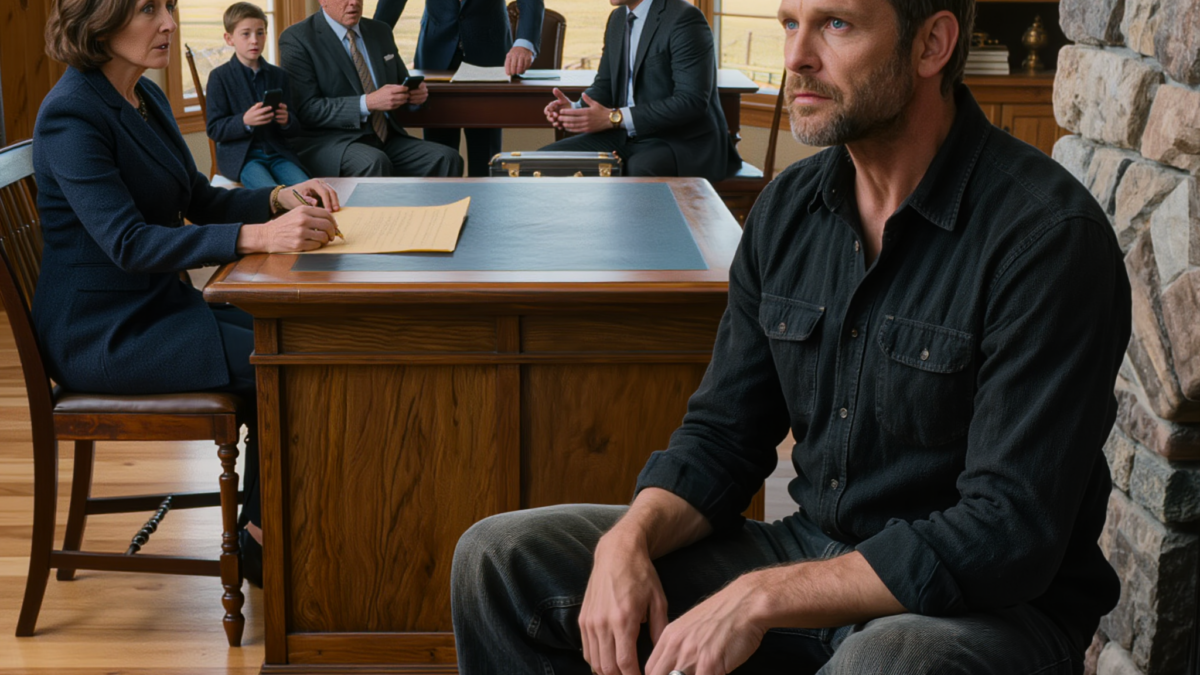
Marcus Warren had meticulously arranged the seating in the large, wood-paneled living room.
He sat confidently behind Arthur’s massive heavy oak desk at the far end of the room, acting as the absolute authority.
He had deliberately placed four identical wooden chairs in a tight semicircle directly facing the desk.
I walked over and sat on a small wooden stool by the cold stone fireplace, completely removed from their direct line of sight.
I blended seamlessly into the background shadows, just as I had done for twenty-two agonizing years in this family.
Diane immediately claimed the absolute center chair.
She sat down, elegantly crossed her legs, and placed her heavy designer bag squarely on her lap.
She looked entirely like a ruthless CEO ready to acquire a failing startup company.
Robert sat right next to her, pulling a yellow legal pad and a heavy silver pen out of his jacket pocket, ready to take detailed notes on his impending wealth.
Mason slumped lazily into the third chair, pulling out his smartphone and immediately scrolling mindlessly through social media.
Completely disengaged from the reality of the room.
Tyler Morgan took the final fourth chair, popping the metal latches on his expensive aluminum briefcase with a loud, aggressive snap that echoed through the room.
“Let’s get this little meeting over with quickly,” Tyler Morgan said, leaning forward aggressively and resting his elbows on his knees.
“My clients have a very tight schedule today in the city. We are here to formally read the last will and testament of Arthur Coleman.”
He paused before continuing.
“We are fully prepared to aggressively challenge any irregularities in the document, specifically regarding his rapidly declining mental capacity during his final months of severe isolation. We want to ensure his true biological family is properly protected from any undue influence.”
He threw the heavy legal accusation right into the center of the quiet room like a live grenade.
Undue influence.
The specific legal term for maliciously brainwashing a dying, vulnerable man to steal his money.
Marcus Warren didn’t flinch.
He didn’t raise his voice in defense.
He simply opened his battered brown leather briefcase, pulled out a massive, incredibly thick stack of legal documents securely bound in heavy blue covers, and placed them deliberately on the oak desk with a heavy thud.
He slowly adjusted his reading glasses.
“Mr. Morgan,” Marcus said, his voice entirely calm but heavily layered with absolute, unyielding authority.
“We are not here today to read a last will and testament.”
Tyler’s eyes narrowed slightly.
“We are here to officially execute the Arthur Coleman revocable living trust, which, upon his tragic death on Tuesday morning, immediately and permanently became an irrevocable trust under the strict, uncompromising laws of the state of Oregon.”
Tyler Morgan’s smug, highly practiced expression faltered for a fraction of a second.
A trust, not a will.
A standard will goes directly through the messy probate court system, where it becomes a matter of highly accessible public record and can easily be contested, tied up in litigation for years, and bled completely dry by aggressive lawyers.
A fully funded, properly executed living trust entirely bypasses the probate system altogether.
It is a private, locked-down, impenetrable financial vault.
My parents had arrogantly brought a battering ram to a titanium vault that required a highly specific digital key they simply didn’t possess.
Diane looked completely confused, glancing between Tyler and Marcus.
Robert’s silver pen completely stopped moving on his yellow legal pad.
Mason didn’t look up from his phone, oblivious to the massive shift in power.
They had absolutely no idea they were already walking blindly into a trap made of solid steel.
I sat perfectly still by the fireplace, running my thumb smoothly over the deeply engraved letters on the iron ring, completely silent, waiting for the massive explosion that was only moments away.
I thought about the terrified little boy waiting on the porch twenty-two years earlier.
And I smiled softly in the shadows.
The trap was perfectly set.
The heavy doors were permanently locked.
The execution was about to begin.
The living room was completely, suffocatingly silent.
The only sounds in the entire house were the heavy, rhythmic ticking of the antique mahogany grandfather clock in the hallway and the distant low hum of the kitchen refrigerator.
The air felt incredibly thick and highly charged with anticipation.
Marcus Warren slowly adjusted his reading glasses, smoothed his hand deliberately over the heavy blue cover of the primary legal document, and looked directly, piercingly at Tyler Morgan.
“As the named successor trustee of this estate, I am legally obligated by the state of Oregon to read the specific distribution clauses of this binding document aloud to all interested parties present,” Marcus said clearly, his voice echoing slightly in the large room.
“I strongly suggest you hold all of your questions, comments, and legal objections until I have completely finished reading the relevant sections in their entirety.”
Tyler Morgan nodded sharply, recovering his aggressive posture, and pulled a silver pen out of his tailored jacket pocket.
“Proceed, counsel. We are documenting every single word spoken here today.”
Marcus cleared his throat and began to read from the document.
His voice was a steady, rhythmic, commanding baritone.
He read through the standard legal preamble, the official establishment of the trust entity, and the formal confirmation of Arthur’s legal identity.
It was incredibly dry, dense, boring legal jargon.
Diane began to tap the toe of her expensive high heel impatiently against the hardwood floor.
Clearly annoyed by the delay, Robert was writing down meaningless, frantic notes on his legal pad, trying to look deeply engaged.
Mason finally put his phone away, crossing his arms and sighing loudly.
Then Marcus turned a thick page, and the temperature in the entire room instantly seemed to plummet.
“Schedule A of this irrevocable trust details the complete verified inventory of the estate assets,” Marcus read, his voice cutting sharply through the room.
“This extensive portfolio includes, but is absolutely not limited to, the real estate property known commercially as Coleman Stables, comprising exactly 1,200 acres of prime, highly fertile agricultural land, all associated lucrative water rights dating consecutively back to 1922, all heavy industrial machinery, the livestock herds, and the primary residential structure.”
Robert started nodding approvingly, a massive, greedy smile spreading across his face as he rapidly calculated the real estate value in his head.
“Furthermore,” Marcus continued, raising his voice slightly to command the complete attention of the room, “the trust currently holds full legal ownership and all lucrative future royalty rights to an active portfolio of fourteen United States utility patents for advanced agricultural irrigation technology engineered entirely by the grantor.”
He looked down at the page.
“The total assessed, independently verified market value of the combined trust assets at the exact time of the grantor’s death is $114 million.”
The entire room seemed to stop breathing.
Diane’s mouth literally fell wide open in pure, unadulterated shock.
Her heavy designer bag slipped completely off her lap and hit the hardwood floor with a heavy, echoing thud.
Robert dropped his silver pen, and it rolled loudly across the floor, coming to a dead stop mere inches from my heavy steel-toe boots.
Even Mason, the perpetually bored, heavily indebted golden child, gripped the armrests of his wooden chair and stared at Marcus Warren with wide, utterly terrified eyes.
$114 million.
They had greedily expected a nice, moderately successful working ranch worth maybe two or three million dollars at absolute best.
They had absolutely no concept of the massive intellectual property empire Arthur possessed.
They were suddenly sitting in a room with unimaginable, life-altering generational wealth.
Tyler Morgan’s eyes lit up with absolute, unfiltered, predatory greed.
He looked at Diane as though she were a winning lottery ticket he was holding in his own hands.
His contingency fee on $100 million was astronomical.
Marcus Warren didn’t pause for even a single second to let them recover from the massive psychological shock.
He immediately turned to the next page of the heavy document.
“Section Four, asset distribution,” Marcus read firmly.
“Upon the death of the grantor, Arthur Coleman, the acting trustee is explicitly and unconditionally directed to distribute 100% of the total trust assets entirely and completely to the sole named beneficiary.”
Marcus slowly looked up from the document, locking his cold eyes directly with Diane’s wide, greedy stare.
“The sole beneficiary of this entire estate is Ethan Parker.”
The heavy silence that immediately followed that sentence was absolute.
It was the kind of heavy, suffocating, terrifying silence that occurs right before a massive explosive detonates in a confined space.
I sat perfectly still on my small wooden stool by the stone fireplace.
My face was completely devoid of any visible emotion.
My breathing was incredibly slow and perfectly steady.
“Wait,” Robert stammered, his voice cracking violently as he broke the silence.
“Wait, that is a massive mistake. Read that section again. My wife is his only living biological daughter. There is a clear legal line of succession here. That is not right.”
Marcus Warren ignored Robert’s frantic outburst entirely and calmly continued reading the heavy document.
“Section Five, intentional exclusions. The grantor further directs that the following specific individuals are intentionally, willfully, and completely excluded from receiving any distribution, any financial benefit, or any access to any property whatsoever under this trust.”
He continued in the same measured voice.
“This total exclusion is absolutely not an oversight, but a highly deliberate, carefully calculated decision made with full knowledge and absolute sound judgment by the grantor.”
Marcus read the names slowly, hitting every single syllable like a heavy hammer striking a steel anvil.
“Diane Marie Callahan. Robert James Callahan. Mason Alexander Callahan.”
Tyler Morgan violently jumped up from his chair.
His face flushed a dark, angry red with sudden manufactured legal outrage.
“This is an absolute, undeniable outrage!” he yelled, slamming his hand on his aluminum briefcase.
“This is a textbook undeniable case of undue influence, coercion, and severe elder abuse. You absolutely cannot completely disinherit an entire biological family like this.”
He straightened his expensive jacket.
“We are filing an aggressive emergency injunction first thing tomorrow morning in superior court. We will completely freeze every single bank account associated with this estate. We will legally demand full, comprehensive psychiatric medical records.”
He pointed toward me.
“Arthur Coleman was clearly suffering from severe, debilitating cognitive decline, and this young man aggressively and maliciously manipulated him in his isolation. We will utterly destroy this fraudulent document in probate court.”
Marcus Warren calmly closed the heavy blue folder.
He didn’t look intimidated.
He didn’t look defensive.
He looked deeply, profoundly amused.
“Mr. Morgan,” Marcus said, his voice entirely flat and completely devoid of any remaining patience.
“Before you completely embarrass yourself publicly and rack up massive, uncollectible billable hours for your desperate clients, I highly suggest you thoroughly review Appendix C of this trust document, which I have generously provided in the manila folders sitting on the desk directly in front of you.”
Tyler Morgan aggressively snatched the folder off the desk and ripped it open, his eyes scanning the pages frantically.
Robert leaned heavily over his shoulder, his breath catching in his throat.
“Your clients are attempting to aggressively but predictably claim that Arthur Coleman completely lacked testamentary capacity or was operating under the undue influence of Ethan Parker,” Marcus said smoothly, leaning back in his chair.
“Arthur explicitly anticipated this exact, precise, desperate legal strategy.”
Marcus looked toward Tyler.
“Eight years ago, when he initially established this complex trust structure, he voluntarily underwent a rigorous, independent four-hour psychiatric evaluation by Dr. Derek Harrison, a highly respected board-certified forensic psychiatrist in Portland.”
“Dr. Harrison unequivocally certified Arthur’s absolute, undeniable mental competence.”
Marcus took a slow, highly deliberate sip of his black coffee, letting the reality set in.
“Furthermore, exactly eighteen months ago, when Arthur formally amended the trust to legally include his final three patents, he voluntarily submitted to a second, entirely independent evaluation by a completely different board-certified psychiatrist.”
He gestured toward the documents.
“Both comprehensive, lengthy medical reports, fully notarized and heavily witnessed by independent third parties, are permanently attached to this trust.”
“Arthur Coleman was officially certified to be in the top one percentile of cognitive function for his age group.”
Marcus leaned forward slightly.
“Any aggressive legal challenge regarding his mental capacity will be immediately dismissed by any competent judge in this state with extreme prejudice and likely accompanied by severe financial sanctions against your firm for filing a frivolous lawsuit.”
Tyler Morgan’s face entirely drained of color.
He stared blankly at the heavy medical reports in his trembling hands.
He was an aggressive shark who had just realized he was swimming at full speed in a concrete pool with absolutely no water.
“And finally,” Marcus continued, driving the final nail deeply into the coffin of their greed, “Section Seven contains a strict, ironclad, heavily tested legal no-contest clause.”
“If any excluded party attempts to aggressively contest the validity of this trust, challenge the mental capacity of the grantor, or file any frivolous lawsuits against the estate or the sole beneficiary, they automatically and permanently forfeit the one-time lump-sum token distribution of exactly $5,000 allocated to them in Schedule B.”
$5,000.
Out of $114 million, Arthur had left them exactly enough money to buy a cheap used car.
And even that tiny crumb was entirely contingent on them walking away quietly in absolute, humiliating defeat.
The entire legal fortress was flawless.
There were absolutely no cracks, no hidden loopholes, no aggressive angles for Tyler Morgan to play.
Arthur had spent years meticulously engineering a massive financial structure that completely and legally isolated them from his wealth forever.
Suddenly, Diane stood up.
Her wooden chair scraped violently against the hardwood floor.
Her perfectly composed, arrogant corporate facade shattered into a million jagged pieces.
Her face was contorted with absolute, unhinged rage.
She completely ignored the expensive lawyers in the room.
She completely ignored her panicking husband.
She turned entirely toward me, sitting quietly in the shadows by the fireplace.
“You maliciously manipulated him!” she screamed, her voice echoing shrilly and painfully off the high wooden ceiling.
“You poisoned my father against his own real family. We brought you here. We gave you this life on this ranch. You were absolutely nothing before we dropped you off. You were a massive mistake.”
She was completely out of control, pointing a violently shaking finger directly at my face, spit flying from her lips.
“You are stealing our entire lives from us. We desperately need this money. You owe us for everything we went through.”
I didn’t stand up from my stool.
I didn’t raise my voice a single decibel.
I didn’t scream back defensively.
I simply looked at the frantic woman who had given birth to me, the cold woman who had ruthlessly evaluated my worth at nine years old and decided I was a massive financial liability.
“You said it best yourself, Diane.”
She screamed, her chest heaving heavily.
“You were the exact one we could afford to lose.”
The room went dead silent again.
The echo of her words hung in the air.
Tyler Morgan closed his eyes tightly and pinched the bridge of his nose in sheer agony.
He knew it was entirely over.
She had just admitted the truth of her abandonment in front of three credible witnesses.
I slowly, deliberately raised my right hand and rested it heavily on my denim-clad knee.
The heavy iron ring caught the bright morning sunlight pouring through the large window.
I looked her dead in the eye, channeling every single ounce of Arthur Coleman’s cold, unyielding strength.
“He already said no,” I said, my voice dangerously quiet, perfectly calm, and completely final.
“In writing.”
The absolute, crushing realization of total, inescapable defeat hit Tyler Morgan first.
He was a professional, highly paid parasite, and he immediately recognized that the massive host was completely dead and devoid of any blood.
He aggressively slammed his expensive aluminum briefcase shut, locking the metal latches with a loud, incredibly final snap that echoed in the quiet room.
He didn’t look at Diane.
He didn’t look at Robert.
He looked directly at Marcus Warren with an expression of profound, grudging professional respect.
“Your paperwork is absolutely flawless, Counselor,” Tyler said quietly, picking up his coat.
“It is an ironclad fortress.”
Marcus simply nodded once.
“I know it is.”
Tyler picked up his heavy briefcase, turned sharply to Robert, and completely dropped his aggressive, highly confident persona.
“My expensive retainer absolutely does not cover fighting impossible miracles in probate court. Mr. Callahan, you blatantly lied to me about the psychiatric state of the deceased. You completely lied to me about the financial structure of the estate.”
He continued without waiting for a reply.
“You have absolutely zero legal standing, and filing an aggressive, baseless injunction would instantly trigger massive sanctions against my own firm.”
“We are entirely done here. I am formally withdrawing as your counsel. I will send you a final itemized invoice for my travel time and consultation this morning. Do not ever attempt to contact my office again.”
Without waiting for a response or a protest, Tyler Morgan walked swiftly right out the front door.
The heavy solid wood door slammed shut behind him, echoing loudly in the massive foyer.
Robert stood completely frozen in the center of the living room, his face pale and covered in a cold, terrified sweat.
He looked at the massive stacks of legal documents on the oak desk representing $114 million of generational wealth that was completely, legally, and permanently out of his desperate reach.
The brutal reality of his catastrophic financial situation was finally crashing down on him like a tidal wave.
Diane was still violently shaking with adrenaline and pure, unadulterated rage, breathing heavily through her nose.
She looked at me, sitting completely calmly by the fireplace, and then she looked frantically at Robert.
“Do something,” she hissed aggressively, grabbing his arm with her manicured nails.
“You are letting him steal our entire lives from right under our noses. Say something.”
Robert violently ripped his arm away from her tight grasp.
“Do what, Diane?” he yelled, his voice cracking loudly in sheer, unfiltered panic.
“Look at the paperwork. We are completely locked out of the vault. You heard the lawyer. We have absolutely nothing left. We are ruined.”
Mason, the perpetually spoiled golden child, finally stood up slowly from his wooden chair.
He shoved his expensive smartphone deeply into his coat pocket and looked at his panicking parents with absolute, unmasked disgust.
“You completely ruined this,” he muttered, shaking his head slowly.
“You aggressively dragged me out to this miserable, freezing desert, promised me a massive multimillion-dollar payout to cover my aggressively mounting debts, and you walked us right headfirst into a solid brick wall.”
He shook his head again.
“You are both completely pathetic.”
Mason walked right past them, completely ignoring their protests, not looking at me once, and headed straight for the front door.
Robert and Diane stood in the living room for another ten seconds, completely shell-shocked, before finally turning and following him outside into the cold.
I stood up slowly from my stool and walked to the large bay window.
I watched the final, pathetic destruction of my biological family happen right there on the frozen gravel driveway of Coleman Ranch.
Robert was screaming at Diane, waving his arms wildly in the freezing air, completely losing his carefully crafted corporate composure.
Diane was screaming back, pointing violently at the historic house and then at Robert’s chest.
Mason was just standing casually by the rented Porsche SUV, smoking a cigarette, blowing smoke into the cold air, and ignoring both of them completely.
They eventually climbed into the luxury SUV in angry silence.
Robert slammed the heavy vehicle into reverse, spinning the expensive tires violently in the loose gravel, and sped recklessly down the long road toward the highway.
They were driving back to Portland to face their crushing, inescapable reality.
Crippling credit card debt.
A rapidly crumbling commercial real estate business.
Aggressive divorce rumors.
And absolutely zero financial safety net.
The massive bailout they had desperately banked on to save their fake lives had just vaporized into thin air forever.
I watched the thick cloud of dust settle slowly on the dirt road.
The sprawling property was completely quiet again.
The slow, rhythmic creak of the old iron windmill turning in the freezing wind was the only sound left in the world.
I turned back to the living room.
Marcus Warren was calmly packing up his heavy leather briefcase, organizing the blue folders.
“They will never legally challenge this document,” Marcus said smoothly, closing his bag and clicking the locks.
“They completely lack the financial resources to mount a serious fight. And even if they somehow found the money, absolutely no reputable lawyer in this state would take the case on contingency after seeing those medical reports.”
He looked at me.
“Arthur completely and brilliantly checkmated them from the grave. You are the sole uncontested owner of everything.”
“Thank you, Marcus,” I said, shaking his hand firmly.
“For everything.”
I spent the next two years expanding the massive operations of the ranch and rapidly scaling my software logistics company with Justin.
We successfully secured three more massive national contracts.
I filed two additional utility patents of my own, utilizing the exact same highly effective engineering principles Arthur had drilled into my head in that dusty workshop.
My net worth grew significantly, but my daily lifestyle didn’t dramatically change.
I still wore heavy denim work jeans every day.
I still drove a reliable, battered truck.
I still ate dinner quietly at the kitchen table.
Then, exactly twenty-four months after the dramatic reading of the trust, the final pathetic twist in the knife occurred.
I was sitting in my home office reviewing a highly complex commercial real estate acquisition file when my personal email chimed loudly.
It was an email from Mason Callahan.
I hadn’t spoken a single word to my older brother since he walked out the front door in disgust.
I opened the lengthy email.
It was a massive, desperate wall of text.
It was a frantic, embarrassing plea for immediate financial salvation.
Mason explicitly admitted that the lavish lifestyle he had projected at the funeral was entirely a fabricated lie.
The expensive Porsche SUV they had driven to the funeral had been rented using a high-interest credit card entirely in his name because Robert and Diane’s credit scores were completely destroyed.
Mason was currently drowning in over $200,000 of consumer debt.
His brutal, highly publicized custody battle had entirely bankrupted him, and Robert and Diane had completely cut him off financially because they were actively facing their own severe Chapter 7 bankruptcy proceedings.
“Ethan,” the desperate email read, “I know we have absolutely no relationship, and I know Mom and Dad treated you terribly when we were kids, but I am begging you on my hands and knees.”
“I am going to lose my house next week to foreclosure. I am going to lose custody of my kids. You have over $100 million sitting in the bank. A small loan of $50,000 would completely save my life.”
“Please, Ethan, we are blood.”
I read the pathetic email twice.
I sat back in my heavy leather chair and looked closely at the heavy iron ring resting firmly on my right thumb.
Coleman keeps.
I didn’t feel a single ounce of malicious joy, aggressive vindication, or pity.
I didn’t feel the urgent need to write a long, insulting reply mocking his complete failure in life.
I just felt absolutely nothing.
The emotional cord connecting me to that family had been violently, permanently severed twenty-two years earlier on a hot wooden porch.
I moved my computer mouse over the screen.
I firmly clicked the delete button.
I permanently emptied the trash folder.
I closed the laptop, stood up from my desk, and walked out the back door toward the massive workshop.
I had real, highly meaningful work to do, and absolutely none of it involved saving the people who had enthusiastically tried to drown me.
The massive workshop smelled exactly the way it always did.
A heavy, deeply comforting mixture of rich saddle leather, penetrating WD-40, hot metal, and old machine oil.
But the massive space was no longer quiet and isolated.
It was filled completely with the loud, chaotic, energetic sounds of heavy tools, grinding wheels sparking against steel, and the enthusiastic voices of eight teenagers.
Exactly eighteen months after Arthur passed away, I had utilized a fraction of the massive trust assets to establish the Arthur Coleman Hope Foundation.
I partnered directly with the state foster care system.
Every single summer, we bring eight teenagers who are rapidly and dangerously aging out of the broken foster system to the ranch for an intensive, fully funded, three-month mechanical engineering and trade skills apprenticeship program.
We don’t offer them empty, meaningless platitudes about how the world is fair.
We don’t sit in circles and talk extensively about our deeply rooted childhood trauma.
We hand them heavy professional-grade torque wrenches.
We teach them how to confidently operate a high-heat welding torch without burning their hands.
We teach them how to meticulously diagnose a failing diesel engine, how to accurately read complex mechanical blueprints, and how to build something permanent and strong with their own two hands.
We teach them the exact same critical, life-saving survival skills Arthur Coleman taught me when I was a completely broken, abandoned kid with nowhere else to go.
I was standing quietly by the main wooden workbench, watching a seventeen-year-old kid named Leo fiercely struggle with a stubborn, heavily stripped bolt on a massive tractor engine block.
He was getting deeply frustrated, his knuckles turning white as he forced the heavy wrench and cursed under his breath.
I walked over calmly and gently put my hand on his tense shoulder.
I smoothly slid the wrench out of his incredibly tight grip.
“Stop forcing it, Leo,” I said, my voice low, steady, and completely calm.
“You have to feel the threads catch. That is exactly where the metal actively wants to stop. It is talking directly to you.”
I held the wrench as I continued.
“If you push aggressively past that point because you think you are fundamentally stronger than the design, you break the exact thing you are desperately trying to hold together.”
“Then you have absolutely nothing but stripped metal and a much bigger, more expensive problem to solve.”
Leo took a deep, shaky breath, wiped the dark grease off his sweaty forehead, took the heavy wrench back from my hand, and tried again.
This time, he moved incredibly slowly.
He found the exact sweet spot.
The bolt locked perfectly and securely into place.
He looked up at me with a massive, incredibly proud grin on his face.
“Good job,” I said, patting his shoulder firmly.
“Go check the fluid levels in the hydraulic system.”
Ryan Mitchell walked over, wiping his massive hands on a red shop rag.
He was officially the head instructor and manager of the foundation now, making a massive, highly competitive salary that he entirely deserved for his loyalty.
He watched Leo walk away with newfound confidence.
“You sound exactly like the old man, Ethan,” Ryan said, laughing deeply.
“It is actually kind of terrifying how much you sound like Arthur when you are teaching these kids.”
I smiled softly, looking down at the heavy iron ring firmly secured on my thumb.
“I guess some things in this world are just engineered to last forever.”
I walked out of the massive workshop and stood quietly in the vast open yard.
The brilliant Oregon sun was setting beautifully over the distant eastern mountains, casting long, vibrant orange shadows across the rich, highly fertile grazing pastures.
The old iron windmill was turning slowly and steadily in the evening breeze.
A rhythmic, deeply comforting sound that had completely scored my entire life from the moment I arrived here.
My biological parents threw me away on that porch because they had coldly, ruthlessly calculated that I was a severe financial burden they couldn’t afford to maintain.
They fiercely valued money, superficial social status, and their own selfish comfort far above the life of their own child.
They honestly thought they were cutting their losses.
But in reality, they handed me the absolute greatest, most valuable inheritance I could ever possibly receive.
Arthur Coleman didn’t just leave me a massive financial fortune and a portfolio of highly lucrative patents.
He fiercely, relentlessly taught me that true family is never defined by a shared biological bloodline or a legal birth certificate.
True family is defined by the people who consistently, undeniably show up for you when you are completely broken and bleeding.
It is defined by the people who hand you a wrench when you are drowning and teach you how to build a boat to save yourself.
I earned the absolute right to keep this incredible ranch.
I earned the right to carry this proud, honorable name.
And now I am spending my entire life handing those exact same tools to the kids who desperately need them the most.
That is my absolute truth.
A cheap blue plastic suitcase at nine years old, a heavy iron ring at nineteen, and a powerful legacy I fiercely earned the right to keep forever.








