My mother uninvited me from the $21,840 Caribbean cruise I paid for with seven words: “You’re not coming. Dad wants just family.” I read the text in Denver traffic, with a gift bag of sunglasses for her on the passenger seat. My parents were also living in a $400,000 house I owned. I didn’t ask them to reconsider. I pulled into a strip-mall parking lot and called my real estate lawyer about Elm Street.
The afternoon sun was glaring off the windshield of the SUV in front of me. Traffic on Interstate 25 had slowed to the kind of bumper-to-bumper Denver gridlock that usually made my blood boil. But that afternoon, I barely noticed the cars around me.
My name is Mark Miller. I’m 34 years old, and two months ago, a seven-word text message changed the way I understood my entire family.
On the passenger seat of my car sat a glossy gift bag containing custom-engraved luggage tags and a pair of expensive polarized sunglasses. I had bought them for my mother to wear during the Caribbean cruise I had arranged for our family. Alongside those gifts were the confirmations for a luxury vacation that had cost me $21,840.
I could almost picture my mother leaning against the balcony railing of the cruise ship, wearing those sunglasses and looking out over the ocean. More than anything, I imagined her finally looking at me with genuine pride.
I had spent years trying to earn that look.
My phone vibrated against the center console. When I saw my mother’s name, I actually smiled. I assumed she was calling to say how excited she was about the trip. Maybe, for once, she had decided to thank me without being prompted.
Instead, I opened a text message that read:
“You’re not coming. Dad wants just family.”
I stared at those seven words.
There was no apology, no explanation, and no attempt to soften the message. My mother had simply informed me that I was no longer welcome on the vacation I had paid for.
For a moment, I wondered whether she’d sent it to the wrong person. I read it again, looking for some explanation I might have missed.
There wasn’t one.
My chest tightened. I blinked against the sunlight, trying to make sense of what I was seeing. This was the trip I had spent months planning, right down to the dinner reservations and shore excursions. Every payment had come from my bank account, funded by the performance bonus I’d worked so hard to earn.
And somehow, my presence had become an inconvenience.
The driver behind me sounded the horn. The light had turned green, and I was still sitting there, gripping the steering wheel with trembling hands.
I eased forward and continued driving, but the words stayed with me.
Dad wants just family.
That was what hurt more than anything else.
Apparently, I wasn’t family. I was the person who paid for things, solved problems, and made everyone else’s life easier. I was useful when a bill arrived or something needed fixing, but I wasn’t someone they actually wanted around.
I drove another ten miles before pulling into the nearly empty parking lot of a strip mall. I turned off the engine and sat there as the Denver sky slowly darkened.
For thirty years, I’d believed being a good son meant giving my family everything I could. I’d convinced myself that enough generosity would eventually turn into love.
Sitting in that parking lot, I began to understand how wrong I’d been.
My parents were living in a beautiful $400,000 suburban home I had purchased for them. I had supplied the down payment, taken out the mortgage, and continued paying the property taxes.
And now they had a luxury vacation as well.
They had everything they wanted from me.
They just didn’t want me.
The sadness was still there, but beneath it something else was taking shape. For the first time, I wasn’t thinking about what I could do to make my parents happy.
I was thinking about what I needed to stop doing.
I picked up my phone, scrolled to the letter J, and called my real estate lawyer.
“James,” I said when he answered, “that property on Elm Street, the one I let my parents move into, I want you to start the paperwork to list the real estate on the market immediately. I want a buyer by the end of the month.”
When the call ended, I looked at the gift bag on the passenger seat one last time.
I picked it up and tossed it into the back.
For the first time in my life, I was no longer volunteering to rescue everyone.
To understand why that single text message affected me so deeply, you need to understand what growing up in the Miller household was like.
My younger brother, Vincent, was always the golden child.
I was the responsible one.
Those descriptions might sound harmless, but in our family they came with very different expectations.
If Vincent broke a window playing baseball inside the house, I was expected to help deal with the consequences. If he failed a class because he hadn’t done his homework, I was the one who stayed up until two in the morning helping him complete assignments.
Vincent could cry, complain, or make excuses, and my parents would find a reason to forgive him.
When I made a sacrifice, everyone simply expected me to do it again.
I learned early that being quiet and dependable made life easier for my parents. Complaining only created another problem for them to handle, so I rarely complained.
The first time I truly became my family’s financial safety net was when I was sixteen.
The financial crisis of 2008 devastated my father’s small independent construction business. When the housing market collapsed, his company went under.
I still remember the atmosphere inside our house during those months.
The telephone would ring, and my parents would stare at it, afraid another debt collector was calling. Dad spent his days on the living room couch, watching television with the sound turned down. He was depressed, angry, and humiliated by what had happened to his business.
Mom tried to make what little food we had last as long as possible. I remember her attempting to stretch a single box of generic macaroni and cheese into meals for several days.
I was a junior in high school. While my friends were spending their afternoons at football games and preparing for prom, I was working two part-time jobs.
From three until seven, I stocked shelves at a grocery store. Then I went to a diner along the highway, where I cleaned tables and scrubbed pots from eight until midnight.
By the time I got home, my clothes smelled of bleach and old French fries.
The money wasn’t much, but it meant everything to me. I was saving it for college, hoping to create a future that didn’t revolve around my parents’ financial problems.
Then came a Tuesday night I have never forgotten.
I’d just finished a double shift. When I walked into the house, almost every light was off except the small bulb above the kitchen table.
Mom was sitting beneath it, crying over a stack of overdue utility bills and mortgage notices. Red final-notice stamps covered several of the pages.
I didn’t hesitate.
I went into my bedroom, got down on my knees, and pulled an old shoebox from beneath my mattress.
Inside were crumpled ten- and twenty-dollar bills I’d been carefully saving.
A little more than $500.
Every cent I had.
I carried the money into the kitchen and set it on top of the bills.
Mom stopped crying and looked at the cash.
For a moment, I thought she might stand up and hug me. I imagined her telling me how proud she was or promising that one day she would pay me back.
Instead, she looked relieved and strangely resentful.
“Oh, Mark,” she whispered. “You shouldn’t have to do this.”
Then she took the money and put it in her pocket.
She never paid me back.
More importantly, she never thanked me.
I didn’t understand it at the time, but that moment helped establish the arrangement that would define my adult life.
When the family had a financial emergency, I was expected to fix it.
When the emergency ended, everyone moved on.
Years later, Vincent decided he wanted to attend an expensive private liberal arts college out of state.
My parents had no savings, and their credit was in terrible condition. Vincent refused to apply for scholarships because he considered the paperwork too much trouble.
Naturally, they turned to me.
I was twenty-two, working my first entry-level corporate finance job, living in a tiny apartment, and eating ramen noodles while trying to pay off my own student debt.
My parents insisted that, as the successful older brother, I had a responsibility to help Vincent get started.
Eventually, I agreed to cosign his student loans.
Vincent lasted exactly three semesters.
He dropped out, claiming his professors were suppressing his creative genius, and moved back into our parents’ basement.
The loan payments soon went into default.
Dad called me in a panic. He was convinced Vincent’s credit would be destroyed and that the family’s reputation would suffer.
“He’ll never be able to get a fresh start. Mark, you have to fix this!” he shouted.
So I did.
I started taking freelance consulting assignments on weekends. I worked weeks that sometimes stretched to eighty hours. My back ached, my vision blurred, and nearly every extra dollar went toward debt I hadn’t created.
It took four years to pay off Vincent’s loans.
When I finally handed him the statement showing a zero balance, he smirked.
“Man, you’re so lucky you’re obsessed with money and numbers.”
He laughed as though those four exhausting years had been some enjoyable hobby.
Vincent never developed much interest in holding a steady job. Instead, he moved from one business idea to another.
There was a craft brewery that never opened and an app that never launched. My parents continued funding his plans whenever they could.
And I continued funding my parents.
Their car insurance became my responsibility. So did their property taxes. When a water heater broke or an unexpected medical bill arrived, they knew exactly whom to call.
They rarely called me Mark anymore.
They called me the responsible one.
For years, I treated that description like an honor. I believed it meant they respected the life I was building.
Eventually, I began to realize that in their minds, responsible meant available whenever they needed money.
My career continued to advance throughout my late twenties. I was promoted into a senior financial director position, and by thirty-three I had a comfortable six-figure income, a solid retirement account, and excellent credit.
I thought my parents would be proud of how far I’d come.
Instead, my financial stability seemed to irritate them. Whenever I achieved something, they found a way to suggest that money had made me arrogant or selfish.
The biggest test came a year before the cruise.
My parents learned that their landlord was selling the house they rented. They were facing eviction and had nowhere else prepared to go.
Once again, I stepped in.
I found a three-bedroom suburban home in a quiet neighborhood. It was listed for $400,000, and I could picture my parents living comfortably there.
I paid an $80,000 down payment and secured the mortgage entirely in my name. The arrangement was simple: I would provide the house, and they would pay the basic utilities.
I thought it might finally prove how much I cared.
On moving day, Mom walked through the spacious living room, running her hand across the granite countertops.
“It’s a bit flashy, don’t you think?” she muttered. “Money really changes people, Mark. It makes them cold and materialistic. I just hope you don’t lose your soul in all this corporate greed.”
Dad agreed from the hallway.
“Don’t forget where you came from, boy. And make sure the spare bedroom is set up nice for Vincent. He needs a quiet space for his new podcast studio.”
I stood in the kitchen of the house I had just bought and said nothing.
I was hurt, but I swallowed it as I always had.
I told myself they were stressed, that they’d been through a difficult time, and that things would improve once they settled in.
I had spent so many years afraid of losing my family that I never noticed how much of myself I was giving away to keep them.
The Caribbean cruise began with another carefully arranged family dinner.
It was a chilly Friday evening in early November. I’d invited my parents, Vincent, his fiancée Kloe, and my aunt Carol to my downtown condo for Thanksgiving dinner.
I’d spent the day preparing a large turkey and the rest of the holiday meal. For about an hour, we sat around my mahogany dining table talking and eating like a normal family.
Then, as I was cutting the pecan pie, Aunt Carol leaned back in her chair and sighed.
Carol was my mother’s older sister, and nobody in the family was better at making someone feel guilty without directly asking for anything.
“You know,” she said, looking toward the city skyline, “Susan and Richard have worked so hard their entire lives. It breaks my heart that they’ve never seen the world, never even been to the Caribbean.”
Mom immediately joined in.
“Oh, Carol, don’t start. We could never afford something like that. Cruises are for people with disposable income, not for people like us who are just struggling to get by.”
She glanced in my direction.
Vincent was scrolling through social media on the new iPhone I’d bought him for his birthday.
“Yeah, it must be nice to just throw money around on vacations,” he said. “Chloe and I are so stressed with the wedding planning. We desperately need a break, but you know, we’re actually humble.”
I looked from one face to another.
Mom appeared defeated. Dad sat there with his familiar scowl. Vincent and Khloe seemed convinced that someone else should be paying for the break they wanted.
I recognized the pressure, yet some part of me still wanted to give them what they were hoping for.
Maybe this would be different.
Maybe if I gave everyone a beautiful experience together, they would finally appreciate having me there.
“Let me handle it,” I said. “I just got my end-of-year promotion bonus. It was a massive quarter for the firm. Let me book a family cruise for all of us. As my gift.”
The table went quiet.
Then Mom began protesting.
“Oh, Mark, no. We couldn’t possibly ask you to do that. That is your hard-earned salary.”
“It’s not asking if I’m offering,” I told her. “It’s for the family. We can all go. You, Dad, Vincent, Chloe, and Aunt Carol. A real family vacation.”
The objections disappeared almost immediately.
For the rest of dinner, everyone seemed delighted with me.
They praised my cooking, complimented the condo, and talked excitedly about the possibility of traveling together.
I absorbed every kind word.
I wish I could say I recognized how conditional that warmth was, but I didn’t.
I wanted to believe it was genuine.
During the next three weeks, I threw myself into arranging the trip.
I studied cruise itineraries before choosing a seven-day luxury voyage through the Eastern Caribbean aboard the Starlight Serenity.
I booked six premium tickets.
For my parents, Vincent, Chloe, and Aunt Carol, I reserved large balcony suites overlooking the ocean. I wanted them to have the sort of vacation they had always dreamed about.
I also purchased premium dining packages, allowing them to enjoy specialty restaurants serving dry-aged steaks, lobster, and other expensive meals.
I included unlimited top-shelf drink packages and high-speed Wi-Fi.
For shore excursions, I reserved private cabanas in the Bahamas, a VIP catamaran tour in San Juan, and guided snorkeling in St. Thomas.
When I finally confirmed everything, the total came to $21,840.
I stared at the payment notification for a long moment.
It was an enormous amount of money, even with my income.
But I told myself it was an investment in my family. If it meant we could spend a week together and create memories that didn’t involve arguments or financial emergencies, perhaps it was worth it.
I sent the complete PDF of booking confirmations to our family group chat.
Then I waited.
Five minutes passed. Then ten.
Eventually, Dad responded with a single thumbs-up emoji.
That was all.
No call. No personal thank-you. No message about how excited he was.
I convinced myself they were simply overwhelmed.
A month before the cruise, that illusion ended.
After Mom’s message arrived while I was driving on Interstate 25, I tried calling her.
Straight to voicemail.
I called Dad.
Voicemail again.
Then Vincent.
He didn’t answer either.
I opened the family group chat, hoping somebody had posted an explanation or that Mom had corrected some terrible misunderstanding.
But the conversation had vanished.
At first, I thought my phone was malfunctioning.
I opened Vincent’s contact information and tried to add him to a new group message.
A gray notification appeared.
“You are no longer authorized to message this group.”
I stared at the screen.
They hadn’t merely decided I shouldn’t come on the cruise. They had removed me from the family conversation entirely.
I drove home to my condo in a daze.
When I got inside, I locked the door, dropped my keys on the counter, and collapsed onto the sofa.
The apartment was silent.
I had worked so hard to become someone my parents could depend on. I had paid their bills, purchased their home, financed my brother’s education, and now arranged the holiday they had always wanted.
Yet I had never felt more alone.
Around ten that night, another message arrived.
This time it was from my cousin Sarah.
Sarah was Aunt Carol’s daughter, but unlike her mother, she had always recognized how unfairly the family treated me.
She didn’t include any explanation.
She sent a screenshot.
I opened it and saw a group conversation titled Miller Cruz crew ship tropical drink.
The participants included my parents, Vincent, Chloe, Aunt Carol, and several other relatives.
My name wasn’t there.
The latest message was a photograph Chloe had posted of herself and Vincent holding champagne glasses.
Beneath it, she’d written:
“So incredibly excited for a drama-free luxury vacation. Thank God Mark decided he was too busy with his fancy corporate job to come. It’s going to be so much more relaxing without his constant controlling energy killing the vibe.”
My mother had replied beneath it.
“Mom, I know honey is a blessing in disguise. He thinks his money buys him the right to dictate our lives. We deserve this break to just be a real family without him looking down his nose at us.”
I kept reading those messages.
Until that moment, I’d thought perhaps my parents had excluded me because of some private disagreement or resentment they hadn’t explained.
Now I could see they were telling the rest of our relatives a completely different story.
According to them, I had voluntarily decided to stay home because I was too important and too busy with work.
They were presenting themselves as the reasonable people who simply wanted to enjoy a vacation without my controlling behavior.
Not one of them mentioned that I had paid for the trip.
I opened my laptop and pulled up the booking invoices.
Every page carried the same information.
Billed to Mark Miller.
Primary cardholder: Mark Miller.
Contact email: Mark Miller.
The reservations, dining packages, excursions, and other purchases were all connected to my name and my payment card.
I looked at those records for a long time.
My family had removed me from the conversation, but they had not removed my financial responsibility.
They still expected to enjoy everything I’d paid for.
I didn’t sleep that night.
I sat at my desk, thinking about what had happened, as the darkness outside my high-rise windows gradually gave way to the first light of morning.
By sunrise, the immediate shock had begun to fade.
I wasn’t interested in another argument. I didn’t want to send my mother an emotional paragraph explaining why she’d hurt me.
For once, I wanted my actions to reflect what they had already told me.
If I wasn’t family, I didn’t need to finance their luxury vacation.
At exactly 8:01 a.m., I made a pot of black coffee, opened my laptop, and found the customer service number for the travel agency.
After two rings, a cheerful woman answered.
“Thank you for calling Oceanic Getaways Elite Support. This is Brenda. How can I make your travel dreams come true today?”
“Good morning, Brenda. My name is Mark Miller. I am the primary account holder calling regarding a group booking. Confirmation number 74 Bravo 3982.”
I heard her typing.
“Yes, Mr. Miller. I have your extensive itinerary pulled up right here. A party of six heading to the Eastern Caribbean on our flagship vessel, the Starlight Serenity. It looks like an absolutely magnificent trip. You have the premium packages loaded. How can I assist you today?”
“I need to make a few immediate, permanent adjustments to the booking.”
“Certainly, sir. What kind of adjustments did you have in mind?”
I looked down the itemized charges on my screen.
“I need to completely cancel the premium dining packages for five of the guests on this itinerary.”
There was a brief pause.
“Five of the guests, Mr. Miller? Are you sure? That removes their access to the steakhouse, the sushi bar, and the private captain’s lounge.”
“I am absolutely sure,” I said. “They will be perfectly fine utilizing the complimentary main buffet and the standard dining hall. Please process that cancellation.”
Brenda typed for a few moments.
“Understood, sir. That has been removed. The prorated refund of $2,400 will be credited back to your primary Visa card within 3 to 5 business days.”
I looked at the next section of charges.
“Excellent. Next, I need to revoke the unlimited premium alcohol passes and the high-speed Wi-Fi upgrades for those same five guests.”
“Okay,” she said. “Removing alcohol and Wi-Fi packages for guests Richard, Susan, Vincent, Chloe, and Carol. That will trigger another refund of $3,150.”
“Perfect.”
Next came the excursions.
I asked her to cancel the private beachfront cabana in Nassau, the VIP catamaran in San Juan, and the guided snorkeling reservations for those five travelers.
One by one, she removed the bookings.
“All excursions canceled, Mr. Miller. Your refund total is now exceeding $8,000.”
With each confirmation, I felt a little more certain about my decision.
These were expenses I had agreed to cover because I believed we were going to share a family vacation.
That wasn’t what my relatives wanted anymore.
Then I reached the cabin assignments.
“Thank you, Brenda. Now we arrive at the most important change. I need to alter the cabin assignments for those five guests.”
“Alter them how, sir? They are currently booked in five contiguous premier balcony suites on deck 9.”
“I need you to downgrade them. I want you to move all five of them to the most basic, lowest-tier interior cabins available on the ship. The absolute cheapest rooms you have in your inventory.”
Brenda paused again.
“Downgrade them to interior cabins, sir? I want to advise you that those cabins are incredibly small. They do not possess any windows or natural light, and the only ones we have left are clustered together on deck two.”
“Deck two?” I asked.
“Yes, sir. It is situated directly above the ship’s engine room and next to the commercial laundry facilities. It can be quite noisy.”
I considered that for a moment.
“Brenda, that sounds absolutely spectacular. Please finalize that change.”
She confirmed the new cabin assignments.
Then she asked about my own ticket.
“And what about your ticket, sir? You are still booked in the master penthouse suite on deck 12. Do you wish to cancel or downgrade your own ticket?”
“Absolutely not,” I replied. “Keep my penthouse suite exactly as it is. I will absolutely be on that ship.”
I paused.
“I just won’t be vacationing with them.”
By nine that morning, the refunds were being processed.
But I still had another financial responsibility to address.
I called James.
“James, the house, is the listing live?”
“It went live on the MLS at midnight, Mark,” he told me. “In this market, a property in that neighborhood priced to sell will move fast. We already have three private showings scheduled for tomorrow.”
“Good,” I said.
I explained that my parents were leaving for the cruise in fourteen days. I wanted their belongings placed in secure, climate-controlled storage after their flight departed Denver, and I would prepay the storage unit for three months.
I also wanted the locks changed.
“Can we legally execute this while they are in international waters?” I asked.
James pointed out that the deed was solely in my name and there was no formal lease agreement.
He assured me I was within my rights to reclaim the property.
“It’s ruthless, but it’s completely legal. Consider it done,” he said.
For the following two weeks, I continued with my normal routine.
I worked, exercised, organized my finances, and packed for the cruise.
I kept expecting an angry phone call or somebody showing up at my condo demanding an explanation.
Nothing happened.
My family apparently believed they had excluded me successfully and would still be enjoying the vacation exactly as I’d originally arranged it.
When departure day finally arrived, I flew to Miami.
Boarding the Starlight Serenity was an experience I would never forget.
The general passenger terminal was crowded and noisy. Travelers stood in long security lines, pulling suitcases across the floor while children cried and exhausted parents tried to keep everyone organized.
But I wasn’t directed into that line.
When my black car stopped at Terminal A, a porter in a white uniform greeted me by name and took care of my luggage.
I was escorted through frosted glass doors into the VIP platinum lounge.
The air was cool and smelled faintly of citrus. A concierge offered me a chilled glass of vintage champagne and a hot towel.
Within ten minutes, I had cleared a private security checkpoint and entered a glass elevator that took me directly to deck 12.
My penthouse suite was enormous.
It was bigger than the first three apartments I’d lived in combined.
Beyond the double mahogany doors was a spacious living room with a grand piano, a wet bar, and a large white leather sectional sofa.
The marble bathroom included a soaking tub beside a floor-to-ceiling window looking out over the Atlantic Ocean.
The best feature was the private wraparound balcony, where I could stand and see the horizon stretching across the water.
A handwritten welcome note from the captain sat on the oak dining table beside a basket of exotic fruit and a bottle of expensive scotch.
I unpacked my tailored suits, walked out onto the balcony, and let the warm Florida air wash over me.
For years, every major professional achievement had been followed by another request from my family.
This time, I was finally enjoying something I’d earned.
I spent the first twenty-four hours largely alone.
I ordered prime rib through the suite’s twenty-four-hour butler service, enjoyed my scotch, and watched the Miami skyline disappear as the ship headed out to sea.
I knew my parents and the others were somewhere aboard.
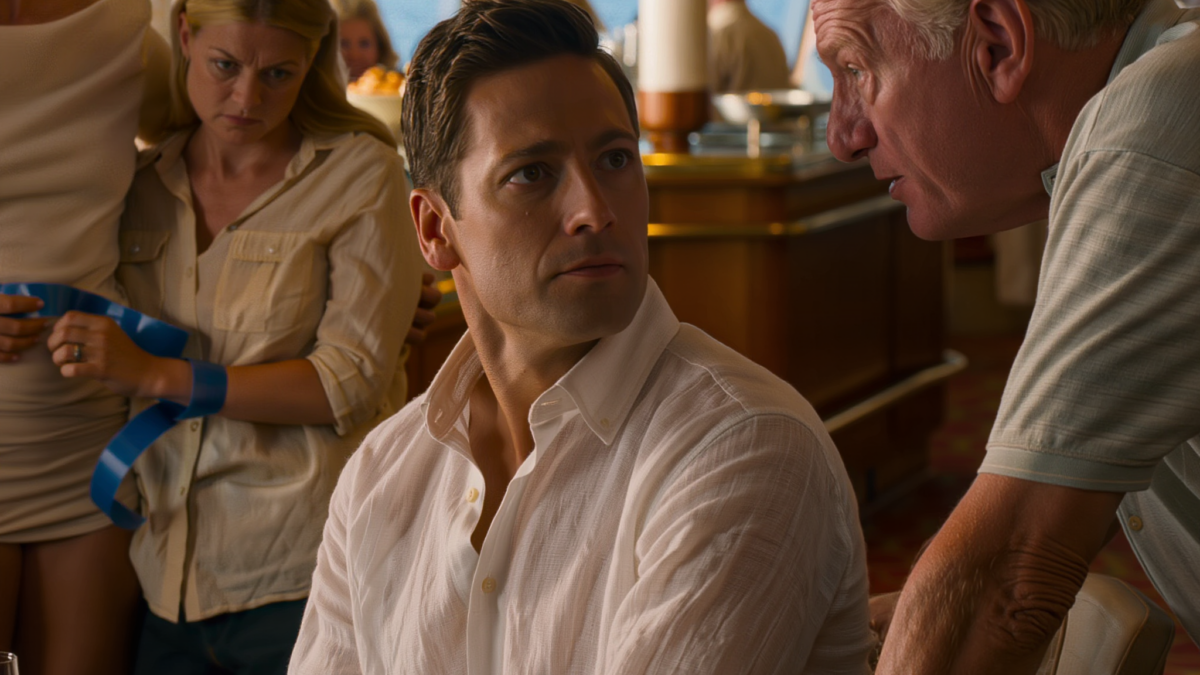
I imagined them arriving at the terminal expecting the same VIP treatment I received, only to be handed blue plastic wristbands and directed toward standard boarding.
I pictured their reaction when they reached their small interior cabins on deck 2, beside the commercial laundry facilities and above the engine room.
Part of me wondered when they would discover exactly how much had changed.
By the second evening, curiosity got the better of me.
I left my penthouse, took the private elevator down, and walked toward the complimentary buffet on the Leo deck.
The restaurant was crowded, with plates clattering, teenagers talking loudly, and the smell of fried food drifting from the serving stations.
I took a small plate of fresh fruit and found a quiet table near a window.
I hadn’t been sitting there five minutes when I spotted them.
Dad was standing in the dessert line, looking furious. His polo shirt was wrinkled, and he shoved his tray along the metal rails with obvious irritation.
Mom looked exhausted. She kept scanning the room nervously, as though she was worried somebody from her country club might see her eating at a public buffet.
Near the soft-serve ice cream station, Vincent and Khloe were arguing.
Vincent was waving a pair of metal tongs while she rolled her eyes at him.
Even from across the room, it was clear that the vacation wasn’t going the way they’d expected.
Mom noticed me first.
She was holding a serving spoon over a tray of chocolate cake when her eyes found mine.
She stopped moving.
Her face went pale, and she quickly nudged Dad.
He turned, followed her gaze, and saw me sitting at the table eating pineapple.
His expression hardened.
Vincent and Khloe turned around as well.
Vincent’s face flushed red.
I stayed in my seat, crossed my legs, and waited.
They whispered among themselves in the dessert line while other passengers gathered behind them. Then they abandoned their trays and marched toward me.
Dad reached my table first.
He gripped the back of the empty chair across from me and leaned forward.
“What the hell are you doing here, Mark?” he demanded.
I finished chewing, wiped my mouth with a linen napkin, and looked up at him.
“What do you mean? I am on a luxury vacation.”
He continued glaring at me.
“Mom sent me a text message stating that this trip was for just family,” I explained. “And last time I checked my birth certificate, I am family. So here I am.”
Nobody answered immediately.
I could tell they hadn’t expected to see me there.
They’d probably imagined me back in Denver, upset and excluded, while they enjoyed the vacation I’d arranged.
Instead, I was sitting a few feet away from them.
Then Khloe noticed my wrist.
I was wearing a gold-colored VIP platinum wristband, which gave me access to the ship’s premium restaurants, private lounges, and exclusive areas.
Her gaze dropped from my wrist to the blue plastic bands around theirs.
She looked at mine again.
The difference was impossible to miss.
It was the first time I saw her begin to understand that the expensive benefits she’d expected were no longer included in her vacation.
Before anyone could say more, I stood up, smoothed my jacket, and picked up my sparkling water.
“Well, this family reunion has been absolutely delightful,” I said. “But I have a reservation at the captain’s private cocktail hour, and I simply cannot be late. Please enjoy the buffet. I hear the macaroni salad is highly tolerable today.”
I walked away without looking back.
That evening, I had an eight o’clock reservation at Ocean Prime Steakhouse, the most exclusive specialty restaurant on the ship.
The dining room was elegant, with dark mahogany walls, soft lighting, and white linen tablecloths.
I was seated in a quiet booth with a clear view of the entrance.
About thirty minutes into dinner, while I was finishing a rich lobster bisque, I saw my family approach the hostess stand.
They had dressed for the occasion.
Dad wore his only tailored blazer, which pulled tightly across his shoulders. Mom had put on her best pearls. Vincent had slicked back his hair, and Chloe was wearing a sequined cocktail dress.
They clearly intended to enjoy the premium dinner they’d expected when I made the original reservations.
The hostess greeted them politely.
“Good evening, ladies and gentlemen. Welcome to Ocean Prime. Do you have a reservation with us tonight?”
“Miller,” Dad replied. “Party of five.”
She checked her tablet.
“I apologize, sir. I am not seeing a reservation under the name Miller for a party of five.”
“Look again,” Mom said, loud enough for nearby diners to hear. “My son booked it months ago. We have the premium dining package. It is an all-inclusive luxury booking.”
The hostess checked again.
“I do see a Miller in our system, ma’am, but it is a solo reservation for a VIP guest currently residing in the master penthouse suite. What is your specific cabin number?”
Dad reluctantly gave her the deck 2 cabin numbers.
After looking them up, the hostess explained the problem.
Their cabin category didn’t include premium dining, and there were no specialty packages associated with their accounts.
Their included dining options were the main dining halls and the complimentary buffet on the Leo deck.
Mom’s face fell.
Chloe turned to Vincent.
“You promised me he paid for everything,” she snapped. “You swore to me we had VIP access to the whole ship. I am not eating generic buffet food for a week.”
The hostess tried to calm the situation.
She explained that she could attempt to accommodate the party for an additional charge of $150 per person, excluding alcohol and gratuity.
Then she asked whether they wanted to use the card on file.
“Yes,” Dad said sharply.
He seemed determined not to walk away after being told they didn’t have a reservation.
“Run the card on file. The Visa ending in 4212.”
I recognized the number immediately.
It was my primary corporate Visa card, the same one I’d used to pay for the original trip.
The hostess entered the information.
A few seconds passed.
Then she looked back at Dad.
“Sir, I am so sorry, but that card has been officially restricted by the primary account holder. It cannot be used for any onboard purchases whatsoever. The transaction has been declined. Do you have another form of payment?”
My family stood there without answering.
Several diners had stopped talking and were watching the exchange.
Dad’s jaw tightened. After a long pause, he turned and left the restaurant.
Mom followed him, partly hiding her face behind her purse.
Vincent and Khloe walked after them, still arguing.
I remained at my table and took another sip of Cabernet Sauvignon.
A few minutes later, my waiter approached to clear the soup bowl.
His name was Marco, an Italian man who had witnessed the incident from the service station.
He leaned toward me and spoke quietly.
“Mr. Miller, the gentleman at the hostess stand just now, before he left, he aggressively demanded that we come over and ask you to authorize your credit card to upgrade their dining plans for the week.”
I considered what he was telling me.
Even after removing me from the family conversation and accusing me of ruining their happiness, Dad still expected the restaurant staff to persuade me to pay another $750 for dinner.
I thought about the years I’d spent working to cover Vincent’s debts.
I thought about the house I’d purchased for my parents.
And I thought about that seven-word message.
“Marco,” I said, “I have absolutely no idea who those people are. Please ensure they are not permitted to charge a single dime to my room or my accounts for the duration of this voyage.”
He nodded.
“Understood completely, sir. Your dry-aged bone-in ribeye will be out in just a moment.”
For the first time in years, I was having an expensive dinner without worrying about what my family might ask me to pay for next.
After the steakhouse incident, my relatives began avoiding me.
The Starlight Serenity carried more than 4,000 passengers, but even a ship that size had only so many restaurants, lounges, and public areas.
Over the next forty-eight hours, whenever my family saw me, they changed direction.
If I entered a lounge where a jazz band was playing, they would get up and leave.
When we passed one another along the shopping promenade, they would stare at the carpet and pretend I wasn’t there.
Sometimes I noticed them from the upper decks near the crowded main pool.
They drank water from plastic cups because they no longer had premium drink packages.
They ate burgers from the poolside grill instead of visiting the specialty restaurants.
The expensive vacation they had expected was now very different from what I had originally purchased.
On the third afternoon, the ship was cruising through international waters toward the Bahamas.
I went to the serenity deck, an adults-only premium area near the back of the ship, and settled into a shaded cabana.
I was stretched out on a comfortable lounger with a legal thriller in my hands and a glass of iced tea flavored with mint beside me.
The warm Caribbean air had finally helped me relax.
I hadn’t felt that peaceful in years.
Then a shadow crossed the pages of my book.
I lowered my sunglasses.
Mom, Dad, and Vincent were standing around my chair.
Chloe wasn’t with them. I assumed she was back in their cabin.
The three of them were unusually quiet.
Mom stood in the middle with her arms tightly crossed. Her face was strained, and her hands were clenched.
“How could you do this to us, Mark?” she whispered.
Her voice was shaking.
I remained where I was, took a sip of iced tea, and set the glass down.
I carefully marked my place in the novel and closed it.
For several seconds, none of us spoke.
“I am not entirely sure what you mean, Mom,” I said. “I am simply sitting here enjoying my afternoon.”
Vincent stepped forward.
“Do not play stupid with us, Mark. You know exactly what you did. You downgraded our rooms. You cancelled our dining packages. You blocked your damn credit card so we can’t buy anything. We are the laughingstock of this entire ship. Chloe is having a meltdown in the cabin and threatening to call off the wedding because her luxury vacation is completely ruined.”
Mom began crying.
“People are staring at us everywhere we go. They see these horrible blue plastic wristbands. They hear us getting turned away from the restaurants. We look completely ridiculous. Mark, you are punishing your own flesh and blood over a simple misunderstanding.”
I looked at her.
Not once had she apologized for uninviting me.
She hadn’t acknowledged the messages in the private group chat, the false story she’d helped spread among our relatives, or the fact that I’d paid for the vacation in the first place.
Her concern was that people were seeing the consequences.
She was embarrassed.
That seemed to matter to her far more than anything she’d done to me.
For most of my life, seeing my mother upset would have been enough to make me back down.
This time, I didn’t feel the need to rescue her.
I sat upright, swung my legs over the side of the lounger, and removed my sunglasses.
I looked at Vincent, then Dad, then Mom.
“You look ridiculous,” I repeated.
Several other passengers in nearby cabanas had lowered their books and were watching.
“Let me see if I have the objective facts straight,” I continued.
“You happily accepted a $21,000 luxury vacation that I fully paid for with my salary. Then you uninvited me via a seven-word text message because my presence would, quote, kill the vibe. You told the rest of our extended family that I was an arrogant corporate snob who was too busy with work to show up. You kicked me out of the family group chat so you could mock me behind my back and post selfies celebrating my absence. You did all of that malicious, calculated work, and you actually have the unmitigated audacity to stand here and tell me that you are the victims.”
Mom took a step backward.
She opened her mouth, but nothing came out.
Vincent responded instead.
“You’re just a petty, vindictive sociopath, Mark,” he said. “This is all about money with you. It always has been. You think just because you have a fat bank account and a fancy title, you can treat us like garbage.”
He stared at me.
“Well, let me tell you a secret. Bro, money doesn’t buy class.”
It was a remarkable statement coming from my twenty-nine-year-old brother, whose student loans I’d spent four years paying off and who was standing on a cruise ship purchased with my credit card.
I stood up.
I was several inches taller than Vincent. When I stepped closer, he had to look up to meet my eyes.
“You are absolutely right, Vincent,” I told him. “Money does not buy class, but it does buy real estate. It buys high-powered legal retainers, and it buys penthouse suites. And as of this exact moment, I am officially done buying yours. You are cut off. All of you.”
Dad, who had remained mostly silent, finally spoke.
His face was flushed with anger.
“You arrogant, ungrateful little bastard,” he said, pointing at me. “You are dead to us. Do you hear me? You are no longer my son.”
I met his eyes.
“The feeling is entirely mutual, Richard.”
Dad grabbed Mom’s arm and pulled her away.
Vincent gave me one final angry look before following them toward the elevators.
I sat back down.
When I reached for my iced tea, I noticed that my hands were steady.
I’d spent almost my entire adult life dreading the possibility of confronting my parents and refusing them something they wanted.
The confrontation had lasted less than four minutes.
And I had survived it.
Later that afternoon, the ship was sailing toward a golden sunset when my phone chimed.
I was sitting on my private balcony.
The notification was an email from James, my real estate lawyer in Denver.
I opened it and found an encrypted PDF attachment containing a settlement statement from the title company.
The accompanying message confirmed what had happened to the Elm Street property.
“Mark, the real estate transaction on the Elm Street property is officially closed,” James wrote.
He explained that the cash buyer had been motivated to complete the purchase quickly, allowing the transaction to close without prolonged legal delays or a lawsuit.
The title had been transferred.
After closing costs, the sale proceeds had been wired to my primary investment account.
The moving company had finished packing the property that morning, and all my parents’ personal belongings were now in the prepaid storage unit off Highway 70.
The keys had been handed to the new owners.
James ended by wishing me a pleasant remainder of my vacation.
I locked my phone and leaned back in the balcony chair.
For the first time in twenty years, I wasn’t financially responsible for the house where my parents lived, Vincent’s next business venture, or another family emergency.
The property had been sold.
The financial obligation was over.
I felt free in a way I hadn’t experienced since childhood.
When the Starlight Serenity returned to Miami at the end of the seven-day cruise, the sky was gray and overcast.
Thousands of passengers were trying to disembark and make their travel connections.
I had a quiet breakfast in the VIP lounge, enjoying fresh pastries and espresso while avoiding the crowded gangways.
The trip had ended, but there were two more reservations I’d made for my family that I no longer intended to pay for.
Months earlier, while planning the vacation, I’d arranged a luxury black car to collect them at the port.
The driver was supposed to take them to an expensive airport hotel, where they could relax by the pool before their flight back to Denver the next morning.
I opened my laptop, signed in to the car service’s reservation portal, and canceled the booking.
Then I logged into the hotel’s website and revoked the reservation under my name.
Both refunds appeared in my pending transactions.
I packed my things and left the ship through the priority exit.
I took an Uber to Miami International Airport and boarded my first-class flight back to Colorado.
I knew what my family would be expecting when they reached the curb outside the cruise terminal.
They would look for a chauffeur holding a sign with the name Miller.
When no driver arrived, they’d try calling me.
But their numbers were blocked.
They would eventually have to pay for their own transportation to the airport hotel, where the reservation I’d arranged no longer existed.
If the hotel was fully booked, they’d have to find another place to stay.
It would be an unpleasant end to their vacation, but I was no longer going to organize every part of their lives for them.
The larger surprise was waiting in Denver.
My flight landed late that evening.
I went straight to my downtown condo, dropped my luggage, poured myself a glass of Kentucky bourbon, and settled in.
Their flight was scheduled to arrive the following afternoon.
At exactly 4:15 p.m. the next day, my phone rang.
It wasn’t Mom, Dad, or Vincent. Their calls were still blocked.
The screen showed Uncle Tom.
Tom was Dad’s younger brother. He liked to present himself as the neutral peacekeeper at family gatherings, although he usually sided with whichever relative was providing the money.
I let the phone ring three times before answering.
“Hello, Tom.”
“Mark, what in the absolute hell is going on?” he demanded.
He sounded more upset than I’d ever heard him.
“Your parents just called me from the front porch of the Elm Street house. They took a cab straight from the airport. Mark, the locks are changed, the keys don’t work, and there is a strange family eating dinner in the dining room. Did the bank foreclose on you? What happened?”
I took a sip of bourbon.
“The bank didn’t foreclose, Tom. I sold the house.”
For a moment, there was nothing but the sound of his breathing.
“You… You sold it?” he finally asked.
“Mark, you can’t do that. That was their home. You just left your parents entirely homeless. How could you be so utterly ruthless to your own blood?”
“It was my property, Tom. My name was on the deed. I bought it. I maintained it. I paid the property taxes, and I liquidated it,” I replied.
“They explicitly informed me I was no longer part of the family. So, I removed my financial assets from their lives. Their belongings are in a paid storage unit off the highway. They can figure out their own housing situation from here on out.”
Tom’s voice grew louder.
“You don’t understand what you’ve done.”
Then he said something I had not expected.
“Mark, they needed that house. Richard and I had a meeting scheduled with the loan officers at the bank next week. He was going to have you sign over a power of attorney so we could leverage the equity in that property. We needed a massive home equity loan to fund Vincent’s new logistics company. If we don’t get that capital infusion, Vincent is going to face a massive lawsuit from his early investors.”
I stopped moving.
My fingers tightened around the glass.
Until that moment, I had believed the cruise was the main betrayal.
My family had taken my money, excluded me from the vacation, and mocked me privately.
Now Tom was describing something potentially far more serious.
According to him, Dad and Tom had already planned a meeting with the bank. They expected me to sign a power of attorney and allow them to borrow against the equity in the home I owned.
That money was supposed to finance Vincent’s latest business, a logistics company that was apparently facing serious financial trouble.
I hadn’t been told about any of it.
No one had asked me whether I was willing to put the house at risk for another one of Vincent’s ventures.
I’d already paid off his student loans. I’d helped support my parents for years. And now I was hearing about plans to use the equity in a $400,000 property for another rescue.
I couldn’t know exactly how they intended to persuade me to sign the paperwork, but the secrecy of the plan alarmed me.
The possibility that my financial future could have been placed at risk without an honest discussion made everything that had happened feel even worse.
The money I’d spent on the cruise was painful enough.
The thought of taking on a substantial debt secured against the house to save Vincent’s company was something else entirely.
And if the business failed, I knew exactly whom my family would expect to handle the consequences.
The realization made my anger return, but it also brought an unexpected sense of relief.
By selling the property, I’d eliminated the asset they had hoped to borrow against.
The sale wasn’t simply the end of my financial support for their housing.
It had also prevented the proposed loan from proceeding as they had described it.
I finally answered Tom.
“Well, Tom, it sounds to me like Richard and Vincent have a very serious legal problem on their hands. I strongly suggest they hire a very good lawyer. Do not ever call this number again.”
I ended the call.
Then I blocked his number.
The arrangement my family had depended on for so many years was finally over.
Six months have passed since that phone call with Uncle Tom.
For the first time in my adult life, I’ve had months of uninterrupted peace.
Without the constant demands of solving my relatives’ financial problems, I’ve been able to focus on my own career and my own future.
The change has been extraordinary.
I no longer spend my evenings worrying about whether Vincent has missed another payment or whether Dad is about to ask for help with a bill.
My attention is back on my work.
Recently, I accepted a lucrative offer to become the chief financial officer of a major competing firm.
My investment accounts have continued growing, and my daily stress is nothing like it used to be.
Even my downtown condo feels different.
For years, it felt like a temporary refuge where I waited for the next family emergency.
Now it feels like my home.
I also hired James to prepare a comprehensive estate plan and an updated will.
I made the decision to disinherit my parents and Vincent.
I wanted to be certain that the wealth and property I’d worked for would not eventually pass to the same people who had treated my generosity as an obligation.
I considered it a final step in ending a relationship that had become less like a family and more like a deeply unhealthy financial arrangement.
I still receive occasional updates from Sarah.
She believes I was justified in protecting myself, and she hasn’t tried to pressure me into reconnecting.
Through her, I’ve learned what happened after the sale of the house.
Without access to the equity they had hoped to use, Vincent’s logistics company collapsed.
According to Sarah, his investors backed out, creditors began demanding payment, and the debts he’d accumulated finally caught up with him.
Chloe, realizing that the easy financial support she’d expected was gone, canceled their wedding.
She packed her belongings and left Vincent for a personal trainer.
Vincent now works as a shift manager at a big-box retail store.
For the first time in his twenty-nine years, he has to clock in, manage customers, and earn his own money on a regular schedule.
There is no older brother standing by to pay his debts.
He has to deal with the financial consequences of his own decisions.
My parents haven’t had an easy time either.
They eventually rented a cramped two-bedroom apartment in a run-down complex on the outskirts of the city.
Dad took a demanding job driving a delivery truck so they could afford the monthly rent.
The lifestyle they enjoyed while I was paying most of their expenses is gone.
I don’t know whether they have truly reflected on how they treated me.
I only know that, for the first time, they are living within the limits of their own resources.
When Sarah first told me what had happened, I felt something close to grief.
I had spent most of my life imagining the family we might become if I just worked harder, earned more, or gave enough.
Letting go of that dream was painful.
But keeping it alive had cost me far more than I understood.
Yesterday afternoon, I went downstairs to check the mail in my building’s lobby.
Among the bank statements, corporate letters, and utility bills was a cheap, glossy postcard.
The front showed a faded photograph of the Rocky Mountains.
I turned it over.
I recognized my mother’s handwriting immediately.
It was shakier than I remembered.
“Mark,” she’d written. “We are so incredibly sorry for everything. We made terrible mistakes. The apartment is so small and your father’s health is declining rapidly from the stress. We miss our family. We miss you. Please call us.”
I stood there reading it.
A year earlier, that message would have undone me.
The mention of Dad’s health would have frightened me. Mom saying she missed me would have made me feel guilty for keeping my distance.
I would have called immediately.
I would have asked what they needed.
And before long, I probably would have offered money, housing, or some other solution that put their problems back on my shoulders.
That was how our relationship had always worked.
Their distress became my responsibility.
Their apologies came with another reason I needed to help.
But standing in the brightly lit lobby, holding that postcard, I didn’t feel the old panic.
I wasn’t angry.
I didn’t want to call and argue with Mom about the past.
I didn’t feel any need to explain my decision again.
I simply understood that I could care about what happened to them without returning to the role I’d spent my whole life playing.
I walked over to the stainless steel trash can in the lobby.
I tore the postcard neatly in half and dropped both pieces inside.
Then I went back upstairs.
Tomorrow morning, I’m boarding a first-class flight to Tokyo.
I’ve planned a three-week solo vacation.
I’m paying for it myself, arranging it for myself, and taking it because it’s something I genuinely want to experience.
There won’t be any relatives waiting for me to upgrade their tickets or cover their meals.
Nobody will be deciding whether I deserve to join a trip I’ve already funded.
For the first time, I don’t have to prove that I’m worth keeping around.
I’m no longer the responsible one.
I’m no longer the emergency fund.
I’m just Mark.
And at thirty-four years old, I’m finally beginning to understand that being myself is more than enough.
I spent decades believing that love was something I had to earn through sacrifice. I thought every problem I solved and every bill I paid brought me a little closer to becoming the son my parents could appreciate.
But love isn’t a financial transaction.
A person’s value isn’t measured by how often they rescue someone else.
When a family only respects you while your credit card is working, what they’re protecting may not be the relationship at all. It may simply be their dependence on you.
I wish I’d understood that before I ended up sitting alone in my car, staring at seven words from my mother.
I can’t recover the years I spent trying to buy a place in my own family.
But I can decide what happens to the years ahead.
I can protect my peace, my financial future, and the boundaries I’ve finally learned to establish.
Those boundaries don’t need to be explained over and over to people who have already shown me what they expect.
They need to be respected.
And I no longer feel the need to apologize for keeping the door closed.








