My mother turned my 7-year-old son away at my brother’s rehearsal dinner after promising he could be the ring bearer. He stood on the stone steps in the navy suit we’d spent three weeks choosing. Later, he whispered, “I could have worn a different color.” I thought we were finally leaving her behind. Then my father, who’d stayed silent for 30 years, called and told us to turn around.
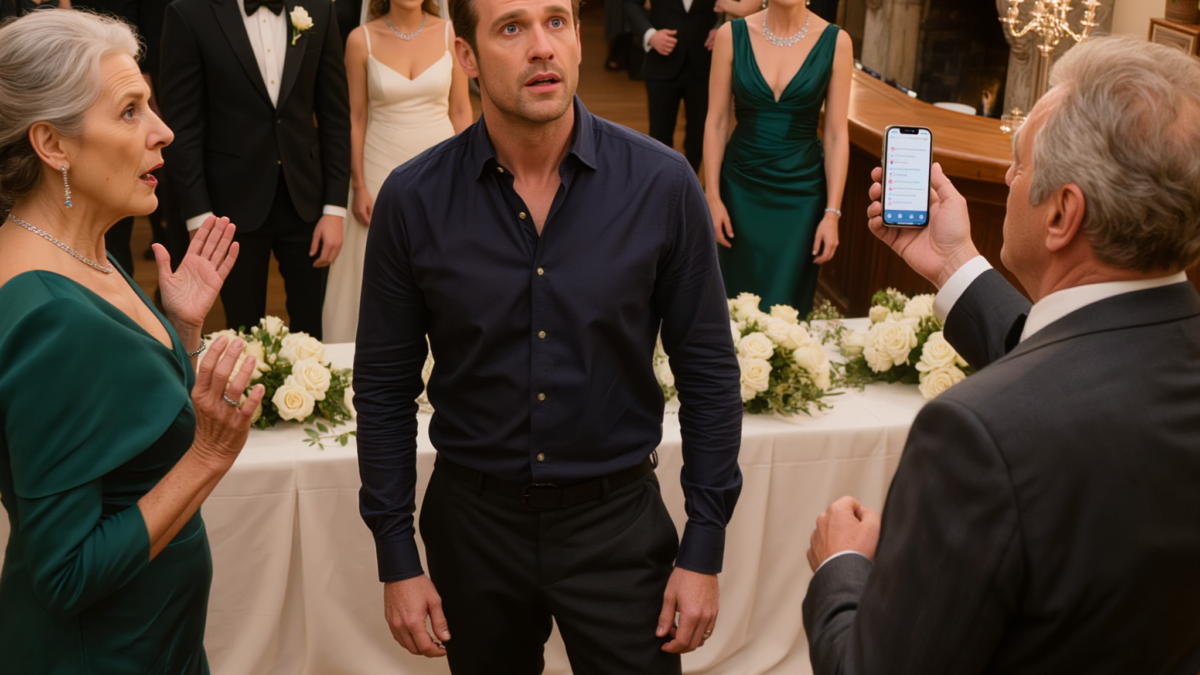
The sound of a live string quartet drifted through the massive mahogany doors of the Whitmore estate. It was a cold autumn evening, and I stood on the stone steps holding my seven-year-old son’s hand, trying to convince myself that we belonged there.
My name is Garrison. I’m 32 years old, and for most of my life, I’d been the son my family could conveniently forget.
My younger brother, Julian, was getting married. His fiancée, Cassandra, came from a wealthy family, and her parents were hosting the rehearsal dinner at their sprawling estate. My wife, Fiona, and I had driven two hours to be there.
But the most excited person in our car had been our son, Miles.
He wore a custom navy blue suit with a pale blue bow tie. Fiona and I had spent three weeks choosing it and having it tailored. We were a middle-class family, and an outfit like that wasn’t an ordinary purchase for us. But Miles had been promised a special role in his uncle’s wedding.
He was supposed to be the ring bearer.
He called the outfit his secret agent suit. During the drive, he’d asked four times whether his hair looked right, smoothing down the stubborn cowlick at the front. He’d practiced walking straight and had carefully checked his polished shoes.
Each time he asked, I told him he looked like a million bucks.
Now, standing outside the enormous doors, he squeezed my fingers.
“Dad, why are we standing outside? Is Uncle Julian inside? I want to show him my shoes.”
I couldn’t give him an answer that would make sense to a child.
Twenty minutes earlier, as we’d entered the estate’s long gravel driveway, a text from my mother had appeared on my phone.
“Don’t come in through the main entrance. Actually, I need to talk to you before you come in at all. Call me.”
I’d called immediately. She didn’t answer. I called again, waited for voicemail, and sent a message back.
Nothing.
Fiona suggested parking our used sedan along the edge of the property, away from the expensive cars near the valet stand. A black Porsche, a Range Rover, and a vintage Rolls-Royce sat near the entrance. Our car looked painfully ordinary beside them.
We followed the gravel path to the house, and I knocked.
The woman who opened the door wasn’t my mother or my brother. It was Sylvia, Cassandra’s mother.
She wore a perfectly fitted emerald dress and an impressive diamond necklace. Her expression was polished, but the way she studied us made me feel as though we had arrived at the wrong entrance.
Her eyes moved from my slightly worn dress shoes to Fiona’s modest dress. Then she looked down at Miles, and her nose wrinkled.
“Oh,” she said.
One syllable, delivered with enough disapproval to make my stomach tighten.
“You must be Julian’s older brother.”
I began introducing my family, but she barely acknowledged us.
“Let me get your mother.”
She left us standing outside.
A few moments later, I heard my mother’s heels clicking against the marble floor.
Vivien came down the hallway, stepped onto the porch, and pulled the door almost completely closed behind her.
She didn’t hug me. She didn’t greet Fiona. She didn’t bend down to speak to her grandson.
Whatever welcome we’d been expecting disappeared the moment I saw her face.
Miles looked up at her, confused.
“Grandma, am I not doing it?”
I turned toward my mother.
“Just what?” I demanded. “It made more sense to cut your own grandson out of the wedding without having the basic human decency to tell anyone? You let us drive two hours up here just to turn us away at the door?”
“Garrison, please keep your voice down. You are embarrassing me,” she hissed.
I stared at her.
That was what mattered. Not that she’d disappointed a seven-year-old who had spent weeks preparing for the wedding. Not that we’d driven two hours because she’d invited us.
She was worried about being embarrassed.
Fiona placed her hand against my back. She didn’t interrupt. She knew how complicated my relationship with my mother had always been, and she let me decide how much I was prepared to say.
“Awkwardness,” I repeated, tasting the word. “You mean me. I am the awkwardness. My family is the awkwardness.”
“You know exactly what I mean,” Mom snapped. “Just go home, Garrison. We will see you at the ceremony tomorrow. Sit in the back.”
For a moment, I couldn’t move.
I’d spent years hoping that one day my family would look at me without comparing me to Julian. I thought getting married, raising a child, and building a stable life might finally be enough to earn their respect.
Standing on that porch, I realized how little had changed.
“We’re going to go,” I said. “Tell Julian congratulations on the aesthetic.”
I turned away from her and knelt in front of Miles.
He was looking down at his new shoes. I took both his hands and tried to keep my voice steady.
“Hey, buddy. Do you want to go get waffles? The diner down the highway with the fresh strawberries and chocolate chips?”
He studied my face.
“Are you sad, Dad?”
“I’m okay, pal. Are you okay?”
He thought for a moment.
“I practiced walking really straight.”
“I know you did. You were going to be the best ring bearer in the world. They really missed out.”
“Can we still get those waffles?”
“Absolutely.”
“With extra whipped cream?”
“With extra whipped cream.”
I stood, took Fiona’s hand, and walked away from the enormous house.
I didn’t look back at my mother. I concentrated on the gravel beneath my feet and reminded myself that I had a wife who loved me, a son who needed me, and a life I’d built without my parents’ help.
I held myself together until we reached the car.
Miles carefully smoothed his jacket before fastening his seat belt. Fiona started the engine.
And once the doors locked, I covered my face with my hands and cried.
That night wasn’t the beginning of my family’s problems. It was the moment thirty years of resentment finally became impossible to ignore.
To understand why, you have to know what growing up with Julian was like.
My brother was four years younger than me. He was charming, outgoing, and always knew how to make our mother laugh. He had her eyes and her flair for drama, and she treated him as though the ordinary rules of life didn’t apply to him.
If Julian wanted something, my parents found a way to provide it.
When he asked for an expensive mountain bike for his tenth birthday, a new one appeared in the garage with a giant red bow.
When I was fourteen and needed basketball shoes because my old pair had holes in the soles, Mom told me it was time I learned responsibility.
She suggested a paper route or a part-time job.
So I went to work.
I spent much of my teenage life at a local diner, scrubbing dishes and mopping greasy floors until midnight. I bought the things I needed with my own earnings.
My parents described that arrangement as a valuable lesson in independence.
They even bragged to their friends about how responsible I’d become.
Then Julian turned sixteen and received a brand-new sedan. My parents paid for the car and covered the insurance.
At Thanksgiving, I watched him show it off to his friends while I stood outside, exhausted from a double shift at the diner.
That’s when Uncle Roland found me.
Roland was my mother’s older brother. He always seemed to have an expensive cigar nearby and a piece of advice nobody had asked for.
He placed his hand on my shoulder.
“Listen, Garrison. Your brother is sensitive. He’s an artist at heart. He needs a little more support and guidance from your parents.”
Then he explained why I shouldn’t complain.
“You, on the other hand, you’re the strong one. You’re a rock. You can handle anything. Be the bigger man. Don’t make your mother upset by keeping a scorecard. It’s petty.”
I was sixteen. I wanted to believe that the adults in my life knew what they were talking about.
So I learned to be the rock.
Whenever Julian received something I didn’t, I was told to understand. Whenever I objected, my mother cried, accused me of jealousy, or called me ungrateful.
Eventually, I stopped raising the subject.
For a while, I convinced myself that being independent was something to be proud of. Maybe my parents were preparing me for a harder world because they believed I could handle it.
That explanation became impossible to maintain when I turned eighteen.
Throughout my childhood, my parents had told me they were saving money for college. They said the fund would allow me to attend a good university, live on campus, and pursue mechanical engineering.
I worked toward that future for years.
I earned straight A’s and received acceptance letters from three excellent engineering programs. I had a plan, and for the first time, I believed I was about to have a life beyond my family’s expectations.
Two weeks before my university deposit was due, Mom called me into the kitchen.
She was sitting at the table with a stack of papers and a tissue. Afternoon sunlight filled the room, and I remember the dust floating in the air.
“Garrison, I am so, so incredibly sorry,” she said, crying.
She told me my father’s business had suffered terrible financial setbacks. The stock market had crashed, taxes had been reassessed, and the mortgage rate had increased.
“The college fund is gone. We had to drain the entire account just to keep the house from going into foreclosure. We have absolutely nothing left. I failed you.”
I was devastated.
For years, I’d imagined walking onto a university campus, studying engineering, and finally beginning my own life.
Suddenly, the money was gone.
But I believed my mother.
If my parents had used the savings to keep a roof over our heads, how could I argue? Losing my opportunity seemed terrible, but I couldn’t bring myself to resent them for protecting the family home.
I hugged her and said I understood.
Then I deferred my college plans and found a full-time position at a local auto shop.
I worked sixty-hour weeks as a mechanic. I came home with oil embedded in my knuckles, an aching back, and the sound of pneumatic tools still ringing in my ears.
I enrolled in community college and took classes at night. Eventually, I transferred to a state school.
It took six difficult years to complete my four-year degree.
I paid for every credit myself.
Four years after Mom told me the college money was gone, Julian turned eighteen.
I was twenty-two, still working at the shop and continuing my education. One Sunday, I drove to our parents’ house to bring Julian a birthday gift.
As I approached the garage, I stopped.
A Porsche 911 was parked in the driveway.
It wasn’t an older car somebody had restored. It looked new, with temporary dealership tags still on the back.
Julian came running outside, laughing and waving the keys.
Mom followed him with a digital camera, smiling proudly.
“Do you like it, Garrison?” Julian asked, running a hand over the hood. “Mom and Dad’s high school graduation present. It’s early, but I convinced them I needed it for summer road trips.”
I looked from the car to my mother.
Four years earlier, she’d cried at the kitchen table and told me our family had no money left.
Now she’d helped buy my younger brother an expensive sports car.
“A Porsche?” I asked. “Where did the money come from?”
Her expression changed.
She told Julian to take the car for a drive around the block. Once the engine faded down the street, she folded her arms and faced me.
“Don’t look at me like that.”
I asked where they’d found the money.
She said Julian would be attending a prestigious private business school and needed an appropriate vehicle for internships and networking. Uncle Roland had helped them find a good deal.
“Where did the money come from, Vivien?” I asked again.
I didn’t call her Mom.
She lifted her chin.
“We used a portion of the family savings.”
“The savings you told me were drained to save the house?”
She didn’t answer immediately.
“The money you told me was completely gone when I had to go work at a mechanic shop for minimum wage? My college fund?”
“You survived, didn’t you?” she snapped.
She told me I was strong and independent, but Julian was sensitive. He needed a head start in life. I could take care of myself, while he required more support.
Then she accused me of being selfish and jealous on his birthday.
I finally understood what had happened.
The sacrifice I’d believed was necessary for our family’s survival had not been shared equally. The savings I’d depended on had been treated as something that could be redirected toward Julian’s comfort.
My mother expected me to accept that and congratulate him.
I didn’t argue any further.
I returned to my old Honda Civic and drove away.
For the next year, I cut off contact with my family.
During that year, I met Fiona.
She worked as a pediatric nurse at a local hospital, often taking exhausting shifts. She was kind, determined, and remarkably steady under pressure.
She didn’t treat me as someone who had to prove his worth by enduring whatever people demanded.
She listened.
We fell in love, and eventually we married in a small courthouse ceremony.
My parents didn’t attend.
They were away on a luxury cruise celebrating a junior marketing promotion Julian had received through Uncle Roland’s connections.
I wish I could say their absence surprised me.
Fiona and I continued building our lives together. We saved carefully, bought a modest three-bedroom house in a quiet suburb, and welcomed Miles into our family.
I moved from working as a mechanic into fleet management. The position offered a solid salary, good health benefits, and a retirement plan.
We weren’t wealthy, but we were secure. Our house had a big backyard, our bills were manageable, and our son was growing up surrounded by love.
I’d finally built the family I’d wanted as a child.
Then Julian announced his engagement to Cassandra.
Cassandra’s father was a wealthy real estate developer, and suddenly my mother began calling again.
She invited us to dinners and sent expensive toys to Miles. She spoke as though the years of distance between us had simply been an unfortunate misunderstanding.
Then she asked if Miles would serve as the ring bearer at Julian’s wedding.
Fiona was cautious.
One evening, we sat together in our kitchen with the formal invitation.
“Garrison,” she said gently, “they are only bringing you back into the fold to pad out the pews. They want to look like a big, happy, traditional, loving family for Cassandra’s wealthy parents. They are using us as props.”
I knew she might be right.
But Miles had become so excited. He talked about wearing a suit, carrying the rings, and helping Uncle Julian get married.
I wanted him to know his grandparents.
More than anything, I wanted to believe my mother had grown older, reconsidered her choices, and finally understood how much she’d hurt me.
So we accepted.
And that decision brought us to the cold stone steps of the Whitmore estate, where my mother sent us away without even allowing my son inside.
As Fiona drove down the estate’s winding private road that night, she rested her hand on my knee.
“She cut Miles,” I managed to say. “She cut her own grandson from the wedding and didn’t even have the decency to call us.”
“I know, Garrison,” Fiona replied.
“And my mother just stood there and defended it. She defended Sylvia.”
Fiona listened without interrupting.
“I know, baby. I know.”
We passed through the estate gates and turned toward the highway. Miles sat quietly in the back seat, his navy suit looking too large around his small shoulders.
I glanced toward the rearview mirror.
“Dad?” he asked.
“Yeah, buddy?”
“Does Uncle Julian hate me?”
I felt the question settle somewhere deep inside my chest.
It was the same fear I’d carried as a child, now coming from my own son.
“No, Miles,” I told him. “Uncle Julian doesn’t hate you. Nobody hates you. You’re the best kid in the world. Sometimes adults just make really, really stupid decisions.”
He looked down at his clothes.
“I could have worn a different color,” he whispered. “If they told me they didn’t like the blue, I could have worn black or gray. I could have changed.”
A tear slid down his cheek.
Until that moment, I’d believed I could tolerate my family’s treatment of me as long as I kept enough distance from them.
But Miles was beginning to believe that his family’s rejection must have been his own mistake.
He was learning to negotiate for affection before he was old enough to understand why anyone would withhold it.
I couldn’t let that become his childhood.
Then my phone rang.
The caller ID showed my father’s name.
Harrison.
I almost declined the call.
Dad had been at the estate that evening. He hadn’t come outside when my mother confronted us, and I assumed he’d chosen silence again.
He had always avoided confrontation with her.
“Up to you,” Fiona said, glancing toward the phone.
I answered and put the call on speaker.
“What do you want, Dad? Did Vivien want you to call and make sure we actually left the zip code?”
“Garrison.”
There was something different about his voice.
Usually, when my father spoke about family disagreements, he sounded tired and eager to end the conversation. This time, his words were controlled, but I could hear anger underneath them.
“Where are you right now?”
“On the highway heading home. We’re gone. You guys got what you wanted.”
“Turn around.”
I stared at the phone.
“Right now,” he continued. “Tell Fiona to turn the car around and come back to the estate.”
“Dad, absolutely not. After what Vivien just did to my son, you want me to bring him back there? I’m not walking into that house and pretending we’re one big happy family.”
“Garrison,” he interrupted, his voice unusually firm. “I need you to come back to this house. This is not about Julian’s dinner anymore. This is about 30 years of poison, and I am going to end it tonight.”
Then his voice softened.
“Please, son. Trust me. Turn the car around.”
I looked at Fiona.
She’d heard every word.
For three decades, my father had avoided standing up to my mother. Hearing him speak with that kind of resolve was something neither of us knew how to interpret.
“Okay,” I finally said. “We’re coming back.”
Fiona waited for an opening in traffic and made a sharp U-turn.
The return drive was only a few miles, but it felt much longer.
When the wrought-iron gates of the Whitmore estate came into view, I could already see someone waiting beneath the security lights.
It was Dad.
Fiona parked the sedan away from the main entrance, beneath the large oak trees. She stayed inside with Miles while I stepped out to meet him.
My father was a retired accountant, a quiet man who had spent years making himself almost invisible whenever my mother became angry.
He’d watched Julian receive advantages I was denied. He’d watched my college savings disappear. Whenever I challenged the unfairness, he’d usually retreated to his study.
But the man waiting in the driveway looked different.
His shoulders were rigid, and his face was drawn with exhaustion.
“Dad,” I said, approaching him, “what is going on? If Mom sent you out here with money to make this disappear, I swear to God—”
He didn’t offer an explanation.
Instead, he reached inside his suit jacket and pulled out his smartphone.
“Read this.”
He unlocked the screen and held it toward me.
“I want you to see exactly what this family has become. I want you to see what I have allowed to happen.”
The phone displayed a group text conversation between my mother, Julian, and my father.
The first message had been sent at 2:15 that afternoon, hours before our arrival.
Julian had written:
“Mom. Sylvia just called Cassandra again. She is freaking out about the Garrison situation.”
I read it twice.
The Garrison situation.
My family and I had been reduced to a problem that needed managing.
I scrolled down.
My mother had replied that everything was handled. She’d already agreed we could attend the rehearsal dinner and sit in the back.
But Julian said Sylvia wasn’t satisfied.
She’d found my LinkedIn profile and discovered I managed a fleet of mechanics. According to Julian, Sylvia considered my blue-collar career embarrassing beside the wealthy country club guests who would appear in the wedding photographs.
She didn’t want me in the formal family pictures.
She didn’t want us participating in the rehearsal dinner.
Cassandra was upset because Sylvia had threatened to disrupt the wedding weekend unless the arrangements changed.
Mom pointed out that Miles already had his suit and had been practicing for his role.
Julian’s response was immediate.
“I don’t care about the suit. Mom, I don’t care about the kid.”
I stopped reading.
Then I forced myself to continue.
Julian wanted a boy named Gideon to replace Miles as ring bearer. Gideon’s father was a corporate lawyer in Manhattan, and Julian believed that connection would look better in the photographs.
He suggested telling me the venue had reduced








