My Mother Tried to Erase Me at My Niece’s Nursing Pinning Ceremony
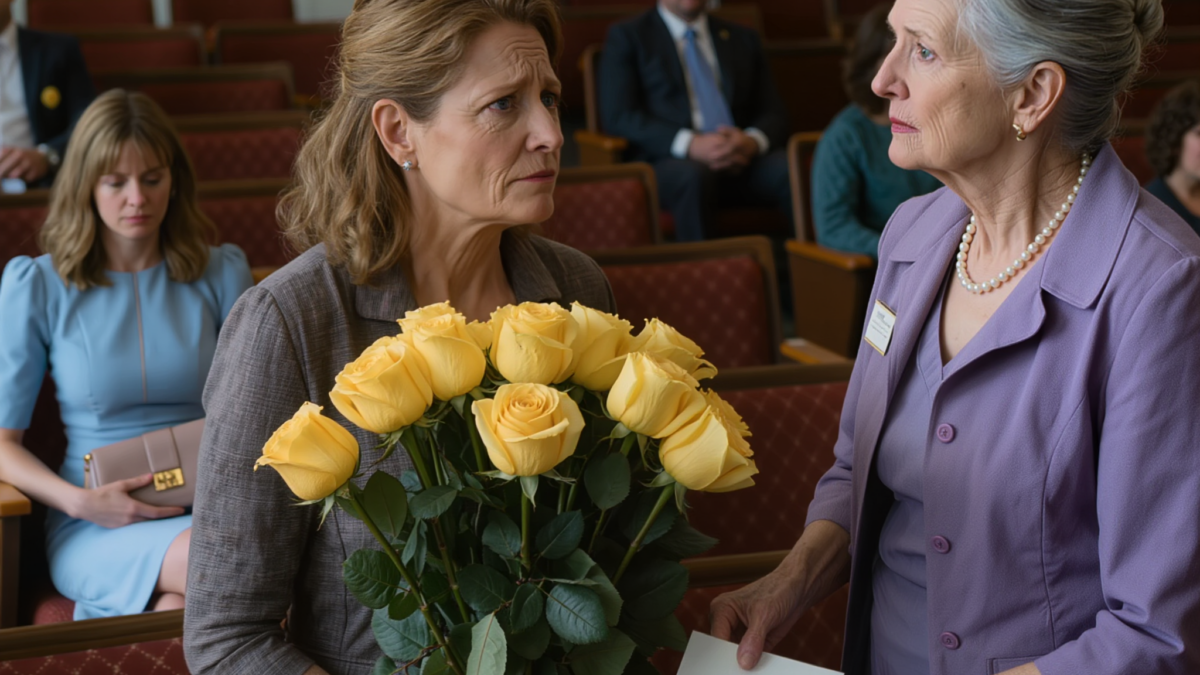
My mother gave away my seat at my niece’s nursing-school pinning ceremony.
Not just any seat. The one reserved for the person my niece had chosen to stand beside her onstage.
I was standing in the auditorium aisle, holding twelve yellow roses, when I saw my younger sister, Jenna, settling into the chair with my name on it.
My mother, Dolores, stood beside her, straightening the collar of Jenna’s pale blue dress.
“Mom,” I said quietly. “I think Jenna’s sitting in my seat.”
My mother turned toward me with the familiar expression she used whenever she thought I was about to make trouble.
“Oh, Maggie. Don’t start.”
She reached down, removed the folded name card from the chair, and placed it in my hand.
Maggie Ellis — Pinning Guest.
Those three words had meant more to me than I could explain.
Apparently, they meant very little to my mother.
“Jenna is Hallie’s mother,” she said. “She should be sitting up front.”
“I know she’s Hallie’s mother. But Hallie asked me to do the pinning.”
My mother leaned closer, lowering her voice so the families around us wouldn’t hear.
“You were there when her mother couldn’t be. Don’t confuse that with being her mother.”
I looked at Jenna.
She sat perfectly still, her hands folded around a small clutch purse. She wouldn’t meet my eyes.
“Hallie chose me, Mom.”
“Then she was trying to be nice. Don’t make the girl choose between you and her own mother on her graduation day.”
Behind us, other families were finding their seats. Someone laughed near the entrance, and a microphone squealed briefly from the stage.
My mother pointed toward the back of the auditorium.
“There are plenty of chairs back there.”
I stood there for another moment, holding the name card and the flowers.
Then I turned and walked away.
I was fifty-six years old, and somehow my mother could still make me feel like a little girl who had brought the wrong thing to a birthday party.
But when I unfolded the ceremony program I’d been carrying, the name printed beside my niece’s told a different story.
And before that afternoon was over, Hallie would have to decide what to do about it.
My name is Maggie Ellis, and I live in Dayton, Ohio.
For twenty-three years, I worked in a school cafeteria. I ordered supplies, supervised the lunch staff, checked food-allergy lists, and made sure hundreds of children had something to eat before the afternoon bell.
It wasn’t glamorous work.
Most days I came home smelling faintly of dish soap and whatever had been served for lunch. My knees complained when the weather changed, and I owned more comfortable shoes than dress shoes.
But I was good at my job.
And for seventeen years, I was also the person who raised my niece, Hallie.
Hallie was eight when her mother, my younger sister Jenna, moved away.
Jenna was thirty-two at the time. Her marriage had ended, and she was convinced that leaving Ohio was the only way to start over.
She had always wanted something bigger.
When we were children, Jenna dreamed about being a singer. Later, she talked about opening a boutique. Whatever she wanted, my mother encouraged it.
“Jenna was born to do something special,” Dolores used to say.
I was the dependable daughter.
The one who stayed close to home, kept a steady job, and showed up whenever someone needed help.
My mother considered that useful, but never particularly impressive.
When Jenna decided to leave, she asked if Hallie could stay with me for a few months while she got settled.
I said yes.
I still remember the evening Jenna brought her over.
Hallie stood in my kitchen with a pink backpack and two suitcases. Her eyes were red from crying, but she was trying very hard to be brave.
“Where will I sleep, Aunt Maggie?”
I showed her the small bedroom at the end of the hall.
It had been my sewing room. I’d moved the table into storage and put fresh sheets on the bed.
“Right here, sweetheart.”
She walked inside and placed her backpack on the floor.
“Can I leave my things out?”
“Of course.”
“All the time?”
Something about that question made my chest ache.
“Yes, Hallie. All the time.”
Jenna promised she would come back soon.
She said she’d call every week, find an apartment with an extra bedroom, and bring Hallie to live with her once things were stable.
But a few months became six.
Then a year.
And eventually, we stopped talking about when Hallie would leave.
Jenna called sometimes. She sent birthday presents, usually a little late, and made promises about visits that didn’t always happen.
I don’t believe she stopped loving her daughter.
I think she kept waiting until her own life was better before trying to be a mother again.
But Hallie couldn’t wait for that.
She needed someone to make breakfast, check her homework, drive her to school events, and sit beside her when she was frightened.
So I did those things.
I learned the names of her teachers. I made sure she got to her doctor’s appointments. I sat through school meetings and helped her prepare for tests.
When she was eleven, she needed glasses and cried because she thought the other children would laugh.
At thirteen, her best friend moved away, and she barely spoke through dinner for a week.
At fifteen, she came home from school and announced that she wanted to become a nurse.
“Why nursing?” I asked.
She thought about it.
“Because when somebody is scared, I want to know how to help them.”
That sounded exactly like Hallie.
She had always noticed when other people were hurting.
Once, when she was nine, she used her allowance to buy a stuffed rabbit for a classmate whose parents were getting divorced.
I found out only because she asked me to wash it before she wrapped it.
“Are you sure you want to give away your new toy?”
She nodded.
“She needs it more than I do.”
I had to turn toward the kitchen sink before she saw me cry.
Those were the moments I lived for.
Not the awards or the family photographs.
Just watching a frightened little girl grow into someone who understood kindness.
My mother never quite understood our arrangement.
Or perhaps she understood it perfectly and didn’t like what it suggested about Jenna.
At family gatherings, she referred to the years Hallie lived with me as “that time Maggie helped out.”
Helped out.
As though seventeen years were a long weekend.
When Hallie made the honor roll, my mother praised Jenna for having such a smart daughter.
When Hallie got her first job, Dolores said Jenna had always been independent at that age.
And when Hallie was accepted into her nursing program, my mother organized a family dinner and insisted Jenna sit beside her in the photographs.
I was in the kitchen washing dishes when most of those pictures were taken.
I didn’t mind helping.
But I was beginning to notice how easily my mother could make the years I’d spent raising Hallie disappear.
By the time Hallie was twenty-two, Jenna had moved back to Ohio and started rebuilding their relationship.
They went to lunch together. They talked on the phone. Jenna began attending some of Hallie’s school events.
I encouraged it.
Hallie deserved a relationship with her mother, and I wanted Jenna to become someone she could depend on.
But my mother treated Jenna’s return as if everything could simply go back to the way it should have been.
“Now Hallie can have her real family back,” she said one Sunday.
We were standing in her kitchen, putting leftovers into containers.
I stopped with a plastic lid halfway onto a bowl.
“Her real family?”
“You know what I mean.”
“No, Mom. I don’t think I do.”
She sighed.
“Maggie, why must you take everything so personally?”
I finished putting the lid on the container.
Then I took it home.
That was how most of our disagreements ended.
My mother made a statement. I objected. She accused me of being too sensitive.
And somehow, I was the one who left feeling guilty.
Hallie’s nursing program was difficult.
She worked part-time at a grocery store while studying, and there were evenings when she sat at my dining-room table surrounded by textbooks, wondering if she had made a mistake.
Sometimes she cried over exams.
Sometimes she fell asleep with a notebook open beside her.
I would bring her sliced apples or crackers with peanut butter and remind her to take a break.
One night she looked up from her notes and laughed.
“You know I’m twenty-four, right?”
“I’ve heard rumors.”
“You don’t have to keep taking care of me.”
“I know.”
But if I was awake and she was studying, I still cut the apples.
A few weeks before graduation, Hallie came home carrying a thick envelope.
She placed it beside my dinner plate.
“Open it.”
Inside was an invitation to her nursing pinning ceremony.
I had expected that much.
What I hadn’t expected was the smaller card tucked behind it.
Guest selected to present the nursing pin: Maggie Ellis.
I read it twice.
Hallie watched me from across the table.
“Well?”
“You picked me?”
“Of course I did.”
“Hallie, you know your mother might want to do this.”
She pulled out the chair beside mine.
“Aunt Maggie, Mom is coming. Grandma’s coming. I want everyone there.”
“I know.”
“But you’re the person I want to pin me.”
I ran my thumb along the edge of the card.
“Are you sure?”
She gave me the same look she’d worn at sixteen when I asked whether she’d remembered her lunch.
“I’m twenty-five years old. I think I can choose who puts a pin on my uniform.”
I laughed.
Then I cried, which made her laugh harder.
She came around the table and hugged me.
“You’re the one who sat up with me when I thought I was going to fail anatomy,” she said.
“That was mostly because you were making so much noise.”
“You’re also the one who made me apply after I talked myself out of it.”
“You were perfectly capable.”
“You kept telling me that until I believed you.”
I held her a little tighter.
“I’m proud of you, sweetheart.”
“I know,” she whispered. “You’ve never made me guess.”
I put the invitation on my refrigerator that night.
For three weeks, every time I opened the door, I saw my name.
The morning of the ceremony, I woke before my alarm.
I pressed my good navy dress, checked the clasp on my shoes, and wrapped the stems of twelve yellow roses in damp paper towels.
Yellow roses had become our thing when Hallie was twelve.
She had given me one from a school fundraiser and explained that yellow meant friendship.
“I know you’re my aunt,” she’d said, “but you’re also my favorite person to talk to.”
I’d kept that rose until its petals crumbled.
For her graduation, I bought twelve.
Hallie had also given me the printed ceremony program the night before. She’d shown me the section explaining that each graduate could invite a selected person to participate in the pinning.
The school had prepared reserved seats so the guests would be ready when their names were called.
It seemed simple enough.
When I arrived at the auditorium that afternoon, Hallie was already backstage with the other graduates.
My mother and Jenna were near the front.
Dolores wore a lavender jacket and her pearl necklace. Jenna had chosen a pale blue dress.
They looked lovely.
For one brief moment, I thought we might have a pleasant afternoon.
Then I saw Jenna sitting in the chair reserved for me.
And my mother told me to go to the back.
I found an empty chair near the back of the auditorium.
I sat down carefully, resting the yellow roses across my lap.
The folded name card was still in my hand.
I looked at it again.
Maggie Ellis — Pinning Guest.
I couldn’t understand how something that had made me so happy just a few weeks earlier could suddenly feel so humiliating.
A woman wearing a staff badge approached me.
“Ma’am? Are you one of our pinning guests?”
I looked up.
“I was supposed to be.”
She glanced at the card.
“Maggie Ellis?”
“Yes.”
“Oh, you’re with Hallie Ellis. We have you down for the ceremony.”
My chest tightened.
“Can I ask you something?”
“Of course.”
“Did Hallie change the name on her form?”
The woman checked the list on her clipboard.
“No, ma’am. You’re still the person she selected.”
I looked toward the front row.
My mother was talking animatedly to another family. Jenna sat beside her, staring down at the program in her lap.
“So Hallie didn’t ask for her mother to take my place?”
“Not according to our records.”
I didn’t know whether to feel relieved or angry.
For one terrible moment, I’d wondered whether Hallie had changed her mind and simply hadn’t known how to tell me.
But she hadn’t.
She’d chosen me.
The staff member lowered her voice.
“Is there a seating problem?”
I could have explained everything.
I could have pointed toward my mother and told the woman what had happened.
Instead, I said, “There’s been some confusion.”
She looked toward the front row.
“Well, we’ll need you nearby when Hallie’s group is called. I’ll speak with the coordinator.”
“Please don’t interrupt Hallie before the ceremony.”
“We won’t. But we do need the person on her form ready when it’s time.”
I thanked her.
Then I sat there with the flowers in my lap, trying to decide what I should do.
Part of me wanted to walk straight to the front row and tell my mother she had no right to make that decision.
Another part of me could already hear her accusing me of ruining Hallie’s graduation.
I had spent most of my life trying to prevent those arguments.
And even now, knowing what my mother had done, I found myself worrying more about embarrassing Hallie than about being embarrassed myself.
So I stayed in the back.
When the music began, everyone stood.
The graduates entered the auditorium in two lines, dressed in white uniforms.
I spotted Hallie almost immediately.
Her hair was pulled back neatly, and she wore the same concentrated expression she used when studying for an exam.
She looked nervous.
But she also looked proud.
I stood and applauded with everyone else.
As Hallie passed the front row, she smiled when she saw Jenna.
Then her eyes moved along the reserved seats.
Her smile faded.
She looked again.
I knew she was searching for me.
I raised the yellow roses slightly.
When she finally spotted me at the back, her expression softened for a moment.
Then she looked toward the front row again, confused.
The graduate behind her nearly bumped into her shoulder.
Hallie turned and kept walking.
I sat down as the music ended.
The ceremony continued with speeches from instructors and school officials.
They talked about compassion, responsibility, and caring for people during some of the hardest moments of their lives.
I listened to every word.
And I thought about the little girl who had once stood in my kitchen asking whether she could leave her belongings in her bedroom.
That little girl was about to become a nurse.
I was so proud of her that I almost forgot where I was sitting.
Almost.
About forty minutes into the program, the pinning portion began.
Each graduate would be joined by the person they’d selected to present the nursing pin.
I watched parents, grandparents, spouses, and friends approach the stage.
Some were smiling.
Others looked so nervous that their hands shook as they struggled with the tiny clasps.
Every time a graduate received a pin, the audience applauded.
I looked toward the front row.
The staff member I’d spoken to earlier had approached Jenna.
She leaned down and said something quietly.
Jenna looked startled.
My mother immediately leaned across her.
I couldn’t hear what they were saying, but I recognized the expression on Dolores’s face.
It was the tight, polite smile she wore when she wanted somebody to stop questioning her.
The staff member stepped away and spoke briefly to another coordinator.
A few minutes later, Hallie’s group was called.
My stomach tightened.
I stood in the back row, holding the roses against my chest.
Hallie walked toward the front of the stage.
The coordinator looked down at her list.
“Hallie Ellis.”
The audience applauded.
Then she read the next line.
“And Hallie’s selected pinning guest, Maggie Ellis.”
For a moment, nobody moved.
Then Jenna began rising from the chair my mother had given her.
Hallie looked toward her mother.
Then toward the back of the auditorium.
Her eyes found mine.
The coordinator leaned over and said something quietly to her.
Hallie answered.
And instead of beginning the pinning, my niece stepped toward the microphone.
“I’m sorry,” she said. “I think there’s been a mix-up.”
My heart was beating so hard I could feel it in my throat.
“I asked my Aunt Maggie to do my pinning.”
The coordinator nodded.
“Yes, Hallie. We have her name here.”
Hallie looked out over the audience.
“Aunt Maggie? Where are you?”
I raised my hand.
It felt ridiculous, like being back in elementary school.
“I’m here, sweetheart.”
“There you are.”
She smiled.
“Could you come up?”
I don’t remember walking down that aisle very clearly.
I remember the flowers brushing against my dress.
I remember a man moving his knees aside so I could pass.
And I remember reaching the front row, where Jenna was still standing halfway out of the chair that had been reserved for me.
My mother sat beside her, staring straight ahead.
As I passed, Jenna stepped into the aisle.
“Maggie,” she said quietly.
I stopped.
Her eyes were wet.
“I’m sorry.”
I looked at her for a moment.
I wasn’t ready to answer.
Not because I wanted to hurt her.
Because I had spent years making sure everyone else felt comfortable, and for once, I didn’t know how to make this situation comfortable for anyone.
I nodded and continued toward the stage.
The coordinator met me beside the steps.
“Here you are, Ms. Ellis.”
She handed me a small nursing pin resting on a blue velvet cushion.
My fingers suddenly felt clumsy.
I’d spent years buttoning Hallie’s winter coats, fastening necklaces before school dances, and helping her tie ribbons in her hair.
Now I was afraid I couldn’t manage one little pin.
Hallie saw my hands shaking.
“You okay?”
“I don’t want to stick you.”
She laughed softly.
“Aunt Maggie, I’ve survived clinical rotations. I think I can survive a pin.”
I laughed, too.
A few people nearby chuckled.
The tension in my shoulders eased just enough for me to unfasten the clasp.
Hallie stood still while I carefully secured the pin to her uniform.
It took me two tries.
When I finished, I stepped back.
There she was.
My little girl with her first nursing pin.
Except she wasn’t a little girl anymore.
She was a grown woman who had worked for something difficult and earned it.
“You did it,” I whispered.
Hallie shook her head.
“We did.”
I wanted to tell her no.
That the accomplishment belonged to her.
That she had studied, worked, and pushed through the days when she thought she couldn’t do it.
But before I could say anything, she took my hand.
Then she turned toward the audience.
“This is my Aunt Maggie,” she said into the microphone.
I felt my face grow warm.
“She raised me from the time I was eight.”
I looked at her.
I hadn’t known she was going to say anything.
“She worked all day and still helped me with homework. She came to every school concert, even the terrible ones, and made sure I never felt like I was bothering her when I needed something.”
Her voice caught slightly.
“When I told her I wanted to become a nurse, she said I could do it. And when I started doubting myself, she kept saying it.”
She turned toward me.
“I wanted her here because she taught me what it means to show up for somebody.”
The applause began before she finished.
Not the polite applause that followed each student’s name.
It was warmer than that.
I looked down because I couldn’t trust my face.
Hallie put her arms around me.
And I held her as tightly as I had when she was eight years old and afraid to sleep in an unfamiliar bedroom.
For a moment, the rest of the auditorium seemed very far away.
There was only Hallie.
And me.
And the little silver pin she had worked so hard to earn.
After the ceremony, families crowded into the hallway for photographs.
Hallie was surrounded by classmates, instructors, and relatives who wanted to congratulate her.
I stood near a window with my roses, trying to decide whether I needed to find a restroom and wash my face.
That’s when Jenna approached me.
She had taken off her high heels and was carrying them by their straps.
“Can we talk?”
I looked at her.
“Sure.”
She leaned against the wall beside me.
For a while, neither of us spoke.
Then she glanced down at the bouquet.
“Yellow roses.”
“Hallie’s favorite.”
“I didn’t know that.”
There was no anger in her voice.
Only a sad kind of surprise.
She looked toward the room where Hallie was laughing with her classmates.
“I didn’t know about the pinning thing, either.”
I turned toward her.
“What do you mean?”
“Mom told me Hallie wanted me to sit there because I was her mother.”
I swallowed.
“Hallie invited me to pin her three weeks ago.”
Jenna closed her eyes briefly.
“She should’ve told me.”
“She probably thought you already understood.”
My sister pressed her lips together.
“I should’ve asked her.”
I didn’t answer.
Because that was true.
And because I had spent years making excuses for Jenna, and I wasn’t willing to do it again.
She looked at me.
“I wanted to believe Mom.”
“Why?”
Jenna rubbed her thumb along the edge of her purse.
“Because I missed so much, Maggie.”
Her voice dropped.
“I missed birthdays. School plays. Getting her ready for her first dance. I missed things I can’t go back and fix.”
I watched her struggle to continue.
“When Mom said I should be up front, I thought maybe it meant I still had a place.”
“You do have a place.”
“I know.”
“But taking mine won’t make yours bigger.”
She looked down.
“I know that now.”
For years, I’d carried anger about Jenna’s absence.
There had been mornings when Hallie asked whether her mother would visit and I had to tell her I didn’t know.
There had been birthdays when I watched her pretend she wasn’t disappointed.
I’d spent so long trying to protect Hallie from feeling abandoned that I had never fully admitted how angry I was.
But standing beside Jenna, I didn’t feel victorious.
I felt tired.
And relieved that she was finally saying something honest.
“I never wanted Hallie to stop loving you,” I said.
Jenna nodded.
“I know.”
“I encouraged her to see you when you moved back. I was happy when you started showing up.”
“I know.”
“But I’m not going to pretend those seventeen years didn’t happen just so you can feel like you didn’t miss them.”
A tear slipped down her cheek.
“I wouldn’t ask you to.”
“You let Mom ask me today.”
Jenna looked straight at me.
“Yes,” she said. “I did.”
That answer mattered more than another explanation would have.
She wasn’t blaming everything on our mother.
She was admitting her own part.
Before either of us could say more, Hallie called from across the hallway.
“Mom! Aunt Maggie! Come take a picture!”
Jenna wiped her face.
We went.
My mother was waiting beside a display of student photographs.
She had her purse hooked over one arm and an expression that told me she’d spent the last hour rehearsing what she wanted to say.
“Well,” she began, “that certainly became quite a production.”
I was still holding the bouquet.
“Hallie seemed happy.”
“Of course she was happy. She graduated.”
Jenna stood beside me.
My mother looked from one of us to the other.
“I hope you understand, Maggie, that I was only trying to do what was right for this family.”
I had heard that sentence so many times I could have spoken it along with her.
“What was right for the family?”
“Yes.”
“Or what looked right to you?”
My mother stiffened.
“There’s no need to be insulting.”
“Mom, you took a seat Hallie reserved for me and gave it to Jenna without asking either of us what Hallie wanted.”
“I was trying to respect her mother.”
“And Hallie was trying to thank the person who raised her.”
My mother’s mouth tightened.
“You’ve always been determined to make a competition out of this.”
I glanced at Jenna.
She was staring at the floor.
Then she surprised me.
“Mom, stop.”
Dolores turned toward her.
“Excuse me?”
“Hallie chose Maggie. We should’ve respected that.”
My mother looked genuinely confused.
“Jenna, I was doing this for you.”
“I know.”
“Then why are you taking her side?”
Jenna let out a slow breath.
“Because she’s right.”
For once, my mother didn’t have an immediate answer.
Then she glanced toward the families passing through the hallway.
“Can we please not do this here?”
I nearly laughed.
She’d been perfectly willing to move me to the back of an auditorium in front of strangers.
But having someone disagree with her in the hallway was suddenly unacceptable.
“We don’t have to do anything here,” I said.
My mother studied my face.
“Then let’s forget this unpleasantness and have a nice family dinner.”
I shook my head.
“I’m going to dinner with Hallie. She’s the one we’re celebrating.”
“Well, I assume we’re all invited.”
“That isn’t my decision.”
“I’m her grandmother.”
“And she’s twenty-five.”
My mother stared at me.
I wasn’t raising my voice.
I wasn’t trying to embarrass her.
I simply wasn’t going to let her make another decision for Hallie and expect me to go along with it.
“Hallie can decide who she wants at dinner,” I said. “Just like she decided who she wanted at the ceremony.”
My mother adjusted the strap of her purse.
“You’ve changed, Maggie.”
Maybe I had.
Or maybe I’d finally stopped hiding the parts of myself she never wanted to see.
Before either of us could say more, Hallie came hurrying down the hallway.
“There you are!”
She looked between our faces.
“Everything okay?”
My mother opened her mouth.
I answered first.
“We’re figuring things out.”
Hallie studied me for a second.
Then she nodded.
“Good. Because I want a picture with all three of you.”
She paused.
“And then I want one with Aunt Maggie.”
My mother looked away.
Hallie noticed.
But she didn’t apologize for what she’d said.
We took the photographs outside, where the late afternoon sunlight fell across the brick walkway.
In the first picture, Hallie stood between Jenna and me, with my mother on the end.
Jenna put an arm around Hallie.
I held the roses.
My mother managed a small smile.
Then Hallie asked Jenna to take another picture.
“Just me and Aunt Maggie.”
Jenna accepted the phone without hesitation.
Hallie turned toward me.
“Hold the flowers up.”
“Why?”
“Because you always make me hold flowers in pictures.”
“Only because you close your eyes in half of them.”
“Then take several.”
She put her arm around my waist.
I leaned my head against hers.
Jenna took four photographs.
In the third one, Hallie was laughing.
That’s the one I liked best.
My eyes were red, my hair had come loose from its clip, and I was holding the bouquet at an awkward angle.
But Hallie looked happy.
And I looked like I belonged beside her.
Dinner was at a small Italian restaurant Hallie loved.
My mother decided not to come.
She said she was tired, although I suspected she simply needed time to be angry.
I didn’t argue.
Jenna joined us.
At first, the conversation was awkward.
But Hallie had plenty to talk about.
She told us about an instructor who’d terrified her during the first semester, a classmate who’d dropped a tray of practice supplies, and the job offer she’d accepted at a local hospital.
Jenna asked questions.
Real questions.
She wanted to know what Hallie’s schedule would be, whether she was nervous, and how she felt about beginning work as a nurse.
I watched Hallie answer.
It struck me that Jenna was finally getting to know her daughter as an adult.
Not the child she’d left behind.
Not the imaginary version of Hallie my mother talked about.
The woman Hallie had become.
When dessert arrived, Hallie pulled something from her purse.
It was a small envelope.
“Aunt Maggie, I almost forgot.”
I looked at her.
“You already gave me an invitation.”
“This is different.”
Inside was a photograph of us at my kitchen table.
Hallie was sixteen, wearing pajamas and an oversized sweatshirt. I was beside her in my work uniform.
We both had textbooks open.
I remembered that evening.
She’d been studying for a biology exam, and I’d been trying to understand enough of the material to quiz her.
I hadn’t understood half of it.
She passed anyway.
On the back of the picture, Hallie had written:
Thank you for being there for all the ordinary days that brought me to this one.
I read it twice.
Then I looked at her.
“You didn’t need to give me anything.”
“I know.”
She reached across the table.
“That’s why I wanted to.”
Jenna looked at the photograph.
Then she quietly said, “I’m glad you had her.”
Hallie turned toward her mother.
“Me too.”
There was sadness in Jenna’s face.
But there was no argument.
For once, nobody tried to turn Hallie’s gratitude into something another person had lost.
Things didn’t magically become perfect after graduation.
My mother didn’t call the next morning to apologize.
In fact, she didn’t call for almost two weeks.
When she finally did, she talked about a doctor’s appointment, the weather, and a neighbor who was getting a new roof.
She never mentioned the ceremony.
Near the end of the conversation, she said, “I suppose you’re still upset about that little misunderstanding.”
I was standing in my kitchen, looking at the photograph Hallie had given me.
“It wasn’t a misunderstanding, Mom.”
She sighed.
“Maggie, must we keep bringing this up?”
“No. But I need you to understand something.”
There was a pause.
“I’ve spent a lot of years keeping quiet because I thought it made things easier for everyone.”
“Maggie—”
“Please let me finish.”
She went silent.
“You don’t have to agree with every choice Hallie makes. And you don’t have to like how close we are. But you cannot keep treating me as though I was just filling in until Jenna came back.”
“I never said you didn’t help.”
“I did more than help.”
My mother didn’t answer.
“And if you want me at family gatherings, I expect to be treated with respect. I’m not going to sit somewhere I’m unwanted just to protect appearances.”
Her voice changed.
“So now you’re threatening not to visit your own mother?”
“No,” I said. “I’m telling you what I need if we’re going to spend time together.”
She was quiet for so long that I wondered whether the call had dropped.
Then she said, “I don’t know when you became so difficult.”
I looked at the photograph again.
“Probably around the time I realized I was allowed to be.”
We ended the call politely.
It wasn’t a reconciliation.
My mother hadn’t apologized or even admitted what she’d done.
But it was the first conversation I could remember having with her where I didn’t apologize for being hurt.
That was enough for the moment.
Jenna kept seeing Hallie.
She took her to lunch, helped her shop for work shoes, and visited on evenings when Hallie wasn’t exhausted from her hospital orientation.
Sometimes Jenna called me to ask what Hallie liked.
At first, those calls irritated me.
Part of me wanted to say she should already know.
But I began to realize that asking was better than pretending.
One afternoon, Jenna called while I was cleaning out the hall closet.
“Does Hallie still hate mushrooms?”
I laughed.
“She eats them now.”
“Since when?”
“About three years ago.”
“Oh.”
There was a pause.
Then Jenna said, “I have a lot to catch up on.”
“You do.”
“I hope she’ll let me.”
“She has been trying to.”
Jenna went quiet.
“I know.”
Our relationship was different after that.
Not easy, exactly.
But more honest.
And that gave us somewhere to begin.
A few months later, Hallie came to my house after a long shift at the hospital.
She was wearing scrubs and carrying a takeout bag.
“I brought dinner,” she announced.
I looked inside.
Chicken sandwiches and fries.
“Are you trying to keep me from cooking?”
“Yes.”
She kicked off her shoes by the door.
Some habits hadn’t changed.
We ate at the kitchen table while she told me about her week.
She didn’t share private details about patients, but she talked about learning to manage busy shifts, asking more experienced nurses for help, and discovering that confidence came slowly.
After dinner, she wandered over to the refrigerator.
The invitation to her pinning ceremony was still attached with a magnet.
So was the photograph of us outside the auditorium.
She touched the corner of the picture.
“You know Grandma’s still upset about that day.”
“I figured.”
“Mom says she’s been telling people I embarrassed her.”
I set down the dish towel.
“Hallie, I’m sorry if any of that made your graduation difficult.”
She turned around.
“Why are you apologizing?”
“Because I never wanted you caught in the middle.”
She thought about that for a moment.
Then she pulled out the chair across from me.
“Aunt Maggie, I need you to understand something.”
I sat down.
“I didn’t choose you because I was mad at Mom. And I didn’t choose you to make Grandma angry.”
“I know.”
“I chose you because you’re the person I wanted standing beside me.”
My throat tightened.
She leaned forward.
“I love my mother. I’m glad she’s back in my life. I want things to be good between us.”
“I want that, too.”
“But loving her doesn’t mean I have to act like you didn’t raise me.”
I reached for her hand.
Hallie glanced toward the old photograph on the refrigerator.
“When I was little, I used to be afraid that if Mom came back, you’d think you weren’t needed anymore.”
I stared at her.
“I never knew that.”
“I know. I didn’t tell you.”
“Sweetheart, I would never have made you leave.”
She smiled gently.
“I figured that out eventually.”
Then she squeezed my hand.
“You know what I remember most about living here?”
“What?”
“Not the big stuff.”
I waited.
“I remember you leaving the porch light on when I worked late. And putting an extra blanket at the end of my bed when it got cold. And how you’d write little notes on the grocery list so I’d see them before school.”
I laughed through tears.
“Mostly I wrote reminders to buy milk.”
“Sometimes.”
She smiled.
“But sometimes you wrote, ‘Good luck on your test,’ or ‘Proud of you.’”
I’d forgotten those notes.
She hadn’t.
“I spent a long time thinking family was about who was supposed to love you,” Hallie said. “You showed me what it looks like when somebody actually does.”
I couldn’t answer for a while.
I just held her hand.
Later that evening, after Hallie had gone home, I took the ceremony invitation off the refrigerator.
The edges were beginning to curl.
I carried it to my bedroom and put it in a small keepsake box with the photograph Hallie had given me at dinner.
Then I returned to the kitchen.
The house was quiet.
For years, that quiet had frightened me.
When Hallie first moved in, I used to listen for her footsteps in the hallway. Later, when she was a teenager, I listened for the front door after she went out with friends.
When she began spending more time away from home, I had to learn how to sleep without wondering whether she needed something.
Now she had a job she loved, a place of her own, and a life that was becoming bigger than the one we’d shared.
I was proud of that.
And I was beginning to understand that my own life didn’t have to stop just because she no longer needed me every morning.
I had friends I’d neglected, books I’d been meaning to read, and a little garden behind the house that had survived years of my inconsistent attention.
For once, I could make plans without first checking someone else’s school schedule.
I could be Maggie, not only Aunt Maggie.
But I would always be grateful that I got to be both.
The following Sunday, I planted yellow roses beside the front steps.
The young plants didn’t look like much.
Just a few green stems in fresh soil.
I watered them carefully and stood back to admire my work.
My phone buzzed.
It was a picture from Hallie.
She was standing in the nurses’ break room at the hospital, wearing her scrubs, with her nursing pin fastened neatly above her name badge.
Underneath, she’d written:
First week on my own. Still nervous. Still doing it.
I sat down on the front step and typed back:
You don’t have to know everything on the first day. I’m proud of you.
A moment later, three little hearts appeared on my screen.
I looked at the roses again.
My mother had wanted me in the back row because she believed the important place belonged to someone else.
For a few minutes, I’d believed her.
But Hallie hadn’t.
And whenever I looked at our photograph from the ceremony, I remembered walking down that auditorium aisle with twelve yellow roses in my hands.
I remembered how nervous I’d been, how carefully I’d fastened that little silver pin, and how Hallie had taken my hand before turning toward the audience.
She hadn’t needed to make a speech.
She hadn’t needed to prove anything to my mother.
She’d simply wanted me beside her on one of the most important days of her life.
That evening, as the sun disappeared behind the houses across the street, I went inside and turned on the porch light.
Old habits.
Some were worth keeping.








