My mother texted, “Consider yourself an orphan,” and changed the locks on the Portland house whose $2,800 monthly mortgage I’d paid for four years. When I drove over, my younger brother’s new yellow Porsche 911 was in my usual spot. I didn’t knock or beg. I photographed the car and deadbolt, called my paralegal friend, and drove to my storage unit for the metal box labeled “family fund.” It contained the records I’d kept for years.
The vibration of my phone against the plywood table was the only sound inside the construction trailer.
It was 11:42 p.m., and I was still at a job site in Portland, Oregon, studying blueprints for a landscape renovation. I had been going over measurements and drainage plans for hours. My hands were dusty, my knuckles were swollen, and all I wanted was to finish my work and get some sleep.
My name is Leo Vance. I’m 32 years old, a landscape architect and general contractor. I build things, repair things, and make other people’s properties beautiful.
That night, I expected the message to be from a supplier about a delayed lumber shipment.
Instead, it was from Susan.
My mother.
Or at least, the woman I had called Mom for thirty-two years.
The message read:
“We changed all the locks from today. Consider yourself an orphan. We don’t have a son named Leo. Don’t come back.”
I stared at the screen.
I didn’t throw my phone. I didn’t call her immediately. I didn’t even stand up.
I just read those words again.
Consider yourself an orphan.
When you’ve spent most of your life being treated like a source of money and free labor, the final rejection doesn’t always feel like a surprise. Sometimes it confirms something you’ve been refusing to acknowledge for years.
I put the phone down and looked at my hands.
There was a scar across my left thumb from when I’d reshingled my parents’ roof four years earlier. I’d spent countless weekends working on their house, often after completing a full week of paid construction jobs.
Now that same roof was protecting a home I was apparently forbidden to enter.
I grabbed my keys and walked outside.
My truck was a 2018 Ford F-150, reliable but dented, with tools scattered across the back. I climbed inside and started the engine.
I wasn’t driving home to beg.
I wanted to know whether they had actually done it.
My parents lived in a beautiful Colonial Revival house in one of Portland’s nicer neighborhoods. I’d personally renovated the property three times. I’d painted the siding, installed copper gutters, repaired the roof, remodeled the kitchen, and laid the driveway pavers by hand.
When I pulled up, the house was dark except for the driveway lights.
And sitting in my usual parking space was a brand-new Porsche 911 Carrera.
Bright yellow.
It gleamed beneath the floodlights, its temporary dealership tags still attached.
I knew immediately who owned it.
My younger brother, Ethan.
The golden child.
The influencer.
The son who had never been expected to work the way I did.
I walked past the Porsche and touched its hood. The metal was cold.
Then I climbed the front steps and inserted my house key into the deadbolt.
It wouldn’t turn.
Susan hadn’t been bluffing.
For a moment, I stood outside listening to faint music coming from somewhere inside. They were probably sitting on the heated floors I had installed, watching the ninety-inch television I had paid for.
Then my phone vibrated again.
This time, it was Robert, my father.
“Don’t make a scene, Leo. Just go away. You’re a grown man. Figure it out. We’re done carrying you.”
Carrying me.
I had been paying expenses on that property since my early twenties. For the previous four years alone, I had covered its $2,800 monthly mortgage. I’d also paid for major renovations and handled property taxes when Robert claimed to be having cash-flow problems.
Yet somehow, according to him, I was the one being supported.
I took out my phone and photographed Ethan’s Porsche.
Then I photographed the new deadbolt.
I walked back to my truck, sat behind the wheel, and called Sarah.
She answered with a sleepy voice.
“Leo? It’s midnight.”
Sarah had been my best friend since high school. She was also the sharpest paralegal I knew.
“They did it,” I told her.
“Did what?”
“They changed the locks. And Susan sent me a text saying I’m an orphan.”
There was a brief silence.
“She actually used that word in writing?”
“I have the message.”
I heard her moving around on the other end of the call.
“Do you still have the box?”
“It’s in my storage unit.”
“Go get it. Meet me at the diner on Fourth in thirty minutes. Bring everything. Receipts, bank statements, messages, all of it.”
I looked at the Porsche through my windshield.
“Sarah, I don’t just want the money back.”
“I know,” she said. “You want them to hurt?”
“No. I want justice. And in this country, justice costs money.”
I started the truck.
As I pulled away, I noticed the living room curtains move.
Someone inside had been watching me.
They probably expected me to knock, cry, or apologize.
Instead, I drove straight to my storage facility.
Inside a fireproof safe, behind the equipment I used for larger construction jobs, was a metal box.
Years earlier, I’d jokingly labeled it “Family Fund.”
That night, the joke wasn’t funny anymore.
I opened the box.
Inside were three notebooks and several manila envelopes.
Every notebook contained dated records of money I’d given my family. Every envelope held bank statements, receipts, or other paperwork.
I had been recording those transactions for twelve years.
The first notebook began with a $400 electricity bill Robert had asked me to cover. He’d promised repayment the following Friday.
Status: unpaid.
Another entry recorded $5,000 Susan had requested for emergency dental work.
The next week, I’d seen her with new veneers and a Louis Vuitton bag.
Status: unpaid.
As I turned the pages, the numbers grew larger.
A few hundred dollars became thousands. Temporary loans became recurring expenses. Eventually, every family problem somehow became my responsibility.
I wasn’t keeping those records because I wanted a confrontation.
I kept them because my parents had a habit of making me question my own memory.
They would insist they had repaid me, or that an expense had been a gift, or that I had misunderstood what they’d promised.
Writing everything down was the only way I could keep the facts straight.
When I arrived at the diner, Sarah was already sitting in a booth with her laptop and a large coffee.
She studied my face, apparently looking for tears.
Then she nodded toward the box.
“Let’s see the damage.”
I placed it on the table.
“They told me to grow up,” I said. “They told me to act like a man. So I’m going to handle this the way a grown man handles a broken agreement.”
“We’re going to sue them?”
I showed her the picture of Ethan’s Porsche.
“We’re going to foreclose on them.”
But to understand why I was willing to take my own parents to court, you need to understand what happened long before the locks were changed.
It started when I was sixteen.
I had just returned from football practice on a rainy Tuesday afternoon. I was exhausted, muddy, and hungry.
Ethan was ten, sitting at the kitchen counter eating ice cream.
I reached into a cabinet for a plate so I could reheat some leftovers.
My hands were slippery, and the plate fell.
It hit the tile floor and shattered.
It was an ordinary white dinner plate, probably worth three dollars.
Susan stormed into the kitchen.
She looked at the broken pieces and then at me.
“You clumsy ox,” she said. “You ruin everything you touch.”
“It was an accident, Mom.”
I bent down to collect the pieces.
“Don’t call me that.”
She grabbed my wrist.
“Sometimes I look at you and wonder how you came from me. Ethan is graceful. Ethan is special. You’re just heavy.”
Then she said something I carried with me for the next sixteen years.
“I should have left you at the fire station. I should have let you be an orphan. At least then the state would pay for your mistakes.”
I froze.
I was six feet two inches tall and weighed around two hundred pounds. I’d spent years playing football, and I was physically stronger than most boys my age.
But standing in that kitchen, I felt smaller than I’d ever felt in my life.
Ethan giggled while licking his spoon.
He was learning something important about our family.
I was the one who could be blamed.
He was the one who would be protected.
By eighteen, I was spending weekends at construction sites to afford my own clothes and school supplies.
Robert said it was character building.
“We’re not raising a freeloader,” he’d tell me while drinking scotch that cost more than my weekly wages. “You want new sneakers? Earn them.”
I believed him.
I thought hard work was how I would earn his respect.
Meanwhile, Ethan received a brand-new BMW 3 Series for his sixteenth birthday.
When I asked why he was getting such an expensive car, Susan explained that Ethan was sensitive and taking the bus made him anxious.
I was strong, she said.
I could walk.
Or buy my own vehicle.
So I bought an old Chevy for $800 and repaired the engine myself.
I even missed my senior prom to work a double shift because Robert said the family was short on the mortgage that month.
I handed him $400.
He accepted it without thanking me.
After high school, I went directly into the trades instead of attending college.
I discovered that I understood construction naturally. Structures made sense to me. So did drainage systems, grading, and landscaping.
By twenty-four, I had my own crew.
By twenty-six, I was earning six figures.
But every successful project seemed to create another emergency at the Vance household.
The roof was leaking.
Robert’s investments had taken a hit.
Ethan needed tuition for a private art college.
Every request came with the same unspoken expectation.
Leo would pay.
And I did.
For years, I told myself that if I contributed enough, my parents would finally appreciate me.
I wasn’t just paying bills.
I was trying to purchase something that should never have required payment.
Their approval.
When I was twenty-eight, my construction business was doing especially well.
I decided it might be time to buy a condo downtown.
I mentioned the idea during dinner.
Robert immediately objected.
“Don’t throw your money away on rent or condo fees,” he said. “That’s foolish.”
“I need my own place, Dad.”
Susan reached across the table and touched my hand.
It was such an unusual gesture of affection that I paid close attention.
“This is your place,” she told me. “Your father and I are getting older. This house is too big for us to manage alone, but it’s our legacy. We want you to invest here.”
I asked what she meant.
Robert explained that I could pay off the mortgage, cover renovations, and increase the property’s value.
“When we sell it or when we pass on, the house is yours.”
They said Ethan already had a trust fund.
I didn’t know at the time that some of my contributions were helping support that arrangement too.
The house, they assured me, would be my inheritance.
“I want you to have a home, Leo,” Susan said softly. “You’ve earned it.”
I believed every word.
I moved into the basement suite and started treating the property as an investment.
I spent $12,000 replacing the roof.
Another $25,000 went toward materials for the kitchen and three bathrooms.
My labor was free to the family, although I estimated it would have cost a paying client another $60,000.
Then there was the mortgage.
For four years, I paid $2,800 every month.
Forty-eight payments.
I wasn’t thinking like a tenant.
I believed I was building equity in a house that would eventually belong to me.
While I worked on that house, Ethan was developing what he called his lifestyle brand.
He didn’t have a regular job.
He bought cryptocurrency with money from Robert and posted expensive-looking photographs on Instagram.
One afternoon, about two years before the lockout, I was eating a sandwich in my truck after working with drywall.
I opened Instagram and saw a picture of Ethan in Miami, leaning against a lime-green Lamborghini Huracán.
His caption talked about grinding, networking, and investors who believed in his vision.
He tagged our parents.
I had just transferred Robert $5,000 for property taxes.
I called him.
“Did you pay for Ethan’s trip?”
“It’s a networking event, Leo. He’s making connections.”
“I gave you money for the taxes, Dad. Not for a Lamborghini rental.”
He dismissed my concern.
“You work with your hands. Ethan works with his image. It’s different capital.”
Then he told me to stop counting pennies.
“We’re a family. We help each other.”
I wanted to believe that.
So I continued paying.
Until another Tuesday changed everything.
I was working on a large terracing project about twenty minutes from the house when my heavy-duty concrete saw jammed.
I needed backup equipment that I’d left in the garage.
I drove home around noon without calling ahead.
Why would I have called?
I lived there.
The driveway was empty.
Robert was probably at the country club. Susan was usually shopping at that hour. Ethan rarely got out of bed before two in the afternoon.
I entered through the side door, wearing soft-soled work boots.
As I reached for the garage keys, I heard voices coming from the sunroom.
Susan and Ethan were talking.
“I don’t know, Mom,” Ethan complained. “The yellow is cool, but a Porsche? Everyone has a Porsche. I really wanted the Ferrari Roma. It fits my brand better.”
I stopped moving.
“Ethan, honey, be reasonable,” Susan replied.
Her voice was gentle in a way I’d almost never heard when she spoke to me.
“The Porsche 911 is a fantastic car. It’s nearly $140,000. We’re stretching as it is.”
“But you said when we sell the house, we’d have millions. Why do I have to settle now?”
My hand froze over the keys.
When we sell the house.
Susan continued.
“We have to wait until the market peaks in the spring. And we need the exterior painting done. Leo is starting that next week.”
Then Ethan asked a question I will never forget.
“Does Leo know he’s painting the house just so we can sell it out from under him?”
He laughed.
I leaned against the refrigerator.
“Of course not,” Susan said. “If he knew, he’d stop paying the mortgage. We need him to cover the costs until closing. He’s useful.”
Useful.
That was the word.
Not loved.
Not appreciated.
Useful.
Like a hammer or a shovel.
Ethan asked what would happen if I demanded part of the sale proceeds.
“He has no paperwork,” Susan answered. “The deed is in our names only. Dad and I checked with Jenkins. Since Leo never asked for a formal lease or loan agreement, everything he put in is considered a gift.”
She believed that meant I would receive nothing.
Ethan sounded delighted.
“He gets the satisfaction of having helped his family.”
Susan chuckled.
Then she explained that I was accustomed to living like a worker, while Ethan needed money to launch his lifestyle brand.
The house money was intended for him.
His legacy.
Ethan asked whether he could upgrade the Porsche to a Ferrari once the sale went through.
Susan promised he could.
I wanted to walk into that room and confront both of them.
But I knew how it would end.
They would deny the conversation, accuse me of misunderstanding, and probably order me out immediately.
I couldn’t afford to react without thinking.
I backed out of the kitchen and returned to my truck.
I never collected the concrete saw.
Instead, I drove three blocks away and sat in a parking lot for an hour, staring at the steering wheel.
Finally, I whispered to myself, “You want a worker? You got a worker.”
Then I went back.
This time, I deliberately slammed my truck door so they would hear me arrive.
I walked inside, whistling.
“Hey, Mom. Hey, Ethan.”
Susan looked startled.
“Oh, Leo. You’re home early.”
“Just grabbing some tools.”
I opened the refrigerator and took out some water.
Then I mentioned the exterior painting project.
I explained that I’d need high-end weather-resistant materials and that they would be expensive.
“How expensive?” Susan asked.
“About four grand.”
That wasn’t the actual cost. I estimated the materials would be closer to $2,000, but I told her the work could add $20,000 to the property’s curb appeal.
She agreed immediately.
“Do it. Use your card. We’ll settle up later.”
Then I brought up some paperwork.
I explained that my accountant had been complaining about how I mixed business and personal expenses. Since I was providing the labor for free, I asked whether they could sign a work-order verification so I could document the materials.
Susan barely hesitated.
“Sure, Leo. Whatever helps your taxes.”
That night, I drafted the document.
It wasn’t simply a work order.
It was an acknowledgment of debt and capital improvements.
I included the value of the labor and materials and stated that the contributions were loans to the homeowners, repayable when the property was sold or transferred.
I placed those terms within other paragraphs concerning liability waivers and insurance standards.
The next morning, I presented it to Robert while he was watching Fox News and drinking coffee.
I described it as standard paperwork for the painting and insurance.
He didn’t read it.
He signed his name because he wanted to return his attention to the television.
Robert Vance.
I took the signed document to my room, scanned it, emailed a copy to a secure server, and placed the original in my fireproof box.
For the next two weeks, I continued living with my family.
I ate dinner with them and listened as they discussed plans that never seemed to include me.
When they were out, I examined records in the home office.
I found bank statements and emails exchanged with a real estate agent.
The proposed listing price was $1.2 million.
I also found a folder labeled “Ethan Trust.”
I photographed what I found.
Then, three days before the lockout, Robert approached me.
He announced that the family had booked a Christmas cruise through the Mediterranean.
“Nice,” I said. “Am I invited?”
He avoided looking at me.
Tickets were expensive, he explained. Someone also needed to stay behind and watch the house.
Since I was working anyway, they thought I could handle it.
“So you want me to housesit while you take Ethan to Europe?”
Robert became irritated.
“It’s not like that.”
Then he added another request.
They needed $5,000 for the cruise deposit.
He wanted me to transfer it to Susan’s account that night.
For the first time, I refused.
“No.”
He stared at me.
“Excuse me?”
“I’m not giving you five grand. I have bills.”
His face reddened.
He started calling me ungrateful and reminded me that I lived under his roof.
“I pay for the roof!” I shouted.
Then I told him there would be no more money.
He stormed away, saying, “We’ll see about that.”
Two days later, Susan sent the message declaring me an orphan.
They believed changing the locks would frighten me into apologizing and resuming my payments.
They didn’t know about the signed acknowledgment.
They didn’t know I had kept the receipts.
And they didn’t know what Sarah was arranging.
The morning after the lockout, Sarah introduced me to Evelyn Sterling.
Evelyn was a highly experienced family-law attorney in her sixties. She wore pearls, spoke with quiet confidence, and ordinarily charged $600 an hour.
Sarah had called in a favor to get me an appointment.
We met in Evelyn’s glass-walled conference room.
I felt out of place sitting on an expensive Herman Miller chair in my flannel shirt and work boots.
Evelyn adjusted her glasses.
“So your parents evicted you. It’s their house. They have the right.”
“It’s not just an eviction,” I replied.
I pushed my evidence across the mahogany table.
“It’s a theft.”
She examined the acknowledgment Robert had signed.
Her eyebrows rose.
“Smart,” she murmured. “Very smart.”
The document acknowledged $85,000 in labor value for the previous three years alone.
Evelyn looked at the signature.
“He didn’t read this?”
“No.”
She turned to the mortgage records.
“You paid the lender directly?”
“Direct transfers from my bank. Forty-eight months.”
She studied the payments.
Then she explained that the combination of financial contributions, improvements, and promises of future ownership might support an equitable interest in the property.
She described it as a potential constructive trust case, rather than a simple landlord-tenant dispute.
“Can we get the money back?” I asked.
“We can do better.”
She explained that we could pursue a filing affecting the property, preventing my parents from selling or refinancing it freely while the dispute remained unresolved.
I told her to proceed.
Then I showed her something else.
I played the recording of Susan and Ethan discussing the house sale and the Ferrari.
Evelyn listened carefully.
When it ended, she removed her glasses.
“They called you an orphan?”
“Yes.”
“And they intended to use the value of your work to buy a Ferrari for your brother?”
“Yes.”
She closed the folder.
“I’m taking the case,” she said.
She planned to pursue claims involving unjust enrichment, fraud, and breach of contract.
Over the next forty-eight hours, we completed the necessary paperwork.
The lawsuit was filed, along with a filing against the property.
I stayed in a cheap motel and slept poorly.
I still had access to the security-camera system I had installed at the house. My parents hadn’t changed the Wi-Fi password.
Through the app, I saw Ethan waxing his Porsche and Robert pacing in the living room.
Then a process server arrived.
I watched him walk to the front door and hand Robert a thick stack of documents.
My father looked confused.
Then furious.
He threw the papers onto the ground.
Ten minutes later, my phone started ringing.
Robert.
Susan.
Ethan.
I ignored the calls.
Then their lawyer, Jenkins, left a voicemail.
He called the lawsuit frivolous and insisted that I was behaving outrageously by suing my own parents.
He demanded an immediate meeting and threatened to countersue for emotional distress and back rent.
Back rent.
After everything I’d paid, that was their argument.
I called Evelyn.
“They want to meet.”
“Good. At my office, not their house. Tell them to bring their checkbook.”
The mediation was scheduled for Friday.
During the days leading up to it, I began to understand how permanent this decision might be.
There might never be another Thanksgiving dinner with my parents.
No Christmas gathering.
No reconciliation.
But whenever I considered backing down, I remembered Susan’s message.
Consider yourself an orphan.
They had already decided I was no longer family.
On Thursday night, Ethan texted me.
“Bro, wtf. Mom is crying. Dad is freaking out. You’re ruining everything. Just drop it and apologize and maybe they’ll let you move back in the basement.”
The basement.
Even after everything, that was the best he could imagine them offering me.
I replied:
“I don’t want the basement, Ethan. I want half.”
He didn’t respond.
Friday morning, I put on my best suit.
It was the suit I usually reserved for funerals.
That seemed appropriate.
I was preparing to put a relationship behind me.
When I arrived at Evelyn’s office, Ethan’s yellow Porsche was parked outside.
My family was already there.
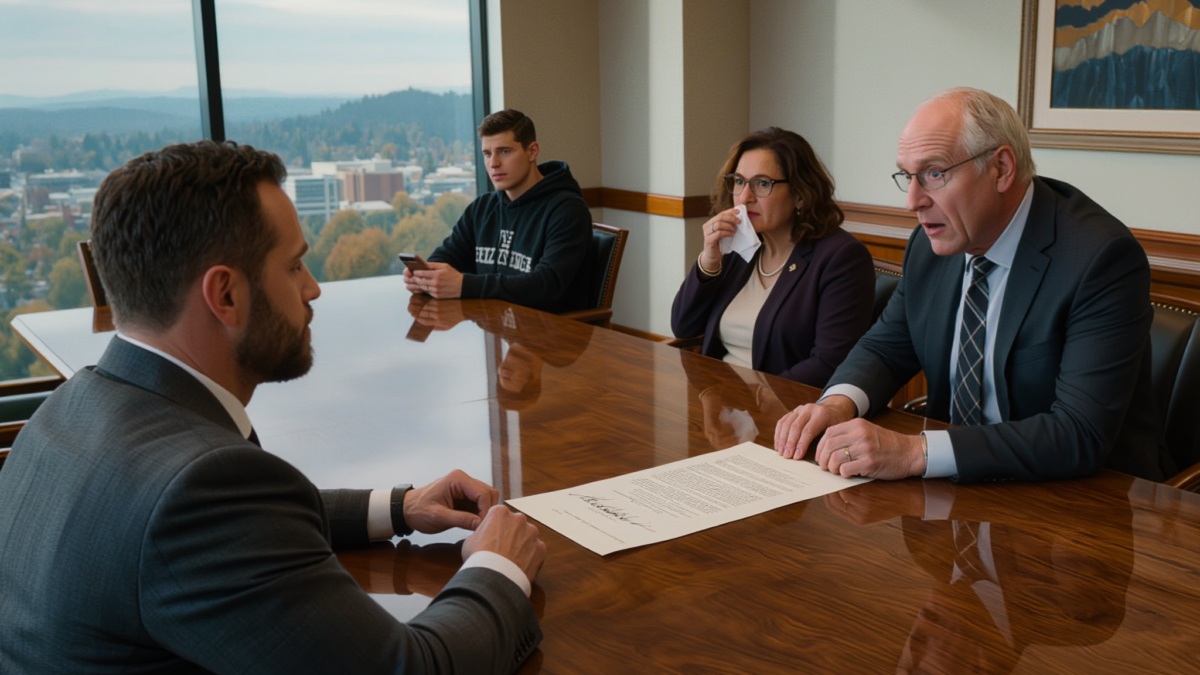
The conference room had floor-to-ceiling windows overlooking the city, large abstract paintings, and air conditioning that made the room feel slightly too cold.
Robert sat with his jaw clenched, refusing to look at me.
Susan dabbed her eyes with a tissue, wearing an expression of wounded disappointment.
Ethan leaned back in his chair, scrolling through his phone. His designer hoodie probably cost more than my first car.
Jenkins looked uncomfortable.
He was an estate-planning lawyer, not a courtroom fighter, and Evelyn clearly had more experience with this kind of dispute.
“Let’s make this quick,” Jenkins began.
He said my parents were heartbroken and wanted to reconcile.
But the lawsuit, he insisted, was insulting.
If I dropped the claim against the house, they were willing to forgive my outburst.
They might even let me visit for dinner on Sundays.
Evelyn gave a short laugh.
“Mr. Jenkins, you seem to be under the impression that we’re here to beg. We’re here to collect.”
Robert slammed his hand onto the table.
“He lived in my house! He ate my food! If anything, he owes us back rent for ten years.”
He claimed a market rate of $1,500 per month.
That came to $180,000.
Evelyn slid a document across the table.
“According to these records, Leo contributed an average of $3,200 a month in mortgage payments, utilities, and groceries. That doesn’t include his labor.”
She placed the signed acknowledgment in front of Robert.
“We also have your verification of the capital improvements.”
My father stared at the document.
His face went pale.
“That was for taxes,” he stammered.
“Exactly,” Evelyn replied. “It’s a legal document, unless you’re telling us there was something improper about the tax reporting.”
Robert fell silent.
Then Evelyn presented our settlement demand.
We were seeking fifty percent of the home’s appraised market value.
The property was valued at $1.2 million.
Our demand was $600,000, plus legal fees.
Susan abandoned her wounded expression immediately.
“You’re insane! That’s our retirement! That’s Ethan’s… I mean, that’s our money!”
For the first time, I spoke directly to her.
“Ethan’s what? His Ferrari fund?”
Ethan looked up from his phone.
I told Susan that I knew about their plan to sell the house.
I had heard the conversation in the sunroom.
I knew she considered me a worker and Ethan the rightful beneficiary of the money.
The room grew quiet.
Jenkins tried to recover.
He argued that the deed was in my parents’ names and that I couldn’t simply force them to sell the property.
Evelyn disagreed.
Then she paused.
There was another document she wanted to discuss.
She reached for a file I hadn’t seen before.
A private investigator working for her had delivered it that morning.
“Unless we discuss the second mortgage,” Evelyn said.
Both my parents went pale.
Even Ethan looked confused.
“What second mortgage?” he asked.
Evelyn turned toward him.
Six months earlier, Robert and Susan had taken out a $200,000 home-equity line of credit against the property.
She asked Ethan whether he knew how that money had been used.
He shook his head.
“It went to the Porsche dealership,” she said, “and to cover losses on your father’s cryptocurrency trading account.”
I stared at Robert.
The house I’d spent years paying for had been used to finance Ethan’s yellow sports car and cover Robert’s failed investments.
Evelyn explained that the property was not nearly as secure as my parents had pretended.
With the additional borrowing, very little equity remained compared with what the family had expected.
If the sale were forced, the lenders would be paid first, followed by whatever amount I was legally awarded.
My parents could be left with very little.
Ethan stood up.
“You lied to me! You said the Porsche was a gift from the trust fund!”
Robert finally lost his temper.
“There is no trust fund, you idiot! The market crashed. I lost it all. I was trying to make it back by selling the house!”
For a moment, everyone was talking at once.
Ethan shouted at Robert.
Susan cried.
Jenkins attempted to restore order.
I remained seated.
“So,” I said.
They turned toward me.
“You’re broke.”
The truth was finally clear.
They had planned to sell the house, take whatever money remained, fund Ethan’s lifestyle, and leave me with nothing.
“Leo, please,” Susan cried.
She reached across the table toward my hand.
“We’re family. We made mistakes, but don’t destroy us. If you force the sale now, we’ll be homeless. We have nowhere to go.”
For years, whenever my parents faced trouble, I had been the person expected to solve it.
Now they were asking me to do it again.
I could have withdrawn the lawsuit.
I could have worked harder, found more money, and tried to help them refinance.
I knew exactly how to repair a damaged house.
But I was beginning to understand that I couldn’t repair the way my parents viewed me.
I looked down at the printed text message inside Evelyn’s evidence binder.
Consider yourself an orphan.
Then I looked at Susan.
“You said I was an orphan, Mom.”
“I didn’t mean it. I was angry.”
I stood and buttoned my suit jacket.
“You were right,” I said quietly. “I am an orphan. And orphans don’t have parents to save.”
I turned to Evelyn.
“Proceed with the sale. I want my money.”
As I walked toward the door, Robert shouted after me.
“You walk out that door, you’re dead to us!”
I stopped but didn’t turn around.
“I stopped being your son the moment I stopped being profitable.”
Then I left.
Outside, I walked past Ethan’s yellow Porsche.
The car had once seemed to represent everything my family valued more than me.
Now I saw it for what it was.
An expensive piece of machinery purchased with money my parents couldn’t afford to spend.
I climbed into my truck.
My hands were shaking from adrenaline.
But for the first time in years, I felt lighter.
The legal process was far from finished, though.
The next thirty days were exhausting.
A judge signed an order directing that the house be sold, with the proceeds held in escrow until the division of assets could be finalized.
I moved into a small rental apartment near my job site.
I still had thousands of dollars in tools and heavy equipment stored in my parents’ garage, and I was legally permitted to retrieve them.
Two weeks after mediation, I returned with my friend Mike.
I wanted help moving the heavy equipment, but I also wanted a witness.
At that point, I didn’t trust my parents not to accuse me of taking things that belonged to me.
When we arrived, a for-sale sign stood on the lawn.
Someone had already attached a “Pending” sticker.
The housing market was active, and a cash investor had moved quickly on the property after learning the owners needed to sell.
The house itself looked strangely neglected.
The grass had grown too tall.
The usual sounds of Ethan’s music, the television, and the sprinkler system were absent.
Without me taking care of the property, no one appeared to be doing much maintenance.
Mrs. Higgins, the neighbor across the street, was sitting on her porch.
She was the neighbor whose logbook had helped me during the dispute.
She raised her coffee mug in a silent greeting.
I nodded back.
My garage key still worked.
Inside, boxes were stacked unevenly, clothes had been shoved into garbage bags, and household belongings were scattered everywhere.
“Jesus,” Mike whispered. “Looks like they’re fleeing a crime scene.”
“They’re fleeing reality,” I answered.
We began loading my table saw.
Then the door connecting the garage to the house opened.
Ethan appeared.
I almost didn’t recognize him.
His usually perfect hair was greasy, and he was wearing stained clothes and sweatpants instead of designer outfits.
He looked exhausted.
“You happy?” he asked.
I continued loading equipment.
“Happiness has nothing to do with it, Ethan. It’s business.”
“They took the Porsche.”
I stopped.
“What?”
“Yesterday. A tow truck came. All the neighbors watched.”
The bank had repossessed it after Robert stopped making the payments.
Ethan shook his head.
“He told me the trust fund would cover it. He lied, Leo. He lied about everything. There is no money. There never was. It was all just you.”
I looked at my brother.
For the first time, I could see how thoroughly our parents had failed him too.
They had taught him that success meant looking wealthy and that someone else would always pay the bills.
Now that the money was gone, he didn’t know what to do.
“I know,” I said. “I tried to tell you.”
He explained that he would have to move into a two-bedroom apartment with Susan and Robert.
He was particularly upset about sharing a bathroom with our father.
“Do you know how humiliating that is?”
I reminded him that I’d spent four years living in the basement.
Then he hesitated.
“Can I come stay with you? Just for a bit, until I get my brand deal sorted?”
I thought about what saying yes would mean.
I’d become responsible for him again.
Sooner or later, my parents would probably find a way to make their problems mine through Ethan.
“No.”
“But I’m your brother.”
I reminded him of Susan’s message.
According to our parents, I was an orphan.
“Orphans don’t have brothers.”
I closed the truck’s tailgate.
“Let’s go, Mike.”
As we drove away, I saw Ethan kick a box of his belongings. Designer sneakers spilled onto the dirty garage floor.
A week later, the house sale closed.
Evelyn handled the paperwork.
I didn’t need to be in the same room as my family.
She called me afterward.
“Do you want the numbers?”
“Give them to me.”
I was sitting in my truck beside the river.
“Final sale price: $1,150,000.”
She explained that the first mortgage, the second mortgage, realtor fees, closing costs, and a lien involving unpaid property taxes had all been addressed.
The net proceeds were $460,000.
“And the split?” I asked.
“The judge awarded your full claim plus interest. You’re getting $285,000.”
That amount covered my capital contributions, legal fees, and share of the equity under the settlement and judgment described by Evelyn.
My parents’ remaining share was $175,000.
“That’s not nothing,” I said.
Part of me had expected them to lose everything.
“Wait,” Evelyn replied. “I’m not finished.”
Jenkins had filed a lien against their share for unpaid legal fees.
That accounted for $25,000.
The IRS also had a hold on Robert’s share for unpaid capital gains from three years earlier.
Another $40,000.
I did the calculation.
After those deductions, Robert, Susan, and Ethan would be left with $110,000.
Three people, starting over.
I knew that amount wouldn’t support the lifestyle they were accustomed to.
Evelyn said they were renters now and might remain that way for the rest of their lives.
After we hung up, I sat by the river for a long time.
My parents had once spent around $10,000 every month maintaining their image.
Even $110,000 wouldn’t last very long if they continued living that way.
Then my bank app sent a notification.
Deposit received: $285,000.
I stared at the screen.
That money represented years of work.
Every roofing shingle, every painted wall, every missed weekend, every mortgage payment.
It wasn’t an unexpected windfall.
It was money I’d earned and contributed because I’d believed a promise.
Two days later, I was standing in the meat aisle of a grocery store, choosing a ribeye steak, when my phone rang.
I didn’t recognize the number.
I answered.
“Leo?”
It was Susan.
Her number was blocked, so I assumed she had borrowed someone else’s phone.
“What do you want, Susan?”
“We’re moving today.”
Her voice sounded small.
She complained about the cost of movers and described their new apartment as dark and smelling of smoke.
“That sounds like a problem,” I replied.
Then she began talking about Robert.
He was barely speaking, she said. He spent hours sitting in a chair staring at the wall.
Ethan was angry with both of them and shouted at them regularly.
I listened.
“Why are you telling me this?”
She said she’d found something while packing.
My old baby photo album.
She remembered how I looked as an infant and how tightly I used to hold her finger.
It was the first time in a long while that she had mentioned a memory of me without connecting it to something she needed.
But I recognized where the conversation was going.
“I was looking at those pictures,” she sobbed, “and I realized we made a mistake. We shouldn’t have sent that text. We were just stressed.”
She asked whether we could meet for coffee.
Just five minutes.
She reminded me that we were family.
I tightened my grip on the package of steak.
Then I asked her a question.
“Do you remember when I was sixteen? When I broke the plate?”
She sounded confused.
“The plate? That was years ago.”
“You told me you wished you’d left me at the fire station. You wished I was an orphan.”
“I didn’t mean it.”
“Yes, you did.”
I told her that she’d finally gotten what she’d asked for.
She no longer had a son named Leo who would come running every time she needed help.
“Leo, please. We have no one else.”
“You have each other,” I said. “And you have $110,000. I suggest you budget carefully.”
I ended the call.
Then I blocked the number.
I stood there for a moment among the other shoppers, feeling my heart pound.
But I wasn’t grieving the way I’d expected.
It felt more like putting down a heavy backpack after carrying it for miles.
I paid for my steak and walked out.
On the drive toward my new land, I passed the old neighborhood one final time.
A budget rental moving truck was parked outside my parents’ former house.
Robert was struggling to lift a sofa into the back.
Ethan stood nearby using his phone, offering no help.
I slowed down.
For an instant, my old habits returned.
I knew exactly how to lift that sofa without hurting myself. I wanted to stop, climb out, and help Robert load it.
Then I noticed the sold sign.
I kept driving.
For once, someone else’s problem didn’t have to become my responsibility.
A year passed.
Exactly 365 days after the judge’s decision, my life looked almost nothing like it had before.
I no longer lived in a basement.
I no longer spent my weekends repairing property for people who treated my work as an entitlement.
I was standing on the deck of a house I’d built for myself.
The structure was a modern A-frame cabin with floor-to-ceiling glass overlooking a creek running through five acres of land.
The air smelled of fresh paint and raw cedar.
I had designed every angle, poured the foundation, and milled timber from trees I’d cleared myself.
I had used the $285,000 carefully.
Instead of buying a sports car, I’d purchased the land with cash and built the house with my crew.
Electricians and plumbers I’d worked with for years helped me complete it.
They showed up because I’d always paid them on time and treated them with respect.
My business had also doubled in size.
Without sending nearly forty percent of my income toward my parents’ financial problems, I could invest in my own company.
I purchased a new excavator and hired two additional workers.
Eventually, I landed a contract with the city to redesign the downtown park.
For the first time, the money I earned was helping me build my future.
But the biggest change wasn’t the property.
It was the people in my life.
That morning, Maya walked into the kitchen while I was making coffee.
She was a landscape architect I’d met six months earlier on a commercial project.
At the time, she’d watched me handle a disagreement with a supplier who was trying to overcharge us for granite.
Later, she’d told me she was impressed that I’d stayed firm without raising my voice.
She knew everything that had happened with my parents.
She’d seen the court documents.
“You’re thinking about them again,” she said, handing me a mug.
“Just reflecting. It’s the anniversary.”
She rested her head against my shoulder.
“You won, Leo. Look around. You won.”
She was right.
But winning a dispute doesn’t mean you forget what it cost.
I hadn’t spoken to Susan or Robert since the grocery-store call.
Their numbers remained blocked, and I kept my address unlisted.
Still, Portland wasn’t so large that I could guarantee I’d never encounter them.
And eventually, I did.
It happened the previous Tuesday.
I needed a heavy-duty hinge for a front gate I was welding.
My regular supplier was out of stock, so I drove across town to a big hardware store.
The store was near the inexpensive apartment complex where Aunt Karen had told me my parents were living.
I parked and walked toward the entrance.
That’s when I saw Robert.
My father had once dressed in Italian loafers, sipped expensive single-malt scotch, and lectured me about executive presence.
He’d spent years suggesting that manual labor was for people who weren’t smart enough to work with their minds.
Now he was standing outside Home Depot in an orange employee vest.
He was wiping shopping-cart handles with a disinfectant rag.
His shirt was slightly too large. He looked thinner, and his once carefully dyed brown hair was completely gray.
He was working as a greeter.
I stopped about twenty feet away.
A young couple walked through the entrance.
“Welcome to Home Depot,” Robert said, using the practiced tone of someone trying to sound cheerful. “Can I help you find anything today?”
“Garden center,” the man muttered.
The couple kept walking.
Robert’s face fell.
He looked exhausted.
Then he glanced up and noticed me.
His hand stopped moving.
For a moment, neither of us spoke.
I wondered whether he would become angry, demand money, or accuse me of ruining his life.
Instead, he looked embarrassed.
He glanced around as if checking whether his manager could see us.
I walked forward and took a shopping cart.
“Hello, Robert.”
He flinched.
“Leo.”
He looked me over.
“You look good.”
“I am good.”
“I heard you’re building a place. Karen told your mother.”
“It’s finished.”
“That’s… that’s good.”
He looked at my boots.
“Expensive boots.”
“They last longer.”
For a moment, the only sounds were the store announcements and the movement of shopping carts.
Then Robert lowered his voice.
“We’re having a hard time, Leo.”
He said Susan wasn’t coping with the apartment. The neighbors were noisy, the rent was expensive, and their money was disappearing quickly.
“I’m here to buy hinges, Robert.”
“Ethan left us.”
That caught my attention.
“What?”
“Two months ago. He met some girl online. Said she lives in Los Angeles.”
According to Robert, Ethan had taken the Honda they’d purchased with the last of their settlement money and driven to California.
He’d also taken Susan’s jewelry and emptied their emergency cash jar.
Robert’s eyes watered as he explained it.
I was shocked, but not entirely surprised.
“I warned you,” I said. “I told you he was a parasite. You fed him until he got big enough to eat you.”
Robert looked desperate.
“He’s your brother. If you could just call him, maybe send him some money to get him settled so he doesn’t sell the car.”
He said they needed the Honda.
Without it, he had to take the bus to work.
“I’m sixty-one years old, Leo.”
I looked at him.
Even now, after everything that had happened, he was asking me to spend my money solving Ethan’s problems.
The pattern hadn’t changed.
“I can’t help you.”
A flash of his old anger returned.
“You have money! You took half our house. You have a business. You owe us.”
A few people nearby began looking in our direction.
A manager glanced toward us from the service desk.
I kept my voice steady.
“I don’t owe you a thing. I paid my debt with fifteen years of labor. I paid it with the childhood you stole. The transaction is closed.”
His anger faded.
“Leo, please. I’m begging you. Just a few thousand for a used car. I can’t take the bus.”
I pushed the shopping cart forward.
“Then walk,” I said. “It builds character. That’s what you always told me.”
I continued into the store.
I bought my hinges and left without speaking to him again.
As I drove home, I realized I no longer felt the same anger toward my parents.
I felt pity.
They had lost their home, their savings, and the lifestyle they’d spent years trying to maintain.
Yet they were still focused on appearances, still protecting Ethan, and still expecting someone else to rescue them.
They hadn’t learned anything.
That evening, I sat beside the fire with Maya.
I told her about Ethan leaving with the car, Susan’s jewelry, and the emergency cash.
“Are you surprised?” she asked.
“No. I’m just glad it wasn’t my jewelry.”
She looked at me.
“And your parents? How do you feel about them being broke?”
I watched the flames move in the fireplace.
“I feel like justice was served. Not by me, but by life.”
They had invested everything in the wrong son.
They had spent years supporting the person who looked successful while dismissing the person who did the actual work.
Now they had to live with the consequences of those choices.
My phone buzzed.
It was a LinkedIn notification.
Ethan Vance had viewed my profile.
Curious, I opened his page.
His profile picture showed him wearing sunglasses in front of a palm tree.
His biography described him as a lifestyle entrepreneur, West Coast enthusiast, and cryptocurrency investor.
His latest post was two days old.
He was holding a stack of cash, which I suspected might have come from pawning the jewelry Robert had mentioned.
The caption announced that he’d made it to Los Angeles and was expecting big things.
Then came the part that almost made me laugh.
He said he’d cut off the toxicity to pursue his dream.
After everything Susan and Robert had done for him, Ethan was describing them as toxic.
I blocked his LinkedIn profile.
Then I put down my phone and looked around the room.
The beams of my house were solid. The fireplace was warm. Maya sat beside me.
Nothing in that room had been purchased to impress people who didn’t care about me.
“I’m ready,” I told her.
“Ready for what?”
“To change the locks.”
I smiled.
Not the locks on the doors.
The locks in my mind.
I was finished allowing my past to occupy space in my life.
My parents had already been excluded from my home. It was time to stop letting them occupy my thoughts every day.
And that brings me to tonight.
I’m sitting on my porch as the sky turns from purple to black.
The creek moves quietly through the trees.
My rescue pit bull, Buster, is asleep at my feet. He was abandoned once too, because someone decided he was too much work.
Beside my chair sits a familiar metal box.
The family fund.
For years, I’d believed I would keep its contents forever.
The receipts.
The bank statements.
The acknowledgment of debt.
The printed text messages.
They were proof of everything I’d contributed and everything my parents had denied.
They helped me defend myself when my family tried to rewrite the past.
For a long time, I thought keeping them would remind me that I hadn’t imagined the exploitation.
But looking at them now, I see something different.
They’re reminders of what I survived.
They served their purpose.
And I don’t need to examine them every day to know what happened.
I strike a match.
Then I take out the acknowledgment of debt.
The document Robert signed without reading because he was more interested in watching television.
The document that became one of the most important pieces of evidence in my case.
I hold the flame to one corner.
The paper begins to curl.
The ink darkens.
Then I lower it into the fire pit and watch it burn.
Susan called me an orphan because she wanted to make me feel unwanted.
She wanted me to believe I had no value unless I continued providing money and labor.
For most of my life, I allowed that fear to control me.
I thought love was something I had to earn by being useful.
But I understand now that a family shouldn’t require someone to purchase their place in it.
I don’t have to inherit the Vance family’s vanity, entitlement, or obsession with appearances.
And I don’t have to repeat those patterns.
Someday, I hope to have children of my own.
When I do, I want them to understand that a home is a place where they are safe.
Not a place where their value depends on how much they contribute.
They won’t have to work themselves to exhaustion to deserve affection.
They won’t have to wonder whether they’ll be welcome home after saying no.
And they won’t have to mistake financial dependence for love.
For years, I believed being a good son meant fixing every problem, paying every bill, and apologizing whenever someone else was unhappy.
I finally understand that setting a boundary doesn’t make someone disloyal.
Sometimes walking away is the only way to stop repeating the same painful pattern.
My mother tried to make the word orphan an insult.
But the day I stopped allowing my parents to control my life was the day I began building a home that was truly mine.
I still have my work.
I have my crew, my business, my land, Maya, and Buster.
I have a house where I can wake up to the sound of water running over rocks instead of arguments about money.
Most importantly, I have peace.
My name is Leo Vance.
I’m a builder.
I’ve spent my life creating things that can withstand pressure, bad weather, and years of wear.
It took me thirty-two years to understand that my own life deserved the same care.
And for the first time, every part of that life belongs to me.








