My mother laughed when I begged her to sign a $40,000 guarantee to save my crushed arm. “You’re ruining the vibe,” she said from my brother Mason’s birthday party, then blocked the hospital’s number. Alone in the ICU, facing amputation, I watched an FBI agent enter with a trembling stranger. The agent said the people who raised me weren’t my real parents, then laid a photograph on my chest. The red fire truck in it was the one I’d just dreamed about.
My name was Ryan Mitchell. I was 32 years old, and two days earlier, a 10-ton hydraulic press at Rockford Metal Works had crushed my right arm. By the time I woke in the intensive care unit, the doctors were warning that I could lose the use of my hand forever. The hospital needed someone to guarantee $40,000 for specialist surgery. I had less than $400 in my account.
I called the only people I had ever known as my parents. My mother, Jordan Matthews, answered from my younger brother Mason’s birthday party. Music was booming, guests were cheering, and champagne glasses were clinking. When I told her I had nearly died, she accused me of being careless. When I begged her to sign the financial paperwork, she laughed.
“Figure it out yourself. You’re ruining the vibe.”
She hung up. When I tried again, the hospital’s number had been blocked.
I was lying there, numb with pain and humiliation, when my hospital door opened. A man in a charcoal suit showed me an FBI badge. Behind him stood an older man in a tailored navy suit, trembling so hard that he clutched the doorway. The agent introduced himself as Matthew Donovan. He said he was there about the blood taken when I arrived at the emergency room.
Then he said the people who had raised me were not my parents.
The older man fell to his knees on the hospital floor. “My beautiful boy,” he sobbed. “We found you. We finally found you.”
I couldn’t begin to understand what I was seeing. To explain it, I have to go back seven days, to a small pawn shop and a wooden box I never wanted to sell.
Inside that box was a set of vintage German drafting instruments, made of heavy brass and prewar steel. They had belonged to Richard Preston’s father, the man I called Grandpa. He had taught me to rebuild engines in his garage, to use my hands, and to see value in things everyone else discarded. He was the one person in Richard and Jordan’s household who had shown me uncomplicated kindness.
When Grandpa died, Richard and Jordan fought over his accounts, properties, and insurance before the funeral was over. His will left the drafting tools to me. Richard was furious enough to threaten a challenge over the box, but to me it was proof that someone in that house had cared.
At the pawn shop, Jeffrey Dalton barely glanced up from his phone. “I can give you 200 bucks.”
I argued that the tools would appraise for at least $500. Jeffrey knew I needed cash and wouldn’t move on his offer. I took the crumpled bills, even though it felt like giving away the last thing Grandpa had left me.
The money wasn’t for rent. Mason was turning 29, and his birthday had always been treated like a national holiday. He had sent a link to limited-edition designer sneakers costing $190 plus tax, followed by a message: “Need these for the party. Don’t show up without them.”
Mason never asked if I could afford the shoes on my factory wages. He didn’t work steadily himself, having left community college after a single semester, but Richard and Jordan treated him as a genius whose great opportunity was always around the corner. If I arrived without the gift, I knew I would hear about it at every family dinner for months.
So I bought the shoes, wrapped the box in blue paper, and went to their modest suburban house. My mother greeted me by complaining that I was late. My father, settled in his worn recliner with a beer, demanded to know why I hadn’t repaired his front gutter. I explained that I had been working double shifts and promised to do it on Sunday.
“Excuses,” Richard said. “We took you in. We put a roof over your head. We fought for custody to keep you out of the terrible foster system.” Then he added the words I had heard all my life: “You’re just like your real parents.”
They had always told me my biological mother and father were drug addicts who left me in an alley behind a diner. According to Richard and Jordan, taking me in was an act of charity. They reminded me how much feeding and housing me had cost, particularly when they wanted me to feel guilty for taking anything Mason might have enjoyed.
Their favoritism was impossible to miss. The previous Thanksgiving, Jordan had prepared steaks because Mason refused to eat turkey. She gave Richard a generous serving, put two steaks in front of Mason, and set a plate of cold canned beans and plain, unbuttered toast in front of me. With extended family present, Richard explained that meat was expensive and Mason was a growing boy who needed protein. I was 31 and doing heavy factory labor; Mason was unemployed.
That evening with the shoes, Mason ripped off the wrapping, looked at the sneakers for about three seconds, and tossed them back into the box. “These are navy blue, Ryan. I sent you the link for midnight blue.” He said he couldn’t wear them to the club because people would laugh. I told him midnight blue had sold out and the shoes had cost $200.
He asked me to return them and hand him the money instead. He wanted cash for a casino trip with his friends.
Jordan slammed a plate on the counter and asked why I couldn’t get one simple instruction right. Something in me finally gave way. I told them I had sold Grandpa’s drafting tools to pay for Mason’s gift.
Richard rose from his chair. Rather than asking why I had been so desperate, he called me trash for selling family heirlooms. I said I had done it for Mason, because they had made it clear I wasn’t welcome without the present. Jordan pointed at the door and told me to leave her house, calling me ungrateful and saying they should have let the state take me.
I left the shoes on the table and walked out into the cold.
The next day, I signed up for back-to-back double shifts to earn enough to buy the instruments back before Jeffrey sold them. I was already exhausted, but losing Grandpa’s tools felt unbearable. At Rockford Metal Works, the air was thick with industrial coolant and the noise of grinders, presses, and workers calling over one another. I was on my thirteenth hour when Kevin Chandler, my floor manager, put a hand on my shoulder.
“Ryan, you look like a walking corpse out here,” he shouted. He told me to sit down, drink water, and take twenty minutes. The work wasn’t worth dying for.
I told him I needed the hours and wanted to finish one last batch of plates.
Press number four was a 10-ton machine used to stamp steel for automotive manufacturing. It had a history of jamming. The floor workers knew about the problem, but management had refused to shut the line down for repairs because of the cost. The safety procedure was straightforward: press the emergency stop, wait until the green light confirmed that the hydraulics were locked out, then use metal tongs to clear the jam.
I hit the stop and saw the green indicator illuminate. Believing the press was disabled, I reached toward the trapped steel plate. I didn’t know that the electrical panel had shorted, giving a false safety signal while the press remained pressurized. My arm touched an internal trigger, and the mechanism came down.
There was a terrible metallic impact, then an overwhelming weight on my forearm. I couldn’t pull free. Pain shot through my shoulder, and I screamed. Kevin reached the emergency power switch within seconds and shut the factory down. The next hours dissolved into paramedics, ambulance sirens, and hospital corridors. I lost consciousness and didn’t wake properly for two days.
Dr. Steven Caldwell told me the bones in my arm were shattered and the radial and median nerves severely damaged. The hospital had stabilized the immediate injuries, but I needed urgent reconstructive neurosurgery. Without it, he said, I could lose the ability to use the hand for work or even ordinary tasks.
Before I could agree to the procedure, Arthur Coleman, the senior claims adjuster for the factory’s corporate insurer, entered in a beige suit. He said the company’s preliminary investigation classified the accident as operator error because the sensor had supposedly been bypassed. The insurer would pay for emergency stabilization, not the expensive nerve graft.
I told him I hadn’t bypassed anything. I’d pressed the stop button and seen the green light. I begged him to inspect the electrical panel and speak to Kevin. Arthur warned that a lawsuit could drag on for years and that I had only hours to arrange the surgery. Then he walked out.
Dr. Caldwell looked apologetic. Because the insurer had denied the claim, he said the hospital required a financial guarantor for $40,000 before bringing in the specialist team. If the paperwork wasn’t signed that night, they would stabilize what they could and prepare to remove dead tissue the next morning.
I barely had money to buy groceries. Nurse Justin Harper saw how frightened I was and gave me the beige hospital telephone. I dialed the number I had known since childhood.
Jordan picked up on the fourth ring. Behind her, Mason’s birthday celebration was in full swing. She demanded to know why I’d missed my factory shift and failed to help set up chairs and tables for the party. She said our neighbors were asking where I was and that I was embarrassing her.
Nobody had told them about my accident. My wallet and ID had been destroyed in the press, and the hospital had admitted me as a John Doe while I lay unconscious. But when I explained that I was in the ICU at Rockford General, Jordan barely paused.
I told her I had been in a coma for two days, that my arm was badly injured, and that doctors needed a $40,000 signature to try to save my hand. I wasn’t asking her to pay immediately. I promised I would repay the full amount, even if it meant working three jobs after I recovered.
Jordan laughed loudly enough for party guests to hear. She said they had a mortgage and weren’t going to risk their credit because of my clumsiness. When I insisted the machine had failed, she accused me of deliberately injuring myself for a workers’ compensation payout. Mason’s cake was about to be cut, she said, and there were thirty important guests to entertain.
“Figure it out yourself. You’re ruining the vibe of the party with your endless drama.”
The line went dead. I pressed redial and heard the recorded message that calls from this number weren’t being accepted. She had blocked the hospital phone.
Justin had heard the conversation. His eyes were wet when I told him I couldn’t pay and didn’t want to fight anymore. I asked him to tell Dr. Caldwell to proceed with the more limited treatment, even if I lost the hand. He switched off the harsh overhead light and left me to rest.
As the morphine pulled me into sleep, I dreamed of a small red metal fire truck. In the dream I was a toddler sitting on a soft, expensive carpet, holding it in my hands while a woman hummed a lullaby nearby. It felt warm and safe, unlike any childhood memory I could consciously recall. Jordan had never sung me to sleep.
That was the state I was in when Agent Donovan arrived with the older man in the navy suit. At first I thought the stranger’s tears and the FBI badge were hallucinations. I told Donovan I was Ryan Mitchell, an assembly-line worker, and that my parents were Richard and Jordan on Elm Street. I assumed he must have the wrong patient.
He explained that I had arrived without identification and that medical tests, including DNA profiling, had led to an alert in a missing-child investigation. The FBI had continued monitoring the case for decades. He opened a manila folder and took out a faded photograph of a young boy sitting on a plush carpet with a red metal fire truck in his hands.
It was the truck from my dream.
Donovan said a two-year-old child named Alexander Vaughn had been taken from his crib thirty-two years before. His family had paid a $3 million ransom, but the child was never returned. The case remained open, though the leads had long since disappeared. Now the DNA results, he told me, matched William and Catherine Carter.
“You are not Ryan Mitchell. You never were. You are Alexander von Carter.”
The older man was William Carter, my biological father. He had fallen to his knees at the doorway when Donovan first explained who I was. Now he came toward my bed, apologizing through tears. He and Catherine had searched for me for decades, hiring investigators, funding search efforts, and offering rewards. He said he had promised my mother he would bring me home.
I could scarcely trust the words. For years, Richard and Jordan had told me I was unwanted. I wanted some detail that couldn’t be explained away. I mentioned the crescent-shaped birthmark on my left hip, the one Jordan called my “dirt mark.”
William already knew. He said Catherine used to kiss that exact mark after my bath before putting me to bed. Then he took my uninjured left hand in both of his.
“You’re safe now,” he told me. “Nobody is ever going to hurt you again, Alexander.”
Dr. Caldwell entered shortly afterward, still focused on the deadline for my surgery. He asked whether I had found the $40,000 guarantor and explained that the hospital would soon have to begin amputation preparations. William demanded to know why my arm was at risk. The doctor described Arthur Coleman’s denial and the hospital’s financial policy.
William pulled a black titanium credit card from his jacket and placed it forcefully on my bedside tray. He told Caldwell to charge whatever was necessary and arrange for the finest available nerve specialist. The doctor said Dr. Aris, a leading specialist, was in Chicago and couldn’t reach us easily within the surgical window. William instructed him to offer triple the normal surgical fee and send a chartered medical helicopter to collect him. He also threatened to buy the hospital and remove the administrators responsible if I lost function because of the delay.
Within the hour, the team began preparing me. William brushed the hair from my forehead and promised he would take care of my arm and everything that followed. I looked once more at the telephone my mother had blocked, then let the anesthesia take me under.
The operation lasted nine hours. Dr. Aris worked to reconnect the badly damaged nerve pathways. When I woke, my arm was held in a carbon-fiber splint and elevated in a sling. I concentrated on my right index finger and tried to move it. The movement was tiny, but it was real. The hand wasn’t lost.
William was sitting beside the bed in an armchair, exhausted, his tie loosened and his jacket draped over the back. He had remained nearby through the surgery. When I whispered that he’d stayed, he promised he wasn’t leaving me again.
Over the following forty-eight hours, William told me about the family I had never known. Catherine was at their estate in New York, overwhelmed and waiting for updates. My older biological brother, Logan Foster Carter, was flying home from a real estate trip to London. Their wealth was immense, William said, but for decades their family had been marked by my disappearance.
One question wouldn’t leave me alone: how had Richard and Jordan come to possess me? On the third evening, I asked whether they’d found me in the street or obtained me from the kidnappers. William’s expression hardened.
“They weren’t strangers, Alexander.”
He explained that thirty-two years earlier, before building his global technology empire, he had run a real estate development business in upstate New York. Richard had been the head groundskeeper at the family’s country estate. Jordan had worked part-time as a maid, helping the kitchen and catering staff. William said the family had paid them well, provided comfortable housing and benefits, and trusted them with access to the property.
Richard, he told me, had been gambling heavily and owed dangerous debts to loan sharks. He and Jordan allegedly used their staff security codes to get past the estate’s alarms and cameras, passed my sleeping nanny, and carried me out of the nursery. The following day they demanded $3 million through burner phones. William and Catherine paid the ransom in unmarked bills, leaving the bags under a highway bridge as instructed.
But with the FBI involved and the kidnapping receiving national attention, the abductors panicked. William said they feared returning me would expose them and that spending the money would attract scrutiny. Rather than return me, they fled across the country, changed their names, forged new identities, and raised me alongside Mason, their biological son, who was born three years after the abduction.
According to William, they kept me as a possible bargaining chip if investigators ever found them. They lived on the ransom money until Richard’s gambling consumed much of it. Eventually, while Mason was indulged, I was sent into factory work and made to feel I owed them for every meal and every roof over my head.
The cold beans at Thanksgiving took on a different meaning. So did the constant speeches about rescuing me. They hadn’t rescued an unwanted child. William was telling me they had taken me from parents who had spent decades searching for me. They had watched me sell Grandpa’s tools for Mason’s shoes and begged me to be grateful, knowing what had happened at that estate.
William said Agent Donovan was preparing a raid on Richard and Jordan’s home. Investigators intended to arrest Richard, Jordan, and Mason over the kidnapping, extortion, fraud, and child abuse allegations. I told William I wanted to be present. I needed to see the people who had raised me understand that the story they’d told me was over.
He agreed.
The following afternoon, I left the hospital. I was weak, and my right arm was secured in a specialized sling, but I refused a wheelchair. Outside, a black armored SUV waited, followed by three unmarked FBI vehicles. Agent Donovan and a twelve-person tactical team accompanied us toward the suburban house on Elm Street.
The front gutter Richard had berated me for not repairing still hung loose above the porch. The white paint was peeling. William asked whether I was ready. I told him I had been ready my entire life.
Donovan’s team took positions around the property while William and I approached the front door. I turned the unlocked knob with my left hand and walked inside. The familiar smells of old beer, air freshener, and fried food hit me immediately.
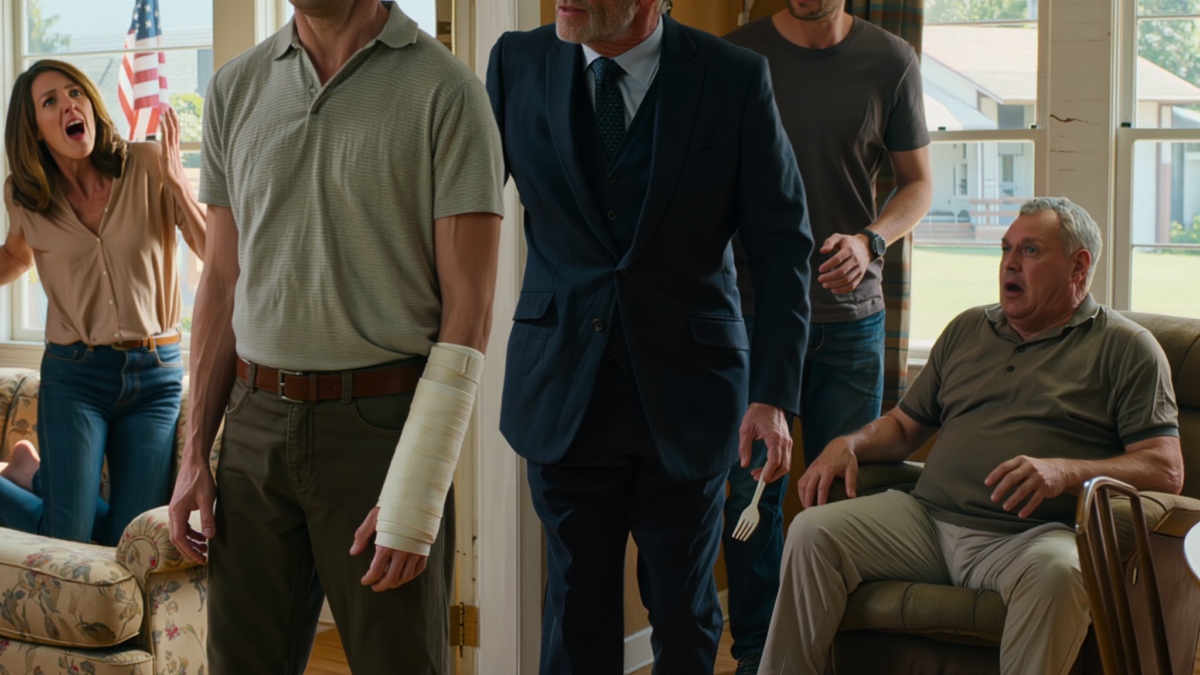
Richard sat in his recliner with a beer on his stomach. Jordan was on the floral sofa looking through a shopping app. Mason sat at the table eating leftover chocolate birthday cake directly from the box with a plastic fork. They looked up when the door opened, but none of them asked whether I was all right.
Jordan sprang up and demanded to know why I had returned. She said she wasn’t paying the hospital bills and mocked the surgical sling. Mason laughed, pointed his fork at me, and suggested I’d bought a fake cast just to beg for money. Richard threatened to call the police and have me removed for trespassing.
William had been standing just behind me, partly concealed by the hallway. As Richard reached for that threat, William stepped forward.
“You don’t need to call the local police, Richard. Federal law enforcement is already here.”
Richard recognized him instantly. His face drained of color and the beer fell from his hand. He tried to rise, but his knees gave way. “Carter,” he whispered. “Oh, God, no. It’s impossible. It’s been 30 years.”
Jordan dropped her smartphone onto the wooden floor. Her expression changed as she recognized William, too. He looked around the room and told her that neither she nor the $3 million taken from his family had aged well.
Mason didn’t seem to understand the history. He stood and threatened William, raising his fists. That movement was the signal Donovan needed. FBI agents entered through the front and patio doors, ordering everyone to the floor.
Mason dropped to his knees, panicked, and was restrained on the carpet. Jordan screamed as agents secured her wrists. Richard tried to run toward the kitchen door, but Donovan intercepted him and handcuffed him on the floor. He announced the arrests of Richard Preston and Jordan Matthews on charges including aggravated kidnapping, federal extortion, wire fraud, and prolonged child abuse.
The woman who had laughed at me from Mason’s birthday party now begged me to tell the agents she had been a good mother. She said she’d fed me, housed me, and kept me alive when she could have abandoned me in the woods.
I thought about Grandpa’s tools, the cold beans, the factory press, and that blocked hospital number. Then I looked at her and said, “My name is Alexander von Carter, and you are absolutely nothing to me. Enjoy your cage.”
I walked out through the broken front doorway. Neighbors stood on their lawns watching federal vehicles take away the people who had presented themselves as the perfect suburban family.
Three months later, the federal case reached its conclusion. Mason was charged as an accessory after the fact for helping conceal assets and avoid taxes associated with the ransom money. He made a plea agreement and testified against his parents. Richard and Jordan received consecutive life sentences in a maximum-security federal penitentiary without the possibility of parole.
But their imprisonment didn’t mean my own life suddenly became easy.
I moved into the Carter family’s estate in the Hamptons, a sprawling modern house overlooking the ocean. My bedroom was larger than my old apartment, and William had filled a walk-in closet with clothes tailored for me. Catherine cried with relief when she looked at me, yet the affection and luxury often left me uncomfortable. I had spent my life believing I was a burden. Now I was supposed to accept that I belonged in this family.
I woke in a panic at five in the morning, sure I was late for my factory shift, until I realized I was in a bed with silk sheets. At formal dinners, I stared at the fine china and different forks, wondering which to use. When the estate staff looked in my direction, I assumed they were judging my scarred arm and rough hands. I felt like an impostor in a home that was supposed to be mine.
One night I couldn’t sleep, so I wandered into the enormous garage, past Rolls-Royces, Lamborghinis, and Ferraris. In a corner under a canvas cover stood a dusty, partly dismantled 1973 Porsche 911 Carrera, its engine exposed and parts arranged on a workbench.
For the first time since arriving, I saw something I understood. I picked up a wrench with my left hand and examined the engine. Machines followed rules. A broken part could be found and repaired. They didn’t ask you to prove you deserved to belong.
“Dad has been trying to rebuild that complex carburetor for three years,” a voice said behind me. “He stubbornly refuses to hire a professional mechanic because he says it’s about the journey, not the destination.”
I turned so suddenly that I dropped the wrench. Logan Foster Carter, my older brother, stood in the doorway holding two cups of coffee. We’d met briefly, but our conversations had been awkward and emotional. He handed me a cup and studied the engine.
“You know exactly how to fix it, don’t you?” he asked.
I told him the fuel-to-air ratio was wrong, the manifold gasket was cracked, and too much oxygen was entering the mixture, causing the car to stall at idle. Logan laughed warmly and said, “Show me.”
For the next four hours, we worked together on that Porsche. Logan didn’t mind my lack of a college education or my uncertainty at formal dinners. He wanted his younger brother beside him. Working with him on the engine felt familiar in a way that neither the luxury bedroom nor the formal dining room had. It was the first time I began to believe I could be a Carter without changing everything about myself.
One year later, I stood inside a newly built automotive workshop in Queens, New York. Its sign read Phoenix Garage Automotive Restoration and Youth Apprenticeship Program. I had used a small portion of my newfound wealth to start a high-end restoration shop, but wealthy clients weren’t the whole purpose.
We partnered with local social services to offer work and training to teenagers aging out of foster care, young people who had been abandoned or told they had no value. I taught them how to repair engines and build skills with their hands. I wanted to give them the kind of safe place Grandpa’s garage had given me.
William was there one day in designer jeans, enthusiastically polishing the chrome fender of a restored 1967 Mustang. An assistant brought me a stack of mail. Among the invoices was a thin white envelope bearing the return address of a maximum-security federal women’s penitentiary.
It was from Jordan.
Without opening it, I could imagine the message: complaints about prison, claims that she missed me, and requests for money for her commissary account. The same guilt she’d used for years was waiting inside that envelope. William asked whether I wanted to read it.
I looked around the shop. A nineteen-year-old who had been sleeping on the street a year earlier was laughing as he worked with a sophisticated engine diagnostic computer. My right arm still ached, and its scar would never disappear. But the hand worked. I had people around me who saw my value without demanding payment for it.
“No,” I told William.
I carried the letter to the waste-oil heater, opened its iron door, and tossed the sealed envelope into the flames. I watched it turn to ash. I didn’t owe Jordan my anger or my forgiveness. I owed her nothing.
I had also bought Rockford Metal Works. I kept the hardworking employees, doubled their hourly pay, and rebuilt the safety procedures that management had neglected. The one person I fired was Arthur Coleman, the insurance adjuster who had refused to listen while my hand was at risk. I made sure his departure from the industry was handled legally.
Sometimes I still look at the long scar on my right arm. It reminds me of the worst day of my life, the phone call I couldn’t forget, and a family that tried to convince me I was worthless. But it also reminds me of the tiny movement of one finger after surgery, my father’s hand holding mine, my brother beside me at the Porsche, and the young people finding a place at Phoenix Garage.
My name is Alexander von Carter. For the first time, I’m in the driver’s seat of my own life.








