My mom took my 12-year-old daughter’s $1,600 MacBook at Sunday dinner and handed it to my brother’s son. “He’s the grandchild who’ll actually do something with his life.” When Piper reached for the laptop she helped buy with $320 of babysitting money, Mom warned, “Touch it again and I’m not your grandma.” I told her to keep that sentence. Nine days later, I found the MacBook listed for $950.
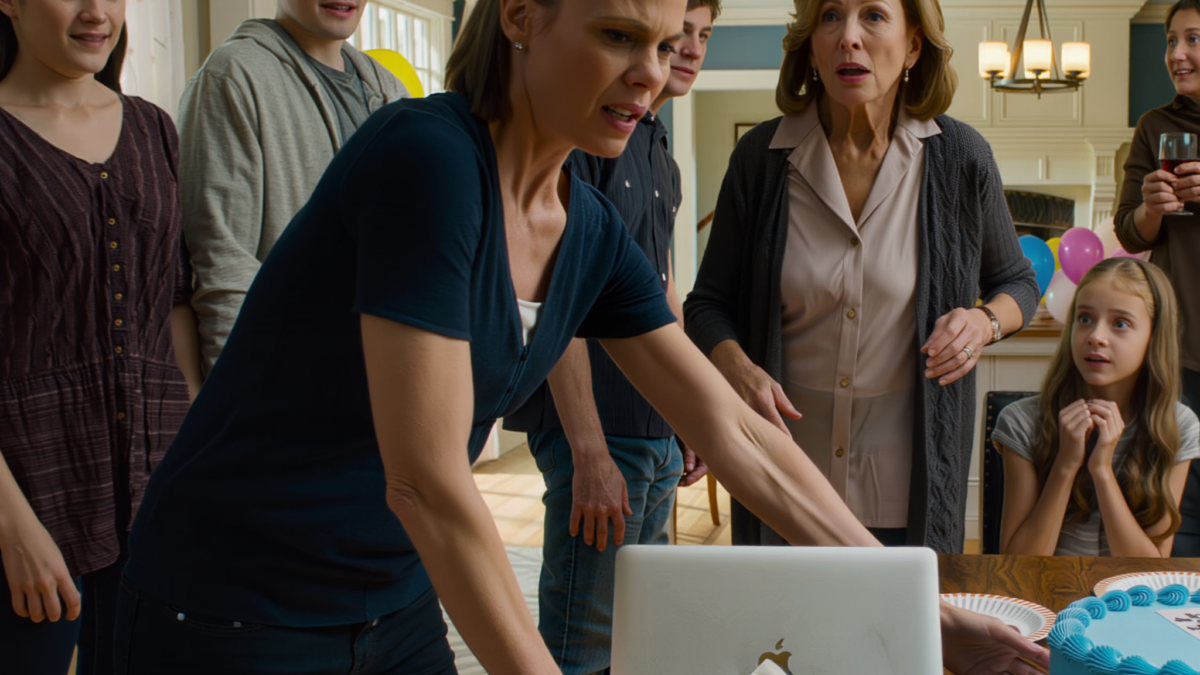
My mother said those exact words while she pulled my 12-year-old daughter’s $1,600 MacBook out of her hands and dropped it into my nephew’s lap like a prize.
“He’s the grandchild who’ll actually do something with his life.”
Piper had put $320 of her own babysitting money into that machine. Her unfinished book was still open on the screen. My brother smirked into his drink. My father kept his eyes on his plate.
I kept my voice level and looked straight at my mother.
“Keep that sentence. You’ll need it later.”
Then I took my daughter home.
Nine days later, something appeared on my screen at work that none of them expected. From that point on, every confident thing my mother said about that laptop only gave me more reason to keep paying attention.
My name is Alice Pratt. I’m 37 years old, and I work customer operations for Revive Electronics, a chain of trade-in and repair shops in the Columbus suburbs.
People bring me their old phones and laptops, and I tell them what those devices are worth. I check serial numbers. I match devices to receipts. I scan local listings every morning so our prices reflect the market.
Six years behind that counter taught me one reliable lesson.
People can tell you anything. Machines keep records.
A customer can say a laptop is barely used while the hinge hangs loose and the keyboard shines from years of wear. Someone can swear a phone belonged to a relative while the account on it says otherwise.
I don’t need to argue. I turn the device over, check what’s there, and let the record speak.
At work, that made me good at my job.
In my family, I had a different role.
I was the daughter who never needed anything.
I got divorced in 2021 when Piper was seven. I didn’t ask my parents for money. I refinanced. I budgeted. I kept our little house.
My mother liked telling people how proud she was that I handled everything myself.
“Alice has always been fine on her own,” she would say.
Meanwhile, my older brother Brett had spent years being the family’s designated success story, even when the facts didn’t cooperate.
In 2019, he borrowed $2,000 from me for a vending machine business.
“You’ll get it back, sis.”
The machines disappeared. The money never came back. Nobody mentioned it again, including me.
In 2023, my parents’ water heater died in January. I wrote a check for $1,400 while sitting at their kitchen table.
Two months later, at a cousin’s baby shower, I heard my mother tell my aunt that Brett had taken care of it.
He was standing right there.
He didn’t correct her.
He just lifted his cup slightly in my direction as if we shared a private joke.
That was how our family worked.
My mother, Judith, wrote the family story, and Brett was its hero.
He was 41, four years older than me. His ventures had a way of failing, but in my mother’s version, he was always one good break away from proving everyone right.
My father, Earl, was different.
He was 71, a retired machinist, and the quietest man I knew.
Every month, he sat under the same yellow kitchen light and balanced the checkbook. His handwriting was tight and square. He noticed everything.
He rarely challenged anyone.
For years, I mistook that silence for weakness.
Then there were the grandchildren.
Brett’s son Dylan was 14 when this began. My mother could tell you his shoe size, his batting average from two summers earlier, and the college she imagined he would attend someday.
Piper sat at the far end of family dinners beside the china cabinet and was rarely asked anything.
Driving home after one of those dinners, she looked out the window and said, “Grandma remembers Dylan’s shoe size, Mom.”
Then she went quiet again.
For years, I told myself favoritism was painful but survivable.
I was wrong.
Favoritism has a budget.
I just hadn’t seen the numbers yet.
Piper was 12 and shy around adults, but on a page she was fearless. She wrote a serialized fantasy story online under the name Piper Writes at Night.
It was about found family and a girl who talked to lighthouses.
Three thousand people followed it.
Every Friday night, Piper would read the new chapter to me first, curled up at the end of my bed. At exactly 8:00, she would publish it and watch the comments arrive.
One reader had written under chapter 14, “You update Fridays or I riot. This story is the best part of my week.”
The MacBook came into our house in August 2025.
It cost $1,600.
Piper had been using a school loaner that froze and shut down without warning. I had been saving for a replacement.
Then one evening, she slid an envelope across our kitchen table.
Inside was $320.
A whole summer of babysitting the Hendricks twins down the street.
“So, it’s ours,” she said. “But mostly mine.”
Some parents might have refused the money.
I understood what she was doing.
She wasn’t buying a laptop.
She was buying ownership.
At the store, my work habits followed me home.
I kept the original box because the serial number was printed on it. I filed the receipt in the kitchen drawer where I keep anything important.
Before we even got the laptop home, I turned on automatic cloud backup.
In December, Piper tripped while carrying it toward the couch. One corner hit the edge of the coffee table and left a small curved dent in the lid.
She was devastated.
I sat beside her and told her something I’d learned from years of evaluating used electronics.
“Brand new means it belongs to a store. Dents mean it’s yours.”
She thought about that.
Then she covered part of the dent with a holographic pink axolotl sticker and declared the machine officially hers.
After that, the little crescent-shaped dent wasn’t damage.
It was a signature.
By March, chapter 14 was online, and chapter 15 was half-written on the MacBook.
Piper also had a school family-history project. She wanted to interview my father about his 30 years as a machinist.
She spent a week writing questions by hand.
One of them was, “Grandpa, what did your hands smell like after work?”
That was why she brought the laptop to Sunday dinner on March 8th.
My parents lived 11 miles from us in the same house where I grew up.
There were six of us at the table that evening: my mother, my father, Brett, Dylan, Piper, and me.
Pot roast, because Sunday at my parents’ house meant pot roast.
For the first half of dinner, everything was surprisingly pleasant.
Piper set the MacBook near the corner of the table, pointed the camera toward my father, and pressed record.
Then my father did something I rarely saw him do.
He talked.
When Piper asked what his hands had smelled like after work, he laughed and leaned toward the camera.
“Grease and pennies. My hands smelled like grease and pennies for 30 years.”
Piper grinned.
My mother refilled the gravy boat.
Even Brett seemed relaxed.
When the interview was finished, Piper stopped the recording and opened chapter 15. She turned the screen toward her grandfather to show him a paragraph she liked, something about an old man and a lighthouse.
The document was still glowing on the screen when Brett put down his fork.
“Dylan’s Chromebook died again this week,” he said.
Dylan didn’t look up.
His school Chromebook was sitting beside his plate. The screen had a spiderweb crack spreading from one corner.
“Some kids get the good machines, I guess,” Brett added.
My mother looked at Dylan’s cracked Chromebook.
Then she looked at Piper’s MacBook.
I saw the change in her expression, but I didn’t yet understand where it was going.
She stood.
She walked around the table.
Then she took the MacBook out of Piper’s hands.
Piper’s fingers were still touching the keyboard. She held on for half a second, mostly from surprise.
My mother pulled it away.
“Touch it again and I’m not your grandma.”
Then she crossed to Dylan and put the open laptop in his lap.
Chapter 15 was still visible on the screen.
My daughter’s sentences were sitting in my nephew’s lap.
“He’s the grandchild who’ll actually do something with his life.”
She said it to the entire table.
Brett smirked into his drink.
My father looked down at his plate.
Dylan did something I didn’t understand until much later.
He kept both hands flat on his thighs.
He did not touch the laptop.
It sat open on his knees while he remained perfectly still.
Piper looked at the computer, then at her grandmother.
She folded her hands in her lap.
Everyone seemed to be waiting for me to make a scene.
I stood up and pushed my chair neatly under the table.
Then I looked at my mother.
“Keep that sentence. You’ll need it later.”
Her smile disappeared.
“Is that supposed to scare me?”
I didn’t answer.
I got Piper’s coat, took my daughter with me, and walked out.
I closed the front door gently behind us.
In the car, Piper stayed silent for six minutes.
I counted because I didn’t trust myself to speak first.
We were stopped at a light on Route 9 when she finally said something.
She was looking out the passenger window.
“Grandma didn’t take a laptop. She took my half.”
$320.
A summer of babysitting.
Her half.
That was when I understood that this had stopped being about a computer.
My mother had told my daughter exactly what she thought she was worth in front of the family, and Piper was old enough to understand the calculation.
The first text came at 7:40 the next morning.
You embarrassed me in front of your father. Dylan needs it for his future. You can afford another one.
There was no apology.
Ten minutes later, Brett texted me.
It’s just a laptop, sis. Don’t be dramatic.
I called my mother once that day and asked her to return Piper’s laptop.
I used those exact words deliberately.
Piper’s laptop.
“It’s Dylan’s now,” she said. “You’ll get over it. You always do.”
That sentence landed because she was right about one thing.
I always had.
That night, after Piper went to sleep, I opened Find My on my phone.
The green dot for the MacBook was sitting at Brett’s house, four miles from my parents.
Exactly where a laptop supposedly given to Dylan should be.
I closed the app.
I could have bought Piper another machine.
It would have been easier.
But replacing it would have taught her something I didn’t want her to learn. Someone could take what belonged to her, and the solution would be for me to quietly pay for the damage while everyone else moved on.
I had spent years doing exactly that for my family.
Not this time.
That Friday, for the first time in 14 weeks, Piper Writes at Night did not post a new chapter.
Eight o’clock came and went.
I stood in her doorway and watched her sit cross-legged on her bed with a spiral notebook, writing chapter 15 by hand in purple gel ink.
“You could use my laptop,” I told her. “Just to post.”
She kept writing.
“Not until it’s mine again.”
Down in the comments beneath chapter 14, someone asked whether she was okay.
Piper read the comment again and again.
She didn’t answer.
What worried me most wasn’t that she was angry.
It was that she stopped asking when she would get the laptop back.
She had already begun treating the loss like something permanent.
The school project was easier to solve.
The interview with my father had been uploaded to the cloud backup, so I downloaded it to my work computer.
Piper turned the assignment in on time and got an A.
My father didn’t call that week.
He rarely called.
But on Wednesday, I came home and found a basket of tomatoes sitting in the center of my front porch.
No note.
There was never a note.
My father had never been good at apologies.
He grew them instead.
Nine days after the dinner, everything changed.
Tuesday, March 17th, at 10:40 in the morning, I was doing my normal market sweep at Revive.
I searched local listings within a 25-mile radius so we could keep our trade-in prices current.
I typed MacBook into the search bar.
The fourth listing stopped my hand on the mouse.
A 15-inch MacBook Air.
$950.
Four miles away.
Seller: Brett P.
My coworker Colleen happened to be passing behind me with a clipboard.
She glanced at the screen.
“Overpriced. Market’s 900 tops.”
Then she kept walking.
To her, it was just another listing on another Tuesday.
I clicked it.
The first photograph had been taken on a beige kitchen counter with a teardrop-shaped burn mark near the edge.
I knew that countertop.
I had washed dishes beside that burn mark at Thanksgiving for years.
It was Brett’s kitchen.
The description read:
Like new, barely used. Selling for my son. Cash only. Can meet today.
Selling for my son.
Nine days earlier, my mother had taken Piper’s MacBook because Dylan supposedly needed it for his future.
Now Brett was offering a MacBook for sale.
I still didn’t know for certain that it was ours.
A silver MacBook Air looks like thousands of other silver MacBook Airs.
That evening, I showed Piper the photos.
She swiped through them slowly.
At the third image, she stopped and zoomed in on the left corner of the lid.
There it was.
A small crescent-shaped dent.
“That’s my dent, Mom.”
Beside it was a pale patch of adhesive where someone had removed the pink axolotl sticker.
Now we knew.
I sat at the kitchen table later that night and started typing a message to Brett.
It was angry.
My thumb hovered over the send button.
Then I deleted every word.
If I confronted him, he could remove the listing within minutes. By morning, he could claim he had been trading the computer toward an upgrade for Dylan.
The machine could disappear into cash, and my mother would have a new version of the story ready before breakfast.
So I didn’t argue with the story.
I decided to buy the laptop back.
I called Colleen.
I told her what had happened.
There was a pause.
Then she asked, “Cash or trouble?”
“Cash.”
She sounded almost disappointed.
Colleen had an established Marketplace profile under the name Jenny. It was six years old and mostly filled with garden furniture.
She messaged Brett.
She offered $875.
He countered at $925.
They settled on $900.
His final message arrived quickly.
Can do Saturday. Need it gone.
Saturday, March 21st, Colleen met him in a grocery store parking lot on the east side.
I parked across the lot with my engine off.
From my car, I watched my brother hand the laptop to a stranger.
He was cheerful.
He shook Colleen’s hand.
He made small talk.
Then he counted the $900 twice before walking back toward his truck.
The entire exchange lasted about four minutes.
Later, Colleen told me something he had said during the sale.
“My son outgrew it. Kid’s a genius, always upgrading.”
That night, I set the MacBook on my kitchen table and took the original box down from the closet.
I checked the serial number printed on the box.
Then I checked the machine.
Character for character, they matched.
It was Piper’s laptop.
Brett had wiped it back to the setup screen and removed her sticker, but the device still belonged to the same account.
I entered the password.
The laptop unlocked.
The cloud backup started restoring everything.
Chapter 15.
The family-history project.
My father’s interview.
His laugh.
“Grease and pennies.”
All of it returned.
The first question had been answered.
The laptop was ours.
Brett had sold it nine days after my mother gave it to Dylan because he supposedly needed it for school.
But that answer created another question.
How long would my mother keep telling everyone Dylan was using it?
I woke Piper.
Some things shouldn’t wait until morning.
She came into the kitchen, saw the MacBook on the table, and covered her mouth with both hands.
Then she looked at me.
She didn’t ask whether she could use it.
She asked, “What’s the plan?”
I told her the truth.
Patience.
The laptop would stay in the locked file drawer in my office beside the receipt until the right moment.
Nobody in the family could know we had it.
Piper looked at the computer.
Then at me.
“So we know something Grandma doesn’t.”
“For now.”
Two days later, my mother scheduled another family dinner.
She called these gatherings peace dinners, although she never apologized for anything. In her mind, there was no wrong to repair.
There was only my mood to wait out.
The first time, Piper asked if she could stay home.
I let her.
Some rooms children shouldn’t have to sit in twice.
On March 29th, my mother raised a glass at dinner.
“Dylan uses that laptop every single day for school,” she announced. “That’s what family sacrifice looks like.”
Brett raised his glass.
My father studied the tablecloth.
I sat there thinking about the laptop in my locked drawer 11 miles away.
My mother kept repeating the claim over the next several weeks.
To relatives.
To neighbors.
At dinners.
Every single day.
Dylan was sometimes there when she said it.
Whenever she did, he looked down.
His ears would turn red.
I noticed.
I didn’t yet understand why.
At home, Piper kept writing chapter 15 by hand.
She filled one notebook and started another, all in purple gel ink.
One evening, I offered my own laptop again.
“Just post it, sweetheart. Your readers miss you.”
She looked up.
“Chapter 15 is the best one, Mom. It deserves the right keyboard.”
I stopped offering.
Around the same time, I noticed something new on Brett’s truck.
Chrome rims.
Bright, aftermarket, probably around $800.
I had watched him count $900 in that parking lot.
Now I had a pretty good idea where some of it had gone.
Brett noticed me looking at the truck.
“Treated myself,” he said. “Been a good month.”
His son was still doing homework on a cracked school Chromebook.
That same evening, my mother mentioned she had written Brett another check.
$600 for Dylan’s spring robotics camp.
“But you can’t put a price on that boy’s future,” she said.
I knew that camp.
Revive worked with the same community center through our annual electronics-recycling drive.
The camp cost $180.
Registration had closed in January.
My mother had given Brett $600 for a $180 camp that was already full.
Then she mentioned that the camp money was separate from what she had been paying for Dylan’s academy.
The Fairfield Coding Academy.
I had heard the name for two years without ever looking closely at it.
Fairfield Avenue was nine minutes from my office.
I drove there during lunch.
Number 240 was part of a strip of storefronts between a nail salon and a check-cashing business.
Butcher paper covered the windows.
A leasing sign hung inside.
A faded takeout flyer was wedged beneath the door.
That evening, I looked up the academy’s website.
The domain was parked.
No school.
No classes.
No academy.
The next morning, I called the community center and confirmed the robotics camp price.
$180.
Full since January.
Now I had more than a laptop sale.
I had a pattern.
Still, there was one obvious source of information I refused to use.
Dylan.
He was a child.
A few carefully chosen questions might have told me everything, but I wasn’t going to turn him into an informant in a conflict created by adults.
Then Easter arrived.
My mother’s card said everyone was expected at 1:00 p.m.
So we went.
It was warm for Ohio, and my parents’ backyard was full of children hunting plastic eggs while adults sat in lawn chairs.
Piper helped one of her younger cousins count eggs at the picnic table.
Dylan sat alone on the back steps.
He was using the same cracked Chromebook.
The grandchild who supposedly used a MacBook every day was doing homework through a spiderweb of broken glass.
I got a lemonade and sat beside him.
Not too close.
Aunt distance.
“That screen’s got more cracks than my driveway,” I said.
He almost laughed.
Then he looked around the yard.
“Tell Piper I didn’t ask for it.”
I said nothing.
His thumb touched the cracked corner of the Chromebook.
“Dad took it back the next day anyway. Said he had to install stuff.”
The next day.
Dylan had possessed Piper’s MacBook for one evening.
One.
Then Brett took it.
A few days later, it appeared online for $950.
I allowed myself one question.
“How’s the coding academy going?”
Dylan blinked.
“What academy?”
Two words.
That was all it took.
He must have seen something in my face because his ears went red.
Then the rest came out quickly.
“Grandma thinks I’m some genius. I’m a C student, Aunt Alice. Dad tells her stuff. He’s always told her stuff. I figured the money was for the truck.”
He looked toward the yard.
“I don’t know. I never know. I just know I’m not what she says I am.”
For the first time, I saw the situation clearly.
Dylan wasn’t the winner in this family arrangement.
He was trapped inside it too.
His father had created an impressive version of him, and my mother had rewarded that version for years.
The real Dylan had to live beside the character they had invented.
“You don’t owe anyone a story,” I told him. “C students build half this country.”
He laughed.
A little awkwardly.
But it was real.
Then my mother came outside.
She had apparently been watching us through the kitchen window.
She put an arm around Dylan and turned him toward several relatives.
“This one uses his laptop every single day,” she announced. “Tell them, sweetheart.”
Dylan’s shoulders tightened.
He looked down at his cracked Chromebook.
He didn’t answer.
She didn’t seem to notice.
At that point, I knew where the laptop was.
I knew Brett had sold it.
I knew Dylan had only had it one night.
I knew the coding academy didn’t exist.
I knew the camp numbers didn’t add up.
What I didn’t know was the total.
That number lived in one place.
My parents’ checkbook.
And that did not belong to me.
Two days after Easter, on Tuesday, April 7th, I heard my father’s truck pull into my driveway.
When I opened the door, he was standing on the porch holding an old Folgers coffee can with a cracked plastic lid.
“Brandywines,” he said.
Seed packets rattled inside.
“Plant them after the last frost.”
Normally, my father delivered things and left.
This time, he stayed.
He came into my kitchen and sat at the table.
For a while, he slowly turned the coffee can in his hands.
Then he said, “That’s not why I’m here.”
He reached inside his jacket and pulled out a small book.
His check register.
Soft at the spine from decades of use.
My mother wrote the checks.
My father recorded them.
For years, I thought that made him the family bookkeeper.
That afternoon, I realized it made him the family witness.
He opened the register and slid it across the table.
Small pencil marks identified the entries.
Dylan tutoring, $250.
Dylan coding, $200.
Month after month.
Dylan camp, $600.
The entries went backward through 2025.
Then through 2024.
On the final page, in pencil, my father had written one number and gone over it twice.
6,800.
Two years.
$6,800 for classes and programs that, according to Dylan and everything I had checked, had not happened the way my mother believed.
“Your mother writes the checks,” Dad said. “I add up what she won’t.”
I asked how long he had suspected something.
He was quiet.
Then he said, “I suspected the coding a year ago. The camp made it certain.”
He looked down at the register.
“I told myself it was her money.”
Then he looked at me.
“Then March happened.”
His eyes were wet.
I had almost never seen my father cry.
“I watched her hand that computer to the boy, and I watched your girl’s face, and I went home and couldn’t eat.”
The tomatoes on my porch suddenly made sense.
Then he put his hand flat over the register.
“Don’t burn her down, Alice.”
His voice was calm.
“She’s my wife, and she’s wrong, and I love her. All three of those things are true at once. Just stop the lying. That’s all I’m asking. Stop the lying, and I’ll stand where I need to stand.”
He left the register with me.
By then, I had the laptop.
The receipt.
The original box.
The Marketplace listing.
The sale messages.
The camp price.
The empty academy.
And my father’s numbers.
But I still didn’t want revenge.
I wanted the truth to exist in a room where nobody could rewrite it.
That evening, my mother called.
Her voice was unusually sweet.
She reminded me of a childhood summer when I had sold lemonade on the corner of Maple.
“You were always my independent one,” she said.
Then she moved to the point.
“Alice, sweetheart, this has gone on long enough, don’t you think? A whole month over a gadget.”
I waited.
“Buy Piper a new laptop,” she said. “A nicer one even. I’ll chip in $100, and we’ll be a family again.”
I understood the offer.
The original laptop stayed gone.
I absorbed the cost.
She contributed $100.
Then everyone returned to their assigned roles.
For a moment, I almost accepted it.
I already had a new MacBook sitting in an online shopping cart.
One click.
$1,100.
I had spent most of my adult life paying for peace.
The habit was familiar.
Then a floorboard creaked.
Piper was standing in the kitchen doorway in her pajamas, notebook pressed against her chest and a purple pen tucked behind her ear.
She looked at my screen.
“I don’t want a new one, Mom.”
She said it quietly.
“I want mine. The one with my dent in it.”
My own words came back to me.
Brand new means it belongs to a store.
Dents mean it’s yours.
I closed the shopping page.
The next evening, I called my mother.
“No, Mom. Piper doesn’t need a new laptop.”
There was a pause.
Then her voice changed.
“Then don’t bother coming around here.”
She hung up.
Three days later, an invitation arrived in the mail.
Dylan’s 15th birthday party.
Saturday, April 25th, 1:00 p.m. at my parents’ house.
My mother had written an extra line beneath the printed information.
We’ll put the laptop business behind us. Bring Piper. Family first.
It wasn’t difficult to understand what she expected.
There would be relatives.
Neighbors.
Witnesses.
If I showed up, she could present my attendance as proof that the conflict was over.
If I didn’t, I would be the aunt who boycotted a teenager’s birthday over a laptop.
Then Brett texted me.
Mom’s giving Dylan a big surprise at the party. Try not to make it about you.
My father told me what the surprise was.
A $500 check presented publicly to Dylan.
The grandson with the future.
My mother was assembling everything I needed in one room.
I RSVP’d that evening.
We’ll be there.
Then I opened my locked drawer.
I printed the Marketplace listing.
$950.
Brett’s kitchen counter.
Like new, barely used.
Selling for my son.
Then I printed the message thread from the $900 sale.
I put the pages in a blue folder.
The original receipt went with them.
Then I placed Piper’s MacBook in my canvas tote.
Piper watched me from the doorway.
I had not intended to bring her.
She put her hand flat over the tote.
“It’s my laptop, Mom.”
Then she looked at me.
“I should be there when it comes home.”
We agreed on rules.
She would stay near her grandfather.
She would not get drawn into an argument.
If she wanted to leave, we would leave.
Saturday, April 25th, was bright and chilly.
There were balloons on my parents’ mailbox.
Inside, I counted 18 people.
Aunts.
Cousins.
Neighbors.
My mother’s cousin Rosemary had come down from Cleveland.
A folding table was covered in presents.
A sheet cake with blue frosting said, Happy 15th, Dylan.
My mother greeted us at the door.
“So glad you came to your senses, dear,” she murmured.
I told her the party looked lovely.
It did.
We gave Dylan his actual present early.
A pair of good headphones he had mentioned around Christmas.
He held them and looked at me for a second longer than usual.
“Thanks, Aunt Alice.”
My tote bag stayed beneath my chair.
Piper sat beside my father on the couch.
Dad caught my eye once.
He gave me a small nod.
The birthday proceeded normally for a while.
They sang.
Dylan blew out his candles.
He looked appropriately embarrassed.
I let him have that part of the afternoon.
He deserved a birthday that belonged to him.
Then my mother stood and tapped her wine glass with a spoon.
The room quieted.
She talked about family.
Sacrifice.
Believing in children.
Then she produced an envelope.
Inside was the $500 check.
She held it up.
“To the grandson with the future.”
People applauded.
Dylan stared down at the check in his lap.
Then my mother continued.
“This boy uses his laptop every single day for school. Every single day.”
She turned toward me.
“Now, Alice, say something nice and let’s end this.”
Every face in the room turned in my direction.
For most of my life, this was the moment when I would have helped everyone return to normal.
I stood.
“You’re right, Mom.”
The room seemed to relax.
“Let’s end it.”
I bent down.
I opened my tote bag.
Then I placed Piper’s MacBook on the table beside Dylan’s birthday cake.
The crescent-shaped dent caught the light.
The pale outline of the removed axolotl sticker was still visible.
For several seconds, nobody spoke.
Then I asked, “Someone should tell me why Dylan’s everyday laptop has been in my house since March 21st.”
My mother stared at the computer.
Confusion came first.
Then recognition.
Then anger.
“You stole it.”
“I bought it.”
I opened the blue folder.
“Ask Brett who sold it.”
I placed the Marketplace listing on the table.
The photograph of the laptop on Brett’s kitchen counter.
The $950 price.
The description.
Like new, barely used. Selling for my son.
Then I put down the message thread from the $900 sale.
“My son outgrew it. Kid’s a genius, always upgrading.”
Rosemary reached for the papers first.
She adjusted her reading glasses and read them carefully.
Then she passed them to someone else.
The pages began moving around the room.
My mother reached for them, but they were already in another person’s hands.
Brett stood.
“Okay. This is family business.”
His voice was louder now.
“We’re not doing this at a kid’s birthday.”
Rosemary kept reading.
“You toasted it at a kid’s birthday.”
Then she turned the page over as if checking whether there was more.
“We’ve been the audience for this laptop for a month, honey. We’re allowed to read the program.”
Nobody laughed.
“ Nine days,” I said. “That’s how long the laptop lasted after that dinner in March. Nine days. Then it was cash.”
Brett came forward.
“I was upgrading it for him.”
He tried to explain that it had something to do with trade-in values.
Then a voice came from the couch.
“You never gave me anything to upgrade.”
Dylan was standing.
He still had the birthday check in one hand.
“I had it one night, Dad.”
Brett stopped.
“One night. Then you took it. You said you had to install stuff.”
Dylan’s voice became steadier.
“There’s no new laptop. There was never going to be a new laptop.”
Nobody had asked him to speak.
He did it himself.
Rosemary looked at my mother.
“But Judith, what about his coding academy?”
Dylan answered before anyone else could.
“There’s no academy, Grandma.”
He looked directly at her.
“There never was.”
For the first time that afternoon, my mother had no immediate response.
She looked at Dylan.
Then at Brett.
Then at the laptop.
That was when my father stood.
Earl Pratt almost never stood up to command a room.
He didn’t have to ask for anyone’s attention.
He pulled the check register from his jacket and opened it.
“Dylan tutoring, 250. Dylan coding, 200 monthly. Camp, 600.”
He turned the page.
“$6,800. Two years.”
Then he closed the register.
“I count things,” he said. “For 46 years, it’s what I do.”
He sat down beside Piper and placed his hand over hers.
My mother turned toward Brett.
“Two years of checks.”
Her voice shook.
“Tutors. The academy. I told everyone.”
Brett’s face reddened.
Then he said something I had never expected to hear.
“You made me the favorite, Mom.”
The room went quiet.
“You made me the favorite. I had to keep being him.”
My mother stared at him.
“You told me his Chromebook died. At dinner, you said it died.”
Brett spread his hands.
“You wanted a reason. You’ve always wanted a reason. I just give you the reasons, Mom. That’s the job. That’s been the job my whole life.”
And suddenly the dinner in March looked different.
His comments about Dylan’s broken Chromebook had not been random.
He knew what my mother wanted to hear.
He gave her the reason.
She took Piper’s laptop.
He turned it into cash.
Piper absorbed the loss.
My mother stood in the middle of the birthday party looking at the pieces of the family story she had repeated for years.
Then she turned toward Piper.
Her voice softened.
“Sweetheart, you know Grandma loves…”
She took a step toward the couch.
Piper stood.
Then she took one step backward and moved beside her grandfather.
She didn’t say anything.
She didn’t need to.
My mother stopped.
That was when I spoke.
“In March, you told her, ‘Touch it again and I’m not your grandma.’”
I kept my voice level.
“She never touched it again. Not once. You made that rule, Mom. We’ve just been living by it.”
I paused.
“I told you to keep that sentence. Today is later.”
Then I told her what would change.
No more loans.
No more paying family bills.
No more ranking the grandchildren in front of me.
Piper would decide when she wanted contact.
Then I looked at Dylan.
“My door is open for Dylan. Any Saturday. He did nothing wrong.”
Dylan looked down at the $500 check.
Then he placed it on the table and slid it toward his grandmother.
“Put it toward what Dad owes you.”
I picked up the MacBook.
I took Piper’s hand.
We walked toward the front door.
Nobody tried to stop us.
My father was already there, holding the door open.
He walked us to the car.
The balloons on the mailbox moved in the wind.
“I’ll be by Sunday,” he said.
Then he added, “Tomatoes.”
We drove home with the windows down.
There were no police reports.
No lawsuits.
No dramatic outside punishment.
My father had asked me not to destroy my mother.
He had asked me to stop the lying.
The truth did enough on its own once everyone in the room had seen it.
The first thing that changed afterward was the money.
My father told me over coffee one Sunday that my mother had stopped writing checks to Brett.
No more tutoring money.
No more academy money.
No more camp money.
Nothing.
Three weeks after the birthday party, I was doing another ordinary market sweep at work.
I found a familiar listing.
Chrome rims.
Like new.
Need gone this week.
Cash only.
They were Brett’s.
With my mother’s checks stopped and his truck payment still there, he had returned to Marketplace.
This time, the thing for sale was his own upgrade.
I stared at the listing for a while.
I didn’t feel triumphant.
It just looked like consequences arriving without anyone needing to push them.
Then relatives started calling.
Rosemary called from Cleveland two days after the party.
“We always wondered, honey,” she said.
She was quiet for a moment.
“For years, nobody wanted to be the one to say it.”
That surprised me.
For most of my life, my mother’s version of the family had felt complete and unquestioned.
It turned out other people had noticed the cracks.
They had simply stayed quiet.
In early May, a letter arrived from my mother.
Two full pages in her looping handwriting.
I read it twice.
It was partly an apology and partly an accounting of everything she believed she had sacrificed for me since childhood.
But near the end was one sentence I kept.
I only ever wanted this family to look right.
She meant it as a defense.
To me, it explained everything.
Look right.
Not be right.
I wrote back.
The door isn’t closed, Mom.
Money stays out of it permanently.
The ranking of grandchildren ends permanently.
Piper’s time is Piper’s to give.
When you’re ready for that version of us, it’s here.
I signed it Alice and mailed it.
Then there was Dylan.
The first Saturday in May, I saw a bicycle turn into my driveway.
He was 15 now, standing on my porch with helmet hair and the uncertain posture of someone who wasn’t sure whether an invitation still applied.
“You said any Saturday.”
He has come almost every Saturday since.
I thought carefully about what would actually help him.
I didn’t want to simply give him another expensive thing and recreate the same pattern in a different direction.
So I brought home one of Revive’s refurbished laptops.
I sold it to him at the employee price.
He pays me $4 a week from his allowance.
There is a receipt.
His signature is on it.
The first time he held that receipt, he studied it as if it were the most important document he had ever seen.
For once, there was no story attached to what he owned.
It was simply his.
I started teaching him some of what I know.
How to read a serial number.
How to recognize water damage beneath a keyboard.
How to price a used machine honestly.
One Saturday, he turned an old laptop over in his hands.
“So the dents don’t kill the value?”
“No, bud.”
“The lies do?”
He nodded slowly.
My mother’s sentence came back to me.
The grandchild who’ll actually do something with his life.
She had meant it as a coronation.
Instead, it had put a weight on Dylan that he never asked to carry.
Now, little by little, he was building something real for himself.
My father kept his promise too.
He came on Sundays.
Sometimes with tomatoes.
Sometimes with seedlings.
The Brandywine seeds from that old coffee can eventually went into my garden after the last frost.
Some Sundays, Dad balanced his register at my kitchen table instead of my mother’s.
He still lived with her.
He still loved her.
He had told me she was his wife, she was wrong, and he loved her.
All three things remained true.
One Sunday, Piper set her recovered MacBook in front of him and opened a video.
The family-history interview from March 8th.
Every second had survived the cloud backup.
Dad watched himself on the screen.
“Grease and pennies,” his recorded voice said. “Thirty years.”
Then my real father, sitting on my couch, laughed at his own recorded laugh.
Piper recorded that too.
“The project is ongoing now,” she said.
The first thing the MacBook had captured at that dinner was my father’s joy.
The machine had been taken nine days later.
It had been erased.
Sold.
Recovered.
And somehow that small moment had survived all of it.
Machines keep records.
Sometimes they preserve the good things too.
Then came Friday, May 1st.
Piper didn’t announce anything.
After dinner, she disappeared into her bedroom with the MacBook and both purple-ink notebooks.
Around 7:30, I looked in.
She was typing.
Chapter 15.
Weeks of handwritten pages were finally going into the keyboard she had refused to replace.
Before she published, she opened her desk drawer.
She took out another axolotl sticker.
This one was purple.
She placed it on the laptop lid so that it overlapped only half of the pale outline left by the original sticker.
She didn’t cover the old mark completely.
“Half,” she said. “So you can see both.”
The part that had been taken.
And the part that came after.
Then, at exactly 8:00, Piper hit publish.
Fourteen weeks late.
And right on time.
The comments began arriving within minutes.
The reader who always threatened to riot wrote in all caps that chapter 15 had been worth the wait.
Piper sat with her knees pulled toward her chest, reading.
She smiled in a way I hadn’t seen since early March.
The girl in Piper’s story who talked to lighthouses spent that chapter learning that some voices only sound powerful because you have been taught to stand too close to them.
Piper insisted it wasn’t about anyone.
I let her have that.
The second Sunday in May was Mother’s Day.
My mother hosted brunch.
I heard about the flowers and the family gathering through Rosemary.
The year before, I would have gone automatically.
This year, I sent one message.
Happy Mother’s Day, Mom. We’re spending it at home this year.
That was all.
I wasn’t trying to punish her.
I simply stopped arranging my life around the version of the family she wanted everyone to see.
Piper and I spent the morning making pancakes.
She built a stack three high and found an old birthday candle in the junk drawer.
She put it on top, lit it, and told me to make a wish.
I looked across the kitchen table at my daughter.
I couldn’t think of anything I needed to ask for.
Later, I called my father.
We talked about tomatoes for ten minutes, which for us was practically a parade.
Not long after that, I passed Piper’s bedroom one Friday evening.
Her door was open.
The MacBook rested on her knees.
The crescent dent caught the lamplight.
The pale ghost of the first axolotl sticker was still there, with the new purple one overlapping part of it.
She didn’t notice me standing in the hallway.
She was already three chapters ahead, typing like the keyboard owed her money.
My mother had spent years teaching me that love in our family had a ranking.
My daughter taught me that it didn’t.








