My mom told me not to come home for Thanksgiving because my brother “didn’t want drama.” I said okay. Two days later, I saw their family photo—six chairs, six plates, not one place for me. Five years later, she walked into my wedding demanding to know who was sitting in the parents’ seats.
My mom told me, “Don’t come home for Thanksgiving. Your brother doesn’t want drama.”
So I ate at a restaurant alone.
The family at the next table invited me to join them. Five years later, they legally adopted me.
My real parents found out at my wedding.
The late-afternoon sun was hitting the Napa Valley vineyard just right, casting an incredible golden glow over the rolling hills and the perfectly aligned rows of grapevines. We had rented out a gorgeous rustic stone estate for the reception. Inside, the ceiling was vaulted with massive exposed wooden beams, draped in warm string lights and cascading white floral arrangements.
It was, without a single doubt, the greatest day of my life.
I was 32 years old, wearing a sharp tailored suit and sitting next to my beautiful bride, Chloe.
The clinking of crystal glasses had finally settled down. The hum of 150 guests—friends, colleagues, and the new family I had chosen—faded into a respectful silence.
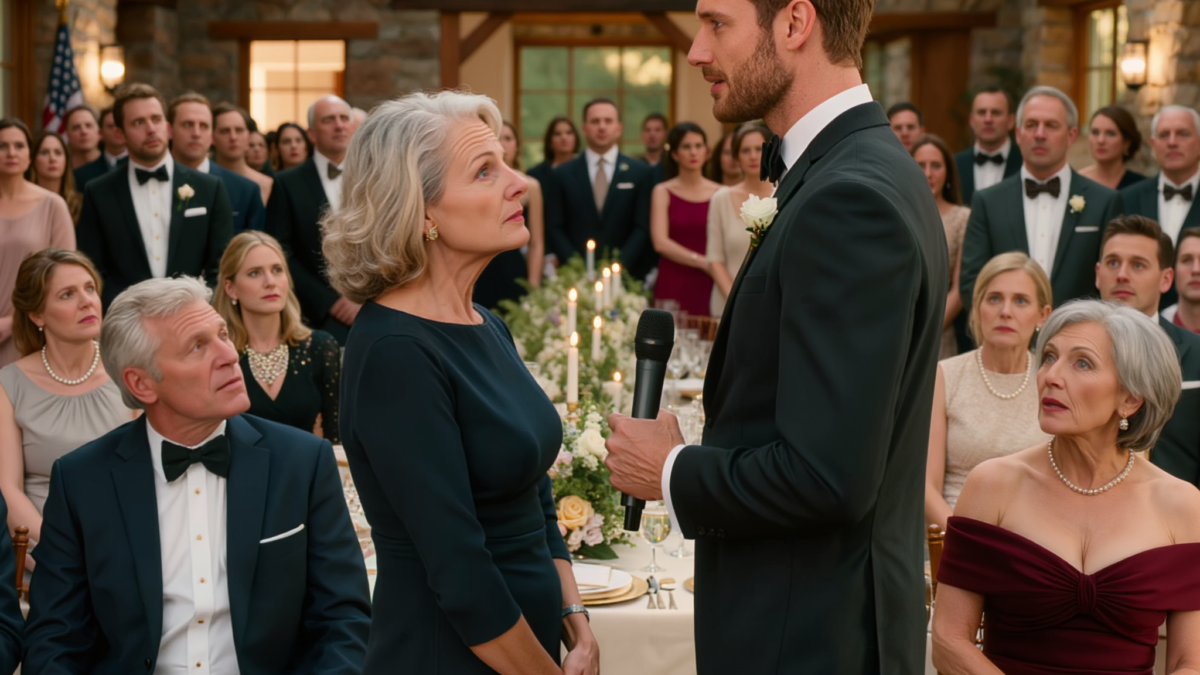
I stood up from the head table, brushed a hand down my jacket, and picked up the microphone. I looked out at the crowd, feeling a profound sense of peace.
I was ready to give my groom’s speech.
I took a deep breath and looked at Chloe, whose eyes were already shining with happy tears.
Then the heavy oak doors at the back of the reception hall swung open with a sudden, echoing bang.
The sound was so abrupt that several guests jumped in their seats. The soft acoustic guitar music playing in the background stopped. Every head in the room turned toward the entrance.
Standing in the doorway, completely uninvited and visibly furious, were three people I had not seen or spoken to in five years.
My biological mother, Margaret.
My biological father, Charles.
And my older brother, Gabriel.
The air in the room seemed to vanish.
The microphone suddenly felt heavy in my hand.
Chloe gasped and brought a hand to her mouth.
My mother led the way. She pushed past a startled waiter carrying a tray of champagne, her expensive heels clicking sharply against the polished hardwood floor.
She wore a dark formal dress that looked completely out of place at a summer vineyard wedding. Her face was tight with indignation.
Gabriel was right behind her. He looked older and heavier, but he still carried the same arrogant, entitled swagger I remembered. His jaw was set, his hands tense at his sides.
My father, Charles, trailed behind them both, his shoulders slumped. He kept his eyes fixed on the floorboards, refusing to make eye contact with anyone in the room.
They marched straight down the center aisle through my bewildered guests.
“What is the meaning of this, Nathan?” my mother demanded.
She didn’t care that more than a hundred strangers were watching. She had always believed she was the main character in every room she entered.
Her voice echoed off the high stone walls.
“You get married, you have this massive, extravagant wedding, and you don’t even invite your own family? We had to find out from a cousin’s Facebook post. A Facebook post, Nathan.”
A low murmur moved through the tables. People shifted uncomfortably in their chairs.
Gabriel stepped out from behind her and pointed directly at me.
“You think you can just erase us, man? You think you can throw a party and pretend you don’t have blood relatives?”
He stared up at me.
“We’re your parents and your brother. You owe us respect. You owe us an explanation right now.”
I stood perfectly still on the stage.
I didn’t flinch. I didn’t step back. I didn’t break into a cold sweat the way the old version of me would have.
I simply looked down at the three people who had spent my childhood and young adult life making me feel like a burden.
My mother crossed her arms and glared at me, waiting for me to shrink. Waiting for me to apologize. Waiting for me to let her take control of the story the way she always had.
Instead, I smiled.
It wasn’t a warm smile. It was calm, controlled, and deeply certain.
I tightened my grip on the microphone.
I was not the same desperate, people-pleasing kid they had pushed aside five years earlier. I had built a life of my own, surrounded by people who actually loved me.
“You’re right,” I said, my voice calm and steady through the speakers. “I didn’t invite you, because you haven’t been my family for a very long time.”
My mother’s jaw dropped.
Gabriel took a sharp step toward the stage.
But to understand what happened next in that reception hall—how I legally and publicly separated my life from theirs—you need to understand what they had put me through.
You need to understand why I blocked their numbers.
You need to understand the phone call that finally severed my ties to them, and the dinner with complete strangers that changed my life.
It wasn’t always about huge public confrontations.
For the first 27 years of my life, the rejection was quiet.
It was a slow, painful pattern of being told over and over that my feelings, my milestones, and my very existence mattered less.
In our house, there was a clear hierarchy.
Gabriel was the golden child.
He was three years older than me. He played varsity sports. He was loud, confident, and demanded constant attention.
My parents, especially my mother, revolved their world around him.
I was the spare part.
I was the kid expected to stay out of the way, keep my grades up without asking for help, and never cause an inconvenience.
I remember my 16th birthday clearly. It was the first time I fully understood how little space I occupied in their hearts.
Turning 16 is supposed to be a big deal.
For months, I had looked forward to it. I didn’t ask for a car or a huge party. I only wanted to invite five of my closest friends over on a Saturday afternoon.
We were going to order pizzas, play video games in the basement, and maybe watch a couple of movies.
I had paid for the food and snacks myself. I spent the entire summer mowing lawns around our neighborhood, saving crisp ten-dollar bills in an old shoebox under my bed so I could host my own birthday without being a financial burden.
The morning of my birthday, I woke up early, buzzing with excitement.
I carried bags of chips and soda downstairs and set up the controllers in the basement.
When I walked back into the kitchen, the atmosphere was thick with tension.
My mother was pacing with her phone pressed to her ear.
Gabriel, who was 19 and home from his freshman year of college, sat at the kitchen island staring at his laptop with his head in his hands.
My mother ended her call and turned to me.
She didn’t say happy birthday.
She didn’t even smile.
“Nathan, you need to call your friends right now and tell them not to come over today.”
Her voice was flat, leaving no room for discussion.
I froze with one hand on the refrigerator door.
“What? Why? I bought all the food. They’re literally going to be here in two hours.”
“Your brother just checked his student portal,” she said, gesturing toward Gabriel. “He failed his calculus final. He is completely devastated. He needs a quiet house to process this and study for his makeup exam next week. Having a bunch of loud teenagers in the basement would be completely insensitive to what he’s going through.”
I stared at her.
“Mom, it’s my 16th birthday. I planned this for weeks. I paid for it.”
Gabriel finally looked up from his laptop and rolled his eyes.
“God, Nathan, does the world always have to revolve around you? Can you stop being so selfish for one day? My entire college fund is on the line here. If I lose my academic scholarship, Dad is going to have to pull from his retirement. This is serious.”
My father walked into the kitchen at that moment, adjusting his tie.
He worked long hours at a corporate firm and hated dealing with household conflict.
I looked at him desperately, hoping he would step in.
“Dad, come on,” I pleaded. “It’s my 16th. We’ll stay in the basement. We won’t make a sound. Please.”
My dad sighed and rubbed his temples as if I were giving him a headache.
“Look, Nathan, just do what your mother says. Your brother is under a lot of pressure. Keep the peace, okay? We’ll celebrate your birthday another time.”
Keep the peace.
That was the family motto.
And keeping the peace always meant Nathan sacrificing what he wanted so Gabriel could be comfortable.
I walked back upstairs, sat on the edge of my bed, and made five humiliating phone calls to cancel my own party.
I spent my 16th birthday alone in my room, listening to the silence of the house.
Around six that evening, I heard the front door open and close.
I looked out my window and watched my parents and Gabriel get into the car.
They were taking him to an expensive steakhouse downtown to cheer him up after his stressful exam news.
They didn’t even ask if I wanted to come.
You tell yourself things will change when you grow up.
You convince yourself their favoritism is just a phase of childhood.
You think that if you achieve enough, work hard enough, and become successful enough, they will finally look at you and see your worth.
I worked incredibly hard to prove myself.
When it was time for college, my parents sat me down and explained that they had spent every spare dollar they had on Gabriel’s private university tuition and living expenses.
There was nothing left for me.
Not a single dollar.
I didn’t argue.
I enrolled at a local state school.
While Gabriel spent weekends at fraternity parties and went on ski trips funded by my parents’ credit cards, I worked night shifts at a logistics warehouse.
I loaded boxes onto trucks from 10:00 p.m. until 4:00 a.m., slept for three hours, then went to my graphic design classes.
I lived on cheap ramen and instant coffee. I took out student loans to cover the rest.
Through sheer grit and exhaustion, I maintained a 3.9 GPA.
When graduation day finally arrived, I was genuinely excited.
For the first time in my life, I felt like I had accomplished something enormous.
Not only was I graduating with honors, I had signed a contract for an incredible entry-level job at a top-tier design firm in Boston. The salary was more than I had ever seen in my life, and I had a clear path toward promotion.
I was desperate to share the news with them.
I mailed my parents official graduation tickets three months in advance and marked the date on their calendar during a visit home.
They promised, looking me directly in the eye, that they would be there.
The graduation ceremony was held in the university’s massive outdoor football stadium.
It was late May, and the heat was blistering. I sat in my black polyester gown, sweat running down my back, surrounded by thousands of other students.
As the speeches dragged on, I kept looking over my shoulder toward Section 104, Row G.
That was where my family’s tickets were assigned.
Every time I looked, the four seats were empty.
When the dean finally called the graphic design majors to line up, my heart began to sink.
I walked up the ramp to the stage.
The announcer’s voice boomed through the stadium.
“Nathan Carter, graduating with high honors.”
I paused in the center of the stage, diploma cover in my hand, and scanned the crowd.
Other students had families blowing air horns, holding enormous cardboard signs, screaming their names.
I looked toward Section 104.
Empty.
I gave the professional photographer a tight smile, shook the dean’s hand, and walked down the steps.
The lump in my throat was so large I could barely swallow.
I returned to my folding chair and stared at the grass for the rest of the ceremony.
They finally arrived two hours later.
The stadium was practically empty. Janitors were already collecting crushed water bottles and confetti from the bleachers.
I was standing beside my beat-up Honda Civic in the parking lot, my gown draped over one arm, about to drive home alone when my parents’ car pulled up.
My dad stepped out holding a sad-looking bouquet wrapped in crinkly plastic, something he had clearly picked up at the last minute.
My mother got out of the passenger side.
She didn’t look rushed.
She didn’t look guilty.
She looked mildly inconvenienced.
“Sorry we’re late, Nathan,” she said, waving dismissively as she walked toward me.
She gave me a stiff one-armed hug that lasted barely a second.
I looked at them, my vision blurring.
“The ceremony ended an hour ago. You missed the whole thing. I walked across the stage to an empty section.”
My mother sighed.
“Oh, don’t start with the guilt trip, Nathan. Gabriel and Victoria found a beautiful new house they want to buy in the suburbs. The housing market is crazy right now, and they needed us to come to the bank this morning to co-sign the mortgage documents. We couldn’t just leave them hanging. The appointment ran long.”
Gabriel had married Victoria two years earlier.
Victoria had a talent for making herself the victim in every situation, and my mother always seemed to take her side.
“You missed my college graduation,” I said, my voice trembling with restrained anger. “A day I worked four years for, because Gabriel was looking at a house.”
“It’s just a piece of paper, Nathan,” my mother snapped.
Her eyes narrowed.
“Gabriel’s future is a massive financial commitment. Plus, Victoria’s parents are going through a difficult divorce right now, and she is under a lot of emotional stress. We had to be there to support them. Stop making everything a tragedy.”
I didn’t tell them about my new job.
I didn’t tell them about the salary.
I didn’t tell them about the promotion track.
Standing in that hot asphalt parking lot, I finally realized that no matter how high I climbed, they would always be looking in Gabriel’s direction.
I put the flowers in the back seat of my car and drove back to my apartment.
But the final breaking point—the moment that shattered the illusion of my family forever—didn’t happen until I was 27 years old.
It was late November.
The Boston air was freezing, and the sky seemed permanently gray.
I stood inside my tiny, overpriced studio apartment packing a duffel bag.
My flight to Connecticut for Thanksgiving was the next morning.
I had bought a pumpkin spice candle and let it burn on the kitchen counter, trying to force myself into the holiday spirit.
I hated going home for the holidays.
It always meant sitting at the far end of the dining table, picking at my food while my parents bragged endlessly about Gabriel’s promotion or Victoria’s latest interior design choices.
But it was Thanksgiving.
It was family.
You went home.
That was the rule.
I was folding a heavy winter sweater when my phone buzzed on the counter.
The caller ID showed my mother’s name.
I tapped the speakerphone button so I could keep packing.
“Hey, Mom,” I said casually. “Just finishing up packing. My flight lands around noon tomorrow, so I should be at the house by two.”
There was a brief silence.
Then her voice came through, sharp and cold, carrying that familiar tone of absolute authority.
“Nathan, I’m calling to tell you not to come home this year.”
My hands stopped moving.
The sweater slipped from my grip and landed on the hardwood floor.
I stared at the phone.
“What? What are you talking about? My flight is tomorrow morning. The ticket is non-refundable.”
“Gabriel and Victoria are hosting Thanksgiving at their new house this year,” she said smoothly.
There wasn’t a trace of hesitation in her voice.
“Victoria is pregnant, as you know, and she’s been dealing with a lot of fatigue and morning sickness. Gabriel called me this morning. He said he doesn’t want any drama this weekend. He just wants a peaceful, quiet holiday for his wife.”
I gripped the edge of the kitchen counter.
“Drama? Mom, what drama do I cause? I literally sit in the corner, eat my turkey, and barely speak to anyone.”
“You always make things tense, Nathan,” she snapped. “You come in with this dark cloud over your head. You’re always sulking or acting like a victim because Gabriel has a nice house. Victoria is very sensitive to negative energy right now. Gabriel wants a positive environment for the baby. It’s better if you just stay in Boston.”
“You’re uninviting me from my own family’s Thanksgiving because Victoria is pregnant?”
My voice was shaking, caught somewhere between anger and a deep hurt I had carried for years.
“Stop making this about you,” she said. “This is exactly the kind of selfish behavior Gabriel is talking about. We’ll call you Thursday afternoon to say happy holidays. Just have a quiet weekend.”
The line went dead.
She had hung up on me.
I stood in my kitchen for what felt like forever.
The hum of the refrigerator suddenly sounded deafening.
The smell of the pumpkin candle turned my stomach.
I picked up my phone again. My hands were shaking so badly I could barely unlock it.
I called my father.
It rang four times before he answered.
In the background, I could hear sports announcers calling a college football game.
“Hey, Nathan,” he said casually, as if the world had not just shifted beneath me.
“Dad,” I said, leaning against the counter. “Did Mom tell you? Did you know they’re banning me from Thanksgiving?”
There was a long pause.
The football announcers kept talking on his television.
“Yeah, son,” he said quietly. “She told me.”
“And you’re just going to let her do that?”
My voice cracked, and I hated how small I sounded.
“I bought a ticket. Dad, I’m your son. Are you really going to let Gabriel and Victoria push me out of my own family?”
Another silence.
I could picture him sitting in his expensive leather recliner, staring blankly at the television, avoiding another family conflict.
He had spent his entire marriage letting Margaret dictate the rhythm of our household. He feared confrontation with her, and he feared Gabriel’s temper.
“Listen, Nathan,” he finally said. His voice was flat. “It’s Gabriel’s house this year. You know how Victoria gets when she’s stressed. It’s her first pregnancy. I think it’s better if you just listen to your mother. We’ll send you a gift card for a nice dinner in the city or something. Let’s just keep the peace, all right?”
Keep the peace.
Those three words had followed me my entire childhood.
They were the excuse used every time I was pushed aside, ignored, or asked to sacrifice something important.
“Right,” I whispered.
The sadness inside me seemed to burn away, leaving a cold emptiness in its place.
“Keep the peace.”
I hung up without saying goodbye.
I walked to the trash can beneath the sink, opened the lid, and dropped my printed boarding pass on top of the wet coffee grounds.
I didn’t throw anything.
I didn’t shout.
I simply felt empty.
They didn’t want me.
Maybe they never had.
Thanksgiving morning in Boston arrived gray, bitter, and aggressively cold.
Snow had fallen overnight, blanketing the city streets in a thick icy layer.
I woke around nine to the muffled sounds of life happening above me.
My upstairs neighbors were laughing.
I could hear children running across the floorboards, dining chairs scraping, and the unmistakable rich smell of roasted turkey and garlic drifting through the air vents.
Everyone was with someone.
Everyone had somewhere to belong.
Everyone except me.
I made a cup of instant black coffee, wrapped myself in a blanket, and sat on my worn couch.
Then I made the worst mistake a lonely person can make on a holiday.
I opened social media.
The first post in my feed was from Victoria.
It was a perfectly filtered photo of the massive custom-built mahogany dining table in Gabriel’s new house.
The table was covered in fine china, crystal wine glasses, and steaming bowls of food.
Sitting around it were my mother, my father, Gabriel, Victoria, and Victoria’s parents.
They were all holding up their glasses, smiling at the camera.
The caption read:
“So incredibly thankful for my amazing, perfect family, surrounded by the people who matter most. Counting our blessings today.”
I stared at the screen.
Then I zoomed in.
I counted the chairs.
Exactly six.
Six chairs.
Six place settings.
Six plates.
They hadn’t simply uninvited me.
They hadn’t even left an empty place just in case.
In that photograph, I had been erased.
I set the phone down on the couch cushion.
For a while, I considered staying in that apartment all day. I could have ordered takeout, watched movies, and let the bitterness consume me.
That was what the old Nathan would have done.
But something inside me pushed back.
No.
I refused to sit in the dark while they drank expensive wine and celebrated my absence.
If I was going to be alone, I was going to do it out in the real world.
I put on my heavy winter coat, wrapped a thick wool scarf around my neck, pulled on my boots, and stepped into the snow.
The streets of Boston felt like a ghost town.
Almost every business, coffee shop, and corner store was closed for the holiday.
After walking for about twenty minutes, my face numb from the wind, I saw a warm neon sign glowing through the snowfall.
Harborview Grill.
It was an old, classic American restaurant—the kind with dark wood paneling, brass light fixtures, and booths upholstered in worn red leather.
When I pushed through the heavy glass doors, heat wrapped around me immediately.
So did the smell of roasted meat, savory gravy, and fresh bread.
The restaurant was surprisingly packed.
Large families filled the tables. Grandparents laughed with toddlers. Teenagers rolled their eyes at their parents. Couples shared bottles of wine.
The air was full of conversation and clinking silverware.
The hostess, a young woman with a sympathetic smile, looked at me as I approached the wooden stand.
“Happy Thanksgiving. Just one today?”
“Yeah,” I said, forcing a polite smile. “Just one.”
She led me to a small, slightly wobbly table in the back corner near the swinging kitchen doors.
It was the kind of table usually left for overflow seating.
I draped my coat across the back of the chair and stared at the menu.
Right beside my tiny table was a sprawling booth that had been pushed together with two other tables to accommodate a large family.
An older couple sat near the head. Two men around my age were there with their wives, and three children ran around them in cheerful chaos.
They were loud.
They were messy.
They passed baskets of bread back and forth, argued about sports, and laughed from deep in their stomachs.
They looked incredibly happy.
Eventually, the waiter brought me the Thanksgiving special: slices of white-meat turkey, stuffing, cranberry sauce, and gravy.
It looked delicious.
My stomach, however, was tied in a knot.
I picked up my fork and stared at the gravy cooling on the turkey.
I felt like a pathetic 27-year-old man sitting in a dark corner, watching other people live the kind of life I had been told I did not deserve.
I put down my fork and closed my eyes.
I just wanted the day to end.
“Excuse me, sweetheart.”
I opened my eyes.
Standing beside my table was the older woman from the large group next to me.
She had warm, crinkling eyes behind silver-rimmed glasses, elegant silver hair pulled back from her face, and a half-full glass of red wine in one hand.
I sat up quickly.
“Oh, I’m sorry. Am I in your way? Do you need me to move my chair?”
She smiled.
It wasn’t a polite customer-service smile.
It was genuine.
“No, not at all. I just couldn’t help noticing you sitting over here by yourself. Are you doing okay?”
I cleared my throat and wiped my hands on my napkin.
“I’m fine. Just, you know, allergies. The cold wind outside really got to my eyes.”
She raised one eyebrow and looked at my untouched plate.
“Allergies don’t usually make a young man stare at his turkey like it personally betrayed him.”
A short, unexpected laugh escaped me.
“Is it that obvious?”
“Only to a mother,” she said softly.
She held out her hand.
“I’m Martha. Martha Morrison.”
“Nathan.”
I shook her hand.
Her grip was firm and warm.
Martha glanced back at her loud table, where one of the kids had just spilled a glass of water and caused a minor commotion.
Then she looked at me again.
“Nathan, my husband Joseph and I have a strict rule in our family. Absolutely no one should have to eat alone on Thanksgiving. We have way too much food, and honestly, we could use a buffer between my two sons before they start arguing about the Patriots game again. Why don’t you bring your plate over and sit with us?”
I stared at her.
I actually looked over my shoulder to see if she might be speaking to someone behind me.
People in the real world didn’t do this.
“Oh, no, Mrs. Morrison. I couldn’t. I really don’t want to intrude on your family time. I’m totally fine here. Really.”
Before she could answer, the older man at the head of the table turned around and waved a half-eaten dinner roll at me.
“Son,” Joseph called over the restaurant noise, “when my wife makes a decision, it’s legally binding. Grab your plate and get over here before the grandkids eat all the good stuffing.”
I looked at my empty little corner table.
Then I looked at the open chair one of their sons, Caleb, was pulling out for me.
For the first time in my life, someone was actively making room for me.
They weren’t asking me to shrink.
They were inviting me in.
I picked up my plate and walked over.
The moment I sat down, the table didn’t become awkward or quiet.
They simply absorbed me into the chaos as if I had always been there.
Joseph poured me a generous glass of red wine without asking.
Across from me, Caleb immediately started complaining about his terrible fantasy football team as if we had known each other for ten years.
His wife, Sarah, kept passing me warm rolls, roasted vegetables, and extra gravy.
“So, Nathan,” Joseph said, leaning back and unbuttoning his suit jacket. “What brings a young guy like you to Harborview Grill by yourself on a day like today? You working a late shift at the hospital or something?”
I hesitated.
Whenever coworkers or acquaintances asked about my family, I usually lied.
I made up stories about missed flights, snowstorms, or conflicting work schedules to protect my parents’ reputation.
I never wanted anyone to know the truth.
But looking around that table at complete strangers who had shown me more warmth in ten minutes than my own relatives had shown me in years, the truth simply came out.
“My mother told me not to come home,” I said quietly, staring down at my wine glass. “My older brother is having a baby. They said they didn’t want the drama of having me around, so I stayed in Boston.”
The whole table went quiet for a moment.
Caleb stopped chewing.
Joseph slowly set down his wine glass.
Martha looked at me from across the table.
Her eyes were sharp, intelligent, and perceptive.
“Can I tell you a secret, Nathan?” she asked, leaning forward slightly. “I spent 35 years working as a family court lawyer. I handled everything—divorces, custody disputes, inheritance fights. I’ve seen some of the darkest parts of families.”
She paused and made sure I was looking at her.
“And if there’s one thing I learned in all those years, it’s this: the person who is constantly complaining about drama is very often the person creating it.”
I looked up.
“They said I make things tense. My mom said I’m the problem.”
“You are not the problem, Nathan,” Martha said firmly.
She didn’t say it with pity.
She said it as if she were stating a fact.
“Some families are deeply unhealthy, and unhealthy families often need a scapegoat so they don’t have to look at their own behavior. This is not your fault.”
My vision blurred.
I had to look down at the table and steady myself.
Those words—You are not the problem—were the exact words I had waited my entire life to hear.
It felt as if a massive weight had been lifted from my chest.
When the waiter finally brought the bill, I reached for my wallet.
Joseph stopped my hand before I could open it.
“Put that away,” he said, pulling out his credit card. “You’re a guest at my table. You don’t pay for anything today.”
When we gathered our coats and stepped into the freezing snow, Martha stopped me on the sidewalk.
She reached into her purse and handed me a thick cream-colored business card.
“We do Sunday dinners every week at our house in Brooklyn,” she said. “Nathan, you have a seat at our table whenever you want it. Don’t be a stranger.”
I went home that night with a strange, unfamiliar warmth in my chest.
But the real turning point—the moment that permanently severed my ties to my past—came two days later.
I was sitting in my apartment on Saturday morning drinking coffee when my phone rang.
The caller ID showed Dylan, my older cousin on my father’s side.
Dylan and I weren’t especially close, but we usually grabbed a beer a few times a year. He was one of the only relatives who treated me somewhat normally.
“Hey, man,” Dylan said as soon as I answered.
He sounded nervous.
“Happy late Thanksgiving. Listen, I need to ask you something, and I don’t want you to freak out.”
“Okay,” I said, putting my coffee mug down. “What is it?”
“Did Aunt Margaret really ban you from Thanksgiving dinner because of Victoria’s pregnancy?”
I frowned.
“Yeah. She called me Wednesday and said Gabriel didn’t want any drama.”
Dylan let out a bitter laugh.
“Nathan, buddy, I don’t know how to tell you this, but that’s not why they kept you away.”
My stomach dropped.
“What do you mean?”
“I was at their house Wednesday night dropping off a pie,” Dylan said, lowering his voice. “Victoria and your mom were drinking wine in the kitchen. They thought I was in the bathroom, but I overheard them talking.”
He paused.
“Nathan, your grandmother’s estate finally cleared probate last month. The lawyer released the funds. The inheritance was supposed to be split fifty-fifty between you and Gabriel.”
My heart began pounding.
My grandmother had died a year earlier. My parents had taken control of the funeral arrangements and legal paperwork.
I had never seen any inheritance money.
I had never even asked, because I didn’t want to look greedy or start another argument.
“Victoria really wanted Gabriel to buy that new luxury Porsche SUV before the baby arrived,” Dylan continued. “She said they needed a safe, high-end family car, but Gabriel’s salary wasn’t enough to qualify for the financing, and they didn’t have enough cash for the down payment.”
I closed my eyes.
I already knew where this was going.
“Your mom convinced your dad to put your name on the release forms,” Dylan said quietly. “They used your entire half of the inheritance—tens of thousands of dollars—as the down payment on Gabriel’s Porsche. They kept you away from Thanksgiving because Gabriel was going to show the new car to the whole family in the driveway.”
I couldn’t move.
“They were afraid you’d ask how he paid for it,” Dylan continued. “They knew the story would fall apart.”
I grabbed the edge of the kitchen counter to steady myself.
It wasn’t about peace.
It wasn’t about Victoria’s morning sickness.
It wasn’t about the baby.
It was about money.
Money my grandmother had intended for my future had been redirected toward Gabriel’s lifestyle, and then I had been excluded from Thanksgiving so no one would have to explain the new car sitting outside.
“Are you serious?” I asked quietly.
“I’m so sorry, man,” Dylan said. “I thought you knew. I thought there had been some agreement. When I realized what happened, I felt sick.”
I didn’t shout.
I didn’t throw my coffee mug.
I simply felt a profound stillness move through me.
“Thanks for telling me, Dylan.”
I ended the call.
Then I walked into my bedroom, sat on the edge of the bed, and opened the contacts app on my phone.
Margaret.
Blocked.
Charles.
Blocked.
Gabriel.
Blocked.
I went to my social media accounts and blocked Victoria and every relative who had spent years defending Gabriel at my expense.
Then I deleted their contact information from my cloud storage.
At that moment, sitting in that quiet apartment, the version of Nathan they knew disappeared.
The desperate kid who kept trying to earn his parents’ love was finished.
I was done.
Time is a funny thing.
When you finally cut something deeply unhealthy out of your life, you suddenly discover how much room there is to grow.
Over the next two years, I never looked back.
I never unblocked their numbers.
I never checked whether they sent emails.
I threw myself into my life.
Without the constant mental drain of my family’s manipulation, my career took off.
I was promoted to senior art director at my firm. I began managing major accounts, earned a salary I never thought possible, and eventually bought a beautiful condo in the city.
But the biggest change in my life wasn’t my bank account.
It was where I spent my Sunday evenings.
I took Martha up on her offer.
The first time I knocked on the door of their beautiful Victorian house, I was terrified.
They never let me feel like a stranger.
Every Sunday, I was there.
I helped Joseph repair the wooden deck in the backyard, holding the flashlight while he complained about rusty screws.
I drank cheap beer with Caleb and watched football in the basement.
I stood in the kitchen with Martha, chopping vegetables and listening to stories from her years as a lawyer.
I didn’t have to walk on eggshells.
If Caleb and I disagreed about a movie, we argued, laughed five minutes later, and moved on.
Nobody called me dramatic.
Nobody told me I was ruining the peace.
I was simply allowed to exist as a normal human being.
Then, about six months into those Sunday dinners, the front door opened and Chloe walked in.
Chloe was Martha’s niece.
She had lived in Chicago for years and had recently moved back east to work as an architect.
She had dark hair, a razor-sharp sense of humor, and a smile that stopped me in my tracks the first time I saw her.
We ended up standing in the kitchen for three hours that night, completely ignoring the football game in the living room.
We talked about art, our careers, and the cities we wanted to visit.
I had never felt so instantly understood by another person.
Our relationship didn’t have the chaotic sparks you see in movies.
It was calm.
It was safe.
It felt like finally taking a deep breath after spending 27 years holding it.
She knew my entire history.
She knew I didn’t speak to my biological relatives, and she never judged me for it.
She never said, “Family is family.”
She simply held my hand and moved forward with me.
Two and a half years after that lonely Thanksgiving, I walked back into Harborview Grill.
This time, I wasn’t alone.
Chloe had insisted we go there for our anniversary.
We sat in the same leather booth where Joseph and Martha had invited me to join them years earlier.
The waiter had just cleared our plates, and I was about to look at the dessert menu when Chloe reached across the table and took both my hands in hers.
“Nathan,” she said softly, her eyes shining in the dim restaurant light, “you told me once that this restaurant was the place where your life really started. Where you realized you didn’t have to be alone.”
“It was,” I said, smiling as I rubbed my thumb over her knuckles.
She reached into her purse, her hands trembling slightly, and pulled out a small velvet box.
My jaw dropped.
She opened it.
Inside was a simple, elegant gold band.
“I don’t want you to ever feel alone again,” she whispered, a tear slipping down her cheek. “You are the greatest man I’ve ever known. I want to be your family. Will you marry me?”
For a second, I couldn’t speak.
Emotion caught in my throat.
I nodded, wiped my eyes, and leaned across the table to kiss her.
The restaurant erupted into applause.
But as wedding planning began a few months later, a heavy question started building in the back of my mind.
One evening after dinner, we sat around the Morrisons’ dining table looking through stacks of wedding invitation samples.
Chloe pointed to the traditional layout on a beautiful piece of card stock.
“We need to figure out what to do here,” she said gently, pointing to the lines where the parents’ names normally went.
I stared at the blank space.
The thought of putting Margaret and Charles on my wedding invitation made my stomach turn.
They hadn’t earned that honor.
They hadn’t supported my life.
In every way that mattered, they no longer felt like my parents.
Martha sat across the table drinking herbal tea.
She set down her mug and looked at me with the sharp, analytical expression she had carried through decades of legal work.
“Nathan,” she said quietly. “You know, when I practiced family law, I didn’t only handle divorces and custody cases. I handled adoptions.”
I looked up.
“Adoptions?”
“Adult adoptions,” she clarified.
She leaned forward.
“In this state, consenting adults can go through a legal adoption process. It can formally recognize a parent-child relationship and change legal family records and next-of-kin status. It makes the relationship official.”
The room went silent.
Caleb stopped scrolling on his phone.
Joseph looked at me, a soft, proud smile spreading across his face.
My heart hammered.
I looked from Martha to Joseph.
“Are you saying…?”
Martha reached across the table and took my hand.
“Nathan, we have considered you our son since the day you sat at our table in that restaurant. If you want it, and if you’re ready, Joseph and I would be honored beyond words to make it legal.”
I broke down.
Right there at the kitchen table, surrounded by invitation samples and half-empty tea mugs, I buried my face in my hands and cried.
I cried for the boy who had never been chosen.
And I cried for the man who finally was.
The legal process took about three months.
We filed the paperwork, paid the court fees, and eventually walked into a judge’s chambers in downtown Boston.
The judge read the decree, smiled at us, and brought the proceeding to a close.
I was no longer Nathan Carter.
I walked out of that courthouse holding new legal documents.
I was Nathan Morrison.
And that legal change—the piece of paper recognizing the family I had chosen—was exactly what my biological parents did not know about when they showed up at my wedding.
The morning of my wedding day in Napa Valley was supposed to be perfect.
For the first few hours, it genuinely was.
I woke early in the groom’s suite of the sprawling stone estate we had rented for the weekend.
The California air was crisp, smelling faintly of crushed grapes and dry earth.
I stood on the balcony with a cup of black coffee and looked out over endless rows of green vines stretching toward the horizon.
I was 32.
I had a career I was proud of.
I was about to marry the most brilliant and compassionate woman I had ever met.
And I was surrounded by a family who actually wanted me there.
Joseph stepped onto the balcony carrying two steaming mugs of coffee.
He was already wearing a crisp white dress shirt and suspenders, his silver hair neatly combed back.
He leaned his forearms against the stone railing.
“You nervous, son?”
I smiled.
“Not about marrying Chloe. That’s the easiest decision I’ve ever made. I’m just hoping the catering staff got the seating chart right. Caleb changed his table assignment three times last night.”
Joseph laughed.
“Don’t worry about Caleb. Martha has him under control today. This day is about you and Chloe. You’ve earned this happiness, Nathan. Never forget how hard you fought to build this life.”
I looked at him—the man who had seen me sitting alone at a restaurant table and eventually made me his son.
A lump formed in my throat.
“Thank you, Dad.”
Calling Joseph Dad felt as natural as breathing.
There was no guilt in the word.
No fear.
No weight.
We went back inside to finish getting dressed.
Caleb, my newly adopted brother and best man, was wrestling with his bow tie in the mirror.
But Dylan was sitting on the leather couch in the corner of the room.
I had invited Dylan because he was the cousin who had finally told me the truth about the inheritance money five years earlier.
I thought we had built real mutual respect.
I thought he understood why I had cut my biological parents out of my life.
But all morning, Dylan had been acting strangely.
He was sweating through his undershirt.
He kept pacing across the hardwood floor.
He could not stop checking his phone.
Every time it buzzed, he flinched, typed something quickly, then shoved it back into his pocket.
I was adjusting my cuff links when someone knocked sharply on the heavy wooden door.
Ryan stepped inside.
Ryan was the head of the private security firm Chloe and I had hired for the weekend.
He was tall, solidly built, and carried himself with the calm professionalism of someone who rarely wasted words.
We had hired security mainly to manage parking and protect the privacy of several high-profile guests, including Arthur, the CEO of one of my firm’s biggest clients, who had flown in from Boston.
“Mr. Morrison,” Ryan said, looking directly at me. “Do you have five minutes to speak in the hallway? It’s urgent.”
A chill moved down my spine.
I set my suit jacket on the bed and followed him into the quiet hallway.
He closed the door behind us.
Ryan pulled a sleek black tablet from beneath his arm and tapped the screen.
“We have an issue at the main gate,” he said.
“A rental car arrived about ten minutes ago. Three individuals. Two older adults and one younger male. They are not on the approved guest list. The guard denied them entry.”
My mouth went dry.
“Do you have a visual?”
Ryan handed me the tablet.
A live security feed showed the iron gates at the bottom of the estate driveway.
There she was.
Margaret.
My mother.
She wore a dark formal dress and was gesturing angrily at the security guard.
Behind her, Gabriel paced back and forth across the gravel.
Charles leaned against the hood of the rental car, looking embarrassed and defeated.
“They’re demanding access,” Ryan said calmly. “The older woman says she is your biological mother and has threatened to involve local authorities if we refuse entry. The younger man has also been verbally confrontational with my staff. We can have them removed from the property if you want.”
I stared at the tablet.
Five years.
Five years of silence.
They had taken money meant for me.
They had erased me from their family.
They had ignored my existence.
And now, on one of the most important days of my life, they had flown across the country and appeared at the gate.
I looked at Ryan.
“How did they even know where the venue was? The invitations were private.”
Ryan’s eyes narrowed slightly.
He tapped the screen and switched to another camera feed.
It showed the parking area from earlier that morning.
“I reviewed the footage,” he said. “One of your guests walked to the edge of the property where the cell signal is strongest, made a phone call, and sent the exact GPS coordinates of the front gate.”
He zoomed in.
Dylan.
The betrayal landed hard.
Dylan had spent two days drinking my wine, eating my catered food, and looking me in the eye while quietly sharing my location with the very people I had spent years separating myself from.
He still wanted Margaret’s approval more than he valued my trust.
“Do you want me to remove him from the event as well?” Ryan asked.
I took a slow breath.
I looked again at the live feed of Margaret arguing with the gate guard.
The old Nathan—the people-pleasing kid who only wanted to keep the peace—would have panicked.
He would have asked Ryan to quietly make the problem disappear before anyone learned about the family drama.
But I wasn’t that kid anymore.
I was Nathan Morrison.
I handed the tablet back to Ryan.
“No,” I said quietly. “Don’t call the police. Tell the gate guard to let their car through. Escort them into the reception building, but don’t let them near the ceremony. Keep them at the back until dinner starts.”
Ryan studied me for a moment.
“Are you certain? They seem very agitated.”
“I’m certain.”
A calm certainty settled over me.
“They came here to make a scene. Let them see what they came for.”
I walked back into the groom’s suite.
Dylan looked up nervously.
“Everything okay, Nathan?”
I looked directly at him.
“Everything is absolutely perfect, Dylan. Better than I could have hoped.”
The ceremony took place in a beautiful open-air courtyard surrounded by blooming roses.
When the string quartet began playing and Chloe walked down the stone path in her white dress, everything else faded away.
I forgot about Margaret.
I forgot about Gabriel.
I forgot about the confrontation waiting in the background.
All I saw was the woman who had helped me build a life beyond the family I was born into.
When we exchanged vows, I couldn’t stop crying.
I looked into the audience.
Joseph and Martha sat in the front row.
Martha dabbed her eyes with a tissue.
Joseph beamed with pride.
They were my family.
This was real.
After the ceremony, the guests moved into the massive stone reception hall for dinner and speeches.
Crystal chandeliers hung from the wooden beams.
The tables were covered in white linen, candles, and elegant floral arrangements.
I sat beside Chloe at the head table.
The room was full of laughter and champagne.
Then, out of the corner of my eye, I saw Ryan standing near the heavy oak doors at the back.
He gave me one curt nod.
I leaned toward Chloe.
“They’re here.”
Her eyes widened.
She reached for my hand beneath the table.
“Are you okay? Do you want Ryan to send them away right now?”
“No,” I whispered, kissing her cheek. “Just watch.”
The master of ceremonies tapped his microphone.
The music faded.
“Ladies and gentlemen,” he announced, “before we get to dinner, we have some very special introductions to make. If I could have your attention on center stage.”
I stood, smoothed my suit jacket, and walked onto the stage.
I took the microphone.
Hundreds of friends, colleagues, and members of the Morrison family looked toward me with warm, expectant smiles.
Arthur, the CEO of one of our biggest client companies, sat near the front and raised his glass.
Then I looked toward the back of the room.
The heavy oak doors were slightly open.
Standing in the shadows were Margaret, Charles, and Gabriel.
They were waiting for me to acknowledge them.
Waiting for me to apologize.
Waiting for me to hand them control of the moment.
I brought the microphone to my lips.
“Thank you all for being here today. This day is about love. But more importantly, this day is about family.”
I paused.
“For a very long time, I didn’t know what that word actually meant.”
Margaret stepped slightly forward.
A smug look crossed her face.
She thought I was about to apologize.
She thought I was about to invite her onto the stage.
“I spent the first 27 years of my life believing family meant walking on eggshells,” I continued, keeping my eyes on her. “I thought family meant shrinking yourself so you wouldn’t take up too much space. I thought it meant giving up your own birthday party, looking into empty seats at your college graduation, and watching money meant for your future somehow become someone else’s new luxury car.”
A collective gasp moved through the room.
The hall fell silent.
Arthur lowered his glass.
Dylan went pale.
Margaret froze.
The smugness disappeared from her face.
“I thought all of that was normal,” I continued. “Until one Thanksgiving, when I was told not to come home because I was an inconvenience. I sat alone in a restaurant, and a family at the next table saw me. They didn’t know me. They owed me nothing. But they invited me to sit with them.”
I turned toward the front row.
“So before we celebrate anything else tonight, I want to formally introduce the two people who taught me what unconditional love actually looks like.”
I smiled.
“Ladies and gentlemen, please raise your glasses for the parents of the groom, Joseph and Martha Morrison.”
The reaction was immediate.
Arthur stood first and began applauding.
Within seconds, the entire reception hall was on its feet.
One hundred fifty people gave them a standing ovation.
Joseph stood and pulled Martha into his arms.
Both of them were crying.
At the back of the room, Margaret’s expression changed completely.
She had expected to walk in and reclaim the center of attention.
Instead, everyone was applauding someone else.
“Stop the music!” she called.
She moved down the center aisle, with Gabriel and Charles behind her.
The applause slowly faded as guests realized this was not part of the planned reception.
Margaret stopped near the stage.
“What is the meaning of this, Nathan? How can you stand there and introduce those strangers as your parents? We are your family. I gave birth to you. You owe us respect.”
Gabriel stepped closer.
“You think you can just erase us? We’re your parents and your brother. You’re making a fool of yourself in front of all these people.”
I stood at the edge of the stage looking down at them.
For the first time, I felt no fear.
“You’re wrong, Gabriel,” I said into the microphone. “I’m not making a fool of myself. I’m finally telling the truth.”
I turned toward Margaret.
“You claim to be my mother,” I said calmly. “But legally, my family changed years ago.”
Margaret blinked.
“What are you talking about? Stop talking nonsense.”
“Three years ago, I walked into a courthouse in downtown Boston. I stood before a judge and completed an adult adoption. My legal name is Nathan Morrison. My legal parents—the people recognized as my family—are Joseph and Martha Morrison.”
The silence in the room was extraordinary.
Margaret stared at me.
“You can’t do that. You can’t just replace me.”
Martha stood from her table.
She walked toward the stage, adjusted her glasses, and looked at Margaret with the cool precision of a veteran attorney.
“The adoption was handled through the proper legal process,” she said. “Nathan made an adult decision about who he wanted recognized as his family. That decision is final.”
Gabriel’s anger flared.
He moved toward the stage, but Caleb immediately stepped into his path and blocked him.
“That’s enough,” Caleb said.
Joseph stood beside him.
“You are not going to disrupt my son’s wedding,” Joseph said evenly. “Take another step and security will escort you out.”
Gabriel stopped.
He had spent years intimidating me when we were younger.
Now he was facing people who had no intention of allowing him to dominate the room.
I looked at Charles.
My biological father had not said a word.
He stared at his shoes, trembling slightly.
“You stood by while money my grandmother left for me went toward Gabriel’s luxury SUV,” I said. “You let her ban me from Thanksgiving. You watched her treat me like I mattered less for nearly three decades.”
Charles flinched.
Several guests exchanged stunned looks.
I held his gaze.
“I hope the peace you kept was worth it, Charles, because it cost you a son.”
Charles finally looked up.
A single tear rolled down his cheek.
He opened his mouth, but nothing came out.
For the first time in my life, I was not waiting for him to defend me.
I no longer needed him to.
I gave Ryan a simple nod.
His security team approached Margaret, Charles, and Gabriel.
Ryan remained calm and professional.
“Ma’am, this is a private event. You have been asked to leave. We will escort you from the property now.”
Margaret looked around at the guests as if she expected someone to defend her.
No one did.
Arthur watched in silence.
“This is an outrage,” Margaret said. “I am his mother.”
A security guard gestured toward the exit.
Gabriel squared his shoulders, but another guard calmly directed him toward the doors.
Charles did not resist.
He simply walked with them, his head lowered.
As they moved down the center aisle, Margaret called back toward me.
“You’re making a mistake, Nathan. You’ll regret this. You are nothing without us.”
I watched them disappear through the heavy oak doors.
The doors closed.
The reception hall went silent.
People exchanged shocked glances.
I still had the microphone.
I stepped off the stage and walked toward table six.
Dylan was sitting there, sweating and staring down at his empty plate.
I stopped behind his chair.
“Dylan.”
He slowly looked up.
“Nathan, man, I swear—”
“You sent them the GPS coordinates this morning,” I said.
His face changed.
“You drank my wine, ate my food, and came to my wedding while secretly helping them find this place. Stand up.”
Dylan swallowed.
He looked around the table.
No one offered him sympathy.
He slowly stood.
“Leave,” I said. “And don’t contact me again.”
Dylan kept his head down, took his suit jacket from the back of his chair, and walked quickly toward the exit.
I stood in the middle of the room.
My past was finally gone from my wedding.
I took a deep breath.
For the first time all evening, my lungs felt completely full.
I walked back toward the head table, handed the microphone to the MC, and turned to Chloe.
She stood and wrapped her arms around my neck.
“You handled that perfectly,” she whispered.
Arthur rose again and lifted his champagne glass.
“To Nathan and Chloe Morrison,” he called, “and to knowing exactly who belongs at your table.”
The room broke into cheers and laughter.
Glasses clinked.
The tension dissolved.
The sound technician turned up an upbeat song, and people moved toward the dance floor.
The rest of the night became a blur of happiness.
I danced with Chloe until my feet hurt.
I shared a whiskey with Caleb.
I hugged Joseph and Martha.
There was no tension anymore.
There was just family.
Real family.
We spent two weeks on our honeymoon in Italy, drinking wine along the Amalfi Coast and completely disconnecting from the world.
We didn’t check social media.
We barely looked at email.
It was paradise.
When we finally flew back to Boston and unlocked the door to our condo, reality began settling in again.
But it was a good reality.
I dropped our suitcases in the hallway and went to the kitchen to sort through the pile of mail that had collected while we were gone.
Most of it was bills, junk mail, and a few late wedding gifts.
Near the bottom was a plain white envelope.
There was no return address.
Only my name, written in neat cursive handwriting that I vaguely recognized.
I opened it with a butter knife and pulled out a two-page letter written on thick stationery.
I unfolded it and looked at the signature.
Aunt Mary.
Mary was Charles’s younger sister.
I hadn’t seen her in nearly a decade.
She lived on the West Coast and had always kept her distance from Margaret’s control over the family.
I sat on a barstool at the kitchen island and began to read.
Dear Nathan,
I heard about what happened at the wedding through the family grapevine. I know it must have been an incredibly painful scene, but I am writing to tell you something important.
I am immensely proud of you.
You need to know a piece of history your father has been too afraid to tell you.
Five years ago, when Margaret kept you away from Thanksgiving over the situation involving Gabriel’s new car, Charles actually tried to push back.
He called me that night in tears.
He felt terribly guilty about what had happened with the inheritance paperwork.
He told me he was going to buy a plane ticket and fly to Boston to spend Thanksgiving with you privately.
But Margaret found out.
She caught him looking at flights.
She told him that if he chose you over her wishes, she would end the marriage and fight over the pension, the house, and every asset they had built together.
Charles was terrified of losing the comfortable life he knew.
So he backed down.
He chose financial security over his son.
I haven’t spoken to my brother since that day.
I am not telling you this so you will forgive him. I am telling you because I want you to have peace.
You deserved a braver father.
You deserved someone willing to stand beside you even when it was difficult.
Charles was not that man.
You did the right thing by walking away.
Congratulations on your marriage.
And congratulations on your new family.
You earned them.
With love,
Aunt Mary
I set the letter on the granite counter.
Through the kitchen window, the Boston skyline stretched beneath the evening sky.
I thought I would feel another surge of anger.
I thought seeing Charles’s choice written so plainly would drag me back into everything I had spent years escaping.
Instead, I felt pity.
Charles was trapped by his own fear.
He had chosen comfort over courage again and again, and now he had to live with that choice.
I didn’t need to be part of it anymore.
I folded the letter, set it aside, washed my hands, and went into the bedroom to help Chloe unpack.
For the first time, I felt truly free.
One year later, life looked completely different.
Six months after the wedding, I was promoted to creative director at my agency.
My salary nearly doubled.
I was managing a major team, designing campaigns for Fortune 500 companies, and actually enjoying my work.
With the new salary, Chloe and I decided we wanted more space.
We bought a beautiful historic four-bedroom house with a large backyard, a wraparound porch, and mature oak trees.
Best of all, it was only a few streets from Joseph and Martha.
We needed the extra bedrooms because exactly one year after our wedding in Napa, Chloe walked into the room holding a small white pregnancy test.
Two pink lines.
The months that followed were filled with excitement.
We didn’t have to worry about Margaret criticizing Chloe or trying to control the baby shower.
We were simply able to enjoy preparing for our child while surrounded by people who supported us.
Martha knitted tiny sweaters.
Caleb started buying miniature football jerseys before we even knew whether we were having a boy or a girl.
On a rainy Tuesday night in late October, the moment finally came.
We went to the hospital.
After 14 exhausting hours in the delivery room, with me holding Chloe’s hand through every contraction, I heard the most beautiful sound I had ever heard.
A sharp, healthy cry.
The nurse wrapped our baby boy in a warm blanket and handed him to Chloe.
She was exhausted and crying as she looked down at him.
I rested my forehead against hers.
About an hour later, there was a soft knock on the recovery-room door.
Joseph and Martha entered holding flowers and balloons.
They looked almost nervous, as if they were afraid to interrupt.
“Come in, Mom. Come in, Dad,” I said, waving them toward the bed.
Martha approached slowly, her hands clasped over her mouth, tears already filling her eyes behind her glasses.
Joseph stood beside her and placed a gentle hand on my shoulder.
“Oh, Nathan,” Martha whispered, looking at the sleeping baby in Chloe’s arms. “He is absolutely perfect. He’s beautiful.”
“Do you want to hold him?” Chloe asked.
Martha looked at me for permission.
I nodded.
Chloe carefully transferred the tiny bundle into Martha’s arms.
Joseph leaned over his wife’s shoulder and stared down at the baby in pure awe.
“Have you two decided on a name yet?” he asked.
I looked at Chloe.
We had made the decision months earlier.
“Yeah,” I said.
I stood and wrapped an arm around Joseph’s shoulders.
“Mom, Dad, we want you to meet your grandson.”
I paused.
“Joseph Morrison Jr.”
Joseph stepped backward.
His breath caught.
He looked from me to the baby, then back at me.
The big, stoic man covered his face with his hands and began to cry.
Martha was crying too, holding the baby close to her chest.
I had been named after a grandfather on Charles’s side whom I had never really known.
My own name had never felt connected to anything meaningful.
But my son’s name carried a legacy.
It carried honor.
It belonged to the man who had seen a lonely young stranger sitting near the back of a restaurant on Thanksgiving and decided there should be room for him at the table.
Five years had passed since that freezing Thanksgiving morning when my mother told me not to come home.
Now I was standing in the warm kitchen of Joseph and Martha’s house.
The air was thick with the smell of roasting turkey, fresh sage, and baking pie crust.
The house was absolute chaos in the best possible way.
Caleb’s three kids were running laps around the kitchen island, chasing our little Joey, who had become a fast and energetic toddler.
Chloe and Sarah stood at the counter with glasses of wine, laughing about a story from work.
Joseph sat in his recliner in the living room, complaining at the television because the Patriots had just fumbled the ball.
It was loud.
It was messy.
It was everything a holiday was supposed to be.
Martha bumped her hip against mine as she carried a massive bowl of mashed potatoes toward the dining room.
“Grab the gravy boat, Nathan. If we don’t feed these animals soon, Caleb is going to start eating the raw vegetables.”
I laughed, picked up the silver gravy boat, and followed her.
The dining table was fully extended across the room.
It was covered with mismatched plates, slightly chipped wine glasses, and a massive Thanksgiving feast.
I looked around the table.
There were no empty chairs.
Everyone took their seats.
The room filled with noise as plates were passed around and people argued playfully over who would get the dark meat.
I tapped my fork against my wine glass.
The sharp clinking sound slowly quieted the room.
Everyone looked at me.
Joseph lowered his fork.
Chloe smiled, holding little Joey on her lap.
I stood with my glass of wine in my hand and looked around at the people who had become my family.
“Five years ago today,” I began, “I was sitting by myself at a tiny table near the kitchen doors of Harborview Grill. I thought there was something fundamentally wrong with me because the people who brought me into this world didn’t seem to want me in theirs.”
I looked at Martha.
She was already wiping a tear from behind her glasses.
“I thought family meant blood. I thought you were stuck with the hand you were dealt, no matter how much it hurt. Then a woman walked up to my table and told me no one should have to eat alone.”
Martha smiled through her tears.
“You didn’t just give me a meal that day. You gave me a life. You gave me a name. You gave me a future.”
I lifted my glass.
“To the Morrisons. Family isn’t only where we are born. It is where we choose to belong—and where people choose us back.”
I smiled.
“Happy Thanksgiving.”
“Happy Thanksgiving,” the table answered.
Glasses clinked.
The laughter began again, louder and warmer than before.
I sat down, found my wife’s hand beneath the table, and finally felt completely, undeniably whole.








