My mom told me, “Don’t come home for Thanksgiving. Your brother doesn’t want drama.” I ate alone at Harborview Grill—until the family at the next table pulled out a chair and told me no one should eat alone. Years later, they became my legal parents. My biological mother learned that at my wedding, after storming in and demanding to know why I hadn’t introduced her as family…
The late-afternoon sun hit the Napa Valley vineyard at just the right angle, casting a golden glow over the rolling hills and perfectly aligned rows of grapevines.
We had rented a rustic stone estate for the reception. Inside, massive exposed wooden beams crossed the vaulted ceiling, surrounded by warm string lights and cascading white flowers.
It was, without question, the greatest day of my life.
I was 32 years old, wearing a tailored suit and sitting beside my bride, Chloe. The clinking of crystal glasses had settled. The hum of 150 guests, friends, colleagues, and the family I had chosen faded into respectful silence.
I stood from the head table, smoothed a hand down my jacket, and picked up the microphone.
I looked at Chloe. Her eyes were already shining with happy tears.
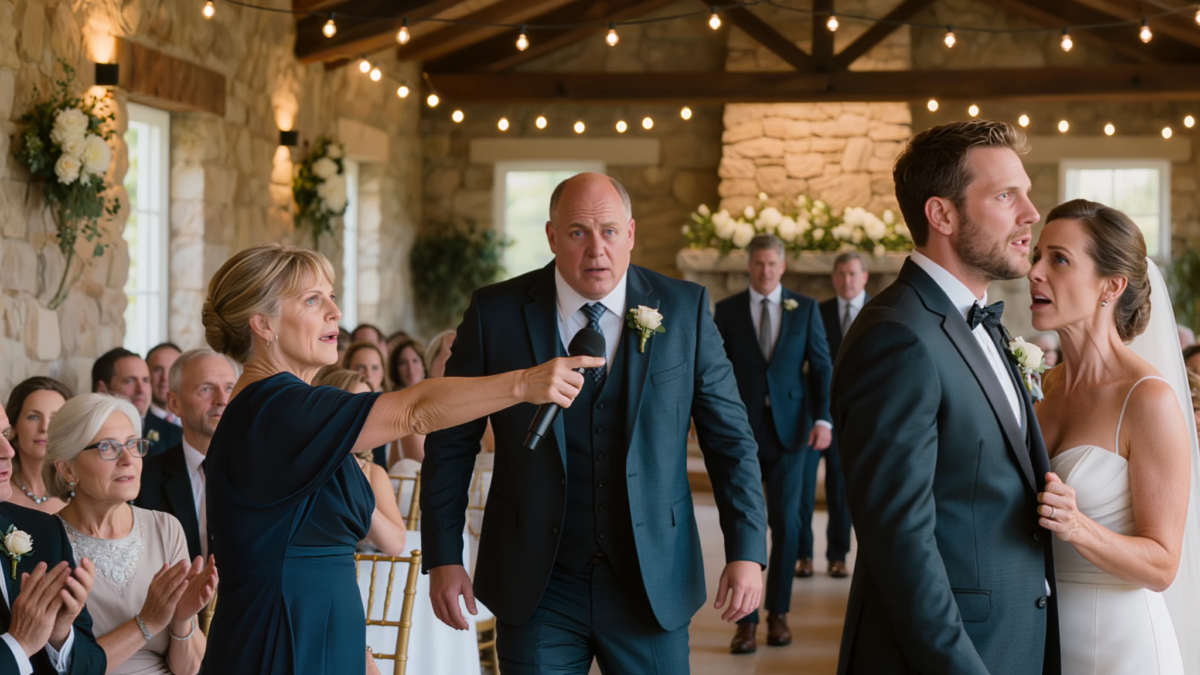
I was about to begin my groom’s speech when the heavy oak doors at the back of the reception hall flew open with a sharp crash.
Several guests jumped in their seats.
The acoustic guitar music stopped. Every head in the room turned toward the entrance.
Standing in the doorway were three people I had not seen or spoken to in five years.
My biological mother, Margaret.
My biological father, Charles.
And my older brother, Gabriel.
Chloe gasped beside me.
Margaret started down the aisle first, brushing past a startled waiter holding a tray of champagne. Her heels struck the polished hardwood floor with every step. She wore a dark formal dress, and her expression was tight with anger.
Gabriel followed close behind. He looked older and heavier than I remembered, but he still carried the same entitled confidence he had always had.
Charles trailed behind them with his shoulders lowered and his eyes fixed on the floor.
They came straight down the center aisle through a room full of confused guests.
“What is the meaning of this, Nathan?” my mother demanded.
She looked around the reception hall.
“You get married, you have this huge wedding, and you don’t even invite your own family? We had to find out from a cousin’s Facebook post.”
A murmur moved through the tables.
Gabriel stepped forward and pointed at me.
“You think you can just erase us? You think you can pretend you don’t have parents and a brother? You owe us an explanation.”
I stood on the stage with the microphone in my hand and looked down at the three people who had spent most of my life making me feel like an inconvenience.
My mother crossed her arms.
She was waiting for the version of me she remembered.
The one who would apologize.
The one who would shrink.
The one who would do anything to keep the peace.
That person was gone.
“You’re right,” I said into the microphone. “I didn’t invite you.”
Margaret’s face changed.
“Because you haven’t been my family for a very long time.”
To understand how we ended up in that reception hall, you have to understand what being part of my family had meant for the first 27 years of my life.
There had always been a hierarchy.
Gabriel was at the top.
He was three years older than me. He played varsity sports, spoke loudly, demanded attention, and seemed to occupy most of my parents’ emotional world.
Especially my mother’s.
I learned early that my role was different.
Stay out of the way.
Get good grades without asking for help.
Do not create inconvenience.
Do not need too much.
And above all, do not upset Gabriel.
I remember my 16th birthday clearly because it was the first time I understood just how little space I occupied in my own family.
I did not ask for a car.
I did not ask for an expensive party.
I wanted five friends to come over on a Saturday afternoon. We were going to order pizza, play video games in the basement, and watch movies.
I even paid for the food myself.
That summer, I had mowed lawns around the neighborhood and saved my money in an old shoebox under my bed. I did it because I knew my parents did not like spending money on things they considered unnecessary for me.
On the morning of my birthday, I carried chips and soda into the basement and set up the controllers.
When I went back upstairs, my mother was pacing through the kitchen with her phone pressed to her ear.
Gabriel was sitting at the island with his head in his hands, staring at his laptop.
My mother ended her call and turned to me.
She did not say happy birthday.
“Nathan, call your friends and tell them not to come over today.”
I froze.
“What? Why? They’re supposed to be here in two hours.”
She gestured toward Gabriel.
“Your brother just checked his student portal. He failed his calculus final. He’s devastated. He needs a quiet house so he can deal with this and prepare for his makeup exam.”
I stared at her.
“Mom, it’s my 16th birthday. I planned this for weeks. I paid for everything.”
Gabriel looked up and rolled his eyes.
“Does the world always have to revolve around you? My scholarship could be on the line.”
My father walked into the kitchen while we were talking.
He worked long hours at a corporate firm and hated household conflict. I looked at him, hoping he would finally tell my mother that canceling my birthday was unreasonable.
“Dad, come on. We’ll stay downstairs. We won’t bother anybody.”
He rubbed his temples.
“Nathan, just do what your mother says. Your brother is under a lot of pressure.”
Then came the phrase that would follow me for years.
“Keep the peace.”
They promised we could celebrate my birthday another time.
We never did.
I went upstairs, sat on the edge of my bed, and called all five of my friends to cancel.
That evening, around six, I heard the front door close.
I looked through my bedroom window and watched my parents and Gabriel get into the car.
They were taking him to an expensive steakhouse to cheer him up.
Nobody asked if I wanted to go.
For years, I told myself things would improve when I became an adult.
I believed favoritism was something families eventually grew out of.
I thought that if I worked hard enough and became successful enough, my parents would finally look at me and see someone worth being proud of.
When it was time for college, they sat me down and explained that there was no money available for me.
Most of what they could spare had gone toward Gabriel’s private university tuition and living expenses.
So I enrolled in a local state school.
While Gabriel took trips and attended fraternity parties, I worked night shifts at a logistics warehouse.
I loaded boxes onto trucks from 10:00 p.m. until 4:00 a.m., slept for a few hours, and then went to my graphic design classes.
I lived on cheap ramen and instant coffee.
I took out student loans for what I could not cover.
Somehow, I maintained a 3.9 GPA.
By graduation, I had done more than survive.
I was graduating with honors, and I had already signed an employment contract with a top-tier design firm in Boston.
For the first time in my life, I felt genuinely proud of myself.
I mailed my parents their graduation tickets three months in advance.
During a visit home, I marked the date on their calendar.
They promised they would be there.
The ceremony was held in the university’s outdoor football stadium on a brutally hot day in late May.
I sat in my black gown surrounded by thousands of students and kept turning toward Section 104, Row G.
Four seats.
All empty.
When the graphic design majors were called to line up, I walked toward the stage with a sinking feeling in my chest.
The announcer read my name over the speakers.
“Nathan Carter, graduating with high honors.”
I paused in the center of the stage and looked into the crowd.
Families were cheering.
Some held signs.
Others blew air horns.
I looked at Section 104 again.
Empty.
I smiled for the photographer, shook the dean’s hand, and walked down the steps.
My parents arrived two hours later.
The stadium was nearly empty by then. Workers were collecting trash from the bleachers, and I was standing beside my beat-up Honda Civic with my graduation gown folded over one arm.
My father got out of the car carrying a bouquet wrapped in crinkled plastic.
My mother stepped out after him.
She did not look rushed.
She looked mildly inconvenienced.
“Sorry we’re late, Nathan.”
She gave me a quick one-armed hug.
“You missed the whole thing,” I said.
My mother sighed.
“Oh, don’t start with the guilt trip.”
Then she explained.
Gabriel and his wife, Victoria, had found a house they wanted to buy. My parents had gone to the bank that morning to help co-sign the mortgage paperwork.
The appointment had taken longer than expected.
“You missed my college graduation because Gabriel was looking at a house?”
My voice shook despite my effort to control it.
My mother narrowed her eyes.
“Gabriel’s future is a major financial commitment. And Victoria is dealing with a lot right now. Stop making everything a tragedy.”
I had planned to tell them about my new job.
I had planned to tell them about the salary and the promotion path.
I said none of it.
Standing in that hot parking lot, I finally understood that there was no accomplishment large enough to make them look away from Gabriel and toward me.
I put the flowers in the back seat and drove home.
Still, even that was not the end.
The breaking point came when I was 27.
It was late November in Boston.
The sky was gray, and the air outside my studio apartment had turned painfully cold.
I was packing a duffel bag for Thanksgiving.
My flight to Connecticut left the next morning.
I had a pumpkin-spice candle burning on the kitchen counter, mostly because I was trying to force myself into a holiday mood.
I hated going home for Thanksgiving.
Usually, I sat at the far end of the table while my parents talked about Gabriel’s latest promotion or Victoria’s newest project.
But Thanksgiving was Thanksgiving.
You went home.
That was what family did.
I was folding a heavy sweater when my phone buzzed.
My mother’s name appeared on the screen.
I put her on speaker.
“Hey, Mom. I’m almost packed. My flight gets in around noon, so I should be at the house by two.”
There was a brief silence.
Then she said, “Nathan, I’m calling to tell you not to come home this year.”
My hands stopped.
The sweater slipped onto the floor.
“What?”
“Gabriel and Victoria are hosting at their new house this year.”
“My flight leaves tomorrow. The ticket is non-refundable.”
“Victoria is pregnant, as you know. She’s been dealing with fatigue and morning sickness. Gabriel wants a peaceful holiday for her.”
I gripped the edge of the kitchen counter.
“What does that have to do with me?”
My mother’s tone hardened.
“Gabriel doesn’t want any drama.”
I almost laughed because I thought I had misunderstood her.
“Drama? Mom, what drama do I cause? I sit at the end of the table and barely say anything.”
“You always make things tense, Nathan. You come in with that cloud over your head, sulking and acting like a victim because Gabriel has a nice house.”
I could feel my heart beating harder.
“So you’re uninviting me from Thanksgiving because Victoria is pregnant?”
“Stop making this about you,” she snapped. “This is exactly the behavior Gabriel means. We’ll call you Thursday afternoon. Just have a quiet weekend.”
The call ended.
She had hung up.
I stood in the kitchen for several minutes listening to the refrigerator hum.
Then I called my father.
He answered with a college football game playing loudly in the background.
“Hey, Nathan.”
“Dad, did Mom tell you?”
There was a pause.
“Yeah, son.”
“You knew?”
“She told me.”
“And you’re okay with this?”
Another silence.
I hated how desperate my own voice sounded.
“Dad, I’m your son. Are you really going to let Gabriel and Victoria push me out of Thanksgiving?”
He sighed.
“Listen, Nathan. It’s Gabriel’s house this year. Victoria is stressed. It’s her first pregnancy. I think you should listen to your mother.”
Then he offered to send me a gift card for dinner in Boston.
“Let’s just keep the peace.”
There it was again.
Keep the peace.
Every sacrifice in my childhood had been hidden behind those three words.
I ended the call.
Then I walked to the trash can under my sink and dropped my printed boarding pass onto the coffee grounds.
I did not throw anything.
I did not call them back.
I just stood there and finally let myself understand what they had been showing me for years.
They did not want me there.
Thanksgiving morning arrived cold and gray.
Snow had fallen overnight.
From the apartment above mine, I could hear laughter, footsteps, chairs scraping across the floor, and the faint sounds of people preparing a holiday meal.
The smell of turkey and garlic drifted through the vents.
Everyone seemed to have somewhere to belong.
I made black coffee, wrapped myself in a blanket, and sat on my worn couch.
Then I made the worst possible choice for someone spending a holiday alone.
I opened social media.
Victoria’s post was the first thing I saw.
It was a carefully filtered photograph of Gabriel’s new dining room.
The mahogany table was covered with china, wine glasses, and serving bowls.
My mother was there.
My father.
Gabriel.
Victoria.
Victoria’s parents.
All six of them were smiling and holding up their glasses.
Victoria’s caption said how thankful she was to be surrounded by her “perfect family” and the people who mattered most.
I stared at the photograph.
Then I counted the chairs.
Six.
Six chairs.
Six place settings.
Six plates.
They had not simply asked me to stay away.
There was not even an empty chair.
Something inside me finally gave way.
I could have stayed home all day and let the feeling swallow me.
Instead, I put on my winter coat, wrapped a scarf around my neck, pulled on my boots, and walked into the snow.
Most of Boston seemed closed for the holiday.
After about 20 minutes, I spotted a warm neon sign through the snowfall.
Harborview Grill.
It was an old-fashioned American restaurant with dark wood paneling, brass fixtures, and deep red leather booths.
The moment I stepped inside, warm air hit my face.
So did the smell of roasted meat, gravy, and bread.
The place was crowded.
Families filled nearly every table.
Grandparents laughed with children. Couples passed food back and forth. Teenagers looked bored while everyone else talked over one another.
The hostess looked at me with a gentle smile.
“Happy Thanksgiving. Just one today?”
I forced a smile.
“Yeah. Just one.”
She led me to a small table near the kitchen doors.
I ordered the Thanksgiving special.
Turkey.
Stuffing.
Cranberry sauce.
I stared at the plate until the gravy began to cool.
At the table beside me sat a large family.
An older couple.
Two men around my age.
Their wives.
Three children creating cheerful chaos.
They passed bread around, argued about football, and laughed loudly.
I tried not to watch them.
Eventually, I put down my fork.
“Excuse me, sweetheart.”
I looked up.
The older woman from the next table was standing beside me.
She had silver hair, silver-rimmed glasses, and a half-full glass of red wine in one hand.
I immediately straightened in my chair.
“Oh, sorry. Am I in your way?”
She smiled.
“No. I just noticed you sitting over here by yourself. Are you okay?”
“I’m fine. The cold wind got to my eyes.”
She looked down at my untouched plate.
“Allergies don’t usually make a young man stare at his turkey like it personally betrayed him.”
A laugh escaped me before I could stop it.
“Is it that obvious?”
“Only to a mother.”
She held out her hand.
“I’m Martha. Martha Morrison.”
“Nathan.”
We shook hands.
Then she glanced toward her table.
“Nathan, my husband, Joseph, and I have a rule in our family. Nobody eats alone on Thanksgiving.”
I did not know how to answer.
“We have too much food anyway,” she continued. “And honestly, we could use someone between my sons before they start another argument about the Patriots.”
She pointed toward their table.
“Bring your plate over.”
“Oh, no. Mrs. Morrison, I couldn’t. This is your family dinner.”
Before she could answer, the older man at the head of the table turned in his seat and waved a dinner roll in my direction.
“Son,” he called, “when my wife makes a decision, it’s legally binding. Grab your plate before the grandkids eat all the stuffing.”
One of the younger men, Caleb, pulled out a chair.
I looked at it.
For the first time in my life, somebody was actively making room for me.
I picked up my plate.
The moment I sat down, nobody became awkward or quiet.
They simply absorbed me into the conversation.
Joseph poured me wine.
Caleb immediately began complaining about his fantasy football team.
His wife, Sarah, passed me warm rolls, vegetables, and extra gravy.
After a while, Joseph leaned back.
“So, Nathan, what brings you here alone? Working a holiday shift?”
Usually, when someone asked about my family, I lied.
I invented missed flights.
Work conflicts.
Weather delays.
Anything that protected my parents from being judged.
But these strangers had shown me more warmth in less than an hour than I had felt at home in years.
So I told them.
“My mother told me not to come home.”
The table quieted.
I stared at my wine glass.
“My brother’s wife is pregnant. They said they didn’t want the drama of having me around.”
Caleb stopped chewing.
Joseph set down his glass.
Martha looked directly at me.
“Can I tell you something, Nathan?”
I nodded.
“I spent 35 years as a family court lawyer. I’ve seen divorces, custody fights, inheritance disputes, and families at their worst.”
She leaned forward.
“And one thing I learned is that the person who complains the loudest about drama is often contributing plenty of it.”
I swallowed.
“They say I make things tense. My mother says I’m the problem.”
Martha did not look at me with pity.
“You are not the problem, Nathan.”
The words hit me harder than I expected.
She continued.
“Some families need one person to blame because it keeps everyone else from looking too closely at their own behavior.”
My vision blurred.
I had spent years waiting for someone to say something like that to me.
When the bill came, I reached for my wallet.
Joseph stopped me.
“Put that away. You’re a guest at my table today.”
Outside, as everyone gathered their coats in the snow, Martha handed me a thick cream-colored business card.
“We have Sunday dinner every week,” she said. “You have a seat whenever you want it.”
I went home that night feeling something I had not felt in a long time.
Welcome.
Two days later, everything changed again.
I was drinking coffee in my apartment when my cousin Dylan called.
Dylan was on my father’s side of the family. We were not especially close, but we sometimes met for a beer, and he had always treated me more normally than most of my relatives.
“Hey, man,” he said. “Happy late Thanksgiving. I need to ask you something.”
His voice sounded tense.
“Okay.”
“Did Aunt Margaret really keep you away from Thanksgiving because of Victoria’s pregnancy?”
I frowned.
“Yeah. She said Gabriel didn’t want drama.”
Dylan gave a bitter laugh.
“Nathan, that’s not why they kept you away.”
My stomach tightened.
“What are you talking about?”
He told me he had stopped at their house Wednesday night to drop off a pie.
While he was there, he said he overheard Victoria and my mother talking in the kitchen.
Then he mentioned my grandmother.
She had died the year before.
According to Dylan, her estate had recently cleared probate.
The inheritance was supposed to be divided equally between Gabriel and me.
I had never received anything.
I had never even asked.
My parents had handled the funeral and the paperwork, and I had assumed the estate was still being settled.
Then Dylan told me that Victoria wanted Gabriel to buy a new Porsche SUV before the baby arrived.
Gabriel apparently could not afford the down payment.
I closed my eyes.
“Nathan,” Dylan said, “your mother convinced your father to forge your signature on the release forms.”
I said nothing.
He continued.
“They took your half. Tens of thousands of dollars. That’s what they used for the down payment.”
My hand tightened around the edge of the counter.
Dylan said that was the real reason they did not want me at Thanksgiving.
Gabriel was planning to show everyone the new vehicle in the driveway.
They were worried I would see it, ask questions, and figure out where the money had come from.
Suddenly, the Thanksgiving photograph looked different in my mind.
The six chairs were no longer only about rejection.
According to Dylan, my absence had been useful.
“Are you serious?”
“I’m sorry,” he said. “I thought you knew. When I realized you didn’t, I couldn’t keep quiet.”
I thanked him and ended the call.
Then I sat on the edge of my bed with my phone.
Margaret.
Blocked.
Charles.
Blocked.
Gabriel.
Blocked.
Victoria.
Blocked.
I removed them from my social media too.
That morning, I stopped waiting for them to become the family I wanted.
Over the next two years, my life changed.
My career moved forward. I became a senior art director, took on major accounts, earned more than I ever expected, and eventually bought a condo.
But the most important change had nothing to do with money.
It happened every Sunday night.
I took Martha seriously when she said I had a seat at their table.
The first time I knocked on the door of the Morrisons’ Victorian house in Brooklyn, I felt nervous.
They did not let me feel like a guest for long.
I helped Joseph repair the backyard deck.
I watched football with Caleb.
I stood in the kitchen chopping vegetables while Martha told stories from her years practicing law.
We could disagree without someone accusing me of causing trouble.
We could argue about a movie and laugh five minutes later.
Nobody expected me to disappear so someone else could stay comfortable.
About six months into those Sunday dinners, Martha’s niece walked through the front door.
Her name was Chloe.
She had been living in Chicago and had recently transferred back to Boston for her work as an architect.
We ended up talking in the kitchen for nearly three hours.
Art.
Work.
Travel.
Cities we wanted to see.
With Chloe, I never felt like I had to perform for approval.
Our relationship was calm.
Safe.
She knew my history with my biological family and never tried to convince me that blood automatically required forgiveness.
Two and a half years after that lonely Thanksgiving, Chloe and I returned to Harborview Grill for our anniversary.
We sat in the same leather booth where the Morrisons had first invited me to join them.
After dinner, Chloe reached across the table and took both my hands.
“Nathan,” she said, “you once told me this was where your life really started. Where you realized you didn’t have to be alone.”
“It was.”
Her hands trembled as she reached into her purse.
Then she pulled out a small velvet box.
Inside was a simple gold band.
“I don’t want you to ever feel alone again,” she said. “I want to be your family. Will you marry me?”
For a moment, I could not speak.
I nodded, pulled her toward me, and kissed her.
People around us began applauding.
Months later, while we were planning the wedding, the past found another way into the room.
We were sitting at the Morrisons’ dining table with stacks of invitation samples spread in front of us.
Chloe pointed toward the traditional wording.
“We need to decide what to do with the parents’ names.”
I stared at the blank space.
The thought of printing Margaret and Charles there made my stomach tighten.
Martha was sitting across from me with a cup of tea.
She noticed.
“Nathan,” she said quietly, “when I practiced family law, I didn’t only handle divorce and custody cases.”
I looked up.
“I handled adoptions.”
I frowned.
“Adoptions?”
“Adult adoptions.”
She explained that adults could go through a legal adoption process and formalize a parent-child relationship.
The room became quiet.
Joseph looked at me.
Martha reached across the table and took my hand.
“Nathan, we have thought of you as our son since the first Thanksgiving you sat at our table. If this is something you want, Joseph and I would be honored to make it official.”
I broke down at that dining table.
Not because I was losing a family.
Because someone was choosing me.
The legal process took roughly three months.
We filed the paperwork, paid the court fees, and eventually appeared before a judge in downtown Boston.
When we walked out, I had a new legal name.
Nathan Morrison.
I carried a new birth certificate in my hand.
Three years later, my biological parents would stand in a Napa Valley reception hall and learn about that decision for the first time.
On the morning of my wedding, none of that was supposed to matter.
I woke early in the groom’s suite at the stone estate.
The California air was cool. From the balcony, I could see rows of vines stretching toward the horizon.
Joseph joined me with coffee.
He was already wearing a white dress shirt and suspenders.
“You nervous, son?”
I smiled.
“Not about marrying Chloe. That’s the easiest decision I’ve ever made.”
Joseph laughed.
“This day is about you and Chloe. You built this life. Enjoy it.”
I looked at him.
“Thanks, Dad.”
By then, calling Joseph Dad felt natural.
Back inside, Caleb was struggling with his bow tie.
He was my legally adopted brother now, and he was also my best man.
My cousin Dylan was there too.
I had invited him because he was the person who finally told me what had happened with my inheritance.
But something about him was off.
He kept checking his phone.
He paced.
Every time it buzzed, he answered quickly and put it away.
I was adjusting my cuff links when someone knocked.
Ryan, the head of the private security team Chloe and I had hired, entered.
He asked to speak with me privately.
In the hallway, he showed me a black tablet.
“We have three people at the main gate who are not on the guest list.”
My body went still.
Ryan described two older adults and a younger man.
“Do you have a visual?”
He handed me the tablet.
My mother was on the screen.
Margaret was arguing with the gate guard.
Gabriel paced behind her.
Charles stood near the rental car with his head down.
After five years of silence, they had flown across the country and appeared at my wedding.
“How did they find the venue?”
Ryan changed the camera feed.
Earlier that morning, one of my guests had walked toward the edge of the property and sent someone the GPS coordinates for the estate.
Ryan zoomed in.
Dylan.
I stared at the screen.
The cousin who had once warned me had been quietly feeding my location to the people I had cut out of my life.
Ryan asked what I wanted him to do.
I looked once more at the live image of Margaret at the gate.
“Don’t let them near the ceremony,” I said. “But let them into the reception building afterward.”
Ryan studied me.
“You’re sure?”
“Yes.”
When I returned to the groom’s suite, Dylan looked up.
“Everything okay?”
I met his eyes.
“Everything is fine.”
The ceremony took place in an open-air courtyard surrounded by roses.
When Chloe walked down the stone path in her wedding dress, the rest of the day disappeared.
For those minutes, I forgot about Margaret.
I forgot about Gabriel.
I forgot that Dylan had betrayed me.
I saw only Chloe.
When we exchanged our vows, Joseph and Martha sat in the front row.
They were my parents.
That was the only fact that mattered.
Afterward, everyone moved into the reception hall.
Chandeliers hung from the exposed beams. Candles flickered across white tablecloths. Guests laughed over champagne.
Near the oak doors, Ryan caught my eye and gave one small nod.
I leaned toward Chloe.
“They’re here.”
She squeezed my hand.
“Do you want them removed?”
“No.”
I kissed her cheek.
“Just stay with me.”
The master of ceremonies tapped his microphone.
The room settled.
I walked onto the stage and accepted the microphone from him.
Friends, colleagues, and the Morrison family looked up at me.
At the rear of the room, the oak doors stood partly open.
Margaret, Charles, and Gabriel waited in the shadows.
“Thank you all for being here,” I began. “Today is about love. And for me, it is also about family.”
Margaret shifted forward.
I could see the expectation on her face.
“For the first 27 years of my life, I thought family meant walking on eggshells. I thought it meant making yourself smaller so someone else would stay comfortable.”
The room became quieter.
“I thought it meant giving up your birthday, looking into an empty section at your graduation, and being told not to come home for Thanksgiving.”
I glanced toward the back.
“And later, I learned there had been another reason I was kept away that Thanksgiving. Money my grandmother intended for me had been used for Gabriel’s new vehicle.”
A murmur moved through the room.
Dylan went pale at his table.
Margaret stopped moving.
“I believed all of that was normal for far too long,” I continued. “Until one Thanksgiving, I sat alone in a restaurant.”
I turned toward the front row.
“A family at the next table saw me. They did not know me. They owed me nothing. But they pulled out a chair.”
Martha lifted a hand toward her face.
Joseph reached for her.
“They never stopped making room for me.”
I raised my glass.
“So before anything else tonight, I want to introduce the parents of the groom.”
I looked at them.
“Joseph and Martha Morrison.”
The room rose.
People applauded.
Joseph wrapped an arm around Martha while she cried.
That was when Margaret lost control.
“Stop!”
Her voice cut through the applause.
She pushed forward and marched down the aisle with Gabriel and Charles behind her.
“What is the meaning of this, Nathan?”
People slowly stopped clapping.
Margaret pointed toward Joseph and Martha.
“How dare you introduce those strangers as your parents? We are your family. I gave birth to you.”
Gabriel came to the edge of the stage.
“You think you can erase us?”
I looked down at him.
Then at Margaret.
“You keep saying I’m trying to erase you.”
I lifted the microphone.
“But I made a legal decision about my own family three years ago.”
Margaret frowned.
“What are you talking about?”
“I went to a courthouse in Boston. I completed an adult adoption.”
She stared at me.
“My legal name is Nathan Morrison.”
The room became completely still.
“My legal parents are Joseph and Martha Morrison.”
Margaret’s face lost color.
“You can’t just replace me.”
Martha rose from her chair.
She approached the stage, adjusted her glasses, and spoke with the same steady tone I had heard the first day she sat beside me at Harborview Grill.
“The adoption was completed legally.”
Gabriel reacted first.
He started toward the steps.
Caleb moved between us before he could get any farther.
Joseph stood beside Caleb.
“That’s enough,” Joseph said. “Back away from my son.”
Gabriel stopped.
I looked at Charles.
He had barely moved since entering the room.
“You knew what happened with Grandma’s inheritance,” I said.
His face tightened.
“You let me be pushed out of Thanksgiving. You spent years choosing silence because keeping the peace was easier.”
Charles finally raised his eyes.
“I hope it was worth it,” I said. “Because the peace you protected cost you your son.”
He opened his mouth.
Nothing came out.
I nodded toward Ryan.
Security approached.
Ryan told Margaret, Gabriel, and Charles that they were at a private event and needed to leave.
Margaret protested all the way toward the doors.
Gabriel complained, but the security team kept him moving.
Charles offered no resistance.
Then the oak doors closed behind them.
The room stayed silent for a moment.
I still had one person left to deal with.
I stepped away from the stage and walked toward Dylan’s table.
He was staring at his plate.
“Dylan.”
He looked up slowly.
“Nathan, I can explain.”
“You sent them the coordinates.”
His face answered before his words could.
“You came to my wedding as my guest after telling me the truth about what they had done. Then you told them exactly where to find me.”
Nobody at his table spoke.
I pointed toward the doors.
“Leave.”
He stood, picked up his jacket, and walked out.
Only after he was gone did I feel my shoulders relax.
I returned to Chloe.
She wrapped her arms around me.
The music eventually started again.
People returned to the dance floor.
I danced with my wife.
I hugged Joseph and Martha.
For the rest of the night, the wedding belonged to us again.
Afterward, Chloe and I spent two weeks honeymooning in Italy.
We drank wine along the Amalfi Coast and disconnected from everything waiting at home.
When we returned to Boston, a pile of mail was waiting on the kitchen counter.
Bills.
Junk mail.
Late wedding gifts.
Near the bottom was a plain white envelope with no return address.
My name was written across the front in handwriting I faintly recognized.
I opened it with a butter knife.
Inside was a two-page letter.
The signature at the bottom belonged to Aunt Mary, my father’s younger sister.
I had not seen her in almost a decade.
I sat at the kitchen island and read.
She told me she had heard about the wedding.
Then she told me something about Charles that I had never known.
According to Mary, five years earlier, after Margaret told me not to come home for Thanksgiving, Charles had called her crying.
He had admitted what had happened with the inheritance paperwork.
He knew my signature had been forged.
He knew the money had gone toward Gabriel.
And that Thanksgiving night, according to Mary, he had considered flying to Boston to see me.
He had even started looking at flights.
Margaret found out.
Mary wrote that Margaret threatened to leave him if he went.
She threatened a brutal divorce and told him she would fight over the house, his pension, and everything else they had built.
Charles backed down.
He chose his financial security and comfortable life over coming to see his son.
Mary did not ask me to forgive him.
Her letter ended differently.
You deserved a braver father.
You deserved someone willing to protect you.
Charles was not that person.
You did the right thing by walking away.
Congratulations on your marriage and your new family.
I set the letter on the counter.
For years, I had imagined that some hidden explanation might make my father’s choices hurt less.
The letter did not do that.
If anything, it made them clearer.
Charles had known.
He had felt guilty.
He had even considered doing the right thing.
Then he chose not to.
I folded the letter.
I did not call him.
I did not call Mary.
I threw the letter away, washed my hands, and went to help Chloe unpack.
For the first time, I no longer felt as if some unfinished conversation with my biological family was waiting for me.
One year after the wedding, my life had moved forward again.
Six months after we married, I was promoted to creative director.
I managed a large team and worked on campaigns for major companies.
Chloe and I eventually bought a historic four-bedroom house in Brooklyn.
It had a large backyard, a wraparound porch, and oak trees along the property.
The best part was its location.
We lived only four streets from Joseph and Martha.
We also had another reason to want the extra bedrooms.
Exactly one year after our wedding in Napa, Chloe showed me a pregnancy test with two pink lines.
For once, a major family event did not come with dread.
There was no wondering which person would become offended.
No calculating how much attention Gabriel required.
No waiting for Margaret to take control.
We were simply happy.
Martha started knitting tiny sweaters.
Caleb bought miniature football jerseys before we even knew whether we were having a boy or a girl.
Months later, on a rainy Tuesday night in late October, Chloe and I rushed to the hospital.
After 14 exhausting hours, I heard our baby cry for the first time.
The nurse wrapped him in a blanket and placed him in Chloe’s arms.
I leaned my forehead against hers.
An hour later, someone knocked softly on the recovery-room door.
Joseph and Martha entered carrying flowers and balloons.
They looked strangely nervous, as though they were afraid they might be intruding.
“Come in, Mom. Come in, Dad.”
Martha approached the bed with both hands over her mouth.
“Oh, Nathan,” she whispered. “He’s beautiful.”
Chloe smiled.
“Do you want to hold him?”
Martha looked at me.
I nodded.
Chloe carefully placed the baby in her arms.
Joseph leaned over Martha’s shoulder.
For a long moment, he said nothing.
Then he asked, “Have you decided on a name?”
I looked at Chloe.
We had decided months earlier.
“Yeah.”
I stood and put an arm around Joseph.
“Mom, Dad, we want you to meet your grandson.”
I looked down at our son.
“Joseph Morrison Jr.”
Joseph stepped backward as if the words had physically hit him.
His eyes moved from me to the baby.
Then the man who was usually so composed covered his face and began to cry.
Martha cried too, holding our son against her chest.
My own name had come from a grandfather on Charles’s side whom I had never known.
For most of my life, it had felt like little more than something written on forms.
My son’s name meant something different to me.
It belonged to the man who saw a lonely 27-year-old sitting beside a restaurant kitchen on Thanksgiving and decided there was room for one more person at his table.
Five years after the Thanksgiving my mother told me not to come home, I stood in Joseph and Martha’s kitchen in Brooklyn.
The house smelled like roasting turkey, sage, and pie.
Caleb’s children ran around the kitchen island, chasing our toddler, Joey.
Chloe and Sarah stood at the counter laughing over glasses of wine.
From the living room, Joseph shouted at the television because the Patriots had fumbled.
It was loud.
Messy.
Chaotic.
Exactly what a holiday should have been.
Martha carried a huge bowl of mashed potatoes toward the dining room and bumped my hip with hers.
“Grab the gravy boat, Nathan. If we don’t feed these people soon, Caleb is going to start eating raw vegetables.”
I laughed and followed her.
The dining table had been extended as far as it could go.
Mismatched plates covered the surface.
Some of the wine glasses were chipped.
Food seemed to be everywhere.
I looked around the table.
There were no empty chairs.
Everyone sat down.
Plates moved from hand to hand.
People argued playfully about who would get the dark meat.
I tapped my fork gently against my wine glass.
The room quieted.
Joseph lowered his fork.
Chloe smiled at me with Joey on her lap.
I stood with my glass in my hand.
“Five years ago today,” I began, “I was sitting alone at a tiny table near the kitchen doors at Harborview Grill.”
Martha was already wiping at one eye.
“I thought something was wrong with me because the people who brought me into this world didn’t want me at their table.”
Nobody interrupted.
“I thought family meant blood. I thought whatever family you were born into was simply what you had to accept.”
I looked at Martha.
“Then a woman walked over and told me nobody should have to eat alone on Thanksgiving.”
Her eyes filled again.
“You didn’t just give me dinner that day. You gave me a seat. Then you gave me a family. You gave me a name. You gave me a future.”
I lifted my glass.
“To the Morrisons.”
Everyone raised theirs.
“Family isn’t only where we’re born. It’s where we choose to belong, and where people choose us back.”
I looked around the table one more time.
“Happy Thanksgiving.”
“Happy Thanksgiving,” they answered together.
Glasses clinked.
The room filled with conversation again.
I sat down and took Chloe’s hand beneath the table.
Five years earlier, one empty chair had shown me exactly where I stood with the family I was born into.
Now, there was no empty chair at all.
And for the first time in my life, I knew exactly where I belonged.








