My father texted me at 11:47 p.m.: “We’re selling the house tomorrow. Your stuff will be on the curb. Don’t bother coming by.” He had spent years calling me a disappointment while praising my older brother, so I replied with one word: “Okay.” At 8 the next morning, he called an agent to list 124 Maple Street for $850,000. Fifteen minutes later, the county records had him threatening to call a lawyer.
At 11:47 p.m. on a Tuesday, my phone buzzed on the nightstand, breaking the silence of my apartment.
I knew who it was before I looked.
Only one person regularly contacted me that late, and it was almost never with good news.
Dad.
My name is Christopher Vance. I was 29 years old, and that night, my father sent me a message that would finally force our family to confront a truth I had kept hidden for three years.
“We’re selling the house tomorrow. Your stuff will be on the curb. Don’t bother coming by.”
I read the message twice, trying to process what he was saying.
The house wasn’t simply a piece of property to me. It was the place where I had grown up, beneath the enormous oak tree in the front yard. It was where I had fallen out of that tree when I was seven and where I had built my first computer in the garage.
It was also where I had spent much of my childhood trying to escape my father’s constant disappointment.
My fingers hovered above the keyboard.
There were plenty of things I wanted to say. I wanted to remind him of everything I had endured and ask how he could still treat me this way.
But I knew what an argument with my father would accomplish.
Nothing.
So I typed a single word.
“Okay.”
A moment later, another message arrived.
“And don’t expect any family support anymore. You’ve been nothing but a disappointment. Time to face the real world.”
That word again.
Disappointment.
It was the same label he had given me years earlier when I told him I wanted to build software instead of following him into construction.
I put my phone down.
I wasn’t furious anymore. The anger I had once felt had gradually been replaced by something quieter and more exhausting.
Sadness.
Because there was something my father didn’t understand.
He couldn’t sell that house.
He no longer owned it.
Three years earlier, when his construction business had nearly collapsed and the bank was preparing to foreclose, I had quietly purchased the property through Vanguard Holdings LLC, one of my companies.
I had arranged the transaction through a third party.
My father never discovered who was behind it.
I allowed him and my mother to continue living there without paying rent, believing they had somehow survived their financial troubles through their own efforts.
And now, after everything, he was threatening to remove me from the very house I had saved.
I lay awake listening to the city outside my window.
The next morning, he planned to contact a real estate agent.
What he didn’t know was that the agent he intended to call, my younger cousin Daniel, worked for a firm in which I held a controlling interest.
And Daniel knew the truth.
To understand why I had kept something so important from my family, you have to understand what growing up in our house had been like.
My older brother, Leo, was everything our father wanted in a son.
He was athletic, popular, confident, and comfortable around construction sites. He loved the smell of sawdust and concrete and had wanted to work in the family business since he was old enough to hold a toy hammer.
My father, Edward Vance, adored him.
Leo was the captain of the football team, earned respectable grades, and knew how to win people over.
I was nothing like him.
I preferred computers to sports. While Leo practiced with his teammates, I spent hours in my bedroom teaching myself how to write code on a secondhand computer I’d bought with money earned mowing lawns.
To me, programming felt like discovering a completely new world.
To my father, it looked like wasting time.
I still remember a Saturday afternoon when I was about fifteen.
I had just finished creating a small text-based adventure game. It was simple, but I had written the entire program myself.
I was so excited that I carried my laptop downstairs to show Dad.
He was in the living room with Leo, admiring a large golden trophy my brother had won at a regional track meet.
“Look at this, Chris,” Dad announced proudly.
He slapped Leo on the back.
“State championships next month. That’s my son. A real winner.”
Leo stood there grinning.
I held up my laptop.
“Dad, look what I made. It’s a game. I wrote the whole thing myself.”
My father glanced at the screen.
“What is all that gibberish? A game? For God’s sake, Christopher, are you still playing with toys?”
He gestured toward Leo.
“Your brother is out there building a future, and you’re in your room playing with a screen.”
Then he told me to put the computer away and do my homework.
I remember how quickly my excitement disappeared.
My mother, Eleanor, stood watching from the kitchen doorway.
She gave me a small, sad smile.
But she didn’t say anything.
She rarely did.
That became the pattern in our household.
Leo’s achievements were celebrated. My academic awards were acknowledged with a shrug or a comment about whether computers would ever pay the bills.
My father wasn’t simply proud of Leo.
He used Leo’s accomplishments to remind me of everything I supposedly lacked.
Eventually, I stopped trying to impress him.
I kept my projects to myself and spent more time in my bedroom, learning to code and building something I believed might become my future.
The breaking point came when I turned eighteen.
My father had already decided that I would join Vance and Sun Construction.
He cleared a small office beside his own and even ordered a plaque for the door.
Christopher Vance, Junior Project Manager.
He showed it to me proudly.
As far as he was concerned, my future had been settled.
That August, the four of us sat down for dinner. My mother had prepared meatloaf, Dad’s favorite meal.
He cleared his throat.
“So, Christopher, you’ll start on Monday, 7 a.m. sharp. I’ll introduce you to the foreman at the Henderson site. It’s time you learned the business from the ground up.”
Leo smirked.
“Don’t be too hard on him, Dad. He’s probably never held a hammer in his life.”
I put down my fork.
My heart was racing, but I knew I couldn’t continue pretending.
“I’m not coming in on Monday,” I said.
My father’s smile disappeared.
“What did you say?”
“I said I’m not coming in. I’ve accepted a full scholarship to Stanford University. I’m going to study computer science.”
The table went silent.
My mother covered her mouth. Leo stared at me.
Dad’s face turned red.
“Stanford? In California? You’re throwing away a guaranteed future, a family inheritance, for some pipe dream on the other side of the country.”
“It’s not a pipe dream,” I told him. “It’s my dream. It’s what I’m good at.”
He slammed his fist onto the table.
“You’re good at hiding in your room. I’m offering you a real life, a real salary, a business that will be yours and your brother’s one day, and you’re spitting in my face for some glorified video game degree.”
I tried to explain that computer science wasn’t a video game degree.
He wouldn’t listen.
“If you walk out that door and go to California, don’t you dare come back expecting a dime from me. You won’t have a college fund. You won’t have anything. As far as I’m concerned, you’ll be on your own.”
My mother was crying.
“Edward, please,” she whispered.
He ignored her.
I stood up.
“Fine. I’ll be on my own.”
Then I went upstairs and started packing.
I knew leaving might cost me my relationship with my family, but staying would mean abandoning the future I wanted.
So I left.
Stanford changed my life.
For the first time, I was surrounded by people who understood what I was passionate about.
I worked three jobs to cover my living expenses and refused to ask my parents for financial help.
Our telephone conversations became increasingly uncomfortable. They asked general questions about school, and I gave short answers.
Eventually, we stopped discussing anything meaningful.
Nearly two years passed before I returned home for Thanksgiving.
By then, I was in my junior year and had begun working with a couple of friends on a software project in our dorm room.
We were developing a data-compression algorithm that could make digital storage more efficient.
The software was far from finished, but I believed it had real potential.
At Thanksgiving dinner, the house was crowded with relatives.
My aunt Carol cornered me near the fireplace.
“Christopher, darling, we barely see you anymore. Tell me, what is it you’re doing out there in sunny California, still tinkering with those little computers?”
Before I could answer, Dad approached with a glass of whiskey.
“He’s starting a company,” he said sarcastically. “Tell them about it, Chris.”
I tried to explain the project.
“We’re working on an algorithm that could make data storage much more efficient.”
Leo joined us.
He had recently received a promotion at Vance and Sun.
“Don’t get too technical, little brother. You’ll bore everyone.”
Then he laughed.
“Basically, he’s trying to sell invisible stuff on the internet. Meanwhile, we just landed the Henderson Mall contract. Now, that’s real business. You can see it. You can touch it.”
Several relatives laughed politely.
Dad clapped Leo on the shoulder.
“That’s my boy, building the world. Not playing in the clouds.”
I looked around the room.
Nobody defended me.
My mother gave me the same sad smile I remembered from childhood.
That was the moment I decided I would never share my professional accomplishments with my family again.
I excused myself, stepped outside into the cold November air, and booked a flight back to California for the next morning.
I made myself a promise that night.
One day, the world would understand what I had built.
But I would no longer beg my father to understand it.
Years later, lying awake after his message about selling the house, I realized that day had finally arrived.
By 7:00 a.m. the next morning, I was sitting in my private office at Vanguard Holdings.
It wasn’t my corner office at Vanguard Tech headquarters downtown. This was a quieter space used by the real estate division of my business.
My assistant, Sarah, brought me coffee.
“The stage is set, Chris,” she said. “Daniel’s in his office waiting for the call.”
Daniel was my younger cousin.
After college, he’d struggled to find his footing. I had quietly helped pay for his real estate certification and assisted him in finding work at a respected firm.
My company later acquired a controlling interest in that firm.
Daniel was loyal, and he was one of the very few people who understood the arrangement involving my parents’ house.
At precisely 8:15 a.m., my private telephone rang.
It was Daniel.
“He’s on my other line,” he whispered. “He is not happy.”
“Walk me through it, Danny.”
Daniel explained that Dad had called at eight, identified himself as Edward Vance of Vance and Sun, and demanded an immediate listing for 124 Maple Street.
The asking price was $850,000.
Dad said the sale was urgent and involved a family matter.
Daniel had checked the county property records, just as we had discussed.
He told my father that the property had been sold three years earlier and was currently owned by Vanguard Holdings LLC.
Dad refused to believe him.
According to Daniel, he began shouting that his family had lived in the house for twenty years and insisted that there must have been a mistake.
He even accused someone of fraud and threatened to involve his lawyer.
Then he demanded to know who controlled Vanguard Holdings.
Daniel explained that he couldn’t disclose confidential client information but could forward his contact details to the owner.
Dad agreed immediately.
“You did perfectly, Dany,” I told him. “Now give him my number. Not my main line. The private one.”
Daniel wished me luck and ended the call.
I waited.
For three years, I had helped my family without asking for recognition. I had protected their home and helped restore their business while my father continued calling me a disappointment.
Now he wanted to speak directly to the person who had made that possible.
My phone rang.
The caller’s number wasn’t displayed.
I answered.
“This is Christopher.”
My father’s voice came through, loud and furious.
“Who the hell is this? Where is the owner of Vanguard Holdings?”
I kept my voice calm.
“You’re speaking to him. My name is Christopher Vance. I’m the owner.”
Silence.
Then he spoke again.
“Christopher, what kind of sick joke is this? I’m in no mood for games. Now, put your boss on the phone.”
“I don’t have a boss, Dad. It’s my company. I own Vanguard Holdings, and I own the house at 124 Maple Street.”
He couldn’t accept it.
“No, that’s not possible. You don’t have that kind of money. You work at some little tech company. You drive that old Toyota. How could you possibly…”
He stopped.
For years, I had allowed my parents to believe I lived an ordinary, modest life.
I drove a ten-year-old Camry because it was practical. I rented an unremarkable apartment because it attracted little attention.
I never discussed the size of my business or the value of my investments.
It was easier than listening to another round of criticism.
But the misunderstanding had finally become impossible to maintain.
“I bought it 3 years ago,” I explained. “The bank was about to start foreclosure proceedings. You were 6 months behind on the mortgage. Vance and Sun was on the verge of bankruptcy.”
I told him that my company had stepped in, acquired the mortgage, and taken over the deed.
My parents had been allowed to remain in the house.
Then I revealed something else.
The monthly mortgage payments Dad believed he had been making were actually being deposited into a retirement account I had established for him and Mom.
“A retirement account?” he asked quietly.
“Yes, there’s over $100,000 in it now.”
He struggled to respond.
“But how? Where did you get that kind of money? Your startup? I thought it was just a hobby.”
“It’s a little more than a hobby, Dad.”
I explained that Vanguard Tech was my company and that Vanguard Holdings was only a subsidiary responsible for managing my real estate assets.
From somewhere behind him, I heard my mother asking what was happening.
Dad didn’t answer her.
“I don’t understand,” he whispered.
“I know you don’t,” I replied. “That’s the whole problem, isn’t it? You never tried.”
Then I ended the call.
I sat quietly in my office.
For years, I had imagined how it might feel to finally tell my father the truth.
I expected satisfaction.
Instead, I felt exhausted.
And then a question occurred to me.
Why now?
Why had Dad suddenly decided to sell the house after three years of financial stability?
His business was doing well.
I knew that because I had access to its finances. I was the silent partner who had helped save it.
Something didn’t make sense.
Sarah entered with fresh coffee.
“Something’s off, Sarah,” I told her. “The timing of this is too specific. My dad wouldn’t make a move this drastic unless he felt he was cornered.”
“Do you think Leo has something to do with it?” she asked.
I had been wondering the same thing.
Leo had always held enormous influence over our father.
If anyone could persuade Dad to make such an extreme decision, it was him.
I called my brother.
He answered cheerfully.
“Hey, little brother, to what do I owe the honor?”
“Leo, I just got off the phone with Dad. He tried to sell the house.”
He paused briefly.
“Oh, yeah. Wow, that’s drastic. Is everything okay?”
His concern sounded forced.
“You tell me. He wouldn’t do this without a reason. The business is fine. I made sure of that.”
There was another pause.
Leo claimed the company had been experiencing cash-flow problems. He said Dad was worried about protecting his legacy and making sure Mom would be financially secure.
But I knew the numbers.
Vance and Sun was more profitable than it had been in a decade.
I asked why selling the family home would have been Dad’s first solution when the business was supposedly struggling.
Leo insisted our father was too proud to ask anyone for help.
“Especially from you,” he added.
That remark brought back a conversation I’d almost forgotten.
Several months earlier, Leo had asked me unusually specific questions about Vanguard Holdings.
He claimed he’d noticed the company’s name on public property records and was curious about it.
At the time, I had told him only that it was a real estate investment company I was involved with.
Now I understood why he might have been asking.
“Leo,” I said. “Did you know Vanguard Holdings owned the house?”
He didn’t answer.
Five seconds passed.
Then ten.
Then fifteen.
Finally, his voice changed.
“I might have done some digging,” he admitted. “I’m not stupid, Chris. I saw the patterns. The way our family’s problems just disappeared. I put two and two together.”
I felt cold.
“So, you knew. You knew I owned the house. You knew I was helping them. And what did you do, Leo? What did you tell him?”
His response confirmed what I had begun to suspect.
“I just suggested that maybe his disappointment of a son was making a power play. That maybe you were trying to take everything he’d built. He’s an old man, Chris. He gets confused. He worries about his legacy.”
I could hardly believe what I was hearing.
My brother knew I had been protecting our parents.
Instead of explaining that to Dad, he had encouraged him to believe I was trying to take control of everything he owned.
The betrayal was devastating.
Leo had always been the son our father admired. Now that he knew I had become successful on my own terms, he appeared determined to protect his position.
“I see,” I said quietly.
Then I ended the call.
This was no longer simply a disagreement about a house.
My family had spent years believing things about me that were completely wrong, and Leo had deliberately used those beliefs against me.
I decided it was time for everyone to hear the truth together.
I called Sarah through the intercom.
“Cancel my afternoon and book a table for 4 at the Metropolitan for tonight, the best table they have.”
Before dinner, however, I had another commitment.
At noon, Vanguard Tech was scheduled to participate in a press conference at city hall.
The event had been arranged months earlier to announce the citywide rollout of Vanguard Civic, software designed to improve municipal operations.
Our technology would support traffic management, energy consumption, and emergency services.
It was a multi-million-dollar contract representing an important milestone for the company.
I stood at the podium beside Mayor Thompson and several city council members.
Reporters and television cameras filled the room.
I discussed the software, answered questions about implementation, and explained how better data management could improve public services.
Then Mayor Thompson approached the microphone.
“I want to say something personal,” he began.
He explained that city officials had initially been skeptical when Christopher Vance and the Vanguard Tech team first presented their proposal.
The project was ambitious.
But he praised our commitment to using technology for the public good.
Then he spoke about the results.
“Vanguard software is already saving this city an estimated $18 million a year. It’s making our streets safer and our government more efficient.”
He also mentioned that Forbes had recently named me Tech Innovator of the Year.
“Our city is incredibly proud to partner with a hometown success story like Vanguard Tech.”
The room applauded.
I shook the mayor’s hand as cameras flashed.
I knew the announcement would appear on the six o’clock local news.
And I knew that television broadcast would reach my parents’ living room at 124 Maple Street.
For once, my family would hear about my accomplishments from someone other than me.
Afterward, I returned to my private office.
It was time to arrange the dinner.
I didn’t call Dad. He was still angry and confused.
I didn’t call Leo because I no longer trusted him.
I called my mother.
She answered immediately.
“Christopher, your father told me. I don’t understand what’s happening.”
“I know you don’t, Mom. And that’s why we need to talk, all of us, face to face.”
She hesitated, saying she didn’t think Dad was in any condition for a family meeting.
“He’ll be there,” I told her. “I’ve booked a table for 4 at the Metropolitan tonight. 8:00.”
My mother was stunned.
The Metropolitan was one of the most exclusive restaurants in the city, a place my parents had talked about but never visited.
Dinner there could cost more than their old monthly mortgage payment.
“The Metropolitan?” she asked. “Christopher, we can’t possibly afford that.”
“You don’t have to. It’s my treat. Think of it as a family meeting. There are some things you all need to understand. Important things.”
Eventually, she agreed.
I told her a car would arrive at 7:30 to collect everyone.
Then I called my personal driver, James.
I asked him to take the Tesla Model S rather than the regular sedan.
The Tesla was one of the luxuries I rarely discussed. It represented a side of my life my family had never seen.
I wasn’t arranging an expensive dinner simply to impress them.
I wanted them to understand how different my life had become from the version they still believed in.
At 7:30 p.m., James arrived outside 124 Maple Street in a pearl-white Tesla Model S.
He wore a sharp black suit and stepped out to open the rear passenger door.
From my own car, parked farther down the street, I watched my family emerge from the house.
Dad looked irritated and confused.
Mom clutched her purse nervously.
Leo appeared annoyed.
Then they saw the Tesla.
Dad stopped walking.
He knew cars and appreciated well-built machinery.
He examined the vehicle, then James, apparently struggling to understand why such an expensive car had been sent for them.
Leo looked equally surprised.
James greeted them politely and explained that Mr. Christopher had sent him to collect them.
They climbed inside.
A few minutes later, I arrived at the Metropolitan.
The valet greeted me by name.
Inside, Francois, the distinguished French maître d’, welcomed me warmly.
“Christopher, my boy, pleasure. Your usual table is ready. It has the best view tonight.”
I thanked him and explained that my family would be joining me for the first time.
Francois promised to make the evening memorable.
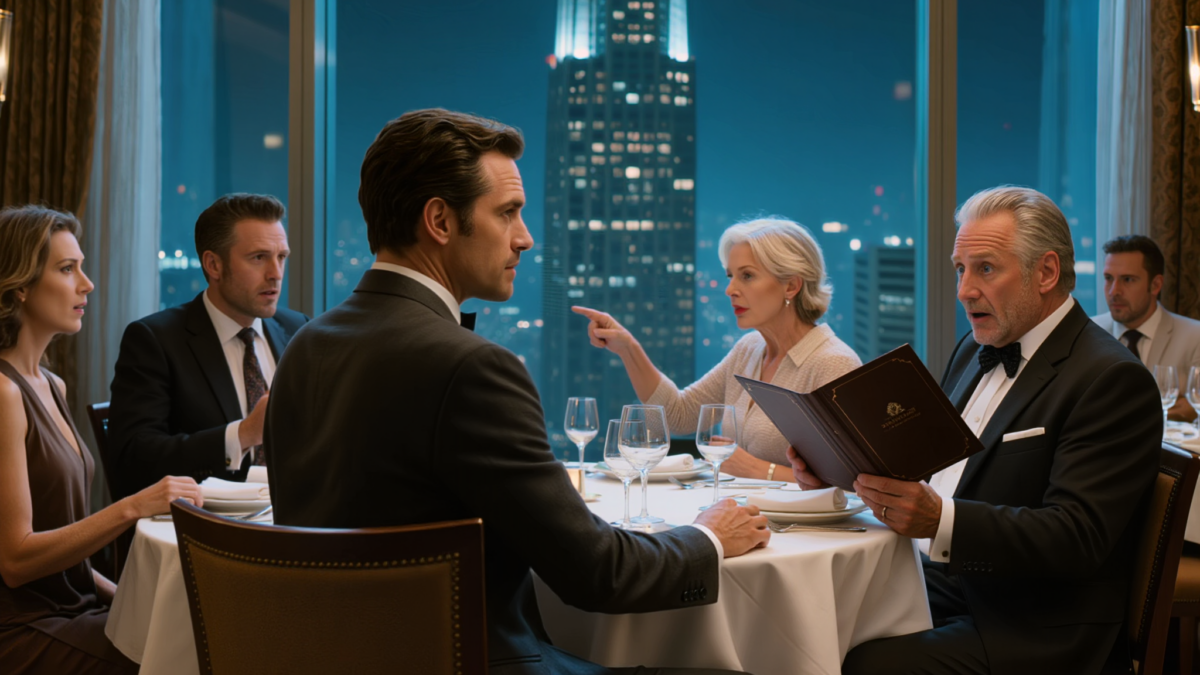
My usual table was a large circular booth beside a panoramic window overlooking the city.
From that window, the skyline stretched across the night.
And near its center stood an illuminated skyscraper with a single blue word near the top.
Vanguard.
My family arrived a few minutes later.
Francois personally escorted them to the table.
They looked uncomfortable among the elegant furnishings, expensive clothing, and quiet atmosphere of the restaurant.
Dad watched Francois pull out Mom’s chair.
“They know you here?” he asked.
“I’m a regular,” I replied.
Everyone sat down.
The waiter brought water and menus.
Dad opened his menu, looked at the prices, and immediately closed it.
“This is ridiculous, Christopher. This is a waste of money.”
“It’s not a waste if there’s a purpose, Dad.”
I turned toward the window.
“It’s a beautiful view, isn’t it?”
They followed my gaze.
Mom noticed the illuminated skyscraper.
“That building,” she said, pointing. “The one that says Vanguard. Is that…?”
“That’s Vanguard Tower. My headquarters. I own the top 10 floors. My main office is right up there.”
I pointed toward the penthouse level.
Dad stared.
Leo looked as though he could barely process what he was seeing.
The company my family had dismissed as an insignificant technology business occupied the upper floors of one of the city’s most prominent buildings.
The waiter returned.
I ordered the chef’s tasting menu for the table and a bottle of wine that cost more than my first car.
Dad didn’t argue.
He kept looking toward the tower.
Once the waiter left, I leaned forward.
“You’re right, Dad. This dinner is expensive, but I consider it an investment. An investment in the truth, because it seems there are a few things you all have misunderstood for a very long time.”
I looked directly at him.
“You think I’m a failure. The text you sent me last night made that perfectly clear. You think I’m a disappointment who needs to face the real world. So, let’s talk about the real world.”
I took a sip of water.
“3 years ago, the real world was about to crush you.”
Then I explained exactly what had happened to his business.
His lawyer had been preparing bankruptcy filings for Vance and Sun.
The company owed more than $200,000 to suppliers. Dad had defaulted on an equipment loan, and the IRS was threatening a lien against his assets because of unpaid payroll taxes.
At the same time, the bank was preparing to foreclose on the family home.
My father’s face became pale.
My mother’s hand trembled as she reached for her water glass.
I continued.
“A company called Vanguard Holdings bought your mortgage and settled your debts.”
I reminded Dad about the money owed to lumber suppliers.
$90,000.
The outstanding amount for the backhoe.
$40,000.
And the unpaid tax bill.
$23,000.
My company had paid those amounts.
Then I reminded him about a phone call he’d received a few weeks after the business had been rescued.
A man named Mark Henderson, CEO of Henderson Manufacturing, had unexpectedly offered him the largest construction contract of his career.
Dad had celebrated that contract at Christmas, calling it a miracle.
I let him remember.
Then I explained.
“It wasn’t a miracle, Dad. It was me. I own Vanguard Holdings. I own Vanguard Tech. Mark Henderson is on my board of directors. I asked him to give you that contract as a personal favor.”
Mom began crying.
“Christopher, why wouldn’t you tell us?”
I turned toward her.
“Why? Because every time I tried to share my life with you, it was thrown back in my face.”
I reminded her how every holiday had become another celebration of Leo’s comparatively small achievements while nobody showed any interest in mine.
They praised him for landing construction deals while I was handling billion-dollar mergers they knew nothing about.
Then I looked at Leo.
“And then there’s you, Leo.”
He avoided my eyes.
“You knew I owned the house. You knew I was helping. But you couldn’t stand it, could you?”
I reminded him of our earlier telephone conversation.
He had learned the truth and chosen to manipulate Dad’s fear of losing control.
He had suggested that I was trying to take away the business and property I’d actually helped preserve.
“You used his pride and his fear against him and against me. All because you couldn’t handle the truth.”
I leaned back.
For the first time, my father wasn’t looking at Leo with unquestioning admiration.
He looked between us, struggling to understand how much of his family’s recent history he had misunderstood.
Outside the window, Vanguard Tower glowed against the night.
I had built that company.
I had built a life my family had spent years dismissing.
And I had done it without their encouragement.
The food arrived, but nobody began eating.
The plates sat untouched.
Around us, other diners continued their conversations, and glasses clinked gently against the tables.
At our booth, nobody knew what to say.
Dad suddenly looked much older than I remembered.
He no longer had the certainty that had defined him throughout my childhood.
Mom was crying silently.
Eventually, she looked at me.
“We… we didn’t know.”
“You didn’t want to know,” I replied.
I wasn’t trying to hurt her.
But after everything, I could no longer pretend that her silence hadn’t mattered.
For years, it had been easier for my parents to accept Leo’s definition of success than to understand mine.
It had been easier to dismiss my work than to admit that the family business was struggling.
Dad finally spoke.
“The money? You paid it all?”
“Yes.”
“And the house? It’s really yours?”
“It has been for 3 years.”
He shook his head slowly.
Then he looked toward Leo.
For the first time, I saw disappointment replace the pride he normally reserved for my brother.
Leo shifted uncomfortably in his chair.
Finally, he looked up.
“Chris, I’m sorry,” he said. “I was jealous. I saw you with all this, and Dad still… He still looked at me like I was the hero. I didn’t want to lose that.”
It was the most honest thing he had ever said to me.
For years, Leo had enjoyed being our father’s favorite. He had built much of his identity around being the successful son, the one who would inherit the family business.
Finding out that his younger brother had quietly surpassed him had threatened everything he believed about himself.
His actions had nearly torn our family apart.
But sitting across from him, I found that I didn’t have the energy to remain angry.
I was simply tired.
The truth was finally out.
There was nothing left to hide behind.
I asked the waiter for the check.
The untouched dinner had served its purpose.
As the waiter processed my card, I explained what would happen next.
“You can continue to live in the house. I’m not going to throw my own parents out on the street.”
I told Dad and Mom that the retirement account would remain in their names.
Whenever they were ready to move into something smaller, that money would be available to them.
Then I explained the conditions.
“But things are going to be different. This dynamic, the one where I am the family disappointment and the emotional punching bag, is over. It ends tonight.”
I wasn’t asking for admiration.
I wasn’t demanding gratitude.
I wanted basic respect.
If we were going to have a relationship, they would have to stop treating me like a problem they needed to correct.
I was their son, not their failure.
Then I turned to Leo.
“And you will find your own way. You can stay at Vance and Sun, but your free ride is over. You’re going to have to earn your place for real this time. The company has a board now, and I’m the chairman.”
Leo went pale.
I signed the bill and left a generous tip.
Then I stood.
“I’ve arranged for the car to take you home. I’m going to walk.”
Mom looked up.
“Christopher, don’t go. Please, let’s talk more.”
“We’ve said enough for one night, Mom. You all have a lot to think about.”
I walked away from the table.
Outside, the night air felt cool against my face.
For twenty-nine years, I had carried the weight of my father’s disapproval. Even after becoming successful, some part of me had continued wondering whether he would ever be proud of me.
That night, I finally understood something.
I didn’t need his permission to be proud of myself.
I didn’t know whether our family could recover from everything that had happened.
But for the first time, I knew I would be all right even if it didn’t.
I had spent years protecting my parents, their business, and their home.
Now I had finally protected myself.
The following six months were among the quietest of my adult life.
There were no angry messages arriving late at night, no tense telephone conversations, and no family arguments demanding my attention.
There was simply space to live.
Vanguard Tech continued growing.
We completed the largest agreement in the company’s history, a partnership with a global logistics firm that pushed our valuation dramatically higher.
Instead of celebrating with an extravagant party, we gave every employee a companywide bonus and an additional week of paid vacation.
Watching my colleagues enjoy that recognition meant more to me than another impressive figure on a financial statement.
I also began doing things I’d neglected.
I took weekends off.
I went hiking and read books that had nothing to do with technology.
I spent time with old Stanford friends who had known me before Vanguard became successful.
They remembered my terrible jokes and my endless fascination with science-fiction movies.
They didn’t need me to prove anything.
One sunny Saturday, I drove to the cemetery.
I visited a few times each year.
I stopped beside a simple granite headstone belonging to Professor Albbright, my mentor at Stanford.
He had been one of the first people to recognize the potential of the software project my friends and I developed in our dorm room.
After seeing our work, he’d pulled me aside.
“Mr. Vance, don’t let anyone, and I mean anyone, ever tell you that your ideas are foolish.”
He had invested the first $10,000 in my company.
Professor Albbright passed away from a heart attack just a year before Vanguard went public.
He never saw how large the company eventually became.
I brushed a few leaves from his headstone.
“Well, Professor, we did it. It got a little messy along the way, but we did it.”
I told him about the city contract and the new logistics partnership.
I also told him about the dinner with my family and how I had finally confronted my father.
It felt meaningful to share those accomplishments with someone who had believed in me when almost nobody else did.
On the drive home, I realized that the need for my father’s approval had finally faded.
Success hadn’t filled that emptiness.
Neither had money.
I had gradually learned to value myself without waiting for someone else to confirm that I deserved it.
The peace I was experiencing didn’t come from changing my family.
It came from changing my relationship with their expectations.
Just when I had become comfortable with that peace, my family began reaching out.
The first message came from Dad on an ordinary Tuesday afternoon.
It contained a link to a news article about Vanguard Tech’s logistics partnership.
Underneath, he had written:
“This is very impressive. We are proud of you.”
I stared at those words for a long time.
We are proud of you.
I couldn’t remember him ever saying that to me before.
It was a small message.
But after a lifetime of hearing how disappointing I was, it meant something.
I replied with a simple thank you.
A few weeks later, Mom called.
She told me Leo had moved out.
He had also resigned from Vance and Sun and accepted an entry-level position at another construction company across town.
“He said he needed to build something on his own,” she explained.
Then her voice became hesitant.
“Christopher, there’s something I should have told you. Something I was too ashamed to admit.”
She confessed that she had known how serious the financial crisis had been three years earlier.
She had seen the bank’s letters and the warnings from the IRS.
She knew the business was in trouble and that they were close to losing the house.
“Why didn’t you say anything, Mom?” I asked. “Why didn’t you call me?”
Her voice broke.
“Because I was a coward.”
She explained that Dad’s pride had always been fragile. She had feared what would happen if he were forced to admit that his business was failing.
She was also ashamed of their financial situation.
“And I was ashamed to admit to my successful son that we had failed so badly,” she said. “It was easier to just hope for a miracle. And then you became that miracle. And I was still too ashamed to admit I needed one.”
For years, I had believed Mom’s silence was simply her way of avoiding conflict.
Now I understood that it had also been a deliberate choice.
She had known the truth and had been too afraid to confront it.
Hearing her admit that didn’t make me angry.
It made me sad for everything we had lost because nobody had been willing to speak honestly.
“I understand, Mom,” I told her.
And I meant it.
The final attempt at reconciliation came from Leo.
One day, a handwritten letter arrived in my mailbox.
It was an old-fashioned letter, and its message was more thoughtful than anything he’d said during our dinner.
He apologized again, this time for the weakness that had driven his jealousy.
“I spent my whole life playing the part Dad wrote for me. I never stopped to think about who I actually wanted to be. Seeing you, seeing everything you built by being yourself, made me realize I hadn’t built anything at all.”
Reading those words, I began to believe that something in our family might genuinely be changing.
Leo was no longer relying on Dad’s approval to define himself.
Mom had finally admitted her own mistakes.
And Dad had made a small but meaningful effort to acknowledge my achievements.
None of those things erased the past.
But they suggested that we might eventually build something more honest.
A year after the dinner at the Metropolitan, on a crisp autumn Sunday, I found myself driving down Maple Street.
I hadn’t planned the visit.
Somehow, my car had carried me toward the place I had once called home.
I parked across the street.
The house looked almost exactly as I remembered.
The enormous oak tree was shedding red and golden leaves across the lawn.
Paint was peeling from the front porch railing.
After all the arguments over ownership, mortgages, and family loyalty, the house itself looked remarkably ordinary.
Then I noticed Dad in the front yard.
He was repairing a loose board on the white picket fence.
He had a hammer in one hand and several nails held between his teeth.
He wasn’t rushing or working with expensive tools. He moved slowly, taking his time with the repair.
He looked peaceful.
Eventually, he noticed me watching.
He stopped, removed the nails from his mouth, and looked across the street.
Our eyes met.
There was no anger in his expression.
No resentment.
He gave me a small, hesitant smile.
Then he lifted one hand in a simple wave.
I took a deep breath and stepped out of the car.
Fallen leaves crunched beneath my feet as I crossed the street.
I stopped at the gate.
“The fence looks good,” I said.
“It’s always something with an old house,” Dad replied quietly.
He looked down at the hammer, then back at me.
“Your mother is making that apple pie you like.”
For a moment, neither of us said anything.
It wasn’t the apology I had imagined needing when I was younger.
There was no long speech about regret or promises to make up for everything that had happened.
But I understood what he was offering.
An invitation.
A chance to begin again.
“Yeah,” I said, smiling. “I’ll bet it smells good.”
“Go on in,” he told me, gesturing toward the front door with his hammer. “She’ll be happy to see you.”
I opened the gate.
It swung smoothly, without a creak.
Then I walked across the yard toward the house.
I knew our relationship would never be perfect. Too much had happened, and the years of disappointment and silence couldn’t simply disappear.
The past would always be part of our family.
But for the first time, I believed we might be able to live together without pretending it hadn’t happened.
My parents had begun seeing me as the person I really was.
My brother was learning to build a life of his own.
And I no longer needed their approval to feel secure in mine.
The house on Maple Street had once represented everything that divided us.
Now, as I walked toward its front door, it offered the possibility of something different.
Not a perfect family.
Not a past without mistakes.
Just a home that might finally be built on something stronger than pride, silence, and secrets.
A foundation of hard-won, beautiful, messy truth.








