My father shoved a Christmas cake into my face because I refused to give my condo to my younger brother. Caleb kept livestreaming. Mom worried about the tablecloth. I reached for my phone—then Grandpa’s cane echoed through the hallway. He stepped inside, pulled a folded envelope from his coat, and Dad went pale.
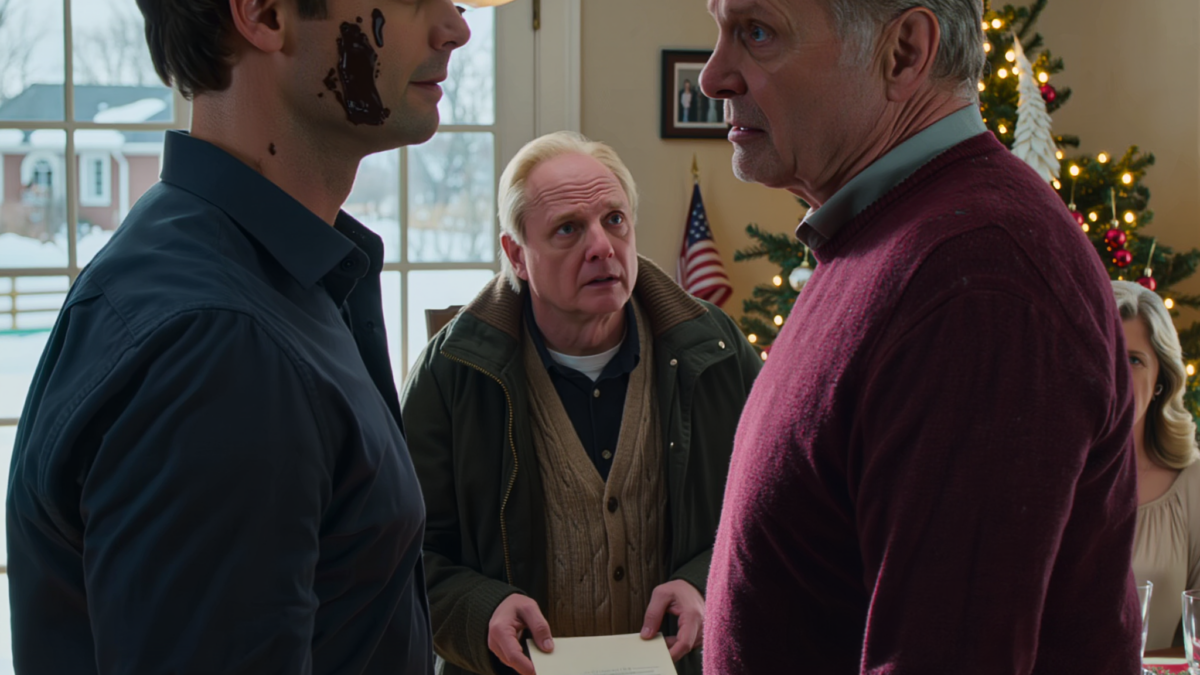
I’m Jacob, thirty-two years old, and on Christmas Eve, my own father smashed a massive chocolate Yule log cake directly into my face because I refused to hand over the deed to my apartment.
Before I tell you about the shocking twist that left my parents homeless in the snow, let me know where you guys are watching from in the comments below.
The drive to my parents’ house should have been a twenty-minute cruise down the interstate. Instead, it felt like a slow march toward a sentencing hearing.
Snow was falling in thick, wet clumps against the windshield, the wipers slapping back and forth in a rhythm that matched the knot tightening in my stomach.
It was Christmas Eve. The radio was blasting “It’s the Most Wonderful Time of the Year,” but inside my chest, it felt more like the calm before a hurricane.
I glanced at the rearview mirror. The back seat was piled high with gifts. I had spent a significant chunk of my salary on them this year.
There was a high-end coffee maker for my mother because she constantly complained about her old drip machine. For my father, Arthur, I’d bought a set of premium golf clubs, even though he hadn’t hit the fairway in three years.
And for Caleb, my younger brother, I had picked up the latest gaming console.
It wasn’t because we were close. We weren’t.
It was a peace offering. It was the tax I paid to be part of this family.
I had been living in my own place, a condo in the city, for about three months now. It was my sanctuary. I bought it with my own money, money I earned from years of grinding through sixty-hour weeks as a software engineer.
No inheritance, no handouts. Just me, my code, and a lot of sleepless nights.
Moving out was the best decision I ever made.
The silence in my apartment was golden. No shouting, no passive-aggressive comments about my career choices, and, most importantly, no cleaning up after Caleb.
But then the phone call came yesterday.
“Jacob, honey,” my mom, Martha, had said, her voice dripping with that sugary tone she used when she wanted something. “You have to come home for Christmas Eve dinner. Your father and I need to discuss a family matter. It’s important. Plus, I’m making your favorite roast.”
I should have known better.
I should have stayed in my condo, ordered Chinese takeout, and watched Die Hard. But that old guilt, that ingrained need to please them, dragged me back.
I pulled into the driveway.
The house looked picture-perfect. Multicolored lights draped the roofline, blinking in a chaotic pattern that used to give me seizures as a kid.
An inflatable Santa waved maniacally from the front lawn, battered by the wind. It looked like the quintessential American Christmas card.
I took a deep breath, grabbed a few of the smaller gift bags, and stepped out into the freezing air.
The cold bit at my cheeks, but it was refreshing compared to the stifling heat I knew waited for me inside.
I unlocked the front door. I still had my old key.
The smell hit me first. Cinnamon, pine, and roasting meat.
It smelled like nostalgia.
It smelled like a lie.
“Hello?” I called out, stomping the snow off my boots.
“In the living room!” my mother shouted.
I walked in.
The living room was a shrine to Christmas consumerism. Piles of wrapped boxes sat under a massive tree that grazed the ceiling.
And there, sitting on the couch, surrounded by torn wrapping paper, was Caleb.
He didn’t look up.
He was twenty-four years old, but he looked like an oversized teenager. He was wearing pajamas, his hair a messy mop, and he was holding a phone attached to a ring-light tripod, talking loudly to a screen.
“Yo, guys, just checking in on the haul. We’re waiting for the big stuff later, but look at this!”
He held up a sneaker box.
He was livestreaming again.
Caleb thought he was an influencer. In reality, he was an unemployed guy with a gambling problem and a delusion that the world owed him an audience.
“Hey, Caleb,” I said, setting the gifts down on the coffee table.
He glanced at me, then looked back at his phone.
“Oh, hey, chat. My brother just walked in. The tech guy. Boring stuff. Anyway, make sure you smash that like button if you want to see the Christmas feast.”
He didn’t even say hello. He just narrated my arrival to strangers.
My father, Arthur, was sitting in his recliner, a glass of scotch in his hand.
He didn’t get up. He didn’t smile.
He just eyed the gifts I put down and then looked at me.
“You’re late,” he grunted.
“It’s five-thirty, Dad. You said six,” I replied, trying to keep my voice even.
“Traffic is an excuse for poor planning,” he muttered, taking a sip of his drink. “Did you bring it?”
I frowned, taking off my coat.
“Bring what? The gifts? Yeah, they’re right here. The golf clubs are in the car. I’ll get them later.”
He waved his hand dismissively.
“Not the toys, Jacob. The paperwork. Your mother said you’d bring the paperwork.”
“What paperwork?”
Before he could answer, my mother bustled in from the kitchen, wiping her hands on a festive apron that said “Santa’s Helper.”
She rushed over and gave me a stiff side hug, careful not to get flour on my suit.
“Jacob, you made it!”
She pulled back, scanning my face, then my clothes.
“You look thin. Are you eating? City food is full of preservatives.”
“I’m fine, Mom. Dad was asking about paperwork.”
She froze for a split second, her smile faltering before she plastered it back on.
“Oh, not now, Arthur. Let the boy settle in. It’s Christmas Eve. We can talk business after dinner. Jacob, why don’t you go help Caleb set up his lighting? He needs the dining room to look professional for his stream.”
I looked at Caleb, who was now posing with a bottle of cologne he must have opened from an early gift.
“Mom, I’m not a lighting grip. I just drove an hour through a snowstorm.”
“It’s for the family, Jacob,” she said, her voice dropping that octave that meant do it or else. “Support your brother. His career is taking off.”
“Career?” I scoffed under my breath.
But I didn’t push it. Not yet.
I wandered into the dining room.
The table was set for a king. Fine china, crystal glasses, polished silver.
And in the center, resting on a crystal platter, was the masterpiece: a Yule log cake.
It was a bûche de Noël, rolled perfectly and covered in thick, dark chocolate ganache textured to look like bark, with meringue mushrooms and holly leaves made of marzipan.
It was my favorite dessert.
Every year, I looked forward to it. And every year for the last decade, something had ruined it.
Last year, Caleb sneezed on it by accident. The year before, Dad dropped it while drunk.
I stared at the cake, mesmerizingly dark and rich. It looked perfect.
Maybe this year would be different.
Maybe we would actually sit down, eat cake, and laugh.
“Don’t touch it.”
Caleb’s voice came from behind me.
He was standing in the doorway, phone in hand.
“I need B-roll footage of it before anyone cuts into it. It’s for the aesthetic.”
“I wasn’t touching it, Caleb.”
“Good, because this stream is sponsored. Well, not officially, but I’m tagging the bakery, trying to get a brand deal.”
He walked past me, shoving his phone camera inches from the frosting.
I watched him, a grown man acting like a child, and felt a wave of exhaustion.
I looked around the room.
The walls were covered in photos. Caleb winning a participation trophy in soccer. Caleb at prom. Caleb’s high school graduation.
There was one photo of me, small and tucked away in the corner, from when I got my first job.
My gut twisted.
I should have turned around right then. I should have walked out the door, gotten in my car, and driven back to my silent, peaceful condo.
But I didn’t.
I stayed.
And that was my first mistake of the night.
“Dinner in ten!” Mom yelled. “Jacob, pour the wine, and use the good vintage. We’re celebrating tonight.”
“Celebrating what?” I asked the empty room.
Nobody answered.
But the way my father was looking at me from the living room, eyes narrowed like a hawk spotting a field mouse, told me the celebration wasn’t for me.
It was going to be at my expense.
As I uncorked the bottle of Cabernet, a vintage I knew cost more than Caleb’s entire wardrobe, my mind drifted.
Being back in this house was like walking through a museum of my own inadequacy.
Every corner held a memory, and very few of them were warm.
I found myself staring at the fireplace mantel.
There was a scratch in the wood, right near the edge.
I was ten years old again.
It was Christmas morning. I had asked for one thing that year: a red mountain bike.
I had been obsessed with it. I cut out pictures from catalogs, taped them to the fridge, and promised to do extra chores.
When I ran downstairs that morning, there it was.
Shiny. Red. Perfect.
I remember the joy exploding in my chest.
I rushed toward it, but then a wail pierced the air.
Caleb, who was four at the time, was sitting amidst a pile of his own toys—expensive trucks, blocks, a train set—and he was screaming.
He pointed at my bike.
“I want that! I want the bike!”
My mother had swooped in, scooping him up.
“Shh, baby, don’t cry.”
She looked at my father.
“Art, he wants the bike.”
My father didn’t even look up from his coffee.
“Let him ride it, Jacob.”
“But it’s mine,” I had whispered. “His legs are too short. He can’t reach the pedals.”
“Don’t be selfish,” Dad snapped. “Share with your brother.”
Caleb got on the bike.
He couldn’t ride it.
He dragged it around the living room, crashing it into the furniture, chipping the paint, and finally ramming it into the mantelpiece, leaving that scratch.
When he got bored ten minutes later, he left it on the floor.
When I went to pick it up, Dad yelled at me for leaving a tripping hazard.
That was the dynamic.
Caleb wanted. Caleb got. Jacob worked. Jacob gave.
“Spacing out again?”
I snapped back to reality.
Mom was standing beside me with a bowl of mashed potatoes.
“You always did live in your own head. That’s why you’re still single, probably.”
“I’m focusing on my career, Mom. Software engineering is a demanding career.”
She sniffed.
“Staring at a computer all day. Caleb is out there connecting with people. He’s building a brand.”
I poured the wine, filling four glasses.
“Does his brand pay his rent yet? Or are you guys still covering that?”
Mom’s eyes narrowed.
She leaned in close, her voice dropping to a harsh whisper.
“Don’t you start. Your brother is going through a transition. He’s sensitive. You have so much, Jacob. You have that fancy job, that big salary, that huge apartment all to yourself. It’s embarrassing.”
“Embarrassing that I’m successful?”
“Embarrassing that you hoard it,” she hissed. “Family helps family. That’s what Christmas is about. Giving.”
She grabbed the wine bottle from me and marched to the table.
I stood there feeling the blood rush to my face.
Hoard it?
I paid my taxes. I paid off my student loans. I sent them money for their anniversary.
And now owning a two-bedroom condo was hoarding.
I walked to the table.
The Yule log cake sat there mocking me.
It was beautiful, but it felt like bait.
I remembered something else then.
The real reason I moved out three months ago.
It wasn’t just the noise. It was the spare-key incident.
I had come home from work early one day to find my room in the family house tossed.
Drawers open. Clothes everywhere.
My limited-edition collectibles, things I had invested in, were gone.
I found them in Caleb’s room.
He had sold half of them online to pay a debt.
When I confronted Mom, she admitted she gave him the key to my room because he needed to feel like he had access to his big brother.
That was the day I signed the papers on my condo.
I needed a lock that Martha Whitaker didn’t have a key to.
“Sit down, Jacob.”
Dad barked from the head of the table.
I took my seat.
The chair felt hard and unforgiving.
Caleb sat opposite me, adjusting his tripod so the ring light reflected in his eyes.
“Okay, stream is live in three, two…”
Caleb whispered to himself, then plastered on a fake, blinding smile.
“What is up, fam? Merry Christmas! We are here at the Whitaker estate, about to dig into this feast. Shout-out to Mama Whitaker for the grub.”
He panned the camera to Mom, who waved and preened. Then he panned to Dad, who raised his glass stoically.
Then to me.
“And there’s Jacob the Grinch!” Caleb laughed. “Smile, bro. You’re on the internet.”
I didn’t smile.
I took a sip of wine.
It tasted sour.
Or maybe that was just the bile rising in my throat.
“Let’s eat,” Dad said.
The food was passed around.
Roast beef, buttery potatoes, green beans with bacon.
It was delicious, technically, but I couldn’t taste it.
I was waiting for the other shoe to drop.
The paperwork. The discussion.
It didn’t take long.
About halfway through the meal, just as I was cutting into a piece of beef, Dad cleared his throat.
It was a loud, rumbling sound that commanded attention.
Caleb muted his stream for a second, a rare moment of awareness.
“Jacob,” Dad said, wiping his mouth with a linen napkin. “Your mother and I have been thinking about your living situation.”
I put my fork down.
“My living situation is fine, Dad. I love the condo. It’s close to work. It’s quiet.”
“It’s selfish,” Dad interrupted.
Silence.
Even Caleb looked up, intrigued.
He unmuted his stream, sensing drama. He tilted the phone slightly so both Dad and I were in the frame.
“Excuse me?” I asked.
“You have a two-bedroom condo in the downtown district,” Dad continued, his voice calm and factual, like he was reading a weather report. “Twelve hundred square feet. High ceilings. Fiber-optic internet.”
“I know the specs, Dad. I bought it.”
“And you live there alone,” Mom chimed in, her voice soft but poisonous. “All that space wasted. Meanwhile, your brother is here trying to launch a media empire from his childhood bedroom. The lighting is bad. The acoustics are terrible. He can’t focus with us old folks walking around.”
I looked from Mom to Dad, then to Caleb, who was trying to look like a suffering artist.
“So?” I asked, though I already knew where this was going.
“So,” Dad said, leaning forward, placing his elbows on the table, “we’ve decided it’s time for a swap.”
I blinked.
“A swap?”
“Caleb needs your condo,” Dad said. “He needs the studio space. The location is better for his networking. You, on the other hand, you’re at the office all day. You don’t need luxury. You need to save money. So Caleb will move into the condo. You will move back here.”
I laughed.
It was a dry, humorless sound.
“Good joke, Dad. Merry Christmas.”
Dad’s face didn’t move.
“It’s not a joke. I have the papers drawn up. A lease transfer agreement, or ideally, you just sign the deed over to us for safekeeping, and we let Caleb manage the property.”
The room spun a little.
They weren’t asking to borrow sugar.
They were asking for my home. My sanctuary. The only thing I truly owned.
“You want me to give my apartment to Caleb?” I repeated, making sure the camera heard every word.
“Not give,” Caleb said, speaking up for the first time. “Reallocate. Think of it as an investment in my brand. When I blow up, I’ll buy you, like, two houses.”
“You can’t even buy your own lunch, Caleb,” I snapped.
“Hey!”
Dad slammed his hand on the table.
The silverware rattled.
“Watch your tone. We are a family. We share resources. You have an excess. Your brother has a need. It is simple math, Jacob.”
“It’s not math, Dad. It’s theft.”
“Theft?” Mom gasped, clutching her pearls.
Pearls I bought her three years ago.
“How dare you, after everything we’ve done for you? We raised you. We fed you.”
“And I’ve paid you back,” I said, my voice rising. “I paid rent from the day I turned eighteen until the day I moved out. I bought the car you’re driving, Mom. I paid for the new roof last summer.”
“That is your duty!” Dad roared. “You are the eldest. It is your duty to lift up the family. Caleb is special. He has talent. He just needs a break. You? You are a worker bee. You can work from anywhere. You can work from the basement here.”
“The basement?”
I stared at him.
“You want me to live in the damp, unfinished basement so he can live in my penthouse condo?”
“It’s temporary,” Mom pleaded. “Just for a year or two until Caleb gets on his feet.”
I looked at Caleb.
He was smirking.
He knew he had won.
He always won.
He looked at his phone screen and winked at his viewers.
Something inside me snapped.
The ghost of the ten-year-old boy who lost his bike stood up and said, Enough.
The air in the dining room was so thick with entitlement, you could cut it with a knife.
The festive smells of cinnamon and roast beef had turned nauseating.
I looked around the table at the people who shared my DNA.
They looked like strangers.
Actually, worse than strangers.
Strangers don’t feel entitled to the roof over your head.
“Let me get this straight,” I said, my voice trembling slightly, not from fear, but from the sheer effort of holding back a scream. “You want me to sign over the deed, a legal document representing half a million dollars of my hard-earned equity, to Caleb for free?”
“Don’t be so crass about money,” Dad spat, cutting into his steak aggressively.
The knife screeched against the porcelain plate, sending shivers down my spine.
“It’s about potential. Caleb is on the verge of greatness. We need to facilitate that greatness.”
I turned to Caleb.
“You have three hundred viewers, Caleb. Half of them are bots.”
“I have four thousand followers!” Caleb shot back, his face flushing pink. “And engagement is up twenty percent this month. You don’t understand the algorithm, Jacob. You’re a boomer in a millennial’s body.”
“I build the algorithms you use to beg for money,” I countered.
“Enough!” Mom intervened, pouring more wine into Dad’s glass, her hand shaking. “Jacob, stop attacking your brother. This is exactly why he needs the apartment. The negative energy in this house. It stifles his creativity. He needs a chi flow. Your condo has excellent chi.”
“My condo has a mortgage, Mom. Who’s going to pay that?”
“Well…” She hesitated, looking at Dad.
Dad chewed his meat slowly, swallowing before speaking.
“You will continue to pay the mortgage. Obviously. It’s in your name. It would be fraud if you didn’t.”
I stared at him, mouth agape.
“So I pay the mortgage, the utilities, the HOA fees, and I live in your basement while Caleb destroys my property?”
“He won’t destroy it,” Mom said quickly. “He’s very artistic.”
“He drew on the walls with a Sharpie when he was seventeen.”
“That was a mural!” Caleb yelled.
I pushed my plate away.
I couldn’t do this.
I stood up.
“No.”
The word hung in the air.
Simple. Quiet. Heavy.
Dad stopped chewing.
He looked up, his eyes cold and dead.
“What did you say?”
“I said no. I am not giving him my apartment. I am not moving back here. And I am certainly not paying for him to play pretend influencer in my living room.”
Dad put his fork down slowly.
“Sit down, Jacob.”
“I’m leaving.”
“Sit down!”
His voice boomed, shaking the walls.
I froze.
Old habits die hard.
The authority in his voice was a trigger I had been programmed to obey for three decades.
I didn’t sit, but I didn’t walk away either.
I stood gripping the back of my chair, my knuckles turning white.
“You are an ungrateful child,” Dad said, his voice dropping to a menacing growl. “We sacrificed everything for you. We gave you structure, discipline.”
“You gave me anxiety and a complex,” I shot back.
“We made you a man!”
Dad stood up now, looming over the table.
He was a big man, broad-shouldered, though age was starting to soften him around the middle.
But in that moment, he looked giant.
“And this is how you repay us? By hoarding your wealth? By stepping on your brother?”
“He’s not stepping on me, Dad,” Caleb interjected, holding the phone up high to get a better angle of the confrontation. “He’s just jealous. He’s always been jealous of my charisma.”
“Shut up, Caleb,” I snapped.
“Don’t you tell him to shut up!” Mom shrieked.
She stood up, too, tears instantly streaming down her face.
A weapon she could deploy on command.
“You’re ruining Christmas! Why can’t you just be generous? Why do you have to be so difficult?”
“Difficult? Mom, you’re asking for my house.”
“We’re asking for help!” she wailed. “Your father’s pension isn’t what it used to be. The heating bills here are huge. If you come back, your rent money—I mean, your contribution—would help us keep this place going. And Caleb would be off our hands. It solves everything.”
The truth finally slipped out.
It wasn’t just about Caleb.
It was about them, too.
They wanted my rent money. They wanted me back under their thumb, subsidizing their life while Caleb lived like a king on my dime.
“So that’s it,” I said, a bitter smile touching my lips. “I’m the cash cow. Caleb is the golden child, and I’m just the wallet.”
“You’re the eldest!” Dad shouted. “It is your responsibility. The Bible says—”
“Don’t quote the Bible to me, Arthur,” I said, dropping the “Dad.” “You haven’t been to church in ten years.”
The room went silent.
Disrespecting Arthur Whitaker’s religious authority was a sin worse than murder in this house.
Caleb whispered to his phone.
“Oh, snap. He went there. Chat, are you seeing this? Send a galaxy if you think he’s going to get hit.”
“You want a reason?” I asked, looking at all of them. “You want to know why I won’t help Caleb? Because I ran a credit check on him.”
Caleb’s smug smile vanished.
“You what?”
“I work in data, Caleb. This is public record. You have three maxed-out credit cards. You have a lien against your car. You owe a bookie in Jersey two grand. You’re not an influencer. You’re a gambler.”
Mom gasped.
“That’s a lie! Caleb, tell him it’s a lie!”
Caleb stuttered, his face turning pale.
“I… it was an investment. Crypto. It’s going to bounce back.”
“He needs my apartment to hide from debt collectors,” I told Dad. “Because they can’t repossess a house he doesn’t own. He wants a fortress.”
I looked at Dad, waiting for the explosion, waiting for him to turn on Caleb, to yell at him for being irresponsible.
But Arthur Whitaker didn’t look at Caleb.
He looked at me, and his eyes were filled with pure hatred.
“You spied on your brother?” Dad asked.
“I protected my assets,” I said.
“You traitor,” Dad whispered. “You are trying to humiliate him in front of us on Christmas.”
“He’s humiliating himself.”
I pointed at the phone.
“He’s livestreaming this. He’s showing the world his own incompetence.”
“He is creating content!” Dad roared. “And you are sabotaging him!”
Arthur reached out and grabbed the nearest thing to him.
It was a crystal gravy boat.
He hurled it.
It missed my head by an inch and shattered against the wall behind me, spraying hot brown gravy all over the expensive wallpaper.
“Get out!” Mom screamed.
But she wasn’t screaming at me.
She was screaming at the wall.
“My wallpaper!”
“No, don’t get out,” Dad said, breathing heavily, his face turning a dangerous shade of purple. “You sit down. You sign that paper, or so help me God, Jacob, you will never set foot in this family again.”
I looked at the shattered gravy boat.
Then I looked at the Yule log cake.
It sat there, pristine and untouched, a chocolate island in a sea of madness.
“I’m leaving,” I said again, turning toward the door. “And I’m not signing anything. Caleb can live in a box for all I care.”
“You walk away now,” Dad warned, his voice shaking, “and you are dead to me.”
I paused.
My heart was pounding against my ribs like a trapped bird.
This was it.
The severance. The amputation.
“I’ve been dead to you for years, Dad,” I said softly. “You just didn’t notice because the checks kept clearing.”
I took a step.
“I said stop!”
I heard movement.
Heavy, fast movement.
I turned around just in time to see my father lunge for the center of the table.
His massive hands didn’t grab a knife. They didn’t grab the wine bottle.
They grabbed the Yule log cake.
Time seemed to slow down.
It was like one of those Matrix movies.
I saw my father’s fingers dig into the soft chocolate ganache of the bûche de Noël. I saw the meringue mushrooms crush under his grip.
I saw the rage in his eyes, a primal, unhinged fury that went beyond disappointment.
It was the rage of a tyrant losing control of his subjects.
“If you won’t share,” Dad screamed, “then have it all!”
He didn’t throw it.
He charged.
He closed the distance between us in two strides and slammed the entire cake—all five pounds of sponge, cream, and chocolate—directly into my face.
Whump.
The impact was heavy and suffocating.
The sponge was dense. The cream was cold and greasy, filling my nose, my eyes, my mouth.
For a second, I couldn’t breathe.
I stumbled back, blinded by darkness and sugar.
I clawed at my face, wiping away globs of frosting.
My expensive wool coat, the one I bought to look professional for them, was ruined.
Sticky brown sludge dripped down my collar, soaking into my shirt, sliding down my chest.
I gasped for air, blinking my eyes open.
The world was blurry, smeared with chocolate.
The first thing I heard was laughter.
High-pitched, hyena-like laughter.
I wiped my eyes and saw Caleb.
He was standing on his chair now.
The phone camera zoomed in on me.
“Oh, my God!” he was screaming. “Chat, did you see that? Headshot! Boom! Dad just wasted him! WorldStar! WorldStar!”
He wasn’t horrified.
He wasn’t concerned.
He was ecstatic.
This was the viral moment he had been waiting for.
“Look at him!” Caleb jeered, pointing a finger at me. “The chocolate monster! That’s what you get for being greedy, bro. Eat it! Eat the rich!”
I looked at Mom.
Surely she would stop this.
Surely this crossed a line.
Martha was standing by the sideboard, hand over her mouth.
But she wasn’t looking at me with pity.
She was looking at the table.
“The tablecloth,” she whimpered. “Arthur, the lace tablecloth. It’s stained.”
She didn’t care that her son had just been assaulted.
She cared about the laundry.
I looked at Dad.
He was panting. Chocolate smeared his hands and cuffs.
He looked triumphant.
He looked like he had just scored a touchdown.
“Now,” he said, breathing hard, “you wash your face. You sit down. And you sign the paper. Or the next thing I throw won’t be soft.”
I stood there dripping.
The sweetness of the frosting was sickening.
The humiliation burned hotter than the shame.
But strangely, underneath the shock, something else was rising.
Cold, hard clarity.
I was done.
I reached into my pocket, my hand slippery with cream, and pulled out my phone.
I wiped the camera lens with the only clean part of my sleeve.
“What are you doing?” Dad asked, his eyes narrowing.
“Documenting,” I said calmly.
My voice sounded strange to my own ears.
Dead calm.
“Assault. Battery. Caleb, keep filming. You’re providing excellent evidence for my lawyer.”
“Lawyer?” Dad laughed. “I’m your father. You don’t sue your father.”
“Watch me.”
“You ungrateful brat!”
Dad stepped forward again, raising a fist.
“Do it,” I challenged him. “Do it on camera. Let the world see Arthur Whitaker for who he really is. The church elder, the pillar of the community, beating his son over an apartment.”
Dad hesitated.
He looked at Caleb’s phone, then at mine.
The red recording light was a deterrent even his rage couldn’t fully ignore.
“You are not my son,” he spat. “My son would sacrifice for his family. My son would understand duty.”
“Your son is a bank account to you,” I said, wiping chocolate from my chin. “And the account is closed. Permanently.”
“Then get out,” he growled. “Get out of my house. And don’t you dare take those gifts back. Consider them payment for the food you wasted.”
“The food I wasted?”
I laughed, a wet, gurgling sound.
“You threw it at me!”
“Because you provoked me! You made me do it. Just like you made Caleb crash your bike. Just like you make your mother cry. It’s always you, Jacob. You are the poison in this house.”
The gaslighting was masterful.
Absolute.
In his mind, he was the victim.
He was the righteous punisher.
“I’m leaving,” I said, turning to the door. “But don’t expect me at the hospital when you get old. Don’t expect me at the funeral. And Caleb, good luck with the loan sharks. I hope they take likes as payment.”
“Wait!” Caleb yelled, jumping down. “Don’t go yet. I need a thumbnail. Turn around. Let me get a still shot of the mess.”
He grabbed my arm.
That was the mistake.
I spun around and shoved him.
Not hard, just enough to get him off me.
But Caleb, ever the drama queen, flailed his arms like he’d been shot.
He stumbled back, hit the edge of the rug, and fell onto his backside.
“Assault!” Caleb screamed to his phone. “He hit me, guys! He hit me!”
“You touched my son!” Dad roared.
He grabbed a heavy wooden dining chair.
He lifted it over his head.
I backed up, hands raised.
This was it.
He was actually going to kill me on Christmas Eve over a condo.
“Dad, put it down,” I said, my voice finally cracking.
“I’m going to teach you a lesson you’ll never forget!” he screamed, his face contorted into a mask of pure violence.
He took a step toward me.
And then the front door, which I had left unlocked when I entered, slammed open.
A blast of freezing wind swirled into the hallway, carrying snow with it.
Thump. Thump.
The sound of a heavy cane hitting the hardwood floor echoed like gunshots.
Everyone froze.
Dad lowered the chair slightly.
Caleb stopped screaming.
Mom looked toward the hallway.
Standing there, framed by the swirling snow and the blinking Christmas lights outside, was a figure in a heavy wool coat and a flat cap.
It was Grandpa Thomas.
My grandfather, Thomas Whitaker, was seventy-eight years old.
He was a veteran of Vietnam, a man who had built his own construction company from nothing, and the only person in this family I actually respected.
He lived in the in-law suite, a small converted carriage house at the back of the property.
He kept to himself mostly, disgusted by my father’s laziness and my brother’s vanity.
We thought he was asleep or watching old Westerns.
We were wrong.
He stood in the entryway, leaning on his cane, his eyes sharp as flint under his bushy white eyebrows.
He took in the scene in seconds.
The shattered gravy boat. The chair in my father’s hands. Caleb on the floor, fake crying. And me, covered head to toe in chocolate, shivering and humiliated.
He didn’t yell.
He didn’t scream.
He just walked into the dining room.
The thump-thump of his cane silenced the room.
He walked right up to me.
He reached into his pocket, pulled out a handkerchief, and gently—so gently it made my heart break—wiped a glob of frosting from my eye.
“You okay, son?” he asked.
His voice was gravel and iron.
“I… I think so, Grandpa,” I stammered.
He nodded.
Then he turned to my father.
“Put the chair down, Arthur,” Grandpa said softly.
Dad lowered the chair, his face flushing red.
He looked like a caught child, but his ego wouldn’t let him back down completely.
He pointed at Caleb.
“Dad, he’s disrespecting the house. He came here starting trouble.”
“I heard everything,” Grandpa said. “I was standing on the porch for ten minutes.”
The color drained from Dad’s face.
“You… you heard?”
“I heard you try to extort your son,” Grandpa said, moving his gaze to Mom. “I heard you guilt-trip him.”
He looked at Caleb.
“And I heard you laugh.”
“We were just… it was a negotiation,” Dad stammered. “We’re trying to keep the family together. Jacob is being selfish with his assets.”
“His assets?”
Grandpa let out a short, sharp laugh.
“You want to talk about assets, Arthur?”
Grandpa reached into his coat pocket and pulled out a thick, folded envelope.
He tossed it onto the dining table.
It landed right next to the empty platter where the cake used to be.
“What is that?” Mom whispered.
“That,” Grandpa said, “is the deed to this house.”
Dad frowned.
“I know it’s your house. But you said it would be mine one day.”
“I changed my will,” Grandpa said calmly. “Three months ago. The day Jacob moved out. The day I saw Martha give Caleb the key to Jacob’s room so he could steal from him.”
Mom let out a strangled gasp.
“You… you knew?”
“I see everything,” Grandpa said. “I saw how you treat the one boy who actually works. The one boy who actually has honor.”
Grandpa pointed a crooked finger at the envelope.
“I signed the property over as a gift inter vivos. That means while I’m living. The transfer was recorded last week.”
“So… so what?” Dad asked, sweating now. “So you gave it to me early to save on inheritance tax.”
Grandpa smiled.
It wasn’t a nice smile.
It was a shark’s smile.
“No, Arthur. I didn’t give it to you.”
Grandpa turned to me.
He placed his hand on my chocolate-stained shoulder.
“I gave it to Jacob.”
The silence that followed was deafening.
It was heavier than the snow outside.
“What?” Caleb whispered, lowering his phone.
“This house,” Grandpa said, his voice ringing out clearly. “This land, the carriage house I live in. It all belongs to Jacob Whitaker as of December fifteenth.”
“That’s impossible!” Dad screamed. “You can’t do that! I’m your son! It’s my birthright!”
“You lost your birthright when you threw a cake at the new landlord,” Grandpa said coldly.
He looked at me.
“It’s your house, Jacob. What do you want to do?”
I stood there stunned.
The weight of the moment crashed over me.
I looked at the house I grew up in, the walls that held so much pain.
I looked at my father, who was now trembling with fear.
I looked at my mother, who was sobbing into her hands.
I looked at Caleb, who looked like his world had just ended.
I wiped my face with my sleeve.
I took a deep breath.
“I want them out,” I said.
“Jacob!” Mom shrieked. “You can’t! It’s Christmas!”
“I want them out,” I repeated, louder this time. “Right now. Tonight.”
“You heard the man,” Grandpa said, banging his cane on the floor. “Get packing.”
“No!” Dad yelled. “I’m not leaving. This is my home. I’ve lived here for forty years!”
“And you haven’t paid rent in twenty!” Grandpa barked. “I let you stay here because I hoped you’d grow up. I hoped you’d become a man, but you’re just a bully. And tonight, the bullying stops.”
Grandpa looked at his watch.
“You have one hour. Anything left behind goes to Goodwill.”
The next hour was pure chaos.
Dad didn’t pack.
He paced.
He marched up and down the living room, ranting like a madman.
“He can’t do this! It’s illegal! Squatters’ rights! I have rights!”
He screamed at the walls.
“It’s not squatting if you’re family, Dad,” I said calmly.
I was in the kitchen, washing the cake off my face with dish soap.
“And Grandpa is the owner. Or was. Now I am. And I’m revoking your tenancy. Technically, you’re trespassing now.”
“Trespassing?”
Dad grabbed a vase from the mantel and smashed it on the floor.
“I’ll show you trespassing!”
Mom was hysterical.
She was running around, throwing random things into garbage bags.
Photo albums. Silverware. Christmas ornaments.
She wasn’t packing clothes.
She was packing valuables.
“My Hummel figurines!” she wailed. “Caleb, help me wrap these!”
But Caleb wasn’t helping.
He was sitting on the stairs, crying.
Real tears this time.
“Where am I going to go? I can’t live in a motel. The Wi-Fi is trash in motels!”
“Go to your girlfriend’s house,” I suggested, drying my face with a paper towel.
“She dumped me last week because I borrowed her credit card,” Caleb sobbed.
“Shocking,” I muttered.
Grandpa was sitting in Dad’s recliner, the throne of the house, sipping Dad’s scotch.
He looked calm, like a general watching a battle he’d already won.
“Four minutes,” Grandpa announced.
“I’m not going!” Dad roared.
He ran to the front door and locked it.
“I’m staying right here. Let the police come. I’ll tell them you tricked a senile old man into signing the deed.”
“I have a video of you, perfectly lucid, confirming the transfer,” Grandpa said, tapping his chest pocket. “And I have a competency test from my doctor dated yesterday. Try it, Arthur.”
Dad looked trapped.
His eyes darted around the room, wild and desperate.
He looked at the Christmas tree.
The lights were blinking merrily, mocking him.
“If I can’t have this house,” Dad whispered, a dark, twisted look crossing his face, “then nobody can.”
He lunged for the Christmas tree.
“Arthur, stop!” Mom screamed.
Dad didn’t stop.
He grabbed the tree and pulled it down.
Ornaments shattered everywhere.
Glass shards flew across the room.
But he wasn’t attacking the tree.
He was attacking the electrical socket behind it.
He ripped the power strip out of the wall.
Sparks flew.
“I’ll burn it down!” Dad screamed.
He ran toward the fireplace.
He grabbed the tangled mess of Christmas lights that were still plugged into an extension cord.
“I’ll burn it all down!”
He threw the plastic lights directly into the roaring fire.
“Dad, no!” I yelled, running forward.
The plastic wire hit the flames and instantly began to melt and smoke.
Sparks jumped.
The dry needles of the fallen Christmas tree were just inches away.
“You want the house, Jacob? Take the ashes!” Dad laughed maniacally.
He grabbed a bottle of high-proof brandy from the bar cart and uncorked it.
He was going to pour alcohol on the fire.
With the tree right there, he was going to blow the living room up.
“Caleb, stop filming and help me!” I shouted.
Caleb just sat there, frozen in terror.
I didn’t think.
I tackled my father.
We hit the floor hard.
He was big, and he was fueled by adrenaline, but I was younger and desperate.
I grabbed his wrist, trying to wrestle the bottle away.
Brandy sloshed out, soaking the rug, missing the fire by inches.
“Let go of me!” Dad screamed, punching me in the ribs.
“You’re insane,” I grunted, pinning his arm down. “Grandpa, call 911!”
“Already did,” Grandpa said calmly from the chair. “Police and fire are three minutes out.”
Dad heard the sirens in the distance.
The sound seemed to snap him out of his rage, replacing it with pure panic.
He stopped fighting.
He went limp.
“The police,” he whispered. “You called the police on your own son?”
“You tried to commit arson, Arthur,” Grandpa said, standing up. “That’s a felony.”
I rolled off him, gasping for breath.
My ribs throbbed.
I kicked the brandy bottle away, sliding it across the floor.
Dad sat up, looking at his hands.
Then he looked at Mom.
“Martha, tell them,” he pleaded. “Tell them it was an accident. Tell them I tripped.”
Mom looked at the fallen tree.
She looked at the smashed vase.
She looked at me, bruised and battered.
And finally, she looked at Arthur.
“You threw the lights in the fire, Arthur,” she whispered. “You tried to kill us.”
“I was angry!” Dad yelled. “It’s passion! It’s stress!”
“It’s over,” I said.
Blue and red lights flashed through the front window, illuminating the snow.
The sirens cut off as the cruisers pulled into the driveway.
Dad scrambled up.
“I have to leave. I can’t go to jail. My reputation!”
He ran for the back door.
“Don’t bother,” Grandpa said. “I locked the back gate.”
There was a heavy pounding on the front door.
“Police! Open up!”
I walked to the door.
I looked back at my family one last time.
My mother, defeated among the ruins of her holidays.
My brother, a coward hiding behind a screen.
My father, a tyrant reduced to a fugitive in his own living room.
And my grandfather, the only real man left standing.
I unlocked the door and pulled it open.
The cold air rushed in again, cleansing the house of the smell of burnt plastic and stale alcohol.
Two officers stood there, hands on their holsters.
“We got a call about a domestic disturbance and an attempted arson.”
I stepped aside and pointed at my father.
“He’s right there, officers,” I said. “And be careful. He’s armed with a lighter.”
As they handcuffed him and led him out into the snow, shouting about his rights and how ungrateful his children were, I felt a strange sensation in my chest.
It wasn’t guilt.
It wasn’t sadness.
It was peace.
The nightmare was over.
The house was mine.
And for the first time in thirty-two years, I was actually looking forward to Christmas morning.
The flashing blue and red lights of the police cruisers danced across the snow-covered lawn, casting long, frantic shadows against the house.
It looked like a disco for the damned.
I stood in the doorway, watching two officers wrestle my father, Arthur Whitaker, toward the back of a squad car.
For thirty years, this man had been the king of his own little castle. He ruled with fear, guilt, and a booming voice that made the walls shake.
But out here, in the freezing cold of a Christmas Eve night, stripped of his armchair and his scotch, he looked small.
He looked pathetic.
“You’re making a mistake!” Arthur bellowed, his face pressed against the cold glass of the police car window as they shoved him inside. “I am a deacon! I am a respected member of the HOA! My son is lying! He’s mentally unstable!”
The officer, a tall woman with a no-nonsense expression, slammed the door shut, cutting off his rant.
She turned to me, adjusting her belt.
“We’ll need statements from everyone,” she said, her breath clouding in the air. “And we’ll need that video evidence you mentioned.”
I turned to Caleb.
He was standing near the porch railing, shivering violently.
He wasn’t wearing a coat. He was clutching his phone like it was a life raft.
His face was pale, his eyes wide with a mixture of terror and confusion.
He still hadn’t processed that his quest for internet fame had just destroyed his family.
“Hand it over, Caleb,” I said, extending my hand.
“I… I can’t,” he stammered. “It’s on the cloud. It’s my property.”
“It’s evidence,” the officer said, stepping up beside me. “Hand over the phone, son, or we can add obstruction of justice to the list of problems your family is having tonight.”
Caleb handed the phone over with trembling fingers.
The officer tapped the screen.
The livestream was technically paused, but the recording was saved.
She scrubbed back through the timeline.
I watched over her shoulder.
There it was in high definition.
My father’s rage. The cake smashing into my face. The verbal abuse.
And then the finale.
Arthur grabbing the burning lights, screaming about burning it all down, and throwing them into the fireplace.
“Jesus,” the officer muttered. “That’s clear intent. Arson in an occupied dwelling, assault, criminal mischief.”
She looked at Caleb.
“You filmed the whole thing. You didn’t try to stop him.”
“I… I was documenting,” Caleb squeaked. “For the… for the narrative.”
“Well, the narrative just got your dad a felony charge,” she said dryly.
She bagged the phone.
Inside the house, reality was setting in for my mother.
Martha was sitting on the bottom step of the staircase, weeping into a dish towel.
The house was freezing because the front door had been open for so long, but she didn’t seem to notice.
Grandpa Thomas was standing over her, leaning on his cane.
He looked like an old oak tree that had weathered a thousand storms.
Unmovable.
“You have to leave, Martha,” Grandpa said.
His voice wasn’t loud, but it carried a weight that crushed the room.
“But Arthur is gone,” she sobbed, looking up with mascara running down her cheeks. “They took him away. You can’t kick me out, too. I have nowhere to go. It’s Christmas.”
“You should have thought about that when you watched your husband assault my grandson,” Grandpa said. “You should have thought about that when you tried to steal his property.”
“I didn’t steal,” she pleaded, turning to me as I walked back inside. “Jacob, tell him. I was just trying to keep the peace. I was trying to help your brother.”
I looked at her.
Really looked at her.
For years, I had made excuses for my mother.
I told myself she was a victim of Dad’s temper, too. I told myself she was just weak.
But looking at her now, I saw the truth.
She wasn’t a victim.
She was an enabler.
She was the one who handed Caleb the keys to my room.
She was the one who guilt-tripped me into coming tonight.
She was the co-pilot on this crash landing.
“You weren’t helping Caleb,” I said, my voice steady. “You were crippling him. You taught him that he could take whatever he wanted and never face a consequence. And you used me to fund it.”
“I’m your mother!” she wailed.
“And he’s your father-in-law,” I said, pointing at Grandpa. “And you tried to declare him incompetent so you could seize his assets. Don’t think I don’t know about the doctor appointments you tried to schedule behind his back.”
Martha went silent.
Her jaw dropped.
She didn’t know I knew about that.
I had found the voicemails on the home phone months ago when I visited.
“Pack your bags, Mom,” I said. “You can call your sister Clara. She always has a lot of opinions about how family should act. Let’s see if she has a guest room.”
The next hour was a blur of misery.
Martha packed two suitcases, mostly filled with her jewelry and expensive creams.
Caleb threw his gaming console and a bag of clothes into his car, a car I had co-signed for three years ago.
“I’m taking my name off the car loan tomorrow, Caleb,” I told him as he loaded the trunk.
He spun around, eyes blazing.
“You can’t do that! They’ll repo it!”
“Then you better get a job,” I said. “Fast food is hiring. I hear they pay weekly.”
“I hate you,” he spat. “You ruined my life.”
“No, Caleb,” I said, watching the snowfall on his expensive sneakers. “I just stopped paying for it.”
They drove off into the snowy night, trailing the police car that held my father.
The house fell silent.
The wind whistled through the open door.
I walked back inside and closed the door.
I locked it.
The click of the deadbolt sounded like the final note of a symphony.
Grandpa was in the kitchen, sweeping up the shattered remains of the vase and the Christmas ornaments.
I went to take the broom from him.
“I got it, Grandpa. You sit down.”
He shook his head.
“I need to move. Keeps the blood flowing.”
He paused and looked at me.
My face was still red from scrubbing the sugar off, and my shirt was stained brown.
“You handled yourself well, Jacob. You didn’t throw a punch. You let him dig his own grave.”
“I wanted to punch him,” I admitted. “I wanted to hurt him.”
“But you didn’t,” Grandpa said. “That’s the difference between a man and a child. A child reacts. A man responds.”
We spent the rest of that Christmas Eve cleaning.
We threw out the ruined rug. We dragged the half-burnt Christmas tree out to the curb.
It felt symbolic.
We were purging the house of the rot.
By midnight, the house was clean.
Empty, but clean.
We sat in the kitchen, eating ham sandwiches and drinking the expensive wine I had brought.
“So,” Grandpa said, taking a bite of his sandwich, “what now?”
“Now,” I said, looking around the kitchen that was finally truly mine, “now we get a lawyer.”
The next few days were a whirlwind of legal chaos.
I hired Franklin Moore, a shark of an attorney who specialized in estate law and family disputes.
He was expensive, costing me a chunk of my salary, but he was worth every penny.
We filed for a restraining order against Arthur, Martha, and Caleb.
Given the video evidence and the arrest report, the judge granted it immediately.
But the real justice came from the internet.
Because Caleb’s livestream had been seized as evidence, the police released a redacted version of the police report.
And somehow, probably through one of Caleb’s fans who had been screen-recording, the video of the incident leaked online.
It didn’t go viral the way Caleb wanted.
It went viral on the justice-themed subreddits and forums.
Millions of people watched Arthur Whitaker throw a cake at his son.
Millions of people heard him scream about burning the house down.
The comments were brutal.
“That dad belongs in a cage.”
“The brother just filming. What a psycho.”
“I hope the older brother took the house and left them in the snow.”
Caleb’s social media channels were flooded with hate.
He lost every follower he had gained.
He tried to post an apology video where he cried and blamed his upbringing, but the internet saw right through it.
He was branded as the Cake Boy, a meme of entitlement.
He had to delete all his accounts.
His brand was dead.
Arthur didn’t fare any better.
The video made the local news.
The church where he was a deacon asked him to step down.
The country club revoked his membership.
He went from being a respected community leader to a pariah in forty-eight hours.
Then came the financial blow.
I found out through Franklin that Arthur had drained Caleb’s college fund years ago to pay for bad investments and his own golf hobbies.
That was why they were so desperate for my house.
They were broke.
They had been living on credit and appearances for a decade.
Martha tried to call me a week later.
She sounded different.
Desperate.
“Jacob,” she cried into the voicemail. “Your father, he’s talking about divorce. He blames me for letting the police in. He says I didn’t protect him. I’m staying at a motel on Route 9. Please, honey, I’m your mother. I have no money. Just let me come stay in the guest room. I’ll cook. I’ll clean.”
I listened to the message in my office at work.
I looked at the end-call button.
I thought about the years of neglect.
I thought about the bike.
I thought about the cake.
I didn’t delete the message.
I forwarded it to my lawyer.
“Franklin,” I said when he picked up, “my mother is contacting me. Remind her of the restraining order, and tell her that if she needs money, she can ask her favorite son. I hear Burger King is hiring.”
I hung up.
It was cold.
It was harsh.
But it was necessary.
I was done setting myself on fire to keep them warm.
One year later, the snow was falling again, just like it had on that nightmare night.
But this time, the atmosphere inside the Whitaker house was entirely different.
The smell of cinnamon and roast beef was back, but the tension was gone.
Soft jazz played from the speakers instead of the frantic blaring of a football game.
The Christmas tree in the corner was modest, decorated with tasteful white lights and ornaments that actually meant something to me.
Souvenirs from my travels, handmade gifts from friends, and a few old wooden soldiers that Grandpa had carved.
I stood in the kitchen, chopping vegetables.
I was wearing an ugly Christmas sweater that said “Merry and Bright.”
And for the first time in my life, I actually felt it.
“Need help with those carrots?”
I turned to see Sarah, my girlfriend of eight months.
She walked in carrying a tray of cookies.
Sarah was everything my family wasn’t.
Kind, self-sufficient, and genuinely interested in me, not my wallet.
We met at a coffee shop near my office.
And when I told her the story of my family, she didn’t judge me.
She just held my hand and said, “You survived.”
“Carrots are under control,” I smiled, kissing her on the cheek. “How’s Grandpa?”
“He’s in the living room cheating at cards with your boss,” she laughed.
I wiped my hands and walked into the living room.
Grandpa Thomas was sitting in his favorite armchair, the one that used to be Dad’s, but we had reupholstered it in a nice navy blue.
Across from him sat Mr. Henderson, the CEO of my tech firm.
“I’m telling you, Thomas,” Mr. Henderson was saying, slapping his knee, “your grandson is the best lead engineer I’ve had in twenty years. That promotion last month was overdue. He saved us a fortune on that cloud migration.”
“He gets his brains from his grandmother,” Grandpa chuckled, laying down a winning hand of poker. “And his stubbornness from me.”
I leaned against the doorframe, watching them.
A year ago, I was being humiliated for my success.
Now I was being celebrated for it.
The contrast was so sharp it almost hurt.
Grandpa looked up and saw me.
His eyes crinkled at the corners.
He looked healthier than he had in years, without the stress of Arthur and Martha constantly leeching off him.
He had thrived.
He spent his days gardening in the back and woodworking in the garage.
“Hey, kid,” Grandpa said. “Mr. Henderson here says you’re getting a bonus. Does that mean you’re buying the good scotch this year?”
“Way ahead of you, Grandpa,” I said, pointing to the bar cart. “Blue Label, just for you.”
We sat down to dinner an hour later.
It was just the four of us.
Me, Sarah, Grandpa, and Mr. Henderson, who had no family in town and was happy to join us.
There was no Yule log cake this year.
We decided to break that tradition.
Instead, we had apple pie.
As we ate, the conversation naturally turned to the past year.
It had been a year of cleaning up the wreckage.
Arthur had taken a plea deal.
To avoid a lengthy prison sentence for arson and assault, he pleaded guilty to lesser charges.
He served six months in county jail and was now on five years of strict probation.
He was living in a halfway house three towns over, working as a night janitor.
He wasn’t allowed to contact us, and honestly, he hadn’t tried.
The shame was too great.
Martha and Arthur did end up getting a divorce.
It was messy and bitter.
Without Grandpa’s money or my salary to plunder, they turned on each other like starving wolves.
Martha was currently living with Clara, exactly as I had predicted.
From what I heard through the grapevine, she was miserable, spending her days complaining to anyone who would listen about her ungrateful son.
And Caleb, the golden child?
I saw him once about three months ago.
I was stopping for gas on my way to work.
He was working the register.
He looked tired. He had gained weight, and the arrogant sparkle in his eyes was gone.
He was wearing a name tag that was crooked.
He saw me.
He didn’t say anything.
He just scanned my energy drink and looked down.
“Keep the change,” I had said.
“I don’t need your charity,” he muttered.
But he took the money.
I walked out of that gas station feeling a strange sense of pity.
He was a victim, too, in a way.
A victim of being spoiled rotten until he had no survival skills left.
But that wasn’t my burden to carry anymore.
Back at the dinner table, Grandpa tapped his glass with a spoon.
“I want to make a toast,” he said, standing up slowly.
We all raised our glasses.
“To family,” Grandpa said. “Not the one you’re born with, because let’s face it, sometimes that’s just a biological accident. But the family you choose. The people who stand by you when the fire starts, not the ones who light the match.”
“Hear, hear!” Mr. Henderson said.
“And to Jacob,” Grandpa continued, looking at me with misty eyes. “You took a house that was full of ghosts and turned it into a home. I’m proud of you, son. I know I joke about my funeral being a long way off, but when that day comes, I’ll rest easy knowing everything I built is in good hands.”
He paused.
“You earned your inheritance, not by waiting for me to die, but by helping me live.”
I felt a lump in my throat.
“Thanks, Grandpa.”
We clinked glasses.
The wine was warm and rich.
The fire crackled in the hearth, safely this time.
Outside, the snow continued to fall, burying the past under a blanket of white.
I looked at Sarah, who squeezed my hand under the table.
I looked at Grandpa, smiling as he took a bite of pie.
I thought about the young Jacob, the boy who cried over a stolen bike.
I wanted to go back in time and tell him, “Hold on. It gets better. You just have to be brave enough to say no.”
The toxic cycle was broken.
The curse was lifted.
And as I looked around my table, I realized that I hadn’t just won a house.
I had won my life back.
And that was the best Christmas gift of all.
This story isn’t just about a cake or a house.
It’s a harsh lesson about boundaries and self-respect.
Many of us are raised with the idea that family comes first, no matter what.
We are taught that blood is thicker than water and that we must endure abuse, manipulation, and disrespect simply because we share DNA with someone.
But this story proves that toxic is toxic, whether it comes from a stranger or a parent.
Jacob’s journey teaches us three critical things.
One, no is a complete sentence.
You have the right to protect your mental health, your finances, and your peace, even if it angers the people who are used to using you.
Two, enabling is not love.
Martha and Arthur didn’t love Caleb.
They disabled him.
By shielding him from consequences, they turned him into a helpless, entitled adult.
True love requires accountability.
Three, you can choose your family.
Grandpa Thomas, Sarah, and even Mr. Henderson represent the family Jacob chose.
These are people who value him for who he is, not what he can give them.
If you’ve ever felt like the Jacob in your family, the one who gives and gives while others take, I hope this story gives you the courage to draw your line in the sand.
You are not a bad person for cutting off toxicity.
You are simply surviving.
Now, I want to hear from you.
Have you ever had to make the tough decision to cut off a family member to save yourself?
Or maybe you have a golden-child sibling who gets away with everything.
Type “good” in the comments if you agree that Jacob did the right thing, or share your own story of family justice below.
I read every single comment, and your experiences help others feel less alone.
Don’t forget to like the video and subscribe for more stories of truth and justice.
Stay strong, everyone.








