My father dragged my eight-year-old daughter away from a family photo shoot because he thought her shoes looked cheap. She came home limping and asked, “Am I in trouble?” After the clinic documented her injuries, I opened my grandfather’s trust papers. My parents’ right to stay in that mansion depended on one condition my father had just violated. At 1:30 a.m., I texted the trust’s attorney.
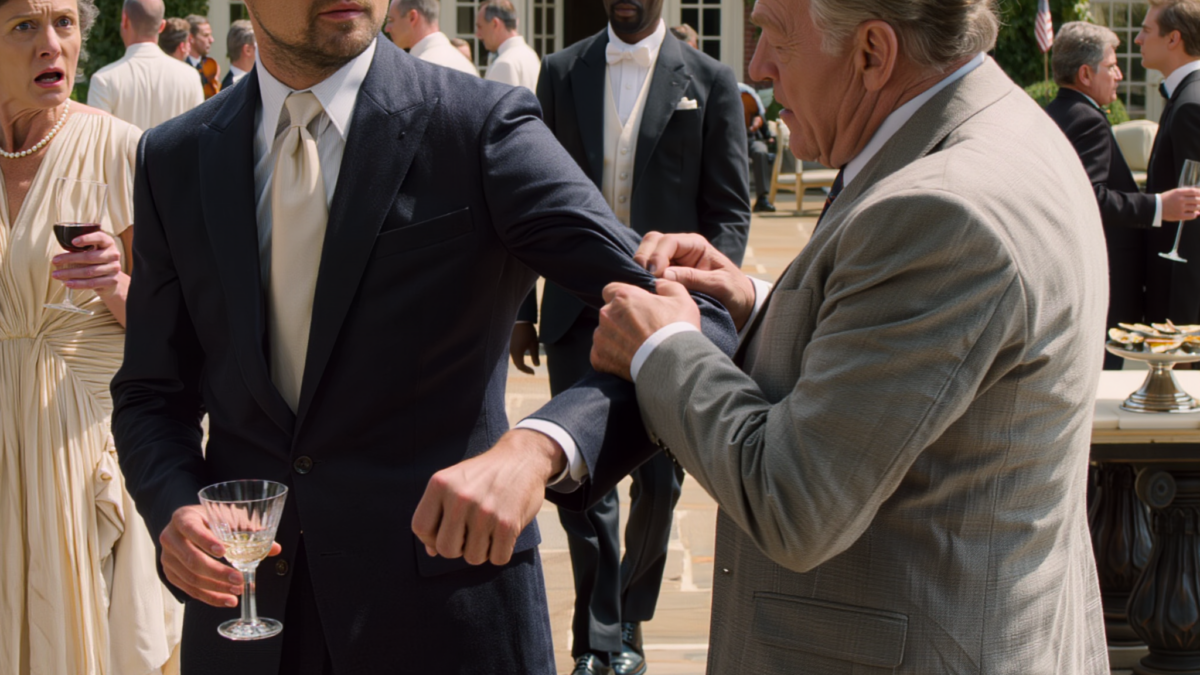
My name is Ezra Blackwood, and I’m thirty-two years old. Forty-eight hours ago, I stood in the middle of a catered real estate brunch, wearing a tailored Italian suit, and watched deputies put my father in handcuffs beside a table of shrimp cocktails.
The events that brought us there began with my eight-year-old daughter being dragged away from a family photograph. My father thought her clothes looked cheap. He decided that keeping her out of the picture mattered more than keeping her safe.
While Hadley was coming home frightened and hurt, my parents were posing for cameras and telling their wealthy friends that I was a disappointment. Apparently, I couldn’t even dress my child properly.
They had spent years treating me like an insignificant employee of the family. But my late grandfather had placed his $52 million real estate portfolio and other assets in a trust, and I was its sole trustee. My parents’ right to live at the estate came with conditions.
For six years, I had let them act as though none of those conditions mattered. After what happened to Hadley, I stopped.
The rain was coming down hard against the window of my small second-floor apartment. Outside, the city lights blurred into gray and yellow through the downpour. It was seven-thirty on a Sunday evening, and I kept checking the clock on the microwave.
Hadley should have been home more than an hour earlier. My older brother, Preston, had promised to bring her back by six-thirty. But Preston operated on what I thought of as golden-child time: he arrived when he pleased, usually without a text, a phone call, or an apology.
I had agreed to let Hadley attend the family photo session only after my mother, Rowan, spent a week pressuring me. She said the portrait was for a prestigious local society magazine. It mattered to the Blackwood family’s image, and Grandfather Arthur would have wanted everyone together.
I had wanted to believe that last part. I should have thought harder about who was asking.
An impatient car horn sounded from the street. I pushed the vertical blinds aside and saw Preston’s oversized luxury SUV idling at the curb, its headlights cutting through the rain.
He hadn’t pulled into a parking space. He didn’t get out with an umbrella or walk his niece to the lobby. The passenger door opened, and a small figure climbed down onto the wet pavement.
Before the door had fully closed, the engine surged. Preston drove off, sending water from a puddle across the sidewalk where Hadley stood.
I grabbed my jacket and ran for the stairs. By the time I reached the ground floor, she was already inside the lobby.
She stood near the wall, soaked through. Her brown hair, which I had spent twenty minutes braiding that morning, had come loose and stuck to her cheeks. Water dripped from her chin onto the tile.
Then I noticed how she was standing.
Most of her weight was against the wall. Her left foot hovered above the floor, and she was shaking with the effort of holding back her sobs.
I dropped to my knees in front of her.
“Hadley, baby, what happened to you?”
She looked at me with swollen eyes. The white Sunday dress I had bought within our careful budget was muddy down one side, and the lace near the hem was torn.
“Daddy,” she whispered.
“Did you fall? Did Uncle Preston get into an accident on the way home? Talk to me, sweetie.”
She shook her head, threw her arms around my neck, and buried her cold face against my shirt.
“Grandpa,” she sobbed. “Grandpa Thaddius did it.”
For a moment, I couldn’t draw a full breath. I eased her back far enough to see her face.
“What did Grandpa do? Tell me exactly what happened, Hadley.”
She wiped her nose on her sleeve.
“We were out in the big garden. The photographer man was setting up the really big flashing lights. Grandma Rowan was telling everybody where to stand.”
She paused to catch her breath.
“I went over by Uncle Preston because he was standing near the pretty stone fountain. I thought it looked nice. Then Grandpa Thaddius came over.”
I kept my hands near her shoulders, afraid of hurting her before I understood where she was injured.
“He looked at my shoes, Daddy. The black ones you polished for me last night. He said they looked cheap and ugly. He said my dress looked like a dirty rag from a thrift store.”
My jaw tightened. I had sat with those shoes in my lap the night before, polishing them because I wanted her to feel good about going.
“Go on, baby.”
“He grabbed my arm.”
She pointed to her upper right arm.
“Really hard. He said, ‘Get out of the frame right now. You look like a little beggar.’ I tried to tell him Grandma told me where to stand, but he pulled me.”
“He pulled you?”
“He dragged me across the patio and threw me down on the wet grass.”
Her voice broke. She looked ashamed, as though she were confessing to something she had done wrong.
“He said, ‘Trash belongs in the bin, not the family portrait.’”
I stared at her. My father had looked at my daughter and said that to her.
“I hit my leg on the stone planter when I fell,” she continued, holding her shin through the torn skirt. “It hurts, Daddy. Then he told Uncle Preston to take me home because my crying was ruining the party.”
I couldn’t answer immediately. I lifted the muddy hem carefully and checked her leg. There was a long scrape on her shin and bruising below it.
When I rolled up her sleeve, I could see distinct marks where an adult hand had gripped her arm. There was nothing uncertain about what I was looking at.
He hadn’t gently moved her out of someone’s way. He had hurt her.
I picked her up. She was getting too big to carry comfortably, but she wrapped her legs around my waist and put her face against my neck. She flinched as she brushed against my side.
“We’re going upstairs,” I told her. “I’m going to get you warm and into dry pajamas. Then we’re taking a little drive down the street.”
“Am I in trouble?”
Her voice was muffled against my collar.
“Grandpa said I embarrassed everybody in front of the photographer.”
“No, baby. You are not in trouble. You did nothing wrong.”
I carried her into the elevator and pressed our floor.
“Grandpa Thaddius is the one who did something wrong.”
Upstairs, I ran a warm bath and laid out her favorite fleece pajamas. While she warmed up, I packed a small overnight bag in case we needed it.
My old laptop sat on the dining table. I opened a protected folder I had labeled “doomsday” years earlier. Inside were scanned copies of the documents establishing the Arthur P. Blackwood Irrevocable Trust.
I looked at the language I had spent so long avoiding. The authority described there had always been mine to exercise. I had simply chosen, again and again, not to confront my parents.
That choice had helped keep things quiet. It had not kept my daughter safe.
Two hours later, rain was still hitting the metal roof of the urgent care clinic near our apartment. The waiting room was almost empty. It smelled of disinfectant and old coffee, and the fluorescent lights hummed overhead.
Dr. Aiden, a pediatrician in his late forties, examined Hadley in room three. She sat on the paper-covered table in an oversized gown, holding a blue ice pack against her arm.
He finished entering his notes, then turned his stool toward me.
“I’ve documented everything in her file, Ezra. There’s a significant contusion on the left tibia and a scrape that needed cleaning and bandaging, but no stitches. The bruising on her upper right arm is consistent with a forceful grip by an adult hand.”
He glanced toward Hadley before continuing.
“That pattern isn’t explained by a simple fall. I’ve also taken the photographs you requested for the medical record.”
“Thank you,” I said. “I need a complete printed copy of the report, signed and dated tonight.”
Dr. Aiden studied me over his glasses.
“As a medical professional, I’m a mandated reporter. I need to ask you directly: is everything safe at home? Are there custody concerns we need to discuss?”
“She’s safe with me.”
I stepped beside the examination table and brushed a damp strand of hair away from Hadley’s face.
“This happened at her grandfather’s estate. Not in our home. I’m going to address it through the proper channels. I need the documentation.”
He held my gaze for a moment, then nodded.
“I’ll print it. Keep ice on that arm over the next twenty-four hours.”
On the drive home, I turned the heater up for Hadley in the back seat. The familiar roads brought back memories I usually kept out of the way: my father’s parties, my mother’s careful smiles, and the years I had spent learning not to expect the same treatment as Preston.
Thaddius cared deeply about appearances. He leased luxury cars he couldn’t comfortably afford, wore custom suits, and entertained people whose approval seemed to matter more to him than anything happening inside his own family.
Rowan supported all of it. Country club memberships, neighborhood meetings, invitations, and society gossip filled her attention. She could remember who had been seated beside whom at a dinner months earlier, yet she had little patience for a problem that couldn’t be made presentable.
Preston fit into their world easily. He was handsome, outgoing, and confident in the way people become when they are rarely told no.
At Thanksgiving, he received the biggest slice of pie, the best seat, and most of the conversation. I was told to eat quietly and stop taking up so much room.
When he went to college, my parents used a generous fund to send him to an expensive private university. He graduated with a communications degree after years of parties and vacations.
When I finished high school with honors, they told me to take out loans and figure it out.
So I did. I worked double shifts at a diner while attending a state school, earned my master’s degree, and became a rare book archivist at the city library.
The work wasn’t glamorous, and it didn’t come with a corporate salary. But I liked the quiet concentration it required. I liked caring for things that had survived long enough to matter.
I lived in a modest apartment, drove a twelve-year-old sedan, clipped coupons, and stayed within my means. To my parents, those choices proved I lacked ambition.
Grandfather Arthur saw something different.
He had built his fortune in commercial real estate. He could be demanding in business, but he paid attention to people. During the years before his death, he watched how my father spent money and how quickly Preston expected more of it.
He also noticed that I saved my allowance, read in the corner instead of competing for attention, and understood how much work went into earning a dollar.
After Arthur’s funeral six years earlier, the family gathered at his lawyer’s office for the reading of the will. My father arrived barely able to contain his excitement. He and Preston were already discussing a yacht and a vacation home in Aspen.
Neither purchase was his to make.
Arthur had placed the twelve-bedroom estate, his commercial properties, investment accounts, and retirement assets into the Arthur P. Blackwood Irrevocable Trust. The value given to us was $52 million.
He named me sole trustee.
My father’s expression changed before the lawyer finished explaining. He threatened a lawsuit, said he would disown me, and struck the desk with his fists.
But his anger did not change the document.
Arthur had included a provision allowing Thaddius and Rowan to remain in the main house. The trust would provide money for maintenance, taxes, landscaping, and household staff.
I agreed to administer the arrangement quietly. My parents could continue living there, and I could continue my life without an argument at every holiday.
That was what I told myself.
Over time, they began treating me like an accountant who existed to sign their checks. They sneered at my job and my car, then sent requests for money to maintain the house they presented as their own.
I let them.
What I had not forgotten, even if I had avoided using it, was the condition Arthur placed on their continued residency.
After I tucked Hadley into bed among her stuffed animals and switched on her nightlight, I returned to the kitchen. I opened the trust document and scrolled to section four, paragraph two.
I read the provision aloud.
“The license to reside in the primary estate may be revoked immediately, entirely, and without any legal recourse if the beneficiaries engage in criminal activity, fraud, or acts of violence and abuse against any descendant of the grantor.”
Hadley was Arthur’s great-granddaughter. She was one of the people the provision was written to protect.
My father had acted as though removing her from a photograph was his decision to make. He had not considered what else that decision might set in motion.
It was one-thirty in the morning when I picked up my phone and messaged Barnaby, the senior partner at the firm that handled the trust.
“Thaddius physically assaulted Hadley at the estate today. I have medical documentation and photographs. I also want a forensic audit of the estate’s maintenance fund started in the morning. I’m invoking the eviction clause.”
I set the phone down and looked at the wall. Rain filled the silence of the apartment. I kept seeing the marks on Hadley’s arm and hearing the word she had repeated with so much shame.
Barnaby replied.
“I’m so sorry about Hadley. Please give her my love. The audit starts at six. I’ll have the papers ready by nine.”
Then came another line.
“Ezra, it is about time.”
I closed the laptop and walked to the window. Somewhere across the city, my father was likely asleep in the house he had spent years treating as proof of his importance.
For once, I wasn’t wondering how to avoid upsetting him.
The next morning, the sky was gray. I called the library and requested a week of unpaid leave for a family emergency.
I walked Hadley all the way to her classroom and explained her bandages and limp to her teacher. She was trying hard to be brave, but each careful step reminded me why I could not let this become another incident everyone expected me to forget.
At nine, I entered Barnaby and Associates, in a downtown office tower with polished glass doors and a lobby larger than my apartment.
Barnaby waited in his corner office. He was in his late sixties, sharply dressed, and had been Arthur’s closest friend as well as his adviser. He rose when I came in and shook my hand.
“How is Hadley this morning?”
“She’s resilient.”
I sat and took the medical envelope from my briefcase.
“But she’s afraid of her grandfather. She asked me whether she was a bad person for ruining a photograph.”
I placed the envelope on his desk.
“I want them out, Barnaby. All of them.”
He read Dr. Aiden’s report and examined the photographs. His expression tightened.
“I have the notices prepared,” he said. “But the accounting team found something else this morning. We need to go through it.”
He slid a red file across the desk.
“You authorize twenty thousand dollars a month for upkeep, property taxes, landscaping, and staff. Larger repair requests come to you separately.”
“That’s right.”
I opened the file.
“Three months ago, my father asked for a hundred and fifty thousand dollars. He said the slate roof over the east wing was failing and water was damaging the plaster in the library. I approved it because I didn’t want the property deteriorating.”
Barnaby tapped the invoice.
“The contractor listed here is Apex Premium Roofing Solutions. My team checked the company. It doesn’t exist. The tax identification number is false, and the address leads to a post office box in a strip mall two towns away.”
I read the invoice again. I remembered approving it. My father had made the request sound urgent, and the library was the part of the house Arthur had cared about most.
“So the roof wasn’t repaired?”
“I sent an investigator out with a drone at dawn.”
Barnaby handed me a tablet with aerial photographs of the estate.
“The slate is the same material installed twelve years ago. We found no sign of the replacement work described in this invoice. The roof appears to be in excellent condition.”
My father had asked me to protect Arthur’s house. I had sent the money because I believed that was what I was doing.
“He took a hundred and fifty thousand dollars from the trust.”
“There’s more.”
Barnaby turned to the recurring expenses.
“For the last two years, five thousand dollars a month has gone to a business called PB Design Group. The stated purpose is luxury landscaping consultation.”
I stared at the initials.
“Preston Blackwood.”
“Yes. The records connect those payments to your brother.”
Barnaby let me look through the entries before he continued.
“Your father has been directing sixty thousand dollars a year to Preston through the maintenance account.”
I thought about the emergency medical bill for Hadley a few years earlier. I had swallowed my pride and asked my parents for a temporary loan. They had laughed and told me to learn financial responsibility.
All that time, they had been finding room in the trust’s expenses for Preston.
I remembered his photographs from Cabo and the comments he made about my life. He spoke as though his vacations and cars were rewards for working harder than everyone else.
The money in front of me told a different story.
“I want to pursue the fraud,” I said. “Not just the eviction. I want this reported.”
“We will,” Barnaby said. “But first, look at where the roof payment went.”
He showed me the transfer records. The money had moved through a holding account before reaching an offshore account associated with my father. A third-party broker had taken a ten-percent cut.
Barnaby turned to a corporate registration document.
I recognized the name at the bottom.
Caleb Vance.
Caleb had been my college roommate. For more than a decade, I had thought of him as a brother.
Five years earlier, he went bankrupt and was at risk of losing his housing. I lent him ten thousand dollars from my own savings, money earned at the library, not money taken from Arthur’s trust.
I had helped him because I believed he would have done the same for me.
“Caleb is moving the money for my father?”
“His name is connected to the holding account,” Barnaby said. “He has the finance background to prepare invoices that would get through the quarterly reviews. Your father appears to have used that.”
I kept looking at the signature.
The false invoice hadn’t arrived scrawled on a scrap of paper. It had looked professional. It had passed the routine checks. Someone who knew what he was doing had helped make it believable.
Someone I had trusted.
“Where did the money end up?” I asked. “My father doesn’t save it. He spends it.”
Barnaby opened another image on the tablet. It was a screenshot from Preston’s public Instagram account, posted the previous afternoon.
My brother stood beside a new cherry-red Ferrari in the estate’s circular driveway.
“Early promotion gift from the best dad in the world,” the caption said. “Hard work pays off. Haters going to hate.”
The car’s base price was more than three hundred thousand dollars.
I thought of the roof payment, the monthly landscaping charges, and the maintenance money I approved while carefully managing my own household budget.
My father was using Arthur’s assets to support Preston’s lifestyle. Then he was judging my daughter for the price of her shoes.
I stood, then stopped myself long enough to put the papers down neatly.
“This has to end.”
Barnaby waited.
“I don’t want them pretending a notice arrived without warning or that they never understood the problem. I want to be there when they hear it.”
Before anything else happened, I wanted to know whether the false expenses were the full extent of what had been taken.
I sat in Barnaby’s conference room and opened the estate’s security system on my laptop. Arthur had arranged for cameras throughout the main rooms and hallways. My parents knew the cameras existed, but they believed a security company handled the recordings and deleted them after a day.
They did not know I had administrative access.
I had rarely looked at the recordings. Whatever I thought of my parents, I had respected the fact that the estate was their home.
Now I needed to check the trust’s property.
I went back to Saturday afternoon, the day before the family photograph, and opened the library feed.
The library was lined with mahogany shelves. Above the stone fireplace hung Arthur’s favorite painting, an original J. M. W. Turner landscape appraised at more than two hundred and fifty thousand dollars.
At two o’clock, the doors opened.
My father entered with two men in gray coveralls. He pointed toward the painting.
I watched them lift it from the wall, wrap it carefully, and carry it toward the service doors. A minute later, my father retrieved a similar framed canvas from behind a sofa and hung it on the empty hook.
“He replaced it.”
I said it aloud before I realized Barnaby wasn’t in the room.
I switched to the service-driveway camera. The men loaded the wrapped painting into a black van. Its license plate was clear enough for a screenshot.
I took the laptop into Barnaby’s office.
“Can you find out who owns this van?”
Ten minutes later, he had an answer.
“Dexter Vance. He runs an art dealership downtown.”
Barnaby explained that Dexter had a reputation in certain circles for handling disputed or poorly documented artwork without asking many questions.
My father had taken a painting that did not belong to him and put a copy on the wall, apparently expecting me never to notice.
“He sold Arthur’s favorite piece,” I said. “An asset that belongs to the trust.”
Barnaby looked back at the recording.
“This goes beyond the maintenance account. Depending on where the painting went, there may be additional charges involved.”
He warned me that my father could be facing serious prison time, not merely a dispute over whether he could remain in the house.
I closed the laptop.
“I want to see the replacement myself.”
At noon, I drove to the gated neighborhood where the estate occupied a hill above the city. I parked three blocks away instead of approaching the main entrance, where the sensors would alert my father.
With a baseball cap and a clipboard, I walked to the service entrance. The gate still used the code Arthur had set: 1984, my birth year.
My parents had never changed it.
Inside, the house smelled of lemon polish and fresh lilies. I followed the service corridor, avoiding the main living rooms. In the kitchen, caterers were preparing for the investor brunch my father planned to host the next day.
I entered the library and closed the door.
From across the room, the replacement looked convincing. The colors and composition were close enough for someone passing through with a drink in hand.
Up close, it was different.
I worked with historical materials every day. Texture, age, and the difference between an original surface and a reproduction were part of my job.
I stepped onto the hearth and examined the canvas. It was flat. What appeared to be brushstrokes had been printed onto synthetic material.
It looked like a high-quality giclée reproduction, the kind that could be ordered online for a few hundred dollars.
I photographed the surface and the signature. Where there should have been textured paint, there were printed details.
“You traded his painting for a sports car,” I said quietly.
As I stepped down, the library door opened.
My mother stood there in a silk blouse and cashmere cardigan, holding a glass of white wine. She looked from my cap to my jacket.
“Ezra, what are you doing sneaking around like a burglar? Why are you dressed like the help?”
Years earlier, that tone would have been enough to make me apologize. I would have started explaining before she finished asking.
I put my phone in my pocket.
“Hello, Mother. I came to check the property.”
“Check the property?”
She took a sip of wine.
“Your father is hosting important investors tomorrow. We don’t need you wandering around and bringing down the mood.”
She crossed the room and adjusted a vase.
“Did you bring that child with you? Please tell me she’s at your apartment. Your father’s blood pressure is still high after the screaming fit she threw yesterday.”
I felt my neck tighten.
“Hadley was crying because he hurt her. He left bruises on her arm, and she injured her leg when she fell.”
Rowan rolled her eyes.
“Oh, spare me the drama. You always overreact and coddle her. He was moving her out of the photograph. She tripped on her own feet.”
I waited, but she wasn’t finished.
“If you dressed her in decent clothes instead of those things from Walmart, perhaps she would have fit in and none of this would have happened.”
For years, I had explained my mother’s behavior to myself as something my father caused. She went along with him. She avoided disagreeing. She was difficult, but perhaps she was also afraid.
Standing in that library, I could no longer make the explanation work.
She was defending what he had done. Worse, she was blaming Hadley for making it inconvenient.
Then I noticed the folder protruding from her handbag on the side table. It bore the logo of Dexter’s art dealership.
I looked at it, then at my mother.
I had no reason to believe she was simply unaware of what happened to the painting. To me, the folder suggested she had been involved in the sale, not merely looking away while my father handled the money.
“You’re right about one thing,” I said. “Hadley doesn’t fit into this picture. Neither do I.”
“Well, at least you finally understand.”
She lifted her glass again.
“Use the back door. And don’t come back until you’re ready to apologize to your father for upsetting him.”
I left through the corridor and stepped into the afternoon air.
My phone rang. It was Barnaby.
“I’ve spoken with the district attorney,” he said. “They have the transfer records, the invoices, the medical report, and the information about the painting. The police are ready to act on the warrants.”
I looked back at the house.
“Tomorrow at noon,” I said. “During the investor brunch. I want the people he’s trying to impress to see what’s happening.”
The morning of the brunch was clear and bright. After the rain, the sunlight seemed almost too cheerful for how little I had slept.
I had spent much of the night thinking through possible objections and arguments. My parents had years of practice turning a complaint into evidence that I was ungrateful. I expected them to try again.
Barnaby had reviewed the documents. The arrangements were in place. I needed to follow through.
I made Hadley chocolate chip pancakes with extra syrup. She was spending the day with her best friend’s family, nowhere near the estate.
When I dropped her off, I knelt on the porch and kissed her forehead.
“I love you more than anything.”
She hugged me carefully, protecting her sore arm.
“I love you too, Daddy.”
Her smile was still cautious. I wanted her to have a day that wasn’t organized around what my father had done.
Back at the apartment, I opened the garment bag at the back of my closet.
For years, my family had seen me in practical trousers, inexpensive shirts, and worn loafers. The navy Italian wool suit inside the bag was something I had bought from my own salary for occasions when I needed to represent the trust.
I put it on with a white silk shirt, a restrained tie, and polished leather Oxfords. Then I pulled my hair back and looked in the mirror.
The suit did not change who I was. It simply left my parents with one less thing to use as a distraction.
A message arrived from Barnaby.
“The police units are three blocks from the estate. The accounting files are ready. Desmond is confirmed to be attending.”
I read it twice.
Then I replied, “It’s showtime.”
By noon, I was back in the neighborhood. I parked my old sedan a few streets away and walked toward the estate through the cold, clear air.
The eighty-year-old Georgian house rose above the lawns, its brick walls covered in ivy. Beyond the open gates, a string quartet played Vivaldi.
The driveway was crowded with Mercedes sedans, a Bentley, and Aston Martins. Preston’s red Ferrari occupied the most prominent spot near the front doors.
A valet approached when he saw me walking rather than arriving in a car.
“Can I help you find the brunch, sir?”
“I know where I’m going.”
He stepped aside.
I walked around the house toward the garden terrace, following the music and the sound of glasses. The gathering was on the same stone patio where Hadley had been hurt two days earlier.
From beside the French doors, I could see about forty guests. Waiters in white jackets carried champagne and shrimp cocktails between small groups of people talking about investments and property.
My father stood near the center, holding scotch and laughing at something he had said.
Beside him was an older man in a charcoal suit. I recognized Desmond from the information Barnaby had shown me. He was the investor my father needed for his proposed commercial development.
I stayed near the doors long enough to hear the conversation.
“This estate has been the foundation of the Blackwood family for four generations,” Thaddius told him. “It’s paid off. No mortgage. It’s the ideal collateral for the venture.”
Desmond looked toward the house.
“We’re talking about fifty million dollars in real estate,” my father continued. “Your investment would be backed by something substantial.”
“It’s a magnificent property,” Desmond said. “Knowing you hold that much personal equity certainly reduces the concerns my board might have.”
My father clapped him on the shoulder.
“Exactly. And Preston will be heading our acquisitions department. He has an excellent mind for the business.”
I looked toward my brother. He leaned against the balustrade with a champagne flute, telling a group of younger guests about the Ferrari’s horsepower.
My mother moved among the tables in a designer dress and pearls, checking that drinks were being replenished. Everyone appeared comfortable with the version of the Blackwood family my parents had arranged for them to see.
My father had permission to live in the house. He was presenting it as an asset he could pledge to someone else.
I stepped onto the terrace.
Several guests near the doors turned at the sound of my shoes on the stone. My mother saw me first. Her smile disappeared, and her wine glass tilted before she steadied it.
My father noticed me a moment later.
His expression faltered, then hardened. He excused himself from Desmond and walked across the patio to block my path.
“What are you doing here?” he asked quietly. “Your mother told you not to come back until you apologized.”
I stopped in front of him.
“You’re embarrassing me,” he continued. “Look at you playing dress-up. Go home before I have security take you out.”
“Move, Thaddius.”
His eyes narrowed. I had not called him Dad.
“Don’t speak to me that way. Go into the kitchen and wait until I’m finished with this meeting.”
I stepped around him, brushing past his shoulder, and approached a waiter near the musicians. I took a champagne flute from the tray and picked up a serving spoon from the appetizer table.
Then I tapped the spoon against the glass.
The ringing carried across the terrace. My father moved toward me.
“Ezra, stop this.”
The quartet fell quiet. Conversations stopped in uneven waves until the guests were looking in our direction.
My mother stood beside the flowers with her mouth slightly open. Preston stopped talking about his car.
“Good afternoon,” I said. “I’m sorry to interrupt. For those who don’t know me, I’m Ezra Blackwood.”
My father laughed, too loudly.
“Please excuse him. This is my other son. He works at the public library and gets carried away with things.”
He turned toward the guests with an expression meant to invite their understanding.
“Let’s get back to our drinks.”
Then he closed his hand around my upper arm.
“Come inside,” he said. “Before you ruin everything I’ve built.”
I looked at his hand gripping my sleeve. The gesture was so familiar after what Hadley had shown me that I reacted before he could pull me.
I drew my arm free. He stumbled backward, coming close to a tray of oysters.
“Do not ever touch me again.”
I spoke loudly enough for the people near the back of the terrace to hear.
“You put your hands on my eight-year-old daughter two days ago. You hurt her on this patio. You will not do that to either of us again.”
People shifted and looked at my father. Desmond stepped out of the group beside him.
“What is he talking about, Thaddius?”
My mother raised her voice from the side of the terrace. She began making claims about my mental state and medication I wasn’t taking, telling everyone not to listen.
“Please, just ignore him,” she said. “He’s always been jealous of his father’s success and his brother’s opportunities.”
“I’m not on medication, Rowan.”
I looked directly at her.
“And this isn’t about Preston’s opportunities.”
I turned back toward Desmond.
“I heard my father tell you that he owns this property free and clear. He said he has fifty million dollars in assets to secure your investment.”
“Ezra, stop talking,” Thaddius snapped.
He looked toward the doors.
“Security. Get him off my property.”
“He doesn’t own it.”
I kept my attention on Desmond.
“He doesn’t own a single brick of this house. He doesn’t own the chair he was sitting in. And he doesn’t own the painting above the library fireplace.”
At the mention of the painting, my father stopped moving.
I could see him trying to decide how much I knew.
“The estate belongs to the Arthur P. Blackwood Irrevocable Trust.”
I took the document from the inside pocket of my jacket and unfolded it.
“I’m the sole trustee.”
The guests looked from the papers to my father. Desmond did not interrupt.
“My parents live here under a conditional license,” I continued. “Their right to remain depends on provisions in the trust, including one concerning conduct toward Arthur’s descendants.”
I lowered the document enough to look at Thaddius.
“Hadley is his great-granddaughter. You hurt her because you didn’t like her shoes. You called her trash because she didn’t fit the photograph you wanted.”
He took a small step back.
“You said she didn’t belong in the picture. Some people won’t belong in it after today. But it isn’t Hadley.”
“You’re ungrateful,” he said. “I raised you. I put a roof over your head. I gave you my name.”
“Arthur put this roof over yours.”
My voice rose despite my effort to keep it steady.
“And you took a hundred and fifty thousand dollars from his trust for a roof repair that never happened. You moved the money through an account connected to my old college roommate. Then you sold Arthur’s Turner and hung a three-hundred-dollar print in its place.”
The guests began talking.
“Sold the painting?” a woman asked.
“Did he say the repair never happened?” someone else murmured.
Desmond stepped closer to my father.
“Is the deed in your name?”
Thaddius didn’t answer immediately.
“Are you trying to secure my firm’s capital with property you do not own?”
“It’s a technicality,” my father said. “Ezra is the trustee on paper. I handle the assets. It’s family money.”
His hands were out now, palms raised.
“We were going to repay the bridge loan within six months.”
I didn’t argue with that explanation. I raised my hand toward the gates.
“There are some other people here who need to speak with you.”
Two sheriff’s cruisers and an unmarked SUV came up the driveway. Barnaby’s sedan followed.
My father looked toward the vehicles. The glass slipped from his hand and broke on the patio, scattering scotch over his shoes.
His eyes moved toward the back garden.
“Don’t,” I said. “There’s security at the other exit.”
Barnaby stepped out carrying his briefcase. Beside him were Zayn, the head of the private security firm I had hired, and three uniformed deputies.
The guests moved out of their path.
“Mr. Thaddius Blackwood?” the lead deputy asked.
“There’s been a misunderstanding.”
My father backed into the catering table. A silver bowl of shrimp and ice fell to the ground.
“My son made this up because he wants my money. Rowan, tell them.”
My mother had lowered herself into a garden chair. She was crying into a linen napkin and would not look at him.
Preston was working at his phone. I suspected he was trying to remove the Ferrari posts, but his hands shook, and he dropped the device onto the stone. The screen broke.
Barnaby placed the legal papers on the table beside the cheese platter.
“Mr. Blackwood, I’m serving you on behalf of the trustee. The notice concerns the breach of the trust’s conditions and your continued residency. You have twenty-four hours to vacate.”
“Twenty-four hours?”
My father looked from Barnaby to the deputies.
“You can’t do that. I have rights. You have to give me thirty days.”
“The criminal-activity provision is being invoked,” Barnaby replied.
He stepped aside.
The lead deputy took out his handcuffs.
“Thaddius Blackwood, we have a warrant for your arrest concerning the theft and trafficking of a J. M. W. Turner painting valued at two hundred and fifty thousand dollars.”
My father stopped protesting.
“The transfer from Dexter Vance’s dealership has been traced. He has given a statement identifying you and confirmed your identity earlier today.”
Thaddius leaned against the table.
Desmond approached him, his expression no longer uncertain.
“You offered my firm collateral you do not own.”
“It was a bridge loan,” my father said. “I was going to repay it. Give me a week to straighten this out.”
“We’re finished, Blackwood.”
Desmond turned toward me.
“Ezra, I apologize. I didn’t understand what I was being brought into.”
“I know,” I said. “He’s had a lot of practice making it look convincing.”
The deputies asked my father to turn around and place his hands behind his back.
As the cuffs closed, I saw Preston moving toward the sunroom.
“And Preston.”
My brother stopped.
“I didn’t take the painting,” he said quickly. “I had nothing to do with that.”
“Barnaby has the bank records. Sixty thousand dollars a year for landscaping consultation. The trust is pursuing the money you received and the funds used for the car.”
He looked toward my mother.
“Mom, do something. He’s taking the Ferrari.”
Preston was nearly thirty-five. He stood in the middle of a catered party, crying about a car while our father was being arrested.
Rowan finally looked up at me.
“Ezra, please. I’m your mother. Where are we supposed to go?”
I thought of Hadley leaning against the lobby wall, asking whether she had done something wrong.
“You have friends here,” I said. “Perhaps one of them has somewhere you can stay.”
I looked around.
People lowered their eyes. A few were already moving toward the driveway, checking phones or speaking quietly to one another. No one offered a room.
The friendships my parents had spent so much maintaining seemed unable to survive the loss of the house’s appearance as their personal asset.
As the deputies walked my father past me, he stopped resisting long enough to turn his head.
There was no apology in his face. Nothing about Hadley.
“You betrayed your own family,” he said.
I leaned close enough that I didn’t need to raise my voice.
“I didn’t betray you. I fired you.”
The removal from the house began the next morning.
I had expected the process to be prolonged and contentious. Instead, with my father charged and the trust’s provisions being invoked, the move proceeded quickly.
He was in county custody, unable to meet the half-million-dollar bail that had been set. The right of habitancy that had allowed my parents to remain at the estate was no longer being honored under the trust’s terms.
Zayn arrived with five security guards to supervise the move. I didn’t want to spend another day inside the house, but someone needed to make sure trust-owned objects did not disappear into the moving truck.
I stood in the marble foyer with an inventory list while the movers worked.
Preston tried to wheel the professional espresso machine toward the front door.
“No,” I said. “That stays.”
“It’s mine.”
“It was bought on the American Express card linked to the maintenance account two years ago. Barnaby has the receipt.”
Preston stopped beside the machine. His clothes were rumpled, and he looked as though he hadn’t slept.
“You can’t just keep my things. I’ll hire a lawyer. I’ll sue for emotional distress and taking my property.”
“You don’t have the money to keep making threats about lawsuits, Preston.”
I marked the machine on the list.
“And I need the Ferrari keys.”
He covered his pocket with his hand.
“Dad gave me that car.”
“He bought it using money taken from the trust.”
I gestured toward Zayn near the door.
“The tow truck is waiting outside. Give me the keys.”
Preston argued that it had been a gift. I told him I would not ask again and that Zayn would handle it if he refused.
He pulled the key fob from his pocket and threw it at my chest. I caught it and handed it to Zayn.
My mother sat on a sealed packing box in the hallway, staring at the floral wallpaper. She looked older than she had the day before, without the prepared expression she usually wore in company.
“Your father is in jail,” she said.
“I know.”
“The judge set bail at half a million dollars because they consider him a flight risk. His accounts are frozen. We don’t have that kind of money.”
“The public defender’s office can help him.”
She rubbed the napkin in her hands.
“We have nowhere to go. The Florida condo was sold years ago to cover his gambling debts. My credit cards are maxed out. We have our clothes and these boxes.”
“You have your Social Security income,” I said. “You’ll have to find something you can afford.”
She began crying again.
“A small apartment,” I continued. “Somewhere outside the city, perhaps. You’ll need to budget.”
The words sounded familiar because they were the kind of advice she had offered me whenever I needed help.
“I can send you grocery coupons,” I added. “Walmart has sales.”
She looked up sharply.
“How can you be so cruel? We’re your family.”
I lowered the clipboard and knelt in front of her.
“When Thaddius hurt Hadley, did you stop him?”
She said nothing.
“When he called her trash, did you tell him he was wrong?”
Her gaze moved away from mine.
“You blamed her clothes. You told me she should have fit into the photograph.”
I waited before continuing.
“And while he was using trust money for Preston, you were living with the results. You weren’t trying to protect Hadley or me.”
I stood.
“The movers are taking your boxes to a storage unit. The first month is paid. You need to be off the property by five. The locks and security codes change at five-oh-one.”
I told her that if they refused to leave, Zayn would deal with their continued presence as trespassing.
By late afternoon, the remaining personal belongings were being loaded into a rented U-Haul. Preston drove because Rowan, affected by the medication she had taken for anxiety, was in no condition to drive.
I watched them leave.
What I felt was not the sudden happiness I had imagined during the worst moments of the previous days. It was relief, quieter and less dramatic.
For once, I would not have to wait for the next demand before deciding whether I was allowed to say no.
A week later, Preston found another way to reach me.
He posted a ten-minute video on TikTok and Instagram. He wore a plain hoodie and spoke through tears, presenting himself as a man whose family had been destroyed by his brother.
According to his version, I had manipulated our elderly grandfather into signing documents that excluded the rest of the family. I had fabricated accounting evidence against our innocent father and thrown our frail mother into the cold.
He described me as controlling and cruel. He made no mention of the payment records, the painting, or what had happened to Hadley.
The caption accused me of taking everything.
“My brother stole everything from us. We are homeless, terrified, and he is trying to destroy us.”
Within twenty-four hours, the video had more than three million views.
The comments were vicious. People who had never met me were certain they understood my motives.
Then the calls began reaching the library.
Strangers had identified my workplace and were contacting it in large numbers, demanding that I be fired for fraud and mistreating my parents.
I sat at the kitchen table reading messages on my phone. For a moment, the fear I knew from childhood returned so completely that I could feel it in my posture.
I had spent years worrying about what my family would say about me. Now Preston had found an audience large enough to make the old fear feel reasonable.
Had I gone too far? Had I given them a way to make everything worse?
Hadley came into the kitchen carrying a drawing.
Her limp had nearly disappeared. She smiled and held the paper toward me.
It showed the two of us in front of a castle. Nearby, a mean-looking dragon sat inside a cage.
“The dragon can’t hurt us anymore, Daddy.”
I looked at the picture, then at her.
She wasn’t thinking about public opinion or whether people at the country club approved of my choices. She was thinking about whether the person who frightened her could reach her again.
I called Barnaby.
“Release the files.”
He paused.
“Are you sure? Once that material is online, you can’t make it private again.”
“I’m sure.”
The firm issued a statement on behalf of the trust that afternoon. It had been reviewed before release and was accompanied by the records supporting it.
The first attachment was the unedited patio recording. It showed what had happened to Hadley, and the audio captured my father’s words about keeping her out of the portrait.
The second was the library recording, along with Dexter Vance’s signed statement identifying my father in the sale of the Turner.
The third was the accounting report showing the false roof payment and the recurring landscaping payments to Preston.
I gathered the material on a new YouTube channel titled The Absolute Truth About the Blackwood Estate.
For the first time, the people repeating Preston’s account had something other than his performance to examine.
The reaction changed.
People began asking why he had omitted the footage and why his bank records showed payments for services he hadn’t provided.
“Did you see what happened to the little girl?” one comment read.
“He’s talking about being homeless, but he was receiving sixty thousand dollars a year from that account,” another said.
Others defended my decision to protect Hadley.
Within three hours, Preston deleted his social media accounts. The public anger had turned toward him, accompanied by threats and the sort of attention he had been willing to direct at me.
The library board reviewed the evidence and issued a statement supporting me. It refused the demands that I be dismissed.
My boss sent a fruit basket to the apartment.
My father remained in custody. Without available collateral, he could not find a bondsman willing to secure his release. The story of his arrest and the records behind it had now reached far beyond the people at the brunch.
No investor was likely to accept his assurances about family assets again. Desmond certainly wasn’t going to return to the deal.
That evening, I sat on the couch beside Hadley while she watched cartoons. A stranger had written that protecting a child sometimes required breaking a pattern older than the parent making the decision.
I read the message, put down my phone, and held my daughter close.
The property mattered. So did recovering the money.
But being able to sit beside her without wondering what my parents would do next mattered more.
Three months have passed since the confrontation at the estate.
Yesterday, I stood in the marble foyer for the last time. The rooms were empty, and every small movement echoed.
The remaining furniture had been sold at auction. Much of it consisted of expensive replacements my parents had bought over the years, objects chosen to impress rather than because anyone loved them.
I had carried the fake Turner outside and put it in a rented dumpster myself.
The original painting was recovered by the FBI from the art dealer. I donated it to the City Art Museum, where people could see it without needing an invitation to my parents’ house.
I had decided early that Hadley and I would not move into the estate.
There was too much of my childhood in those rooms: my father’s voice carrying down the hall, my mother’s silence when I needed her, Preston’s assumption that everything belonged to him first.
I didn’t want the size of a house to become the measure of a good life for my daughter.
With Barnaby’s help, I put the property on the market. A young tech billionaire from Silicon Valley bought it for forty-eight million dollars in cash.
He planned to renovate the interior and use it as a coding retreat for young people who lacked those opportunities. He was surprisingly practical in conversation, without the need to make every exchange a demonstration of his importance.
I hoped the house would become a place children could enter without worrying whether they were dressed well enough to belong.
Following the sale, with the remaining investments, the trust’s value was close to sixty million dollars.
I bought a home for Hadley and me.
It was a four-bedroom farmhouse about forty minutes outside the city, with an old oak tree in the front yard and a wide porch wrapping around the house.
There were no gold sconces or marble corridors. There was a fenced backyard where Hadley could play, and a study with built-in shelves where I could read.
It felt like somewhere we could live, not somewhere we would have to perform.
I also worked with financial advisers to establish a college fund and a separate long-term trust for Hadley. Her future would be protected, with the life trust set for her access at twenty-five.
Then I donated two million dollars to a local legal aid fund supporting people facing domestic financial abuse and parental alienation.
As for my father, the lawyers he retained could not make the records disappear.
He accepted a plea agreement rather than face a lengthy trial. He is serving a sentence of three to five years for fraud, embezzlement, and grand larceny.
He has tried to call me collect from prison several times. I do not answer.
Rowan moved into a small, government-subsidized apartment. Sometimes she calls late at night from a new number and leaves a message asking for money for groceries or heating.
She says she has changed.
I listen once, then block the number. I remember the woman in the library telling me Hadley would not have been hurt if I had bought her better clothes.
Preston has had to find work without my father paying for the appearance of a career.
His private university degree had not given him the résumé or experience he needed for the corporate positions he expected to receive. A mutual acquaintance told me she saw him working at a chain restaurant near the highway.
He was greeting customers and clearing tables in a polyester uniform. She said he looked exhausted.
I knew what restaurant work felt like. It had helped put me through school. I hoped doing it would teach him something about the people he had spent years dismissing.
I wasn’t going to visit to find out.
Caleb remains under federal investigation for his role in moving the money. The man I had once helped avoid eviction is now dealing with the consequences of helping my father take money from a trust I was responsible for protecting.
I locked the estate’s front door and handed the keys to the buyer’s real estate agent. Then I walked to my old sedan and drove away without looking back.
At the farmhouse, Hadley helped me plant orange marigolds.
She wore muddy overalls and bright yellow rain boots. There was nothing formal about the afternoon, and no one was arranging her into a photograph.
“Daddy, look.”
She ran over with an earthworm in her dirt-covered hands.
“I found a big one for the garden.”
“That’s a beautiful one, baby.”
I bent and hugged her without worrying about the mud on my shirt.
She looked up, leaving a brown streak across her cheek when she tried to brush her hair away.
“Since we moved to the farm, does that mean we’re rich now?”
I thought about the accounts, the property sale, and the work Barnaby and the advisers had done.
On paper, we were wealthy beyond anything I had expected for myself.
Then I looked at my daughter.
She was relaxed. She was muddy. She was happy about an earthworm.
Behind her was a house where she could make noise without someone accusing her of spoiling the atmosphere.
“Yes, Hadley,” I said. “We’re very rich. But it isn’t just about the money.”
“I know.”
She carefully placed the worm back in the soil.
“It’s because we have the garden and the house and no Grandpa to yell at us.”
I laughed, then kissed her muddy forehead.
She had found a simpler way to say what I had spent months trying to understand.
That night, after she fell asleep in her new room, I sat on the porch swing with a glass of lemonade. Crickets sounded in the grass beyond the yard.
I thought about everything that had happened.
My father was in prison. My mother had far less than she was used to. Preston was working for the money he needed instead of receiving it through a misleading line in the household accounts.
I had allowed evidence of their actions to become public. I had stopped protecting the family’s image.
There were people who would say I should have kept it private. That I should have moved away, forgiven them, or continued the payments because they were my parents.
For years, I had tried some version of that approach. I had made excuses, absorbed the insults, and called the absence of open conflict peace.
Then my daughter came home asking whether she was in trouble for being hurt.
I could not go back to the arrangement that made that question possible.
Family had to mean more than a shared name. It had to include respect, safety, and a willingness to protect someone who could not protect herself.
I had cut off my parents, removed them from the estate, and pursued the theft from Arthur’s trust. The man who had hurt Hadley was now in prison, and the life my parents had built around appearances was gone.
Was I wrong to finally respond with the full force of the law? Or should I have let them keep their dignity for the sake of family peace?








