My family skipped my housewarming to celebrate my brother’s leased Lamborghini. Then Dad called: “We need your house to back your brother’s car.” At 7:50 the next morning, he arrived with a notary and paperwork to give my brother half my home. But I’d already called my own lawyer—and asked him to bring the approval letter the city had issued two days earlier.
My name is Declan, and I’m thirty-two. Just two months ago, I was standing in the backyard of my newly purchased dream home, staring at a grill full of cold steaks. My entire family had abandoned me on the biggest day of my life.
While I wiped down the patio table for the third time, waiting for people who weren’t coming, my parents were across town at a luxury car dealership. They were co-signing a predatory loan for my younger brother’s leased Lamborghini. My father called me from the showroom floor, his voice competing with applause and the sound of engines.
“Forget the barbecue. Have your property documents ready by tomorrow morning. We need your house to back your brother’s car.” Văn bản đã dán (1)
They had left me to explain their absence to the one neighbor who actually showed up. The house I’d worked years to buy was already, in their minds, another account they could draw from for their favorite son. They weren’t interested in celebrating it. They were interested in using it.
What they didn’t know was that the property stood to gain enormously from commercial rezoning. They also didn’t know how closely I’d been working with a real estate attorney. The money they had treated like an inheritance they were entitled to take would never be theirs, and the financial ruin they eventually faced would not be mine to repair.
Before any of that happened, though, I was still hoping my father would come through the front door and tell me I’d done a good job.
I’m a structural engineer. It sounds impressive when someone asks what I do at a party, but most days involve calculations, dirt on my steel-toed boots, and explaining to architects why the floating glass ceiling they’ve designed might eventually collapse and become a lawsuit. My work is about understanding pressure and knowing where a structure can no longer bear it.
I look for tiny stress fractures in poured concrete. I calculate shear tension and how much weight a steel beam can support before it fails. For most of my life, I understood that kind of pressure much better at work than I did at home.
In my family, I was the load-bearing wall. If the water heater broke during a freezing winter night, I got the call. If my father left his truck’s headlights on and refused to pay for roadside assistance, I drove forty-five minutes through the rain to jump-start it. I co-signed my mother’s cell phone plan because years of irresponsible spending had left her with terrible credit.
I was dependable, useful, and usually invisible until something needed fixing. Nobody had to wonder whether I would show up. They simply expected me to, and once the problem was solved, their attention moved elsewhere.
My younger brother, Preston, was twenty-eight. He called himself a digital creator, a cryptocurrency visionary, and a high-end lifestyle coach. In practice, he was unemployed, photographing expensive lattes, renting designer clothes for photo shoots, and waiting for strangers online to confirm that he was successful.
He moved from one get-rich-quick idea to another, leaving bills behind him. My parents, Warren and Hadley, kept treating each new venture as the one that would finally prove how gifted he was. They had been financing that belief for as long as I could remember.
When Preston decided to become a music producer, Dad bought him a top-of-the-line laptop on a credit card charging twenty-five percent interest. When he needed the first and last month’s rent for a luxury downtown apartment he couldn’t afford, Mom took money from the grocery budget or their retirement savings. They treated him like a promising man having a temporary setback, not someone who had made a habit of avoiding work.
I learned early that asking them for help usually ended in disappointment. I paid my own way through state college, working full-time nights at a distribution warehouse and studying physics during the day. I didn’t want to ask Dad for money from a college fund I strongly suspected didn’t exist.
I lived in cramped apartments with roommates who left their dishes in the sink. I drove used cars that barely passed inspection and worried about whether the transmission would make it through another month. I skipped vacations, expensive dinners, and the kinds of purchases other people seemed to make without thinking.
There was a reason for all of it. I wanted to own a place that belonged to me, a home nobody could take from me just because someone else in the family needed something. I wanted a solid foundation and a door I had the right to close.
When the escrow company finally handed me the keys to my 1920s Craftsman, I sat in my car and stared at the porch for an hour. The house needed serious work. During the inspection, I’d received a repair list three pages long, and I knew exactly how much of my free time those pages represented.
There was a roof leak over the main bedroom that threatened the drywall. A rotting support post had left the front porch sagging to one side. Three layers of pet-stained shag carpet covered the original hardwood floors, and the whole place carried the stale smell of a house that hadn’t been properly cared for in decades.
But the framing was solid oak, heavy and dense. The concrete foundation had no cracks, and the lot was well graded, high and dry. Beneath the neglected surfaces, the house was sound. It needed someone willing to do the work rather than someone willing to complain about it.
For two months, that work filled every evening after ten-hour days at the engineering firm and every weekend from morning until dark. I pulled out the old carpet, sanded the floors on my hands and knees, and kept going until my back cramped and my knuckles were raw. I painted the walls slate gray, repaired the plumbing beneath the sink, and rewired the kitchen fixtures.
I wanted the house to be right. More than that, I wanted my family to see what I had made of it. I imagined my father walking through the front door, looking around, and understanding that all those years of work had amounted to something worth acknowledging.
I didn’t need a speech. I wanted him to pat me on the back and say I’d done well. That wish felt childish, so I usually kept it buried beneath more practical explanations about property values and independence.
Still, it was there every time I painted another wall or finished another repair. I thought buying the house might finally make them regard me as an adult whose choices deserved respect. I thought the worst thing they might do was arrive late to the barbecue.
The habit of treating my money as theirs had started long before I bought a house. By the time I was sixteen, I already knew that anything I’d saved could become a family resource the moment Preston wanted something. I just hadn’t understood how little warning I would get.
For two summers, I worked for a demanding local landscaping contractor. I pushed a gas mower through heavy summer heat, weeded flower beds until my hands hurt, and sweated through ten-hour shifts for minimum wage. While I worked, Preston stayed in the air-conditioned living room, playing video games and complaining about the Wi-Fi.
I saved $3,000 in cash. Every bill went into a rusty coffee tin hidden at the back of my closet beneath old winter sweaters. I knew what I intended to do with that money, and thinking about it helped me get through the worst afternoons on the job.
A neighbor had a used Ford Ranger for sale at the end of his driveway. It was rusty, the paint was peeling, the air conditioning didn’t work, and the inside smelled like a wet dog. None of that mattered much to me because it would be mine.
That truck meant I wouldn’t have to ask Dad for rides to school. It meant I could get myself where I needed to go without explaining why it mattered or waiting for somebody to decide I deserved the inconvenience. For the first time, independence had a price I could actually pay.
Two days before I was supposed to pay the seller, I came home from work exhausted and covered in grass clippings. I went to the closet, pulled out the tin, and opened it to count the money one last time. There wasn’t a single dollar inside.
I walked into the kitchen with my heart pounding. Dad was at the table, drinking black coffee and reading the local paper. Before I could ask what had happened, he looked at me over his reading glasses with an expression that said he’d already decided how the conversation would go.
“Don’t make a scene, Declan,” he said. “Preston has an incredible opportunity to join an elite traveling sports team. The entry fees, the new uniforms, and the cross-country travel are expensive. We needed the cash today to secure his spot.”
“That was for my truck,” I said, struggling to keep my voice steady. “I worked for two entire years for that money. I worked hard for it.”
Dad folded the newspaper and set it on the table. The small, deliberate movement made it clear he wasn’t going to apologize. He was preparing to explain why I was wrong to object.
“A truck is a want, Declan. It’s a luxury. Your brother’s athletic talent is an investment in his future. Don’t be selfish. We’re a family, and in this house, we pool our resources for the greater good. You’ll drive your mother’s minivan until you graduate, and you’ll be grateful you have a vehicle at all.”
I never bought the truck. For the next two years, I rode the crowded public bus. Preston quit the traveling team a month later because the coach yelled at him for skipping a morning practice.
For years, I thought my two summers of work had paid for that one month. I thought all those long days had bought a uniform and a brief experience my brother couldn’t even be bothered to finish. Then, in my twenties, I found an old highlighted bank statement while cleaning out files in Dad’s home office.
The money hadn’t gone to the team. Preston had become involved in an illegal online betting operation while he was underage and had run up debts to people who worried my parents. They had taken my savings to pay those debts and keep him out of danger and legal trouble.
Both of my parents had let me believe the sports story. They had watched me give up the truck and catch the bus without telling me what they had actually done. Protecting Preston had been worth more to them than being honest with me about money I’d earned myself.
That was the arrangement I grew up with. I supplied the resources, and Preston remained the investment. Buying the house was the first time I had put a legal, physical boundary around something large enough that I thought they would have to respect it.
The deed was filed with the county. My name was on it, and neither of my parents had contributed to the purchase. I’d eaten ramen, skipped social events, and worked overtime for five years to save the twenty-percent down payment and avoid private mortgage insurance.
I hadn’t asked Dad for a loan. I hadn’t asked Mom to co-sign. There was no family contribution they could point to, no favor attached to the mortgage, and no reason for anyone else to act as though the house belonged to them.
Looking back, the questions at Thanksgiving should have made me more cautious. My offer had just been accepted, and escrow had begun. We were sitting around my parents’ dining table, eating Mom’s dry turkey and trying to look like an ordinary family enjoying a holiday.
My uncle Silas, Dad’s younger brother, was there. He worked in mid-level corporate sales and had a way of acting like your closest friend just before asking for a large favor. He leaned over his mashed potatoes, pointed his fork toward me, and smiled.
“So, Declan, I hear you finally pulled the trigger on a house in that up-and-coming neighborhood. Congratulations, kid. That takes guts. How much did you put down on a place like that in this market?”
I told him I’d gotten a decent deal and a fixed rate, hoping that would be enough. It wasn’t. He wanted the zip code, the property taxes, and the details of the down payment, and each answer seemed to lead him toward another question.
“With a down payment like that, you must have a lot of equity right away,” he said, wiping his mouth with a linen napkin. He spoke loudly enough for everyone to hear. “It’s basically a brick-and-mortar savings account you can borrow against whenever you need cash. That’s smart. Banks love someone with strong property equity.”
I told him I had no intention of borrowing against my home, then asked him to pass the gravy. As I reached across the table, I saw him exchange a quick look with Dad. It was brief, but there was a familiarity to it that stayed with me.
At the time, I dismissed it as intrusive family conversation about money. I didn’t want to make an argument out of Thanksgiving, and I didn’t think I had given them anything they could use. I hadn’t realized that knowing I had equity was enough to interest them.
I spent the next two months living among tools and unfinished rooms while I prepared for the housewarming. I wanted the work completed before anybody came over. I wanted them to walk into the finished house rather than look at the mess and tell me I’d taken on too much.
On Monday afternoon, I sent a message to the family group chat.
“Keys are in hand. The renovations are finally done. Housewarming barbecue this Saturday at 5:00 p.m. I’m making steaks. Come celebrate.”
Preston sent a fire emoji without a word of congratulations. Mom replied three hours later, saying they would try their best to make an appearance, but preparations for Preston’s lifestyle brand launch were keeping them busy. Dad read the invitation immediately and never answered.
I told myself they had other things going on. I wasn’t going to spend the week resenting them before they’d even had a chance to come. Instead, I went to the local butcher and bought four thick, well-marbled prime ribeyes at $30 apiece.
I bought a case of the bitter, hoppy craft IPA Dad liked and a bottle of imported Savanyon Blanc with the gold-foil label Mom enjoyed showing off. On the new patio, I set out four comfortable chairs, real silverware, and everything we would need for dinner. It was a small gathering, but I wanted it to feel like an occasion.
At 4:45 on Saturday, I lit the charcoal. The sky was clear, a cool breeze moved through the yard, and smoke rose from the grill. After weeks of work, the patio was finally somewhere I could sit with people instead of another unfinished project demanding my attention.
By 5:15, none of my family had arrived. The only person who showed up was Ezra, my next-door neighbor, a retired commercial plumber and widower. A few weeks earlier, he’d seen me working on the roof and brought me a cold glass of lemonade.
Now he stood at the wooden fence between our properties with a small potted snake plant for a housewarming gift. His eyes moved over the set table, the four empty chairs, the wine chilling in the ice bucket, and the grill. The sympathy in his face was almost harder to bear than the empty yard.
“Traffic is probably bad on the interstate,” I told him, forcing a smile. “They’ll be here soon.”
By six, the charcoal had turned gray and the sun was slipping below the fence. Long shadows stretched across the grass. Condensation had run down the beer bottles and gathered in rings on the table I’d spent a week staining and sealing.
I went inside and put $80 worth of prime ribeye in the back of the refrigerator. I couldn’t bring myself to cook dinner just for me. The house I’d been so eager to show off felt painfully quiet, and every empty room seemed to make the disappointment harder to ignore.
I sat on a stool in the dark kitchen. For a while, I tried to think of it as thoughtlessness. My family was disorganized and self-absorbed; this wasn’t the first time they’d forgotten something important to me. Then my phone vibrated on the granite counter.
“Preston Crypto is live. Biggest moves only. Surprise reveal.”
I opened the notification. There was no traffic jam, no emergency that explained why they hadn’t called, and no sign that anyone remembered my invitation. The screen filled with the bright showroom lights and polished white floors of an exotic car dealership.
Preston stood in the middle of the frame, wearing designer sunglasses indoors and holding his phone on a gimbal. Behind him sat a yellow Lamborghini Urus with a large red velvet bow on the hood. He had positioned himself so the car gleamed directly behind his shoulder.
“What is up, guys?” he shouted. “I told you big things were coming. We’re leveling up today. You have to project massive success to attract massive success. This is the new company car for the lifestyle brand. We’re taking over.”
He panned the camera around the showroom. Mom came into view, wiping tears from beneath her carefully applied makeup. She was looking at Preston with an expression I had spent years hoping to see directed at me.
“He works so hard,” she said, crying into the camera. “He deserves this so much. He’s so talented, and the world is finally seeing it.”
The camera moved again, and there was Dad beside the finance manager’s glass desk. He was shaking hands with a salesman in a fitted suit. His chest was out, his expression proud, and he looked completely involved in what was happening.
I recognized the salesman as Carter, an old high school friend of Preston’s. Around our hometown, he had a reputation for questionable deals and getting people into vehicles they couldn’t afford. He was exactly the sort of salesman who would treat Preston’s promises about future earnings as something worth encouraging.
Dad looked happy to be there. He looked like a father celebrating his son’s achievement, not someone who had lost track of the time or reluctantly gotten stuck in a showroom. That was what hurt: he knew how to show up and be proud. He had simply chosen where to do it.
They hadn’t forgotten that I was waiting. They had chosen the car over the home I’d spent my adult life working toward. I watched them celebrate a vehicle my brother couldn’t support with a verifiable income while the food I had bought for them sat in my refrigerator.
Then I started thinking about the numbers. A Lamborghini Urus was a quarter-million-dollar vehicle. Even leasing one meant a five-figure down payment and monthly costs that could rival a commercial mortgage on a warehouse.
My parents were already carrying high-interest credit card debt. They had recently taken out a second mortgage on their house to cover expenses. I couldn’t see how they could qualify as co-signers without finding another asset to offer, and the longer I watched Dad at that desk, the less I wanted to think about what it might be.
My phone rang while I was still holding it. Dad’s name appeared beneath an old photograph, and I stared at the screen for ten seconds. Part of me still hoped he was calling to apologize, that he had looked at the time and remembered the table waiting in my backyard.
“Hello,” I said.
“Declan.” Dad had to raise his voice over the dealership noise. I could hear Preston revving the V8 in the background. “Listen, we’re wrapping up some complicated business here. We need to stop by your place tomorrow morning. Early. Be dressed and ready at eight sharp.”
“You missed the housewarming,” I said.
“What? Oh, the barbecue thing. Time got away from us today. This negotiation took all day, and Carter really fought for us to get the interest rate down. Anyway, listen carefully. Have your property documents printed out and on the kitchen table when we get there. The deed, your mortgage statements, your current insurance binder, and your most recent pay stubs. Have everything organized.”
I held the edge of the counter until my knuckles went white. The granite was cold beneath my hands, and his list kept repeating in my head. He hadn’t mentioned the house once as something I had bought or restored; it was already a collection of documents he expected me to produce.
“My property documents? Why do you need my property documents, Warren?”
“We need to restructure some family assets for Preston’s insurance and credit profile.” His voice settled into the firm, unquestioning tone I’d heard when the coffee tin went missing. “The lease underwriter needs a stronger asset base for the co-signer to finalize the terms and release the car. We’re just moving some numbers around on paper to make the algorithm happy. Have the coffee ready. Eight sharp. Don’t be difficult about this, Declan. Be a team player.”
He hung up before I could answer. There had been no request, no discussion of risk, and no suggestion that I had a choice. He expected me to arrange the papers as neatly as I’d arranged dinner and be grateful for the chance to help.
I stood in the kitchen and understood that they wanted my house involved in Preston’s lease. The equity I’d built and the money I’d saved were the missing pieces in a deal they otherwise couldn’t support. My home was supposed to secure a car for someone who couldn’t reliably pay his own electric bill.
Two minutes later, another message arrived. It was from Rowan, my cousin and Uncle Silas’s son.
“Hey man, heard about the house closing. So happy for you, bro. Dad said you got a crazy good interest rate from your lender. How much equity do you actually have in that place anyway? Just asking for my own future reference. Lol.”
After Dad’s call, I couldn’t regard the timing as harmless. Silas’s questions over Thanksgiving dinner, that brief look he’d exchanged with Dad, and Rowan’s sudden interest all pointed in the same direction. In my mind, they were no longer separate conversations. My family had been discussing what they could do with an asset that wasn’t theirs.
I believed Silas and Rowan had passed their information to Dad. The rest of the family knew I had bought a house and saved a substantial down payment, and I could no longer trust that knowledge to remain an ordinary family detail. It had become something they could use to plan around me.
I didn’t answer Rowan. I didn’t throw the phone or shout into the empty kitchen. There was no one there to argue with, and by morning there would be several people expecting me to give in.
At work, panic never made a failing structure safer. I had to identify the problem, understand the load, and decide what could be protected. That was how I approached the night ahead, not because I wasn’t hurt, but because I couldn’t afford to let the hurt make my decisions.
My father still expected the sixteen-year-old who had opened an empty tin and accepted his explanation. I wasn’t that boy anymore. Before they arrived, I needed to understand exactly what they intended to put in front of me.
I didn’t sleep that night. I stayed at the dining table with my laptop open, pulling up every PDF and paper connected to the house. I checked the county clerk’s public records to make sure the title was clear, then worked through the mortgage provisions about liens and secondary encumbrances.
The language was dense, but I kept reading. By the time daylight began reaching the windows, my eyes burned and the table was still covered with documents. At exactly six, I picked up my phone and called Elias.
We had known each other since college, but he was also the real estate attorney handling work for me. He specialized in commercial zoning and difficult property disputes. I woke him up on a Sunday morning, yet once I explained Dad’s demand, he was fully alert.
“Declan, listen carefully,” he said. “Do not sign a single piece of paper they put in front of you. If they’re trying to put Preston on the title to boost his asset profile, they’re going to bring a quitclaim deed. It’s a fast way to transfer property rights. If you sign the document they’re proposing, he owns fifty percent of your house.”
He continued before I could respond. “It doesn’t matter what verbal agreement you make or what your father promises you. If Preston defaults on the Lamborghini lease, and based on his history I expect him to default within six months, creditors can place a lien on the property and force a sale. You could lose your home to pay for his car.”
“I know,” I said, staring at the grain of the table. “I know what they’re trying to do, and I’m not signing anything. I want to see how far they’re willing to go.”
“Do you want me there?” He was typing as we spoke, and I assumed he was pulling up the property records.
“Yes. And bring the commercial zoning documents we discussed last week. Bring the city council approval letter that came through on Friday.”
There was a reason Elias was already familiar with my house. Before I bought it, I’d spent a great deal of time researching the city’s long-term development plans. My lot stood at the edge of a proposed commercial district, and I wanted to understand what that might mean before I made the purchase.
Elias had been helping me petition the city council to rezone the property for commercial development. Approval would allow a developer to buy the land for a high-rise office project, and I’d been looking at the possibility of its value multiplying fivefold. That work had gone on quietly alongside the repairs and the long days at my regular job.
The approval had arrived on Friday afternoon. My family didn’t know about the petition, the research, or the decision. While they were concentrating on the equity needed for Preston’s lease, the property had become far more valuable than they realized.
I hung up, drank two large cups of black coffee, and waited in the living room. From the front window, I could see the street. My family was supposed to arrive at eight, and there was nothing left for me to prepare for them.
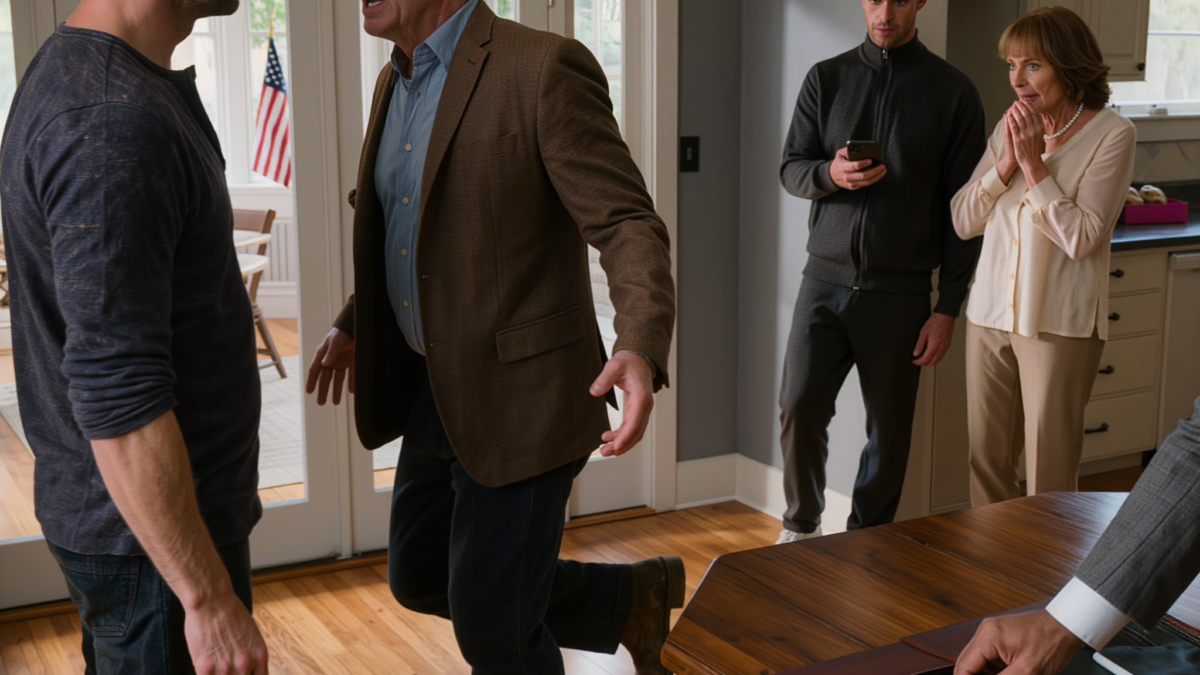
At 7:50, the sound of a modified V8 broke the Sunday morning quiet. Preston pulled up in the yellow Lamborghini and parked across the driveway, blocking my truck. He climbed out in a matching designer tracksuit, already holding his phone on a selfie stick and narrating his arrival as another big business occasion.
Dad’s SUV followed. He parked with part of the vehicle on the street and part on the grass I’d recently seeded. He came up the walkway carrying a leather briefcase, while Mom hurried behind him with a pink pastry box.
A fourth person came with them. He wore a wrinkled suit and carried a leather binder and a heavy metal stamp. They had brought a notary public, ready to complete the transaction before I had even agreed to discuss it.
Seeing him made the plan feel different from a demand made over the phone. They had arranged the papers, the witness to the signature, and the early-morning visit. I could see why they wanted me dressed, ready, and seated at the kitchen table with everything organized.
I opened the front door before they reached the bell. Dad stepped past me without wiping his boots, leaving mud on the oak floor I’d sanded and stained by hand. He didn’t stop to look at the work.
“Morning, buddy. Let’s get this paperwork done quickly. I have a golf tee time with the dealership owner at eleven, and I don’t want to be late.”
Preston followed, taking off his sunglasses and looking around the living room. His attention moved over the ceiling and walls with a look of disapproval. Nothing about the house seemed worth acknowledging except what he found wrong with it.
“It smells like old wood and dust in here. This place is tiny. The ceiling’s so low. Where’s the guest room? I need to check the natural lighting.”
“Why do you care about the lighting in my guest room?” I asked. I folded my arms and waited for an answer.
Mom put the donut box on the kitchen counter. She smiled, but her eyes kept moving around the room instead of meeting mine. Then she answered as though she were explaining an arrangement I had already accepted.
“Well, since Preston is going to be on the deed, it makes sense for him to use the space. His downtown rent is so expensive. With the new car payment and insurance, he needs to save money for a few months. He’s going to move into your spare room and use it as his content studio. Won’t it be fun having your brother around?”
Until then, I had thought they wanted an ownership transfer on paper. Now Mom was telling me they had also decided where Preston would live. The mortgage, taxes, and utilities would remain my responsibility while he used a room in my house to make videos and kept his leased car in the driveway.
They had built a plan around my work without asking whether I wanted any part of it. Preston wouldn’t just benefit from the house; he would have a legal claim to it and a place to stay while I continued paying the bills. My home was being discussed as a solution to his expenses.
“The guest room is not available,” I said.
Dad ignored that. He put his briefcase on the dining table, opened the brass latches, and took out a stack of documents. At the top of the first page, I could read the words “Quitclaim deed.”
He put a pen on top of the paper. The notary stood awkwardly to one side, holding his stamp. Dad pointed at a chair as though I were late for an appointment he had every right to schedule.
“Sit down, Declan. We’re doing this now. You’re adding Preston as a tenant in common. It boosts his net worth for the underwriters so the lease goes through. It’s just a formality. It’s paperwork to help the family.”
“Just paperwork?” I stepped closer and looked down at the deed. “If he defaults on that car, the bank puts a lien on my house. They take my home.”
“He isn’t going to default,” Mom said, pressing a hand to her chest. “His brand is taking off. You’re being negative and unsupportive. Why can’t you be happy for your brother’s success for once?”
“Because his success is a lie.” I looked at Preston, who was examining his reflection in his phone. “Your brand is fake. The car is leased on Dad’s credit, and now you want my house to pay for it.”
Dad’s face reddened. He hit the table with his fist, and the donut box rattled as the sound carried through the dining room. He wasn’t trying to answer my concern about the house anymore. He was reminding me how these arguments had always ended.
“We raised you. We put a roof over your head. You owe us this. Pick up the pen and sign the paper before I lose my temper and cut you out of this family.”
I looked at the pen lying on the deed. Then a car door closed outside, and I glanced toward the front window. Elias was walking up the drive, and he wasn’t alone: Vance, the CEO of the engineering firm where I worked, was beside him with a chilled bottle of champagne.
Dad didn’t notice. He was still leaning over the table, tapping the page with one finger and waiting for me to obey. Preston had settled against a slate-gray wall and returned to his phone, while Mom adjusted her pearl necklace beside the counter.
The notary looked down at the floor. I couldn’t tell how much he had known before coming, but he no longer looked comfortable with the appointment. The only person who still seemed certain about what was going to happen was my father.
The doorbell rang. Dad stopped tapping and looked up, irritated by the interruption. Preston let out a long sigh and finally took his eyes off his phone.
“Who is that? Did you order breakfast? Because these donuts are stale. The glaze is melting, and I’m on a high-protein diet for my brand photo shoot this afternoon. Tell whoever it is to leave the food on the porch. We’re conducting serious business in here.”
I didn’t answer him. Mom was wringing her hands, and Dad was still waiting by the table, but I walked past them to the door. I opened it and let the cool morning air into the house.
Elias entered first, wearing a tailored navy suit and carrying a reinforced leather briefcase with a combination lock. He looked around the room, taking in Dad’s position at the table, Mom beside the counter, and Preston against the wall. His attention stopped on the documents laid out in front of the empty chair.
He made his living handling contentious property matters, predatory contracts, and corporate disputes. He didn’t need me to explain the scene a second time. He could see the paper Dad expected me to sign and the notary who had been brought to complete it.
Vance stepped in behind him. I’d worked sixty-hour weeks at his firm for five years, and I knew the calm authority he brought to difficult rooms. He was tall and broad-shouldered, dressed in a charcoal suit, with the bottle of vintage French champagne held casually at his side.
Dad blinked and straightened. He didn’t know either man, but their presence unsettled him in a way my objections hadn’t. He stepped away from the table and raised his voice, trying to make clear that he still considered himself in charge of what happened in my house.
“Excuse me. This is a private family matter. We’re in the middle of signing confidential real estate documents. You need to turn around and leave my son’s property immediately.”
Elias walked into the dining room without answering that instruction. His shoes clicked on the floor as he approached the table. He leaned down, read the first paragraph of the deed, and gave a short, disbelieving laugh.
“A quitclaim deed,” he said. “You’re trying to transfer fifty percent of this property’s equity to a tenant in common without any payment in return. And you’ve brought a mobile notary to a Sunday morning meeting where the owner is being pressured to sign. That is desperate, and it is legally actionable.”
“Who do you think you are?” Dad demanded. He pointed at Elias’s chest, his finger shaking. “I told you to get out. You’re trespassing.”
“I’m Elias Sterling, Declan’s primary legal counsel.” He took a business card from his jacket and handed it to Dad. “I practice commercial real estate law, asset protection, inheritance disputes, and corporate litigation. The gentleman by the door is Vance Sterling, the CEO of Sterling Engineering and Declan’s employer. We’re here because my client called this morning and told me his family was subjecting him to financial coercion and intimidation.”
Mom gasped and raised both hands to her mouth. Preston lowered his phone and stood away from the wall, looking between Elias and Dad. The appointment was no longer unfolding as any of them had expected.
“Coercion?” Dad said. His voice caught, then grew louder. “Be careful what you accuse me of. This is family business. Declan is helping his brother secure a vehicle lease. It’s a temporary, legal transfer of assets to satisfy a bank algorithm. We support each other. You have no right to interfere with our family’s financial planning.”
“A vehicle lease.” Elias turned toward Preston. “You’re asking my client to give up half his house to secure a lease on a car that loses value. You’re asking him to risk foreclosure and damage to his credit so your son can drive a Lamborghini and use it to promote himself online.”
“It’s an investment in my personal brand,” Preston said, stepping forward. “You don’t understand digital marketing or audience retention. My earning potential is enormous once I get the right image on my channels. I’m building a digital business, and that car is the cornerstone of the marketing strategy.”
“Your salary is zero, Preston.” I stepped beside Elias. “You haven’t held a legitimate, taxpaying job in five years. You owe money to multiple high-interest credit card companies. Now you want the home I’ve worked for to pay for things you’ve rented to make yourself look successful.”
Dad struck the table again. The sound made everyone stop speaking, but it didn’t make Elias move or the pen appear in my hand. Dad looked at me as though he could still force the morning back into the shape he had planned.
“I’m warning you, Declan. Sign the paper today, or you will never see a dime of your inheritance. I’ll call my attorney tomorrow and cut you out of the will. You will get nothing when I die.”
I laughed. It wasn’t a performance or something I’d prepared to do. The threat was so far from the reality of his finances that, for a moment, I couldn’t respond any other way.
“What inheritance, Warren? The second mortgage you took out last year to cover your sports gambling debts? The five maxed-out credit cards? The retirement accounts you emptied for Preston’s apartments and cryptocurrency investments? You’re in debt. You’re standing in my house making demands because I’m the only person in this family with a positive net worth.”
Dad stepped back, his mouth open. He hadn’t expected me to know about the second mortgage or the gambling. He had maintained the appearance of financial authority for so long that hearing me question it in front of my employer and attorney seemed to leave him without an answer.
The notary quietly put his metal stamp into his leather bag. He zipped it closed and moved toward the front door. He had seen enough of the conversation to decide he would not be part of what Dad wanted to do.
“I’m going to leave now,” he said, his voice unsteady. “This transaction is officially cancelled. Do not ever contact my business again.”
He hurried down the driveway, got into his worn sedan, and drove away. Dad watched the person he’d brought to make the transfer official leave without witnessing a signature. The papers were still on the table, and they remained unsigned.
“You ungrateful, disrespectful…” Dad struggled to finish the sentence, his hands shaking. “I’m your father. I gave you life. You owe me everything you have.”
“I owe you nothing.” I stepped closer and looked down at him. “You stole $3,000 from my bedroom closet when I was sixteen. You took my truck money to pay Preston’s gambling debts because you wouldn’t hold him accountable. You’ve treated me like a bank account my whole life. I’m done letting you.”
The refrigerator hummed in the kitchen. Mom’s breathing was quick, and when she began crying openly, Dad continued staring at me instead of turning to comfort her. His chest rose and fell, but he didn’t answer what I’d said about the money.
For years, I had expected that saying these things out loud would leave me ashamed. I had carried the disappointment quietly and kept showing up when something needed fixing. Now the facts were out in the room, and I wasn’t the one who had to explain them away.
I wasn’t holding the family together by agreeing to another sacrifice. I was standing in my own home with a document I had refused to sign. That was all I needed to do at that moment, even while Mom cried and Dad looked at me as though I had betrayed him.
Vance came forward and set the champagne on the granite counter beside the pink donut box. He regarded Dad with a calmness that made Dad’s raised voice seem even less effective. When he spoke, he didn’t need to compete for anyone’s attention.
“It’s a shame that you see your son as a financial resource to use when it suits you,” Vance said. “If you’d taken the time to celebrate his work, if you’d come to the housewarming instead of going to the dealership, you would be celebrating the biggest financial victory of his life today.”
Dad frowned. His attention sharpened at the mention of money, and his anger gave way to a different kind of concern. He looked from Vance to me, trying to work out what he hadn’t been told.
“What are you talking about? What victory?”
Elias opened his briefcase and removed a thick manila folder. The city council’s embossed watermark was visible on the cover. He put it on the table, directly over the quitclaim deed Dad had brought for me to sign.
“That is the commercial rezoning approval from the city planning commission,” Elias said, pointing to the folder. “It was signed, ratified, and entered into the public record at four on Friday afternoon.”
Preston looked confused. He had been following the argument while it concerned his lease, but the folder seemed unrelated to the problem he wanted solved. He looked from it to Elias with growing impatience.
“Rezoning? What does that mean? Who cares about zoning regulations? We’re talking about my car and my career.”
“It means this property is no longer classified as a single-family residential lot,” I said. For the first time that morning, I smiled. “It’s now part of the new downtown commercial development district.”
Dad’s eyes went straight to the folder. He understood enough about property to recognize that the new classification could mean money. I could see him trying to estimate the value of what he’d almost persuaded me to share.
Vance turned to me. His smile was genuine, and for the moment he seemed to be speaking only to me, the way I had hoped someone would speak to me at the housewarming. My family stood around us, listening.
“Declan, I spoke with the primary developer this morning. They’re eager to acquire the block and begin construction on the new corporate high-rise. Your lot is in the center of the proposed building’s footprint, and they submitted their preliminary purchase offer an hour ago.”
He paused. Dad kept his eyes on him, no longer tapping the table or ordering anyone out. When Vance spoke again, he looked directly at my father.
“They’re offering $2.5 million for this property.”
Mom stopped crying. Preston’s phone slipped from his hand and hit the oak floor, cracking the screen. Dad stared at Vance as the color drained from his face, and for a moment nobody seemed able to decide what to say.
I’d bought the house for $300,000 only a few months earlier. The $60,000 down payment had taken five years to save. My research and the work Elias had done on the zoning application had brought me to an offer I could scarcely compare to those years of careful budgeting.
I had spent evenings repairing walls while other people were out enjoying themselves. I’d kept working through the inconvenience of living in a construction project because I believed in the house and the land beneath it. Now a developer was offering $2.5 million for the property my father had dismissed as paperwork for a car.
My family’s attention returned to the deed. They were looking at the same page they had wanted signed ten minutes earlier, but the number Vance had announced changed what they saw. Half of $2.5 million was $1.25 million, and that was the share they had come close to getting from me for nothing.
In that moment, I thought of the equity I’d almost been pressured into handing over. If guilt had made the decision for me, Preston would already have a claim to half the property. My family would have gained access to the result of work they hadn’t bothered to celebrate.
But there was no signature. The notary was gone, the deed was still on my table, and the decision remained mine. Their expressions told me they understood that almost as clearly as they understood the money.
“Declan, honey.” Mom’s voice changed completely. She stepped toward me with her hands extended, as though she wanted to hug me. “Two and a half million. Oh my God. We’re so proud of you. This changes everything for us. We can pay off the house, cover Preston’s salary for his company, and finally take that family trip to Europe.”
“We?” I stepped back before she could touch me. “There is no we, Hadley. There’s me.”
Dad adjusted his jacket. He had stopped making threats and was now trying to sound practical, the experienced parent guiding his son through an important decision. The speed of the change was more revealing than anything he had said over the phone.
“Son, listen. This is incredible news. This is generational money, which is exactly why we need to manage it as a family asset. We can set Preston up with a legitimate marketing agency downtown and secure your mother’s retirement. You don’t have to sell immediately. Let me look at the developer’s contract. I know business, and I can negotiate a better deal for us. We need a wealth manager.”
He said “us” as though the argument about the deed had never happened. Minutes earlier, he had been ready to risk my home to complete a car lease. Now he was offering to take charge of a financial future he had played no part in building.
I looked at him and thought of the empty coffee tin. I thought of the truck I never bought, the steaks in my refrigerator, and the sight of him shaking the salesman’s hand. None of those memories had stopped being painful, but they no longer made me feel obligated to earn a different ending from him.
The anger had loosened its hold on me. So had the need to hear him say he was proud. He had finally said the kinds of things I’d wanted to hear, but only after another man put a price on my work, and that was enough to tell me what those words were worth.
I went to the table and picked up the pen he’d put there. I rolled it between my fingers while they watched, then took hold of the quitclaim deed. Dad’s expression changed again as he realized I wasn’t preparing to sign it.
“Declan, what are you doing? Don’t do anything rash. Let’s sit down and talk about the lawsuit protections first.”
I held his gaze, gripped the paper with both hands, and tore it down the middle. The sound was clear in the quiet dining room. I didn’t have to explain my decision again; they were watching me make it.
“No, Declan, stop it!” Mom cried.
I tore the document again, then again, until I was holding small pieces. I carried them to the counter, opened the pink donut box, and dropped the paper over the pastries. Then I threw the box in the trash.
“Get out,” I said. I wasn’t shouting. I had already said everything they needed to hear.
“Please, let’s talk about this rationally,” Dad said, lifting both hands. “You’re emotional. You’re not thinking clearly. Two million dollars is a tremendous responsibility. You need your family to guide you through it.”
“I have my family.” I pointed toward Elias and Vance. “They showed up to protect me. You showed up to take from me. Get out of my house.”
Preston’s face turned red. For the first time since he’d arrived, his concern wasn’t hidden behind talk of branding or future income. The consequences of leaving without the paperwork had become much more immediate to him.
“You can’t do this to me. I signed the lease yesterday. The bank needs the asset verification by tomorrow morning, or they’ll repossess the Lamborghini. My credit will be destroyed. I’ll get sued for breach of contract.”
“That sounds like your problem, Preston,” I said. “Maybe you should get a job.”
I walked to the front door and opened it. The morning air moved through the house while they remained beside the table and counter, looking at one another. None of them was ready to leave, but there was nothing left to negotiate.
“Leave my property. If you’re still here in thirty seconds, Elias will call the police about trespassing. Then I’ll pursue a lawsuit for attempted fraud, coercion, and emotional distress.”
Dad looked at Elias. Elias took out his phone, tapped the screen, and gave him a small smile. Dad understood that nobody in the room was going to pressure me to make this easier for him.
He picked up his briefcase and walked past me with his shoulders slumped. Mom followed, crying and saying I was destroying the family loudly enough for anyone outside to hear. Preston was last.
He stopped in the doorway and glared at me. “You’re selfish and greedy, Declan. You’ve always been jealous of me.”
“Enjoy riding the public bus, Preston,” I said.
I shut the oak door, locked the deadbolt, and slid the chain into place. Then I leaned against the door and closed my eyes. The breath I let out felt like one I’d been holding through years of trying to keep everyone else satisfied.
Vance opened the champagne. The cork popped, and I heard the liquid pouring into glasses. Elias brought one over and held it out to me without asking anything in return.
“To boundaries,” he said.
“To a solid foundation,” I answered, and took a drink.
I thought closing the door would end it. They had seen that I wouldn’t sign, and they had met the attorney who would be there if they tried again. I expected them to retreat, embarrassed and angry, and leave me alone while they dealt with the car.
By Monday morning, it was clear they intended to tell a different version of what had happened. My phone filled with messages, missed calls, and voicemails from relatives I hadn’t spoken to in years. People who had shown no interest in the house before now had strong opinions about what I owed my family.
Uncle Silas left a furious three-minute message. He accused me of physically throwing my crying mother into the street and keeping millions for myself while my family went without. Rowan sent a long, profane text telling me I was heartless and deserved to spend my life alone.
Aunt Linda, whom I hadn’t seen since I was twelve, left her own condemnation. The details in their messages had little to do with the morning I’d actually experienced. I had opened my door and ordered people out of my home; they were describing something entirely different.
Against my better judgment, I opened Facebook. I wanted to see what they were saying before I decided how to respond. Preston had posted a carefully edited, ten-minute storytime video across his social accounts.
Its title read, “Toxic family alert. My jealous brother tried to destroy my career because he can’t handle my massive success.”
He filmed it from the driver’s seat of the yellow Lamborghini, wearing a rented designer hoodie and lit by a ring light. He looked into the camera and told his followers I had invited the family over just to shout at them. Then he said I had promised for months to help finance his business and withdrawn the support at the last minute to embarrass him in front of investors.
None of that was true. He had arrived with my parents and a notary to get a share of my home, and I had refused. In his version, I was a jealous brother breaking a promise rather than a homeowner declining a demand.
“He threw our crying mother out onto the cold street,” Preston said, wiping at his eyes. “I wanted to share my success with him. I wanted to lift him up and give him part of my company. But some people are full of negative energy. They want to pull you down to their level.”
Hundreds of strangers responded as though they had witnessed the scene themselves. They called me selfish, diagnosed my personality, and told Preston to hire a lawyer. Some urged him to sue for emotional distress and financial sabotage.
Mom added a comment beneath the video. “A mother’s heart breaks when her own child turns his back on the family. We’ll survive this betrayal, sweetie. Prayers needed for our family during this difficult time.”
I watched from my home office with a cup of coffee in my hand. I didn’t reply to Preston or argue with the commenters. The people responding were reacting to a story he’d designed for them, and I wasn’t going to make the comment section the place where I tried to prove what had happened in my own house.
Instead, I downloaded the video at full resolution. I saved screenshots of the comments and kept the threatening voicemails. Then I sent everything to Elias, who already knew the events Preston was trying to rewrite.
Ten minutes later, Elias called. His voice was practical and even, the same voice he’d used before coming to my house. He wasn’t interested in trading insults with Preston online.
“I have the Ring footage from your front porch,” he said. “I have the messages from your father demanding the property documents, and the audio of him trying to pressure you into signing the deed. Do you want me to take legal action?”
“Yes,” I said. “Go ahead.”
On Wednesday morning, a licensed process server delivered a formal legal packet to my parents’ front door. Elias had drafted a cease-and-desist order detailing the conduct he considered actionable, including the attempt to pressure me into transferring ownership. The packet also addressed what Preston had said publicly after the meeting.
It threatened a multimillion-dollar defamation lawsuit if Preston didn’t delete the video and issue a public retraction. Printed screenshots showed the messages demanding my property records. Elias laid out the difference between a voluntary offer to help a brother’s business and the demand that had brought my parents to my house with a deed and a notary.
The final warning was direct. Further contact, attempts to approach my property, or public use of my name would lead Elias to pursue a restraining order and a civil lawsuit. It made clear that continuing the campaign could carry financial consequences much larger than the car payment they had wanted me to support.
Within two hours of the packet being served, Preston’s video was deleted. Silas, Rowan, Aunt Linda, and the other relatives stopped contacting me. No one sent a follow-up argument or left another furious voicemail demanding that I repair the family by giving them money.
The quiet was different from the silence after the housewarming. That evening, I had been waiting for people who didn’t come. Now I wasn’t waiting for anyone, and the absence of calls meant I could move through my day without preparing to defend myself.
Exactly two weeks later, I saw another video. I was eating breakfast and scrolling through a local community Facebook page when a post from someone near Preston’s downtown apartment appeared. It was an unedited recording taken from a balcony above the street.
A heavy-duty tow truck stood in the road, blocking traffic. Behind it was the yellow Lamborghini, its rear wheels lifted off the pavement. The car that had been displayed beneath showroom lights was now attached to equipment built to take it away.
Preston ran out of the apartment building wearing pajama pants and a wrinkled graphic T-shirt. He waved his arms and shouted at the driver, who stood beside the truck with a clipboard. There was no edited introduction, designer outfit, or careful lighting this time.
“You can’t take that. Put it down. That’s my company car!” Preston shouted.
The driver, a large man in a safety vest, pointed to his clipboard. “The bank ordered the repossession. The lease documents were flagged as fraudulent. Your co-signer failed the asset verification, and the primary account is in default. Step back onto the curb, or I’m calling the police.”
Preston dropped to his knees on the sidewalk and covered his face with his hands. The truck drove away with the Lamborghini. I watched the same car leave his life that he had used to announce his success while I waited alone at my patio table.
I later heard through the neighborhood grapevine that the bank had audited Dad’s finances after the dealership submitted the final lease papers. According to what I heard, the underwriters found that he had misrepresented his income and assets and couldn’t produce my deed as collateral. The contract was terminated.
I also heard that the dealership sued him for breach of contract and fraud. The bank called in the second mortgage on my parents’ house after they missed three consecutive payments while trying to cover Preston’s legal fees. Their debts had caught up with them, and the asset they expected me to provide was not available.
They were facing bankruptcy and legal consequences with no one left to pay their way out. For years, they had treated my reliability as something that would always be there, regardless of how they treated me. This time, they had to deal with the result of their choices without my signature or savings.
Six months have passed since that Sunday morning. I didn’t sell the property outright for the developer’s initial offer. Elias negotiated a different arrangement: a ninety-nine-year commercial ground lease.
I retained ownership of the land, while the developer agreed to pay a substantial monthly amount to build its corporate plaza there. Instead of receiving one lump sum and giving up the property, I kept the land and secured a long-term income. The arrangement gave me a level of financial stability I had never expected during those years of saving for a down payment.
With the first check from the developer, I bought a large piece of land in the countryside. It was far from the city and the neighborhood where so much of the confrontation had unfolded. I wanted my next home to be somewhere I could live without carrying those rooms and that table into every day.
I designed and built a custom single-story house. The concrete foundation was extra thick, and the framing was reinforced steel. I put the same care into its structure that I had put into the Craftsman, building it to last a hundred years.
Last Saturday, I finally had the housewarming I had wanted. It was small and quiet. I didn’t invite my extended family or send another message to the old group chat.
I invited Elias, Vance, and Ezra. My former neighbor drove forty minutes into the country to celebrate with me. None of them treated the invitation as something to fit in if nothing more interesting came along.
We sat on the new back deck while the sun went down behind the trees. I cooked thick ribeyes on a new outdoor grill, and we drank aged bourbon. We talked and laughed about the upheaval of the past year without anyone trying to turn dinner into a financial arrangement.
Nobody asked me to sign anything. Nobody brought a request for a loan or explained what my house could do for someone else’s career. They were there because they wanted to spend the evening with me, and I could enjoy their company without waiting for a demand to follow.
After dinner, Ezra walked out to the front yard with me. He had brought another housewarming gift, but this one wasn’t a small plant for a windowsill. It was an oak sapling, its roots wrapped in burlap.
“I figured you have enough land now for something with deep roots,” he said, handing me a steel shovel. “A tree like this takes time and patience. But once its roots take hold in good soil, no storm can knock it down.”
We planted it together in the middle of the front yard. I packed the dark soil around the base, watered it carefully, and stood back. When I wiped the dirt from my hands and looked toward the house, I thought briefly about my parents.
Elias had told me they were working through a bitter bankruptcy case, blaming each other for their financial collapse. Preston had been evicted from his apartment and moved back into their house. With his online brand gone, he was working a minimum-wage retail job.
I didn’t feel the anger I had expected to carry. I wasn’t planning another confrontation or waiting for them to acknowledge what they’d done. I felt relieved that their arguments and expenses were no longer the structure around which I had to build my life.
Sharing a last name had never guaranteed that someone would protect what I worked for. The people I had expected to help me build a secure life had been willing to undermine it when that suited them. Accepting that was painful, but continuing to ignore it had cost me years.
I couldn’t repair that arrangement by working harder or giving more. I had tried being dependable, patient, and useful. None of it changed the expectation that whatever I earned would be available whenever Preston needed it.
My life is quiet now. My phone doesn’t fill with emergencies I didn’t create, and my bank account isn’t treated as a family solution. My home and future belong to me.
I spent thirty-two years being the load-bearing wall for people who never appreciated the weight I carried. Now I’m building my own castle, and I’m the only one holding the keys to the front gate.








