My family called me a janitor at my brother’s engagement dinner, but the billionaire they wanted to impress knew me as his CEO
My name is Harrison. I am 32 years old.
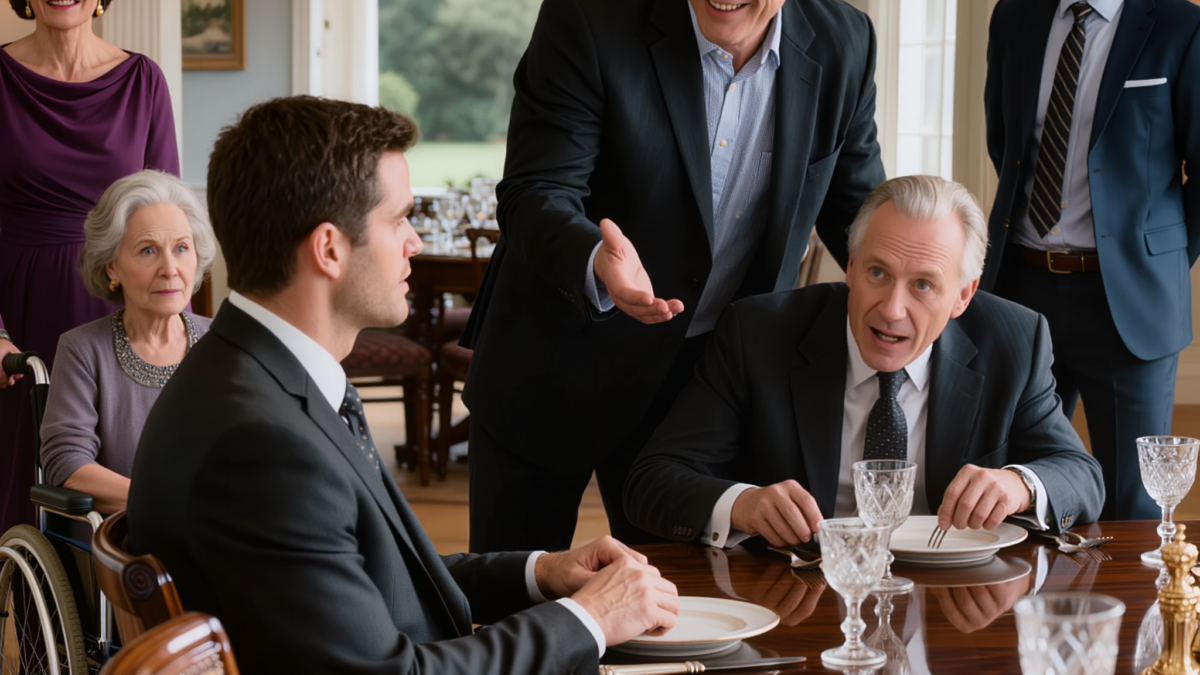
Last Saturday, at my younger brother’s incredibly lavish, over-the-top engagement dinner, my father looked across a mahogany table of 23 people and told the bride’s extremely wealthy family that I was a complete lost cause who cleaned toilets for a living.
While I was sitting right there, perfectly quiet, trying to endure the evening, my parents laughed and publicly humiliated me just to elevate their golden child of a son.
But there was a massive secret they didn’t know. The bride’s father, the billionaire real estate tycoon they were trying so desperately to impress, wasn’t a stranger to me.
He was my biggest corporate client.
And in the next 40 minutes, my family watched their entire carefully constructed house of lies burn straight to the ground.
Now, let’s go back to the exact second the bomb dropped.
The private dining room at the Birches was suffocatingly warm. It was one of those farm-to-table restaurants situated just outside the city limits that charges an absolute fortune for exposed brick walls, rustic dim lighting, and portions of food so small they look like a garnish.
There were 23 people sitting around this massive, highly polished mahogany table. The air in the room smelled heavily of roasted garlic, expensive red wine, and the thick, undeniable scent of my family’s sheer desperation to belong to a tax bracket they had absolutely no business being in.
My mother, Margaret, was wearing a plum-colored dress that definitely cost more than her first car. She was sitting with her posture perfectly straight, her neck stiff, playing the part of a high-society matriarch.
She had spent the entire month leading up to this dinner obsessing over every detail, determined to prove to the bride’s family that the Hallways were people of substance.
My father, Richard, was working the room like a small-town politician running out of funding. He was desperate to impress Clara’s family.
Clara is my younger brother Julian’s fiancée.
And Julian was doing what he has done every single day of his 28 years on this earth. He was sitting at the exact center of attention, soaking up the praise, wearing a tailored navy suit that I knew for an absolute fact he had put on a high-interest credit card because he couldn’t actually afford the lifestyle he projected.
Julian is a mid-level marketing manager who talks like he owns the agency.
We had just finished the appetizers when Winston Kensington leaned forward.
Winston is Clara’s father, the CEO and founder of Kensington Real Estate Holdings, a company that owns commercial properties across the entire Midwest.
He is a man who commands a room without ever needing to raise his voice. He had silver hair, a custom Italian wool suit, and the kind of quiet, terrifying authority that my father has spent 30 solid years trying to fake in front of his co-workers at the insurance firm.
Winston looked at me from the other end of the long table. We hadn’t formally spoken yet that evening.
I had deliberately chosen a seat at the far end, right next to my elderly grandmother, keeping my head down, my mouth shut, and blending into the background just like my family wanted.
“And you must be Harrison,” Winston said politely, his deep voice effortlessly cutting through the chatter of the room. “Julian hasn’t mentioned much about your line of work.”
Before I could even open my mouth to form a single syllable, my father chuckled.
It was that loud, forced, booming laugh he always uses when he’s trying to control a narrative or cover up his own deep-seated insecurities.
“Oh, Harrison,” my father said, waving his hand dismissively in the air like he was swatting a bothersome fly away from his plate. “This is our other son. He cleans houses for a living. Mostly residential stuff, you know, mops and buckets. He does what he can.”
My mother smiled, her lips pulling tight across her teeth, chiming in right on cue like a well-rehearsed stage play.
“We really tried with him, Winston. We tried to get him to use his college fund for something useful, maybe get into corporate law or management, but, well, we’ve given up on him. Julian is the real success story of the family. We are just so incredibly proud of Julian.”
My father nodded in furious agreement, leaning closer to Winston, desperate to establish a connection of shared superiority.
“Exactly. We just let Harrison do his little cleaning thing. He’s not exactly climbing the corporate ladder like Julian with his big promotion and high salary.”
I did not react. I didn’t flinch. I didn’t let a single ounce of the rage burning in my chest show on my face.
I simply picked up my crystal water glass, took a slow, measured sip of the ice water, and set it back down on the pristine white tablecloth.
I kept my eyes locked entirely on Winston Kensington.
Winston had his heavy silver fork halfway to his mouth. He stopped completely. A piece of roasted asparagus hovered in midair.
His eyes narrowed slightly as he looked at my father, then shifted to my mother’s fake, painted-on smile, and finally they locked directly onto me.
I saw the exact microsecond his brilliant brain processed the information. I saw the flicker of absolute, unadulterated shock behind his dark eyes.
He slowly lowered his fork back to his porcelain plate.
The clink of the heavy silver against the dish sounded like a gunshot in the suddenly quiet room.
Winston leaned forward, ignoring my parents completely. He looked me dead in the eye and whispered, his voice carrying the heavy, undeniable weight of an anvil dropping from a great height.
“Wait, you’re him.”
I gave him a fraction of a nod, just a millimeter of movement, just enough to confirm everything he was putting together in his head.
Winston went completely quiet.
He leaned back in his expensive leather chair, slowly folding his hands over his stomach.
The entire table locked up. The silence was thick, heavy, and absolutely deafening.
The waiter, who was pouring wine in the corner, literally froze midway through the pour.
My father lost all color in his face. His skin turned a sickly pale gray.
He looked back and forth between Winston and me, completely unable to comprehend why the billionaire he was trying so hard to worship was staring at his massive disappointment of a son with absolute awe.
But to understand why Winston’s reaction broke my family and why I let them hang themselves in front of 23 people without saying a single word to stop them, you need to understand how we got here.
Because this dinner wasn’t just a random misunderstanding.
It was a 10-year execution.
10 years ago, I was 22 years old, living in Carver, Indiana. Population 9,000.
Carver is the kind of small town where everyone knows exactly how much money you make, what kind of car you drive, and what time you turn your porch lights off at night.
It is a town built on judgment and keeping up appearances.
My father was a regional claims manager at a midsized insurance firm. He got the job when he was 31 years old and stayed in that exact same gray, lifeless cubicle for three decades.
He was terrified of risk, obsessed with the illusion of status, and deeply, deeply insecure about his stagnant career.
He lived in constant fear of his superiors and took out that frustration by ruling our house like a petty dictator.
My mother was his loyal echo chamber. She lived for the local country club gossip. Always comparing our family to everyone else’s. Always worried about what the neighbors thought of our lawn, our clothes, and our choices.
And then there was Julian.
Four years younger than me, Julian was the absolute golden boy. He played the right sports, dated the right girls, and knew exactly how to manipulate my parents’ fragile egos perfectly.
Whatever Julian did was spectacular. Whatever I did was just expected or completely ignored.
The fuse for the explosion at that engagement dinner was lit on a rainy Thursday night in my parents’ kitchen.
A whole decade ago, I had just graduated with a degree in business administration. I came home exhausted, only to find my entire future mapped out for me without my consent.
I walked into the kitchen to find a glossy, expensive-looking admissions packet for a local MBA program sitting directly on my dinner placemat.
“I already paid the application fee,” my father said, not even looking up from his evening newspaper. “You’ll start in the fall after you graduate. I talked to a guy at the firm. You can come in as an entry-level analyst. Safe salary, good 401k, you’ll be set for life. You won’t have to worry about a thing.”
I looked down at the brochure.
It looked like a prison sentence.
A lifetime of gray cubicles, kissing up to bosses who didn’t care about you, and living the exact same terrified, risk-averse life my father lived.
I could already feel the walls closing in on me.
“I’m not going to grad school, Dad,” I said quietly, leaving the brochure on the table and taking a step back.
He lowered his newspaper slowly. The paper crinkled loudly in the quiet room.
My mother stopped washing the dishes, her hands freezing in the soapy water.
The silence in the kitchen was thick enough to choke on.
“Excuse me,” he said, his voice dropping an octave, taking on that dangerous authoritative tone he used when he wanted to intimidate us.
I reached into my worn-out canvas backpack and pulled out a thick, heavy binder.
I had spent the last eight months of my senior year researching, calculating, and building a comprehensive business plan.
It had deep market research, exact cost projections, a realistic 12-month cash flow estimate, and a full demographic breakdown of the regional commercial sector.
I set it gently on the table next to his MBA packet.
“I’m starting a commercial cleaning company,” I told him, looking him right in the eye, refusing to back down. “I’ve already scoped out the Indianapolis market. There’s a massive gap in reliable high-tier facility maintenance for mid-sized commercial buildings. Everyone focuses on the massive skyscrapers or the small residential homes. The middle market is wide open. I can start small, do the manual labor myself to keep overhead low, and scale up within 2 years to hire a dedicated crew.”
My father stared at the binder like it was a dead rat on his dining table.
He didn’t reach for it. He didn’t open it. He didn’t read a single page of the hundreds of hours of painstaking work I had poured into it.
“You want to scrub toilets?” he asked, his voice dripping with absolute unfiltered disgust. “I spent 20 years putting a roof over your head, funding your college education, and your big master plan is to be a janitor. You want to drag our family name through the dirt while your brother is applying for pre-law programs?”
“It’s a business, Dad. It’s a highly scalable industry with a massive profit margin if you run it efficiently. I’m not going to be the janitor forever. I’m going to be the CEO of a facility management firm.”
“It’s a joke!” he yelled, suddenly slamming his heavy hand on the wooden table so hard the silverware rattled against the plates. “I have colleagues at the firm who are sending their kids to medical school. I have bosses whose sons are getting into investment banking. What am I supposed to tell them at the holiday party? That my eldest son is emptying trash cans for minimum wage? You are embarrassing me. You are a complete embarrassment.”
My mother wiped her hands on a dish towel, looking at me with pure agonizing disappointment, as if I had just confessed to a terrible crime.
“Harrison, please don’t do this to us. Your father works so hard to maintain our image in this town. Just take the MBA. Don’t be difficult. Why can’t you just be more like Julian? Julian never causes these kinds of problems.”
“I’m not being difficult, Mom. I’m building my own life on my own terms.”
My father stood up. His face was flushed crimson with rage.
“If you want to be a garbage man, you do it on your own dime. I am not funding a mop-and-bucket operation. You have until the end of the month to pack your things. You are completely cut off. No inheritance, no safety net, no support, nothing. We are done.”
He turned on his heel and walked out of the kitchen, his heavy footsteps echoing down the hallway.
My mother didn’t say a single word to defend me. She didn’t try to stop him.
She just turned her back to me, picked up a sponge, and went back to scrubbing a perfectly clean plate, acting as if I had already ceased to exist.
I didn’t wait until the end of the month.
I went straight to my room, grabbed two large canvas duffel bags, and packed my entire life in 45 minutes.
As I was loading my things into the trunk of my beat-up Honda in the dark, freezing driveway, the rain started to come down in cold sheets.
The front door creaked open.
It was my grandmother, Beatatrice.
She was 78 years old at the time, sharp as a tack, and the only person in that entire house who actually saw me for who I was.
She had been living in the small in-law suite in the back of the house since my grandfather passed away.
She walked down the wet driveway in her slippers, ignoring the cold rain soaking into her clothes, holding her knitted cardigan tight around her chest.
She didn’t say a word at first.
She just walked right up to me, reached into her deep pocket, and pulled out a thick white envelope, pressing it firmly into my hand.
“There is $800 in there,” she whispered, her voice raspy, but incredibly strong. “It’s not much. It’s what I could pull from my savings, but it will buy your first industrial vacuum and a whole lot of bleach.”
“Graham, I can’t take your money,” I said, my throat tightening so hard I could barely speak.
I tried to push the envelope back into her hands.
“Take it,” she commanded, her grip on my hand tightening with a surprising, fierce strength.
Then she handed me something else.
A crisp white cotton handkerchief.
She had hand-embroidered my initials HH into the corner with dark blue thread.
“For the hard days,” she said, tapping my chest right over my heart. “Listen to me, Harrison. Your father is a terrified man. He’s so afraid of failing that he never once tried to build anything real in his entire life. He wants you in that cubicle because if you succeed out here on your own, it proves to him that he wasted his life. Don’t let his fear become your cage. Go build your empire. Prove them all wrong.”
I hugged her tightly, smelling the faint, comforting scent of lavender and old paper that always clung to her clothes.
I drove away from Carver that night, my tires splashing through the deep puddles on the highway, gripping the steering wheel until my knuckles turned white, and I didn’t look back once.
Indianapolis was brutal.
It was a baptism by fire.
My first apartment cost $475 a month. It was a tiny single-room studio above a loud dive bar.
It had peeling yellow wallpaper, a mattress on the floor, and a radiator that sounded like someone hitting a metal pipe with a hammer every single night at 3:00 a.m.
I took Grandma Beatatric’s money and bought a used, rusted white van.
The heater didn’t work. The air conditioning was nonexistent. The back smelled faintly of wet dog and old harsh chemicals.
My first client was a small independent dental clinic on the east side of the city.
They paid me a grand total of $200 a week.
I was the CEO, the marketing department, the accountant, and the janitor.
I would wake up at 4:00 a.m. in the freezing cold, drive to the clinic, and scrub the mint-green tiles in the bathroom until my hands were raw and blistered.
I learned the exact chemical ratio of ammonia and water to remove stubborn hard water stains.
I learned how to buff a cheap linoleum floor so perfectly that it looked like pure glass.
My back ached in a deep, agonizing way that didn’t stop even when I was trying to sleep on my cheap, lumpy mattress.
By month six, I had hustled my way to five contracts.
I was pulling 16-hour days, 7 days a week.
The physical toll was agonizing, but the financial spreadsheets I kept on my cramped kitchen counter were starting to look beautiful.
The math was working.
At the end of year 1, my total revenue was $62,000.
It wasn’t millions, but it was mine.
That was when I hired my first employee.
Her name was Carmen.
She was a single mother from Guatemala who had just finalized a horrific divorce and was fighting a brutal, emotionally draining legal battle for full custody of her two young kids.
Her ex-husband was trying to claim she couldn’t provide for them.
She needed flexible hours, a fair wage, and someone to treat her with basic human dignity so she could pay her lawyer.
I paid her 20% above the industry standard.
She showed up 15 minutes early every single day, worked with incredible, meticulous precision, and never once complained about the grueling labor.
Carmen taught me a lesson I never forgot.
A business is only as strong as the people holding the mops. If you take care of your people, they will take care of your clients.
I called Grandma Beatatrice every Sunday evening without fail.
She asked about my profit margins, my client retention rates, my liability insurance policies.
She didn’t ask when I was getting a real job. She listened to me. She validated my existence and my hard work.
Every few months, I would make the mistake of calling my parents, hoping something had changed.
The conversation was always exactly the same.
My father would answer, give a dismissive grunt, and immediately hand the phone to my mother as if speaking to me was a chore.
My mother would ask when I was coming back to the real world, and then she would spend 20 uninterrupted minutes talking about Julian.
Julian got into a prestigious fraternity. Julian got an amazing internship at a downtown firm. Julian bought a new designer watch that cost more than my van.
I took the blinding, sharp pain of their constant rejection, and I weaponized it.
I poured every single ounce of my anger, my grief, and my relentless drive directly into my company.
Year three was the massive turning point for Holloway Commercial Services.
I had grown from just me and Carmen to a dedicated, highly trained team of 12 full-time employees.
We had standard uniforms, a fleet of three reliable vans, and a reputation for absolute perfection.
And then I landed my first true whale.
A midsize tech company in downtown Indy needed a massive multi-story facility cleaned nightly. They were unhappy with their current vendor.
I came in, pitched them aggressively, and won.
The contract was worth $340,000 a year.
I remember sitting in my freezing van in the parking lot outside their towering glass building, staring at the freshly signed contract resting on my steering wheel.
My hands were shaking uncontrollably.
I had done it.
I had officially broken through the barrier of small-time operations.
I was running a real, highly profitable enterprise.
I picked up my phone.
I didn’t call Grandma Beatatrice first, like an absolute idiot, like a wounded, desperate child who still just wanted his dad to look at him and be proud.
I called my father.
He answered on the third ring.
“Yeah?”
“Dad. It’s Harrison.”
“I’m busy, Harrison. The lawn mower is acting up again, and your mother is breathing down my neck about the landscaping. What do you want?”
I took a deep breath, looking down at the wet ink on the contract, feeling a surge of hope.
“I just wanted to tell you some news. I just signed a new corporate client. The contract is worth $340,000 a year. My company is really growing, Dad. I’m hiring more people. It’s really happening. I did it.”
There was a long, agonizing pause on the line.
The kind of silence that stretches out and makes your stomach drop.
I waited for it.
I waited for the “Good job, son.”
I waited for a “Wow. I underestimated you.”
Even just a basic congratulations.
Instead, I heard the sputtering sound of a lawnmower engine stalling out in the background.
My father sighed heavily, a wet, exhausted sound into the receiver, as if my success was entirely exhausting to him.
“So,” he said, his voice dripping with that exact same venom and condescension from 3 years ago. “How many people are you sending to mop floors now? You know, Julian just got a massive promotion at the marketing firm. They bumped his salary up by 15%. Real corporate money. He’s managing massive accounts. Harrison, he wears a tailored suit to work. He’s really making a name for himself. Listen, I have to go fix this carburetor. Tell your mother I need more lemonade if you talk to her.”
Click.
He hung up on me.
He didn’t even say goodbye.
I sat in my freezing van in that empty parking lot for 20 long minutes.
I didn’t cry.
The sadness had completely burned out, leaving only a cold, hard, indestructible resolve in its wake.
That was the absolute last time I ever shared a single detail about my life, my finances, or my business with my parents.
I locked the massive steel door to that part of my heart, and I threw away the key forever.
The real betrayal, the exact moment that showed me exactly how toxic and rotten my extended family had become under my parents’ constant influence, happened a year later at my aunt Martha’s funeral.
I drove back to Carver for the service.
I wore a clean, perfectly tailored black suit that I had bought with my own hard-earned money.
During the somber reception at my parents’ house, I was standing quietly in the kitchen getting a glass of water.
The house was packed wall-to-wall with aunts, uncles, and cousins eating dry sandwiches and gossiping about the inheritance.
My cousin Felix walked in.
Felix was an incredibly arrogant real estate agent who thought selling a few two-bedroom ranches in a dying town made him the absolute Wolf of Wall Street.
He had a cheap beer in his hand and a massive, cruel smirk on his face.
He walked right up to me, making sure he was surrounded by half the family, including my aunt Brenda and uncle Marcus.
“Hey, Harrison,” Felix said loudly, raising his voice intentionally to ensure the entire living room got quiet enough to hear him. “I saw a garbage truck driving down Route 9 today. Made me think of you. You still driving around with the bleach and the dirty rags, making sure those toilets sparkle for minimum wage?”
A few cousins snickered openly.
Aunt Brenda covered her mouth with her hand to hide a vicious, delighted smile.
Uncle Marcus looked down at his expensive shoes, totally unwilling to step in and defend his nephew.
I looked across the crowded living room.
My mother and father were standing right there by the fireplace.
They heard every single word Felix said.
They didn’t say a thing to defend me.
In fact, my father looked slightly embarrassed that I was even in the room breathing the same air as his successful family members.
He actually turned his back to me.
I looked back at Felix.
I could have told him that my company was now generating over a million in annual revenue.
I could have told him that my personal net worth was already triple his entire real estate portfolio and I didn’t have a single cent of debt.
But I looked at the smug, punchable faces of my family and I realized something profound.
They didn’t want me to be successful.
They desperately needed me to be the failure.
They needed me to be the punchline so that Julian could look brighter and so that my father’s incredibly mediocre, cowardly life could feel like a massive victory.
If I showed them my success, they would just find a way to tear it down, belittle it, or falsely claim credit for it.
So, I smiled calmly at Felix.
“Yeah, Felix, still working with the rags. Good to see you.”
I left the funeral reception early.
I drove back to Indianapolis and I went to absolute war.
Over the next 7 years, I built a corporate empire in total beautiful silence.
Holloway Commercial Services expanded rapidly from Indianapolis into Ohio, then Michigan, then Illinois.
We completely stopped doing small clinics and started taking over massive facility management for regional hospitals, sprawling university campuses, and towering corporate headquarters.
I didn’t just have janitors.
I had a highly trained, deeply loyal workforce of 283 employees operating across 14 different states.
My annual revenue crossed $18 million.
I bought a stunning penthouse downtown in cash.
I drove a discreet but incredibly expensive Porsche Cayenne.
I set up fully funded college funds for Carmen’s kids, who had been with me since day one, and promoted Carmen to regional director with a six-figure salary.
My employee retention rate was 87%.
The absolute highest in the entire commercial facility sector.
I was a total ghost to my family in Carver, but in the corporate world of the Midwest, I was a titan.
And that is exactly how I met Winston Kensington.
18 months before that fateful engagement dinner, Kensington Real Estate Holdings put out a highly competitive bid for a massive facility management contract covering 47 of their largest commercial buildings across the Midwest.
The contract was worth an astronomical $3.8 million a year.
It was the white whale of the industry.
Every major cleaning conglomerate in the country was bidding on it.
I didn’t send a sales rep.
I went myself.
I walked into the Kensington boardroom in Columbus, Ohio, wearing a custom navy suit, carrying a 50-page proposal I had written, audited, and bound myself.
There were six intimidating executives sitting at the massive glass table.
Winston Kensington was sitting at the head, looking like a king holding court.
For two grueling hours, they grilled me.
They asked about supply chain logistics, liability coverage, employee turnover, and lawsuit history.
Winston didn’t say much until the very end of the meeting.
He leaned forward, steepling his fingers, his piercing dark eyes locking onto mine.
“Mr. Holloway,” Winston said softly, silencing the room. “Your numbers are impeccable. Your cost projections are aggressive. But I need to know what happens when things go catastrophically wrong at 2 a.m. in a building with a burst pipe. Who handles it?”
I looked him dead in the eye, not blinking.
“My people handle it, sir, because I pay them a living wage. I provide them with full health care, and I don’t treat them like disposable labor. When a pipe bursts, my regional managers don’t wait for a frantic call from me. They fix the problem because they have ownership in the work. I started this company scrubbing mint-green tiles with a toothbrush at 4:00 a.m. in a freezing clinic. I know the exact human cost of the labor, and I fiercely protect the people doing it.”
Winston stared at me for a long, heavy minute.
The silence in the boardroom was absolute.
Then a slow, genuine smile spread across his face.
“I have sat across from a hundred CEOs who only care about the bottom line,” Winston said softly. “You are the first one who actually cares about the foundation. You have the contract.”
We shook hands.
Over the next year and a half, my company flawlessly managed his buildings.
Winston and I developed a deep mutual respect.
We played golf twice a year.
He knew my business model inside and out.
But he didn’t know my family.
He didn’t know my last name was connected to the pathetic Julian Holloway who was dating his daughter Clara.
To Winston, I was just Harrison, the brilliant CEO of Holloway Commercial Services.
The illusion finally collided violently with reality on a random Tuesday afternoon.
I was standing in my massive corner office, looking through the floor-to-ceiling windows overlooking downtown Indianapolis, reviewing a major lawsuit one of our competitors was facing for wage theft, when my cell phone buzzed loudly on my mahogany desk.
It was Julian, my golden brother.
We hadn’t spoken a single word to each other in 8 months.
“Hey, Harrison,” he said, his voice painfully fake, dripping with that forced, upbeat tone he always uses when he wants something from someone. “Listen, I’ve got big news. I’m engaged.”
“Congratulations, Julian. That’s great,” I said, keeping my voice perfectly neutral, masking the absolute lack of emotion I felt toward him.
“Yeah, thanks. So, her parents are throwing this massive exclusive engagement dinner on Saturday at the Birches in Carver. It’s going to be very high-end. Her family is, well, they’re kind of a really big deal. Anyway, Grandma Beatatric said she absolutely won’t come unless you’re there. Her health hasn’t been great, and she was adamant. So, Mom and Dad wanted me to extend the invite.”
He didn’t want me there.
My parents definitely didn’t want me there.
I was the annoying ransom they had to pay just to get my grandmother to attend the dinner to make the family look complete.
“Who is the fiancée?” I asked, looking out my window at the sprawling city skyline, watching the traffic move below.
“Clara. Clara Kensington. Her dad runs a massive real estate empire in Ohio. You wouldn’t know them. It’s way above our pay grade, but they are absolutely loaded. Just do me a favor, man. Wear something nice, okay? Try not to look like you just came off a shift scrubbing floors. We need to make a good impression on these people.”
I stopped breathing for a solid second.
My hand tightened around my phone.
Kensington.
I turned slowly back to my desk.
Sitting right there, displayed proudly in a heavy silver frame on the corner of my desk, was the $3.8 million contract signed in thick black ink by Winston Kensington.
“I’ll be there, Julian,” I said smoothly, a slow, dangerous smile creeping across my face that he couldn’t see. “I wouldn’t miss it for the world.”
I hung up the phone.
I didn’t laugh. I didn’t gloat.
I felt a cold, sharp, terrifying precision settle deep into my bones.
The universe was handing me the perfect storm, a beautifully wrapped gift of absolute karma, and I was going to ride it straight into the shoreline of my family’s incredible arrogance.
Saturday evening arrived.
I deliberately didn’t drive the Porsche.
I went to a rental agency and rented a standard, incredibly boring midsize sedan.
I wore a simple, unbranded black suit. Clean, perfectly presentable, but completely unassuming.
I wasn’t going there to show off my wealth.
I was going there to let them show exactly who they truly were.
I drove the 3 hours to Carver, pulling into the gravel parking lot of the Birches 15 minutes early.
The private dining room was already buzzing with voices.
As soon as I walked through the heavy wooden double doors, the temperature in the room seemed to plummet.
My mother spotted me first.
She did a quick, panicked visual sweep of my outfit, exhaling a tight breath of relief when she saw I wasn’t wearing a uniform with a name tag.
She power-walked over to me, grabbing my bicep with a grip that actually bruised my skin.
“You’re late,” she hissed, even though I was perfectly on time. “Listen to me very carefully, Harrison. The Kensingtons are incredibly important people. Clara’s mother, Victoria, judges absolutely everything. Do not talk about your messy little business. If someone asks, just say you work in residential services and immediately change the subject. Do you understand me?”
“Hello to you, too, Mom. You look lovely,” I said, firmly pulling my arm away from her claws.
My father walked over, barely making eye contact, checking his watch nervously.
“Harrison, go sit at the far end of the table. Stay quiet and let Julian handle the conversation tonight. We can’t afford any slip-ups.”
I bypassed them both without another word and walked straight to the end of the long mahogany table.
Grandma Beatatrice was sitting in her wheelchair.
She looked much frailer than the last time I saw her. Her skin was paper-thin and translucent, but her eyes were still ablaze with that fierce, unbroken intelligence.
I knelt down beside her on the hardwood floor.
She gripped my hand with surprising, desperate strength.
“You came,” she whispered, her voice rough with emotion.
“I’d go anywhere for you, Graham,” I said, pressing a gentle kiss to her warm cheek.
“They’re going to try to make you feel small tonight,” she warned me, glaring down the length of the table at my father, who was schmoozing a waiter. “Don’t you let them do it, Harrison. You are worth 10 of them.”
“I won’t,” I promised softly.
I took my seat right next to her.
Across from me were Aunt Brenda and Uncle Marcus.
Brenda gave me a tight, incredibly fake smile that didn’t reach her eyes.
“Harrison, still surviving out there in the dirt. We thought you might have given up by now.”
“I’m doing just fine, Aunt Brenda. Peachy,” I replied, taking a sip of water.
15 minutes later, Julian and Clara arrived, followed shortly by Winston and Victoria Kensington.
The room erupted into loud applause and fake high-pitched laughter from my mother.
I stayed seated in the background, perfectly still, watching the absolute circus unfold.
Julian was sweating completely through his expensive cologne, practically bowing to Winston every time the man spoke.
My father was hovering around Winston like a desperate, unpaid intern, laughing entirely too loud at jokes Winston hadn’t even made yet.
They all took their assigned seats.
Julian ended up sitting diagonally across from me. He placed his expensive smartphone face up on the table right next to his water glass.
He was too busy leaning over to kiss Clara’s cheek and play the perfect fiancé to notice his screen light up with a notification.
But I noticed.
A notification banner popped up bright and clear on Julian’s phone.
It was a message from a group chat titled “Family Dinner Kensington Prep.”
I have 20/20 vision.
The text was from my mother.
It read, “Make sure Harrison doesn’t open his mouth about his mop and bucket. We can’t let him embarrass Julian in front of the Kensington real estate money. If he tries to talk, talk over him immediately.”
A second message popped up right beneath it.
This one from Felix, my lovely cousin.
“Don’t worry, Aunt Margaret. If the trash man tries to speak, I’ll distract him with a shiny object or ask him to take out the restaurant’s garbage.”
I sat back in my chair.
I felt the pulse pounding heavily in my ears.
This wasn’t just casual ignorance anymore.
This was a coordinated, premeditated assassination of my character.
They had literally formed a strategy group chat just to make sure I remained the family failure.
They were terrified that my mere existence would pollute their proximity to wealth.
I reached into my breast pocket.
My fingers brushed against the soft, worn cotton of the handkerchief Grandma Beatatrice had given me 10 years ago.
The embroidered HH was rough against my thumb.
I looked up.
Winston Kensington was just taking his napkin off his plate. He hadn’t seen me yet.
The lighting in the back of the room was dim, keeping me perfectly concealed in the shadows.
I didn’t feel anger anymore.
Anger is chaotic. Anger is messy.
I felt absolute surgical, terrifying clarity.
I was not going to cause a scene.
I was not going to yell or throw a drink.
I was going to sit perfectly still, eat my expensive dinner, and wait for my father to pull the pin on his own grenade.
And that brings us right back to the moment the appetizer plates were cleared.
Right back to the exact moment my father, bloated with his own fake importance and desperate to impress the billionaire sitting across from him, decided to use me as a stepping stone.
“This is our other son,” my father said to Winston. “He cleans houses for a living. We’ve given up on him.”
Winston Kensington froze.
The bomb had just been dropped and nobody in my family realized that the blast radius was going to incinerate every single one of them.
Winston Kensington completely and utterly froze.
The heavy, intricately engraved silver fork he was holding in his right hand, with a single piece of oil-roasted asparagus perfectly balanced on the polished tines, simply stopped moving in midair.
I need you to visualize this exact second in time with me because it is the precise defining moment when a decade of carefully constructed, incredibly toxic lies began to violently fracture and bleed out onto the pristine white tablecloth.
There were 23 people sitting around that massive, brilliantly polished mahogany table inside the highly exclusive private dining room at the Birches.
The ambient restaurant music, some soft, unassuming jazz instrumental, was playing gently through the hidden overhead speakers.
The waiters, dressed in crisp white shirts and black vests, were quietly moving around the perimeter of the room, pouring incredibly expensive red wine into crystal glasses that caught the dim rustic lighting of the chandeliers.
And my father, Richard, was practically beaming.
His chest was puffed out so far his cheap off-the-rack suit jacket looked like it was going to violently pop a button and fly across the room.
He was utterly thrilled with himself.
He was riding a massive intoxicating high of his own manufactured ego, completely and totally convinced that he had just delivered the ultimate devastating punchline to finally secure his permanent place in high society.
He had just looked a billionaire real estate tycoon dead in the eye and proudly, arrogantly announced that his eldest son was a pathetic, ambitionless loser who scrubbed dirty toilets for a living.
Winston slowly, methodically, and deliberately lowered his silver fork back down to his delicate porcelain plate.
The sharp metallic clink of the heavy silver hitting the dish echoed through the sudden, suffocating quiet of our end of the table like a gunshot echoing in an empty canyon.
Winston completely and entirely ignored my father’s desperate, fawning, painfully eager smile.
He entirely ignored my mother’s perfectly practiced, stiff-necked, high-society posture.
Instead, Winston leaned forward.
He rested his custom-tailored, expensive wool forearms on the edge of the table, his movements slow and incredibly calculated, and he locked his dark, piercing, utterly intimidating eyes directly onto mine.
“Wait,” Winston whispered.
His deep, gravelly voice did not require any volume to demand absolute unquestioning attention.
It carried a sudden heavy gravity that completely silenced the idle chatter of every single person sitting within a 10-foot radius.
“You’re him.”
I didn’t smile.
I didn’t gloat.
I didn’t give my parents or my smug brother the satisfaction of seeing any emotional reaction on my face whatsoever.
I simply looked back at the incredibly powerful man who had signed a massive, life-changing $3.8 million commercial real estate contract with my facility management company just 18 months ago, and I gave him a single microscopic nod of confirmation.
Winston leaned back in his plush, oversized leather chair.
He folded his hands over his stomach, his fingers intertwining in a gesture of deep contemplation.
He looked directly at me, taking in my plain unbranded black suit.
Then he slowly turned his massive head to look at my father.
And then he looked right back at me.
The absolute silence that fell over that private dining room was so absolute, so suffocatingly thick and heavy that you could clearly hear the air conditioning unit humming steadily through the brass vents in the ceiling.
My father’s arrogant, self-satisfied smile began to violently falter.
The corners of his mouth twitched downward in a sudden spasm of uncertainty.
His brow furrowed in utter genuine confusion.
He looked at Winston, his eyes darting back and forth, frantically trying to read the room, completely failing to understand why the incredibly wealthy man he was trying to worship was currently staring at me with a look of absolute unadulterated respect.
“Winston?” my father asked.
His voice had suddenly lost all of its booming artificial confidence.
It shrank rapidly into a nervous, greedy, almost high-pitched tone of panic.
“Is everything all right? Like I just said, Harrison just does a little residential cleaning on the side. He struggles, but we love him anyway. It is absolutely nothing for you to worry about. Julian is the one you really want to talk to about corporate strategy and big business. Julian just got that massive promotion and a huge salary bump at his marketing firm. We are actually talking to a lawyer right now about setting up a specialized trust fund for him once the marriage is finalized to protect his assets and secure his future.”
My father was digging his own grave with a massive diesel-powered backhoe and he was completely too blind to see the dirt piling up high above his own head.
He was recklessly tossing out corporate buzzwords like lawyer and salary and trust fund, desperately trying to speak a language of immense wealth that he did not actually understand in the slightest.
Winston slowly turned his head to look back at my father.
The look of utter disgust, profound disappointment, and deep, terrifying judgment on the billionaire’s face was so intense it could have easily melted solid steel.
“Richard,” Winston said, his voice dropping into a dangerously low, rumbling register, abandoning the polite, conversational dinner tone entirely. “Are you completely out of your mind, or are you simply a pathological liar?”
My mother gasped audibly, a sharp intake of air that sounded like she was choking.
Her manicured hand flew up to clutch the fake pearls resting at her throat.
“Excuse me,” she sputtered, her perfectly painted, carefully contoured face instantly turning a blotchy, panicked, horrifying shade of crimson red. “Mr. Kensington, I absolutely do not understand what is happening right now. We are just being honest about our family dynamics. We don’t want any secrets between our families before the wedding.”
“I don’t think you understand much of anything about your own family, Margaret,” Winston cut her off instantly.
He didn’t raise his voice by a single decibel, but the sheer crushing authority in his tone physically pinned her back against her expensive wooden chair.
She looked exactly like she had just been slapped across the face with a heavy brick.
Winston reached into the inside breast pocket of his custom Italian wool suit jacket.
He pulled out a sleek, minimalist, incredibly expensive leather card holder.
He opened it slowly, slid a single, exceptionally thick business card out with his thumb, and casually, effortlessly tossed it onto the absolute center of the mahogany table.
It was a heavy, premium navy blue business card with bright, beautifully embossed silver lettering.
It slid smoothly across the polished wood, catching the light from the chandeliers, and stopped right in front of my father’s dinner plate, sitting there like a loaded, ticking weapon.
“The young man you just publicly humiliated in front of my entire family,” Winston said, his voice echoing clearly in the dead silent room, commanding the terrified attention of every single guest, “is the founder, sole owner, and chief executive officer of Holloway Commercial Services. He operates a massive facility management empire across 14 different states. He employs nearly 300 people, providing them with full premium benefits, retirement plans, and a thriving competitive wage. 18 months ago, he walked into my executive boardroom in Columbus completely alone and flawlessly outnegotiated three of the largest corporate facility management conglomerates in the entire country. My real estate holdings company currently pays his firm $3.8 million a year to manage our commercial properties. He is one of the most brilliant, ethical, and relentless minds I have ever had the absolute pleasure of doing business with.”
The color drained out of my father’s face so incredibly fast, I honestly thought he was going to have a massive cardiac event right there over his roasted salmon.
His skin turned a sickly, translucent, terrifying shade of gray.
His jaw literally dropped open, exposing his bottom teeth.
He stared at the navy blue business card sitting on the white tablecloth like it was a live explosive about to detonate and wipe out his entire existence.
Winston was absolutely not done.
He shifted his piercing, furious gaze directly to Julian.
My younger brother was sitting completely frozen in his chair, his mouth slightly open, a piece of artisan bread hovering halfway to his face.
The golden boy arrogance, the sickening superiority he carried every single day of his life, had been completely wiped from his features, rapidly replaced by pure, unadulterated, paralyzing terror.
“Julian,” Winston said coldly, the profound disappointment in his voice cutting deeper than any jagged knife. “You sat in my living room last month drinking my scotch and told me your older brother was struggling. You looked me directly in the eye and told me he was a low-level janitor who couldn’t get his life together. You sat here tonight and let your parents mock him mercilessly in front of my wife and my daughter. Harrison’s company generates over $18 million in annual revenue. He has the highest employee retention rate in the entire commercial sector. He is a recognized, respected titan in his industry. And you people sit here and treat him like he is something you scraped off the bottom of your shoe.”
My cousin Felix, who had been loudly and obnoxiously mocking me at Aunt Martha’s funeral all those years ago, literally choked on his expensive red wine, coughing violently and uncontrollably into his linen napkin.
Aunt Brenda looked like the floor had just completely dropped out from underneath her chair.
Uncle Marcus was staring at me with his eyes practically bulging out of his head, completely speechless.
The silence that followed Winston’s earth-shattering declaration was absolute chaos in its quietest, most destructive form.
You could physically feel the massive shifting of power, status, and reality in the room.
The Kensingtons were looking at my family, not just with judgment, but with utter, undeniable revulsion.
They saw exactly who the Hallways truly were.
A pack of insecure, toxic social-climbing frauds.
My mother started stammering, her voice shaking uncontrollably, desperately trying to rewrite a decade of horrific history in real time.
Her hands were trembling violently as she reached blindly for her wine glass, knocking it slightly against her plate and spilling a few drops of red liquid onto the pristine white cloth.
“Well, well, Winston, we simply didn’t know the exact scale of his little operation,” she cried out, her voice pitching into a hysterical, grating frequency. “Harrison is incredibly private. He never tells us anything about his life or his finances. We always knew he had wonderful potential. Of course, we did. We are his parents. We are so incredibly proud of him. We just thought he was keeping it small to avoid too much stress.”
I decided I had finally heard enough of her sickening lies.
I finally spoke.
I kept my voice perfectly level, completely void of the raging, burning emotion that was tearing through my chest, projecting a calm, icy, terrifying authority.
“You didn’t know the scale, Mom?” I asked quietly, but my voice carried effortlessly to every single corner of the room.
Every eye snapped directly to me.
“7 years ago, I called Dad to tell him I signed my first major corporate contract for $340,000. I was ecstatic. I wanted to share it with you. Do you remember what he said? He asked me exactly how many people I was sending to mop floors, bragged about Julian’s entry-level marketing salary, and then hung up on me to go fix a broken lawn mower.”
My father swallowed hard.
A thick, heavy bead of sweat was visibly rolling down his pale forehead.
The sheer unmitigated panic of being utterly exposed as a complete fraud and a terrible, unsupportive father in front of the wealthy family he was desperately trying to leech off of was visibly breaking his brain into pieces.
He tried to scramble.
He tried to save face in the most pathetic, cowardly, utterly disgusting way possible.
I thought the worst was over.
I was so incredibly wrong.
“Now wait just a damn minute!” my father practically shouted.
He slammed his heavy hand flat on the table, trying to muster a fake, authoritative outrage to cover his absolute soul-crushing terror.
“Harrison is completely exaggerating. He’s always been incredibly dramatic and sensitive, Winston. Yes, he has a successful business, but he absolutely did not do it alone. I gave him his seed money. I funded his startup when the banks wouldn’t even look at him. I gave him a massive chunk of his early inheritance to get that company off the ground. We supported him financially and emotionally from day one. He is just trying to make himself look like a self-made martyr to impress you.”
The absolute staggering, breathtaking audacity of my father’s lie hung in the heavy air of the dining room for exactly 2 seconds before I could even formulate a verbal response to that disgusting, desperate, completely fabricated lie.
Grandma Beatatrice moved.
She had been sitting quietly next to me the entire evening, absorbing every single word, watching her son destroy his own reputation.
Now she slammed her frail, shaking hand down on the heavy wooden table with a physical force I honestly didn’t know she still possessed.
The sound cracked through the room like a bullwhip.
“You miserable lying coward!” Beatatrice yelled.
Her voice was raspy from age, but it carried the fierce, protective, undeniable rage of a matriarch who had finally reached her absolute breaking limit.
My father flinched violently in his chair, recoiling physically as if he had been struck across the face with a closed fist.
“Mom, please, you don’t understand modern business.”
“Do not Mom me, Richard,” Beatatrice snapped, pointing a trembling, arthritic finger directly at his pale, sweating, terrified face. “You never gave that boy a single solitary dime. You handed him a useless MBA brochure he did not want. And when he refused to live your pathetic, terrified, miserable, cowardly life, you kicked him out of your house into the freezing rain. You completely cut him off. You threatened his college fund. You threatened his inheritance, and you looked him directly in the eye and told him he would be absolutely nothing but a garbage man.”
The entire table of Kensington relatives was staring in sheer unadulterated horror.
Victoria Kensington, Clara’s mother, looked absolutely sick to her stomach, holding a napkin to her mouth.
Clara was staring at Julian with wide, terrified, tear-filled eyes, finally realizing that the perfect family she was about to marry into was actually built on a rotting foundation of pure, unadulterated toxicity.
“I was the one who gave him $800 from my own meager savings so he could buy a commercial vacuum,” Beatatrice continued, her chest heaving with righteous, furious anger, her eyes blazing with a protective fire. “He built that $18 million empire with his own two hands. He built it scrubbing dirty floors at 4 in the morning until his hands literally bled while you sat in your safe gray cubicle and talked behind his back to your country club friends. You do not get to claim a single ounce of his massive success. You have absolutely no right to his glory. You are a small, petty, deeply insecure man, Richard, and you always have been.”
My father shrank back into his expensive chair.
He physically looked smaller, as if the air had been violently let out of his tires.
The grand, sophisticated, wealthy illusion he had spent 30 years painstakingly building in Carver, Indiana, had just been completely dismantled, shredded, and incinerated in under 5 minutes.
My mother burst into loud, heaving tears, but they weren’t tears of remorse for how she treated me.
They were tears of profound selfish embarrassment.
She buried her face in her linen napkin, sobbing loudly, realizing that her social-climbing days were permanently, irreparably over.
My father couldn’t take it.
The intense public shame was entirely too much for his fragile, inflated ego to process.
His fight-or-flight response kicked in, and he chose a chaotic, irrational mixture of both.
His face went from pale gray to a mottled, furious, highly dangerous purple.
He violently pushed his chair back.
The wooden legs screeched agonizingly against the polished hardwood floor, making several people physically wince at the awful sound.
“Harrison,” he hissed, his voice shaking with uncontrollable, venomous rage. “A word right now in the hallway.”
He didn’t wait for my answer.
He turned on his heel and marched aggressively out the heavy double doors of the private dining room.
I did not rush.
I took a slow, deliberate sip of my ice water.
I gently patted Grandma Beatatric’s trembling hand, giving her a reassuring, loving squeeze.
She gave me a firm, proud, unwavering nod, her eyes shining brightly with unshed tears.
I stood up smoothly, buttoned my unbranded black suit jacket with one hand, and slowly, calmly walked out of the dining room, leaving the absolute smoking wreckage of my family behind me at the table.
The long hallway outside was lined with dim rustic sconce lighting and expensive watercolor paintings of peaceful farm landscapes.
My father was pacing frantically back and forth across the expensive carpet, his hands running aggressively through his thinning hair, muttering insanely to himself.
As soon as the heavy wooden doors clicked shut behind me, completely isolating us from the rest of the party, he spun around and lunged at me.
He stopped just inches from my chest, pointing a violently shaking finger directly at my face.
“You planned this?” he spat, actual spit flying from his lips and hitting my lapel. “You orchestrated this entire disgusting, vindictive spectacle to humiliate me. You knew Winston Kensington was going to be here. You deliberately set up your own brother to look like a complete fool on the biggest night of his life. You vindictive, jealous, spiteful little—”
“Stop.”
I didn’t yell.
I didn’t raise my voice by a fraction of a decibel.
I simply spoke with the exact same cold, absolute, terrifying tone I use when my corporate lawyers are drafting a multi-million-dollar lawsuit against a vendor who maliciously breached a contract.
Cold, dead, and entirely final.
My father’s mouth snapped shut instantly.
He blinked rapidly, physically stunned by the sheer force of the unbreakable boundary I just threw up between us.
“I didn’t plan a single thing, Dad,” I said, stepping closer to him, forcing him to step back and look up at me. “I didn’t reach out to Winston before tonight. I didn’t announce my net worth to the table to show off. I sat there in complete, absolute silence. You were the one who couldn’t wait five miserable minutes to use me as a prop to boost your own pathetic, fragile ego. You introduced me as a total failure. You pulled the trigger on that gun. I just let you look down the dark barrel when it fired.”
“You could have told us.”
He desperately tried to pivot the blame, his voice cracking horribly with the strain of his own cognitive dissonance.
“If you were making that kind of corporate money, you should have told your family. We would have supported you. We would have embraced the business. We would have—”
“You would have what?” I interrupted, my voice turning to absolute unforgiving ice. “You would have asked for a massive loan to pay off your mortgage. You would have tried to take complete credit for my grueling hard work, just exactly like you did 5 minutes ago in front of the Kensingtons. 10 years ago, you threw me out into the dark street because you were terrified of what your mediocre co-workers would think of you. You chose your fragile, pathetic social status over your own flesh and blood.”
He looked away, entirely unable to meet my intense eyes, staring intensely at the rustic floorboards, as if the answers to his failures were written there in the wood.
“You want the real truth, Dad?” I continued, stepping firmly into his personal space, letting 10 long years of suppressed facts finally hit the oxygen. “While you were bragging to the neighbors about Julian’s little entry-level marketing promotions, I was fighting off massive corporate lawsuits from aggressive competitors trying to steal my multi-million-dollar contracts. While you were obsessing over your meager retirement fund, I was setting up fully funded college accounts for the children of the brave immigrants who actually helped me build my company. People like Carmen, my very first employee. She was going through a horrific divorce and fighting a brutal, terrifying custody battle when you threw me out. Now she just bought her first house in cash because I pay her a six-figure salary. I own premium commercial real estate across the entire Midwest. I drive a Porsche you couldn’t afford with 10 years of your gross salary. But I didn’t need you to know a single piece of that because your approval completely stopped mattering to me the exact night you hung up the phone on me.”
My father stood perfectly still in that dim, quiet hallway.
He looked exactly like a completely deflated balloon.
His shoulders slumped forward heavily. His chest caved in and the color never returned to his face.
The horrifying, inescapable realization that he had completely lost control of his carefully crafted narrative and lost his eldest son permanently in the process was finally sinking deep into his bones.
“You ruined your brother’s engagement,” he whispered weakly, staring blindly at the floor.
It was a desperate, pathetic final attempt to make me the villain of his completely shattered story.
“No,” I replied calmly, adjusting my cuffs. “Julian ruined his own engagement when he lied to his future father-in-law to make himself look better. You ruined it when you allowed your blinding arrogance to completely obscure reality. You all dug this massive, inescapable grave together over the course of 10 years. Now you get to lie in it.”
I turned my back on him.
I didn’t wait for a rebuttal. I didn’t wait for a fake apology.
I walked back to the heavy wooden doors, gripped the brass handles, and pushed them open, stepping back into the private dining room.
The atmosphere inside was completely toxic.
It felt exactly like walking into a fresh crime scene.
Clara, the beautiful bride-to-be, was crying quietly into a linen napkin, her shoulders shaking with silent sobs, completely refusing to look at Julian.
Winston and Victoria were leaning in close to each other, speaking in hushed, incredibly serious, urgent tones, entirely ignoring my mother, who was sitting completely frozen in her chair, staring blankly at the wall with her expensive mascara running in dark streaks down her pale cheeks.
I walked straight past my mother.
I walked past Julian, who wouldn’t even lift his heavy head to look at me, his face buried deep in his trembling hands.
I stopped at the head of the table, standing tall and confident directly beside Winston Kensington.
“Mr. Kensington,” I said smoothly, ensuring my voice was highly respectful but incredibly firm. “I sincerely apologize for the dramatic disruption to your daughter’s lovely evening. My company will, of course, continue to provide exceptional uninterrupted facility service to your commercial properties, but I think it is best for everyone in this room if I take my leave now.”
Winston stood up immediately.
It was a rare sign of deep genuine respect from a man of his incredible stature.
He extended his right hand.
“Harrison,” Winston said, his voice warm, steady, and full of admiration. “It is an absolute privilege to do business with you. Please do not apologize. The disruption was incredibly enlightening. It saved my daughter from making a catastrophic life-altering mistake. We will be in touch regarding the lease renewals next quarter. Have a safe drive back to Indianapolis.”
I shook his hand firmly.
Then I walked to the far end of the long table.
I knelt down on the hardwood floor beside Grandma Beatatric’s wheelchair.
“I have to go, Graham,” I whispered, holding both of her fragile, warm hands in mine.
“You go,” she said, a brilliant, fierce, beautiful smile lighting up her wrinkled face, cutting straight through the horrible tension of the room. “You go back to your incredible empire, Harrison. I am so incredibly proud of the man you have become.”
I kissed her forehead gently.
I stood up, looked at the table of my stunned, utterly silent relatives, and delivered my final unbreakable boundary.
“I love my grandmother,” I said, my voice carrying clearly across the room, leaving absolutely no room for interpretation or debate. “But as for the rest of you, I will never ever sit at a table where I am expected to shrink myself just so you can feel tall. Do not call me. Do not contact my office. We are done.”
I turned around and walked out of the Birches.
I didn’t look back a single time.
I walked out into the cool, refreshing night air, got into my boring, unbranded rental car, put it in drive, and headed straight back to Indianapolis.
As my tires hit the highway, I felt a massive, crushing weight that I hadn’t even realized I was carrying for 10 long years completely lift off my chest.
I felt like I could finally truly breathe.
3 months passed in absolute glorious peace.
The fallout from the engagement dinner was absolute, rapid, and entirely devastating for my family.
Word travels incredibly fast in a small town like Carver, Indiana, when the Kensingtons completely called off the wedding exactly 2 weeks later, officially returning the expensive ring and citing irreconcilable differences in core family values.
The local gossip spread like a raging wildfire in dry brush.
Julian’s golden boy image was utterly and permanently shattered.
He lost access to the billionaire network he was banking on to elevate his mediocre career.
My mother was effectively ostracized from her beloved pretentious country club circle once the real story leaked through the grapevine about how she treated her self-made millionaire son.
The wealthy women she used to gossip with suddenly stopped returning her calls, completely icing her out of the HOA meetings and charity galas she lived for.
My father stopped going to the local sports bar after work, completely unable to face the whispers and the mocking stares of the men he had lied to for years about his own success and mine.
But I honestly didn’t care about their social ruin.
I wasn’t dwelling on revenge.
I was completely focused on my rapidly expanding business.
And Karma, as it turns out, is not only very real, but she has an absolutely brilliant poetic sense of irony.
My company, Holloway Commercial Services, had amassed significant capital over the years.
We were aggressively looking to diversify our corporate assets.
My legal team and I found a prime piece of commercial real estate located right in the heart of downtown Indianapolis.
It was a massive modern glass and steel mid-rise building holding dozens of lucrative corporate leases.
We aggressively negotiated the purchase, finalized the intense legal paperwork, wired the massive funds, and bought the building outright for $12 million.
As the new legal owner of the property, my administrative department sent out standard automated notices to all the current commercial tenants in the building, informing them of the change in management, the new rent payment portals, and the updated leasing agreements.
I was sitting in my penthouse office, looking over the massive tenant manifest on my monitor, when I saw a very familiar company name listed on the fourth floor.
Apex Marketing Solutions.
It was the exact mid-level marketing agency where Julian worked.
The agency my father had bragged about for years.
The place where Julian got his massive promotion and his huge salary bump.
My brother’s entire career, his entire daily life, was literally operating inside a building that I now own lock, stock, and barrel.
2 days after the legal notices went out, my receptionist buzzed my desk phone.
“Mr. Holloway,” she said through the intercom, her voice slightly confused. “There is a Julian Holloway here in the main lobby. He doesn’t have an appointment, but he says he is your brother. Should I call security to have him escorted out?”
I leaned back in my ergonomic leather chair.
I looked at the framed, worn handkerchief sitting on my desk.
“Send him up,” I said quietly.
The private elevator doors opened directly into my sprawling executive suite.
Julian walked in slowly, hesitantly, like a condemned man walking toward his executioner.
He looked absolutely terrible.
He had visibly lost a significant amount of weight.
There were deep, dark circles under his eyes, and the tailored suit he was wearing looked slightly wrinkled, dusty, and defeated.
He walked past the massive glass conference room, past the bustling desks of my highly paid administrative staff, and stepped cautiously into my massive corner office.
He stopped just inside the doorway.
His eyes immediately went to the floor-to-ceiling windows overlooking the entire sprawling city skyline, then to the massive mahogany desk, and finally they landed heavily on the keys to my brand new Lamborghini parked securely in my private garage downstairs, resting casually right next to my open laptop.
All the arrogance, all the deeply ingrained golden boy superiority completely drained out of his body in real time.
The crushing reality of the situation hit him like a runaway freight train.
He finally realized that his high salary and his big promotions were absolute literal pennies compared to the sprawling corporate empire I had built in total silence.
“Harrison,” Julian started, his voice incredibly dry, awkward, and quiet.
He shifted his weight uncomfortably from foot to foot.
“I, I got the official legal notice from my HR department yesterday. Holloway Holdings bought the building. You are our new landlord.”
“We did,” I replied evenly, keeping my face perfectly blank, purposefully not offering him a seat. “It’s a very solid investment property. Good location in the financial district. Reliable corporate tenants. The financial yield is excellent.”
He swallowed hard, his Adam’s apple bobbing nervously.
“Harrison, listen, about the dinner, about Clara calling off the wedding and everything completely falling apart. I, I know Mom and Dad were totally out of line. I know they shouldn’t have said those things to Winston. I was just caught in the middle of it. You know exactly how they are. They get in my head. They always have. I’m sorry.”
It was a pathetic, chapped, incredibly hollow apology.
He wasn’t sorry for what happened to me for 10 brutal years.
He was sorry that he lost his billionaire fiancée, lost his elevated social standing, and that he was currently standing in a multi-million-dollar office owned entirely by the brother he had mocked and belittled his entire life.
“Julian,” I said, folding my hands carefully on my desk. “Do you have any idea what Carmen, my regional director, makes a year?”
He looked thoroughly confused by the sudden pivot in the conversation.
“Uh, no, I don’t.”
“She makes a base salary of $140,000 a year, plus massive performance bonuses, full premium healthcare benefits, and a heavily matched 401k. 10 years ago, she was a single mother fighting a brutal, terrifying custody battle, cleaning dirty toilets for me at 4 in the morning because she desperately needed to pay her lawyer. She is deeply loyal. She is brilliant, and she worked relentlessly for everything she has.”
I stood up, walking slowly around my massive desk, leaning casually against the polished wooden edge, crossing my arms over my chest.
“You and Mom and Dad spent 10 long years looking down your noses at people who do manual labor. You thought putting on a cheap suit and sitting in a cubicle made you inherently superior to the rest of the world. You let Mom text a group chat telling everyone to silence me so I wouldn’t embarrass you in front of the wealthy people you desperately wanted to impress. You are not a victim, Julian. You are a willing participant in their toxicity.”
He looked down at the expensive carpet.
He couldn’t formulate a defense because there absolutely wasn’t one.
The truth was standing right in front of him.
Undeniable and absolute.
“I accept your apology,” I said quietly, the finality in my voice echoing in the large room. “But a forced apology does not erase a decade of abuse. I am your landlord now. If your agency pays their lease on time, we will have a great, seamless, professional relationship. But as a brother, you have a very, very long way to go before you ever earn a seat at my table. My family is made up of the people who stood by me when I had absolutely nothing. You only showed up today when you realized I had everything.”
Julian nodded slowly.
He didn’t try to argue.
He didn’t beg.
He turned around and walked out of my office, looking completely and utterly defeated.
He walked back to the elevator, heading down to the fourth floor to work in a small cubicle inside my massive building.
A full year has passed since that defining day in my office.
My parents have never called me to apologize.
I know for a fact that they still try to spin the narrative back in Carver.
My mother tells her few remaining friends that we simply had a minor business disagreement, desperately trying to salvage whatever is left of her shattered reputation.
My father took early retirement from the insurance firm, hiding away in his house, completely unwilling to face the reality of what his own pride destroyed.
I don’t hate them anymore.
Hate requires immense emotional energy, and I absolutely refuse to spend another ounce of my precious energy on people who are deeply committed to misunderstanding me.
I set a hard, impenetrable boundary that night, and I have protected my peace fiercely ever since.
6 months ago, I made the absolute best decision of my entire life.
I moved Grandma Beatatric out of my parents’ suffocating house.
I bought her a beautiful sprawling private suite in a luxury assisted living facility right here in Indianapolis.
Fully staffed with incredible nurses, private chefs, and a stunning garden where she can sit and read her books in the sun.
I visit her three times a week without fail.
Last month, I was sitting in my car in the parking lot of her facility after a wonderful visit.
She had slipped a small sealed envelope into my jacket pocket right before I left.
I opened it while sitting behind the leather steering wheel of my Lamborghini.
Inside was a single handwritten letter.
Her cursive was shaky from the severe arthritis in her hands, but the dark ink was pressed firmly into the thick paper.
“Harrison, I watched you build your life the exact way your grandfather and I always dreamed of building ours. Your father unfortunately inherited all of my fear. But you, my sweet, wonderful boy, you inherited all of my courage. I am so incredibly sorry it took me so long to say it out loud in front of them. You broke the toxic cycle of this family. You built a kingdom out of the dirt they threw at you. Don’t ever let anyone make you feel small again. The right people already see exactly how tall you stand.
Love always, Graham.”
I read that letter three times, and then, sitting alone in the quiet, insulated luxury of my car, I finally cried.
Not out of sadness, not out of grief for the family I lost, but out of absolute overwhelming relief.
I reached into the center console, pulled out the worn, soft white cotton handkerchief with the blue H embroidered in the corner, and I wiped my eyes.
I kept that handkerchief on me for 10 brutal years.
It smelled faintly of bleach, sweat, and lavender.
It was a constant grounding reminder of every freezing morning, every aching muscle, every blister, and every single door that was slammed in my face.
My father tried to bury me.
My mother tried to silence me.
My brother tried to erase me.
But they didn’t realize that they were planting a seed.
And from that seed, an unbreakable empire grew.
I still have that original business card framed on my massive mahogany desk.
The cheap paper, the bad font.
It sits right next to the multi-million-dollar contracts, a constant grounding reminder that there is absolutely no shame in honest hard work.
We clean hospitals where premature babies are saved.
We clean corporate towers where global economic decisions are made.
We clean the very foundation of our society.
There is absolutely nothing “just” about the work we do.
If there is one thing I want you to take away from my story today, it is this.
Family is not simply defined by shared blood or a matching last name.
Blood just makes you related.
Loyalty, respect, and unconditional support are what actually make you family.
If you are sitting at a table where people are constantly trying to shrink you, belittle your hard-earned accomplishments, or force you into a tiny box just to make themselves feel comfortable, you need to stand up, push your chair back, and build your own table.
It will be lonely at first. It will be terrifying. You will doubt yourself, but I promise you, the profound peace and success you find on the other side of a toxic family dynamic is worth every single tear you shed to get there.








