My brother texted: “No room for you on this year’s Christmas trip.” I replied, “Okay.” It’s the same story every year. Four years later, my parents posted a “perfect family” photo from their ski lodge even the dog was there. But when they discovered the vacation I took without them, my phone exploded.
I’m Chase, thirty-two years old, and my own brother texted me to say there was no room for me on our family’s Christmas trip.
The message glowed on my phone screen, stark and clinical. Just six words from my younger brother:
“No room for you this Christmas.”
There was no greeting, no apology—just a statement of fact delivered as casually as if Liam were telling me it was raining outside.
My thumb hovered over the keyboard. Years of this had trained both my fingers and my heart to react in one specific way. I typed back one word.
“Okay.”
I didn’t add a period. That would have felt too emotional.
I hit send, and the little blue bubble appeared on his end, confirming that my quiet surrender had been received. Then I placed my phone beside the blueprints on my drafting table. The sharp scent of graphite and paper filled my lungs as I forced myself to focus on the clean lines in front of me—a building that would one day exist because of me.
That world brought me comfort. Architecture followed rules. Weight had to be supported. Materials had limits. Every line served a purpose. In that world, things fit together the way they were supposed to.
An hour later, my phone buzzed again.
This time, it was a Facebook notification. My mother, Eleanor, had tagged me in a photograph.
I opened it, and my stomach clenched.
There they were, gathered in front of a massive stone fireplace inside a ridiculously expensive ski lodge in Vail, Colorado. My father, Richard, had one arm around my mother. Liam stood beside them, grinning, with his wife, Chloe, tucked under his arm. Their ten-year-old son, Noah, smiled at the camera. Even their golden retriever, Buddy, was sprawled comfortably across a plush rug.
Right beside my mother was a single, perfectly fluffed, empty cushion on the sofa.
The caption read, “Our perfect pack, all together for the holidays. So blessed.”
My mother had tagged me.
It wasn’t an oversight. It was a performance—a way of announcing that they were thinking of me while concealing the fact that they were the reason I wasn’t there.
Comments were already pouring in from aunts, cousins, and family friends.
“Looks perfect!”
“Missing you, Chase.”
“Wish you were there with them!”
I felt that familiar heat rise in my chest, a bitter mixture of anger and resignation. Then I closed the app. It was a well-practiced routine by then, a scar I had learned not to scratch.
But let me jump forward for a moment.
Picture me standing on a brightly lit stage in New York City, wearing a tailored tuxedo that felt both foreign and strangely comfortable. In my hands was a heavy, beautifully sculpted glass award.
Beyond the lights, hundreds of faces looked up at me—some of the most respected people in American architecture. The auditorium shook with applause. To my right stood Mr. Sterling, the CEO of one of the largest development firms in the country, smiling at me.
It wasn’t a polite professional smile. It was genuine, filled with unmistakable respect.
My heart hammered against my ribs, a wild rhythm of disbelief and vindication. My family was watching on a live stream, and I knew with absolute certainty that their carefully curated version of our lives was about to crack apart.
To understand how I reached that stage, however, you have to understand the empty cushion.
You have to understand all the empty seats that came before it.
The first time I truly recognized the blueprint of my family’s dynamics, I was eighteen years old. It was the day of my high school graduation.
I remember the sticky vinyl of the folding chair, the endless drone of the principal’s speech, and the sea of smiling, tearful parents packed into the bleachers. I kept scanning the rows, searching for the familiar flash of my mother’s floral dress or my father’s stern profile.
They were supposed to be there. They had promised.
The ceremony ended. Caps flew into the air in a chaotic, joyful explosion. Families flooded the field, hugging, crying, and taking photographs.
I stood alone.
The cardboard diploma tube felt heavy and slick in my sweaty palm. I continued searching the thinning crowd, even as my hope disappeared minute by minute.
Finally, I pulled out my flip phone and found a message my mother had sent two hours earlier.
“So sorry, honey. Liam’s travel team made the regionals. We had to drive him to an out-of-state tournament. It was all very last-minute. We are so proud of you. Dad says congratulations.”
Liam was sixteen. His soccer tournament had been deemed more important than my graduation.
I slipped the phone into my pocket, the plastic cold against my leg, and remained there like an island in a sea of celebration. The loneliness was so deep and hollow that it seemed to echo inside me.
I felt invisible.
Just as I was preparing to begin the long walk home, a battered Ford pickup rumbled into the nearly empty parking lot. My uncle Jean climbed out from behind the wheel.
Jean was my father’s younger brother, a man who always smelled faintly of motor oil and sawdust. His hands were permanently calloused from a lifetime of repairing engines, cabinets, fences, and almost anything else that broke. He wasn’t a man of many words, but his presence felt more solid than any promise my parents had ever made.
He walked straight toward me and pulled me into a hug that smelled like home. He held me for a moment, then stepped back and clapped one heavy hand against my shoulder.
“Knew I’d find you here,” he said in his low, rumbling voice.
He glanced at the diploma in my hand.
“Well, look at that. An official smart guy.”
He didn’t ask where my parents were. He never did. He simply knew. Jean could see the empty seats without forcing me to point them out.
“Come on,” he said, nodding toward the truck. “I’m starving. My treat.”
We ended up at a cheap pizza place beside the highway, sitting across from each other in a cracked red vinyl booth. Jean let me talk.
I hadn’t planned to say much, but once I began, everything came pouring out—the missed school plays, the parent-teacher conferences my grandmother had attended in place of my parents, and the years I had spent being the quiet, easy child who never demanded anything and therefore received almost nothing.
Jean listened, slowly chewing his pizza and nodding from time to time. He never interrupted.
When I finally ran out of words, my throat was tight with tears I refused to shed. Jean wiped his mouth with a paper napkin and looked directly at me. His eyes were kind, clear, and steady.
“Chase,” he said, “some people are built to be the sun. Everyone else just orbits around them.”
I said nothing.
“Your brother—your parents made him their son in a way they never did with you. That isn’t your fault.”
He leaned forward and lowered his voice.
“But your talent, what you’ve got in here…”
He tapped his temple with one finger.
“That’s your own gravity. It’s going to pull you so far away from all of this that they won’t even understand what happened. You’ve just got to build it.”
That night, eating greasy pizza with my uncle, was the first time I understood that I didn’t have to remain trapped in my family’s orbit.
I could build a world of my own.
It would take me years to fully learn that lesson, but its foundation was laid in that red vinyl booth.
Later that same summer, the pattern became as solid as concrete.
For my eighteenth birthday, my parents announced a seven-day Caribbean cruise. I was ecstatic. For months, I imagined the blue water, the warm sun, and what it might feel like to belong to a real family on a real vacation.
I helped my mother research shore excursions. I printed brochures and compared packages. I counted the days until we were supposed to leave.
A week before the trip, my father called me into his study.
He sat behind his large oak desk, looking every inch the authority figure. He cleared his throat, a sound he always made before delivering bad news.
“Chase, about the cruise…”
He avoided my eyes and shuffled several papers.
“There’s been a mix-up with the booking. The travel agent booked a three-person cabin instead of a four-person cabin. There’s no extra bed.”
I stared at him.
“What? Can’t we change it or get another room?”
“Everything is sold out,” he replied flatly. “It’s peak season. There’s nothing to be done.”
He finally looked at me, his face arranged into a mask of mild regret.
“Liam is so excited. We can’t cancel the whole thing. You understand, don’t you? We’ll make it up to you.”
I did understand.
I understood perfectly.
I was the path of least resistance. I was the acceptable loss.
My throat was too tight to speak normally, so I nodded.
“Yeah. Okay, Dad.”
“That’s my boy,” he said, relief washing over his face. “Be mature about it.”
They left a few days later.
The house became painfully quiet. I spent my eighteenth birthday working a double shift at the diner where I had found a summer job.
That night, I sat alone in my room and opened Facebook.
The first photographs were already online. My mother had posted an album titled “Caribbean Dream.”
There they were, smiling on the deck of a massive cruise ship—my father, my mother, and Liam.
In the fourth spot, standing beside Liam with one arm looped through his, was Chloe, his girlfriend of only two months. She wore a bright yellow dress and a wide sun hat, looking completely at home with my family.
The caption beneath a photograph of the four of them at dinner read, “The perfect table for four.”
The air left my lungs.
It hadn’t been a booking mistake. It hadn’t been about a bed.
It had been a choice.
They had a fourth ticket, a fourth place at the table, and a fourth bed in whatever cabin arrangement they had actually reserved. They had deliberately chosen to give that place to Chloe.
That was the moment when the quiet sadness I had carried for years began to harden into something colder.
For the first time, I understood that their neglect wasn’t passive. It wasn’t forgetfulness. It wasn’t the result of busy schedules or innocent mistakes.
It was deliberate.
I was the piece they could remove whenever they wanted to make room for someone they valued more.
I closed my laptop. I didn’t cry. I simply sat in the darkness while the silence of the empty house pressed against me.
“We’ll make it up to you,” my father had promised.
That was the phrase they always used—a blank check written against an account they never intended to fund.
I knew then that I had to stop waiting for them to pay what they owed me emotionally. I had to begin building something that belonged only to me.
Four years later, I graduated summa cum laude from one of the best architecture schools in the country.
This was different from high school. It was the culmination of years of sleepless nights, side jobs, expensive materials, and every ounce of energy I had poured into the only passion that had ever made complete sense to me.
This was the beginning of my real life.
I had sent my parents an invitation months in advance. My mother responded with a vague, noncommittal text.
“We’ll try our best, sweetie. Liam has a big showcase that weekend for his semi-professional contract.”
A part of me—the foolish, hopeful part—still held on.
Maybe this time would be different. Maybe this achievement was finally large enough to command their attention.
The day of the ceremony was bright and warm. I stood in my cap and gown, surrounded by classmates posing with their proud families.
My phone remained silent.
No calls. No messages. Just another empty space where my family should have been.
After the ceremony, I was walking toward my dorm room when my phone finally buzzed.
It was a picture message from Chloe.
The photograph showed her, Liam, and my parents at an expensive rooftop bar in another city. Liam was holding up a newly signed contract, a triumphant grin spread across his face. My parents stood on either side of him, beaming.
The message beneath the photograph read, “He did it! Celebrating our star.”
They hadn’t even bothered inventing an excuse this time. They simply hadn’t come, and they wanted me to see exactly where they had chosen to be instead.
A familiar wave of nausea and emptiness washed over me. I leaned against a brick wall, the rough surface pressing into my back, and closed my eyes.
I had done it. I had graduated at the top of my class.
And it had made no difference at all.
“Chase! Hey, over here!”
My eyes opened.
Parked illegally beside the curb was Uncle Jean’s battered Ford. He was leaning against the hood and waving.
Aunt Carol stood beside him, fussing with something inside a large cardboard box. My little cousin Maya, who was about ten then, bounced excitedly on her toes while holding a hand-painted sign.
“My cousin builds the coolest stuff!” it said.
They had driven six hours.
Six hours, just for me.
A lump formed in my throat so thick that I could barely swallow. I walked toward them on unsteady legs.
Aunt Carol saw my face and immediately wrapped me in a hug. She smelled like cinnamon and coffee.
“Oh, honey,” she whispered, her voice cracking. “We are so incredibly proud of you.”
Maya pushed the sign into my hands.
“We brought you something!” she announced.
Uncle Jean opened the box Carol had been carrying.
Inside was a cake, but it wasn’t an ordinary graduation cake. It was a large, multilayered sheet cake painstakingly decorated to resemble the blueprint of a skyscraper. Tiny windows, support beams, and structural lines had all been drawn in blue icing.
“Maya’s idea,” Jean said, a rare, wide smile spreading across his face. “Figured an architect deserved a proper building.”
I stared at it, unable to speak.
The thought, the effort, and the unconditional love packed into that ridiculous, wonderful cake meant more than anything my parents had given me in twenty-two years.
We didn’t celebrate at an expensive restaurant. We sat on the grass in the middle of campus and ate cake directly from the box with plastic forks. We laughed when Maya got blue frosting on her nose. We talked about my plans and the future.
They never mentioned my parents.
They didn’t have to.
Their presence said everything.
They were my family—not the one I had been born into, but the one I had been fortunate enough to be chosen by. They were the people who showed up.
From that day forward, I knew they were the only people I would always show up for.
Now return with me to the day Liam sent that Christmas message.
After seeing my family’s “perfect pack” photograph from Vail, I didn’t spiral. I didn’t sit alone in the dark. Years of practice had built a layer of armor around my heart.
The pain remained, a dull and familiar ache, but it no longer paralyzed me.
Instead, I turned back to my work.
I was the lead architect on the Sterling Tower, a massive skyscraper designed to redefine the city skyline. It was the most important project of my career, the kind of opportunity architects dream about for decades.
I had poured my life into it for eighteen months. I had worked weekends, stayed awake through countless nights, and sacrificed almost everything to keep the project moving.
As I studied the blueprints, my phone chimed with another notification.
It wasn’t from Facebook.
It was an email from my firm’s payroll department. The subject line was simple: “Project Bonus Confirmation.”
I opened it and scanned the message until my eyes landed on the number.
My breath caught.
Fifty thousand dollars.
It was my bonus for bringing the Sterling project in ahead of schedule and under budget. It was more money than I had ever seen deposited at one time.
I stared at the figure.
It wasn’t merely a payment. It was validation. It was proof of my value written in black and white. It represented every sacrifice, every lonely holiday, and every night I had chosen my drafting table over despair.
It was the gravity Uncle Jean had told me to build.
Something inside me shifted.
For years, I had been the quiet one, the person who accepted the scraps, replied “Okay,” and disappeared into the background. I had been waiting for a seat at a table that had never truly been meant for me.
I picked up my phone with a new sense of purpose.
I didn’t open my messages. I opened a travel app.
My search history was filled with budget motels and discounted flights. I cleared it and typed, “Luxury ski cabins, Aspen, Colorado.”
Dozens of properties appeared. One stood out immediately—a sprawling five-bedroom log mansion with floor-to-ceiling windows, a private hot tub overlooking the slopes, and a chef’s kitchen.
It was outrageously expensive.
It was perfect.
Without allowing myself time to reconsider, I booked it for the entire week of Christmas. Then I opened an airline website and purchased four first-class tickets.
Finally, I opened my contacts.
I scrolled past Dad, Mom, and Liam.
My finger stopped on Uncle Jean’s name.
He answered on the second ring, an impact wrench buzzing in the background.
“Hey, Chase. What’s up?”
I smiled—a real smile.
“Hey, Uncle Jean. Quick question. How do you, Aunt Carol, and Maya feel about a white Christmas?”
There was a pause, followed by a chuckle.
“Always wanted one. Why?”
“Good,” I said, my voice steady. “Clear your calendar for Christmas week and pack your warmest coats. I’m taking care of everything else.”
It wasn’t a question. It was a declaration.
That year, I wasn’t going to be left out.
I was building my own table, and the only people invited were the ones who had helped me lay the foundation.
Aspen looked like something inside a snow globe. The air was so crisp it seemed capable of cracking, and the mountains looked as though they had been dusted with powdered sugar.
The place I had rented wasn’t merely a cabin. It was a palace made of timber, stone, and glass.
When we pulled into the driveway, Maya pressed her face so firmly against the SUV window that I thought she might leave a permanent mark.
“Is this… is this where we’re staying?” she whispered.
Uncle Jean let out a long, low whistle as he studied the vaulted ceilings and massive stone fireplace, where a fire was already burning.
Aunt Carol walked quietly through the main room, running one hand over the smooth granite kitchen island as if she couldn’t believe any of it was real.
“Chase, this is… this is too much,” she said. Her eyes glistened.
“It’s not enough,” I replied.
And I meant it.
For all the years they had filled the empty spaces in my life, no amount of luxury could ever feel like enough.
The next few days were perfect. We skied during the day. I taught a squealing Maya how to make a pizza wedge with her skis as she worked her way down the beginner slope, while Jean and Carol—surprisingly capable—took on the blue runs.
In the evenings, we soaked in the outdoor hot tub while steam curled into the freezing air and stars appeared across the black mountain sky. We prepared enormous meals in the chef’s kitchen and played board games beside the fire until late at night.
There was constant laughter.
It felt easy. Effortless.
It felt like family.
On Christmas Eve, we gathered in the living room to decorate a small tree I had bought in town. The cabin smelled of pine, cinnamon, and mulled cider.
My phone had remained blissfully quiet for days. I had muted the family group chat and turned off social media notifications.
For the first time in my adult life, I felt completely at peace during the holidays.
Then the phone, which I had left on a side table, began vibrating.
It wasn’t a single buzz. It was a frantic, nonstop vibration, like an angry hornet trapped inside a jar.
Aunt Carol looked toward it.
“Someone’s popular.”
Curiosity overcame my better judgment. I crossed the room and picked it up.
The screen was filled with notifications. Liam had called repeatedly. My mother had sent a dozen messages. But the alert that caught my attention came from TikTok.
A college friend had tagged me in a video.
I opened it.
The screen showed the familiar interior of my family’s rented lodge in Vail. A long dining table was covered with a Christmas feast. My mother served potatoes. My father carved a turkey. Liam raised a glass.
The camera, clearly held by Chloe, slowly traveled down the length of the table before stopping on a single empty chair at the far end.
A plate, silverware, and filled wineglass had been arranged in front of it.
Then Noah’s young voice whispered dramatically over the video.
“We saved a seat for Uncle Chase, but I guess his work was more important.”
Text appeared over the image of the empty chair:
“Some people forget what family is all about during the holidays.”
Beneath it were hashtags about family, the empty chair, and a sad Christmas.
My blood ran cold.
It was calculated. Manipulative.
They hadn’t merely excluded me. They had turned my absence into a weapon. They had rewritten the story so I became the villain—the cold, career-obsessed son who had abandoned his loving family at Christmas.
The view counter had already passed two hundred thousand and was climbing quickly.
Comments poured in.
“That’s so sad. I feel terrible for you.”
“My brother is the same way. Always puts his job first.”
“I hope he sees this and realizes what he’s missing.”
My hands began to shake.
This was no longer a private family conflict. They had taken years of dysfunction and broadcast them to the world, painting an elaborate lie with me at its center.
The peace I had felt minutes earlier evaporated, replaced by white-hot anger.
The TikTok was only the opening move.
Once I unmuted my phone, it became a weapon aimed directly at me. Liam’s calls came one after another, each appearing as another angry red notification. I let every call go to voicemail.
Then my mother’s texts began arriving.
“Chase, darling, we’re so worried. Please call us.”
“Everyone is asking where you are. This is very embarrassing for us.”
“Your father is extremely disappointed in your behavior.”
It was a master class in guilt and passive aggression.
Chloe, however, wasn’t interested in being passive. Her methods were far more direct.
While my mother performed the role of the wounded parent, Chloe remained in the TikTok comments, encouraging the outrage.
One person wrote, “Maybe there’s more to the story.”
Chloe responded from her public account. Her profile picture showed her and Noah smiling sweetly together.
“We wish there were,” she wrote. “We’ve been trying for years to include him, but he’s always been distant. We just keep saving a seat and hoping that one day he’ll choose to sit in it.”
She added praying hands and heart emojis.
It was a performance worthy of an award. She was constructing a public story about a patient, loving family waiting for its distant son to return.
Uncle Jean saw my expression and placed a heavy hand on my shoulder.
“Don’t look at it, kid. It’s poison.”
But I couldn’t look away. It felt like watching a collision unfold in slow motion.
Then, as if on cue, an email notification appeared.
It wasn’t from my family.
It was from David Chun, the head of human resources at my firm.
The subject line read, “Urgent Formal Concern Regarding Employee Conduct.”
My heart seemed to stop.
I opened the message, my hands numb.
“Dear Chase,” it began. “We have been contacted by a concerned family member, Ms. Chloe Richards, your sister-in-law, regarding what she describes as a pattern of unstable and potentially antisocial behavior that has caused your family significant distress. She has expressed concern that these personal issues may be affecting your professional judgment and fitness for a leadership role, particularly in light of your recent promotion and increased responsibilities on high-stakes projects.”
I scrolled, my vision blurring.
Chloe had attached a long, bullet-pointed list of my supposed transgressions, reaching back to childhood. She had twisted every memory into evidence of some defect in my character.
My childhood shyness had been reframed as an inability to form healthy social bonds. My focus on school became obsessive avoidance of family obligations. Even my decision to move into the city for work was presented as a deliberate attempt to isolate myself from my support system.
She had turned my entire life into evidence against me.
And she hadn’t sent the message only to HR.
She had copied my boss, my boss’s boss, and several senior leaders at the firm.
This was no longer a personal attack. It was a calculated attempt to damage my career.
Chloe wasn’t merely trying to win a family argument. She was trying to take away the one thing I had built entirely for myself—the one thing that was truly mine, the one thing I had believed they couldn’t touch.
Until then.
The floor seemed to disappear beneath me.
The TikTok had been created for public consumption. This email was more precise—a silent strike aimed at the heart of my professional life, my salary, my promotion, and the future I had worked so hard to build.
For a long moment, I sat motionless, staring at the screen.
The beautiful, warm cabin suddenly felt thin and cold. The laughter of the previous days seemed to belong to someone else’s life.
Uncle Jean read the email over my shoulder. His normally kind, open face darkened. His jaw tightened, and a muscle moved along his temple.
He didn’t say, “I told you so.”
He gently removed the phone from my numb fingers, placed it facedown on the table, and went into the kitchen to pour me a drink.
Aunt Carol and Maya had fallen silent. The festive atmosphere had been replaced by a heavy tension.
Maya studied me with concern.
“Is everything okay, Chase?”
I forced a smile that felt like cracking plaster.
“Everything’s fine, kiddo. Just some work trouble.”
At that moment, my phone began ringing again.
Liam.
This time, anger surged past the shock. I picked up the phone, accepted the call, and put it on speaker so Jean could hear.
“What?” I said quietly.
“Finally,” Liam snapped. His voice carried all the confidence of someone certain that he was the injured party. “Do you have any idea what you’ve done? Mom is a wreck. Everyone is calling and asking what’s going on. You’re making us look like monsters.”
I almost laughed.
The accusation was so absurd and so completely lacking in self-awareness that, for a second, I didn’t know how to answer.
“You’re making yourselves look like monsters, Liam,” I said. My voice was as cold and clear as the mountain air outside. “I haven’t done anything.”
“Oh, really? So disappearing to Aspen without telling anyone isn’t doing anything? Chloe saw you posting pictures from some fancy cabin while your family thought you were working. You left us no choice but to explain the situation.”
“The situation,” I repeated slowly.
I looked toward Uncle Jean. He leaned against the kitchen counter with his arms crossed and gave me a small, almost imperceptible nod.
“You want to talk about the situation?” I asked. “Okay. Let’s talk about the situation.”
I spoke without emotion, like an attorney presenting evidence.
“Age eighteen, high school graduation. You had a soccer game. Later that year, the Caribbean cruise. There was supposedly no extra bed, but Chloe fit just fine. Age twenty-two, college graduation. You had to sign a contract. Age twenty-four, Thanksgiving in Hawaii. It was ‘cousins only.’ Age twenty-five, Christmas in Park City. The lodge was supposedly at maximum capacity. Age twenty-seven, New Year’s in Miami. The rental house had strict rules about the number of guests. Age twenty-nine, an Alaskan cruise. Every suite was booked. Last year, the vineyard tour in Napa was ‘couples only.’ And this year, Vail. No room.”
I paused.
Liam’s breathing came through the speaker, quick and shallow.
“That’s ancient history,” he stammered. “You’re holding grudges.”
“It isn’t history, Liam. It’s a pattern. Fourteen years of being told there’s no room for me.”
He tried to interrupt, but I continued.
“I didn’t disappear. I finally listened. I stopped trying to sit at a table where I was never truly invited, and I built my own.”
Silence.
“You aren’t angry because I’m not there,” I said. “You’re angry because I’m not sitting at home waiting for the phone to ring, making it easy for all of you to pretend you care. You’re angry because you lost control of the story.”
The silence on the other end became complete.
In the background, I heard Chloe telling him to hang up.
Then the call ended.
I placed the phone on the table.
A strange calm moved through me. It wasn’t triumph. It was the quiet, clean feeling of a fever finally breaking.
For the first time, I hadn’t swallowed the bitterness.
I had handed it back.
The remainder of the vacation passed inside a kind of protective bubble. Jean and Carol refused to let the conflict poison our time together. We continued skiing, cooking, and laughing.
But beneath everything, dread slowly gathered in my stomach.
I knew the call with Liam hadn’t ended anything.
It had escalated it.
My first day back at work proved me right.
I entered the gleaming marble lobby of my firm with a cup of coffee in one hand, feeling the familiar morning energy around me.
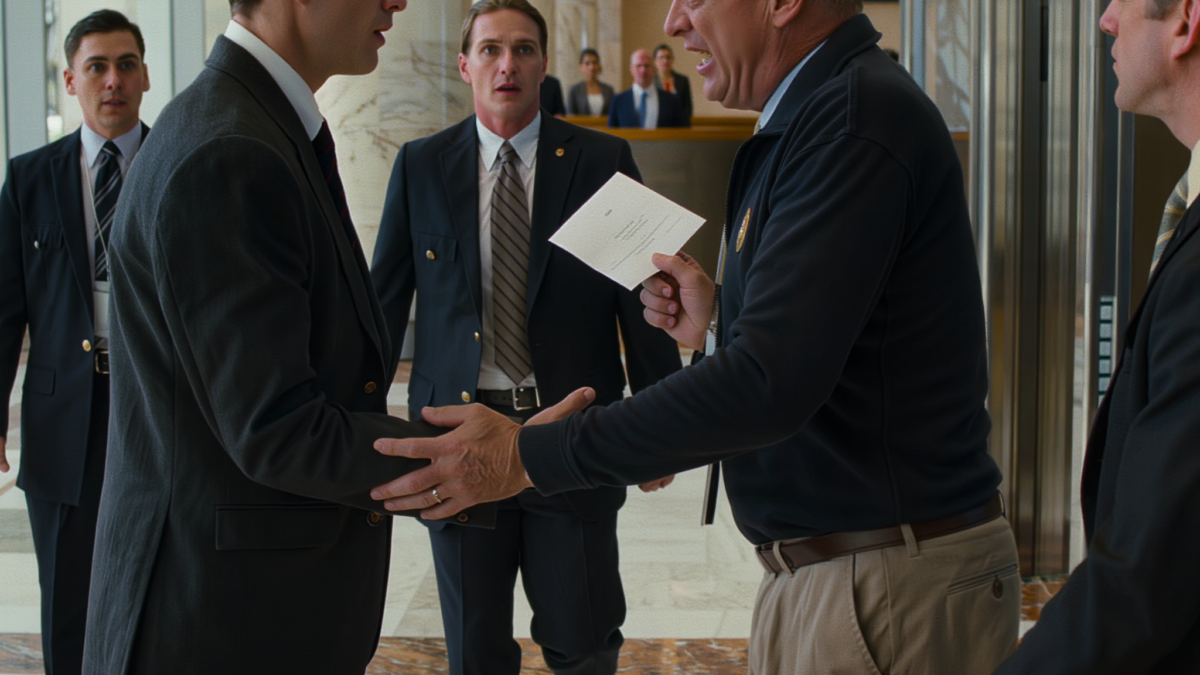
Then I saw my father.
He stood near the reception desk, looking completely out of place in khaki pants and a golf jacket. He held a briefcase tightly in one hand. His posture was rigid, and his face was set in grim determination.
He looked like a general surveying a battlefield.
Jenna, the young receptionist, gave me a wide-eyed, panicked look as I approached.
My father’s gaze locked onto mine. He didn’t say hello. He strode forward and blocked my path to the elevators.
“We need to talk,” he said. His voice was low and commanding, but deliberately loud enough for others to hear.
“This isn’t the time or place, Dad.”
I kept my voice even, though I could feel coworkers passing behind me and casting curious glances in our direction.
“You’ve made it the place,” he shot back. “You aired this family’s private business for the world to see, and now you’ve dragged it into your workplace. You’re going to fix it.”
He placed the briefcase on a nearby bench, snapped it open, and pulled out a single sheet of paper.
He thrust it toward me.
“This is a letter of apology to your mother, to Liam, and to the entire family. You will sign it. You will post it in the family group chat, and you will send a formal retraction to your human resources department explaining that your sister-in-law acted out of genuine concern and that you overreacted.”
I glanced at the document.
It was a masterpiece of manipulation. It portrayed me as unstable and overly emotional, a person who had misunderstood the loving intentions of his family.
My signature at the bottom would have become a confession. It would have validated every lie Chloe had told.
“No,” I said.
My father’s face darkened.
“What did you say?”
“I said no. I’m not signing that.”
“You are going to sign it,” he boomed.
His voice echoed through the high-ceilinged lobby. People stopped walking. Conversations ended. The entire space seemed to fall silent.
“You have embarrassed this family for the last time,” he continued. “You owe your mother an apology. Your behavior has caused Liam and Chloe enormous stress. And for what? Some childish need for attention?”
At the reception desk, Jenna spoke quietly but urgently into the phone.
“Security to the front lobby, please.”
I looked directly at my father—the man who had never defended me, the man who had watched me be pushed aside year after year.
“The only thing I’m going to do,” I said, my voice trembling slightly but holding firm, “is go upstairs and perform the job I earned—the same job you are trying to jeopardize.”
I stepped around him.
He grabbed my arm.
“You’re not walking away from me.”
“Sir, you need to let him go.”
A firm voice came from behind us.
Two security guards had arrived. Their expressions were calm but unyielding.
My father released me as though he had been burned. The appearance of outside authority had finally punctured his belief that being my parent gave him unlimited control.
“This is a family matter,” he snapped at the guards.
“It’s a corporate lobby, sir,” one of them replied evenly. “You’re causing a disturbance. Please leave the premises.”
My father stared at me. His eyes carried a level of fury I had never seen before—the fury of a man discovering that his authority no longer worked.
As the guards began escorting him toward the entrance, he pointed a trembling finger in my direction.
“You’ll regret this, Chase. You’re choosing a building over your own blood. You’ll end up with nothing. No family. No inheritance. Nothing.”
The word inheritance hung in the air, his final attempt at control.
I said nothing. I watched the guards lead him through the doors.
The letter he had brought lay where he had dropped it.
I bent down, picked it up, and tore it neatly in half in full view of Jenna and the security guards. Then I tore the halves again and placed the pieces in the lobby trash can on my way to the elevator.
The doors closed.
As the elevator began to rise, I released a breath I hadn’t realized I was holding.
The office became a minefield of whispers and sideways looks. The scene in the lobby was the morning’s main event.
Sarah, one of my closest colleagues—and for years something of a professional rival—walked to my desk, shook her head, and placed a fresh cup of coffee beside my keyboard without saying a word.
It was a small gesture, but it meant more than she could have known.
I spent the day in a fog, attempting to focus on building codes and schematics while my father’s furious face kept returning to my mind.
Later, HR sent me a discreet email asking whether I wanted to file a formal complaint. They also assured me that building security had been instructed not to admit my father again.
I responded with a simple thank-you.
I worked late, losing myself in the familiar comfort of lines, angles, and measurements.
By eight o’clock, the office was deserted. The only sounds were the low hum of the servers and the distant rush of city traffic.
I was packing my things when the elevator chimed.
I froze.
The glass doors opened, and Uncle Jean stepped out.
He wore his usual work jeans and flannel jacket. In one hand, he carried a thermos. In the other, he held a rolled-up sleeping bag.
He looked as out of place in the sleek modern office as my father had, but for entirely different reasons.
Jean saw me and offered a small, tired smile.
“Hey, kid. Figured you might be working late.”
“Uncle Jean, what are you doing here?”
My voice had gone hoarse with surprise.
He set the thermos and sleeping bag on the reception sofa.
“Jenna at the front desk is married to a guy in my bowling league. Word gets around.”
He glanced across the empty office.
“Figured you might need a security detail for the night shift. My rates are pretty reasonable. One cup of coffee, and you don’t have to listen to me snore.”
I stared at him.
A wave of emotion struck me so powerfully that I nearly lost my balance.
My father had come to my workplace to intimidate and humiliate me.
My uncle had come to stand guard.
Later that night, I worked at my desk beneath the dim glow of a task lamp while Jean slept on the sofa.
His presence was a silent, unshakable comfort.
During a break, I opened the family group chat. I hadn’t left it yet.
My mother had posted a photograph of herself and my father with a caption beneath it.
“Standing strong with my husband against vicious, unfounded attacks. Family should be a sanctuary, not a war zone.”
Beneath it was a comment from my cousin Mark, whose struggling construction business had recently received a substantial investment from my father.
“So sorry you have to go through this, Aunt Eleanor. Some people don’t appreciate what they have until it’s gone.”
It felt like another betrayal.
Only a few months earlier, Mark had called me to complain about my father’s controlling behavior and ask for advice on a project. Now that my father had invested in his company, Mark was repeating the family line.
I opened his profile and blocked him.
It was a small act, but it felt good.
Then I looked toward Jean, sleeping peacefully on the office sofa.
He wasn’t part of my immediate family in the way my parents and brother were, but he was the person who had consistently behaved like family. He was the sanctuary.
The others were the war zone I was finally learning to leave behind.
The next three months became a strange cold war.
My family stopped contacting me directly. I had been unofficially expelled, but the TikTok video continued circulating through certain corners of the internet, a piece of digital shrapnel lodged in my life.
HR handled Chloe’s email professionally. David Chun assured me that my employment record remained clean and that the firm supported me.
Still, the incident left an unpleasant stain. I constantly felt as though I were waiting for another attack.
Professionally, however, everything moved at remarkable speed.
The Sterling Tower became a major success. Critics described it as a landmark achievement. The firm’s reputation rose, and mine rose with it.
Then another email arrived.
I had been nominated for the National Architect of the Year Award, one of the most prestigious honors in the field. The ceremony would be held at a black-tie gala in New York City.
My first instinct was not to attend. After the online spectacle, the idea of standing in a public spotlight terrified me.
Uncle Jean refused to entertain that idea.
“You earned this, Chase,” he told me over the phone. “You’re going to walk onto that stage with your head high. This isn’t about them anymore. It’s about you.”
He was right.
I bought a tuxedo, reserved a flight, and went to New York. Aunt Carol and Maya insisted on watching the live stream from home and promised to cheer louder than anyone in the ballroom.
The night of the gala felt like a dream.
The ballroom glittered with chandeliers and evening gowns. I was surrounded by living legends in my profession—people whose books I had studied in college.
I felt like an impostor, a child dressed in an adult’s clothes.
I found my assigned table and discovered that I had been seated with the other nominees and, to my surprise, Mr. Sterling himself.
He was a powerful, intimidating man in his sixties, but he greeted me with a warm handshake and a surprisingly kind smile.
“Chase, it’s a pleasure to see you again,” he said in his commanding baritone. “The tower is magnificent. Truly. You should be very proud.”
“Thank you, sir,” I managed. “That means a great deal.”
We made polite conversation through dinner, but my thoughts remained elsewhere.
I knew my family was watching.
Chloe had posted about the ceremony in the family group chat. I saw her message only because a sympathetic cousin sent me a screenshot.
“Hoping for the best for Chase tonight,” she had written. “Even when families have disagreements, we always support one another’s success.”
She presented herself as generosity personified.
But I knew they weren’t watching to celebrate me. They were hoping I would lose—that my brief moment in the light would be denied, proving to them and their followers that I had made a mistake by separating myself from the family.
At last, a famous architectural critic walked to the podium.
“And now,” she announced, “the award for National Architect of the Year.”
A montage of the nominated projects appeared on enormous screens.
My heart hammered as the sweeping glass façade of the Sterling Tower filled the ballroom. For a moment, I forgot my fear and felt pure pride.
I had made that.
The presenter opened the envelope.
“The winner is an architect whose vision has not only transformed a city skyline but has done so with a profound sense of humanity and purpose. The National Architect of the Year is Chase Richards, for the Sterling Tower.”
The room erupted.
For several seconds, I couldn’t move.
Mr. Sterling leaned toward me and clapped one hand against my back.
“Go on, son. That’s you.”
My legs felt impossibly heavy as I walked toward the stage. The lights were blinding, and the applause sounded like a physical force.
I shook the presenter’s hand and accepted the heavy glass award.
Then I approached the microphone.
My hands trembled as I looked into a sea of shadowed faces.
I had prepared a speech and a list of colleagues to thank. But when I opened my mouth, no words came.
All I could think about was the empty chair.
As the silence grew uncomfortable, someone moved toward the podium.
It was Mr. Sterling.
The room quieted immediately. He placed one hand gently on my shoulder.
“If you’ll permit me,” he said, his voice carrying through the ballroom, “I’d like to say a few words.”
I looked at him, confused.
“Usually, the client simply funds a project. But with Chase, you receive more than a blueprint. You receive a piece of his soul.”
We had spoken only a handful of times, and I had no idea what he was about to say.
“During one of our final design meetings,” Mr. Sterling continued, “I asked Chase about the central inspiration for the building’s atrium. It is a vast, open space designed to become the heart of the tower—a place where people can gather.”
He turned slightly toward me, though he continued addressing the audience.
“What he told me has remained with me ever since.”
He paused.
“He said, ‘I wanted to create a space where everyone felt that they belonged—a place with no empty chairs.’”
My breath caught.
I had said those words during a rare moment of vulnerability while explaining my design philosophy. I never imagined that he had remembered them, much less that he would repeat them on a national stage.
“A place with no empty chairs,” Mr. Sterling repeated, emotion entering his voice. “In a world that often feels isolating, and in a city of millions, this young man’s driving ambition was to create a space for inclusion and community.”
He looked across the ballroom.
“That, ladies and gentlemen, is more than architecture. It is a mission.”
Then he turned toward the main camera broadcasting the live stream.
A chill moved through me.
He knew.
Somehow, he knew exactly who was watching.
“That is why the Sterling Corporation believes not only in recognizing this talent but in investing in it. We believe in creating more places where there are no empty chairs.”
The ballroom was completely silent.
“Tonight, in honor of Chase Richards’ vision and achievement, my company is donating five million dollars to the Architecture for Communities Foundation, an organization that develops community centers and housing for at-risk young people.”
My knees nearly gave way.
“The donation will be made in Chase Richards’ name,” he continued, “to establish a fund that he will oversee.”
The ballroom exploded with applause.
Five million dollars.
My name.
None of it felt real.
Mr. Sterling had taken the private pain my family used as a weapon and transformed it into a symbol of strength. He had turned it into a multimillion-dollar legacy of hope.
He hadn’t merely given me an award.
He had given me back my story.
He turned to me, the corners of his eyes creasing.
“The stage is yours, son.”
I stepped toward the microphone again.
The trembling had disappeared. In its place was a profound, immovable calm.
I looked directly into the camera.
I didn’t see an anonymous audience. I saw my parents’ living room. I saw Liam and Chloe sitting on their sofa. I saw their carefully curated version of our family beginning to collapse.
“Thank you, Mr. Sterling,” I said clearly. “I am overwhelmed. I don’t have a long speech. The building speaks for itself. But I do have people to thank.”
I took a breath.
“I want to thank my uncle Jean, who taught me that you can build a future from spare parts and sheer will.”
The room remained silent.
“I want to thank my aunt Carol, who showed me that the warmest homes are built with love, not drywall. And I want to thank my cousin Maya, who reminds me that the best designs are the ones that create joy.”
I looked into the camera one final time.
“Thank you to the family that built me.”
That was all.
I didn’t mention my firm. I didn’t mention my parents. I didn’t mention the brother who had repeatedly told me there was no room.
I picked up the award, nodded to the audience, and walked off the stage while the applause followed me.
That was the moment everything changed—the moment I stopped allowing them to write my story and finally took control of it myself.
The rest of the gala passed in a blur.
People I had admired throughout my career approached me, not only to congratulate me on the award but to discuss the foundation. My story—or at least the part Mr. Sterling had shared—had touched something in them.
In the space of ten minutes, I had gone from being a promising architect to being viewed as a philanthropic leader in the industry.
I flew home the next morning with the heavy award carefully packed in my carry-on.
When the plane landed and I took my phone off airplane mode, I expected an explosion of messages from my family.
There was nothing.
Only silence.
It was a deafening, revealing silence.
They didn’t know what to say. How could they continue attacking the celebrated architect whose story of overcoming exclusion had just been broadcast from a national stage? How could they preserve the narrative they had created?
They couldn’t.
The consequences came quickly.
A week later, a cousin who still spoke to me called. She said Chloe’s TikTok—which had once been her pride and joy—had backfired spectacularly.
After the gala, viewers connected the details.
New comments flooded the video.
“So this is the family that abandoned the Architect of the Year?”
“That empty chair looks very different now.”
“This is next-level manipulation.”
Chloe deleted the video, but by then the damage had been done.
Then professional consequences followed.
Someone at Liam’s competitive sales company had seen the gala and sent an anonymous email to management with a link to the now-infamous TikTok.
Liam was called into a meeting with his vice president.
The issue wasn’t his job performance, which remained excellent. It was brand integrity, professionalism, and his visible involvement in a public campaign against a family member.
His year-end bonus—the money he and Chloe had planned to use for a down payment on a new house—was reduced by fifty percent as a disciplinary measure.
Nothing formally connected the decision to me. The company mentioned only poor judgment regarding social media.
Chloe’s consequences were even more direct.
She worked as a freelance marketing consultant, and her largest client was a national retail brand that had built its identity around family values.
The chief executive of that company had attended the gala. He had heard my speech.
Two days later, Chloe received an email informing her that her lucrative six-figure contract was being terminated immediately because of a misalignment of core values.
With one email, she lost nearly half her annual income.
I didn’t feel joy when I heard what had happened.
I felt only a quiet, somber sense that balance had been restored.
They had tried to damage my career—the foundation of the life I had created. Instead, the structures they had built on lies and manipulation began to collapse.
I hadn’t sought revenge.
I had simply chosen to succeed.
My success became a mirror, forcing them to look at themselves clearly for the first time.
They did not like what they saw.
About a month after the gala, my phone rang.
The number was unfamiliar. I nearly ignored it, but something made me answer.
“Hello?”
“Chase.”
It was my mother.
Her voice wasn’t warm or conciliatory. It sounded thin and brittle, threaded with desperation.
“We need to talk,” she said. “Your father and I are prepared to sit down and work through this like a family.”
I remained silent.
“This has gone on long enough,” she continued, her voice taking on a self-pitying edge. “Chloe is a mess. Liam lost a significant part of his bonus. Your father’s friends are asking him questions. You’ve made your point, Chase. You won. Now you need to stop punishing us. You need to come home and help us fix this.”
I couldn’t believe what I was hearing.
There was no apology. No acknowledgment of what they had done. No remorse.
She still viewed everything as a power struggle that I had somehow won. Now she believed it was my responsibility, as the victor, to repair the damage they had caused.
She didn’t want reconciliation.
She wanted me to help rebuild their public image.
“Fix what, Mom?” I asked calmly. “There’s nothing for me to fix.”
“Don’t be ridiculous,” she snapped, desperation turning to anger. “You stood on that stage and humiliated us. You talked about family, and you didn’t even mention your own mother. Do you have any idea how that felt?”
“Yes,” I said softly. “I think I do.”
She went quiet.
“It probably felt like sitting at your graduation while every other student was hugged by their parents. It probably felt like seeing photographs of your family on a cruise you were told was full. It probably felt like having your entire life twisted into a weapon by your own sister-in-law.”
The line remained silent.
I had answered her question with the currency of my own pain.
“I didn’t humiliate you, Mom,” I continued. “I stopped allowing you to humiliate me. There’s a difference.”
I heard her take a shaky breath.
“After everything we’ve given you—”
“I’m hanging up now,” I said.
I wasn’t cruel. My voice simply carried a finality that felt as solid as steel.
“I wish you well. I truly do. But my seat at your table is officially empty. This time, it’s my choice.”
Before she could respond, I ended the call.
Then I opened my contacts.
I found my mother’s name, my father’s name, and Liam’s name. One by one, I selected “Block This Caller.”
Each time, the phone asked me to confirm.
Each time, I pressed the button without hesitation.
It felt like turning a key in a lock and securing a door I had spent twenty years trying to close.
For the first time, I was truly free.
Six months can feel like an entire lifetime.
During the half year after that final phone call, my world changed completely.
True to his word, Mr. Sterling and my firm supported my promotion to full partner. My name appeared on the letterhead, and a corner office with a panoramic view of the city became mine.
But the title and view weren’t what mattered most.
The work mattered.
I spent much of my time overseeing the new Chase Richards Fund within the Architecture for Communities Foundation.
Our first project was ambitious. We converted an abandoned warehouse in a neglected neighborhood into a modern community and arts center for underserved young people.
It was the most difficult and rewarding project of my life.
I was no longer building only with steel, glass, and concrete.
I was building with hope.
One warm Saturday afternoon in May, I attended a barbecue at Uncle Jean’s house. The smell of hamburgers and freshly cut grass filled the air. His backyard was alive with the easy conversation of friends and neighbors.
I sat on the porch steps teaching Maya how to use perspective in a drawing.
She was thirteen by then and showed real talent, a spark of creativity I intended to encourage in every way I could.
Aunt Carol emerged from the house carrying a huge sheet cake covered in bright blue icing.
It read, “Congratulations, Mr. Partner!”
Everyone cheered.
Uncle Jean handed me a beer. His eyes shone with a fierce, quiet pride that meant more to me than any award.
“Look at you, kid,” he said, clapping my shoulder. “Building whole new worlds.”
I looked around the yard.
Maya sat with her brow furrowed in concentration over her drawing. Carol laughed with one of the neighbors. Jean stood at the grill like a seasoned general.
This was my world.
It wasn’t perfect. It wasn’t a carefully staged photograph for social media.
It was real—messy, loud, and filled with unconditional love.
Later, as the sun began to set and long shadows crossed the lawn, I found myself talking with Sarah, my colleague from the firm.
I had invited her to the barbecue. Over the previous months, our old rivalry had softened into mutual respect and a growing friendship.
“You seem different,” she said as she watched me push Maya on the old tire swing.
“I am,” I admitted. “I spent most of my life trying to fit into a picture that was never designed for me. I thought that if I worked harder or achieved more, they would finally see me. But I was wrong.”
“What was it really about?” she asked.
I considered the question while Maya swung into the twilight.
“It was about them,” I said. “About the story they needed to tell themselves regarding who they were. In that story, they needed a villain—or at least a ghost. An empty chair they could point to as proof of how much they loved the people who were present.”
I watched Maya rise and fall against the darkening sky.
“The problem was that I wasn’t a ghost. I was a person.”
That was when I finally understood.
My value had never been open for debate. I didn’t need their approval or validation. I only needed to approve of myself.
When I looked at the life I was creating—the career, the foundation, and the real family surrounding me—I finally did.
The emptiness that had followed me for so many years was gone.
I had filled the space myself.
A few weeks after the barbecue, a package arrived at my office.
It was a dusty brown cardboard box addressed in my father’s sharp, unfamiliar handwriting. There was no return address.
My first instinct was to throw it away. I didn’t want that part of my life entering the new one I had built.
But curiosity is a stubborn weed.
I took the package home and placed it on my kitchen table. For a long time, I simply looked at it.
It felt heavy—not merely because of its contents, but because of the history it carried.
Eventually, I cut through the tape.
Inside, wrapped in old yellow tissue paper, were two objects.
The first was a thick, leather-bound portfolio.
The second was a sealed envelope with my name on it.
My hands trembled slightly as I opened the envelope.
Inside was a letter several pages long, written on my father’s personal stationery.
“Chase,” it began. “I am not writing this letter to ask for your forgiveness. I know I have not earned it, and I likely never will. I am writing to offer an explanation—not an excuse, but an explanation. I owe you that much.”
He wrote about a life I had never known.
When he was young, architecture had been his greatest passion. He had dreamed of designing buildings and shaping city landscapes. He had even been accepted by the same prestigious university I later attended.
But his father—my grandfather—had forbidden it.
My grandfather was a stern, practical man who considered architecture a frivolous and unstable career. He forced my father into the family’s profitable but soulless manufacturing business and told him to abandon his childish dream.
My father obeyed.
He entered the business, married, and raised a family. He buried his passion so deeply that he nearly forgot it had existed.
Then the letter continued.
“You were born. From the time you were a little boy, you were always building—with blocks, with LEGO, with anything you could find. When you began drawing, I saw it. You had the same spark, the same talent I had been forced to extinguish in myself.
“And I was terrified.”
I stopped reading.
My heart pounded.
The letter continued.
“A part of me was proud of you. But a darker and more shameful part of me was consumed by jealousy. You were living the life that had been taken from me. Every success you achieved reminded me of my own failure and my own cowardice.
“Liam was easy to love. He was good at sports. He was charming. He was everything my father would have wanted in a son. He did not challenge me. He did not remind me of the man I could have become.
“So I did what cowards do. I pushed you away. I minimized your achievements. I sided with your brother. I convinced myself it was because you were difficult or distant.
“That was a lie I told myself to justify my weakness.
“The truth is that I could not stand near the light you carried because it illuminated all my own dark, empty corners.
“The empty chair was never really for you, Chase. It was for me. It was for the man I never became.”
He wrote that on the night of the gala, while watching me stand on the stage, he had felt two things at once: a flare of the same old jealousy and an overwhelming, crushing shame.
He saw the man I had become—not because of his support, but perhaps because of the empty space he had created.
“I do not expect you to understand,” he wrote, “and I certainly do not expect you to forget. No apology can erase years of neglect. I have to live with that.
“My only hope is that you know the fault was never yours.
“It was always mine.”
The letter ended there.
My hands shook as I placed it on the table.
Then I opened the leather portfolio.
Inside were dozens of architectural drawings dated more than forty years earlier.
They belonged to my father.
They were brilliant.
The pages were filled with bold concepts and raw, untamed talent. I saw buildings that never existed, public spaces that had never been constructed, and an entire creative life that had been buried before it could begin.
I didn’t feel anger.
I didn’t feel forgiveness.
I felt a deep, aching sadness—for the boy whose dreams had been crushed and for the man who had allowed that bitterness to poison his life and his relationship with his son.
None of it excused what he had done.
But, as he had written, it explained it.
His cruelty hadn’t begun with simple malice. It had grown from unresolved pain. He had inherited disappointment from his own father and then passed that inheritance to me.
My entire life had been an unconscious effort to refuse it.
I still have the letter and the portfolio.
They rest on a shelf in my office, a quiet reminder that people are almost always more complicated than the roles we assign them in our stories.
I haven’t spoken to my father, mother, or Liam since that final phone call.
There was no dramatic confrontation. No tearful reunion.
Our story didn’t end with an explosion. It ended with a quiet acceptance of the distance between us—a distance that, for the first time, was healthy.
Occasionally, I hear updates through relatives.
Liam and Chloe are still together, living with a little less money and considerably more humility. My parents sold the large family home and moved into something smaller.
I hope they found some measure of peace.
My own life is full.
The community center I designed opened recently to an extraordinary reception. Watching young people in the art studio drawing, painting, and building fills a part of me I hadn’t realized was still empty.
My friendship with Sarah became something more. We are building a life together based on mutual respect and shared dreams.
Jean, Carol, and Maya remain the bedrock beneath everything.
We have dinner together every Sunday.
There is always a place waiting for me at their table—a place I never have to question, earn, or fight to keep.
It is simply there.
From my office window, I can see the city skyline, a landscape of steel, glass, and human ambition. The top of the Sterling Tower gleams in the afternoon sun.
I once believed my story was about the pain of being excluded.
I was wrong.
My story is about the power of building something of your own.
You can’t always repair a broken family, but you can lay a new foundation. You can design your own life, create your own spaces of belonging, and choose the people you invite inside.
Family, I learned, isn’t defined by blood, obligation, or a shared history.
It is defined by who shows up.
It is the person who brings you pizza on your loneliest day. The people who make a cake shaped like your dreams. The uncle who sleeps in a dark office to make sure you feel safe.
Family is made of the people who, without hesitation, give you a seat at their table—and are genuinely happy to see you take it.








