My Brother Smirked And Introduced Me To His Boss As “Our Family’s Failure”—Then His Boss Spoke…
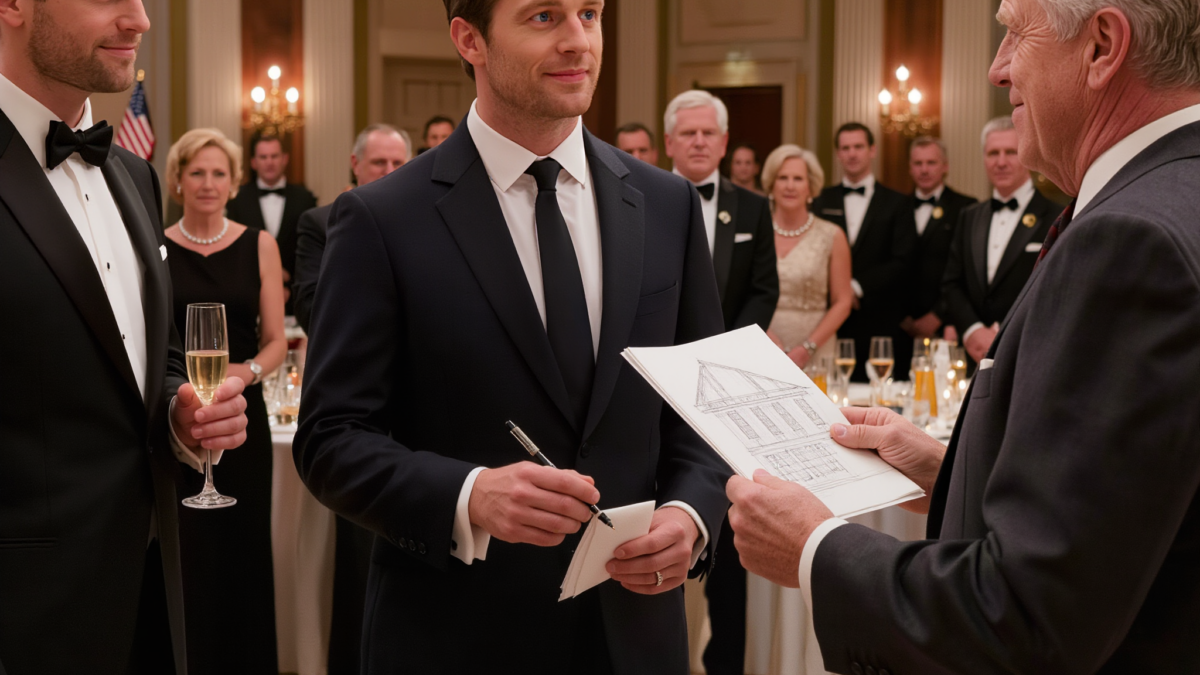
My name is Matthew Miles. I’m thirty-six years old, and my own younger brother introduced me as a failure to the one man I admired most in the world.
That night, I thought I was simply going to endure another evening of being treated like the family disappointment. I had no idea that a drawing on a cocktail napkin would expose more than a decade of secrets, unravel my brother’s carefully constructed reputation, and eventually put my name on one of Chicago’s most remarkable skyscrapers.
It all began on a bitterly cold evening in downtown Chicago.
The kind of cold that found its way through the seams of a cheap coat.
I pulled my collar higher and checked my reflection in the darkened window of a parked delivery van before crossing the street.
I looked tired.
I looked like exactly what I was: a high school art teacher who had spent the day grading mediocre watercolor projects and settling arguments in the cafeteria.
Across the street, the entrance to the Zenith Gala looked like an entirely different world.
Camera flashes illuminated the sidewalk. Velvet ropes separated invited guests from curious onlookers, while the valet stand resembled a private exhibition of expensive European automobiles.
I watched as a sleek silver Porsche 911 GT3 rounded the corner, its engine growling with the unmistakable confidence of a machine designed to attract attention.
It pulled up to the curb as though the entire evening had been arranged around its arrival.
The driver’s door opened.
Out stepped Parker.
My younger brother.
Five years younger than me, three inches taller, and wearing a tuxedo that probably cost more than my car.
Parker didn’t simply step out of the Porsche. He practically launched himself toward the waiting cameras.
He ran a hand through his perfectly styled hair, flashed a smile that looked suspiciously expensive, and tossed his keys to the valet without bothering to look at the man.
“Keep it close,” Parker announced, loudly enough for everyone nearby to hear. “I might need to make a quick exit.”
My parents, George and Barbara Miles, climbed out of a hired town car that had pulled up behind him.
My mother was adjusting her pearls, looking anxious about whether her appearance met the standards of the occasion.
My father was already scanning the crowd, searching for someone important enough to justify an introduction.
They moved to either side of Parker like bodyguards.
Or perhaps like devoted admirers accompanying their favorite celebrity.
I took a deep breath and crossed the street.
I wasn’t really on the guest list.
Not as an important attendee, anyway.
I was the additional family member.
The afterthought.
“Matthew!”
My mother spotted me first. Her smile faltered for a fraction of a second before she carefully restored it.
Her eyes traveled down my outfit.
I was wearing a suit I’d bought off the rack five years earlier. It still fit reasonably well, but beside Parker’s tailored Italian wool, I probably looked like someone who had wandered into the wrong event.
“You made it,” she said. Then, after another glance at my clothes, she added, “And you wore that.”
“It’s a suit, Mom.”
I leaned forward and kissed her cheek.
She smelled of expensive perfume and hairspray.
“It’s fine,” my father grunted, checking his watch. “Just try to stay in the background tonight, Matt. This is Parker’s big night. We don’t want any distractions.”
“Good to see you too, Dad.”
Parker turned around.
His eyes passed over me with the casual disinterest he usually reserved for people who couldn’t help advance his career.
“Hey, bro. Glad you could make it. Try not to spill anything on the investors, all right? The cleaning bill here is murder.”
He laughed.
My parents laughed.
I forced a smile.
“Congratulations on the nomination, Parker.”
“Nomination?”
He scoffed and adjusted his silk bow tie.
“It’s practically a coronation, Matt. The Zenith Project is the crown jewel of the city. Theodore Ramsay knows talent when he sees it.”
Theodore Ramsay.
The billionaire developer who had reshaped skylines across three continents.
A man whose projects had transformed ordinary city blocks into architectural landmarks.
I had followed his work since graduate school.
To me, he was a legend.
And that evening, according to Parker, Ramsay was preparing to announce Parker’s firm as the lead design partner for the new Zenith Tower.
We moved inside.
The ballroom was enormous, illuminated by chandeliers that resembled frozen waterfalls suspended above the crowd.
Waiters moved between guests carrying trays of champagne.
I accepted a glass simply because I needed something to do with my hands.
Then I drifted toward the edge of the room.
Without thinking, I pulled a small, battered sketchbook from the inside pocket of my jacket.
It was a nervous habit.
Whenever I felt uncomfortable, which happened frequently around my family, I drew.
I began sketching the structural details of the vaulted ceiling, studying how the load-bearing columns had been disguised beneath elaborate decorative molding.
“Matthew, put that away.”
My mother’s voice appeared beside my ear like an alarm.
“You look like a schoolboy doing homework. Mingle, but don’t talk business. Leave that to Parker.”
I slipped the sketchbook back into my pocket.
“Where is he?”
“Over there.”
She pointed toward the center of the ballroom.
A circle had formed around a tall, silver-haired man.
Theodore Ramsay.
He was around sixty, with sharp eyes that seemed capable of evaluating an entire room in a single glance.
He wasn’t loud.
He didn’t need to be.
His wealth and reputation drew people toward him without any effort on his part.
And standing right beside him was Parker, laughing much too enthusiastically at something Ramsay had said.
My father nudged me.
“Come on. We have to go say hello.”
“I don’t think—”
“Come on,” Dad insisted, gripping my elbow. “We need a family photo with Ramsay. It’s good for the brand.”
We pushed through the crowd.
Parker saw us approaching.
For a moment, his smile tightened.
Then he slipped effortlessly back into the role of the charming, successful son.
He threw an arm around my shoulders and leaned against me.
“Mr. Ramsay,” Parker announced, his voice booming across the circle, “I’d like you to meet the rest of the Miles clan. My parents, George and Barbara, and this—”
He squeezed my shoulder a little too firmly.
“This is my older brother, Matthew.”
Ramsay turned.
Up close, he was even more intimidating.
He didn’t merely look at people.
He studied them.
He shook my parents’ hands politely.
Then his attention settled on me.
“Matthew,” he said. “Are you in the industry as well?”
The conversations around us grew quieter.
People were listening.
This should have been a simple question.
But Parker saw an opportunity.
His mouth curved into that familiar, condescending smile I had known since childhood.
“Oh, no, sir. Matthew isn’t really built for the high-pressure world of architecture. He’s an art teacher for elementary kids. Finger painting and macaroni art, right, Matt?”
A ripple of polite laughter moved through the circle.
My face grew warm.
“High school,” I corrected quietly. “I teach perspective and art history.”
“Right, right.”
Parker waved his hand dismissively.
“Point is, he’s the creative spirit of the family, just on a much smaller scale. I build skyscrapers. He builds confidence in teenagers.”
He paused, enjoying the attention.
“We’re very proud of him, in a way. He’s sort of our family’s cautionary tale about ambition.”
My mother released a theatrical sigh.
“He just lacks the drive, Mr. Ramsay. Always has. But he’s happy, and that’s what matters.”
“Such a disappointment,” my father muttered.
Then, realizing the circle had grown quiet enough for everyone to hear him, he added, “But we love him.”
Three sentences.
That was all it took for my family to summarize my entire existence as a failure.
I stood there, holding a glass of champagne I suddenly didn’t want, wishing the marble floor would open beneath my feet.
But Theodore Ramsay didn’t laugh.
He didn’t even smile.
He simply stood there with his champagne glass, studying Parker.
The silence stretched.
It grew uncomfortable.
Parker’s expression began to falter.
“Interesting,” Ramsay said.
His voice was soft, almost a whisper, but everyone heard it.
He stepped closer to me.
And then I realized he wasn’t examining my inexpensive suit.
He was looking at my hand.
I was holding a cocktail napkin.
During Parker’s little speech, I had apparently pulled out a pen and begun sketching the column beside us.
I hadn’t even realized I was doing it.
“May I?” Ramsay asked.
I froze.
“It’s nothing. Just a doodle.”
He gently took the napkin from my fingers and held it beneath the chandelier light.
On that flimsy piece of paper, I had drawn a cross-section of the ballroom’s cantilever support system.
But I had also added a small correction in the margin.
A note about stress-load distribution.
Ramsay studied it for a long moment.
Then he looked at Parker.
Then back at me.
“You have a very distinct line weight,” he observed. “The way you render shadow isn’t merely artistic. It’s structural.”
“I dabble,” I said, my throat suddenly dry.
For the first time that evening, Ramsay smiled.
It wasn’t the polite social smile he’d been offering the investors.
It was the expression of a man who had just discovered something unexpected.
“Tell me, Matthew. This drawing style looks remarkably similar to the preliminary sketches for the Zenith Atrium. The ones Parker submitted for the competition.”
Parker nearly choked on his champagne.
“Well, sir, we share genes. Similar handwriting, similar drawing style. It’s a family thing.”
Ramsay ignored him.
His eyes remained on me.
“Interesting,” he repeated. “Because Parker told me he drew those sketches during a sudden burst of inspiration while vacationing in Cabo.”
He paused.
“Were you in Cabo, Matthew?”
“No,” I answered. “I was in Chicago grading papers.”
“I see.”
Ramsay folded the napkin neatly and placed it in his breast pocket beside his silk handkerchief.
Then he turned toward my brother.
“Parker, I’d like to see you in my office tomorrow morning at nine sharp. We need to discuss the final phase of the contract.”
Parker immediately brightened.
“Absolutely, sir. I’ll be there, ready to sign.”
“And,” Ramsay added, turning back toward me, “bring your brother Matthew.”
Parker laughed nervously.
“Why? He’d be bored to tears.”
“Bring him,” Ramsay said.
The softness had vanished from his voice.
“Or don’t bother coming at all.”
He nodded politely to my parents, turned, and walked away.
The crowd parted before him.
We remained standing there.
My mother looked thoroughly confused.
“Why does he want Matthew?”
Parker turned toward me.
His expression had changed completely.
“What did you do? What was on that napkin?”
“Nothing,” I said, although my heart was pounding. “Just a sketch.”
He stepped closer.
“You’d better not embarrass me tomorrow. You sit there, keep your mouth shut, and nod. If you ruin this deal, Matthew, I’ll make sure that teaching position of yours becomes very uncomfortable. Do you understand?”
“I understand,” I answered quietly.
“Good.”
Parker adjusted his jacket.
“Go home, get some sleep, and wear a better suit tomorrow. You look like a funeral director.”
I watched as my family walked away to mingle with the investors.
They looked perfect together.
The successful son.
The proud parents.
And me.
The disappointment.
But when I stepped outside into the freezing Chicago night, something felt different.
I stood at the bus stop while Parker’s silver Porsche gleamed beneath the streetlights.
For the first time in years, I couldn’t shake the feeling that the ground had shifted beneath our feet.
Ramsay knew.
He had seen the line weight.
He had recognized something in the sketch.
And although I was still afraid, there was another feeling growing beneath that fear.
I was ready.
The bus ride home took forty minutes.
Forty minutes crawling through a city I had helped design but could never publicly claim.
I pressed my forehead against the cold window and watched the skyline drift past.
Every few blocks, I recognized something that carried a piece of my work.
The curved glass façade on Fourth Street.
I had solved the thermal-bridging problem on that building while Parker was too exhausted from a weekend of partying to open his laptop.
The converted loft building in the West Loop.
That concept had begun as a series of sketches I made on a pizza box at three in the morning while Parker was networking in Ibiza.
There were others.
Small details.
Structural innovations.
Pieces of my imagination scattered across Chicago, each one carrying someone else’s name.
I got off at my stop and walked two blocks to my apartment.
It was a cramped studio that smelled faintly of turpentine and old coffee.
My parents called it sad.
I called it affordable.
I tossed my keys onto the small table and collapsed onto the sofa.
My phone buzzed.
A text from Mom.
Don’t be late tomorrow. And please shave. You looked scruffy tonight.
I didn’t reply.
I couldn’t.
Instead, I closed my eyes and let the memories come.
It hadn’t always been this way.
There had been a time when I was the one everyone believed had potential.
Twelve years earlier, I was twenty-four, freshly graduated from my master’s program at the top of my class.
My portfolio was receiving attention from professors who called my work visionary.
Parker was nineteen.
He was struggling through his first year of business school, spending more time at parties than in classrooms and accumulating debts my parents refused to discuss openly.
I remembered the family meeting at our kitchen table.
My father, George, sat at the head of the table, looking grim.
My mother was crying into a tissue.
“We have a problem,” Dad announced.
I already knew what was coming.
“Parker. He’s in trouble. Academic probation. And some debts.”
“Debts?” I asked. “From gambling?”
Mom began crying harder.
“He’s just a boy, Matthew. He made mistakes. But if this gets out, our reputation, your grandfather’s legacy—”
“We need a pivot,” Dad interrupted.
He looked directly at me.
“Parker needs a win. He needs a career that looks impressive.”
Then he said the word that changed my life.
“Architecture.”
I stared at him.
“He can’t draw a straight line. And he doesn’t have a degree.”
“We can pay for a private program,” Dad replied dismissively. “Something flexible. The credentials can be arranged. But he needs the talent. He needs the work.”
Then both my parents looked at me.
The silence around the kitchen table became unbearable.
“You want me to tutor him?” I asked.
“We want you to help him,” Mom said, reaching across the table to squeeze my hand. “Just for a while, until he gets on his feet. You’re the big brother, Matthew. You’re the strong one.”
She leaned closer.
“You can handle being in the background. Parker needs the spotlight to survive. He’s fragile.”
Fragile.
That was their favorite word.
The word they used whenever they wanted to turn my love for my younger brother into an obligation.
Parker was charming, handsome, and socially confident.
I was quiet, awkward, and more comfortable with drafting pencils than dinner parties.
So my parents decided that I would supply the talent while Parker supplied the personality.
It started small.
A few assignments.
Then his final thesis.
Then, when Dad helped finance Parker’s architectural firm, his first major commission.
I designed it.
Parker presented it.
He won an award.
My parents threw him a celebration.
I sat in the corner while Dad leaned over and whispered, “Thank you for saving the family, Matt.”
Saving the family.
I opened my eyes and stared at the cracked plaster above my apartment sofa.
That was the trap.
Every time I considered stopping, every time I thought about building a career under my own name, they appealed to family loyalty.
We’re a team, Matt.
Don’t be selfish, Matt.
Do you want your brother to lose everything, Matt?
I stood and walked toward the corner of my apartment.
There, beneath an old protective tarp, sat my drafting table.
It was the only expensive piece of furniture I owned.
I pulled the tarp away.
Spread across the table were the real Zenith Project drawings.
Not the polished digital renderings Parker presented to clients.
The original sketches.
Charcoal studies showing how morning sunlight would move across the atrium.
Detailed calculations for the structural system supporting the spire.
Sheet after sheet of revisions, measurements, and handwritten notes.
I had spent six months developing that design.
During those same six months, Parker had vacationed in the Maldives, purchased expensive watches, and attended endless networking events.
I ran my hand across the paper.
This was my life’s work.
And the following morning, Theodore Ramsay was supposed to sign a contract that would permanently attach Parker’s name to it.
My phone rang.
Parker.
“What?” I answered, my voice rough.
“Are you awake?”
He sounded frightened.
The arrogance he’d displayed at the gala had disappeared.
“I’m looking at the contract draft. There’s a clause about intellectual-property indemnity. And Ramsay wants the original concept sketches tomorrow.”
I waited.
“So?”
“So I don’t have them, Matthew. You have them. You never gave me the physical sketchbooks. Just the digital scans.”
“I kept them,” I said. “They’re mine.”
“Don’t start this.”
His voice sharpened.
“Bring them tomorrow. Ramsay wants to see the process. If I show up empty-handed, he walks. If he walks, the firm goes under.”
He paused, then delivered the line he knew would affect me.
“And if the firm goes under, the loan Dad took out against the house gets called in. Do you want Mom and Dad to lose their home?”
There it was.
The familiar leverage.
“I’ll bring them,” I said, feeling the old weight of obligation settling over me.
“Good. And Matt?”
“Yeah?”
“Don’t say anything stupid. Just hand over the books and let me do the talking. You’re the assistant. The archivist. Got it?”
“Got it.”
I ended the call.
For several minutes, I stood staring at the drawings.
I knew the routine.
I would arrive at Ramsay’s office, surrender the evidence of my own talent, and watch Parker accept the praise.
It was the script I’d followed for more than a decade.
But then I remembered Ramsay’s eyes.
Interesting.
He hadn’t looked at me with pity.
He had looked at me with curiosity.
I sat down at the drafting table.
I didn’t sleep that night.
Instead, I opened a fresh page and began to draw.
Not for Parker.
Not for the Zenith Project.
For myself.
I sketched an entirely new structure, an ambitious design that seemed to defy gravity.
I worked through its proportions, its supports, the rhythm of its exterior lines.
I kept drawing until my hand cramped and the first pale sunlight appeared through the blinds.
If my family insisted on calling me a failure, then I would walk into that boardroom as the most talented failure they had ever met.
The following morning, I put on my funeral-director suit.
I shaved.
I packed the original sketchbooks into a worn leather satchel.
The satchel had belonged to my grandfather.
He was the only person in my family who had consistently encouraged my talent.
I took a cab to Ramsay Tower.
The building rose above downtown Chicago like a glass monument to ambition.
Parker was waiting in the lobby.
He looked exhausted.
His eyes were bloodshot, and he kept pacing between the elevators and the glass entrance, checking his reflection whenever he passed a polished surface.
“You’re five minutes late,” he hissed as I walked through the revolving doors.
“Traffic.”
He immediately reached for my arm, trying to pull me toward the elevators.
“Do you have the books?”
I patted the satchel.
“Right here.”
“Let me see.”
“Not here.”
I stepped away.
“There are cameras. Do you want everyone watching you panic over your assistant’s bag?”
He stopped.
Straightened his tie.
“Right. Good point.”
He took a breath.
“Keep it together. We go up, we smile, we show him the sketches, we sign, and then you can go back to whatever it is you do.”
“Teaching,” I said.
“Yeah. That.”
The elevator ride felt like a silent ascent toward judgment.
My ears popped as we passed the fortieth floor.
Parker was practically vibrating with nervous energy.
He checked his watch, adjusted his cuffs, and smoothed his hair.
“Ramsay likes me,” he muttered. “He likes bold vision. I’m bold. I’m the face. You’re just the hands. I’m the face.”
He repeated those words as though saying them often enough might make them true.
The elevator doors opened onto the penthouse floor.
The reception area was larger than my entire apartment building.
Everything was minimalist, polished, and unmistakably expensive.
A receptionist wearing a headset looked up.
“Mr. Miles?”
Her gaze shifted toward me.
“And—”
“Mr. Miles’s associate,” Parker answered quickly.
The receptionist maintained her professional smile.
“Mr. Ramsay is waiting for you in the boardroom.”
We followed a long corridor lined with architectural models of famous buildings.
I recognized the Empire State Building.
The Burj Khalifa.
Several of Ramsay’s most celebrated developments.
And at the far end of the corridor stood an empty pedestal.
A space reserved for the next landmark.
Parker pushed open the heavy double doors.
The boardroom was surrounded by glass, overlooking Lake Michigan and the sprawling Chicago skyline.
Theodore Ramsay stood beside the window with his back to us.
For a moment, he seemed entirely absorbed in the city below.
“Mr. Ramsay,” Parker said, activating his most polished salesman’s voice. “Good morning. What an incredible view.”
Ramsay turned slowly.
He didn’t smile.
“Sit down.”
We sat.
The conference table was an enormous slab of black marble.
There were no contracts waiting on its polished surface.
No folders.
No documents.
Just a single pencil.
“I’ve been reviewing the Zenith proposal,” Ramsay began, walking toward the head of the table. “It’s brilliant. The atrium design is revolutionary. The way it handles natural light is almost spiritual.”
Parker straightened proudly.
“Thank you, sir. Inspiration struck me one morning while I was watching the sunrise over the Pacific. I grabbed a napkin and—”
“Stop.”
Ramsay spoke quietly.
But the word brought Parker’s performance to an immediate halt.
“I checked the flight records, Parker.”
My brother froze.
“You weren’t in Cabo when these preliminary drawings were dated. You were in Las Vegas.”
Ramsay placed a tablet on the table.
“And the timestamps on the digital files show they were uploaded from an internet connection associated with a small apartment complex in Chicago.”
Parker opened his mouth.
Then closed it.
“Sir, I have a remote server. My workflow is complicated.”
“Is it?”
Ramsay looked at me.
“Matthew. Open your bag.”
Parker shot me a terrified glance.
His expression pleaded with me not to move.
For a moment, I hesitated.
This was the edge of the cliff.
“Open it,” Ramsay repeated.
I unbuckled the leather straps.
Then I removed three black sketchbooks.
Their covers were worn and their pages dog-eared.
They smelled faintly of graphite, paper, and years of work.
I slid them across the marble table.
Ramsay rested one hand on the covers.
But he didn’t open them.
Not yet.
“Parker,” he said, “I have a simple test for you. A design challenge. Right here, right now.”
“A what?”
“A test.”
Ramsay picked up the pencil and placed a blank sheet of paper in front of Parker.
“Draw the connection detail for the main spire. Just a quick sketch. Show me how the load transfers to the foundation.”
He paused.
“If you designed this building, you should know that system by heart. It’s the spine of the entire structure.”
The room fell silent.
The hum of the air-conditioning system suddenly seemed extraordinarily loud.
Parker stared at the paper.
He picked up the pencil.
His hand was shaking so badly that the tip tapped repeatedly against the marble.
Tap.
Tap.
Tap.
He looked at me.
His expression was filled with panic.
“I’m more of a concept guy, sir,” Parker said, forcing a nervous laugh. “I have people for the technical details. My vision is big-picture.”
“A visionary should understand the bones of his own creation,” Ramsay replied.
Then he pointed toward the blank paper.
“Draw.”
Parker lowered the pencil.
He drew a line.
Then a circle.
Then another awkward line.
The result looked more like a crude symbol than an architectural detail.
It was the work of a man who hadn’t seriously used a drafting table in ten years.
Ramsay watched him for a full minute.
Then he reached forward and gently removed the pencil from Parker’s hand.
“That’s what I thought,” he whispered.
He turned toward me.
Slid the paper across the table.
Placed the pencil in front of me.
“Matthew,” he said. “Show him.”
The pencil felt warm in my fingers.
A Staedtler Mars Lumograph 4B.
High quality.
Smooth wood.
A familiar tool.
I looked at Parker.
His face had lost its color. Moisture gathered along his carefully groomed hairline.
For the first time in my life, I didn’t see the golden child.
I saw a frightened young man who had built his entire reputation on something he couldn’t support.
“Matt,” Parker whispered, his voice trembling. “Don’t.”
I turned toward Ramsay.
His expression was unreadable, but his eyes were patient.
He was waiting.
I took a breath.
Then I began to draw.
It wasn’t a conscious decision.
It was muscle memory.
Ten years of late nights hunched over a drafting table while Parker slept.
Ten years of frustration, exhaustion, and silence.
All of it seemed to flow through the graphite.
I drew the spire connection.
But I didn’t merely draw its shape.
I drew the forces acting upon it.
Heavy, dark strokes represented the compression members.
Fine, controlled lines showed the tension cables.
I crosshatched the shadows to communicate depth.
Then I added technical notes in my distinctive block handwriting.
The same handwriting Ramsay had noticed on the napkin.
Load transfer via radial truss.
Secondary damping system required for wind shear.
The scratching of the pencil became the only sound in the room.
Scratch.
Scratch.
Scratch.
For the first time in years, I was creating something under my own name, directly in front of the person whose opinion mattered.
I worked for ten minutes.
When I finished, I placed the pencil on the table.
Ramsay picked up the drawing.
Then he opened one of my original sketchbooks and held the pages side by side.
The match was unmistakable.
The line weight.
The drafting technique.
The handwriting.
The confidence behind the design.
“It’s beautiful,” Ramsay said quietly.
Then he looked at Parker.
“Get out.”
Parker stood so quickly that his chair scraped across the floor.
“Sir, please. Let me explain.”
Ramsay remained silent.
“It’s a collaboration,” Parker insisted. “I provide the direction. Matthew just executes. He’s a technician. He can’t run a firm. He’s a schoolteacher.”
“He’s the architect,” Ramsay replied, his voice suddenly firm. “And you have been presenting his work as your own.”
“You can’t do this!”
Parker’s polished composure finally disappeared.
“My parents and I have a verbal agreement with you. The press release has already been drafted.”
“I don’t care about your press release.”
Ramsay pressed a button on the intercom.
“Security, please escort Mr. Parker Miles from the building. His access to Ramsay properties is revoked.”
Parker turned toward me.
“Matthew! Say something. Tell him we’re partners.”
I looked at my younger brother.
For a moment, I saw the boy I had once protected.
The teenager whose assignments I had completed.
The young man whose mistakes I had quietly repaired.
Then I remembered the years of deception.
The awards.
The contracts.
The family dinners where I was introduced as the disappointment while everyone celebrated the success I had created for him.
“We aren’t partners, Parker,” I said.
My voice was steadier than I expected.
“I was your ghost. And I’m done being invisible.”
Two security officers entered the room.
They didn’t need to touch him.
They simply stood nearby, making it clear that the conversation was over.
Parker stared at me with open resentment.
“You’re no longer part of this family,” he said. “Mom and Dad will never forgive you.”
Then he turned and marched toward the door.
He tried to preserve some appearance of dignity, but even that failed when he stumbled slightly over the edge of the carpet.
The doors closed behind him.
Silence returned.
Ramsay sat opposite me.
He opened a small silver case, considered a cigarette, and offered me one.
I shook my head.
“Good habit,” he said.
He closed the case without lighting one himself.
“I knew something was wrong the moment I saw that napkin. But I needed to see whether Parker would admit the truth when confronted. Whether he had enough integrity to acknowledge what you’d done.”
He glanced toward the closed doors.
“He didn’t.”
“He never has,” I answered.
Ramsay leaned back and brought his fingertips together.
“Here is the situation. I have a billion-dollar project scheduled to break ground in three months. The person who was supposed to lead the design has just been dismissed for misrepresenting the work. I need someone who can take responsibility for the project.”
“I can recommend some firms,” I said immediately. “Skidmore, Owings & Merrill. Gensler. There are several excellent—”
Ramsay laughed.
It was a dry, rasping sound.
“I don’t want another firm, Matthew.”
He leaned forward.
“I want the mind that designed this atrium. I want you.”
For several seconds, I couldn’t respond.
“I’m not licensed,” I finally admitted. “I have my master’s degree, but I never completed the licensing exams. Parker always needed something. There was never enough time.”
“I have attorneys who can help you navigate the licensing process and experienced professionals who can handle the required approvals in the meantime.”
He waved one hand.
“We’ll do it properly. The paperwork is a technical matter. The design talent is what I cannot manufacture.”
Then he said something I had spent most of my adult life dreaming of hearing.
“I’m offering you the position of lead designer for the Zenith Project, with a path to serving as its licensed lead architect, and a principal position in my in-house design studio.”
My heart seemed to stop.
This was the dream.
Not the practical dream I had allowed myself to imagine.
Not a slightly better apartment or a modest promotion.
The impossible dream.
“And,” Ramsay continued, sliding a folder across the table, “we are beginning the process of acquiring the appropriate assets and intellectual-property rights associated with Parker’s firm.”
I stared at the folder.
“Your original work is central to that process. My legal team believes there are substantial issues with how Parker represented ownership of those designs.”
He tapped the folder.
“This is your signing bonus. I have also instructed my team to examine the unpaid work you performed over the years so we can address it properly.”
I opened the folder.
Inside was a blue check.
I looked at the amount.
Then I looked again.
Two hundred and fifty thousand dollars.
$250,000.
I had never held a check for anything close to that amount.
“Why?” I asked quietly. “Why would you go to all this trouble for me?”
Ramsay turned toward the window.
For a moment, he seemed to be looking at something far beyond Chicago.
“Fifteen years ago, I was nearly bankrupt,” he said.
I listened.
“A young consultant saved my company. Brilliant woman. She worked behind the scenes while her boss collected every compliment and every opportunity.”
His jaw tightened.
“I knew what was happening. But I didn’t speak up. I watched her career suffer while the wrong person became successful.”
He turned back toward me.
“I promised myself that if I ever saw that pattern again, I would do something about it.”
His eyes settled on mine.
“Talent is rare, Matthew. Courage is rarer. Today, you showed me both.”
I touched the check.
It felt real.
The paper had weight.
The number wasn’t going to disappear when I blinked.
“One condition,” I said.
Ramsay raised an eyebrow.
“Name it.”
“My name goes on the building. On the cornerstone. Somewhere permanent. I want people to know who designed it.”
“Done.”
He answered without hesitation.
Then he smiled.
“And the Porsche?”
I frowned.
“What about it?”
“The car Parker drove to the gala. It’s leased under his firm’s name. Depending on the outcome of the acquisition and the legal proceedings, we may have control over that lease.”
He paused.
“Would you like the keys?”
I thought about Parker tossing his keys to the valet without looking at him.
I thought about myself waiting in the cold for the bus.
Then I shook my head.
“No. Send it back. I’ll buy my own car.”
Ramsay smiled again.
This time, it was genuine.
“Good answer.”
He stood.
“Now, let’s get to work. That spire connection still needs refining.”
The work was exhilarating.
For the first time in my professional life, I wasn’t drawing in a dark corner while someone else prepared to claim the result.
I was working in a studio with floor-to-ceiling windows, surrounded by young architects who listened when I spoke.
They called me sir.
At first, it made me uncomfortable.
Then I realized something extraordinary.
They respected my ideas.
They asked questions.
They challenged calculations.
And when I explained why a particular detail mattered, they listened because they believed I knew what I was talking about.
Ramsay was a demanding boss.
But he was fair.
He pushed me to be better.
Not merely faster.
For someone who had spent years being treated like an invisible employee in his own family’s arrangement, the difference was overwhelming.
Outside that office, however, the situation was becoming increasingly complicated.
My phone had been ringing for six hours.
Forty missed calls from Mom.
Twenty from Dad.
And a stream of messages from Parker that shifted between pleading, blaming, and angry accusations.
Matthew, answer the phone.
You ruined everything.
How could you do this to your family?
I knew I would eventually have to face them.
I couldn’t hide inside Ramsay Tower forever.
At seven that evening, I left the office.
I didn’t take the bus.
Instead, I hailed a cab.
“Highland Park,” I told the driver.
My parents’ house.
The house was a sprawling Colonial-style property in an expensive northern suburb of Chicago.
Wide driveway.
Perfectly maintained lawn.
White columns framing the entrance.
It was the kind of place my father believed announced success before anyone even opened the front door.
It was also the house Parker’s career had been expected to support.
As the cab pulled up, I spotted Parker’s silver Porsche parked crookedly in the driveway.
I asked the driver to wait.
Then I walked toward the front door.
I didn’t knock.
I used my key.
The moment I stepped into the foyer, the shouting stopped.
My family was gathered in the living room.
Mom sat on the sofa, clutching a handkerchief.
Dad paced near the fireplace with a glass of scotch in his hand.
Parker sat on the ottoman with his head buried in his hands.
All three looked up.
“You.”
Dad’s voice was heavy with anger.
“You have the nerve to walk in here?”
“I’m still part of this family,” I answered calmly.
“Not anymore!”
Parker jumped to his feet.
His eyes were wild.
“You stole my job. You stole my client. You told Ramsay I was a fraud.”
“I told him the truth.”
I walked farther into the room.
I didn’t sit.
I remained standing near the fireplace.
“You’ve been presenting my work as your own for ten years, Parker. When Ramsay asked you to demonstrate the most important structural detail of the building, you couldn’t do it.”
“We had an arrangement!” Mom cried.
Her voice shook.
“We had a plan. You were supposed to support him. That’s what family does.”
“Support him?”
I laughed.
It was a bitter, hollow sound.
“Mom, I didn’t support him. I carried him. I built his entire career while he collected the awards and the applause.”
I looked from one parent to the other.
“And what did I get in return? The disappointment. The failure. Last night, you humiliated me in front of half the city’s business community.”
“It was a strategy!” Dad shouted.
I stared at him.
“What?”
“We had to lower expectations for you so Parker would look better. It’s marketing, Matthew. You don’t understand how business works.”
For a moment, I couldn’t believe what I was hearing.
Then I realized he was serious.
He had deliberately presented me as unsuccessful to make Parker seem more impressive.
“I understand business perfectly well,” I said. “I just signed a contract worth more than Parker has earned in his entire career.”
Parker’s head snapped up.
“That money belongs to the family.”
I looked at him.
“Excuse me?”
“That’s my project. My intellectual property.”
“You pressured me into signing papers five years ago that I never had an independent lawyer review,” I said. “Ramsay’s legal team is examining those documents now.”
I took a breath.
“They’re also reviewing the original designs, the payment records, and the fact that I was never formally employed or compensated for most of the work.”
I looked straight at Parker.
“They believe I have a legitimate claim to the designs I created.”
Parker moved suddenly toward me.
I stepped aside.
He lost his balance and stumbled against the coffee table.
A decorative vase fell onto the carpet and broke.
“Stop it!” Mom cried. “Both of you, stop it right now!”
Parker straightened, breathing heavily.
“You think you’ve won?” he demanded. “You think Ramsay will keep you? He’ll wear you down. You have no presence, Matthew. No personality.”
He pointed toward me.
“You’re a ghost. You’ll always be a ghost.”
“Maybe,” I said.
Then I smiled.
“But now I’m a ghost with a very good contract. And a lawyer.”
“A lawyer?”
Dad narrowed his eyes.
“You’re suing us?”
“No. Ramsay is pursuing legal action against Parker for fraudulent representations, breach of contract, and misuse of project funds.”
Parker’s expression changed.
“The forensic team has already started reviewing the advance payments,” I continued.
I turned toward my brother.
“Parker, where did the hundred thousand dollars allocated for material research go?”
His face turned pale.
He looked toward Dad.
Dad looked away.
“Las Vegas?” I asked. “Or was it the car payments?”
“It was networking!” Parker insisted. “I had to maintain the image. You don’t get wealthy clients driving a Honda.”
“You don’t keep clients by charging personal expenses to their projects, either.”
The room went quiet.
Then the doorbell rang.
We all froze.
Who would arrive in the middle of this?
“I’ll get it,” Mom muttered, wiping her eyes.
She disappeared into the foyer.
A moment later, I heard a voice I hadn’t heard in two years.
“Hello, Barbara. I hear there’s a crisis. I thought I’d bring wine.”
Aunt Irene.
My mother’s older sister.
The black sheep of her generation, according to my parents.
The only other person in our extended family who had ever openly questioned the way Parker was treated.
She walked into the living room wearing a trench coat and carrying a bottle of Pinot Noir.
Her gaze moved from the broken vase to Parker’s flushed face, then toward me.
“Well,” Irene said, setting the bottle down, “looks like the chickens have finally come home to roost.”
“Get out, Irene,” Dad snapped. “This is a private family matter.”
“Oh, be quiet, George.”
She said it casually, as though discussing the weather.
Then she approached me and kissed my cheek.
“Hello, Matthew. You look lighter.”
“Hi, Aunt Irene.”
Mom followed her into the room.
“Why are you here?”
“Because Savannah called me.”
Parker immediately looked up.
“Savannah?”
“Your fiancée,” Irene said.
She paused.
“Former fiancée, I believe.”
Parker went still.
“She called me an hour ago. She’s packing her things. She asked me to tell you she left the engagement ring on the kitchen counter at your condo.”
Mom made a small distressed sound.
Irene wasn’t finished.
“She also asked me to give Matthew something.”
She reached into her bag and removed a thick manila envelope.
Then she handed it to me.
“What is this?”
“Open it.”
I looked at her.
“It’s the reason I drove two hours through the snow,” she said.
I opened the envelope.
Inside were old bank statements.
Copies of documents.
And a will.
My grandfather’s will.
I recognized his name immediately.
My grandfather had passed away twelve years earlier, around the time my parents began pressuring me to help Parker.
I scanned the documents.
Then I stopped breathing for a moment.
“Grandpa left me money,” I whispered.
I looked at the amount.
“Fifty thousand dollars. For an art studio.”
“He did,” Irene said.
She was staring directly at my mother.
“He established a trust specifically for Matthew. He knew Parker was the favorite, and he wanted to make sure Matthew had the opportunity to build something of his own.”
My hands began trembling.
I turned to the bank records.
The date of the first major transfer was two weeks after Grandpa’s passing.
The entire fifty thousand dollars had been moved out of the account.
“Where did it go?” I asked.
But I was already beginning to understand.
I turned another page.
There it was.
A payment connected to Porsche Cars North America.
Another payment toward tuition at the University of Southern California.
I looked up at my parents.
“You took my inheritance.”
My voice was barely above a whisper.
But the room went completely silent.
“Grandpa left that money so I could open my own studio. You took it and used it for Parker’s car and education.”
Mom began crying again.
“We had to,” she insisted. “Parker didn’t get the scholarship. He needed a car to join the right fraternity. It was an investment in his future.”
She looked at me desperately.
“We thought you’d be fine. You’ve always been so self-sufficient, Matthew. You didn’t need the help.”
I stared at her.
“Parker needed the help,” she repeated.
Something inside me finally gave way.
“I didn’t need the help?”
My voice rose.
“I was living in a basement apartment. I was eating instant noodles to save money. I was working three jobs while completing Parker’s assignments.”
I held up the documents.
“And all that time, you had fifty thousand dollars Grandpa left for me?”
Neither parent answered.
“You used my money to buy Parker a car.”
“It wasn’t stealing!” Dad shouted, bringing his fist down against the mantel.
“We were the trustees. We made a decision about the allocation of resources.”
He looked at me as though I should have understood.
“It was a family decision.”
“I wasn’t part of that decision!”
“Because you don’t matter!”
Parker’s words cut through the room.
Everyone stopped.
Even he seemed surprised by what he had said.
For a moment, I thought he might apologize.
Instead, he straightened.
“You don’t matter,” he repeated, quieter now. “You’re the worker bee, Matt. The support staff. I’m the star.”
He gestured toward the documents in my hand.
“That money would’ve been wasted on you. You would have bought paint and sketchbooks. I used it to build a network. To create a brand.”
“A brand that just lost its biggest contract,” Irene said coldly.
“A brand whose financial records are now being investigated.”
I looked around the room.
At my mother, who was more concerned about Parker’s embarrassment than the money she had taken from me.
At my father, who could justify almost anything as long as it benefited his favorite son.
At Parker, who had started believing the story everyone else had been telling about him.
And for the first time, I understood something I had spent years refusing to accept.
There was no apology coming.
No sudden recognition.
No moment when my parents would admit what they had done and make it right.
They had grown comfortable with an arrangement that benefited them.
And they resented me for ending it.
I reached into my pocket.
I removed the check Ramsay had given me.
The signing bonus.
I looked at it one last time.
Then I crossed the room and placed it on the coffee table.
“What is that?” Dad asked, squinting.
“That,” I replied, “is two hundred and fifty thousand dollars.”
His eyes widened.
He leaned forward, reaching toward the check.
I moved it out of his reach.
“Don’t touch it.”
I allowed him another moment to see the amount.
“I just wanted you to see it. This is what my talent is worth when someone finally pays me for it.”
I picked up the check and returned it to my pocket.
“I’m leaving.”
Mom looked up.
“Matthew—”
“Don’t call me. Don’t come to my office. And don’t send Parker to speak for you.”
I held up the envelope Irene had brought.
“My attorney will review these trust records. If you continue interfering in my life, I’ll also consider pursuing every legal option available concerning Grandpa’s money.”
Dad’s expression tightened.
I continued.
“I’ve already been told there may be grounds for a claim against the trustees, depending on when the misuse of those funds was discovered.”
“Matthew, please,” Mom pleaded. “He’s your brother.”
I looked at Parker.
The brother I had protected.
The brother whose career I had built.
The brother who had just informed me, in front of our entire family, that I didn’t matter.
“I don’t recognize the relationship we’ve had as brotherhood anymore,” I said. “I was useful to him. That’s all.”
I turned toward Irene.
“Do you need a ride home?”
“I drove,” she answered with a smile. “But I’ll follow you. Let’s get dinner. I’m buying.”
I walked out of the house.
The cold air touched my face.
For the first time in years, it felt refreshing.
Behind me, I heard the arguments begin again.
Parker blamed Mom.
Dad blamed Parker.
Mom tried to silence them both.
The family that had always demanded I hold everything together was finally being forced to confront its own problems.
I climbed into the waiting cab.
“Drive,” I told the driver.
As we pulled away, I watched the familiar house disappear in the rearview mirror.
It didn’t look like home anymore.
It just looked like a building.
And I knew something about broken buildings.
Sometimes, when the foundation has been compromised beyond repair, the only way forward is to start over.
The next few months passed in a blur of concrete, steel, and legal proceedings.
Ramsay hadn’t been exaggerating about pursuing Parker’s firm.
His attorneys and forensic accountants began examining its financial records.
And what they found was far worse than a few questionable expenses.
There were false invoices.
Personal vacations charged as business site visits.
Payments to services that had completed Parker’s college assignments.
One questionable transaction after another.
The evidence painted a picture of someone who had been using his business to finance an expensive lifestyle while relying on others to perform the actual work.
Eventually, the story reached the local press.
The Chicago Tribune published an article with a memorable headline:
The Hollow Skyscraper: How a Promising Architect Built a Career on Lies.
My name appeared only briefly.
I was identified as the previously uncredited source of important architectural designs.
That was fine with me.
I didn’t want my entire career to become a public argument about my family.
I wanted to build.
Parker’s professional credentials came under scrutiny.
Investigators uncovered irregularities in the experience records he had used to qualify for his license.
Those credentials were eventually revoked.
His firm collapsed.
He filed for bankruptcy.
And the silver Porsche that had once arrived so confidently at the Zenith Gala was repossessed.
I didn’t celebrate.
I didn’t feel particularly satisfied watching his life unravel.
The truth was, I had spent so many years thinking about Parker’s needs that I was exhausted by the idea of continuing to make him the center of my attention.
I had work to do.
And the Zenith Project was finally rising.
I arrived at the construction site every morning at six.
I wore a hard hat and work boots instead of a suit.
I walked the reinforcement grid with the foremen.
Reviewed weld inspections.
Discussed material specifications.
And argued with the structural engineers about the wind loads acting on the spire.
One dusty afternoon, the lead engineer approached me with a set of revised calculations.
“Matt, this is aggressive,” he said. “Ramsay usually plays it safer.”
I studied the figures.
“The math works. The truss has the necessary redundancy. It will hold.”
He frowned.
“You’re certain?”
“Ramsay hired me to be bold,” I answered. “And we have the analysis to support the design.”
I tapped the drawing.
“Trust the line.”
He studied it again.
Then he nodded.
And that was the remarkable thing.
People trusted me.
Not because I wore an expensive watch.
Not because I drove a sports car.
Not because my parents told everyone I was special.
They trusted me because I understood the work.
One afternoon, I was sitting in the construction-site trailer reviewing glass specifications when the door opened.
I looked up.
Savannah stood in the doorway.
Parker’s former fiancée.
She looked different.
Less makeup.
Jeans and a simple sweater instead of the elegant cocktail dresses I was accustomed to seeing her wear.
She looked tired.
“Hi, Matthew.”
“Savannah.”
I stood.
“I can’t discuss the lawsuit. My lawyer said—”
“I’m not here for Parker,” she interrupted gently.
She remained close to the door.
“I just wanted to say I’m sorry.”
“You don’t have to apologize.”
“Yes, I do.”
She took a breath.
“I knew, Matt.”
I stared at her.
“I didn’t know everything,” she continued. “But I knew he wasn’t doing those drawings. I saw him panic whenever a deadline approached. I saw him calling you at midnight.”
Her eyes filled with regret.
“I let myself believe the lie because the life was good. The parties were fun. The trips were exciting. I was shallow.”
I studied her for a moment.
Then a thought occurred to me.
“You sent the portfolio to Ramsay.”
Savannah looked surprised.
“How did you know?”
“Irene told me you’d called her. But I guessed the rest.”
I leaned against the edge of the desk.
“Ramsay told me he received an anonymous package containing some of my old college sketches about a week before the gala. That’s why he was already suspicious of Parker.”
Savannah nodded.
“I found them in a closet. Parker was planning to destroy them.”
She looked down.
“He said he couldn’t leave evidence that contradicted the story he’d been telling.”
She swallowed.
“I couldn’t let him do that.”
There was a long pause.
“They were beautiful, Matthew.”
I didn’t know what to say.
She reached into her purse and pulled out a key.
“This is the key to the condo.”
I looked at it.
“It’s in Parker’s name, but the bank has started foreclosure proceedings. I’ve already moved out.”
She placed the key on the desk.
“I wanted you to know that not everyone was blind.”
She shook her head sadly.
“Some of us simply chose not to see. And I regret that.”
“Where is he?” I asked.
“Living in your parents’ basement.”
Her expression grew grim.
“They’re miserable. He blames them. They blame him. It’s an endless cycle. You got out just in time.”
I looked at the key.
Then at her.
“Thank you, Savannah.”
She nodded.
“For saving the sketches.”
A small smile appeared on her face.
“Good luck with the tower, Matthew. It’s going to be amazing.”
Then she left.
I watched through the trailer window as she carefully made her way across the construction site, avoiding a cement mixer and stepping around the temporary barriers.
For the first time since everything had happened, I felt a sense of closure I hadn’t realized I needed.
Savannah had known the truth.
And even though she’d waited longer than she should have, she had eventually chosen to protect the evidence.
That mattered.
Later that evening, Theodore Ramsay called me up to his office.
“Status report,” he said as I entered.
“We’re on schedule. Glass installation starts next week.”
“Good.”
Ramsay turned his chair away from the window.
“I have a new project in Tokyo. Mixed-use development. High density. Very ambitious.”
He looked at me.
“I want you to lead it.”
“Tokyo?”
I blinked.
“That’s big.”
“You’re big now, Matthew.”
He tossed a magazine onto the table.
Architectural Digest.
On the cover was a rendering of the Zenith Tower.
Beneath it, in bold letters, was a headline I would never forget.
The Ghost Steps Into the Light: Matthew Miles Redefines the Chicago Skyline.
I picked up the magazine.
For a moment, all I could do was stare at my own name.
“They want an interview,” Ramsay said. “And a photo shoot.”
“I hate photo shoots.”
“Get used to it.”
He smiled.
“Oh, and one more thing. I took the liberty of ordering a company car for you, since you refused Parker’s Porsche.”
“I have a perfectly good Jeep,” I replied.
“It’s in the garage. Slot one. Take a look on your way out.”
I shook my head.
But after leaving his office, curiosity got the better of me.
I took the elevator down to the parking garage.
Slot one.
There was a car waiting beneath the fluorescent lights.
It wasn’t a flashy sports car.
It wasn’t the kind of machine designed to announce itself from three blocks away.
It was a Rolls-Royce Ghost.
Black on black.
Powerful.
Quiet.
Elegant.
I stood looking at it for several seconds.
Then I walked closer and rested my hand on the hood.
It felt like a car designed for someone who had arrived, rather than someone who was constantly trying to prove he deserved to be noticed.
I climbed inside.
The cabin smelled of new leather.
I started the engine.
It came to life with barely a whisper.
Then I drove out of the garage and onto Wacker Drive.
Chicago’s evening lights reflected across the glossy black hood.
I passed the bus stop where I had stood in the freezing cold only a few months earlier.
A man was waiting there.
He looked tired.
His collar was turned up against the wind, and he held a worn bag close to his side.
For a moment, I saw myself.
I didn’t feel superior to him.
I felt grateful.
Grateful that someone had recognized my work.
Grateful that I had finally found the courage to speak.
And grateful that the dream I’d nearly abandoned had survived long enough for me to reclaim it.
I drove toward the lakefront.
Then I parked and looked out across the dark water.
For a while, I simply sat there.
Watching the lights move across Lake Michigan.
Enjoying the silence.
Then my phone buzzed.
A blocked number.
I knew immediately who it probably was.
I considered ignoring it.
But something made me answer.
“Hello?”
“Matt?”
Mom.
Her voice sounded strained and exhausted.
“What do you want, Mom?”
“We need money.”
She began crying.
“The lawyers. The legal fees. We’re going to lose the house. Parker is having such a difficult time.”
She paused, apparently hoping I would interrupt.
I didn’t.
“We need help,” she continued. “Just a loan. Please. You’re successful now. You have that big check.”
“I invested it,” I answered calmly.
“In my future.”
“How can you be so cruel?”
Her voice rose.
“We are your family!”
“No, Mom. You’re the people who took Grandpa’s gift and used it for Parker. You’re the people who made me feel like a shadow in my own home.”
I looked through the windshield toward the city.
“I’m not being cruel. I’m establishing boundaries that should have existed years ago.”
“Don’t hang up!” she cried. “If you hang up, don’t ever come back!”
I closed my eyes.
For thirty-six years, the threat of losing my family’s approval had controlled nearly every important decision I made.
Now, hearing the same warning again, I realized how little power it had left.
“That’s the plan, Mom.”
I ended the call.
Then I blocked the number.
I sat there in the silence of the Rolls-Royce.
I waited for the guilt.
The crushing sense of obligation that had shaped my entire adult life.
The familiar urge to call back, apologize, and offer whatever help they demanded.
But it didn’t come.
Instead, I looked toward the skyline.
In the distance, the skeletal frame of the Zenith Tower rose against the evening sky.
It was unfinished.
Rough.
Exposed.
Still surrounded by cranes and temporary scaffolding.
But it was standing.
It was carrying its own weight.
And so was I.
One year later, the ribbon-cutting ceremony for the Zenith Tower became one of Chicago’s most anticipated social events.
The same people who had attended the gala the previous year were there.
The same expensive suits.
The same carefully practiced smiles.
The same investors who measured everyone in the room by their net worth and professional influence.
But everything had changed.
This time, I wasn’t standing near the back of the ballroom with a cheap glass of champagne, hoping nobody would notice my clothes.
I was standing at the center of the celebration.
Parker wasn’t there.
According to Aunt Irene, he had taken a job at a car dealership in Wisconsin.
It wasn’t the glamorous future he’d once imagined.
But it was a job where he would finally have to rely on his own abilities.
Dad had experienced a minor stroke during the stress of the bankruptcy proceedings and was now living in an assisted-living facility.
Mom had moved into a small condominium.
Irene told me she spent most of her time complaining about how unfairly life had treated her.
I wasn’t happy about their difficulties.
But I had finally learned that their circumstances were no longer my responsibility to manage.
I stood on the observation deck beside Theodore Ramsay.
Sixty stories above Chicago.
The wind pulled at our ties as the city spread out beneath us like an enormous circuit board.
From that height, Lake Michigan seemed endless.
The streets below formed precise lines between buildings.
Cars moved like tiny silver and black pieces across an intricate model.
And all around us rose the skyline I had loved since childhood.
Only now, I had contributed something to it that carried my own name.
Ramsay stepped toward the microphone.
“Ladies and gentlemen,” he began, “architecture is not just about steel and glass.”
The crowd grew quiet.
“It’s about truth.”
He paused, looking toward the transparent walls surrounding the observation deck.
“A building cannot lie. If its foundation is weak, it cannot withstand the forces placed upon it. If its design is without purpose, it will eventually be forgotten.”
He turned toward me.
“For years, the creative mind behind this extraordinary design was hidden from the people who should have recognized it.”
He smiled.
“But truth has a way of rising.”
My heart began beating faster.
“Ladies and gentlemen, it is my privilege to introduce the lead architect of the Zenith Tower and my new partner, Matthew Miles.”
The applause was thunderous.
I stood there for a moment, unable to move.
Then Ramsay stepped aside and gestured toward the microphone.
I walked forward.
From the podium, I could see hundreds of faces.
Investors.
Engineers.
Architects.
City officials.
Members of the construction team who had spent long mornings and late evenings bringing the tower to life.
Then I saw Aunt Irene in the front row.
She was wiping a tear from the corner of her eye.
Beside her sat several of my former high school students.
I had invited them as VIP guests.
They wore their nicest clothes and looked around in wonder, as though they couldn’t quite believe their old art teacher had helped create the building they were standing in.
Seeing them nearly overwhelmed me.
I remembered the countless afternoons I’d spent in my classroom, encouraging students who believed they weren’t talented enough.
I remembered telling them that their ideas mattered, even when other people failed to recognize their potential.
Now they were watching me prove that lesson.
“Thank you,” I began.
My voice was steady.
“I used to think being invisible was safe.”
The crowd listened.
“I thought that if I stayed in the background, if I did my work quietly and didn’t ask for recognition, I could avoid disappointment.”
I looked toward the Chicago skyline.
“But I learned something important.”
I rested one hand on the steel railing.
“When you spend your life carrying someone else’s ambitions, you eventually forget what your own dreams look like.”
I paused.
“For a long time, I allowed other people to decide what I was worth. I let them tell me that my work mattered only when it made someone else successful.”
I looked toward Aunt Irene.
Then toward my former students.
“This tower taught me something different.”
I turned slightly and gestured toward the glass structure around us.
“Every beam has a purpose. Every connection carries a load. Every piece contributes something essential.”
I let the words settle.
“And the same is true of people.”
The wind moved through the open observation deck.
“This building is transparent. It has nothing to hide.”
I smiled.
“And neither do I.”
Several people began applauding.
I raised my hand gently.
“To anyone who feels like they’re carrying the weight of someone else’s expectations, I want you to remember something.”
I thought about the little studio apartment.
The endless late nights.
The years of invisible work.
The bus stop.
The cocktail napkin.
“You don’t have to spend your entire life building someone else’s tower.”
I looked directly toward the students.
“Put down the weight that was never yours to carry.”
Then I said the words I wished someone had told me twelve years earlier.
“Build your own.”
The applause rose again.
This time, I let myself enjoy it.
Ramsay joined me beside the ceremonial ribbon.
We lifted the scissors together.
And I cut the ribbon.
Champagne was poured.
Cameras flashed.
The observation deck filled with congratulations.
People came forward to shake my hand.
Investors who hadn’t acknowledged my existence at the previous year’s gala now wanted my opinion about the future of Chicago real estate.
Executives asked about the Tokyo project.
Developers wanted to know whether I would consider consulting on their buildings.
People who had overlooked the quiet art teacher a year earlier suddenly seemed determined to introduce themselves.
Several women who probably wouldn’t have looked twice at me before offered their business cards and suggested we meet for dinner.
I was polite.
I thanked everyone.
But I kept a little distance.
Because I finally understood the difference between people who valued me and people who valued my position.
That distinction had taken me thirty-six years to learn.
And I wasn’t going to forget it.
Later that evening, the celebration began to wind down.
The final guests departed.
The catering staff cleared the tables.
The city lights came on one by one beneath the darkening sky.
Eventually, I found myself alone on the observation deck.
I loosened my tie and stood beside the railing, looking out across Chicago.
It was quiet up there.
Not completely silent.
I could still hear the faint hum of the building’s systems and the distant movement of traffic far below.
But it was the kind of quiet I’d spent my entire life searching for.
A peaceful silence.
One that didn’t demand anything from me.
The door opened behind me.
Theodore Ramsay stepped onto the deck carrying two glasses of scotch.
He handed one to me.
“Rare vintage,” he said.
Then he raised his glass.
“You did good, kid.”
I smiled.
“Thanks, Theodore.”
He leaned against the railing beside me.
For a while, we stood looking out at the city without speaking.
Then he cleared his throat.
“So. Tokyo starts next month.”
I turned toward him.
“You ready?”
“I’m ready.”
He nodded.
“Good.”
I looked down at my glass.
“But I have a request.”
Ramsay laughed.
“Another one? You’re getting expensive, Matthew.”
I smiled.
“This one isn’t for me.”
He raised an eyebrow.
“All right. I’m listening.”
“I want to start a scholarship.”
His expression changed.
“What kind?”
“An art and architecture scholarship. For students who have the talent but don’t have the financial resources.”
I thought about my grandfather.
The worn leather satchel.
The fifty thousand dollars he’d left so I could start my own studio.
Money I hadn’t even known existed until it was gone.
“I want to call it the Miles Grant.”
Ramsay remained quiet.
“I want it to help students who might otherwise spend years believing their dreams are impossible because they can’t afford the education, equipment, or opportunities.”
I looked out across the city.
“I want to fund it with my bonus from this project.”
Theodore studied me for a long moment.
Then he smiled.
He lifted his glass and gently touched it against mine.
“Done.”
I looked at him.
“And I’ll match it,” he added.
I laughed softly.
“You don’t have to do that.”
“I know.”
He looked toward the skyline.
“That’s why I want to.”
We stood there together, two men looking out over a city filled with millions of stories.
Some people were celebrating.
Some were struggling.
Some were beginning careers.
Others were wondering whether they had already missed their chance to become something more.
And somewhere in Chicago, perhaps in a cramped apartment like the one I’d once lived in, another talented person was sitting at a desk, creating something remarkable while wondering whether anyone would ever notice.
I hoped the Miles Grant would reach someone like that.
Someone who needed a little help.
Someone who needed to hear that their work mattered.
Someone who had spent too long being told to stay in the background.
I thought about the cocktail napkin.
The flimsy piece of paper that had changed everything.
Months earlier, Ramsay had returned it to me after the investigation began.
He’d suggested I keep it.
Not as evidence of Parker’s deception, but as a reminder of the moment my life had taken a different direction.
I’d had it preserved inside a small acrylic block.
That evening, I had brought it with me.
I reached into my jacket pocket and carefully took it out.
The little sketch was still there.
The cantilever detail.
The tiny handwritten correction about stress distribution.
The familiar lines I had drawn while standing beside a brother who was telling an entire room that I lacked ambition.
It was such a small thing.
A cocktail napkin.
Something a waiter might have swept into the trash without a second thought.
But to me, it represented a moment I would never forget.
Because that was the moment someone had looked past the expensive suit, the practiced smile, and the confident speeches.
Someone had noticed the work.
Someone had asked the right question.
And for the first time in years, I had allowed the truth to speak for itself.
I held the acrylic block for a moment longer.
Then I slipped it carefully back into my pocket.
Ramsay glanced toward me.
“The napkin?”
I nodded.
He smiled.
“Good thing I asked to see it.”
“Good thing I couldn’t stop drawing.”
We both laughed.
Then he turned toward the door.
“Don’t stay up here all night, Matthew. Tokyo isn’t going to design itself.”
“I’ll be down in a minute.”
He nodded and went inside.
I remained by the railing.
The lights of Chicago shimmered across the glass façade of the Zenith Tower.
And in the reflection, I saw a man standing tall in a beautifully tailored suit.
Not because the suit made him important.
Not because his car was expensive.
Not because a billionaire had decided to hire him.
But because he finally believed he deserved to stand where he was.
The man in the reflection looked different from the exhausted teacher who had crossed the street toward the Zenith Gala a year earlier.
His shoulders were straighter.
His expression was calmer.
There was confidence in his eyes that hadn’t been there before.
I thought about the bus rides.
The late nights.
The awards Parker had accepted.
The conversations where my parents had called me disappointing.
The inheritance that had been diverted toward someone they considered more important.
The years I’d spent believing that asking for recognition would somehow make me selfish.
Then I thought about my students.
About Aunt Irene.
About Savannah choosing to preserve the old sketches.
About Ramsay placing a pencil in front of me and saying two simple words.
Show him.
For so long, I had believed my greatest weakness was that I didn’t know how to demand attention.
But my greatest mistake had been allowing other people to convince me I didn’t deserve any.
I didn’t need to become louder than Parker.
I didn’t need to humiliate my parents in return.
I didn’t need to buy the most expensive car or host the most extravagant parties.
I only needed to stop giving away the work that made me who I was.
The tower beneath my feet was real.
The thousands of hours that had gone into its design were real.
The people who trusted me to lead them were real.
And the future ahead of me was finally mine to shape.
I looked once more at my reflection in the glass.
I wasn’t Matthew the failure.
I wasn’t merely Matthew the teacher.
And I wasn’t just Parker’s older brother.
I was Matthew Miles.
Architect.
For years, I had helped build a city while allowing someone else to take the credit.
Now, one of its most remarkable buildings carried my name.
And the greatest thing I’d gained wasn’t the money.
It wasn’t the Rolls-Royce.
It wasn’t even the Zenith Tower.
It was the freedom to wake up each morning knowing that the life I was building finally belonged to me.
I smiled at my reflection.
Then I turned toward the elevators.
Tokyo was waiting.
And I was just getting started.








