My brother demanded $185,000 from my retirement savings for his dream house. When I refused, my family let themselves into my apartment with a spare key—and a repayment plan: $500 a month. I made them leave, then checked an old student account I thought had been closed for years. The balance was only $14—but every month, $600 was leaving it to pay for my brother’s Porsche.
I am Lincoln, and I am 32 years old. Last week, I packed up my life, untangled my finances, and crossed the Atlantic Ocean in less than 48 hours.
While I had been building a future for myself, my family had been making plans for the money I earned. They cornered me in my apartment and demanded $185,000 from my retirement savings to cover another of my younger brother’s disasters. My father looked at me with an anger I had never seen from him before. The words he texted me were just as clear.
“Pay his debt or you are disowned. You are dead to us.”
They humiliated me. They treated me like an ATM that had stopped working and needed enough pressure applied to make it dispense money again. But while they were threatening my career and trying to wear me down, I discovered that this was not the first time they had helped themselves to my future.
They had been taking money from my childhood college fund for years to finance my brother’s lifestyle.
What followed left them facing serious charges, bankruptcy, and the loss of their home. They were cut off from my money and asking for a compassion they had never shown me. But before any of that happened, I was sitting alone at my kitchen table, reading a message from my father.
It was 11:45 p.m. on a Thursday. The blue glow of my laptop was the only light in my downtown Chicago apartment. Outside, a Midwest storm drove rain against the windows. Inside, I could hear almost nothing.
I sat at my cheap particleboard table with my phone in front of me. The message was from Cyrus, my father. I read it once, then again, then a fourth time, trying to convince myself I had misunderstood it.
“Pay his debt by tomorrow at 5:00 p.m. or you are disowned. You are dead to this family, Lincoln. Do the right thing.”
I did not throw the phone. I did not shout or cry. Instead, a cold clarity settled over me, beginning at the back of my neck and working its way down to my hands.
For 32 years, I had been the family safety net. I was the responsible one, the predictable older brother who worked 60-hour weeks as a senior financial analyst. I never asked for money, never caused a scene at Thanksgiving, and never expected applause for staying out of trouble.
I was the person they leaned on. Somewhere along the way, they had decided that meant I did not get to have limits.
I turned my phone facedown on the table and opened a secure browser tab. After logging into my bank and entering the six-digit authentication code, I went straight to the page listing linked and joint accounts.
An old checking account was still there. My parents had put my name on it when I was nineteen, telling me it would help me build credit. It looked like the sort of account a person could forget about for years.
I highlighted the routing information. My hands were steady now. I opened my high-yield savings accounts, then my liquid Vanguard portfolios, and began moving my money.
I drained my liquid assets from the accounts connected to that part of my life and shifted my finances into an international offshore account. I wanted my entire net worth separated from the financial arrangements my family had been using. Whatever threats came next, I did not want them to have access to another dollar I had earned.
The confirmation screen appeared. A small green check mark sat above the words I kept staring at.
Transfer complete. Current balance: $0.
I let out a breath that felt as though it had been trapped in my chest since childhood.
Anyone walking into my apartment might have called it sparse. I thought of it as practical. My couch had come from Craigslist, and my closet held dark suits for work and plain T-shirts for weekends.
To my family in Ohio, I was the lonely brother with no wife, no children, and no expensive hobbies. I drove a ten-year-old Honda Civic that sounded strained whenever it reached sixty on the interstate. They noticed the rust on the car and the turkey sandwiches I carried to the office.
They did not see the investment portfolio. They did not see the annual contributions to my 401(k), the index funds, or the Roth IRA. They saw the things I had chosen not to buy, not what those choices had made possible.
Over a decade, I had built a net worth of more than $300,000.
Every dollar represented something I had given up. Vacations I had passed on. Dinners I had declined. A social life that had often taken second place to work and saving.
I had done it because I wanted to be able to support myself without asking anyone’s permission. In my family, dependence always came with conditions.
I pushed back my chair and went into the bedroom. Two heavy-duty suitcases lay open on the carpet. They were half full, and I intended to keep them that way.
For six months, my managing director had been trying to persuade me to transfer to our London office. The offer was good. The promotion was good. The only thing holding me back was a hope I had never admitted aloud: that my family might change, and I might miss it if I left.
Two hours before my father’s message arrived, I had answered the HR director’s email and accepted the transfer. My one-way flight from O’Hare was booked for six the following evening.
I was leaving the United States. It was not an impulsive decision made in the middle of an argument. I was approaching it with the same care I brought to financial analysis at work, looking at what could be saved and what needed to be left behind.
To understand why leaving had become necessary, you have to understand the roles in our house. Those roles had been established long before the confrontation that finally pushed me to go.
Mine was to handle things. Asher’s was to need help.
He was two years younger than me, but we might as well have grown up in different families. From the time he could talk, Cyrus and my mother, Rowan, treated him as someone whose potential needed protection from ordinary consequences.
I remember the summer I turned sixteen. I wanted a car badly enough that I brought it up at dinner, holding my fork and trying to sound reasonable.
Dad did not look up from his steak. He pointed his knife in my direction.
“If you want to drive in this house, you buy the gas, you pay the insurance, and you buy the tires. Get a job, Lincoln.”
So I did. I spent three months working at a run-down diner off the interstate, flipping burgers and cleaning deep fryers. Most evenings, I came home smelling of old cooking oil and bleach.
I missed time with my friends and most of the summer I had imagined having. But I saved $3,000 in cash and bought a dented, rusted 2004 Toyota Corolla.
It was not much to look at, but it was mine. I had paid for it myself, and that mattered to me.
When I pulled into the driveway, Mom came out onto the porch. She did not congratulate me or ask how it drove. She folded her arms and told me not to let it leak oil on the concrete she had just had power-washed.
Two years later, Asher turned sixteen.
He did not have a part-time job. He was not passing all his classes. But on the morning of his birthday, a brand-new luxury SUV sat in our driveway with a red bow on the hood.
I stood at the kitchen window with a cheap mug of coffee, watching him move around the car. Then I turned to Mom.
“Why?” I asked. “Why does he get a $30,000 car for free when I had to scrub grease traps for a junker?”
She gave me a small, sympathetic smile that somehow made the answer worse. Then she reached out and patted my arm.
“Lincoln, you are a survivor. You are strong. You always figure things out on your own. But Asher is different. He is highly sensitive. He needs a little more support to thrive.”
That word, sensitive, explained everything in our house. It meant he was not expected to manage disappointment. It meant there was always a reason someone else needed to absorb the cost of his choices.
The pattern continued as we got older. I went to an affordable state college, relied on academic scholarships, and worked two jobs. Asher went to an expensive private university out of state, spent his time partying, joined a fraternity known for damaging property, and dropped out after three semesters.
My parents used their emergency savings to pay off his student loans. They said they did not want him beginning adult life with bad credit.
I paid my own loans down to the last penny.
While I built a steady career in corporate finance, Asher moved from one ambitious plan to another. He sold solar panels for three months. Then he became a lifestyle coach. After that, he started trading cryptocurrency with money he borrowed from our parents.
He and his girlfriend, Hadley, lived in a constant cycle of financial trouble. Hadley worked part-time at a high-end yoga studio, but her social media made her life look as if it were supported by a hotel dynasty.
Together, they posted the holidays, clothes, and restaurants of people with far more money than they had. Behind those photographs were credit card balances and another request for help.
Through all of it, Asher drove a leased Porsche.
The call that led to the family dinner came on a Tuesday evening. I was at my kitchen table with my sleeves rolled up, reviewing a corporate merger file. My phone vibrated against the wood.
Asher’s picture appeared on the screen. He was wearing designer sunglasses and leaning against the Porsche.
A call from him usually meant one of three things. His car needed something, he wanted me to act as a reference for another job, or he needed money quickly.
My thumb hovered over the decline button. I wanted to let the call go to voicemail. I knew answering would probably cost me time, money, or the rest of a peaceful evening.
But I was the older brother. Even after all those years, that old sense of responsibility still had a hold on me.
I answered.
“Hello?”
“Lincoln. Oh, man. I’m so glad you picked up.”
His voice was too bright and too breathless. I knew that tone. He used it when he wanted a large favor to sound like a happy coincidence.
“What’s going on, Asher?”
“Wow. Why does something always have to be going on? Can’t a guy call his big brother to say hi?”
I waited. There was a pause long enough to make the answer obvious.
“Okay, there is something,” he admitted. “But it’s incredible news, Link. Life-changing news.”
I did not congratulate him. I stayed quiet and let him continue.
“Mom and Dad want you to come home for dinner this weekend. Hadley and I have a huge announcement. We want the whole family together. It’s going to be special.”
My stomach tightened. An announcement from Asher usually meant an engagement, a child he was not financially ready for, or another business idea. None of those required me to drive to Ohio unless there was a bill attached.
Something about his voice bothered me. He sounded urgent rather than excited, as if he were trying to keep me on the line long enough to secure a commitment.
“I can’t make it, Asher. I have a lot of work. My firm is looking at transferring me to London, and there’s a mountain of preparation before the end of the quarter.”
“London?” His friendly tone vanished. “Why would you go to London? You can’t just leave the country. You can work on the plane later. Please, Lincoln. Mom’s making her pot roast. Dad really wants you there. It’s important.”
Before I could answer, I heard movement on his end. Someone took the phone from him.
“Lincoln, you are coming home this Saturday,” Mom said.
She used the voice that had ended arguments when I was a child. It carried an assumption that the decision had already been made.
“Your brother is finally settling down. Don’t be selfish. Don’t ruin this for him by being stubborn and antisocial. We expect you at six sharp.”
She hung up.
I stared at the dark screen. What should have been an invitation felt like a summons.
The London transfer paperwork was on my desk. I looked at it and thought about signing it. Instead, I told myself I could drive home, eat the pot roast, listen to the announcement, and return to Chicago that night.
It seemed easier than another argument. At the time, I still thought the cost of going would be an uncomfortable dinner.
I made the four-hour drive on Saturday afternoon under a low gray sky. By the time I reached my childhood neighborhood, the tension in my shoulders had settled into an ache.
My parents’ sedan and Asher’s polished Porsche filled the driveway. I parked my scratched Honda on the street and walked up the concrete path.
Inside, the house smelled of rosemary, garlic, and roasted beef. It was a familiar smell, one I had once associated with being safe and home. That afternoon, it made me feel as if I had stepped into an obligation I would not be allowed to refuse.
Mom met me in the hallway. She looked tired, with tightness around her eyes, but she smiled broadly and pulled me into a hug.
“You look thin, Lincoln,” she said, looking over my plain button-down shirt. “Are you eating, or are you just hoarding all your money like a dragon in a cave?”
She laughed. I could not find anything warm in it.
“I’m doing fine, Mom.”
I stepped past her into the living room. Dad was in his worn leather recliner with a glass of whiskey. He did not get up.
“Hey, kid.”
Asher and Hadley sat on the edge of the floral sofa, holding hands tightly. She wore a silk dress that looked as if it had cost at least $500. He wore a large watch I knew his uncertain sales income could not justify.
Neither of them looked relaxed.
We moved into the dining room. Mom had set the table with the gold-rimmed plates she usually saved for Thanksgiving and Christmas. Seeing those plates made me more uneasy, not less.
For twenty minutes, we ate with almost no conversation. The occasional sound of silverware seemed unusually loud. Nobody asked much about my work or the drive.
Finally, Asher put down his fork and cleared his throat. He leaned forward, resting his elbows on the mahogany table.
“So,” he said, settling into the voice he used when selling something. “I know you’re wondering why we asked you here.”
I was not wondering so much as waiting.
“You know Hadley and I have been looking for a forever home. Somewhere solid to start our family. A place that reflects our lifestyle and where we’re going. Well, we found it.”
He took out his phone, opened a photo gallery, and slid it across the table.
On the screen was a sprawling colonial house in Oak Creek, in an expensive, exclusive ZIP code. White pillars framed the front entrance. There was a three-car garage and a lawn that seemed to go on for acres.
It looked like a house for an established surgeon or a successful corporate attorney. It did not look like a house for someone moving between commission-only sales jobs and a girlfriend working part-time at a yoga studio.
“It has four bedrooms, a custom-built sunroom, and a granite chef’s kitchen,” Hadley said. “It’s our dream home, Lincoln. It’s perfect for us. We put down a $20,000 cash deposit to secure it.”
I choked on my water and reached for my napkin.
“Twenty thousand dollars? Where did you get twenty thousand dollars in cash?”
Asher waved a hand.
“We scraped it together. Savings, moving some assets around. But the bank is being completely unreasonable.”
“Unreasonable how?” Dad asked.
His voice sounded flat, as though he already knew the answer and was asking for my benefit.
“They say our debt-to-income ratio is a little off,” Asher said. “It’s a paperwork technicality. A minor underwriting issue. But the sellers are getting impatient. If we don’t close by next Friday, they’ll pull the contract. We’ll lose the house and the deposit.”
The grandfather clock in the hallway ticked through the silence. Mom looked at Dad. Asher looked directly at me.
“We need a bridge loan,” Hadley said, leaning forward. “Just enough cash to show the bank we have the liquidity. Once we get the mortgage approved, we’ll give it right back.”
“How much?”
Asher took a breath.
“One hundred eighty-five thousand dollars.”
I stared at him. For a moment, I wondered whether I had heard an extra digit.
“$185,000,” I repeated. “You want me to hand you $185,000.”
“It’s not a gift,” he said quickly. “It’s an investment in family real estate. Once we close and refinance in a year or two, we’ll pay every cent back. We’ll even give you interest. It’s a guaranteed return.”
I looked at my parents. Neither seemed surprised by the amount. Neither asked how Asher would cover the mortgage, what his income was, or what his credit report showed.
They were waiting for my answer. The pot roast, the special plates, the insistence that I come home: it had all led to this.
I put down my silverware. The clink against the plate interrupted the silence.
“No.”
Asher’s smile disappeared.
“What do you mean, no?”
“I mean no. I don’t have $185,000 sitting in a shoebox, Asher. That’s an enormous amount of money to ask for.”
“Come on, Lincoln. Stop lying to us.”
He leaned back, and his expression hardened.
“We know you have it. Uncle Felix told Dad about your Vanguard accounts. He saw your laptop when he fixed your hard drive last Christmas. You’ve been hoarding money since you were twenty-two. You drive that junk car and live like a monk. You’re sitting on all that money, and you’re being selfish.”
I turned toward Dad.
Felix was the friendly neighbor we called Uncle Felix, the man who had offered to run a diagnostic on my computer. While he had access to it, he had looked at my financial information and passed it along.
“You discussed my private finances with the neighbors and my brother?”
Dad brought his hand down on the table hard enough to rattle the water glasses.
“Don’t take that tone with me in my house. We are a family, Lincoln. We don’t keep secrets from each other. Your brother is in a bind. He’s going to lose his deposit. You have all this money doing nothing in a computer account while he’s trying to build a life.”
“It’s not doing nothing.”
I stood, and my chair scraped across the floor.
“It’s compounding. It’s my retirement. It’s my freedom. It’s what I have because I’ve worked sixty-hour weeks for a decade while Asher has been leasing sports cars on your money.”
“You’re just jealous,” Asher said, getting to his feet and pointing at me. “You want to see me fail. You’re alone, and you want everyone else to be miserable.”
“Jealous?” I let out a short, dry laugh. “I’m not jealous, Asher. I’m solvent. There’s a difference. I’m not setting my future on fire to keep your delusions warm.”
Mom covered her face with her hands and began crying.
“Lincoln, please. It’s a bridge loan. Why do you hate your family so much? Why are you doing this to me?”
“I’m not giving him the money.”
I took my coat from the hook in the hallway.
“If he wants that house, he needs a better job. Otherwise, he can rent an apartment like the rest of us.”
Dad called after me, telling me to come back and sit down. I kept walking.
Once I reached the Honda, my hands shook so badly that I struggled to fit the key into the ignition. I pulled away while they were still standing in the doorway.
On the highway back to Chicago, the anger began to give way to something more unsettling. Asher was desperate, and my parents were furious. I had refused them, but I did not believe they would leave it there.
The messages began Sunday morning.
“You need to rethink this, Link. You’re making a huge mistake. Don’t make me get lawyers involved. I’ll sue you for emotional distress.”
Then the threats became more personal.
“It would be a shame if your boss heard about your creative accounting. I know people, Lincoln. I can make noise. I can ruin your career.”
I stared at the words. My taxes were prepared by a CPA. My professional work was careful, and I paid what I owed to the IRS. Asher was threatening to make accusations because I had refused to give him money.
Mom followed with phone calls. I let them go to voicemail, but she left long messages accusing me of destroying the family. In one, she said Asher was so stressed he was getting sick in the bathroom, and that it was my fault.
By Monday afternoon, I had blocked both of their numbers. I thought that would give me enough room to think.
On Tuesday evening, I came home exhausted. I wanted a frozen pizza and a quiet hour to finish my London paperwork.
I walked down the hallway of my building, took out my keys, and put one in the lock. Before I turned it, the door moved inward.
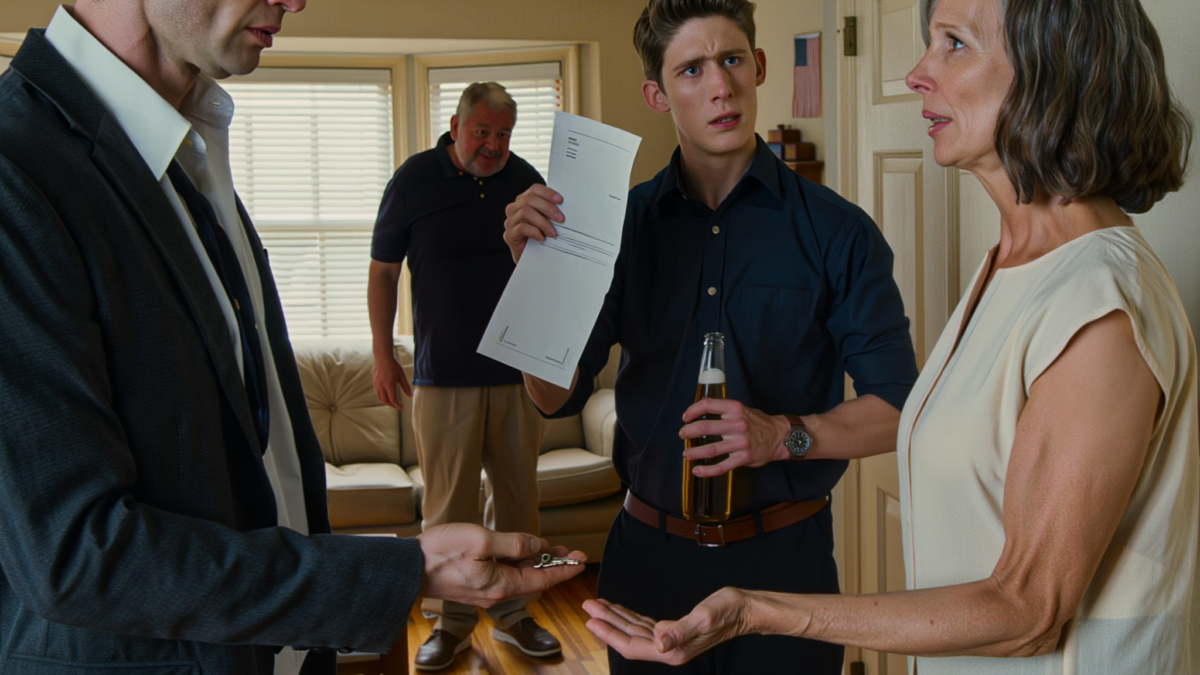
The apartment lights were on. Cyrus, Rowan, and Asher were sitting on my couch.
I stopped in the doorway, gripping my keys.
“How did you get in here?”
Mom stood and smoothed her skirt.
“You gave me a spare key three years ago, Lincoln. For emergencies.”
“This is not an emergency.”
I dropped my briefcase onto the floor.
“You can’t let yourselves into my apartment. Get out.”
“We’re doing an intervention,” Dad announced.
He stood and squared his shoulders, using the same posture that had intimidated me when I was twelve. In my small living room, it looked different than it had in my childhood kitchen.
“You’re hoarding money, Lincoln. This is unhealthy. We’re trying to help you let go of it before it takes over your life.”
“Help me let go of my money?” I looked from him to Mom. “Is that what we’re calling this?”
Asher came out of the kitchen carrying a sheet of paper. In his other hand was one of the craft beers he had taken from my refrigerator.
“We drew up a payment plan,” he said. “You authorize the transfer tomorrow morning, and I sign this promissory note. I’ll pay you back five hundred dollars a month.”
I did the calculation immediately. At $500 a month, it would take more than thirty years just to repay the principal. That assumed he made every payment, something his history gave me no reason to believe.
They were asking me to hand over years of work and spend most of the rest of my career waiting to get it back.
I walked up to Mom and held out my hand.
“Give me the key. Right now.”
“Lincoln, please, listen to reason.”
“Key.”
The force in my voice startled both of us. I had spent years moderating my tone, swallowing objections, and trying not to make things worse. This time, there was nothing left to soften.
She stepped back and dropped the silver key into my palm.
I went to the door and opened it.
“You have thirty seconds to leave. If you’re still here when I finish counting, I’m calling the police. I don’t care that we’re related. You do not get to come into my home and do this. Get out.”
They stared at me. Dad did not issue another command.
They moved into the hallway. As he crossed the threshold, Cyrus spat on the floor of my entryway.
I shut the door, turned the deadbolt, and fastened the chain. Then I dragged a wooden dining chair over and wedged it beneath the handle.
I sat on the floor with my back against the wall. My breathing was uneven, and my heart would not slow down.
This could not be only about a lost house deposit. Losing $20,000 would be painful, but it did not explain the threats to my career or my family letting themselves into my apartment to demand access to my savings.
There was something I had not been told.
I brought my laptop down to the floor. For the next three hours, I changed passwords on my banking accounts, email, investments, and social media. I did not know how much private information they had seen, and I no longer trusted the access I had once allowed them.
While updating the security on my primary checking account, I opened the page for linked and external accounts.
There it was: the old student account. It had originally been opened during my freshman year so my parents could transfer rent money. I thought it had been closed years earlier.
I clicked the transaction history.
The balance was $14. The account itself was anything but dormant.
Every month, on the fifteenth, money arrived from an outside account. Almost immediately, a $600 automatic payment went out to an auto finance company.
I opened the payment details and stared at the name.
It was the lease payment on Asher’s Porsche.
My hands began shaking again. I traced the incoming transfers to a credit union in Ohio. The source was a custodial college fund my grandmother had established for me when I was born.
My parents had told me that fund was gone. They said they had used it to cover my freshman year.
The records in front of me said otherwise.
Their names remained on the account as trustees. For the past four years, money had been moving from that fund through my old student checking account to support Asher’s car lease.
I looked at the screen and felt sick.
It was about $9,000 taken over the years, but the number was not the only thing I could not get past. My grandmother had left that money to help me begin my life. My parents had told me it was spent while quietly using it to make my brother look more successful than he was.
They had used my account and my name to move it.
I kept thinking about the dinner. About Asher’s watch, the photograph of the house, and my father telling me my money was doing nothing.
If they had been willing to hide this from me, what was the $185,000 really for?
I did not sleep that night. I stayed on the floor of the apartment, moving through one statement after another.
The pattern repeated. Money from the fund, a transfer into the student account, a payment to the auto finance company. Each month confirmed what I had wanted the previous one not to mean.
For years, I had told myself my parents were misguided. I knew they favored Asher. I had not believed they would knowingly use money intended for me and lie about where it had gone.
Now I had records in front of me, and the explanation they had given at dinner no longer felt credible.
A bank’s underwriting objection did not explain their panic. A supposedly temporary loan did not explain a repayment schedule lasting more than thirty years. I could not shake the feeling that they were trying to cover something much larger than a failed purchase.
When daylight began to reach the apartment on Wednesday morning, I did not settle into my usual routine. I took a hot shower, put on my sharpest dark suit, and picked up my briefcase.
I needed someone who could look at the financial facts without getting pulled into the family history.
I called in a professional favor and arranged an urgent meeting with Declan, a forensic accountant I had worked with on a complicated merger two years earlier. His firm was downtown, in the financial district.
Declan was fifty-five, wore carefully tailored suits, and had the kind of concentration that made other people check their work before handing it to him. I had seen him find discrepancies buried in hundreds of pages of records. I trusted him to tell me what was there, whether I wanted to hear it or not.
I sat across from his desk holding a paper cup of bitter coffee. My hands still had not entirely steadied.
“I need you to find everything,” I told him. “Every account, every line of credit, every loan attached to my name. Pull the reports from all three credit bureaus. Treat it like an audit.”
He did not ask me to explain thirty-two years of family dynamics. He listened, adjusted his glasses, and began working.
I waited for three hours.
The office was quiet except for his keyboard and the air conditioning. From the guest sofa, I could see the gray city through the floor-to-ceiling windows. I kept looking outside, then back at his desk.
I knew he would probably find more. What frightened me was not knowing how much more.
Finally, he turned the monitor toward me.
“Okay, Lincoln. Here’s what we have.”
He pointed with his pen to a highlighted line.
“There’s a Chase credit card in your name. It was opened three years ago, about a month after your twenty-ninth birthday. The limit is thirty thousand dollars.”
I shook my head.
“No. I use American Express for corporate travel and a Visa through my credit union. I’ve never opened a Chase account.”
Declan looked at me for a moment before continuing.
“According to the report, you have a Chase Sapphire card. There’s also an authorized user on it.”
I waited.
“Asher Carver.”
I gripped the wooden armrests of the chair. The room seemed to shift around me.
“What’s the balance?”
“Twenty-four thousand eight hundred ninety dollars.”
He let me absorb the number before explaining what he had found.
“These aren’t everyday purchases, Lincoln. There’s luxury retail, travel, and a large amount in cash advances.”
“Cash advances?” I tried to focus on the screen. “At that interest rate? Where?”
He opened another tab.
There was activity associated with MGM Grand in Detroit and Jack Cleveland Casino. There were repeated transfers to online betting platforms, including DraftKings. He also pointed out recurring payments to a private holding company that, he said, was associated with unregulated bookmakers.
I stared at the entries.
Five hundred dollars. Two thousand dollars. Five thousand in a single weekend during the Super Bowl.
This was not the occasional hand of blackjack Asher might play with friends. The records showed a sustained pattern, financed in part with credit attached to my name.
“And the payments?” I asked. “Someone has to be making them.”
Declan moved to another screen and followed the payment information.
“Minimum payments, every month, on the due date. They’re coming from a checking account registered to Cyrus Carver.”
My father.
The man who had taught me to pay every bill on time had been making minimum payments on a credit card I never opened. He was helping maintain an account my brother used while keeping me unaware it existed.
The application used my parents’ address in Ohio. The statements had gone to their house. They had received the mail, and I had never seen it.
“This is identity theft, Lincoln,” Declan said. “The account was opened in your name without your permission. Given the address and the other information, it looks as though your mother or your brother submitted the application and used your signature.”
I sat back in the chair.
The urgency at dinner had seemed disproportionate. The exact demand for $185,000 had sounded rehearsed. The story about a mansion and a minor banking problem had required me to ignore every financial instinct I had.
Now I could see a different explanation.
Perhaps they had tried to buy the house. Perhaps a lender had looked more closely at the finances and turned them down. I did not yet have every answer about the purchase.
But the gambling transactions were there. The unauthorized card was there. My father’s payments were there.
I believed the money they wanted was not a bridge loan at all. It was a bailout for debts they could no longer keep contained.
My parents had been covering for Asher, making payments and using my college fund to support expenses he could not afford. When that was no longer enough, they had turned to my retirement savings.
They were willing to sacrifice what I had built because they could not bear to let him face what he had done.
I thought about the promised refinancing, the interest Asher said he would pay, and the sheet of paper he had carried around my apartment. None of it had given me a real reason to believe I would see the money again.
“Lincoln,” Declan said, bringing me back to the office. “Do you want me to help you file a police report now? If you don’t report this, the bank may continue treating the balance as yours. You could end up fighting over debt you never authorized.”
I looked at the rows on his monitor. Years of concealment had become dates, amounts, and account numbers.
“Not today,” I said, standing and buttoning my jacket. “First, I need to secure my exit. Then I’m going to report what they’ve done.”
I left with a thick manila folder containing the records he had assembled.
Instead of going home, I took a cab to my company’s headquarters. The streets were familiar, but I felt oddly removed from them, as if I were already looking at a city I was about to leave.
I walked past my cubicle and went straight to Bennett’s office.
Bennett, my managing director, valued competence and loyalty. He was not a man who enjoyed vague explanations, which was one of the reasons I went to him.
I closed the glass door behind me.
“Is the London promotion still available?”
He looked up from his paperwork.
“Yes. But HR said you needed a few more weeks to think about the move and the salary adjustments.”
“I don’t need more time. I’m taking it. But I need to be on a flight Friday evening. I’ll start working from London on Monday.”
He took off his glasses.
“Lincoln, that’s a very fast turnaround. There are work visas, background checks, housing arrangements. HR normally needs weeks.”
“Please expedite it.”
I held his gaze.
“My family is trying to commit financial fraud against me. They’ve already come into my apartment without permission. I need to get away from the situation before it gets worse.”
He stopped talking and looked at me more closely.
Then he picked up his phone.
“Okay. I’ll speak to legal. Go home and pack your bags. You’re going to London.”
Wednesday evening and Thursday passed in a blur of practical decisions.
I hired a junk removal service and paid extra to have the apartment cleared within two hours. I watched them carry out the couch, the bed, and the dining table. Nothing I owned was valuable enough to justify keeping myself there longer.
I sold the Honda to a local dealership. I accepted less than I might have gotten with more time because I wanted the transaction finished.
I called my landlord, broke the lease, and paid the two-month penalty. It was expensive, but the amount was clear and finite. I could understand it in a way I could no longer understand what my family expected from me.
I packed my work clothes, legal documents, and laptop into two suitcases. The rest of my Chicago life was being closed down one decision at a time.
My phone stayed silent, but the messages continued.
There were forty-seven missed calls from Mom, twelve threatening messages from Asher, and six voicemails from Dad. Friday was their deadline, and their panic was becoming harder to disguise.
By then, I understood that Asher’s debts involved people my family was afraid of. They wanted the money by Friday afternoon because they believed they were running out of time.
I kept making arrangements.
Thursday night, I stayed in a corporate hotel near O’Hare rather than sleep in the empty apartment. On Friday, I woke at six.
I showered, dressed for the flight, and checked my phone.
Dad had sent another message at three in the morning.
“Lincoln, this is your last chance to act like a loyal son. Transfer the $185,000 to the routing number below by 5:00 p.m. today. If you don’t, you are no longer my child. I will write you out of the will. You will receive no inheritance. You will be dead to us. Do the right thing before you regret it.”
I read it in the quiet hotel room and let out a short laugh.
He was threatening to withhold an inheritance from me while trying to take the savings I already had. After what I had seen in Declan’s office, the promise of anything he might someday leave me meant very little.
But the words about no longer being his child still hurt.
That was the condition underneath all the others. I was his son as long as I remained useful. Once I refused to give him what he wanted, the relationship itself became something he could threaten to withdraw.
I did not answer. I had an appointment to keep.
At nine that morning, I walked into a large Chase branch downtown. I had arranged to meet the senior branch manager, Mrs. Higgins.
I sat across from her desk and took out the folder Declan had prepared. I laid the records in front of her, including the account information and the signature material.
“I’m here to report a credit card opened in my name without my authorization,” I said. “I’m also reporting unauthorized transfers from a custodial college account.”
She adjusted her glasses and began reading.
As she moved through the documents, she stopped at the names.
“Mr. Carver, are these members of your immediate family?”
“Yes. My brother, Asher, and my parents, Cyrus and Rowan. I didn’t authorize the credit account or sign those documents. I want the card frozen, and I want the fraud investigated.”
Her expression became more serious.
“Once we file this, it becomes a formal fraud report,” she said. “Given the amount involved, law enforcement may become involved. The balance is nearly twenty-five thousand dollars. Your family could face criminal charges. Are you certain you want to proceed?”
I had spent years being asked whether I was certain about saying no. Nobody in my family had ever seemed equally concerned about what saying yes would cost me.
“I have never been more certain,” I said. “Violet, press the button.”
She turned to her computer.
It took fifteen minutes. I watched her type, check the information, and complete the report. There was no dramatic sound when it was done, just the ordinary click of a keyboard in a bank office.
“Okay,” Mrs. Higgins said. “The card is frozen, and the fraud alert is active. Attempts to use it will be declined and flagged. The major credit bureaus will be notified.”
I thanked her, shook her hand, and put the folder back in my briefcase.
Outside, Chicago was moving through an ordinary Friday morning. I checked my watch. It was 10:30.
Somewhere in Ohio, Asher might have been trying to take another cash advance. He might have been looking for another way to buy time. For once, whatever he was doing did not depend on whether he could make me answer the phone.
I imagined him at an ATM outside a casino, entering the PIN and waiting for money. I imagined the transaction being declined and the confusion that would follow.
I had no way of knowing whether that scene was happening. But I knew the card was no longer available to him, and I knew he would eventually discover why.
By noon, during the cab ride to the airport, calls began arriving from numbers I did not recognize. Some came from prepaid phones, some from Hadley’s number, and some from neighbors’ landlines.
I let them go to voicemail.
At the airport, I sat with an iced coffee and watched international flights move across the runway. Eventually, I opened one of the messages.
It was Dad, calling from an unfamiliar Ohio number.
“Lincoln, please pick up.”
His voice was different. The command was gone.
“The bank says there’s a fraud alert. The police came to the house asking about Asher and the credit card. You need to call them. Tell them it was a misunderstanding. Tell them you gave him permission.”
He sounded breathless.
“Please. You’re going to ruin his life. Pick up the phone.”
I listened to the end, then deleted the voicemail.
Asher had used a credit card I did not know existed. My father had helped keep it active. They were now asking me to undo the consequences by telling another lie.
I was not going to do it.
Boarding began at 5:15 p.m. I stood in the first-class priority line holding my passport and boarding pass.
Before putting my phone away, I opened the family group chat. It was the same conversation Mom used for Minion memes and questions about when I would be home for holidays. Looking at it, I could almost hear her asking who would carve the turkey.
I decided to send one final message.
I did not want them filing a missing-person report or claiming they did not know whether I was safe. I wanted them to understand that leaving was a choice, and that I knew what they had done.
“I saw the credit card statements. I saw the gambling transactions. I saw the transfers from my college fund paying for the Porsche. I went to the bank this morning and reported it. The police will be in touch about the identity theft and the unauthorized transfers. I chose the don’t-come-back option you gave me, Dad. I’m gone. Do not look for me.”
I pressed send and waited for the delivered notification.
Then I took the small removal tool from my wallet, opened the SIM tray, and removed the card. I snapped it in half and dropped the pieces into a trash can near the gate.
When I handed over my boarding pass, the flight attendant scanned it and smiled.
“Have a wonderful flight to London, Mr. Carver.”
“Thank you,” I said. “I will.”
For the first time in weeks, my smile was not something I had arranged for someone else’s benefit.
I walked down the jet bridge without looking back. I was tired, and I knew there would be difficult days ahead, but I felt lighter than I had when I entered the airport.
It has now been one full year since that flight landed at Heathrow.
London is often gray and wet. To me, it is also the place where my life stopped revolving around the next family emergency.
I have a quiet flat in Islington overlooking a small park. In the mornings, people walk their dogs beneath the trees. I received the promotion and now lead a team of analysts who respect both my work and my boundaries.
I also have a partner, Finn. He is a British architect, thoughtful and kind in ways that took me time to trust.
On our first date at a small Italian restaurant, he insisted on splitting the bill. He told me that a partnership meant standing on equal footing, with mutual respect and honesty rather than a running debt between us.
It was strange to be liked without wondering what would be asked of me next. I still catch myself looking for conditions that are not there.
Thirty years of family habits do not disappear because you change countries. But I am learning the difference between being needed and being valued.
I did not disappear from the world. I disappeared from the part of it where my family expected constant access to me.
I still heard what happened in Ohio. Declan occasionally sent secure emails with updates, and news traveled quickly through the town where my parents had built their reputation.
After the fraud report, Asher’s finances began to unravel.
He was arrested at my parents’ house and taken out in handcuffs in view of the neighborhood. The account balance was substantial, and the matter did not end with a warning or a private family agreement.
Because it was his first major offense, and because my parents spent heavily on a defense attorney, he avoided serving state prison time by pleading guilty to a lesser felony fraud charge.
He still had a felony record. The loans, corporate jobs, and comfortable housing he once assumed would be available to him were no longer simple possibilities. His name now carried consequences he could not pass to someone else.
When the lease payments stopped, the Porsche was repossessed.
As the money disappeared and the people he owed kept asking for it, Hadley left. She packed her designer bags and pursued a legal separation. There was a dispute over their expensive purebred dog, and the court gave the dog to her.
Asher was left with the remaining debt.
He moved into my parents’ basement, with far fewer options than the ones he had imagined when he slid that photograph of the colonial house across the table.
My parents paid heavily for trying to keep the consequences away from him. They liquidated retirement assets to cover the legal bills and the most urgent gambling debts.
They withdrew money from their 401(k)s and absorbed the early withdrawal penalties. When that still was not enough, they put the family home on the market at a loss.
It was the house they had treated as proof that they had done everything right. They had hosted holidays there, displayed their good china there, and told me what being a loyal son required there.
Eventually, they filed for Chapter 11 bankruptcy.
They now live in a cramped, poorly insulated two-bedroom rental in a run-down part of town. The money they had expected me to give them never arrived, and their own savings were not enough to protect the life they had built around rescuing Asher.
Dad also lost his seat on the church council.
He had cared deeply about being seen as a dependable man, someone other people could trust. But people talked, and the account of what happened spread through the same social circle he had once relied on for approval.
Felix heard it. The neighbors heard it. The family they had presented to the community was no longer the only version anyone knew.
I was told the stress had aged Dad noticeably. He had become bitter and withdrawn, with fewer people willing to accept his explanation.
For years, my parents had told me I was strong enough to manage without help. When I finally stopped helping them, they discovered how much of their stability had depended on my willingness to stay available.
Last week, a letter arrived at my flat.
It had been forwarded by HR at my old Chicago office. The return address belonged to a lawyer working out of a strip mall in Ohio.
I left it on the kitchen counter for three days. Each morning, I saw it while making coffee. Each morning, I decided it could wait.
On Saturday, I took it to the coffee shop on the corner. I ordered Earl Grey and sat by the window, watching rain collect on the glass.
Then I opened it.
It was not a lawsuit. There was no demand for payment. It was a carefully worded request to consider professional mediation and the possibility of repairing our family relationship.
The lawyer wrote that Mom cried for me every day. Dad regretted the harsh misunderstandings of the past. Asher was attending meetings, working on rebuilding his life, and missing his older brother’s guidance.
I read those paragraphs more than once.
I thought about the college fund and the years they had told me the money was gone. I thought about the credit application, the statements sent to their address, and the minimum payments Dad had made.
I remembered coming home to find all three of them in my apartment.
Most of all, I remembered how quickly my father had been willing to tell me I was no longer his son when I refused to transfer the money.
I did not read the letter as proof that nothing could ever change. But I also did not see a reason to believe they understood what they had taken from me.
What I could hear, beneath the careful language, was the old expectation that I would return to being useful.
They missed the person who fixed things. The person who absorbed the expense, answered the call, and made another exception because family was supposed to matter.
Now they were asking for that person again.
I took a sip of tea and folded the letter in half, then in half once more. The coffee shop had a stone fireplace burning in the corner, keeping the room warm against the damp morning.
I walked over and put the folded pages into the fire.
For a moment, I watched the edges curl. The paper darkened, then broke into ash. When it was gone, I returned to the quiet of the room around me.
I still sometimes wonder whether I was wrong.
Not about the card or the college fund. Those records do not become less clear with distance. I wonder about the decision to leave, about the life I might have had if I had found some other way to remain their son and still protect myself.
Then I remember the choice they actually offered.
Give us the money, or you are no longer family.
I look at the life I have now. My accounts are secure, and my savings are growing toward the future I worked for. Finn cares about me without treating my income as the answer to his problems.
I can look in the mirror without thinking first about how to carry three other adults through the next emergency.
I did not make my brother open that account. I did not make my parents hide the statements or use the money my grandmother left for me. Reporting it did not create those decisions.
It meant I had stopped covering for them.
For years, I had confused protecting my family with preventing them from experiencing the consequences of their choices. I no longer believe those are the same thing.
I finished my tea and stepped outside into the London rain, pulling my wool coat closer around me.
I was separated from the family I had grown up with. But for the first time in my thirty-three years, I was not lonely.
I was finally truly free.








