My brother called me a beggar in front of my 10-year-old son. He wanted me scrubbing toilets at his company for $12.50 an hour. My father ordered me to sign the application. Instead, I opened my laptop to the supplier contract his company needed to renew. Then I made a call on speakerphone—and my brother recognized the voice before I even said hello.
My name is Julian, and I am thirty-four years old. For eight years, I allowed my family to treat me like someone who had nothing to offer. They made my life into a cautionary tale, something they could bring up whenever they needed to feel better about their own choices.
While I grieved the sudden loss of my wife and raised our little boy alone, my parents and older brother called me a financial liability. They mocked my clothes and laughed at my supposed failures in front of the extended family. At Thanksgiving, my circumstances were as much a part of the conversation as the food.
There was one thing they did not know. While they assumed I was struggling to keep a roof over our heads, I had taken my late wife’s engineering designs and built a manufacturing company. That company had become essential to the supply chain of my brother’s employer.
Now my brother was sitting across a dining table from me, asking me to stop. The confidence he had brought to dinner was gone.
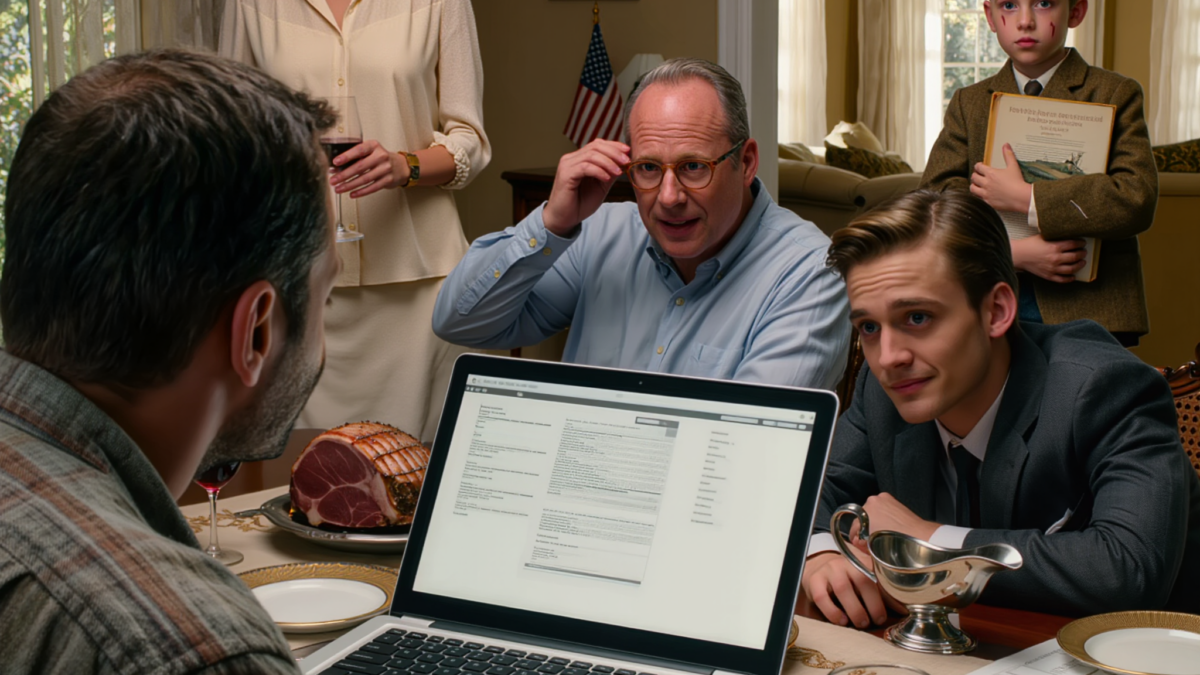
The formal dining room in my parents’ house was too warm. It smelled of roasted garlic and red wine. Marcus leaned back in our father’s antique mahogany chair, swirling his cabernet as though the evening had been arranged for his entertainment.
He reached into a designer leather briefcase, an accessory that looked out of place at a Sunday family dinner, and removed a crisp sheet of paper. Instead of handing it to me, he pressed his fingers against the page and slid it across the polished table. It passed the silver gravy boat and stopped beside my scratched water glass.
“Take this janitor gig, Julian,” he said. “Toby looks absolutely ragged in those hand-me-downs. It’s embarrassing for the family. People in the neighborhood are starting to talk. Just sign the form, take the night shift, and buy your kid some new clothes.”
I looked down. It was an intake form for Vanguard Logistics, offering a sanitation technician position. The duties included cleaning restrooms and mopping warehouse floors in the same building where Marcus worked as a supply chain manager.
My ten-year-old son was staring at his plate. His cheeks had gone red, and he was trying not to look at anyone.
I reached into my battered canvas messenger bag, took out my aluminum MacBook Pro, and set it on my mother’s hand-embroidered tablecloth.
“I won’t be filling this out, Marcus,” I said. “But I’ll be sure to give this to my assistant. You know him as your company’s CEO.”
His face lost its color. The smile disappeared.
Two hours earlier, I had been gripping the steering wheel of my fifteen-year-old sedan, trying to ignore the familiar tension in my chest. There was a particular anxiety that came with driving toward a place where I was expected but not wanted. I had felt it on those Sunday drives for eight years.
The car ran well. I kept the engine maintained and the interior clean. But the faded gray paint, manual windows, and rust along the bumper told my family the story they preferred to believe.
To them, it was proof that I was still struggling. They never looked beyond it.
“Dad?”
Toby’s voice came from the back seat. In the rearview mirror, I could see him looking at the manicured lawns and stone facades of my parents’ neighborhood.
Every yard met the standards of an HOA board my mother chaired. She took the position seriously, issuing fines over tall grass and mailbox colors with the same confidence she brought to family disagreements.
Toby wore a vintage tweed jacket I had found at an estate sale. The wool was warm and well made, with a small repair near one elbow where I had mended a loose thread.
“Yeah, buddy?”
“Do I have to hug Uncle Marcus today?”
He was picking at his fingernails. He only did that on the way to his grandparents’ house.
“He always pinches my shoulder too hard,” Toby continued. “And Aunt Beatatrice is going to say something about my shoes again. She always looks at my shoes first, before she even says hello.”
I let out a slow breath and kept my voice light.
“Just a quick hello, Toby. We won’t stay for dessert. Promise. And if they say anything about your clothes or my car or anything at all, you just look at me, okay? We have our secret signal.”
He gave me a small smile in the mirror. Our signal was a double blink. It was supposed to remind him that we were a team and that their comments did not define us.
I hated bringing him to those dinners. But I wanted him to have grandparents and cousins, a family beyond the two of us. I didn’t want losing his mother to mean that his world kept getting smaller.
I had told myself that enduring a few unpleasant hours was worth preserving those connections. Lately, the price had become harder to justify.
My phone vibrated in the cup holder. The message was from Victor, my chief operating officer at Apex Components.
Victor: Vanguard Logistics is pushing extremely hard for the Q3 renewal today. Their VP is practically begging for a 15% discount on the bulk order to save their quarterly margins. Do I stall them until Monday?
At a red light, I picked up the phone and answered.
Julian: Stall them completely. Do not sign the renewal. I want to review their supply chain leverage numbers tonight. They need us more than we need them. Let them sweat through the weekend.
I set the phone facedown. That was the other part of my life: contracts, production schedules, and decisions that moved millions of dollars in freight.
I was the chairman and majority shareholder of Apex Components. I negotiated with companies much larger than ours and had a legal team to handle contract disputes. But as I turned onto my parents’ tree-lined street, all of that seemed to recede.
Here, I was still the widower who had never recovered. The younger son who supposedly needed help. The family disappointment.
Marcus had parked his newly leased Porsche SUV diagonally across the circular driveway, occupying enough space for three cars. It was exactly the kind of vehicle he liked: conspicuous, expensive, and impossible to overlook.
I left my sedan on the street, careful not to let the tires touch the neighbor’s grass. My mother would have noticed. She noticed everything that could become a criticism.
After I switched off the engine, I sat for a moment in the quiet. Toby was watching me from the back seat.
“Game faces, Toby,” I said. “Remember, whatever they say today, it’s about their own insecurities, not us. We are bulletproof.”
“Bulletproof,” he repeated, straightening a little.
We walked up the brick path, and I rang the brass doorbell. Its chime carried through the house before my mother opened the door.
Sylvia wore pearls and a carefully styled bob. Her smile appeared immediately, but her eyes moved past us to the grandfather clock in the hall.
“Oh, you made it. We thought your old clunker finally broke down on the highway. Your father was just saying we might have to drive out and jump-start you.”
“The car is fine, Mom. We’re right on time.”
“Well, wipe your shoes thoroughly, Julian. We just had the foyer rugs professionally steam-cleaned.”
She waved us inside. In the living room, Marcus sat in a recliner with a craft beer, watching a golf tournament on the television.
“Look who it is,” he called without getting up. “Did you guys eat breakfast today, or were you saving room for the free food?”
He made some version of that joke every week. I rested a hand on Toby’s shoulder and let the comment pass.
I had learned to do that after Clara died. But the habit had begun at her funeral, when I discovered how little comfort my family intended to offer.
I was twenty-six then. Three days after losing my wife, I stood beside her grave in a black suit I had bought from a clearance rack. Cold rain had soaked through the fabric.
Toby was two. I held him against my chest to keep him warm while the priest read about peace and the afterlife. I heard the words without taking them in.
Clara had been a mechanical engineer. She filled diner napkins with sketches and calculations, working through ideas while I handled administrative jobs that helped support her research. We were building a life together, one ordinary day at a time.
Then a sudden aneurysm took her. There had been a brief stay in intensive care and hospital bills I could barely comprehend. None of the numbers mattered to me while there was still a chance she might come home.
My family visited the hospital once. They stayed ten minutes, complained about the parking fees, and left.
After the funeral service, people began returning to their cars. I remained on the wet grass with Toby, unable to move. I needed someone to put an arm around me or take the child for a minute. I needed somebody to tell me that I would get through the next day.
A hand touched my shoulder. I turned, expecting an embrace.
Marcus stood beneath a large golf umbrella. His suit was dry, and he was looking at his watch.
“Well,” he said, “at least the hospital drama is over.”
I stared at him. Rain ran down my face and onto Toby’s jacket.
“She was twenty-five, Marcus. My wife is in that casket.”
“I know it’s sad,” he said, adjusting his tie. “But I need to be completely realistic with you right now, Julian. I hope Clara had some kind of life insurance because Mom and Dad are looking at their 401(k), and they are terrified. They cannot afford to carry you and the kid.”
He spoke as though we were discussing a problem at work.
“You have no real career. You have no impressive degree. You’re a massive financial liability now. If you can’t provide a stable environment, we might have to look into custody arrangements for the boy. Do not expect this family to fund your life.”
He patted my shoulder twice and walked back to his car. Across the grass, my parents stood beneath a tent, talking quietly and avoiding my eyes.
Neither of them came over. They didn’t offer to hold Toby or ask what I needed. They got into Marcus’ car and left for the reception.
I stayed where I was, holding my son in the rain. The grief did not disappear, but something changed alongside it. I stopped assuming that being related meant they would protect us.
Clara did have life insurance. She had insisted on a comprehensive policy, and the payout was substantial. It was enough to pay off our small mortgage and establish a secure college fund for Toby.
She had also left something I could not reduce to a dollar amount: an encrypted hard drive containing completed designs for an automated sorting component used in warehouse logistics.
“Julian, this gear mechanism will cut supply chain delays by twenty percent,” she used to tell me. “No one is doing this yet. It’s the future.”
That night, after I put Toby in his crib, I sat in front of her laptop. I had no manufacturing experience. I had been an administrative assistant, and I was trying to imagine how to raise a toddler without his mother.
But her work was there. So was the memory of Marcus explaining that I was a liability before the funeral flowers had been cleared away.
Instead of putting the payout into a conservative savings account, I hired a patent lawyer. I found a small prototype manufacturer and founded Apex Components in our drafty guest bedroom.
For the next four years, I read manufacturing guidelines, trade regulations, and supply chain textbooks whenever Toby was asleep. I lived on black coffee and too little rest, learning enough to ask better questions and recognize when an answer was incomplete.
I put Clara’s legacy into her designs. If the company failed, the consequences for us would be serious. But I was determined to build something that would allow me to provide for our son without giving my family control over our lives.
The double life developed gradually. Around my parents, I drove the same sedan and wore faded flannel shirts. I clipped grocery coupons while my mother watched, and I let her take that as confirmation of whatever she already believed.
Sometimes they paid for inexpensive lunches. I accepted because arguing over the check seemed less exhausting than explaining myself.
Away from them, I negotiated with vendors and worked through production problems. I dealt with a competitor that challenged Clara’s design and avoided a costly lawsuit. There were contracts to review, manufacturing runs to fund, and decisions I could not postpone.
By the third year, Apex was profitable. By the fifth, we had become a major regional supplier and had begun acquiring smaller logistics firms. By the seventh, we were Vanguard Logistics’ primary supplier.
Marcus had worked his way into middle management there. He never connected the components moving through his company with the younger brother he kept ridiculing.
Christmas three years earlier had shown me just how fixed their assumptions had become. We were in my parents’ living room beneath a large tree crowded with glass ornaments. Wrapped gifts filled the space around it.
Marcus and Beatatrice handed my parents new iPads. There were designer handbags and expensive packages passed from one adult to another.
“And for our little Toby,” Beatatrice announced.
She handed my son a worn cardboard box closed with peeling packing tape. Toby was seven then. He opened it eagerly, still young enough to expect that a present meant someone had thought about what would make him happy.
Inside were loose plastic action figures. One was missing its head, and another had a leg warped by heat. Dust clung to them.
“Those are Felix’s old toys,” Beatatrice said loudly. “Felix is getting the new VR gaming system this year, so we figured, why throw these away when Toby has so little? It’s practically a gold mine for a boy like him. They are very gently used.”
Toby picked up the headless figure. He looked at it, then at me. His face changed for a moment before he carefully brought it under control.
“Thank you, Aunt Beatatrice.”
“You’re so welcome, sweetie.”
She took a sip of champagne. Then my aunt Valerie, Sylvia’s sister, handed me a paper grocery bag.
Valerie talked often about church and charity. She patted my arm as though the bag represented something generous.
“For you, Julian. I was cleaning out my pantry for the new year. I know your freelance administrative work doesn’t pay much. Food is so expensive these days. I can’t imagine how you manage to feed the boy.”
The bag held dented soup cans and boxes of stale crackers. Some labels were peeling. I turned over a can of chicken noodle soup and found that it had expired seven months earlier.
“Say thank you to your aunt, Julian,” my father said from his armchair. “Family takes care of family.”
I looked from the soup to the broken toys. That morning, Victor had sent me our quarterly report. My personal liquid assets had passed three million dollars.
I could have bought a fleet of the cars Marcus liked to discuss. Instead, I sat there while my father instructed me to be grateful for food someone else could no longer use.
“Thank you, Aunt Valerie.”
The words were difficult to say. I took the bag and Toby’s box home.
The next morning, I threw out the expired food and donated the toys to a shelter. I did not keep the objects, but I remembered the way my son had thanked Beatatrice while holding a broken gift.
People have asked why I didn’t simply show my family a bank statement. Why I kept driving to their house in the old car when I could have ended the assumptions with one purchase.
Part of the answer was that I did not want them involved in my business. In negotiations, I had learned the value of knowing more than I disclosed.
But another part was harder to admit. I kept waiting to see whether they could care about us without attaching a judgment to it. I wanted one visit when they treated Toby as a grandson and nephew rather than evidence that I had failed.
Eight years passed. I kept waiting.
Meanwhile, I paid close attention to Vanguard. Its quarterly reports showed debt, delayed shipments, and pressure on margins. Potential lawsuits over international delivery delays added to the risk.
The company depended on the efficiencies our components provided. I understood that dependence better than Marcus did, even as he used his position there to explain why he was more successful than I was.
Back at Sunday dinner, my mother had set the table with the good china. The gold-rimmed plates were the ones we had been forbidden to touch as children. Heavy silver cutlery lay beside embroidered napkins, and a large prime-rib roast occupied the center of the table.
My father sat at the head, sharpening the carving knife. He gestured toward me with it as he spoke.
“So, Julian, did you ever fix that leaky window in your rental apartment? Winter is coming. You don’t want the kid catching pneumonia. Medical bills will bankrupt you.”
I unfolded my napkin and placed it on my lap.
“There is no leak, Dad. It was just condensation. I took care of it.”
“You really should look into moving to a better complex,” Beatatrice said.
She poured herself a large glass of cabernet. Her diamond tennis bracelet caught the light as she lifted the bottle.
“Felix’s private school is doing a charity drive for underprivileged families in your ZIP code. So sad how people live over there. The crime rate must be terrifying. I worry about Toby’s safety walking around that neighborhood.”
“We live fine, Beatatrice.”
I hadn’t lived in that apartment for four years. I kept it as a mailing address so my family would not know where we actually lived. Toby and I had a custom-built home in a private gated community 20 m away, with a pool, a home theater, and a security system.
They had never asked enough questions to discover that their picture of our lives was outdated.
“Well, you need to think about Toby’s future,” Marcus said, helping himself to potatoes and beef. “Have you put anything away for college? Or are you banking on financial aid and government handouts to bail you out?”
He didn’t wait for an answer.
“Getting a promotion in this economy isn’t easy if you don’t have a top-tier degree. My salary at Vanguard just got bumped into the executive tax bracket, plus bonuses. Takes real hustle, Julian. Something you severely lack.”
“I do freelance consulting, Marcus. We are comfortable.”
“Freelance?” Valerie said from the other end of the table. “That’s just a millennial word for unemployed.”
She had arrived late with a store-bought pie. Now she leaned toward my mother without making any effort to lower her voice.
“You know, Sylvia, I didn’t want to say anything, but I told the women at my book club about Julian’s situation. Susan said she saw someone who looked just like Julian digging through the donation bins behind the church last week.”
Valerie turned toward me.
“I had to defend you, Julian. I told them you were just thrifty and resourceful.”
The table quieted. I felt my jaw tighten.
I hadn’t been near a donation bin in nearly a decade. Valerie was repeating a story about me that was not true, then presenting herself as the person who had protected my reputation.
“Valerie, please,” my mother said, touching her pearls. “Not at the dinner table.”
Then she looked at Toby.
“Julian, is that true? Are you dumpster diving for Toby’s clothes? Look at that jacket he’s wearing. It looks like something from the Great Depression. This is a reflection on all of us.”
“It’s vintage,” I said. “And no, I don’t dig through trash. Aunt Valerie, you should find a better hobby than spreading lies about your own nephew.”
“Don’t speak to your aunt that way.”
My father struck the table with his palm. The china rattled, and water spilled from a glass.
“She is just worried about you. We all are. You are thirty-four years old, Julian, and you have absolutely nothing to show for your life. You do nothing. You earn nothing. And you contribute nothing to this family.”
He looked around as though the others should confirm it.
“Real estate is booming. The stock market is up. And you are still exactly where you were eight years ago.”
My mother looked embarrassed by me rather than by the conversation. Valerie waited for someone to defend her. Marcus sat back and watched.
This was how they came together. As long as the conversation remained about my supposed failures, none of them had to question their own behavior.
Toby had finished his small portion of beef. At these dinners, he usually found somewhere quiet to read, and that evening he had brought a new hardcover encyclopedia of marine biology. I had bought it for him after he aced his math finals.
He left the table and settled on the Persian rug in the living room. I could see him through the opening between the rooms.
Felix wandered over. At twelve, Marcus’ son was already much bigger than Toby, and he had learned how to use that advantage.
“What is that?” he asked, standing over him.
“It’s a book about sharks.”
Toby drew the book closer to his chest. I watched from the table.
“Books are for losers,” Felix said. “Let me see it.”
He bent down and grabbed the upper edge of the hardcover.
“No, stop,” Toby said, pulling back. “You’re going to rip it.”
“Give it to me, poor kid.”
Felix pulled harder. The sound of cardboard and paper tearing carried into the dining room.
The front cover came away from the spine. The first twenty glossy pages tore down the middle.
Toby stared at the damaged book. Tears filled his eyes.
“You broke it!”
Felix dropped the cover onto the floor and laughed.
“It looked like trash anyway. Tell your dad to get you a real toy instead of garbage.”
“Felix,” Beatatrice called.
For a moment, I expected her to get up. I thought she might make him apologize and hand the book back properly.
Instead, she took another sip of wine.
“Play nice with your cousin, honey. Don’t break his little thrift-store books. His dad can’t afford to replace them.”
Marcus looked at me and laughed.
“It’s just a book, Julian. Don’t look like you’re going to cry over paper. I’m sure you can go back to the public library and check out another one for free. Toby needs to learn to share. It builds character.”
Toby stood, holding the torn pages and cover. His shoulders shook.
When he looked at me, the expression on his face was not only sadness. He was waiting for me to do something. I could see the question I had avoided answering every time I brought him there: why was I still allowing this?
I had spent years protecting my business and keeping Toby’s inheritance in a trust where my family could not reach it. I had told myself that privacy was the safest answer to their threats and demands.
But none of those protections helped a child standing in a living room with his favorite book in pieces. My silence had become something he had to endure, too.
“It wasn’t a library book,” I said.
I stood, and my chair scraped across the floor.
“I bought it for him. It was eighty dollars. And your son is going to apologize right now.”
“Eighty dollars?” my mother said. “Julian, please stop lying to impress us. You can barely afford your heating bill, let alone an eighty-dollar book. Stop making a scene over nothing.”
“Sit down, Julian,” Marcus said.
His voice had taken on the tone he used when talking about subordinates at work.
“Don’t throw a tantrum in Mom’s house. In fact, you should be thanking me. While you’ve been pretending to be a father and pretending you can afford expensive books, I’ve been out actually solving your problems.”
He reached for his briefcase. The others watched as he removed the folded HR document.
“I pulled a lot of strings for this,” he said, tapping the page. “My professional reputation at the company is on the line, so you better not screw this up.”
He slid it across the table to my water glass. My mother watched with the solemn approval she usually reserved for announcements about his career.
The application had a printed email thread attached. Marcus had sent the message to the head of HR.
Subject: Urgent favor for night shift sanitation role.
Hey, Linda. I have a guy for the warehouse cleaning crew. It’s my younger brother. He has zero skills, a massive employment gap, and is completely desperate for cash. He will take the absolute minimum starting rate. Just get him a mop and a bucket so he can stop begging our family for handouts. I vouch for him, but keep a close eye on him.
Below the email was the position description. Sanitation technician. Restroom maintenance, hazardous-spill cleanup, waste disposal, and sweeping the loading docks. The shift ran from 10:00 p.m. to 6:00 a.m., and the wage was $12.50 an hour.
Marcus folded his arms. He looked pleased with himself.
“It’s a massive opportunity for you, Julian. Twelve-fifty an hour is better than zero. You can work the night shift while Toby is asleep. Scrubbing toilets isn’t glamorous, but beggars can’t be choosers.”
His eyes moved toward my son.
“And let’s be brutally honest. Looking at Toby in those ragged clothes, you are a beggar.”
“Sanitation technician,” I read aloud.
“It’s cleaning the warehouse, Julian,” Marcus said, as though I had failed to understand. “I’m in the executive wing, obviously, so I won’t have to see you. I have an office with a door. But I will be checking your timesheets to make sure you’re not slacking off on company time.”
He tapped the page again.
“You report directly to the shift supervisor, but ultimately you answer to me.”
My mother clapped her hands together.
“Oh, Marcus, you are so incredibly generous. Julian, look at what your brother has done for you. A steady paycheck. You can finally start acting like a real man and contributing to society. You can finally start paying your own way.”
“And he gets partial dental after a year,” Beatatrice added, studying her nails. “Which is good because, Julian, your teeth are looking a little yellow. You really need to take better care of yourself.”
I placed both palms on the table and looked at Marcus.
“So, let me get this straight. You want me to scrub toilets in the warehouse of the company where you work as a manager?”
“I want you to stop being a burden,” he snapped. “I’m sick of explaining to my colleagues why my brother looks like he has nowhere to live. Sign the paper, take the job, and say thank you to me for saving your life.”
“Sign it, Julian,” my father said. “Don’t be ungrateful. This is the last time this family helps you.”
I looked back at the wage. At forty hours a week, it would amount to about twenty-six thousand dollars a year before taxes.
Three days earlier, I had signed a dividend distribution check from Apex Components for $1.8 million.
“Thank you, Marcus.”
“You’re welcome.”
He picked up his wineglass.
“See? Was that so hard?”
“I’m not thanking you for the job,” I said. “I’m thanking you for the clarity.”
His glass stopped halfway to his mouth.
“Excuse me?”
I reached into my canvas bag, past Toby’s spare inhaler, and took out my laptop. Then I moved the platter of prime rib aside, sliding it close enough to make Valerie shift in her chair, and placed the computer in the center of the table.
“Julian, what on earth are you doing?” my mother asked, pulling back to protect her dress. “Get that dirty thing off the dining table.”
“Since we are discussing my career at Vanguard Logistics,” I said, opening the lid, “I figured I should bring out my own paperwork.”
The screen lit up. Beatatrice stared at the laptop.
“Is that a MacBook Pro? Those cost over two grand. Did you steal that?”
“I bought it. Four years ago.”
“Probably maxed out a predatory credit card,” my father muttered. “You’re going to ruin your credit score forever.”
I entered my password and opened the directory on my desktop. Inside was the folder labeled Vanguard Logistics Q3 Corporate Strategy.
“Marcus, you work in supply chain management. Specifically, you oversee the Midwest regional distribution hub. Correct?”
He blinked at the change in the conversation.
“Yes, I manage the whole Midwest floor. Why? Did you apply for a warehouse job online, too?”
“Then you must be very familiar with Apex Components.”
He rolled his eyes.
“Obviously, I know Apex. They are our primary supplier for automated sorting gears. We spend tens of millions with them annually. Our entire Q4 delivery schedule depends on their contract renewal.”
He glanced at the laptop.
“What does a multimillion-dollar logistics supplier have to do with you?”
“More than you think.”
I turned the screen toward him. Its light fell across the mahogany table and the faces gathered around it.
My mother stopped reaching for her glass. My father still held the carving knife, though he had forgotten about the roast. Valerie sat with her mouth slightly open.
On the screen was Apex’s organizational dashboard. It was a live internal display, not an image I had downloaded. In the corner was the geometric company logo Clara had sketched on a napkin eight years earlier.
“What exactly is this supposed to be?” Marcus asked. “Is this a joke? Did you make a fake corporate chart to try and impress me?”
He tried to laugh, but his voice had become less certain.
“I know you do freelance administrative work, but playing make-believe CEO is a new low.”
“Read the top box, Marcus.”
He leaned forward. At the top of the chart, highlighted in blue, was my name and title.
“Chairman of the board and majority shareholder, Julian Vance.”
He gave a short laugh.
“You? The chairman of Apex Components? Right. You clearly photoshopped this graphic. Where did you even get the high-resolution Apex logo?”
His eyes went from the screen to me.
“Did you get into their directory just to stage a stunt at Sunday dinner? You drive a rusted fifteen-year-old car. You live in a dump. You buy your kid clothes from thrift stores and charity bins.”
“It isn’t a stunt, Marcus. I built Apex Components in our guest bedroom eight years ago. I used Clara’s life insurance payout to fund the first manufacturing runs of her designs.”
I kept my hands on the table.
“We hold the patents. We own the manufacturing facilities and the distribution rights. And we hold the supplier contract your company relies on.”
“You are lying,” Beatatrice said.
Wine spilled over the edge of her glass and spread across the embroidered cloth.
“Marcus, he is lying to us. Tell him he is lying.”
“Look at the timestamp in the bottom right corner,” I said. “This is a live reporting dashboard. It’s connected to the Apex server through a secure VPN.”
I opened the renewal folder and turned the laptop slightly so my father could see it, too.
“This is your company’s current proposal, Marcus. Your CEO, Mr. Harrison, is requesting a fifteen-percent discount on the next bulk order of our sorting components.”
I pointed to the financial figures.
“Your margins are tight. The international shipping lanes are backed up, and overtime costs are eating into the operating budget. Without that discount, Vanguard is going to miss its quarterly projections.”
Marcus stared at the highlighted numbers.
“That means no executive bonuses,” I continued. “No promotion for you. And a problem paying for that house and the Porsche. Is my assessment accurate?”
He knew the figures. He had been in the meetings where Vanguard discussed those projections, and his expression changed as he recognized them.
The explanation that I had made a fake chart was no longer enough. A supposed freelance assistant had opened information he had seen behind closed doors at work.
“How do you have this file?” he asked. “This is illegal. This is corporate espionage.”
“I have it because my chief operating officer, Victor, sent it to me for final approval an hour ago while I was driving here. Victor is the man your CEO asks for discounts.”
I leaned forward.
“And Victor answers to me.”
My father adjusted his reading glasses and studied the screen.
“Julian, is this actually real? Are you actually running this company?”
“It is entirely real, Dad. I’ve been a multimillionaire for five years. My real estate portfolio alone is worth more than this neighborhood.”
I looked directly at him.
“But I knew that if I told you, the money would become the only thing you cared about. You wouldn’t see me. You would see a bank account. After tonight, I have no reason to think I was wrong.”
“I don’t believe it,” Marcus said. “I refuse to believe it. It’s an elaborate trick. You’re trying to blackmail me or humiliate me.”
He shook his head and pointed at the computer.
“Put it away. You are not a CEO. You can’t even afford a new winter coat for your son.”
“Then let’s prove it.”
I picked up my phone, found Victor in my favorites, and called. I put it on speaker beside the application Marcus had brought.
It rang twice.
“Julian.”
Victor’s voice carried across the table.
“I know you’re at your family dinner, but we need to make a firm decision on Vanguard. Harrison just emailed again and marked it urgent. He’s still asking for the fifteen-percent discount.”
Marcus went still. He recognized Victor from the conference calls where Vanguard’s executives negotiated with Apex.
“He says their fourth-quarter survival depends on our components shipping by next Wednesday,” Victor continued. “He’s bringing up our history together and asking us to take that into account.”
“Hi, Victor. Yes, I’m still at dinner. But there’s been a change of plans regarding the Vanguard renewal.”
“Okay.”
I heard his keyboard.
“Do we give them the discount in exchange for a longer term? We could lock them in for five years.”
“No,” I said, looking at Marcus. “Cancel the discount. Don’t give them a penny. I also want a ten-percent surcharge on future expedited shipping orders for Vanguard, starting with next week’s shipment.”
Victor paused.
“Julian, a ten-percent surcharge on top of the current rate will put serious pressure on their projections. It could cost them millions in additional overhead.”
He let that sit for a moment.
“Do we have a business justification? Their legal team might challenge it.”
“We do. I have concerns about the reliability of their regional supply chain leadership. I don’t want Apex exposed to that operational risk.”
Marcus leaned across the table, reaching for the phone.
“Stop, Julian. You can’t do that. Please.”
I moved it closer to me, out of his reach.
“Did you get that, Victor?”
“Loud and clear. We’ll draft the revised terms tonight. Anything else?”
“One more thing.”
I picked up the application and its attached email. The Vanguard Logistics name was visible at the top. I photographed the pages.
“I’m sending you a document I was given today. It’s a job offer, personally endorsed in writing by their Midwest supply chain manager, Marcus Vance.”
I looked at my brother as I continued.
“I think Harrison should know that his manager tried to hire the chairman of his primary supplier to clean the warehouse for twelve-fifty an hour.”
The message sent. Victor went quiet while he looked at it.
“Got it,” he said. “Sanitation technician.”
There was another pause.
“That is an extraordinary thing for him to have put in writing.”
“Send it to Harrison’s personal email. Mark it confidential and urgent.”
“Consider it done. It’ll be in his inbox in two minutes.”
I ended the call. Marcus held the edge of the table with both hands.
He understood how quickly a threat to a major supplier relationship could become a problem for the person responsible. He also understood that his email to HR did not need interpretation. He had written every word himself.
I expected Vanguard’s board to ask questions about any increase in costs. Once Harrison saw the application, Marcus would have to explain why he had involved his employer in an attempt to humiliate a member of his family.
“You just ruined my life,” he said.
“No, Marcus. You made your choices. I finally stopped accepting the way you treated me.”
No one answered immediately. Marcus stared at the space where my phone had been, while the others looked between us as though they were trying to decide which version of the evening was still true.
Beatatrice gripped her tennis bracelet. She understood what the loss of bonuses could mean for their mortgage, their country club membership, and the expenses they had built around Marcus’ salary.
My father stood, bracing a hand on the table.
“Julian, wait a minute. Let’s talk about this like adults. You can’t make a phone call and destroy your brother’s career. Blood is thicker than water. We are a family.”
“Are you lecturing me about family loyalty, Dad?”
I began putting my laptop and charger back into the canvas bag.
“Where was that loyalty when Clara died? Where was it when Marcus called me a financial liability at her funeral? Where was it every Thanksgiving when you let him humiliate me in front of my son?”
“We were trying to push you,” my mother said.
Tears ran down her cheeks.
“We thought you were struggling. We thought you needed tough love to get motivated and find a real job. You cannot do this to Marcus. Think about Felix.”
She glanced toward the living room.
“If Marcus loses his job, they could lose their house. They could lose everything.”
“Why didn’t you think about Toby?”
My son stood in the living room doorway, still holding his damaged book.
“For eight years, you watched them make fun of him. You watched Beatatrice give him broken toys for Christmas and called it generous. You listened when they called him ragged. You let Valerie spread stories about us taking clothes from donation bins.”
I stopped packing long enough to look at each of them.
“You never said, ‘Stop treating my grandson that way.’ You poured the wine and served dinner.”
“We didn’t know,” Valerie said.
She held her napkin against her chest.
“We didn’t know you had money, Julian. If we’d known you were a CEO, if we’d known you were successful, we would have treated you with the respect you deserve. We thought you were just a freelancer.”
I left the zipper halfway closed.
“That’s the point, Valerie. You think respect is something you owe people after you’ve seen their bank accounts. You thought it was acceptable to humiliate us when you believed we had nothing.”
She looked down at the napkin.
“The money hasn’t changed who I am. It has changed how you think you should treat me.”
“No, of course not,” my father said. “Julian, please. We love you. We’re your family. We want the best for you.”
“You loved the version of me that made you feel successful. You liked having someone to point to whenever you wanted proof that you were doing well.”
I closed the bag.
“You needed me to be the one who had failed.”
Toby had stopped crying. He watched me with wide eyes, the torn cover pressed against his chest.
“Get your coat, Toby,” I said. “We’re leaving.”
“Julian, please.”
Marcus pushed back his chair and came around the table. He caught my arm, gripping the sleeve of my flannel shirt.
“You have to call Victor back. Tell him to retract the picture. Tell him you were hacked. Harrison is looking for any excuse to cut payroll, and he’ll fire me tomorrow.”
His words came faster.
“I have car payments. I have a mortgage. I have Felix’s tuition.”
I looked down at his hand, then back at him. The confidence he had carried through the years I had known him was gone.
“Let go of me, Marcus.”
“I’m sorry. Okay? I’m sorry about the application. It was a joke. A stupid joke to get a reaction. I didn’t mean it. Please don’t do this to my family.”
“It wasn’t a joke. You enjoyed it. I watched you slide that paper across the table.”
I pulled my arm free.
“Vanguard is our client. You used your position there to put this in writing and bring it into our family. You don’t get to decide afterward that it didn’t count.”
“Beatatrice, do something,” he said, turning toward her.
She stood and smoothed her dress, but she did not come to him.
“You tried to hire the owner of our biggest supplier to clean the warehouse toilets,” she said. “You have put our entire family at risk, Marcus. You ruined everything.”
“I didn’t know!”
“We’re leaving,” I told Toby.
I took his hand. It felt warm and steady in mine as we walked toward the front door.
Behind us, my mother was crying. My father was talking about lawyers and betrayal. Marcus stood near the table, struggling to catch his breath.
Outside, the evening air was cool. The sun was setting across the lawns, and the noise from the house faded when I pulled the door closed.
We walked past the Porsche toward our sedan.
“Dad?”
“Yeah, buddy?”
“Are you really the boss of a big company?”
I unlocked the car and held the door for him.
“I am, Toby. I built it from the designs your mom left us. We own it together. It’s yours, too.”
He climbed into the seat and looked up at me. A smile spread across his face.
“That was incredibly awesome.”
I got behind the wheel and started the engine. Through my parents’ front window, I could see Marcus pacing with his phone pressed to his ear. I assumed he was trying to reach Harrison.
The photograph had already been sent. Whatever he said next, the email would still be there.
I pulled away from the curb. For once, I wasn’t rehearsing excuses for my family’s behavior or wondering how to make the next visit less painful for Toby.
I felt lighter. The familiar tension in my chest had eased.
The business response began the next morning. At nine, Victor called while I sat at the oak desk in my home office.
Floor-to-ceiling windows overlooked the lake. I had a cup of coffee beside me and watched a heron settle near the water as I answered.
“Well,” Victor said, “Vanguard is in crisis mode. Harrison called my personal cell at seven-thirty. He sounded as though he hadn’t slept.”
“Did he see the application?”
“He saw it. First he asked whether it was a prank or a Photoshop job. I told him it was genuine.”
Victor paused.
“I explained that the chairman of Apex took the use of Vanguard’s name and hiring process in that situation seriously. Harrison apologized on behalf of the company and the board.”
“What does he want?”
“A video call with you. He wants to repair the relationship. He’s offering to fire Marcus immediately and make it clear why, if that gets the surcharge removed.”
“No,” I said. “Don’t have him fire Marcus.”
“Really? After the application, you want to show him mercy?”
“That isn’t what I mean.”
I set my coffee down.
“If he’s fired without cause, he gets the severance package. He goes home and tells everyone I had him dismissed out of spite. He gets to be the victim in the story.”
“So what are you asking for?”
“Tell Harrison we’ll maintain the contract without the surcharge if he addresses the problems in the Midwest supply chain department. Tell him I have concerns about the reliability of the information coming from Marcus’ team.”
I kept my attention on the window.
“We need a new point of contact. Someone else needs to handle the vendor relationship. Marcus should be reassigned somewhere he can’t damage those relationships again.”
“A corrective demotion,” Victor said. “Understood.”
By Wednesday evening, the news had spread through the neighborhood. Marcus had been called into a meeting with Harrison and the global head of HR.
They showed him Victor’s email and the projected cost of the surcharge. The ten-percent increase could have added nearly three million dollars a year to Vanguard’s expenses, wiping out the executive bonus pool and affecting the company’s stock price.
He was given a choice. He could resign without severance or benefits, or accept a demotion that would preserve his health insurance and help keep the Apex contract in place.
He accepted the demotion. His mortgage, two leased vehicles, and Felix’s private school tuition left him little room to go without an income.
His new title was data entry specialist in the archive division. The office with a view was gone.
He was assigned a small, windowless cubicle in the basement, near the server room and the janitorial supply closet. His work involved digitizing old shipping manifests from the early 2000s, entering tracking numbers into a legacy database.
It was repetitive work, and the software monitored his keystrokes. The man who had promised to inspect my timesheets now had his own productivity measured throughout the day.
His salary and bonuses were replaced with an hourly wage. It was not twelve-fifty, but the change amounted to a seventy-percent reduction in pay.
I did not call him. I didn’t send my parents a message about it.
Marcus blocked me on Facebook, then LinkedIn, then on his phone. I let the silence remain.
The effects reached his household quickly. Marcus and Beatatrice had arranged their lives around a high income without leaving much room for it to change. Their house, vehicles, school fees, and memberships consumed most of what came in.
Once the salary dropped, the payments no longer worked. The appearance of financial security had depended on the next paycheck.
The Porsche went first. No one arrived in the night to take it; Marcus drove it back to the dealership himself and surrendered the keys. He bought a ten-year-old compact car that developed frequent problems.
Beatatrice had valued the status that came with his job. She liked the country club, the spa visits, and the healthcare package. As the news of his demotion circulated among their friends, she became increasingly unwilling to stand beside him.
She stopped being comfortable at the HOA meetings. People who had once listened to her discuss Marcus’ success now knew about the basement office.
In the months after the dinner, she filed for divorce. The paperwork cited irreconcilable differences.
Among their acquaintances, she described the situation differently. She told people that Marcus had damaged his career by behaving unprofessionally toward a major vendor.
She hired a lawyer and contested custody of Felix. Her demands for child support and alimony were far beyond what Marcus believed he could afford on his reduced income.
For a while, he remained alone in the house. Then the mortgage warnings began to arrive.
Facing foreclosure, he put the property on the market as a short sale. It sold to a real estate investor for much less than he had hoped to receive. After debts, credit cards, and divorce expenses, he was left with very little.
He packed what remained of his belongings into trash bags and moved into a small one-bedroom apartment. It was the kind of place Beatatrice had used to criticize when she believed Toby and I lived somewhere similar.
The comfortable life Marcus had described as proof of his superiority was gone. The dinner had exposed a fragility I had understood in the company’s numbers long before my family had considered it in their own lives.
“Marcus is—well, Marcus is really struggling right now. He’s deeply depressed. He lost his house. He barely sees Felix. He needs his brother. We all need to come together and heal as a family.”
I stared at the screen. My parents were outside the gate, asking to be let in.
Seeing them there did not make them seem more powerful. They looked like the same people who had always measured success by money, property, and what their neighbors thought.
When they believed I had little, they treated me as an embarrassment. Now that they knew about the company and the house, they wanted to visit.
I imagined opening the gate. They would admire the floors and the rooms, then return to the reason they had come. There would be requests for money to help Marcus and arguments about what a family owed one another.
The house was the place where Toby did not have to prepare himself for insults. I was not willing to turn it into another version of my parents’ dining room.
“No,” I said.
“What?”
My mother’s surprise came clearly through the speaker.
“Julian, open the gate. Don’t be ridiculous.”
“No. You don’t get to come in here. You don’t get to enjoy what I built while treating me the way you did.”
“Don’t be spiteful,” my father said. “We’re your parents. We raised you. You owe us some respect.”
“You raised me to believe I was nothing without you,” I said. “Then I built a life without your help, and now you want to be part of it.”
I leaned closer to the microphone.
“You didn’t come here to apologize for how you treated Toby. You came because your private investigator told you I was worth millions. You’re not here for the person you knew. You’re here for the person you now think has value.”
“That is a lie,” my mother said. “We always loved you.”
“You loved me when I stayed quiet and accepted being the failure. You don’t know the man who built this house.”
I watched them on the screen.
“Go home, Mom. Help Marcus. He’s the one who needs your charity and your expired soup now. Toby and I are fine. We’re done.”
I ended the call. The screen went black.
For a moment, I waited for guilt to follow. I expected the old feeling that I had been disrespectful, that I should have given them one more chance.
Instead, I felt that I had protected the place where my son lived. I left the gate closed.
A year later, Toby and I spent a month on the Amalfi Coast. I sat on the stone balcony of our rented villa with my laptop open on the glass table, looking past it toward the sea.
The air smelled of salt and lemons. For once, I was not reading a contract while pretending to appreciate the view.
Apex had completed its most profitable year. We had expanded manufacturing into European markets, and Victor was managing the daily operations well enough for me to step back.
The glass door slid open, and Toby came onto the balcony. He was eleven now, taller and more relaxed. He wore a linen shirt and the sunglasses we had bought in Rome.
The anxious expression he used to wear before family dinners had faded. He no longer picked at his nails while waiting to hear what someone would say about him.
“Hey, Dad.”
He put a glass of sparkling lemonade beside my laptop.
“Victor texted me. He said to tell you to log off, or he’s changing the server password.”
I laughed and closed the computer.
“Victor is getting too bossy. I might have to fire him.”
Toby leaned against the warm stone railing. For a while, he watched the water.
“Dad?”
“Yeah, buddy?”
“Do you ever think about Uncle Marcus?”
I had not expected the question. We had gone more than a year without speaking his name together.
“Sometimes. Why do you ask?”
“I saw a picture of him on an old social media account. He looked tired. He was wearing a uniform.”
I nodded. I knew he was managing a discount retail store after Vanguard eventually let him go.
I had kept track of him quietly because I wanted to know whether he might try to approach us. He was working and supporting himself, though his life was very different from the one he had once displayed at Sunday dinner.
“Are we bad people, Dad?” Toby asked. “For not helping them when we have so much money? For letting him lose everything?”
I stood beside him and rested a hand on his shoulder.
“Toby, imagine you’re holding a rope, and the person on the other end keeps pulling you toward the edge of a cliff. They tell you that you’re weak and that you deserve what’s happening. You keep holding on because they’re family.”
He listened without interrupting.
“But your hands hurt, and you’re getting closer to the edge. Letting go doesn’t make you a bad person. It means you’ve decided not to fall.”
I looked out at the water with him.
“Marcus made choices. We stopped accepting the way he treated us. We weren’t required to keep supporting that just because we were related.”
Toby considered it for a while.
“He wanted you to clean toilets so people wouldn’t laugh at my clothes.”
“Yes, he did.”
“I like our life now much better.”
He looked up at me.
“And I like that you don’t say sorry for existing anymore.”
“Me neither, buddy. Come on. Let’s get some gelato. I heard there’s a place down the street that puts real honeycomb on top.”
We left the laptop behind and walked out of the villa. In the afternoon sun, we were a father and son with nowhere we had to be and no one we needed to impress.
That was the part of our life I wanted Toby to carry forward. More than the company or the house, it was the inheritance that mattered.








