My brother accused me of faking paralysis at his engagement party, then pulled me from my wheelchair into a $10,000 champagne tower in front of 200 guests. He didn’t know the surgeon who saved my spine was already calling 911.
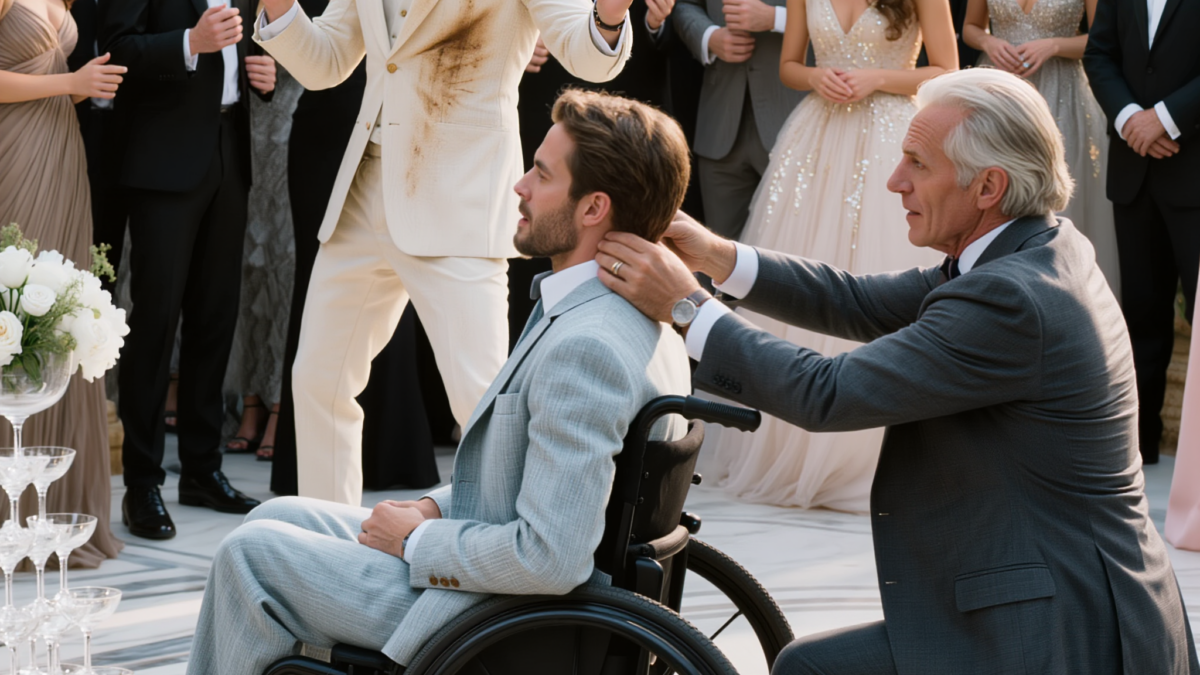
My name is Julian. I was twenty-eight years old when my older brother, Caleb, grabbed me by the shoulders, pulled me out of my wheelchair, and sent me crashing into a $10,000 crystal champagne tower.
I landed on the marble floor, surrounded by broken glass, unable to move my paralyzed legs. My face and hands were bleeding, and pain shot through my shoulder. Instead of helping me, my parents told two hundred wealthy guests that I was faking my spinal injury for attention.
They called me bitter and jealous, claiming I wanted to ruin my brother’s perfect engagement party.
But there was something they didn’t know.
The distinguished older gentleman who dropped his drink and rushed to support my head and neck wasn’t an ordinary wedding guest. He knew something about my medical history that Caleb had spent two years trying to conceal.
Before the afternoon ended, my brother would be in handcuffs, and my parents would be desperately trying to protect him from the consequences.
To understand how we reached that moment, I have to explain what happened before the champagne tower collapsed.
The sound of a $200 bottle of Dom Pérignon shattering against the marble didn’t frighten me nearly as much as the expression on Caleb’s face.
I had known his temper my entire life. I knew how he behaved when someone questioned his authority, especially in public. Everything about him was carefully managed, from his designer suits to his professional reputation.
But I had never seen him look at me with such hatred.
He stood over me, his custom-tailored ivory suit soaked with champagne, screaming that my black wheelchair had ruined the appearance of his engagement party.
What happened wasn’t an accident.
He had deliberately grabbed my jacket, pulled me from my chair, and caused me to fall toward the elaborate pyramid of crystal glasses standing in the center of the garden.
The display was seven levels high, glittering beneath the afternoon sun. Hundreds of glasses had been arranged with extraordinary precision, filled with expensive champagne and surrounded by imported white roses.
Because of my complete T10 spinal cord injury, I had no voluntary movement in my legs and severely limited trunk stability. I couldn’t step backward or position my feet to protect myself.
I fell forward, my upper body crashing through the crystal display.
Glass broke around me. Champagne spilled across the polished marble. I raised my arms instinctively to shield my face, but fragments still cut my hands and skin. A heavy bottle struck my shoulder before rolling away.
The impact left me breathless.
I tried to reposition myself, but the floor was slippery, and broken glass surrounded me. Every movement hurt.
The entire garden went silent.
The string quartet beside the fountain stopped playing. Conversations among wealthy investors, executives, and socialites faded. All I could hear was champagne dripping from the edge of a table and my own uneven breathing.
Then Caleb began shouting.
He didn’t ask whether I was injured. He didn’t call for an ambulance.
Instead, he pointed at me and announced that I had thrown myself into the champagne tower on purpose.
He told his fiancée, Khloe, and her family that I was an attention-seeking fraud. According to him, my wheelchair was merely a prop I used to gain sympathy and manipulate our parents.
My mother and father stood behind him, nodding in agreement.
I lay there staring at the pastel flowers climbing the estate’s white columns, wondering how the people who raised me could watch their injured son on the floor without showing the slightest concern.
For two years, I had fought to recover some independence. I had endured surgery, rehabilitation, painful nights, and the loss of the career I loved.
And now my family was using my disability to humiliate me in front of strangers.
But Caleb was so focused on defending his reputation that he failed to notice the older man approaching through the crowd.
The gentleman knelt beside me without concern for his expensive suit. His hands moved with the calm precision of someone experienced in emergency medicine.
He carefully supported my head and told me not to move.
Caleb didn’t recognize the danger his own lies had created.
He had no idea that the man kneeling beside me possessed the knowledge needed to expose him.
And the truth began two years earlier, on a dark, rainy night.
Back then, I was twenty-six and working as a junior architect at a prestigious commercial design firm in New York.
I had recently secured the position after years of studying and building my portfolio. The salary was excellent, and I was gaining experience on projects I had once only dreamed of joining.
I loved my work.
I spent my days developing blueprints, reviewing construction plans, meeting engineers, and imagining buildings that would one day become part of the city skyline.
I was saving to buy my first home.
Caleb, four years older than me, worked in luxury commercial real estate. He was handsome, charismatic, and ambitious. He managed multimillion-dollar property transactions and spent much of his time socializing with the city’s wealthy investors.
To our parents, he was the perfect son.
Every commission was celebrated. Every promotion was treated as a family achievement.
Caleb knew how to impress people, but he was also reckless. He took shortcuts, ignored warnings, and expected others to deal with the consequences.
The night of my firm’s annual gala, he insisted on driving me in his new Porsche 911.
The expensive sports car had been purchased almost entirely on credit. Caleb believed arriving in a luxury vehicle would strengthen his image among potential clients.
He was pursuing a senior partnership at his brokerage and wanted everyone to see him as successful.
It was raining heavily that evening.
Water covered sections of the asphalt, and visibility was poor. The windshield wipers struggled against the downpour.
Caleb was arguing with his girlfriend through text messages while driving.
I remember the blue light of his phone illuminating his face. His jaw was clenched, and he kept looking down at the screen.
Meanwhile, the speedometer climbed well above the posted limit.
I gripped the passenger-side door handle.
“Caleb, put the phone down,” I told him. “The roads are terrible.”
He ignored me.
“You can barely see ahead. Pull over if you need to answer her.”
“Relax, Julian. I’ve got it under control.”
“You’re driving too fast.”
“This car handles perfectly. Stop being so nervous.”
I looked through the windshield at the rain.
“Please, just slow down.”
He shook his head.
“You’re ruining my mood.”
Those were the last words I remembered before the crash.
Caleb entered a sharp curve too quickly while looking at his phone.
The rear tires lost traction on standing water, and the Porsche began sliding sideways.
He tried to correct the steering, but the car continued toward the shoulder.
An enormous oak tree appeared in our headlights.
Then came the deafening sound of crushing metal, the deployment of the airbags, and the smell of burning rubber.
Everything went dark.
When I regained consciousness, I was lying in a hospital room.
A heart monitor beeped beside my bed. The air smelled of antiseptic, and bright fluorescent lights illuminated the white ceiling.
I tried to sit up but immediately felt pain in my back.
Then I tried to move my legs.
Nothing happened.
I concentrated on moving my toes, something I had done without thinking for twenty-six years.
Still nothing.
Panic tightened my throat.
My parents were standing near the foot of the bed, but they didn’t rush forward when they saw I was awake.
Instead, they exchanged nervous glances.
My mother approached and gripped my hand.
“Julian, honey, you need to listen carefully.”
I stared at her.
“The police are waiting outside. They need a statement about the crash.”
“Where’s Caleb?” I whispered.
“He’s fine. But he’s facing serious trouble.”
She glanced toward the door.
“The police found his phone on the driver’s side. They checked the messages and know he was texting around the time of the collision.”
I struggled to concentrate through the medication.
My mother continued.
“If he’s charged with reckless driving, he could lose his real estate license. His promotion would disappear. His entire career could be ruined.”
I looked down toward the blanket covering my legs.
“Mom, I can’t move.”
She barely acknowledged what I’d said.
“The doctors are treating you, sweetheart. But we need to think about your brother’s future.”
My father stepped closer.
“Julian, listen to your mother.”
He spoke slowly, as though explaining a complicated business transaction.
“You have a clean record. You weren’t driving. If you tell the police you grabbed the steering wheel during an argument, they’ll have a different explanation for the crash.”
I stared at him.
“What?”
“You can say you’d been drinking and became upset. Caleb would still have to answer questions, but it could reduce his legal trouble.”
“But that never happened.”
“We’ll hire the best attorney available,” my father said. “We’ll take care of the expenses.”
He leaned toward me.
“You’re an architect. Your career doesn’t depend on a real estate license or the kind of reputation Caleb needs.”
I couldn’t believe what I was hearing.
I had awakened from a serious crash, unable to move my legs, and my parents were asking me to accept responsibility for my brother’s dangerous driving.
“No,” I said weakly.
My mother squeezed my hand.
“Julian, please.”
“I’m not lying to the police.”
Then Aunt Patricia arrived.
She was my father’s sister and the most skillful manipulator in our family. She rarely raised her voice. Instead, she spoke in a gentle, reasonable tone that made disagreement seem selfish.
She sat beside my hospital bed for hours.
First, she reminded me how much my parents had supposedly sacrificed to pay for my architecture education.
Then she mentioned the inheritance my grandparents had left the family.
She hinted that if I allowed Caleb to face criminal charges and created a public scandal, I might be excluded from future financial support.
My parents reinforced her warning.
They reminded me that rehabilitation would be expensive. I might need specialized equipment, accessible housing, and long-term assistance.
Without their help, they said, I could face enormous medical debt.
I was frightened and exhausted.
The medication made it difficult to concentrate, and I still didn’t fully understand the extent of my injuries.
Patricia stroked my forehead.
“Family protects family, Julian.”
She continued softly.
“Caleb needs his mobility and reputation to show expensive properties. You can still work from a desk. Be a good brother.”
I wanted to believe they were asking because they loved both of us.
I wanted to believe they would support me afterward, exactly as they promised.
Eventually, overwhelmed by pain, fear, and pressure, I agreed.
When the police took my statement, I repeated the story my family had prepared.
I claimed I had interfered with the steering wheel during an argument.
I accepted blame for something I hadn’t done.
I damaged my own reputation to protect Caleb’s.
Shortly afterward, the neurosurgeon who had operated on me explained the full extent of my injuries.
He was a distinguished older physician who had led an eight-hour emergency procedure to stabilize my damaged spine.
He stood beside my bed holding my medical chart.
“Julian, you sustained a complete spinal cord injury at the T10 level.”
He carefully explained what the diagnosis meant.
My spinal cord had suffered severe damage. The surgery had stabilized my spine, but it couldn’t reverse the neurological injury.
He told me I should prepare for permanent paralysis of my legs.
“Will I ever walk again?” I asked.
He was quiet for a moment.
“Based on your injury, we don’t expect you to regain normal walking function.”
I stared at the ceiling.
My entire future had changed.
I thought Caleb would visit and thank me for protecting him.
I thought my parents would honor their promise to support my rehabilitation.
Neither happened.
Once Caleb’s immediate legal trouble disappeared, so did their gratitude.
Within six months, my family had completely rewritten the story.
I was no longer the younger brother who had accepted blame to protect Caleb.
According to them, I was a reckless young man who had been drinking, grabbed the steering wheel, and nearly killed us both.
They repeated that version to relatives, neighbors, and business acquaintances until they seemed to believe it themselves.
My parents began treating me as a burden.
Eventually, they pressured me to move out.
I rented a cheap apartment on the outskirts of the city. It was barely accessible, with narrow spaces and fixtures that made ordinary tasks difficult from a wheelchair.
I tried to keep my architecture job, but the exhausting commute, inaccessible facilities, and physical demands of recovery became too much.
Eventually, I lost the position.
I started accepting low-paying freelance drafting assignments online to cover rent, groceries, and medical supplies.
Some nights, I worked until three in the morning correcting floor plans and preparing architectural drawings.
My parents didn’t contribute toward my outstanding medical bills.
Instead, they told me I needed to accept responsibility for my choices.
Every disability payment and freelance check went toward surviving another month.
I sometimes struggled to afford medication and utilities at the same time.
For eighteen months, I saved whatever money I could toward a better wheelchair.
Eventually, I accumulated $5,000.
I bought an ultralight carbon-fiber chair weighing approximately eighteen pounds, with a sleek matte-black frame and a design suited to my mobility needs.
It gave me back a measure of independence.
I could navigate tight spaces more easily and move around without constantly asking strangers for assistance.
During that difficult period, the person who helped me most was Elena, my physical therapist.
She was compassionate, determined, and direct.
She taught me how to transfer safely, manage daily activities, strengthen my upper body, and adapt to the changes in my mobility.
She also recognized the anxiety, nerve pain, and exhaustion that accompanied my recovery.
Elena listened when I talked about my family’s treatment of me.
She never dismissed my experience or treated my wheelchair as something shameful.
She reminded me that my professional abilities and personal worth hadn’t disappeared because I could no longer walk.
Over time, she became the person I trusted most.
Meanwhile, Caleb was thriving.
He received his coveted promotion to senior partner.
He began dating Khloe, the daughter of a billionaire commercial real estate developer.
Soon, his social media accounts were filled with photographs from luxury yachts, private aircraft, and expensive vacations.
He seemed to be living the life he had always wanted.
While he celebrated his success, I sat in my apartment calculating whether I could afford my monthly prescriptions.
Then a formal invitation arrived in the mail.
It was printed on thick cream-colored cardstock, with gold lettering and elaborate calligraphy.
Caleb and Khloe were hosting a lavish engagement celebration at the Magnolia Springs Botanical Garden.
The dress code was strictly pastel.
Spring pink, mint green, pale blue, and cream.
No exceptions.
Elena noticed the invitation on my kitchen counter.
“You’re not seriously going, are you?”
I adjusted one of the wheels on my chair.
“I think I have to.”
“Julian, they’ve treated you terribly. You don’t owe them anything.”
“I know. But if I don’t show up, they’ll tell everyone I’m jealous and holding a grudge.”
I looked at the invitation.
“I just want to congratulate Caleb, give him his gift, and leave quietly.”
Elena sighed.
“Promise you’ll leave if they start treating you badly.”
“I promise.”
I genuinely believed I could attend the party without becoming involved in another family argument.
I thought I could blend into the background.
I thought the worst of my family’s betrayal was already behind me.
I was wrong.
The wrought-iron gates of Magnolia Springs opened onto an estate decorated with an almost unbelievable display of wealth.
The engagement party wasn’t simply a celebration. It was a carefully organized networking event designed to connect Caleb with Khloe’s influential family and their business associates.
Imported white roses covered the garden arches. A string quartet played beside an ornate marble fountain. Servers carried silver trays of caviar and vintage champagne.
Every detail followed the pastel color scheme.
I arrived wearing a pale blue linen suit I’d found on a department store clearance rack. It was the only suitable pastel outfit I owned, and I’d made sure it fit comfortably while seated.
My wheelchair, however, was matte black.
Against the sea of cream, mint, and blush pink, it stood out immediately.
I guided myself up the temporary accessible ramp and searched the crowd for Caleb.
He stood beside the towering champagne display, laughing with several wealthy businessmen.
His ivory suit looked extraordinarily expensive.
Khloe stood next to him in an elegant designer gown, smiling for photographs and greeting guests.
I took a steady breath and approached.
Despite everything, Caleb was still my older brother.
I wanted to believe we could share one peaceful moment.
“Caleb. Khloe.”
They turned.
“Congratulations to both of you,” I said. “It’s a beautiful party.”
Caleb’s smile disappeared when he recognized me.
He looked at my face, then at my wheelchair.
“Julian. You actually came.”
“I said I would.”
“I honestly didn’t think you’d bother leaving your apartment.”
I ignored the remark and reached into my jacket pocket.
“I brought you something.”
I handed him a small velvet box.
Inside was a vintage silver money clip engraved with our original family crest.
I’d discovered it at an estate sale and paid a specialist to restore it.
The crest reminded me of our grandfather, and I thought Caleb might appreciate having something connected to our family history.
I’d taken three additional freelance drafting assignments to afford the gift.
Caleb opened the box.
His expression twisted into a sneer.
“A used money clip? Seriously?”
“It’s vintage,” I explained. “The crest belonged to our family.”
“I don’t carry cash, Julian.”
“I know, but I thought—”
“And it looks old. It doesn’t exactly match the luxury image we’re going for.”
He closed the box and tossed it onto a nearby cocktail table beside a used napkin.
“Keep it.”
I stared at him.
Khloe offered an uncomfortable smile and looked away.
“Anyway,” Caleb continued, “we have important guests to entertain.”
He gestured toward my wheelchair.
“Try not to run over anyone’s feet with that thing.”
Then he turned his back.
I sat there for a moment, struggling to understand how a simple attempt at kindness had become another humiliation.
I retrieved the box and returned it to my pocket.
As I moved away, I noticed Caleb speaking quietly to Khloe’s parents.
He pointed subtly in my direction.
Khloe’s mother turned and looked at me with an expression of suspicion and distaste.
I later learned what Caleb had told her.
He claimed I had a psychiatric disorder that caused me to exaggerate or fabricate medical problems.
He said my spinal injury wasn’t permanent and that specialists believed I could walk if I wanted to.
According to him, I refused to cooperate with physical therapy because I enjoyed receiving sympathy and disability benefits.
None of it was true.
But he described me so confidently that Khloe’s family had no obvious reason to question him.
He portrayed me as a manipulative younger brother trying to embarrass him on an important day.
I moved toward a shaded corner near the rose bushes.
My hands were shaking.
I wanted to call an accessible car service and leave.
Before I could reach my phone, my parents approached.
My mother wore an expensive pastel dress, her expression tight with irritation.
“Julian, what are you doing over here?”
“I’m getting ready to leave.”
“Why are you sitting in the corner looking miserable?”
“I’m not.”
She crossed her arms.
“You’re making people uncomfortable.”
I stared at her.
“Caleb just threw my gift away. Now he’s telling his future in-laws I’m faking my paralysis.”
My father scoffed.
“Oh, for heaven’s sake. Stop being so dramatic.”
I looked at him.
“Did you hear what I said?”
“Your brother is under tremendous pressure. This marriage is extremely important for his career.”
“And that makes it okay to treat me like this?”
My father glanced at my chair.
“Frankly, showing up in that depressing black contraption isn’t helping.”
For a moment, I thought I’d misunderstood him.
“What?”
“The photographs are supposed to be coordinated. Couldn’t you have covered it with white fabric or something?”
My mother nodded.
“Even a ribbon around the frame would have helped.”
I looked down at the wheelchair I’d worked so hard to purchase.
They were completely serious.
My essential mobility equipment was an inconvenience to their decorative arrangements.
“It’s a wheelchair, Dad. Not a decoration.”
He frowned.
“Don’t take that tone.”
“I’m not changing it to match a party.”
My mother sighed.
“You always have to make everything about yourself.”
Before I could respond, my older cousin Marcus approached.
He was holding a crystal glass of bourbon.
Marcus worked as a junior real estate agent at Caleb’s brokerage. He often presented himself as the reasonable family member who understood my situation.
“Uncle Richard, Aunt Eleanor,” he said smoothly. “Give Julian a break.”
He placed a hand on my shoulder.
“He’s doing his best. It’s not easy being in his position.”
My parents exchanged irritated looks.
My father muttered something about ungrateful children.
Then they returned to the main gathering.
I let out a long breath.
“Thanks, Marcus.”
“Don’t mention it.”
I rubbed my temples.
“I don’t know how much more of this I can handle.”
Marcus pulled a chair closer.
“Caleb’s been pretty awful today.”
“He’s acting like I’m an embarrassment just because I use a wheelchair.”
“I know. It’s completely unfair.”
He leaned toward me.
“Tell me how you really feel.”
I hesitated.
Marcus had always seemed sympathetic, and I desperately needed someone to listen.
So I told him.
I explained how furious I was that Caleb had used my injuries to make himself look like the responsible brother.
I talked about losing my job, struggling with bills, and watching him enjoy the career I had protected with my false statement.
Marcus nodded.
“How does it feel seeing him act like a king after everything he’s done?”
I looked across the garden.
Caleb was laughing with Khloe’s wealthy relatives.
“Sometimes I wish he’d lose everything,” I admitted.
Marcus lowered his voice.
“His job?”
“His job, his money, his promotion. I wish he understood what it’s like to lose the future you worked for.”
I shook my head.
“I just want him to face consequences for once.”
Marcus nodded sympathetically.
“Go on. Get it off your chest.”
I continued talking.
I said things I would never ordinarily say in public, expressing years of anger and frustration.
I wasn’t threatening to hurt anyone. I was venting about the damage my brother had caused.
But I didn’t realize Marcus had placed his smartphone against his knee.
Its audio recorder was running.
He was secretly capturing my words.
Marcus wasn’t protecting me.
He was gathering material for Caleb.
At the brokerage, Marcus wanted a management promotion and believed helping Caleb would improve his chances.
A recording of me speaking angrily about my brother could be presented without context to make me appear unstable and resentful.
It was exactly what Caleb needed to support his lies.
When Marcus finished listening, he gave me another reassuring pat on the shoulder.
“Hang in there, Julian.”
Then he walked away.
I remained near the roses, unaware that he’d recorded our conversation.
I felt surrounded by people who valued money, reputation, and professional connections more than honesty.
I decided I would endure the remaining family photographs and go home.
After that, I wouldn’t attend another gathering simply because my parents demanded it.
Unfortunately, Caleb wasn’t willing to let the afternoon end quietly.
About an hour into the reception, the sun began lowering behind the trees.
A photographer struck a spoon against a crystal glass to get everyone’s attention.
“All right! We need the immediate family for the formal portraits.”
Assistants began organizing guests along the broad marble staircase.
Khloe’s family arranged themselves on one side, the men in expensive suits and the women in elegant gowns.
My parents took their places on the opposite side.
Caleb stood in the center beside Khloe, smiling confidently.
I moved my wheelchair toward the far edge of the group.
I left enough space to avoid interfering with the guests’ clothing and positioned myself where the photographer could include me without changing the arrangement.
I wanted to be as unobtrusive as possible.
The photographer lifted his camera.
Then Caleb noticed me.
“No. Absolutely not.”
Everyone turned.
I looked up.
“What’s wrong?”
Caleb pointed toward a wooden banquet chair near the staircase.
“Julian, get out of that wheelchair.”
I stared at him.
“What?”
“Sit in the wooden chair. I want everyone at a uniform height.”
The chair had a polished wooden frame, a slippery silk cushion, and no armrests.
It offered none of the support my body required.
Because of my complete T10 spinal cord injury, my trunk stability was severely limited. Sitting safely in an ordinary decorative chair without appropriate support would be extremely difficult.
My wheelchair had been carefully fitted to provide the stability I needed.
The banquet chair hadn’t.
“Caleb, I can’t sit there safely.”
He rolled his eyes.
“Just do it for the photograph.”
“I don’t have the balance to sit in that chair. I could fall.”
The nearby conversations stopped.
Dozens of guests turned toward us.
Caleb pointed at my wheelchair.
“I don’t want that ugly black thing ruining the engagement announcement pictures.”
I felt my face grow hot.
“It’s my wheelchair.”
“You’re always making excuses.”
My mother leaned toward me.
“Julian, stop being difficult.”
“Mom, I physically can’t do it.”
“It’s five minutes.”
“That doesn’t change anything.”
She glanced nervously toward Khloe’s parents.
“Stop making everything about your limitations.”
I looked directly at Caleb.
“I’m staying in my chair.”
His expression hardened.
“If you don’t want it in the picture, that’s fine,” I continued. “I’ll move out of the frame.”
I reached for the hand rims.
“You can take the family photograph without me.”
It was a reasonable solution.
I wasn’t demanding special treatment or asking anyone to rearrange the group.
I was simply refusing to put myself in an unsafe position.
But Caleb interpreted my refusal as a public challenge.
He had given an order in front of Khloe’s wealthy family.
And I hadn’t obeyed.
His face turned red.
He glanced toward the watching guests, then strode toward me.
His expensive leather shoes struck the marble sharply.
“You selfish little manipulator,” he hissed, bending close to my face.
I held his gaze.
“Move away, Caleb.”
“You’re jealous of me. You couldn’t make it as an architect, and now you want to drag everyone else down.”
“That’s enough.”
He ignored me.
“Stand up.”
I stared at him.
“You know I can’t.”
“Stop pretending. Get up.”
The words were so absurd that I struggled to respond.
Caleb knew my medical history. He knew about the surgery, the rehabilitation, and the permanent damage to my spinal cord.
He knew I couldn’t stand.
But he was so angry that none of it seemed to matter.
“I’m leaving,” I said.
I began moving backward.
He lunged.
Before I could react, Caleb grabbed me beneath the arms, his fingers digging painfully into my sides through the linen jacket.
“Caleb, stop!”
He pulled upward.
My body shifted forward, and my hips lifted from the wheelchair seat.
I tried to reach for the arm support, but the movement was too sudden.
My legs couldn’t stabilize me.
“Put me down!”
He kept pulling.
For a terrifying moment, I was suspended above the chair with nothing supporting my lower body.
I reached backward, trying to find something to hold.
My wheelchair rolled slightly away.
Caleb stepped backward to gain leverage.
His heel caught against the chair’s rear anti-tip wheel.
He stumbled.
To keep himself from falling, he released me.
Caleb recovered his balance.
I couldn’t.
The momentum of his movement carried me forward.
My hands reached through empty air.
I saw the marble staircase, the blue afternoon sky, and the glittering champagne tower directly in front of me.
Then I struck the crystal.
The crashing sound filled the garden.
Hundreds of glasses collapsed around me, and champagne poured across the marble.
I raised my arms to protect my face, but fragments cut my hands and skin.
A heavy bottle fell from the display and struck my shoulder.
Then I hit the floor.
The impact knocked the breath from my lungs.
For several moments, I could barely understand what had happened.
My face stung, my shoulder throbbed, and broken crystal surrounded me.
I tried to turn, but the champagne made the marble slippery.
Guests began shouting.
The string quartet stopped.
The photographer lowered his camera.
And Caleb stepped toward me.
He stood over my injured body, adjusting the sleeves of his ruined ivory suit.
Then he began shouting.
“Look what he did!”
I looked up at him.
“He threw himself into it! I told you he’d try something like this!”
I couldn’t believe what I was hearing.
He had grabbed me, pulled me out of my chair, and caused me to fall.
But in front of everyone, he was claiming I had done it deliberately.
“He’s been faking this whole thing for two years!” Caleb declared.
He gestured toward the wheelchair.
“That chair is just how he gets people to feel sorry for him.”
My mother stepped forward.
She placed a comforting hand on Caleb’s shoulder.
“Please understand,” she told the guests. “We’ve been trying to get Julian help for a long time.”
Her voice trembled with practiced sadness.
“It’s been terribly difficult for the whole family.”
My father nodded.
“Caleb has been very patient with him.”
I lay on the cold marble, listening to them repeat the same lies they had used since the car accident.
I wanted to explain what had happened.
I wanted to tell everyone that my brother had caused both incidents.
But my breathing was uneven, and moving made the pain worse.
I felt trapped.
Two hundred people stood around us, yet my family was still trying to convince them that I was the problem.
Then a voice interrupted.
“Step away from him.”
The command was firm and unmistakably authoritative.
“Do not touch him.”
A distinguished older gentleman in a charcoal suit pushed through the crowd.
His silver hair was neatly combed, and his expression was focused.
People moved aside as he approached.
He knelt beside me, carefully avoiding the larger pieces of glass.
Without hesitation, he positioned his hands along the sides of my head, supporting my neck and limiting unnecessary movement.
“Can you hear me?” he asked.
I blinked.
“Good. Don’t try to sit up.”
He watched my breathing.
“We’re going to wait for the paramedics.”
I felt an overwhelming sense of relief.
Someone was finally treating me as an injured human being instead of an embarrassing inconvenience.
Caleb stepped forward.
“Excuse me, sir.”
The gentleman kept his attention on me.
“Please step back.”
“He’s my younger brother,” Caleb said. “I know exactly what he’s doing.”
The man didn’t respond.
Caleb continued.
“He’s completely faking it. If you stop encouraging him, he’ll stand right up.”
The older gentleman finished checking my pulse.
Then he slowly looked up.
“You’re telling me this man is pretending to have a spinal cord injury?”
“Exactly,” Caleb replied.
“Despite the loss of voluntary movement in his lower extremities?”
“It’s psychological. He just wants attention.”
The gentleman studied him.
“And a qualified physician has told you that?”
Caleb hesitated.
“Well, my family knows his history.”
My mother nodded.
“We’ve spoken to people about his behavior.”
The man looked at her.
“Which doctors?”
She didn’t answer.
Caleb lifted his chin.
“Look, I don’t have to explain our private medical issues to a stranger.”
At that moment, Khloe pushed through the crowd.
She looked pale and frightened.
“Uncle Victor?”
The older gentleman turned slightly.
“Khloe.”
“What are you doing?” she asked. “Caleb says Julian isn’t really paralyzed.”
The man looked from his niece to Caleb.
Then he spoke.
“My name is Dr. Victor Sterling.”
A murmur moved through the guests.
“I am the chief of neurosurgery at Mount Sinai Hospital.”
Caleb’s expression changed.
Dr. Sterling continued.
“Two years ago, I performed emergency surgery on a young man who sustained a devastating spinal cord injury in a high-speed automobile collision.”
My heart began pounding.
I recognized his voice.
He was the surgeon who had operated on me.
The physician who had explained my diagnosis.
The man who had told me I would likely spend the rest of my life using a wheelchair.
Dr. Sterling looked down at me.
“That patient was Julian Wells.”
My mother’s hand flew toward her mouth.
Caleb stood motionless.
The surgeon turned back toward them.
“I personally supervised the eight-hour procedure to stabilize his damaged spine. I reviewed the neurological findings, examined the scans, and discussed the diagnosis with his rehabilitation team.”
His voice remained calm.
“Your brother has a documented complete T10 spinal cord injury.”
The entire garden fell silent.
“I was the doctor who told Julian that we did not expect him to regain normal walking function.”
Caleb opened his mouth but couldn’t immediately respond.
Dr. Sterling’s expression hardened.
“So I find it remarkable that you continue to describe his disability as a performance.”
He glanced toward my parents.
“The fact that you dislike the appearance of his wheelchair does not change his diagnosis.”
Caleb swallowed.
“But he—”
“Your brother’s condition is real,” Dr. Sterling interrupted. “And removing him from his wheelchair against his will exposed him to serious harm.”
My brother looked around desperately.
No one offered to defend him.
The man whose approval mattered enormously to Khloe’s family had just dismantled Caleb’s central lie.
For two years, my relatives had repeatedly claimed that I was exaggerating my injury.
Now, in front of two hundred witnesses, the surgeon who had treated me confirmed exactly what they had denied.
I remained on the floor, still injured and frightened.
But for the first time in a very long time, I felt that someone with the authority to challenge my family was finally telling the truth.
And the consequences were beginning to unfold.
The aftermath of Dr. Sterling’s revelation was chaotic.
Sirens sounded beyond the garden gates, growing louder as emergency vehicles approached the estate.
Caleb seemed to realize that the afternoon was slipping beyond his control.
He turned toward Khloe and reached for her hands.
“Khloe, baby, listen to me.”
She stepped back.
“Your uncle doesn’t know the whole story,” Caleb insisted. “Julian caused the car accident two years ago. My parents can confirm it.”
Khloe stared at him.
“And today?”
“I was just helping him into a chair. He slipped.”
She looked down at my injured body, then toward her uncle.
Dr. Sterling gave her a grim look.
“Don’t touch me, Caleb,” Khloe whispered.
He stopped.
She reached for her engagement ring, a large custom-designed diamond Caleb had proudly shown off to everyone.
She removed it and threw it toward him.
The ring struck his chest and fell among the broken crystal.
“We’re done,” she said. “Don’t contact me or my family again.”
Caleb stared at the ring.
His engagement was over.
The wealthy connections he’d hoped to gain through Khloe’s family were disappearing in front of everyone.
Before he could respond, two police officers entered through the garden gates, followed by paramedics.
Dr. Sterling immediately briefed the medical team, explaining my surgical history and the possibility of additional spinal injuries.
The paramedics carefully assessed me, fitted a cervical collar, and prepared to transfer me onto a stretcher.
One officer approached the crowd.
“Who called 911? What happened here?”
My father stepped forward.
“Officer, it’s a family misunderstanding.”
I looked toward him.
“My youngest son lost his balance and fell into the champagne display. It was an unfortunate accident.”
The officer frowned.
“Did anyone else touch him?”
My father hesitated.
“It’s a private family matter. We can handle it ourselves.”
“That’s not what happened.”
A tall man emerged from the crowd.
It was Sebastian, Khloe’s older brother and the chief operating officer of her family’s enormous real estate development company.
Sebastian rarely raised his voice, but he looked furious.
He approached the officer.
“I was standing less than ten feet away. I watched Caleb grab Julian and pull him out of his wheelchair.”
Caleb shook his head.
“That’s not true.”
Sebastian ignored him.
“Julian repeatedly explained that he couldn’t safely sit in the wooden chair. Caleb became angry, pulled him upward, then released him when he stumbled.”
The officer listened carefully.
Sebastian pointed toward the champagne display.
“Julian fell into that tower because of what Caleb did.”
My father tried to interrupt.
Sebastian turned toward him.
“And I won’t let anyone describe it as an accident that happened without interference.”
He looked back at the officer.
“I’ll provide a formal statement. There’s also security footage.”
Caleb’s face changed.
“What footage?”
Sebastian gestured toward the cameras mounted around the estate.
“Our company arranged the security system for this event. The terrace and staircase were being recorded.”
Caleb stared at the nearest camera.
For the first time, he seemed to understand that his explanation could be checked against physical evidence.
The police questioned several witnesses.
Their accounts supported Sebastian’s description.
One officer approached Caleb and asked him to step aside.
Caleb attempted a confident smile.
“Of course, Officer. I’m happy to explain.”
But the officer had already heard enough to establish grounds for an arrest.
“Caleb Wells, place your hands behind your back.”
My brother froze.
“Wait. What?”
“You’re under arrest in connection with the assault on your brother.”
The officer secured his wrists with handcuffs.
My mother cried out.
“No! You can’t take him!”
She rushed toward the officers.
“He’s a senior real estate broker! He has a clean record! You’re destroying his life!”
The officer instructed her to step back.
My father stood motionless.
Caleb looked toward him.
“Dad, do something!”
But there was nothing my father could do.
The security cameras had recorded the incident, and multiple guests had witnessed it.
I was loaded into the ambulance while Dr. Sterling continued speaking with the paramedics.
Through the open doors, I saw my mother pleading with the officers and my father standing silently beside the ruined champagne display.
Caleb was being escorted away.
The family that had spent two years protecting his reputation could no longer control the story.
Two hours later, I was lying in a private recovery room at Mount Sinai Hospital.
Dr. Sterling had arranged for my medical history to be reviewed and for my visitor access to be restricted.
My cuts had been cleaned and stitched. My shoulder was badly bruised but fortunately unbroken.
The CT scans confirmed that the hardware from my original spinal surgery remained intact.
There was no obvious new structural damage.
I was exhausted, still receiving medication for pain, when the door opened.
My parents entered.
Their expensive clothing was wrinkled, and both looked pale and frightened.
For one moment, I wondered whether they had finally come to apologize.
My father approached the bed.
“Julian, you have to fix this.”
I stared at him.
“Caleb is sitting in a holding cell. They’re talking about felony charges.”
My mother moved closer.
“The scandal is already spreading. If he’s convicted, he could lose his license and his career.”
Neither asked how I was feeling.
Neither apologized.
My father lowered his voice.
“You need to tell the police Sebastian misunderstood what happened.”
I looked at him.
“What?”
“Say you lost your balance. Explain that you and Caleb were arguing and things got out of hand.”
My mother nodded.
“You can say it was a misunderstanding. Family protects family, Julian.”
Those words again.
The same words they’d used two years earlier when they pressured me into accepting blame for the crash.
I looked at the bandages covering my hands.
For years, I had hoped my parents would eventually recognize what they had done.
But even now, after watching Caleb hurt me in public, they cared more about his future than my safety.
“Get out,” I said.
My father frowned.
“Julian, don’t be stubborn.”
“I said get out.”
“We’re trying to save your brother.”
“I know.”
He stared at me.
“And that’s all you’ve ever cared about.”
My mother began crying.
I continued.
“I’m not changing my statement. Caleb made his choice. You made yours two years ago when you forced me to lie about the accident.”
My voice remained steady.
“I’m finished protecting him.”
My father opened his mouth to argue.
Before he could speak, the door opened again.
A tall woman in a dark professional suit entered carrying a leather briefcase.
Her expression was composed and serious.
“Mr. and Mrs. Wells?”
My parents turned.
“I’m Samantha Hayes, Julian’s attorney.”
Dr. Sterling had helped me contact her earlier that evening.
Samantha specialized in personal injury cases and had already begun reviewing the circumstances of the assault.
My father looked irritated.
“Attorney? What attorney?”
Samantha handed him her business card.
“I’m representing Julian in connection with today’s incident.”
She glanced toward me.
“Julian, would you like your parents to leave?”
“Yes.”
She nodded and turned toward them.
“Then I suggest you respect his decision. Continuing to pressure him to alter his statement could create additional legal problems.”
My father crossed his arms.
“This is a private family issue.”
“Your son is an adult. He has the right to legal representation and to decide who visits him.”
Samantha stepped toward the doorway.
“Hospital security can assist if necessary.”
My parents hesitated.
Then my father asked, “What happens to Caleb now?”
Samantha opened her briefcase.
“The police have eyewitness statements, medical documentation, and security footage. The district attorney’s office is reviewing serious criminal charges.”
My mother covered her mouth.
“How serious?”
“His exposure could be substantial. Depending on the final charges and any conviction, he could face a lengthy prison sentence.”
My father looked stunned.
“What about a plea agreement?”
“That will depend on the prosecutor, Caleb’s defense attorney, and ultimately the court.”
She explained that a negotiated resolution involving a lesser charge and a possible two-year sentence had been discussed as an alternative to proceeding on more serious charges.
Nothing was guaranteed.
Then she continued.
“Separately, Julian has a substantial civil claim for his injuries and related losses.”
My father frowned.
“How much?”
Samantha placed a legal folder on the table.
“We are proposing a comprehensive settlement covering his medical expenses, rehabilitation needs, damaged equipment, lost income, and the physical and emotional harm caused by the incident.”
My mother looked between us.
“Can we just pay for the hospital bills?”
“No,” Samantha replied. “The claim is considerably broader than that.”
My father pulled out his checkbook.
“Fine. Ten thousand? Twenty?”
Samantha didn’t blink.
“The proposed settlement is $420,000.”
The color drained from his face.
“Four hundred twenty thousand dollars?”
“That’s correct.”
“That’s impossible! We don’t have that kind of money sitting in a checking account.”
Samantha remained calm.
“The amount reflects the seriousness of the incident and the damages we’re documenting. You can review the proposal with your own attorney.”
My mother leaned heavily against the wall.
“You’re trying to ruin us.”
“I’m presenting a settlement proposal on behalf of my client.”
Samantha explained that any civil settlement would be handled separately from the criminal prosecution. Restitution could be documented and presented during the criminal proceedings, but it wouldn’t automatically erase the charges or guarantee a particular sentence.
My parents would need independent legal advice.
My father rubbed his forehead.
“How long do we have?”
“The current offer remains open until five o’clock Friday afternoon.”
“That’s less than two days!”
“You’re free to reject it and litigate the civil claim.”
My mother began crying.
“We’d have to use our retirement savings. We might have to sell the vacation house.”
My father said nothing.
Then she added, “We’d have to touch the inheritance money we’ve been saving for Caleb’s children.”
I watched them quietly.
For years, they’d used money as leverage.
They’d threatened to withdraw support when I refused to protect Caleb after the crash.
They’d allowed me to struggle with medical debt while preserving their expensive lifestyle.
Now they faced the possibility of using those same assets to compensate me.
I didn’t feel triumphant.
I simply understood that their priorities had finally become costly.
My father turned toward me.
“Julian, surely you don’t want to destroy your family.”
I met his eyes.
“I didn’t create this situation.”
Samantha closed the folder.
“My client needs to rest. Please leave.”
My parents walked out.
For the first time, there were no more threats or demands.
Over the next two days, Samantha kept me updated as the attorneys negotiated.
My parents scrambled to raise the money.
They arranged withdrawals from retirement accounts, accepting substantial tax consequences. They sold their beloved sailboat at a significant discount and drew heavily on funds intended for Caleb’s future inheritance.
They also arranged financing against family assets.
By Friday afternoon, the civil settlement agreement had been finalized.
At exactly 4:45 p.m., Samantha entered my hospital room carrying her tablet.
She smiled.
“The wire transfer cleared.”
I looked at the screen.
$420,000.
The money had been placed in the designated escrow account under the settlement terms, with arrangements underway to protect and disburse my funds.
For a moment, I couldn’t speak.
I’d spent two years calculating how to pay rent, buy medical supplies, and continue therapy.
Now I had resources to plan for the future.
Samantha sat beside the bed.
“Julian, this gives you financial security and choices you haven’t had for a long time.”
I closed my eyes and exhaled.
For the first time since the crash, I wasn’t afraid of what would happen if I needed another piece of medical equipment or an unexpected treatment.
Caleb’s legal consequences followed.
Because of the security footage, witness statements, and medical documentation, his attorneys advised him to accept a negotiated plea.
He pleaded guilty to a lesser offense involving reckless endangerment.
At the sentencing hearing, the judge reviewed the agreement and the evidence.
Caleb stood before the court wearing standard jail clothing, looking exhausted and frightened.
The confident real estate broker who had once dominated every family gathering was gone.
The judge sentenced him to two years in a state correctional facility.
His professional life collapsed afterward.
The state licensing authorities took disciplinary action, and Caleb lost his real estate broker’s license.
His brokerage terminated his employment.
The promotion he’d worked so hard to secure went to someone else.
Khloe had ended their engagement, and his reputation among the wealthy families he once tried to impress was ruined.
As for me, I stopped looking back.
Once I was medically cleared to leave the hospital, I used part of the settlement to pay my outstanding medical debt.
I hired a specialized moving company and left my cramped, barely accessible apartment.
Then I signed a lease on a beautiful, fully accessible apartment in the center of Manhattan.
It had wide doorways, accessible counters, a spacious bathroom, and enough room to move comfortably in my wheelchair.
For the first time since the crash, my home supported my independence instead of making every daily task difficult.
I upgraded my workstation and began exploring better professional opportunities in architecture.
But the settlement also gave me access to something I had never been able to afford.
Through Dr. Sterling’s professional network, I learned about an experimental neurorehabilitation program in Zurich, Switzerland.
The clinic was studying advanced neural interfaces, including surgically implanted devices designed to support communication between the brain and parts of the nervous system affected by spinal cord injuries.
The technology was still experimental.
There were risks.
There were no guarantees of success.
The specialists explained that even modest improvements could require years of intensive rehabilitation.
But for the first time in two years, I could consider the possibility without immediately worrying about how to pay for it.
After extensive medical evaluations, I was accepted into the program.
I booked a first-class flight, arranged accessible accommodations, and traveled to Switzerland.
As the plane lifted away from New York, I looked through the window.
Somewhere below was the city where I’d grown up, the hospital where my life had changed, and the family I’d spent years trying to please.
I didn’t know what the future held.
But it finally belonged to me.
Eighteen months passed after Caleb’s sentencing.
Today, I’m sitting in my matte-black wheelchair on a sunlit wooden boardwalk overlooking the Mediterranean Sea in southern France.
The water stretches toward the horizon in brilliant shades of blue.
Warm salt air moves across my face, and the sound of waves fills the afternoon.
For the first time in almost four years, I feel truly peaceful.
Elena is sitting beside me in a lounge chair, reading a novel and occasionally sipping iced coffee.
She joined me during my rehabilitation journey and eventually accepted a full-time role helping coordinate my therapy and daily support.
Over time, she became more than my physical therapist.
She became my chosen family.
The sister I never had.
Someone who supported me without demanding that I sacrifice my dignity in return.
My phone vibrates in the side pouch of my wheelchair.
I take it out, expecting a message from the clinic.
Instead, I see a familiar name.
Eleanor Wells.
My mother.
I’d changed my number and blocked my family’s usual email addresses after leaving the United States.
Somehow, she’d found my private medical contact address.
I hesitate before opening the message.
There’s no long explanation or demand for money.
Only a scanned handwritten letter.
The handwriting belongs to Caleb.
It’s written on inexpensive lined prison paper.
I begin reading.
He explains that he was released on parole several weeks earlier.
He doesn’t make excuses.
He writes that losing his freedom, career, and reputation forced him to confront the consequences of his behavior.
He apologizes for the car crash.
He admits he was texting while driving and ignored my warnings about the rain and road conditions.
He apologizes for allowing me to accept blame.
He apologizes for the years of lies that followed.
Then he addresses the engagement party.
He acknowledges that he knew I couldn’t safely sit in the wooden chair.
He admits he became angry because I refused to follow his instructions in front of Khloe’s family.
He accepts responsibility for pulling me out of my wheelchair and causing my fall.
He writes that he doesn’t expect forgiveness.
He simply wanted to acknowledge what he’d done.
Near the end, he describes what happened to our parents.
The financial strain of the settlement, combined with their damaged social standing and the loss of Caleb’s career, had devastated their marriage.
They were forced to sell their house.
Arguments over money became constant.
Eventually, they filed for divorce.
My father was living in a modest rental property.
My mother had lost the expensive country club lifestyle she’d valued so highly.
They were fighting over the remaining family assets.
Caleb writes that the entire family has fallen apart.
I read the letter twice.
For years, I imagined how satisfying it would feel to hear my brother finally admit the truth.
I expected anger, relief, or perhaps sadness.
But as I look at the words on the screen, I feel surprisingly little.
I no longer need his approval.
I no longer need my parents to admit they were wrong.
And I no longer believe that sharing blood means I must keep people in my life regardless of how they treat me.
They made their choices.
Those choices had consequences.
I had spent too many years carrying the weight of decisions that weren’t mine.
I close the email, delete it, and block the address.
Then I return the phone to my wheelchair pouch.
The sea glitters beneath the afternoon sun.
Elena continues reading beside me.
I look down at my legs.
For months, I’ve been participating in an experimental rehabilitation program involving an implanted neural interface and carefully supervised therapy.
The process has been exhausting.
Progress has been uncertain, and the medical team has reminded me repeatedly that no particular outcome is guaranteed.
I understand that.
But I’ve learned to appreciate small improvements instead of expecting dramatic changes.
I close my eyes and concentrate on the movement exercises I’ve practiced so many times.
I focus on my right foot.
I imagine moving my big toe.
For several seconds, nothing happens.
I try again.
Then I open my eyes.
My right big toe moves slightly.
The movement is tiny, barely noticeable.
I stare at it, wondering whether I’ve imagined it.
I concentrate again.
There’s another slight movement.
My heart begins beating faster.
It’s not proof that my injury has been reversed. The medical team will need to assess whether the movement is voluntary and reproducible.
But it’s something worth investigating.
I look toward Elena.
“Hey, Elena.”
She lowers her book.
“Yeah, Julian?”
“Can you come here?”
She moves closer, and I explain what I think I’ve seen.
She watches carefully while I repeat the exercise.
After several attempts, another small movement occurs.
Elena smiles.
“We need to tell the clinic.”
I nod.
I know this doesn’t mean I’ll suddenly stand up and walk along the beach.
Recovery from a severe spinal cord injury is complicated, and experimental treatments don’t offer guaranteed results.
But this small moment reminds me why I chose to continue exploring my options.
The settlement money didn’t give me new legs.
It didn’t erase the accident or restore the years I’d lost.
What it gave me was the freedom to make my own decisions.
I could choose where to live, which treatments to explore, and what kind of future I wanted to build.
And whether I ever regained more movement or not, my life was already meaningful.
I had work I loved, friends I trusted, and the independence I’d fought so hard to reclaim.
Elena returns to her chair.
I look out at the Mediterranean, feeling the warm breeze against my face.
For years, I’d believed that being a good son and brother meant putting my family’s needs ahead of my own.
I’d confused loyalty with obedience.
I’d believed that protecting the family meant accepting blame, remaining silent, and tolerating mistreatment.
Now I understood the difference.
Family isn’t defined only by blood.
It’s defined by respect, compassion, and the willingness to protect one another.
Elena had shown me that.
Dr. Sterling had shown me that.
The people who helped me rebuild my life had shown me that.
I no longer needed to prove my worth to Caleb or my parents.
I reached for the hand rims of my wheelchair.
“Let’s get back to the clinic,” I told Elena.
She looked surprised.
“Already? I thought you wanted another hour by the beach.”
I smiled.
“I think it’s time to push a little harder.”
She laughed and closed her book.
“All right, Julian.”
I turned toward the boardwalk leading back to the promenade.
The sun was beginning to lower over the water, casting long golden reflections across the sea.
There would still be difficult days.
There would be setbacks and disappointments, and I knew recovery would require patience.
But I wasn’t afraid of the future anymore.
I’d survived the crash, the betrayal, and the years of isolation that followed.
I’d built a life beyond the expectations of the people who once controlled it.
I looked at Elena and smiled.
“I have a lot of living left to do.”
Then I pushed my wheelchair forward, ready to discover what came next.








