Mom called me a failure and kicked me out, then gave my brother the house. Three years later, he drove past my new place and froze. He called Mom, shouting, “Mom! This house must be worth… Wait—it’s his?” What Mom did after that was the one thing I never saw coming…
I’m Alex. I’m 32, and three years ago, my own mother called me a failure at my brother’s engagement dinner. She ordered me out of my childhood home and announced that she was giving the entire house to him as a wedding gift. It was an inheritance I had always believed we would share, taken from me in a single sentence.
The day my brother later drove past my new home and froze at the gate still plays in my mind like a movie I can’t turn off. Every detail is burned into my memory.
The heavy scent of my mother’s signature roast chicken and garlic mashed potatoes filled our formal dining room in Greenwich, Connecticut. The air itself felt heavy, thick with unspoken tension that seemed to cling to the velvet drapes.
It was supposed to be a celebration. My older brother, Leo, the golden child, was getting married. His fiancée, Chloe, sat beside him, a portrait of smug perfection. Her diamond ring, a stone the size of a small bird’s egg, caught the light from the crystal chandelier every time she moved her hand.
I sat across from them, a ghost at the feast.
My mother, Eleanor, occupied the head of the table, presiding over the meal with the silent, stony judgment of a queen. The silence wasn’t peaceful. It was a weapon.
I had tried. I really had. I’d put on my best shirt, forced a smile, and attempted to bridge the chasm that had been widening between us for years.
I asked Leo about his latest promotion at the hedge fund.
“Good,” he said.
Then he turned and whispered something into Chloe’s ear that made her giggle.
I congratulated Chloe on the wedding plans.
“Thanks,” she replied with a tight, dismissive smile, her eyes already scanning the room for someone more important to speak to.
My mother hadn’t made eye contact with me since I arrived. She simply moved the food around her plate, her lips pressed into that familiar thin line of disappointment.
Finally, the suffocating silence became too much to bear. I had to try one more time to connect with them, to show them I wasn’t the dead end they believed I was.
I cleared my throat. In the stillness of the room, the sound seemed unnaturally loud.
“So, I actually have some good news.”
Nervous energy buzzed beneath my skin.
“The software I’ve been developing—the one that tracks renewable-energy use for businesses—we just landed our first real pilot program with a small grocery chain.”
There was a beat of absolute silence.
Then Leo looked up, a lazy, condescending smirk playing across his lips.
“Still playing with your little computer projects? That’s nice, Alex. Good for you.”
My mother lowered her fork onto her china plate with a sharp, definitive clink. It sounded like a judge’s gavel.
The storm had arrived.
“Nice,” she repeated, her voice dangerously low. “It isn’t nice, Leo. It’s a waste. A complete and utter waste of a life.”
She finally turned her gaze toward me. Her eyes were like chips of ice.
“I look at you, Alex, and all I see is disappointment. Your brother is a vice president. He has a future, a real salary, and a fiancée. He’s building something. And what do you have? A pilot program? You’re 32 years old, and you have nothing to show for it. No savings, no serious job—just hobbies.”
My throat felt as though it were closing.
“It’s more than a hobby, Mom. It’s my career.”
“A career?”
She released a short, bitter laugh that cut through me.
“Don’t be ridiculous. You are a failure, and I will not have a failure living under my roof and tarnishing this family’s name any longer.”
She rose from her chair, her napkin falling to the floor like a surrendered flag.
“Leo and Chloe are getting married. They need a proper home in which to begin their lives, a home that reflects their status. So I’m giving them this house as an early wedding present—an inheritance for the son who has actually made me proud.”
The words hung in the air, seeming to pull all the oxygen from the room.
I stared at Leo, searching his face for some sign of surprise or protest. There was none. I saw only a flicker of pure triumph.
He had known. This had been planned before I sat down.
I was being ambushed.
“Mom, you can’t be serious,” I whispered.
“I have never been more serious. Pack a bag. I want you out tonight.”
Just like that, 25 years of my life in that house were erased.
I stood, my chair scraping harshly across the polished hardwood floor. I didn’t shout. I didn’t plead. A strange, cold calm settled over me.
I looked at each of their faces one final time, memorizing the image of their victory. Then I turned and walked out of the dining room.
Upstairs, I entered the bedroom that had been my sanctuary and threw a few clothes into a duffel bag. Minutes later, I carried it back down the staircase.
When I reached the heavy oak front door—the same door I had raced through a thousand times as a child—I paused.
Their voices drifted in from the dining room. Conversation had already resumed as though nothing had happened.
I hadn’t been a person to them. I had been an inconvenience, and now the inconvenience was gone.
The door clicked shut behind me, the sound echoing into the cold, empty night.
It was the sound of my life breaking in two.
That night wasn’t a sudden earthquake. It was the final collapse of a structure that had been rotting from within for decades.
The signs had always been there, written in the language of birthday presents and holiday dinners, of praise and punishing silence.
Growing up in Greenwich, my mother taught us that life was a competition and that perception was reality. What mattered was having the right address, the right car, and the right kind of children.
To her, Leo was the right kind of child.
I was a flawed product, a source of constant, low-grade embarrassment.
I remember my sixteenth birthday with perfect clarity. It was a quiet Tuesday evening. My father, Richard, was still alive then, a warm, grounding presence in a house that often felt cold.
He slid a box across the dinner table.
It was an ordinary brown cardboard box, slightly battered around the edges. Inside was a used laptop. It had a few scratches on the lid, but it was a powerful machine with an impressive processor and a high-end graphics card.
“It has more RAM than you’ll know what to do with,” Dad said, his eyes sparkling with shared excitement. “You can use it to run the simulations for that energy-tracking application you’re designing. This will take it to the next level, son.”
To me, it was like being handed the keys to the universe.
My mother barely looked up from her salad.
“Another toy,” she sighed. “Richard, you indulge his fantasies. He needs to focus on his SAT preparation, not these games.”
That night, Dad and I stayed in the garage until two in the morning. It was our makeshift laboratory. A giant whiteboard covered one wall, and together we sketched complex algorithms and data-flow charts.
Dad was an engineer at heart, a man who had exchanged his passion for a lucrative but deeply unfulfilling career in finance to please my mother. He saw part of his younger self in me—the part of himself he had been forced to sacrifice.
He was the only person in the family who understood that what I was doing wasn’t a game.
“Don’t ever let anyone tell you this is a waste of time, Alex,” he said, resting one hand on my shoulder as the sharp smell of whiteboard markers filled the garage. “What you’re building is the future. They just can’t see it yet.”
Six months later, the entire house was transformed for Leo’s sixteenth birthday.
It looked like a scene from a movie. Professional caterers in white jackets hurried in and out of the kitchen. A DJ had set up beside the pool, the bass vibrating through the floorboards.
The main attraction was parked in the driveway: a brand-new cherry-red sports car, a machine of pure, unnecessary speed with a giant bow tied across its hood.
My mother stood beside it, glowing with a kind of radiant pride I had never seen directed toward me. She handed Leo the keys while relatives and family friends applauded.
Uncle Lawrence, my mother’s brother, clapped Leo on the back with a booming laugh.
“Now that is a beautiful ride. Wall Street’s future star deserves nothing less.”
I stood near the dessert table holding a paper plate, feeling like a stranger in my own family’s home.
Later that evening, as I passed the study, I overheard my mother speaking to Uncle Lawrence. The door was slightly ajar.
“Leo just understands it,” she said, her voice filled with deep, satisfied pride. “He knows how the world really works. Money, ambition, status—that’s what matters. Alex is lost in his own little world of codes and wires. It worries me.”
My uncle made a soothing sound.
“Don’t worry, Eleanor. Some kids are just late bloomers. He may come around. Though I have to say, those nerdy hobbies will never buy him a house in this neighborhood.”
Their laughter followed me down the hallway.
It wasn’t loud or openly cruel. It was worse than that. It was casual and dismissive, as though my entire identity were a mildly amusing joke.
Dad was my shield, my translator, and my advocate.
When I won first place at the regional high school science fair for a working prototype of my home energy monitor, he cheered so loudly that he embarrassed me. He took the cheap plastic trophy and certificate and had them professionally framed.
Then he hung the newspaper clipping, with its grainy photograph of me, in the center of his home-office wall.
“The world needs innovators like you, Alex,” he told me, his voice thick with an emotion that tightened my throat. “Not just another banker.”
When I showed my mother the trophy, she gave me one of her thin smiles, the kind that looked more like a grimace.
“That’s nice, dear. Just a school project, right?”
It wasn’t truly a question. It was a statement—a box she was putting me into.
It was her way of diminishing my achievement, keeping my world small while expanding Leo’s.
She couldn’t see the hours of work, the passion, or the vision. All she saw was something that didn’t come with an impressive salary or a prestigious title from a major corporation.
She saw something without value.
And whenever she looked at it, I knew she was really looking at me.
The foundation of my world didn’t merely crack. It disintegrated three weeks before my high school graduation.
It was a rainy Thursday night in May. Dad was driving home from a late meeting in Manhattan. According to the police report, a truck hydroplaned on the wet interstate.
It happened instantly.
There was a phone call from a state trooper, followed by a blur of red and blue emergency lights painting streaks across our rain-covered windows. I remember the sterile smell of the hospital waiting room.
And then he was gone.
The last real conversation I had with him took place only a few days before the accident.
He found me in the garage, hunched over my laptop and struggling to debug a piece of code that was making my head spin. He stood there for several minutes without speaking, watching me with a thoughtful, almost melancholy expression.
“You know,” he finally said, “I was like you once. I loved building things and solving complex problems. I was going to start my own software company.”
He paused, looking at the tangled lines of code on my screen.
“Then I met your mother. I went into finance. It was good money, and it gave our family a comfortable life. But part of me has always wondered what might have happened. Sometimes I feel as though I’ve been playing a role for 30 years.”
He looked directly into my eyes.
“Alex, promise me something. Whatever you do with your life, follow your heart. Build the things you want to build. Don’t chase money the way I did. The fulfillment isn’t the same. Don’t let anyone talk you out of your dreams.”
“Sure, Dad,” I mumbled. “I promise.”
At the time, I didn’t fully understand the weight of his words. They sounded like another piece of fatherly advice.
After his death, they became his final testament to me. They became a sacred vow, a legacy I had to honor.
Losing Dad wasn’t simply the loss of a parent. It was the loss of my only ally, my only defender in a family where I often felt like a foreign-exchange student.
In the suffocating haze of grief that followed, my mother’s focus sharpened. It was like a camera lens twisting until one object came into perfect clarity while everything else faded into the background.
Leo was the object.
I was the background.
“Leo needs to remain focused,” I heard her telling friends over the phone, her voice brittle and strained. “His final exams are coming up, and then he’s going to NYU. We can’t allow this tragedy to derail his future.”
A few days after the funeral, the house was oppressively quiet and filled with the scent of lilies from dozens of sympathy arrangements lining the hallway.
I found my mother in Dad’s study, speaking to an attorney about his estate, life-insurance policy, and inheritance.
I stood in the doorway like a ghost in my own home.
When she ended the call, I tried to speak to her.
“Mom, I really miss him.”
My voice broke halfway through the sentence.
She looked up, but her eyes were distant, already moving toward the next task.
“We all do, Alex. But we have to be strong. We have to be practical. I need to make sure Leo’s college fund is secure. His tuition is due in July.”
She didn’t ask how I was feeling. She didn’t offer to hug me. To her, grief was simply another problem to be managed.
The attorney came to our house several more times. I was never invited into the meetings. My mother told me I was too young to be burdened with such matters.
I was 18 and legally an adult, but in her eyes, I was still a child who couldn’t be trusted with anything important.
She and Leo would remain in the study for hours with the door closed. Only years later did I understand that she was systematically dismantling the financial protections Dad had established for both of us and redirecting everything toward her chosen son.
The newspaper clipping from my science-fair victory remained on the wall of Dad’s office for about a month. It was a small comfort, a reminder of his pride in me.
Then one day, I walked into the study and discovered that it was gone.
In its place, meticulously centered on the wall, was a framed photograph of Leo in his lacrosse uniform, holding a championship trophy.
I never asked my mother about it. I didn’t need to.
The message was perfectly clear.
My father’s legacy was over. Hers was beginning.
And in her version of the future, there was room for only one successful son.
The distance between my family and me widened into a canyon during our college years.
Leo’s path was paved in gold. He went to NYU’s prestigious Stern School of Business, and my mother paid for everything—the staggering tuition, an upscale Greenwich Village apartment nicer than my entire dormitory floor, and a monthly allowance larger than what I earned in an entire semester.
“Leo needs to concentrate on his education and networking,” she declared to anyone willing to listen, speaking as though he were a prized racehorse. “He can’t be distracted by trivial things like a part-time job.”
His college fund, which I would later discover had originally been intended for both of us, was carefully managed to ensure that he never wanted for anything.
I, on the other hand, scrambled.
I was accepted into the University of Connecticut’s computer-science program with a partial academic scholarship I had worked relentlessly to earn. It covered about half of my costs. For the rest, I was entirely on my own.
My mother made it clear that all her financial resources were tied up in what she called Leo’s future.
So I worked three jobs, a chaotic juggling act that left me perpetually exhausted.
Late at night, I built freelance websites for small businesses until my eyes burned from staring at the screen. On weekends, I waited tables at a greasy-spoon diner, returning to my dorm smelling like fried onions after hours of dealing with impatient customers. I also worked lonely overnight shifts at the university IT desk, repairing printers for frantic students.
I lived in a cramped dorm room with two other guys. My diet consisted mostly of instant ramen and the least expensive coffee I could find.
One evening, during a break at the diner, I scrolled through social media and saw a photograph Leo had posted.
He was on a yacht in the Caribbean for spring break, tanned and smiling, with a beautiful woman on one arm and a bottle of champagne in his other hand.
The caption read, “Working hard or hardly working? Thanks for the getaway, Mom.”
I was holding a pot of burnt coffee. My back ached, and I had a midterm examination the following morning.
The unfairness was difficult to swallow, but I never complained.
In some ways, the struggle fueled me. I was doing what I loved. The work was brutally demanding, but it was honest, and every dollar I earned belonged to me.
Every line of code felt like a small act of defiance and a tribute to the promise I had made to Dad.
Phone calls home were always exercises in frustration.
“Leo just had dinner with a senior partner at Goldman Sachs,” my mother would report, her voice alive with an excitement she never showed for me. “He’s making such wonderful connections. His future is practically guaranteed.”
“That’s great, Mom,” I would say, forcing enthusiasm into my voice. “I just finished a project modeling solar-panel efficiency for one of my classes. My professor thinks it has real commercial potential.”
There would be a pause.
“Oh,” she would finally say, all the energy draining from her voice. “That’s interesting, dear. Are you eating properly? You sound tired.”
The subject always changed. My achievements were dismissed as quaint hobbies. My struggles were ignored.
During my junior year, however, a light appeared at the end of the tunnel.
His name was Professor David Chin, a leading expert in renewable-energy systems. He was a quiet, brilliant man who saw something in my solar-panel project that my mother never could.
He saw the future.
Professor Chin became my mentor, the first person since Dad who looked at my work and saw potential rather than foolishness. He gave me access to the university’s advanced laboratories and introduced me to researchers within his professional network.
“Alex, this algorithm is brilliant,” he told me one afternoon as he examined my laptop in his cluttered, book-filled office. “You aren’t merely tracking data. You’re predicting energy needs based on weather patterns and usage habits. This could save companies millions of dollars. You’re onto something important.”
His belief in me felt like water in a desert.
Under his guidance, I developed the first true prototype of my application, the system that would eventually become the foundation of my company.
While Leo was learning to leverage other people’s money to make more money, I was learning to build something from nothing—something that might actually make a difference.
My mother saw life as a race, and in her mind, I had already been lapped.
I was beginning to understand that it wasn’t a race at all.
Leo and I weren’t even running in the same direction.
After graduating with honors—a distinction my mother barely acknowledged—I made the strategic, though personally painful, decision to move back home.
It was supposed to be a temporary launching point while I established myself. Instead, living beneath my mother’s roof as an adult felt like regression, a daily surrender.
Her house felt less like a home than a courtroom where I was constantly on trial for the offense of not being my brother.
By then, Leo had secured a high-paying analyst position at a prestigious Manhattan hedge fund. He lived in a sleek high-rise apartment my mother had co-signed for, complete with floor-to-ceiling windows and a doorman.
On some weekends, he returned to Greenwich smelling of expensive cologne and effortless success, speaking about seven-figure trades and year-end bonuses in a language my mother understood and adored.
I, meanwhile, accepted an unpaid internship at a small, scrappy technology startup in New York called Urban Energy.
The company was doing fascinating, cutting-edge work in sustainable urban infrastructure. It was exactly the field I wanted to enter.
The chief executive was a quiet, intense man named Samir Gupta. He was a gifted engineer who rarely wasted words, but he possessed a sharp eye for talent. He had discovered my senior project on a university forum and contacted me directly to offer the internship.
There was something familiar and kind in his expression, although I couldn’t identify it.
At the time, I didn’t know the truth. Samir had been Dad’s friend and colleague during their early engineering years. He was one of the few members of their college circle who had remained in the field.
He recognized my father’s name and saw the same spark of passion in me, but he never mentioned their history. He wanted to find out what I could accomplish on my own merits.
To my mother, the phrase unpaid internship was merely a polite way of saying unemployed.
“You have an honors degree in computer science from a good university, and you’re working for free?” she demanded during one of our tense, mostly silent dinners. “Leo’s starting salary is six figures, Alex. Six figures, with a guaranteed bonus. When are you going to take your life seriously and find a real job with a real salary?”
Uncle Lawrence possessed an uncanny ability to appear for dinner whenever there was an opportunity to offer patronizing advice.
“Now, Eleanor, give the boy a chance,” he said, patting my arm with one soft hand.
It was meant to look as though he were defending me. In reality, it was another form of attack.
“Every generation has its dreamers. It’s a noble gamble, Alex, but a gamble nonetheless. You have to understand finance. Finance offers stability. It’s a sure thing. Your brother is building a secure future. This technology business is a lottery ticket, and most lottery tickets are losers.”
The message never changed.
What Leo did was real.
What I did was fantasy.
Every day was a grind. I woke before dawn to catch the commuter train into Manhattan, worked ten to twelve hours without pay while absorbing everything I could, and took the late train back to Greenwich, exhausted, returning to a house where I felt like a permanent disappointment.
I poured every part of myself into that internship, driven by a desperate need to prove them wrong.
More than that, I was driven by the persistent memory of the promise I had made to Dad in our garage.
I only hoped it would be enough.
Sometimes I wondered whether I was chasing a dream or simply running away from their judgment.
At Urban Energy, I thrived. I wasn’t merely correcting minor software errors. I was improving the company’s core systems.
One afternoon, Samir gave me a complex data-processing problem that had frustrated his senior engineers for weeks. The inefficiency was costing the company valuable server time and money.
I locked myself in a small conference room for two days, sustained by coffee and a stubborn refusal to fail.
I didn’t merely correct the problem. I rewrote the entire module and made it ten times faster.
When I presented it to Samir, my hands trembled slightly.
He reviewed my work in silence, his expression unreadable. Five long minutes passed before he nodded.
“Good work, Moore. Very good work.”
Coming from him, it felt like winning an Olympic medal.
It was a small victory, but it belonged to me. It kept the flame of hope alive in the cold, dismissive atmosphere of my mother’s house.
And that brings me back to the night that divided my life into a before and an after—the night of Leo and Chloe’s engagement dinner.
My mother hadn’t exploded because of one careless comment. Her reaction was the culmination of years of resentment, a pressure cooker that had always been destined to burst.
I came to the dinner table that evening carrying one small, fragile piece of hope.
That same afternoon, Samir had called me into his office. He wore his usual serious expression.
“Alex, your work on the predictive-energy algorithm has been revolutionary for us,” he said. “You’ve accomplished what would normally require an entire team.”
He leaned forward.
“We’re a small company. We can’t offer you the kind of salary your brother earns—not yet. But we are offering you a full-time position as lead project engineer, along with a significant number of stock options. If this company succeeds, you will succeed in a very meaningful way.”
It was the first tangible validation of my career.
A real job. A leadership title. A stake in the future I was helping to build.
I thought that perhaps, just perhaps, it would finally be enough. Maybe this was the language my family would understand.
So when Leo smirked at my “little computer projects,” I drew a breath and placed my cards on the table.
“Actually, I was promoted to lead project engineer today. It’s a full-time salaried position.”
My mother waved one hand dismissively without even looking at me.
“Lead of what? A team of one? Alex, please don’t embarrass yourself with inflated titles.”
Chloe released a light, condescending laugh.
“That’s sweet. It’s important to have a passion, isn’t it? My cousin has an Etsy shop. I think it’s wonderful.”
The comparison—and the willful ignorance behind it—felt like a slap.
That was when I finally broke.
Years of swallowing my pride and accepting their dismissals rose to the surface all at once.
“Why do you do this?” I asked, my voice cracking with emotion. “Why is nothing I accomplish ever good enough for you? This is my career. I work 60 hours a week. It matters to me. It’s important work that could actually help people, not merely make wealthy people wealthier.”
The criticism of Leo’s profession was a mistake.
My mother’s face hardened.
“Important?” she asked, her voice low. “Let me explain what is important, since you’re clearly too naïve to understand. Providing for your family is important. Building a legacy is important. Securing your future is important. Your brother understands that. He’s making a name for himself and protecting his family’s future.”
She pointed toward me.
“You’re playing in a sandbox, and you’re dragging our family name down with you. I’m tired of making excuses for you to my friends. I’m tired of being embarrassed by my own son.”
Then she stood and delivered the verdict she had prepared long before that evening—the declaration that I was a failure and that our family home would belong to Leo.
Her speech was calculated and brutally efficient.
Leo’s complete absence of surprise and Chloe’s satisfied expression told me everything. They had discussed it in advance.
This wasn’t a spontaneous decision.
The verdict had already been reached.
That dinner was only the sentencing.
“After everything Dad did to build this family and provide for us, you’re simply giving his house away?”
The words tasted like ash. Mentioning Dad was my final, desperate appeal.
“Your father was a dreamer, just like you,” she replied, her voice sharper than I had ever heard it. “He was soft, and look where it got him. I am a realist, Alex. This house is a major asset. It’s part of the inheritance I will leave my children, and I’m giving it to the child who won’t waste it on foolish dreams and worthless hobbies. If you can’t respect my decision in my house, then you can leave.”
The silence that followed was absolute.
No one defended me. No one spoke.
I looked from my mother’s cold, triumphant face to my brother’s equally victorious expression.
Leo wouldn’t meet my eyes. He stared at his plate, a small smile at the corners of his mouth.
In that moment, I understood completely.
I wasn’t their son or brother.
I was a problem, a loose end, a disappointment they had finally learned how to remove.
After leaving the house, I drove for what felt like hours. The familiar, tree-lined streets of Greenwich blurred into an abstract painting of grief and anger.
My duffel bag sat in the passenger seat, a pathetic reminder of the life from which I had just been evicted.
My phone buzzed repeatedly. It was my college friend, Ben.
“Dude, what happened? Leo’s fiancée just posted a picture of them toasting with champagne. The caption says, ‘Celebrating our new home.’ Call me.”
I couldn’t speak.
The humiliation felt physical, a knot in my chest that made it difficult to breathe.
They were celebrating while I drove aimlessly with nowhere to sleep.
They were celebrating because they had gotten rid of me.
My thoughts were a storm, but one desperate idea emerged from the wreckage.
Uncle Lawrence lived only 20 minutes away in a sprawling, ostentatious mansion he had acquired through his marriage to a wealthy heiress.
He had always presented himself as the relaxed, understanding uncle—the man who pretended to be on my side even while quietly reinforcing my mother’s belief that I was a lost cause.
Maybe, faced with the reality of his nephew having nowhere to go, he would show some human decency.
I turned into his long, curved driveway, the gravel crunching beneath my tires. His house glowed like a luxury hotel against the darkness.
I rang the bell.
After a long pause, the ornate front door opened. Uncle Lawrence stood there in a silk robe, holding a glass of whiskey. His usual jovial mask was gone. His expression was stern and guarded.
“Alex, what on earth are you doing here at this hour?”
He made no effort to invite me inside. Instead, he positioned himself in the doorway, blocking it.
“Uncle Lawrence, Mom kicked me out. She’s giving the house to Leo—the entire house. I don’t have anywhere to go. I only need a place to stay for a few nights, just until I can figure something out and find an apartment.”
He released a long, theatrical sigh of disappointment and swirled the whiskey in his glass.
“I heard. Your mother called me. And honestly, Alex, I’m not surprised. Your mother is a practical woman. She’s a strong woman. You can’t expect to live on her generosity forever while chasing technological fantasies.”
“They aren’t fantasies. I have a real job. I was promoted today.”
“A job that doesn’t pay you a living wage. Come on, son.”
He shook his head, wearing an expression of pity that was more insulting than anger.
“I can’t have you here. It would show profound disrespect for your mother’s decision. A family needs to present a united front. Taking you in would undermine her authority and, frankly, enable your irresponsible behavior.”
His hypocrisy stunned me into silence. A man who had accomplished almost nothing on his own was lecturing me about responsibility.
“So that’s it?” I asked quietly. “You’re going to turn your back on me? You’re Dad’s own brother-in-law.”
He looked directly into my eyes, his voice empty of warmth.
“I’m not turning my back on you, Alex. I’m helping your mother teach you a lesson your father was always too soft to teach. The world is difficult and unforgiving. It’s time for you to grow up and face it.”
He offered me a thin smile.
“Consider this the gift of rock bottom. I’ve heard it’s a fine place from which to build.”
The door began to close.
A moment later, I heard the lock turn.
That was the bottom.
Every door had been slammed and locked in my face.
I stood in his perfectly landscaped driveway beneath cold, indifferent stars, the despair pressing against me with physical weight.
Then something changed.
The grief, humiliation, and hopelessness began to burn, but the fire didn’t consume me. It forged something new inside my chest—something cold, hard, and unbreakable.
Determination.
They expected me to sink. They had thrown me into the deep end.
Fine.
I would swim.
I would swim faster and farther than any of them could imagine, and I would build an ocean of my own.
I climbed back into my battered car and drove away from Uncle Lawrence’s mansion, away from Greenwich, and away from my family.
For the first time in my life, I didn’t look back.
I was finished with them.
Completely and utterly finished.
The next several months became a disorienting blur of inexpensive coffee, sleepless nights, and the steady hum of a computer server.
I rented a tiny, run-down studio in a rough section of Brooklyn. The paint peeled from the walls. The radiator clanged like a blacksmith’s anvil throughout the night. My only window faced a brick wall.
It was all I could afford with my limited savings.
But it was mine.
For the first time in my life, I felt truly and terrifyingly free.
The crushing weight of my family’s expectations disappeared, replaced by the sharp, exhilarating pressure of survival.
I cut off all contact. I blocked my mother’s number, Leo’s number, and Uncle Lawrence’s number. I disappeared from social media.
The only person I remained in contact with was Ben, who sent a simple message every couple of weeks.
“You still alive?”
Those words became a lifeline to the world I had left behind, a reminder that at least one person still cared.
Every waking moment became focused on my work at Urban Energy.
I was now a salaried employee, although my income barely covered rent and ramen. I poured every ounce of energy I possessed into the job.
I arrived before everyone else and left after everyone else. My anger and grief became fuel. Every line of code was another brick in the new life I was constructing.
One evening, while struggling with a particularly complicated problem and feeling overwhelmed by loneliness, I took a chance and contacted Professor Chin.
We met at a small café near the university.
I told him everything—the engagement dinner, the house, and Uncle Lawrence’s rejection. I placed the entire ugly story in front of him.
He listened patiently, his expression calm and unreadable.
When I finished, he didn’t offer empty sympathy.
He offered a strategy.
“There’s someone I think you should meet,” he said, taking out his phone. “Her name is Jessica Vance. She’s a venture capitalist. She’s notoriously demanding—a real shark—but she is also one of the smartest people I know. Her entire fund is focused on disruptive green technology.”
He leaned toward me.
“Your algorithm is larger than a feature in someone else’s company, Alex. It deserves to become its own entity. It’s time for you to stop building for other people and begin building for yourself.”
My meeting with Jessica took place in a sterile, glass-walled conference room on the fortieth floor of a Midtown Manhattan skyscraper.
The view alone was worth more than all my possessions combined.
Jessica was exactly as Professor Chin had described. She was sharp, impeccably dressed in a tailored business suit, and radiated intimidating intelligence.
Her questions came like surgical strikes, precise and designed to expose every weakness.
She didn’t care about my family history or personal passion. She cared about scalability, the total addressable market, and my projected customer-acquisition costs.
For an hour, I stood before a whiteboard and explained my application, business plan, and five-year vision.
I described the future as I saw it—a world powered by smart, predictive, sustainable energy.
I was terrified. My heart pounded, but my voice remained steady.
This was the one area of my life in which I felt entirely confident. I knew the technology. I knew the market. I knew what the system could become.
I expected Jessica to tear the proposal apart and identify a dozen flaws I had overlooked.
Instead, when I finished, she leaned back in her leather chair and studied me through a silence that seemed to last forever.
“Most people who enter this room are attempting to build a better mousetrap,” she finally said. “They want to make an existing process one percent more efficient. You aren’t doing that, Mr. Moore. You’re trying to eliminate the need for the mousetrap. You’re building infrastructure.”
She stood and extended her hand.
“I’m in. My fund will provide $75,000 in seed capital for a 20 percent stake in your new company.”
The air rushed from my lungs.
Seventy-five thousand dollars was more money than I had ever seen. More important, it was a chance—a real, tangible chance—to build my dream.
I walked out onto the crowded streets of Manhattan with my head spinning.
Looking up at the towering skyscrapers, symbols of the world my brother belonged to and the world that had rejected me, I no longer felt small or insignificant.
For the first time, I felt as though I were beginning to build something equally tall.
I named the company Vidian Dynamics.
It was the first brick in my new life, and I had laid it myself.
Starting a business from nothing is like trying to build an airplane while it is already falling from the sky.
The first months of Vidian Dynamics proved that point.
Our world headquarters was my tiny Brooklyn apartment. The server holding the company’s entire intellectual property hummed beside my bed. Our conference room was a small, unstable table in the kitchen.
Jessica’s investment gave us more than money. It gave us credibility, a stamp of approval from a world that had previously been closed to me.
My first employee was a brilliant young software engineer named Marco Diaz. Fresh out of Carnegie Mellon, Marco was hungry, idealistic, and devoted to our mission.
He didn’t care that the office was my living room or that the coffee was instant. He understood the elegance of the code and the potential of the idea.
Together, we became a two-man army.
We worked day and night, sustained by inexpensive pizza and a shared, obsessive vision. We refined the algorithm, designed a user interface, and began the exhausting process of finding our first customer.
Rejection followed rejection.
Potential clients saw two young men carrying a laptop and a dream, then politely showed us the door.
Our seed capital disappeared at an alarming pace.
About three months in, we experienced one particularly bleak week. Our primary server failed in the middle of the night and erased two days of work. A potential client we had pursued for weeks sent a brief email saying it had chosen another direction.
Our bank balance continued to shrink.
That old, familiar shadow of doubt crept over me. I heard my mother’s and uncle’s voices in my mind.
A foolish gamble.
A lottery ticket.
A wasted life.
At three in the morning, I sat on the floor of my apartment surrounded by empty coffee cups and seriously considered giving up.
Marco found me there.
He lowered himself to the floor beside me without speaking. After several minutes of silence, he looked at the failed server.
“So we rebuild it, and then we find another client. We knew this would be difficult, Alex. If it were easy, someone else would have done it already.”
His simple, unwavering belief was the lifeline I needed.
We returned to work.
Our breakthrough came from an unexpected place.
I had been targeting large, glamorous technology corporations. Marco suggested that we pursue smaller, more practical businesses.
We discovered Harrison’s Market, a regional chain of grocery stores run by its third-generation owner, a no-nonsense man named Mr. Harrison.
He was known as a demanding but fair businessman who valued community and practical innovation over flashy presentations.
Getting a meeting with him was nearly impossible, but I remained persistent.
I mailed him a personalized one-page letter—not an email—explaining in simple language exactly what our system could do.
To my astonishment, his assistant called one week later and offered us a 15-minute appointment.
Marco and I entered Mr. Harrison’s modest, wood-paneled office.
I didn’t discuss venture capital, stock options, or disruptive paradigms. I talked about his grocery stores.
I explained that our system could reduce his electricity costs by 30 percent—savings he could pass to customers or reinvest in employee health care.
I described how he could help build a more sustainable future for the community his family had served for 50 years.
Mr. Harrison listened, his weathered face thoughtful and his sharp eyes studying me.
At the end of the presentation, he leaned forward and folded his hands on his desk.
“I receive a dozen pitches every week from polished technology kids who want to sell me something I don’t need,” he said in a low voice. “You’re different. You aren’t selling software. You’re selling a solution.”
He paused.
“My father always told me to invest in people who believe in what they’re doing. I’ll give you a chance. We’ll run a pilot program in our three largest stores. Don’t make me regret it, son.”
Marco and I walked out of his office in a daze. Neither of us spoke until we reached the street.
Then we looked at one another and burst out laughing.
It wasn’t a multimillion-dollar contract, but it was everything.
It was a foothold. It was an opportunity to prove that our supposedly foolish dream could produce measurable results.
The storm wasn’t over, but for the first time, I could see a break in the clouds.
Three years.
That was how long it took.
Three years of relentless, obsessive, all-consuming work.
The Harrison’s Market pilot program was an extraordinary success. We didn’t merely reduce energy costs by 30 percent. We reduced them by 35 percent and identified two major sources of waste the company hadn’t known existed.
Mr. Harrison was thrilled.
He became our strongest advocate and personally recommended us to other business owners throughout his network.
Then the dam broke.
That single, hard-won contract became a dozen contracts, and a dozen became a hundred.
Vidian Dynamics didn’t simply grow. It exploded.
We moved from my apartment into a small, crowded office and then onto an entire floor of a sleek glass-and-steel building in downtown Brooklyn.
Our team grew from two people to 16, and then to 50 gifted engineers, data scientists, and sales professionals.
We completed a Series A funding round led by a major Silicon Valley firm, making Jessica’s original investment look like pocket change.
My “little computer project” was now providing smart-energy solutions to companies across New York, New Jersey, and Connecticut. We were saving those companies millions of dollars while significantly reducing their carbon footprints.
I was no longer the broke, displaced son who had been ordered out of his childhood home.
I was the founder and chief executive of a multimillion-dollar company.
Yet the money, as predictable as it may sound, was never the point. It was a byproduct.
The point was the work. The point was proving that a vision for a cleaner, more sustainable world wasn’t a waste of time.
It was the future.
Success brought a degree of financial freedom I had never imagined.
I could have purchased a Manhattan penthouse with skyline views or a sports car more expensive than the one my mother had given Leo. I could have surrounded myself with all the glittering symbols of success my family valued.
But I wanted something different.
I wanted something real.
I wanted a home—not merely a house, but a physical expression of everything I believed.
My attorney helped me locate the ideal property: a secluded seven-acre wooded lot in Greenwich, not far from the neighborhood where I had grown up.
The land sat along a quiet private road.
It felt right.
It felt like closing a circle on my own terms.
I didn’t merely build a house on that land. I built a statement.
I hired some of the country’s finest architects and engineers, specialists in sustainable design. Together, we created a modern, minimalist home of glass, steel, stone, and reclaimed wood that blended naturally into the surrounding forest.
The house was entirely self-sustaining, a living laboratory for the technology Vidian Dynamics was developing.
Its systems were integrated with our software. Hidden solar panels generated electricity. A geothermal network provided heating and cooling. A state-of-the-art water-reclamation system reused nearly every drop of water.
It was a net-zero home that produced more power than it consumed, sending its surplus back into the town’s electrical grid.
Construction required more than a year, and I visited the property every week to supervise each detail.
One day, while the foundation was being prepared, workers uncovered an old, rusted metal box near a large oak tree.
Inside, protected by oilcloth, was a collection of hand-drawn blueprints dated 20 years earlier.
They belonged to Dad.
They were his original sketches for a sustainable home he had dreamed of building on that exact property.
Seeing his familiar handwriting and notes in the margins felt like receiving a message from the past, an affirmation that I was moving in the right direction.
When the house was completed, it became my sanctuary.
It was peaceful, beautiful, and a testament to the power of an idea.
I had built it from nothing.
I didn’t build it to impress my family or punish them. I built it for myself and for the promise I had made to Dad.
It was a place of peace, far removed from the noise and judgment of my past.
I never expected my family to see it.
I certainly never invited them.
But Greenwich is a small, insular town, and secrets rarely remain secret for long.
It was a bright Saturday afternoon in late September. I sat in my glass-enclosed home office, a room that felt like an adult treehouse, reviewing quarterly reports.
My phone, connected to the security camera at the front gate, buzzed.
I glanced at the screen, and my body went cold.
A sleek black Mercedes had stopped outside the gate.
It was Leo’s car.
He occupied the driver’s seat, and Chloe sat beside him.
For a full minute, they remained motionless, staring up the long driveway at the house.
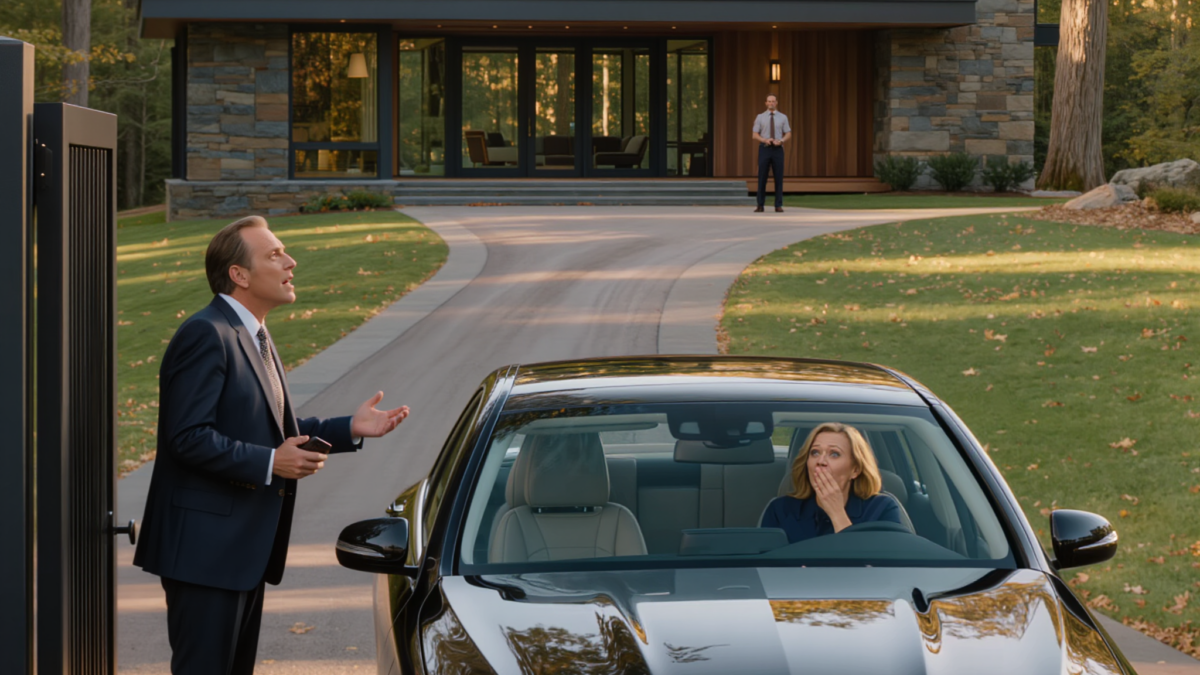
The high-definition camera showed Leo’s expression with perfect clarity. His mouth hung open. He pointed toward the house and spoke rapidly to Chloe, who looked equally stunned, one hand covering her mouth.
Then Leo reached for his phone.
I knew exactly whom he was calling.
I watched with the detached focus of a clinical observer as he climbed out of the car and paced outside the gate, gesturing wildly toward the property.
I couldn’t hear him from the house, but I could read the disbelief on his face.
“Mom, you won’t believe this. There’s an incredible modern mansion on the old Miller property. It must be worth $10 million—maybe $20 million. Wait. Hold on.”
He stepped closer to the gate and squinted at the small, discreet plaque beside it.
The plaque didn’t display a street number.
It displayed one name.
Moore.
Leo stared at it.
“Wait a second. The name—it’s… No, that can’t be right. Mom, this house is his. It’s Alex’s.”
One hour later, exactly as I expected, another vehicle approached the gate.
A familiar silver Lexus.
My mother stepped out. She looked smaller and older than I remembered, and her face was pale.
She approached the camera and spoke directly into it, her voice sounding thin through the security speaker.
“Alex, please. It’s your mother. We need to talk. Please open the gate.”
Against my better judgment and every instinct for self-preservation, I pressed the button.
The heavy steel gate slid open without a sound.
I decided to meet her on my ground and on my terms.
I followed the stone path down from the house and found her waiting near the front steps.
She looked around with wide eyes, taking in the clean architectural lines, the floor-to-ceiling glass reflecting the autumn trees, and the quiet hum of a perfectly balanced energy system.
It was a world she didn’t understand.
And that frightened her.
“Alex,” she breathed, her voice coated in false sweetness.
I recognized that voice. It was the tone she used when attempting to control damage.
“I had no idea. I am so proud of you.”
She moved closer and reached toward my arm.
“I was wrong. I was so wrong to push you away. Can you ever forgive me?”
I didn’t move or allow her to touch me. I stood with my arms folded, feeling only a profound and weary emptiness.
“You aren’t proud of me. You’re impressed by this.”
I gestured toward the house.
“This is another version of Leo’s sports car to you. It’s a symbol of wealth and status. That’s the only language you understand.”
“That isn’t true.”
Tears filled her eyes, but I knew how easily she could produce them.
“I made a mistake. I was frightened for you. I was trying to protect you and push you toward what I believed was success. I want you back in my life. I want my family back.”
Years of buried anger rose inside me.
It wasn’t hot or explosive.
It was cold, sharp, and precise.
“Your family? You declared that I wasn’t part of your family three years ago. You sent me away with a duffel bag and the clothes I was wearing.”
“But look at what you built,” she pleaded, her voice rising. “It worked out for the best, didn’t it? Pushing you was the motivation you needed.”
A short, humorless laugh escaped me.
“It worked out because I left. It worked out without your help. In fact, it worked out despite everything you did.”
I drew a breath, preparing to reveal the one part of the story she didn’t know—the truth that would dismantle the way she saw herself.
“Would you like to know why I built this house here, on this specific piece of land?”
My voice dropped almost to a whisper.
“Do you know who purchased this property 20 years ago, before the Millers?”
Her expression changed. Her tears disappeared.
“No. I don’t remember.”
“Then let me remind you. A young software engineer purchased it. He dreamed of building a self-sustaining family home where technology and nature could coexist—a place where he could raise his two sons away from Wall Street. He invested all his savings in the land and drew the blueprints himself.”
I allowed the words to settle between us.
“But his wife believed it was a foolish and impractical dream. She mocked him and told him to sell the land and invest in something real, something that would impress her friends. So he sold it. He abandoned his dream and entered finance to please her.”
The color drained from my mother’s face as a memory she had buried returned.
Her mouth opened, but no words came.
“Yes,” I said quietly. “Dad bought this land. This was his dream—the dream you called stupid, the dream you made him surrender.”
I removed my phone from my pocket, opened a photograph of the old hand-drawn plans, and held the screen in front of her.
Dad’s familiar handwriting was visible in the corner.
“I didn’t build this house for you. I didn’t build it to impress you or Leo. I built it for him. I finished what he began.”
I lowered the phone.
“So don’t come to my father’s house and attempt to claim any part of this victory. You are not welcome here.”
She stood speechless, her face frozen in pure disbelief.
For the first time in my life, I had left my mother with nothing to say.
That was the moment everything changed—the moment I finally took control of my own story.
In a town like Greenwich, gossip can become more valuable than gold.
The account of what happened at my gate—my mother’s confrontation and my revelation about Dad’s land—spread across manicured lawns and through exclusive country clubs like fast-growing ivy.
Leo must have told someone, who told a spouse, who told a tennis partner.
The story wasn’t merely the satisfying tale of the unsuccessful son becoming wealthy. It was darker and more complicated.
It was the story of a mother who had cast out one son while crushing her late husband’s dream—a dream that same son had later resurrected in spectacular fashion.
It was the one narrative my mother’s carefully curated world couldn’t tolerate.
It stained the public image she had spent her life constructing. Instead of appearing to be a strong family matriarch, she appeared materialistic and cruel.
The friends she met for lunch every Tuesday and played bridge with began to distance themselves.
The calls stopped.
Invitations to charity galas and private dinner parties disappeared.
She had built her identity around being the mother of a successful Wall Street executive, the widow of a respected financier, and the center of her social circle.
The truth exposed the damaged foundation beneath the perfect façade.
Status was the currency she valued above all else, and suddenly hers had lost much of its worth.
One afternoon, I visited a local coffee shop to meet a contractor. While waiting, I overheard two women at the next table.
They were older, impeccably dressed, and I recognized them as members of my mother’s social circle. They spoke in low, conspiratorial voices.
“Can you imagine doing that to your own son?” one woman asked. “And after what he revealed about Richard’s dream for the property? It’s awful.”
“I know,” the second woman replied, stirring her cappuccino. “Eleanor was always talking about how impractical Richard had been before he entered finance. It turns out she was the shortsighted one. She called me yesterday, and I let it go to voicemail. What could I possibly say?”
I remained hidden behind my laptop and felt a strange hollowness.
It wasn’t triumph or pleasure.
It was a quiet, sad confirmation of the world I had escaped.
A week after the confrontation, I received a message from an unfamiliar number.
“Still playing with your little technology toys, I see. Quite an expensive treehouse you’ve built. Don’t forget who has the real education. Your brother deserved that house. Family should be loyal.”
It was Uncle Lawrence.
The same condescending tone. The same jealousy. The same distorted definition of loyalty.
Three years earlier, a message like that would have wounded me and sent me spiraling into self-doubt.
Now it seemed pathetic—the desperate complaint of a man whose worldview was beginning to collapse.
I felt no anger, only distant pity.
I deleted the message and blocked the number.
I was finished engaging with their hostility.
My peace mattered more than the final word.
Ben called several days later.
“Man, you’ve really disturbed the hornet’s nest,” he said, sounding almost impressed. “My mom plays bridge with some of your mother’s former friends. Apparently, Eleanor is a complete mess. She’s telling everyone that you’ve been brainwashed by new money and forgotten the meaning of family.”
I looked out my office window at the peaceful woods.
“Her definition of family was a transaction, Ben. I’ve simply refused to remain the bad investment.”
He was silent for a moment.
“For whatever it’s worth, my mom says everyone sees through it. They know what she did. In that world, public humiliation is worse than losing money. Eleanor is the one who looks foolish.”
It was a strange feeling.
I hadn’t pursued revenge. I had pursued a life of my own.
Yet justice, in its slow, inexorable way, was arriving.
The social standing my mother had sacrificed her own son to preserve was evaporating because of a truth she could no longer control.
About a month later, I received an unexpected call from Samir Gupta, my first boss and Dad’s old friend.
He had read an article about Vidian Dynamics in a business journal and wanted to congratulate me. We agreed to meet for lunch at a quiet downtown restaurant.
After a little conversation about the company’s rapid growth, Samir’s expression became serious.
“Alex, I’ve been thinking about your father a great deal since seeing your success. He would be incredibly proud of you. But there’s something I believe you should know—something I probably should have told you years ago, although I didn’t believe it was my place.”
He took a sip of water.
“Richard wasn’t merely a brilliant engineer. He was a careful and meticulous planner. After you boys were born, he worried constantly about your futures.”
Samir slid a file folder across the table.
“Before he died, Richard established a substantial trust fund for you and Leo. I helped with part of the paperwork. It was supposed to be divided equally. The money could be used for your education, and the remainder was to be distributed to both of you when you turned 25. Richard appointed your mother as trustee because he never imagined she would do anything other than honor his wishes.”
I stared at him, struggling to process what I had heard.
“A trust fund? I never saw a cent of it. My mother told me Dad left only the house and a mountain of debt from poor investments he made before he died.”
Samir shook his head, regret visible in his eyes.
“That was a lie, Alex. A cruel one. Richard was an excellent investor. There was no mountain of debt. The trust was worth more than $2 million when he died.”
He rested one hand on the folder.
“After his death, your mother’s attorney petitioned the probate court to dissolve the trust. As your sole guardian, she argued that the funds were needed for Leo’s specialized education and to maintain the family’s standard of living. She was granted control of the entire amount.”
He looked directly at me.
“Your half of the college fund and your half of the inheritance were poured into Leo’s future. Your mother erased yours.”
The sandwich on my plate suddenly seemed inedible.
Everything fell into place with a sickening certainty.
Leo’s fully paid tuition at NYU. His luxurious apartment. His generous allowance. The investment capital he received after graduation.
It hadn’t been only my mother’s money.
It had been Dad’s money.
It had been my money.
My mother hadn’t simply abandoned me emotionally. She had removed me financially from my father’s legacy.
She had taken his final gift to me—his last act of love and protection—and handed it to my brother.
The betrayal was so complete that it felt almost unreal.
I looked at Samir, my thoughts spinning. I expected to feel a new wave of fury or an immediate desire for a legal fight.
Instead, a deep calm came over me.
This wasn’t a new injury. It was a detailed explanation of an old one.
It confirmed everything I already understood about my mother’s character and priorities. It strengthened my decision to walk away with the quiet certainty that I had done the only thing I could.
Dad had tried to give me a safety net.
My mother had cut it apart.
And somehow, I had learned to fly without it.
Another year passed.
Life moved forward, not through dramatic confrontations and revelations, but through the steady, satisfying rhythm of purpose.
Vidian Dynamics continued its upward trajectory. We expanded into Maryland and Pennsylvania, and our predictive-energy technology became a leading standard for corporate sustainability.
We were no longer a scrappy startup. We had become a major company in the green-technology industry.
I was no longer merely a chief executive. I was recognized as an innovator and invited to speak at universities and major conferences about the future of sustainable technology.
My life wasn’t about money or accolades, although both provided welcome validation for years of work.
It was about the work itself and the team I had built.
Marco, my first employee, became our chief technology officer and a respected industry leader in his own right.
Together, we created a company culture based on respect, collaboration, and a shared passion for solving difficult problems—the exact opposite of the toxic, zero-sum hierarchy in which I had grown up.
My team, Professor Chin, Marco, and my loyal friend Ben became my real family.
They were the people I chose, and the people who chose me in return—not relatives connected to me only through the accident of biology.
The house Dad had imagined and I had completed became my true sanctuary.
On weekends, I hiked the wooded trails across the property while my dog ran ahead. I spent hours reading in the sun-filled living room overlooking the forest or working on experimental projects in the basement workshop.
Sometimes I simply sat in silence and listened to the peaceful, efficient hum of the systems operating around me.
It was a home filled with peace rather than pressure.
It was a place where I could finally breathe.
One of my proudest accomplishments was establishing an internship program at Vidian Dynamics for promising students from state universities and community colleges—young people with talent but few connections.
I made a point of mentoring them personally.
One intern, Sarah, was brilliant but quiet and filled with self-doubt. She reminded me of myself at her age.
One afternoon, I noticed her becoming frustrated with a difficult piece of code. I walked over, not to give her the answer, but to help her think through the problem in the way Dad had once helped me.
“What is the central problem you’re trying to solve?” I asked.
We spent an hour at a whiteboard, sketching ideas.
When Sarah finally found the solution herself, the pride and excitement in her expression meant more to me than any multimillion-dollar contract.
I was breaking the cycle.
I was becoming for others what Dad had been for me.
I was carrying his legacy forward.
I never unblocked my family’s numbers.
Occasionally, I heard news through Ben or saw a passing reference in a local article, but I never searched for information about them.
My mother had apparently moved out of the old family house and downsized to a small condominium. Her social life never recovered from the scandal.
Uncle Lawrence was facing financial problems after an expensive and bitter divorce.
I felt nothing—not satisfaction, anger, or pity.
They had become characters in a book I had finished long ago.
Their story was no longer mine.
My story was about looking forward, building, and creating a legacy of innovation and mentorship that Dad would have respected.
I had finally healed from a wound I once believed would define me forever.
I was more than a survivor of my past.
I was the architect of my future.
The final chapter of my old life—the epilogue I had never requested—arrived through Ben.
He called one evening with hesitation in his voice, the tone he used when carrying news he didn’t want to deliver.
“Hey, man. I heard something strange. You may want to sit down.”
He told me that Leo and Chloe’s marriage, celebrated on the night of my exile, had collapsed.
The contrast between my success and their stagnant life had become a constant source of tension in their home.
Chloe had apparently never allowed Leo to forget that the brother everyone once considered a failure now owned one of the most admired and valuable homes in Greenwich.
Envy slowly corroded their relationship until little remained but resentment and blame.
They were in the middle of an ugly divorce.
But that wasn’t the worst of it.
The real disaster was financial.
“After you built your house, Leo became obsessed,” Ben explained, his voice carrying a mixture of disbelief and pity. “He became desperate to surpass you and prove he was still the successful brother. He quit his secure, high-paying hedge-fund position and invested all his money, along with a significant amount of your mother’s, in a high-risk real-estate company.”
My stomach tightened.
“What kind of company?”
“He attempted to copy you. He started building luxury eco-mansions. He believed he could attach solar panels to an oversized house and market it as green technology. But he didn’t have your knowledge, technical background, or passion. He was chasing the appearance and status. He was building monuments to his own ego.”
The venture became a predictable, unmitigated disaster.
Leo cut corners, used inferior materials, and produced designs that were inefficient and unattractive.
The entire business had been constructed on arrogance and ignorance.
When the real-estate market weakened slightly, his investors became nervous and withdrew. Leo was left with a portfolio of half-completed, unsellable mansions that consumed money every day.
He had tried to play my game without understanding its rules.
He lost everything.
Eventually, he declared bankruptcy.
Then came the final, bitter irony.
The house my mother had forced me to leave—the prize she had awarded her chosen son, the symbol of his victory and my defeat—was taken to cover the debts created by his failed development company and divorce.
The court ordered the property sold. The bank seized it and auctioned it for a fraction of its former value to pay his creditors.
The ultimate symbol of Leo’s triumph became a public monument to his failure.
He had been given everything: an elite education, family connections, financial support, the childhood home, and the inheritance originally intended for both of us.
And he had reduced it all to nothing.
I had been given a broken heart and a promise to my father.
From those two things, I had built an empire.
It didn’t feel like victory.
I experienced no pleasure in hearing about Leo’s downfall. It was a tragedy—a hollow, wasteful example of how unchecked envy eventually consumes itself.
I was simply grateful, deeply and profoundly grateful, that I had moved far enough away not to be caught in the consequences.
Today, I’m sitting in the office that appears to float among the trees. Late-afternoon sunlight streams through the glass walls.
Beside the sleek monitors displaying real-time energy data from a thousand buildings across the country sits a single old photograph in a plain wooden frame.
It shows Dad and me standing in our garage almost 20 years ago. Behind us is a whiteboard covered in his messy, brilliant handwriting.
A younger, thinner version of me stands beside him, smiling with a hope I had once forgotten and only recently rediscovered.
Sometimes I study that photograph and think about the long, painful, twisting road that brought me to this exact place.
During the early, angry years, I believed my journey was about proving my mother and brother wrong.
I imagined becoming successful enough to place my achievements in front of them. I believed success would be the ultimate revenge.
I was mistaken.
Standing in a house built from a dream and leading a company built from a promise, I finally understand the truth.
My journey was never about proving them wrong.
It was about proving my father right.
Dad believed passion possessed a value beyond any price tag. He believed building something meaningful mattered more than chasing numbers on a spreadsheet.
He believed the future belonged to people brave enough to create it.
Most important, he believed in me.
My mother saw a failure and a wasted life.
Dad saw a future.
I have spent the last several years trying to build the world he imagined.
I haven’t spoken to my mother or brother since the day at my gate. I don’t know whether I ever will.
I’ve learned that forgiveness doesn’t require me to excuse what they did. It means freeing myself from the anger.
And I am free.
That freedom does not require a reunion.
Some bridges, once burned, are not meant to be rebuilt.
My family is the team that enters Vidian Dynamics every morning, prepared to change the world beside me.
My family is Ben, who never stopped checking whether I was still alive.
My family is the memory of my father and the principles he left inside me.
My story isn’t about becoming wealthy or settling a score.
It is about the quiet, unshakable power of remaining true to yourself, even when the people who are supposed to love you most insist that you have no value.
Sometimes the greatest gift a destructive family can give you is the freedom that arrives when they finally let you go.








