I woke up to my parents moving my brother’s furniture into my house. “You work from home, right? Where you stay doesn’t matter,” they said—so I told them to leave in 10 seconds, or I’d call the police. What they didn’t expect was that I had already changed the locks and was done letting family decide who owned my home.
Chapter 1: The Unexpected Arrival
I’m Liam, and I’m 30 years old. Three weeks ago, I woke to a nightmare I never could have anticipated. Through my front window, I saw my parents unloading a moving truck in my driveway, carrying my older brother’s furniture straight toward my front door. Văn bản đã dán (1)
I was in the middle of a critical deployment meeting for the software firm where I work as a senior systems architect. My screen was filled with 12 faces from four different time zones. I was leading the call, explaining the final integration steps for a system that processed millions of transactions every day.
The stakes were incredibly high.
Then my doorbell camera started pinging my phone like a fire alarm.
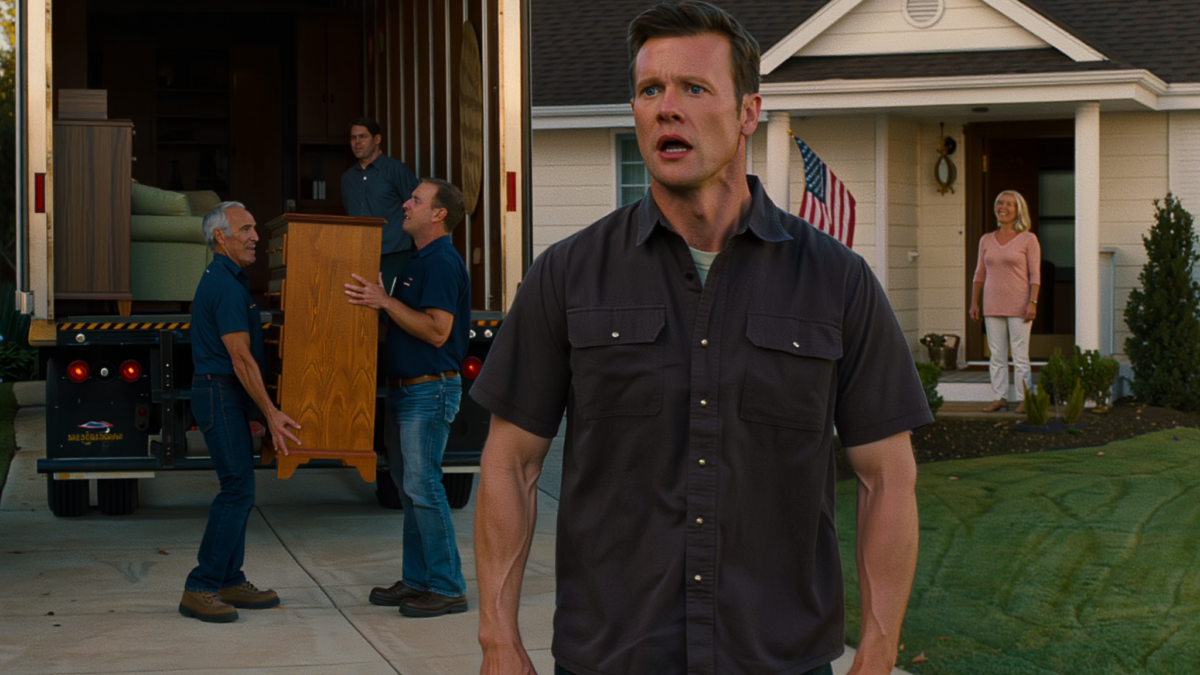
I muted my microphone, opened the live feed, and felt my stomach drop. In broad daylight, beneath a clear blue Ohio sky, my father was directing two men carrying a solid oak dresser. My mother stood on the porch, smiling and waving at the camera.
I ran downstairs, threw open the front door, and demanded to know what they thought they were doing.
My mother didn’t even blink. She gave me a sickeningly sweet smile.
“We’re here to help with the transition. You work from home, right? Where you stay doesn’t matter. Just grab your laptop, honey. The basement is all ready for you.”
My father told the movers to keep going, pointing them toward my freshly painted living room.
In that moment, staring at the people who were supposed to love and protect me, I felt a fury so sharp it nearly blinded me. My own parents were trying to take over my property.
I planted my feet and looked them directly in the eyes.
“Get off my property right now. And since you think where people stay doesn’t matter, I’m sure you won’t mind spending tonight in custody. I’m calling the police in exactly 10 seconds.”
There was one crucial detail my parents didn’t know.
They thought they were dealing with the same quiet, compliant kid they had pushed around for three decades. They had no idea I already had a real estate attorney on speed dial or that I was preparing a case strong enough to leave their plan in pieces.
And now, as I tell this story, they are the ones begging for another chance.
Chapter 2: The Family Dinner Trap
To understand the sheer audacity of that moving truck pulling into my driveway, you have to understand the dinner we had three weeks earlier.
I lived in suburban Ohio in a beautiful but modest three-bedroom colonial that I had bought entirely on my own two years before. That house was my sanctuary.
I had spent every spare weekend renovating it. I installed the hardwood floors myself. I put in a custom kitchen with granite countertops and a farmhouse sink. I turned the largest spare bedroom into a state-of-the-art home office with acoustic paneling, several monitors, and a dedicated server rack.
I earned a high salary in the technology industry, and I had worked brutally hard to get there. I didn’t commute to a cubicle farm. I logged in from my home and managed complex digital infrastructure.
That house was a reflection of my independence.
My older brother, Ethan, was 34. He lived about 20 minutes away with his wife, Chloe, and their three children: an 8-year-old boy, a 6-year-old girl, and a 3-year-old boy.
They lived in a cramped two-bedroom apartment that constantly smelled like stale diapers and fried food.
Ethan had always struggled, but most of those struggles were the result of his own choices. He jumped from one job to another and was currently working as a retail shift manager. I had nothing but respect for honest work, but his financial problems came largely from his refusal to save and Chloe’s obsession with maintaining appearances through credit cards.
We were sitting around my parents’ dining room table for Sunday roast. It was a tradition I usually tried to avoid, but my mother had poured on the guilt that week.
The dining room smelled like overcooked beef and heavy gravy. An unspoken tension hung over the table.
I felt their eyes on me from the moment I sat down.
Chloe kept making passive-aggressive comments about how nice it must be to have a quiet house while her children shouted in the background. Ethan aggressively sawed at his meat without looking at me.
My mother, Eleanor, wiped her mouth with a cloth napkin and began asking pointed questions about my daily routine.
“So, Liam,” she said, passing me a bowl of mashed potatoes I hadn’t requested. “You really just sit at that computer all day? You don’t actually go anywhere. You don’t leave the house.”
I sighed. I had explained my career a hundred times.
“Mom, yes, I work from home, but I am actually working. I have strategy meetings. I write complex code. I manage a team of 12 engineers. It’s a demanding schedule. Just because I’m not driving to an office building doesn’t mean I’m playing video games.”
My father, Robert, scoffed and dragged his fork against his porcelain plate. The sound made my teeth clench.
“But it’s not like real work, is it?” he said. “You don’t put on boots. You don’t report to a real facility. You work in your pajamas. It’s a pretend job that just happens to pay you.”
I should have seen the trap closing then, but I was completely blindsided by what came next.
My mother set down her napkin, folded her hands on the table, and looked at me with manufactured pity.
“Well, Liam, your father and I have been thinking. We’ve been discussing the family’s future. Since you don’t really need all that space in your house—I mean, realistically, you just need a desk and an internet connection—wouldn’t it make more sense for Ethan and his family to live there? You could move into our basement. We’re getting it finished next month. We picked out a lovely shade of gray for the walls.”
I laughed.
It was a deep, genuine laugh because the suggestion was so absurd that I assumed it had to be a joke.
I looked around the table, waiting for someone else to smile.
No one did.
Ethan stared at his plate, pushing peas around with his fork. Chloe had a predatory glint in her eyes, as though she were already measuring my living room for her oversized sectional sofa.
“You’re not joking,” I said.
The amusement drained from my face. The room suddenly felt 10 degrees colder.
My father leaned forward and launched into what sounded like a prepared presentation. He called it “family resource optimization.” According to him, a family with three growing children had legitimate physical space requirements, while a single man with a laptop did not deserve an entire house.
He counted his arguments on his fingers.
First, because I worked remotely, I supposedly didn’t need a real house.
Second, children needed a backyard.
Third, a basement was perfect for a bachelor.
Fourth, helping Ethan was my duty as his brother.
Then he looked me directly in the eyes and said they would generously allow me to use the main-floor bathroom during working hours if I moved into their basement, provided I didn’t take too long or interrupt my mother’s soap operas.
“You want me,” I said slowly, making sure every syllable was clear, “to give up the house I bought with my own money and live in your damp, unfinished basement because my job is remote?”
My mother frowned as though I were the unreasonable one.
“It’s not like you’re using the house properly, Liam. You have two empty rooms. You use them for your office and your music-recording hobbies. That’s incredibly wasteful when your own family needs real housing. Ethan’s children are practically sleeping in a closet.”
I tried to introduce logic into a room entirely devoid of it.
I kept my voice steady, although my heart was pounding. I reminded them that I paid the mortgage. I paid the property taxes, the homeowner’s insurance, the utilities, and every maintenance bill.
My name, and only my name, was on the deed.
I had saved for a 20% down payment while eating ramen noodles for three years.
My father shook his head in disgust, waving away my financial responsibility as though it meant nothing.
“But you earned that money sitting in a chair at home, Liam. It’s not the same as Ethan, who has to commute to a real job and stand on his feet all day. Family helps family. You have a surplus, and they have a deficit. We are fixing it.”
I stood up from the table.
I didn’t say another word. I grabbed my coat, walked out the front door, and got into my car.
I drove home gripping the steering wheel so tightly that my knuckles turned white.
Foolishly, I believed they would wake up the next morning, realize how irrational they had sounded, and abandon the idea. I told myself it had been one of those bizarre, holiday-level family arguments that would eventually fade away.
I was wrong.
The nightmare had barely begun.
Chapter 3: Escalation and Manipulation
The silence I expected the next morning never came.
Instead, my phone started vibrating at 7:00 a.m. and didn’t stop.
My screen was filled with text messages from my mother. She wasn’t apologizing or reconsidering anything. She was sending me links to Home Depot paint swatches.
“Liam, do you prefer Agreeable Gray or Accessible Beige for the basement walls? We want you to feel comfortable in your new zone. Your father is picking up the drywall today. Also, let me know when you can drop off your house keys. Chloe wants to bring a contractor over to look at removing the wall between your living room and kitchen so the space will be more open for the kids.”
I stared at the screen while my morning coffee went cold in my hand.
The entitlement wasn’t merely irritating. It felt like a violation of my entire existence.
It brought back a suffocating flood of memories I had spent years in therapy trying to bury.
Growing up, Ethan had been the undisputed golden child. He had been the high school football star who injured his knee during his senior year, and my parents treated it like a national tragedy that excused every failure that followed.
If Ethan earned a C on a math test, they praised him for doing his best under a difficult teacher.
If I earned an A, my father inspected the paper and asked why it wasn’t an A+.
When it came time for college, their favoritism became a financial reality.
My grandparents had established a college fund for both of us. It was a substantial amount intended to give us each a strong start.
But when Ethan was 22, he decided he no longer wanted to work for anyone else. He wanted to open a custom car shop.
My parents quietly drained the entire college fund, including my half, to pay for his lease, equipment, and an enormous neon sign he purchased instead of paying his vendors.
The shop failed in eight months.
Ethan walked away with a shrug, and my parents forgave him completely.
Meanwhile, I took out crushing student loans and worked exhausting night shifts at a gas station to pay for my textbooks. I still remembered smelling like gasoline and stale coffee while sitting beneath flickering fluorescent lights at 3:00 a.m., teaching myself complex algorithms while my classmates were out at parties.
My accomplishments were always minimized.
When I landed my first six-figure position, my father didn’t congratulate me. He muttered something about “computer money.”
My career was never real to them because it didn’t fit their belief that suffering and physical labor were the only measures of value.
My success highlighted Ethan’s failures, so my success had to be diminished.
I looked again at my mother’s messages. I felt the familiar urge to explain myself, justify my choices, and beg them to understand.
Then the lessons from therapy took over.
I took a breath and sent one clear response.
“Do not contact me about this again. You are not getting my keys, and I am not moving out of my own home.”
Ten minutes later, my phone rang.
The caller ID showed Aunt Martha, my father’s older sister.
Martha had always presented herself as the family peacemaker. She baked cherry pies and smoothed over arguments at Thanksgiving. I answered, hoping she might finally be a voice of reason.
“Liam, honey,” she began, her voice coated in artificial concern. “Your mother is in tears. She’s inconsolable. You’re being incredibly harsh. You know how much Ethan is struggling with those three children in that tiny place. Why are you holding on to a house that’s far too large for you? It’s only bricks and wood, Liam. Family is forever.”
“Aunt Martha,” I said, keeping my voice calm despite the shaking in my hands, “if it’s only bricks and wood, why don’t you give Ethan your four-bedroom house? You can move into my parents’ basement. You live alone too.”
She gasped as though I had insulted her beyond repair.
“That is entirely different, Liam. I am an elder. I earned my home. You are a young, single man who plays on a laptop all day. You’re being deeply selfish. I always thought you were the intelligent one, the generous one, but clearly you lack basic human empathy.”
I ended the call.
I didn’t have the energy for her emotional manipulation.
What I didn’t understand at the time was that Aunt Martha hadn’t called merely to lecture me. She wasn’t trying to reason with me.
She was keeping me distracted.
Later that evening, my father called.
I let it go to voicemail, but he left a message that sent a chill through me. His voice was cold, authoritative, and detached from reality.
“Liam, you are disrespecting this family. A man who works in his pajamas should not be hoarding real estate while a real family suffers in an apartment. Your grandfather would be deeply ashamed of the greedy corporate coward you’ve become. We are coming to an arrangement regarding the house, with or without your cooperation. Prepare yourself.”
Chapter 4: Securing the Property
The following day, I was putting away groceries when I noticed something missing from the wooden hook beside my back door.
An old spare key on a plain brass ring.
I had given it to Aunt Martha two years earlier when I traveled to Seattle for business and needed someone to water my plants.
I had completely forgotten she still had it.
The realization struck me like a freight train.
She had kept the key.
She hadn’t only called to scold me. She had given my parents access to my house.
That was the turning point.
The sadness, the childhood longing for my parents’ approval, and the guilt all vanished in a single instant. In their place came a cold, focused instinct to protect myself.
I didn’t cry. I didn’t shout at the walls.
I went into the garage, grabbed my heavy-duty toolkit, and spent the next three hours replacing every deadbolt in the house.
I didn’t buy inexpensive locks. I purchased the highest-grade security locks I could find. I upgraded my doorbell camera and installed four new high-definition cameras around the perimeter, making sure every section of the yard was covered.
I linked motion sensors directly to my phone.
I was a systems architect. If there was one thing I knew how to do, it was build a firewall.
So I built one around my life, both digital and physical.
I believed the new locks would send a clear enough message. I thought a physical barrier might finally make them understand that I was serious.
But people who refuse to respect boundaries often treat them as challenges.
That brings me back to the moment the massive 20-foot U-Haul pulled into my driveway.
I stood on the porch facing my father and two movers carrying Ethan’s worn leather sofa. I saw the shock in my father’s eyes when the spare key failed to turn in the lock.
He shook it aggressively, his face darkening with anger.
“You changed the locks,” he growled, dropping the key. “On your own family. You locked your mother out.”
“It’s called private property, Dad. You are trespassing.”
I looked past him at Ethan, who stood near the rear of the truck. He appeared uncomfortable, but he was doing nothing to stop what was happening.
“Are you seriously going along with this, Ethan? You’re going to help them take my house in broad daylight?”
Ethan shoved his hands into his pockets and refused to look at me.
“It’s not stealing, Liam. Mom and Dad said it was a family decision. The kids need a backyard, man. You don’t even use yours. It’s just sitting there.”
Chloe moved to the front of the group, carrying her youngest child on her hip as though the child were evidence in her argument.
“Liam, please don’t make this harder than it needs to be. Think about your niece and nephews. Do you really want them sleeping in a closet while you keep an entire house to yourself? Where is your heart? We already told our landlord we were moving.”
“My heart is fine,” I said, my voice carrying down the quiet suburban street. “My mortgage is fine too. You have exactly 10 seconds to get back in that truck and leave, or I’m calling the police to report trespassing and an attempted break-in. One. Two.”
My mother burst into tears.
They weren’t tears of sorrow. They were angry, weaponized tears.
“After everything we’ve done for you! We raised you. We fed you. We put a roof over your head.”
“That was your responsibility as parents!” I shouted. “Seven. Eight.”
My father pointed a trembling finger at my chest.
“You will deeply regret this. You’ll end up alone in this big house with no one to bury you. You are dead to us.”
“Nine.”
They backed away.
The movers, realizing they had been pulled into a serious property dispute, muttered apologies and began carrying the heavy dresser back to the truck.
I stood on the porch with my arms crossed and watched them drive away.
My heart hammered against my ribs.
I had won that confrontation, but the larger battle had only begun. The lengths they were willing to go would soon defy anything I had imagined.
Chapter 5: The Social Media Smear
If you want to see how quickly an entitled family can rewrite a story, watch what happens when they are denied something they believe they deserve.
After failing to enter my home, my family shifted from a physical invasion to a social campaign.
Less than 24 hours after the moving-truck confrontation, Chloe created a new Instagram account called Apartment Life with Three Kids.
Soon, my feed and the feeds of everyone we knew were filled with carefully staged black-and-white photographs of my nephews looking miserable in their shared bedroom.
The captions were masterpieces of emotional pressure.
“Teaching the kids that love is more important than square footage today,” one post read beneath a picture of her oldest son sitting sadly on a small bed. “It’s difficult explaining to an innocent 8-year-old why his wealthy uncle has three empty bedrooms for hobbies while he shares a twin bed with his little brother. But God gives His toughest battles to His strongest soldiers.”
She added hashtags about family, prayer, selfishness, and minimalist living.
It was a carefully targeted attack on my character, and the extended family consumed it eagerly.
My cousin Kevin, whom I hadn’t spoken to in five years because he had borrowed money and never repaid it, left a comment.
“Absolutely disgusting, Chloe. I am so sorry. Some people get a little tech salary, sit in front of a screen, and completely forget where they came from. Real men provide for their families. Liam is a disgrace.”
My mother shared Chloe’s posts directly to her Facebook page, tagging people from our hometown—church members, former teachers, and local business owners.
She added passive-aggressive prayers about hoping my hardened heart would soften before the holidays.
They painted me as a greedy corporate monster hoarding wealth while innocent relatives suffered in terrible conditions.
I began receiving texts from people I barely knew. High school acquaintances I hadn’t seen in a decade and distant relatives from other states offered unsolicited advice about how family legacy mattered more than property rights.
The betrayal didn’t remain online.
It entered my daily life.
A few days later, on a Saturday morning, I walked toward my mailbox. My neighbor Dave was mowing his lawn.
Dave and I usually drank beer together on weekends and watched football. Normally, he would turn off the mower and walk over to talk.
That morning, he gave me a cold stare.
“Hey, Dave,” I said, raising a hand and trying to preserve some sense of normalcy.
He didn’t wave.
He left the mower running, approached the white picket fence between our properties, and crossed his arms.
“Liam, man, I saw Chloe’s posts on Facebook. My wife showed me.”
My stomach dropped.
“Dave, you have to understand that you’re not hearing the whole story.”
“I didn’t realize you were putting your own brother and his children out on the street,” he interrupted, his voice filled with disgust. “That’s pretty low. I see you inside all day. You work in sweatpants. You don’t even use the whole house. Would it really hurt you to help your own family? My brother lived with me for a year after he lost his job.”
A rush of adrenaline moved through me.
They were turning my own neighborhood against me.
“Dave, listen. They aren’t on the street. They live in an apartment. They are demanding—not asking, demanding—that I give them my house, sign over the deed, and move into my parents’ unfinished basement. I bought this house.”
Dave shook his head skeptically.
“That’s not what your mother told my wife at the grocery store. She said you promised Ethan the house when you received your promotion last year, and now you’re backing out because you want to build a private gym in the spare room.”
The lies were so elaborate that I could barely respond.
I realized there was no point in arguing.
I turned around, walked inside, locked the heavy deadbolt, and stood alone in my dark hallway.
It was a suffocating feeling to realize that the people who shared my DNA were strategically destroying my reputation to gain control of my property.
But the most unsettling moment came the following Tuesday.
Chapter 6: The Sign and the Fake Contract
I had a rare afternoon without video meetings and was deep into a complicated coding sequence, wearing noise-canceling headphones, when my motion alerts went off.
I opened the camera feed on my second monitor.
My mother and father were standing in the middle of my front yard.
My father held a clipboard and a long measuring tape. He was measuring the distance between the porch and sidewalk. My mother carried a large wooden stake and a heavy mallet.
She was driving something into my carefully maintained lawn.
I dropped my headphones on the desk, opened the front door, and marched outside.
In the middle of my yard, facing the street where every neighbor could see it, stood a large, professionally printed real estate sign. It was glossy and bright, with a photograph of Ethan, Chloe, and their three children smiling together.
The enormous lettering read:
“Future Home of the Baker Family. Renovations Starting Soon. God Is Good.”
“What is this?” I demanded.
I pulled the sign from the ground and threw it onto the concrete.
My father didn’t flinch. He continued writing on his clipboard as though my reaction were irrelevant.
“Don’t damage the sign, Liam. It cost $80 at the print shop. We’re only taking measurements for the patio expansion Ethan wants. He plans to put a fire pit where your rose bushes are.”
“Get off my property!” I shouted, no longer caring whether Dave or the other neighbors heard me. “I am not giving you this house. Are you completely detached from reality? You are trespassing again.”
My mother approached me with the mallet still in her hand. Her face carried a terrifying kind of condescension.
She wasn’t looking at me like a son.
She was looking at me like a patient.
“Liam, sweetheart, we are doing this for your own good. You’re isolating yourself in this house. You’re becoming a hermit. You stare at screens all day. We have consulted with the extended family, and we are stepping in to manage your affairs because living alone is clearly affecting your judgment. You’re hoarding.”
That was the moment the ground shifted beneath me.
She no longer sounded merely entitled.
She sounded clinical.
She sounded as though she were building a case.
“Manage my affairs?” I repeated, lowering my voice. “I am 30 years old. I earn three times what Ethan earns. I pay my bills. My credit score is over 800. You are not managing anything.”
“We’ll see about that,” my father said, snapping his clipboard shut. “You bought this house with fake computer money. That isn’t real labor. You haven’t earned the right to be this selfish. We’ll be back Friday with a general contractor to inspect the load-bearing walls. Be ready.”
I watched them climb into their SUV and drive away.
A heavy feeling settled in my stomach.
This was no longer simply a disagreement over a house. They were strategizing to strip me of my autonomy. They were laying the groundwork to argue that I was mentally incapable of managing my own property.
The psychological pressure intensified over the next 48 hours.
I was running on caffeine and adrenaline.
The morning after the sign incident, I opened my front door for an early run and found something heavy and metallic hanging from the doorknob.
It was a steel lockbox, the kind real estate agents use to hold keys during property showings.
My parents had returned during the night, entered my porch, and attached a lockbox to my front door.
I went to the garage, grabbed a large pair of bolt cutters, snapped the metal shackle, and dropped the entire device into the trash.
But the physical harassment was minor compared with the legal fiction they were creating.
That afternoon, I found a thick manila envelope among the bills and advertisements in my mailbox. There was no return address.
I opened it at my kitchen island.
Inside was a multipage document designed to resemble a formal contract, although it had been printed on ordinary paper.
The bold Times New Roman heading read:
“Residential Lease Agreement and Family Asset Redistribution Protocol.”
I read the clauses while my vision blurred with disbelief.
It was a fake lease drafted by my parents, outlining the terms of my supposed tenancy in their basement.
It required me to pay them $600 per month for the privilege of living underground. It ordered me to surrender the deed to my house to Ethan within 30 days.
It imposed a strict 10:00 p.m. curfew, after which the basement door would be locked from the outside.
Clause Four was the most insulting.
“Tenant Liam is permitted upstairs main-floor access only for meals and approved family gatherings. Kitchen privileges are restricted to nonpeak hours to avoid disturbing the homeowners.”
It was a manifesto of control.
The stress began affecting me physically. I wasn’t sleeping. I was eating poorly. Every movement on my security monitors made me jump.
Chapter 7: Legal and Professional Help
The next day, during a critical one-on-one video meeting with my department manager, Sarah, I finally broke under the pressure.
For the first time in my professional career, I had missed a major coding deadline.
When Sarah gently asked what was happening, everything poured out.
I told her about the moving truck, the lockbox, the fake lease, the social media campaign, and the way my neighbors had begun treating me.
Sarah was a sharp, fiercely intelligent, no-nonsense executive based in our Chicago office. She had little patience for drama.
She sat in her ergonomic chair, listened without interrupting, and took careful notes.
When I finished, she leaned closer to the camera.
“Liam, I need you to listen to me very carefully,” she said. “What you’re describing isn’t a strange family disagreement or a minor boundary issue. It is organized, targeted harassment. You need to stop treating them like parents who can be reasoned with and start treating them like hostile people interfering with your life.”
Her words felt like a bucket of ice water.
She had named the situation for what it was.
I was still reacting like a wounded son, trying to reason with people who intended to take advantage of me.
“Take the rest of the week off,” Sarah said. “Fully paid. Gather your evidence and call an attorney today.”
She paused and began typing.
“And Liam, the principal engineer position in our Denver, Colorado, office just opened. I was going to wait until the end of the quarter to discuss it, but I’m submitting your name for the promotion today. It comes with a significant salary increase. Get out of Ohio. We’ll arrange a full relocation package.”
It felt like a lifeline.
Denver. Mountains. Distance.
Before I could fully process the possibility of escape, the final and most unsettling piece of my parents’ strategy arrived.
Later that afternoon, a certified letter came to my door.
I had to sign for it.
This one wasn’t printed on inexpensive paper. It carried the embossed letterhead of Dr. Evans, the local general practitioner my family had used since I was five years old.
The letter stated that, based on repeated reports from immediate family members concerning sudden behavioral changes, severe social isolation, paranoia regarding property, and an unhealthy detachment from reality, Dr. Evans was recommending a complete psychiatric evaluation to determine whether I possessed the capacity to make sound financial and residential decisions.
My heart pounded against my ribs.
The lockbox.
The lawn measurements.
The social media posts depicting me as unstable and obsessed with my property.
The fake lease.
It wasn’t simply bullying.
It was an effort to create a documented record.
They weren’t only trying to pressure me out of the house. They were attempting to establish that I needed someone else to manage my financial and residential affairs.
If they succeeded, they believed they could take control.
This time, I didn’t panic.
The panic had been replaced by a freezing sense of clarity.
I went into my office, sat at my desk, and created a new encrypted folder on my hard drive.
I downloaded every text message. I saved every voicemail. I captured screenshots of every Instagram and Facebook post. I exported every second of security footage in high definition.
Then I called Mr. Henderson, the real estate attorney who had helped me close on the house.
I forwarded him the fake lease, the threatening voicemails, and the doctor’s letter.
“They are creating serious problems for themselves, Liam,” Mr. Henderson said over the phone. “This may involve extortion, fraud, and professional misconduct if that medical letter was issued solely on hearsay. Let them continue. Do not engage. If they cross another line, we will respond decisively.”
I spent the next three days in complete silence.
I didn’t answer messages. I stayed away from social media.
I packed my most valuable possessions—my servers, documents, and family heirlooms—and placed them in a secure, climate-controlled storage unit across town.
I became a ghost inside my own home, waiting in the eye of the storm.
I knew they would not interpret silence as resistance.
They would interpret it as weakness.
They would escalate.
And I was right.
Chapter 8: The Break-In and Arrest
It was a Tuesday night.
I lay fully dressed on my bed, staring at the ceiling because I couldn’t sleep. The house was completely quiet. Outside, the wind moved softly through the trees.
At exactly 3:14 a.m., my phone vibrated violently against the nightstand.
It wasn’t a text.
It was a high-priority alert from my backyard security camera.
Motion detected at the rear patio door.
I grabbed the phone, opened the live feed, and felt the breath leave my lungs.
In the darkness, illuminated by infrared night vision, stood my brother Ethan.
He was holding a heavy steel crowbar.
I had been lying on top of the bedspread, still fully clothed, staring at the ceiling fan when the notification came through.
The silence in the house felt heavy enough to press against my ears.
I reached for the phone, my hands steady despite the rush of cold adrenaline moving through me.
The high-definition feed from the rear patio filled the screen.
Ethan stood in the darkness wearing a black hoodie with the hood pulled over his head. The night-vision camera still captured the unmistakable outline of his face.
The steel crowbar was gripped tightly in his right hand.
A few feet behind him, crouching near the bushes and glancing anxiously toward the street, was Chloe.
For about 10 seconds, I didn’t move.
I watched the screen, paralyzed not by fear but by the reality of the betrayal.
This was my brother.
This was the boy who had shared a bedroom with me, broken my toys, and never apologized. This was the man whose failed business had consumed my college fund.
Now he was standing at my back door, using a crowbar against the frame.
They had moved beyond entitlement.
This was criminal behavior.
I didn’t shout. I didn’t turn on the lights. I didn’t go downstairs and confront them.
I was a systems architect. When facing a hostile breach, I isolated the threat and contacted the proper authorities.
I minimized the camera application, opened the phone dialer, and called 911.
“911. What is your emergency?”
The dispatcher’s voice was calm and professional.
“My name is Liam,” I whispered. “A man is trying to enter my house through the back patio door with a crowbar. A woman is with him. I’m upstairs with my bedroom door locked. I have both of them on live security cameras.”
“Okay, Liam. Officers are being dispatched now. Are you armed?”
“No,” I said. “But the intruder has a steel crowbar, and I know who he is. He’s my older brother.”
There was a brief pause.
“Stay on the line with me, Liam. Officers are approximately three minutes away. Do not engage them.”
I placed the call on speaker, muted my side, and returned to the camera feed.
Ethan was struggling against the upgraded door. The heavy-duty frame I had installed earlier that week was holding.
He wedged the crowbar between the door and frame and leaned his full body weight against it. I could see the strain in his neck.
Chloe whispered urgently and pointed toward the street.
Then a sharp crack echoed through the house.
Ethan had swung the crowbar into the double-paned reinforced glass.
It didn’t explode into fragments. The glass spiderwebbed but remained partially intact.
He struck it again and forced an opening large enough to kick through.
The crunch of his boots stepping over broken glass onto my hardwood floors made my stomach turn.
He was inside my home.
“They breached the door,” I whispered to the dispatcher. “He’s in the kitchen.”
“Officers are arriving on your street now. Remain where you are.”
Through my bedroom door, I heard heavy, clumsy footsteps downstairs.
Ethan moved from the kitchen toward the living room.
Then I heard a cabinet open.
He wasn’t simply trying to “secure” the property.
He was searching through my belongings.
Red and blue lights suddenly flashed across my bedroom walls, reflecting through the trees outside. The officers had arrived without sirens.
A commanding voice came from the backyard.
“Police department! Drop the object and get on the ground. Show us your hands.”
Chloe screamed from somewhere outside.
Downstairs, I heard a heavy thud, the scrape of boots against hardwood, and the sound of officers restraining someone.
“Do not move. Stop resisting. Put your hands behind your back.”
“It’s my brother’s house!” Ethan shouted from below.
His usual arrogance had disappeared. His voice was thin and frightened.
“I have permission! He’s my brother. We’re family. I’m securing the residence.”
Another officer called from the stairs.
“Homeowner, if you are upstairs, identify yourself.”
“I’m in the primary bedroom,” I called. “I’m coming out.”
I opened the door slowly with my hands raised and empty.
The hallway was swept by the beam of a tactical flashlight. The officer lowered it after seeing me.
“Are you Liam?”
“Yes, Officer. I’m the homeowner.”
“We have two individuals in custody downstairs. We need you to identify them.”
I walked down my own staircase.
The living-room lights had been turned on. My kitchen looked like a scene from a surreal dream.
Broken glass covered the floor, glittering under the lights. Cold night air poured through the damaged patio door.
Ethan lay facedown on my hardwood floor with his hands secured behind him.
Chloe stood near the broken doorway in handcuffs, crying as dark streaks of makeup ran down her face.
Officer Davis, a veteran patrol officer from our neighborhood, looked at me.
“Do you know these individuals, sir?”
I looked at Ethan.
He turned his head and stared up at me with wide, desperate eyes.
“Liam, tell them. Tell them this is a misunderstanding. Mom and Dad said it was okay to start moving things in tonight to surprise you. Tell them to take these cuffs off.”
I stared down at him.
Every year of being treated like the lesser son, every achievement that had been dismissed, every threat, document, and attempt to control my life seemed to harden inside my chest.
“I know them,” I said.
My voice was flat.
“That is Ethan Baker and his wife, Chloe Baker. I did not give them permission to be here. They entered my property and damaged the door. I want the incident fully documented, and I intend to cooperate with the case.”
Chloe let out a ragged cry.
“You can’t do this to us! We have three children. You’re ruining our lives.”
“You made this decision,” I replied.
I turned to Officer Davis.
“The entire incident was recorded by multiple high-definition cameras. I’ll provide the footage.”
The officers helped Ethan to his feet.
He was crying now—not angry tears, but tears of panic.
They led Ethan and Chloe through my front door and placed them in the back of a patrol car.
My phone started vibrating again.
It was my mother.
I ignored the call.
For the next two hours, I gave my statement and transferred the relevant security files to the police.
By 6:00 a.m., the sun was beginning to rise, casting a pale light across my damaged patio door.
My phone rang again.
This time, it was Mr. Henderson.
Chapter 9: Revealing the Hidden Motive
“Liam,” his gravelly voice said through the speaker, “I received a call from the precinct. Your parents are there trying to arrange bail for Ethan and Chloe. And I did some research into their financial records, as we discussed yesterday.”
He paused.
“I found the motive.”
I lowered myself onto a stool at the kitchen island and stared at the broken glass.
“What motive? I thought they only wanted the house for Ethan’s children.”
“No,” Mr. Henderson said. “It is much worse than that. Do you remember the custom car shop Ethan opened years ago?”
“Yes. It failed.”
“He didn’t merely lose the business. Shortly before it closed, Ethan seriously damaged a client’s vehicle—a fully restored vintage Porsche 911. The engine block cracked because of his negligence. The owner pursued Ethan personally for hundreds of thousands of dollars. To keep their golden child from facing a devastating civil case and potential fraud allegations, your parents took out a large second mortgage on their own house to pay the settlement.”
The room seemed to tilt.
“They took out a second mortgage?”
“Yes. And they are currently 60 days behind. They are drowning, Liam. They are close to foreclosure. They didn’t simply want Ethan to live in your house. They wanted you removed, and they wanted that psychiatric evaluation to support an argument that you could not manage your own affairs.”
He continued before I could respond.
“If they obtained control over your finances, they were not planning only to move Ethan into the property. They intended to liquidate your real estate, sell your house, and gain access to your salary accounts to cover the debt Ethan created.”
I gripped the counter until my knuckles turned white.
This had never been about family.
It had never been about bedrooms or a backyard for the children.
It was a calculated attempt to solve their financial crisis by sacrificing my home, career, and independence.
“I’m coming to the precinct,” I said. “Meet me there.”
I arrived shortly before 8:00 a.m.
The lobby was a sterile, depressing room beneath buzzing fluorescent lights. It smelled of floor cleaner and stale coffee.
The moment I pushed through the heavy glass doors, the shouting stopped.
My parents sat on a hard plastic bench against the far wall. Ethan and Chloe remained in holding rooms while the paperwork was processed.
When Eleanor saw me, she didn’t look remorseful.
She looked cornered.
She stood, smoothed her skirt, and marched toward me with fury and panic in her eyes.
“You monster,” she hissed, pointing a trembling finger toward my face. “You had your own brother arrested. You put the mother of your nephews in a holding cell. Have you lost your mind? Tell the desk sergeant you’re withdrawing the complaint. We are family. We handle these matters privately.”
I didn’t step back.
“We do not handle forced entry privately, Mom. He broke my patio door with a crowbar.”
My father moved closer, puffing out his chest as though physical intimidation might still work.
“It was a misunderstanding. We sent him there to secure the property. We believed you were having some kind of episode, and now you’ve ruined everything. How is Ethan supposed to explain an arrest record to his employer?”
“I don’t care,” I said.
At that moment, Mr. Henderson walked through the entrance.
He wore an expensive navy suit and carried a thick leather briefcase. He looked like a shark entering a goldfish pond.
He stopped beside me, opened the briefcase, and removed a stack of documents.
“Mr. and Mrs. Baker,” he said evenly, “I am Liam’s legal counsel. I strongly advise you to stop harassing my client inside a police station. Your behavior may be included in the civil and criminal matters we are reviewing.”
Eleanor scoffed, although her hands were visibly shaking.
“Harassment? You’re a ridiculous ambulance chaser. We are his parents. We are simply trying to manage a family asset.”
“Ah, yes,” Mr. Henderson said, turning a page. “The family asset. You mean Liam’s house—the one he owns outright?”
He looked at my father.
“Because according to the publicly available liens and financial notices I reviewed yesterday, your own house is largely controlled by the bank. You are 60 days past due on a substantial second mortgage, Robert. A mortgage taken out to resolve the claim involving the vintage Porsche Ethan damaged.”
The color drained from both of my parents’ faces.
Robert opened and closed his mouth without forming a sentence. Eleanor stepped backward and bumped into the plastic bench.
“You accessed our private records,” my father stammered.
“Publicly filed liens and bank notices are not private,” Mr. Henderson replied. “We know what you were attempting to construct—the fake lease, the lockbox, the social media posts portraying Liam as unstable, and the letter from Dr. Evans recommending an evaluation.”
He closed the file.
“You were not trying to find Ethan a larger place to live. You were trying to gain legal and financial control over Liam so you could use his property and income to prevent your own bankruptcy.”
The silence in the precinct lobby was overwhelming.
Their moral arguments and speeches about family values collapsed in a matter of seconds.
They had presented themselves as concerned parents.
In reality, they had been desperate people trying to take what belonged to me.
“It isn’t fair,” Eleanor suddenly sobbed, abandoning anger for victimhood. “You have so much, Liam. You have that enormous salary. You have that beautiful house. You don’t even have a wife or children to spend it on. We were going to lose our home. Ethan made a mistake, and he’s your brother. It’s your duty to share your wealth and protect the family name.”
“I don’t have an inheritance,” I said, my voice echoing off the tile walls. “Because you gave it to Ethan for a car shop that failed. I built my life with my own work, and you tried to take it.”
I looked at both of them.
“You are no longer part of my life. Do not contact me again. If you do, Mr. Henderson will pursue a permanent protective order.”
I turned and walked out of the station, leaving them amid the ruins of their plan.
Chapter 10: Selling the Sanctuary
When I reached my car, I sat behind the wheel and breathed.
The cold morning air felt clean in my lungs.
For the first time in 30 years, the cloud of guilt that had always hovered above me was gone.
Later that morning, I logged in from my home office. An emergency repair crew had covered the damaged patio door.
I opened an encrypted video call with Sarah.
“How are you holding up, Liam?” she asked.
“I’m finished here, Sarah. The ties are completely severed. I need to leave Ohio.”
Sarah nodded, and a small smile appeared.
“Done. The board has officially approved your promotion to principal engineer in the Denver office. Your new compensation includes a 20% increase. The relocation package will cover your moving costs and temporary corporate housing while you find a place in Colorado. You begin in three weeks.”
I thanked her, ended the call, and immediately contacted Mr. Henderson.
“Sell the house off-market and sell it quickly. I don’t care if I accept slightly less than the full value. I want it gone before they realize what is happening.”
Mr. Henderson moved quickly.
Within 48 hours, he found a private cash buyer—a young couple relocating from another state. They loved the custom kitchen and didn’t need to wait for a traditional bank appraisal.
We signed the preliminary paperwork in his office.
My parents, who had been released along with Ethan and Chloe while the case proceeded, made one final desperate legal maneuver.
They were facing serious charges. Their debt was crushing them, and they knew they were losing control.
A week before closing, Mr. Henderson called me with dark amusement in his voice.
“Liam, you will not believe this. Your father attempted to file a fraudulent mechanic’s lien against your property at the county clerk’s office.”
“A mechanic’s lien? For what work?”
“He submitted a handwritten invoice claiming you owe him $85,000 for childhood expenses, room and board, and emotional-support services provided before you turned 18. He attempted to attach it to the deed so the sale could not proceed.”
It was pathetic—the frantic movement of someone who had run out of options.
Mr. Henderson eliminated the false lien within hours through an emergency filing and warned that any further attempt could produce additional fraud allegations.
The county clerk rejected the paperwork.
Meanwhile, my house became a fortress of quiet efficiency.
I hired a specialized moving team. They arrived in unmarked trucks at night.
I packed my servers, clothes, documents, and the rest of my life.
I left no trace.
I didn’t tell anyone in the neighborhood. I didn’t even tell Dave.
They could continue believing the story my family had spread.
The truth would arrive soon enough.
In the middle of everything, an unexpected ally emerged.
I received a call from Grace, Chloe’s mother.
Grace was a direct, no-nonsense retired nurse who had never approved of Ethan.
“Liam,” she said, exhaustion weighing down her voice, “I am deeply sorry for what my daughter and your brother did. It is inexcusable.”
“Thank you, Grace, but you do not need to apologize for them.”
“I’m not only apologizing,” she said. “I’m taking action. I filed for emergency custody of the three children. With Ethan and Chloe facing charges, and their apartment lease ending next week because of unpaid rent, Child Protective Services was becoming involved. I will not allow my grandchildren to enter the foster system because of their parents’ choices. They are safe with me now.”
A tremendous weight lifted from my shoulders.
The children were the only innocent people in the entire situation. Knowing they were with a stable adult gave me the final piece of closure I needed.
I loaded the last box into my car and stood in the empty living room of the house I had rebuilt.
I didn’t feel grief.
I felt free.
I locked the front door, left the keys in a secure lockbox for the new owners, and began the long drive toward the Rocky Mountains.
Chapter 11: The Final Failed Attempt
On closing day, I sat on the balcony of a high-rise corporate apartment in downtown Denver.
The air was thin and crisp, completely different from the heavy Ohio humidity. Snowcapped peaks framed the horizon.
My laptop sat open on the patio table beside a cup of black coffee.
My phone buzzed.
It was an alert from the security cameras I had transferred to the new owners, the Millers. We had agreed that I would keep temporary access to the exterior feeds for one additional week in case my family attempted anything unusual.
They did not disappoint.
At exactly 10:00 a.m., my parents’ SUV pulled to the curb in front of my former house.
A rented 20-foot U-Haul followed directly behind it.
I watched the feed in high definition.
Eleanor and Robert climbed out of the SUV. They looked exhausted and stressed, but strangely triumphant.
They had no idea the house had been sold.
They apparently believed I was still hiding inside and refusing their calls.
Robert walked toward the front door carrying heavy bolt cutters. A confused local locksmith stood beside him on the porch.
Eleanor carried a stack of envelopes, waving them toward the locksmith and pointing at the door.
I turned on the audio.
“We have tenant rights,” she told him loudly. “We have established residency. Look, we receive mail at this property. Our son is having a mental breakdown and locked us out. Cut the lock.”
They had mailed catalogs and other junk mail to themselves at my address during the previous two weeks, apparently hoping to manufacture evidence of residency.
It was a plan built from desperation and questionable internet advice.
Before the locksmith could touch the door, a sleek black sedan pulled into the driveway and blocked the U-Haul.
Mr. Miller, the new owner, stepped out.
He looked confused and irritated.
“Excuse me,” he called. “Who are you, and what are you doing on my property?”
Robert turned and pushed out his chest.
“Your property? Listen here. This is my son’s house. We are moving in today. Move your car before I have it towed.”
Mr. Miller happened to be a corporate litigator.
He didn’t flinch.
“I closed on this house three hours ago. The deed is in my name. You have 30 seconds to leave my driveway before I call the police and report trespassing and attempted unlawful entry.”
Shock washed across my parents’ faces.
Eleanor dropped the envelopes onto the porch. Robert lowered the bolt cutters, his mouth hanging open.
“Sold?” Eleanor shouted so loudly that Dave stepped onto his neighboring porch. “He couldn’t have sold it. It is our family home. He owes us. We have a lien.”
Mr. Miller ignored her and called 911.
The locksmith, realizing he had been pulled into a potentially serious dispute, packed his equipment and hurried back to his van.
Ten minutes later, two police cruisers arrived with their sirens on.
In a final stroke of irony, one of the responding officers was Officer Davis, the same man who had arrested Ethan several weeks earlier.
From a thousand miles away, I watched while sipping my coffee.
Robert shouted about inheritance, fake leases, and family loyalty.
Officer Davis showed no interest in the argument.
He asked Mr. Miller for identification and proof of ownership.
Mr. Miller provided the digital closing documents immediately.
“Sir, ma’am,” Officer Davis said, his voice carrying clearly through the camera microphone, “you have no legal right to be on this property. You are also currently released under conditions connected to prior allegations involving the previous owner. Turn around and place your hands behind your backs.”
Eleanor collapsed onto the manicured grass, crying and begging the neighbors to help her.
“Dave! Dave, tell them! Tell them Liam is stealing from us. Help us!”
Dave stood on his porch with his arms crossed.
For the first time, he seemed to understand the scale of the manipulation.
He shook his head, returned to his house, and closed the door.
I watched as my father—the man who had belittled my career and dismissed my work—was placed in the back of a police cruiser.
My mother, still crying, was placed in another vehicle.
The empty U-Haul remained in the driveway, a monument to the collapse of their plan.
The consequences came quickly.
With my parents again in custody and facing allegations that they had violated the conditions of their release, their finances collapsed completely. The bank moved forward with foreclosure on their home.
Ethan’s life unraveled just as quickly.
When his employer learned of the arrest connected to unlawful entry and property damage, he was terminated.
He lost his salary, benefits, and whatever remained of his pride.
Chloe, realizing that the family had no money left and no property to claim, filed for a bitterly contested divorce. She argued that Ethan and his parents had manipulated her into participating in the break-in.
She turned against him completely.
Grace retained custody of the children and refused to allow Chloe to use them as leverage. Chloe was left with legal expenses and a damaged reputation.
Her Instagram account, Apartment Life with Three Kids, was deleted after large numbers of users reported it for fraud and harassment.
They had tried to destroy my sanctuary to save themselves.
Instead, they dismantled their own lives.
Six months have passed since I watched those police cruisers pull away from my old house.
I am sitting in my new home office now.
The window beside my desk no longer looks onto a suburban street filled with gossiping neighbors and toxic family dynamics.
It overlooks a broad valley framed by the jagged, snow-dusted peaks of the Colorado Rockies.
The air here feels different.
It is lighter.
It is easier to breathe.
Chapter 12: Finding Peace in Distance
The promotion to principal engineer changed my life.
The increase in salary was substantial, but the real value came from the validation.
My company, my manager, and my colleagues looked at my work, intelligence, dedication, and long nights and told me those things mattered.
They never called it fake computer money.
They respected what I had built.
I began intensive therapy shortly after moving to Denver.
It wasn’t easy.
Unpacking 30 years of serving as the invisible foundation beneath a golden child takes time.
My therapist helped me understand that my parents had never truly viewed me as a son.
They saw me as a resource—an emergency fund and insurance policy against Ethan’s inevitable failures.
They appreciated what I could provide for the family, but they resented my independence because it placed me beyond their control.
Setting boundaries is not only about changing locks or blocking phone numbers.
It requires an internal rewiring.
It means accepting that the people who were supposed to love you unconditionally may be incapable of doing so.
Blood does not require blind loyalty.
Shared DNA does not excuse mistreatment.
Yesterday, while clearing my spam folder, I noticed an email that had slipped through the filters.
It came from a generic, newly created address, but the subject line was unmistakable.
“Liam, please. We need you.”
I opened it out of clinical curiosity.
It was a long, rambling message from my mother.
The arrogant, commanding tone she once used was gone. In its place was the desperate pleading of someone who had reached the bottom.
She described their current lives.
Their house had been foreclosed on. She and my father were living in a cheap residential motel on the outskirts of town.
A large portion of Robert’s pension was being garnished to cover mounting legal expenses.
Ethan was sleeping on a friend’s couch while going through a vicious divorce with Chloe. Because of the pending charges, he was only permitted supervised visits with his children.
The email ended with a plea.
“We know we made mistakes, Liam. We were terrified of losing everything. Please, you have so much. Your salary is so high. If you could wire us enough money for a better attorney or help Ethan rent an apartment, it would save us. We are your family. We are begging you.”
I read the message twice.
I didn’t feel anger.
I didn’t feel a rush of satisfaction.
I felt only a deep sadness for them.
They had gambled everything on controlling and destroying me, and they had lost everything instead.
I moved the cursor across the screen.
I didn’t write a reply.
I didn’t offer an explanation.
I didn’t tell them I forgave them, and I didn’t tell them I hated them.
I clicked Delete.
Then I permanently blocked the address.
I don’t regret calling the police when my brother entered my home.
I don’t regret selling the house before my parents could interfere again.
I don’t regret moving a thousand miles away.
I chose peace over chaos.
I chose sanity over toxic loyalty.
I built this life.
Every line of code, every late night studying, and every dollar I saved belonged to me.
No one has the right to demand the rewards of your labor simply because they share your last name.
For anyone who has worked tirelessly to build a sanctuary of their own, remember this:
Your boundaries are valid.
Your home is yours.
If relatives belittle your career, demand your resources, or use guilt to force you into submission, you are not unreasonable for protecting yourself.
Sometimes, the most profound act of self-respect is walking away.








