I was 14 when my parents padlocked the refrigerator and told me to buy my own food, clothes, and school supplies. Four years later, on my 18th birthday, Dad slid an $800-a-month lease across the kitchen counter and said, “Pay up or move out.” I packed two trash bags and left in the Seattle rain. Sixteen years later, they walked into my corporate lobby asking for help.
I am Nathaniel. I am thirty-one years old, and seventeen years ago, my parents made a cold, deliberate decision that my childhood was over.
On the morning of my fourteenth birthday, my father placed a heavy brass padlock on our kitchen refrigerator and told me that if I wanted to eat, I would have to buy my own food.
I remember standing in the middle of our pristine kitchen, staring at the metal chain wrapped around the pantry doors. My father, Richard, stood beside the refrigerator wiping his hands with a linen dish towel.
He looked at me as if he were announcing a minor change to a household budget.
I was fourteen.
Over the next several years, I would scrub grease from diner cookware until late at night just to afford bread, peanut butter, school supplies, clothes, and basic medicine. Meanwhile, my parents bought my younger brother imported berries, designer clothes, electronics, and eventually a brand-new Porsche.
They told me I owed them gratitude for the roof over my head.
They mocked the clothes I bought at thrift stores.
And on the morning of my eighteenth birthday, my father handed me a typed lease demanding $800 a month for the bedroom I had grown up in.
But there was something my parents could not have known then.
The hungry teenager they pushed out into the Seattle rain would spend the next sixteen years making sure nobody could ever control his survival again.
The view from my office in downtown Seattle is breathtaking now.
Through the floor-to-ceiling glass, I can see cargo ships moving across Puget Sound and the city skyline rising beneath the gray Pacific Northwest clouds. I am one of the principal owners of a successful commercial architecture and development firm. We handle major urban redevelopment projects and work with banks, investment groups, corporations, and public agencies.
I have financial security that would have been impossible for my fourteen-year-old self to imagine.
Still, every once in a while, I pour a cup of black coffee in the morning and remember that birthday.
I had woken up with the kind of quiet hope children have even when they have learned not to expect much.
I did not need a huge party or expensive presents.
My family could have afforded either. We lived in a gated suburban neighborhood, and money had never been the problem.
My father was a senior corporate consultant who worked on mergers and acquisitions. My mother, Beatrice, spent much of her time organizing charity events, planning elaborate dinners, attending tennis matches, and keeping up appearances within their social circle.
All I wanted was some acknowledgment that it was my birthday.
Maybe pancakes.
Maybe a card.
Maybe someone saying, “Happy birthday, Nathaniel.”
I walked downstairs and found the house strangely quiet.
My mother was sitting at the breakfast bar with an espresso and a glossy magazine.
My father stood in front of our stainless-steel refrigerator holding a steel hasp, a power drill, and a brass padlock.
I stopped in the doorway.
The drill roared as he drove screws into the refrigerator casing. When he finished, he threaded the padlock through the metal loop and snapped it shut.
The sound echoed through the kitchen.
Then he slipped the key into his pocket and turned toward me.
“Fourteen is old enough to pull your own weight, Nathaniel.”
His voice was flat.
“Childhood is a privilege, not a lifetime guarantee. If you want groceries, clothes, or school supplies from this day forward, you buy them yourself.”
I stared at him, certain I had misunderstood.
Then I looked at my mother.
I waited for her to laugh and tell me it was some terrible joke.
She turned another page of her magazine.
“Your father is right,” she said. “It’s time you learned the value of a dollar. We’re not running a charity here.”
At first, I convinced myself it was temporary.
Maybe they were trying to make some point about responsibility. Maybe I had forgotten chores or left lights on too often. Maybe tomorrow everything would go back to normal.
The next morning, there were chains around the pantry doors too.
The cabinets containing cereal, bread, pasta, and snacks were locked.
I went to school hungry.
By the middle of my morning classes, my stomach was growling loudly enough that I became embarrassed. I went into the bathroom and drank cold water from the sink because it made the empty feeling slightly easier to ignore.
When I got home that afternoon, my twelve-year-old brother, Julian, was sitting at the dining table.
Julian was the golden child.
He could do almost nothing wrong in my parents’ eyes.
He was eating a deli sandwich on artisan bread and a large bowl of fresh berries. On the floor beside him sat a pair of new designer sneakers and a newly released video game console my father had brought home for him.
Julian looked at me while chewing.
“Are you going to make your own dinner?”
There was a smirk on his face.
That was the moment I understood.
No one was coming to save me.
This was not a lesson that would last a weekend.
My parents had made a decision.
Julian was their investment.
I was their expense.
If I wanted to eat, stay in school, and eventually leave that house, I was going to have to become almost invisible.
So I did.
My alarm started going off at 4:30 every morning.
Seven days a week, I pulled on whatever worn clothes I had, climbed onto a rusty secondhand bicycle, and delivered newspapers throughout our affluent neighborhood.
Seattle rain is relentless.
It worked through my thin sweaters and soaked my shoes. My fingers sometimes went numb around the handlebars as I threw plastic-wrapped papers onto the dry porches of houses that looked very much like mine.
Inside those houses were kids my age sleeping in warm beds.
After the route, I went to high school.
I took AP calculus, advanced literature, chemistry, and every difficult course I believed might help me earn a scholarship.
I refused to let my grades slip.
Grades were not about pride for me.
They were transportation.
They were the only reliable vehicle I could see that might carry me out of that house.
Lunch was the hardest part of the school day.
The cafeteria smelled like pizza, fries, and toasted sandwiches. I usually avoided it and went to the back of the library instead.
I would sit between shelves with a sleeve of cheap saltine crackers from my backpack and eat them slowly, washing them down with water from the fountain.
On better days, when I could spare the money, I had generic canned tuna.
After the final bell, I walked about two miles to a diner on the industrial side of town.
The manager was an older man named Samuel.
Samuel was a retired Navy veteran with a rough voice and very little patience for laziness or excuses. But underneath that hard exterior, he had a quiet sense of fairness.
I walked into his diner one cold afternoon, soaked from the rain, and asked for a job washing dishes.
He looked at my skinny frame, handed me a heavy rubber apron, and put me to work.
For hours every evening, I stood over a stainless-steel sink filled with hot, greasy water.
I scrubbed eggs from plates, burger grease from pans, and burned cheese from heavy skillets.
My hands were often red and cracked.
The smell of dish soap, bleach, fried onions, and old grease followed me home.
About six months after I started, Samuel came into the back kitchen while I was washing a large stockpot.
He noticed a small yellow spiral notebook beside my backpack.
That notebook was one of the most important things I owned.
I recorded every dollar I earned and every dollar I spent.
Notebook paper.
Used clothes.
Food.
Medicine.
A winter coat I bought because my old one had holes in it.
Dental bills.
It was essentially an accounting ledger for the cost of keeping myself alive.
Samuel picked it up and looked through the pages.
Then he looked at me.
“You pay for your own dental checkups?”
I kept scrubbing.
“Yes, sir.”
“Your folks. Where are they?”
“At home.”
He closed the notebook.
He did not say he felt sorry for me.
That would have embarrassed me more than helped.
But when I finished my shift that night, there was a foil-wrapped package sitting on top of my backpack.
Inside was a meatloaf sandwich and a large slice of cherry pie.
“Leftovers,” Samuel said without looking at me. “Eat it or throw it away. I don’t care.”
After that, something similar appeared at the end of almost every shift.
He never called it charity.
Years later, when I had the ability to repay him, I made sure he understood what those meals had meant to me.
Back home, the contrast was impossible to ignore.
I would walk through the front door around nine at night, exhausted and smelling like industrial cleaner and fried food.
My parents might be watching television or drinking expensive wine.
They rarely asked about my day.
They never asked whether I had eaten.
Julian’s life moved in the opposite direction.
When he turned sixteen, my father proudly walked him into the driveway and handed him the keys to a new black Porsche.
I watched from the hallway wearing jeans I had bought at Goodwill and repaired at the knee myself.
My mother took pictures of Julian leaning against the hood.
A few months later, during Thanksgiving week, I overheard my parents talking in the kitchen.
I was standing in the dark hallway when my father mentioned Julian’s college fund.
“It’s looking incredibly healthy,” he said. “We should get him private SAT tutors. The boy is brilliant. He just needs focus.”
My mother asked, “What about Nathaniel?”
There was no warmth in her voice. It sounded more like a budgeting question.
My father took a sip of wine.
“Nathaniel is a survivor. He doesn’t need our money. Besides, building character builds success. He’ll figure it out, or he won’t. Either way, our financial priority is Julian.”
I went upstairs.
I pulled an envelope of cash from its hiding place inside my mattress and counted it again.
Every dollar represented distance.
I endured that life for four years.
I kept working.
I maintained a 4.0 GPA.
Eventually, I secured a full academic scholarship to a prestigious university.
I thought I had made it.
The day after my high school graduation was my eighteenth birthday.
I had graduated as valedictorian.
My parents had not attended.
The next morning, I came downstairs with a backpack over my shoulder, getting ready for a summer construction shift. I had found work pouring concrete and hauling materials before college began.
My father was sitting at the kitchen island in a tailored suit, reading the financial section of the newspaper.
My mother was arranging imported flowers near the window.
“Morning,” I said, continuing toward the door.
“Sit down, Nathaniel.”
I stopped.
That voice was familiar.
It was the same detached corporate tone he had used four years earlier.
I turned and walked back toward the kitchen, but I did not sit.
My father opened his leather briefcase and removed a typed document.
He slid it across the granite counter.
At the top, in bold letters, were the words:
“Month-to-Month Residential Lease Agreement.”
“You are a legal adult today,” he said. “Starting tomorrow, rent for your bedroom is $800 a month. Utilities are not included. You will also be responsible for one-third of the water, electricity, and internet bills.”
I looked at him.
“Rent is due on the first of every month,” he continued. “No exceptions. No grace periods.”
Then he said the words I would remember for the rest of my life.
“Pay up or move out.”
I stared at the document.
“I’m leaving for college in two months.”
“Then you owe $1,600 for those two months, plus utilities.”
He leaned back slightly.
“Welcome to the real world, son. Nothing is free.”
He pushed a pen toward me.
“Sign.”
I looked at my mother.
She continued trimming roses as if nothing important was happening.
Then I looked back at my father.
“I’ll pack my things.”
For the first time, his expression shifted.
Only for a second.
But I saw it.
He had expected me to negotiate.
Maybe he expected me to hand over the savings he knew I had been building.
Instead, I walked upstairs.
I did not own a suitcase.
I went to the hallway closet, found two heavy black trash bags, and carried them into my bedroom.
I packed my thrift-store winter coat, a few pairs of worn jeans, my work boots, books, and the envelope of money from the mattress.
Forty minutes later, almost everything I planned to take from eighteen years of life fit into two garbage bags.
Julian was on the living-room sofa playing a video game when I came downstairs.
He barely looked up.
I opened the front door.
Rain was pouring across the driveway.
I stepped outside.
The door closed behind me.
The click of the latch reminded me of the padlock snapping shut four years earlier.
I walked about three miles through the rain.
My boots soaked through. My hands were freezing around the plastic bags.
Eventually, I reached a modest apartment complex on the edge of the city and knocked on a basement door.
My friend Marcus answered.
Marcus was one of the few people from high school who understood what it meant to have very little. His family struggled financially, but he never treated hardship as an excuse to be cruel.
He looked at me standing there drenched, shivering, and holding two trash bags.
Then he stepped aside.
“Move over,” he said, nodding toward the worn pullout couch. “I’ve got instant ramen on the stove.”
I stayed on that couch for two months until the university dormitories opened.
During that summer, I worked long construction shifts. I mixed concrete, carried lumber, and saved everything I could.
The day I left my parents’ house, I made one decision that shaped nearly every choice afterward.
I would never again allow another person to control whether I had food, shelter, or basic security.
I changed my phone number.
I deleted my social media accounts.
I stopped speaking to Richard, Beatrice, and Julian.
Then I went to college.
For many students, college was football games, parties, and weekends sleeping late.
For me, it was architecture studios, black coffee, cheap noodles, internships, and work.
I spent long nights learning structural design and drafting.
During the day, I worked as a paid intern at a commercial development firm downtown.
I paid attention to everything.
Zoning.
Financing.
Construction schedules.
Contracts.
Negotiations.
Property acquisition.
I did not want to spend my career simply drawing buildings for someone else to own.
I wanted equity.
I wanted to understand who controlled the land, who financed the project, who carried the risk, and who ultimately made the decisions.
By the time I was twenty-eight, I had co-founded Brooks and Sterling Architecture.
We started with smaller projects, including old industrial warehouses that we converted into modern office spaces for technology companies.
Then the projects became larger.
So did the stakes.
We moved into major commercial redevelopment and began working directly with national banks, investment funds, developers, and holding companies.
My breakthrough came during a meeting with Harrison, the CEO of one of the largest real estate groups in the Pacific Northwest.
He had a reputation for being difficult.
I walked into his boardroom with detailed plans for a downtown commercial center and presented a design that could cut projected construction costs while increasing usable leasable space.
He challenged nearly every number.
He questioned my experience.
He questioned my age.
He paced around the room and tested every weakness he could find in the proposal.
But I had spent years learning how to stay calm while someone with more power tried to intimidate me.
Compared with my father, Harrison was simply another negotiation.
I answered each challenge with numbers.
Eventually, he signed.
That project transformed the trajectory of our company.
Brooks and Sterling expanded quickly.
I bought my own home without a mortgage.
For the first time in my life, the roof over my head belonged to me, and nobody could attach conditions to my right to sleep beneath it.
Success, however, introduced a different kind of risk.
As the firm grew, we hired senior designers, engineers, managers, and financial specialists.
One of those employees was Gavin.
Gavin was talented, charming, and ambitious.
I mentored him.
I trusted him with increasingly important projects.
That trust nearly cost us one of the most important contracts in our history.
We were preparing a proposal for a major waterfront redevelopment project, a public-private partnership that could establish our reputation for decades.
My team had spent six months on the design.
Two weeks before bids were due, our chief financial officer, Brenda, came into my office and closed the door.
Brenda was in her late fifties, highly experienced, and not easily rattled.
That day, she looked concerned.
“Nathaniel, we have a data leak.”
She explained that a routine server audit had revealed an overnight transfer of the Waterfront CAD files to an outside location.
“Trace it,” I said.
“I did.”
She placed printed logs on my desk.
The credentials belonged to Gavin.
Further investigation connected the transfer to a shell company associated with Victor, one of our most aggressive competitors.
The evidence suggested Gavin had been passing information outside our firm.
For a moment, I felt something old and familiar.
Betrayal.
The instinct to react immediately.
Instead, I slowed down.
I did not confront Gavin that day.
I worked offline with my head engineer and revised the waterfront design before final submission. We incorporated updated load calculations and seismic requirements that made the older version obsolete.
When proposals were reviewed, the competing design based on outdated material failed to meet the updated requirements.
Our secure version did.
Gavin was dismissed after our legal and security teams preserved the relevant company records and equipment.
It was unpleasant, but it reinforced something I had learned long ago.
Panic wastes leverage.
Facts create options.
Around that same period, Brenda and I were expanding the firm’s investment portfolio.
One afternoon, she entered my office carrying a folder containing a list of distressed properties and delinquent loans that First Regional Bank planned to sell.
The bank wanted to remove nonperforming assets from its books.
There were commercial lots.
Abandoned retail properties.
Warehouses.
Residential loans.
I scanned the addresses.
Then my finger stopped.
I knew one of them immediately.
It was my parents’ house.
The house with the locked refrigerator.
The house where Julian had received his Porsche.
The house I had left carrying two garbage bags.
A second mortgage on the property was severely delinquent.
Foreclosure proceedings were approaching.
I stared at the page.
Sixteen years had passed since I had spoken to my family.
I had no idea how Richard and Beatrice had gone from wealthy suburban homeowners to a property appearing in a distressed-debt portfolio.
I looked at Brenda.
“I want this portfolio.”
She studied my face.
“All of it?”
“All of it.”
The acquisition took time to complete.
When the paperwork cleared, our holding company controlled the delinquent debt connected to my parents’ home.
Three days later, I was standing in the glass-walled lobby of Brooks and Sterling with Dominic, our lead structural engineer, reviewing plans for a major technology campus.
The elevator chimed.
A voice cut through the lobby.
“Nathaniel.”
I stopped.
Then I turned.
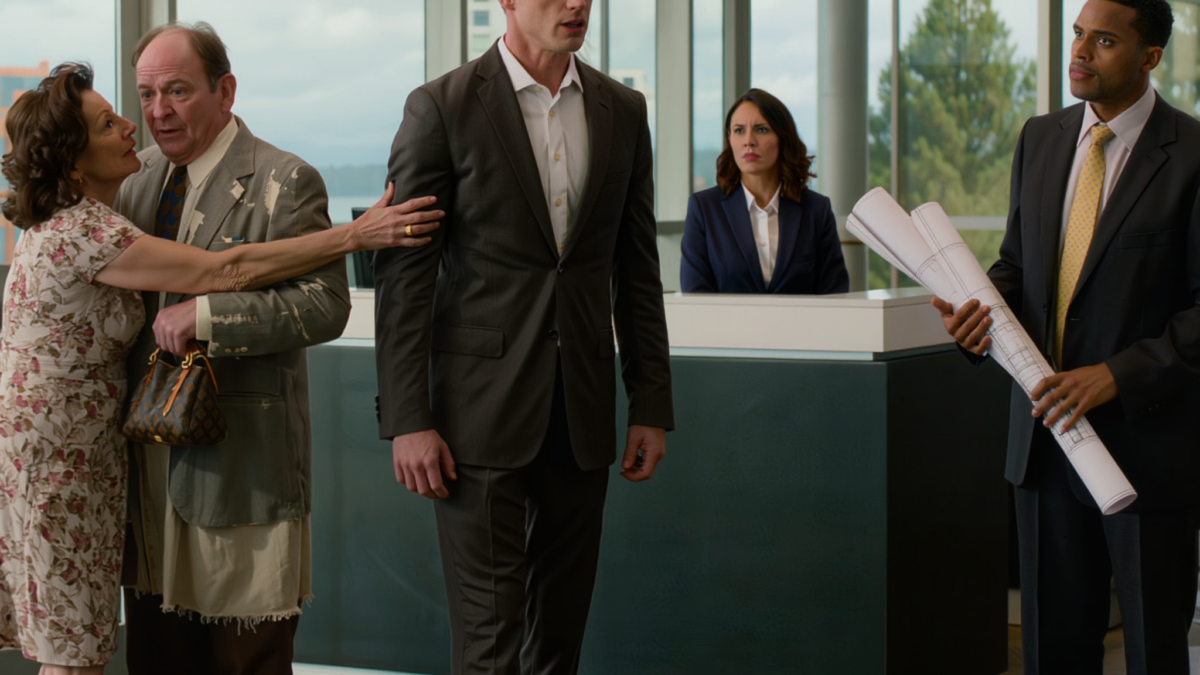
Richard and Beatrice were standing near the reception desk.
Sixteen years had changed them.
My father no longer looked like the intimidating corporate consultant who had once filled our kitchen with his authority.
His gray sport coat hung loosely from his shoulders. His hair had thinned and turned white. His posture was lower.
My mother wore a floral dress and clutched a designer-style purse tightly in both hands.
Maya, my receptionist, looked uncomfortable.
Beatrice stepped forward.
“Nathaniel. Oh, sweetheart. Look at you.”
She opened her arms and tried to hug me.
I stepped back.
Her arms stayed suspended for a moment before she lowered them.
“We saw your firm featured in a regional commercial real estate journal,” she continued. “Brooks and Sterling. We recognized the name immediately.”
She smiled too brightly.
“We are so proud of you. We always knew you had this kind of greatness in you.”
I almost laughed.
Instead, I asked the only question that mattered.
“What exactly are you doing here?”
Richard stepped forward.
“We need to talk privately.”
He glanced around at the employees moving through the lobby.
“Family sticks together in difficult times. Things have become complicated with the economy and the real estate market. We need to discuss a financial arrangement.”
I could have asked security to escort them out.
Instead, I turned toward Dominic.
“Put those plans on my desk. I’ll meet you in twenty minutes.”
“Yes, sir.”
Dominic looked at my parents for a moment before walking away.
I gestured toward the boardroom.
“In there.”
They followed me.
The room had a long conference table surrounded by black leather chairs and windows overlooking Seattle.
I walked to the head of the table.
Richard and Beatrice sat at the opposite end.
“Speak.”
My mother opened her purse and pulled out a tissue.
“It’s Julian,” she began. “Your brother is in terrible trouble. And because of that, your father and I are facing a financial catastrophe.”
Then the story came out.
While I had been working through high school and college, my parents had continued financing Julian’s life.
They paid for two private colleges.
He left both during his first year.
Then came business ventures.
First, an upscale cocktail lounge.
My parents supplied much of the startup money and personally guaranteed the commercial lease.
Julian spent heavily on the interior, including imported finishes and expensive furnishings.
The business failed within months.
There were unpaid vendors and significant debts.
After that came a luxury clothing company.
That venture accumulated hundreds of thousands of dollars in supplier obligations after Julian ordered inventory he could not sell.
Each time Julian failed, my parents stepped in.
They refinanced.
They withdrew retirement funds.
They borrowed against the house.
They paid settlements and bills.
They kept supporting the expensive lifestyle he wanted because they remained convinced that one more opportunity would finally prove he was the brilliant entrepreneur they believed him to be.
Eventually, Richard’s consulting income declined.
Property values softened.
Their adjustable debt became harder to manage.
Still, they tried to maintain appearances.
“We couldn’t let people at the country club or the homeowners association know,” Richard admitted.
I stared at him.
Even while losing nearly everything, they had been worried about what the neighbors thought.
“And where is Julian now?”
My mother looked down.
“He left.”
When the bank’s foreclosure notices arrived, Julian packed his remaining belongings and drove to Southern California.
He was dealing with a divorce and a custody dispute.
He changed his phone number.
He stopped answering his parents’ calls.
The son they had protected from every consequence had disappeared as soon as the consequences reached their doorstep.
Richard straightened slightly.
For a moment, I saw the old version of him return.
The man who believed authority alone could create an obligation.
“Julian needs money to get back on his feet,” he said. “He needs legal help. Your mother and I need this mortgage resolved before the bank takes the house.”
He looked directly at me.
“As our eldest son, you have a duty to fix this. Family is family, Nathaniel.”
I said nothing.
“You need to clear the mortgage,” he continued, “and you should establish a trust that allows Julian to secure a decent home while he deals with custody.”
Then came the line that nearly took me back sixteen years.
“After everything we gave you, after the roof we put over your head for eighteen years, you owe us this much.”
I looked toward the rain streaking the windows.
The refrigerator.
The pantry.
The newspaper route.
Samuel’s sandwich.
Julian’s Porsche.
The lease.
The garbage bags.
My parents truly believed the roof over my head had erased everything else.
I reached down for my briefcase.
Inside was a folder I had prepared after learning they were coming to my office.
I placed it on the table and slid it toward my father.
“Open it.”
Richard hesitated before lifting the cover.
The first document was a copy of pages from my old yellow notebook.
I had kept it all those years.
My teenage handwriting still filled the pages.
Food.
Clothing.
School materials.
Medicine.
Dental costs.
Every expense I had tracked between fourteen and eighteen.
“That is the ledger I kept while I was living in your house,” I said. “It records what I earned and what I had to spend on basic necessities.”
My mother stopped looking at me.
I continued.
“My accounting department adjusted the total for inflation.”
The amount came to $32,412.16.
Richard stared at the number.
“That,” I said, “is approximately what it cost me to support myself while living under your roof.”
Neither of them answered.
“Turn the page.”
Richard did.
Underneath was a preserved copy of the month-to-month lease agreement he had given me on my eighteenth birthday.
Eight hundred dollars a month.
Utilities extra.
No grace period.
He recognized it immediately.
“You sat in your kitchen and handed this to me the morning I turned eighteen,” I said. “I had just graduated as valedictorian and was leaving for college in two months.”
Richard’s face tightened.
“That was tough love,” he said.
There it was.
The old justification.
“You were stubborn. We were teaching you the reality of the world. Look at you now. You became successful because we refused to coddle you.”
“No.”
The word came out quietly.
“My discipline built this company. My education helped me build it. My decisions built it.”
I kept my eyes on him.
“What you did was something I had to survive. You do not get credit for the life I built after I left.”
The boardroom went quiet.
Then I pointed to the remaining documents.
“There is one more thing you should read.”
Richard lifted the final pages.
They carried the name of First Regional Bank and the corporate information for our holding company.
His eyes moved across the first page.
Then the second.
I watched him understand.
“Two weeks ago,” I said, “our real estate company purchased a portfolio of delinquent commercial and residential debt from First Regional.”
Beatrice leaned forward.
Richard kept reading.
“The portfolio included nonperforming commercial properties, warehouses, retail sites, and residential loans.”
I paused.
“One of those loans was the severely delinquent second mortgage on your house.”
My mother made a small sound.
Richard looked up.
I continued before he could speak.
“The house on West Hill. The house you still live in.”
He stared at me.
Our holding company now controlled the debt they had come to beg someone else to forgive.
“I do not owe you Julian’s expenses,” I said. “I do not owe you a bailout. I do not owe you repayment for being allowed to exist in your house as a child.”
I pointed toward the documents in his hands.
“But according to these records, you owe our holding company approximately $460,000 in delinquent mortgage obligations, fees, and accumulated penalties.”
For once, Richard had nothing to say.
My parents had entered my office believing I was simply the wealthy son they could pressure into rescuing them.
Now they understood that the company they needed to negotiate with was mine.
Beatrice looked at me.
“No. Nathaniel, please.”
I did not enjoy seeing her frightened.
That surprised me.
For years, I had imagined that someday justice would feel dramatic.
It did not.
It felt quiet.
Heavy.
Almost administrative.
Richard tried one last time.
“We’re still your parents.”
I nodded.
“Yes.”
That was true.
It simply did not give them control over me anymore.
I reached into my jacket and placed another document on the table.
“I am not going to force you out today.”
Both of them looked up.
“I run a real estate business. An occupied property generating consistent rent is often more practical than an empty one requiring immediate maintenance.”
I slid the document toward them.
Richard looked at the heading.
His face changed again.
It was a month-to-month residential lease agreement.
The structure closely resembled the agreement he had handed me years earlier.
“You can remain in the house,” I said. “You will maintain the property and landscaping. You will pay your own utilities.”
Then I pointed to the monthly amount.
“Rent is $800.”
Richard stared at me.
“Due on the first of the month.”
I paused.
“No exceptions. No grace periods. Pay on the first or move out.”
His hand trembled slightly as he reached for the pen.
For a moment, the two kitchens existed in my mind at the same time.
The one from my eighteenth birthday, with my father sliding a lease toward me.
And the boardroom where he now sat holding mine.
He signed.
My mother signed beneath him.
I checked the signatures.
Then I gathered the paperwork.
“You can go.”
They stood slowly.
There was no apology.
No final explanation.
No attempt to rewrite the past again.
They walked out of the boardroom and toward the elevators.
Maya watched them leave.
The glass doors closed behind them.
That evening, while I was reviewing architectural drawings at home, my cell phone rang.
The caller was my aunt Clara, my mother’s older sister.
I had not spoken to her in years.
Apparently, she had been following my career through business publications and property records and had been feeding information about my success back to my parents.
“Nathaniel,” she began, “I heard about the terrible misunderstanding at your office.”
I leaned back in my chair.
“Your parents are devastated. They only ever wanted what was best for you. And Julian is going through such a difficult divorce. Surely someone in your position can help his own family.”
“Clara.”
She stopped.
“Do not call my private number again. Do not send my parents to my workplace. If anyone continues interfering with my employees or contacting me after I have asked them to stop, I will handle it through the appropriate legal channels.”
She tried to interrupt.
“I’m serious.”
There was a pause.
Then the call ended.
That was the last time I allowed an extended relative to negotiate with me on my parents’ behalf.
As for Julian, I never gave him money.
Without the financial support my parents had provided for years, his life became much less comfortable.
His divorce in California was finalized.
His financial history and unstable income became part of the custody proceedings. He moved into a small apartment and took a retail job while continuing to meet his court-ordered financial obligations.
For the first time, he had to live within the limits of what he actually earned.
My parents remained in the house on West Hill.
Every month, a certified check for $800 arrived at our accounting department.
They were no longer the owners in the way they had once imagined themselves to be.
They were tenants.
For the first time in many years, I thought about the phrase my father had used when I was eighteen.
“Welcome to the real world. Nothing is free.”
The irony was obvious.
But over time, even that stopped feeling important.
The real change happened inside me.
For most of my adult life, I had been building security as if I were still fourteen years old.
Every contract.
Every building.
Every investment.
Every property.
Some part of me had been trying to construct a wall high enough that nobody could ever put a padlock between me and a meal again.
Standing alone in my boardroom after my parents left, I finally understood that I no longer needed to live entirely from that fear.
I had already survived.
I had already built the life I wanted.
Their choices no longer controlled it.
Brooks and Sterling continued to grow across the Pacific Northwest.
We designed commercial projects, sustainable developments, technology campuses, and urban spaces where people could build businesses of their own.
The work became about more than proving I was safe.
It became about creating things that would remain long after the fear that had motivated me was gone.
Years earlier, I had eventually purchased the commercial property where Samuel’s diner operated.
I had never forgotten the sandwiches he pretended were leftovers.
When the opportunity came, I made sure he understood that his kindness had mattered.
Marcus remained part of my life too.
Neither man shared my last name.
Neither had been legally obligated to help me.
One fed me when I was hungry.
The other gave me a couch when I had nowhere to sleep.
They taught me something my parents never had.
Family is not defined only by biology.
It is also defined by what people choose to do when you are vulnerable.
Eventually, I bought a secluded piece of property overlooking the waters of Puget Sound and designed my own home.
I paid attention to every detail.
The kitchen receives natural light from large skylights.
The pantry has open glass doors.
There is no lock on the refrigerator.
There is no lock on the food.
It is a home designed for peace instead of survival.
Nobody who enters it is charged for the right to belong there.
For years, I had believed justice would arrive as some enormous moment when my parents finally understood everything they had done.
That never really happened.
They never gave me the apology I once imagined.
They never sat down and admitted that what they had called “tough love” was wrong.
Richard continued to believe that hardship had made me successful.
Beatrice preferred not to discuss the past at all.
Eventually, I stopped needing either of them to agree with my version of what happened.
I knew what happened.
I had the notebook.
I had the lease.
More importantly, I had the memory of a fourteen-year-old boy standing in front of a locked refrigerator, wondering how he was going to eat.
I also had the memory of Samuel pretending a sandwich was worthless because he knew I was too proud to accept pity.
I had Marcus opening his apartment door without asking for an explanation.
Those memories belonged to the same life.
One taught me what abandonment looked like.
The others taught me what care looked like.
For a long time, my parents used the word “family” as if it were a debt I could never finish paying.
They believed biology created a permanent obligation to tolerate whatever they demanded.
I no longer believe that.
Biology makes people relatives.
Trust, loyalty, care, and respect are what create family.
Sometimes protecting yourself means leaving.
Sometimes it means refusing to finance someone else’s choices.
Sometimes it means accepting that the people who were supposed to love you may never understand the damage they caused.
Walking away at eighteen was terrifying.
There were nights in Marcus’s basement apartment when I was exhausted, frightened, and painfully aware that I had no parents I could call if everything went wrong.
There were nights in college when I had almost no money and wondered whether all the work would ever lead anywhere.
But that period ended.
The peace that came afterward lasted.
My parents once taught me, in the harshest possible way, that security could disappear whenever the person controlling it decided to change the rules.
I spent years responding by trying to control everything myself.
Eventually, I learned something better.
Security is not about controlling everyone around you.
It is about having enough stability, enough boundaries, and enough confidence to know that someone else’s manipulation does not determine your future.
My father locked the refrigerator when I was fourteen.
At eighteen, he told me to pay rent or leave.
So I left.
Sixteen years later, when he sat across from me asking for the financial rescue he once refused to give his own child, I did not need revenge.
I needed a boundary.
For the first time, that boundary belonged entirely to me.








