I was 13 when my mom threw me out to pay for my brother’s football camp and said, “Harold’s your problem now.” Fifteen years later, she smirked at Harold’s will reading, expecting a payout—until I placed one document from 2010 on the table, the same paper she had signed when she decided I was no longer her responsibility.
My name is Jonathan Meyers. I am 32 years old, and 15 years ago, my parents looked me in the eye and chose my brother over me. They didn’t just choose him. They erased me to make room for him.
Last week, those same people walked into a conference room in Seattle, expecting to inherit a fortune from the man who saved my life.
To understand why I did what I did in that boardroom, you have to understand the kitchen table in Southeast Portland in the spring of 2010. I was 13. That’s a tough age for any kid. But in the Meyers household, it was a battlefield. I just didn’t realize I was the only one without armor.
My brother Tyler was 15. In my mother’s eyes, Tyler was the son, and the rest of us were just planets lucky enough to orbit him. He was the athlete, the golden boy.
My father, Richard, just went along with whatever Sandra said. He was a mechanic who came home, drank a beer, and nodded. If Sandra said the sky was green, Richard would compliment the shade of emerald.
I was the mistake. I was the budget deficit.
It was a Tuesday in April. I remember because it was raining, that relentless gray Oregon drizzle that soaks into your bones. I had run all the way home from the bus stop, clutching a large, thick envelope inside my jacket to keep it dry.
I burst into the kitchen. My mom was chopping onions for meatloaf. Tyler was sitting at the table, scrolling on his phone, his feet up on a chair.
“I got it,” I said, breathless. I slapped the envelope on the table. “The Oregon STEM Summer Academy. I got in.”
My mom didn’t stop chopping.
“That’s nice, Jonathan. Don’t put wet paper on the table.”
“No, Mom. You don’t get it,” I said, ripping it open. “It’s the residential program at Oregon State. Six weeks. Advanced coding, robotics. And look.”
I pulled out the acceptance letter, smoothing the crease.
“Full scholarship for tuition. Covers the classes.”
Tyler snorted without looking up.
“Nerd camp. Have fun with the virgins.”
“Shut up, Tyler,” I said, but I was too happy to let him ruin it. “Mom, look. It’s worth $4,000.”
Sandra finally put the knife down. She wiped her hands on a dish towel and picked up the letter. She scanned it, her face unreadable. I waited for a smile. A “good job.” Anything.
“It says here,” she said, tapping a line with her fingernail, “that the scholarship covers tuition. It doesn’t cover room and board or the materials fee.”
“Yeah,” I said, my heart stuttering a little. “But that’s the smaller part. It’s—let me see.”
I looked at the paper.
“It’s $1,200 for the room and food for six weeks and $300 for the robotics kit. So, $1,500 total.”
I looked at her, hopeful.
“I have $300 saved from mowing lawns. I just need you guys to cover the rest. It’s an investment, Mom. This is for college.”
Sandra dropped the letter back onto the table like it was a bill she didn’t want to pay. She looked at Tyler.
“Tyler got into the elite football camp in California,” she said.
My stomach dropped.
“Okay.”
“It’s three weeks,” Tyler said, finally looking up. He had that smug grin that always made me want to punch him. “Scouts from USC and Oregon are going to be there. It’s big time.”
“How much is it?” I asked.
“$2,000,” my mom said. “Plus airfare and new gear.”
I did the math in my head.
“Okay, so Tyler’s camp is like three grand. Mine is $1,200. Can’t we do both?”
My dad walked in then, wiping grease off his hands with a rag. He grabbed a beer from the fridge.
“Do both what?”
“Jonathan wants to go to science camp,” Mom said, her voice flat. “He needs $1,200.”
“We don’t have it,” Dad said immediately. “Money’s tight, John. You know that.”
“But you’re sending Tyler to California,” I shouted. The unfairness hit me like a physical blow. “That costs twice as much, and he didn’t even get a scholarship. I earned this. I beat out 2,000 other kids.”
“Lower your voice,” Mom snapped. Her eyes went cold. “Tyler has a future in football. That scholarship is real money down the line. We have to prioritize. We can’t afford to send both of you.”
“So send me,” I pleaded. “I actually got the award. Tyler just signed up.”
“Watch your mouth.”
Tyler stood up, stepping toward me. He was bigger, broader.
“I’m the one who’s actually going to do something with my life. Who cares about robots?”
“Diana,” Mom said.
She sometimes confused me with her sister when she was mad, but she corrected herself.
“Jonathan, you will decline the acceptance. Tell them you can’t go. Maybe next year.”
“There is no next year for this program. It’s for eighth graders.”
I felt tears stinging my eyes, hot and humiliating.
“Why does he always get everything? Why am I always the one who has to give up?”
“Because he has potential,” Mom shouted, slamming her hand on the counter.
The sound echoed in the small kitchen.
“He has talent. You’re just smart. Smart doesn’t pay the bills, Jonathan. Charisma does. Talent does. Now go wash up for dinner.”
I stared at them, the three of them. A unit, a triangle that didn’t have room for a square.
“No,” I said.
The silence was instant. Even the refrigerator seemed to stop humming.
“Excuse me?” Dad asked, lowering his beer.
“I said, ‘No, I’m not declining it. This scholarship isn’t your money to redirect. I earned it. It’s mine. If you won’t pay the room and board, I’ll ask Uncle Harold.'”
My mother’s face went chalk white. Uncle Harold was Dad’s older brother. They hadn’t spoken in eight years. I didn’t know why back then. I just knew his name was a dirty word in our house.
“You will not,” she hissed. “You do not air our family business to that man.”
“Then pay for the camp,” I yelled. “Treat me fairly for once in your life.”
My mother walked around the island. She stopped inches from my face. I could smell the onions on her hands.
“If you can’t sacrifice for this family,” she said, her voice dropping to a terrifying whisper, “then you aren’t part of this family.”
I thought she was being dramatic. I thought it was just another fight. I stormed upstairs, slammed my door, and threw myself on my bed. I cried until I fell asleep, clutching that acceptance letter.
I didn’t know that downstairs, a phone call was being made. I didn’t know that my father was signing a paper on the kitchen table.
Three days later, I came home from school. I walked up the driveway and saw something weird. Two black garbage bags were sitting on the front porch. They looked lumpy, misshapen.
I walked up the steps, my heart hammering a weird rhythm against my ribs. I recognized the corner of my checkered bedspread poking out of a tear in the plastic.
I tried the front door. Locked. I knocked.
“Mom? Dad?”
Nothing.
I went to the window and peered in. The house was dark, but I saw movement in the kitchen. My mother was standing there, arms crossed, watching me. She came to the door and opened it a crack, keeping the chain on.
“I called Harold,” she said.
No emotion, just business.
“He agreed to take you. He’ll be here at 6.”
“What?” I stepped back. “Mom, what are you talking about?”
“We can’t handle you, Jonathan. You’re disruptive. You’re selfish, and we can’t afford you.”
She looked at me like I was a stranger soliciting donations.
“You made your choice. You wanted Harold’s help. Now you belong to him. From now on, you’re his problem.”
She slammed the door. I heard the deadbolt slide home.
“Mom!”
I pounded on the wood.
“Mom, stop. I’m sorry. I won’t go to the camp. Mom!”
Nothing.
I ran to the backyard. The sliding glass door was barred with a piece of wood. I ran back to the front.
I looked up at the second floor.
The curtain in Tyler’s room moved. I saw him. He was standing there, looking down at me.
“Tyler!” I screamed. “Tyler, let me in. Tell them to let me in.”
He looked at me. His face was pale. For a second, I thought he was going to turn around and run downstairs to save me. We were brothers. We shared a room for ten years.
Then he reached out and pulled the curtains shut. He turned his back on me.
I sat down on the garbage bags. It started to rain again. I sat there for four hours.
The sun went down. The streetlights flickered on. The neighbors drove by, slowing down to look at the kid sitting on trash bags in the rain, but nobody stopped. My parents were inside watching TV. I could see the blue flicker of the screen through the living room blinds.
They were watching American Idol. I knew the schedule. They were eating dinner without me. I was 13 years old, and I realized with a clarity that shattered my childhood that I was homeless.
At 9:45 p.m., a gray Honda Accord turned onto our street. It drove slowly, checking house numbers. It pulled into the driveway, the headlights sweeping over me, blinding me for a second.
A man got out. He was tall, wearing a tan raincoat and glasses. He looked like my dad, but sharper, cleaner. He walked up the driveway, ignoring the rain. He looked at the house, then at the garbage bags, then at me.
I was shivering so hard my teeth were chattering.
“Uncle Harold?”
He didn’t say a word. He knelt down on the wet concrete right in front of me. He took off his raincoat and wrapped it around my shoulders. It was warm and smelled like peppermint and old paper.
He looked me in the eyes. His eyes were kind. Sad, but kind.
“Grab the bags, John,” he said quietly.
“Did they really kick me out?” I asked, my voice cracking.
Harold looked at the dark house. He looked at the door that remained shut.
“Come on, son,” he said. “Let’s go home.”
He didn’t mean that house. He meant his house.
I got in the passenger seat of the Honda. As we backed out of the driveway, I looked at my childhood home one last time. The porch light never turned on.
That was the night Jonathan Meyers died, and something else was born.
The drive to Seattle took three hours. Harold didn’t blast the radio. He didn’t ask me twenty questions. He stopped at a diner off I-5 and bought me a burger and a milkshake. He watched me eat like a starving animal.
“I know you’re scared,” he said, stirring his coffee. “But you need to know something. You didn’t do anything wrong. This isn’t on you.”
“They said I was selfish,” I mumbled, wiping ketchup off my chin.
“They are fools,” Harold said.
The steel in his voice surprised me.
“And they are broke. Not just in money, but in spirit. You’re better off, Jonathan. It doesn’t feel like it right now, but you are.”
Harold lived in the Ballard neighborhood of Seattle. His house wasn’t a mansion. It was a sturdy two-story Craftsman with a wraparound porch and a detached garage. It was filled with books, stacks of Architectural Digests, biographies, history books.
“This is your room,” he said, opening a door on the second floor.
It was clean. It had a desk, a bed with a real quilt, not a sleeping bag, and a window that looked out toward the Puget Sound.
“We’ll get your clothes washed tomorrow,” he said. “Get some sleep.”
I didn’t think I could sleep, but the moment my head hit the pillow, I passed out. I felt safe. For the first time in years, I wasn’t walking on eggshells.
Over the next few weeks, I learned who my uncle Harold really was. My dad had always called him “Stuck-up Harold” or “the miser.” The truth was, Harold was a genius.
He had started with nothing, working double shifts at a lumberyard, saving every penny until he could buy a small duplex. He lived in one half, rented the other. Then he bought another and another.
By 2010, he owned Meyers Property Holdings. He had 12 commercial properties and three apartment complexes across Seattle. He wasn’t flashy. He drove that gray Honda Accord until the wheels practically fell off. He wore suits from Macy’s, but he was worth millions.
He didn’t just give me a room. He gave me a life.
He paid for the STEM camp. He drove me there himself. When I came back, he asked me about every project. He actually listened.
“You have a mind for systems, John,” he told me one night over a game of chess. “You see how things connect. That’s a rare skill. Don’t waste it.”
I didn’t.
I threw myself into school. I wanted to prove my parents wrong. I wanted to prove that the spare child was worth something.
I graduated high school as valedictorian.
My parents weren’t there. Harold sat in the front row, beaming, holding a camcorder.
I went to the University of Washington. I studied finance and accounting. I graduated summa cum laude. Harold was there.
I got my CPA license. I worked at a Big Four accounting firm for two years. Grueling hours, learning the guts of corporate finance.
In 2021, Harold called me into his office. He was 68 then and slowing down.
“I need a CFO, John,” he said. “I’m tired of dealing with outside consultants who don’t care about the tenants. Come work with me.”
I quit my job the next day. I took over the financials of Meyers Property Holdings. I modernized our systems, renegotiated our debt, and expanded our portfolio into the East Side market.
Under my watch, the company’s value grew from $18 million to $23.7 million in four years. I was 26 years old, managing a multimillion-dollar portfolio. I bought my own condo in Belleview. I bought a nice car, not a Ferrari, just a solid Audi A6.
I was building a life. But there was a hole, a silence where my family used to be.
In 15 years, my biological family reached out exactly three times.
The first was in 2012. I was 15. My mom called Harold’s landline. I picked up.
“Hello?”
“Harold?”
“No, it’s Jonathan.”
Silence, then:
“Oh. Is your uncle there?”
No “How are you?” No “I miss you.”
I handed the phone to Harold. I listened from the hallway.
“No, Sandra,” Harold said, his voice cold. “I will not lend you $5,000. I don’t care if Richard lost his job. That is not my problem. No, you cannot speak to him. You lost that privilege.”
He hung up. He looked at me, his jaw tight.
They wanted money for a new transmission for Tyler’s truck.
The second time was in 2016. I received a heavy cream envelope in the mail, a wedding invitation. Tyler Meyers and Ashley Williams. There was no note, no personal message, just a registry link for Williams Sonoma.
They wanted a $400 blender. I threw it in the trash. I didn’t send a gift. I didn’t go.
The third time was in 2020. My mom sent an email to my work address. She must have found it on the company website.
Subject: Saw you in the paper.
“Jonathan, saw the article about the new building project. You look well. We should catch up sometime. Your father isn’t doing great with his back. Hope you’re happy. Mom.”
“Hope you’re happy.” It sounded like a dare.
I deleted it.
But there was something I didn’t know. A secret legal maneuver that Harold had executed years ago. It started back in 2010, that first week I arrived. Harold had a lawyer come to the house. I had to sit in the living room while they discussed guardianship.
Then, in 2012, when I turned 15, Harold took me to a courthouse.
“What are we doing here?” I asked.
“Making sure you’re safe,” he said. “Permanently.”
We went before a judge. There were papers. Lots of papers. The judge asked me if I agreed. I said yes, though I didn’t fully grasp the magnitude of it at the time.
I thought it was just about who signed my report cards. I didn’t realize until much later that the document I signed that day was a shield. A shield against the vultures.
Fast-forward to the summer of 2024. Harold started getting short of breath. His ankle swelled. Congestive heart failure. The doctors gave him six months.
I moved back into the house in Ballard to take care of him. I ran the company from his dining room table. We spent the nights talking. He told me stories about his childhood, about how my dad, Richard, had always been the charming one, the one who borrowed money and never paid it back.
“Richard has a hole in his pocket and a hole in his soul,” Harold said, hooked up to his oxygen tank. “He feels the world owes him. Don’t ever let him make you feel like you owe him.”
“I won’t,” I promised.
One night in January 2025, Harold grabbed my hand. His grip was weak.
“John,” he wheezed. “When I go, they will come. You know that, right?”
“They haven’t spoken to us in years, Uncle Harold.”
“Money has a smell,” he whispered. “It draws predators. I’ve set it up, John. I’ve built the walls, but you have to be the one to close the gate. Promise me you won’t let them take what we built. Promise me you won’t settle.”
“I promise,” I said, choking back tears. “I won’t give them a dime.”
He smiled.
“Good. The files are in the safe. The golden file. Use it only if you have to.”
Harold Raymond Meyers passed away on February 28th, 2025. He died in his sleep while I was reading to him from a history book about the building of the Space Needle.
I was alone. The silence in that house was deafening.
I buried him three days later. It was a small service. His staff came. His tenants came. The barista from the coffee shop he went to for 20 years came.
My parents didn’t come. Tyler didn’t come.
I thought maybe, just maybe, they would stay away forever.
I was wrong.
One week. That’s how long it took.
On March 7th, I was sitting in Harold’s office, my office now, staring at a lease renewal for a warehouse in Sodto. My phone buzzed. An unknown number from Portland, area code 503.
I knew. My gut clenched. I answered.
“This is Jonathan.”
“Jonathan.”
The voice was unmistakable. It was raspy, a little higher-pitched than I remembered, but it was her. Sandra.
“Hello, Sandra,” I said.
I kept my voice neutral, businesslike.
“Sandra?” She sounded offended. “Is that what you call your mother?”
“You lost the title Mom when you put me on the curb,” I said. “What do you want?”
“I—I heard about Harold,” she said.
Her tone shifted, becoming syrupy, fake sad.
“I’m so sorry, Jonathan. I know you were close. We wanted to come to the funeral, but we didn’t know when it was.”
“It was online,” I said. “If you cared, you would have looked.”
“Well, things have been crazy here,” she sighed. “Your father’s back is terrible. And Tyler, well, the economy is tough. But we’re family. We should be there for each other in times of grief.”
I waited. I knew the pivot was coming.
“Anyway,” she continued, “I assume there’s going to be a reading of the will. As Harold’s only living brother, your father wants to pay his respects and ensure everything is handled properly.”
“Everything is handled,” I said. “You don’t need to worry about it.”
“Actually”—her voice hardened, the syrup dissolving instantly—”we do. We have a right to be there. We’ve hired representation, Jonathan, just to make sure everything is fair.”
“Representation?”
I almost laughed.
“You hired a lawyer?”
“Mr. Victor Harrington,” she said smugly. “He says that as immediate family, we have claims, especially since Harold was unwell at the end. We’re concerned about undue influence.”
My blood ran cold. Undue influence. That was the legal term for manipulating a sick person into changing their will. She was accusing me of taking advantage of the man who saved me.
“Don’t come to Seattle, Sandra,” I said.
“We’ll see you on the 14th,” she said. “We know the date. Mr. Harrington made some calls.”
She hung up.
I sat there shaking, not with fear, but with rage. They didn’t care that he was dead. They only cared about what he left behind.
I called Margaret Morrison immediately. Margaret was Harold’s estate attorney, a sharp-witted woman in her 60s who had known me since I was a teenager. I went to her office in the Columbia Center an hour later.
“They filed a caveat,” Margaret said, sliding a document across her polished mahogany desk. “Victor Harrington. I know him. He’s a pit bull. Not the smartest, but loud.”
“What are they claiming?”
“That you isolated Harold,” Margaret explained. “That you poisoned him against his brother. They’re arguing that the estate should follow intestacy laws, meaning if the will is invalid, it goes to the next of kin, which would be Richard.”
“That’s a lie,” I said. “Harold hated them.”
“I know that. You know that,” Margaret said calmly. “But proving it in court can take years. They know that, too. They’re fishing for a settlement, Jonathan. They want us to cut them a check for $500,000 just to make them go away.”
“No,” I said.
“It’s the logical move,” Margaret advised gently. “The estate is frozen while this is contested. It could cost you more in legal fees to fight them.”
“I don’t care,” I said.
I stood up and walked to the window. Seattle lay spread out below me, gray and beautiful.
“Harold made me promise. He said not to give them a dime. If I settle, I’m admitting I did something wrong. I’m admitting I manipulated him.”
I turned back to her.
“We fight. I want the will reading to proceed. I want them in the room.”
Margaret studied me over her glasses. A small smile touched her lips.
“I was hoping you’d say that. Harold hoped so, too.”
“What do you mean?”
“Harold left instructions for this exact scenario,” she said. “He called it the nuclear option.”
I remembered Harold’s words. The golden file.
“I have the file,” I said. “It’s in the safe at the house.”
“Bring it,” Margaret said. “And Jonathan, wear your best suit.”
That night, I opened the wall safe in Harold’s study. Inside was a thick, yellowed manila envelope labeled “Richard and Sandra. Do not open unless necessary.”
I sat on the floor and opened it. I read through the documents. My hands shook as I turned the pages. There were emails, promissory notes, and at the bottom, a document from 2010 with four signatures.
I stared at that document for a long time. It was the smoking gun. It was the proof of their cruelty preserved in ink.
I called my best friend, Elena. She was the HR director at our company.
“Elena, I need you to pull the visitor logs for the last five years,” I said. “And I need the donor records for the children’s hospital.”
“Are they really coming?” Elena said.
“Yeah,” I said, closing the file. “They’re coming for the money, but they’re going to get something else.”
“You okay, John?”
“I will be,” I said. “After Friday.”
Friday, March 14th, 2025, the day of the reckoning.
I woke up at 5:00 a.m. Couldn’t sleep. I went for a run in the drizzle, pushing myself until my lungs burned. I needed to burn off the adrenaline.
I showered and dressed. I put on a charcoal-gray suit, tailored perfectly, a crisp white shirt, a black tie. I dressed like the CFO I was, not the scared kid on the porch.
I drove to the office. I didn’t take the Audi. I took Harold’s old Honda Accord. Felt right.
I arrived at Margaret’s office at 1:30 p.m. The reading was scheduled for 2:00. The conference room was impressive. Floor-to-ceiling windows, a long oval table that could seat 20.
“We have guests,” Margaret said, nodding to the chairs lining the wall.
Sitting there were three people I didn’t expect to see in a legal battle.
“Dr. Patricia Wells from Seattle Children’s Hospital, a representative from Habitat for Humanity, and a ranger from the Olympic National Park Foundation.”
“Why are they here?” I asked.
“Beneficiaries,” Margaret said. “Harold wanted witnesses. Neutral witnesses.”
Smart. Harold was always three steps ahead.
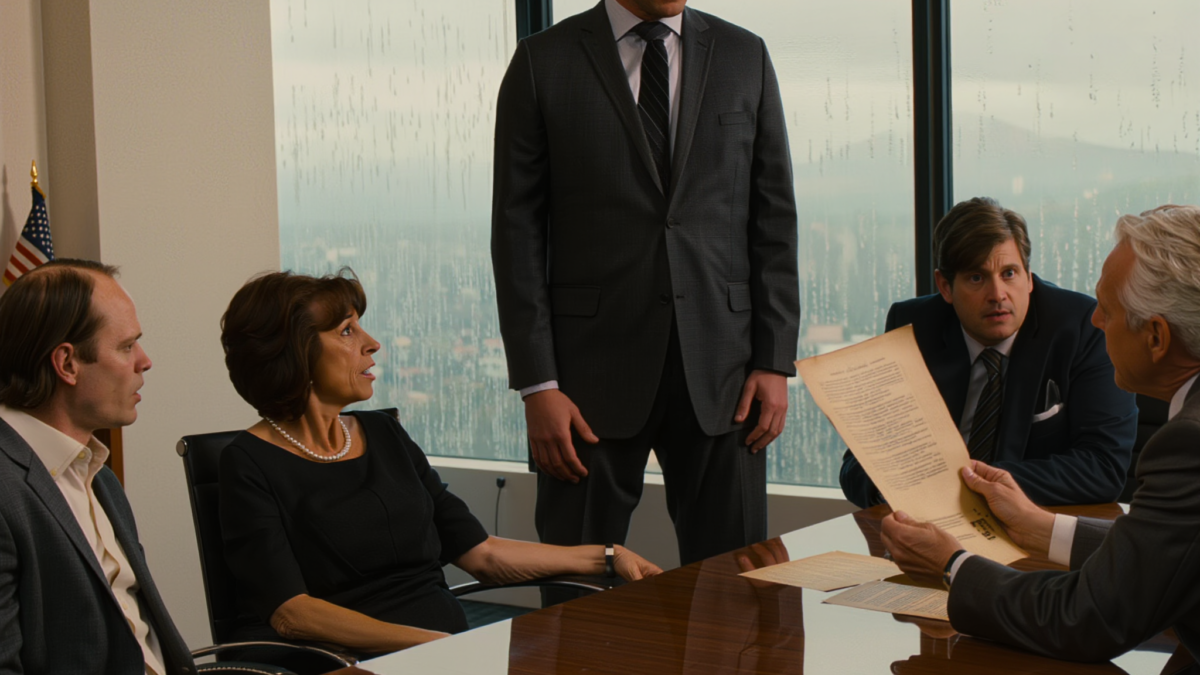
At 1:55 p.m., the elevator chimed. I stood at the head of the table, my back to the window. I clasped my hands behind my back and waited.
The doors slid open. Sandra led the way.
She was wearing a black dress that looked brand new, with a string of pearls that were definitely fake. She walked with her chin up, scanning the room like she was inspecting a hotel room she planned to complain about.
Richard followed. He looked old. His suit was tight around the middle. He walked with a shuffle. He wouldn’t meet my eyes.
Then Tyler, my brother, the golden boy. He didn’t look golden anymore. He looked tired. He was wearing khakis and a blazer that didn’t match. His hairline was receding. He looked like a guy who worked hard and drank hard to forget how hard he worked.
And finally, Victor Harrington, the lawyer. He was a tall man with silver hair and a tan that came from a bottle. He carried a Montblanc briefcase and had the arrogant swagger of a man who bullied people for a living.
They entered the room. The air instantly felt heavier.
Sandra saw me, her eyes narrowed, then widened into a fake smile.
“Jonathan,” she exclaimed, opening her arms as if she expected a hug. “Oh, look at you. You look so corporate.”
I didn’t move. I didn’t smile.
“Sandra,” I nodded. “Richard. Tyler.”
My use of their first names hit them like a slap. Richard flinched.
“We’re family, John,” Tyler said, his voice rough. “You don’t have to be a dick.”
“Please take a seat,” I said, gesturing to the chairs on the opposite side of the table. “We’re about to begin.”
Victor Harrington slammed his briefcase onto the table.
“My clients will sit where they please, and we expect this to be a full and transparent disclosure of assets.”
“Sit down, Victor,” Margaret said from her seat at the head of the table.
Her voice was like a whip. Victor blinked. He recognized her.
“Margaret. I didn’t know you were handling the estate.”
“There’s a lot you don’t know,” Margaret said. “Please sit.”
They sat. The tension was so thick you could choke on it.
Sandra leaned over to Tyler and whispered loudly, “Just let them talk. We know what we’re entitled to.”
I looked at Tyler. For a second, our eyes locked. I looked for the brother who used to play catch with me. I looked for the guy who defended me from bullies in third grade. But all I saw was the guy who closed the curtains.
Margaret opened the heavy binder in front of her.
“This is the last will and testament of Harold Raymond Meyers,” she began.
The game was on.
The rain lashed against the glass of the 47th floor, creating a gray curtain around us. It was fitting. Inside, the air was sterile, smelling of coffee and expensive leather.
Margaret Morrison put on her reading glasses. She had a way of commanding a room without raising her voice. She was the only person I knew who could make Harold listen when he was being stubborn.
“Before we begin the reading of the specific bequests,” Margaret said, looking over her rims at Victor Harrington, “I want to address the caveat filed by Mr. Harrington’s office this morning regarding undue influence.”
Victor straightened his tie, looking smug.
“We stand by the filing. Mr. Meyers was isolated from his biological family during his final months. We have reason to believe he was coerced into altering his estate plan.”
“Coerced?” I spoke up. Couldn’t help it. “He didn’t want to see you. He had a phone. He had email. He chose not to answer you because you only called when you wanted money.”
“That is your narrative,” Sandra sniffed, dabbing at dry eyes with a tissue. “Harold was my brother-in-law. We loved him. But you, you always were manipulative, Jonathan. Even as a child, always twisting things to make yourself look like the victim.”
I clenched my jaw so hard my teeth ached. The audacity. She was rewriting history in real time.
“Let’s stick to the document,” Margaret cut in. “Mr. Meyers underwent a competency evaluation by a forensic psychiatrist one week before signing this will. The report is attached. He was of sound mind. The challenge has no merit, but we will proceed with the reading regardless.”
Victor frowned. A competency exam. That was a defensive move usually only taken when someone expects a fight. He scribbled something on his notepad.
Margaret turned the page.
“Article One: Payment of debts and expenses,” she read.
Standard stuff. Funeral costs, taxes.
“Article Two: Specific bequests to charity.”
Sandra shifted in her seat. She crossed her arms. I could see her thinking: Get through the charity crap so we can get to the real money.
“To Seattle Children’s Hospital,” Margaret read, “I bequeath the sum of $500,000.”
Sandra gasped audibly.
“$500,000?”
Dr. Wells nodded respectfully to me.
“To Habitat for Humanity, the sum of $300,000. To the Olympic National Park Foundation, $200,000.”
“That’s a million,” Richard blurted out. “He gave away a million dollars.”
“It’s his money, Richard,” I said.
“That’s reckless,” Sandra muttered. “Family should come first. Charity begins at home.”
“Article Three,” Margaret continued, her voice getting harder. “Regarding Richard James Meyers.”
The room went silent. Richard sat up straighter. He licked his lips. This was it. He was expecting the brotherly share. Maybe not half, but something significant. A million, two.
Margaret looked directly at Richard.
“I leave nothing to my brother, Richard James Meyers.”
The air left the room. Richard’s mouth opened, but no sound came out.
“This is a mistake,” Sandra said, standing up. “You’re reading it wrong. There must be a mistake.”
“Please sit down, Mrs. Meyers,” Margaret said. “I am not finished. Harold left a specific explanation for this exclusion, which he directed me to read into the record.”
“I don’t want to hear it,” Richard said, his face turning red.
“You need to hear it,” I said.
Margaret read from the will. Her voice was steady, unemotional, which made the words cut deeper.
“I make no provision for Richard, not out of malice, but out of accounting. In March of 2002, Richard borrowed $80,000 from me to start a custom motorcycle shop. He signed a promissory note agreeing to repay the principal plus four percent interest within five years. The shop closed in six months. The money was never returned. No payments were ever made.”
Margaret paused. She pulled a yellowed piece of paper from the file. The original promissory note.
“Calculated with compound interest over 23 years,” Margaret continued, “that debt now exceeds $210,000. I consider this unpaid debt to be his inheritance. We are even.”
Richard sank back into his chair. He looked like he’d been punched in the gut.
“That was a business deal,” he stammered. “Family forgives business deals.”
“Harold didn’t,” I said.
“This is outrageous.”
Victor Harrington stood up, channeling righteous indignation.
“You can’t disinherit a sibling based on a 20-year-old bad loan. There are laws regarding intestacy and familial obligation.”
“There are,” Margaret agreed. “But Richard is not the priority heir. Which brings us to Article Four.”
“Wait.”
Tyler spoke up. His voice was quiet.
“Does he say anything about me?”
I looked at my brother. He wasn’t angry like Sandra or shocked like Richard. He just looked resigned.
Margaret softened slightly.
“He does not mention you by name in the bequest section, Tyler. I’m sorry.”
Tyler nodded. He looked down at his hands.
“Figured.”
“But,” Sandra interrupted, her eyes wild, “if Richard gets nothing and the charities got a million, where is the rest? The estate is worth over $20 million. Who gets it?”
She pointed a shaking finger at me.
“Him?”
“You gave it all to him? The kid we kicked out.”
“Yes,” I said. “He gave it to the person who actually cared about him.”
“This is undue influence,” Victor shouted, slamming his hand on the table. “This proves it. You manipulated a dying man to give you everything and cut out his own flesh and blood. We will contest this. We will tie this estate up in probate for years. You won’t see a penny.”
Sandra was panting.
“We’re his family. We have rights. You were just a charity case he took in. You’re nothing.”
The insults washed over me. Years ago, they would have hurt. Now they just felt like confirmation.
“Margaret,” I said quietly. “It’s time.”
Margaret nodded. She reached into her folder and pulled out a document. It wasn’t the will. It was an older document. The paper was slightly different. The font dated.
“Mr. Harrington,” Margaret said, “before you file any more motions, you should examine this.”
She slid the document down the long table. It spun slowly and stopped right in front of Victor.
He picked it up. He adjusted his glasses.
He read the title.
His tan face went pale. Genuine, sickly pale.
“What is it?” Sandra demanded. “Victor, what is it?”
Victor looked up at me. His eyes were wide with horror. He looked at Sandra, then back at the paper.
“Victor?” Richard asked.
“It’s a relinquishment of parental rights,” Victor whispered.
Sandra froze.
“July 15th, 2010,” Margaret cited the date. “Signed by Richard Meyers and Sandra Meyers. Notarized. Filed with the state.”
“So what?” Sandra snapped, though her voice wavered. “We let Harold take guardianship. We signed some papers so he could enroll him in school. That doesn’t mean we aren’t his parents.”
“Actually,” I said, standing up, “that is exactly what it means.”
The silence in the room was absolute. Even the rain seemed to stop hammering against the glass. I walked around the table slowly.
I wanted them to see me. Not the boy on the porch, but the man who held the cards.
“You didn’t just sign guardianship papers, Sandra,” I said. “You signed a voluntary termination of parental rights. You were so eager to get rid of me, so eager to wash your hands of the burden, that you gave up everything. You legally declared that you were no longer my mother.”
“I—I didn’t know that’s what it meant,” she stammered. “It was just paperwork.”
“You knew,” I said. “Harold told me. You asked him if this meant you wouldn’t be liable for my college tuition. That was your specific question. And when he said yes, you signed the pen so hard you almost tore the paper.”
I looked at Victor.
“Mr. Harrington, explain to your clients what that document does to their claim of familial relationship.”
Victor swallowed hard. He loosened his tie.
“It—it severs the legal bond. Under the law, Jonathan is a stranger to you.”
“Strangers?” Richard whispered.
“But wait,” Victor tried to rally, though he looked weak. “Even if they aren’t his parents legally, Harold is still his uncle, and Richard is still Harold’s brother. If the will is thrown out for undue influence, Richard is still the next of kin.”
“That brings us to the second document,” Margaret said.
She pulled out a certified court order with a gold seal.
“Article Seven of the will,” Margaret read. “I leave the entirety of my estate, including Meyers Property Holdings, all liquid assets and personal property, to my son, Jonathan Marie Meyers.”
“Son?” Tyler looked up. “He calls you his son?”
“Not just affectionately,” Margaret said.
She held up the gold-seal document.
“On September 12th, 2012, Harold Meyers formally adopted Jonathan. It was an adult adoption consented to by Jonathan, who was then 16 and legally emancipated from his biological parents due to the relinquishment.”
She placed the adoption decree on the table.
“Jonathan is not Harold’s nephew,” Margaret stated clearly. “Legally, he is Harold’s son, his only child, his sole heir.”
I watched the realization hit them like a physical wave.
“That means,” Margaret continued, “that even if you managed to throw out this will, even if you proved undue influence, the estate would still go 100% to Jonathan under intestacy laws. Because a son always outranks a brother.”
“You got adopted?” Tyler asked.
He looked at me with something like awe.
“You really did it. You replaced us.”
“I didn’t replace you,” I said. “I found a father who wanted me.”
Sandra was shaking. Her hands were gripping the edge of the table so hard her knuckles were white. The money was gone. The millions she had probably already spent in her head were vanishing.
“This is fraud,” she shrieked. “You hid this. You hid this for 15 years.”
“I didn’t hide it,” I said. “You never asked. You never called to ask how I was doing. You never asked who signed my report cards. You never asked who walked me to my graduation.”
“Victor.”
Sandra turned to her lawyer.
“Do something. Sue them.”
Victor Harrington didn’t move. He was staring at the adoption decree, but he wasn’t looking at the seal. He was calculating his own exit.
“There is nothing to sue for, Sandra,” Victor said quietly. “If the adoption is valid, the case is dead.”
“Not quite,” Margaret said.
She picked up a remote and pointed it at the wall monitor. The screen flickered to life. It displayed an email thread.
“There is one more matter,” Margaret said. “Mr. Harrington, do you recognize this email?”
Victor squinted at the screen. Then his eyes bulged.
“This is an email from Harold Meyers to Victor Harrington. Dated three years ago,” Margaret read.
Subject: Termination of services.
“Victor, I am firing you effective immediately. Your suggestion that I should buy off my brother Richard to prevent future litigation is insulting. You know Richard abused his son emotionally. You know he owes me money. For you to suggest I owe him anything puts your ethics in question. Do not contact me again.”
Margaret turned to Victor.
“You represented Harold,” she said accusingly. “You knew about the bad blood. You knew about the debt. And yet you took Richard and Sandra as clients to sue Harold’s estate. You didn’t disclose a conflict of interest.”
Victor stood up so fast his chair tipped over.
“I—I have to go.”
“That’s a disbarable offense, Victor,” Margaret said calmly. “I’ll be filing a complaint with the bar association this afternoon.”
“You took our retainer,” Richard yelled, finally waking up. “You took $5,000. You said this was a slam dunk.”
“I need to check my files,” Victor muttered.
He grabbed his briefcase. He didn’t look at Sandra. He didn’t look at Richard. He practically ran for the door.
“Victor!” Sandra screamed. “Get back here.”
The door slammed shut. We were left in silence.
The family was alone with me. Sandra looked at the empty chair where her lawyer had been. Then she looked at the charity representatives, who were watching her with open disgust. Then she looked at me.
And then the mask broke.
She started to cry, not the fake tears from before. These were tears of total defeat.
“Jonathan,” she sobbed. “Johnny, please.”
She walked around the table. She tried to grab my hand. I stepped back.
“Don’t,” I said.
“We’re broke, Jonathan,” she wept. “Your father can’t work. The house. The bank is going to take the house. We have nothing. Tyler is barely making rent. We just need—we just need a little help. Harold had so much. He wouldn’t miss it.”
“Harold is dead,” I said. “And he left it to me.”
“But I’m your mother,” she wailed. “I gave birth to you. Doesn’t that count for anything?”
“You gave birth to me,” I agreed. “And then you threw me away like garbage because you thought I wasn’t worth the investment.”
I looked at Richard.
“And you let her.”
I looked at Tyler.
“And you watched.”
I walked back to the head of the table. I placed my hand on the will.
“This is the moment that changes everything,” I said to them, and I felt like I was speaking to the ghosts that had haunted me for 15 years. “I am finally taking control of my life. You have no power here. You have no money here. You have no son here.”
I looked at the witnesses.
“Dr. Wells, the check for the hospital is ready. Margaret has it.”
“Thank you, Jonathan,” Dr. Wells said softly.
I turned back to my parents.
“Get out.”
The energy had shifted from conflict to resolution. Sandra didn’t leave immediately. She stood there trembling, looking small. The imperious woman who had commanded me to decline the scholarship was gone. In her place was an aging woman in a cheap dress and fake pearls, realizing her retirement plan had just evaporated.
“Jonathan,” Richard spoke up. His voice was the house. “If we lose the house, where will we go?”
“I don’t know, Richard,” I said. “Maybe you can stay with Tyler.”
I looked at Tyler. He was staring at the floor, his face red.
“I can’t take them,” Tyler mumbled. “Me and Ashley, we’re in a one-bedroom apartment. We’re separated right now.”
So, the golden boy’s life hadn’t turned out so golden after all. Football hadn’t panned out. The charisma hadn’t paid the bills.
“That sounds like a family problem,” I said. “And as you established in 2010, I’m not family.”
“How can you be so cruel?” Sandra whispered.
“We made a mistake. We were stressed. We were broke. We were trying to do what was best for Tyler.”
“And look how that turned out,” I said, gesturing to my brother, who couldn’t even look me in the eye. “You bet on the wrong horse, Sandra. And you shot the other one. You don’t get to come back to the racetrack now and ask for a refund.”
I turned to Margaret.
“Are we done?”
“We are done,” Margaret said, closing the binder with a satisfying snap. “The will has been read. The assets are transferred. Security will escort you out.”
Two uniform security guards appeared at the door. I hadn’t seen them before, but Margaret was thorough.
“Please,” Sandra tried one last time, reaching for my sleeve. “Johnny, I love you. I always loved you.”
I looked at her hand on my suit. Then I looked into her eyes.
“No, you didn’t,” I said simply. “You loved the idea of a successful family, and I didn’t fit the picture. Now I do, and you don’t.”
I pulled my arm away.
“Goodbye, Sandra.”
She sobbed. A loud, ugly sound.
Richard took her arm. For the first time, he showed a spark of dignity.
“Come on, Sandy,” he said quietly. “Let’s go. He’s gone.”
They walked out. Richard shuffling. Sandra weeping. Tyler trailing behind like a lost shadow.
Tyler paused at the door. He looked back at me. He opened his mouth to say something, then closed it. He shook his head and walked out.
The door clicked shut. I let out a breath I felt like I’d been holding since I was 13 years old. The silence in the room wasn’t heavy anymore. It was peaceful.
“You did good, kid,” Margaret said, dropping her professional demeanor.
She reached over and squeezed my hand.
“Harold would be proud. Hell, he is proud.”
Dr. Wells came over. She shook my hand firmly.
“Jonathan, what you did today? Protecting Harold’s legacy? It’s going to save a lot of lives at the hospital. Thank you.”
“He wanted to help kids who didn’t have a chance,” I said, my voice thick. “I’m just the delivery man.”
“You’re a lot more than that,” the Habitat for Humanity rep said.
I gathered the files, the golden file, the adoption decree, the promissory notes. I put them back in the envelope.
They were just paper now. The power they held over me was gone.
I took the elevator down to the lobby. I walked out into the Seattle rain. It was still pouring, but I didn’t mind.
I walked to the old gray Honda Accord, parked in the lot full of Teslas and BMWs. I got in. I gripped the steering wheel. I smelled the peppermint and old-paper smell that still lingered in the upholstery.
I looked at myself in the rearview mirror.
I wasn’t the abandoned boy anymore. I wasn’t the spare child. I was Jonathan Meyers, son of Harold, and I had work to do.
But as I started the car, my phone buzzed. I looked at the screen. It wasn’t Sandra. It wasn’t Richard.
It was an email from Tyler.
Subject: The truth about that night.
I hesitated. I wanted to delete it. I wanted to drive away and never look back. But curiosity is a dangerous thing.
I opened it. And what I read froze the blood in my veins. Because while I thought I had won, I realized the story wasn’t over. There was one more secret buried in the past. One that Tyler had kept for 15 years.
I sat in the front seat of Harold’s old Honda, the rain drumming a rhythmic beat on the roof, staring at the email on my phone. The subject line was simple: The truth about that night.
My thumb hovered over the delete button. Part of me wanted to erase Tyler from my existence, just like I had erased Sandra and Richard. I had won. The war was over. Why open a letter from the enemy camp?
But I didn’t delete it. I opened it. The email wasn’t long, but every word felt like it was carved out of something heavy and sharp.
“John,
“I know you probably hate me. You should. I saw what happened in the conference room today. You were right about everything. But there’s something you don’t know. Something I’ve carried for 15 years.
“You know, I watched you from the window that night. You saw the curtains move. But you don’t know how long I was there. I stood there for 4 hours, John. I watched you sitting on those garbage bags in the freezing rain. I watched you shivering. I watched the neighbors drive by.
“I wanted to come down. I had my hand on the doorknob a dozen times. I wanted to bring you a blanket. I wanted to let you in and tell Mom and Dad to go to hell, but I didn’t. And it wasn’t just because I was scared of Mom. It was because I knew.
“I knew about their plan 3 days before they did it. I heard them talking in the garage. Mom said, ‘If we get rid of Jonathan, we can afford the travel gear for Tyler. We can focus on the one who matters.’
“I heard them planning to throw you out to make room for me. And I didn’t warn you. I didn’t say a word because I wanted to go to that football camp. I was 15, selfish, and I thought that camp was my ticket to the NFL. I traded my brother for a chance at being a star.
“I’m sorry. I know that word is worthless now. That camp was a bust. I blew out my knee sophomore year of college. I never made it. Now I’m 34, divorced, working two shifts at a warehouse, and I realized that the only thing I actually earned in my life was the guilt of letting my little brother sit in the rain.
“I’m not writing this to ask for money. Please believe that. I don’t want a dime of Harold’s money. I just couldn’t let you go on thinking I was just a bystander. I was an accomplice.
“I hope you have a good life, John. You deserve it more than any of us.
“Tyler.”
I put the phone down on the passenger seat. My hands were shaking. For years, I had told myself Tyler was just a kid, that he was a victim of Sandra’s narcissism, too.
But reading that he had known, that he had traded me for a pair of cleats and a plane ticket, it hit me with a fresh wave of nausea.
But then something else happened. I looked at the tone of the letter. There was no defense, no “buts,” no “we were struggling,” just raw, ugly honesty. It was the first honest thing a Meyers had said to me since 2010.
I didn’t reply. I started the car and drove home to the empty house in Ballard.
The next few weeks were a blur of administrative victory. Margaret Morrison was as good as her word. She filed the complaint against Victor Harrington the very next morning. I was called in to give a deposition about the conflict of interest. It was brutal and efficient.
Two months later, the Washington State Bar Association issued its ruling. Victor Harrington was suspended from practicing law for six months and fined $15,000 for ethical violations. Word got around the Seattle legal community fast. His firm lost three major corporate clients within the week. He was done.
As for Sandra, she tried one more time. About three weeks after the will reading, an email popped up in my inbox.
“My dearest Jonathan,
“I’ve been doing a lot of praying. I know tensions were high. I just want you to know that I forgive you for what you said. A mother’s love is unconditional.
“We are struggling to keep the lights on here. If you could find it in your heart to help us with just a small loan, we could put this ugliness behind us. We are family.”
I forgive you.
The audacity was breathtaking. She forgave me for defending myself against her lawsuit.
I didn’t feel anger this time. I felt nothing. It was like reading spam mail from a Nigerian prince. I dragged it to the trash folder and emptied it. Blocked.
But Tyler’s letter stayed in my inbox, unread, but not deleted.
I brought it up with Dr. Hayes, my therapist. I’ve been seeing her since I was 25, trying to untangle the mess of abandonment issues I carried around.
“Why haven’t you deleted it?” Dr. Hayes asked, adjusting her glasses.
“Because he didn’t ask for money,” I said. “That’s the only reason. Everyone else asked for something. Tyler just confessed.”
“And how does that make you feel?”
“Validated,” I admitted. “And sad. He sounds broken.”
“You aren’t responsible for fixing him, Jonathan,” she reminded me. “He is an adult who made his choices.”
“I know,” I said. “But Harold taught me that family is a choice. Tyler made a bad choice when he was 15. But he’s the only one who seems to realize it was a bad choice.”
I took a month. I focused on the business. We closed the deal on the Sodto warehouse. I set up the scholarship fund.
Then, on a Tuesday night, I poured myself a glass of whiskey, sat down at my laptop, and wrote back.
“Tyler,
“I read your email. Took guts to admit that. You were a coward then, and you were selfish. I can’t forget that. But I also know what it’s like to live in that house. I know the pressure Mom put on you to be the star. I know what it’s like to be a pawn in her game.
“I’m not ready to be brothers. I don’t know if I ever will be, but I am willing to talk. One time.
“Conditions. One, we do not discuss Mom or Dad. I don’t want to know how their backs are. I don’t want to know about their mortgage. Two, we never discuss the inheritance. Not a penny. Three, if I feel like you’re fishing for a loan, I hang up and block you forever.
“If you agree, I’m free Saturday at 2 p.m.
“John.”
He replied four minutes later.
“Agreed.”
That Saturday, I sat in my home office. I had set up my laptop on a stack of books. My heart was hammering harder than it had in the boardroom. This wasn’t business. This was blood.
At 2 p.m. sharp, the Skype notification chimed. I clicked Answer.
Tyler’s face filled the screen. The connection was a little grainy. He was sitting in what looked like a small, dim kitchen. I could see cheap laminate cabinets behind him and a pile of laundry on a chair.
He looked worse than he had at the lawyer’s office. He was wearing a gray T-shirt stained with grease. He looked exhausted.
“Hey,” he said.
He didn’t smile.
“Hey,” I said.
We stared at each other. Two men who shared a face, shared a history, but were strangers.
“Thanks for doing this,” he said, rubbing the back of his neck. “I didn’t think you would.”
“I almost didn’t,” I said.
“So, you’re working at a warehouse?”
“Yeah,” he said. “Amazon fulfillment center. Night shift. Pays the bills, barely. Alimony is a killer.”
“You and Ashley done?”
“She left when the NFL dream died. Took the kids. I get them every other weekend. I’m actually—I’m staying in a studio apartment right now. It’s not much.”
He turned the laptop slightly. I saw a mattress on the floor in the corner. A TV on a milk crate. It was a far cry from the golden-boy future my mother had promised him.
“I’m sorry, Tai,” I said.
And I meant it.
“Don’t be,” he said with a bitter laugh. “I deserved it. I bought into Mom’s hype. I thought I was too good to work. By the time I realized I wasn’t special, I was 25 with a bad knee and no degree.”
He looked at me directly.
“You know, when you left, the house died. Dad started drinking more. Mom just focused on me. It was suffocating. Every time I failed a test or dropped a pass, she would scream that they sacrificed you for me, so I better make it worth it.”
I winced.
“That’s heavy.”
“It’s not an excuse,” he said quickly. “I still should have come down those stairs. I think about that every time it rains.”
Just then, a small voice piped up from behind him.
“Daddy, can I have juice?”
A little girl, maybe five years old, wandered into the frame. She had messy blonde hair and was holding a plastic cup.
Tyler’s face softened instantly. The hardness vanished.
“Hey, princess,” he said, picking her up and setting her on his lap. “Say hi to—say hi to your Uncle John.”
The girl looked at the screen shyly.
“Hi.”
My breath caught in my throat.
“Hi there,” I managed to say. “What’s your name?”
“Lily,” she whispered.
“This is Lily,” Tyler said, smoothing her hair. “And Jaden is in the bathroom. They’re my world, John. I’m just trying not to mess them up the way Mom and Dad messed us up.”
“She looks like you,” I said.
“Poor kid,” Tyler joked weakly.
We talked for another 20 minutes. We didn’t talk about Sandra. We didn’t talk about money. We talked about the Seahawks. We talked about how much Seattle had changed.
When we were about to hang up, Tyler looked at me.
“John,” he said, “I know I can’t undo it, but I’m proud of you. Serious. You beat them. You got out.”
“We both got out, Tai,” I said. “Just in different ways.”
“Yeah.”
He looked around his tiny, shabby apartment.
“I guess I did.”
I closed the laptop. I sat there for a long time.
I didn’t wire him money. That would have broken the dynamic. That would have turned me back into the ATM they wanted me to be. Harold had taught me that enabling isn’t helping.
But I did send him a book.
A week later, I mailed him a copy of the study guide for the HVAC certification exam. I wrote a note inside.
“Smart trades pay the bills. Good luck.”
He texted me a picture of it two days later.
“Thanks. Studying starts tonight.”
It wasn’t a fairy-tale ending. We weren’t best friends, but the silence was broken.
March 14th, 2026. Exactly one year since the will reading.
The sky over Seattle was a brilliant, crisp blue. The kind of day that makes you forget about the nine months of gray.
I stood on the sidewalk in the Capitol Hill district in front of a three-story brick building. It was the first property Harold had ever bought back in 1987. We had just finished a full renovation. New windows, sandblasted brick, modern interiors.
A small crowd had gathered. Elena was there, holding a clipboard. Dr. Wells from the hospital, a few of our long-term tenants, and standing quietly in the back, wearing a clean polo shirt and jeans, was Tyler.
He had driven up for the day. He looked healthier. He’d lost the beer gut, and the dark circles under his eyes were fading. He was halfway through his HVAC certification. He was doing it on his own.
I stepped up to the microphone. I adjusted my tie. Not black this time, but a deep blue.
“Thank you all for coming,” I said.
My voice echoed slightly off the brick.
“Most of you knew Harold Meyers as a landlord, a businessman, the guy who drove that beat-up Honda.”
A ripple of laughter went through the crowd.
“But to me,” I continued, “he was the man who opened a door when everyone else had locked theirs. He was the man who taught me that value isn’t something you inherit. It’s something you build.”
I turned to the entrance of the building.
“I am proud to rededicate this building today as the Herald R. Meyers Center for Youth.”
Elena pulled the cord, and the velvet cloth fell away to reveal a bronze plaque mounted by the door.
“The Herald R. Meyers Building. Dedicated to the belief that every child deserves a home. Home of the Meyers STEM Scholarship Foundation.”
We weren’t just renting apartments anymore. I had converted the ground floor into the headquarters for the new foundation. We had already awarded five full-ride scholarships to kids like me, kids from broken homes, kids who had the brains but not the budget.
One of the recipients, a 14-year-old girl named Sarah, was standing in the front row. She was clutching a robotics kit like it was gold bullion. I saw myself in her. The hunger, the fear, the hope.
After the ceremony, people mingled. I walked over to Tyler.
“Nice plaque,” he said.
“Thanks for coming,” I said.
“Wouldn’t miss it,” he said.
He hesitated, then reached into his pocket.
“I, uh—I brought you something. It’s not much. I made it in shop class, part of the training.”
He handed me a small metal object. It was a keychain welded together from scrap copper pipes. It was rough, uneven, but polished to a shine.
“It’s abstract,” he grinned sheepishly.
“I love it,” I said.
And I did. I clipped my car keys onto it immediately.
“How are the kids?”
“Good. Lily starts kindergarten next week. Jaden is playing soccer.”
He paused.
“Mom called me last week.”
I stiffened.
“Yeah?”
“She wanted to know if I had your number yet. She heard about the scholarship fund. She thinks maybe she could apply for a hardship grant.”
I let out a short, cynical laugh.
“What did you tell her?”
Tyler looked me in the eye.
“I told her I didn’t have your number and I told her to stop calling me at work.”
I smiled. A real, genuine smile.
“Good man,” I said.
“She’s never going to change, John,” Tyler said. “I see that now. Dad is just that. They live in their own world, but we don’t have to live there with them.”
“No,” I said. “We don’t.”
We shook hands. It was a firm grip. I watched him walk away to his truck, an old Ford, but clean. He was rebuilding his life brick by brick, just like Harold had built his, just like I was building mine.
I looked up at the building. I looked at the plaque. I looked at the sky. For the first time in my life, I didn’t feel the phantom weight of the garbage bags in my hands. I didn’t feel the cold rain of the porch.
I felt warm.
If you take anything away from my story, let it be this: Your worth is not conditional.
I spent the first 13 years of my life believing that if I was just smarter, quieter, or less expensive, my parents would love me. I thought their rejection was my failure.
It wasn’t.
There is a psychological concept called conditional self-worth. It’s the trap of believing you only matter if you meet someone else’s impossible standards. My parents put me in that trap, and they tried to keep me there even after I escaped.
But Harold taught me the antidote: boundaries.
Forgiveness doesn’t mean letting toxic people back into your life to hurt you again. Forgiveness is something you do for yourself, to cut the anchor so you can sail away.
Reconciliation is a choice, not an obligation. I chose to open the door a crack for Tyler because he took ownership of his actions. I chose to keep the door bolted shut for Sandra and Richard because they only wanted to rob the house.
You have the right to choose your family. You have the right to define your own value. And you have the right to say no, even to the people who gave you life.
This has been the hardest story I’ve ever had to tell. And remember, the only person you need to prove anything to is the one in the mirror.








