“I might let you come up and wash the windows sometime,” Uncle Wesley said after the lawyer read the clause leaving him Grandpa’s $2.8 million penthouse at 447 Riverside Drive. My relatives laughed while I sat in my cheap black suit. Dad was ready to defend me, but I stopped him. When Wesley demanded the keys, the lawyer replied, “I cannot do that, Wesley,” and mentioned a private transaction from three years earlier.
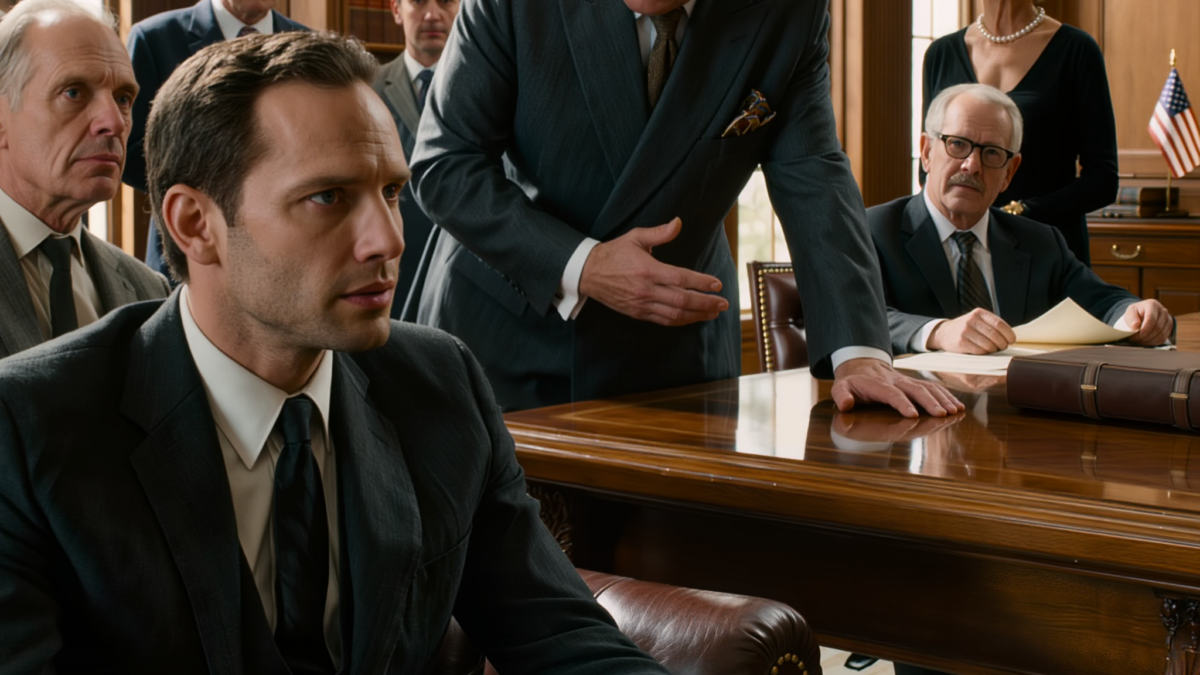
My name is Caleb Anderson. I’m twenty-eight years old, and at the reading of my grandfather’s will, twenty-three members of my family gathered in a law office expecting to divide up the fortune he had spent his life building. Most of them barely acknowledged me when I entered. By the time the meeting ended, they were looking at me as if I were a stranger.
My uncle Wesley had been particularly pleased with himself that afternoon. He wore a custom-tailored Italian suit, adjusted his silk pocket square every few minutes, and spoke as though the family business already belonged to him. When the lawyer announced that Grandpa had left him the penthouse condominium at 447 Riverside Drive, valued at approximately $2.8 million, Wesley sprang from his chair. The room erupted in applause. My relatives congratulated him while I remained seated in the corner, wearing the inexpensive black suit I had bought on sale three years earlier.
Wesley eventually turned toward me with a smirk. “Don’t worry, Caleb. I might let you come up and wash the windows sometime. Someone has to do the manual labor, right? We can’t all be executives.”
The room filled with laughter. My father, Logan, sat beside me, gripping the armrest of his chair so tightly that his knuckles turned white. I knew he was about to stand up and defend me, so I put a hand on his knee. There was no reason for him to get into an argument. Edward Lawson, my grandfather’s longtime attorney, still had more to say.
Wesley wanted the keys immediately. He was already talking about moving his belongings into the penthouse and hiring an interior decorator. Edward looked up from the documents and told him that would not be possible. Then he mentioned a private business transaction completed three years earlier. Wesley demanded an explanation, and Edward began reading from the property records.
What followed would turn that celebration into the ugliest family confrontation I had ever witnessed. The relatives who had spent the afternoon laughing at my cheap clothes and modest job would discover that I had been managing the very properties they were planning to sell. Some of them had even been paying rent to a company I owned.
To understand why my grandfather made that arrangement, and why I had kept it secret for three years, I have to explain what my family was like long before we entered Edward Lawson’s office.
Grandfather Arthur Coleman was a self-made businessman. He came from almost nothing, spent years doing exhausting construction work, and fought his way through a fiercely competitive real estate market. He survived two major economic downturns and built a multimillion-dollar property business through decades of work. He understood how much effort went into earning a dollar because he remembered every stage of building his company.
His children had a very different experience. They grew up in large houses, attended expensive schools, and rarely worried about ordinary expenses. As adults, many continued expecting Grandpa to solve their financial problems. A family gathering was often an opportunity to request another loan, ask about a future inheritance, or convince him to fund something expensive.
Aunt Cameron was especially comfortable treating Grandpa’s wealth as a resource she could use whenever she needed it. She was approaching her third divorce and had developed an enormous appetite for costly lawyers, social events, and maintaining appearances. Uncle Marcus preferred luxury cars and speculative investments. Wesley, the family’s favored son, carried himself as though inheritance were a position he had already earned. He rarely questioned whether he understood the work behind the assets he expected to receive.
I had never fitted comfortably into that world. I worked an entry-level position at a logistics company, earning a modest salary while putting in fifty-hour weeks. My car was a beat-up sedan about ten years old. There were months when paying rent meant living on inexpensive noodles and avoiding unnecessary purchases. I didn’t wear designer clothes or attend exclusive clubs, and that was enough for several relatives to treat me as a failure.
Grandpa never judged me that way. For five years, I drove across town every Sunday to visit him. Sometimes it rained, sometimes snow covered the roads, but I went because I enjoyed his company. We sat in his quiet study, drank cheap black coffee, and talked for hours. He rarely wanted to discuss family gossip. He preferred conversations about interest rates, financial statements, zoning restrictions, and the difficult work of keeping commercial tenants satisfied.
He gave me thick books about property law, accounting, business management, and real estate. I read them after my shifts at the logistics company. Sometimes I was exhausted, but I wanted to understand how he thought. He had built something remarkable, and I respected the intelligence and discipline behind it. I never asked him to leave me his business. I wanted to learn enough to build something of my own someday.
Meanwhile, most of my relatives appeared only for Thanksgiving, Christmas, or another celebration. They would complain about the food, discuss the wine, and eventually steer the conversation toward money. Someone needed help financing a wedding. Someone else wanted a loan for a boat. Another cousin needed an expensive education paid for. Very few asked whether Grandpa was lonely or whether his arthritis had been troubling him.
Three years before the will reading, Grandpa called me on a rainy Tuesday afternoon and asked me to come over. It was unusual because we normally met on Sundays. When I entered his study, he looked older and more tired than usual. His hands trembled slightly as he pushed a sheet of paper across the oak desk.
“Read it,” he said.
It was a legal ownership transfer for Morrison Holdings, the parent company controlling his real estate portfolio. The company held sixteen properties, including the Riverside Drive building, three large apartment complexes, and six mixed-use developments. The purchase price printed at the bottom was exactly one dollar.
I read the document several times, unable to believe what I was seeing. Grandpa was offering to transfer the business to me. I immediately told him I couldn’t accept it. Wesley and Cameron would be furious. They would accuse me of stealing their inheritance, turn relatives against one another, and drag the family through years of arguments.
Grandpa listened before interrupting. “Wesley is a fool,” he said. He believed his children regarded property as a convenient source of cash rather than a business requiring constant care. If they gained control, he expected them to liquidate valuable assets, incur enormous expenses, and abandon the tenants and employees who depended on the company. He was afraid that sixty years of work would disappear in a matter of months.
Then he explained what the document meant. “I am not giving this to you, Caleb. I am selling it to you for a dollar, and the actual price is your life.” He expected me to manage the properties, learn the business thoroughly, answer emergency calls, handle lawsuits, and deal with difficult tenants and contractors. He wasn’t offering a life of leisure. He was handing me responsibility for everything he had built.
There was one condition. I couldn’t tell anyone in the family until after his death. Grandpa wanted to see how his relatives treated me when they believed I had nothing to offer them financially. He wanted their behavior to speak for itself. I looked at him, looked back at the document, then reached into my pocket. I pulled out a worn one-dollar bill and placed it on his desk.
That was how I purchased Morrison Holdings. I was twenty-five years old, still working at a logistics company, and suddenly responsible for a commercial real estate portfolio worth millions. I understood almost immediately that accepting Grandpa’s offer would change my life in ways I couldn’t fully anticipate.
I kept my regular job because it helped preserve the secret. During evenings and weekends, I worked on the real estate business. I hired a small management team that I could trust and operated through Morrison Property Management. The corporate structure allowed us to handle leases, rent payments, maintenance requests, and legal matters without making my identity obvious to relatives or tenants.
To my family, I remained Caleb, the young man driving an aging car and buying clothes at discount stores. To the property managers, contractors, and professionals I worked with, I was the person responsible for making decisions at Morrison Holdings. The difference between those two lives was exhausting. I often went from a long day at the logistics company straight into property meetings, financial reviews, and late-night maintenance calls.
Six months into my ownership, I faced an emergency that made me understand exactly what Grandpa had meant by responsibility. It was two in the morning during a freezing January night. The temperature had dropped below zero when my phone rang. Nathan Brooks, my night manager, told me that a major water pipe had burst in the lobby of an older apartment complex on Fifth Avenue.
Water was flooding toward the electrical room. If it reached the main breaker, hundreds of residents could lose power and heat during the coldest part of the night. Some of the tenants were families with young children. I threw on my clothes, grabbed my keys, and drove to the building.
When I arrived, the lobby was chaotic. Residents stood in the hallways wearing pajamas and carrying blankets. Maintenance workers were trying to keep the water away from electrical equipment. Everyone was frightened, and the regular crew was overwhelmed. We needed outside help immediately, so I contacted an emergency contractor named Tyler Morgan, who had a reputation for getting difficult jobs done quickly.
Tyler arrived about an hour later in a heavy utility truck. He looked at my inexpensive winter coat and the freezing water around my boots, then informed me that the job would cost triple the normal emergency rate, plus a hazard fee. He wanted $20,000 simply to shut off the main water supply and patch the pipe for the night. If I refused to sign the invoice immediately, he said he would leave.
For a moment, I wanted to pay him whatever he demanded. I was freezing, exhausted, and worried about everyone in the building. But I had spent months learning the technical and financial details of property management, and I knew his demand was unreasonable. I also knew where the emergency shutoff valves were located and what the standard rates should have been.
I took out my phone and began recording. I told Tyler that the shutoff valves were accessible from an exterior hatch, that the standard emergency union rate in the area was capped at $250 an hour, and that I intended to report his conduct to the state licensing board if he refused to perform the work at the appropriate rate. I also warned him that his company could face a claim for damages caused by an unnecessary delay.
He stared at me for several seconds. Then he threw away his toothpick, grabbed his tools, and went into the freezing water without another argument. I remained at the building until six in the morning, helping the maintenance crew mop floors and clean up after the repair. My clothes were soaked, my hands hurt, and I was barely able to keep my eyes open when I finally went home.
Three hours later, I got up, put on a cheap tie, and went to my logistics job. Nobody in my family knew what had happened. They saw the expensive buildings, the rooftop views, and the possibilities for profit. They never saw the broken pipes, emergency calls, insurance claims, or tenants who needed help in the middle of the night.
Over the next three years, I learned the business through situations like that one. I negotiated commercial leases, worked with contractors, managed financial reports, handled tenant problems, and reviewed legal disputes. The company required constant attention. I sacrificed sleep, weekends, and much of my personal life because I knew how much Grandpa trusted me.
As his health declined, keeping our arrangement secret became harder. I knew he was proud of the business, but I also knew he was frightened of what might happen after he was gone. Our Sunday conversations continued to matter to me, even as the reality of losing him became impossible to ignore.
When Grandpa finally passed away, I felt as though the center of our family had disappeared. The funeral took place in a large stone church. I stood near the back wearing my old black suit, watching relatives who hadn’t visited him in years suddenly present themselves as his closest companions.
Aunt Cameron wore a dramatic black lace veil and carried an expensive silk handkerchief. She made a conspicuous display of grief when the city’s mayor passed by to pay his respects. Uncle Marcus spent much of the service and reception approaching bankers, developers, and city officials. He seemed more interested in developing business connections than remembering his father.
My dad, Logan, was different. He stood beside me with red, swollen eyes and barely spoke. He was Grandpa’s son-in-law, a working-class man who had always been treated as an outsider by the wealthier Coleman relatives. But he had genuinely respected Grandpa, and I could see how deeply the loss affected him.
“He was a titan, Caleb,” Dad whispered after the service. “The world is a lot smaller without him in it.”
I nodded because my throat was too tight to answer. I wanted time to mourn, but I knew the disputes over the estate were already beginning. By the time we reached the reception at a luxury country club, relatives were openly speculating about the inheritance. The estate was paying for the gathering, and several guests seemed determined to make the most of it.
I was standing near the buffet with a plastic cup of water when my cousin Austin Reynolds approached me. Austin was Wesley’s oldest son. He had always presented himself as the friendly, successful cousin, but he had a habit of asking questions that served his father’s interests.
“Hey man, tough day, right?” he said, touching his expensive whiskey glass against my cup.
I gave him a short answer and hoped he would leave. Instead, he leaned closer and asked whether Grandpa had ever discussed his assets during our Sunday visits. He wanted to know about liquid cash, offshore accounts, hidden retirement funds, and anything that might help Wesley prepare for taking control of Morrison Holdings.
Austin talked as though his father’s succession were already settled. He said the family needed to understand the finances and avoid unnecessary taxes. But he wasn’t asking how I felt about losing Grandpa. He was trying to get information he could pass along to Wesley.
I told him that Grandpa and I had talked about life rather than money. Austin looked annoyed for a moment before restoring his friendly smile. He patted my shoulder and walked away, pulling out his phone almost immediately. I watched him leave and wondered how many other relatives had already begun preparing their plans.
Over the following days, those plans became increasingly obvious. Wesley started hosting private family meetings at his large suburban house. Neither Dad nor I was invited. Dad learned about the discussions from Cameron’s husband, who had been drinking at the golf course and revealed more than he probably intended.
According to what Dad heard, relatives were sitting in Wesley’s living room drinking extremely expensive wine and discussing how to divide or liquidate Morrison Holdings as soon as the estate proceedings allowed it. Cameron wanted to sell historic downtown apartment buildings to a commercial developer planning to demolish them and build a luxury shopping mall. Those buildings were home to working-class families, many of whom had lived there for years.
Marcus wanted to borrow heavily against the Riverside penthouse and three other properties to finance a risky technology venture. He had no real experience in that business. Others discussed breaking long-term leases, selling buildings quickly, and replacing maintenance workers who had served Grandpa for more than twenty years.
I couldn’t stop thinking about the people who would be affected. Our company had employees who needed their salaries to support their families. We had tenants who paid their rent and expected safe, reliable housing. I had spent hundreds of hours maintaining those relationships, negotiating contracts, and solving problems. The relatives planning these changes seemed to care only about how much cash they could obtain.
By then, I had helped keep occupancy rates at a record 94 percent during a difficult economic period. I had worked through zoning problems, legal disputes, expensive repairs, and countless financial decisions. Watching relatives discuss the company as though it were a pile of money waiting to be collected made me realize why Grandpa had insisted on the private sale.
But I also knew that simply announcing my ownership at the will reading would not end the matter. Wesley would almost certainly challenge the transfer. Cameron might accuse me of manipulating Grandpa during his final years. They had enough money to hire aggressive lawyers, and a prolonged dispute could harm the company’s operations even if the ownership documents were valid.
I called Edward Lawson on his private number. When he answered, I told him the family was preparing to liquidate the portfolio and that we needed to be ready.
“I’ve been waiting for this call for three years, Caleb,” he replied. He told me to bring everything to his office that night and use the back elevator.
A violent storm rolled into the city that evening. I drove my old sedan through heavy rain, entered the underground garage of Edward’s downtown office building, and took the private elevator to the fortieth floor. His office was lit by desk lamps, and the conference table was covered with property deeds, tax records, financial statements, and legal documents.
Edward poured us coffee and explained that Wesley had already retained Robert Callahan, an aggressive attorney known for inheritance disputes. Callahan was preparing to challenge the estate on grounds involving undue influence, elder abuse, and diminished mental capacity. The family would argue that I had isolated Grandpa, manipulated him during our visits, and persuaded him to transfer the business while he was vulnerable.
I asked whether the transfer’s age placed it beyond the ordinary limitations for probate disputes. Edward said that the paperwork gave us a strong position, but he warned that a determined litigator could still create serious problems. A lengthy civil dispute, requests for documents, and attempts to freeze company assets could cost us years and enormous amounts of money.
Then Edward opened a secure briefcase and removed a thick red-tabbed folder. Grandpa had anticipated the possibility of a challenge. On the day of the ownership transfer, he had undergone a comprehensive psychiatric evaluation. Dr. Benjamin Rhodess, a forensic psychiatrist, had examined him for four hours, and three independent board-certified physicians had signed statements confirming his mental competency.
I was surprised. Grandpa had never told me about the evaluation. Edward explained that Grandpa wanted the medical evidence prepared independently and had deliberately kept it from me. Then he placed an encrypted silver flash drive on the table. Grandpa had also recorded a video message on the day of the sale, specifically intended to be shown if Wesley contested his decision.
Seeing the flash drive affected me more than I expected. I had spent weeks trying to manage legal questions and financial responsibilities while grieving. Now I learned that Grandpa had left a message that would allow me to hear his voice again. I wasn’t sure how I would react when the time came.
Edward also showed me a large binder containing the audited history of my three years managing Morrison Holdings. It included leases, invoices, tax records, maintenance expenses, and detailed financial statements. During my management, the overall portfolio value had increased by $2.3 million, and operating overhead had fallen by 18 percent.
We worked until four in the morning reviewing documents and considering what Wesley’s lawyers might argue. Edward wanted us ready to defend the sale immediately rather than allowing the family to create uncertainty. By the time I left, the storm had passed. The streets were wet and quiet under the streetlights.
I returned to my modest two-bedroom apartment in one of the buildings I owned. Even there, I paid full market rent each month to keep the company’s accounting clean. I looked at myself in the bathroom mirror. I was twenty-eight, but the dark circles beneath my eyes made me feel much older. I put on my inexpensive black suit, adjusted the collar, and prepared to walk into the reading.
Later that afternoon, I entered Edward Lawson’s office. The sunlight was bright, and the family had already gathered around the long mahogany conference table. Cameron studied the expensive furnishings. Marcus repeatedly checked his watch. Wesley sat near the head of the table like a man waiting to be crowned.
There were twenty-three family members present. Almost everyone wore expensive funeral clothes, but there was little sign of genuine mourning. Cameron whispered to Marcus about a friend who had obtained a large financial settlement during a divorce. She was considering how her own inheritance might help finance her impending third divorce.
Marcus was researching auction values for Grandpa’s vintage cars. The collection included a classic Rolls-Royce, a cherry-red Ferrari, a Lamborghini, and a Porsche that Grandpa had spent hours polishing. Marcus remembered their market value more readily than the time Grandpa had devoted to caring for them.
Edward entered carrying a heavy leather folder. Everyone became quiet. He began with smaller bequests, including a college fund for a distant nephew and antique jewelry for other relatives. Cameron received $50,000 in cash and first-edition books worth approximately $80,000. Marcus inherited the vintage car collection and immediately began whispering about storage, transport, and brokers.
Then Edward reached the major property provisions. He read the clause leaving the Riverside Drive penthouse to Wesley Turner. It was valued at approximately $2.8 million. Wesley jumped to his feet, celebrated loudly, and declared that his father had always known he was the only person capable of managing such an important property.
Relatives crowded around him to offer congratulations. Austin began discussing parties they could hold on the rooftop terrace. Wesley accepted their praise with obvious satisfaction. Eventually, he turned to me and made his insulting offer about washing the windows. When the laughter spread around the table, Dad was ready to intervene, but I stopped him.
Edward waited until the room settled. Then he said there was one final item concerning the Riverside Drive property.
Wesley dismissed the interruption and demanded the keys. He wanted to move in that weekend and hire someone to redesign the interior.
“I cannot do that, Wesley,” Edward replied.
The attorney explained that three years earlier, Grandpa had completed a private transaction involving Morrison Holdings. Wesley immediately demanded to know what had been sold and who had purchased it.
Edward read from the corporate and property records. In April, James Coleman had sold his controlling interest in Morrison Holdings, the parent company owning the commercial real estate portfolio, including the entire building at 447 Riverside Drive, to his grandson Caleb Anderson for exactly $1.
According to the official records, I was the registered owner of the building. I had owned it for three years. My relatives had been discussing property they believed they were about to inherit without realizing that Grandpa had transferred ownership long before his death.
For a moment, the room was completely quiet. Wesley stared at Edward, apparently struggling to understand the statement. Then his face flushed and he slammed both hands against the table.
“That is a lie. That is fraud!” he shouted.
Cameron grabbed her pearl necklace. Marcus dropped his phone, and its screen shattered against the hardwood floor. Austin looked from his father to the lawyer, his mouth open. The family members who had been congratulating Wesley only moments earlier no longer seemed certain what to say.
I remained seated. I had imagined this moment many times during the previous three years, usually while dealing with another difficult repair or reviewing financial documents late at night. Yet actually watching their reactions felt different. I was relieved that the secret was finally coming out, but I also knew the confrontation was only beginning.
Wesley pointed at Edward and called him a senile fool. He said I was just a twenty-eight-year-old logistics employee who could barely afford rent. According to Wesley, I lacked the money, credit history, and intelligence necessary to purchase a commercial real estate business. He accused Edward of producing forged documents and threatened to ruin his professional reputation.
Edward did not raise his voice. He opened the red-tabbed folder and explained that the transaction had been recorded with the city clerk on April 16, three years earlier. The paperwork had been audited, notarized, and independently witnessed. Grandpa had retained no ownership, voting rights, or equity in Morrison Holdings after the sale.
Edward also explained that Grandpa had remained in the penthouse under a private, rent-free lease that I had approved. He had continued living there until his death, but legally he had been a tenant rather than the owner.
“A tenant?” Wesley repeated. He could hardly believe what he was hearing. “My father was a tenant in his own building?”
I stood up.
“No,” I said. “He was a tenant in my building.”
Every face turned toward me. Cameron looked furious. She accused me of taking advantage of Grandpa’s loneliness and manipulating him through our Sunday visits. She claimed he had been losing his mental capacity and that I had convinced him to give away assets that should have belonged to his children.
She threatened a public lawsuit and said she would see me prosecuted for elder abuse. I listened, knowing that the accusations were exactly what Edward and I had prepared to address.
Edward interrupted her. He said Grandpa had anticipated this reaction and had left evidence specifically to explain his decision. Then he walked to the conference room’s multimedia system and inserted the silver flash drive.
The motorized blinds lowered, blocking the sunlight. A projector screen descended from the ceiling, and a moment later, Grandpa’s face appeared. He was sitting in Edward’s office wearing his familiar worn tweed suit, the one Cameron had often complained made him look too ordinary for their country club gatherings.
Seeing him again nearly overwhelmed me. His face looked tired, but his eyes were alert. He stared directly into the camera and began speaking in the same steady voice I remembered from our Sunday conversations.
“If you are watching this video,” Grandpa said, “it means I am finally dead and gone in the ground. And it means my children are currently screaming their lungs out in Edward Lawson’s office, threatening a massive, messy lawsuit and wildly accusing my grandson Caleb of elder abuse and manipulation.”
Wesley visibly flinched. Grandpa had described the situation with remarkable accuracy.
The recording continued. Grandpa stated that he had been of sound mind when he transferred Morrison Holdings to me. He understood the date, the business, and the value of his assets. No one had coerced or confused him. He had deliberately chosen the transaction because he believed I had demonstrated the dedication and competence required to manage the company.
Then he described our five years of Sunday visits. He talked about the books I had read, the financial questions I asked, and the attention I paid to the difficult details of running commercial properties. He contrasted those visits with the behavior of relatives who appeared mainly during holidays and usually wanted something expensive.
Grandpa said his children had treated him like a bank account. They wanted money for weddings, vacations, divorces, and lifestyles they couldn’t comfortably afford on their own. They had rarely shown the same curiosity about the business itself or the work necessary to maintain it.
Then he addressed Wesley directly.
“Wesley,” he said, looking into the camera.
My uncle shifted in his chair.
Grandpa said Wesley had always believed he was entitled to inherit the business simply because he was the eldest son. He liked being treated as an important businessman but had never carried the responsibility of operating the properties.
“The penthouse was never mine to give you in this will,” Grandpa explained. He had sold it to me three years earlier as part of Morrison Holdings, along with the company’s other buildings and their maintenance obligations.
He said I could have sold the Riverside building or changed his living arrangement after taking ownership. Instead, I had allowed him to remain in his home without paying rent while I continued learning how to manage the portfolio. I had also maintained my ordinary job to cover my personal expenses.
Cameron began crying into her hands. Marcus looked down at the broken phone lying on the floor. The room had none of the excitement that had filled it earlier.
Grandpa acknowledged that he had left his children valuable personal gifts, including the cash bequests, books, and cars. He explained that those gifts were expressions of his love as their father. But he wanted the business, his life’s work, controlled by someone capable of protecting it.
He described the difficult maintenance emergencies, contract negotiations, and problems I had handled during the previous three years. He said his children hadn’t noticed because they had spent more time anticipating his death than paying attention to the work being done.
Finally, he warned them not to challenge the transaction. He believed a lawsuit would accomplish nothing except consume money and damage relationships. He said I was the rightful owner of Morrison Holdings and that he stood by his decision.
Then the recording ended.
The screen went dark, and the blinds rose, allowing afternoon sunlight back into the office. Nobody spoke for several seconds. I could hear people breathing and shifting in their chairs.
Wesley was the first to recover. Instead of accepting the explanation, he stood up and kicked his chair backward. He said a recorded video could have been staged. He mentioned deepfakes and suggested that I might have pressured Grandpa into reading a prepared statement.
He repeated his threat to hire Robert Callahan and tie the company up in court until I was bankrupt. Edward remained calm and opened the red-tabbed folder again.
The attorney explained that the transfer was a completed corporate sale, separate from the will. He presented the psychiatric evaluation performed by Dr. Benjamin Rhodess on the morning of the transaction, along with signed assessments from three independent board-certified doctors. He also identified the witnesses, notarized agreements, financial audit, and official filings documenting the sale.
Edward told Wesley that these records would make his proposed challenge extremely difficult. He warned that our side would seek legal fees and consider counterclaims if Wesley pursued a baseless case. Wesley stared at the documents, his hands shaking. He turned toward Cameron, apparently hoping she would support him, but she was looking down at the floor.
Then Austin spoke.
“But why you?” he asked me.
His friendly manner had disappeared. He looked angry and deeply resentful. He wanted to know what made me qualified to manage a multimillion-dollar company. He insisted I was too young and inexperienced, and predicted that I would destroy the business Grandpa had built.
I walked toward the conference table and picked up the heavy binder Edward had prepared. I placed it in front of Wesley and Austin.
“I showed up,” I told Austin. “I listened. I learned. I did the work.”
Grandpa hadn’t owed me the company. I knew that. But he had given me the opportunity to learn, and I had spent three years proving that I could take the responsibility seriously.
Marcus interrupted and demanded proof. He said I worked at a desk job and had no practical experience managing a real estate operation.
I opened the binder and turned to the financial records.
I described the January plumbing emergency at the historic Fifth Avenue apartment complex. It had happened at two in the morning while Grandpa was hospitalized with severe pneumonia. The temperature was around zero. I had coordinated the repairs, negotiated with the contractor who tried to charge triple the normal rate, arranged temporary accommodation for three displaced families, and managed the insurance claims to protect the company’s expenses.
I reminded Marcus that while I was handling those problems, he had been enjoying a luxury ski trip in Aspen.
Then I turned to the company’s operating figures. Since taking control, I had increased residential occupancy from 78 percent to 94 percent. I had renegotiated vendor agreements and replaced overpriced maintenance contractors, including some Wesley had recommended years earlier. Operating costs had fallen by 18 percent.
We had also upgraded HVAC systems across the commercial properties, improved tenant satisfaction, and increased the overall property valuation by $2.3 million during a difficult market.
The numbers were supported by audited financial statements. They weren’t claims I was making simply to win an argument.
I explained that I held a business degree and had earned a commercial property management certification through night school. In addition to the formal training, I now had three years of direct experience operating a $12 million real estate portfolio.
Then I asked Wesley how many commercial leases he had reviewed from beginning to end. I asked how often he had dealt with a midnight maintenance emergency or a difficult eviction. He opened his mouth but didn’t answer.
The silence was interrupted by my younger cousin Zachary, Cameron’s son. Zachary worked as a freelance graphic designer and frequently struggled with money. He raised his hand hesitantly.
“Caleb, I have a question.”
I told him to go ahead. I had never had the same problems with Zachary that I had with Wesley and some of the others.
He asked whether I also owned the smaller Riverside apartment buildings. He had been renting unit 4B in one of them for two years.
I told him that I did. I even remembered his rental history. His payments were generally on time, although the neighbors had complained about noise during the previous Halloween. I had personally reviewed and approved his lease renewal the month before.
Zachary looked stunned. He said he had been sending his rent payments to Morrison Property Management and contacting that company when appliances needed repairs. He had never imagined that I was the person behind it.
I explained that I used the management company name for professional, legal, and security reasons. But I remained closely involved in important lease decisions, maintenance requests, late payments, and eviction matters. I had also decided not to increase Zachary’s rent that year despite inflation and market conditions.
Cameron grabbed the edge of the table. She demanded to know how I could have hidden all of this from my family for three years. She insisted that I had lied to them while sitting at their dinner tables.
That was when Dad finally stood.
“He did not lie to anyone,” Logan said.
He walked over and stood beside me. His voice was firm, and I could hear the pride in it.
Dad told them I had simply chosen not to announce my success to people who would have tried to interfere with it. He believed I had protected Grandpa’s business from relatives who were more interested in extracting money than preserving the company.
I had spent much of my life watching Dad receive the same dismissive treatment I received from the Coleman relatives. Hearing him defend me in that room meant more than I could easily explain. Grandpa had always recognized the value of his character, and standing beside him in that moment reminded me why.
Edward began collecting his documents. He said the formal business concerning the remaining estate assets could now proceed. I still needed to sign final transfer paperwork related to liquid cash accounts, while the other heirs would receive their designated cash gifts and personal property through the ordinary probate process, generally within thirty days.
He made it clear that he was willing to answer legitimate legal questions but would not continue entertaining insults and threats.
The meeting finally ended.
My relatives had entered expecting to become the owners of a real estate empire. Now they understood that the company had been operating under my control for years. Some looked furious. Others seemed unable to process what they had learned.
Marcus collected his belongings without discussing his vintage cars. The possibility of expensive insurance, storage, and maintenance seemed to weigh more heavily on him now that he knew he would not receive the additional real estate wealth he had expected. Austin avoided looking at me as he left.
Wesley was the last person to move toward the door. He stopped, turned around, and threatened me again.
He said Robert Callahan would examine every signature, tax filing, and corporate document. If he found even a small irregularity, Wesley intended to challenge my ownership and pursue every available legal remedy.
I told him he was welcome to review the records. Grandpa had prepared them carefully because he understood how Wesley would react. The video, the independent evaluations, and the formal filings existed precisely because Grandpa wanted his decision defended.
Wesley shook his head. He said he could not understand why his father had favored a grandson over his firstborn son. He reminded me that I was still just a young man wearing an inexpensive suit.
I acknowledged that he was Grandpa’s son. I also reminded him that Grandpa had left him a substantial stock portfolio. Their relationship had not been erased or dismissed. But inheriting control of a company with hundreds of employees required something different from sharing a family name.
I told Wesley that I had been Grandpa’s student and friend. I had listened when he talked about his life’s work and had learned how much responsibility the business required.
“You wanted the crown, Wesley, but you never wanted to carry the weight.”
Wesley had no answer. He walked out and slammed the heavy office door hard enough to rattle its glass.
I hoped that would be the end of the argument, but Edward had warned me not to expect an immediate surrender.
During the following three weeks, Wesley continued pursuing his plan to challenge the corporate transfer. He retained Robert Callahan and paid a substantial nonrefundable fee for an investigation. Callahan requested extensive records relating to the sale and Grandpa’s mental capacity.
We provided the documents without delay. Edward handed over audited financial statements, psychiatric evaluations, notarized contracts, and other relevant paperwork. We had spent years preserving those records, so there was no reason to conceal them.
Two weeks later, Callahan formally dropped Wesley as a client. The documentation supporting the transfer had left Wesley without the case he had expected to pursue.
The rest of the family also faced consequences from assumptions they had made about Grandpa’s fortune.
Cameron’s third divorce settlement became much less favorable than she had hoped. Her husband’s lawyers demonstrated that she did not have access to the Coleman real estate portfolio. A judge rejected her large alimony requests. She had to reduce her spending, move into a smaller condominium, and take a part-time job.
Marcus received the vintage car collection, just as the will provided. But maintaining a Rolls-Royce, Ferrari, Lamborghini, and Porsche proved far more expensive than he anticipated. Insurance, specialized storage, and maintenance quickly added up. Within six months, he had auctioned off the cars to help pay his debts.
I didn’t need to celebrate what happened to them. The more important change was that I no longer had to conceal my responsibilities. I could stop pretending that I spent every evening doing nothing more demanding than my logistics job. I could concentrate openly on Morrison Holdings and the people who depended on it.
There was still one personal matter Grandpa had left for me to handle.
A week after the dramatic will reading, I went to the main branch of the downtown bank to access his private safe deposit box. Edward had given me the heavy brass key after I signed the final transfer documents.
A bank employee brought me to a small private viewing room inside the vault. When the metal door closed, I found myself alone with the long deposit box. I placed it on the table and opened it carefully.
Inside were old property deeds, original birth certificates, and an envelope sealed with red wax. My name was written across it in Grandpa’s familiar, slightly slanted handwriting.
There was also a thick stack of bearer bonds.
My hands trembled as I broke the seal. The envelope contained a handwritten letter dated one week before Grandpa’s death. I unfolded the paper and began reading.
“Caleb, if you are reading this, I am gone, and you have just sat through the most incredibly uncomfortable, vicious, and ugly family meeting of your entire life.”
He apologized for what he had put me through, although he admitted he wasn’t entirely sorry. He believed the confrontation had been necessary. The family needed to understand his decision, and I needed to establish that I was responsible for the company.
He predicted that Wesley had threatened a lawsuit and Cameron had called me a thief. He even anticipated that several relatives would question my ability to run the business. Reading those words made me feel as if Grandpa were sitting across from me again, explaining the family in the dry, practical way he always had.
He told me not to let their opinions determine how I viewed myself. They might eventually accept his decision, or they might never accept it. Either way, the company still needed someone to manage it.
Then he explained why he had chosen me.
“I did not give you Morrison Holdings because you are my grandson. Being related to me by blood is an accident of birth, not an achievement.”
He said he had chosen me because I cared enough to learn about the business. I had asked questions, studied the books he gave me, and paid attention to tenants, operating expenses, and market conditions. The others wanted the visible rewards of wealth without spending time understanding the work behind them.
He mentioned Wesley and Cameron specifically. Wesley wanted the penthouse because it was valuable and impressive, not because he understood what building and maintaining it required. Cameron wanted cash to support a lifestyle she struggled to maintain. Grandpa had seen those patterns for years.
He reminded me that Morrison Holdings was fundamentally sound. The company had valuable properties, reliable contractors, established tenants, and reserves for emergencies. He believed it could continue for generations if managed responsibly.
What worried him most was my confidence.
He knew I would wonder whether I deserved the opportunity, whether I was too young, and whether I had made mistakes. His answer was direct. I deserved the responsibility because I had worked for it. I was not too young to continue learning, and mistakes were part of becoming a better manager.
“Run the business your way,” he wrote. “I will not be looking over your shoulder. Make it better than I ever did.”
Then he explained the bearer bonds. They were worth approximately $200,000 and were separate from Morrison Holdings. He had set them aside personally for me, with no conditions attached. I could use them to pay student loans, buy a home, travel, or do anything else that felt right.
He ended by saying he was proud of me. Not simply because I had taken control of the business, but because of the kind of person I had become. He valued my work ethic, intelligence, and integrity more than the real estate itself.
“Love, Grandfather.”
I sat in the vault holding the letter and finally cried.
During the weeks after his death, I had been so busy protecting the business that I hadn’t allowed myself much time to grieve. There were relatives to confront, lawyers to meet, documents to review, and employees whose livelihoods needed to be protected. I kept moving because I was afraid that stopping would leave everything exposed.
But alone in that room, none of those responsibilities could distract me from the fact that Grandpa was gone.
I cried because I missed our Sunday conversations. I cried because keeping the secret for three years had been exhausting. And I cried because his letter answered the question that had quietly troubled me since the rainy Tuesday when I bought the company for a dollar.
I had wondered whether he truly believed I was capable of carrying his legacy. Now I knew he had understood my doubts and believed in me anyway.
I didn’t use the $200,000 to purchase an expensive sports car or designer clothes. I used a portion to establish a secure retirement fund for my father, Logan, so he wouldn’t have to worry constantly about medical expenses, mortgage payments, or his financial future. I kept the rest in emergency reserves.
Dad had stood beside me when it mattered, without knowing anything about the company beforehand. He hadn’t needed me to be wealthy to respect me. Providing him with greater security was one of the most satisfying decisions I made after the inheritance dispute.
A few nights later, I stood on the windy balcony of one of my high-rise commercial buildings, looking over the city. Lights filled the windows below, and traffic moved through the streets. The view was beautiful, but I no longer saw the buildings merely as valuable assets.
I thought about the sixteen buildings under my responsibility. Each represented tenants who needed reliable management, employees who depended on their salaries, and maintenance problems that could become serious if ignored. Grandpa had spent decades building the portfolio. I had spent three years learning what it meant to keep it functioning.
My phone buzzed.
It was a message from Nathan Brooks, my lead property manager. A tenant in unit 12B at the Fifth Avenue complex had reported a minor leak. Nathan had already dispatched the night crew, but the tenant was frightened.
I answered immediately, telling him to keep me informed, reassure the tenant, and let me know if the crew needed approval to remove drywall. I also reminded him not to approve emergency rates for work involving standard access.
After sending the message, I looked out over the city again.
The work hadn’t become easier simply because the family now knew I owned the company. Pipes would still burst. Tenants would still need help. Contractors would still submit invoices, and employees would still look to management when something went wrong. I would still have late nights, difficult decisions, and unexpected expenses.
But the secret was gone.
I no longer had to sit through family dinners pretending I knew nothing about real estate while relatives mocked my ordinary job. I didn’t have to explain why I was driving across town in the middle of the night or why I spent weekends reviewing contracts.
More importantly, I no longer had to measure myself against the approval of people who had dismissed me without ever asking what I did with my time.
Grandpa had given me more than a company. He had trusted me with the work that defined much of his life, and he had taught me that ownership meant accepting responsibility for people and decisions long after the celebrations ended.
I put my phone back in my pocket and remained on the balcony for another moment, breathing in the cold night air.
This was my empire now, and I was going to protect it with everything I had.








