For my 25th birthday, Grandma handed me the deed to a $50 million hotel. Before I could even thank her, my mother walked in with her new husband and my golden-boy brother and said, “We’ll manage it together as a family.” I told her, “Absolutely not. I’m the owner now.” She ordered me to pack my bags and leave. Grandma just chuckled—and reached into her handbag.
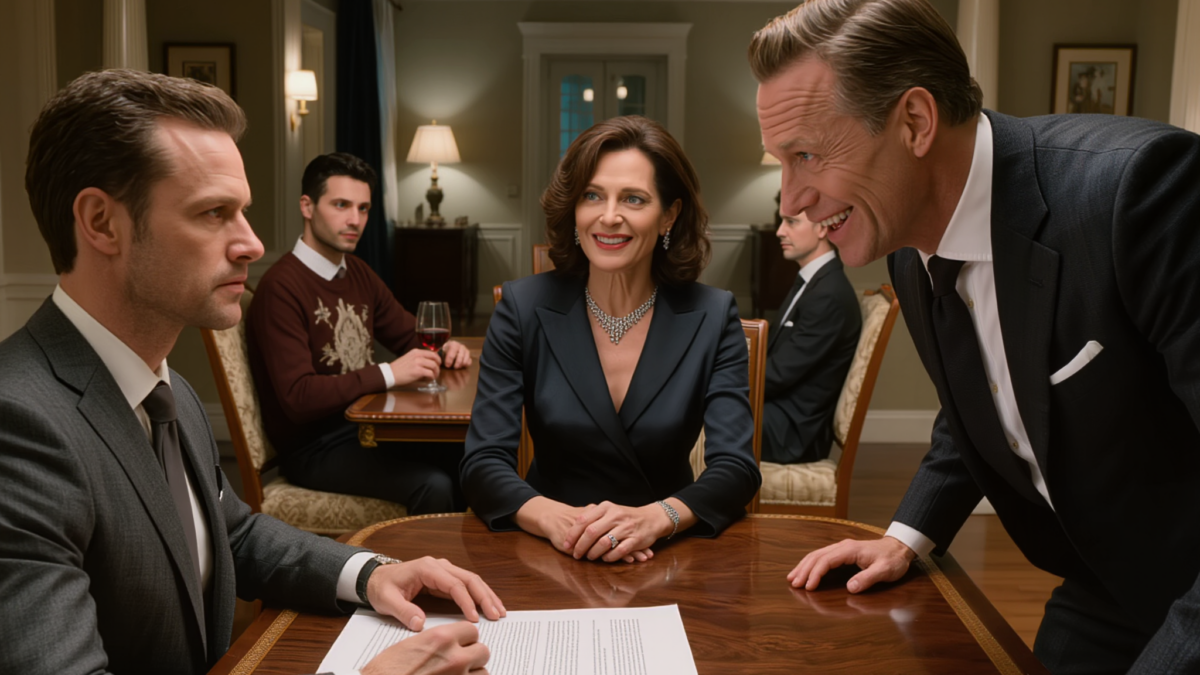
My name is Julian Bennett. I was twenty-five years old when my own mother tried to take control of a $50 million inheritance on the very night I was supposed to be celebrating my birthday.
It was a freezing November evening, the kind of night when wind pressed against the windows and made the warmth of a fire feel almost luxurious. My grandmother, Evelyn Bennett, and I were sitting across from each other at her custom-built mahogany dining table. The house smelled of roasted lamb, garlic, rosemary, and the faint cedar scent I had always associated with her.
It was supposed to be a quiet dinner.
Then Grandma handed me a dark brown leather folder.
The leather was worn soft around the edges. Inside was the deed to the crown jewel of everything she had built: the Grand Bennett Hotel.
The property was worth roughly $50 million. It was debt-free, profitable, and now legally transferred into my name.
I stared at the paperwork for what felt like forever.
Julian Bennett. Sole owner.
My hands actually shook.
I had spent years studying architecture. I had spent summers and weekends doing the least glamorous jobs at Grandma’s smaller properties, from maintenance work in basements to helping with ledgers and vendor contracts. I knew her business mattered to her, but I had never imagined she would entrust me with the Grand Bennett.
Before I could properly thank her, the heavy oak front door opened.
No knock.
No doorbell.
My mother, Veronica, walked in first.
Behind her came her new husband, Marcus, polished from head to toe in an expensive suit and enough designer cologne to overpower dinner.
My older brother, Silas, followed them.
Silas was twenty-eight and had always been the golden child. He still lived largely on our mother’s money, drove cars he had not paid for, and had somehow gone through life without being expected to carry the same responsibilities everyone else did.
The three of them entered Grandma’s dining room as if they owned the place.
My mother did not say happy birthday.
She did not ask how dinner was going.
Her eyes went directly to the leather folder beside my plate.
She knew what it was.
Veronica walked to the table, placed her manicured hands on the back of an empty chair, and announced that we needed to discuss “the future of the Bennett estate.”
Then she looked at me and calmly explained that I was too young and inexperienced to understand corporate management, executive payroll, staffing, and large-scale real estate.
According to her, the responsible solution was obvious.
“We are going to manage it together as a family.”
I looked at Marcus.
He adjusted the cuff of his suit and gave me the kind of smile adults use when they have already decided that a younger person’s opinion does not matter.
Silas barely seemed interested. His eyes wandered around the room, lingering on anything expensive.
I gripped the edge of the table.
“Absolutely not,” I said. “I’m the owner now.”
The paperwork had been completed. I was not signing over management control to them.
My mother’s expression changed instantly.
The polished social smile disappeared.
She pointed toward the hallway.
“Then pack your bags and leave this house right now,” she said. “You are cut off. You are nothing without me, Julian. Nothing.”
For a moment, I could only stare at her.
She was trying to throw me out of a house that did not belong to her.
Marcus watched with a smug expression. Silas looked entertained.
I turned toward Grandma.
She had remained silent throughout the confrontation.
Then she chuckled.
Not loudly.
Just once.
She reached into her structured leather handbag and started to remove something.
The look on her face made me realize she was not surprised by anything that had just happened.
At the time, I did not understand why.
To understand how we reached that dinner table, you have to understand what growing up in my family was like.
Everything revolved around appearances.
My mother cared deeply about what neighbors thought, what people at charity galas whispered, what country-club friends saw, and whether our family looked successful from the outside.
And in her version of our family, Silas was the star.
If he earned a mediocre grade, Mom blamed the teacher.
If I brought home a strong grade, she wanted to know why it was not better.
Silas could describe some half-formed business idea over Thanksgiving dinner and receive applause from a table full of relatives and guests.
I was expected to help the caterers.
I cleared plates, fetched wine from the cellar, and tried to make myself invisible.
If I spoke, I was interrupting.
If I stayed quiet, I was antisocial.
The difference was even more obvious when money was involved.
When Silas turned sixteen, a midnight-blue Porsche appeared in the circular driveway with a red bow on it.
He had not even passed his driving test.
A few weeks later, he damaged it after hitting a mailbox. Mom quietly handled the problem for him.
When I turned sixteen, I asked whether I could get a cheap used car so I could attend architecture-club meetings and debate tournaments without relying on the bus.
Mom looked at me as though I had asked for something outrageous.
She told me to get a part-time job and buy my own bus pass because money was supposedly tight.
I knew that was not true.
I had seen household bank statements left on the counter.
The money existed.
It simply flowed toward Silas.
My father, Richard, was different.
He was a quiet commercial architect who believed in working for what you had. He tried to protect me from the worst of the tension in the house, but over the years, I watched him change.
His shoulders seemed lower.
He spoke less.
My mother criticized his income, his career, his choices, and his inability to match the lifestyles of the husbands in her social circle.
When I was sixteen, I came home from school one rainy afternoon and found his suitcases by the front door.
He was wearing his winter coat.
His eyes were red and exhausted.
He did not give me a long speech.
He pulled me into a tight hug and told me he could not breathe in that house anymore.
He promised he would stay in touch.
He did.
But watching him walk out still broke something in me.
The divorce was finalized about a year later.
It was ugly.
My mother hired expensive lawyers and fought aggressively over money and custody. From where I stood, it often seemed as though the financial battle mattered more to her than whether anyone in the family was actually okay.
Not long afterward, she married Marcus.
Marcus called himself a business consultant.
He wore tailored suits and spoke in corporate buzzwords. Everything was synergy, leverage, paradigm shifts, acquisitions, and market strategy.
He looked at me as if I were an inconvenience.
Together, he and my mother began presenting themselves as sophisticated business people. They invested heavily in projects Marcus claimed would generate enormous returns. Many of those deals quietly failed.
Their lifestyle never changed.
Neither did their public image.
Meanwhile, I became almost invisible in my own house.
I stayed in my room, focused on school, and counted the months until college.
When I was seventeen, Mom announced at breakfast that I was moving in with Grandma Evelyn.
She framed it as a favor to Grandma.
Grandma was getting older, she said. The estate was too large. She needed company.
I understood the real message.
I no longer fit into the image Mom wanted to present with Marcus and Silas.
Being sent away turned out to be the best thing that ever happened to me.
Evelyn Bennett had built her real estate business from almost nothing.
She started with small, neglected motels and properties that required more work than most people wanted to put into them. She renovated, negotiated, reinvested, and expanded.
She had very little patience for status symbols.
She cared about structures that lasted and people who could be trusted.
Living with her was nothing like living with my mother.
There were no automatic handouts.
If I wanted spending money, I worked.
I wore work boots and learned maintenance at her smaller properties. I patched drywall. I dealt with plumbing issues. I learned how expensive a careless vendor contract could become.
Eventually, she began teaching me how to read financial statements.
Some nights we sat at her old desk beneath a brass lamp while she studied faded blueprints.
One evening she tapped a plan with one finger.
“Buildings don’t lie, Julian,” she told me. “The walls always remember who built them and why. Make sure your foundation is honest or the whole thing eventually comes down.”
At the time, I thought she was talking about architecture.
Years later, I realized she had been talking about people too.
While I worked and studied, Silas moved in the opposite direction.
He enrolled in multiple universities and did not finish.
Mom always found an explanation.
Eventually, he was given a comfortable executive position through one of Marcus’s businesses.
I focused on my architecture degree.
I wanted to build something real.
By the time I reached my final semester, I genuinely believed I had created enough distance between myself and my mother’s world that it could no longer control me.
Then came my twenty-fifth birthday.
And the front door opened.
The morning after the birthday confrontation, I woke up hoping some part of it had felt worse than it really was.
That hope disappeared when I went downstairs.
Mom and Marcus were sitting at Grandma’s kitchen island drinking coffee from her mugs.
Financial ledgers and property blueprints were spread across the counter.
Silas was stretched across a sofa with his shoes on one of Grandma’s rugs.
I stopped in the kitchen doorway.
“What are you doing?”
Marcus barely looked up.
He called it an initial audit.
He said they were getting a head start on the management transition.
“There is no transition,” I told him. “The hotel is mine.”
Mom finally looked up.
She told me to stop acting like a child.
According to her, I should concentrate on my final exams and let experienced adults handle an asset of that size.
Then she took another sip of coffee.
“You stick to your little drawings.”
I could feel my temper rising, but arguing would accomplish nothing.
I grabbed my truck keys and left.
My architecture capstone was the one thing in my life that still felt under my control.
I had spent hundreds of hours on it. The project was a sustainable redesign for a commercial property, heavily influenced by what I had learned from Grandma’s buildings and from the Grand Bennett itself.
Professor Gregory had praised the work repeatedly during the development process.
I went to campus expecting to check the final grade.
I found my student ID on the list.
Fail.
I stared at it.
Then I checked again.
Same result.
I went straight to Gregory’s office and demanded an explanation.
He avoided eye contact.
He told me the project lacked commercial viability and claimed the structural concept had serious flaws.
None of that matched the feedback he had given me for months.
I pushed harder.
His face reddened.
He told me the decision was final and threatened to call campus security if I did not leave.
I turned toward the door.
That was when I saw the portfolio.
It sat on the corner of his desk, partly covered by graded papers.
Expensive leather.
Gold embossing.
Marcus’s consulting firm.
I stopped.
A portfolio did not prove bribery by itself.
But the timing was difficult to dismiss.
Within twenty-four hours of my mother and Marcus insisting I was too incompetent to manage the hotel, a professor who had praised my capstone for months had suddenly failed me, and something from Marcus’s firm was sitting in his office.
I left campus furious.
I did not want to return to Grandma’s house yet.
Instead, I drove to the Grand Bennett Hotel.
I needed to see it.
The lobby usually calmed me. Polished marble floors reflected warm light from crystal chandeliers. Staff moved with the quiet efficiency of people who knew their jobs.
It was not just an asset on paper.
It was a working business.
And now it was mine.
I decided to find Beatrice.
She had managed the hotel for fifteen years and had always been one of Grandma’s most trusted employees. When I was a teenager doing maintenance work, she had sometimes brought me pastries from the kitchen.
I thought I could trust her.
Her office door was slightly open.
I raised my hand to knock.
Then I heard my mother’s name.
Beatrice was on the phone.
“Yes, Veronica,” she said quietly. “I know he’s furious.”
I froze.
She continued talking.
She said I appeared to be noticing payroll discrepancies.
She said she had not shown me the new vendor contracts.
Then she mentioned Marcus and a trust amendment.
“Make sure Marcus pushes that amendment through before Friday,” she said. “If Evelyn checks the main escrow accounts before then, we are all going to be in serious trouble.”
I stepped backward.
My heart was pounding.
Beatrice had known me for years.
Grandma trusted her with the hotel.
And she was feeding information directly to my mother.
I left without letting her know I had been there.
In the parking garage, I sat inside my truck and locked the doors.
For several minutes, I just stared at the steering wheel.
Professor Gregory.
Beatrice.
Marcus.
My mother.
Every place I had assumed was separate from the family conflict suddenly seemed connected.
I cried.
Not because I wanted to surrender the hotel.
I cried because I felt completely outnumbered.
They had access, money, connections, and people in positions I had trusted.
Then something Grandma used to say came back to me.
Trust the numbers.
I started the truck and drove straight back to the estate.
Grandma was in her private study.
I closed the heavy doors behind me and told her everything.
I told her about the failed capstone.
I told her about the portfolio with Marcus’s firm logo.
I told her exactly what I had heard outside Beatrice’s office.
I expected shock.
Grandma took a sip of Earl Grey tea.
“I know, Julian.”
I stared at her.
“You know?”
She opened the locked bottom drawer of her desk and pulled out a thick packet.
She slid it across the polished surface.
“I didn’t build this business by trusting smiles and handshakes,” she said. “I read the fine print. And I trust the numbers.”
I opened the packet.
Bank statements.
Wire-transfer records.
Internal emails.
The records went back months.
What I saw was worse than the conversation I had overheard.
According to the documents Grandma had collected, Marcus and my mother had been using Beatrice’s access to obtain financial information and approvals connected to Bennett properties.
Some executive authorizations appeared to have been forged.
Mortgages had been taken against smaller properties that had previously been debt-free.
The Grand Bennett itself was being positioned as collateral.
The money was not merely paying for expensive dinners or vacations.
Some of it was connected to Silas.
I looked at Grandma.
“Why didn’t you stop them?”
She leaned forward.
“If you stop someone too early, you teach them where you were watching,” she said.
She wanted the entire structure documented.
Not one questionable transaction.
Not one employee.
Everyone involved.
The deeper they went, the harder it would be for them to claim the situation was a misunderstanding.
For the first time since I had overheard Beatrice, I no longer felt alone.
But the records contained another problem.
Time.
If Marcus succeeded in pushing the trust amendment through before Friday, the ownership and management dispute could become tangled in legal proceedings while money continued moving.
We needed stronger evidence.
Grandma wanted something that clearly connected the forged paperwork to the people directing it.
I called Harrison.
Harrison was my closest friend in the architecture program. He loved technology almost as much as design and had a talent for finding public information other people overlooked.
I told him I needed help locating Clara, Marcus’s executive assistant.
Within the hour, we had enough information to find her during her lunch break.
I met Clara at a modest coffee shop.
She looked exhausted.
I sat across from her and placed one of the questionable bank documents on the table.
“Clara,” I said, keeping my voice low, “I know Marcus has been using you to process these transfers.”
Her eyes dropped to the page.
I pointed to her initials.
I told her the transactions were being investigated and that she needed to decide whether she intended to protect Marcus or tell the truth about what she had been asked to do.
Her hands started shaking.
Then she broke down.
Clara admitted she knew the transactions were wrong.
She said Thorne, a bank manager involved in approving the loans, had been receiving a ten-percent kickback.
She agreed to forward relevant emails to Grandma’s lawyer and provide a formal statement.
By the time I left the coffee shop, the situation felt different.
We no longer had only financial anomalies.
We had someone from Marcus’s own office willing to explain how the paperwork had been processed.
That evening, Grandma called Reginald.
He had been the family’s chief legal counsel for decades.
Reginald arrived through the back entrance so my mother and Marcus would not see him.
The three of us locked ourselves in Grandma’s study.
We went through everything.
Beatrice’s employment was terminated, and her access to hotel systems was revoked.
Clara’s statement was prepared and formalized.
Reginald also showed me the state-verified deed transfer.
The Grand Bennett Hotel was mine.
That part was not up for negotiation.
Then Grandma looked at the grandfather clock.
She picked up her phone and called my mother.
She put the call on speaker.
“Veronica,” Grandma said, making herself sound tired, “Julian and I have talked. We realize this may be too much for an old woman and a college student.”
I looked at her.
Her expression did not change.
“Bring Marcus and Silas back tonight,” she continued. “We’ll sign the management transition papers.”
There was a pause.
Then my mother’s voice changed completely.
Triumphant.
“I knew you’d see reason,” she said. “It’s for the best.”
They agreed to come at eight.
Grandma ended the call and looked at me.
“Go put on your best suit, Julian.”
The dining room was reset before they arrived.
The same room where Mom had ordered me out of the house now looked calm again.
Grandma’s private chef, Marco, prepared dinner.
The table was polished.
The chandelier glowed overhead.
Grandma wore a dark navy dress she usually chose for serious business meetings.
I wore the charcoal suit I had bought for graduation.
Barnes, head of security at the hotel, remained nearby and out of sight. Grandma did not want another surprise if Silas reacted badly.
The grandfather clock struck eight.
A little later, the front door opened.
Again, they did not knock.
Marcus’s laugh carried from the foyer.
My mother’s heels clicked across the floor.
They entered the dining room as though they were arriving to collect something that already belonged to them.
Marcus wore another expensive suit.
Mom wore silk and diamonds.
Silas looked bored.
“Mother,” Veronica said warmly, approaching Grandma. “I’m so glad we could put all that emotional drama behind us. Family shouldn’t fight over money.”
Marcus sat across from me.
“Julian,” he said, “I know things got heated last night.”
His tone was patient and patronizing.
He explained that commercial real estate was unforgiving. One bad mortgage, one mishandled account, one major operational mistake, and the consequences could be enormous.
“You don’t have the real-world experience,” he told me.
I listened.
This was the man whose company portfolio I had seen in Professor Gregory’s office.
The man connected to the financial records Grandma had been collecting.
And he was lecturing me about risk.
I forced myself to look defeated.
“I just wanted to make her proud,” I said quietly. “I wanted to prove I could handle the inheritance.”
Mom laughed.
“Oh, Julian.”
Then she brought up my capstone.
She said they had received troubling information about my final project.
Professor Gregory had supposedly determined that the work was a failure.
“If you can’t even handle your college project,” she said, “how do you expect to manage a $50 million hotel?”
That sentence removed the last doubt I had about whether my academic problem and my family problem were connected.
They knew about the grade immediately.
And they were using it to pressure me into surrendering control.
Silas poured himself wine.
“Just sign the papers,” he said. “I have a flight to Vegas tomorrow.”
Marcus opened his briefcase.
He removed a thick management contract and slid it across the table.
Then he placed a gold pen on top.
The contract transferred broad executive decision-making powers, banking authority, employee-benefit controls, and property-management rights to Marcus’s consulting firm and my mother.
In exchange, I would receive a salary.
They were offering to pay me to give them control of my own hotel.
“Sign on the bottom line, Julian,” Marcus said. “Let your family carry the burden.”
I looked at the contract.
Then at the pen.
Mom watched me closely.
Marcus leaned forward.
Silas chewed a piece of bread as though this were taking too long.
I picked up the pen.
My mother’s eyes widened slightly.
Marcus smiled.
I let several seconds pass.
Then I put the pen back down.
“I just have one question before I sign away my inheritance.”
Marcus frowned.
“What is it?”
“It’s not about the salary.”
I leaned back.
“It’s about the offshore wire transfers.”
No one moved.
I continued.
I asked Marcus about the mortgages on the Bennett properties.
I asked about Beatrice.
I asked about Thorne and the ten-percent kickbacks.
Marcus’s expression changed.
The confidence disappeared from his face.
My mother stared at me.
“Julian, what are you talking about?”
She tried to sound dismissive.
Her voice was not steady.
Grandma reached beneath the edge of the table and pressed a small buzzer.
The doors opened.
Reginald walked into the dining room carrying his old leather briefcase.
Marcus stared at him.
“Reginald?”
Our attorney set his briefcase on the table.
“This is a private family matter,” Marcus said.
Reginald disagreed.
The financial records, he explained, had moved far beyond a family disagreement over management.
I took the packet Grandma had given me and placed it on top of Marcus’s contract.
“Let’s talk about synergy, Marcus.”
For once, his favorite corporate language did not seem to amuse him.
I told them Beatrice had already been terminated.
Her access cards were inactive.
Her server permissions were gone.
Legal action had been initiated over her role in the transactions.
My mother reacted immediately.
“You fired Beatrice?”
“She works for the hotel,” I said. “My hotel.”
Then I explained what the records showed.
Forged executive authorizations.
Loans tied to Bennett properties.
Money moving through accounts associated with Marcus’s structure.
And Silas’s financial problems sitting underneath all of it.
That was when Silas stopped pretending not to care.
He put his glass down hard.
“Shut your mouth, Julian.”
I looked directly at him.
I told him I knew about the gambling debts.
I knew money had been moving to cover them.
And I knew Marcus had attempted to use property that did not belong to him to keep the situation under control.
Then I began sliding documents across the table.
One set showed transfers bearing Clara’s initials.
I told Marcus that Clara had provided a formal statement.
His breathing changed.
Another set contained communications involving Thorne at the bank and described the kickback arrangement connected to the questionable loans.
Mom stared at the papers.
Her hands were shaking.
Then she looked at Grandma.
“Mother, please.”
Her tone had changed completely.
She said Marcus handled the complicated finances.
She claimed she had signed what he placed in front of her without understanding every detail.
“I’m your daughter.”
Grandma leaned forward.
Her voice stayed quiet.
“You stopped acting like my daughter when you decided my life’s work was your personal account.”
Mom’s face tightened.
Grandma continued.
She brought up my capstone.
The pressure campaign.
The hotel.
And the fact that less than twenty-four hours earlier, Veronica had ordered me out of a house she did not own because I would not surrender the hotel.
“There is no misunderstanding here,” Grandma said. “There are consequences.”
Silas reacted badly.
He lunged across the table toward me, knocking papers aside.
Barnes moved before he reached me.
He pulled Silas back and restrained him on the floor without allowing the confrontation to go further.
Mom stood so quickly that her chair toppled behind her.
“Get off him!”
She shouted threats about lawsuits.
She said she would take the hotel, the properties, everything.
Grandma did not raise her voice.
“You’re not going to be suing anyone tonight, Veronica.”
Then she looked toward the windows.
Red and blue lights reflected against the glass.
Grandma explained that Reginald had not been the only person she contacted.
Authorities had been reviewing Clara’s statement and the financial records.
A short time later, officers entered the estate.
Marcus’s confidence disappeared.
He immediately asked for legal counsel.
He and Veronica were taken into custody in connection with allegations involving wire fraud, bank fraud, and the fraudulent financial structure surrounding the Bennett properties.
My mother began crying.
“Julian, please.”
She looked at me as officers prepared to take her away.
“Tell them to stop. I’m your mother.”
I stood from the table and walked around the broken glass and spilled wine.
For years, I had wanted her to see me.
Not as the disappointing son.
Not as the child standing behind Silas.
Just me.
Now she was finally looking directly at me, and it was too late.
“You destroyed this family a long time ago, Veronica,” I said. “I’m finally cleaning up what you left behind.”
I turned away.
Marcus and my mother were taken outside.
When the front door closed, Silas was still in the dining room.
Barnes released him once the immediate danger had passed.
For the first time that night, my brother looked genuinely frightened.
The people who had funded and protected him were gone.
Accounts connected to the investigation were being frozen.
He looked at me.
“You think you won?”
His voice shook.
“You think you can just throw me out? I live here too.”
“No, Silas.”
I pointed toward the door.
“You lived off money that wasn’t yours.”
Around that time, a tow truck arrived outside.
The Porsche Silas had loved for years was being seized because investigators had connected its purchase to funds under review.
He watched through the window as the car was taken away.
When he turned around, there was no arrogance left.
“Julian, come on,” he said. “Where am I supposed to go? My cards probably don’t even work.”
He asked to stay in the guest house for a few days.
I thought about all the years he had laughed when Mom humiliated me.
All the times he accepted more and never once asked why I received less.
“Get off my property, Silas.”
He searched my face for some sign that I might change my mind.
I did not.
Eventually, he walked out into the winter night.
Barnes closed and locked the door.
The police lights disappeared down the street.
For the first time in what felt like days, the estate was quiet.
I returned to the dining room.
Grandma was still seated at the head of the table.
She suddenly looked tired.
The adrenaline that had carried me through the confrontation drained away.
My hands shook.
I sat beside her.
Neither of us spoke for a while.
The table was covered with legal documents. Red wine stained the white cloth. Dinner had gone cold.
Grandma placed one hand over mine.
“You did beautifully, Julian.”
Her voice was softer now.
“You protected the foundation. You protected the real estate. More importantly, you protected yourself.”
I looked at the deed.
The hotel was still mine.
Six months later, my life looked almost unrecognizable.
It was late May.
The cold night of my twenty-fifth birthday felt distant.
The Grand Bennett Hotel was thriving.
Running it was harder than receiving it.
Ownership did not mean sitting in an executive office while everyone else worked.
I spent my days learning the operation from the inside.
Marco, who had served our family for years, became head of culinary operations for the hotel group.
Barnes became director of property management and security.
Harrison joined us as chief technology officer and began replacing outdated booking and security systems.
We removed every remaining connection Beatrice, Marcus, and my mother had to the corporate structure.
I also returned to the university issue.
Once the arrests and financial investigation became public, I took documentation concerning Marcus and Professor Gregory to the dean.
My capstone was reviewed independently by senior architects.
The result was an A+.
Professor Gregory left the university early amid the scandal.
I graduated with high honors.
Walking across that stage mattered to me almost as much as keeping the hotel.
The grade was proof that someone else’s attempt to undermine me had not changed the value of the work itself.
One bright morning in May, I was standing in the Grand Bennett lobby reviewing new vendor contracts when the glass doors opened.
My father walked in.
Richard looked older.
There was gray in his hair now.
But the heaviness I remembered from my childhood was gone.
He looked peaceful.
We had spoken on the phone, but I had not stood face-to-face with him since the rainy afternoon when I was sixteen and watched him leave home with his suitcases.
For several seconds, neither of us knew what to say.
Then I walked toward him.
We hugged.
It was not a polite hug.
It carried years of missed time, regret, anger, forgiveness, and things neither of us had ever managed to put into a phone call.
Dad eventually stepped back and looked around the lobby.
“Look at this place, Julian.”
He looked up at the chandeliers.
“You actually did it. You held the line against them.”
“I had a lot of help from Grandma.”
He smiled.
“You have her spine.”
Then his expression changed.
“I’m sorry I wasn’t there to protect you from the worst of it when you were younger.”
I swallowed.
He put a hand on my shoulder.
“But seeing the man you became is the greatest thing I could ask for as your father.”
Later that afternoon, Reginald stopped by my office.
He had paperwork related to the ongoing cases.
After we finished with the routine documents, he sat back and told me investigators had discovered more about Silas’s finances.
That was when I finally learned why my family had been so desperate to gain control of the hotel so quickly.
Silas did not owe a few thousand dollars from casual gambling.
According to what investigators had uncovered, he owed roughly $3 million to an illegal sports-betting operation connected to Chicago.
I stared at Reginald.
“Three million?”
He nodded.
Marcus and my mother had not been moving money only to preserve their luxury lifestyle.
They had been trying to cover Silas’s debt.
They were frightened of what would happen if they could not keep making payments.
That explained the urgency.
The hotel was not simply another asset they wanted.
At $50 million, it was the largest source of collateral within reach.
If I had signed Marcus’s management contract, I would have handed them the authority they needed to pull my hotel deeper into a financial disaster I did not even know existed.
“What happened to Silas?” I asked.
Reginald told me Silas had entered federal protective custody and was cooperating against the betting organization in exchange for consideration in his own fraud and illegal-gambling case.
Marcus and Veronica were facing substantial federal prison sentences.
Their personal assets had been liquidated to help satisfy restitution connected to the bank losses.
The lifestyle my mother had spent years protecting was gone.
After Reginald left, I sat alone in my office for a long time.
All the moments I had thought were separate suddenly fit together.
Mom arriving at my birthday dinner.
Marcus insisting I could not handle the hotel.
The failed capstone.
Beatrice’s phone call.
The forged authorizations.
The loans.
The urgency around Friday.
Silas’s sudden interest in whether I signed.
They had not merely wanted control because they thought I was young.
They needed the hotel because they were running out of places to find money.
That evening, I took the private elevator to the roof of the Grand Bennett.
The sun was dropping over the city.
From that height, the noise from the streets softened into a distant hum.
I thought about Grandma starting with run-down properties no one else wanted.
I thought about the nights she made me study contracts before she let me talk about design.
I thought about my father leaving with his suitcases.
I thought about my mother telling me I was nothing without her.
For most of my life, I had confused family with obligation.
I believed sharing blood meant enduring whatever happened at the dinner table.
I believed walking away made you disloyal.
I believed protecting yourself was somehow selfish.
I did not believe that anymore.
The hotel mattered.
The money mattered.
The deed mattered.
But none of those things was the most important inheritance Grandma gave me.
She taught me how to recognize a bad foundation before I built my life on top of it.
For years, I had watched my mother build everything around appearances.
Silas built his life around being rescued.
Marcus built his around sounding more powerful than he was.
Eventually, all three structures failed under the weight they were never designed to carry.
I looked down at the Grand Bennett Hotel beneath me.
My responsibility now was not simply to own it.
It was to protect it, improve it, and make sure the people who depended on it never had to wonder whether the person in charge understood what the building was really worth.
My twenty-fifth birthday gift had been a $50 million hotel.
But what I finally inherited was the freedom to decide what kind of family, business, and life I was willing to build.
And this time, the foundation belonged to me.








