At my parents’ 38th anniversary, Mom handed me a quitclaim deed in front of 70 guests and said, “Your brother has done more for this family than you ever could.” She expected me to sign away the house I’d spent seven years paying for so Tyler could inherit it. I took the silver pen, read the page, then asked, “Mom, do you want to explain what this document really is—or should I?”
I am Ethan Parker. I am 37 years old, and for seven exhausting, bank-draining years, I paid every single dime to keep a roof over my parents’ heads.
But at their 38th wedding anniversary party, surrounded by 70 guests holding catered drinks beneath expensive string lights, my own mother slid a legal document across the gift table.
“Sign the house over to your brother,” she said.
Her voice carried that fake, sugary sweetness she always reserved for moments when other people were watching.
In front of our relatives, our neighbors, and people I had known nearly my entire life, she smiled and told me that my younger brother—a man who had never held a steady job in his adult life—had done more for the family than I ever could.
According to her, Tyler rightfully deserved my real estate inheritance.
There was just one massive detail she didn’t know.
The house she was trying to pressure me into giving away—the property she thought she could use an audience to bully me out of—had already been sold to an off-market investor a week earlier.
And she and her golden child were about to discover that they had exactly 90 days to pack their belongings and leave.
To understand how we got there, you have to understand what I do for a living.
I am a certified residential appraiser in the greater Indianapolis area.
My job is not to care whether a house looks pretty from the curb. I do not care that someone repainted the kitchen cabinets a fashionable shade of sage green, that their children grew up playing in the backyard treehouse, or that the front porch swing carries thirty years of family memories.
My job is to walk into a structure with a clipboard, a laser measurer, and a critical eye and determine what it is actually worth.
I find the number that can survive a bank review, a court case, or a bitter divorce.
Just last month, I appraised a property for a couple fighting over custody and assets. The husband insisted the house was worth half a million dollars because he had installed a custom patio.
I had to explain that the severe water damage in the crawl space and the unpermitted electrical work mattered more than his patio.
People do not always like me when I tell them the truth about their houses.
I have been doing this for 14 years and have walked through more than 900 homes. I know the difference between a house that looks good and a house that is structurally sound.
Eventually, I learned that people can be exactly the same.
You can dress someone in an expensive suit, give them a winning smile, and seat them at the head of a Thanksgiving table beside a perfectly roasted turkey.
But if the foundation underneath all of that is built on manipulation and lies, eventually something gives way.
The first major crack in my family appeared eight years ago.
My father, Richard, was 58 at the time. He had worked 22 years for a regional freight company as a dock supervisor.
Dad was quiet and stoic. He communicated more through heavy sighs, the way he gripped his morning coffee mug, and the sound of his work boots hitting the floor at five in the morning than through actual conversation.
He was not particularly warm, but he was reliable.
He earned a solid salary, contributed to his 401(k), and paid his bills on time.
Then one Tuesday afternoon, that reliability disappeared.
A forklift operator at the freight yard clipped a massive support pallet at the wrong angle. The load shifted, and my father went down hard between two heavy pallets of industrial steel supplies.
He was lucky not to lose his leg.
The paramedics said it was a miracle he had not been crushed to death.
But he suffered severe, permanent spinal nerve damage that ended his career almost immediately.
I still remember walking into the hospital room. The smell of bleach and sterile gauze made my stomach turn.
The doctors were grim.
The workers’ compensation settlement was nowhere near what the lawyers had initially led us to expect. It barely covered the immediate medical debt, much less the physical therapy Dad would need for the rest of his life.
The freight company gave him an early retirement package that felt like a firm handshake, a cheap plastic plaque thanking him for two decades of service, and a coffee maker somebody might as well have taken from the employee break room.
Just like that, his income collapsed.
He went from being the primary breadwinner to relying on a small disability check while spending long stretches staring at the ceiling through a painkiller haze.
Within a year, the finances at my parents’ house on Crescent Mill Drive stopped making sense.
Growing up, Sunday dinner at that house had been non-negotiable. It did not matter whether you were tired, studying, sick of everyone, or dealing with a flat tire.
You showed up.
My mother, Jordan, was a retired school cafeteria manager who ran that dining table the same way she ran most things in her life: loudly, confidently, and with an unshakable belief that she knew who deserved what.
She was the kind of person who could dominate an HOA meeting just because she enjoyed feeling in control.
And beside her, usually getting the best cut of meat and the first pour of wine, sat my younger brother, Tyler.
Tyler is 33.
He is living proof that love and expectations are not always distributed equally among children.
He is the golden child.
To be fair, Tyler is not a monster.
He is charming. He is funny. At family reunions, he is genuinely good at entertaining younger cousins and filling uncomfortable silences.
But he is also a 33-year-old man who has never held a job longer than 14 months.
Tyler is the king of the side hustle that goes absolutely nowhere.
Mom introduces him at church as “my son, the entrepreneur.”
Three days after Dad’s accident, Tyler arrived at the hospital carrying a lukewarm footlong sandwich from a fast-food restaurant. He handed it to Dad, made a joke about hospital food, and was almost immediately praised in the family group chat for really coming through during a difficult time.
Meanwhile, I had been there since day one.
I canceled three weeks of paid leave from my firm.
I arrived with a temporary power-of-attorney document in my briefcase that a lawyer had prepared at my expense.
I carried a thick binder full of medical insurance correspondence organized by claim number and date.
I spent 12-hour days arguing with hospital billing departments and insurance adjusters so my parents would not go bankrupt before Dad was even out of his wheelchair.
Nobody took a picture of that.
Nobody sent heart emojis because I had built spreadsheets to track Dad’s physical therapy schedule.
My contribution was treated like plumbing.
Essential.
Expected.
Almost invisible until something stopped working.
At the time, I thought the hospital stay and the medical bills were the worst problems our family would ever face.
I was wrong.
A few months after the accident, I was sitting at my parents’ kitchen table. The house smelled like pot roast and lemon cleaner, a comforting combination that hid the financial panic underneath everything.
Mom handed me a large stack of mail and asked me to sort through it while she paced the living room talking to Tyler on the phone.
He was explaining why his latest business idea—a custom screen-printed hoodie company that was supposedly going to revolutionize streetwear—needed one more small investment from the Bank of Mom and Dad to get past the next manufacturing hurdle.
I worked my way through grocery flyers, credit-card offers, and junk mail until I found a heavy envelope from the county tax assessor’s office.
Inside was a final property-tax notice.
It was badly overdue.
The penalties alone were significant.
Then I found another envelope from a major national bank.
It was a second-mortgage statement.
They were two full payments behind.
I remember staring at the page and thinking the same words over and over.
Second mortgage?
What second mortgage?
As far as I knew, my parents had paid off their original 30-year mortgage years earlier.
I dug farther into the pile and found a registered letter from their primary lender.
One word immediately caught my attention.
Acceleration.
In banking and real estate, that word is the beginning of the end.
The lender was preparing to call the outstanding loan balance due.
Foreclosure was no longer an abstract possibility.
It was breathing down their necks.
I did not yell.
I did not interrupt Mom’s phone conversation, during which she was still praising Tyler’s “visionary spirit.”
I packed the documents into my leather briefcase, kissed her on the cheek, and drove back to my small rented apartment.
That night, I sat at my cramped kitchen table with a yellow legal pad and a cheap beer and did what I do professionally.
I appraised the situation.
At the time, the house on Crescent Mill Drive was worth approximately $218,000.
There was equity, but that equity had been badly damaged by a large second mortgage my parents had secretly taken out three years earlier.
The next day, I started digging.
That was when I found out what had happened.
They had drained equity from their home to finance Tyler’s food-distribution venture.
The business had distributed almost nothing except debt and eventually left behind a warehouse full of rotting produce before quietly closing.
With Dad now living on disability and Mom collecting modest Social Security, their combined monthly income was roughly $2,900.
Between the primary mortgage, the second mortgage, property taxes, and homeowners insurance, housing alone was costing approximately $2,200 a month.
That left $700 for two adults to buy food, pay utilities, put gas in the car, cover Dad’s medical co-pays, and handle every other expense involved in simply being alive.
The math was impossible.
No responsible bank was going to refinance them on that income with that debt-to-income ratio and Dad’s permanent inability to return to his old job.
There was one clean way out.
Me.
What I did next matters because of what happened years later.
I did not give my parents cash.
I did not quietly make their mortgage payments as a gift.
I did not co-sign another loan.
I bought the house.
I hired a real estate attorney named Matthew Donovan, a ruthless and extremely capable lawyer who specialized in complicated family assets.
I paid for a complete title search to make sure there were no other hidden liens or judgments.
Then I emptied my savings.
That money had been intended for the down payment on my own future home.
It was supposed to be my safety net.
Instead, I used it to clear the mortgages and purchase Crescent Mill Drive as the sole buyer of record.
The purchase price was exactly $218,000.
Because I wanted everything to be unquestionably legitimate, I even hired an independent appraiser from a competing firm to confirm the fair market value.
I did not want the transaction to resemble an improper family transfer, tax scheme, or anything else that might cause problems later.
After the mortgages were satisfied, my parents received roughly $31,000 in remaining equity.
It gave them a financial cushion.
Outside the title company, Dad cried.
He took my hand in both of his while tears ran down his weathered face.
“You saved us, Ethan,” he said. “I don’t know what kind of man I am that my son has to buy my house, but you saved us.”
Mom hugged me and called me their guardian angel.
For a moment, I believed something fundamental had changed.
The gratitude lasted about a week.
Then Mom began telling her church friends, neighbors, and relatives that she and Dad had simply refinanced the house to get a better interest rate.
My name disappeared from the story.
Admitting that her eldest son had rescued them after she and Dad had poured money into Tyler’s failed venture was apparently too embarrassing.
So she created a version she preferred.
My parents continued living in Crescent Mill Drive rent-free.
There was no formal lease.
I allowed it because they were my parents.
For a long time, I believed family love operated according to some invisible accounting system and that eventually everything would balance out.
It never did.
For seven years, I paid the mortgage.
I paid the property taxes, which increased twice.
I paid the homeowners insurance.
When the water heater failed and flooded the basement, I bought the replacement and paid the plumbers.
When a summer thunderstorm ripped shingles from the roof, I was the person standing on a ladder with a tarp until the contractors I hired could arrive.
And while I was financing the home I owned, I continued living in a cramped two-bedroom apartment across town.
I postponed my own life.
I did not take vacations.
I did not date seriously because money was constantly tight.
I did not start saving for hypothetical future children.
I did not aggressively pursue a major promotion because I was already exhausted balancing my career with the endless minor crises associated with a house that belonged to me legally but functioned as somebody else’s home.
That was the prison I created for myself.
Tyler lived in a very different reality.
In our family group chat, he existed in a permanent state of almost becoming successful.
After the hoodie company disappeared, he briefly decided he would flip houses.
He had watched enough reality television to assume it was easy.
He called me once for advice.
I explained carrying costs, capital-gains taxes, holding periods, and local permit fees.
He became very quiet.
Once he realized real estate involved actual math and work, he never mentioned flipping houses again.
Then came a gourmet food-truck idea.
Later, he claimed he was in serious negotiations with a regional restaurant chain for a high-level management position.
Every new idea arrived in the family chat surrounded by exclamation points, praying-hands emojis, and photographs of Tyler grinning in front of leased luxury cars or restaurants he could not afford.
Every business eventually disappeared with no explanation.
But whenever Tyler did something small for our parents, Mom treated it as an act of extraordinary devotion.
Once, he drove them to a routine specialist appointment downtown.
The round trip consumed about 45 minutes of his day.
Mom wrote five paragraphs in the family group chat praising his selflessness.
Aunts, uncles, and cousins added hearts.
When the central furnace at Crescent Mill Drive failed, I paid $5,200 out of pocket to replace it.
I arranged the work during my lunch break on a Tuesday.
The new furnace was installed by Friday so my parents would not freeze.
Mom sent me a single thumbs-up emoji.
In the same message, she mentioned that Tyler had ordered an edible fruit arrangement to cheer everyone up while the heat was out.
She displayed the plastic basket in the center of the dining table as if it were a sacred object.
The only person in that house who seemed to maintain an accurate accounting of reality was my grandfather, William.
Grandpa William was Dad’s father.
He was 80 when I bought the property.
He had dry humor, a sharp mind, and a talent for saying devastatingly accurate things in a quiet voice while reading the newspaper on the back porch.
He moved into the guest bedroom around the same time I took ownership so the family could supposedly keep an eye on him as he aged.
In practice, Grandpa was watching everyone else.
Every few months, I would open my apartment mailbox and find a small white envelope.
Inside would be $50, sometimes $75, in crisp older bills.
It came from Grandpa’s pension.
Money he had carved out of his own modest grocery budget.
The handwritten note was always basically the same.
“For the house. Don’t make a fuss. Grandpa.”
One humid summer evening, I sat on the back steps at Crescent Mill Drive while Mom talked loudly through the open kitchen window to my uncle Greg.
She was explaining why Tyler’s latest subscription-box venture only needed a little more financial runway before it became profitable.
Grandpa pushed open the screen door carrying iced tea and lowered himself onto the step beside me.
For a while, we said nothing.
We watched fireflies blinking across the yard and listened to Mom making excuses for a grown man.
Then Grandpa spoke.
“She loves you both the same, Ethan,” he said.
His voice was rough but firm.
“She really does. But she believes in him more. She pities him. She thinks you’ll always survive no matter what happens, so she doesn’t have to worry about you. She thinks Tyler will drown without her. Those are not the same thing.”
He looked toward the kitchen window.
“And you need to stop waiting for them to become the same thing.”
I stared at the grass.
“She’s just stressed, Grandpa. When the house is paid off, things will change.”
I told him he was wrong.
I wanted desperately to believe it.
He looked at me with the same patient skepticism I use when inspecting a beautiful house with freshly painted trim and soft, rotting floorboards underneath.
Then he patted my shoulder and went inside.
I did not understand it at the time, but Grandpa had just given me the key to my freedom.
I simply was not ready to use it.
I was still addicted to the idea that eventually I would be enough for my family.
Grandpa William died two and a half years ago.
He passed peacefully in his sleep, but losing him left a hole in me I did not know how to repair.
The funeral was packed with friends, neighbors, and extended relatives.
Naturally, Tyler gave the eulogy.
I will give my brother this much credit: he is extremely good at performing grief.
He knows when to pause, when to lower his voice, and exactly how much emotion to put behind a sentence.
He stood at the pulpit in a sharp black suit and told stories about Grandpa that were mostly embellished versions of events designed to make Tyler sound like the devoted grandson.
By the end, the church was crying.
Mom sat in the front pew accepting condolences as relatives passed.
Nobody asked who had arranged the funeral home in the middle of the night.
Nobody asked who had spent hours selecting a casket and challenging hidden charges.
Nobody asked who had handed over an American Express card to pay for the catering in the church hall afterward.
At the reception, while I was arranging catering trays, Aunt Linda took my arm.
Her eyes were swollen from crying.
“Your brother really stepped up today, Ethan.”
She looked across the room toward Tyler, who was surrounded by relatives.
“Tyler really showed up for William. Your grandfather would have been so proud of the man he’s become.”
I stood there holding a cheap Styrofoam cup near the punch bowl.
And for the first time, I allowed myself to do the ugly accounting in my own head.
I was 35 years old.
I had spent years carrying a mortgage on a house where my role was treated like indoor plumbing.
Essential to survival.
Completely invisible.
Entirely assumed.
Standing in that church basement, I realized something important.
I did not actually want the money back.
When people hear about family disputes involving real estate, they often assume everything is about greed or inheritance.
It was not.
The money was already gone into equity, interest, taxes, insurance, and repairs.
I had accepted that.
What I wanted cost nothing.
I wanted one sentence.
At one family dinner, after years of hearing Tyler’s mediocre achievements celebrated, I wanted Mom to look at me and say:
Ethan held this family together.
That was it.
It sounds small when I say it plainly.
But it was the only currency I still cared about.
So I decided to create a moment they could not ignore.
I would pay the mortgage off early.
The house would be completely free and clear.
Then, at my parents’ 38th wedding anniversary party, I would hand them the lien release and tell them they never had to worry about their home again.
For the next three years, I lived like a monk.
I accepted every extra appraisal assignment I could get.
I evaluated commercial strip malls on weekends.
I drove three hours outside Indianapolis for difficult divorce appraisals while furious couples argued over square footage and property lines.
I ate cheap meals.
I skipped expensive social events.
Every extra dollar I could spare went toward the principal on Crescent Mill Drive.
Finally, in February, the payoff arrived.
The lien release came from the county courthouse in an ordinary white envelope between a credit-card offer and a postcard reminding me that I needed a dental cleaning.
It was an almost comically understated way of confirming that years of financial bleeding were over.
The loan was paid in full.
The house was mine, free and clear.
I sat on the kitchen floor of my apartment with my back against the cheap cabinets and read the document twice while my coffee cooled on the counter.
I had done it.
My parents were safe.
My phone buzzed.
The family group chat was celebrating another Tyler business idea.
This time, he wanted to launch a premium subscription box for regional hot sauces. He claimed the margins were enormous and said he was looking for founding investors.
Several relatives were already praising his entrepreneurial spirit.
I muted the chat.
I did not care about hot sauce.
I was thinking about June.
My plan for the anniversary was simple.
During the toasts, I would stand up, hand Mom and Dad a beautiful card with the lien release inside, and say:
“The house is paid off. You’re safe now. Happy anniversary.”
It was not supposed to be a confrontation.
It was supposed to be a gift.
A chance for the acknowledgment I had waited years to hear.
I never got to give that speech.
Seven weeks before the party, Dad casually mentioned over Sunday dinner that he and Mom had started working with an estate attorney.
“Sensible,” I said as I cut my chicken. “Everybody should have their affairs in order. Do you want me to review anything? I work with estate attorneys all the time.”
Dad stared at his green beans.
“No. We’re handling it.”
His discomfort was obvious.
Three weeks later, Mom brought up the real issue.
We were eating dessert when she carefully placed down her serving spoon and folded her hands.
“Ethan,” she began in her diplomatic voice, “your father and I have been thinking a lot about legacy lately. About how important it is for Crescent Mill Drive to stay in the family.”
I felt something tighten at the back of my neck.
“It is in the family, Mom. I own it. I bought it. It’s not going anywhere.”
She dismissed that with a wave.
“Yes, yes, technically, you own the paper. But we were talking to the lawyer, and wouldn’t it make sense for Tyler’s name to be added alongside yours on the deed?”
I stared at her.
“Just as a formality,” she continued. “He’s your brother. He’s the other son. That’s how family inheritance works. It should be split 50/50. Your father and I won’t be around forever to make sure things are fair between the two of you.”
Fair.
She wanted to discuss fairness.
Two years earlier, she had vaguely suggested that Tyler might need assets in his name to look stronger for a business loan.
I had shut the idea down.
Apparently, the issue had never disappeared.
“No, Mom,” I said.
I kept my voice level.
“Tyler has no equity in this house. He didn’t buy it. He hasn’t paid anything toward the upkeep. He doesn’t pay the taxes. His name is not going on the deed.”
Something changed in her expression.
Only for an instant.
Then the pleasant mother returned.
“We’ll talk about it later.”
She smiled and changed the subject to the catering menu for the anniversary party.
That smile bothered me all the way home.
After 14 years of inspecting houses for hidden defects, my professional instincts were screaming that something was wrong.
The following Saturday, my parents were attending a church planning committee meeting and would be gone for several hours.
I drove to Crescent Mill Drive on the pretense of repairing a bathroom faucet that had been dripping for six weeks.
I let myself in with my key.
While looking for the main water shutoff in the hallway utility closet, I moved a stack of towels.
Behind them sat Mom’s accordion file.
It was where she kept documents she considered especially important—birth certificates, Social Security cards, old tax returns, warranties.
A new bright yellow tab stuck out of the top.
June family.
My heart started pounding.
I knew I was crossing a boundary.
I opened it anyway.
On top was a cover letter from a prominent local estate attorney.
Beneath that was a thick legal draft.
I recognized the formatting immediately.
It was a quitclaim deed.
My name, Ethan Parker, appeared as the grantor.
My parents were listed as the grantees.
They had hired an attorney to prepare documents that would transfer my ownership of Crescent Mill Drive back to them.
Then I found the wills.
There were two freshly drafted last wills and testaments.
I flipped to the asset-distribution provisions.
After my parents died, Crescent Mill Drive was to pass 100 percent to Tyler.
I was not included.
The only meaningful place my name appeared in that file was on the line where I was expected to sign away a quarter-million-dollar asset I had bought and paid for.
Then I saw the pink sticky note attached to the inside cover.
It was in Mom’s handwriting.
“After the toasts, in front of everyone, he won’t make a scene. He’ll sign.”
I stood in the hallway for a long time.
The dripping faucet echoed from the bathroom.
I did not cry.
I did not feel heartbroken.
I felt clear.
Grandpa’s words came back to me.
Stop waiting for them to become the same thing.
I took out my phone and photographed every page—the quitclaim deed, the wills, the attorney’s letter, and the pink note.
Then I returned the file exactly where I found it.
I left without repairing the faucet.
I let it drip.
On Monday morning, instead of going to the appraisal office, I put on my best suit and went downtown to see Matthew Donovan.
I sat at his mahogany conference table and placed everything in front of him.
The original purchase agreement.
Closing documents showing my money paying the lenders.
The recorded warranty deed.
The lien release proving the mortgage had been paid.
And the photographs from Mom’s closet.
Matthew studied the material silently.
Eventually, he removed his reading glasses.
“Your assessment of the situation is legally flawless,” he said. “The house is yours, free and clear. You purchased it at fair market value through a licensed title company. You have a long paper trail showing taxes, insurance, and upkeep. No judge in Indiana is going to unwind a legitimate transaction between competent adults simply because your mother now wants a different result.”
“What about their residency?” I asked. “Could they claim squatters’ rights or something?”
“They’re occupying the property without a lease or rental agreement. Under state law, they’re tenants at will. Sixty days’ written notice would be legally sufficient. I’d recommend 90 so that you appear completely reasonable if anyone tries to challenge you.”
Then he tapped his pen against the photograph of the quitclaim deed.
“But you have a risk.”
He explained that if my parents realized I had discovered the plan, they could file a civil claim arguing that I had originally purchased the property on their behalf under some kind of constructive-trust theory.
Matthew considered the claim weak.
But even a weak lawsuit could cloud the title and prevent me from selling until the dispute was resolved.
“You need to act before they do,” he said.
“Liquidate the asset.”
Before I made the final decision, I gave my parents one last chance.
At Sunday dinner, I casually asked:
“Mom, Dad, inventory is really low right now. What do you think would happen if I ever needed to sell this property to free up money for my own life?”
Mom laughed.
It was a flat sound.
“You wouldn’t sell, Ethan.”
She wiped her mouth with a napkin.
“It’s not really yours in the way you seem to think it is. A good son keeps his family’s home secure. He doesn’t sell it out from under them for profit.”
I looked at Dad.
He stared at his plate.
He would not meet my eyes.
That told me everything.
The next morning, I called a colleague who specialized in off-market residential sales.
I needed a cash buyer who did not require open houses or a conventional marketing process.
Four days later, she introduced me to Scott Bradley.
Scott was a retired general contractor who bought dated houses, renovated them, and kept them as long-term rentals.
He toured Crescent Mill Drive with me on a Wednesday morning while Mom and Dad were at Dad’s physical therapy appointment.
We walked through the kitchen where I had eaten countless Sunday dinners.
We passed the hallway closet containing Mom’s accordion file.
We crossed the backyard near the old birdbath where Grandpa William used to sit.
Scott understood the property.
He offered $249,000 in cash with no contingencies.
I accepted.
But I imposed conditions.
My parents would receive 90 days of free post-closing occupancy.
I wanted enough time to move them without creating an emergency.
That same day, I signed the contract with Scott.
Then I arranged the next part.
I prepaid a premium moving company for a date exactly 85 days away.
After that, I visited a large apartment complex eight minutes from Tyler’s rental.
I paid a security deposit and signed a lease on a first-floor, two-bedroom apartment.
There were no stairs, which mattered because of Dad’s back.
There was an in-unit washer and dryer for Mom.
I worked with the property manager so the lease could transfer into my parents’ names once they signed the necessary addendum.
When my friend Kevin from the appraisal office heard what I was doing, he stared at me like I had lost my mind.
“Ethan, they plotted behind your back to take a quarter-million-dollar asset from you in front of the entire family. Why are you spending more of your own money giving them a soft landing?”
I stirred my coffee and thought about it.
“Because I don’t want to spend the rest of my life wondering who I was when it counted.”
I looked at him.
“The apartment and the movers aren’t for them. They’re for my conscience. When I walk away, I’m walking away with clean hands.”
Closing day came on a quiet Tuesday.
I sat at a title-company conference table signing document after document.
Nine years earlier, I had sat at another closing table and used my financial future to rescue people who did not respect me.
This time, when the notary stamped the final warranty deed transferring Crescent Mill Drive to Scott Bradley, I stood and felt lighter than I had in years.
I deposited the cashier’s check into a new account my family knew nothing about.
Four days later, my parents celebrated their 38th wedding anniversary.
It was a hot Midwestern Saturday, the kind of humid day when the air sticks to your clothes the moment you step outside.
I drove toward Crescent Mill Drive with the air conditioning running at full power and my hands wrapped tightly around the steering wheel.
Every block held a memory I had paid for.
I passed the corner where I once waited for the school bus in winter.
I passed the old oak tree that had dropped a massive branch during a storm five years earlier.
I had paid a professional crew $600 to remove it because Dad could no longer operate a chainsaw and Tyler had been unreachable.
When I reached Crescent Mill Drive, cars lined both sides of the street all the way toward the cul-de-sac.
Aunt Linda’s enormous white SUV sat near a fire hydrant.
Mom’s wealthy church friends had parked their leased luxury sedans nearby.
Uncle Greg’s heavy-duty pickup was there.
Mom had invited an audience.
I had to park three blocks away.
I wore my best tailored navy suit, a heavily starched white shirt, and a dark blue silk tie.
I was not dressing to impress Mom.
I wanted to arrive looking like what I actually was: an independent professional fully capable of controlling his own property, income, and future.
Inside my jacket were three sealed white envelopes.
One contained the 90-day occupancy termination notice.
One contained the prepaid moving contract.
The third contained the lease for the apartment.
I touched the envelopes through my jacket before walking into the backyard.
Mom had spared no expense.
A large white canvas tent covered much of the lawn.
Vintage-style string lights crossed overhead.
White padded chairs filled the space.
Long buffet tables covered in linen held catered pulled pork, slow-roasted vegetables, baked beans, and other food kept warm over small blue flames.
Expensive wine flowed freely.
In the center of everything stood a gift table loaded with picture frames, bottles, wrapped packages, and a hand-painted ceramic bowl from an overpriced boutique downtown.
But my eyes went immediately to one thing.
A manila folder.
It was partially hidden behind a glossy gift bag with pink tissue paper.
Exactly where Mom’s note had suggested it would be.
She was really going through with it.
Aunt Linda spotted me first.
Her bracelets clattered as she pulled me into a perfume-and-Chardonnay hug.
Uncle Greg slapped my shoulder.
“Ethan, my boy, how’s the appraisal business? Real estate is crazy right now, isn’t it? You must be working every night. Making bank, I hope.”
“It’s steady,” I said. “Inventory is low, so values are holding strong. Keeps me busy.”
“You always were the hard worker,” Linda said.
Her eyes moved across the yard.
“Not like some people.”
She did not have to say Tyler’s name.
I followed her gaze.
My brother stood near the makeshift bar holding a local craft beer and wearing a flashy light-colored linen suit that looked more appropriate for a yacht in Miami than an Indiana backyard.
Three younger cousins and a trapped-looking neighbor stood around him.
Tyler was pitching the hot-sauce subscription idea.
“The margins are incredible once you scale,” he told our cousin David. “It’s recurring revenue. You hook people with the first artisanal small-batch box, and they stay subscribed for the exclusivity. We’re going to disrupt the condiment industry.”
He claimed serious venture-capital investors were already interested.
He said he might soon need a corporate lawyer to protect his intellectual property and manage equity splits.
This was a man who still relied on Mom to help pay his cell-phone bill when he overdrafted his checking account.
I walked past without speaking.
Tyler saw me.
He raised his beer in a mocking little salute.
Then he smiled.
He knew about the folder.
He knew what Mom planned to do.
He already thought he had won.
A moment later, Mom appeared.
She wore an expensive floral dress and looked energetic, polished, and completely in control.
When she saw me, she hurried over, wrapped her arms around my neck, and loudly kissed my cheek.
“Ethan, sweetheart, you look so handsome today.”
Several people nearby could hear her clearly.
“I’m so glad you’re here. Today is going to be so special for our family. So monumental. We have so much to celebrate.”
“Happy anniversary, Mom.”
My voice carried little warmth.
She did not seem to notice.
Or care.
She cared about appearances.
Over her shoulder, I spotted Dad sitting in a padded folding chair near the edge of the tent with a glass of iced tea.
He looked pale.
When our eyes met, he immediately looked down at his shoes.
He knew.
He knew exactly what Mom intended to do, and he had never warned me.
For the next two hours, I played my role.
I sat with relatives.
I ate pulled pork.
I drank iced water.
I listened to stories about Mom and Dad’s marriage.
People complimented the house.
They talked about how fortunate my parents were to have such a beautiful, stable home for retirement without a large mortgage hanging over them.
Every compliment felt like a private joke.
They had no idea the warranty deed now belonged to Scott Bradley.
As the sun went down, the catering staff cleared plates and the string lights came on.
Then Mom stood.
She lifted a silver spoon and gently tapped her champagne glass.
The ringing cut through the conversations.
The backyard became quiet.
Mom climbed the three wooden steps onto the patio deck.
Dad stood beside her, staring at the floor.
A DJ handed Mom a wireless microphone.
Her speech was a masterclass in emotional control.
She talked about 38 years of marriage.
She talked about love, sacrifice, family, and surviving difficult times.
She mentioned Dad’s accident.
Her voice cracked at exactly the right moment.
She described medical bills, physical therapy, uncertainty, faith, and the strength of family.
People wiped their eyes.
Men nodded respectfully.
It was moving.
It was also a completely manufactured version of what had happened.
Mom was publicly taking credit for a rescue I had financed.
Then her posture changed.
She turned toward the gift table.
“We wouldn’t be here today without our boys,” she said into the microphone.
“Family is absolutely everything. And as Richard and I get older, we realize how important it is to secure our legacy. We want this beautiful home, where we’ve shared so many memories, to stay in the family forever.”
She walked toward the gift table.
“We want to protect it for the next generation. We want to make sure everything is perfectly fair.”
Then she picked up the manila folder.
She held it against her chest for a moment.
“Ethan, sweetheart.”
She looked directly at me.
“Come up here, please.”
Seventy people watched as I crossed the yard.
The crowd opened a path.
I climbed the three patio steps and stood beside my parents.
Mom opened the folder with a little flourish.
She passed the attorney’s cover letter and went directly to the marked page of the quitclaim deed.
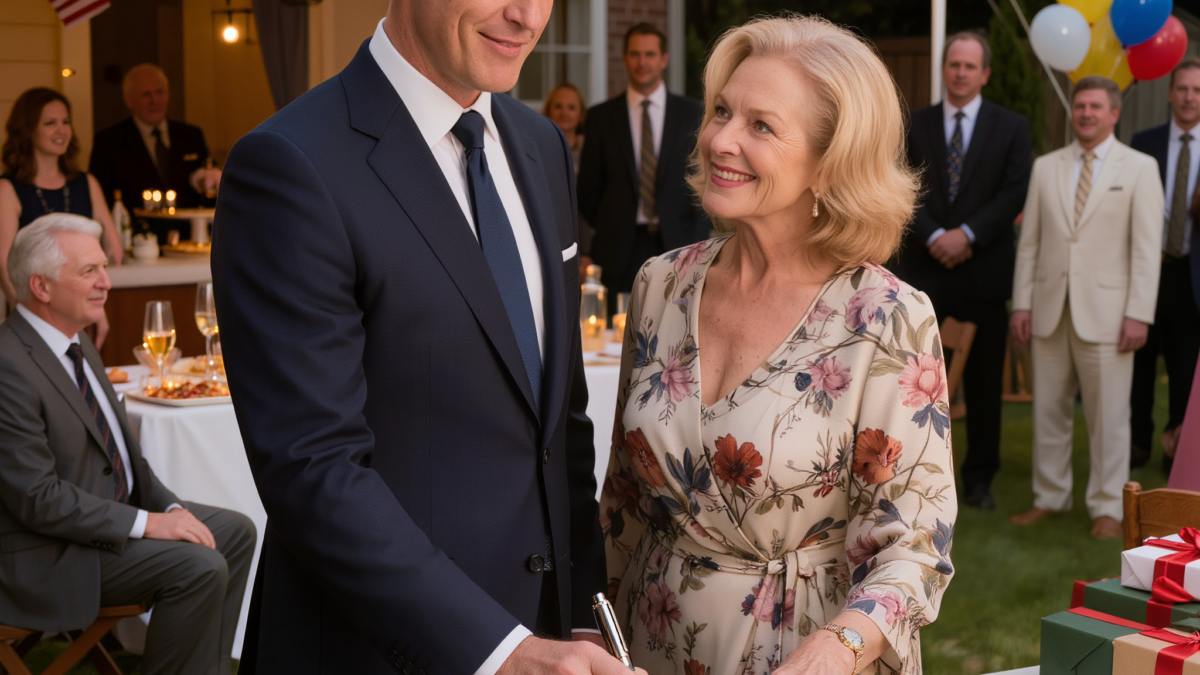
Then she reached into her purse and removed a heavy silver fountain pen.
She held it toward me.
The microphone caught every word.
“Your father and I have done some very important estate planning to make sure Crescent Mill Drive is legally shared equally between you and your brother,” she said.
“It’s the way these things should work. It’s how a real family is meant to operate. We want Tyler’s name on the deed right next to yours.”
She indicated the signature line.
“Sign it for the family.”
A murmur of approval moved through the guests.
From their perspective, they were watching a touching moment between parents and sons.
They did not know Mom was asking me to surrender property I had purchased myself.
They did not know Tyler had never paid a mortgage payment, utility bill, tax bill, insurance premium, or repair expense on that house.
I took the silver pen.
It was cold against my fingers.
Then I looked at the document.
My name was there as grantor.
My parents’ names were there as grantees.
I read it slowly.
I let the silence grow.
Five seconds passed.
The applause faded.
Someone coughed in the back row.
A child said something before being quickly shushed.
The atmosphere changed.
I raised my eyes to Mom.
“Do you want to explain to these people what this legal document actually is,” I asked quietly, “or would you prefer that I do it?”
Her smile remained in place, but maintaining it suddenly required visible effort.
Panic flashed in her eyes.
“It’s just standard estate planning, Ethan,” she whispered through clenched teeth. “Just sign the paper and we’ll cut the cake.”
She leaned closer.
“Do not embarrass us. Do not ruin this beautiful day.”
I looked at her for one final moment.
For years, some part of me had been waiting for a different version of my mother to appear.
She never did.
I clicked the fountain pen closed.
The sound was surprisingly sharp.
I placed it on the table.
Then I closed the manila folder, turned it face down on the white tablecloth, and pressed my palm against it.
I turned toward the crowd.
I did not need the microphone.
“I cannot sign this document,” I said, “because this house is no longer mine to give away.”
A gasp moved through the yard.
Aunt Linda covered her mouth.
Uncle Greg spilled part of his drink.
Near the bar, Tyler froze with his beer halfway lowered.
His smile disappeared.
Mom went completely pale.
Then I told the crowd what had actually happened.
Nine years earlier, Crescent Mill Drive had been close to a bank auction.
My parents had been carrying two mortgages they could not afford, including the second loan connected to Tyler’s failed business.
They had been facing foreclosure and financial collapse.
I watched neighbors who had been told about a simple refinance begin to understand.
“I bought this house,” I said.
“I hired the attorney. I cleared the liens. I used my savings. My name has been the only name on this deed since I was 28 years old.”
I explained that I had paid the mortgage, property taxes, insurance, and major repairs while my parents lived there without paying rent.
The yard was silent.
Tyler stared at the ground.
His face had turned red.
Then I told them the final part.
“On Tuesday morning, I sold this house.”
Mom looked at me.
“The transaction is complete. The deed has been recorded with the county. The property is now owned by a private investor named Scott Bradley.”
I paused.
“The money is in my bank account.”
Then I reached into my jacket.
I removed the three white envelopes and placed them one at a time on the table beside the uncut anniversary cake.
“These three envelopes contain your new reality.”
I looked directly at Mom and Dad.
“The first is a 90-day notice terminating your occupancy. The second is the moving contract. The movers are already paid and scheduled for day 85.”
I touched the third envelope.
“The last one is a lease for a first-floor apartment in Carmel. Your names are on the transfer addendum. The deposit is paid. The first month is covered.”
Mom stared at the envelopes.
The champagne glass slipped from her hand.
It struck the wooden deck and shattered.
When she looked at me again, her public smile was gone.
“Your brother has done more for this family than you ever could!” she shouted.
“You are selfish. You are a selfish, heartless, ungrateful son.”
I had heard versions of that sentence for most of my adult life.
Usually, it worked.
Usually, it sent me back into my own head, searching for another bill to pay or another problem to solve so I could prove her wrong.
This time, the words did not land.
I smiled.
Not because I had won some argument.
Because I was finished having it.
“You’re right, Mom.”
She stared at me.
“You’ve been telling me that for years, and I’ve spent years arguing with you in my head, trying to prove you wrong.”
I shook my head.
“I’m done arguing. If Tyler has done so much for this family, then Tyler can take it from here.”
I looked toward my brother.
“Let him cover your rent. Let him cover the rest of your life.”
Then I turned toward Dad.
He was still sitting in his chair with his hands clamped around his knees.
His knuckles were white.
Later, Uncle Greg told me Dad had known about the estate attorney’s quitclaim plan since March.
He had known for months that Mom intended to have me surrender the house.
He had never warned me.
His silence at the party was not surprise.
It was the weight of knowing what he had allowed.
“90 days, Dad,” I said quietly. “The movers are scheduled and paid. The apartment is nice. There are no stairs, just like you need for your back.”
I did not wait for him to answer.
I walked down the patio steps.
I passed the catered food nobody was eating.
I passed relatives whispering to each other.
I passed Grandpa William’s old concrete birdbath.
Then I walked out to my car.
I got inside and locked the doors.
For exactly four minutes, I sat in the darkness gripping the steering wheel while the adrenaline tremors in my hands slowly settled.
Then I started the car.
I drove away from Crescent Mill Drive.
I did not look back.
The fallout happened quickly.
Tyler immediately began trying to repair the family narrative.
Three days after the anniversary party, he launched a GoFundMe campaign across two social-media platforms.
The title was:
“Save my elderly parents from corporate greed.”
He posted a heavily edited photograph of Mom sitting on the porch at Crescent Mill Drive looking deliberately frail and sad.
His description talked about family legacy, heartlessness, and a greedy corporate real estate investor who had supposedly taken the family home through some predatory technicality involving the deed.
He avoided using my name.
But anybody who knew us understood what he was implying.
Tyler asked for $30,000 to help secure emergency housing and fund a lawsuit.
The campaign raised exactly $450 during the first 24 hours.
Most of the donations came from strangers and distant relatives who had not been at the anniversary party.
Tyler had underestimated two things.
Public property records.
And how angry our extended family had become after realizing they had been lied to.
My second cousin Zachary worked as a senior data analyst for a logistics company.
He had attended the party and heard everything I said.
When he saw Tyler’s fundraiser, he did not argue in the comments.
He went to the Hamilton County property-records database.
He pulled the deed-transfer history for Crescent Mill Drive.
The records showed that I had owned the property and later transferred it to Scott Bradley.
Zachary posted a screenshot and the direct public-record link beneath Tyler’s fundraiser.
Then he added one sentence.
“Public records confirm Ethan Parker owned this property, paid the mortgage for seven years to save them from foreclosure, and he sold it legally. Stop lying to steal people’s money and get a job, Tyler.”
The fundraiser disappeared before the end of the week.
Tyler deleted it and stopped answering calls from relatives demanding explanations.
The same people who had celebrated his endless business ideas were now asking questions he could not answer.
The golden-child version of Tyler began to crack.
Meanwhile, the 90-day clock kept moving.
Scott Bradley’s property-management company sent my parents a certified letter stating the exact date the locks would be changed and the house secured.
On day 85, the moving company I had prepaid arrived.
The crew professionally packed 38 years of accumulated belongings.
They boxed the good china.
They carefully wrapped Dad’s medical equipment.
They loaded the furniture onto the truck.
Mom and Dad moved into the Carmel apartment exactly on schedule.
At first, Tyler made a show of stepping up.
He told relatives not to worry.
He said he would handle everything now that I was no longer involved.
He told Aunt Linda that he was taking control of Mom and Dad’s finances.
On move-in day, he helped unpack a few boxes, ordered a cheap pizza, and promised he would take care of their bills.
He lasted five weeks.
By the second month, reality arrived.
Rent was due.
Utilities needed to be paid.
Groceries had to be purchased.
Medical expenses continued.
Tyler, a man who had never consistently supported himself, was suddenly expected to help support two aging adults with income from a hot-sauce company that did not actually exist.
Soon he announced that a major new business opportunity required his full concentration.
Then he quietly moved his belongings into his new girlfriend’s cramped apartment across town.
When supporting our parents became difficult, Tyler disappeared.
He still visits occasionally on Sundays.
He often arrives around dinner.
He eats food my parents bought, complains about investors who supposedly do not understand his creative vision, and leaves before the dishes need to be washed.
For the first time in their adult lives, Mom and Dad are carrying the full weight of their monthly expenses.
There is no invisible safety net.
There is no quiet son paying the property taxes.
Dad’s disability check and Mom’s Social Security barely cover their apartment, utilities, and medical co-pays.
Money is tight.
There are no lavish parties.
No catered pulled pork.
No expensive gifts designed to impress neighbors or church friends.
They are living the life their own financial choices created.
Mom did not call me after the anniversary party.
Her pride was too strong, and her anger was too deep.
But when her birthday came around in late September, I called her.
I did not expect her to answer.
She did.
For a few seconds, neither of us spoke.
“Hello, Mom. Happy birthday.”
“Thank you, Ethan.”
Her voice sounded older.
Quieter.
Almost emptied of the commanding certainty I had known all my life.
We spoke for exactly 11 minutes.
We did not discuss Crescent Mill Drive.
We did not discuss the quitclaim deed.
We did not mention the attorney, the fundraiser, or the anniversary party.
We talked about the weather.
We talked about whether the closets in the apartment were deep enough for her winter coats.
We talked about the neighbors.
Strangely, it may have been the most honest conversation we had shared in more than a decade.
For once, Mom was not trying to get anything from me.
And I was not auditioning for her approval.
We were simply two adults speaking to each other from a safe distance.
In October, as the leaves across Indiana turned orange, red, and gold, I finally turned my attention toward my own future.
For the first time in seven years, I was debt-free.
The sale of Crescent Mill Drive had left me with substantial liquid capital.
I decided to buy a house.
Not a house to rescue anyone.
Not a financial shield for my parents.
Not another monument to my need to be appreciated.
A home for me.
I found a beautiful 1960s split-level on the quiet east side of Indianapolis.
It had original hardwood floors hidden beneath ugly old carpet.
I checked them myself.
It had a poured-concrete foundation that had once been professionally repaired instead of cosmetically covered with sealant.
I checked that too, using my laser measurer and a heavy-duty flashlight.
I inspected the roof, HVAC system, plumbing, and electrical panel.
I knew exactly what I was buying.
I have always known what I was doing.
Closing on that house felt completely different from the closing table where I had once taken on my parents’ financial burden.
There were no desperate tears.
No crushing debt belonging to somebody else.
The sellers were an older couple moving to Florida for retirement.
We chatted comfortably about the neighborhood.
I signed my name on the warranty deed.
The title agent handed me the brass keys.
Before I moved in a single box or piece of furniture, I carried one small terracotta pot through the front door.
Inside was a rooted cutting from one of Grandpa William’s African violets.
I had taken the cutting from the guest-room windowsill during the final walkthrough of Crescent Mill Drive with Scott Bradley before closing.
I wrapped it in a damp paper towel, placed it in a plastic bag, and kept it alive in my apartment for months.
I watered it carefully.
I paid attention to the sunlight.
I kept it alive through the chaos.
Now it sits on my kitchen windowsill.
In mid-November, it bloomed.
One small purple flower.
Every morning, when I drink coffee, I look at it and think about Grandpa sitting beside me on those concrete patio steps.
“She loves you both the same, but she believes in him more.”
And then:
“Stop waiting for them to become the same thing.”
That truth once devastated me.
For years, I carried the need for my family’s recognition like an open wound.
I believed that if I paid one more bill, fixed one more furnace, solved one more emergency, or rescued them from one more financial disaster, eventually they would look at me and understand my value.
I thought sacrifice could purchase respect.
It cannot.
Being needed is not the same thing as being loved.
My parents needed my reliable paycheck.
They needed my credit.
They needed my responsible nature to protect them from the consequences of repeatedly financing Tyler’s failures.
But they did not respect me enough to protect me.
They were willing to let me surrender the financial security I had spent years building so their favorite son would never have to struggle.
I understood that later than I probably should have.
But I understood it eventually.
And once I did, I turned that realization into a boundary.
Something solid.
Something I can actually build a life on.
For years, the paperwork had been the only part of the situation that never changed depending on who was telling the story.
The warranty deed.
The bank statements.
The appraisals.
The contracts.
They said what happened even when people around me preferred a different version.
Crescent Mill Drive taught me something I should have learned much earlier.
I do not have to destroy my own future to keep someone else comfortable.
I am allowed to protect what belongs to me.
I am allowed to build a life under a roof that does not come with somebody else’s debt attached to it.
And for the first time in a very long time, my home feels exactly like that.
Mine.








