At my own wedding, my mother-in-law slapped me in front of 200 guests and said, “You married above your station, little nurse.” Her family laughed. My Marine pilot husband stepped between us and warned, “Touch my wife again, and we’re done.” She kept smiling—until the man on crutches sitting directly behind him slowly stood up.
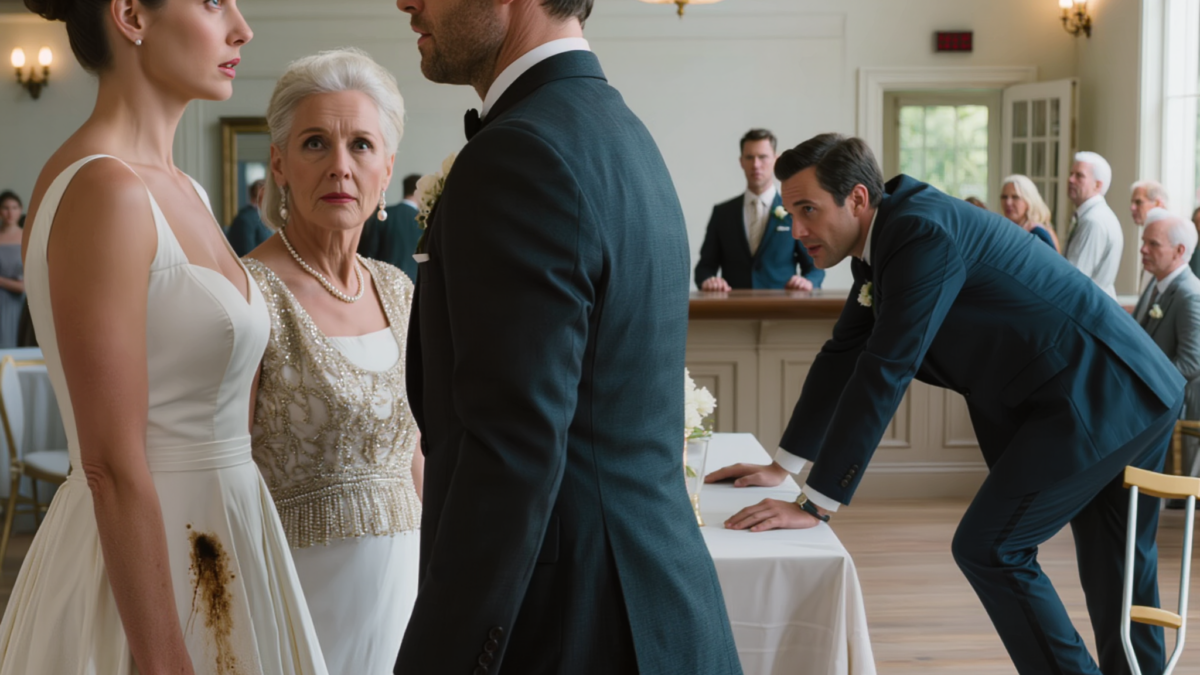
“You married above your station, little nurse. Your parents still smell like grease and old coffee. Don’t ever forget where you came from.”
My mother-in-law said it loudly enough for 200 guests to hear, then slapped me hard enough to turn my head.
The band stopped.
Champagne spilled down the front of my wedding dress. Her family laughed as if she had delivered the best toast of the night.
My husband stepped between us almost instantly.
“Touch my wife again,” Desmond said, his voice low, “and we’re done.”
Beatatrice only smirked.
She was still smiling when the quiet man sitting directly behind my husband placed both hands on the table and forced himself to his feet.
It took him longer than it would have taken most men.
The ballroom went silent.
By the end of that night, Beatatrice no longer owned the room, the guests, or her son’s respect.
My name is Matilda Miller. I’m 31 years old.
To understand why that man stood up, you have to understand a chair.
My parents own a diner off Lun Boulevard in Jacksonville, North Carolina. It’s called Miller’s, and my father has run it for 22 years.
In all that time, he has kept one rule that has never changed.
Nobody eats alone in his diner.
If a man comes in, sits by himself, and has that look, the look of someone who has nowhere else to be, my father brings him coffee he didn’t order and stays nearby until he starts talking.
A lot of them are Marines.
We’re in a Marine town. You learn to recognize people carrying things they don’t know how to put down.
Sunday nights are different at Miller’s.
The diner closes to the public and opens to us. My mother cooks too much food, the way she always has, and the family gathers around the long table by the window.
For years, there was one chair at that table nobody sat in.
My mother set a place for it anyway.
Fork on the left. Knife on the right. Glass turned upright.
An empty chair with a complete place setting.
The man it was kept for wasn’t related to us by blood. He was somebody the world had thrown away and my parents had picked back up.
For now, all you need to know is that the chair was never a sad thing in our house.
It was a promise.
It meant a place was being kept. The door had not closed. If he ever came home, he would not have to ask where he belonged.
I grew up believing that was how you measured a family.
Not by who it impressed.
By who it made room for.
On Sundays, after the last customers left, my father would flip the sign, lock the front door, and roll his shoulders once as if he were setting down the week.
My mother would have three pans going on the flattop while telling everyone to sit down even though the food wasn’t ready.
Sitting was the point.
The food was just the excuse.
My brother and his kids would come. Sometimes a regular who had nowhere else to go would join us. The windows would turn gold and then blue, and that empty chair would remain set at the end of the table.
Nobody explained it to me when I was little.
It was simply there.
When I was finally old enough to ask, my mother said, “It’s for whoever needs it.”
Then she went back to the stove.
That was her entire philosophy folded into five words.
You keep a place.
You don’t make someone prove they deserve it first.
You set the fork and wait.
Without realizing it, I carried that into my work.
Early in my nursing career, I had a stroke patient who was furious at his own left hand. One day, on his worst day, he told me he was finished trying. He wanted everyone to leave him alone.
I didn’t argue.
I pulled a chair beside his bed and sat down.
I stayed there.
After a while, he cried.
Later, he picked up a fork again. We had been working on feeding himself, and that day he managed to bring one bite of food to his mouth without help for the first time in a month.
Neither of us celebrated out loud.
Some victories are too big for cheering.
That’s the job.
You don’t fix people.
You keep a place beside them until they can stand in their own lives again.
I was good at doing that for strangers.
What I wasn’t good at was protecting my own dignity.
For a long time, when someone treated me badly, my first instinct was to explain their behavior to myself.
She’s tired.
He’s stressed.
They didn’t mean it that way.
I could help strangers rebuild their lives and still struggle to give myself one clean boundary.
For eight years, I worked in rehabilitation nursing with people learning to use their bodies again after strokes, amputations, spinal injuries, and other life-changing events. Many of my patients were service members.
I was good at my work.
I knew how to stand beside someone at the parallel bars and let my face show certainty even when neither of us knew whether the next step would happen.
I was much slower at offering myself that same certainty.
There was also a coin.
Brass. Heavy for its size. Worn smooth along one edge.
A patient had pressed it into my hand once and folded my fingers over it.
I carried it in the pocket of my scrubs for years.
At the time I met Desmond, I thought my story was simply that: a diner, an empty chair, a brass coin, and a habit of making excuses for people who never made any for me.
Then Desmond Holloway walked into Miller’s on a Tuesday in October.
He was still wearing his flight suit.
He sat at the counter and ordered meatloaf.
He tipped like a man who had waited tables at some point in his life, and when he got up to leave, he pushed his stool in and stacked his plate at the end of the counter without being asked.
That told me more than the uniform did.
He flew Ospreys out of New River.
Captain Desmond Holloway.
He came back the next Tuesday.
Then the Tuesday after that.
Eventually, he stopped pretending he was coming for the meatloaf.
Desmond wasn’t perfect, and I don’t want to rewrite him into someone who was.
But he was kind in a specific, unshowy way I trusted.
He remembered things.
He asked my mother about her knee.
Once, he paused in front of the wall of Sunday photographs and looked at them the way people look at someone else’s family pictures when they’re a little hungry for what those pictures represent.
Then he moved on.
At the time, it meant nothing.
Our first real date was at a restaurant with cloth napkins and a wine list.
Within ten minutes, I could tell he had chosen the place because he thought it was the kind of restaurant a man was supposed to choose for a serious date.
Neither of us was comfortable.
Halfway through, I put down my menu.
“I’d rather have a hot dog on the waterfront.”
His whole body loosened.
We ended up sitting on a bench, eating hot dogs and watching container ships move along the Cape Fear.
That was the night he told me what flying actually felt like.
Not the recruiting-poster version.
The fear.
The responsibility.
The knowledge that there were other people’s sons in the back of the aircraft.
The way you learned to keep your voice level over the radio while everything inside you wanted to shake.
I had always trusted people more when they could admit fear.
Desmond met my parents on a Sunday.
I hadn’t planned it.
He showed up at the diner because I had mentioned Sunday dinner, and my father put a plate in front of him without asking.
Then Dad watched him eat.
That was basically my father’s entire interview process.
Desmond ate every bite, thanked my mother twice, and got up to help carry dishes to the back.
My father caught my eye from across the room and gave me the smallest nod.
That nod meant more to me than the restaurant with the wine list.
Desmond’s family was different.
He told me once that as a boy, he had learned to read his mother’s mood from the seating at dinner.
Who sat near her.
Who sat far away.
Who had been moved down the table because of some offense nobody would name.
Love in that house was a chair that could be moved.
If you pleased Beatatrice, you sat close.
If you disappointed her, you found yourself farther away.
Desmond had spent most of his life trying to sit close.
I think part of what he loved about my family was that our table had no far end.
There was only the table and the people around it.
During the time we were together, Desmond deployed once for seven months.
That period taught me who he was when I couldn’t see him.
He wrote letters.
Real ones.
His handwriting got worse the more tired he was.
He wrote about coffee, heat, equipment, and a bird that kept landing in the same place every morning.
Even far away, he never made me feel like an afterthought.
When he came home, thinner and quieter, the first place he wanted to go was Miller’s.
He wanted my mother’s meatloaf, her fussing, and one evening when nobody treated him as important.
I watched his shoulders lower at that table and thought he understood the difference between a house that photographed well and a home where you could breathe.
He proposed on the waterfront near the bench where we had eaten hot dogs.
No crowd.
No photographer.
A plain ring he had obviously spent too much time choosing.
He admitted later that he had considered proposing somewhere grander, then realized that “grander” was his mother’s language, not ours.
I said yes before he finished asking.
There was one subject he avoided.
A man from his past.
Early in our relationship, he told me he had flown with someone they called Brick.
The name changed his face.
“I owe him everything,” Desmond said. “And I let him disappear.”
Then he changed the subject.
I knew better than to force open a door someone had closed.
To me, Brick was only a call sign.
I had no reason to connect it to anybody in my own life.
The man I knew who would eventually turn out to be Brick had never told me the truth about how he was injured.
He always called it an accident.
Nothing more.
So there was no name on my side to match with Desmond’s story and no real story on Desmond’s side beyond a call sign and a silence.
Two people can love each other and still be carrying opposite halves of the same secret without knowing the pieces fit together.
Before I met Beatatrice, Desmond tried to warn me.
“In my mother’s house, love came with a seating chart,” he said one night. “Yours doesn’t. That’s why I’m here.”
He laughed, but he wasn’t joking.
Then he added, “Just don’t let her decide who you are.”
I told him I could handle a difficult mother.
I thought I had handled worse.
I was wrong about which part would be difficult.
The Holloways lived in Wilmington, about an hour down the coast, in a house with a history, a name, and a portrait of somebody’s grandfather hanging over the fireplace.
Beatatrice met us at the door wearing pearls.
She took both of my hands and looked at them.
I have working hands.
Nurse’s hands.
She smiled.
“How wonderful,” she said. “To do work with your hands. We so admire that.”
I thanked her.
It took me the entire dinner to realize she had introduced me to guests three different times as “the nurse Desmond’s been seeing.”
Never Matilda.
My place card at the table didn’t say my name either.
It said Desmond’s guest.
I told myself Beatatrice was nervous.
That she was meeting the woman her son loved and didn’t know how to behave.
I gave her the benefit of the doubt because that was what I always did.
After dinner, she walked me through the front rooms and showed me photographs of the family’s charitable work.
Beatatrice holding giant scissors at a ribbon-cutting.
Beatatrice at a gala beneath a banner honoring service members.
“We’ve given so much to our military families,” she told me.
I stood in a house that had given money to banners while, an hour away, my parents had given a man a chair.
There was a curio cabinet in the hall.
On one shelf, between a porcelain bird and a silver dish, sat a military challenge coin.
I didn’t know whose it was.
I’m not sure Beatatrice did either.
It seemed to be there because it looked good.
I stopped in front of it longer than I meant to.
At the time, I couldn’t explain why.
The last thing that happened that night involved the wedding invitation.
Beatatrice had been helping with the invitations and sent Desmond a proof, copying me as a courtesy.
I opened it in the car.
The expensive raised lettering named Captain Desmond Holloway. It included his mother and his late grandfather, who was being honored.
Where the bride’s name should have been, there was nothing.
I showed Desmond.
His jaw tightened.
“It’s a draft. We’ll fix it. She’ll fix it.”
She never did.
He told me he would handle it.
I believed him because I wanted to.
That was the first time Desmond told me he would handle something involving his mother.
It wasn’t the last.
The gap between the promise and the actual handling became one of the central problems in our engagement.
Nothing Beatatrice did during that first visit looked enormous by itself.
A forgotten name wasn’t a crime.
A blank on a proof could be called a clerical mistake.
“We admire people who work with their hands” could pass for a compliment if you wanted badly enough to believe it.
Each slight was deniable.
That was the design.
Beatatrice wasn’t someone who regularly lost control.
She rarely had to raise her voice because everyone around her had spent years learning to lower theirs.
I spent the drive home explaining her behavior to myself.
I kept giving her room.
I called it grace.
The pattern became clearer with time.
There was the dress fitting.
Beatatrice insisted on coming, and I agreed because refusing felt dramatic.
She sat in the boutique while I stood on the pedestal wearing the first gown, the one I loved.
She tilted her head.
“It’s lovely. Maybe a little ambitious for your frame.”
The seamstress met my eyes in the mirror and said nothing.
I bought a different dress.
For weeks, I told myself I had simply changed my mind.
I hadn’t.
There was lunch with Beatatrice, supposedly so we could get to know each other.
She asked what my parents did.
When I said they owned a diner, she repeated the word softly.
“A diner.”
She asked where I had gone to school.
When I answered, she smiled.
“Oh. A practical choice.”
Every question felt like a door she opened so she could show me a room I had never entered.
I answered politely.
Then I went home and replayed the conversation, thinking about how I could have sounded more impressive.
One afternoon, I overheard her talking on the phone.
She didn’t know I was nearby.
“No, no, she’s a nurse. The family has some little restaurant. It’s fine. Desmond will settle down and it’ll all get smoothed over.”
Smoothed over.
As if I were a wrinkle in his life.
I heard it.
And I still returned for the next lunch.
That was the part I eventually had to be honest with myself about.
I knew what she thought of me.
I kept going back because naming the problem felt more dangerous than tolerating it.
I told myself I was being the bigger person.
Really, I was making myself smaller.
The engagement itself was easy.
The wedding was where Beatatrice went to work.
Desmond and I found a restored waterfront building in Wilmington that we loved.
Brick walls.
Bad plumbing.
A river view that made the plumbing forgivable.
We paid the deposit.
Three weeks later, Beatatrice called me.
She had moved the wedding to her country club.
“You’ll thank me,” she said. “The other place is charming, but it isn’t quite us.”
I reminded her that we had already paid a deposit.
There was a small pause.
She used pauses like punctuation.
“It’s been handled.”
She had called and canceled our venue herself.
The deposit was gone.
A decision about my wedding had been made without me in the room.
I didn’t fight.
I told myself the club was nicer.
And it was.
That was how Beatatrice operated.
She usually took something while replacing it with something that looked like an upgrade.
The fact that she had taken it without asking was the part everyone was expected not to mention.
Then I saw the guest list.
Near the top, under honored guests, was a name I didn’t recognize.
Poppy Ashworth.
I asked Desmond.
He went still.
“Poppy’s family funds half my mother’s league,” he said. “Our mothers had ideas once, a long time ago.”
Then he looked directly at me.
“I never had the idea.”
I believed him.
But I noticed Beatatrice had seated Poppy at the front table near the family.
I also noticed Desmond had not known Poppy was invited.
I filed that information away instead of putting it in front of him.
That was another mistake I made repeatedly.
I carried the small things quietly instead of letting Desmond see the whole weight of them.
The venue was only the beginning.
Beatatrice changed the menu.
Desmond and I wanted simple food people would actually eat. My mother had offered to make dessert.
Beatatrice replaced the whole menu with a plated dinner from the club.
She said the club had requirements.
I understood later that Miller’s pie was never going to appear at a wedding she considered hers.
Then came the vows.
When Beatatrice learned Desmond and I were writing our own, she gently suggested traditional vows might be more appropriate.
Personal vows, she said, could seem “informal.”
Desmond fought that one.
We kept our vows.
It was one of the few battles he won during the planning.
By then, a pattern had formed.
Beatatrice would take something.
Desmond would find me afterward.
“I’ll handle it.”
He meant it.
He wasn’t lying.
But handling it often meant a conversation that happened later, or didn’t happen, or happened without changing anything.
Desmond had been raised inside his mother’s system.
He loved me.
He was also conditioned to flinch from her.
Both things were true.
I spent the engagement pretending only the first mattered.
I kept telling myself that after the wedding, once we were married and Beatatrice had no choice but to accept reality, she would soften.
That was the lie I repeated most often.
She’ll soften.
The seating chart was where the situation finally became difficult for me to deny.
Beatatrice placed my parents at the farthest table from the head table.
Table 22.
Right beside the swinging kitchen doors.
Every time a server passed through, the door opened and sent a draft across the table.
When my mother saw where they had been seated, she said nothing.
Beatatrice patted her hand.
“The back is so much cozier. You’ll be able to slip out early if it’s all too much.”
My mother is not a woman who needs to slip out of anything.
She raised three children.
She buried her parents.
She had been starting work in a diner kitchen at five in the morning for 22 years.
Still, she smiled at Beatatrice.
“That’s kind of you.”
Later, in the parking lot, I was shaking with anger.
My mother said one word.
“Let her.”
I thought she meant let Beatatrice have her way.
I thought Mom was choosing peace by making herself smaller, the same way I had.
I was wrong.
She was calm for a completely different reason.
She already knew something I didn’t.
She had known for months.
The last fight before the wedding was over a chair.
My parents asked for one additional seat.
Not another table.
Not a special arrangement.
One chair for a family friend who was trying to make it back in time.
They asked quietly, through me.
Beatatrice looked at the master seating chart and drew a red line through the extra chair.
“We’re simply at capacity.”
Two hundred people.
No room for one folding chair.
My father was standing beside me.
He didn’t argue.
He took the seating chart, folded it along the existing creases, and slipped it inside his jacket.
“We’ll see about that,” he said.
Then he went back to talking about flowers.
I thought he had let it go.
My father almost never argues.
It took me years to understand that silence and surrender are not the same thing.
Some people get quiet because they have given up.
My father gets quiet when he has decided something.
On the morning of my wedding, my mother came into the room where I was dressing with a needle and thread.
She asked me for the brass challenge coin.
I had once told her I wanted to carry it with me when I got married.
Something borrowed.
Something brave.
She folded back the hem of my dress and stitched the coin inside, low enough that it rested against my ankle beneath the layers of fabric.
“So you carry someone brave with you,” she said.
Then she bit the thread with her teeth and smoothed the dress back into place.
My father came in later to walk me down the aisle.
He had rented a suit and kept touching the collar as though it belonged to somebody else.
He looked at me for a long time.
I expected something grand.
My father rarely says grand things.
“You look like your grandmother,” he finally said. “She never let anybody tell her she was small either.”
Then he offered me his arm.
“Whatever happens today, you’ve already got a place at my table. That’s not something a wedding can give you or take away. You remember that?”
I thought he was being sentimental.
Later, I understood that every word was deliberate.
The ceremony itself was beautiful.
That mattered.
Desmond’s hands shook when he took mine.
He said his vows as though he were afraid of dropping them.
He had fought to keep those words, and when the moment came, he could barely get them out.
He told me he had grown up believing love was something you earned and could lose.
A seat that could be moved.
Then he said I had shown him a table where nobody got moved down.
He wanted to spend his life learning how to love that way.
His voice broke on the word learning.
He stopped.
Then started again.
I stood there with Caleb’s coin against my ankle, though I still thought of it only as the coin a former patient had given me.
When the officiant pronounced us husband and wife, my father made a sound from the second row and tried to disguise it as a cough.
My mother didn’t hide her tears.
For the length of the ceremony, I had everything I wanted.
For about an hour afterward, I was happy enough to stop watching.
The reception was held in the country club ballroom.
Chandeliers above us.
Tall windows facing the river.
The uneasiness returned as soon as we walked inside.
My parents were at Table 22 beside the kitchen doors.
My father had removed his jacket and hung it over the chair.
Every time the door swung open, the tablecloth lifted slightly in the draft.
My mother had food on her plate she wasn’t eating.
They looked entirely at peace.
I mistook that peace for resignation.
Beatatrice moved around the room greeting the people she had invited to be impressed.
A hand on someone’s shoulder.
A laugh at another table.
A private word with a man whose name I had been told mattered.
She was completely at home in that environment.
Near the front of the room, I noticed her gesture twice toward an empty chair.
An honored place.
As if someone important had not arrived yet.
At the time, I didn’t understand who she had imagined sitting there.
Later, I would.
I should have felt like the bride.
Instead, I felt like a guest at an event designed to prove I did not belong.
Beatatrice took the microphone for the champagne toast.
She raised her glass.
“To Desmond,” she said, “who could have married anyone and who chose someone so… refreshingly simple.”
There was a small pause before those last words.
Then laughter from some of the tables.
Not everyone.
Enough.
I stood there in my wedding dress, the brass coin pressing against my ankle, and smiled because smiling was what I had trained myself to do.
Across the room, Desmond’s hand tightened around the stem of his glass.
I didn’t see the late guest enter.
I only noticed some movement near the back.
An usher helping a man on crutches.
Instead of taking him across the ballroom to a distant seat, the usher placed him in the closest accessible open chair.
It happened to be directly behind Desmond’s table.
I remember thinking it was kind of the usher.
I didn’t look closely at the man’s face.
Beatatrice had taken my elbow and was steering me toward the family photographs.
Across the room, my mother lifted one hand and gave the man on crutches the smallest nod.
I almost followed her gaze.
Beatatrice turned me away before I could.
The formal photographs were where everything finally broke.
The photographer arranged Desmond’s family for the portrait that would eventually hang on a wall.
Beatatrice adjusted people with small touches.
A hand on a shoulder.
A nudge to one side.
There was an open space beside Desmond.
The center of the photograph.
I stepped into it.
I was the bride.
Beatatrice’s hand came down on my arm.
“This photograph,” she said pleasantly, “is for family.”
I didn’t move.
That was new.
For nearly a year, I had practiced stepping back.
This time, my feet stayed where they were.
I think that surprised Beatatrice more than anything I could have said.
She was accustomed to me making room for her.
I didn’t.
That was when she did it.
“You married above your station, little nurse.”
Her voice carried.
She intended it to.
“Your parents still smell like grease and old coffee. Don’t ever forget where you came from.”
Then she slapped me.
My head turned.
One earring came loose and swung against my jaw.
Someone had handed me a fresh glass of champagne moments earlier. It tipped when I flinched, and cold wine spread down the front of my dress.
The band stopped one instrument at a time.
Then I heard laughter.
That was the part that hurt differently.
People laughed.
As if Beatatrice had delivered a clever line.
As if seeing the bride humiliated in the middle of her own wedding was entertainment.
I wish I could tell you I responded brilliantly.
I didn’t.
For a few seconds, I simply stood there.
Two hundred witnesses.
Wine on my dress.
My hand hovering near my cheek.
I looked for my parents.
My father was still seated at the far table.
He did not stand.
My mother’s hands were folded in her lap.
She looked calm.
Dad wasn’t looking at me.
He wasn’t looking at Beatatrice either.
He was staring directly at the man seated behind my husband.
I didn’t understand.
Then Desmond moved.
He crossed the space between us and put himself between his mother and me.
His back was to the guests.
He faced Beatatrice.
“Mom.”
One word.
A warning shaped like her name.
Then Desmond’s eyes dropped toward the front table.
There was a place card among Beatatrice’s carefully arranged settings.
Poppy Ashworth.
He saw it.
I watched him understand that his mother had invited the woman she once imagined for him and seated her at the front of our wedding without telling him.
His shoulders went still.
“Touch my wife again,” Desmond said, his voice so low the room seemed to lean toward him, “and we’re done.”
The laughter stopped.
“Done.”
Beatatrice smiled.
That smile is still one of the clearest things I remember.
Her son had just challenged her in front of everyone she had spent years trying to impress.
And she still believed she would win.
Desmond had spent his whole life returning to her.
Trying to earn the close chair again.
Why, in her mind, would his wedding day be any different?
“Don’t be dramatic, darling.”
She reached up as if she were going to pat his cheek.
“She’ll learn her place or she’ll leave.”
Behind Desmond, the man on crutches placed both hands flat on the table.
Then he began to stand.
It took effort.
He leaned forward.
One leg carried weight differently from the other.
His crutches were propped beside the chair, but he didn’t reach for them.
He pushed down on the table and rose.
Around the ballroom, people began turning toward him.
Men I had barely noticed before straightened.
Some were Marines.
Even out of uniform, you could see the recognition move through them.
An older man at one table half rose from his seat.
Two younger men near the bar went completely still.
I had no idea what I was seeing.
I only knew that the man on crutches had stood up and the room was reacting as if someone important had just entered, even though he had been sitting there all along.
Beatatrice’s smile slipped.
I learned later that she recognized him before either Desmond or I did.
For three years, Beatatrice had tried to get this man to attend one of her galas.
He was exactly the kind of person people in her circle wanted in a photograph.
He had declined every invitation.
Now he was standing at her son’s wedding.
And he was not looking at Beatatrice.
Desmond turned toward the silence.
Then he saw the man’s face.
My husband was steady under pressure.
He flew aircraft in the dark.
I had watched him remain controlled in situations that made other people nervous.
His voice still broke when he said one word.
“Brick.”
The man looked at him.
Then at me.
Then at Beatatrice.
His name was Caleb Brennan.
In the squadron, they called him Brick because he was the man you could not move.
He had flown with Desmond for years.
Caleb’s eyes dropped toward the hem of my dress, almost as if he knew exactly what was stitched inside it.
Then he looked at Beatatrice.
“Ma’am,” he said evenly, “you have no idea whose family you just insulted.”
I looked across the ballroom at my parents.
Neither of them looked surprised.
Caleb spoke without shouting.
“I flew Ospreys with your son.”
He wasn’t speaking only to Beatatrice.
The whole room was listening now.
“Four years ago, on a night training flight, we had an emergency. His aircraft was in trouble, and mine was the one that could stay with him. So I stayed.”
He paused.
“We got him down. I didn’t come out of it as clean.”
Caleb knocked his knuckles once against his left leg.
The sound was hard and hollow.
“The Corps gave me a medal for that night,” he said. “My own family gave me a forwarding address.”
Nobody laughed.
“When I got hurt, the people who raised me decided I was a complication. Wheelchairs don’t photograph well. A son who needs help getting up the stairs isn’t the son they planned on.”
He let the words settle.
“So I spent about eight months learning how much a person can be worth to a family before he becomes an inconvenience.”
Then Caleb looked toward my parents.
“The only door that opened for me after that was a diner.”
My mother drew in a breath.
My father’s jaw tightened.
Caleb looked at Beatatrice.
“You want to know her station?”
Then he looked at me.
His voice changed.
Only slightly.
“This woman, the one you just hit, was the nurse who taught me how to walk on this leg. Eight months. Five days a week. She stood next to me while I fell down and got me back up. She never let me quit. And she never made me feel like less of a man for needing her.”
Desmond turned toward me.
I could see pieces of old conversations rearranging themselves in his mind.
Caleb looked back at Beatatrice.
“And her parents, the ones who smell like grease and old coffee, gave me a chair at their table and told me I was family.”
He reached into his jacket and removed a photograph worn soft around the edges.
He held it up briefly.
I knew the picture without needing to see it clearly.
A Sunday at Miller’s.
The long table.
Caleb in the chair my mother had kept setting.
“They kept a place for me every Sunday for four years,” he said. “Whether I could make it or not.”
Then he looked directly at Beatatrice.
“You spent tonight trying to teach her where she came from. I came here to tell everyone exactly where she came from.”
The ballroom was silent.
“She came from the only people who didn’t leave.”
Desmond made a small sound beside me.
He stared at Caleb, then at me.
“All this time,” he said. “You never told me it was you.”
I hadn’t.
It wasn’t my story to tell.
Caleb had always called what happened to him an accident. I had respected his privacy because that was what nurses did and because he deserved control over his own history.
To me, he wasn’t Brick.
He was Caleb.
Our Caleb.
What happened next was quieter than applause.
The Marines stood first.
Not all at once.
There was no signal.
One man rose, then another.
The people who understood what Caleb had done got to their feet because a debt like that was standing in the room.
One woman who had laughed earlier slowly set down her fork.
She looked at her plate.
An older man in an expensive suit, somebody Beatatrice clearly valued, pushed back his chair, buttoned his jacket, spoke quietly to his wife, and walked out.
Not angrily.
Just finished.
Then Poppy Ashworth stood.
She picked up her clutch and left before anyone had to ask her to.
Other guests followed.
A couple from another table went for their coats.
A woman I recognized from photographs on Beatatrice’s wall crossed the ballroom and stopped beside my mother at Table 22.
She said something I couldn’t hear.
Then she stayed there.
One of Desmond’s younger squadron friends walked to Caleb’s side, picked up the crutches, and placed them within easy reach.
He remained standing nearby.
Nobody shouted at Beatatrice.
That was what made it unbearable for her.
There was no argument for her to win.
People were simply withdrawing.
One by one, they stopped being her audience.
Beatatrice looked toward Gerald, her husband.
He had been sitting through everything in the quiet way he always did.
She looked at him for support.
Gerald lowered his eyes.
Then he looked toward the windows and the river.
He didn’t stand.
He didn’t defend her.
He simply refused to meet her gaze.
That was when I finally spoke.
I hadn’t planned anything.
“You spent a year deciding I was beneath you,” I said.
My voice sounded steadier than I felt.
“You just never asked who I’d carried.”
That was all.
I didn’t list every insult.
I didn’t need to.
I reached down and touched the coin through the hem of my dress.
Then I took Desmond’s hand on one side and Caleb’s arm on the other.
Together, we walked the entire length of that ballroom.
Away from the head table Beatatrice had arranged.
Away from the front of the room.
We went to Table 22 beside the kitchen doors.
And we sat with my parents.
Beatatrice remained standing beneath the chandeliers in the middle of the event she had designed around her own idea of importance.
For once, nobody was waiting for her to tell them what to do next.
The reception did not exactly end.
It emptied.
Within half an hour, roughly a third of the guests were gone.
They were mostly Beatatrice’s guests, the people she had invited to be impressed.
One woman from the league stopped at our table on her way out.
“Give your mother my regrets,” she told Desmond.
The band started playing again.
The people who remained were the people who had wanted to celebrate us in the first place.
Desmond’s squadron.
My father’s regulars.
Cousins who had never cared about the seating chart.
Someone’s uncle asked my mother to dance.
Somehow, the evening continued.
The side of my face still felt warm while I danced with my husband beneath the chandeliers Beatatrice had chosen.
Caleb sat with my family.
My mother had managed to bring one dish of her own food despite the club’s rules, and Caleb ate it slowly while watching Desmond and me dance.
Only later did I understand the expression on his face.
He had loved us in two different parts of his life.
Desmond in one room.
Me and my family in another.
For three months, he had known those two rooms were about to become one.
Now they finally had.
The guests who mattered to Beatatrice were gone.
The people who mattered to me were dancing.
At some point, Beatatrice left.
So did Gerald.
I don’t know exactly when.
Their absence barely changed the room.
That was when I began to understand something about power built entirely on other people’s willingness to participate.
Once they stop participating, very little is left.
Later that night, Desmond and Caleb sat together at our table.
My mother had worked the challenge coin loose from the hem of my dress, and it rested on the tablecloth between them.
Desmond kept looking at it.
Then at Caleb.
“I looked for you.”
Caleb listened.
“Afterward, I tried to find you. Your number was disconnected. Your family wouldn’t…”
“Not hard enough,” Caleb said.
He was smiling when he said it.
Then he put a hand on the back of Desmond’s neck the way a brother would.
Desmond lowered his head.
They stayed quiet for a while.
Then Caleb looked toward me.
“There’s something Matilda doesn’t know.”
I waited.
“Something I’ve known for a while.”
He turned the coin once between his fingers.
“But not tonight. Tonight isn’t the night for it.”
I didn’t push.
I thought the worst part was behind us.
I was wrong.
The moment your husband chooses you over his family in front of 200 people feels like a victory.
Then the wedding ends.
And you have to live inside the cost.
Two weeks later, the calls stopped.
Beatatrice never dramatically disowned Desmond.
There was no letter.
No final scene.
It was quieter than that.
Desmond had grown up inside an entire network of family connections.
Dinners.
The club.
Friends of his parents.
People who took his calls because of the Holloway name.
One by one, those doors stopped opening.
Invitations no longer arrived.
Calls went unanswered.
People who used to be available were suddenly busy.
One night, Desmond sat on the edge of our bed turning his own coin between his fingers.
“My mother didn’t disown me,” he said.
He looked down.
“She just stopped setting a place for me.”
Neither of us missed the irony.
His family punished people by removing their chair.
Mine kept an extra one ready.
One closed door hurt more than the rest.
An old colleague of Gerald’s had known Desmond since he was a boy. Months earlier, he had promised to make an introduction that could matter when Desmond eventually transitioned toward civilian work.
Desmond called to confirm it.
I was sitting nearby.
I watched his expression while the man on the other end explained warmly that the timing was no longer right.
Things were complicated.
He was sure Desmond understood.
Desmond thanked him and hung up.
He sat there holding the phone.
“He didn’t say her name,” he finally said. “Not once.”
He placed the phone face down.
“He didn’t have to.”
I couldn’t fix that for him.
So I did the only thing I knew how to do.
I sat beside him.
And stayed.
Work helped steady me during those weeks.
One of my patients was 19 and had lost most of the use of his legs.
He fought me on nearly everything.
Young patients sometimes struggle to separate accepting help from giving up.
One morning, he snapped that I couldn’t possibly understand.
He was right about his legs.
I didn’t understand his specific loss.
But I understood something about being told you were less than you were and having to decide whether to believe it.
I didn’t say that.
I stood beside him at the parallel bars and asked him to try one more time.
He did.
Two steps.
Then he cried.
I kept my face steady.
That work reminded me that Beatatrice’s idea of my “station” had never been the thing that defined me.
Desmond struggled in quieter ways.
He had been raised to believe family was a man’s root system, his place in the world.
He had cut himself loose from that system for me.
He did not regret it.
But not regretting a choice and not grieving what it costs are two different things.
He was grieving.
And because my old habits were still there, I began to think his grief was something I should fix.
One evening, I stood in our kitchen with my phone in my hand.
I had started typing Beatatrice a message.
I’m sorry things went the way they did. Maybe we could…
My thumb hovered over send.
Every part of me trained to keep peace by shrinking wanted to apologize.
Maybe, I thought, if I accepted some blame, those doors would open for Desmond again.
Maybe that could be my gift to him.
“Maybe if I just apologized to her…”
Desmond was standing in the doorway.
“No.”
He crossed the kitchen and gently took the phone from my hand.
He deleted the unfinished message without reading the rest.
“I know what you do,” he said. “You give people their dignity back. You’ve been doing it your whole life for strangers, for me, for Caleb.”
He put the phone down.
“But you don’t get to give her yours. That’s the one you keep.”
My mother told me something similar.
I was at the diner while she rolled out dough.
I told her I had considered reaching out to Beatatrice to smooth things over.
Mom didn’t look up.
“Peace isn’t the same as quiet, Matilda.”
Her rolling pin moved across the dough.
“You’ve been confusing those your whole life. Quiet is what she wanted from you. Peace is what you have now.”
She finally looked at me.
“And it cost you something. That’s how you know it’s real.”
The deepest pain, though, belonged partly to Desmond and Caleb.
One night, Desmond lay awake beside me.
“For three years, I thought I failed him.”
I knew he meant Caleb.
“I thought I was the guy who let his wingman disappear. The guy who got saved and couldn’t even hold on to the man who saved him.”
He was quiet.
“And it turns out your parents did what I couldn’t. Your family caught him when I dropped him.”
His voice tightened.
“I don’t know whether to thank them or be ashamed in front of them for the rest of my life.”
I didn’t have an answer.
I held him.
Then his phone lit up on the nightstand.
A message from Caleb.
Sunday. Come to the diner. There’s something you both should hear.
Before Sunday arrived, Beatatrice called.
Her voicemail was formal.
Controlled.
She wanted to meet and, in her words, put the unpleasantness behind us for Desmond’s sake.
We went together.
Not because we owed her a reconciliation.
Desmond wanted to say what he needed to say to her face.
Beatatrice had coffee waiting in the good room beneath the portrait over the fireplace.
She began the way she always did, as though everyone else needed managing.
“Feelings ran high. Things were said. I’m willing to move forward if we can all agree to be civil going forward.”
“That’s not an apology,” Desmond said.
Beatatrice looked genuinely offended.
“I don’t know what you want me to apologize for, darling. For caring about this family’s name?”
I put down my cup.
“You hit me at my wedding.”
She looked at me.
“In front of 200 people. You insulted my parents.”
I kept my voice level.
“I’m not here for an apology. I’m here to tell you what it will cost to stay in our lives, so you can decide.”
She looked at me the way someone might look at a piece of furniture that had unexpectedly spoken.
Then she turned to Desmond.
Her voice softened.
“Sweetheart, I raised you. I gave you everything you have. Are you really going to throw your family away over a misunderstanding at a party?”
Her eyes shone.
“Family is family. You don’t get another mother.”
A year earlier, that performance might have worked on me.
I felt the old instinct rising anyway.
The urge to make everyone comfortable.
To accept a little blame so the tension would stop.
I watched Desmond feel it too.
Thirty-four years of conditioning pulled at him.
Then he looked at me.
“It wasn’t a misunderstanding, Mom,” he said quietly. “You knew exactly what you were doing. You always do.”
Beatatrice sat back.
“That’s the whole problem. None of it was ever an accident.”
I told her the boundary plainly.
“If you want to be in our marriage, in our home someday, around our kids, you’ll treat me as your son’s wife. And you’ll treat my parents as family, because they are.”
Beatatrice stared at me.
“That’s the price of the door staying open. It isn’t punishment. It’s the price.”
“And if you don’t accept it,” Desmond said, “the door closes.”
He leaned forward slightly.
“That’s your choice. Not ours. We’re not slamming it. We’re just not going to keep holding it open while you decide whether we’re worth walking through.”
Beatatrice smiled.
The smile was thinner now.
She spoke about ingratitude and the life she had built.
Desmond stood.
Then he removed a key from his key ring.
The key to the house where he had grown up.
He placed it on the coffee table beside the untouched cream.
“Keep the room set for me if you want,” he said. “I’m not coming to sit in it.”
We left.
She didn’t follow.
For once, there was no audience for her.
The consequences that followed were not something we arranged.
We didn’t call people.
I didn’t post about her.
We didn’t campaign against her.
But 200 people had been in that ballroom.
People talk.
More importantly, people withdraw.
Over the following weeks, the league Beatatrice had centered her life around quietly moved on without her.
She had been president for 11 years.
Then there was a vote at a meeting she didn’t attend.
A different name appeared at the top of the newsletter.
Nobody dramatically removed her.
They simply stopped saving her a seat.
Photographs of Beatatrice at league events began disappearing from the website, replaced by newer photographs of other people.
Poppy Ashworth’s family was among the first to step back.
The very relationship Beatatrice had treated as so important was gone.
I didn’t feel triumphant.
Mostly, I felt sober.
So much of Beatatrice’s power had depended on agreement.
When people stopped agreeing to participate, there was surprisingly little underneath it.
One of the moments I remember most happened in a grocery store.
I was buying eggs when I recognized a woman from the wedding.
She had been part of Beatatrice’s circle.
She had also laughed.
The woman stopped her cart.
For a second, I braced myself.
Instead, she said, “I’ve been meaning to tell you that what she did was wrong.”
I didn’t say anything.
“I should have said something then. I didn’t. I’m sorry.”
She didn’t wait for me to forgive her.
She pushed her cart away.
I stood there holding a carton of eggs and realized that this was what accountability looked like most of the time.
Not a dramatic courtroom.
Not public revenge.
Just one person after another deciding in ordinary places that they didn’t want to be the person who had laughed.
Desmond, meanwhile, kept making his own choice.
Not once.
Repeatedly.
He began driving down to Jacksonville on his days off.
He and Caleb rebuilt their friendship slowly.
Four lost years, repaired one conversation and one bad joke at a time.
One afternoon, Desmond came home with routine paperwork from the base.
It included the people to contact if something happened to him.
He had written my parents’ names.
Vincent and Clara Miller.
“You can put anyone,” I told him.
“They’re the ones who’d come.”
He said it like the answer was obvious.
“If it were the middle of the night and things were bad, they’re the ones who’d get in the truck. So they’re the ones I’m putting down.”
Around that time, Gerald first appeared at the diner.
I looked up from the register and saw Desmond’s father standing in the doorway in his good coat.
He wasn’t entering.
He wasn’t leaving.
He looked like a man standing at the edge of water he wasn’t sure he had permission to cross.
My father saw him too.
Neither man said anything.
Gerald looked around.
The long table.
The wall of photographs.
Then he nodded once and left.
But he came back.
Finally, Sunday arrived.
The day Caleb had asked us to come to the diner.
Miller’s was closed to the public.
My mother had cooked too much food.
Caleb was already seated at the long table by the window.
The first thing I noticed was the chair.
The one that had been empty and set for four years.
There was a plate in front of it.
It was being used.
Caleb no longer sat there like a guest whose place needed to be kept.
He sat there like a man who lived in our family.
He waited until we had eaten.
Then he pushed back his plate.
“I need to tell you both something,” he said. “And I need you not to be angry with your folks when I’m done.”
He glanced toward my parents.
My mother went still by the stove.
My father put down his coffee.
“They only kept quiet because I asked them to.”
I still didn’t understand.
Desmond reached for my hand under the table.
Caleb looked at me.
“In January, you showed me a picture.”
I remembered.
“You were so proud. You called to tell me you’d set the date, and you sent me a photo of the two of you.”
He looked at Desmond.
“I knew the man in it.”
The only sound in the diner was the coffee maker.
Caleb’s voice caught.
“It was Desmond. It was the man I stayed on the wing for. The man I spent three years telling myself I’d lost.”
He shook his head.
“The woman who taught me to walk again was marrying the man I had stayed in the air for, and neither of you had any idea.”
I turned toward my parents.
“You knew?”
My mother pressed a hand to her chest.
“At the wedding,” I said. “That’s why you were so calm.”
“I told them,” Caleb said before they could answer.
He had called my father the same night he understood who Desmond was.
“I told him who Desmond was to me. And I asked him to keep it quiet.”
Caleb looked embarrassed.
“Begged him, honestly.”
He didn’t want our engagement taken over by his past.
“It was your wedding. A man deserves to be found by his own life, not ambushed by mine at the altar.”
He turned to Desmond.
“I figured I’d come to the wedding, sit in the back, and find you afterward. Quietly. Reintroduce myself over a beer.”
Then he looked down.
“I never planned to stand up.”
He looked back at Desmond.
“I only stood up because your mother put her hands on your wife.”
Desmond’s voice was rough.
“I spent three years thinking I was the guy who let you disappear.”
Caleb started to answer, but Desmond continued.
“I thought I got saved and then couldn’t even hold on to the man who saved me.”
“You didn’t let me disappear,” Caleb said. “I disappeared on purpose.”
Desmond looked at him.
“I was so far down after all of it. My family. The leg. Everything. I couldn’t stand the idea of you seeing me like that.”
Caleb looked at his hands.
“The guy you flew with could fly. I didn’t want to be the before picture in your head.”
He had disconnected himself from Desmond deliberately.
“That was mine. Not yours.”
Then, Caleb said, a diner took him in.
A nurse taught him to walk.
Somewhere in the middle of that process, he stopped thinking of himself as a before picture.
By the time he felt ready to call Desmond, too much time had passed.
Then I got engaged.
I sent Caleb the photograph.
“The universe has a sense of humor,” he said, almost smiling. “It gave me back to you through her.”
Desmond’s eyes were wet.
“You were the wall,” he said. “Not me.”
Caleb shook his head.
“Nah.”
His voice softened.
“That was always both of us.”
My parents had carried that secret for three months.
Their daughter was marrying the man their adopted son had once saved.
They knew.
They said nothing because Caleb asked them not to.
And because they wanted me to have one ordinary season of happiness that belonged to me.
“You could have told me,” I said to my mother.
“Yes.”
She wiped her hands on her apron.
“It would have been about Caleb. And Desmond. And the past.”
Her hands were shaking slightly.
“I wanted one season where it was just about you.”
She looked at me.
“Let me have that. I gave you away once. I’m allowed to have wanted the day to be yours.”
Desmond stood.
He walked around the table toward Caleb.
Caleb pushed himself up the same way he had at the wedding.
The two men held on to each other for a long time.
I looked away.
Some moments belong to the people inside them.
When it was over, my mother did something simple.
She pulled out the chair beside mine.
Just an ordinary diner chair.
She set a plate in front of it.
Fork on the left.
Knife on the right.
Glass turned up.
Then she looked at Desmond.
“Sit here.”
He hesitated.
“It’s yours now,” she said. “We don’t take it back.”
Desmond sat.
My husband had grown up believing his place at the family table depended on his behavior.
Now he was sitting in a chair that would remain his whether he earned it or not.
He had lost one family’s table.
He had been given another.
The second one was the kind that didn’t get taken away.
The chair we had kept empty for years was full now.
And there was a new place beside it.
My parents.
My husband.
The man my family had caught when his own family dropped him.
I finally understood what my mother had been teaching me all my life.
She wasn’t keeping a chair for one specific person.
She was keeping a promise about the kind of family we intended to be.
A family with no far end of the table.
A family where your place did not rise or fall according to how useful, impressive, or convenient you were.
Beatatrice had spent a year trying to teach me that belonging was earned.
That it could be granted and revoked.
That some people sat near the center and others belonged beside the kitchen doors.
At a diner off Lun Boulevard, the entire answer to her philosophy was set with a fork on the left and a glass turned upright.
The wedding had been in April.
By May, Gerald had started coming to Miller’s more regularly.
At first, he stood in the doorway.
Then he sat at the counter with coffee.
Over several Sundays, he moved closer to the long table.
One afternoon, he finally came all the way in.
He stopped a few feet away, holding his hat in both hands.
“I don’t expect a place,” he said.
My father stood.
He went to the wall, took down an extra chair, and carried it over.
He placed it at the table.
“In this diner,” Dad said, “you don’t have to earn one.”
Gerald sat.
He didn’t say much.
He wasn’t a man who said much.
I think he had spent 40 years married to someone who did most of the speaking.
But he came back the next Sunday.
Then the Sunday after that.
We never asked him to choose between us and Beatatrice.
He never asked us to choose either.
He simply started showing up.
Weeks later, over a slice of my mother’s pie, Gerald told me the closest thing he had to an explanation.
“I watched her do it for 40 years,” he said. “To other people. To me.”
He turned his fork over in his hand.
“I always told myself it wasn’t my business to stop her.”
He looked toward the long table.
“Turns out it was.”
He exhaled.
“I just didn’t have the nerve until I watched her do it to you at my own son’s wedding. Then I looked around that room and couldn’t find one person who thought she was right.”
He paused.
“Not one.”
Gerald never asked me to forgive 40 years of silence.
He simply kept coming back to the table.
That became its own kind of apology.
The kind that shows up instead of explaining.
I don’t know what will happen to Beatatrice.
The last I heard, she still had the house, the pearls, the portrait over the fireplace, and far fewer people to show them to.
The league moved on.
The galas continued without her.
I don’t take pleasure in that.
She didn’t lose anything I stole from her.
She lost the audience she had mistaken for a life.
Two hundred people saw who she was in the length of one slap and quietly decided they would rather stand somewhere else.
Maybe someday Beatatrice will walk into Miller’s.
If she does, my father will pull out a chair.
That’s the infuriating, beautiful thing about my parents.
The price of admission has never been status.
It has never been money.
It has never been usefulness.
You only have to be willing to sit down as an equal.
Beatatrice may never be able to pay that price.
That is hers to work out.
Not mine.
I stopped needing to know whether she would ever come to our table.
Some people learn.
Some people simply grow quieter.
It is no longer my job to predict which one she will be.
The brass coin is on the wall now.
Caleb’s coin.
The squadron coin that lived for years in my scrub pocket and then spent my wedding day stitched into the hem of my dress.
My mother put it in a plain little frame and hung it among the Sunday photographs.
Most people who walk into Miller’s have no idea what it is.
They don’t know what it cost.
That’s fine.
We do.
I used to think Beatatrice was talking about geography when she told me not to forget where I came from.
For a while, I had forgotten.
Not literally.
I knew where my parents lived.
I knew where the diner was.
But I had become embarrassed by grease and old coffee.
By a father who rarely argued.
By a mother who always cooked too much food.
It took being humiliated at my own wedding to remind me what those things actually meant.
Station, it turns out, isn’t where you’re seated.
It’s who pulls out a chair when you fall.
The chair at our table is no longer empty.
But my mother still cooks too much.
And most Sundays, there is still an extra plate waiting at the end.
“Just in case,” she says.
There’s always room.
I know where I came from now.
A diner off Lun Boulevard.
A long table by the window.
And a chair nobody is allowed to take away.








