At my medical school graduation, my parents left four reserved seats empty so they could host my older brother’s networking barbecue. When I begged my father to come, he laughed and told me to “stop being a drama queen.” I walked that stage alone—then drove straight to the bank with the sealed wooden box my grandmother had told me not to open until I had nothing left to lose.
By 8:00 on the morning of my medical school graduation, I was sitting on the edge of a cheap motel bed, already dressed in my black gown, staring at a silent phone.
The drive from my parents’ house to the university took roughly three hours. If they wanted decent parking and enough time to reach the four seats I had reserved for them, they should have been on the road by 6:00.
There was no text.
No voicemail.
No email.
I tried to convince myself that my father was concentrating on traffic and my mother was helping with directions. I told myself I was overreacting.
At 9:00, one hour before the procession, my phone finally vibrated.
My mother’s name appeared on the screen.
Relief hit me so hard that I answered with a cheerful voice I did not actually feel. I asked where they were and told her I could meet them near the south entrance.
Then I heard the background noise.
Meat sizzling on an outdoor grill.
Glass bottles clinking.
Laughter.
My mother was not in a car.
She told me not to get upset. She said they had gotten the time mixed up and thought the ceremony was later. With traffic being what it was, she explained, it no longer made sense to drive all the way to the university.
I reminded her that the date and time had been pinned to their refrigerator for six months.
I reminded her that I had sent multiple confirmation texts that week.
Then she told me the real reason.
My older brother, Derek, needed help with a barbecue.
He was hosting local real estate investors, and my parents considered it an important networking opportunity for his new business venture. She told me Derek needed his family there because the deals he was trying to close could change his life.
I stood in the middle of the motel room gripping my phone.
I had spent seven years getting to that morning. Years of exams, rotations, sleepless nights, debt, cheap meals, and constant pressure. All I wanted was for my parents to sit in those seats and watch me become the first doctor in our family.
Instead, they were helping Derek grill burgers.
I raised my voice. I told my mother this was the most important day of my life.
Then my father took the phone.
He immediately told me to stop upsetting my mother. When I begged him to tell me this was some kind of joke, he said they were staying home.
According to him, graduation was just a tedious ceremony where names were read for hours. I already had the degree. The paper was already printed. Their physical presence would not change anything.
He offered to take me to a chain seafood restaurant the following weekend.
I told him it was not about a free dinner. I wanted my parents to watch me walk across the stage.
He groaned.
Then he told me to stop being a drama queen.
He said I was being selfish and ruining Derek’s big day with my attitude.
Then he laughed and hung up.
For a few seconds, I stood in front of the scratched motel mirror and looked at the graduation cap I had decorated the night before.
Across the top, in bright white letters, I had written:
“First doctor in the family.”
I had imagined my parents seeing those words from the stands.
Now they felt almost embarrassing.
But the pain I felt that morning was not really about one missed ceremony. Graduation was simply the final confirmation of a pattern that had existed for most of my life.
When I was ten, I spent months preparing for a regional science fair. I built a hydroponic crystal garden display, tracked the results, and made a presentation board taller than I was.
I won first place.
My parents had promised that if I won, we would celebrate with pizza and an afternoon at my favorite arcade.
I ran to our minivan holding a blue ribbon with gold trim, expecting the celebration they had promised.
The mood inside the van was miserable.
Derek, who was fourteen, had been dumped by his middle school girlfriend of three weeks.
My mother told me to put the ribbon away.
When I asked about the pizza and arcade, my father told me to read the room. My mother said we were going home to support my brother.
Then she called me selfish for wanting to celebrate while Derek was upset.
My uncle Evan Carter had attended the science fair and was sitting in the back of the van. He saw what happened. At the time, he was going through a difficult divorce and custody dispute and did not want to create more family conflict.
He looked out the window and said nothing.
That night, Derek picked the movie. He ate popcorn while I sat quietly with the blue ribbon crumpled inside my pocket.
No one asked about the project.
No one congratulated me.
Years later, I graduated from high school as valedictorian. At the celebration dinner, my father spent most of the evening bragging about Derek becoming an assistant manager at a sporting goods store.
My diploma sat on the table while everyone toasted Derek’s promotion.
I learned early that my biggest accomplishments could be displaced by the smallest event in my brother’s life.
Then the favoritism became financial.
My grandmother, Nana Rose, had told me before she passed away that she and my grandfather had contributed to a college savings account for more than fifteen years. The money was supposed to be divided evenly between Derek and me.
Derek had dropped out of community college after three weeks.
During my sophomore year of premed, I came home for the summer while working night shifts as an emergency room orderly. I needed $5,000 for the next semester.
I sat my parents down at the kitchen table and asked for access to my portion of the college fund.
My father would not look at me.
My mother started scrubbing at a spot on the table.
Eventually, the truth came out.
Derek had found what he described as a guaranteed real estate investment. He and his friend Brandon Keller wanted to flip a damaged foreclosed house.
My parents had emptied the college account.
They gave Derek $40,000.
They had not asked me.
They had not warned me.
When I demanded to know why my education had been sacrificed for Derek’s investment, my mother told me it was temporary. Derek would make a profit and return the money with interest.
Then she told me I was smart enough to figure things out for myself.
I could take out loans.
Derek, she said, needed a chance.
The real estate project never succeeded.
Brandon disappeared with part of the money. Derek spent the remaining $20,000 on a lifted pickup truck, a large television, and a weekend in Las Vegas.
My parents never replaced the money.
They never apologized.
When I mentioned the debt I had been forced to take on, they told me I was holding a grudge.
Over the following years, I accumulated roughly $150,000 in federal and private student loans.
The financial strain followed me into medical school, where another betrayal reinforced a lesson I was becoming increasingly reluctant to ignore.
During my third year, I became close friends with another student named Dylan Harrison. We studied together constantly, and I eventually told him about my family, the lost college fund, the debt, and the anxiety of trying to survive medical training without a safety net.
Soon afterward, a highly competitive funded residency scholarship became available.
Dylan and I were among the leading candidates.
I had stronger scores and clinical evaluations, and I believed I had a real chance.
Dylan got the position.
A professor later told me that Dylan had privately approached the selection committee and raised concerns about my ability to handle pressure. He had used the personal information I trusted him with to argue that my family situation and financial stress made me a risk.
When I confronted him, he did not deny using the information.
Medicine was competitive, he told me. He had used what he could.
By graduation morning, I had spent years learning what happened when I trusted people to protect something important to me.
Still, some part of me wanted my parents in those four seats.
I drove to the university through gray weather and entered an arena filled with families carrying flowers and handmade signs.
My reserved seats were in Section 104, row G, seats 4 through 7.
I knew exactly where to look.
Four blue plastic chairs sat empty.
As the ceremony continued, every name seemed to trigger an eruption somewhere in the stands. Parents shouted. Families applauded. People took photographs.
Then the dean called my name.
“Dr. Mason Bennett.”
I walked onto the stage.
For one irrational second, I listened for a familiar voice.
Nothing came from Section 104.
I shook the dean’s hand, accepted the diploma folder, faced the photographer, and smiled for the camera.
Then I returned to my seat.
After the ceremony, I avoided the crowds of graduates hugging their families and went directly to my car.
I locked the doors and sat behind the steering wheel.
A small part of me still hoped there might be a message.
Perhaps my parents had watched the livestream.
Perhaps they had realized what they had done.
There were no missed calls.
No voicemail.
No apology.
There was only a Facebook notification.
Derek had tagged me in a post.
The photo showed my parents’ backyard. Derek stood at the grill holding a spatula. My father had a beer in his hand. My mother was laughing beside them with a platter of food.
They looked relaxed.
Happy.
Together.
The caption said there was nothing better than a sunny Sunday with “the people who matter most.”
It ended with hashtags including #FamilyFirst.
The timestamp showed the photo had been posted around the time I was walking across the stage.
They had not simply gotten confused about the schedule.
While I was waiting for someone in Section 104 to cheer for me, they had been posing for a family photograph.
I took a screenshot.
Then I turned off my phone.
I did not drive to my parents’ house.
Instead, I drove to a bank parking lot and opened the trunk of my car.
Years earlier, after my grandfather’s funeral, Nana Rose had given me a small wooden box. She had made me promise not to open it until the day I genuinely felt I had nothing left to lose.
I had kept it hidden with my emergency supplies.
That afternoon, I opened it.
Inside was a sealed envelope.
I tore it open and found a handwritten letter and a certified cashier’s check for $5,000.
In the memo line, Nana Rose had written:
“No expiration freedom fund.”
Her letter was even more important.
She wrote that she had watched William and Susan treat me this way for years. She had warned my father that his favoritism was turning Derek into someone entitled while leaving me desperate for approval.
Then she told me something no one else in my family ever had.
I was allowed to leave.
Her maiden name was Mercer.
She described it as the name of a builder, someone who created value.
“You are a builder, Mason,” she wrote. “You built yourself from the ground up.”
She told me to use the money to disappear.
I read the letter several times.
Then I said the name aloud.
Dr. Mason Mercer.
The following morning, I went to the county courthouse.
At the clerk’s counter, I submitted a petition to legally change my name from Mason Cole Bennett to Mason Cole Mercer.
For the reason, I wrote that I was severing ties with my biological family and reclaiming my maternal grandmother’s maiden name for personal safety and professional use.
I used part of Nana Rose’s money for the filing fees.
Over the next five days, I dismantled my old life.
I had already accepted a demanding residency position at a major hospital in Portland, Oregon, roughly 2,000 miles from the Ohio suburb where I grew up. The hospital was understaffed, so when I asked if I could arrive early and move into temporary housing, the administration agreed.
I packed my clothes, medical books, laptop, and stethoscope into my sedan.
I discarded most of the photographs and cards that tied me to my family.
I closed my local bank accounts and opened new ones through a national credit union.
I got a new phone number with an Oregon area code.
Before leaving, I mailed three certified letters: one each to William, Susan, and Derek.
I kept them short.
I told them I was safe.
I told them I had changed my name and relocated.
I told them not to contact me.
“The decision to skip my graduation was yours,” I wrote. “The decision to permanently leave this family is mine.”
Then I drove west.
The first year in Oregon was difficult.
Residency meant long hours, little sleep, and relentless pressure. I was alone during holidays, and there were nights when the loneliness made my decision feel heavier than I expected.
Thanksgiving was especially difficult.
I sat by myself in the hospital cafeteria while colleagues discussed family recipes and holiday traditions.
For a moment, I considered calling home.
Then I opened the screenshot of the barbecue.
Derek smiling.
My parents beside him.
#FamilyFirst.
I put the phone away and stayed where I was.
I worked constantly, and eventually my effort caught the attention of the chief of surgery, Dr. Marcus Warren.
On Christmas Eve, Marcus found me at the nurse’s station at 3:00 in the morning even though I was not scheduled to work.
He asked why I was there.
I admitted that I did not have anywhere else to go.
He told me to get my coat.
His wife, Sarah, had cooked enough food for an army.
That evening, I sat at their dining table with Marcus, Sarah, and their three children. The house was loud and imperfect. People disagreed. Someone spilled water.
No one was humiliated.
No one was punished for inconveniencing someone else.
People listened when another person spoke.
I remember sitting there and realizing how unfamiliar ordinary kindness felt.
Over the next five years, I completed residency and became an attending trauma surgeon at a highly regarded hospital in the Pacific Northwest.
My income allowed me to build a comfortable life. I bought a quiet home with a vegetable garden overlooking the city and eventually the black Porsche 911 I had once promised myself I would own if I made it through training.
But the most valuable thing I acquired was not the house or the car.
It was peace.
I maintained zero contact with my biological family.
I stopped checking their social media pages.
I did not attend holidays.
I did not send birthday cards.
To process what had happened, I began writing anonymously online under the name Dr. M.
One evening, after a long shift, I wrote a post called “The Empty Seat.”
I did not include real names, the university, the town, or the state.
I wrote about graduation day.
I described the four empty blue chairs in Section 104.
I described the barbecue photo and #FamilyFirst.
Then I published it and went to sleep.
By the next morning, the post had spread far beyond my small audience.
It was being shared on social media, forums, and support groups. Thousands of people commented. Many described similar experiences with favoritism, financial manipulation, and family members who expected loyalty without offering respect.
Eventually, people from my hometown recognized the details.
That became a serious problem for Derek.
By then, he had built a life-coaching and wealth-management business around an image of traditional family values. He used polished photographs of our parents in his marketing and was trying to attract investors for a large commercial real estate project.
People began connecting my anonymous story to him.
Clients started asking questions.
Investors withdrew.
A contractor dispute appeared at the same time his revenue was shrinking.
Within months, Derek’s business was collapsing.
Then he pulled our parents into it.
According to occasional updates from my cousin Caleb Anderson, Derek persuaded William and Susan to take out a second mortgage on their previously paid-off home to support a high-risk business loan.
They trusted him.
They signed.
When Derek’s business failed, the bank came after the debt.
My parents were approaching retirement age and suddenly facing foreclosure.
I stayed out of it.
Then an email appeared in my professional inbox.
The subject line read:
“You win. Now help us.”
It was from Derek.
He blamed my anonymous post for ruining his reputation. He said our parents were going to lose the house. According to him, they needed exactly $50,000 to stop the foreclosure and catch up on back taxes.
Then he wrote:
“You owe them this money.”
His reasoning was simple. I was a successful doctor. I could afford it. They were my parents.
For the first time in years, I decided to see them.
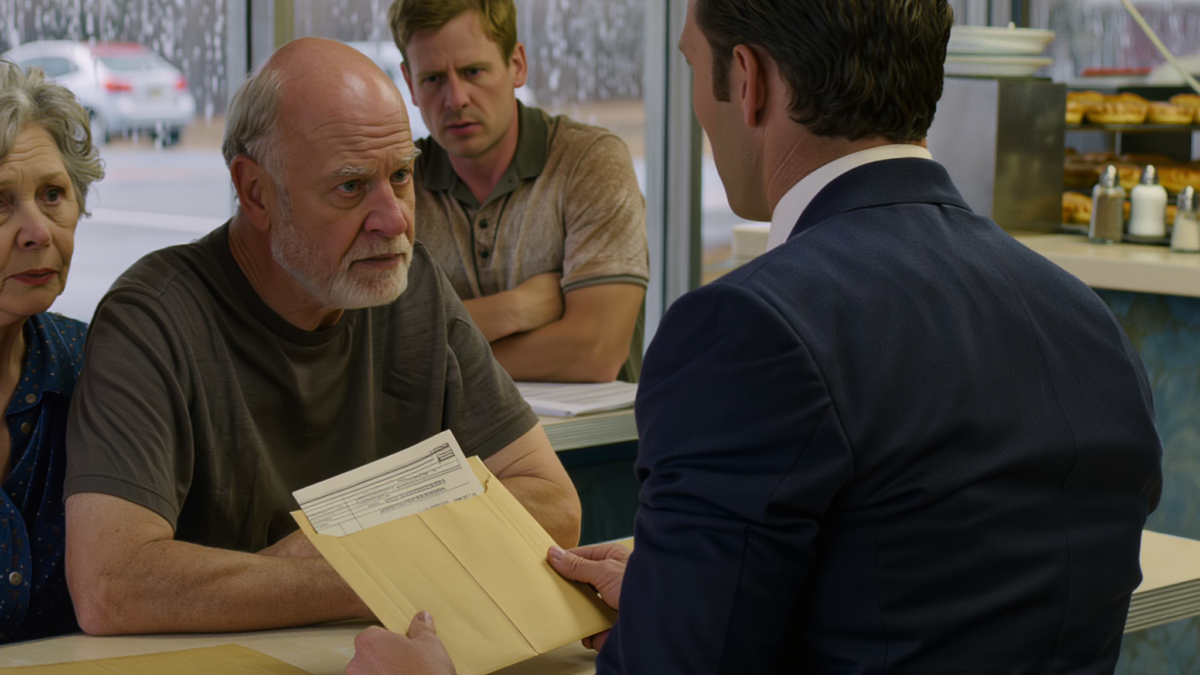
I agreed to meet on Sunday at 2:00 p.m. at a diner halfway between their house and the county line.
I took four days away from the hospital and drove back to Ohio.
When I arrived, freezing rain was falling over the cracked parking lot.
My parents and Derek were already inside.
My mother stood when she saw me and reached toward me.
I stopped several feet away.
“It’s Dr. Mercer,” I told her. “Sit down, Susan.”
My father visibly reacted to the surname.
I pulled a wooden chair from another table and sat opposite the booth. Then I placed a thick manila envelope beside the salt and pepper shakers.
My father attempted a reunion.
He told me they had missed me. He said my mother had been sick with worry and claimed they had thought something terrible had happened after I disappeared.
I reminded him of the certified letters they had signed for.
They had known I was safe.
Then Derek lost patience.
He blamed me for the destruction of his business. According to him, my writing had humiliated the family and frightened away his investors.
I listened.
Then my father stated what they wanted.
They needed $50,000 before the bank locked them out of the house.
He knew I was earning a substantial salary.
He told me to write the check and do the right thing for my family.
I reached for the envelope.
All three of them watched.
Instead of a checkbook, I removed a copy of a bank withdrawal record from nine years earlier.
The document showed the $40,000 taken from the college fund.
I slid it toward my father.
“That,” I told him, “is the official bank record of the $40,000 you stole from my college fund.”
My mother immediately defended their decision.
It had been an investment for the family, she said.
They had meant to replace it.
I reminded them that the money had never been returned. I had carried the student debt while Derek received another chance.
I was not going to fund another one.
Then I removed the second stack of papers.
Before driving to Ohio, I had hired a forensic accountant and worked with a corporate lawyer friend in Portland to examine Derek’s failing company.
The records showed something my parents did not know.
Derek had a separate LLC connected to a shell corporation. Three weeks before the house entered pre-foreclosure, more than $80,000 in remaining business assets had been transferred into his private account.
He had money.
He simply had not used it to save their house.
For the first time during the meeting, my parents stopped looking at me as the person who could solve their problem.
They looked at Derek.
My mother asked whether it was true.
Derek accused me of fabricating the records.
I told them the bank routing numbers were on the documents and that they could verify them themselves.
My father studied the pages.
Then he turned toward the son he had defended for decades.
The certainty in his expression was gone.
A moment later, my father grabbed his chest and began claiming that the stress was affecting his heart.
My mother panicked.
I remained seated.
As a trauma physician, I watched his color and breathing. Nothing I could observe matched the dramatic emergency he was presenting.
Then I gave him back the sentence he had given me on graduation day.
“Stop being a drama queen.”
I reminded him that, by his own logic, it was only a house.
He lowered his hands.
For the first time in my life, I understood that his words no longer had any authority over me.
I stood.
I took out my American Express card and told the waitress I would cover the coffees.
The total was $4.50.
I told my parents it would be the last thing I ever bought for them.
My mother shouted that if I walked out, I would be dead to them and they would never speak to me again.
“That is exactly the point, Susan,” I said.
Then I left.
Outside, the Ohio rain felt as heavy as I remembered.
I returned to my Porsche, started the engine, and headed west.
About ten minutes later, my phone buzzed.
It was Caleb.
He asked whether I had met the family and whether I had given them the money.
By then, I already knew something Caleb did not realize.
When I hired the forensic accountant to investigate Derek’s finances, I also asked him to determine how Derek had obtained my restricted professional email address.
The trail led back to Caleb.
He had been communicating secretly with Derek for months. He had provided my contact information and location in exchange for the promise of a management position in Derek’s company.
For five years, Caleb had presented himself as the one relative who respected my boundaries.
He had been passing information behind my back.
I sent him one final message explaining that I knew.
Then I blocked his number.
He was the last connection to my old family.
In the months after the diner meeting, information still reached me through former acquaintances.
The bank completed the foreclosure.
William and Susan lost the suburban house.
Derek refused to use his hidden money to save it, saying he needed the funds for his legal defense. Facing lawsuits from former investors over the collapse of his company and management of its funds, he packed his truck and left the state.
He did not stay to help our parents.
William and Susan moved into a small two-bedroom apartment near the county line.
My father, who had once proudly discussed his corporate salary and status, took a night job as a security guard at a distribution warehouse.
My mother began working part-time as a cashier at a discount grocery store.
From what I heard, they blamed me.
They told people their successful doctor son had abandoned them.
I accepted that I would always be the villain in their version of the story.
I no longer needed to change it.
Six months after the diner meeting, I attended a hospital gala.
The hospital director, Dr. Jeffrey Dalton, stepped to the podium and announced that I had been promoted to full partner in the surgical practice.
He spoke about my work in the trauma ward, my ability to remain calm under pressure, and the care I showed families during some of the hardest moments of their lives.
When my name was called, I walked onto the stage and accepted a glass award.
Then I looked into the audience.
There were no empty chairs.
At the front table sat Marcus and Sarah Warren.
Beside them were friends who had supported me through residency and the years that followed.
They were cheering.
They were looking at me as if my presence mattered.
For most of my childhood, I believed family was something biology assigned to you and that love was something I had to earn from the people assigned to me.
It took me years to understand that those were two different things.
William and Susan gave me my biology.
Nana Rose gave me the first practical means to leave.
Marcus and Sarah showed me what ordinary care could look like.
The people I met after leaving Ohio showed me that respect did not have to be begged for.
Sometimes, when the house is quiet and rain taps against the windows, I still think about the 28-year-old man sitting alone in the arena parking lot, staring at a barbecue photograph while holding a medical diploma.
I think about the ten-year-old boy with the blue ribbon crushed inside his pocket.
Both of them believed that if they achieved enough, stayed patient enough, or explained themselves clearly enough, the people they loved would finally choose them.
They were wrong about that.
But they were wrong about something else too.
Being rejected by those people did not mean they were worthless.
Walking away did not erase what had happened. It did not return the college fund, fill the empty graduation seats, or undo decades of favoritism.
It did something more important.
It stopped those choices from controlling the rest of my life.
I could not choose the family I was born into.
Eventually, I learned I could choose what access that family had to the life I built afterward.








