At my graduation, I collapsed halfway through my valedictorian speech. The hospital called my parents 67 times. Neither answered. Three days later, I woke after brain surgery to 65 missed calls from my family and Dad’s text: “We need you. Answer immediately.” Grandpa showed me Mom’s photo of her, Dad, and Julian toasting champagne in Paris on the day of my surgery. Then he unfolded a financial spreadsheet across my hospital bed.
The microphone hit the floor before I did.
Of everything that happened on my graduation day, that is the detail I remember most clearly. The heavy microphone struck the polished wooden stage with a sharp metallic crack, followed by a piercing squeal of feedback that echoed through Whitmore Auditorium.
I was standing in front of nearly 3,000 people, delivering the valedictorian speech I had spent weeks preparing. I had reached the fourth paragraph, the one about resilience, overcoming unseen obstacles, and pushing through the barriers life places in front of us.
Looking back, the irony is almost unbearable.
The auditorium had been unbearably warm all morning. Under my heavy graduation gown, I was sweating, and my heart had been beating much faster than usual. I thought it was nerves, exhaustion, or simply the pressure of standing in front of so many people.
Then the ceiling appeared to tilt sideways.
A cold darkness crept into the edges of my vision. It swallowed the faces of my classmates in the front rows, then the bright stage lights, and finally everything else.
I never felt myself hit the floor.
There was simply nothing.
Three days later, I opened my eyes in the intensive care unit of St. Marcus Medical Center.
Coming back to consciousness was terrifying. The first sound I recognized was the mechanical hiss of a ventilator near my right ear. A blood pressure cuff tightened around my left arm, and the sharp smell of antiseptic filled the room.
A nurse wearing dark blue scrubs leaned over me and shone a small light into my eyes. I tried to ask where I was, but my throat felt raw, and even breathing required an effort.
Then I realized someone was holding my right hand.
The grip was firm and steady, almost as though the person holding it was afraid I might disappear if he loosened his fingers.
I turned my head and saw my grandfather, Arthur.
He was 76 years old and still wearing the dark navy suit he had carefully pressed for my graduation ceremony. The silk pocket square I had helped him fold that morning was still in his breast pocket, slightly crumpled and stained with coffee.
He hadn’t gone home to change.
He hadn’t left my bedside.
His face looked more exhausted than I had ever seen it. Deep lines surrounded his eyes, and his shoulders sagged beneath the weight of three days of fear.
“There he is,” he whispered.
He didn’t smile. He simply tightened his grip on my hand.
It took nearly twenty minutes of confused questions before I began to understand what had happened.
I had suffered a medical emergency during my graduation speech. Doctors had discovered a large brain tumor and performed an emergency craniotomy to save my life.
I had been unconscious for three days.
As the medication slowly wore off, another realization settled over me.
The room was strangely quiet.
There were medical monitors beside my bed, a television mounted on the wall, and a chair occupied by my grandfather. But there was nobody else.
No mother hovering over me. No father asking questions about my condition. No older brother pretending to be concerned.
I kept looking toward the door, expecting someone to walk through it.
Nobody did.
Eventually, I noticed my phone charging on the bedside table.
I gestured toward it.
Arthur hesitated before handing it over. For a moment, he looked away toward the blank television screen, as though he already knew what I was about to discover.
The screen lit up.
Sixty-five missed calls.
Thirty-one from my father, Robert. Twenty-two from my mother, Evelyn. Twelve from my older brother, Julian.
There wasn’t a single voicemail.
But there was one text message from Dad, sent at exactly 6:47 that morning.
“We need you. Answer immediately.”
I stared at those words.
Not “Are you okay?”
Not “We’re coming to the hospital.”
Not even “I’m sorry we weren’t there.”
Just “We need you.”
The message didn’t ask about me at all.
It took me a moment to recognize what I was feeling. I had expected to cry when I discovered my parents hadn’t come. Instead, something colder settled inside me.
I had spent my entire life waiting for them to need me for the right reason.
Even now, lying in a hospital bed after emergency brain surgery, I was still useful to them only when they wanted something.
To understand why that text hurt so much, you need to understand what growing up in my family was like.
From the outside, we looked like an ordinary American success story.
We lived in a large, carefully maintained colonial house at the end of an exclusive suburban cul-de-sac. Our lawn was always perfectly trimmed, our cars were polished, and our parents knew exactly how to impress the neighbors.
My father was a successful financial adviser. He managed wealthy clients’ retirement portfolios, handled their investments, and spoke constantly about financial responsibility.
The irony was that he was reckless with his own money.
My mother, Evelyn, worked as an independent interior designer. She loved expensive furniture, imported finishes, elaborate renovations, and anything that made our house look more impressive than the others on our street.
Our home felt like a showroom that was constantly being redesigned.
My parents attended lavish country club dinners, hosted social gatherings, and cared deeply about what people thought of them. Dad used those events to network with wealthy clients, while Mom loved discussing her latest renovation projects at neighborhood meetings.
Appearances mattered more than almost anything.
And then there was Julian.
My older brother was four years ahead of me, and he was unquestionably the center of our family.
Julian had an easy charm that my parents adored. He wasn’t particularly hardworking, and his accomplishments were rarely extraordinary, but my parents treated every small success as a major achievement.
When he barely made the junior varsity lacrosse team in high school, they surprised him with a brand-new red sports coupe.
When he was accepted into a mid-tier state college, after Dad had repeatedly contacted the admissions office and made a sizable donation to the athletics department, they threw him an enormous backyard celebration.
There were catered tables, melting ice sculptures, and a live jazz band.
It looked more like a wedding reception than a college acceptance party.
Four years later, I received my acceptance letter from Alderman University.
I had earned a full academic scholarship to study biochemistry in a brutally competitive program.
I remember walking into our designer kitchen with the envelope in my hand. I was so excited that I could barely speak.
For once, I thought my parents might be proud of me.
Mom glanced up from her iPad, gave me a thin smile, and said, “That’s great, honey. Make sure you don’t track mud on the new Persian rug when you take out the trash.”
That was the entire celebration.
No party. No congratulations from Dad. No photograph for the family album.
Just another reminder that my achievements occupied very little space in their lives.
For years, I wondered why they seemed to resent me.
Grandpa Arthur eventually told me something that helped explain it.
I looked almost exactly like my late grandmother, Beatatrice.
She was my father’s mother, a strong, independent woman who never cared much about appearances. According to Arthur, she had always seen through Evelyn’s obsession with money and status.
Beatatrice had openly criticized my mother’s spending habits and the way she treated me. Evelyn never forgave her.
When Grandma died, the funeral was tense and uncomfortable. Mom hardly appeared affected by the loss.
On the drive home, she immediately began questioning Dad about the inheritance and the commercial real estate Beatatrice had left behind.
There was also an ugly family dispute over valuable antique heirlooms that Mom believed she deserved simply because she had married into the family.
Arthur told me that Evelyn carried her resentment toward Beatatrice for years.
Unfortunately, I had inherited my grandmother’s dark eyes and sharp jawline.
Every time Mom looked at me, she saw the woman who had challenged her.
I spent much of my childhood paying for that resemblance.
Eventually, I stopped expecting my parents to support me.
The morning after my high school graduation, I packed my belongings into two canvas duffel bags, placed my house key on the kitchen counter, and moved out.
I didn’t say goodbye.
At Alderman University, my scholarship covered tuition, but almost everything else was my responsibility.
Rent, food, utilities, laboratory materials, transportation, and textbooks were expenses I had to manage myself.
So I worked.
A lot.
I spent thirty to forty hours every week juggling three jobs while studying for my biochemistry degree.
At five in the morning, I worked as a barista at a crowded campus coffee shop. Between making drinks and dealing with impatient customers, I tried to memorize chemical structures on scraps of paper.
On weekends, I worked as a laboratory assistant at a private research facility. I cleaned dirty beakers, sanitized equipment, and entered research data for hours.
In the evenings, I tutored students in organic chemistry.
Most nights, I slept about five hours.
My meals were usually instant ramen, discounted bread from Walmart, or pastries the coffee shop manager quietly allowed me to take home.
I was constantly exhausted.
One winter during my sophomore year, my shoes became so worn that water seeped through the soles whenever I walked outside.
I remember standing in a discount shoe store for forty-five minutes, trying to calculate whether I could afford a $30 pair without falling short on rent.
In the end, I put the shoes back.
I walked home through the snow and covered the holes in my old sneakers with silver duct tape.
Meanwhile, Julian was living in a luxury apartment downtown.
My parents paid his rent, his car insurance, and his credit card bills. He moved between entry-level marketing jobs while confidently talking about promotions that never materialized.
At family dinners, everyone listened to his plans as if he were building an empire.
Nobody asked how I was managing.
The one exception was Grandpa Arthur.
He had built a small manufacturing business from nothing during the 1970s. After selling it for a comfortable but modest sum, he lived simply.
He hated showing off.
He drove a ten-year-old Buick that rattled whenever it reached fifty miles an hour. He brought his own turkey sandwiches for lunch rather than spending money at expensive restaurants.
Every other weekend, he drove two hours to take me to a small diner near campus.
He always made sure I ate a hot meal.
We would sit across from each other at a sticky table, talking about my classes, my research, and whatever was happening in his life.
He never made me feel like a burden.
When I talked about biochemistry, he listened even when he didn’t understand the technical details. When I mentioned an exam or a paper, he remembered to ask about it the next time we met.
Looking across that table, I could see that he was genuinely proud of me.
During my senior year, though, something began to go wrong.
I started developing severe headaches, usually concentrated behind my right eye. Sometimes the pain was so intense that I felt nauseated.
I assumed it was stress.
Between my three jobs and a hundred-page thesis on cellular degradation, I was pushing myself constantly.
I took over-the-counter painkillers and kept going.
I couldn’t afford to slow down. I couldn’t afford to miss shifts. And I certainly didn’t think I could afford to be seriously ill.
The morning of graduation, Arthur came to my small apartment to help me get ready.
He adjusted my inexpensive clip-on tie and rested his hands on my shoulders.
His expression was unusually serious.
“I have something incredibly important to tell you after the ceremony, Liam,” he said. “I’ve prepared everything. Your life is going to change completely today. I promise you.”
I thought he was planning to give me a graduation present.
Maybe a few hundred dollars to help me buy new clothes or finally replace those worn-out shoes.
I hugged him, thanked him, and left for the auditorium.
Two hours later, I was unconscious on the graduation stage.
Back in the hospital, Dr. Sarah Vance came into my room after I had begun to understand where I was.
She was the chief of neurosurgery at St. Marcus Medical Center. She spoke directly and professionally, without trying to soften the medical facts.
“Liam,” she began, “you have a glioblastoma. It’s a highly aggressive malignant brain tumor.”
She explained that the tumor had been located deep in my right temporal lobe and was approximately the size of a golf ball.
Based on the pathology reports, it had probably been growing for at least a year, possibly two.
I thought about every headache I had ignored.
Every afternoon when I had struggled to concentrate. Every time I had criticized myself for being lazy or weak because I needed sleep.
All that time, I had been living with a serious illness without knowing it.
“We performed an emergency craniotomy,” Dr. Vance continued. “You were on the operating table for four hours and eleven minutes. You lost a significant amount of blood. We had to intubate you immediately upon arrival.”
Then she told me about the calls.
During the first forty-eight hours, hospital staff and a social worker had repeatedly attempted to contact my parents to obtain medical consent and warn them how serious my condition was.
They called sixty-seven times.
Not once did my parents answer.
Dr. Vance paused before delivering that final detail. Her normally controlled expression revealed just how troubling she found their absence.
After she left, I looked at Arthur.
“Where are they?” I asked.
He reached into his jacket, took out his phone, and opened Instagram.
Then he handed it to me without saying a word.
It was my mother’s public profile.
The photograph had been posted at exactly 11:47 p.m. on the day I underwent emergency surgery.
There stood Mom, Dad, and Julian beneath the illuminated Eiffel Tower in Paris.
All three were holding champagne glasses.
Mom wore an expensive new silk scarf and was laughing openly at the camera.
The caption read, “Finally, the Paris family trip. No stress, no drama, just living our absolute best lives in the city of light.”
One of her wealthy country club friends had commented, “You deserve this getaway so much, Evelyn. Enjoy the luxury.”
Mom had replied, “We absolutely do. Life is too short.”
I stared at the photograph.
While surgeons were trying to save my life, my family had been celebrating beneath the Eiffel Tower.
I handed the phone back to Arthur.
For a long moment, neither of us spoke.
Then Grandpa told me something that made the photograph even harder to accept.
“They knew,” he said quietly.
My cousin had called him on the night of my surgery. She had also contacted my parents before they reached their boarding gate.
According to Arthur, she told them I had collapsed during graduation and was in critical condition.
They knew I was in the hospital.
They knew the situation was life-threatening.
And they had chosen to turn off their phones and continue their trip.
I closed my eyes.
For years, I had tried to convince myself that my parents simply didn’t understand how much their behavior hurt me.
But this was different.
They had been given a choice between coming to their seriously ill son and continuing a luxury vacation.
They chose Paris.
I felt as though something inside me had finally broken.
But Arthur wasn’t finished.
“Liam,” he said, leaning closer, “there is something else. It’s what I was going to tell you after your graduation.”
He explained that before Grandma Beatatrice died, she had met with lawyers and established a trust specifically for me.
It was intended to provide a substantial college fund and protect my future.
The trust documents explicitly stated that my parents were not to have access to the money.
Arthur told me that by the time I started my freshman year at Alderman, the fund had grown to more than $340,000.
I could barely process what he was saying.
More than three hundred thousand dollars.
While I had been surviving on instant noodles.
While I had worked three jobs and struggled to pay for rent.
While I had walked through snow in shoes held together with duct tape.
That money had existed all along.
“Your father knew about it,” Arthur continued.
Four years earlier, shortly before my first semester began, Dad had visited him.
According to Arthur, Robert had claimed that my full academic scholarship had unexpectedly fallen through because of a clerical error.
He told Grandpa that I was desperate, frightened, and unable to enroll without immediate financial help.
Dad said he needed the money released directly to him so he could personally pay Alderman University.
“I had a full ride,” I managed to say. “I never paid a single dime in tuition.”
Arthur nodded sadly.
“I know that now. But I trusted him. I thought he was trying to protect you.”
Over the next four years, Dad returned several times with more stories.
There were supposedly expensive laboratory fees, housing emergencies, and necessary textbooks.
Arthur wrote four checks totaling approximately $153,000.
He believed the money was going toward my education.
In reality, I had never received it.
“Where did it go?” I asked.
Arthur’s expression hardened.
He told me that in March, he had hired a private investigator and an experienced forensic accountant to examine the transactions.
They had obtained bank records and traced where the payments went.
Not one of those large transfers had gone to Alderman University.
Arthur reached into his jacket and unfolded the spreadsheet he had brought with him.
He placed it on my hospital blanket and pointed to the first entry.
“Year one. $41,000.”
The money had been transferred into a joint home renovation account.
It had paid for the custom imported Italian marble kitchen island my mother loved showing off on Facebook.
I remembered that island perfectly.
Mom had been so proud of it that she didn’t even want me touching the surface.
Arthur moved his finger down the page.
“Year two. $38,000.”
That money had covered the down payment and first year of lease payments for Julian’s luxury apartment downtown.
I thought about my brother living comfortably while I was working before sunrise to afford groceries.
Then Arthur pointed to the next amount.
“Year three. $74,000.”
He explained that my parents had used the funds to purchase Mom’s custom-ordered Porsche.
They had paid for the luxury vehicle using money Grandma Beatatrice intended for my education.
I remembered standing at freezing bus stops before my morning coffee shop shifts.
There had been times when Mom drove past me in that beautiful white Porsche without stopping.
I’d assumed it was simply another reminder of how differently we lived.
Now I knew where the money for the car had come from.
It was difficult to describe what I felt.
For most of my life, I had believed my parents didn’t care enough to help me.
The spreadsheet suggested something worse.
They had taken money that was specifically intended to help me and used it to fund the lifestyle they preferred.
The expensive kitchen.
Julian’s apartment.
Mom’s Porsche.
All while I struggled to afford basic necessities.
For years, I had accepted the small pieces of affection they occasionally offered, telling myself I should be grateful for whatever I received.
Now I was looking at records that gave those years a different meaning.
I wasn’t simply the forgotten child.
I had also been financially exploited.
My eyes returned to Dad’s text message.
“We need you. Answer immediately.”
Something suddenly made sense.
“They didn’t text me because they found out about the brain surgery. Did they?” I asked.
Arthur slowly shook his head.
He explained that his estate lawyer, Marcus Thorne, had recently carried out the legal instructions Arthur had prepared before my graduation.
Marcus had frozen the remaining balance of the trust and obtained an emergency injunction affecting my parents’ bank accounts.
The action was based on the financial records and allegations of fraud and misuse of trust funds.
Their checking accounts, savings, joint accounts, and investment portfolios had been affected.
Arthur said Marcus had also obtained a provisional lien involving the house and the Porsche while preparing the civil case.
My parents were in Paris without access to the money they expected to use.
Mom had discovered the problem when her premium credit card was declined at a designer boutique near the Louvre.
That was why the calls had begun.
They weren’t trying to find out whether I would survive.
They wanted me to persuade Arthur to reverse the restrictions.
They needed the son they had ignored to help them regain access to their accounts.
I stared at the phone in my hands.
My parents had been told about my emergency before boarding their flight. They had ignored the hospital’s attempts to contact them.
But the moment their money became unavailable, they found time to call me sixty-five times.
“I want to speak to Marcus Thorne,” I said.
Within an hour, Arthur had the lawyer on speakerphone.
Marcus spoke with the calm precision of someone who had spent years dealing with complicated legal disputes.
He reviewed the documents Arthur’s investigation had uncovered.
There were original canceled checks bearing memo lines that described payments for Liam’s tuition.
There were bank records showing transfers to the luxury car dealership and private kitchen contractors.
There were records connecting the college trust payments to purchases that had nothing to do with my education.
Marcus explained that he was preparing a formal civil complaint seeking recovery of the money, along with legal expenses and additional damages.
Then he warned me about what would probably happen next.
“Liam, listen to me very carefully,” he said. “They’re going to contact you the moment they return to the United States.”
He expected my parents to rush to the hospital and attempt to persuade me to sign a waiver releasing them from financial liability.
He warned that they would appeal to family loyalty, insist everything had been a misunderstanding, and pressure me to make the lawsuit disappear.
He also explained the potential professional consequences for Dad.
Robert’s financial advisory career depended heavily on his reputation and his clients’ trust.
A public fraud lawsuit involving his own son’s family trust could trigger regulatory scrutiny and place his trading licenses at risk.
I listened quietly.
Then I said, “File it today. I want every single dime back.”
We spent the next two hours discussing the records and the legal strategy.
I studied the receipts and transfer information from my hospital bed.
The documents included amounts such as $74,200 for the Porsche and $41,500 for the kitchen renovation.
Every number represented something I had gone without while my parents spent the money.
Later that afternoon, hospital staff transferred me from intensive care to a quieter private room on the oncology floor.
The room had a large window overlooking a gray concrete parking garage.
It wasn’t a beautiful view, but I found it strangely comforting.
The concrete didn’t pretend to be anything other than what it was.
Arthur went downstairs to the cafeteria for coffee and a sandwich.
I was alone when I heard a familiar sound outside the room.
Sharp, quick footsteps.
Expensive heels striking the polished hospital floor.
I recognized the rhythm immediately.
My mother.
I reached up and gently touched the thick bandages around my head. The surgical area still ached, and I was exhausted from everything that had happened.
I took a careful breath and adjusted myself against the pillows.
The door handle turned.
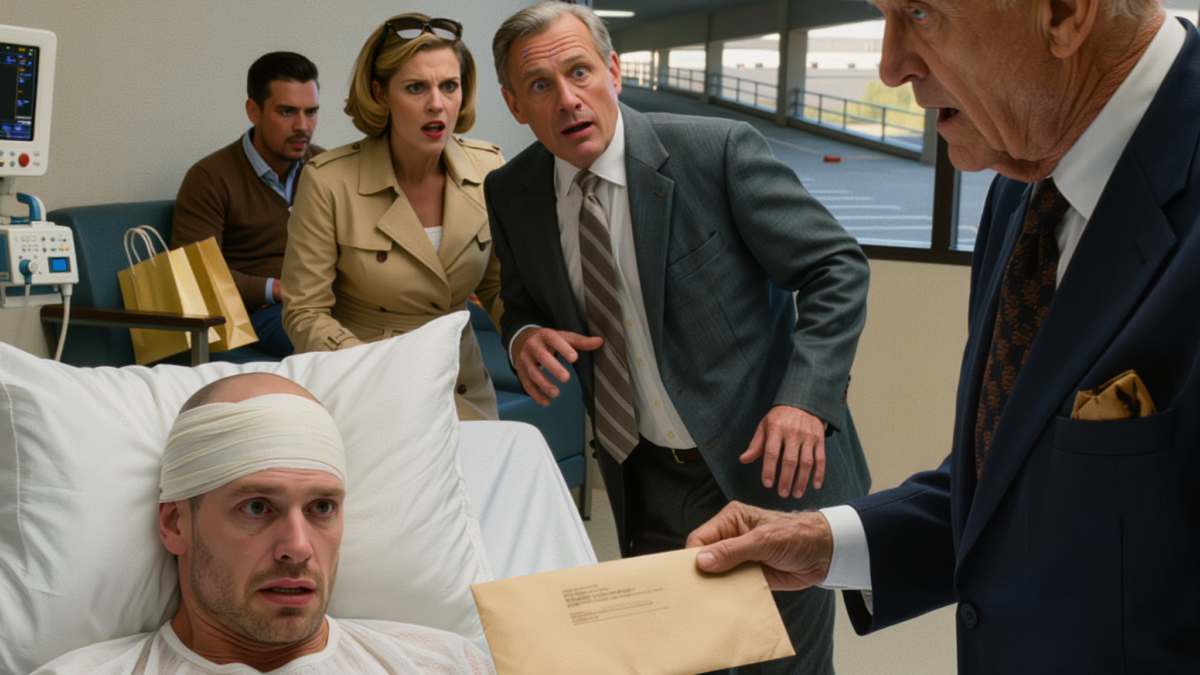
Mom entered first.
She wore a perfectly tailored beige trench coat. Her designer sunglasses rested on top of her carefully styled hair.
She looked polished, expensive, and irritated.
Dad followed, adjusting his silk tie and glancing around the room with obvious discomfort.
Julian came last, carrying three shopping bags from expensive Parisian boutiques.
He was looking at his phone.
“Oh, my sweet boy!” Mom exclaimed.
She hurried toward my bed with her arms spread wide.
I didn’t move.
She attempted to hug me, but I didn’t lift my arms to return it.
After an awkward moment, she patted my shoulder and pulled away.
“We came as fast as we physically could, Liam,” she said. “It was an absolute nightmare trying to get a direct flight out of Charles de Gaulle. The airline was completely unreasonable.”
I looked at her.
“The Louvre was open yesterday,” I said. “I saw the photos.”
She froze.
Then her expression changed into one of injured concern.
“Liam, sweetheart, we didn’t know how serious it was. The hospital left these incredibly vague automated messages. We thought you just had a fainting spell from working those ridiculous barista shifts you insist on taking.”
“The hospital called 67 times, Evelyn.”
Grandpa Arthur had returned and was standing near the corner of the room.
His voice cut through Mom’s explanation.
Dad stepped forward.
“Arthur, please, let’s not raise our voices in a hospital. We are a family. We are here now, and that is all that matters. Liam is clearly recovering well.”
Julian finally looked up from his phone.
He glanced at my bandaged head, the IV lines attached to my arms, and the medical monitors beside the bed.
“Yeah, honestly, bro, you look totally fine,” he said.
He dropped his shopping bags onto the visitor’s sofa.
“It was super scary when we finally got the voicemails, but the doctors obviously handled it. Anyway, we had to cut the Paris trip two whole days short to fly back, so, you know, we made a massive sacrifice to be here.”
I looked at those shopping bags.
My brother was standing inside an oncology recovery room, complaining about a vacation interrupted by my emergency brain surgery.
For years, I had held on to a small hope that one day my family would understand how much they had hurt me.
That hope disappeared.
“Sit down,” I said.
Dad blinked.
“Excuse me?”
“I said, sit down. All of you.”
Mom looked offended, but Dad placed a hand on her arm.
They sat on the visitor’s sofa beside Julian’s shopping bags.
Dad leaned forward almost immediately.
“We need to talk about the bank accounts.”
There it was.
Not a question about my diagnosis.
Not a question about the operation.
Not a question about how much treatment I might need.
The bank accounts.
“Liam, Arthur has completely lost his mind,” Dad continued. “He has somehow managed to put a temporary illegal freeze on our primary checking and our investment portfolios. He’s even threatening our real estate.”
He insisted that the entire situation was a misunderstanding.
Then he told me to instruct Arthur to contact his lawyer and remove the injunction before Dad was forced to sue for defamation.
I watched him carefully.
“It’s not a misunderstanding, Robert,” I said. “And Grandpa Arthur didn’t do it. I did.”
The room became quiet.
Mom stared at me.
“What are you talking about? You don’t have the authority to do anything, Liam. You’re 26 years old, and you’re heavily medicated.”
“I have complete authority over my own trust fund,” I replied. “The college fund that Grandma Beatatrice left specifically for me. The inheritance that you thought you could drain dry while I was scrubbing dirty coffee mugs at five in the morning.”
Dad’s face lost its color.
“Liam, listen to me,” he said. “I don’t know what Arthur has been filling your head with, but every single financial decision I made was for the overall benefit of this family as a fiduciary.”
“Don’t you dare use that word,” Arthur interrupted.
He stood and faced my father.
“You have no concept of fiduciary duty. You are a thief, Robert. A common, pathetic thief wearing a very expensive suit.”
Mom suddenly raised her voice.
“It was a family discussion!”
She pointed at me.
“We all agreed that the household needed improvements to maintain our property value. We are the ones who put a roof over your head for eighteen years. You owed us that money.”
I felt anger rising, but I tried to keep my voice steady.
“I owed you nothing.”
Then I said what I had been thinking since Arthur showed me the spreadsheet.
“You stole $153,000 from your own dying son to buy a custom Porsche.”
Grandpa Arthur reached into his jacket and pulled out a thick manila envelope.
He tossed it onto the edge of my hospital bed.
It landed with a heavy thud.
“That envelope contains the subpoenaed bank records,” I told Dad. “It contains the original canceled checks with your forged memo lines. It contains the exact itemized wire transfers to the luxury car dealership and the private kitchen contractors. We have every single receipt.”
Robert’s hands were trembling.
Julian suddenly turned toward Mom.
“Wait, what? Porsche? Mom’s Porsche? You bought that with Liam’s money?”
Mom didn’t answer him.
She stared at the envelope.
Then her entire approach changed.
The anger disappeared, replaced by tears.
“You don’t understand,” she sobbed. “You don’t understand what it was like for me, Liam.”
She looked at me with mascara running down her cheeks.
“Every single time I look at you, I see her. I see Beatatrice.”
For years, Mom had avoided telling me directly why she treated me differently.
Now, sitting in my hospital room, she finally said it.
“She made me feel completely worthless for thirty years. Every room I walked into, every Thanksgiving dinner, every family gathering, she found something to criticize. She hated me. She wanted Robert to divorce me.”
Mom pressed her hand against her mouth.
“And you, you have her exact face. You have her eyes. You judge me exactly the way she did.”
I couldn’t keep my voice calm any longer.
“I am not her!” I shouted.
The heart monitor beside me began beeping faster.
“I never was. I was your son. You punished a terrified, starving child for a dead woman’s sins.”
Mom continued crying.
“It’s not fair! She left all that money for you just to spite me, just to prove she was better than us.”
I turned toward Dad.
He was staring at the floor.
“And you? You watched her do it. You watched her treat me like garbage for twenty-two years. And you said absolutely nothing because it was easier for you.”
I thought of every dinner when he’d looked away, every achievement he’d ignored, and every time he’d allowed Mom to make me feel unwelcome.
“Because standing up to her cost you more energy than watching your own son be destroyed. And then you had the sheer unbelievable audacity to steal my college fund to buy her loyalty.”
Dad didn’t deny it.
He stood there without an answer.
Arthur broke the silence.
“We are filing a formal civil lawsuit, Robert. My lawyer, Marcus Thorne, is filing the paperwork on Monday morning.”
He explained that the claim would seek repayment of the $153,000, legal fees, punitive damages, and consequential damages related to the years of labor I had endured while supporting myself.
He also reminded Dad that a civil fraud case concerning a family trust would become public record.
Dad looked horrified.
“Arthur, please, you can’t do that. If a fraud lawsuit goes public, the regulatory boards will launch an investigation. My wealthy clients will pull their portfolios. I will lose my financial trading licenses.”
He shook his head.
“It will completely ruin my entire career.”
“You ruined your own career,” Arthur replied. “You should have thought about the regulatory boards before you cashed the very first check.”
Dad stepped toward my bed.
“Liam, please.”
He reached for my hand.
I pulled it away.
“We are family,” he said. “Families make mistakes. I will pay you back. I swear to God, I will liquidate some assets. I’ll figure it out. But you cannot let Arthur file that lawsuit. It will destroy us.”
I looked at him.
“You left me to die while you drank champagne in Paris,” I said quietly. “You are already destroyed.”
At that moment, my phone vibrated on the bedside table.
Everyone stopped talking.
I picked it up.
The caller ID read National Neurological Research Consortium.
I recognized the name immediately.
Eight months earlier, after a grueling six-hour shift at the coffee shop, I had submitted an application for a highly competitive research fellowship.
It was a prestigious two-year position connected to a groundbreaking clinical trial studying treatment-resistant glioblastomas.
I hadn’t expected to hear back so soon.
I answered.
“Hello, this is Liam.”
“Liam. Hi, it’s Claire Bautista, the clinical research coordinator for Dr. Vance.”
Her voice was bright and energetic.
My family watched me closely.
“I have incredible news,” Claire said. “The board officially reviewed your application and your outstanding academic records from Alderman.”
She explained that Dr. Sarah Vance had personally recommended me.
Dr. Vance had read my biochemistry thesis and considered it brilliant.
The consortium wanted to offer me the fellowship.
For a moment, I couldn’t speak.
Then Claire continued.
The position included comprehensive health insurance, which would cover my upcoming radiation and chemotherapy treatments.
It also included a starting salary of $58,000 per year.
And because I would be participating in the clinical trial, Dr. Vance would be both my managing physician and my senior colleague.
I closed my eyes.
For four years, I had worried constantly about money.
Now I was facing cancer and had been terrified of the medical costs that might follow.
This fellowship offered a path forward.
It meant I could continue doing the research I loved while receiving treatment from the medical team already caring for me.
“I accept,” I said, struggling to control my emotions. “Tell Dr. Vance I absolutely accept. Thank you, Claire.”
When the call ended, I set down my phone.
I smiled.
It was the first genuine smile I had managed in five days.
Mom immediately became suspicious.
“Who was that?” she asked. “Was it the billing department? Do they need our insurance information? Because if you drop this ridiculous lawsuit, your father can—”
“No,” I interrupted. “It was good news.”
Dad leaned forward.
“Well, what is it? Did you get a job?”
I looked at them.
For as long as I could remember, my parents had expected to know every useful detail of my life while offering almost nothing in return.
But this news belonged to me.
“I’m not telling you,” I said.
Mom looked offended.
“Excuse me? We are your parents, Liam. We have a right to know what is going on in your life.”
“No, Evelyn, you don’t.”
I spoke calmly.
“You lost the right to know anything about my life the second you boarded that plane. You lost it when you bought that Porsche.”
I looked toward the door.
“Some things belong entirely to me now, and I get to decide exactly what to share and with whom and when. Now get out of my hospital room.”
Marcus Thorne filed the civil claim the following Monday.
He was a former county prosecutor with twenty-six years of experience in estate and civil law.
The lawsuit sought exactly $153,400, the amount identified as the total of the four checks my father had misappropriated.
Marcus also included claims for legal fees and documented consequential damages.
Those damages included the financial impact of the years I had spent working exhausting hours while pursuing my degree without access to funds intended to support me.
I wasn’t at the courthouse when Marcus filed the paperwork.
I was lying in my hospital bed watching a National Geographic documentary about deep-sea fish.
The creatures on the screen had evolved to survive in extraordinary darkness, developing their own ways to produce light.
After everything that had happened, the subject felt strangely appropriate.
By Tuesday afternoon, news of the civil claim had begun spreading through my parents’ social circle.
Their reputation mattered enormously to them.
So when one of Mom’s country club friends sent her a message asking whether Robert was being investigated for defrauding a family trust, she panicked.
Mom called me twelve times that Tuesday.
I ignored every call.
Finally, she sent a text.
“Can we please just talk, Liam? As a family, please. People at the club are starting to stare at me.”
I read it and thought about what she had chosen to emphasize.
Not the money they had taken.
Not my health.
Not even the relationship she had destroyed.
People at the club were staring.
I replied with one sentence.
“Marcus Thorne is your only point of contact now. His office number is in the formal email he sent you.”
By Wednesday, Dad had hired an expensive defense attorney.
According to Marcus, his lawyer immediately began exploring a private settlement.
They wanted the financial dispute resolved before further publicity reached Dad’s clients and the regulatory authorities.
On Thursday afternoon, Marcus brought their written offer to my apartment.
I had just been discharged from the hospital.
My new place was a quiet one-bedroom apartment on the fourth floor of a building that smelled faintly of old wood and fresh coffee.
It had good natural light, and for the first time in years, I could afford somewhere comfortable without constantly worrying about the next bill.
I had signed the lease when the remaining unfrozen balance of my trust became available in my private account.
Marcus sat across from me at a cheap folding table.
“The initial offer is for $110,000,” he said.
He slid the document toward me.
My father’s attorney had explained that the full amount wasn’t immediately available because so much money was tied up in the Porsche and the equity in the house.
Their argument was that accepting a smaller settlement would save everyone the costs and publicity of a lengthy court proceeding.
I studied the offer.
Then I asked Marcus for his professional opinion.
“It’s significantly below what you are legally owed,” he replied.
He explained that we could continue pursuing the full amount, but doing so would take time and keep the case in public view.
Dad’s financial advisory clients followed local business news closely. Further proceedings would likely attract attention.
I considered what that meant.
I could insist on fighting for every dollar.
I could force the case through court and allow the consequences to unfold publicly.
But I was also preparing for radiation and chemotherapy.
I had already spent years exhausting myself trying to survive my family.
I didn’t want the next chapter of my life to revolve entirely around them.
I wanted treatment.
I wanted meaningful work.
I wanted peace.
“Counter with $140,000,” I told Marcus. “Give them exactly seventy-two hours to wire the funds, or we proceed to a full public trial and contact the regulatory board ourselves.”
Marcus nodded.
“Consider it done.”
My parents accepted the counteroffer within twenty-four hours.
The money arrived in my account by wire transfer on a bright Tuesday morning.
I was sitting at my kitchen table with a cup of coffee when my phone notified me.
$140,000.
I looked at the number for a long time.
The money had been transferred into the private account that also held the remaining balance of Grandma Beatatrice’s fund.
I didn’t feel the overwhelming excitement I had imagined I might feel after recovering such a large amount.
Instead, I felt quiet.
The money represented years of work, missed meals, exhaustion, and unnecessary fear.
It couldn’t give me those years back.
But it meant I wouldn’t have to continue living under the financial consequences of what my parents had done.
A little later, my phone buzzed again.
This time, it wasn’t Mom or Dad.
It was Julian.
He had sent me a long direct message on Instagram.
Since the confrontation at the hospital, we hadn’t spoken.
I opened his message cautiously.
“Liam, I just want you to know the absolute truth. I didn’t know about the stolen college fund. I swear to God, I genuinely didn’t know.”
He explained that Mom and Dad had always told him my scholarship covered everything.
They had also told him that the money paying for his apartment came from Dad’s year-end bonuses.
“I thought I was just the favorite child,” he wrote. “I didn’t realize my entire life was being funded by your suffering and your money.”
Then he admitted that an apology couldn’t undo what had happened.
He told me he had started seeing a therapist and was trying to understand who he was without our parents’ money.
I read his message several times.
Julian had spent most of his life acting entitled to advantages I never received.
He had often behaved arrogantly, accepted expensive gifts without question, and allowed our parents to treat him as though he were more important than me.
But the message made me consider something else.
Our parents had manipulated him, too.
They had taught him to depend on their money and approval, leaving him poorly prepared to stand on his own.
That didn’t erase the way he had treated me.
It didn’t make the years of resentment disappear.
But it meant there might be room for a different relationship someday.
I finally typed a reply.
“I believe you, Julian. That doesn’t change the past, and it doesn’t instantly fix our relationship, but I believe you. Keep going to therapy. Do the work.”
He didn’t demand that I forgive him immediately.
He didn’t argue.
He simply reacted to my message with a heart.
It wasn’t a reconciliation.
It was a beginning.
Six months have passed since the settlement.
I am now six months into my research fellowship, working at the same hospital where I woke up frightened and uncertain whether I would survive.
I work alongside Dr. Sarah Vance and seven other dedicated researchers.
Our work focuses on the biological mechanisms that make glioblastomas resistant to standard treatments.
Sometimes the irony still surprises me.
The disease that interrupted my graduation and nearly ended my life is now at the center of the research I spend my days studying.
I don’t know whether to call that fate, coincidence, or simply an unexpected turn in my life.
I’ve stopped trying to give it a perfect explanation.
My medical treatment continues.
Radiation and chemotherapy are exhausting. Some days, the side effects leave me so ill that even ordinary tasks require tremendous effort.
But my most recent MRI brought cautious encouragement.
The remaining tumor mass hadn’t grown.
Dr. Vance used the word “encouraging” when she reviewed the scans.
I’ve learned not to turn that word into a promise.
It doesn’t guarantee that everything will be fine.
But it gives me a reason to keep going.
Outside the hospital, my life is quieter than it has ever been.
I live alone in my apartment, and I love it.
Sunlight comes through the large windows. I have a sturdy wooden bookshelf I built myself using a confusing YouTube tutorial and a screwdriver that turned out to be the wrong size.
I’ve started cooking actual meals.
Salmon, roasted vegetables, and food that isn’t instant ramen.
That might sound ordinary to someone who has never had to choose between groceries and electricity.
To me, it feels extraordinary.
I also bought a new pair of comfortable running shoes.
I paid full price.
I didn’t stand in the store calculating whether the purchase would leave me unable to cover rent.
I just bought them.
I wish I could explain how much that small moment meant to me.
My parents haven’t been part of my life since the settlement.
Three days after the $140,000 transfer cleared, Mom sent me one last message.
“I hope someday when you have children of your own, you’ll finally understand that we loved you in the only way we knew how.”
I read it.
I thought about everything that had happened.
I thought about the money, the hospital, the graduation, and the years when I had tried so hard to deserve their attention.
Then I thought about how she still seemed unable to acknowledge the damage she’d caused.
I waited several days before replying.
“I know you did. I also know that your way wasn’t nearly enough and it almost killed me. I hope you find a better way to live your life. Do not contact me again.”
She hasn’t answered.
Dad hasn’t reached out at all.
Maybe he’s ashamed.
Maybe his pride won’t allow him to apologize.
Maybe he simply doesn’t know what to say now that he can no longer control the situation with money.
I don’t spend much time trying to understand his silence anymore.
For years, I worked hard to explain my parents’ behavior to myself.
I don’t need to keep doing that.
Julian and I have spoken twice on the phone.
The conversations haven’t been easy.
He is still attending therapy and trying to understand how twenty-six years of favoritism and financial dependence shaped his life.
We aren’t close.
Maybe we never will be the kind of brothers who share everything.
But we are talking honestly and respecting boundaries.
For now, that’s enough.
Grandpa Arthur, meanwhile, remains the most dependable person in my life.
Every Sunday, without fail, he drives his rattling Buick to my apartment.
He usually arrives carrying something he cooked himself, either a pot roast or a large container of homemade vegetable soup.
We sit at my kitchen table, eat dinner, argue about local politics, and talk about whatever has happened during the week.
Lately, we’ve talked a great deal about Grandma Beatatrice.
Arthur tells me stories about her stubbornness, her loud laugh, and her complete lack of interest in impressing wealthy people.
He told me about a time he bought her an expensive piece of jewelry.
She returned it.
She believed the money would do more good if it went to a local charity.
One Sunday, while we were finishing dinner, Arthur looked across the table at me.
“She would have really liked you, Liam,” he said.
I smiled.
“I have her exact face.”
“Much more than that,” he replied.
He placed his rough hand over mine.
“You have her absolute, unshakable sense of what things are truly worth in this life.”
I think about those words often.
I also think about the letter Grandma Beatatrice left with the trust documents.
She wrote it in elegant, looping handwriting on thick stationery.
She called the money my “freedom fund.”
She explained that she wanted me to have the freedom to leave situations that harmed me.
The freedom to stay where I was valued.
And the freedom to build a life that belonged to me.
The remarkable thing is that she never actually met me.
She died before I took my first breath.
But somehow, she understood that I might someday need a way to protect myself from the family I was born into.
She made sure that possibility existed.
I had her letter professionally framed.
The frame itself is nothing special, just a cheap black plastic one I bought at a local drugstore.
Someday, I might replace it with something nicer.
For now, it hangs on the living room wall where the sunlight reaches it.
Every time I look at it, I remember the woman who tried to protect a child she would never meet.
I also remember the man who stayed.
When I collapsed during graduation, nearly 3,000 people witnessed the moment.
I had spent four years working toward that ceremony, imagining what it would feel like to finally stand on that stage and celebrate everything I had accomplished.
Instead, I woke three days later in intensive care, frightened and physically exhausted, facing a diagnosis that would change the rest of my life.
And when I opened my eyes, only one member of my family was there.
Grandpa Arthur.
Still wearing his navy graduation suit.
Still carrying the coffee-stained pocket square I had helped him fold.
Still sitting in that uncomfortable hospital chair, holding my hand.
He had stayed because he knew someone needed to be there when I woke up.
That matters more to me than the bank accounts, the Porsche, the lawsuit, or the money that eventually came back.
The legal records established where the trust funds had gone.
The settlement gave me financial security and a chance to move forward.
But Arthur gave me something none of those documents could provide.
He showed me what it meant to be loved without having to prove I was useful.
For most of my life, my parents treated the word “family” as an obligation I owed them.
Arthur showed me that family is also a choice made through ordinary actions.
Driving two hours to share a meal.
Remembering what matters to someone.
Staying beside a hospital bed when it would be easier to go home.
Holding a hand until the person holding yours finally wakes up.
I once thought family was defined by the people who brought you into the world.
Now I think about the person who refused to leave when I almost left it.
Everything else is paperwork.
And trust me, I had very, very good documentation.








